
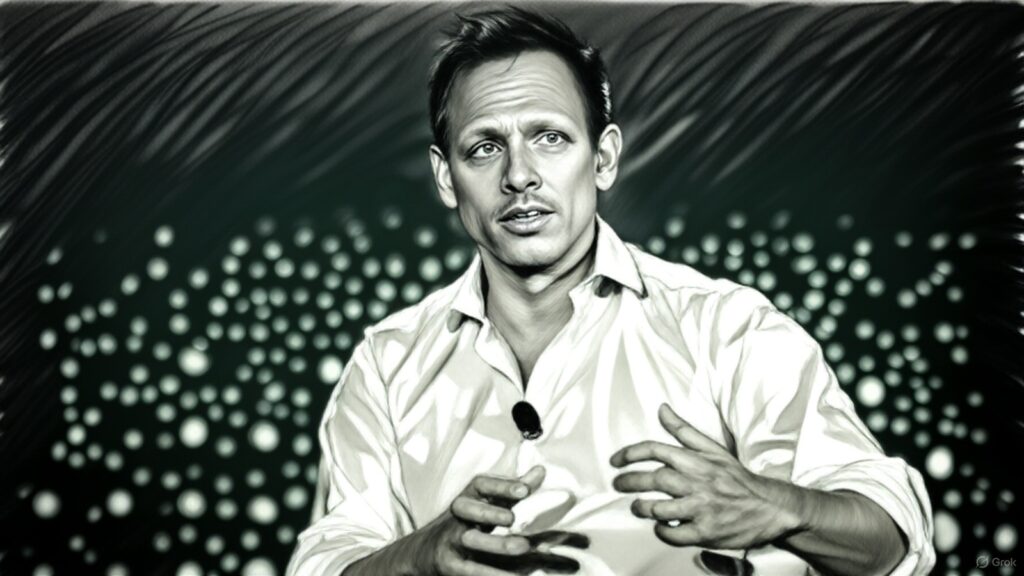
Peter Thiel is a German-American entrepreneur, investor, and author best known for co-founding PayPal and Palantir Technologies. A Stanford-educated lawyer turned venture capitalist, he was the first outside investor in Facebook and co-founded Founders Fund, backing companies like SpaceX and Airbnb. Thiel is a leading figure in Silicon Valley, known for his contrarian views on innovation, politics, and the future of technology. Author of Zero to One, he advocates for bold, visionary startups. A libertarian-leaning thinker, Thiel has influenced debates on capitalism, competition, and the role of technology in shaping society.
Christian Background and Influence
Peter Thiel was influenced by René Girard, a Catholic scholar, during his time at Stanford University, which helped provide “a basis for his Christian faith without the fundamentalism of his parents.” This intellectual approach to Christianity appears to have shaped his ongoing religious engagement.
The Gospel of the Antichrist: Tech, Prophecy, and the New Eschatology of Power
When The Washington Post published Nitasha Tiku’s exposé, “Inside billionaire Peter Thiel’s private lectures: Warnings of ‘the Antichrist’ and U.S. destruction,” the headlines read like the synopsis of a sci-fi apocalypse. But behind the sensationalism lies something more unsettling: a coherent theology of power, built for the Silicon Valley age.
According to recordings obtained by the Post, Thiel delivered four private, two-hour lectures this fall under the title “The Antichrist: A Four-Part Lecture Series.” Attendees were instructed to keep the content “off the record.” What they heard was not a financial forecast, but a sermon—a worldview that fuses libertarian economics, apocalyptic Christianity, and the gospel of unrestrained innovation.
“In the 21st century,” Thiel declared, “the Antichrist is a Luddite who wants to stop all science. It’s someone like Greta or Eliezer.”
That’s Greta Thunberg, the Swedish climate activist, and Eliezer Yudkowsky, a leading AI safety advocate whom Thiel once funded but now calls “deranged.” To Thiel, calls for restraint—whether environmental or ethical—aren’t acts of caution but spiritual sabotage. His message is clear: those who question technology’s momentum are not just wrong; they are on the side of the Antichrist.
Faith as Firewall
This isn’t the first time Thiel has wrapped technological optimism in religious garb. As I noted in my Righteous Cause essay, “Apocalypse Now: Peter Thiel on Ancient Prophecies, Modern Tech, and the Anti-Christ,” his thought has been drifting toward an eschatology where innovation itself becomes the measure of righteousness. The new revelation isn’t about Christ’s return—it’s about civilization’s deliverance through code, capital, and creation.
Thiel’s recent lectures, as reported by Tiku, confirm that transformation. He told his listeners that only a religious argument could properly motivate resistance to “the one world state,” which he described as an emerging system of surveillance, tax enforcement, and global governance. Rational objections weren’t enough, he said. Only apocalyptic conviction could make people “find it scary enough.”
This is faith weaponized—not to save souls, but to immunize markets from oversight. For Thiel, belief becomes a firewall against regulation.
The Silicon Sermon Circuit
The lectures were hosted by the ACTS 17 Collective, a nonprofit founded by Michelle Stephens, whose husband, Trae Stephens, works with Thiel at Founders Fund and co-founded the defense-tech firm Anduril. ACTS 17’s mission—“Acknowledging Christ within Technology and Society”—has made it a magnet for a new strain of Christian intellectualism spreading among Silicon Valley elites.
As stated in their About Us / Manifesto:
As humans, we are all made to worship and will worship something if we don’t worship God.
What are you putting your faith in? What are you worshipping?
In a world where we’re always building—startups, audiences, reputations—it’s easy to forget to ask what we’re building toward. Fame, power, money, success: these things promise fulfillment, but often leave us wanting more.
We believe there’s something deeper worth exploring.
Not just for your work, but for your soul.
Not just for Sundays, but for your every day.
Not just to fill you, but for you to find wholeness.We’re a community of thinkers, builders, artists, and leaders who are wrestling with what it means to live with purpose and conviction.
We’re here to explore deeper questions, together.And yes, we talk about Jesus.
Not in a pushy way.
Not with religious jargon.
But with honesty, clarity, and respect.Because we believe Jesus is so much more than a religious figure. He’s the answer to the longings we often try to fill with ambition, success, or self-discovery.
Seems legit … right?
In this ecosystem, Thiel is less a financier than a prophet. The group’s events, often closed-door, explore how divine purpose can be reframed as a technological mission. As one attendee told the Post, the secrecy itself added allure: “It’s a pretty good marketing shtick if you want everyone to hear about something—don’t let anyone into the room.”
But the larger story is that Christianity is quietly returning to Silicon Valley—not the social-justice gospel of compassion, but a Calvinism of code. This theology sanctifies wealth, hierarchy, and risk as marks of divine favor.
The Politics of Prophecy
Thiel’s religious revival is inextricably linked to his political network. His allies now hold significant influence in the Trump administration, including Vice President J.D. Vance, White House science adviser Michael Kratsios, and crypto czar David Sacks. Tiku notes that Silicon Valley’s campaign against AI regulation has intensified since Trump’s reelection—and Thiel’s lectures give it a cosmic frame.
If regulation is recast as a satanic temptation, opposition to oversight becomes a form of worship. The regulatory state, in this theology, is Babylon reborn.
In one recording, Thiel warned that globalism would “turn the planet into a prison.” In another, he lamented that “it’s become quite difficult to hide one’s money.” Financial surveillance, he argued, was proof that a singular world government had already begun to form—an infrastructure awaiting the Antichrist’s rule.
It’s a theology tailor-made for billionaires: the persecuted rich as saints besieged by the demonic bureaucracy of the poor.
Saints and Scapegoats
The Post reveals that Thiel even speculated on which global figures might fit the Antichrist mold. Joe Biden and Xi Jinping were dismissed as too bland. Bill Gates was “a very, very awful person,” but not “remotely able to be the Antichrist.”
Only Donald Trump prompted hesitation. “If you can make the argument that Trump is the Antichrist, I’ll give you a hearing,” Thiel said, “but if you’re not willing to make that argument, maybe you have to be open to the possibility that he’s at least relatively good.”
This wasn’t endorsement so much as inversion—an invitation to see Trump, and perhaps Thiel himself, as misunderstood instruments of divine chaos. His spokesman later clarified that Thiel doesn’t believe Trump is the Antichrist, but the ambiguity serves its purpose: it positions Thiel as interpreter of revelation, the arbiter of who is damned and who is redeemed.
The New Eschaton
Nitasha Tiku’s reporting stops short of psychoanalyzing Thiel, but the implications are clear. Here is a man who sees history not as tragedy or progress, but as apocalypse—an unfolding binary between the builders and the breakers. Those who innovate ascend; those who restrain are cast out.
Your humble writer argued in September that Thiel’s theology “transmutes deregulation into salvation.” His lectures now make that literal. The Antichrist isn’t a horned beast—it’s the bureaucrat, the activist, the regulator. The Second Coming, in this cosmology, will not descend from heaven; it will emerge from the lab.
What Remains Unanswered
For all its depth, the Post investigation leaves vital questions open:
- Does Thiel believe his own prophecy? Is he a true mystic or a calculating rhetorician cloaking ideology in scripture?
- What power does ACTS 17 truly wield? Its founders and members sit at the nexus of venture capital, military contracting, and political influence.
- And what happens when prophecy becomes policy?
Thiel’s sermons blur the boundary between faith and governance, between moral conviction and market logic. When billionaires begin to speak in tongues of revelation, it’s worth asking not only what they believe—but what they plan to build.
Conclusion: Faith, Power, and the Coming Technocracy
Peter Thiel’s theology of the Antichrist offers Silicon Valley something it has always lacked: a moral narrative for domination. It baptizes innovation, sanctifies greed, and transforms resistance into heresy.
Whether Thiel’s apocalyptic faith is sincere or strategic hardly matters. Its effect is the same—a blueprint for a techno-theocracy where salvation is measured in patents and power.
As one ACTS 17 member told the Post, Thiel’s ideas are “thought-provoking” and maybe “tongue-in-cheek.” But history has shown that empires rarely joke about their gods.
So who is Peter Thiel, really — prophet, provocateur, or just a billionaire with a taste for Revelation fan fiction? What he appears to want is nothing less than to baptize Silicon Valley in holy water and deregulation, to swap the Sermon on the Mount for a PowerPoint on exponential growth. His theology borrows Christian vocabulary but rearranges the furniture — humility becomes weakness, and creation itself is a venture-backed startup. Whether that’s faith or marketing is anyone’s guess. We’d ask Thiel himself about our conclusion, but given the record, we’re confident his spokesman would decline to comment — probably on theological grounds.
I saw an article from Small Bites that was saying just the opposite, so I’m a bit confused. Can anyone clarify this?
https://smallbite.substack.com/p/peter-thiel-and-the-antichrist-lectures?utm_source=post-email-title&publication_id=3686685&post_id=175920552&utm_campaign=email-post-title&isFreemail=true&r=2kv6ai&triedRedirect=true&utm_medium=email
Thiel’s thinking is rooted in Christian theology (influenced by thinkers like René Girard) and his contrarian politics—he’s a self-described Christian who funds conservative causes while building surveillance tech like Palantir. The lectures critique both naive globalism and tech utopianism, positioning AI critics as potential “legionnaires of the Antichrist” for slowing progress that could counter real threats (e.g., China’s military tech advances). Small Bites captures the theological dread, while my post focuses on the pro-innovation implications for Silicon Valley. Together, they show Thiel’s hope for tech to avoid biblical pitfalls, not embrace them.
The key difference lies in whom Thiel identifies as the “servants of the Antichrist.” The article from *Small Bites*, focuses on the dangers of AI itself as a false divinity that could lead to spiritual downfall. At first glance, this might seem “opposite” because Small Bites leans into the fearful side of Thiel’s rhetoric—his concerns about AI enabling a deceptive global authority—while my post emphasizes his defense of unchecked innovation against critics. However, they’re not truly contradictory; they’re two sides of Thiel’s coin.
My post, however, emphasizes Thiel’s pro-innovation stance. From this perspective, the true “servants” are not the technology, but the regulators and ethicists who seek to slow AI progress, whom Thiel views as heretics blocking a divinely-sanctioned future.
They’re not contradicting so much as highlighting dual threads in Thiel’s thinking: AI is both a godlike temptation (per Small Bites) and a divine tool we can’t afford to stifle (per my post). Thiel’s lectures blend awe for tech’s potential with paranoia about anything curbing it, all filtered through Christian end-times lenses. It’s provocative stuff—part sermon, part strategy session for his network (J.D. Vance, David Sacks, etc.)—and it explains why Silicon Valley’s anti-regulation push feels so religiously fervent these days.