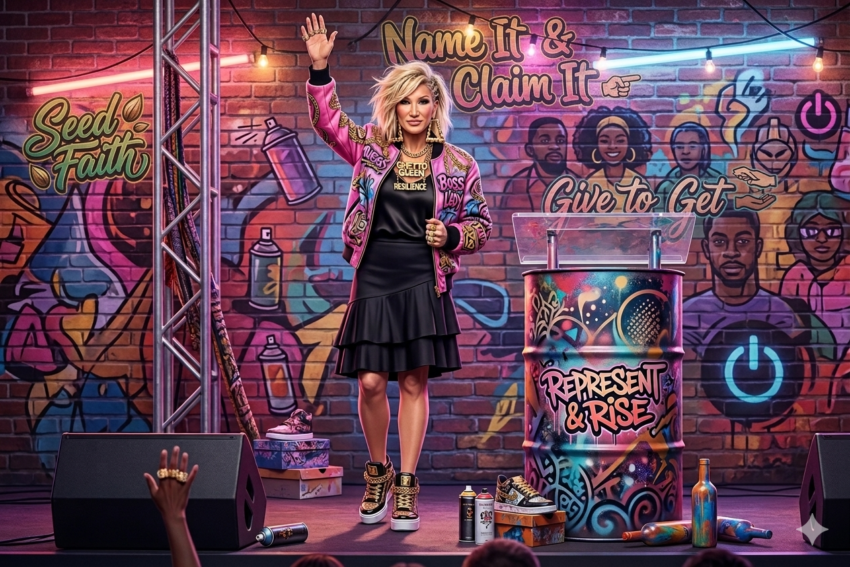
Image:An AI-generated image shows a more appropriate venue for Paula White’s preaching: a graffiti-covered back alley. The markings on the wall—”Seed Faith,” “Name It & Claim It,” “Give to Get”—reflect the core tenets of her prosperity gospel. Critics argue this theology turns God into a vending machine, promises material wealth for financial “seeds,” and preaches a transaction-based relationship with the divine—heresies that belong in the shadows, not the sanctuary.
Donald Trump has sparked a backlash from leading Christians over his appointment of a controversial televangelist to the White House.
The president on Friday signed an executive order to open a White House Faith Office to be led by Paula White, his longtime spiritual adviser.
Trump established a similar office at the White House during his first term and regularly consulted with a tight group of evangelical advisers.
But the move sparked fury from Christian leaders who believe that White, a megachurch pastor from Florida, preaches an interpretation of the gospel that critics argue exploits the most vulnerable.
White teaches followers that God will reward them if they donate to her church, going as far as to suggest precise sums over a thousand dollars to ensure their ‘salvation’.
‘This is an abomination,’ wrote Christian motivational speaker Scott Ross on X.
‘She preaches the heresies of Word of Faith & Prosperity Gospel, both utterly opposed to authentic Christianity. Worse, she has lived a life of scandal, with multiple husbands, twisting the Gospel for profit.’
But the backlash came thick and fast online as it sent shockwaves through Trump’s Christian base.
[Scott] Ross, an Orthodox Christian leader based in Texas, went as far as to argue that White’s appointment was the ‘worst and most dangerous thing’ Trump could have done.
‘Lord, have mercy on our country and this administration,’ he wrote on X.
Christian blogger Chris Hohnholz wrote on X: ‘Not every choice he makes will be a home run, we understand that. But this? This is a train wreck. @realDonaldTrump, sir, you need to reverse course on this ASAP. Not only is Paula White not biblically qualified to be a pastor, she is a false teacher leading people to Hell. Do not do this, sir.’
Presidential spiritual adviser Paula White claims to have recently been transported to the Throne Room of Heaven, where she received a new “mantle” and anointing from God.
“I literally went to the Throne Room of God,” she said. “There was a mist that was coming off the water, and I went to the throne of God, and I didn’t see God’s face clearly, but I saw the face of God … I knew it was the face of God.”
“He put a mantle [on me] and it was a very distinct mantle,” White continued. “There was a mantle, and I saw it very distinctly, the color was like a goldish, a yellowish goldish … and then I saw the Earth for a moment, and [God] brought me back, and he put me in certain places, one being the White House, one being certain continents.”
Is there absolutely anything that Paula knows about constitutional law? Is she widely connected outside her prosperity-gospel bubble with other faith leaders? Does she actually know how to exposit and apply Scripture to public policy? Will her third husband (the member of the band Journey who wrote Don’t Stop Believin’) assist her in “strengthening marriage” throughout the land?? Or at the very minimum, does she inspire confidence in a majority of Americans to help protect their religious freedoms from tyranny? ~ Not The Bee
President Donald Trump is facing pressure to “fire” pastor Paula White, his controversial pick to lead the new White House Faith Office, just one day after announcing her appointment.
Scores of pastors, priests, and Christians of all denominations reacted harshly to Trump’s pick on X after it was announced. Trump faced similar criticism when he picked White to be involved in his 2016 campaign and first presidential administration.
“I’m hearing from a credible source that President Trump is well aware that Paula White has been trending all day on X and that the response to him appointing her the head of the White House Faith Office is receiving a TON of negative backlash,” former Bay Area sports broadcaster Jon Root posted.
While Root is one of the leading voices calling on Trump to “fire” and “replace” White, podcaster Chris Hohnholz called on the president to “reverse course on this ASAP.” Pastor David Reece suggested Trump replace White with Voddie Buacham, and another user wrote, “Dear @POTUS, please don’t do this. Worst decision you will ever make.” Each post received more than 1,000 likes.
The editor-in-chief of Christianity Today magazine, Russell Moore, was one of many prominent Christians who came out against Trump’s decision to appoint White as chairwoman of the evangelical advisory board for his first presidential campaign. Moore described White as “a charlatan and recognized as a heretic by every orthodox Christian, of whatever tribe.”
Among other things, a Senate report found that White’s personal ministry and the church she ran with her now ex-husband used tax-exempt ministry funds to pay nearly $900,000 one year for the Whites’ waterfront mansion. It paid over a million dollars in salaries to family members and kept the Whites in the air with a private jet. White and her church refused to cooperate with the investigation and in 2011, Sen. Charles Grassley (R-Iowa), issued a report outlining the committee’s findings but took no other action. White’s church declared bankruptcy in 2014 after defaulting on $29 million in loans from an evangelical credit union. In 2011, amid controversy, she became senior pastor at the predominantly black City of Destiny—then known as New Destiny Christian Center—after its former pastor died of a drug overdose.
Women as pastors?
The question of whether women should serve as pastors is a significant and nuanced topic within Christianity, warranting thorough exploration and discussion. While this subject merits its own dedicated study in a future blog post, for those interested in an initial perspective, I recommend reviewing the 1998 article from SBCLife titled “Women Pastors: What Does the Bible Teach?” available through the Internet Archive. This piece provides a foundational look at the biblical teachings surrounding this issue, offering insights that can serve as a starting point for deeper personal study and reflection.
The Apostle Paul: “But as for you, teach what accords with sound doctrine” (Titus 2:1)
If your name’s not God, your opinion doesn’t matter, and your acceptance is not needed. If your name is not God, Jehovah, Yahweh, El Shaddai, Jesus Christ then your opinion doesn’t matter, and your acceptance is not needed. ~ Paula White Preach the word; be instant in season, out of season; reprove, rebuke, exhort with all long suffering and doctrine. ~ The Apostle Paul Beloved, do not believe every spirit, but test the spirits to see whether they are from God, for many false prophets have gone out into the world. ~ The Apostle John
According to the Apostle Paul, doctrinal training is crucial for a Christian’s spiritual growth and maturity, as it provides a solid foundation of truth based on God’s Word, protecting believers from false teachings and equipping them to live a life aligned with God’s will; he repeatedly emphasizes the need for “sound doctrine” which acts as a safeguard against error and enables Christians to discern truth from falsehood, thus promoting healthy Christian living and effective ministry.
Key points about Paul’s view on doctrinal training: Protection from false teaching:
Paul warns against being “tossed to and fro by every wind of doctrine” (Ephesians 4:14), highlighting the importance of having a firm grasp on sound doctrine to resist misleading teachings. Spiritual maturity:
Proper doctrinal understanding leads to a mature Christian life, allowing believers to apply biblical truths to their daily lives and make informed decisions. Gospel centrality:
Paul emphasizes the importance of teaching the core message of the Gospel, which is the foundation of Christian belief. Leadership responsibility:
Paul instructs leaders like Timothy to diligently guard and teach sound doctrine, ensuring the faithful transmission of the Christian message to future generations. Examples from Paul’s writings:
White, who once prayed for the angels of “Africa and South America” to reverse the 2020 election, told the Universal Peace Federation in 2023 that she worked with Nelson Mandela to end apartheid in South Africa. The Nelson Mandela Foundation’s Razia Saleh told the Post the foundation had no record of White ever working with the civil rights icon. ~ Atlanta Black Star
Titus 2:1: “But as for you, teach what accords with sound doctrine” 1 Timothy 1:10: “The aim of our charge is love that issues from a pure heart and a good conscience and a sincere faith” 2 Timothy 3:16-17: “All Scripture is breathed out by God and profitable for teaching, for reproof, for correction, and for training in righteousness”
An investigation into Paula White’s background reveals a troubling deficiency in traditional Biblical training and doctrinal education. Unlike many Christian leaders who possess formal theological education, White lacks seminary training or ordination from a recognized Christian denomination. Her theological foundation appears to be self-taught or influenced by non-traditional sources, including mentors within the prosperity gospel and Word of Faith movements, which are often criticized for their unorthodox teachings.
Critics argue that her teachings, which blend prosperity gospel with elements of New Thought—emphasizing wealth, health, and the power of positive confession—deviate significantly from orthodox Christian doctrine. This has raised alarm among theologians and laypeople alike, who question her capability to lead and teach within the broader Christian community, especially given her prominent roles in spiritual advisory capacities and public platforms. Concerns also extend to her susceptibility to theological error and the potential for misleading followers, as her lack of formal education may limit her ability to critically engage with complex scriptural and doctrinal issues.
She said what??
Examining the actual quotes of so-called religious leaders often serves as a critical window into their beliefs, revealing doctrinal positions that may significantly deviate from Orthodox Christianity. These direct statements can uncover theological inconsistencies or unorthodox interpretations that might otherwise be obscured by general teachings or public personas, highlighting the importance of scrutinizing their words to discern any troubling departures from established Christian doctrine.
Norman Vincent Peale brought the Gospel in a very practical way in our time of history for not only New York but our nation and also the Trump family. ~ Paula White
While Norman Vincent Peale had a profound influence on American Christianity and popularized certain Christian concepts, his doctrines are not universally accepted as aligning strictly with Orthodox Christianity. Critics often point to a perceived lack of emphasis on sin, repentance, and the traditional path to salvation through Christ, alongside his incorporation of non-traditional elements into his theology. Therefore, within the context of strict doctrinal correctness according to traditional Orthodox standards, Peale would not be considered one of its “most doctrinally correct” personalities.
In the New Testament, Jesus talks more about stewardship and finances and management of your life than anything else outside the love of God. ~ Paula White
Paula White’s statement is an overstatement when looking at the sheer volume and thematic focus of Jesus’s teachings in the New Testament. While Jesus indeed addresses stewardship, finances, and management of life, these are not more frequently discussed than other major themes like faith, repentance, forgiveness, and especially the love of God and neighbor. Her claim could be seen as an interpretative emphasis that aligns with the prosperity gospel narrative, which some critics argue selectively highlights certain passages to support its theology. Thus, while there is truth to Jesus discussing these topics, saying they are discussed more than almost anything else outside of love does not fully align with a comprehensive view of the New Testament’s content.
There is creative power in your mouth right now. God spoke and created the universe; you have creative power to speak life and death! If you believe God, you can create anything in your life. ~ Paula White
The claim that humans can “create anything in your life” by speaking it into existence is a hallmark of the Word of Faith movement. This teaching suggests that believers can claim or speak into existence health, wealth, or success by using faith-filled words. This view is not universally accepted within Christianity and is often criticized for promoting a form of magical thinking. Mainstream theology would caution against the idea that humans can “create anything” in their lives through speech, as this could lead to misunderstanding the role of suffering, the will of God, and the complexities of faith.
Each January, I put God first and honor him with the first of our substance by sowing a first fruits offering of one month’s pay. That is a big sacrifice, but it is a seed for the harvest I am believing for in the coming year. And God always provides! ~ Paula White
Yes, the principle of giving from one’s first or best can be seen as an extension of Old Testament practices, but the specific application of giving one month’s salary as described by White is more of a modern interpretation or tradition. White’s statement is linked to prosperity theology, which suggests that giving can lead to material blessings. This interpretation is controversial among theologians, as it might not align with the broader New Testament teachings on wealth, humility, and the dangers of materialism (e.g., Matthew 6:19-21, Luke 12:15). The New Testament encourages generosity, giving as one is able, and doing so with joy, but it does not prescribe specific amounts or times for giving beyond encouraging regular, proportional giving based on one’s income.
There have been times that I have taken prayer cloths that have been anointed as a point of contact. I put them in my loved ones sneakers, I put them under their bed. I put them on parts of my body that I believe God for healing. ~ Paula White
While the Bible does support the notion that faith can manifest through physical means (like the cloths in Acts), there’s a fine line between faith in God’s power and what might be perceived as superstition or magical thinking. Focusing on the cloth rather than on God Himself could lead to idolatry or misplaced faith.
And now it’s time to discuss the “H” word … and yes, “Huckster” does come to mind.
The Barre Montpelier Times Argus, 2019: On Halloween, President Trump announced the appointment of televangelist Prosperity Gospel preacher Paula White as an official member of the White House staff. She has been Trump’s personal spiritual adviser for some time, but now she will be with the Office of Public Liaison as special adviser for the administration’s Faith and Opportunity Initiative. Halloween was a perfectly chosen date for this announcement, since Ms. White is nothing more than a mega-church, self-help huckster wearing the costume of a Christian minister.
In Ms. White’s case, this costume consists of expensive designer dresses impeccably tailored to show off her striking good looks and svelte figure. She literally “looks like a million bucks.” This is not an irrelevant sexist comment because she does, indeed, have millions of bucks, which is only perfectly fitting (pun intended) since, according to her version of Christianity, worldly success and monetary rewards are the outward signs of God’s favor.
The only problem with her message is that her version of Christianity is heresy — pure and simple and blatant. This is not merely my personal opinion, but the opinion of many well-known American evangelical figures, such as Southern Baptist theologian Russell D. Moore, who has said, “Paula is a charlatan and recognized as a heretic by every orthodox Christian, of whatever tribe” (as cited in The Washington Post, Jan. 3, 2017). Prof. Michael Horton of the Westminster Seminary California has stated much the same thing. Well-known Christian radio host Erick Erickson has said, “The president of the U.S. is putting a heretic on stage who claims to believe in Jesus, but does not …” Of course, many Catholic theologians have long held that Prosperity Gospel Christianity is a form of heresy.
Frankly, Paula White is just a flashier, sexier, female version of Norman Vincent Peale. Let me be as clear as I can possibly be: these are dangerous people, dangerous charlatans who are using a false mantel of “Christianity” to promote their sale of snake-oil theology on a massive scale via the modern miracle of mass media. A look at White’s career and her three marriages reveals her to be an opportunist who has left a fair amount of wrack, ruin and bankruptcies in her wake. Her current husband (as of 2015) is rock star Jonathan Cain.
All this would be one thing if White were merely a “pastor” of sorts, doing her own thing, whatever that might be. But the fact is that, since 2017, she has been placed center stage in the spotlight by Donald Trump again and again. She has now been officially brought into the White House administration. She now has, arguably, the highest-placed role in national governmental affairs of any Christian pastor in America. But the question remains: What is she a pastor of? She has no degree from any college, bachelor’s or master’s, and no theological training of any sort. Period. Moreover, she and the whole Prosperity Gospel movement have been roundly condemned by bona fide Christians as a whole — evangelicals, Protestants and Catholics. Yet here she now is, sitting at the right hand of our president in an official capacity and (one has to assume) receiving a government salary.
The heresy of the Prosperity Gospel is based on many lies. Top among them is the teaching that one’s wealth and success in the world demonstrate God’s favor and blessings placed upon you because you are “saved” and this is God’s reward to you. Anybody with common sense knows — today just as 2,000 years ago — that worldly success is often more than 50% pure luck, and also often more than 50% disreputable business practices.
The Prosperity Gospel has brought those disreputable business practices right into church and placed them on the altar. If that’s not heresy, I don’t know what is.
And in all the excitement, I nearly forgot the Moonie Connection
In the shadowy corners where faith meets finance, televangelist Paula White-Cain, once a spiritual advisor to former President Donald Trump, has found herself entangled in a web of controversy that stretches from the Christian mainstream to the fringes of religious doctrine. At the heart of this narrative lies her connection with the Unification Church, colloquially known as the “Moonies,” founded by the late Rev. Sun Myung Moon, a figure whose teachings have long been labeled heretical by traditional Christian denominations.
Paula White, known for her charismatic preaching and her role in founding the City of Destiny church in Florida, has been a figure of both admiration and scrutiny. Prosperity gospel teachings have marked her ministry, but recent activities have cast a spotlight on her association with one of the most controversial religious movements in modern history.
The controversy began to surface prominently when White was seen speaking at Moonie events, notably at the Universal Peace Federation’s Peace Summit. Here, she lavished praise on Dr. Hak Ja Han Moon, the widow of Rev. Sun Myung Moon, calling her a “jewel from God” and a woman who “loves the Lord.” This was not just a one-off occurrence; White has been a repeat presenter at these gatherings, where she has described Moon’s widow as carrying “such a tremendous calling of God in this earth.”
But what exactly does this association imply? The Unification Church, founded in 1954 by Sun Myung Moon, is known for its unorthodox beliefs, including the assertion that Moon was the second coming of Christ, sent to complete the mission Jesus could not complete due to his crucifixion. They believe in mass weddings where Moon himself would match couples, often strangers, in a bid to restore humanity to a sinless state. These practices, alongside their reinterpretation of Biblical texts, have led to widespread condemnation from evangelical and mainline Christian communities.
The heart of the issue lies in the theological discordance. White, a prominent figure in the New Apostolic Reformation (NAR) movement, has now aligned herself with a group whose doctrines are anathema to basic Christian orthodoxy. Critics, as seen in posts on X and various Christian watchdog blogs like Protestia, argue that her involvement signifies a profound lack of discernment, if not an outright endorsement of heretical teachings.
A News Narrative, compliments of Grok
Investigating Dr. Hak Ja Han Moon: A Departure from Orthodox Christianity
In the quiet corridors of religious discourse, the name Dr. Hak Ja Han Moon resonates not with the chimes of traditional Christianity but with the echoes of a distinct, controversial path. Known as “True Mother” or “Mother of Peace” among her followers, Dr. Hak Ja Han Moon has inherited the leadership of the Unification Church, or the Family Federation for World Peace and Unification, following the death of her husband, Rev. Sun Myung Moon, in 2012.
The Roots of Deviation At the heart of the investigation into Dr. Hak Ja Han Moon’s theological positions lies the core doctrine of the Unification Church, which sharply diverges from Orthodox Christianity. The central tenet that sets the Unification Church apart is its belief in Rev. Sun Myung Moon and Dr. Hak Ja Han Moon as the “True Parents” of humanity, a concept that fundamentally challenges the Christian doctrine of salvation through Jesus Christ alone. Moon’s teachings, encapsulated in “The Divine Principle,” assert that Jesus failed to fulfill his mission, which Moon himself completed by establishing a new family free from sin. This notion not only undermines the Christian understanding of Jesus’s role but also introduces a theology where Moon and his wife are seen as messianic figures.
Theological Incongruities Our investigation reveals several points where Dr. Hak Ja Han Moon’s teachings diverge from orthodox Christian doctrine: The Trinity:Unlike the traditional Christian view of the Trinity, the Unification Church views God in a unique way, proposing a dual nature of masculinity and femininity within God, which is not aligned with the Trinitarian understanding of Father, Son, and Holy Spirit as co-equal persons. Salvation:Orthodox Christianity teaches salvation through faith in Jesus Christ. However, in the Unification Church, salvation is linked to participating in the “Blessing” ceremonies, which are mass weddings officiated by Moon or, post-2012, by Dr. Hak Ja Han Moon. This represents a significant departure, suggesting human action (marriage under the Moon’s auspices) as a means of salvation rather than grace alone through faith. Christology:The assertion that Rev. Moon completed the mission Jesus could not is antithetical to Christian doctrine, where Jesus is seen as the perfect and final sacrifice for sin, with no need for a human successor to complete his work.
Public Statements and Actions Dr. Hak Ja Han Moon’s public engagements, like the “Rally of Hope” events, have included speeches where she promotes a vision of peace and unity but often under the umbrella of her and her husband’s unique theological framework. Her involvement with various organizations like the Universal Peace Federation (UPF) and the Women’s Federation for World Peace (WFWP) further extends this narrative, blending religious ideology with political and social activism, yet always rooted in the Unification Church’s doctrine rather than traditional Christian teachings.
Criticism and Controversy Critics, ranging from theologians to former members, have long highlighted these deviations. Posts on platforms like X have questioned her connections to political figures and her influence in various countries, suggesting a blend of religious leadership with political agendas that lack the theological grounding of Orthodox Christianity. The term “Moonies,” once used pejoratively for Unification Church members, reflects a broader societal and religious critique of the movement’s beliefs and practices.
Conclusion Dr. Hak Ja Han Moon’s leadership continues to steer the Unification Church away from the theological norms of Orthodox Christianity. While her initiatives for peace and family values might resonate with some Christian ideals, the underlying theology presents a stark contrast. This investigation finds that the doctrine she upholds and propagates is not just a variation but a significant departure from what is traditionally recognized as Christian orthodoxy. For those within or considering the Unification Church, understanding these distinctions is crucial in discerning the theological landscape they are navigating.
This narrative underscores the importance of theological scrutiny, especially when religious leaders claim to represent or expand upon Christian teachings. Dr. Hak Ja Han Moon’s journey, while influential and impactful in its own right, must be viewed through the lens of its divergence from the historical and doctrinal roots of Christianity.
Investigations into White’s financial and political connections reveal further layers to this story. White’s history includes affiliations with high-profile figures and her involvement in the Trump administration, which adds another dimension to her engagement with the Moonies. The Moon family’s extensive network, which includes business ventures and political lobbying, might have been a draw for White, whose ministry has never shied away from the intersection of faith and finance.
Critics argue that this relationship is not just spiritual but potentially lucrative. The Moonies have a history of funding projects and events for those who align with their vision of global peace and unification under their doctrine. The Universal Peace Federation, associated with the Moonies, is known for its international conferences where figures like White are invited to speak, potentially providing a platform for mutual benefit.
The response from the Christian community has been polarized. While some dismiss these connections as mere ecumenical outreach, others view it as a dangerous blurring of lines that could mislead followers or dilute Christian doctrine. Evangelical leaders and theologians have openly criticized White for her participation, pointing out the inherent contradictions between her teachings and those of the Unification Church.
The discovery of Paula White’s connections to the Moonies alone should be sufficient reason to reject the notion that she should lead the White House Faith Office. This investigative dive has not only revealed a narrative of religious convergence but has highlighted a concerning interplay of power, influence, and possibly personal gain. Her association with the Moonies casts serious doubts on the integrity of her ministry and her theological judgment, questioning her suitability for a role that demands the highest level of discernment in Christian leadership. As this story unfolds, the line between providing spiritual guidance and engaging in spiritual compromise has come under intense scrutiny, underscoring the problematic nature of her involvement in shaping interfaith dialogue and political influence at such a high level.
But wait … there’s more.
Update, April, 2026:
.
[Click here] to read the full transcriptof this interview [Click again to close]
So who is Paula White exactly? And pardon my ignorance, but it’s just, she’s become this figure. She’s one of the people who prayed over the president and encouraged this war with Iran, a country with over a million Christians in it. But she’s like played a role in our foreign policy. So I think it’s, and of course she’s been used publicly and has allowed herself to be used to justify this war and violence in the name of Jesus. So I think it’s worth asking, like, where does she come from? Who is this person?
I don’t know her upbringing, but I’ll start with this. I will give Paula the benefit of the doubt that she came in to the church space wanting to do good. She wanted to save souls. She wanted to preach the gospel. I believe that. But I also believe- I think that’s a, that’s we should always extend that benefit of the doubt to people. Okay, so when she’s presenting that gospel, she has to play in a certain legal realm, which is religious institutions, corporations in America.
I firmly stand on my word that that legal architecture will corrupt anybody that goes into the mission or that ministry full time. So she started a church in Tampa called Without Walls with her husband, Randy Knight. I went to the building Saturday because I wanted to see where that was. So I drove up to Tampa and now it’s a bar. It’s like a restaurant bar. And so I went in- The church is a bar? Well, so I went in and talked to the restaurant. I’m like, hey, was this Paula White’s church without walls? And the manager was like, yeah. So he’s like, we get this question a lot, actually, which is fascinating.
So I don’t know the financial exchange or the real estate side of things, but the original without walls church was bulldozed. And then that restaurant bar was built on the property. So she and her husband started a church in Tampa. They started a church in Tampa called Without Walls. There’s some scandal wrapped around that church. They used to work or they’re very loudly talking about how they work in prostitution. They help prostitutes. They help the needy in that area. And so I talked with a past employee who said that. And we’re getting the tapes right now. We found some old VHS tapes from Paula back in the day. So those are actually just, they just arrived in my house. Very excited to look at those.
But they said, oh, there’s a rundown hotel on the property next to us. We bought that hotel. We’re going to turn it into a rehab facility for prostitutes and drug addicts. And that’s going to be our main witness. Awesome. That’s right where I think Christ would be, is hanging out with the hurting, the needy, the prostitute, the widowed. And so they started raising money for this hotel that they had built. And they raised, I don’t know the exact amount, but hundreds of thousands of dollars. And some of their congregants mortgaged their homes for it. Well, come to find out they never even bought the hotel. This was just all theory and a good intentioned idea. And so that really crippled the church.
And at the same time, her husband kind of, I’ll just say, fell off the wagon. And so they got divorced. And her spiritual advisor was T.D. Jakes. Do you know who T.D. Jakes is? Yes, I’ve met T.D. Jakes. So her spiritual advisor. Famous black preacher, built like a linebacker. Yep, huge. Yeah, yep. He was her spiritual advisor. He was also another pastor’s spiritual advisor in Opopka. and um unfortunately that pastor in opopka um od’d in a bathtub and on drugs non-drugs yeah and uh he was with a prostitute the prostitute made the call the emergency call he died.
And so T.D. Jakes, as Without Walls is crumbling, T.D. Jakes, as the spiritual advisor, tells Paula to go take over this church in Opopka. So Paula White moves to Opopka, takes over that church, which they rebranded to Story Life Church, and that became her home church. Wow, that’s quite a story. So then what happens? She gets remarried or— She’s remarried to one of the band members of Journey, that awesome band that I love to listen to. Yeah. So he plays piano for her on stage, you know, as she preaches. It’s a great husband-wife duo. Yeah.
So she now, well, she did pastor this church. She’s since passed it down to her son, Brad Knight. And… Why did she pass it down? Because she became a special government employee under Trump. And you can’t run a, you can’t run, I believe the rule is you can’t run a nonprofit or you can’t be raising money outside. So I don’t want to judge her as a person. There’s a lot written about her personal life. I don’t know, you know, what is true and what is not true. So I don’t want to repeat it, but it’s, I mean, it’s kind of defined by personal scandal. Correct. True or not. There’s a lot of personal scandal that I won’t even go into.
Well, of course, because I don’t know and I don’t want to repeat things that are not true. But it’s sexual scandal. Those are the allegations. So there’s that. And I do think in order to maintain credibility, I also think like you’re Your faith requires you to explain that and show people that it’s true and repent, apologize, be better, or prove it’s not true. But that seems all kind of unaddressed. So how did she wind up, given all that, the president of the United States, chief spiritual advisor? I’ve talked to a past employee of hers who… Paula’s a very bold woman, very loud. I had never seen her. I don’t consider that a compliment at all. I just want to be clear.
What, bold and loud? Yeah, I’m not into it. No, either am I. And so I had never been around her before. But when her son was preaching and her son would say something, she would always be the loudest one yelling, amen, brother, go, go, son. You know, she just wanted to. I find that awful. Yeah. And we’re like told we have to think that’s great. I don’t think it’s great at all. Yeah. Sorry. Well-behaved women really make history. I don’t know about that. I mean, stop. Yeah. Excuse me. I would agree with you. But so the stories that I’ve heard from her employees are she – Trump was a mark from the early 2000s. So she would go down to Mar-a-Lago and hang out at Mar-a-Lago, just waiting for Trump to pass. And when Trump would pass, she’d approach him. And she’s a very bullish, bold woman. So she kind of had a mark on Trump for decades.
And then same thing in New York. She rented an apartment in Trump Tower and she stayed in Trump Tower waiting to have FaceTime with Trump. So she’s been playing the long game with Trump. Has she? I mean, is she like a well-known theologian? I don’t know. No. But I guess all I’m saying is there are all kinds of predators around all power centers, including the White House, right? It’s just that’s the nature of power. It’s like a bug light. It draws the Michael Cohen’s of the world into your orbit, right? People who want power and money. But if you’re going to be the spiritual advisor, you would think there would be some like track record of… I don’t know, Christian living?
So I got a question for you, Tucker. Can I call you Tuck? Call me whatever you want. So should your business model, if you’re a pastor, should your business model emulate Christ? I think your whole life is supposed to emulate Christ. Perfect. So here’s her bylaws, which are marked confidential, by the way. So her church cannot read her bylaws. The people who fund her cannot vote her bylaws. The only reason why they came out was because of a lawsuit. I’m going to jump to page two really quick about membership. Members of the congregation are non-voting. Members of the board of directors are voting. So congregants who fund it have no say over anything. We’ll jump a few pages further. Okay. about removing officers.
So if for some reason she had a scandal, right? Usually we remove officers from corporations that have scandals or abuse their control and power, but not for her, ready? Any officer except the pastor president, she is the pastor and president, may be removed from his or her office by the board of directors. The pastor president shall have the authority to remove any officer from his or her office at any time at her discretion. So she cannot be removed because any officer except the pastor president can be removed and then she can fire anyone at any time. for anything. So she has unilateral control. It gets better. Ready? Section five is resignation, removal, succession of pastor president. If the pastor president voluntarily resigns, she may designate her successor.
The pastor president shall serve as president and a member of the board of directors until her death or resignation without need of election or appointment. She shall not be subject to removal. It says that? It says that. Is this a monarchy? What is this? It’s a monarchy. It’s a monarchical power. Death. Upon her death, the pastor president shall be succeeded in the office of pastor president and as a director by her son, Brad Knight. It’s a dynasty. in bylaws that congregants can’t see. Is this a Christian principle? No. No. And then this is the banger. Ready? Powers of officers. The senior pastor is the president of the corporation.
And this is a sticking point for me because most pastors will say, my church is not a business. Well, no, it’s a corporation registered with the state. It’s very much a business. So the senior pastor is the president of the corporation and is referred to within these bylaws as pastor president. Here’s the drum roll. The church finds its headship under the Lord Jesus Christ in its pastor president. So you don’t find your headship in Jesus Christ. You find it under the Lord Jesus Christ in Paula White. So if I want to get to Jesus Christ, I have to go through Paul. I believe we had a Protestant Reformation to get away from this idea.
You can keep that copy. That the leader is infallible and the leader speaks always and everywhere for God himself. Yes.
Isn’t that why we had the Reformation 500 years ago? Well, that’s the point of Christ. Christ came to remove middlemen, to remove the Levitical priesthood. That’s what I thought. Yeah. Wow, that’s, so how unusual, I’ve never heard of anything like that. How unusual is that? That’s pretty aggressive bylaws, but here’s second Baptist bylaws. So I had a fun interaction in Houston the other week. This is a church with a billion dollars in assets in Houston, a billion. It’s 98 years old. So that means generation after generation of generous Christ-centered Houstonians have funded this building. Some of my favorite people in the world and relatives of mine who I really look up to as Christians, you know, have spent a lot of time in that church and helped fund it and whatever. So I know that there are true. Amazing people. Christians in that church.
93,000 members had voting rights. And voting rights are, hey, just like a democracy, just like America, a republic. We want to have a say in how- Just like the church in Acts. Yes. We want to have a say- The earliest church. And that’s what we should probably be modeling ourselves after, right? We want to have a say in how this all operates. A couple of years ago, one very interesting lawyer from Dallas who I’ve had multiple interactions with and then the young family decided to, in a shady back-end deal, remove voting rights of 93,000 members like that. So a billion dollars in assets that was voted on by 93,000 members in a single meeting that On page seven, removed the voting rights. As such, members are not entitled to vote in person by proxy or otherwise. So a billion dollars in assets were put into the hands of six people, five of which are related. When did that happen? 2023. And now there’s an ongoing lawsuit because the congregants are suing for their rights back. How can you do that? You can’t.
Summary of Tucker Carlson Interview
This transcription is an extended conversation criticizing Paula White’s rise in American politics and Christian leadership, while using her story to argue that church legal structures can corrupt ministry and concentrate power. The speakers also compare her church governance to another example they see as dangerously centralized, using bylaws and corporate control to make a broader point about religious institutions in America.
Paula White’s background and early ministry
The discussion begins with questions about who Paula White is and how she became such a prominent public religious figure. One speaker says he is willing to give her the benefit of the doubt that she originally entered ministry wanting to do good, save souls, and preach the gospel, but argues that the legal and corporate structure of American religious institutions can corrupt people over time.
The speakers describe White and her husband starting a Tampa church called Without Walls, saying it later became associated with scandal, and eventually the original site was demolished and replaced by a restaurant/bar. They claim White and her husband had planned to buy a nearby hotel and convert it into a rehab facility for prostitutes and drug addicts, raising large amounts of money for the project, but that the hotel was never actually purchased, which they say crippled the church.
Setbacks, divorce, and relocation
The transcript says White’s husband “fell off the wagon,” leading to their divorce. It then says her spiritual advisor, T.D. Jakes, told her to take over a church in Apopka, which she later rebranded as Story Life Churchand made her home church.
The speakers also reference a pastor in Apopka who reportedly died in a bathtub under drug-related circumstances, using the story to show what they see as the instability and scandal surrounding these ministry circles.
Trump connection and public influence
A major theme of the conversation is White’s connection to Donald Trump. The speakers claim that she played a long game of building access to Trump by appearing at Mar-a-Lago and even renting an apartment in Trump Tower so she could gain face time with him. They argue that she became influential as a “chief spiritual advisor” because she attached herself to a center of power rather than because of her theological credentials.
They also criticize her participation in prayer and public religious justification for political decisions, including war and foreign policy, saying she has been used to help frame violence “in the name of Jesus.”
Scandal, credibility, and church governance
The discussion repeatedly returns to allegations of personal scandal, especially sexual scandal, though the speakers say they do not know what is true and what is not. They argue that White should either repent, apologize, or prove the allegations false if she wants to maintain credibility.
The most detailed section focuses on church bylaws. The speakers say White’s church operates like a corporation with confidential bylaws that ordinary congregants cannot read and voting rights reserved only for board members. According to the transcript, congregants who fund the church have no voting power, the pastor-president cannot be removed by the board, and she can remove any other officer at her discretion.
They claim the bylaws even specify succession: if White resigns or dies, her son Brad Knight becomes the next pastor-president. The speakers call this a “monarchy” or “dynasty,” arguing that it is contrary to Christian principles and the Protestant Reformation’s rejection of infallible human intermediaries.
Broader critique of church corporatization
The conversation expands into a broader critique of megachurch governance and church corporations. The speakers argue that churches often claim not to be businesses while functioning as state-registered corporations with concentrated executive control. They contrast White’s church bylaws with more democratic congregational models and suggest that centralized control invites abuse and removes accountability from members.
Comparison with another church example
The transcript ends by shifting to a separate example from Houston: Second Baptist Church. The speakers describe it as a church with massive assets and a long history of member participation, but they say a recent legal or governance maneuver stripped voting rights from a large membership and handed control to a small group. They present this as another example of how church wealth and power can be seized through legal restructuring, leading to lawsuits and member backlash.
Main takeaway
Overall, the transcription is a polemical critique of Paula White, her influence around Trump, and the corporate structure of modern churches. Its central argument is that religious institutions can become corrupt when power is concentrated in one leader or a small inner circle, especially when congregants who fund the institution have little or no real control.