
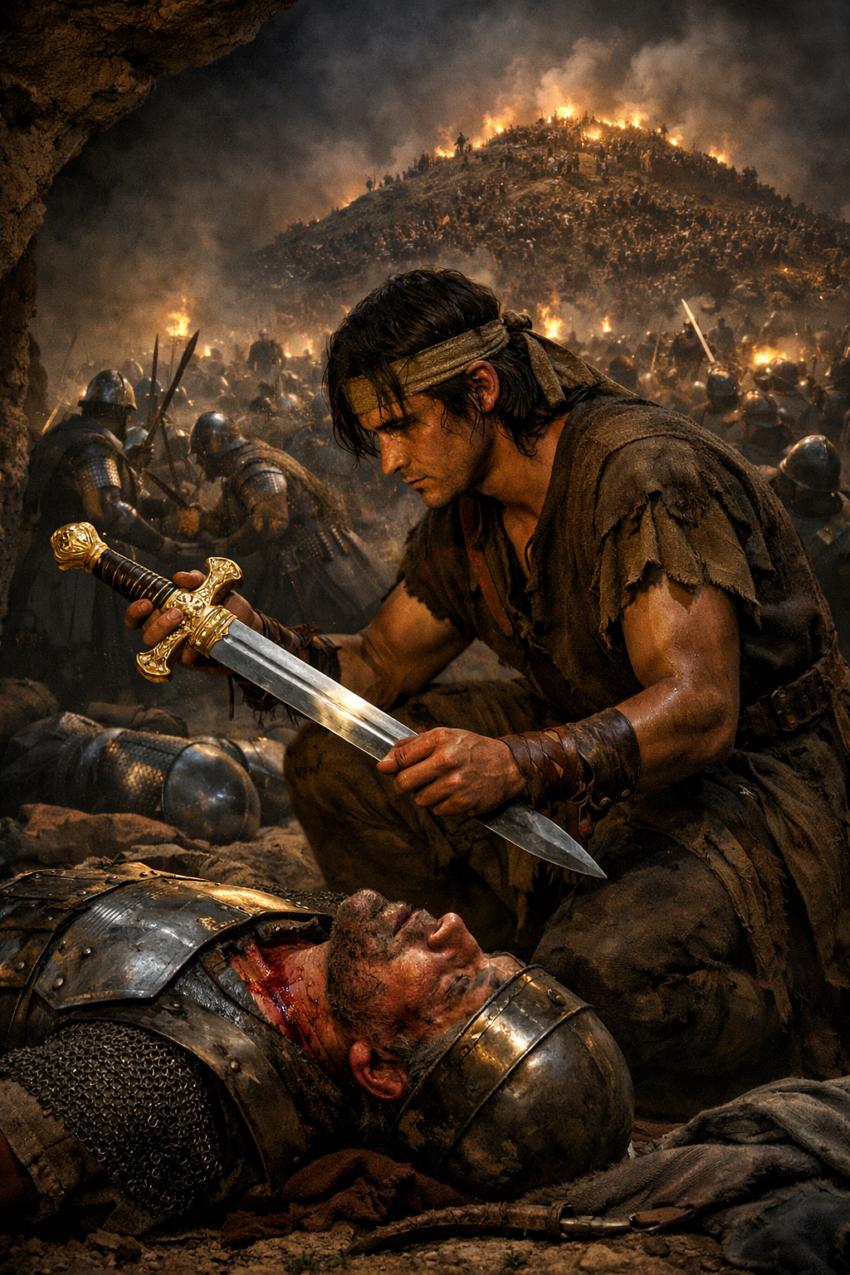
Image: An AI-generated photo-realistic image that illustrates the text in 1 Nephi 4:9, where a young man crouches in darkness over a fallen enemy and marvels at his weapon: a sword of the most precious steel, hilted in pure gold.
SWORDS, STEEL, AND SILENCE:
The Metallurgical Anachronisms of the Book of Mormon
A Historical and Archaeological Examination
Introduction: The Blade That Should Not Exist
In 1 Nephi 4:9, the narrator pauses to admire a weapon:
“And I beheld his sword, and I drew it forth from the sheath thereof; and the hilt thereof was of pure gold, and the workmanship thereof was exceedingly fine, and I saw that the blade thereof was of the most precious steel.”
— 1 Nephi 4:9, The Book of Mormon
It is a stunning literary moment — a young man crouching in the dark over the body of a fallen man, pulling free a magnificent weapon and marveling at its craftsmanship. As a literary image, it works beautifully. As a historical claim, it is the beginning of a problem that no amount of LDS apologetics has fully resolved.
The sword of Laban — forged of the “most precious steel,” hilted in pure gold — is the narrative anchor for the entire metallurgical framework of the Book of Mormon. From this single artifact flows a cascade of subsequent claims: that Nephi used it as a template to manufacture more steel swords in the New World (2 Nephi 5:14–15); that his people worked “in iron, and copper, and of brass, and of steel, and of gold, and of silver” (2 Nephi 5:15); that the Jaredite prince Shule “did molten out of the hill, and made swords out of steel” (Ether 7:9); and that warfare throughout a thousand-year narrative involved armies wielding swords, cimeters, shields, breastplates, and head-plates made largely of metal.
There is, however, a fundamental problem with all of this: the archaeological record of the pre-Columbian Americas contains no evidence of iron metallurgy, no iron smelting tradition, no steel-production technology, and no iron-bladed swords of any kind. This is not a minor omission in the record. It is a complete and consistent silence that spans every excavated site, every studied culture, and every analyzed artifact across the entirety of the Western Hemisphere during the period the Book of Mormon describes.
This essay examines that silence. It explores what we know — with considerable confidence — about the actual metallurgical traditions of pre-Columbian America; the nature and limits of LDS apologetic responses to the weapon anachronisms; the irresolvable geographic tensions created by the Heartland and Mesoamerican models of Book of Mormon geography; the problem of the cimeter as a specifically metallic, Old World weapon; and the historical context of Joseph Smith’s nineteenth-century environment that provides a more parsimonious explanation for the text’s weapon vocabulary.
This examination is not motivated by hostility toward LDS individuals, who are our neighbors and whom we approach with the pastoral respect that 1 Peter 3:15 demands. It is motivated by the conviction that truth matters — that the questions raised by the Book of Mormon’s extraordinary historical claims deserve honest, rigorous answers. The invitation here is to follow the evidence wherever it leads, with intellectual integrity and spiritual honesty.
Section I: The World of Iron and Steel — A Global Metallurgical History
The Bronze Age Foundation
To understand why the Book of Mormon’s weapon claims are anachronistic, one must first understand the global history of metal technology — how it developed, where it spread, and, crucially, where it did not.
The story of metals in human civilization begins roughly around 3500 BCE, when communities in Anatolia and Mesopotamia discovered that heating copper ores produced a malleable, recyclable metal far superior to stone. As historian Brian D. Colwell documents, the earliest copper smelting sites at Belovode in Serbia, Tal-i Iblis in Iran, and Timna in the Negev reveal centuries of careful experimentation, as ancient metallurgists learned the properties of different ores, the significance of flame colors, and the alloying possibilities of different minerals.
“Around 3300 BCE, probably in Anatolia or Mesopotamia, smiths found that adding roughly one part of a rare, silvery metal [tin] to nine parts copper produced something remarkable: bronze. This new alloy was 30% harder than pure copper, held a sharper edge, and could be cast into complex shapes impossible with stone or pure copper.”
— Brian D. Colwell, “A Complete History of the Metals That Built Civilization,” briandcolwell.com
The Bronze Age, spanning approximately 3000 to 1200 BCE, was defined by access to tin — a geologically scarce resource found only in limited locations. The quest for tin drove some of the earliest international trade networks in human history, connecting Mesopotamia with Cornwall, Iberia, and Afghanistan. Crucially, this bronze technology, though it eventually spread widely through the Old World, never crossed the Atlantic in any archaeologically demonstrable form.
The Iron Age Revolution
The transition from bronze to iron represents one of the most significant technological shifts in human history. Beginning around 1200 BCE — partly accelerated by the collapse of Bronze Age civilizations that disrupted established tin trade networks — iron smelting gradually emerged as the dominant metallurgical tradition across the Old World.
Iron held decisive advantages. As History.com’s overview of the Iron Age notes, iron ore was far more abundant and widely distributed than tin, meaning that iron-working communities were not dependent on fragile long-distance trade routes. The transition did not occur overnight — it was gradual, regionally variable, and required sophisticated techniques of heating, hammering, and — most importantly for our discussion — carburization, the process by which carbon is introduced into heated iron to produce the harder alloy we call steel.
By the tenth century BCE, smiths in the ancient Near East — precisely the world from which Lehi and his family would supposedly have departed — had mastered intentional steel production. The Vered Jericho sword, discovered by archaeologists and now displayed at the Israel Museum in Jerusalem, dates to approximately the late seventh century BCE. Its museum placard reads, in part: “The sword is made of iron hardened into steel.” This artifact demonstrates that steel weapons were a known commodity in the Israelite world at the very time the Book of Mormon’s narrative begins.
The Iron Age spread extensively through the Old World. Iron technology moved through the Mediterranean into Greece and Rome, laying the groundwork for classical antiquity. It spread east into Persia, India, and eventually China. It moved west into Europe, transforming agriculture and warfare wherever it arrived. What it did not do was cross either the Atlantic or Pacific oceans to establish itself in the pre-Columbian Americas.
The Metallurgical Reality of Pre-Columbian America
The metallurgical history of pre-Columbian America is rich, sophisticated, and fascinating — but it is categorically different from the Old World tradition in one decisive respect: it never developed iron smelting or steel production.
As Wikipedia’s comprehensive article on metallurgy in pre-Columbian America documents, indigenous peoples of the Americas developed genuine metallurgical sophistication — but along an entirely different technological pathway:
“Indigenous Americans had been using native metals from ancient times, with gold artifacts from the Andean region being dated to 2155–1936 BC, and North American copper artifacts being dated to approximately 5000 BC. The metal would have been found in nature without the need for smelting and shaped into the desired form using hot and cold hammering without significant chemical changes or alloy formation. As of 1999, ‘no one has found evidence that points to the use of melting, smelting and casting in prehistoric eastern North America.'”
— Wikipedia, “Metallurgy in pre-Columbian America,” en.wikipedia.org/wiki/Metallurgy_in_pre-Columbian_America
The Andean civilizations — among the most metallurgically sophisticated in the pre-Columbian world — worked extensively with gold, silver, copper, and eventually bronze. South American metalworkers developed remarkable techniques, including depletion gilding, lost-wax casting, alloying (particularly the copper-gold alloy tumbaga), and even the earliest known powder metallurgy in the world. Ecuadorian cultures from the La Tolita tradition mastered the soldering of platinum grains as early as 600 BCE — a technical achievement that Europeans would not replicate until around 1730 CE.
Yet even in this context of genuine metallurgical ingenuity, iron was conspicuously absent. The Wikipedia article is explicit: unlike other world metallurgy traditions where metals gained military and utilitarian importance, metals in South America and later Central America were “mainly valued as adornments and status objects.” Even the metallurgically advanced Inca civilization never replaced stone tools with bronze items in everyday life, let alone iron. Iron smelting technology — the foundation upon which any steel sword culture must rest — simply does not appear in the pre-Columbian archaeological record of the Americas.
Metallurgy did gradually spread northward from South America into Colombia, Panama, Costa Rica, and eventually into Mesoamerica — but it arrived late, brought primarily gold, copper, and bronze techniques, and never produced iron-working traditions. In Mesoamerica specifically, the region most frequently proposed as the setting for Book of Mormon events, the metals employed were primarily gold, copper, and some bronze. The Maya, Olmec, Aztec, and their predecessor cultures were sophisticated warriors and craftspeople, but their weapon technology was built around stone, wood, and obsidian — not iron.
Section II: The Book of Mormon’s Weapon Claims — A Detailed Inventory
Steel: Five Mentions, Zero Corroboration
The word “steel” appears five times in the Book of Mormon, and each occurrence is significant. The most famous is the sword of Laban in 1 Nephi 4:9, described above. The Jaredite prince Shule is said to have “molten out of the hill, and made swords out of steel” in Ether 7:9. Nephi describes making many swords “after the manner” of Laban’s steel sword in 2 Nephi 5:14. The broader metalworking program is described in 2 Nephi 5:15, where Nephi teaches his people to work in “iron, and copper, and of brass, and of steel.” Jarom 1:8 mentions weapons of war created from these metals, including “the sharp pointed arrows, and the quiver, and the dart, and javelin.”
LDS apologist organizations have worked energetically to address this problem. FAIR Latter-day Saints argues that steel, as described in the Book of Mormon, is “probably not modern steel” but rather refers to early carburized iron, and cites the Vered Jericho sword as evidence that steel weapons existed in the ancient Near East near Lehi’s departure period. Elder D. Todd Christofferson, quoted on the FAIR Latter-day Saints steel page, references Matthew Roper’s research:
“It is increasingly apparent that the practice of hardening iron through deliberate carburization, quenching and tempering was well known to the ancient world from which Nephi came. ‘It seems evident’ notes one recent authority, ‘that by the beginning of the tenth century B.C. blacksmiths were intentionally steeling iron.'”
— Matthew Roper, quoted by Elder D. Todd Christofferson, BYU Idaho Devotional Address, September 24, 2013; cited at fairlatterdaysaints.org/answers/Book_of_Mormon/Metals/Steel
This is a legitimate archaeological point — as far as it goes. Steel weapons did exist in the ancient Near East in the period described. The Vered Jericho sword provides genuine evidence of Old World iron-and-steel technology at approximately the right time period. The problem is that this evidence, while it makes the Old World side of the equation plausible, does nothing whatsoever to address the New World side.
LDS apologist William Hamblin himself, cited by FAIR Latter-day Saints, acknowledges a telling detail: “there are no references to Nephite steel after 400 B.C.” This concession is remarkable. If Nephi brought iron-age metallurgical knowledge to the Americas and established steel manufacturing operations (teaching his people to “work in iron, and of copper, and of brass, and of steel”), why does the technology vanish from the record within two centuries of arrival — leaving behind a thousand-year war narrative that relies on metal weapons with no archaeological trace? The apologetic explanation — that the knowledge was lost — creates as many questions as it answers.
The Iron, Brass, and Copper Problem
Beyond steel, the Book of Mormon describes the broader use of iron, brass, and copper in weaponry and armor. Ether 10:23 describes the Jaredites working in iron, copper, brass, and gold, “making all manner of tools” and “making all manner of weapons of war.” The Nephite military reforms under Captain Moroni famously equipped soldiers with breastplates, arm shields, head-plates, and thick clothing (Alma 43:38, 44) — equipment whose metal composition is implied by the narrative context.
Archaeological survey of Mesoamerica and North America finds no corroboration for this material culture. Metal armor was unknown in pre-Columbian warfare in either of the proposed locations for Book of Mormon events. The absence is not merely a matter of organic materials failing to preserve — metal objects preserve extraordinarily well in the archaeological record, and Mesoamerican sites have been extensively excavated. Metal armor capable of the defensive function described in the Alma war chapters simply does not appear.
The Jaredite Timeline Problem
The Jaredite narrative presents a particularly acute chronological difficulty. The Book of Ether places the Jaredites in the Americas from approximately 2200 BCE — far earlier than even the most generous assessments of when metal-working traditions arrived anywhere in the Americas. The Jaredite king Shule’s steel swords (Ether 7:9) would have appeared at a period when even the Andean cultures were still in the early stages of working native gold and copper by cold-hammering, and when iron technology anywhere in the world was still centuries in the future.
If the Jaredites are placed in Mesoamerica — a region where metallurgy didn’t arrive until approximately 800 CE, based on the archaeological evidence — the anachronism deepens from the implausible to the simply impossible. The earliest Mesoamerican metallurgy was imported from South America through Ecuadorian maritime traders; it arrived over two thousand years after the Jaredite narrative would have required functional steel swords.
Section III: The Apologetic Response and Its Limits
The Macuahuitl Gambit
Facing the archaeological silence regarding pre-Columbian metal swords, LDS apologists have advanced an alternative argument: perhaps the “swords” described in the Book of Mormon are not metal weapons at all, but rather the macuahuitl — the obsidian-bladed wooden weapon used throughout Mesoamerica.
LDS scholar Matthew Roper, cited by FAIR Latter-day Saints, makes this case directly:
“Recent scholarship on Book of Mormon warfare suggests that the Mesoamerican weapon the macuahuitl fits the criteria for the Book of Mormon ‘sword.’ Early chroniclers of Mesoamerican culture such as Duran and Clavijero unashamedly describe this weapon as a sword. Modern Mesoamerican historians commonly use similar terminology.”
— Matthew Roper, cited at fairlatterdaysaints.org/answers/Book_of_Mormon/Warfare/Weapons/Swords
The macuahuitl was indeed a formidable weapon. As Wikipedia’s article on the subject explains, it consisted of a wooden blade — typically 90 to 120 centimeters in length and weighing 2 to 3 kilograms — with obsidian blades embedded along both edges. Conquistador Bernal Díaz del Castillo documented their use extensively during the Spanish conquest. Historian John Pohl defines it as “a kind of a saw sword.” Spanish accounts confirm that the macuahuitl was capable of decapitating horses and inflicting catastrophic wounds on armored soldiers. The obsidian blades embedded in its edges were, in the words of the Wikipedia article, “capable of producing an edge sharper than high-quality steel razor blades.”
The macuahuitl was used across a broad range of Mesoamerican civilizations — the Aztec, Olmec, Maya, Mixtec, Toltec, and Tarascans. Evidence of its use reaches back to the first millennium CE, and artistic representations suggest even earlier antecedents. Notably, no authentic pre-conquest specimen survives; the only documented example was lost to fire in Madrid in 1884.
This argument has a surface plausibility, but it faces several insurmountable difficulties when pressed against the actual text of the Book of Mormon.
Problem 1: The Text Explicitly Mentions Metal. The macuahuitl hypothesis is an attempt to reinterpret “sword” as referring to an obsidian-bladed wooden weapon, but the Book of Mormon does not leave the question of material composition ambiguous. It explicitly names the metals: “most precious steel” (1 Nephi 4:9), “swords out of steel” (Ether 7:9), work in “iron, and copper, and of brass, and of steel” (2 Nephi 5:15). The text does not describe wood-and-obsidian composite weapons. It describes metal swords. The apologetic move of substituting a macuahuitl for the text’s own metallic descriptions requires the reader to conclude that the named materials are not actually what they appear to be — a significant interpretive leap.
Scripture Central’s own evidence page, while sympathetic to the macuahuitl hypothesis, acknowledges this tension: “Although some readers have assumed that all swords in the Book of Mormon were metal, there are surprisingly few references to metal swords in the text.” The phrase “surprisingly few” is apologetically loaded — it implies that the text could be read as describing mostly non-metal weapons. But the references that do exist are quite specific in their material claims.
Problem 2: The Macuahuitl Is Not A Nephite or Jaredite Weapon. Even granting that the macuahuitl was a functionally sword-like weapon, it was an exclusively Mesoamerican technological tradition. If Book of Mormon peoples are to be identified with Mesoamerican cultures and the macuahuitl is to explain their “swords,” then the Book of Mormon narrative must be mapped onto cultures that never described themselves as having Israelite origins, who maintained their own indigenous cosmologies, and who left behind archaeological records that show no Semitic cultural intrusions.
Moreover, the macuahuitl, as a weapon, is attested from “the first millennium CE” (Wikipedia) — well after the Jaredite period (c. 2200–600 BCE) and after the early Nephite period (c. 600–400 BCE). Its use in Postclassic and Classic Maya contexts cannot rescue the earlier Book of Mormon weapon claims.
Problem 3: Obsidian Weapons Cannot Rust. The Book of Mormon describes Jaredite sword blades as “cankered with rust” (Mosiah 8:11) when discovered by King Limhi’s search party. Rust — iron oxide — is the specific chemical product of iron or steel oxidation. Obsidian is volcanic glass; it does not rust. Wooden handles can rot. Stone and glass blades may chip or lose their edges. They do not form rust. This single detail effectively forecloses the macuahuitl interpretation for the Jaredite weapons at least: rusted blades are, by chemical definition, iron or steel blades.
James R. White, in his Christian Research Institute article “Of Cities and Swords: The Impossible Task of Mormon Apologetics,” captures the essential problem with the apologetic enterprise:
“The Mormon organization FARMS is producing the most widely read and seemingly scholarly defenses of the Book of Mormon… Despite their use (or misuse) of scholarly references, they have not found much of an audience outside of the rather narrow confines of the Latter-day Saints community.”
— James R. White, “Of Cities and Swords: The Impossible Task of Mormon Apologetics,” Christian Research Institute, equip.org/articles/of-cities-and-swords-the-impossible-task-of-mormon-apologetics
White’s broader point — that FARMS/FAIR argumentation tends to generate solutions that require increasingly elaborate interpretive frameworks while the basic archaeological silence remains unchanged — is well taken. The macuahuitl argument is a creative attempt to close a gap that archaeology has firmly established.
The “After the Manner Of” Defense
A second apologetic approach focuses on 2 Nephi 5:14’s phrase “after the manner of” — arguing that when Nephi made swords “after the manner” of Laban’s blade, he may have been copying the general form or design rather than the specific material composition. This reading would allow that Nephite swords were functionally similar to Laban’s weapon (straight, double-edged) without necessarily being made of steel.
This is an internally coherent reading, and is acknowledged: The text in 2 Nephi 5 says Nephi made ‘many swords’ ‘after the manner’ of the Sword of Laban, but that phrase does not necessarily mean he imported the same metal technology wholesale; it could also mean he copied the sword’s general form or design.
The difficulty is that this reading, while possible, directly contradicts the adjacent verse (2 Nephi 5:15), which explicitly states that Nephi’s people were taught to work in iron, copper, brass, and steel. If Nephi was teaching steel-working, the “after the manner of” escape hatch for sword-making becomes less convincing. The apologist cannot simultaneously argue that Nephi had steel-working knowledge (to make the Old World sword plausible) and that Nephi’s swords weren’t actually made of steel (to make the New World silence plausible).
Section IV: The Cimeter — An Old World Weapon in a New World Text
What Is a Cimeter?
The Book of Mormon mentions “cimeters” — an archaic spelling of scimitar — as a weapon used by both the Lamanites and eventually the Nephites. The term appears as early as Mosiah 9:16, where Zeniff arms his people with “bows, and with arrows, with swords, and with cimeters, and with clubs, and with slings.” Mormon describes “the heavy blows of the Nephites with their swords and their cimeters which brought death at almost every stroke” (Alma 43:37).
Scripture Central’s “Why Does the Book of Mormon Mention Cimeters?” (KnoWhy #472) provides a careful LDS apologetic response to the cimeter problem. The article correctly notes that critics have long identified the scimitar as a weapon not invented until after the rise of Islam in the seventh century CE, which would make it a massive anachronism in a pre-Christian New World text. Scripture Central’s response is to demonstrate that curved sword-like weapons existed in the ancient Near East far earlier than Islamic-era scimitars:
“The weapon is depicted in the ancient Near East as early as 2000 B.C. Rare archaeological specimens of this weapon have been found sometimes with the cutting edge on the outer or convex side, while others are double-edged, such as the ‘curved sword sharpened on two sides’ discovered at Shechem, a Canaanite city, which dates to 1800 BC.”
— Scripture Central, “Why Does the Book of Mormon Mention Cimeters?” KnoWhy #472, scripturecentral.org/knowhy/why-does-the-book-of-mormon-mention-cimeters
The article further notes that the Hebrew term kidon, found in the Dead Sea Scrolls and in 1 Samuel 17:45 (Goliath’s armament), has been identified by scholars as referring to a scimitar. Boyd Seevers argues that curved swords may actually have been more common than straight swords in ancient Israel. The article also references Ross Hassig’s identification of a curved weapon in Postclassic Mesoamerican art that he calls a “short sword.”
What the Cimeter Defense Proves — And What It Does Not
The Scripture Central argument establishes two legitimate points: (1) that curved, sword-like weapons existed in the ancient Near East well before the Islamic period, and (2) that some form of curved weapon was depicted in Mesoamerican art. Both of these facts are historically defensible.
However, the argument does not establish what it needs to establish for the Book of Mormon’s historical credibility. Consider what the cimeter actually is, even in the ancient Near East: it is a metal sword. The Shechem “curved sword sharpened on two sides” is a metal weapon. The kidon in Goliath’s arsenal is a metal weapon. The sickle-swords used in Egyptian military art are metal weapons. Whether curved or straight, ancient Near Eastern swords are fundamentally iron, bronze, or steel implements.
The discovery of curved metal swords in Middle Eastern archaeological digs does not provide evidence of their existence in the Book of Mormon record in any meaningful sense. What it provides is evidence that:
• Curved metal swords existed in the ancient world from which Lehi’s family purportedly departed.
• Joseph Smith’s era was broadly familiar with the idea of curved “Oriental” swords through the cultural imagination of the early nineteenth century.
• The word “scimitar” was part of the common English-language vocabulary in the 1820s.
What the Middle Eastern cimeter evidence does not establish is that curved metal swords were present in the pre-Columbian Americas, that the Mesoamerican curved weapons identified by Hassig were metal weapons rather than obsidian-bladed wooden implements, or that any transfer of this technology from Jerusalem to the New World occurred.
The apologetic move here is geographically confused. The Old World cimeter finds are relevant to the question of whether Laban could have had a curved metal sword in Jerusalem — a question that most critics do not actually contest. They are irrelevant to the question of whether the Nephites and Lamanites used metal cimeters in the Americas, which is the claim the text is actually making.
Putting it plainly: finding an ancient curved sword in Israel does not prove that ancient Americans had curved swords. It proves that ancient Israelites did, which almost everyone already knew.
Section V: The Geographic Trap — Heartland Model vs. Mesoamerican Model
The Problem That Geography Cannot Solve
The metallurgical anachronism problem is made structurally more complex by the fact that the two major geographic models for Book of Mormon events each create their own distinct weapon-related difficulties. There is no geographic placement that resolves the archaeological silence on pre-Columbian iron metallurgy, because the silence is continent-wide. But the two models create additional specific problems worth examining carefully.
The Heartland Model and Its Weapon Deficit
The Heartland Model, championed by researchers like Rod Meldrum and others, argues that Book of Mormon events took place primarily in North America east of the Mississippi River, with Hill Cumorah in New York corresponding to the final battle site. This model has a certain intuitive appeal — the hill in New York is where Joseph Smith physically found the plates, and early church statements from figures, including Joseph Smith himself, sometimes seem to assume a North American setting.
But the Heartland Model has a particularly severe weapon problem. The warfare described in the Book of Mormon is not generically ancient — it is specifically the warfare of an Iron Age, sword-wielding, armor-bearing culture. The Indigenous cultures of eastern North America, during the period from 600 BCE to 421 CE, were skilled warriors who used bows, war clubs, stone-tipped weapons, and various forms of wooden and bone implements. They were not sword-using, metal-armor-bearing cultures comparable to what the Book of Mormon describes.
The Heartland Model also faces the particular absence of the macuahuitl — the very weapon that LDS Mesoamerican apologists deploy to resolve the sword problem. The macuahuitl was a Mesoamerican weapon. It was never a feature of Eastern Woodland or Plains Indian warfare cultures. If Book of Mormon events happened in North America’s heartland, then the apologetic crutch of equating “swords” with macuahuitls is not even available, because macuahuitls weren’t used there. The Heartland Model must confront the sword problem without the Mesoamerican workaround.
The Mesoamerican Model and the Cumorah Catastrophe
The Mesoamerican Model proposes that Book of Mormon events took place primarily in southern Mexico and Central America, with the “narrow neck of land” corresponding to the Isthmus of Tehuantepec. This model has the advantage of placing Book of Mormon events in a geographic setting where genuine militaristic civilizations with sophisticated weaponry existed during the relevant time periods.
However, the Mesoamerican Model immediately runs into what might be called the Cumorah catastrophe. The Book of Mormon is explicit that the final battle of the Nephites — the battle that destroyed their civilization — took place at a hill called Cumorah (Mormon 6). The text describes it as located in a “land of many waters” in the “land northward.” Early LDS tradition, reinforced by the physical reality of Joseph Smith’s plates-discovery story, places Cumorah in upstate New York.
The Mesoamerican Model therefore requires one of two things: either there are two hills named Cumorah (a “Mesoamerican Cumorah” where the battle happened, and the New York hill where the plates were buried — a theory that requires Moroni to have physically carried the plates thousands of miles northward over decades), or the traditional identification of the New York hill as Cumorah must be abandoned entirely.
Both options are deeply problematic. The two-Cumorahs theory requires Moroni — a man wandering alone after the destruction of his entire civilization — to have undertaken a multi-thousand-mile journey from Mesoamerica to New York over a period of years or decades, carrying irreplaceable metal plates, while hunted by his enemies. The text itself gives no hint of such a journey; Moroni’s final entries describe him writing alone after the battle and wandering without a fixed destination, not executing a planned archival migration to a specific distant location.
The alternative — abandoning the New York Cumorah identification — strips away one of the most tangible geographical anchors of the LDS narrative. It also leaves unanswered why Moroni’s plates would have ended up in New York if the history they described took place in Mesoamerica.
There is a deeper logical problem here. If the final Nephite-Lamanite war was fought at a Mesoamerican Cumorah, then the last warriors of both civilizations were using whatever weapons were available in Mesoamerica around 385 CE. As the macuahuitl evidence shows, those weapons would have been primarily obsidian-bladed wooden clubs, atlatls, spears, bows, and stone-headed weapons — not metal swords and metal armor. The Mesoamerican geographical solution, therefore, simultaneously undermines the metal weapon claims of the text.
The geographic models do not rescue the metallurgical problem. They merely relocate it.
Section VI: The Weapons of the Real Mesoamerica
What the Maya and Aztecs Actually Used
To fully appreciate the contrast between the Book of Mormon’s weapons and the actual material culture of pre-Columbian Mesoamerica, it is worth examining in some detail what the archaeological record and historical sources actually show.
Mesoamerican military technology was sophisticated and effective — but it was built around entirely different material traditions than those described in the Book of Mormon. The macuahuitl, as described above, was the premier close-combat weapon. Alongside it, Mesoamerican warriors used:
• The atlatl (spear-thrower), capable of launching darts at velocities and distances impossible with unaided throwing
• The tlacochtli (javelin), typically tipped with obsidian, bone, or flint
• The chimalli (shield), constructed from wood and animal hide
• The tematlatl (sling), used to hurl stones with considerable force and accuracy
• Bows and arrows, with flint or obsidian tips
• Various wooden clubs and maces
The macuahuitl was the Mesoamerican weapon most analogous to a sword in function, and Spanish conquistadors frequently described it as such. Bernal Díaz del Castillo’s accounts describe macuahuitl strikes that could decapitate horses — a testimony to the devastating edge produced by obsidian blades. But as Wikipedia notes about the macuahuitl:
“Its sides are embedded with prismatic blades traditionally made from obsidian (volcanic glass); obsidian is capable of producing an edge sharper than high-quality steel razor blades.”
— Wikipedia, “Macuahuitl,” en.wikipedia.org/wiki/Macuahuitl
The weapon was used “from the first millennium CE” through the Spanish conquest of 1521. Even at its chronological earliest, this puts the macuahuitl’s attested use beginning around 0 CE at the earliest — centuries after Nephi purportedly established his steel-sword manufacturing operations, and more than two thousand years after the Jaredites supposedly arrived with their iron-age metallurgy.
Mesoamerican warriors were also notably unarmored by the standards the Book of Mormon describes. While quilted cotton armor (ichcahuipilli) provided some protection and was worn by elite warriors, the full suite of metal armor described in the Alma war chapters — breastplates, arm shields, thick metal head-plates — has no analogue in Mesoamerican military culture. Mesoamerican warriors prized capture over killing, as prisoners were valuable for ritual sacrifice; this cultural imperative shaped their combat styles and weapon choices in ways that further distinguish them from the Book of Mormon’s apparent assumption of Old World kill-or-be-killed warfare.
The Question of Raw Materials
The Book of Mormon’s weapon claims require not just finished metal weapons but the entire industrial infrastructure to produce them: ore extraction, fuel and furnace technology sufficient to smelt iron, knowledge of carburization to produce steel, forging, tempering, and weapon-smithing. This is not a portable craft — it requires established metallurgical communities with generational knowledge transmission.
The Americas had none of this for iron. The Reddit community r/AskHistorians, in a thread examining why native Americans did not develop iron metallurgy, notes that the absence was not primarily a matter of intelligence or capability — indigenous American cultures clearly demonstrated sophisticated material innovation — but rather of raw material accessibility and historical contingency. Iron ore exists in North America and Mesoamerica, but the smelting tradition — the knowledge of how to transform that ore into usable metal through high-temperature furnaces — never developed independently in the pre-Columbian Americas and was never transmitted there from the Old World in any archaeologically demonstrable way.
Section VII: The Thousand-Year War and Its Impossible Arsenal
A Military Timeline That Defies the Archaeology
The battles recorded in the Book of Mormon span roughly a thousand years, from approximately 544 BCE to 421 CE. Throughout this entire period, the text depicts warfare conducted with metal swords, cimeters, shields, breastplates, and head-plates. This is not an incidental feature of a few isolated passages — it is a structural constant of the narrative, repeated across hundreds of references.
Consider the chronological spread of key military episodes and their weapons implications:
• c. 544–421 BCE: Early Nephite-Lamanite conflicts, during which Nephi has just established his steel-sword manufacturing program. No iron metallurgy in the Americas.
• c. 160–150 BCE: Lamanites attack Nephites with unspecified “weapons of war.” Still no iron metallurgy in the relevant regions.
• 87 BCE (War of Amlici): Major battle at the hill Amnihu, with swords central to combat. Still no iron metallurgy.
• 74 BCE (Zoramite War): Captain Moroni fights with metal-armored troops (Alma 43). The macuahuitl, even if it were the “sword” intended, is not yet attested.
• 72–61 BCE (Amalickiahite Wars): Seven-year conflict with swords and cimeters. Still no evidence of iron or macuahuitl weapons in any regional archaeology.
• 385 CE (Battle of Cumorah): Final battle with swords central. Even if macuahuitls now existed (they are attested from approximately 1000 CE), they are still not metal swords.
At no point in these thousand years does the archaeological record of any proposed Book of Mormon geography support the weapon culture described. The silence is not a gap waiting to be filled by future discoveries; it is a comprehensive, consistent pattern confirmed by a century and a half of extensive archaeological research.
The Lamanites’ Weapons: An Additional Problem
The Book of Mormon’s treatment of Lamanite weapons creates additional difficulties. The text portrays the Lamanites as acquiring weapons primarily through battlefield capture, cultural exchange with Nephite colonists, and imitation. This “arms race” model is narratively reasonable — but it depends on the Nephites actually having had iron-age metal weapons to be captured and imitated in the first place.
If the apologetic position is that Nephite “swords” were actually macuahuitls, then the weapons being transferred to the Lamanites through battlefield capture were obsidian-bladed wooden clubs — not iron-age technology. But the text describes a very specific pattern: Lamanites obtaining “swords” and “cimeters” from Nephite contact (Mosiah 9:16 introduces cimeters in a specifically Lamanite context), which implies that the Nephites had these weapons first, and the Lamanites learned or borrowed them. If both cimeters and swords are being glossed as obsidian-wood weapons, the entire narrative logic of weapons technology transfer in the text collapses.
Section VIII: The Nineteenth-Century Context
What Joseph Smith’s World Knew About Ancient Weapons
Having examined the archaeological problems at length, it is appropriate to consider what an alternative explanation for the Book of Mormon’s weapon vocabulary might look like — not as a polemic attack on LDS faith, but as an honest historical inquiry.
Joseph Smith dictated the Book of Mormon between 1827 and 1829 in the cultural context of rural New England and upstate New York. His intellectual and cultural environment included:
• The King James Bible, which is saturated with references to swords, shields, breastplates, and metal weapons. “The sword of the LORD” appears repeatedly; Goliath’s armor (bronze, with an iron spear) is described in 1 Samuel 17; the Psalms, Proverbs, and Prophets use sword imagery extensively
• Popular romance and adventure literature of the early nineteenth century, which routinely depicted ancient and Oriental warfare with swords and scimitars. The Arabian Nights had been available in English translation since the early 1700s, and “scimitar” was a recognizable term in Anglo-American popular culture.
• Early American antiquarianism, which tended to interpret Native American earthworks, mounds, and artifacts through a lens that imagined sophisticated ancient civilizations — sometimes with assumed connections to ancient Israel or lost tribes, a very active theory in Smith’s era.
• Limited accurate archaeological knowledge of pre-Columbian cultures. The systematic scientific archaeology of Mesoamerica and North America was decades in the future; what was known was fragmentary, speculative, and often wildly inaccurate.
In this context, an author (whether Joseph Smith himself or, as LDS theology holds, an ancient prophet whose record was translated by Smith) writing about ancient American warfare would naturally reach for the weapon vocabulary of the ancient world as he understood it: swords, shields, breastplates, cimeters. These are the weapons of biblical warfare, of ancient epic literature, of the cultural imagination of early nineteenth-century America.
The critical reader of the Book of Mormon will note that its weapon descriptions sound much more like the biblical war narratives familiar to any Sunday-school student than like the actual warfare traditions of pre-Columbian America. Captain Moroni’s military reforms (Alma 43) read like a description of an Israelite military reorganization, not a Mesoamerican or Eastern Woodland one. The weapons, the armor, the tactical thinking, and the combat descriptions all reflect an Old World cultural template.
This does not establish, by itself, that the Book of Mormon is a nineteenth-century composition rather than an ancient document. But it does establish that every claimed element of the weapon culture described — swords, cimeters, metal armor, steel manufacturing — has a ready explanation in the cultural world of the 1820s that does not require positing an ancient pre-Columbian iron-age civilization that left absolutely no archaeological trace.
Section IX: What the LDS Church Has Said — And What It Has Not
Official and Semi-Official Responses
The LDS Church itself has not made definitive official statements about Book of Mormon geography or the specific material culture of its peoples — a studied ambiguity that provides some theological flexibility. The apologetic work has been largely delegated to organizations like FAIR Latter-day Saints (formerly FairMormon) and the Interpreter Foundation, as well as Scripture Central (formerly Book of Mormon Central).
FAIR Latter-day Saints’ treatment of the steel question illustrates the general apologetic approach: acknowledge the historical problem, cite the Vered Jericho sword as evidence of steel in the ancient Near East, argue that the Book of Mormon’s steel references may describe early carburized iron rather than modern steel, concede that steel references disappear from the text after approximately 400 BCE, and suggest that knowledge could have been lost over time. Elder Christofferson’s BYU Idaho address quotes Matthew Roper approvingly on the steel question, giving this apologetic response a semi-official imprimatur.
The Interpreter Foundation’s 2025 chapter by Matthew Roper on warfare in the Book of Mormon (“Anachronisms: Accidental Evidence in Book of Mormon Criticisms, Chapter 2”) takes the position that alleged anachronisms in Book of Mormon warfare accounts are themselves evidence of the text’s authenticity — that when critics identify problems with the text, they are often simply revealing their own ignorance of ancient warfare practices that modern scholarship has since confirmed. Roper notes:
“Accounts of warfare in the Book of Mormon have also been the focus of criticism. In 1834, Eber Howe dismissed the accounts in the book of Alma as entirely overblown and lacking any historical credibility or authenticity.”
— Matthew Roper, “Anachronisms: Accidental Evidence in Book of Mormon Criticisms — Chapter 2: Warfare in the Book of Mormon,” Interpreter Foundation, interpreterfoundation.org
Roper’s larger argument is that earlier critics who identified specific anachronisms were often proven wrong by subsequent discoveries, and that the same pattern should lead us to be humble about current criticisms. This is a reasonable epistemological caution in principle. In practice, however, the metallurgical absence is not a matter of insufficient discovery — it is a matter of decades of intensive systematic archaeological work that has consistently failed to find the Iron Age material culture the text requires.
The Critical Bottom Line on Official LDS Responses
Examining the official and semi-official LDS responses to the metallurgical anachronism yields a clear pattern: the responses are intellectually serious, carefully researched, and genuinely grappling with real archaeological data. They are also, ultimately, responsive rather than probative.
What the apologetic literature establishes:
• Steel weapons existed in the ancient Near East at approximately the right time for the Laban sword story to be plausible in its Old World context.
• Curved sword-like weapons existed in the ancient Near East earlier than Islamic-era scimitars.
• Spanish conquistadors called the macuahuitl a “sword.”
• Organic and metal weapons do not always preserve well in tropical environments.
• The text itself reduces the frequency of steel references after approximately 400 BCE.
What the apologetic literature does not establish:
• Any archaeological evidence of iron or steel weapon production in the pre-Columbian Americas.
• Any evidence of the macuahuitl in either North America (Heartland Model) or Mesoamerica (during the Jaredite and early Nephite periods).
• Any plausible mechanism by which Iron Age metallurgical technology could have been introduced to the Americas and then disappeared without an archaeological trace.
• Any resolution to the Cumorah geographic problem.
• Any explanation for why “rusted blades” are described if obsidian weapons are what the text intends?
The gap between these two lists is the gap between what LDS apologetics can demonstrate and what the text’s historical claims require.
Conclusion: Following the Evidence
The metallurgical anachronisms of the Book of Mormon are not peripheral details — they are structural features of the text’s historical claim. A narrative that depicts a thousand years of Iron Age sword warfare, metal armor, steel manufacturing, and cimeter-wielding armies is making specific claims about the material culture of the ancient Americas. Those claims can be tested against the archaeological record. They have been tested, exhaustively, by a century and a half of professional archaeological research. The record does not support them.
Pre-Columbian America developed genuine, sophisticated, and impressive metallurgical traditions — gold work, copper work, bronze alloying in the Andes, platinum work in Ecuador, and eventually the copper-and-gold tumbaga tradition across much of South and Central America. These traditions are well-documented, extensively studied, and genuinely remarkable. What they never produced is iron smelting, steel manufacturing, or iron-bladed weapons. The archaeological silence on this point is comprehensive, consistent, and continent-wide.
LDS apologetics has responded to this silence with creative and sometimes sophisticated arguments. The macuahuitl hypothesis offers a genuinely interesting attempt to bridge the gap between the text’s “sword” vocabulary and what ancient Mesoamerica actually had. The Vered Jericho sword establishes that steel weapons were part of the ancient Near Eastern world from which Lehi’s family came. The “loss of knowledge” explanation provides a theoretical account of how Iron Age technology might have disappeared from the record.
None of these responses, however, resolves the fundamental problem. They address individual elements of the anachronism while leaving the structural issue unchanged: there is no pre-Columbian American archaeological record of an Iron Age sword culture, and there is no geographic model for Book of Mormon events that places that culture in a setting where such a record would be expected to exist.
The geographic models compound rather than resolve the problem. The Heartland Model must explain the absence of Iron Age metallurgy and Mesoamerican weapons in North America. The Mesoamerican Model must explain how the final battle of a Mesoamerican civilization ended at a hill in New York — and must account for the fact that the weapons of Mesoamerica are obsidian-bladed wooden clubs, not steel swords.
For Christians engaging LDS neighbors with the intellectual seriousness that 1 Peter 3:15 commands, the metallurgical anachronism represents one of the most tractable and empirically grounded challenges to the Book of Mormon’s historical claims. It requires no special theological presuppositions — only the honest application of historical and archaeological evidence to a specific, testable set of claims.
The invitation is not to dismiss LDS individuals or their faith as unworthy of respect. The invitation is to pursue truth with the rigor it deserves — asking the questions that the Book of Mormon’s own extraordinary historical claims make unavoidable. Where were the forges? Where were the iron mines worked during this period? Where are the swords, the rusted blades, the breastplates, the head-plates? Where is any trace of the Iron Age civilization that the text requires?
The archaeological record has been searched diligently. The silence it returns is its own form of testimony.
Primary Sources and References
Primary Resources Consulted
• Wikipedia. “Metallurgy in pre-Columbian America.” en.wikipedia.org/wiki/Metallurgy_in_pre-Columbian_America
• Scripture Central. “Book of Mormon Evidence: Pre-Columbian Swords.” Evidence #195. May 25, 2021. scripturecentral.org/evidence/book-of-mormon-evidence-pre-columbian-swords
• FAIR Latter-day Saints. “Book of Mormon/Warfare/Weapons/Swords.” fairlatterdaysaints.org/answers/Book_of_Mormon/Warfare/Weapons/Swords
• FAIR Latter-day Saints. “Book of Mormon/Metals/Steel.” fairlatterdaysaints.org/answers/Book_of_Mormon/Metals/Steel
• Scripture Central. “Why Does the Book of Mormon Mention Cimeters?” KnoWhy #472. December 11, 2018. scripturecentral.org/knowhy/why-does-the-book-of-mormon-mention-cimeters
• White, James R. “Of Cities and Swords: The Impossible Task of Mormon Apologetics.” Christian Research Journal, vol. 19, no. 1 (Summer 1996). equip.org/articles/of-cities-and-swords-the-impossible-task-of-mormon-apologetics
• Roper, Matthew. “Anachronisms: Accidental Evidence in Book of Mormon Criticisms — Chapter 2: Warfare in the Book of Mormon.” Interpreter: A Journal of Latter-day Saint Faith and Scholarship 65 (2025): 51–92. interpreterfoundation.org/journal/anachronisms-accidental-evidence-in-book-of-mormon-criticisms-chapter-2-warfare-in-the-book-of-mormon
• Colwell, Brian D. “A Complete History of the Metals That Built Civilization: Copper, Tin, Bronze, Iron, and Steel Through the Ages.” briandcolwell.com
• Wikipedia. “Macuahuitl.” en.wikipedia.org/wiki/Macuahuitl
• History.com Editors. “Iron Age.” history.com/articles/iron-age
_______________________________________________
“Always be prepared to give an answer to everyone who asks you to give the reason for the hope that you have.” — 1 Peter 3:15
A Note on Research Methods and Accuracy
In recent years, some have voiced concern that artificial intelligence may distort facts or introduce inaccuracies into serious research. That criticism deserves acknowledgment. However, AI has now evolved into the most powerful research instrument available to any dedicated scholar—capable of analyzing vast datasets, cross‑referencing historical records, and surfacing overlooked connections across sources. This work represents a collaboration between the author’s theological and historical inquiry, verified primary documentation, and the advanced analytic capabilities of AI research tools. Here, AI was not used as a ghostwriter or a shortcut for scholarship, but as a disciplined research partner devoted to rigor, accuracy, and transparency.
Every factual claim in this work has been subjected to active verification. Where AI‑generated content was used as a starting point, it was tested against primary sources, peer‑reviewed scholarship, official institutional documentation, and established historical records. Where discrepancies were found—and they were found—corrections were made. The author has made every reasonable effort to ensure that quotations are accurately attributed, historical details are precisely rendered, and theological claims fairly represent the positions they describe or critique.
That said, no work of this scope is immune to error, and the author has no interest in perpetuating inaccuracies in the service of an argument. If you are a reader—whether sympathetic, skeptical, or hostile to the conclusions drawn here—and you identify a factual error, a misattributed source, a misrepresented teaching, or a claim that cannot be substantiated, you are warmly and genuinely invited to say so. Reach out. The goal of this work is not to win a debate but to get the history right. Corrections offered in good faith will be received in the same spirit, and verified corrections will be incorporated into future editions without hesitation.
Truth, after all, has nothing to fear from scrutiny—and neither does this work.