
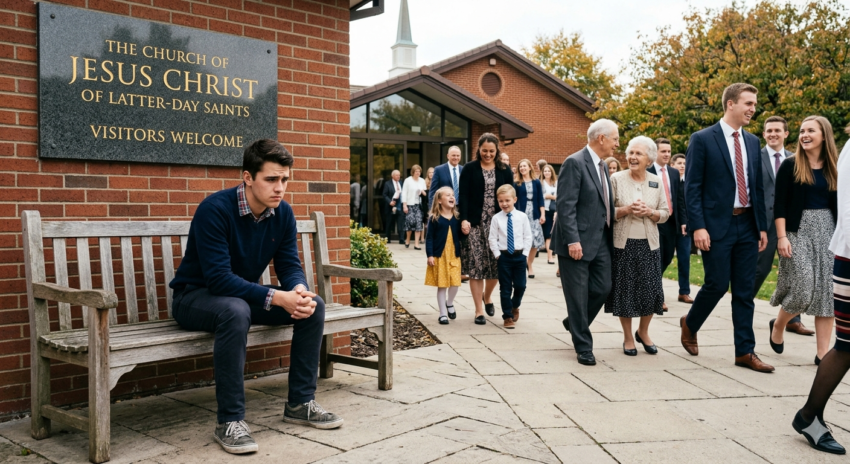
Image: An AI-generated image captures the visible sign and the invisible wall: A young man in worn-out sneakers and casual clothes sits in somber isolation on a bench under a “VISITORS WELCOME” sign, a stark contrast to the impeccably dressed and happy congregation walking past him. He feels the heavy burden of loneliness and the silent, invisible barrier that keeps him from feeling truly accepted in their midst.
The LDS Church and LGBTQ Individuals: From the Restoration to the Present Day
A Comprehensive Historical and Theological Examination, Including a Christian Perspective
Introduction: A Community at the Crossroads
Few religious institutions in modern American life have navigated the intersection of faith and sexuality with more turbulence, more consequence, or more international visibility than The Church of Jesus Christ of Latter-day Saints. For more than a century and a half, the LDS Church has engaged — sometimes reluctantly, sometimes aggressively, and occasionally with apparent tenderness — the reality of homosexuality within its pews, its policies, and its theology.
The stakes of this engagement could scarcely be higher. With a global membership approaching 17 million, the LDS Church exercises enormous cultural and political influence, particularly in the American West. Its teachings on family, gender, and sexuality are not peripheral doctrines but sit at the very center of its cosmological vision — a vision in which eternal marriage between a man and a woman is not merely a social institution but the very mechanism by which the Church believes that human beings may be elevated to divine status. To alter that vision would be, from within the tradition, to alter the structure of eternity itself.
And yet the world has changed. Since the mid-twentieth century, social, scientific, and legal attitudes toward homosexuality have undergone a revolution. Same-sex marriage became a constitutional right in the United States in 2015. Public consciousness of transgender experience has grown dramatically. Suicide rates among LGBTQ youth remain a recognized public health crisis. And within the LDS Church itself, thousands of gay, lesbian, bisexual, and transgender members — and the families who love them — have pressed the institution to reckon with their humanity in ways that cannot be deflected by policy memos alone.
This essay undertakes a comprehensive historical and theological examination of the LDS Church’s engagement with LGBTQ individuals, from the earliest days of the Restoration through the present. It draws on official church statements, general conference addresses, policy documents, scholarly research, and the testimony of LGBTQ Latter-day Saints themselves. It views this history from a traditional Christian perspective — one that takes Scripture seriously, values human dignity unconditionally, and believes that both truth and compassion are indispensable to any faithful engagement with this subject.
This is not a polemic against the LDS Church. It is an attempt to understand a complex institution grappling honestly — if sometimes painfully — with one of the most consequential moral questions of our time.
Part I: Theological Foundations — Why This Issue Cuts So Deep
The Plan of Salvation and the Centrality of Eternal Marriage
To understand why the LDS Church’s engagement with LGBTQ issues has been so intense and so consequential, one must first understand the theological architecture in which the question is embedded. Unlike mainline Protestant traditions, which typically ground their sexual ethics in biblical texts and natural law reasoning, the LDS Church approaches human sexuality through the lens of a distinctive cosmological narrative — what is called the Plan of Salvation, or the Plan of Happiness.
According to LDS doctrine, human beings are not merely physical creatures with immortal souls. They are the literal spiritual offspring of Heavenly Parents — a Heavenly Father and, in LDS theology’s more unusual formulation, a Heavenly Mother. According to The Church of Jesus Christ of Latter-day Saints, “premortal life refers to our life before we were born on this earth, when we lived in the presence of our Heavenly Father as His spirit children.” The Church teaches that “God gave us the gift of moral agency,” and that “in our premortal life, each of us chose to follow God’s plan and come to earth.”
LDS doctrine also says that mortality is a time “to receive a physical body and learn by experience,” and that God’s plan is for His children to “progress toward perfection and ultimately realize his or her divine destiny as an heir of eternal life.” The Church further teaches that “we are now being tried and tested to see if we will do all things whatsoever the Lord our God shall command us,” and that those who remain faithful may receive “the gift of exaltation—to live as a family in His presence.”
Central to this exaltation is celestial marriage — the sealing of a man and a woman in an LDS temple for time and eternity. As the Dialogue Journal’s scholarly summary of LDS cosmology explains, this binary of Heavenly Father and Heavenly Mother having given rise to billions of spirit children implies that gender is an eternal characteristic, fixed in the premortal existence and essential to one’s ultimate destiny. The implication for LGBTQ theology is immediate and significant: if gender is eternal and binary, and if exaltation requires an opposite-sex marriage sealed in the temple, then same-sex relationships cannot, by definition, lead to the highest degree of celestial glory.
“Latter-day Saint theology as it relates to LGBTQ issues centers on the origin and nature of being, agency, the purpose of mortality, and eternal salvation and exaltation.”
— Robert A. Rees & William S. Bradshaw, “LGBTQ Latter-day Saint Theology,” Dialogue Journal (August 20, 2020) | https://www.dialoguejournal.com/diablogue/lgbtq-latter-day-saint-theology/
The Family Proclamation: Doctrine Codified
In 1995, the Church of Jesus Christ of Latter‑day Saints issued one of its most significant modern documents: “The Family: A Proclamation to the World.” It was read by President Gordon B. Hinckley as part of his message at the General Relief Society Meeting held September 23, 1995, in Salt Lake City, Utah.
The proclamation declares that, “We, the First Presidency and the Council of the Twelve Apostles of The Church of Jesus Christ of Latter-day Saints, solemnly proclaim that marriage between a man and a woman is ordained of God and that the family is central to the Creator’s plan for the eternal destiny of His children.”
The Proclamation has been referenced repeatedly in church policy decisions, legal briefs, and general conference addresses since its publication. For LGBTQ Latter-day Saints, it has often functioned as the most direct articulation of why their relationships cannot be affirmed within LDS theology. For defenders of the traditional LDS position, it represents prophetic clarification on the eternal order of human identity.
The Law of Chastity
Beneath the grand cosmological vision lies a concrete behavioral standard: the Law of Chastity. The LDS Church teaches that all sexual expression outside of a legal marriage between a man and a woman is sinful — a category that encompasses premarital heterosexual sex, extramarital affairs, and all same-sex sexual activity. The law applies equally to all, in theory; in practice, it means that an LGBTQ member who wishes to remain in full fellowship with the Church must either enter a mixed-orientation marriage or embrace lifelong celibacy.
As the Human Rights Campaign’s analysis of LDS stances notes, the Church’s official position distinguishes sharply between same-sex attraction, which is not considered sinful, and same-sex sexual behavior, which is. This distinction — sometimes framed by the Church as offering a compassionate middle way — has been experienced by many LGBTQ members as a demand to suppress, hide, or indefinitely defer their most intimate human capacities.
Part II: Historical Origins — Silence, Stigma, and the Early Church
The Founding Era: A Subject Largely Unaddressed
The earliest period of LDS history — from Joseph Smith’s founding of the Church in 1830 through the pioneer migration to Utah — produced remarkably little formal doctrine on the subject of homosexuality. As many historians of sexuality observe, the habitual understanding of people in terms of fixed “homosexual” or “heterosexual” identities is a relatively modern development: only in the mid‑twentieth century did the homo/hetero binary solidify in U.S. culture as a framework for personal identity, replacing earlier ways of thinking about same‑sex behavior that did not center on orientation as a core self‑definition.
The historical record from the Nauvoo period does document what appears to be the first LDS disciplinary action with a homosexual dimension: the May 1842 excommunications of John C. Bennett and Francis Higbee. Bennett, a trained physician who served as Mayor of Nauvoo and Major-General of the Nauvoo Legion, was accused by William Smith of having sexual relations with men. Church records describe the offense as “a crime not fit to be named.” The incident is historically significant but contested; historians note that Bennett’s sexual behavior appears to have been broadly polyamorous rather than exclusively homosexual in the modern sense.
“Church records confirm that Higbee and Bennett were excommunicated: guilty of “a crime not fit to be named.””
— Andrew F. Smith, The Saintly Scoundrel: The Life and Times of Dr. John Cook Bennett; cited in “On the Record,” LatterGayStories.org (2023)
Beyond this episode, Joseph Smith himself appears to have made relatively few direct statements on homosexuality. The “On the Record“ historical compilation notes an interesting early account in which Smith spoke about men sleeping together in a loving embrace, viewing such a relationship as a strong bond — a statement that Mormon apologists interpret as entirely non-sexual, but which revisionist historians have read differently. What is beyond dispute is that homosexuality did not function as a major organizing concern of early Mormonism.
Sodomy Law in the Utah Territory: Brigham Young’s Era
Under Brigham Young’s leadership, the Utah Territory enacted its first law addressing sodomy in 1851, prohibiting “any man or boy” from engaging in sexual intercourse “with any of the male creation.” Historical legal analyses note that the 1851 statute proved unenforceable and that the new 1852 territorial code omitted sodomy entirely, effectively making such conduct legal under territorial law—a “curious” lacuna given Utah’s strong religious culture.
As historians of Mormon and Utah law point out, female homosexuality remained largely invisible in the legal and ecclesiastical records of the period, with early sodomy statutes and disciplinary patterns focused almost exclusively on men.
Young’s own statements on the subject, when they touched on it at all, were consistent with the harsh moralizing typical of Victorian religious leaders. The historical record from this period, as compiled in the “On the Record” document, suggests a strong religious stigma attached to sodomy even when the government showed no formal interest in prosecuting it.
The Late Nineteenth Century: George Q. Cannon and Public Condemnation
The first unambiguous public condemnation of homosexual behavior by a senior LDS leader occurred in 1897, when First Presidency member George Q. Cannon seized on the highly publicized criminal conviction of Irish poet Oscar Wilde to denounce homosexual behavior as an “abominable, filthy, nameless crime.” According to the Wikipedia timeline of LDS teachings on homosexuality, Cannon went further, stating that the only way to stop homosexuals was for God to wipe them out — a statement that reflects both the Victorian cultural moment and the theological seriousness with which the church was beginning to treat the subject.
Part III: The Twentieth Century — Institutionalization of Condemnation
The 1950s: McCarthyism, the Lavender Scare, and the Church’s First Formal Response
The mid-twentieth century transformation of American public discourse around homosexuality — accelerated by the McCarthyist “Lavender Scare,“ which conflated homosexuality with communist subversion — prompted the LDS Church to begin addressing the subject with increasing directness and alarm. As the scholar Seth Anderson observes on the Rational Faiths platform, Mormonism’s understanding of homosexuality shifted during this period from quiet disapproval to intense institutionalized concern.
In 1952, Apostle J. Reuben Clark became the first general authority to address homosexuality explicitly in a General Conference address, lamenting that homosexuality was found among men and women and that homosexual people exercised great influence in shaping culture. Clark’s address set a tone of social alarm that would characterize LDS public statements on homosexuality for the next several decades.
“Mormonism’s understanding of homosexuality shifts over time from quiet disapproval to intense institutionalized homophobia by the mid-20th century. The common theme that runs throughout Mormonism’s treatment of homosexuality is what I call “other as outsider” — the belief that homosexuality could be imported and spread but that it did not exist among the Saints.”
— Seth Anderson, “Timeline of Mormon Thinking About Homosexuality,” Rational Faiths (November 3, 2013) | https://rationalfaiths.com/timeline-of-mormon-thinking-about-homosexuality/
In 1958, General Authority Bruce R. McConkie published Mormon Doctrine, a widely influential volume in which he stated that homosexuality was among Lucifer’s chief means of leading souls to hell, and that — in a phrase that would be quoted for decades — “it is better to be dead clean, than alive unclean.” While the book was never officially endorsed by the Church’s First Presidency, it was treated by many members and leaders as authoritative and represented the prevailing theological consensus on the subject.
The Kimball Era: Curing the “Disease”
No figure looms larger in the LDS Church’s twentieth-century engagement with homosexuality than Spencer W. Kimball, who served as an apostle before becoming the Church’s twelfth president (1973–1985). Beginning in the 1960s, Kimball delivered a series of addresses that established what amounted to the Church’s official pastoral theology on homosexuality for an entire generation.
In 1964, Kimball called homosexuality a “malady,” a “disease,” and “an abominable and detestable crime against nature” — but crucially, he also declared it curable. He cited a lay bishop who ran a conversion therapy program, through which he claimed there had been “numerous cures,” and noted that police, courts, and judges were referring individuals directly to the church for treatment.
In a 1965 address at BYU, Kimball escalated his language further, calling homosexuality “a gross, heinous, obnoxious, abominable, vicious sin.” He declared that BYU “will not knowingly enroll nor tolerate anyone with homosexual tendencies who failed to repent,” and stated that it was “a damnable heresy for a homosexual person to say God made them that way.” He also made the remarkable claim that masturbation was sometimes an introduction to homosexuality.
Kimball’s 1969 book, The Miracle of Forgiveness, became a bestseller within the Church and was routinely given to missionaries. It reinforced his view that homosexuality, like alcoholism, was a condition that the sufferer could overcome through self-mastery, intense repentance, and righteous living. The book was later criticized heavily for the psychological and spiritual damage it caused to LGBTQ Latter-day Saints, many of whom internalized its message as a mandate to despise themselves.
Conversion Therapy at BYU: A Dark Chapter
The practical application of the “curable disease” framework played out most dramatically at Brigham Young University, the Church’s flagship university in Provo, Utah. As the Religious Info Service analysis documents, beginning in the 1950s, Church leaders authorized conversion therapy programs for homosexual students at BYU. Students who did not attempt to cure their homosexuality faced expulsion from both the university and the Church.
The conversion therapy administered at BYU included electroshock therapy, the administration of emetics and other nausea-inducing substances, and the screening of pornography — interventions now regarded by every major medical and psychiatric organization as harmful and ineffective. In 1962, homosexual students were asked to leave the university. By 1965, the first five gay suicides at BYU were recorded.
In 1976, under the administration of Dallin H. Oaks — now an LDS apostle and second counselor in the First Presidency — a program was reportedly launched to seek out gay students and expel them if they refused conversion therapy. Oaks has since denied the existence of such a program. In the same year, Apostle Boyd K. Packer delivered his infamous address “To Young Men Only,” in which he described a missionary companion’s confession of homosexual feelings and implied that the appropriate response was forceful rejection — a speech later criticized as an implicit endorsement of violence against gay individuals.
“The students (all male in all cases) therefore submitted to a series of electroshock therapies, the administration of emetics and other substances that have been used, along with the screening of pornography, to convert homosexuals.”
— Jakub Jahl, “Mormons’ Uneasy Relationship with LGBTQ People,” Religious Info Service (January 18, 2023) | https://novus2.com/righteouscause/wp-content/uploads/2026/04/mormons-lgbtq-2-parts-en-GB.pdf
Conversion therapy at BYU officially ended in 1981, the same year the Church published a confidential handbook for bishops on how to handle homosexual members. The handbook, only some copies of which were distributed to selected leaders under a secrecy requirement, contained chapters on the alleged causes of homosexuality (including dysfunctional families, poor peer relationships, and exposure to homosexuality at an early age) and created typological categories of homosexuals — “situational,” “rebellious,” and others — that reflect the psychological pseudoscience of the era.
The 1976–1989 Policy: Discipline for Attraction Itself
A particularly severe chapter in LDS policy history is the period between 1976 and 1989, during which the Church’s General Handbook of Instructions mandated disciplinary action not only for homosexual behavior but for members experiencing same-sex attractions — effectively equating the experience of homosexual desire with serious immoral conduct. This policy meant that a member who confessed to a bishop that they experienced attraction to persons of the same sex could face formal church discipline, even in the absence of any sexual activity.
The 1968 update to the Church Handbook had already specified that “homo-sexual acts require a church court.” The subsequent decades saw this framework tightened and formalized. It was not until the late 1980s and 1990s that Church leaders began, haltingly, to distinguish between attraction and behavior — a distinction that, for all its limitations in the eyes of LGBTQ advocates, represented a genuine shift in the pastoral approach.
Part IV: The Political Arena — Proposition 8 and the Marriage Wars
The LDS Church Enters the Marriage Debate
By the 1990s, the landscape of American politics had changed dramatically. The emergence of the modern LGBTQ rights movement, culminating in the first serious legal challenges to marriage law, forced the LDS Church into a new arena: electoral politics. The Church’s involvement in the marriage debate became one of its most consequential — and most criticized — chapters.
In 1993, same-sex marriage became the foremost public LGBTQ concern for the LDS Church. The Church supported the Hawaii constitutional amendment process and joined other faith groups in backing the federal Defense of Marriage Act in 1996. As Wikipedia’s article on homosexuality and the LDS Church notes, “the topic of same-sex marriage has been one of the church’s foremost public concerns since 1993.”
Proposition 8: All-In
The Church’s most consequential political intervention came in 2008, with California’s Proposition 8 — a ballot initiative to constitutionally define marriage as between a man and a woman, reversing a California Supreme Court ruling that had briefly legalized same-sex marriage. President Thomas S. Monson, who had assumed leadership of the Church in February 2008, sent a letter to California congregations directing them to become fully involved in the effort.
“The Church’s teachings and position on this moral issue are unequivocal. Marriage between a man and a woman is ordained of God, and the formation of families is central to the Creator’s plan for His children. Children are entitled to be born within this bond of marriage. We ask that you do all you can to support the proposed constitutional amendment by donating of your means and time.”
— President Thomas S. Monson, letter to California LDS congregations (June 2008), cited in QSaltLake Magazine (January 3, 2018) | https://www.qsaltlake.com/news/2018/01/03/lds-church-president-thomas-monsons-legacy-largely-lgbt-related/
Mormon members donated hundreds of thousands of dollars — some estimates place LDS-connected contributions at more than $20 million — and went door-to-door throughout California. The LDS Church produced television advertisements that flooded the California airwaves. When Proposition 8 passed on election night, the backlash against the Church was immediate and massive. Approximately 5,000 protesters surrounded the Salt Lake Temple just 36 hours after the vote. A second demonstration the following month drew many more. The Church’s involvement generated national media coverage and a documentary film.
The Proposition 8 campaign marked a turning point in how the LDS Church was perceived by the broader American public on LGBTQ issues. For many members — particularly younger Latter-day Saints and those with LGBTQ family members — the campaign was deeply troubling. The following years saw a measurable increase in membership departures and faith crises connected to LGBTQ issues.
Part V: The Policy Pendulum — 2015, 2019, and the Current Stance
November 2015: The “Exclusion Policy”
On November 5, 2015, the LDS Church introduced what became known among critics as the “Exclusion Policy“ — a set of handbook revisions that had two central elements. First, members in a “same-gender marriage, cohabitation, or other similar relationship” were now categorized as apostates, subject to formal church discipline, including potential excommunication. Second, and more explosively, children of same-sex couples were to be barred from receiving baptism, confirmation, and other ordinances until they were 18 years old — and only then if they disavowed same-sex cohabitation or marriage and received First Presidency approval.
The stated rationale was pastoral: the Church wished to avoid placing children in a position of conflict between their home environment and Church teachings. Critics argued that the policy punished children for their parents’ relationships and sent a devastating message about the worth of families headed by same-sex couples. The policy produced what observers described as the largest mass resignation in LDS history, with thousands of members formally resigning in the weeks that followed.
Bryce Cook, writing in his extensive examination of the LDS Church’s position on homosexuality — published through the Mormon LGBTQ Questions research project — compared the situation facing LGBTQ Latter-day Saints to that faced by Black members before the 1978 revelation extending priesthood and temple access, suggesting that the Church might similarly be in a period of incomplete understanding awaiting further revelation.
“The church’s positions and policies, particularly the November 2015 policy that labels members in same-sex marriages apostates and prohibits their children from receiving church ordinances, have caused some members to question the church’s stance and others to actually leave the church.”
— Bryce Cook, “What Do We Know of God’s Will for His LGBT Children? An Examination of the LDS Church’s Position on Homosexuality” | https://mormonlgbtquestions.com/wp-content/uploads/2017/10/an-examination-of-the-lds-church-position-on-hs.pdf
April 2019: The Reversal
On April 4, 2019, the Church reversed the 2015 policy in its most significant LGBTQ-related policy change in decades. President Russell M. Nelson announced that children of same-sex couples would once again be eligible for baptism and that same-sex marriage would no longer be categorized as apostasy for purposes of mandatory church discipline, though it remained classified as “a serious transgression.” The announcement was welcomed by many members and observers as a compassionate correction, while others — particularly those who had left the Church over the 2015 policy — expressed grief that the reversal had come too late for the harm already done.
As the Religious News analysis notes, the reversal reflected a broader shift in the Church’s public communications on LGBTQ issues — away from the language of cure and cure-adjacent programs, and toward an emphasis on pastoral inclusion, even as the underlying doctrinal restrictions remained unchanged. Yet the reversal stands out as especially striking, since Russell M. Nelson—now church president—was among the policy’s strongest proponents in 2015, insisting it was divine revelation straight from God. This about-face on what was once hailed as prophetic truth raises questions about the reliability of such “revelations,” suggesting they may bend to cultural pressures rather than timeless divine mandate.
The Current Stance: Attraction vs. Action
The LDS Church’s current official position, as articulated in its newsroom statement on same-gender attraction and reinforced by the updated Gospel Topics essay, rests on a fundamental distinction:
• Same-sex attraction is not a sin. Members may experience it, acknowledge it, and even identify with it (though the Church discourages use of identity labels like “gay” or “lesbian”) without violating Church standards.
• Same-sex sexual behavior — including marriage — is a sin, specifically a violation of the Law of Chastity. Acting on same-sex attraction can result in Church discipline.
• Members who experience same-sex attraction and remain celibate may hold callings, attend the temple, serve missions, and be in full fellowship with the Church.
• The Church has explicitly moved away from supporting or recommending conversion therapy, acknowledging that attempts to change sexual orientation are harmful and ineffective.
• Transgender members who transition medically or socially face restrictions on temple attendance and priesthood ordination.
The Church maintains the website “Gospel Topics: Same-Sex Attraction” and the companion platform originally known as “Mormon and Gay” (now part of the broader Gospel Topics structure) as resources for LGBTQ members seeking to navigate their faith within these boundaries.
“The experience of same-sex attraction is a complex reality for many people. The attraction itself is not a sin, but acting on it is. Even though individuals do not choose to have such attractions, they do choose how to respond to them.”
— The Church of Jesus Christ of Latter-day Saints, Official Statement on Same-Gender Attraction | https://newsroom.churchofjesuschrist.org/official-statement/same-gender-attraction
Respecting Marriage Act (2022): A Surprising Endorsement
In a development that surprised many observers, the LDS Church in November 2022 publicly endorsed the Respect for Marriage Act, a federal bill that codified same-sex marriage protections in federal law while including religious liberty protections. The Church’s statement expressed gratitude for legislation that “includes appropriate protections for religious liberty while respecting the laws and protecting the rights of our LGBTQ brothers and sisters” — the first time an official Church statement had used the phrase “our LGBTQ brothers and sisters” in an affirmative, non-disciplinary context.
“We are grateful for the continued efforts of those working to ensure that the Respect for Marriage Act includes appropriate protections for religious liberty while respecting the laws and protecting the rights of our LGBTQ brothers and sisters. We believe this approach is the way forward.”
— The Church of Jesus Christ of Latter-day Saints, official statement on the Respect for Marriage Act (November 2022), cited in Religious Info Service (January 18, 2023)
Part VI: Voices from the Crossroads — LGBTQ Latter-day Saints Speak
The Experience of Living at the Intersection
No examination of this subject is complete without attending to the voices of LGBTQ Latter-day Saints themselves — those who have lived at the intersection of deep faith and sexual minority identity. Their experiences span a wide spectrum, from those who have found peace within the Church’s framework of celibacy and community, to those for whom the Church’s teachings have been a source of devastating psychological and spiritual harm.
The Liahona magazine published a striking article in October 2021 by Ryan J. Wessel, a member writing from Utah, who called on fellow Latter-day Saints to actively work toward inclusion of LGBTQ brothers and sisters within their ward communities. The article represented the Church’s growing emphasis on creating belonging within the existing doctrinal framework — acknowledging the reality of LGBTQ experience while maintaining the behavioral standards.
The Dialogue Journal’s scholarly article “Mormon and Queer at the Crossroads“ documents the profound dislocation experienced by many LGBTQ Latter-day Saints — members who describe growing up internalizing teachings that their attractions were diabolical, sinful, or a sign of spiritual weakness, only to later confront the reality that no amount of prayer, therapy, or repentance changed their fundamental orientation.
The “On the Record” historical compilation, produced by LatterGayStories.org, documents the remarkable range of language used by church leaders to describe homosexuality and LGBTQ individuals across the institution’s history: “Diabolical, blasphemy, pervert, unnatural, abnormal, an affliction, immoral, impure, victim, under the control of Lucifer, weak, transgressor, evil, ridiculous, sinful, ugly, predator, sin of the ages, deceitful, abominable, detestable, crime against nature, malady, confused, degenerate…” The document presents this language as historical documentation, not for shock value, but to help readers “understand the progress that has been made” by seeing clearly where the Church has been.
“These are descriptors used by church leaders to define homosexuality and the LGBTQ+ community — in and out of the Church of Jesus Christ of Latter-day Saints.”
— “On the Record: A Chronological History of LGBTQ+ and LDS Church,” LatterGayStories.org (2023) | https://novus2.com/righteouscause/wp-content/uploads/2026/04/On-The-Record-4-2023.pdf
Suicide and Mental Health: The Crisis Within the Crisis
Perhaps the most tragic dimension of this history is its intersection with mental health and suicide. The first five recorded gay suicides at BYU were documented in 1965. In 2000, a BYU student’s death by suicide — attributed in part to a letter the university sent comparing homosexuality to zoophilia, pedophilia, and Satanism — attracted significant media attention. Research has consistently demonstrated elevated rates of depression, anxiety, and suicidal ideation among LGBTQ individuals who experience high levels of religious conflict about their identity.
The Church has increasingly acknowledged the mental health dimension of this issue, encouraging leaders and members to respond to LGBTQ individuals with compassion and to take concerns about suicide seriously. In 2016, Elder Jeffrey R. Holland gave an address acknowledging the pain of LGBTQ members and calling on fellow Saints to “lead with love” — a formulation that has since become something of a watchword in LDS pastoral approaches to the community.
David Matheson: A Cautionary Tale
One of the most instructive individual stories in recent LDS LGBTQ history is that of David Matheson, who for years served as one of the most prominent promoters of sexual reorientation within the Church — a man who testified to the possibility of changing one’s orientation, built a ministry around supporting others in doing so, and presented his marriage as evidence that it worked. In 2019, Matheson announced that his attempts to overcome his homosexual orientation had been unsuccessful, that he was leaving the Church, and that he was gay. His story became a symbol, for many observers, of the harm that results from institutional pressure to present a false narrative of change.
But even as I was “falling in love” and pursuing my wife-to-be, I had a sense that there was something overly rational about the transaction I was proposing. She felt it too; she told me that the date on which we first discussed marriage felt like a “business meeting.” Neither of us understood what that foretold. With years of hindsight, and the recent experience of falling in love with and proposing marriage to a man, it is clear that this heterosexual “romance” was prompted more by a need to follow the narrative that was demanded by religion than by love and desire. Yes, I wanted to be with someone. And yes, I wanted sex. But I pursued those normal human impulses with a woman only because I lacked the freedom to pursue them with a man, though I didn’t recognize that at the time.
– David Matheson, My Journey | https://www.davidamatheson.com/my-journey
Part VII: The Apologetic Perspective — Defending LDS Doctrine
FAIR Latter-day Saints and the Traditional Defense
Any honest examination of this subject must include the perspective of those within the LDS tradition who believe the Church’s doctrinal position is both scripturally grounded and compassionate. FAIR Latter-day Saints (the Foundation for Apologetic Information and Research) represents one of the most sophisticated articulations of this perspective, addressing the many questions that arise from the Church’s LGBTQ policies with careful theological reasoning.
FAIR emphasizes, for instance, that the Church does not teach that LGBTQ individuals cannot be full and valued members. Citing President Gordon B. Hinckley’s statements from 1998 and 1999, FAIR notes that the Church’s welcome extends explicitly to those who identify as gay or lesbian:
“My response is that we love them as sons and daughters of God. They may have certain inclinations which are powerful and which may be difficult to control. Most people have inclinations of one kind or another at various times. If they do not act upon these inclinations, then they can go forward as do all other members of the Church.”
— President Gordon B. Hinckley (1998), cited in FAIR Latter-day Saints | https://www.fairlatterdaysaints.org/answers/Homosexuality_and_the_Church_of_Jesus_Christ
FAIR also highlights President Russell M. Nelson’s counsel about identity labels — a counsel that applies to a wide range of social identifiers and not exclusively to sexual orientation. Nelson argues that any label which displaces one’s identity as a “child of God,” “child of the covenant,” and “disciple of Jesus Christ” can ultimately be spiritually limiting — regardless of what that label is.
The apologetic position also emphasizes that the Law of Chastity applies equally to all members, regardless of sexual orientation. A heterosexual single member is equally called to celibacy outside of marriage; the Church’s standard, from this perspective, is not discriminatory against same-sex attracted individuals but rather a universal call to sexual holiness within a specific theological framework.
Critics respond that the situations are not analogous, because heterosexual members have access to the possibility of marriage and family formation within the Church’s framework, while gay and lesbian members — barred from same-sex sealing ordinances — do not. This asymmetry, many argue, cannot be papered over with appeals to universal standards.
Part VIII: A Nuanced Christian Perspective on Human Sexuality
Scripture, Context, and Compassion: What the New Testament Actually Says
At this point, our examination must widen from the specific case of the LDS Church to consider the broader biblical and traditional Christian framework within which this essay is written. This essay approaches Scripture with the conviction that the Bible is the inspired, authoritative Word of God — and that faithful engagement with its teaching requires both careful interpretation and genuine love for the people the text concerns.
The New Testament passages most directly addressing same-sex behavior are Romans 1:26–27, 1 Corinthians 6:9, and 1 Timothy 1:10. It is important to engage these texts honestly, in their cultural and literary context, while also recognizing the profound pastoral implications they carry for real human lives.
Romans 1:26–27 — The Theological Context
Writing to the church in Rome, the Apostle Paul describes same-sex relations as part of a broader catalog of what he calls the consequences of humanity’s rejection of the knowledge of God. Paul writes: “For this reason God gave them up to dishonorable passions. For their women exchanged natural relations for those that are contrary to nature; and the men likewise gave up natural relations with women and were consumed with passion for one another, men committing shameless acts with men and receiving in themselves the due penalty for their error” (Romans 1:26–27, ESV).
Traditional Christian interpreters, including scholars at the Christian Research Institute, understand Paul’s argument here as rooted in natural law and creation order: the union of male and female reflects the complementarity of God’s design, and departures from that order are signs of the broader human condition of fallenness. As Joe Dallas writes in his examination of the “gay Christian” position for the Christian Research Institute, the fundamental question is whether believers are to “conform our sexuality to a revealed intent or to our own deeply ingrained preferences.”
“Should the authenticity of our sexual desires be the criteria by which we judge their rightness? If so, one wonders whether pedophilia, incest, or sadomasochism might not also be legitimized so long as they “seem right” to an individual.”
— Joe Dallas, “Answering the ‘Gay Christian’ Position,” Christian Research Journal (vol. 23, no. 1, 2000) | https://www.equip.org/articles/answering-the-gay-christian-position/
It is equally important, however, to note what Romans 1 does not say. The passage describes same-sex behavior as a symptom of a broader condition of idolatry and rebellion against God — a condition Paul proceeds, in chapters 2 and 3, to apply equally to his Jewish readers who may have felt smugly exempt. Romans 1 is not a polemic against a particular class of sinners; it is a mirror held up to all humanity, culminating in the declaration of Romans 3:23 that “all have sinned and fall short of the glory of God.”
1 Corinthians 6:9 — The Vice List and the Gospel
Paul’s epistles contain the New Testament’s primary critiques of same-sex acts. Romans 1:26–27 denounces women and men abandoning “natural relations” for “unnatural” ones. 1 Corinthians 6:9 and 1 Timothy 1:10 bar sinners—including two disputed Greek terms, malakoi (“soft,” often passive partners or effeminates) and arsenokoitai (Paul’s coinage from “male-bed,” evoking pederasty or exploitation)—from God’s kingdom.
Traditionalists read arsenokoitai as any male-male intercourse, rooted in Leviticus’ “lying with a male.” Revisionists limit it to exploitative acts like pederasty or prostitution, not consensual adult unions.
KJV (1611) emphasized deeds (“abusers with mankind”); RSV (1946) shifted to identity (“homosexuals”)—a theological choice, per critics. NIV offers “male prostitutes/homosexual offenders”; NRSVue hedges “illicit sex.” Paul’s novel term lacks pre-Christian use, fueling debate: ancient texts targeted power-laden behaviors, not innate orientations.
Amid debates over arsenokoitai, 1 Corinthians 6:11 offers this vital perspective: “And such were some of you. But you were washed, you were sanctified, you were justified in the name of the Lord Jesus Christ and by the Spirit of our God” (ESV).
Whatever theological side one takes, Paul spotlights God’s unmistakable transformative power over sin’s grip. The gospel doesn’t merely condemn; it redeems, washing and sanctifying every sinner equally through Christ. This promise of renewal transcends interpretive disputes, inviting all into freedom from bondage.
1 Timothy 1:10 — Law and Its Purpose
1 Timothy 1:9–11 places arsenokoitai (“sodomites” in NKJV) amid lawless acts “contrary to sound doctrine”—for the unrighteous, not the redeemed. Some scholars argue this targets exploitation, idolatrous rites, or pederasty, not consensual modern relationships, fitting the list’s gravity (murderers, kidnappers). Yet Paul insists the law diagnoses sin, driving sinners to Christ’s grace.
Knowing this: that the law is not made for a righteous person, but for the lawless and insubordinate, for the ungodly and for sinners, for the unholy and profane, for murderers of fathers and murderers of mothers, for manslayers, for fornicators, for sodomites, for kidnappers, for liars, for perjurers, and if there is any other thing that is [a]contrary to sound doctrine, according to the glorious gospel of the blessed God which was committed to my trust.
– 1 Timothy 1:9-11 | NKJV
This aligns with the Reformed third use of the law: a guide for holy living post-salvation. While revisionists narrow these texts to ancient abuses, traditional scholarship—spanning Catholicism, Orthodoxy, Protestantism, and LDS history—holds same-sex acts defy God’s creational design. Regardless, the gospel transforms: law exposes, grace redeems, for all.
Part IX: A Devotional Appeal — Holding Truth and Love Together
The Hardest Conversation in the Church
How should Christians — whether evangelical, Catholic, or Latter-day Saint — engage the LGBTQ individuals in their families, their congregations, and their communities? This is not an abstract theological question. It is one of the most practically urgent challenges facing the body of Christ in the twenty-first century.
The history we have surveyed in this essay should humble every person of faith who reads it. However one interprets the biblical texts on homosexuality, the historical record of how Christian institutions — including the LDS Church — have treated gay and lesbian individuals includes chapters of cruelty, neglect, psychological harm, and institutional betrayal that cannot be minimized or explained away. Electroshock therapy. The pathologization of identity. The shaming of children. The silencing of suicidal despair. Whatever one believes about the morality of same-sex relationships, these practices were not expressions of the love of Christ.
And yet the call of Scripture is not to choose between truth and love, as if they were competing values. The New Testament presents them as inseparable — as two aspects of the same divine character. Jesus, who said “Go and sin no more” to the woman caught in adultery, was the same Jesus who wrote in the dirt while her accusers were shamed into silence.
Leading with Love: What the Research and the Gospel Both Suggest
Research consistently demonstrates that LGBTQ individuals who feel loved, accepted, and supported by their families and faith communities — even when those communities maintain traditional moral positions — show dramatically lower rates of depression, anxiety, and suicidal ideation than those who feel rejected. This is not a call to abandon convictions. It is a call to recognize that how we hold and communicate our beliefs matters enormously for the people in our care.
An alumnus of Biola’s Talbot School of Theology, Caleb Kaltenbach’s perspective on engaging LGBTQ friends and family members is drawn from his evangelical Christian framework, emphasizing that the first responsibility of the Christian is not to correct but to listen, not to pronounce judgment but to build a relationship. The starting point of any genuine pastoral engagement with an LGBTQ person must be the acknowledgment of their full humanity, their worth as an image-bearer of God, and the reality of their experience.
Kaltenbach serves as lead pastor of a major church in Simi Valley, California, and is a married father of two. He brings a unique viewpoint to Christian-LGBTQ dialogue, shaped by his upbringing: his parents divorced and separately came out as gay and lesbian. Immersed in pride parades and LGBTQ social scenes as a child, Kaltenbach converted to Christianity and entered ministry as a young adult. He now navigates the challenge of upholding traditional biblical views on sexuality while maintaining deep love for his gay-identified parents.
The more Christians stop treating people in the LGBT community as “evangelistic projects” or “those people,” the more meaningful relationships will develop. Here’s the secret to engage in meaningful relationships with anyone: Treat people like actual people. Embrace the tension by developing friendships over meals, coffee and more. Engage in conversations. Try to understand who they are as a person (experiences, hopes, dreams, fears, etc.). Don’t seek to “fix” anyone, but point to Christ. Here’s a hard truth I came to learn over the years: It’s never been my job to change someone’s sexual attraction. God didn’t call me to “restore” LGBT people to a straight orientation. It’s not even my job to change lives. It’s God’s job. He has great experience in the “life change department.” My responsibility is to love people, make friends and journey with them.
– Caleb Kaltenbach, How Should Christians Respond to Gay Friends or Family Members?
This does not mean pretending that Scripture says something it does not. It means recognizing that a person who is wrestling with the deepest questions of identity, belonging, and faith deserves a conversation partner who has actually thought carefully about those questions — not a pamphlet, a policy, or a platitude.
For the LGBTQ Person Reading This
If you are an LGBTQ individual reading this essay, whether Latter-day Saint or otherwise, the writer wishes to speak directly to you: your life has value that is not contingent on your sexuality, your behavior, your church standing, or any human verdict about your worth. You are known by God, and the same Jesus who received tax collectors, prostitutes, and social outcasts into his presence — who touched the leper and spoke to the Samaritan woman — is not repelled by your complexity or your questions.
The traditional Christian understanding of sexuality, honestly held, does not require contempt for people whose experience differs from the expected norm. What it requires is integrity, humility, and the recognition that the cross is the only ultimate answer to the problem of human fallenness — and the cross stands equally over all of us.
The church — in all its traditions — is called to be a community of people who are honest about their own brokenness, who extend to others the grace they have received, and who refuse to use the language of holiness as a weapon. If that community has sometimes failed in this calling — as the history surveyed in this essay makes painfully clear — then repentance, not denial, is the appropriate response.
Part X: Institutional Consequences — Membership, Credibility, and the Future
The Cost of the Policy Wars
The LDS Church’s engagement with LGBTQ issues has carried high institutional costs. The Proposition 8 campaign, widely seen as the Church’s most aggressive political intervention in the marriage debate, generated a backlash that accelerated the “faith crisis” phenomenon already underway among younger Latter-day Saints. The 2015 Exclusion Policy produced what observers described as the largest mass resignation event in LDS history. Research by sociologists of religion suggests that LGBTQ issues have become one of the primary drivers of Mormon disaffection, particularly among Millennials and Generation Z.
The Church’s response to these trends has been multifaceted. On the one hand, it has maintained its core doctrinal commitments without alteration. On the other hand, it has invested significantly in pastoral resources, updated its communications on LGBTQ issues to emphasize compassion and inclusion, distanced itself from conversion therapy, and — in the case of the Respect for Marriage Act — offered a striking signal that it is capable of distinguishing between its theological convictions and its political engagement on LGBTQ rights.
The Question of Revelation
Within the LDS tradition, the most profound question raised by this history is not sociological but theological: Could the Church’s current position on homosexuality be subject to revision through prophetic revelation, as its 1978 revelation extending priesthood to all worthy male members reversed a century of racial restriction?
Many LGBTQ Latter-day Saints and their allies believe the answer is yes — and point to the 1978 revelation as evidence that the LDS understanding of God’s will can undergo substantial revision. Others, including most of the current Church leadership, argue that the heterosexual, binary foundation of LDS cosmology is not a policy but a theological constant — as unchangeable as the nature of God.
Bryce Cook’s scholarly examination of the LDS position draws the parallel explicitly: just as Lester Bush’s 1973 article on the historical origins of the priesthood ban helped create the intellectual and spiritual conditions for the 1978 revelation, perhaps a similar process of honest examination could prepare the way for a new understanding of God’s will for LGBTQ Latter-day Saints.
Whether or not one accepts the LDS claims to continuing revelation, the question is a serious one — and the answer, if it ever comes, will almost certainly emerge from within the tradition itself, shaped by the faith, struggle, and testimony of LGBTQ Latter-day Saints who have refused to abandon either their Church or their integrity.
Part XI: Traditional Christianity’s Parallel Reckoning
The Broader Evangelical and Protestant Response
The LDS Church’s struggle with LGBTQ issues mirrors, in many ways, a broader conversation taking place across the entire spectrum of traditional Christianity. Evangelical Protestant communities, Roman Catholic parishes, and Eastern Orthodox congregations are all wrestling with the same fundamental tension: how to maintain fidelity to what they understand as biblical teaching while also responding with genuine love and pastoral care to the LGBTQ individuals in their midst.
The Christian Research Institute’s analysis of the “gay Christian” position — representing the traditional evangelical perspective — argues that the revisionist reinterpretation of biblical texts on homosexuality rests on a fundamental willingness to let personal experience determine theological conclusions, rather than allowing theology to engage and sometimes challenge experience. Author Joe Dallas, drawing on his own experience as a former staff member of the Metropolitan Community Church, argues that the question “Is there a divine intent for sexual expression?” is the crux of the matter — and that for believers who take Scripture seriously, the answer shapes everything else.
Yet traditional Christianity’s engagement with this question has also, at its best, produced voices of remarkable pastoral sensitivity. Writers and thinkers associated with organizations like Biola University have emphasized that the first obligation of Christian community is not to enforce behavioral compliance but to create environments of genuine belonging — places where LGBTQ individuals can be honest about their experience without fear of contempt or rejection, even within a framework that maintains traditional moral convictions.
The reality is that man Christian congregations — regardless of denomination or tradition — almost certainly includes members who experience same-sex attraction. Many of them are silent. Many of them are suffering. Many of them are longing to know whether their faith community sees them as beloved children of God or as problems to be managed. The answer a congregation gives to that longing — through its language, its culture, its pastoral care, and the quality of its human relationships — may matter more than any doctrinal statement it publishes.
Conclusion: The Long Arc of a Complex History
The LDS Church’s LGBTQ journey—from BYU’s 1950s electroshock horrors to the 2021 Liahona’s measured welcome, Kimball’s fierce denunciations to tender testimonies of faithful queer Saints, Prop 8’s fervor to the Respect for Marriage Act nod—reveals conviction clashing with culture, rigidity yielding to compassion.
Yet this saga mirrors broader flaws in Mormon cosmology: a theology “tossed to and fro by every wind of doctrine” (Eph. 4:14), diverging from biblical Christianity on God’s nature, Christ’s atonement, and salvation’s means. LGBTQ struggles expose a system prioritizing institutional image over gospel truth, chasing societal winds rather than anchoring in eternal verity.
For traditional Christians outside the LDS tradition, this history offers both a cautionary tale and a challenge. The cautionary tale: institutions that define faithfulness primarily by enforcing behavioral compliance, and that mistake cruelty for conviction, will eventually produce a generation that walks away — not from God, but from the institution that failed to represent him well. The challenge: engaging sexual ethics with both theological integrity and genuine human compassion is not a choice between two goods, but a demand that requires the best of what faith communities have to offer.
The Apostle Paul, in the very passage (Romans 1) most frequently cited in debates about homosexuality, proceeds — after cataloging the sins of the Gentiles — to turn the mirror on his Jewish readers: “You who pass judgment on someone else, for at whatever point you judge another, you are condemning yourself, because you who pass judgment do the same things” (Romans 2:1, NIV). The grace that the gospel offers is not reserved for those who have their sexuality resolved. It is extended to all who are broken, which is everyone.
This dialogue demands attention from every faith community. Its resolution—in evangelical megachurches, Catholic parishes, or small congregations where an LGBTQ individual sits in the third pew, silently questioning their belonging—will define the church’s gospel witness more than nearly any other action. Do we proclaim Christ’s transforming grace for all sinners, or erect barriers that echo Pharisaic exclusion? The world watches.
PRIMARY SOURCES AND REFERENCES
The following primary sources were consulted and cited in this examination:
- FAIR Latter-day Saints — Homosexuality and the Church of Jesus Christ
- Wikipedia — Homosexuality and the Church of Jesus Christ of Latter-day Saints
- Wikipedia — Timeline of teachings on homosexuality in the LDS Church
- Wikipedia — Timeline of LGBTQ Mormon history in the 1950s
- LDS Church Newsroom — Official Statement on Same-Gender Attraction
- LDS Liahona — “Understanding and Including Our LGBT Brothers and Sisters”
- Human Rights Campaign — Stances of Faiths on LGBTQ+ Issues: LDS
- “On the Record” — LatterGayStories.org (The Righteous Cause archive)
- Mormons’ Uneasy Relationship with LGBTQ People — Religious Info Service
- Bryce Cook — “An Examination of the LDS Church Position on Homosexuality”
- Seth Anderson — “Timeline of Mormon Thinking About Homosexuality,” Rational Faiths
- Robert A. Rees & William S. Bradshaw — “LGBTQ Latter-day Saint Theology,” Dialogue Journal
- QSaltLake — “LDS Church President Thomas Monson’s Legacy Largely LGBT-Related”
- Joe Dallas — “Answering the ‘Gay Christian’ Position,” Christian Research Institute
- Biola University — “How Should Christians Respond to Gay Friends or Family?”
- Twelve Stones — “Christ, Love and LGBTQ”
- Southern Evangelical Seminary — “Can You Be Gay and Christian?”
- The Advocate — “From Contradictions to Compassion, the LDS Church Struggles with LGBTQ+ Inclusion”
- Dialogue Journal — “Mormon and Queer at the Crossroads”
- Dialogue Journal — “Queer Mormon Histories and the Politics of a Usable Past”
A Note on Research Methods and Accuracy
In recent years, some have voiced concern that artificial intelligence may distort facts or introduce inaccuracies into serious research. That criticism deserves acknowledgment. However, AI has now evolved into the most powerful research instrument available to any dedicated scholar—capable of analyzing vast datasets, cross‑referencing historical records, and surfacing overlooked connections across sources. This work represents a collaboration between the author’s theological and historical inquiry, verified primary documentation, and the advanced analytic capabilities of AI research tools. Here, AI was not used as a ghostwriter or a shortcut for scholarship, but as a disciplined research partner devoted to rigor, accuracy, and transparency.
Every factual claim in this work has been subjected to active verification. Where AI‑generated content was used as a starting point, it was tested against primary sources, peer‑reviewed scholarship, official institutional documentation, and established historical records. Where discrepancies were found—and they were found—corrections were made. The author has made every reasonable effort to ensure that quotations are accurately attributed, historical details are precisely rendered, and theological claims fairly represent the positions they describe or critique.
That said, no work of this scope is immune to error, and the author has no interest in perpetuating inaccuracies in the service of an argument. If you are a reader—whether sympathetic, skeptical, or hostile to the conclusions drawn here—and you identify a factual error, a misattributed source, a misrepresented teaching, or a claim that cannot be substantiated, you are warmly and genuinely invited to say so. Reach out. The goal of this work is not to win a debate but to get the history right. Corrections offered in good faith will be received in the same spirit, and verified corrections will be incorporated into future editions without hesitation.
Truth, after all, has nothing to fear from scrutiny—and neither does this work.