
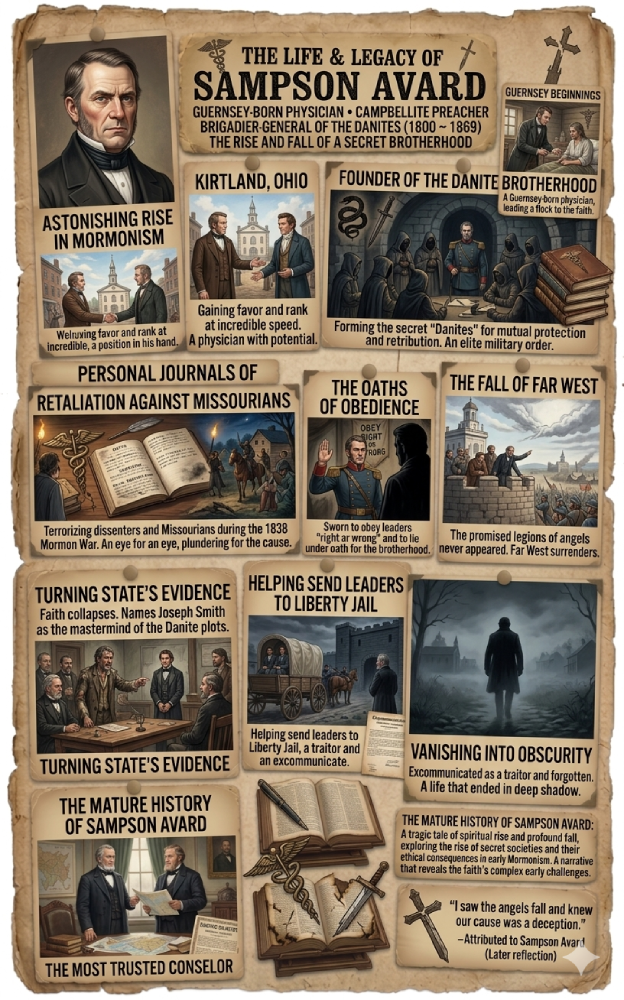
EARLY MORMON PERSONALITIES — FIFTEENTH INSTALLMENT
Sampson Avard and the Education of a Holy Vengeance
Introduction: A Man Looking at the Sky
On the last day of October 1838, a tall, restless physician stood near the unfinished temple lot at Far West, Missouri, and turned his face toward heaven. The autumn light was hard and thin. Below him, columns of state militia were tightening around the Mormon town like a closing fist, and the men of the city, hungry and frightened, gripped their rifles behind hasty barricades. But Sampson Avard was not watching the soldiers. He was watching the sky.
He had been promised a miracle. The Prophet Joseph Smith, he later recalled, had assured the Saints that no harm would befall them, that when the militia reached Far West, a legion of angels would descend directly over the temple lot and sweep the mob away in a single stroke of divine destruction. Avard believed it. He had staked everything on it. And so he positioned himself where he might see the heavens crack open, and he waited for the angels to come.
Smith … assured them they were in no danger from the militia; that when the militia should reach Far West a legion of angels were to descend … and sweep the mob with a lesson of destruction … [Avard] stationed himself near temple lot as the militia approached, and while looking up to see the heavens open and the angels appear, there came a runner to tell him that Joseph and the other leaders had surrendered, and he said, ‘I lost all faith and am no longer a Mormon.’
— Sampson Avard, recalled in the Liberty Tribune (Liberty, Missouri), 9 April 1886
No angels descended. Instead, a messenger arrived with news that broke him in two: the Prophet and the other leaders had surrendered without a fight. In that instant, the scaffolding of Avard’s faith collapsed, and the man who had spent the summer drilling a secret army in oaths of blood and vengeance turned, fled into the brush, and within a fortnight stood in a Richmond courtroom as the chief witness against the very Prophet he had served. His testimony would help send Joseph Smith to Liberty Jail through a brutal Missouri winter. His name would become, for generations of Latter-day Saints, a synonym for treachery.
Yet to dismiss Sampson Avard as a mere villain is to miss the deeper and more disquieting story. He was not a stranger who crept into the Church to corrupt it, nor a cartoon Judas. He was a gifted, devout, ferociously ambitious man—a Channel Islander, a Campbellite preacher, a frontier doctor—who came to early Mormonism hungry for significance and found, in the besieged communalism of Far West, a doctrine of holy violence that gave his ambition a sacred shape. The tragedy of Avard is not that he was alien to the movement, but that he was so very much its product. To understand him is to peer into a question that the Latter-day Saint tradition has wrestled with, sanitized, and re-fought for nearly two centuries: how much of the Danite fury was the work of one rogue zealot, and how much flowed from the top of the Church itself?
This is the fifteenth installment in our series on early Mormon personalities. It is offered not as polemic but as portrait—an attempt to take the measure of a complicated man, to follow the thread of his choices, and to ask what his story reveals about the difference between the kingdom Joseph Smith was building and the kingdom of God revealed in Scripture.
❦ ⁂ ❧
Origins and Early Life: From the Channel Islands to the Capital
Sampson Avard was born on 27 October 1800 (some records say 1803) in St. Peter Port, the principal town of Guernsey, one of the Channel Islands lying off the coast of Normandy in the English Channel. It was a place defined by its in-between-ness: legally British, culturally half-French, its economy built for generations on privateering and smuggling. With the peace of 1814 that ended the long wars with France, the bottom dropped out of that economy, and a wave of islanders left in search of opportunity abroad.
The Avards were among them. Around 1818, the family—apparently led by Sampson’s mother, Ann, his father seemingly already dead—immigrated to the United States and settled in Georgetown, in the District of Columbia. It was not a promising landing place. The capital was still raw from the devastation of the War of 1812. One Englishman passing through in 1817 described it bluntly as a place of “fine natural scenery, but no decidedly great natural advantages; little external commerce, a barren soil, a scanty population.” As the eldest or second son in a fatherless household, the young Sampson likely shouldered much of the burden of keeping the family afloat—a circumstance that may help explain the driving, status-hungry ambition that would mark his entire life.
He remained in Georgetown for about a decade. In 1828, he married Eliza H. Ball, a Virginian; a daughter, Virginia, followed within a year, and the family relocated to Frederick County, Virginia, where a son, John, was born in 1830. It was in these years of young fatherhood and frontier striving that two forces took hold of Sampson Avard’s imagination and never let go: religion and medicine. Both promised the same thing—a way up, a way to matter.
❦ ⁂ ❧
The Spiritual Quest: Campbellism, Medicine, and a Restless Heart
The America of the 1820s and 1830s was a furnace of religious enthusiasm, the period historians call the Second Great Awakening. Into the river valleys of Ohio, western Pennsylvania, and what is now West Virginia poured a movement of reform-minded preachers led by Alexander Campbell—the Campbellites, or Disciples of Christ. Their cry was a return to “primitive” New Testament Christianity, stripped of creeds and “all historic human theology.” It was a restorationist impulse, a longing to leap backward over eighteen centuries of church history and recover an apostolic purity presumed lost.
Sampson Avard embraced it and began to preach. At the same time, he took up the practice of medicine—almost certainly one of the irregular, self-taught systems common to the era, most likely Thomsonianism, a botanical movement that rejected the calomel and bloodletting of regular physicians in favor of herbs, diet, and temperance. A man could become a Thomsonian practitioner for the price of an instruction book and a license, both sold by traveling agents for twenty-two dollars. Regular doctors dismissed such men as quacks; one called the irregular practitioner “a demagogue” who relied for his success on “nearly the same arts, with his political and religious brethren.” The phrase is unkind, but it captures something true about Avard: he was a man perpetually selling a remedy, religious or medical, and perpetually moving on when the market proved cold.
That restorationist hunger—the conviction that the true church had vanished and must be restored—is precisely the soil in which Mormonism flourished. Campbellism and the new Latter Day Saint movement were competing answers to the same question, and Mormon missionaries reaped a remarkable harvest among the Disciples. Sidney Rigdon himself, soon to be Joseph Smith’s chief spokesman, had been a Campbellite luminary before his conversion. When the restless Dr. Avard collided with Mormonism, he was meeting a more audacious version of a story he already believed.
Conversion: “I Baptized Three in Freedom”
In 1835, Avard moved his family once more, to Beaver, Pennsylvania, where he set up his medical practice and resumed preaching in a community that was neither receptive to religious reform nor short of doctors. It was, in short, another cold market. But it was there that he encountered the Church’s newspaper, the Messenger and Advocate, and in late September or early October wrote to its editor, Oliver Cowdery, in Kirtland, Ohio, asking to know more. Cowdery wrote back, explaining “the first principles of the gospel” and urging a visit.
Shortly after, the apostle Orson Pratt arrived on a mission in Beaver County. The result was recorded in Pratt’s own hand in the November 1835 Messenger and Advocate:
I baptized three in Freedom [Beaver County], one of which (Sampson Avard) I ordained an elder; he formerly had belonged to the Campbellites, and had preached among them. After parting with two books of Mormon, four books of Revelations, and obtaining 14 subscribers for the Messenger and Advocate, I left them with Elder Avard to continue the work.
— Orson Pratt, Messenger and Advocate, November 1835
The convert’s ambition surfaced almost at once. Excited by his new faith, Avard wrote Cowdery again, asking whether he might relocate to Kirtland to establish a medical practice, deliver a lecture series on philosophy to the Saints, and have his wife open a female school. The reply was discouraging—the Church already had a physician, and the Saints were preoccupied with the School of the Prophets and a coming migration to Missouri. Avard stayed in Beaver and served as a branch president, but a pattern was already visible: wherever he stood, his eyes were fixed on a larger stage. Notably, his family did not share his zeal. When he finally moved to Kirtland in 1837, they did not follow, and his wife and children apparently never joined the Church at all.
❦ ⁂ ❧
Ascent and Stumble: Kirtland, Canada, and the First Warning
In Kirtland, Avard rose with startling speed. He received his patriarchal blessing, took his endowment in the Kirtland Temple in April 1837, was ordained a high priest, and sat on the high council that same May. He went into business with Sidney Rigdon and Zebedee Coltrin, establishing a mercantile firm. Within weeks of arriving, this newcomer from a Pennsylvania backwater had inserted himself into the leadership and commerce of the gathering place of the Saints. One observer noted that Avard and Rigdon were “on quite intimate terms,” and that Rigdon was “considerably tinctured with the ideas and spirit” of the doctor—a telling glimpse of Avard’s persuasive force over a man who would soon be preaching extermination.
But Kirtland in 1837 was a town coming apart. The Kirtland Safety Society—the Church’s ill-fated bank—was collapsing, and with it the confidence of many Saints in Joseph Smith’s leadership. A faction of dissenters, convinced the Prophet had fallen, met in the temple to discuss replacing him with David Whitmer. Brigham Young remembered it as “a crisis when earth and hell seemed leagued to overthrow the Prophet and Church of God,” when “the knees of many of the strongest of men in the Church faltered.” Among those whose knees faltered was Sampson Avard.
The Canadian Coup
When the dissenters’ bid to seize the Church in Kirtland failed, they turned to its branches in Upper Canada, and they chose Avard as their instrument. Armed with a letter purporting to authorize him to replace John Taylor as president of the Church in Canada, Avard set out for Toronto in June 1837, reorganizing branches along the way and sending men on missions as though he held genuine authority. Reaching Taylor’s house, he announced himself as the new president; Taylor, examining the letter, gave way and departed on a mission of his own.
The deception lasted only weeks. When Joseph Smith himself toured the Canadian branches in late July, accompanied by Rigdon and Thomas Marsh, he went straight to John Taylor—and was baffled to find Taylor had surrendered his presidency to Avard. As Taylor later recalled, Smith “stated that he [Avard] was never sent, and that I had no business to give up my presidency to him … He seemed very much annoyed.” Catching up with Avard at a conference in Scarborough, Smith reproved him sharply, suspended him from office, and ordered him home.
This episode deserves close attention because it is the Rosetta Stone of Sampson Avard’s character. Here, fully a year before the Danites, is the entire pattern in miniature: a man who exploits ambiguous lines of authority to seize a command that was never his, who acts “in the name” of a leader who never sent him, and who is found out and cast down. For years, this Canadian episode rested chiefly on B. H. Roberts’s account; it has since been corroborated by the journal of Joseph Horne, a Church member who rode to Canada with Avard and witnessed the attempted takeover firsthand. The man who would later swear that Joseph Smith secretly commanded the Danites had already, once before, claimed an authority that was a fabrication.
❦ ⁂ ❧
Far West and the Birth of the Danites
By the start of 1838, dissent and lawsuits had driven Joseph Smith and Sidney Rigdon out of Kirtland altogether, and they fled to Far West, Missouri—only to discover that dissent had preceded them. A group of prominent Missouri Saints, including Oliver Cowdery, David Whitmer, John Whitmer, and W. W. Phelps, had grown estranged from the leadership and were corresponding with the Kirtland apostates. By mid-April, these men had been excommunicated, but they remained in Far West, influential and unsettling, a constant reminder of how quickly a community could fracture from within.
Into this charged atmosphere, Sampson Avard arrived in late May 1838, his Kirtland charges resolved and his high priesthood restored. He brought his family this time, settling them in nearby St. Joseph, and he threw himself back into the life of the Church—renewing his friendship with Rigdon, practicing medicine, and, within weeks, transforming his posture toward the dissenters from courtesy to contempt. Cowdery, who had once corresponded with him, now wrote that Avard “appears very friendly, but I look upon him with so much contempt, that he will probably get but little from me.”
The Saints of 1838 were a people who believed, with reason, that they were fighting for survival. They had been driven from Jackson County by mobs in 1833 and bled by apostates in Kirtland. Joseph Smith had prophesied that Missouri was Zion, the chosen gathering place, and now their very presence—their numbers, their bloc voting, their northern and antislavery sympathies—inflamed the old Missourians around them. It is essential to hold this context steadily in view: the Danites did not rise in a vacuum of malice, but in a real and recurring nightmare of persecution. The question early Mormonism faced was not whether the threat was real—it was—but how a people of faith should answer it.
The Brother of Gideon and the Salt Sermon
In the first week of June 1838, Jared Carter and Dimick Huntington called a secret meeting to discuss how to be rid of Cowdery and the other dissenters. Reed Peck would later allege that some present proposed simply to “kill these men” so they could not injure the Church—a proposal that John Corrill and Thomas Marsh, still loyal at that point, argued down. No firm plan emerged, but the meeting gave birth to a new fellowship within the body of the Saints, first called “the Brother of Gideon” after Jared Carter.
Then, on 17 June, Sidney Rigdon mounted the pulpit and preached what became infamous as the “Salt Sermon.” Taking as his text the words of Christ about salt that has lost its savor—good for nothing but to be cast out and trodden underfoot—Rigdon applied them to the dissenters. Reed Peck recorded the chilling escalation:
From this scripture [Matthew 5:13] he undertook to prove that when men embrace the gospel and afterwards lose their faith it is the duty of the Saints to trample them under their feet … and if the county cannot be freed from them any other way I will assist to … erect a gallows on the square of Far West and hang them up … and it would be an act at which the angels would smile with approbation.
— Reed Peck, manuscript account of Sidney Rigdon’s “Salt Sermon,” 17 June 1838
The next day, the marked men received a letter—later called the “Danite Manifesto”—demanding that they leave the county within three days, “or a more fatal calamity shall befall you.” Eighty-three Mormons signed it, among them Hyrum Smith, Jared Carter, and Sampson Avard. The letter’s prose throbbed with the new spirit: vengeance, it warned, “sleepeth not, neither does it slumber,” and would overtake the dissenters “as furious as the mountain torrent, and as terrible as the beating tempest.” Within days, the dissenters fled to neighboring counties—robbed, by John Whitmer’s account, “of all their goods save clothing and bedding.” The internal purge had succeeded. The Brother of Gideon had drawn its first blood, if only in property and terror.
Brigadier-General of the Daughter of Zion
By the end of June, the organization was reconstituted under a new and biblical name—the “Daughter of Zion,” soon and lastingly known as the Danites, after the prophecy of Daniel that the Saints should “take the kingdom and possess it forever.” And Sampson Avard, the eloquent doctor with the gift for command, was made its brigadier-general and its principal teacher. He explained the society’s rules and aims at its weekly meetings, which gathered in secluded, guarded places and bound their members with oaths of secrecy. The band grew swiftly; John Corrill estimated three hundred members—roughly a third of the Mormon men in Missouri—though the historian D. Michael Quinn would later argue, from the testimony of Danites such as John Sapp and Anson Call, for numbers running into the high hundreds and a claim that nearly the whole fighting force at Far West had become Danites.
For a few summer weeks, Sampson Avard stood at the height of his life. On the Fourth of July, he took the reviewing stand beside the Danite leadership as the militia and the Church passed in parade, and watched the cornerstones of the temple laid. Then Rigdon rose to deliver the oration the Church would call its “Declaration of Independence,” and spoke the words that Brigham Young would later name “the prime cause of our troubles in Missouri”:
And that mob that comes on us to disturb us, it shall be between us and them a war of extermination; for we will follow them until the last drop of their blood is spilled; or else they will have to exterminate us, for we will carry the seat of war to their own houses and their own families, and one party or the other shall be utterly destroyed.
— Sidney Rigdon, Fourth of July Oration, Far West, 1838
The language of extermination, soon to be turned against the Saints in Governor Boggs’s notorious order, was first loosed by the Saints themselves. Avard’s Danites were the instrument forged to make good on it.
❦ ⁂ ❧
The Danite Months: Oaths, Plunder, and “Sign or Die”
Through July and August, the Danite organization expanded its reach into three domains: enforcement, politics, and war. Avard pressed the Saints to obey the newly revealed law of consecration—threatening, by one account, to beat those who filed lawsuits against the leadership—and when consecration faltered, urged the formation of communal agricultural firms. He also turned the band to politics. Days before the August county elections, he announced that the Danites had neglected their duty in failing to inquire of the Lord, through the Prophet, whom the Saints should support; a slate was duly drawn up by the Presidency, printed, and distributed by the Danites across Caldwell County. Every candidate on the ticket was elected. Even sympathetic men were uneasy; Corrill admitted that “many saw that it was taking unfair advantage of the election and were extremely dissatisfied,” the murmuring “soon put down by the Danite influence.”
It was in Daviess County, where the Saints were a minority, that the doctor’s ferocity showed its edge. After an election-day brawl at Gallatin, Avard led an armed company—the First Presidency among them—to Adam-ondi-Ahman. There, on 8 August, a party called on the local justice of the peace, Adam Black, demanding he sign a pledge to keep the peace. Avard, leading a small group into the house, presented the document and, in Black’s account, told him he “must sign it, or die.”
Black’s testimony preserves the single most revealing exchange of Avard’s Mormon career. As the men were leaving, the judge said, Avard threatened that “he could shoot a man who would not sign the obligation and drink his heart’s blood.” Disturbed, Black turned to Joseph Smith and asked whether the Prophet “protected Dr. Avard in his savage disposition, or if he possessed such a heart”—and Smith, Black recalled, “replied no.”
He could shoot a man who would not sign [the] obligation and drink his heart’s blood.
— Adam Black, testifying to the words of Sampson Avard, Richmond Court of Inquiry
That exchange marks the fault line that would define everything to come. John Corrill testified that when Joseph Smith addressed the Danites in late June, his remarks were comparatively restrained—that he “wished to do nothing unlawful, and, if the people would let him alone, they would preach the gospel and live in peace.” Whatever Smith’s private intentions, the Prophet appears to have favored a posture of armed defense, while Avard preached an offensive doctrine of vengeance, plunder, and the building of the kingdom upon the spoils of the ungodly. After the Black affair, Smith removed Avard from his Danite command—a demotion Avard himself acknowledged under oath: “I once had a command as an officer, but Joseph Smith removed me from it.” From that point, his role shrank steadily. When the Saints rode to Daviess in October, he went along merely as a surgeon; when the Battle of Crooked River was fought on 25 October, he had chosen to stay home and sleep, joining only the relief party that carried back the wounded.
❦ ⁂ ❧
Eyewitness Perspectives: The Man as Others Saw Him
Few early Mormon figures left behind such a vivid and contradictory gallery of impressions. To his admirers in the days of his prominence, Avard was magnetic. John D. Lee, who would later die before a firing squad for his part in the Mountain Meadows Massacre, remembered that “in the days of our prosperity [Avard] had looked like an angel to me.” The pioneer Peter Burnett, who would become the first governor of California, recalled him as a man of formidable gifts:
A very eccentric genius, fluent, imaginative, sarcastic, and very quick in replying to questions.
— Peter H. Burnett, Recollections and Opinions of an Old Pioneer (1880)
After the betrayal, the portrait darkened. John Corrill—himself a dissenter and no friend of the leadership—pronounced Avard “as grand a villain as his wit and ability would admit of.” Lyman Wight, the fierce Danite colonel of Daviess County, dismissed him as “a man whose character was perfectly run down in all classes of society, and he, being a stranger, palmed himself upon the Mormon Church.” By the close of the nineteenth century, some Latter-day Saints would go further still, denying that Avard had ever truly been a member at all, recasting him as a fugitive from the law who merely hid for a season among the Saints—a striking instance of memory bending to need.
The historian must weigh these testimonies with care. Nearly every detailed account of the Danites comes from disaffected men—Avard himself, Corrill, Peck, Lee—writing after their estrangement, with grievances of their own. This is a genuine problem of evidence, and Latter-day Saint apologists rightly press it. Yet the convergence is also striking: friend and foe, loyalist and apostate, agree that Sampson Avard was the Danites’ teacher and active agent, a man of unusual eloquence and unusual capacity for menace. Stephen LeSueur observed that “nearly all sources—Mormons and dissenters—agree that Sampson Avard was the group’s teacher and active agent.” On the central fact of his leadership, the record is not seriously in doubt.
❦ ⁂ ❧
Betrayal at Richmond: The Witness Against the Prophet
When Far West surrendered on the last day of October, and Avard’s expected angels failed to appear, his faith died on the spot. He fled toward his family at St. Joseph, but a militia patrol found him the next day, hiding in the brush of Platte County. Offered legal immunity in exchange for testimony against the Church leadership, and fearing for his life, he accepted. He warned a fellow prisoner that survival required swearing “hard against the heads of the Church”: “I intend to do it … in order to escape, for if I do not, they will take my life.”
On 12 November 1838, before Judge Austin A. King at Richmond, Sampson Avard was sworn in as the first witness for the prosecution—to the astonishment of Mormon leaders, who had known him as the Danites’ own general. For two days, he testified, and his account was carefully shaped to a single end: he minimized his own role and laid the whole enterprise at the feet of Joseph Smith, naming the Prophet as “the prime mover and organizer of the Danite band.” He recited from memory a “Danite Constitution” of eight articles, the second of which vested the society’s “executive power” in “the president of the whole church” and stipulated that “all officers shall be subject to the commands of the Captain General, given through the Secretary of War.”
The testimony was devastating, and it was also, in the judgment of most historians, materially unreliable. Avard inflated the Danites’ continuing role through the fall conflict, blurred the distinction between the secret society and the ordinary militia, and minimized his own central agency. Other well-known Danites—Moses Clawson, Corrill, Peck—named Avard, not Smith, as the head of the band, and George Hinkle swore that the Smiths had never commanded Danites in the field. Tellingly, no one but Avard had ever heard of his eight-article constitution; he produced it in court, and there alone. Several scholars suspect Avard struck a bargain to implicate Smith in exchange for his own escape from prosecution. On the strength of his evidence, Judge King bound Smith, Rigdon, and the others over for trial, and they passed the winter in the cold of Liberty Jail.
The Church responded swiftly. On 17 March 1839, a conference at Quincy, Illinois, excommunicated Sampson Avard, along with the other men who had testified against the First Presidency. Significantly, no other Danite leader was cut off; Avard was removed not for organizing the band but for turning traitor. His name became a byword for apostate treachery: when John C. Bennett resigned as mayor of Nauvoo in 1842, he vowed he would not “become a second Avard.”
When a knowledge of Avard’s rascality came to the Presidency of the Church, he was cut off from the Church, and every means proper used to destroy his influence … finding every effort unavailing, he again turned conspirator, and sought to make friends with the mob.
— Joseph Smith, History of the Church, vol. 3
❦ ⁂ ❧
Theological Departure from Biblical Christianity
Sampson Avard was no systematic theologian. His departures from historic Christian teaching were not the abstractions of the study but the working creed of a secret army—doctrines hammered out in midnight oaths and tested in the field. Yet precisely because they were practical, they expose with unusual clarity where the trajectory of early Mormonism in Missouri diverged from the faith of the New Testament.
The Oath of Unconditional Obedience
At the heart of the Danite covenant lay an oath to support the heads of the Church “in all things that they say or do, whether right or wrong”—the words are Thomas Marsh’s, sworn in his affidavit before he left the Church. Even loyal men recoiled. Corrill, Peck, and Lorenzo Young objected to swearing to a lie to free a fellow Danite, to upholding a man “right or wrong,” and to the notion of killing dissenters. This is the doctrine’s rotten core, and it is profoundly unbiblical. Scripture nowhere binds the believer to obey a leader in wrongdoing; it does the opposite. “We ought to obey God rather than men,” the apostles answered the authorities of their own day (Acts 5:29). The Bereans were commended for testing even the apostle Paul’s preaching against the Scriptures (Acts 17:11). An oath to follow any man “right or wrong” transfers to a human leader the unconditional allegiance that belongs to God alone—and history, sacred and secular, testifies to the carnage such oaths produce.
Vengeance and the Sanctified Lie
Avard taught, by numerous accounts, that the Danites might lie under oath to protect one another, and might plunder and “waste away” the Gentiles, consecrating the spoils to build the kingdom of God. Here, the departure from the gospel is total. The Christ of the Sermon on the Mount—the very chapter Rigdon twisted in his Salt Sermon—commanded His followers to love their enemies, to bless those who curse them, to pray for those who persecute them (Matthew 5:44). “Vengeance is mine; I will repay, saith the Lord,” Paul writes, forbidding the believer to avenge himself (Romans 12:19). The ninth commandment forbids the false witness; the eighth forbids the theft that Avard sanctified as consecration. A kingdom built on plunder and perjury is not the kingdom of the Galilean, who told Pilate plainly, “My kingdom is not of this world: if my kingdom were of this world, then would my servants fight” (John 18:36).
Holy Violence and the Misuse of Daniel
The very name “Danite” drew on the prophecy that the saints of the Most High “shall take the kingdom, and possess the kingdom for ever” (Daniel 7:18). But Daniel’s vision describes a kingdom given by God, established by the Ancient of Days, not seized by armed men consecrating the goods of their neighbors. The Danite reading collapsed an eschatological hope into a present-tense license for force—the same error that produced the medieval crusader and the Anabaptist insurrection at Münster. Whenever the church has confused the kingdom of God with a kingdom of this world to be won by the sword, the result has been blood. Avard’s tragedy is that he took the militant rhetoric swirling around him—Rigdon’s extermination, the prophecies of Zion redeemed by power—and drove it to its logical and lethal conclusion.
None of this is to single out Avard as uniquely wicked. The Missourians who butchered children at Haun’s Mill three days after Boggs’s extermination order committed atrocities that dwarf anything the Danites did. The point is theological, not merely moral: a movement that grounds its authority in continuing revelation through a living prophet, and that binds its members to obey that prophet “right or wrong,” has removed the very safeguard—the supremacy of the written Word over every human leader—that Scripture erects precisely to prevent a Sampson Avard.
❦ ⁂ ❧
Character Study and Moral Evaluation
What manner of man was Sampson Avard? The temptation is to flatten him into a type—the cynical opportunist, the wolf among the sheep. The evidence resists it. Avard was almost certainly a sincere believer for most of his Mormon years; his earlier devotion to the Campbellites and the genuine anguish with which he abandoned his faith when the angels failed to come argue against pure cynicism. He believed enough to stake his life on a promised miracle at the temple lot. A mere fraud does not do that.
And yet the thread of ambition runs through every chapter. The fatherless boy who carried his family in Georgetown; the doctor and preacher forever moving toward a larger stage; the newcomer who vaulted onto the Kirtland high council within weeks; the man who claimed a Canadian presidency that was never his; the brigadier-general who turned a fellowship of frightened men into an instrument of terror. The Canadian episode and the Danite episode are the same man performing the same act on two stages: seizing a command in the name of an authority that had not granted it, and being cast down when discovered. He was, in the truest sense, a usurper of authority—and when the structure he had climbed began to fall, he saved himself by pulling it down on the head of the man at its summit.
His strengths were real: eloquence, intelligence, courage of a kind, the magnetism that made John D. Lee see an angel. His blind spots were equally real: a hunger for significance that overrode conscience, a willingness to sanctify cruelty in the name of a cause, and—at the end—a self-preservation that overrode loyalty, truth, and gratitude. He was not a monster but a warning of what becomes of genuine religious zeal when it is detached from the restraints of Scripture and yoked to ambition. The Christian tradition has a word for the condition Avard embodies. It is not “heresy.” It is the older, plainer word: pride.
❦ ⁂ ❧
The Contest Over Memory: How the Story Has Been Told
The figure of Sampson Avard sits at the center of one of the most contested questions in Latter-day Saint historiography, and the way his story has been handled is itself a study in how religious communities manage an inconvenient past.
The traditional and apologetic account, descending from Joseph Smith’s own History of the Church and codified by B. H. Roberts, casts Avard as a lone rogue who corrupted an innocent band. In this telling, the Danites began as a legitimate defensive brotherhood and were led astray entirely by their wicked teacher; Smith, learning of “Avard’s rascality,” promptly repudiated and excommunicated him; the whole affair, in the Prophet’s phrase, “died almost before it had an existence.” The Foundation for Apologetic Information and Research (FAIR) follows this line, emphasizing that Avard “attempted to blame Joseph Smith in order to save himself,” that his eight-article constitution surfaced only at trial and was unknown to other Danites, and that he had a documented reputation for untrustworthiness reaching back to Canada.
There is real force in these points. The evidentiary problems are genuine: the hostile and self-interested character of the witnesses, the suspicious singularity of Avard’s constitution, and his demonstrable motive to shift blame. A careful Christian historian must concede them and resist the opposite temptation—to treat every Danite legend, every dime-novel fantasy of throat-cutting Avenging Angels, as sober fact. Much of the lurid Danite mythology that filled nineteenth-century exposés and even Arthur Conan Doyle’s first Sherlock Holmes novel, A Study in Scarlet, was precisely that: mythology, which Doyle himself later regretted.
But the apologetic account has its own pressures, and the contest between two serious LDS historians frames the stakes. D. Michael Quinn, in The Mormon Hierarchy: Origins of Power, argued that the rogue-Avard story is anachronistic—that it reads Smith’s later repudiation back into the summer of 1838, when, in Quinn’s pointed phrase, “Avard was the stalking-horse for the First Presidency.” Quinn noted that the Danite constitution placed the band under the Captain General “through the Secretary of War,” an office Smith had held “by revelation” for three years, and concluded that what the Danites did militarily “was by the general oversight and command of Joseph Smith.” Against him, Alexander Baugh and others maintain that the Danites were always a select group whose excesses were Avard’s own.
The official Church has, in recent years, moved toward a measured candor. Its Gospel Topics essay “Peace and Violence among 19th-Century Latter-day Saints” acknowledges the Danites by name and concedes the central, difficult point:
Historians generally concur that Joseph Smith approved of the Danites but that he probably was not briefed on all their plans and likely did not sanction the full range of their activities.
— “Peace and Violence among 19th-Century Latter-day Saints,” Gospel Topics, ChurchofJesusChrist.org
That sentence repays slow reading. It is at once an admission and a containment: Smith “approved” of the Danites, yet was “not briefed on all their plans.” It grants what older accounts denied—that the Prophet sanctioned the band—while preserving distance from its worst deeds. This is the characteristic shape of institutional memory under pressure: not outright falsehood, but a carefully bounded truth that concedes the undeniable while shielding the foundational. The older move—denying Avard had ever been a member, or insisting the Danites “died almost before” existing while former Danites went on to staff Nauvoo’s police and Brigham Young’s bodyguard—was cruder. The newer move is more honest and more sophisticated, but it still performs the essential function of every tradition’s self-telling: it makes the discomfort manageable.
For the Christian observer, the lesson is one of method rather than mockery. We hold our own histories—the Crusades, the wars of religion, the complicity of churches in slavery and worse—under the same searching light, and we know how powerful is the instinct to make the founder blameless and the disaster the work of a single bad man. The honest path, in every tradition, is to follow the documents where they lead, to grant what the evidence grants, and to let the uncomfortable remain uncomfortable. Sampson Avard is uncomfortable. He should remain so.
❦ ⁂ ❧
Legacy and Impact
After Richmond, Sampson Avard simply walked out of Mormon history. He testified once more before a Daviess County grand jury in April 1839, then took his family to Madison County, Illinois, near Edwardsville. There he lived another thirty years in obscurity—his wife, Eliza, teaching school, the doctor practicing medicine until around 1850, and then turning to farming, a third daughter born in 1843. He delivered a couple of lectures on Mormonism in 1842, the content now lost. He never rose again to prominence, never returned to any church of significance, and died on 15 April 1869, a forgotten man in a country town. The ambition that had carried him to the high councils of two religious movements seemed to die with his faith on the temple lot.
His true legacy, however, was not in what he became but in what he set in motion and in what he came to mean. The immediate consequences of the Danite episode were catastrophic for the Saints: the attack on state troops at Crooked River triggered Governor Boggs’s Extermination Order, which in turn unleashed the Haun’s Mill massacre and the expulsion of the entire Mormon population from Missouri. The militant turn that Avard embodied helped bring down upon his people the very destruction it was meant to prevent—a bitter irony that haunts the whole Missouri period.
Beyond the events themselves, Avard bequeathed to Mormonism a myth and a wound. The shadowy “Danite” and the “Destroying Angel” became fixtures of anti-Mormon literature for the rest of the century, attaching themselves to Porter Rockwell, to the tragedy at Mountain Meadows, to the fevered imaginations of novelists from Robert Louis Stevenson to Conan Doyle. The historical Danites had dissolved by 1839; the legendary Danites rode through fiction for fifty years more. And within the Church, “Avard” became the permanent name for the traitor within—the convert whose zeal curdled into betrayal.
From a Christian vantage, the deepest significance of Sampson Avard’s story is theological and pastoral. It is a case study in the perennial danger of fusing religious devotion with the will to power, and of the catastrophe that follows when a community’s ultimate authority is lodged in living men rather than in the written Word of God. It is also a reminder of the gospel’s own diagnosis of the human heart—that the same person can preach truth, heal the sick, weep at an altar, and still be undone by pride and fear. Avard looked to the sky for angels of destruction. The gospel he had left behind pointed to a different sky, and a different deliverance: not legions descending to sweep away enemies, but a Savior who told Peter to put up his sword, and who conquered not by spilling the last drop of His enemies’ blood, but by shedding His own.
That is the contrast at the center of this whole story—the difference between the kingdom of the Danites and the kingdom of the cross. Sampson Avard, in the end, is a mirror held up to all of us who would serve God: a warning of how easily zeal becomes violence, ambition becomes idolatry, and the servant of the kingdom becomes its betrayer, when the heart loses sight of the One who said, “Learn of me; for I am meek and lowly in heart.”
❦ ⁂ ❧
Primary Sources and Further Reading
The following sources informed this narrative. Where direct quotations appear above, attribution is given in the text; the documentary record on Sampson Avard and the Danites is drawn principally from the Richmond court testimony, the contemporaneous manuscripts of Reed Peck and John Corrill, and the scholarly literature listed here.
• Corwin L. Nimer, “Sampson Avard: The First Danite,” Mormon Historical Studies (Fall 2004) — https://ensignpeakfoundation.org/wp-content/uploads/2013/04/MHS_FALL-2004_04-Sampson_Avard.pdf
• “Sampson Avard,” Wikipedia — https://en.wikipedia.org/wiki/Sampson_Avard
• “Danite,” Wikipedia — https://en.wikipedia.org/wiki/Danite
• FAIR (Foundation for Apologetic Information & Research), “Mormonism and persecution / Danites” — https://www.fairlatterdaysaints.org/answers/Mormonism_and_persecution/Danites
• FAIR, “How were the activities of the Danite band exposed?” — https://www.fairlatterdaysaints.org/answers/Question:_How_were_the_activities_of_the_Danite_band_exposed%3F
• D. Michael Quinn, The Mormon Hierarchy: Origins of Power (excerpts) — http://www.tungate.com/quinn_origins_power.htm
• “Guernsey Mormon Sampson Avard dies in Illinois,” On This Day in Guernsey — https://history.gg/guernsey-mormon-sampson-avard-died-in-illinois/
• BYU agent record for Sampson Avard (archived) — https://web.archive.org/web/20210118133115/https://archives.lib.byu.edu/agents/people/14911
• Utah Stories, “Danites: Mormonism’s Secret Enforcers” — https://utahstories.com/2025/11/danites-mormonism-secret-enforcers/
• Saints Unscripted, “Danites in Latter-day Saint History” — https://saintsunscripted.com/faith-and-beliefs/the-restoration-of-christs-church/danites-in-latter-day-saint-history/
• Missouri Secretary of State, Mormon War records (finding aid) — https://www.sos.mo.gov/cmsimages/archives/resources/findingaids/fulltext/b02_f24_f01.pdf
• Joseph Smith Papers, Letter to Oliver Cowdery and Others, circa 17 June 1838 — https://www.josephsmithpapers.org/paper-summary/appendix-1-letter-to-oliver-cowdery-and-others-circa-17-june-1838/1
• Joseph Smith Papers, Constitution of the Society of the Daughter of Zion, circa late June 1838 — https://www.josephsmithpapers.org/paper-summary/appendix-2-constitution-of-the-society-of-the-daughter-of-zion-circa-late-june-1838/1
• Stephen C. LeSueur, “High Treason and Murder: The Examination of Mormon Prisoners at Richmond,” BYU Studies — https://byustudies.byu.edu/article/high-treason-and-murder-the-examination-of-mormon-prisoners-at-richmond-missouri-in-november-1838
• Dean Jessee & David Whittaker, “The Last Months of Mormonism in Missouri: The Albert Perry Rockwood Journal,” BYU Studies — https://byustudies.byu.edu/article/the-last-months-of-mormonism-in-missouri-the-albert-perry-rockwood-journal
• “Hell of a Pay in Missouri,” BYU Religious Studies Center — https://rsc.byu.edu/well-sing-well-shout/hell-pay-missouri
• Sunstone, “The Culture of Violence in Joseph Smith’s Mormonism, Part II” — https://sunstone.org/the-culture-of-violence-in-joseph-smiths-mormonism-part-ii/
• Juvenile Instructor, “We Have a Company of Danites in These Times” — https://juvenileinstructor.org/from-the-archives-we-have-a-company-of-danites-in-these-times/
• Jeff Lindsay, LDSFAQ: The 1838 Missouri Conflict — https://www.jefflindsay.com/LDSFAQ/FQ_Missouri.shtml
• “Sampson Avard and Danite Leadership” (The Righteous Cause) — https://novus2.com/righteouscause/wp-content/uploads/2026/05/Sampson-Avard-and-Danite-Leadershi.pdf
❦ ⁂ ❧
A Note on Research Methods and Accuracy
In recent years, some have voiced concern that artificial intelligence may distort facts or introduce inaccuracies into serious research. That criticism deserves acknowledgment. However, AI has now evolved into the most powerful research instrument available to any dedicated scholar—capable of analyzing vast datasets, cross‑referencing historical records, and surfacing overlooked connections across sources. This work represents a collaboration between the author’s investigative inquiry, verified primary documentation, and the advanced analytic capabilities of AI research tools. Here, AI was not used as a ghostwriter or a shortcut for scholarship, but as a disciplined research partner devoted to rigor, accuracy, and transparency.
This essay was researched and composed with the assistance of artificial intelligence (Anthropic’s Claude), working under the direction, editorial judgment, and theological framing of the author. All sources were consulted in their original form; quotations are reproduced from the documentary and scholarly record cited above, and the analysis, argument, and conclusions reflect the author’s own convictions. The aim throughout has been accuracy, fairness to Latter-day Saint sources and scholarship, and the equipping of ordinary Christians for respectful, evidence-based dialogue — in the spirit of 1 Peter 3:15.
Every factual claim in this work has been subjected to active verification. Where AI‑generated content was used as a starting point, it was tested against primary sources, peer‑reviewed scholarship, official institutional documentation, and established historical records. Where discrepancies were found—and they were found—corrections were made. The author has made every reasonable effort to ensure that quotations are accurately attributed, historical details are precisely rendered, and theological claims fairly represent the positions they describe or critique.
That said, no work of this scope is immune to error, and the author has no interest in perpetuating inaccuracies in the service of an argument. If you are a reader—whether sympathetic, skeptical, or hostile to the conclusions drawn here—and you identify a factual error, a misattributed source, a misrepresented teaching, or a claim that cannot be substantiated, you are warmly and genuinely invited to say so. Reach out. The goal of this work is not to win a debate but to get the history right. Corrections offered in good faith will be received in the same spirit, and verified corrections will be incorporated into future editions without hesitation.
Truth, after all, has nothing to fear from scrutiny—and neither does this work.