
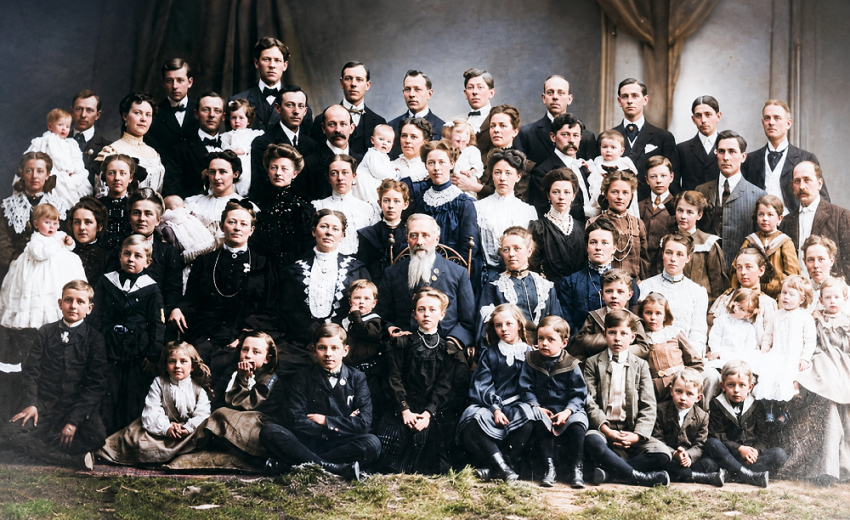
AI Colorized Photo: Joseph F. Smith, nephew of the founding prophet, and his family. Original black & white photo courtesy: Church History Library, The Church of Jesus Christ of Latter-day Saints.
A Theological and Historical Examination from a Traditional Christian Perspective
✦ ❧ ✦
I. A Faith That Cannot Look Away
There is a particular kind of silence that settles over a family when an old story is brought down from the attic. The Latter-day Saints know this silence well. For more than a century, the practice of plural marriage—polygamy—has occupied that attic in the Mormon house: acknowledged in scripture, attested by genealogy, embedded in the bones of nearly every pioneer family tree, and yet held at arm’s length, spoken of softly, and rarely confronted head-on. It is a story the Church has at times defended with martyrs’ zeal, at other times buried beneath the public romance of the handcart and the seagull, and in our own day has begun, cautiously, to tell again. This essay is written in the conviction that the telling is not finished, and that an honest reckoning with the polygamous past is not an act of hostility toward the Latter-day Saints but an act of respect—the respect owed to any people capable of bearing the truth about their own origins.
It is written, too, from a particular place. The author writes as a traditional Christian who holds the historic faith of the creeds and the sufficiency of Scripture, who counts Latter-day Saints as neighbors and friends, and who has walked the sidewalks of the American West in conversation with them. The aim here is neither to mock nor to wound. Mockery is the refuge of those who have not done the reading. The aim, rather, is to set the historical record beside the theological claims and to ask, with as much fairness as rigor allows, what the one reveals about the other. Where the evidence is firm, it will be stated firmly. Where it is contested or speculative, it will be marked as such. And where the matter touches the deepest convictions of sincere people, it will be handled with the gravity those convictions deserve.
The questions are not small ones. They reach the center of how a religious community understands revelation, authority, and the relationship between God’s eternal nature and His commands in time. If polygamy was a divine commandment, why was it introduced in secret, defended for half a century as essential to salvation, and then withdrawn under the pressure of federal marshals? If it were not a divine commandment, what does its origin tell us about the prophetic office of the man who introduced it? These are not gotcha questions. They are the questions that thoughtful Latter-day Saints ask themselves in quiet moments, and that the rest of us owe them the courtesy of asking aloud.
✦ ❧ ✦
II. The Shape of the Secret
To understand Mormon polygamy, one must first grasp a paradox that lies at its foundation: it was, from the beginning, both a sacred principle and a guarded secret. Joseph Smith introduced plural marriage privately in the 1830s and expanded it among trusted associates in Nauvoo, Illinois, in the early 1840s—and he did so while publicly denying that any such thing existed. The historian’s task here is complicated by the very secrecy that defined the practice. Participants pledged confidentiality; they kept few contemporary records; and the fullest accounts we possess were set down decades later, in Utah, when the surviving witnesses had every reason to cast the early years in the most favorable light. Even the Church’s own historians acknowledge that the documentary record is thin and that some measure of ambiguity will always cling to the subject.
Plural marriage was introduced among the early Saints incrementally, and participants were asked to keep their actions confidential. They did not discuss their experiences publicly or in writing until after the Latter-day Saints had moved to Utah.
— “Plural Marriage in Kirtland and Nauvoo,” Gospel Topics Essays, churchofjesuschrist.org
The chronology, as nearly as it can be reconstructed, runs as follows. Smith’s first documented plural relationship was with Fanny Alger, a young woman living in the Smith household, around 1833. Whether this is best described as a marriage or, as Oliver Cowdery would later put it, a “dirty, nasty, filthy affair,” remains one of the most disputed points in the whole history. What is not disputed is that it occurred years before any written revelation on the subject and before Smith claimed the priesthood sealing keys that Latter-day Saint theology requires for such unions. After the Alger episode ended in scandal and separation, the matter seems to have lain dormant until Nauvoo, where in April 1841, Smith was sealed to Louisa Beaman in what the Church reckons the first plural marriage of the Nauvoo period.
From there, the practice spread by careful initiation. Smith taught it to his closest associates—apostles, scribes, and confidants—and bound them to secrecy. By the time of his death in June 1844, the Church’s own accounting places roughly twenty-nine men and fifty women in plural marriages, beyond Joseph and his own wives. The number of Smith’s own wives is variously estimated between thirty and forty, a range that itself testifies to how shrouded the practice was. Among these were women as young as fourteen, and a striking number—at least a dozen—who were already married to living husbands, several of them faithful members of the Church. This last feature, polyandry, sits uneasily even within the theological framework Smith would eventually produce to justify plurality, and apologists and critics alike have struggled to account for it.
All of this unfolded behind a wall of public denial. Smith and other leaders repeatedly and categorically denied practicing or teaching plural marriage, even as they lived it. The Church newspaper condemned “spiritual wifery.” The official position, declared from the pulpit and printed in the press, was monogamy; the private reality, known to an inner circle, was something else entirely. It is this gap—between what was said in public and what was done in private—that has proven most corrosive to trust, and most difficult for the modern Church to explain. A practice can be defended as a hard commandment faithfully obeyed. It is far harder to defend a commandment that required its obedient followers to deny, under direct questioning, that they were obeying it.
✦ ❧ ✦
III. The Revelation That Binds Heaven to Polygamy
On July 12, 1843, in an upper room of his Nauvoo office, Joseph Smith dictated to his scribe William Clayton a revelation that would be canonized as Section 132 of the Doctrine and Covenants. It remains the single most illuminating document on Mormon polygamy, and it repays close reading, because it reveals that plural marriage was never, in Smith’s mind, a mere social arrangement. It was woven into the very fabric of his most ambitious theological vision: the exaltation of human beings into gods.
The revelation opens by invoking the Old Testament patriarchs. Smith presents it as an answer to his inquiry as to how the Lord justified Abraham, Isaac, Jacob, Moses, David, and Solomon in “having many wives and concubines.” The answer it gives is that God Himself commanded the practice. But the document quickly moves beyond historical justification into the heart of Smith’s doctrine of eternal progression. Marriage sealed by proper priesthood authority, it teaches, endures beyond death; and those who enter this “new and everlasting covenant” and abide its conditions are promised an astonishing destiny:
1 Verily, thus saith the Lord unto you my servant Joseph, that inasmuch as you have inquired of my hand to know and understand wherein I, the Lord, justified my servants Abraham, Isaac, and Jacob, as also Moses, David and Solomon, my servants, as touching the principle and doctrine of their having many wives and concubines—
2 Behold, and lo, I am the Lord thy God, and will answer thee as touching this matter.
3 Therefore, prepare thy heart to receive and obey the instructions which I am about to give unto you; for all those who have this law revealed unto them must obey the same.
4 For behold, I reveal unto you a new and an everlasting covenant; and if ye abide not that covenant, then are ye damned; for no one can reject this covenant and be permitted to enter into my glory.
5 For all who will have a blessing at my hands shall abide the law which was appointed for that blessing, and the conditions thereof, as were instituted from before the foundation of the world.
6 And as pertaining to the new and everlasting covenant, it was instituted for the fulness of my glory; and he that receiveth a fulness thereof must and shall abide the law, or he shall be damned, saith the Lord God.
…
60 Let no one, therefore, set on my servant Joseph; for I will justify him; for he shall do the sacrifice which I require at his hands for his transgressions, saith the Lord your God.
61 And again, as pertaining to the law of the priesthood—if any man espouse a virgin, and desire to espouse another, and the first give her consent, and if he espouse the second, and they are virgins, and have vowed to no other man, then is he justified; he cannot commit adultery for they are given unto him; for he cannot commit adultery with that that belongeth unto him and to no one else.
62 And if he have ten virgins given unto him by this law, he cannot commit adultery, for they belong to him, and they are given unto him; therefore is he justified.
63 But if one or either of the ten virgins, after she is espoused, shall be with another man, she has committed adultery, and shall be destroyed; for they are given unto him to multiply and replenish the earth, according to my commandment, and to fulfil the promise which was given by my Father before the foundation of the world, and for their exaltation in the eternal worlds, that they may bear the souls of men; for herein is the work of my Father continued, that he may be glorified.
— Doctrine and Covenants 132 (1843)
Here is the theological engine of the whole system. The promise is not merely eternal companionship; it is deification, and a deification explicitly tied to the perpetuation of offspring—“the continuation of the seeds forever and ever.” In Smith’s cosmology, the exalted couple becomes a creating, procreating divine pair, populating worlds with their own spirit children throughout eternity. Within such a framework, the logic of plural marriage becomes brutally clear. If glory is measured in part by posterity, and if posterity can be multiplied through plural wives, then the accumulation of wives is not incidental to exaltation but instrumental to it. The more wives, the more seed; the more seed, the more glory. Smith never spelled out the calculus in those terms, but the structure of the doctrine makes the inference difficult to avoid.
This is what makes Section 132 so consequential, and so resistant to tidy resolution. The same revelation that commands plurality also makes eternal marriage—the sealing of one man and one woman for eternity—the gateway to the highest heaven. The two doctrines are fused in a single text. A Latter-day Saint who wishes to retain the cherished doctrine of eternal families cannot simply excise the polygamous verses; they are sewn into the same garment. The revelation also lays down specific conditions: the plural wife must be a virgin, she must not be “vowed to any other man,” and the first wife must give her consent. As critics have long noted and as the historical record amply confirms, Smith violated each of these conditions in his own practice—marrying women already wed to living husbands, marrying without Emma’s knowledge or consent, and marrying women who were anything but the virgins the revelation specified. A commandment whose author does not keep its own terms invites the gravest of questions about its origin.
It should be said plainly, in fairness, that faithful Latter-day Saints read this text through the lens of trust. To them, the apparent irregularities are the inevitable friction of heaven breaking into a fallen world through an imperfect mortal prophet. That reading is sincere and internally coherent. But it is precisely the coherence of the system that this essay means to examine, for a system can be perfectly self-consistent and still rest upon a foundation that will not bear the weight of Scripture or of history.
✦ ❧ ✦
IV. The Fracture: Death, Schism, and the Westward Road
Joseph Smith was murdered by a mob at Carthage Jail on June 27, 1844. He died, as he had lived on this question, behind a veil: only weeks before, he had publicly denied having more than one wife, even as he was sealed to dozens. His death detonated a succession crisis, and plural marriage was very near the center of the explosion.
The movement Smith left behind did not hold together. One body of believers, gathering eventually around Smith’s widow Emma and his son Joseph Smith III, rejected polygamy outright and would coalesce as the Reorganized Church of Jesus Christ of Latter Day Saints (today the Community of Christ). For generations, the Reorganized Church maintained that Joseph Smith had never practiced polygamy at all—that the doctrine was Brigham Young’s innovation, falsely attributed to the founding prophet. Emma herself, who had endured the practice with grief and resistance, denied to her dying day that her husband had taught it. The pain in that denial is its own kind of testimony.
The larger body followed Brigham Young and the Quorum of the Twelve Apostles. Young—himself a vigorous polygamist who would eventually number some fifty-five wives and father fifty-seven children—led the main company of Saints across the plains to the Great Basin, beyond the reach, as they hoped, of a hostile republic. In the isolation of the Utah Territory, what had been a guarded secret could at last become a public institution. In 1852, eight years after Smith’s death, the apostle Orson Pratt was deputed to announce and defend plural marriage openly to the world. The wall of denial came down. For the next thirty-eight years, polygamy would be not a whispered practice but the proud, embattled emblem of Latter-day Saint identity—a banner around which a persecuted people rallied, and a target that would nearly destroy them.
✦ ❧ ✦
V. From Defense to Disavowal: The Long Retreat
Once plural marriage was public, it became inseparable from the Mormon cause—and inseparable, in the eyes of the nation, from everything the nation wished to condemn. The Republican Party’s first national platform in 1856 yoked it to slavery as one of the “twin relics of barbarism,” and the phrase stuck. For the next four decades, the Latter-day Saints and the United States government were locked in a slow, grinding contest over the practice, a contest the Saints framed as religious liberty and the government framed as the rule of law.
The legal machinery advanced in stages. In 1862, Congress passed the Morrill Anti-Bigamy Act, outlawing plural marriage in the territories. The Saints defied it, trusting that the First Amendment shielded their practice. That trust was shattered in 1879, when the Supreme Court in Reynolds v. United States drew a line that would shape American religious-liberty law for a century: belief was protected, but conduct was not, and a man could not, the Court reasoned, excuse an act forbidden by the law of the land merely by pleading religious duty. Congress then tightened the screws. The Edmunds Act of 1882 made unlawful cohabitation a crime; the Edmunds-Tucker Act of 1887 went further still, dissolving the legal corporation of the Church and authorizing the confiscation of its property. Apostles and bishops went into hiding or to prison; families were broken; wives went into concealment rather than testify against their husbands. The Church that the government was squeezing was being squeezed toward extinction.
It is worth pausing to credit the genuine heroism of this period, for the story is not only one of error. Many ordinary Latter-day Saints suffered real persecution with real courage. They believed they were obeying God, and they paid for that belief in fines, imprisonment, exile, and ruptured homes. A counselor in the First Presidency, George Q. Cannon, emerged from five months in the Utah penitentiary, describing his cell as a heavenly place. Whatever one concludes about the doctrine, one cannot withhold sympathy from the sincerity of those who bore its cost. This is precisely why the subject demands tenderness as well as honesty: real people built their lives, and staked their souls, on the principle.
But sincerity is not the same as vindication, and the end, when it came, came not by heavenly directive but by earthly checkmate. In May 1890, the Supreme Court upheld the Edmunds-Tucker confiscations. The temples themselves—the sacred center of Latter-day Saint worship—were now at risk. On September 25, 1890, President Wilford Woodruff recorded that he was “under the necessity of acting for the Temporal Salvation of the Church,” and the next day, he issued the document known as the Manifesto, declaring his intention to submit to the laws against plural marriage and to counsel the Saints to do the same.
The Lord showed me by vision and revelation exactly what would take place if we did not stop this practice. … All the temples would go out of our hands.
— Wilford Woodruff, as recounted in “The Manifesto and the End of Plural Marriage,” Gospel Topics Essays
The candor of Woodruff’s own explanation is arresting. The revelation he describes is not a fresh disclosure that plural marriage had ceased to be true or good; it is a vision of consequences—of temples lost, of a Church destroyed—if the practice continued. The decision was framed, in his own words, around the temporal salvation of the institution. Within six years, Utah was admitted to the Union; the price of statehood had been paid in the surrender of the principle. Even then, the practice did not stop cleanly. New plural marriages continued quietly, especially in Mexico and Canada, until a Second Manifesto under President Joseph F. Smith in 1904, issued amid the glare of the Reed Smoot Senate hearings, finally made excommunication the penalty for new plural unions. Existing plural families lived on into the middle of the twentieth century. The retreat, like the advance, was a process and not a moment.
Here, the central historical irony comes into focus. A practice introduced in secret as an eternal principle, defended publicly for nearly four decades as essential to the highest exaltation, and sealed in scripture that remains canonical to this day, was discontinued under legal and financial duress, by the leader’s own admission, to save the Church’s temples and property. This is the sequence the modern Church must explain, and the explanations it offers are the subject to which we shall return.
✦ ❧ ✦
VI. The Men Who Obeyed: Portraits in Obedience and Cost
Doctrine lives in people. To understand what plural marriage demanded, it helps to walk among the men who first received it—the founding generation of the Latter-day Saint movement, whose names recur in every Mormon catechism. Some embraced the principle as the supreme test of faith; some recoiled and then submitted; some broke with the Church over it; and some, notably, never practiced it at all, a fact worth remembering when polygamy is treated as the universal mark of early Mormon devotion. The brief portraits that follow trace, where the record allows, each man’s relationship to plural marriage and his sense of its necessity. They are offered in the narrative spirit of the great biographers, who knew that the measure of a movement is taken in the lives of those who carried it.
Joseph Smith, Jr. (1805–1844)
The founder and fountainhead. Smith introduced plural marriage, received and dictated the revelation that justified it, and practiced it more extensively than any contemporary, while denying it publicly to the end of his life. For him, the principle was inseparable from the doctrine of exaltation; to reject it, the 1843 revelation warned, was to be “damned.” Yet his own conduct—polyandrous sealings, marriages to teenagers, unions concealed from his wife Emma—violated the very conditions the revelation laid down. No figure better illustrates the tension between the system’s exalted theology and the disorder of its origins.
“Verily, I say unto you, that the wisdom of man, in his fallen state, knoweth not the purposes and the privileges of my hold priesthood, but ye shall know when ye receive a fullness by reason of the anointing: For it is my will, that in time, ye should take unto you wives of the Lamanites and Nephites, that their posterity may become white, delightsome and just, for even now their females are more virtuous then the gentiles.”
– Prophet Joseph Smith, Jr., 1831 revelation, recorded in a letter from W.W. Phelps to Brigham Young, dated August 12, 1861
Brigham Young (1801–1877)
Smith’s successor and the great institution-builder of Mormonism. Where Smith practiced plurality in secret, Young made it public, defended it ferociously, and embodied it on a grand scale—some fifty-five wives and fifty-seven children. For Young, the principle was not negotiable. He taught that any Saint who denied the plurality of wives and persisted in that denial would be damned, while those who lived their religion would be exalted. Under his hand, polygamy became the visible boundary marker of the Latter-day Saint people, and the fortress they would defend against the entire weight of the federal government.
“Now if any of you will deny the plurality of wives and continue to do so, I promise that you will be damned; and I will go still further, and say that this revelation, or any other revelation that the Lord had given, and deny it in your feelings, and I promise that you will be damned.”
– Prophet Brigham Young, Deseret News, November 14, 1855
Parley P. Pratt (1807–1857)
Apostle, hymn-writer, and the movement’s most gifted early theologian; it was to Pratt that Smith first privately taught, around 1840, that marriage could endure into eternity. Pratt embraced plurality and eventually had twelve wives. His death was bound up in the practice’s perils: he was murdered in Arkansas by the estranged husband of his twelfth wife, whom Pratt had married while her civil marriage was unresolved—a violent epilogue that fused the doctrine’s promise of eternal sealing with the temporal chaos it so often produced.
These scriptural evidences show what, the mind of the Lord was in former times relative to this principle; they show that the Latter-Day Saints in putting this doctrine in practice, merely do what the people of God did in previous ages, and therefore, that Polygamy is not a new-fangled doctrine of their own invention; but they do not give to the Latter-Day Saints, or to any other people, the right and authority to enter into the practice of this system aside from the command of God, any more than the Scriptures give the right and authority to every person who may peruse them to go forth and preach the gospel or officiate in its ordinances. Whenever this system is practiced under the divine sanction of the Almighty, it will be by His direct command; and He will undoubtedly reveal the laws by which its observance will be governed, so that everything connected therewith will be under proper restrictions and done in order. Until this command was given, though they had all the evidences of Scripture that this doctrine was believed and practiced by the people of God in ancient days, the Latter-Day Saints never dared to adopt it. The Lord in his wisdom, however, saw fit to give it, accompanying it by so strong a testimony of His Holy Spirit that there was no room to doubt; the only alternative that was left us, therefore, was to believe and obey it.
– Parley P. Pratt, Scriptural Evidences in Support of Polygamy (San Francisco: George Q. Cannon, 1856), 4–5, 9–10, 17–18
Hyrum Smith (1800–1844)
Joseph’s elder brother, the Church Patriarch, and most loyal lieutenant. Hyrum at first opposed plural marriage but was won to it, and it was reportedly at his urging that Joseph committed the revelation of July 1843 to writing, in the hope of persuading the grieving Emma. Hyrum took a plural wife and died beside his brother at Carthage. His arc—from resistance to advocacy to martyrdom—mirrors in miniature the journey the principle asked of the whole inner circle: to suppress one’s instinctive recoil and call the suppression faith.
Plural marriage is stated as a commandment (same as in Saints), but then explained within the context of deceased spouses. Hyrum Smith “was ultimately converted to the principle when he realized that he had married two women on earth whom he could not bear to part with in eternity.” (In Saints, Hyrum obtains a testimony of the principle while speaking with Brigham Young prior to learning he could be sealed to both Jerusha and Mary – p. 492). Mercy Fielding Thompson became converted to plural marriage after Joseph Smith testified her deceased husband had appeared to him in vision. Robert Thompson expressed his desire for Mercy to become the plural wife of Hyrum because he wanted Mercy to be taken care of. It’s literally a “taking care of widows” argument for polygamy.
– Church historian Jed Woodworth, Revelations in Context essay for D&C 132? In the essay “Mercy Thompson and the Revelation on Marriage”
Orson Pratt (1811–1881)
Apostle, mathematician, and the man chosen in 1852 to announce plural marriage publicly to the world—an irony, given that Smith’s earlier private approach to Pratt’s wife had once driven him to the edge of despair and temporary excommunication. Reconciled and restored, Orson Pratt became the doctrine’s foremost public defender, constructing the elaborate theological and even pseudo-scientific arguments by which the Utah Church justified the practice. No one did more to clothe polygamy in the language of revelation and reason.
“God has told us Latter-day Saints that we shall be condemned if we do not enter into that principle [of polygamy]; and yet I have heard now and then (I am very glad to say that only a low such instances have come under my notice) a brother or a sister say, ‘I am a Latter-day Saint, but I do not believe in polygamy.’ Oh, what an absurd expression! What an absurd idea! A person might as well say, ‘I am a follower of the Lord Jesus Christ, but I do not believe in him.’ One is just as consistent as the other…. If the doctrine of polygamy, as revealed to the Latter-day Saints, is not true, I would not give a fig for all your other revelations that came through Joseph Smith the Prophet; I would renounce the whole of them, because it is utterly impossible, according to the revelations that are contained in these books, to believe a part of them to be from the devil… The Lord has said, that those who reject this principle reject their salvations, they shall be damned, saith the Lord…”
– Apostle Orson Pratt, Journal of Discourses, v. 17, pp. 224-225
Orson Hyde (1805–1878)
Apostle and the man who dedicated Palestine for the gathering of the Jews. Hyde embraced plural marriage and entered into it, including, the records indicate, a polyandrous sealing of the kind that so complicates the early Nauvoo picture. His career illustrates how thoroughly the principle saturated the highest councils of the Church: to sit in the Quorum of the Twelve in the Utah years was, with few exceptions, to live the principle and to teach it as the will of God.
“But one thing I will name, and that is in regard to plural marriage. A great many men say–“Oh, well, I can get along, I can live, and I believe I shall only have one wife.” Well, that is your privilege, nobody compels you to take more than one; but with the commandment of the Lord before us like a blaze of light, can we disregard it and serve him acceptably? If we can, then why not retain those laws and commandments in heaven, and not send them down here to earth? These commandments are sent for our good, for our salvation and exaltation.”
– Apostle Orson Hyde, Journal of Discourses, v. 16, p. 236
John Taylor (1808–1887)
Apostle, survivor of the Carthage attack that killed the Smith brothers, and third President of the Church. Taylor was a committed polygamist and an uncompromising defender of the principle in the face of federal prosecution; he died in 1887 while in hiding from federal marshals—a fugitive president of a hunted church. He had received, he believed, divine direction not to abandon plural marriage, and he held that line to the grave. His successor would receive, three years later, the opposite direction. The contrast between Taylor’s resolve and Woodruff’s surrender frames the whole crisis of the 1880s.
“God has given us a revelation in regard to celestial marriage. I did not make it. He has told us certain things pertaining to this matter, and they would like us to tone that principle down and change it and make it applicable to the views of the day. This we cannot do; nor can we interfere with any of the commands of God to meet the persuasions or behests of men. I cannot do it, and will not do it.”
– Prophet John Taylor, Journal of Discourses, v. 25, p. 309
Wilford Woodruff (1807–1898)
Apostle, meticulous diarist, and fourth President of the Church—the man who issued the 1890 Manifesto ending plural marriage. Woodruff had himself lived the principle for decades and defended it as divine. His Manifesto, framed by his own account as a revelation of consequences rather than a repeal of doctrine, is the hinge on which modern Mormonism turns. In his journals and discourses, one can read the agony of a leader caught between a commandment he believed eternal and an institution he was charged to preserve. He chose the institution and called the choice inspiration.
“If we were to do away with polygamy, it would only be one feather in the bird… Do away with that, then we must do away with prophets and Apostles, with revelation and the gifts and graces of the Gospel… and finally give up our religion altogether…. We just can’t do that….”
– Prophet Wilford Woodruff, Journal of Discourses, v. 13, p. 166
Heber C. Kimball (1801–1868)
Apostle, counselor to Brigham Young, and one of the most prolific polygamists of the Utah era, with dozens of wives. Kimball’s blunt, earthy preaching on the principle survives in the sermons of the period and leaves no doubt how central plurality was to the leadership’s sense of their calling. It was Kimball’s daughter Helen Mar, married to Joseph Smith at fourteen, whose later writings would give the practice one of its most poignant and troubling first-person testimonies. Few families embodied the principle’s reach across generations more completely than the Kimballs.
“I speak of plurality of wives as one of the most holy principles that God ever revealed to man, and all those who exercise an influence against it, unto whom it is taught, man or woman will be damned, and they and all who will be influenced by them, will suffer the buffetings of Satan in the flesh; for the curse of God will be upon them, and poverty, and distress, and vexation of spirit will be their portion; while those who honor this and every sacred institution of heaven will shine forth as the stars in the firmament of heaven, and of the increase of their kingdom and glory there shall be no end. This will equally apply to Jew, Gentile, and Mormon, male and female, old and young.”
– Apostle Heber C. Kimball, Journal of Discourses, v. 11, p. 211
William Clayton (1814–1879)
Smith’s trusted scribe, the man who took down the July 1843 revelation, and the keeper of journals that remain among the most valuable contemporary sources for the entire subject. Clayton practiced plural marriage himself, beginning in 1843 at Smith’s encouragement, and his cryptic, coded diary entries—recording sealings under veils of abbreviation—reveal both the secrecy of the practice and its intimate place at the prophet’s right hand. Without Clayton’s records, much of what we know of Nauvoo polygamy would be lost; with them, the romantic legend becomes far harder to sustain.
“… the Prophet invited me to walk with him. During our walk, he said he had learned that there was a sister back in England, to whom I was very much attached. I replied there was, but nothing further than an attachment such as a brother and sister in the Church might rightfully entertain for each other. He then said, ‘Why don’t you send for her?’ I replied, ‘In the first place, I have no authority to send for her, and if I had, I have not the means to pay expenses.’ To this he answered, ‘I give you authority to send for her, and I will furnish you with means,’ which he did. This was the first time the Prophet Joseph talked with me on the subject of plural marriage. He informed me that the doctrine and principle was right in the sight of our Heavenly Father, and that it was a doctrine which pertained to celestial order and glory. After giving me lengthy instructions and information concerning the doctrine of celestial or plural marriage, he concluded his remarks by the words, ‘It is your privilege to have all the wives you want.’”
– William Clayton, in Fillerup, comp., William Clayton’s Nauvoo Diaries and Personal Writings, under March 9, 1843
✦ ❧ ✦
VII. The Apologetic Architecture: How the Reversal Is Explained
How does a church explain commanding a practice for half a century as essential to the highest salvation, and then forbidding it? The Latter-day Saint answer, presented fairly, does not concede that God changed His mind about eternal principles. It frames the shift as a change in practice and commandment, tailored to particular circumstances. Three interlocking arguments carry the weight, and intellectual honesty requires that they be stated at their strongest before they are weighed.
The Principle of Continuing Revelation and Stewardship
The first argument rests on the Latter-day Saint conviction that God speaks through living prophets in every age. Just as He gave the Law of Moses to one generation and the gospel of Christ to another, so He may direct His Church through present-day prophets according to the needs of the time. Plural marriage was commanded when the Lord willed it and withdrawn when He willed otherwise. The same prophetic authority that instituted the practice possessed the authority to end it; obedience to the living oracle, not allegiance to a frozen rule, is the mark of faith. On this view, the Manifesto is not a retreat but a revelation—God’s word for a new season.
The “Abrahamic Test” Rationale
The second argument characterizes plural marriage as a kind of Abrahamic sacrifice: a hard, specific, temporary commandment given to prove and refine a people, rather than an eternal law of marriage in itself. As God once commanded Abraham to offer Isaac and then stayed his hand, so He commanded plurality for a season and then lifted the requirement once its purpose was fulfilled. The difficulty of the commandment is, on this reading, the very point—a crucible designed to sanctify those who would obey at great personal cost. The pain in the historical record becomes, paradoxically, evidence of the doctrine’s divine seriousness.
Divine Law versus Temporal Practice
The third argument draws a careful line between the enduring and the contingent. The underlying realities—eternal marriage, the sealing power, the binding of families across the veil—remain in full force; only the temporal practice of plural marriage was discontinued. God, the argument runs, adapts His commandments to the capacity and context of His people without altering the eternal verities beneath them. Monogamy is the standing law; plurality was the exception, divinely commanded and divinely revoked, leaving the deeper covenant theology untouched.
These are not foolish arguments, and they should not be treated as such. They flow logically from premises the Latter-day Saints hold sincerely: that Joseph Smith was a true prophet, that the Doctrine and Covenants is scripture, and that the living president of the Church holds the keys to bind and loose. Grant those premises, and the explanation hangs together. The question this essay must now press is whether those premises, and the explanation built upon them, can withstand the scrutiny of Scripture and of the historical record they are meant to interpret.
✦ ❧ ✦
VIII. A Commanding Rebuttal: Weighing the Defense in the Scales
The apologetic architecture is elegant, but it stands or falls on a single load-bearing claim: that the God who is “the same yesterday, today, and forever” may nonetheless command, as a matter of righteousness, what He elsewhere forbids as sin. It is here that the traditional Christian must respectfully but firmly demur, and the demurral rests not on cultural distaste but on the witness of Scripture itself.
Consider first the appeal to continuing revelation. The biblical test of a prophet is not merely whether he claims to speak for God, but whether his word conforms to what God has already revealed. Deuteronomy 13 commands Israel to reject even a prophet who works signs and wonders if he leads the people after other gods or away from the commandments already given. The apostle Paul pronounces an anathema upon any messenger—“though we, or an angel from heaven”—who preaches a gospel contrary to the one delivered (Galatians 1:8). The standard is not the office but the consistency of the message. An angel with a drawn sword, threatening destruction unless a married man takes the wives of other living men, does not pass that test; it fails it precisely as Paul warned. Continuing revelation cannot be invoked to license what prior revelation condemns, for then revelation has no fixed content at all, and the word of God becomes a wax nose, turned to any shape the moment requires.
Consider next the Abrahamic test analogy. It is a poignant comparison, but it breaks at the decisive joint. When God tested Abraham, He commanded an act and then forbade its completion; the ram in the thicket was the whole point, and Isaac walked down the mountain alive. The test was Abraham’s willingness, not the deed itself, which God explicitly halted. Mormon plural marriage inverts this entirely: the deed was not halted but consummated, multiplied, and perpetuated across decades and thousands of households. To call a practice carried to completion in tens of thousands of marriages an “Abrahamic sacrifice” is to empty the analogy of its meaning. Abraham’s test ended with a stayed hand; polygamy ended with a federal injunction.
Consider finally the distinction between divine law and temporal practice. This is the most sophisticated of the three arguments, and the most revealing. For if plural marriage was merely a temporal practice and not an eternal law, then the leaders who declared it indispensable to exaltation—who taught that to deny it was to be damned—were not merely mistaken in a minor matter; they were gravely wrong about the very terms of salvation, and they bound that error upon the consciences of their people for forty years. Either those teachings were the word of God, in which case the Manifesto contradicts them, or they were not, in which case the prophetic claim that produced them is fatally compromised. The distinction meant to rescue the doctrine instead impales it on the horns of a dilemma.
Set against the elaborate edifice of Section 132 stands the plain testimony of Scripture concerning marriage. Jesus, asked about marriage, reached back past Moses to the creation: “from the beginning of the creation God made them male and female,” and “the two shall be one flesh” (Mark 10:6–8). The grammar is singular and exclusive. The pattern of Eden is one man and one woman, and the prophets and apostles consistently treat polygamy in the patriarchal narratives not as a divine ideal but as a source of rivalry, sorrow, and ruin—Sarah and Hagar, Leah and Rachel, the wives who turned Solomon’s heart. Scripture records polygamy; it does not commend it. The leap from “the patriarchs did this” to “God commands us to do this” is precisely the leap the 1843 revelation makes, and it is a leap the text of Scripture will not support.
There is, moreover, the matter of fruit. “By their fruits ye shall know them,” the Lord said, and applied the test to prophets specifically (Matthew 7:15–20). The theological justification offered for plural marriage was the raising up of a righteous posterity—the multiplication of seed. Yet of Joseph Smith’s thirty-odd plural wives, despite documented conjugal relationships, no child has ever been established as his offspring, even as those same women bore children readily when they later remarried. The one stated purpose of the practice is, in the founder’s own case, conspicuously unfulfilled. A commandment justified by fruit that the record cannot find invites the gravest reconsideration of its source. None of this is offered in triumph. It is offered as the honest conclusion of an honest reading—the conclusion that plural marriage was not a divine commandment faithfully obeyed, but a human innovation theologically clothed, and that the long defense and sudden abandonment of it are exactly what one would expect of the latter and exactly what one would not expect of the former.
✦ ❧ ✦
IX. Sanitized Transparency: The Management of Memory
For most of the twentieth century, the Church managed the polygamous past largely by managing attention. The public story of Mormonism became the heroic pioneer epic—the trek, the gulls and the crickets, the desert made to blossom—while the secret Nauvoo origins of plural marriage receded into a fog of reticence. Manuals were silent or vague; the difficult specifics, the teenage brides, and the polyandrous sealings, were left to critics and specialists. A faithful Latter-day Saint could live an entire devout life and never learn the particulars that a curious teenager can now find in an afternoon online.
The internet changed the calculus. Confronted with a generation encountering the hard facts not from the pulpit but from the search engine—and sometimes losing their faith in the encounter—the Church chose a new strategy, and to its credit, it chose disclosure over denial. Beginning in 2013 and 2014, it published a series of carefully researched Gospel Topics essays that, for the first time in official literature, plainly acknowledged that Joseph Smith practiced polygamy, that he married women as young as fourteen, and that some of his wives were already married to other living men. These are not small admissions, and they represent a real and commendable step toward candor.
And yet the candor is curated. The essays acknowledge the facts while enclosing them within an interpretive frame that converts each difficulty into a faith-promoting feature. The teenage marriage is set in the context of nineteenth-century norms. The angel with the drawn sword recasts Smith’s pursuit of plurality as reluctant obedience to a terrifying command rather than personal initiative. The thinness of the record becomes an invitation to “walk by faith” and to “see through a glass, darkly.” The Manifesto, born of a Supreme Court defeat, is presented as an inspired direction. This is what may fairly be called sanitization through transparency: the facts are released, but pre-digested, each one wrapped in a narrative that drains it of its capacity to disturb. The disclosure is genuine; so is the management. Both can be true at once, and an honest reckoning must hold them together rather than pretend the disclosure is the whole story.
The deeper question the essays leave unresolved is the one no amount of framing can dissolve: not whether the practice can be contextualized, but whether it was true. Context can explain why people did difficult things; it cannot transform a human innovation into a divine command. To acknowledge that a thing happened is not yet to have reckoned with what its happening means. That reckoning is the work that remains.
✦ ❧ ✦
X. Theological Departure from Biblical Christianity
Polygamy was never merely a marital arrangement; it was the visible expression of a theology that departs from historic Christianity at its very center. To see why early Saints found the principle compelling, one must see the doctrine that gave it meaning—and to weigh it fairly, one must lay that doctrine beside the witness of Scripture and the confession of the historic church.
The Doctrine of Exaltation and the Plurality of Gods
The engine of plural marriage, as Section 132 makes plain, is the doctrine of exaltation: the teaching that faithful human beings may become gods, populating eternity with their own spirit offspring. “Then shall they be gods,” the revelation declares. This was compelling because it offered a destiny of breathtaking scope—not merely to dwell with God, but to become as God, an endless dynasty of the deified. Plurality served this vision by multiplying the seed through which glory was perpetuated. The doctrine answered the human longing for significance with the promise of divinity itself.
Yet here the departure from biblical Christianity is absolute. The Scriptures confess one God eternally: “Before me there was no God formed, neither shall there be after me” (Isaiah 43:10); “I am the LORD, and there is none else” (Isaiah 45:5). The Creator is not the first among an ascending order of deified men but the uncreated Lord, distinct in kind from all He has made. The historic creeds confess this same faith—one God, maker of heaven and earth—and the Christian hope is not deification into separate godhood but adoption as redeemed children who will see God and be conformed to the likeness of Christ (1 John 3:2; Romans 8:29), forever creatures, forever His. The Mormon doctrine of exaltation, and the polygamy built upon it, rests on a conception of God and humanity that historic Christianity has always regarded as outside the boundaries of the biblical faith.
Salvation by Ordinance and the Question of Grace
Plural marriage was, in the Utah years, taught as nearly indispensable to the fullness of salvation—an ordinance to be entered, a law to be obeyed, a work to be performed. This too was compelling: it gave the believer agency, a clear path, a covenant to keep. But it set Mormon soteriology at odds with the gospel of grace that lies at the heart of the New Testament. “By grace are ye saved through faith; and that not of yourselves: it is the gift of God: not of works, lest any man should boast” (Ephesians 2:8–9). The historic Christian faith confesses that salvation is the unearned gift of God in Christ, received by faith, and that no ladder of ordinances—however sincerely climbed—can purchase what only the cross has freely given. A salvation that hangs upon entering plural marriage is a salvation that hangs, in the end, upon the works of men.
Prophetic Authority and the Sufficiency of Scripture
Beneath both doctrines lies the deepest divergence of all: the locus of religious authority. Mormonism rests its case on continuing revelation through a living prophet whose word can establish new doctrine, new scripture, and new commandments—including the commandment of plurality and its later revocation. Historic Christianity confesses the sufficiency of Scripture: that in the Law, the Prophets, and the apostolic witness, God has spoken His final word in His Son (Hebrews 1:1–2), and that the faith was “once delivered unto the saints” (Jude 3), to be guarded rather than augmented. The whole controversy over polygamy is, at bottom, a controversy over this question. If a prophet may bind upon the conscience as the word of God a practice that Scripture nowhere commands and the example of Christ nowhere models, then Scripture is no longer the rule of faith but merely its raw material. It is on this rock that the apologetic for plural marriage finally founders—not on the strangeness of the practice, but on the authority claimed to institute it.
✦ ❧ ✦
XI. The Call: To Acknowledge, To Reckon, To Be Free
What, then, is being asked? Not that the Latter-day Saints be ridiculed, nor that their sincerity be doubted, nor that the genuine sufferings of their forebears be dishonored. What is being asked is something harder and more hopeful: a full reckoning—not merely with the fact of polygamy, which the Church has now acknowledged, but with what the fact reveals. There is a difference between admitting that a thing occurred and confronting what its occurrence means for the claims on which an entire faith is built. The first the Church has begun. The second remains.
To the Latter-day Saint reader, this essay extends not an indictment but an invitation. The God of Scripture does not ask His people to suppress their questions in the name of loyalty; He invites them to “come now, and let us reason together” (Isaiah 1:18). A faith that can only survive by managing attention is a faith afraid of the truth, and the God of truth is not honored by fear. The same courage that carried the pioneers across a thousand miles of plains is the courage now required to look squarely at the origins of the principle for which they suffered—and to ask whether the One who introduced it spoke for heaven or for himself.
To the Christian reader, the call is equally pointed. The temptation, when confronting a neighbor’s error, is to confront it with contempt. But the gospel forbids it. We are commanded to speak the truth in love (Ephesians 4:15), to give an answer with meekness and reverence (1 Peter 3:15), to be ready to reason but never to wound for the pleasure of wounding. The Latter-day Saints are not an abstraction to be defeated in argument; they are men and women, made in God’s image, many of them more disciplined in devotion and more generous in deed than their critics. To engage them rightly is to combine the rigor of the historian with the tenderness of the shepherd—to refuse both the cowardice that will not speak and the cruelty that speaks without love.
Let the conversation, then, be opened and kept open. Let Christians read the Latter-day Saint sources honestly rather than caricature them. Let Latter-day Saints read their own history without the anesthetic of pre-arranged conclusions. Let both sit at the same table, with the documents between them and the Scriptures open, and let the truth do its slow, patient, liberating work. That is the only kind of dialogue worth having, and the only kind that honors the God whom both parties claim to seek.
✦ ❧ ✦
XII. A Closing Thought
Every faith carries an attic, and in it the stories it would rather not bring down. What distinguishes a living faith from a frightened one is the willingness to climb the stairs. The Latter-day Saints have begun to climb; the question is whether they will open every trunk or only the ones already pried apart by others. For the deepest matters are not finally settled by historians or apologists, but in the quiet of a single honest heart asking whether the thing it was taught to revere is true.
The revelation of 1843 promised its hearers that they would become gods, from everlasting to everlasting, because they would continue. It is a vast and dazzling promise. But the gospel of Jesus Christ makes a different and, in the end, a greater one: not that we shall become gods, but that the one true God became man, and dwelt among us, and died for us, and rose, so that creatures might be reconciled to their Creator by grace alone. Between those two promises, every reader must finally choose. The history is only the doorway. What lies beyond it is the only question that has ever mattered—and it is asked, in the end, not of a church, but of a soul.
✦ ❧ ✦
Primary Sources & Further Reading
The following sources informed this examination. Latter-day Saint official sources are included so that the Church’s own framing may be read in full; critical and scholarly sources are included for balance. Readers are encouraged to consult all sides directly.
• Joseph Smith: Failed Polygamist — The Righteous Cause (companion essay) https://novus2.com/righteouscause/2026/02/06/joseph-smith-failed-polygamist/
• “Plural Marriage in Kirtland and Nauvoo,” Gospel Topics Essays https://www.churchofjesuschrist.org/study/manual/gospel-topics-essays/plural-marriage-in-kirtland-and-nauvoo?lang=eng
• “Plural Marriage and Families in Early Utah,” Gospel Topics Essays https://www.churchofjesuschrist.org/study/manual/gospel-topics-essays/plural-marriage-and-families-in-early-utah?lang=eng
• “The Manifesto and the End of Plural Marriage,” Gospel Topics Essays https://www.churchofjesuschrist.org/study/manual/gospel-topics-essays/the-manifesto-and-the-end-of-plural-marriage?lang=eng
• Revelation, 12 July 1843 [D&C 132] — Joseph Smith Papers https://www.josephsmithpapers.org/paper-summary/revelation-12-july-1843-dc-132/1
• “Mormonism and polygamy” — Wikipedia overview https://en.wikipedia.org/wiki/Mormonism_and_polygamy
• “1890 Manifesto” — Wikipedia https://en.wikipedia.org/wiki/1890_Manifesto
• The Four Major Periods of Mormon Polygamy — Signature Books (archived) https://web.archive.org/web/20190928132255/http://signaturebookslibrary.org/the-four-major-periods-of-mormon-polygamy/
• How an 1843 Revelation on Polygamy Poses a Challenge to Modern Mormonism — Religion Dispatches https://religiondispatches.org/2020/05/14/how-1843-revelation-polygamy-poses-serious-challenge-modern-mormonism
• An Act of Religious Conviction — FAIR (2015 Conference) https://www.fairlatterdaysaints.org/conference_home/2019-2015-fair-conferences/august-2015_fair_conference/an-act-of-religious-conviction
• The Church of Jesus Christ and Plural Marriage Today — FAIR https://www.fairlatterdaysaints.org/answers/The_Church_of_Jesus_Christ_and_plural_marriage_today
• LDS Practice of Polygamy, 1847–1904 — Utah Division of State History https://ilovehistory.utah.gov/1847-1904-lds-practice-of-polygamy/
• Polygamy: Latter-day Saints and the Practice of Plural Marriage — Newsroom https://newsroom.churchofjesuschrist.org/article/polygamy-latter-day-saints-and-the-practice-of-plural-marriage
• LDS Church Details Practice, History of Polygamy — KSL https://www.ksl.com/article/28065188/lds-church-details-practice-history-of-polygamy
• The Sovereignty of the Latter-day Saints — JSTOR Daily https://daily.jstor.org/the-sovereignty-of-the-latter-day-saints/
• How Do Today’s Latter-day Saints View Their Faith’s Past Polygamy? — Patheos https://www.patheos.com/blogs/religionqanda/2021/10/how-do-todays-latter-say-saints-view-their-faiths-past-polygamy/
• Polygamy Origins — Times and Seasons (archived) https://archive.timesandseasons.org/2015/03/polygamy-origins/index.html
• How Could Joseph Smith Be a True Prophet Practicing Polygamy? — Ask Gramps https://askgramps.org/how-could-joseph-smith-be-a-true-prophet-practicing-polygamy/
• Joseph Smith and Polygamy — Joseph Smith Foundation https://josephsmithfoundation.org/joseph-smith-polygamy/
✦ ❧ ✦
A Note on Research Methods and Accuracy
In recent years, some have voiced concern that artificial intelligence may distort facts or introduce inaccuracies into serious research. That criticism deserves acknowledgment. However, AI has now evolved into the most powerful research instrument available to any dedicated scholar—capable of analyzing vast datasets, cross‑referencing historical records, and surfacing overlooked connections across sources. This work represents a collaboration between the author’s investigative inquiry, verified primary documentation, and the advanced analytic capabilities of AI research tools. Here, AI was not used as a ghostwriter or a shortcut for scholarship, but as a disciplined research partner devoted to rigor, accuracy, and transparency.
Every factual claim in this work has been subjected to active verification. Where AI‑generated content was used as a starting point, it was tested against primary sources, peer‑reviewed scholarship, official institutional documentation, and established historical records. Where discrepancies were found—and they were found—corrections were made. The author has made every reasonable effort to ensure that quotations are accurately attributed, historical details are precisely rendered, and theological claims fairly represent the positions they describe or critique.
That said, no work of this scope is immune to error, and the author has no interest in perpetuating inaccuracies in the service of an argument. If you are a reader—whether sympathetic, skeptical, or hostile to the conclusions drawn here—and you identify a factual error, a misattributed source, a misrepresented teaching, or a claim that cannot be substantiated, you are warmly and genuinely invited to say so. Reach out. The goal of this work is not to win a debate but to get the history right. Corrections offered in good faith will be received in the same spirit, and verified corrections will be incorporated into future editions without hesitation.
Truth, after all, has nothing to fear from scrutiny—and neither does this work.