
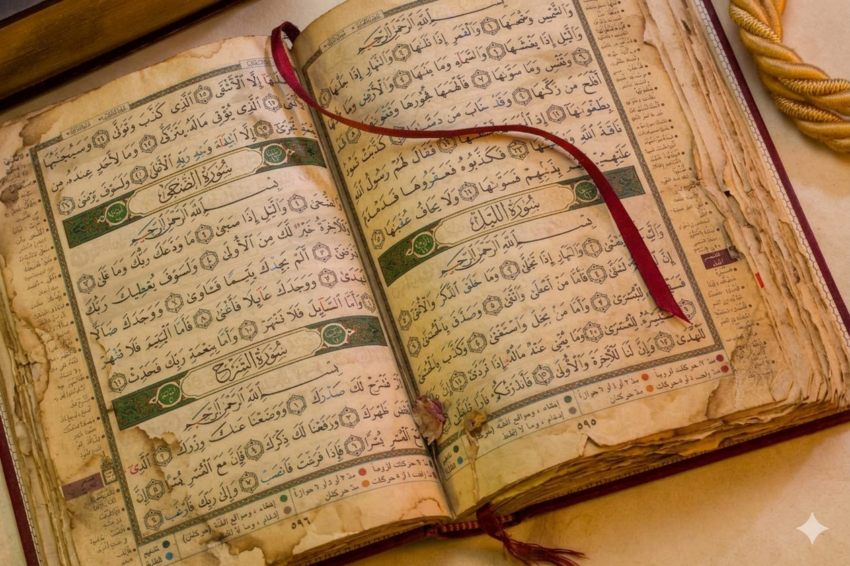
A scholarly narrative tracing the Muslim scripture from its first recitation to the present age —
its preservation, its transmission, and its place beside the biblical record.
✦ ❖ ✦
Introduction: A Book Born of a Voice
On a night that Muslims call Laylat al-Qadr, the “Night of Power,” in or around the year 610 of the Christian era, a forty-year-old merchant of Mecca named Muhammad ibn Abdullah is said to have withdrawn, as was his custom, to a cave on the slopes of Mount Hira. There, according to the cherished memory of the Islamic tradition, the angel Gabriel pressed upon him and commanded, “Recite!” The trembling man protested that he could not read. The command came again, and from that encounter flowed the first verses of what would become the Qur’an — a word that itself means “recitation” or “reading.” Over the next twenty-three years, until he died in 632, Muhammad would proclaim a stream of revelations that his followers memorized, recited, and eventually inscribed, and which more than a billion and a half people today revere as the literal, uncreated speech of God.
To approach this book honestly is to step into one of the most consequential stories in human history. The Qur’an has shaped empires, law, art, language, and the daily devotion of generations. For the Christian who wishes to understand his Muslim neighbor — and who is commanded to love that neighbor — the question of where the Qur’an came from, how it was preserved, and how its message stands in relation to the Bible is not idle curiosity. It is the necessary groundwork of any honest, respectful conversation.
This essay tells that story from a traditional Christian vantage point, but it does so as scholarship rather than as polemic. We will hear the Islamic tradition speak in its own confident voice, for it has a remarkable account to give. We will then set that account beside the findings of modern historical-critical scholarship — much of it produced by secular and even sympathetic Western academics — which has raised serious questions about the timing and manner of the Qur’an’s composition. Finally, we will examine the points at which the Qur’anic message and the biblical record genuinely diverge, and consider what a faithful and compassionate Christian response might be. The aim throughout is not to wound but to understand; not to score points but to seek the truth, which has nothing to fear from careful examination.
✦ ❖ ✦
The Traditional Account: Revelation, Recitation, Codex
Every inquiry must begin where the believers begin. According to mainstream Sunni teaching, the Qur’an is the verbatim word of God, communicated to Muhammad through the angel Gabriel in the Arabic tongue, beginning in 610 and continuing piecemeal until 632. Muslims regard it as the final and most complete revelation, confirming and superseding the scriptures that came before. The traditional view is not merely that the book is divinely inspired in the way Christians speak of the Bible’s inspiration; it is the stronger claim that the Qur’an is the uncreated, eternal speech of God, an attribute co-eternal with Him, of which the earthly book is a faithful copy of a heavenly archetype called the “Mother of the Book” (umm al-kitab).
Memorization and the First Scribes
In the largely oral society of seventh-century Arabia, the primary mode of preservation was the human memory. As each portion was revealed, Muhammad recited it to his Companions, who committed it to memory and, where possible, to writing. The Islamic sources report that roughly forty scribes recorded verses on whatever materials lay at hand — parchment, leather, the shoulder-blades of camels, palm-leaf stalks, flat stones, and the breasts of men. The practice of memorizing the entire Qur’an, producing a hafiz, continues among Muslims to this day and is regarded as a living guarantee of the text’s integrity.
Yet on the traditional account itself, no single, bound copy existed at the Prophet’s death. The revelation had come in fragments over more than two decades; the order of its recitation was not the order of any book, and the expectation of further revelation made a final edition impossible while Muhammad lived. Daily Sabah, a mainstream Turkish source presenting the Islamic view, summarizes the situation candidly:
During the 23 years of Muhammad’s time as a prophet, the verses of the Qur’an were memorized as they were revealed, and about 42 scribes wrote the verses on different materials such as paper, cloth, bone fragments and leather. In ancient times, literacy was a skill that few people had and Muhammad himself did not know how to read or write.
— Ekrem Buğra Ekinci, Daily Sabah (2017)
Abu Bakr and the Crisis of the Slain Reciters
The decisive impetus for compilation came, the tradition says, from a battlefield. In 633, at the Battle of Yamama against the false prophet Musaylima, a large number of the Companions who had memorized the Qur’an — some reports say seventy — were killed. Among the dead was Salim, the mawla of Abu Hudhayfa, one of the few entrusted by Muhammad to teach the text. Alarmed that the living repositories of revelation were dying faster than they could be replaced, Umar ibn al-Khattab urged the first caliph, Abu Bakr, to gather the scattered material into a single collection. Abu Bakr appointed Zayd ibn Thabit, who had been one of Muhammad’s scribes, to lead the effort. Zayd assembled the verses from written fragments and the memories of the Companions, reportedly requiring two witnesses for each passage. The resulting sheets (suhuf) were passed to Umar, and after he died, his daughter Hafsa, a widow of the Prophet.
The Uthmanic Recension and the Burning of the Variants
The second great moment came under the third caliph, Uthman ibn Affan (r. 644–656). As Islam spread rapidly across the conquered lands, Muslims from different regions — Syria, Iraq, and beyond — began reciting the Qur’an in noticeably different ways. The general Hudhayfa, having witnessed soldiers from Damascus and Iraq quarreling over the correct recitation during a campaign, returned alarmed and begged Uthman to act before the community fractured over its own scripture. Uthman commissioned a delegation, again led by Zayd ibn Thabit, to produce a standardized text in the dialect of the Quraysh, Muhammad’s own tribe. Copies were dispatched to the principal cities of the empire.
What happened next is acknowledged by the tradition itself and is of great importance for any honest history. Uthman ordered that every other manuscript, sheet, and codex be destroyed:
When they had copied the sheets, Uthman sent a copy to each of the main centres of the empire with the command that all other Qur’an materials, whether in single sheet form, or in whole volumes, were to be burned.
— Quoted in “Criticism of the Quran,” Wikipedia
The traditional verdict is that this act secured the perfect preservation of the text. Muslims commonly affirm, in the words of the modern scholar Abul A’la Maududi, that the Qur’an “exists exactly as it had been revealed to the Prophet; not a word — nay, not a dot of it — has been changed.” It is a magnificent and sincerely held claim, and it deserves to be examined with the same rigor that Christian scholars have long applied to the transmission of their own scriptures. To that examination we now turn.
✦ ❖ ✦
The World That Received the Word: Orality and Literacy
Before weighing the modern objections, we must grasp the cultural soil in which the Qur’an grew, for it bears directly on how the text could have been preserved. Here, the traditional account and modern scholarship actually agree on a crucial fact: seventh-century Hijaz — the region of Mecca and Medina — was an overwhelmingly oral society. Writing existed, but it was rare, rudimentary, and largely irrelevant to the transmission of important cultural and religious texts.
The historian Stephen J. Shoemaker, in his 2022 study Creating the Qur’an: A Historical-Critical Study, marshals the work of leading specialists in early Arabian languages to argue that literacy in Muhammad’s milieu was almost nonexistent. He cites the epigrapher Michael Macdonald, whose anthropological comparisons show that even where a writing system is available, a society can remain fundamentally “nonliterate” when memory and speech perform the functions that reading and writing fill elsewhere:
Despite the extensive use of writing with pen and ink implied by the development of the Nabataean into the Arabic script, the confident handwriting of the earliest Arabic papyri, and the reports from the early Islamic period mentioning writing and documents, Arab culture at the dawn of Islam was fundamentally oral.
— Michael Macdonald, quoted in Shoemaker, Creating the Qur’an, p. 124
The graffiti scattered across the Arabian deserts — tens of thousands of scratched names and idle messages — might suggest a literate people, but their content tells the opposite story. They are, in Shoemaker’s memorable phrase, largely a matter of “Kilroy was here.”
The iconic “Kilroy was here” graffiti originated during World War II with a shipyard inspector named James J. Kilroy in Quincy, Massachusetts. To prevent co-workers from erasing his inspection marks, he began writing his name—and eventually drawing a cartoon character with a long nose peering over a wall—on the ship parts he checked.
The legend spread as military personnel who helped construct or load these ships traveled overseas. Servicemen began drawing the character and phrase all over the world as a morale booster, turning it into a universal symbol that American troops had “been there” first.
Servicemen began scrawling the Kilroy text and picture on walls and other surfaces wherever they were stationed, encamped or just passing through. The comical cartoon, which came to be known as simply Kilroy, appeared on every surface imaginable, including ship holds, rail cars, bridges and more throughout Japan, Italy, France and the Philippines.
Writing was a desert pastime, not the medium of governance, commerce, or sacred memory. The very vocabulary of the Qur’an reflects this: Qur’an means recitation; the term wahy denotes the preverbal inspiration behind the words; even kitab, “book,” in the Qur’an refers chiefly to the heavenly archetype rather than to any earthly volume. The Qur’an was, first and last, a spoken word.
This recognition cuts in two directions. For the believer, it underscores the marvel of a community that carried its scripture in its heart. For the historian, it raises an unavoidable question: if the text was not written in any complete form during Muhammad’s lifetime — and the Islamic sources themselves concede that it was not — then it must have been transmitted orally for decades before being fixed in writing. What does the study of oral cultures tell us about what happens to a text during such a passage?
✦ ❖ ✦
The Revisionist Turn: Modern Historical-Critical Scholarship
For more than a century after Western scholars first took up the Qur’an in earnest, most simply accepted the broad outline of the traditional Muslim narrative, treating the Islamic literary sources — the hadith, the sira (biography of the Prophet), and the tafsir (commentaries) — as reliable history. That deference began to crack in the 1970s, when a generation of historians applied to Islamic origins the same source-critical methods long used on the Bible. The results were unsettling.
Wansbrough, Crone, and Cook
The British scholar John Wansbrough argued that the Qur’an was not finalized until perhaps two centuries after Muhammad, the product of a long process of redaction within a sectarian milieu. His students Patricia Crone and Michael Cook, in their provocative 1977 book Hagarism, pressed the point that the Islamic sources were written too late and too tendentiously to be trusted, and they noted the striking scarcity of early material evidence. As Crone and Cook bluntly put it, there is “no hard evidence for the existence of the Koran in any form before the last decade of the seventh century.”
It is essential to be fair here, and fairness requires noting that the most extreme revisionist positions have not won the field. Patricia Crone herself later moderated her views considerably, concluding that it is “difficult to doubt” that Muhammad uttered “all or most” of the Qur’an. Scholars such as Fred Donner and Emran El-Badawi have defended an early, essentially Uthmanic date for the collection, pointing to the text’s lack of later anachronisms. The mainstream scholarly consensus today holds that the bulk of the Qur’an does indeed go back in some form to Muhammad himself. The debate is not whether Muhammad is the source of the material, but how long and how fluidly that material was transmitted before it was fixed.
Gerd Puin and the Sana’a Discovery
In 1972, workmen restoring the Great Mosque of Sana’a in Yemen stumbled upon a vast cache of ancient parchments hidden between the ceiling and the roof — fragments of nearly a thousand early Qur’an codices. Among them was a palimpsest: a manuscript whose original text had been scraped away and written over to reuse the costly parchment. Under ultraviolet light, scholars recovered the erased lower text, and what they found was significant. The German scholar Gerd R. Puin, who examined the cache, suggested that the Qur’an might be a “cocktail of texts” that had evolved. We will return to the manuscript evidence shortly, for it is among the most concrete data we possess.
Shoemaker and the Date of Canonization
The most thorough recent statement of the revisionist case is Shoemaker’s. He accepts that Muhammad is the origin of most of the Qur’anic material, but argues that the text did not reach its final, canonized form until the reign of the caliph Abd al-Malik (685–705), roughly two generations after the Prophet’s death. His evidence is partly negative and partly positive. On the negative side, references to the Qur’an — and indeed to “Islam” as a distinct new religion — are conspicuously absent from the seventh-century Christian and other non-Muslim sources that describe the Arab conquerors. When an early Arab commander and a Christian patriarch held a religious colloquy, the surviving account records much discussion of scripture but no mention of the Qur’an at all. On the positive side, the earliest securely datable Qur’anic inscriptions — on coins and on the Dome of the Rock in Jerusalem — belong to Abd al-Malik’s reign, and those inscriptions were intended, in part, to proclaim the new faith’s supremacy over Christianity.
Shoemaker frames his whole enterprise with admirable candor about its limits. He does not pretend to deliver a final verdict on the Qur’an’s truth:
What I offer is merely a perspective on the Qur’an as viewed by a historian of religion, rather than by a faithful Muslim, or a philologist for that matter. . . . My interest in the Qur’an is not, as it would be for a Muslim, to discern what God has revealed in its pages, but instead I seek to understand the text as a product of human history.
— Stephen J. Shoemaker, Creating the Qur’an, Introduction, pp. 2–3
This is the proper posture for the historian, and it is one a thoughtful Christian can respect. The historical-critical method does not, and cannot, pronounce on whether God spoke; it can only ask what the human evidence shows about how a text came to be. We turn now to the heart of that evidence.
✦ ❖ ✦
The Problem of Oral Transmission and Collective Memory
The romantic assumption — widely shared by scholars and laypeople alike — is that people in oral cultures possess prodigious, near-photographic memories that the rest of us can scarcely imagine, and that they therefore transmit their traditions with mechanical precision. Decades of anthropological and psychological research have demonstrated that this assumption is not merely unproven but false. Shoemaker, drawing on the work of Jack Goody, Milman Parry, Albert Lord, and modern memory science, summarizes the findings starkly:
Oral transmission is characterized by a high level of omission and alteration, and, with only a matter of a few repetitions, a tradition will change significantly from the “original,” even if in some instances something of the original gist is maintained. . . . We may not simply assume that what eventually came to be written down in the Qur’an is identical with what Muhammad taught.
— Stephen J. Shoemaker, Creating the Qur’an, ch. 7
The classic fieldwork of Parry and Lord among the epic singers of Yugoslavia in the 1930s showed that an oral performer does not recite a fixed text from memory; he recomposes the song anew with each performance, drawing on a stock of formulas and a remembered “gist” while improvising the particulars. Tellingly, the singers themselves believed they were reciting the very same song each time, word for word — yet recordings proved the versions diverged substantially. Verbatim memorization on a large scale, the research shows, is actually a product of literate cultures, where a written exemplar exists against which recitation can be checked and corrected. In a purely oral setting, no such check is possible.
To this, Shoemaker adds the concept of collective memory: communities remember their founders and origins not with archival precision but in ways shaped continually by present needs. The followers of Muhammad, a tiny minority of perhaps forty thousand fighting men, swiftly found themselves ruling some twenty million Jews, Christians, Zoroastrians, and others across a vast and sophisticated late-antique world. In that crucible of intense interreligious encounter — especially with the Abrahamic traditions of Syria and Mesopotamia — the community’s understanding of its own revelation would, on this analysis, inevitably have been reshaped before it was finally written down.
The Christian reader will notice at once that this argument is double-edged. The very same scholars who apply oral-tradition theory to the Qur’an apply it to the Gospels, arguing that the words of Jesus, too, circulated orally for decades before they were written. Shoemaker explicitly draws this parallel. An honest apologist must therefore wield the argument with care: the historical-critical method, taken to its limits, is no respecter of any sacred text. The Christian’s confidence rests not on a claim that the New Testament escaped all the ordinary conditions of transmission, but on the abundance and antiquity of its manuscript witnesses, the early creedal summaries embedded in its letters, and the testimony of those who claimed to be eyewitnesses. The comparison is worth making precisely because it keeps the discussion honest.
✦ ❖ ✦
Preservation Tested: Manuscripts, Script, and Variant Readings
The traditional claim of letter-perfect preservation can be tested against three bodies of hard evidence: the nature of the early Arabic script, the documented system of variant readings, and the surviving early manuscripts themselves.
The Defective Script and the Rasm
The earliest Arabic script in which the Qur’an was written was profoundly ambiguous. It was a consonantal skeleton — the rasm — that lacked the dots (i‘jam) which distinguish many consonants from one another, and lacked the marks (harakat) which indicate short vowels. A single written form could therefore be read as several different words. The Uthmanic codices were unpointed and unvocalized; they functioned less as a complete text than as a memory aid for reciters who already knew the words. The diacritical and vowel systems were added gradually over the following centuries, notably during and after the governorship of al-Hajjaj ibn Yusuf around the turn of the eighth century.
This is not a hostile invention; it is the consensus of Islamic scholarship and of Qur’anic studies alike. It means, however, that the standardization under Uthman fixed the consonantal skeleton but not the full reading of the text. The way was open for legitimate differences in how the skeleton was vocalized and pointed.
The Ten Qira’at: Variant Readings Within the Tradition
Those differences were formalized. Despite the belief that not a dot of the Qur’an has changed, the Islamic tradition itself recognizes not one but ten canonical “readings” (qira’at), each transmitted through named authorities, and each with two principal lines of transmission. As the Wikipedia survey of the subject notes:
There are not one but ten different recognized versions of recitations of the Qur’an, known as qira’at. . . . These exist because the Qur’an was originally spread and passed down orally, and though there was a written text, it did not include most vowels or distinguish between many consonants.
— “Criticism of the Quran,” Wikipedia
It is fair to the Muslim position to stress that the differences among the canonical readings are, in the great majority of cases, minor — matters of pronunciation, dialect, or a single letter — and that only one reading (that of Hafs ‘an ‘Asim) is in wide use today. Muslims regard the readings as a divinely sanctioned richness rather than a defect, often connecting them to a tradition that the Qur’an was revealed in “seven ahruf” (modes). Nevertheless, the existence of a recognized, named system of textual variation sits in genuine tension with the popular claim of a single, unchanging, letter-perfect text, and it is the historian’s task to hold both facts in view.
The Sana’a Palimpsest and the Earliest Manuscripts
The most striking physical evidence comes from the Sana’a cache. The lower, erased text of the famous palimpsest — the only known surviving witness to a textual tradition independent of Uthman’s — contains numerous variants from the standard text, and even arranges its surahs in an order found in no known Qur’an. Radiocarbon analysis has dated the parchment of its lower text to before 671 CE with high confidence, placing it within a few decades of Muhammad’s death.
Other early witnesses point the other way, toward stability and antiquity. The Birmingham manuscript, two leaves containing portions of Surahs 18 to 20, has been radiocarbon dated to between 568 and 645 CE — a range that overlaps Muhammad’s own lifetime. Taken together, the manuscripts tell a nuanced story: the consonantal text was remarkably stable and very early, yet it was not absolutely uniform, for the Sana’a undertext preserves a genuinely different recension that the standardization was designed to suppress. The candid summary of one scholarly source is worth recording:
The Sana’a Qur’an palimpsest is significant because it is one of the oldest extant Qur’an manuscripts; it is different from the standard Qur’an that Uthman distributed; and it is manuscript evidence of a different textual tradition from Uthman.
— Notes on the Sana’a palimpsest, summarized from Sadeghi & Bergmann (2010)
Lost Verses, Abrogation, and Disputed Passages
The Islamic tradition itself preserves memories that complicate the picture of seamless preservation. The personal codices of revered Companions such as Ibn Mas‘ud and Ubayy ibn Ka‘b reportedly differed from the Uthmanic text in content and in the number and order of surahs — Ibn Mas‘ud is said to have omitted certain short surahs, and Ubayy to have included material not in the standard codex. There are also well-known reports of verses that were said to have once been part of the revelation but were later “lost” or abrogated — the tradition concerning the “verse of stoning” is the most frequently cited example.
The Qur’an also teaches the doctrine of naskh, or abrogation (see Surah 2:106), by which a later revelation can cancel an earlier one. This is a sophisticated and internally coherent doctrine, and Muslim scholars have developed it with great care. From a Christian perspective, however, it raises a question worth posing respectfully: what does it mean for the eternal, uncreated speech of God to be superseded within the lifetime of a single prophet? The question is not a gotcha; it is an invitation to a serious theological conversation about the nature of revelation, one that Muslims have themselves debated for centuries.
✦ ❖ ✦
The Qur’an and the Biblical Record
For the Christian, the deepest questions are not finally about manuscripts and dates but about the message. The Qur’an speaks often, and warmly, of the figures and scriptures of the Bible — Adam, Noah, Abraham, Moses, David, Mary, and Jesus all appear, the last revered as a great prophet, born of a virgin, and called the Messiah. Yet at the points where it matters most, the Qur’anic and biblical testimonies diverge sharply. Three areas deserve careful, charitable treatment.
The Affirmation of the Earlier Scriptures — and the Charge of Corruption
The Qur’an repeatedly affirms the divine origin of the Torah (Tawrat) given to Moses and the Gospel (Injil) given to Jesus. It calls them revelations from the same God, confirms their authority, and even instructs the People of the Gospel to “judge by what Allah has revealed therein” (Surah 5:46–47). It directs Muhammad himself, in a moment of doubt, to “ask those who have been reading the Book before you” (Surah 10:94). On its face, this is a ringing endorsement of the Jewish and Christian scriptures as they existed in the seventh century.
Later Islamic theology, however, developed the doctrine of tahrif — the claim that Jews and Christians corrupted their scriptures, removing prophecies of Muhammad and distorting the text. Christian apologists have long pressed what is now widely called the “Islamic Dilemma,” and it is worth stating in its strongest form, as its defenders do:
Islam claims to be the final and most complete revelation from God, affirming the prophets who came before Muhammad and acknowledging the Scriptures they brought — the Torah, the Psalms, and the Gospel. Yet . . . Islam insists that Jews and Christians corrupted these earlier Scriptures, so they no longer reflect their original form. In other words, Islam both affirms the Bible and denies it.
— Dr. Eitan Bar, “The Islamic Dilemma Explained”
The dilemma, as its proponents frame it, is this: the Qur’an commanded seventh-century Christians to judge by the Gospel they possessed; but the only Gospel they possessed — then as now — was the fourfold record of Matthew, Mark, Luke, and John, whose manuscript tradition is abundant and demonstrably older than Islam. If those scriptures were already corrupt, why would the Qur’an commend them? And if they were sound, they contradict the Qur’an on the very points the Qur’an cares about most. The argument concludes that one cannot consistently affirm the earlier revelation and deny its central claims.
Fairness demands that the Muslim reply be heard. Defenders of Islam respond in several ways: that the corruption charged is one of interpretation (tahrif al-ma‘na) rather than of the text itself (tahrif al-lafz); that the original Injil was a single revealed book given to Jesus, distinct from the four Gospels; or, as the apologist Mohammed Hijab has argued, that the relevant verses mean the earlier communities “lost” their books rather than altered them. Each reply has been contested, and the exchange continues among scholars on both sides. The Christian apologist’s task is not to caricature these responses but to engage them, and to do so remembering that the goal is persuasion in love, not victory in debate.
The Crucifixion of Christ
Nowhere do the two scriptures collide more directly than at the cross. The entire New Testament — and indeed the unanimous testimony of first-century historical sources, hostile and friendly alike — affirms that Jesus of Nazareth was crucified under Pontius Pilate. The Qur’an, in Surah 4:157, appears to deny it, stating of the Jews that “they did not kill him, nor did they crucify him, but it was made to appear so to them.” For Christianity, the crucifixion and resurrection are not peripheral; they are the very heart of the gospel, the event in which God reconciles the world to Himself. A revelation that denies the crucifixion does not merely differ from Christianity on a detail; it removes its foundation. This is the single most consequential point of conflict between the two books, and it cannot be smoothed over by either side.
The Person of Christ and the Triune God
The Qur’an honors Jesus as Messiah, as a word and a spirit from God, and as a worker of miracles — a higher Christology, in some respects, than many modern skeptics would grant. Yet it firmly rejects that Jesus is the Son of God in any literal sense, denies the Trinity, and warns against “excess” in religion (Surah 4:171; 5:73). It is worth noting, in the interest of accuracy, that the triad the Qur’an seems to censure in Surah 5:116 — God, Jesus, and Mary — is not the Trinity that orthodox Christianity confesses, which is Father, Son, and Holy Spirit. Whether this reflects a polemic against a heterodox sect, a rhetorical formulation, or a genuine misunderstanding of mainstream Christian teaching is itself a matter of scholarly discussion. For the Christian, the doctrines of the Incarnation and the Trinity are not later corruptions but the considered conclusions the Church drew from the apostolic witness, and they remain the great theological watershed between the two faiths.
✦ ❖ ✦
The Qur’an in the Contemporary World
Whatever one concludes about its origins, the Qur’an is among the most influential texts ever composed, and its life in the present age is anything but static. For the world’s Muslims, it remains a source of law, devotion, poetry, consolation, and identity; its recitation moves listeners to tears, and its memorization is a cherished spiritual discipline. In recent generations, a movement has arisen to read the Qur’an as a repository of scientific foreknowledge — a reading that many academic specialists, Muslim and non-Muslim, regard with caution, since it tends to read modern findings back into ancient poetry.
Interpretation today spans a wide spectrum. Modernist and reformist thinkers seek readings compatible with pluralism, human rights, and historical-critical inquiry; some Muslim scholars, such as Roslan Abdul-Rahim, have welcomed critical study as no threat to faith, on the conviction that truth withstands scrutiny. At the other end stand fundamentalist movements that insist on a literal and comprehensive application of the text and that reject Western academic study as a colonial intrusion. The field of academic Qur’anic studies, meanwhile, has matured into a rigorous discipline that increasingly treats the Qur’an, in Angelika Neuwirth’s phrase, “at eye level with the other Semitic scriptures.” For the Christian observer, this ferment is a reminder that “Islam” is not a monolith, and that the neighbor across the street may hold any of a hundred views about the book on his shelf.
✦ ❖ ✦
Conclusion: Truth and Charity
We have traced the Qur’an from a cave on Mount Hira to the codices of Uthman, from the oral world of the Hijaz to the manuscripts of Sana’a and Birmingham, from the confident claims of the tradition to the searching questions of modern scholarship, and finally to the points where its message and the Bible’s cannot both be true. What should a Christian make of all this?
First, honesty. The historical record is genuinely complex. The Qur’an is very early and remarkably stable in its consonantal core, and the sincerity and devotion of those who preserved it command respect. At the same time, the claim of a single, letter-perfect, never-altered text does not survive contact with the unpointed script, the ten canonical readings, the lost and abrogated verses, and the divergent Sana’a undertext. These are not Christian inventions; they are the findings of mainstream scholarship and, in many cases, the admissions of the Islamic tradition itself. The same scholarly tools, it must be said again, probe the Bible no less searchingly — and the Christian who invokes them against the Qur’an must be willing to answer for his own scriptures with the same candor and confidence. That confidence, however, is well-founded. The Biblical record has been subjected to precisely this scrutiny and has emerged with its integrity intact, its text confirmed through thousands of Greek and Hebrew manuscripts preserved across centuries, whose remarkable consistency — demonstrated through the Dead Sea Scrolls and the broader apparatus of textual criticism — establishes a documentary foundation no other ancient religious text can match.
Second, charity. The purpose of this inquiry is not to humiliate a neighbor but to understand him, and through understanding to bear witness. Our Muslim neighbors love God as they understand Him, revere a prophet, and order their lives around a book they believe to be divine. To engage them well is to take their convictions seriously enough to examine them, and to take our own seriously enough to commend them — above all the crucified and risen Christ, whom the Qur’an honors as Messiah but whose cross it denies, and at whose cross the Christian believes the love of God for the whole world was made plain.
Christians need not fear informed engagement with Islam. Truth stands scrutiny, and the gospel’s power doesn’t depend on our ignorance of competing claims. By understanding Islamic beliefs while remaining rooted in Scripture, believers can navigate interfaith conversations with both conviction and compassion.
The goal isn’t winning arguments but winning people to Christ. Paul’s charge to Timothy applies equally today: “Preach the word; be prepared in season and out of season; correct, rebuke and encourage—with great patience and careful instruction” (2 Timothy 4:2). May we pursue such preparation, trusting that the Holy Spirit uses faithful witness to open blind eyes and soften hard hearts.
As we engage Muslim friends and neighbors, let’s remember Christ’s heart for the lost, His command to make disciples of all nations (Matthew 28:19-20: “Go therefore and make disciples of all nations, baptizing them in[a] the name of the Father and of the Son and of the Holy Spirit, teaching them to observe all that I have commanded you. And behold, I am with you always, to the end of the age.”), and His promise: “I am with you always, to the very end of the age” (Matthew 28:20). The gospel that transformed us has power to transform them too—when shared knowledgeably, lovingly, and prayerfully.
✦ ❖ ✦
Principal Sources Consulted
• https://wikiislam.net/wiki/Textual_History_of_the_Qur%27an
• https://en.wikipedia.org/wiki/History_of_the_Quran
• https://novus2.com/righteouscause/wp-content/uploads/2026/05/Shoemaker-018-033.pdf
• https://novus2.com/righteouscause/wp-content/uploads/2026/05/Shoemaker-134-164.pdf
• https://novus2.com/righteouscause/wp-content/uploads/2026/05/Shoemaker-165-187.pdf
• https://novus2.com/righteouscause/wp-content/uploads/2026/05/Shoemaker-188-220.pdf
• https://novus2.com/righteouscause/wp-content/uploads/2026/05/Shoemaker-221-246.pdf
• https://ehrmanblog.org/creating-the-quran-where-did-the-scripture-of-islam-really-come-from-guest-post-by-stephen-shoemaker/
• https://smarthistory.org/the-quran/
• https://www.minhaj.org/english//tid/2929/The-History-And-Compilation-Of-The-Holy-Quran.html
• https://www.dailysabah.com/feature/2017/06/02/history-of-the-compilation-of-quran
• https://wikiislam.net/wiki/Textual_History_of_the_Qur%27an
• https://humanjourney.us/ideas/muhammad-origins-of-islam/history-of-mohammad/
• https://www.jewishhistory.org/the-rise-of-islam/
• https://www.reddit.com/r/CritiqueIslam/comments/15qsdfu/arguments_against_the_quran_and_islam/
• https://wikiislam.net/wiki/Historical_Errors_in_the_Quran
• https://en.wikipedia.org/wiki/Criticism_of_the_Quran
• https://gcdiscipleship.com/article-feed/the-islamic-dilemma-a-game-changer-for-conversations-with-muslims
• https://wikiislam.net/wiki/Scientific_Errors_in_the_Quran
• https://eitan.bar/articles/islamic-dilemma-explained-islams-self-destructive-doctrine/
• https://hopeandsanity.com/the-quran/
• https://en.wikipedia.org/wiki/Islamic_fundamentalism
• https://www.reddit.com/r/CritiqueIslam/comments/15qsdfu/arguments_against_the_quran_and_islam/
• https://apologeticspress.org/violence-and-the-quran-1491/
• https://prodigal.org/illogical-religion-of-islam/
A Note on Research Methods and Accuracy
In recent years, some have voiced concern that artificial intelligence may distort facts or introduce inaccuracies into serious research. That criticism deserves acknowledgment. However, AI has now evolved into the most powerful research instrument available to any dedicated scholar—capable of analyzing vast datasets, cross‑referencing historical records, and surfacing overlooked connections across sources. This work represents a collaboration between the author’s investigative inquiry, verified primary documentation, and the advanced analytic capabilities of AI research tools. Here, AI was not used as a ghostwriter or a shortcut for scholarship, but as a disciplined research partner devoted to rigor, accuracy, and transparency.
Every factual claim in this work has been subjected to active verification. Where AI‑generated content was used as a starting point, it was tested against primary sources, peer‑reviewed scholarship, official institutional documentation, and established historical records. Where discrepancies were found—and they were found—corrections were made. The author has made every reasonable effort to ensure that quotations are accurately attributed, historical details are precisely rendered, and theological claims fairly represent the positions they describe or critique.
That said, no work of this scope is immune to error, and the author has no interest in perpetuating inaccuracies in the service of an argument. If you are a reader—whether sympathetic, skeptical, or hostile to the conclusions drawn here—and you identify a factual error, a misattributed source, a misrepresented teaching, or a claim that cannot be substantiated, you are warmly and genuinely invited to say so. Reach out. The goal of this work is not to win a debate but to get the history right. Corrections offered in good faith will be received in the same spirit, and verified corrections will be incorporated into future editions without hesitation.
Truth, after all, has nothing to fear from scrutiny—and neither does this work.