
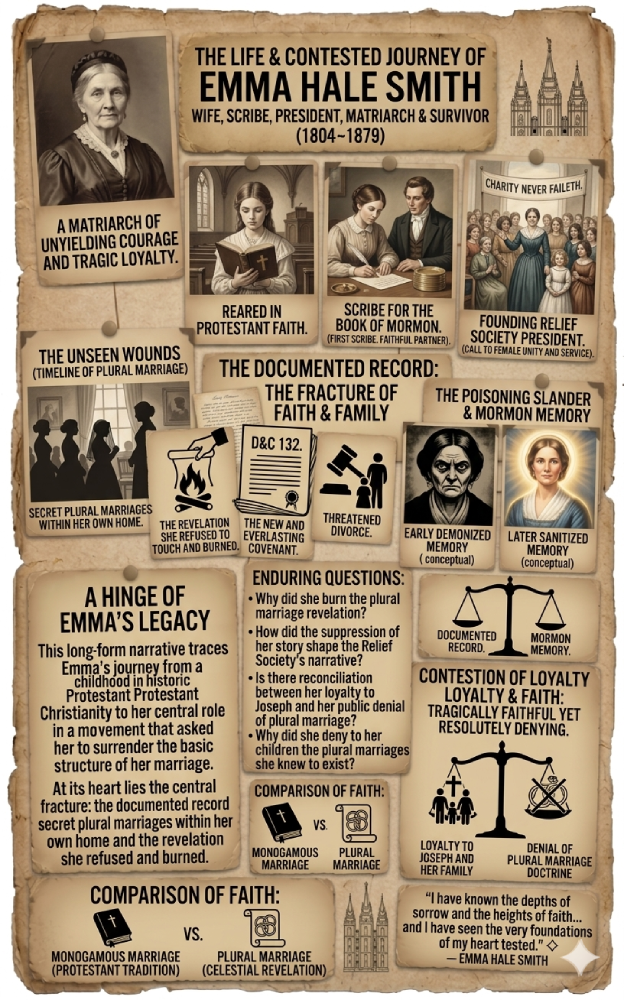
EARLY MORMON PERSONALITIES — NINETEENTH INSTALLMENT
Emma Smith, Loyalty, and the Limits of Faith
❦ ⬩ ❦
Introduction: A Woman on the Ice
In February of 1839, a woman stepped onto the frozen surface of the Mississippi River with two small children clinging to her skirts, two more carried in her arms or strapped to her body, and the manuscript pages of an unpublished translation of scripture sewn into the cotton bags that hung beneath her dress. The ice groaned beneath her. Behind her lay Missouri, an extermination order signed by its governor, and a husband she had left shut up in a comfortless jail at Liberty. Ahead lay Illinois, charity, uncertainty, and a town that did not yet exist. Emma Hale Smith was thirty-four years old, pregnant with grief if not yet with child, and she was carrying nearly everything that the early Latter-day Saint movement possessed of its founder’s most sacred writings across a river that could have swallowed her whole.
It is one of the enduring images of early Mormonism, and like most enduring images, it has been polished by retelling until the human terror at its center is nearly invisible. But Emma herself did not soften it. Years later, she set down what she felt in words that resist all sentimentality, and they remain among the most affecting lines written by any participant in that turbulent first decade.
No one but God knows the reflections of my mind and the feelings of my heart when I left our house and home, and almost all of everything that we possessed excepting our little children, and took my journey out of the State of Missouri, leaving my husband shut up in that lonesome prison. But the reflection is more than human nature ought to bear.
— Emma Hale Smith, recollection of the 1839 flight from Missouri
To write the life of Emma Smith is to write a story that almost no one has told plainly. She is among the most contested figures in nineteenth-century American religion — venerated by one church she helped found, vilified for generations by another, and quietly sanitized in the modern era by institutions that find her inconvenient for opposite reasons. To the Reorganized tradition that gathered around her son, she became the steadfast widow who never bowed to polygamy. To the Utah Saints who followed Brigham Young, she became, for the better part of a century, a cautionary tale: the rebellious wife, the burner of revelations, the woman accused of poisoning a prophet. To the modern Church of Jesus Christ of Latter-day Saints, she has been carefully restored to honor, but at the price of a narrative so smoothed of friction that the actual wound at the heart of her marriage can scarcely be felt.
This essay attempts something harder and, I hope, more honest: to follow Emma through the documented record — her own letters, the diaries of those who watched her, the recollections of friend and antagonist alike — and to let her stand as what she was, a complicated and courageous woman caught inside a religious movement that asked of her things no historic Christian confession had ever asked of a wife. Hers is not a story that yields easily to villains or to saints. It is, rather, a story of loyalty stretched to its breaking point, of faith and grief braided so tightly that they could not finally be separated, and of a theological system whose central innovations cost Emma Smith nearly everything and yet never quite cost her belief.
❦ ⬩ ❦
Origins: The Hale Farm at Harmony
Emma Hale was born on July 10, 1804, in the Susquehanna River valley of northeastern Pennsylvania, in a township then called Willingborough and later renamed Harmony. She was the seventh of nine children of Isaac and Elizabeth Lewis Hale, a family of English Puritan descent that counted seven Mayflower passengers among its ancestors and that had been among the first permanent settlers of the county. The Hales were not poor. Isaac was a renowned hunter who shipped venison and other goods down the river to Philadelphia and Baltimore; Elizabeth kept boarders; and the family’s ninety-acre farm gave Emma a childhood of relative security and respectability uncommon on that frontier.
Religion ran through the household like a current. The Hales belonged to the first Methodist Episcopal congregation in Harmony, where one of Emma’s uncles preached, and Emma began attending services with her mother at the age of seven, reading her Bible and learning the hymns that would later become her life’s quiet vocation. A treasured family tradition held that Isaac Hale, who had drifted into deism, was drawn back toward faith after overhearing his small daughter praying for him in the woods near their home. Whether or not the story happened exactly as told, it captures something the records corroborate: that Emma was, from girlhood, a person of unusual religious earnestness.
She was also unusually capable. She learned to read and write at a time when many frontier girls did neither well, attended a female seminary in nearby Great Bend for a year, and returned to teach school in Harmony. Contemporaries remembered her as intelligent, dignified, and physically striking — tall, dark-haired, with large hazel eyes — and as a woman entirely comfortable on horseback and in a canoe. When she met the man who would remake her life, she was no naïve child but a self-possessed twenty-one-year-old with prospects of her own.
It is worth pausing here, at the threshold of the story, to notice what Emma’s origins were and were not. She was reared in the broad evangelical Protestant world of the early American republic — Methodist hymnody, Bible reading, revival piety, the warm experiential religion of the Second Great Awakening. Nothing in that upbringing prepared her for the radically new theology she would spend her adult life inside. The tragedy and the tension of Emma Smith begin precisely there: a woman formed by historic Christianity who would be asked, again and again, to follow her husband beyond its boundaries.
❦ ⬩ ❦
The Stranger from Palmyra
In the autumn of 1825, a nineteen-year-old laborer from the Palmyra district of New York came south into the Susquehanna valley looking for work. His name was Joseph Smith Jr., and he had been hired, along with a company of other men, by a farmer named Josiah Stowell who believed that a lost Spanish silver mine lay buried somewhere in the hills. Joseph had a local reputation — the kind that traveled faster than a man could — for an uncanny gift of finding hidden things by gazing into a seer stone placed in his hat. Stowell paid him a premium wage on the strength of it. The company boarded, as it happened, at the home of Isaac Hale.
The dig found nothing. Isaac Hale, who regarded treasure-seeking as next door to fraud, soon turned against the whole enterprise and against the young man at its center. But by then it was too late, for Joseph and Emma had begun meeting quietly, against her family’s wishes, at the home of a friend. The official Latter-day Saint accounts and the more skeptical histories agree on the essential shape of what followed: when the couple asked Isaac and Elizabeth for their blessing on a marriage, the Hales refused. Isaac considered Joseph a penniless ‘stranger’ with no settled prospects and a disreputable occupation, and he had hoped Emma would marry a respectable neighbor instead.
So they eloped. On January 18, 1827, Emma left the Stowell house, traveled with Joseph to South Bainbridge, New York, and married him before a justice of the peace. She was twenty-two. The breach with her father would never fully heal. When Emma returned to Harmony in 1830 and then departed for the last time to follow the new church, she left her parents behind forever; she would communicate with her mother only by letter, and would never see Isaac again. It is a pattern that recurs through Emma’s life with painful regularity — the steady subtraction of the people and securities of her youth, exacted as the price of standing beside Joseph Smith.
❦ ⬩ ❦
Scribe to a New Scripture
Within months of their marriage, Emma found herself at the center of the event that would define the rest of her life. In September 1827, she accompanied Joseph in a borrowed carriage to the hill near Palmyra, where he said an angel delivered to him a set of gold plates engraved with an ancient American scripture. Emma never saw the plates uncovered — Joseph kept them wrapped in cloth or hidden — but she would later say she had moved them, felt their weight, traced the engraved pages with her fingers through the linen, and heard the metallic rustle of the leaves. When hostility in New York made work impossible, the couple moved back to Harmony, and there, in a small farmhouse helped along by the very Hale family that had opposed the marriage, the translation of the Book of Mormon began in earnest.
Emma was Joseph’s first scribe. Long before Oliver Cowdery arrived to take down the bulk of the dictation, it was Emma who sat at the table writing as her husband spoke. Decades later, interviewed by her son shortly before her death, she gave the single most candid eyewitness description we possess of the translation process — a description that has become indispensable to historians precisely because it comes from the person closest to the work.
In writing for your father I frequently wrote day after day, often sitting at the table close by him, he sitting with his face buried in his hat, with the stone in it, and dictating hour after hour with nothing between us.
— Emma Smith, “Last Testimony of Sister Emma,” Saints’ Herald, 1879
That image — the seer stone in the hat, the face buried, the hours of dictation with ‘nothing between us’ — is the founding scene of a new American scripture, and Emma was its only witness for long stretches. Her testimony cut in two directions at once, which is characteristic of her. On one hand, she insisted to the end of her life that the work was genuine and beyond Joseph’s natural ability to compose; on the other, her plain account of the stone and the hat has been used by critics as evidence that the Book of Mormon emerged not from gold plates read through divine instruments but from the same folk-magical practice of stone-gazing for which Joseph had first come to Harmony. Emma reported the facts as she saw them and left others to conclude. It was a habit of integrity that would later cost her dearly.
In June 1828, in the midst of this labor, Emma bore her first child, a son named Alvin, who lived only a few hours. She herself nearly died and lay gravely ill for two weeks. It was the first of a long catalogue of bereavements: of the eleven children Emma would bear or adopt, six would die in infancy or early childhood. The woman who helped midwife a new religion into the world buried more of her own children than she raised. No account of Emma Smith that fails to reckon with this relentless tide of infant graves can claim to understand her.
“An Elect Lady”
On April 6, 1830, the Church of Christ was formally organized; Emma was baptized that June by Oliver Cowdery in Colesville, New York, amid a jeering crowd, and her husband was arrested the same day on charges of disorderly conduct. The following month, Joseph dictated a revelation addressed directly to Emma — now canonized as Section 25 of the Doctrine and Covenants — that would furnish the title by which she has been known ever since. In it she is named ‘an elect lady,’ charged to be a comfort and a scribe to her husband, to ‘expound scriptures, and to exhort the church,’ and to compile a selection of sacred hymns for the worship of the new movement. The same revelation also instructed her to ‘murmur not’ and to cleave to Joseph.
From an evangelical Christian standpoint, the revelation is a study in how the new theology worked. It honors Emma genuinely — the commission to expound scripture and exhort the church is no small thing, and the hymnbook she would produce was a real and lasting contribution. Yet it also locates her identity, her duties, and even her emotional posture inside a structure of revelation issued through her husband’s mouth. The boundary between the word of God and the will of Joseph Smith, which historic Christianity guards with the closed canon of Scripture, was here dissolved. Emma’s worth was affirmed in the very act of binding it to a prophetic authority that would, within a decade, command her to accept the one thing she could not bear.
❦ ⬩ ❦
Builder, Hymnist, President: Emma in Her Strength
Whatever else must be said of the theology that surrounded her, Emma Smith was no passive ornament to her husband’s movement. Through the 1830s and early 1840s, she emerged as one of the most consequential women in early Mormonism, and it is a disservice to her memory to let the later controversies eclipse the genuine reach of her labor.
She compiled the first Latter-day Saint hymnal, published in Kirtland in 1835 under her own name — an extraordinary thing in an era when hymn selection was almost universally the work of male clergy. Working with W. W. Phelps, she gathered ninety hymn texts, some borrowed from the Protestant world of her childhood and altered to fit the new theology, others freshly composed. In Kirtland, she organized the feeding and clothing of the laborers who raised the temple, just as she would later in Nauvoo. Her well-known concern about tobacco and strong drink is traditionally credited with prompting the inquiry that produced the ‘Word of Wisdom,’ the dietary code that remains a marker of Latter-day Saint identity to this day.
Her greatest public role came in Nauvoo, the Illinois city the Saints built on a bend of the Mississippi after their expulsion from Missouri. On March 17, 1842, the Female Relief Society of Nauvoo was organized as the women’s body of the church, and Emma was elected its first president. It was she who insisted the organization be called the ‘Relief Society’ rather than the ‘Benevolent Society,’ and she who shaped its early character. She presided, taught doctrine to the assembled women, managed its membership, and made the defense of moral purity its central mission, calling the women of Nauvoo to repentance, one contemporary wrote, ‘with all the frankness of a Methodist exhorter’ — the phrase a quiet reminder of the evangelical soil from which she came.
As the first lady of Nauvoo, she ran the Mansion House as a hotel, took in orphans and the destitute, hosted visiting dignitaries, and traveled with a committee to petition the governor of Illinois on behalf of her persecuted people. She was, by any measure, a formidable woman operating at the height of her powers. Her mother-in-law, Lucy Mack Smith — who lived with or near Emma through most of the seventeen years of her marriage and watched her at close range through every trial — left a tribute that no later detractor ever managed to refute.
I have never seen a woman in my life, who would endure every species of fatigue and hardship, from month to month, and from year to year, with that unflinching courage, zeal, and patience, which she has always done. She has been tossed upon the ocean of uncertainty; she has breasted the storms of persecution, and buffeted the rage of men and devils, which would have borne down almost any other woman.
— Lucy Mack Smith, Biographical Sketches, 1853
It is the testimony of the one woman in the world best positioned to know, and it should be kept firmly in view as the story turns toward its central agony. Whatever Emma later became in the eyes of her enemies — shrew, rebel, poisoner — the person who shared her household for seventeen years saw something altogether different: a woman of almost superhuman endurance, holding a family together through poverty, mob violence, exile, and the serial death of her children.
❦ ⬩ ❦
The Wound That Would Not Close: Emma and Plural Marriage
Here is the fracture at the center of Emma Smith’s life, and the reason her name has been fought over for nearly two centuries. Joseph Smith, beginning quietly in the mid-1830s and intensively in Nauvoo, secretly took dozens of plural wives. Emma opposed the practice with everything she had. The collision between her husband’s most radical doctrine and her own conscience produced a series of episodes so charged that they passed almost immediately into legend, and the legends have obscured the documented record ever since.
How Emma Learned
The historian Linda King Newell, co-author of the landmark biography Mormon Enigma: Emma Hale Smith, has shown that Emma’s introduction to polygamy was nothing like the careful, private instruction Joseph gave to the men of the Twelve and to the women he intended to marry. The earliest evidence suggests that in Kirtland, Emma discovered, more or less by accident, her husband’s relationship with a young hired girl named Fanny Alger, by one account catching sight of them through a crack in the barn door. She seems to have treated it as a single aberration. Then, in Nauvoo, the rumors began again.
The cruelest irony of all is preserved in the Relief Society minutes and in her son’s recollections. In the spring of 1842, believing the whispers of ‘spiritual wifery’ to be the work of the disgraced John C. Bennett, Emma stood before the women of Nauvoo and warned them against ‘a great evil creeping into the church,’ urging them to guard the sanctity of their homes. Only afterward did she learn that the man whose secret practice she had unknowingly denounced was her own husband. She had been preaching against Joseph to his own followers without knowing it.
Emma, Eliza, and the Stairs
By early 1843, the secret could no longer be contained. Among Joseph’s plural wives was Eliza R. Snow, poet, future leader of the Utah Relief Society, and Emma’s close friend, who had taught the Smith children, served as Emma’s secretary, accompanied her to plead with the governor, and lived in the Smith home at Emma’s own invitation. When Emma discovered the relationship between her husband and her trusted friend, the result was an explosion that Mormon folk memory transmuted into one of its most enduring tales: that Emma, in a fury, knocked Eliza down a flight of stairs, causing a miscarriage.
Newell and Avery treat the story with scholarly caution. No contemporary account of the incident survives; the tale is ‘so shrouded in Mormon folk tale and legend that it becomes difficult to determine what actually happened,’ though the evidence does suggest some physical confrontation between the two women occurred. What matters more than the broom and the staircase is the human reality beneath them. Emma had discovered that her husband and her dearest friend had, in her own home, perpetrated what she could only regard as the ultimate betrayal. As Newell observes, a woman known by family and friends as even-tempered and fair would be recast by later writers as a shrew, chiefly because she reacted humanely to circumstances few human beings have ever been asked to endure.
The Revelation and the Burning
The crisis reached its climax in July 1843. On the twelfth of that month — two days after Emma’s thirty-ninth birthday — Joseph, pressed by his brother Hyrum, dictated to the scribe William Clayton the revelation on celestial and plural marriage now canonized as Doctrine and Covenants 132. Hyrum, confident that the doctrine’s purity would win her over, carried the document to Emma. Clayton recorded what happened when he returned. The exchange has the terrible economy of real life.
When Hyrum came back Joseph asked, “How did you succeed?” “I have never received a more severe talking to in my life. Emma is very bitter and full of resentment and anger.” Joseph quietly remarked, “I told you you did not know Emma as well as I did.”
— William Clayton diary, July 12, 1843, as quoted in Newell & Avery, Mormon Enigma
What followed has been told a hundred ways. According to Clayton, Emma so ‘teased and urgently entreated’ Joseph for permission to destroy the document that he finally let her burn it — knowing, he confided, that he could rewrite it from memory whenever he wished. Other witnesses placed the burning differently; some said Joseph himself thrust it into the fire with his own fingers when Emma refused to touch it, even with the tongs. A relative recalled the family tradition that Emma ‘would not touch it with her fingers but took the tongs to put it in the fire.’ Emma, for her part, later denied burning any authentic revelation at all. The contradictions cannot all be resolved, but Newell draws one safe conclusion: if Emma destroyed the document, she did so with Joseph’s permission. The image that survives — a woman who would not so much as touch the paper that commanded her to share her husband — is perhaps truer to her heart than any of the disputed details.
The revelation itself was, in Newell and Avery’s reading, no gentle invitation. Where the 1830 ‘elect lady’ revelation had been warm, this one was ‘threatening and strident.’ It informed Emma that she could accept plural wives willingly or have them imposed upon her, and it bound her eternal standing — her claim upon her own husband in the world to come — to her obedience. Joseph taught her that the temple endowment was essential to exaltation and that her refusal of plural marriage would bar her from it, and would block other women as well, since she was to be their example. The whole architecture of Nauvoo theology was thus arrayed against a single grieving wife.
The Threat of Divorce, and a Promise Not Kept
Emma was not powerless, and she used the leverage she had. After Joseph sought the Nauvoo High Council’s support for the revelation, Emma — returning from a business trip to St. Louis to find herself outmaneuvered — resisted the principle, as Clayton put it, ‘in toto.’ In the most serious crisis of the marriage, she threatened divorce. Joseph backed down and told her he would give up his other wives. But to Clayton, he confided the truth: he did not intend to keep his word. The same diary records Joseph admitting that he ‘should not relinquish anything.’ It is one of the most damning entries in the whole Nauvoo record, and it places the moral weight of the deception squarely where the documents put it.
The Poisoning Accusation
The darkest of the legends — that Emma tried to poison her husband — deserves the careful handling Newell gives it, because it has done more to blacken her name than any other charge. In an 1866 conference address in Utah, more than two decades after the events and at the height of RLDS-LDS hostility, Brigham Young told a congregation that Joseph had once accused Emma of putting poison in his coffee, calling her ‘a child of hell’ and ‘the most wicked woman on this earth.’ The story has been repeated as fact ever since.
The contemporary evidence tells a more human and more tragic story. Joseph’s own diary for November 5, 1843, records that he became suddenly and violently ill at dinner, vomiting so hard that he dislocated his jaw, and that he believed he had been poisoned — yet he recovered enough to attend a prayer meeting that very evening. Physicians consulted by Avery concluded that no poison capable of producing such immediate hemorrhaging would have left its victim well enough to walk to a meeting hours later; the far likelier culprit was a bleeding ulcer, entirely consistent with the crushing stress Joseph was under. The next morning, Joseph was occupied with ‘domestic concerns,’ and a month later, when he was again gravely ill, it was Emma who nursed him through it. The probability is not that Emma poisoned Joseph, but that a sick and frightened man, in a season of unbearable tension, leveled an accusation he could not prove and may himself have abandoned — an accusation that hardened, in the retelling of his successors, into one of the foundational slanders of the Utah church.
❦ ⬩ ❦
Eyewitness Perspectives: How They Saw Her
Because Emma has been so thoroughly mythologized, it is worth setting side by side the actual testimonies of those who knew her, friend and rival alike. They do not all agree, but together they restore the dimensionality that legend strips away.
Consider Emily Dow Partridge, one of the very plural wives Emma alternately consented to and rejected — a woman who had every reason to resent her. Writing of Emma after years of pain on both sides, Emily produced not condemnation but a remarkable extension of grace.
I hope the Lord will be merciful to her, and I believe he will. Perhaps she has done no worse than any of us would have done in her place. Let the Lord be the judge.
— Emily Dow Partridge Young, recollection
Or consider Aroet Hale, an ordinary Utah Saint who had heard the accusations against Emma and refused to accept them, recording in his journal that there ‘never was a more dutiful woman than Emma Smith to her husband’ until the revelation on celestial marriage was made public, and asking how many women in any age could have borne such a trial without their hearts breaking. Even the love between Emma and Joseph, fractured as it was, is documented in their own hands. From Liberty Jail, Joseph wrote of her, ‘My heart is entwined around yours forever and ever,’ and Emma answered from the freezing exile of Quincy that she was ‘yet willing to suffer more if it is the will of kind Heaven.’ These are not the words of a marriage without love. They are the words of a marriage in which love and anguish had become almost indistinguishable.
The official Latter-day Saint biography, for its part, gathers these affectionate fragments and arranges them into a portrait of enduring devotion, which is true as far as it goes. What that portrait conspicuously underplays is the deception, the threats, the broken promise recorded in Clayton’s diary, and the full weight of what Emma was asked to accept. The contrast between the documents and the institutional retelling is itself part of the story, and we will return to it.
❦ ⬩ ❦
The Widow of Nauvoo
On June 27, 1844, a mob with blackened faces stormed the jail at Carthage and shot Joseph and Hyrum Smith to death. Emma, pregnant with her last child, became a widow at thirty-nine. The grief was compounded almost at once by a financial catastrophe that would consume the next eight years of her life. Joseph had died deeply in debt — by his own reckoning, some seventy thousand dollars, an immense sum — and had left no will. Worse, his finances were hopelessly entangled with the church’s: most of the assets stood in his name as ‘trustee-in-trust,’ while the liabilities stood in his name as a private citizen. As the family lawyer summed it up, the property belonged to the church, but the debts belonged to Emma.
What followed was a long and bitter contest between Emma and Brigham Young over the disposition of property — a contest that did as much as polygamy to poison Brigham’s view of her and to fix the hostile image of Emma in the Utah church for generations. Newell’s careful reconstruction of the estate records corrects the picture Brigham broadcast from the pulpit. Brigham accused Emma of usurping fifty thousand dollars in city property from the church; the actual records show that most of that land had already been sold before Joseph’s death, that Brigham’s valuations were wildly inflated, and that when the estate was finally settled in the courts in 1850–52, the federal government and the lawyers took nearly everything. Emma’s widow’s share amounted to a mere eighteen hundred dollars, and she had to spend it, and more, simply to buy back her own home. The legend of the grasping widow collapses under the weight of the documents.
When the main body of Saints abandoned Nauvoo for the Great Basin in 1846, Emma stayed. She would not follow Brigham Young into the wilderness, and she would not surrender her children to a system she believed had killed their father. In December 1847, she married Lewis C. Bidamon, a genial non-Mormon, in a ceremony performed by a Methodist minister — a small, telling return to the religious world of her girlhood. Bidamon was no saint, but he was kind to her children and stood by her, and the marriage gave Emma a measure of peace she had not known in two decades.
❦ ⬩ ❦
The Denial: Emma’s Last Testimony
There remains the most painful and puzzling act of Emma’s life: her lifelong public denial that Joseph had ever practiced polygamy at all. In 1842, she had signed and circulated petitions and certificates declaring that her husband neither taught nor practiced plural marriage. And in 1879, on what amounted to her deathbed, she gave her sons an interview — published as the ‘Last Testimony of Sister Emma’ — in which she denied the whole thing with a flat and sweeping finality.
No such thing as polygamy, or spiritual wifery, was taught, publicly or privately, before my husband’s death, that I have now, or ever had any knowledge of. He had no other wife but me; nor did he to my knowledge ever have.
— Emma Smith, “Last Testimony of Sister Emma,” 1879
The denial is, on its face, impossible to reconcile with the documented record — with the wives she chose herself, the revelation she burned, the divorce she threatened. Historians have proposed a range of explanations, and they are worth weighing with charity rather than contempt. Fawn Brodie suspected a kind of revenge against the plural wives. Richard Van Wagoner argued that the subject simply ‘evoked painful memories’ too dark for Emma to revisit, that she ‘could not face the shadows of the past.’ Newell and Avery noted that Emma had received temple covenants of strict secrecy and may have extended that silence even to the practice she despised, and that she chose not to burden her children with it. D. Michael Quinn observed that Emma regarded polygamy as the very thing that had gotten her husband killed. Benjamin Park suggested that denial was, after years of anguish, simply Emma’s way of surviving.
From a Christian standpoint, the denial is neither to be excused nor to be used as a club. It was, most likely, the last defensive act of a woman who had spent her life shielding the people she loved from a doctrine that had wounded them all — protecting Joseph’s memory for her sons’ sake, and protecting her sons from a truth she believed had destroyed their father. It was not honest, and Emma was by temperament an honest woman; that is precisely what makes it tragic. The denial measures the depth of the wound. A woman does not spend thirty-five years insisting that something never happened unless its happening was more than she could bear to own.
And yet — this is the final paradox of Emma Smith — she never abandoned the faith Joseph founded. To the end, she affirmed the divine origin of the Book of Mormon she had helped transcribe. ‘My belief is that the Book of Mormon is of divine authenticity,’ she testified in that same final interview; ‘I have not the slightest doubt of it.’ She rejected polygamy root and branch, supported her son Joseph Smith III as he organized the Reorganized Church on an explicitly anti-polygamy footing, but she carried her conviction about her husband’s prophetic calling and his founding scripture to the grave.
❦ ⬩ ❦
How Memory Was Made and Remade
No part of Emma’s story illustrates the workings of religious memory more starkly than what happened to her reputation after she died — and how it has been reshaped, more than once, to serve the needs of institutions rather than the integrity of the record. This is the dimension the careful Christian historian must not miss, because it shows how a movement manages the unflattering history of its own origins.
For roughly a century after her death, Emma was effectively a non-person in official Latter-day Saint publications. As Linda King Newell documented, apart from a few paragraphs in a 1933 magazine, the first article devoted to Emma to appear in an official church periodical came only in 1978 — and that brief, generally favorable piece drew indignant letters from readers steeped in the inherited lore. One correspondent mailed in nineteen note cards of quotations, drawn from sources spanning 1863 to 1955, ‘documenting’ Emma as a selfish shrew who had burned a revelation, attempted to poison the prophet, conspired in his death, and tried to usurp the leadership of the church for herself. None of these charges were new; they had been quoted, embellished, even deliberately fictionalized, and then repeated as fact, almost always without anyone tracing them back to their origins or asking in what circumstances they had first been made.
And the origins are revealing. The earliest hostile sources, as Newell shows, cluster precisely around the arrival of the first RLDS missionaries in Utah in September 1863. Emma’s continuing denial of polygamy — and her son’s organization of a rival church built upon that denial — made her a standing threat to the Utah Saints, who had staked their identity on the very practice she repudiated. The demonization of Emma was, in significant part, a polemical necessity of the inter-Mormon contest over who were the rightful heirs of Joseph Smith. Brigham Young’s pulpit accusations of poisoning and greed were forged in that fire. The ‘rebellious wife’ was, in other words, manufactured for institutional purposes a generation after the events she supposedly embodied.
The modern correction has been welcome but has produced a sanitization of its own. The contemporary Church of Jesus Christ of Latter-day Saints, eager to honor its founding women and to defuse the polygamy controversy, now presents Emma with respect — but in language so carefully smoothed that the actual conflict nearly vanishes. The official biographical essay tells readers that ‘little is known about Emma’s knowledge and feelings’ regarding the plural marriages, that she ‘purportedly’ denied them, and that her support ‘shifted over time.’ Each phrase is technically defensible; together they form a haze through which the documented facts — the secret marriages within her own household, the strident revelation, the threatened divorce, the broken promise recorded in Joseph’s own scribe’s diary — can scarcely be discerned. Where the nineteenth-century church demonized Emma to win an argument, the twenty-first-century church softens her to avoid one. In both cases, the institution’s needs, not the historical record, govern how Emma is permitted to appear.
The Christian observer should note this pattern soberly and without triumph, for the temptation to revise inconvenient history afflicts every human community, including the church. But it is precisely here that the contrast with biblical faith comes into focus. The Scriptures of historic Christianity are notorious for refusing to sanitize their heroes: they record Abraham’s lies, David’s adultery and murder, Peter’s denial, the apostles’ cowardice. A tradition confident in the truth does not need to manage the memory of its founders. The recurring impulse to remake Emma — first into a villain, then into a vague and frictionless saint — tells us something about the relationship between the Latter-day Saint movement and its own beginnings.
❦ ⬩ ❦
Theological Departure from Biblical Christianity
Emma Smith is a poignant figure for the Christian precisely because her instincts so often ran back toward the faith of her Methodist childhood even as her life carried her further from it. To evaluate her story theologically is not to condemn the woman but to weigh the system within which she lived, and at three central points that system departed decisively from historic biblical Christianity.
Continuing Revelation and the Authority of Scripture
The first and most fundamental departure concerns the locus of religious authority. In the revelation that named Emma an ‘elect lady,’ her duties and even her emotions were prescribed by a word claimed to come from God through Joseph Smith’s mouth. The Book of Mormon she transcribed, and the Doctrine and Covenants in which her own revelation appears, were received as scripture on a par with — and in practice above — the Bible. Historic Christianity, by contrast, confesses the sufficiency and finality of the biblical canon. The apostle Paul warned the Galatians that even if ‘an angel from heaven’ should preach another gospel, it was to be rejected (Galatians 1:8); the closing of the Revelation pronounces a curse on adding to the words of the book (Revelation 22:18–19). The tragedy of Emma’s binding to D&C 25 is that the same revelatory authority that honored her would, thirteen years later, issue D&C 132 and command her to share her husband — and she had no higher court of appeal, for the canon was open and the prophet held the keys.
Celestial Marriage, Exaltation, and the Gospel of Grace
The second departure is the doctrine that drove the wedge into Emma’s marriage: celestial and plural marriage as the gateway to exaltation. The Nauvoo theology taught Emma, in Newell and Avery’s summary, that the temple endowment and eternal marriage were ‘essential for exaltation’ — for the highest degree of glory and the path to godhood — and that her refusal of plural marriage threatened her own eternal standing and her claim upon Joseph in the world to come. This is a gospel of works and conditions wrapped around the marriage bed. Against it stands the plain teaching of the New Testament that salvation is ‘by grace through faith, and that not of yourselves; it is the gift of God, not of works’ (Ephesians 2:8–9). And against the very idea of eternal plural marriage stands the word of Jesus himself, who taught that in the resurrection ‘they neither marry, nor are given in marriage, but are as the angels of God in heaven’ (Matthew 22:30). Emma’s revulsion at polygamy, far from being the rebellion her detractors named it, aligned her conscience with the consistent biblical witness to monogamous marriage (Genesis 2:24; 1 Timothy 3:2; Titus 1:6). In opposing plural marriage she was, whether she fully knew it or not, standing on biblical ground against a novel doctrine.
The Book of Mormon and the Closed Canon
The third departure is the one Emma never relinquished: her conviction that the Book of Mormon was ‘of divine authenticity.’ Here, the Christian must speak plainly and kindly. The historic church receives the sixty-six books of the Bible as the complete and closed canon of God’s written revelation, and it does not recognize the Book of Mormon as Scripture. Emma’s lifelong testimony to its divine origin — sincere, costly, and unwavering — is for the evangelical Christian the deepest mark of how far the movement had carried a daughter of the Methodist Episcopal Church from the faith of her fathers. She had read her Bible at her mother’s side from the age of seven; she ended her life bearing witness to a new book she had helped bring into the world. That trajectory, traced with sympathy rather than scorn, is the whole story of early Mormonism in miniature: a movement that grew in the soil of American Protestant piety and yet became, in its essential doctrines, a departure from it.
❦ ⬩ ❦
Character Study and Moral Evaluation
What manner of woman emerges from the documents when the legends are cleared away? Above all, a woman of extraordinary endurance. The litany of what Emma survived would have broken most people: the rupture with her family, grinding poverty, repeated forced migrations, the burning of homes, the murder of her husband, the death of six of her children, and a sustained campaign of vilification that pursued her beyond the grave. Lucy Mack Smith’s tribute to her ‘unflinching courage, zeal, and patience’ was not flattery; it was the considered judgment of the woman who watched her at closest range.
She was loyal — perhaps to a fault, and certainly past the point where loyalty and honesty could comfortably coexist. Her loyalty to Joseph survived deceptions that would have shattered most marriages, and after his death, it hardened into the protective denial she carried to the end. Her loyalty to her children shaped that same denial, as she shielded them from a truth she believed had killed their father. And her loyalty to the cause she had helped found kept her faithful to the Book of Mormon and to Joseph’s prophetic calling even as she rejected the doctrine that had cost her so dearly.
Her great strength was also her chief contradiction. Emma was, by every account but those of her enemies, a truthful and fair-minded woman; yet she ended her life as the author of a sweeping public falsehood about her husband’s most consequential practice. The contradiction is not a stain to be explained away but a measure of the impossible position in which she was placed. She could be honest, or she could protect the people and the faith she loved; the system did not leave her room to do both. That she chose protection over candor is a moral failing, but it is the failing of a woman crushed between her conscience and her loyalties, not the calculation of a schemer.
Her blind spot — if it must be named — was the one her whole tradition shared: an inability, or unwillingness, to follow her own moral instinct about polygamy all the way to its source. Emma’s conscience told her, rightly, that plural marriage was wrong; her Methodist upbringing and her plain reading of monogamous Scripture stood behind that conviction. Yet she could never bring herself to conclude that a practice she knew to be evil disqualified the prophetic authority that had commanded it. She rejected the fruit while clinging to the tree. In that single, fateful inconsistency lies the whole pathos of Emma Hale Smith.
❦ ⬩ ❦
Legacy and Impact
Emma Smith’s influence on the movement she helped found is incalculable, and it runs along two divergent channels. Through her son Joseph Smith III, whom she supported as he took up the leadership of the Reorganized Church of Jesus Christ of Latter Day Saints in 1860, Emma’s anti-polygamy convictions became the founding pillar of an entire branch of the Restoration — the tradition that survives today as the Community of Christ. For well over a century, the RLDS Church maintained, partly on the strength of Emma’s testimony, that plural marriage had originated not with Joseph but with Brigham Young. Emma’s denial thus shaped the self-understanding of millions and helped fracture the Latter-day Saint movement along the fault line of polygamy.
Her constructive legacy is just as real. The Relief Society, which she organized and named in 1842, endures as one of the largest women’s organizations in the world. The hymnody she championed shaped Latter-day Saint worship for generations. And her plain testimony about the translation of the Book of Mormon — the seer stone, the hat, the hours of dictation — remains a primary source that every serious historian of Mormon origins, believing or skeptical, must reckon with.
For the Christian, Emma’s deepest significance lies in what her life reveals about the movement at its birth. She is the human cost of early Mormonism’s most radical doctrine made visible — a faithful, intelligent, devout woman, formed by historic Protestant Christianity, who was asked by a new revelation to surrender the most basic structure of Christian marriage, and who spent the rest of her life unable either to obey it or to escape the system that had demanded it. Her story is the rise of early Mormonism in a single life: born of American evangelical piety, carried by personal devotion into a theology that departed from that piety at its core, and left, at the end, denying the very practice that defined the movement’s most distinctive claim — yet still bearing witness to the book that began it all.
❦ ⬩ ❦
Conclusion: The Woman Who Would Not Touch the Paper
Of all the images that survive from Emma Smith’s life, the one that lingers is not the elect lady of the revelation or the formidable president of the Relief Society, but the woman who would not touch the paper — who, when handed the revelation that commanded her to share her husband, refused even to lay her fingers on it and reached for the tongs to put it in the fire. In that gesture is the whole of Emma Hale Smith: a wife who loved her husband past all reason, a believer who could not stop believing, and a daughter of historic Christianity whose conscience recoiled from the one doctrine her tradition had never asked of any wife.
She has been made a villain and made a saint, and she was neither. She was a woman of rare courage and real faith, caught inside a religious revolution that asked more of her than any system has a right to ask, and bearing it, year after year, with what her own mother-in-law called a patience that would have borne down almost any other woman. To remember her honestly — neither demonized as her enemies wished nor smoothed into a frictionless heroine as her institutional defenders prefer — is to honor both her dignity and the truth. And to weigh her story theologically, with compassion rather than contempt, is to be reminded that the gospel of grace which Emma first learned at her mother’s side asks no wife to bargain for her soul, and that the One who entwined her heart with Joseph’s offers, to all who are weary and heavy-laden, a rest that no revelation of men can give.
❦ ⬩ ❦
Primary Sources and Further Reading
This narrative draws upon the documented historical record and the following sources, consulted within the bounds of fair use:
• Wikipedia, “Emma Smith” — https://en.wikipedia.org/wiki/Emma_Smith
• The Church of Jesus Christ of Latter-day Saints, “Emma Hale Smith” — https://www.churchofjesuschrist.org/study/history/topics/emma-hale-smith?lang=eng
• Mormonism Research Ministry (Eric Johnson), “Did Emma Smith Approve of Polygamy?” — https://mrm.org/emma-smith-polygamy
• Linda King Newell, “The Emma Smith Lore Reconsidered,” Dialogue: A Journal of Mormon Thought — https://www.dialoguejournal.com/articles/the-emma-smith-lore-reconsidered/
• Linda King Newell & Valeen Tippetts Avery, Mormon Enigma: Emma Hale Smith (Univ. of Illinois Press) — https://en.wikipedia.org/wiki/Mormon_Enigma
• Source biography (fair-use reference) — https://novus2.com/righteouscause/wp-content/uploads/2026/05/Mormon-Enigma-Emma-Hale-Smith.pdf
• Joseph Smith’s Polygamy, “Emma’s Path through Plural Marriage” — https://josephsmithspolygamy.org/wp-content/uploads/2022/05/10.-Emmas-Path-through-Plural-Marriage-2022.pdf
• Deseret News, “The Courtship and Marriage of Joseph Smith and Emma Hale” — https://www.deseret.com/2016/2/2/20581554/the-courtship-and-marriage-of-joseph-smith-and-emma-hale/
❦ ⬩ ❦
A Note on Research Methods and Accuracy
In recent years, some have voiced concern that artificial intelligence may distort facts or introduce inaccuracies into serious research. That criticism deserves acknowledgment. However, AI has now evolved into the most powerful research instrument available to any dedicated scholar—capable of analyzing vast datasets, cross‑referencing historical records, and surfacing overlooked connections across sources. This work represents a collaboration between the author’s investigative inquiry, verified primary documentation, and the advanced analytic capabilities of AI research tools. Here, AI was not used as a ghostwriter or a shortcut for scholarship, but as a disciplined research partner devoted to rigor, accuracy, and transparency.
Every factual claim in this work has been subjected to active verification. Where AI‑generated content was used as a starting point, it was tested against primary sources, peer‑reviewed scholarship, official institutional documentation, and established historical records. Where discrepancies were found—and they were found—corrections were made. The author has made every reasonable effort to ensure that quotations are accurately attributed, historical details are precisely rendered, and theological claims fairly represent the positions they describe or critique.
That said, no work of this scope is immune to error, and the author has no interest in perpetuating inaccuracies in the service of an argument. If you are a reader—whether sympathetic, skeptical, or hostile to the conclusions drawn here—and you identify a factual error, a misattributed source, a misrepresented teaching, or a claim that cannot be substantiated, you are warmly and genuinely invited to say so. Reach out. The goal of this work is not to win a debate but to get the history right. Corrections offered in good faith will be received in the same spirit, and verified corrections will be incorporated into future editions without hesitation.
Truth, after all, has nothing to fear from scrutiny—and neither does this work.