
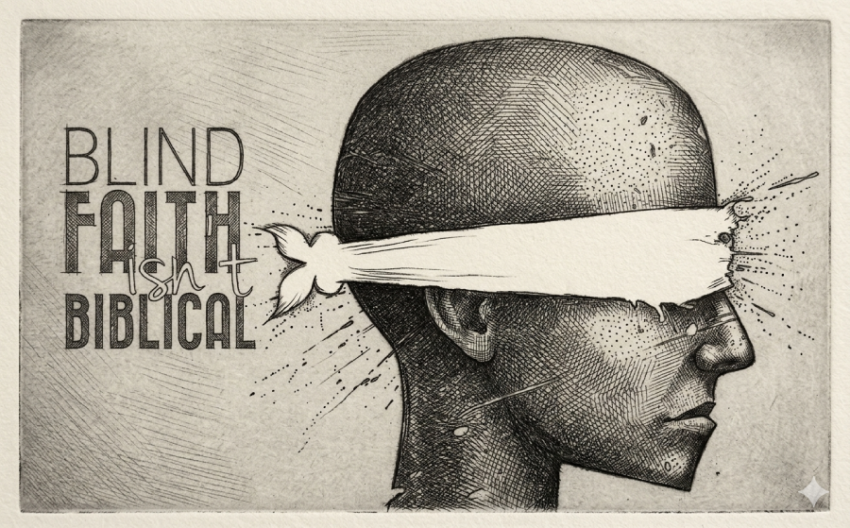
Why Biblical Faith Is Not Blind, Why It Is Not a Feeling,
and How a Modern Disciple Can Walk in Both Reason and Trust
Introduction: A Bandage Tied Across the Eyes
Somewhere along the way — between the Enlightenment’s confidence and the modern internet’s noise — the word “faith” acquired a bandage. The bandage covered the eyes. Christians, in popular imagination, became people who had decided, against the evidence of their senses, to walk through life with sight stripped away. The wager was simple: if you could not see God, then to claim Him was to claim something you did not know. Belief was rebranded as bravery without proof, conviction without examination, certainty without grounds. The whole enterprise was condensed into two words that even today’s middle schoolers can repeat in the lunchroom: blind faith.
It is a phrase that does enormous rhetorical work for very little intellectual effort. It begs every relevant question before any of them is asked. It assumes that the believer has produced no reasons, examined no history, weighed no evidence, and tested no claim. It assumes that the act of believing is, by its nature, an abdication of the mind. And, perhaps most galling of all, it has been quietly imported into the pews of evangelical churches as if it were a compliment — as if “I just take it on faith” were a humble surrender rather than what it most often is: an admission that the speaker has never bothered to find out why he believes what he believes.
This essay sets out to do three things. First, to locate the origin of “blind faith” and refute its premise as both a category mistake and a straw man — a definition supplied to Christianity by its opponents and adopted by too many of its defenders. Second, to draw the sharp distinction between faith and feelings, two categories that modern devotionalism has so blurred that many believers cannot now tell which one is steering. And third, to recover the biblical pattern that runs from Exodus to the Upper Room — the pattern in which God provides evidence, evidence yields knowledge, and knowledge gives birth to trust. The Apostle Peter summarized the whole enterprise in a single sentence: “Sanctify Christ as Lord in your hearts, always being ready to make a defense to everyone who asks you to give an account for the hope that is in you, yet with gentleness and reverence” (1 Peter 3:15). Note the verb. A defense. A reasoned answer. There is no bandage in the apostle’s instructions.
What follows, then, is a survey — historical, philosophical, scriptural, and pastoral — of a phrase that has done more damage to Christian witness in the modern age than perhaps any other single misunderstanding. We will trace its origin, examine its logical structure, listen to its loudest contemporary apostles, and then return to Scripture to see what kind of faith the biblical writers actually commend. We will then take up the more delicate matter of feelings: their place, their limits, and the catastrophe that follows when they are mistaken for faith itself. And we will close, as any honest pastoral essay should, with practical counsel for the believer who wishes to walk — not stumble blindfolded — in the life of active, engaged, reasoning trust.
❦ ⬥ ❦
Part I • The Origin of “Blind Faith”
A Polemical Invention, Not a Biblical Category
It is important, at the outset, to grasp a historical point that is rarely conceded in popular debate: the phrase “blind faith” is not a biblical category. It does not appear in Scripture. The Hebrew and Greek vocabulary used by the Old and New Testament writers for trust, belief, faithfulness, and conviction — אֱמוּנָה (emunah), אֱמֶת (emet), πίστις (pistis) — carries connotations of firmness, reliability, faithfulness, and reasoned commitment. The words are deliberately drawn from the language of evidence and proven character. They do not, by themselves or in combination, suggest a posture of uninformed credulity. As the apologist John C. P. Smith of Answers in Genesis observed:
“The very language of the Hebrew Old Testament reveals that our faith is intrinsically linked to truth. The two words for faith and truth—emunah and emet—are even sometimes translated interchangeably in different Bible versions. Both Hebrew words derive from the same root, aman, meaning ‘firmness, certainty, reliability.’ So rather than being nebulous, biblical faith—like truth—is sure and certain.…Some faith may be unwarranted, and no doubt this faith is blind. In contrast, the Christian faith is both reasonable and justified. It is founded firstly and primarily upon God’s consistent and reliable Word.”
— John C. P. Smith, Answers in Genesis (quoted at Hope Radio KCMI 97.1)
The phrase “blind faith,” then, did not enter Christian theology through the front door of revelation. It arrived through the side door of polemic, supplied by Christianity’s critics as a convenient label for what they wished to discredit. Once installed, it acquired an air of inevitability — the kind of phrase that everyone uses, and no one examines.
The New Atheist Catechism
If we wish to identify the modern fountainhead of the “blind faith” caricature, we need not look far. The movement that came to be known as the New Atheism — with Richard Dawkins, Sam Harris, Daniel Dennett, Christopher Hitchens, and the philosopher Peter Boghossian as its evangelists — made the redefinition of faith into a central rhetorical strategy. Boghossian, perhaps more than any other figure, attempted to formalize the redefinition into a dictionary entry of his own design. In his 2013 book A Manual for Creating Atheists, and across countless social media broadsides, Boghossian propounded what he called the definition of faith: “pretending to know things you don’t know.”
The phrase is clever in the way that only thoroughly question-begging definitions can be. It folds the conclusion of the argument into the premise, presenting what is in fact a polemical assertion as a neutral lexical entry. Greg Koukl of Stand to Reason puts the problem succinctly:
“Boghossian’s definition of faith is not the Bible’s definition. It’s just the opposite. Biblically informed Christians define faith as trusting in what you have reason to believe is true. Boghossian treats faith as a way of knowing—pretending to know things you don’t know. That’s another straw man. Christian faith is trust based on knowledge grounded in evidence.”
— Greg Koukl, Stand to Reason (str.org)
Boghossian is not alone. Sam Harris, in The End of Faith, supplied the now-famous formulation that “faith is generally nothing more than the permission religious people give one another to believe things strongly without evidence.” Richard Dawkins, in The God Delusion, described faith as “persistent false belief held in the face of strong contradictory evidence.” Earlier, Bertrand Russell had already established the tone in characteristically elegant fashion:
“We only speak of faith when we wish to substitute emotion for evidence. The substitution of emotion for evidence is apt to lead to strife, since different groups substitute different emotions. Christians have faith in the Resurrection; communists have faith in Marx’s Theory of Value. Neither faith can be defended rationally, and each therefore is defended by propaganda and, if necessary, by war.”
— Bertrand Russell, “Will Religious Faith Cure Our Troubles?” (1954)
Russell’s sentence repays attention because it gathers, in a few elegant lines, the two errors that this essay must answer. First, the substitution of emotion for evidence is presented as the very definition of faith. Second, the Christian and the Marxist are placed in the same boat — each accused of arbitrary commitments held against reason. The Christian apologist must concede none of this. The historic Christian faith was never a substitution of emotion for evidence; it was a reasoned trust in the One who had given evidence — in creation, in the moral law written on the conscience, in the historical record of Israel, in the prophets, and, climactically, in the resurrection of Jesus Christ. Whether the evidence is convincing is a separate question to be argued on its merits. Whether the Christian even claims to offer evidence is no longer in doubt: he does, and he always has.
Older Roots: Tertullian Misread, Kierkegaard Misunderstood
Modern skeptics did not invent the misreading of Christian faith out of thin air. They inherited a handful of celebrated phrases from Christian history that, taken out of context, appeared to license the very thing they wished to indict. Two examples will suffice.
The first is the Latin tag often attributed to the third-century North African theologian Tertullian: Credo quia absurdum est — “I believe because it is absurd.” The phrase, as commonly cited, was never written by Tertullian in those words. What he actually wrote, in De Carne Christi, concerning the death and resurrection of Christ, was Certum est, quia impossibile — “it is certain, because it is impossible” — a rhetorical construction meant to argue that no fabricator would have invented a story so obviously offensive to the prejudices of his age. Tertullian was making an argument from improbability, not a confession of irrationality. The skeptical tradition has nevertheless preferred the misquotation because it makes a better caricature.
The second is Søren Kierkegaard’s celebrated “leap of faith,” a phrase that has done more damage to Christian self-understanding in the last hundred years than nearly any other. Kierkegaard’s actual argument, developed across Fear and Trembling and the Concluding Unscientific Postscript, was complex and not easily reducible to a slogan. He was wrestling with the limits of objective reasoning in matters of ultimate concern and with the personal, decisional dimension of trust. But in popular usage, the leap has come to mean a jump into the dark — a willed commitment made in defiance of evidence rather than in light of it. This is not what Kierkegaard intended, and it is certainly not what the New Testament teaches.
The Saddest Migration: From Skeptic’s Slogan to Pew Cliche
If “blind faith” had remained the property of village atheists and undergraduate philosophy seminars, the damage might have been contained. Its more grievous fate has been its migration into the church itself. Cody Guitard, national director of Ratio Christi Canada, recalls the moment a fellow pastor told him over breakfast that he thought Christianity was “inherently irrational.” Sean McDowell, professor of apologetics at Talbot School of Theology, describes his pleading in public debate with an atheist: “Please stop saying that faith is blind. Spread the word to the atheist community for me that we don’t think faith is blind” — only to acknowledge that “a lot of Christians contribute to this, so I understand why you might think faith is blind.”
The pews are full of believers who, when asked why they believe what they believe, can produce no answer beyond a vague appeal to upbringing, feeling, or the pastor’s say-so. Julie at The Set-Apart Walk, a pastor’s wife, has written with the kind of frankness one rarely encounters from inside the camp:
“The Church has a serious problem, and it is only getting worse. Christians don’t know why they believe what they believe. So many are operating on blind faith in their Christian walk that the Church and its gospel witness are being severely damaged. We have taken the word faith which is the ‘assurance of things hoped for, the conviction of things not seen’ (Hebrews 11:1) to mean we don’t need or want evidence for anything in our spiritual lives. Big mistake, guys.”
— Julie, The Set-Apart Walk
Her assessment is, if anything, too gentle. The believer who cannot articulate the why of his belief has effectively conceded the atheist’s definition of faith. He has become Exhibit A for the very caricature he ought to refute. The first task of this essay, therefore, is to disabuse the reader of the notion that the Bible ever commended such a posture. It did not, and it does not.
❦ ⬥ ❦
Part II • The Logical Anatomy of Blind Faith
What Blind Faith Actually Is
Before refuting blind faith biblically, it is worth defining it carefully. Logically considered, blind faith is the act of accepting a claim, doctrine, or person as definitively true in the absence of empirical evidence, rational justification, or critical analysis. It is a willful suspension of skepticism in which belief is anchored in emotion, tradition, or authority rather than in objective verification. Three features distinguish it as an epistemic posture.
Violation of the Principle of Sufficient Reason
The Principle of Sufficient Reason, articulated formally by Leibniz but operative throughout the Western intellectual tradition, holds that for every fact or true proposition, there must be a sufficient reason why it is so. Blind faith dispenses with this principle. It accepts the conclusion without requiring the premises to bear it up. The believer is asked to assent, but the assent itself is treated as the warrant. Belief becomes its own justification.
Severance from Epistemic Justification
In standard epistemology, knowledge is classically defined as justified true belief. Take a claim such as “Water boils at 100°C at sea level.” To know the claim, three conditions must obtain: the claim must be true, you must believe it, and your belief must be justified by some reason adequate to the belief. Blind faith operates with justification set to zero. The belief is held; the truth is asserted, but the third leg of the stool is missing.
Immunity to Falsifiability
Because blind faith does not arrive by way of evidence, no contrary evidence can dislodge it. It is unfalsifiable not because its object is transcendent (some truths about God are, by their nature, unfalsifiable by empirical means; that is a different matter) but because the believer has refused, in principle, to allow evidence to bear on the question. When contradictory data appear, it is dismissed. When the prediction fails, the believer revises the prediction — or revises history.
Three Grades of Trust
It clarifies matters to distinguish three modes of trust, each with a different relationship to evidence.
Earned trust is the trust we place in things or persons whose reliability has been demonstrated by past performance. We trust the engine that has started a thousand mornings. We trust the friend whose word has held through a decade of testing. This is inductive trust, calibrated by experience.
Rational faith is the trust we extend to claims that, though not provable with mathematical certainty, are supported by deductive or abductive reasoning, by historical evidence, by testimony, or by the convergence of multiple lines of corroborating data. We believe that Julius Caesar was murdered in 44 B.C. We do not have a video of the event, but the convergence of ancient sources is sufficient. Rational faith goes beyond what can be seen, but not beyond what can be reasoned.
Blind faith, by contrast, is belief maintained independently of — or in direct opposition to — observable data and logical inference. It is the posture of the conspiracy theorist who has decided in advance what the world is like and rearranges every fact to suit the picture. It is the posture, regrettably, that has too often been ascribed to the Christian. But the Christian, when he is faithful to his own Scriptures, occupies the second category. He believes because he has reasons. He may not always articulate them well; he may not have studied them deeply, but the reasons are there, and the apostles assumed his right and duty to know them.
❦ ⬥ ❦
Part III • The Biblical Pattern: Evidence, Knowledge, Trust
Exodus: A Miracle, a Knowledge, an Obedience
The clearest way to demonstrate that biblical faith is not blind is to read the biblical narratives in which faith is expected, commended, or rebuked, and to ask what role evidence plays in them. The pattern is so consistent that, once noticed, it becomes impossible to un-see. Sean McDowell summarizes it as a three-step rhythm: God performs a sign or miracle; the sign produces knowledge; the people are then called to trust and obey based on what they now know. McDowell traces this pattern through the book of Exodus, where the formula appears so often as to become almost a refrain:
“By this you shall know that I am the Lord. Behold, with the staff that is in my hand I will strike the water that is in the Nile, and it shall turn into blood… So that you may know that there is no one like the Lord our God… That you may know that the earth is the Lord’s.”
— Exodus 7:17; 8:10; 9:29 (ESV)
Each plague carries the explicit purpose of producing knowledge. Pharaoh and Israel alike are not asked to believe against the evidence; they are given evidence so that they may believe. By Exodus 14, at the parting of the Red Sea, the writer records the outcome of the entire pattern: “Israel saw the great power that the Lord used against the Egyptians, so the people feared the Lord, and they believed in the Lord and in his servant Moses” (Ex. 14:31). Notice the order. They saw. They knew. Then they believed. This is the precise reverse of blind faith. It is sighted faith, faith with its eyes open and its memory intact.
The popular animated film The Prince of Egypt features a memorable song with the refrain, “There can be miracles when you believe.” It is a stirring lyric, and it captures something true about the biblical world. But, as McDowell observes, if the Israelites had been required to believe before God acted, they would still be making bricks in Goshen. The biblical order is the other way around. The miracle came first, to ground the belief that came after.
The Paralytic and the Roof: Evidence Made Visible
The same pattern reappears in the public ministry of Jesus. In Mark 2, four men lower a paralyzed friend through the roof of a crowded house in Capernaum. Jesus, observing their faith — itself rooted in their knowledge of his reported works — pronounces the man’s sins forgiven. The scribes object internally; only God can forgive sins. Jesus, perceiving their objection, makes the connection explicit:
“Why do you question these things in your hearts? Which is easier, to say to the paralytic, ‘Your sins are forgiven,’ or to say, ‘Rise, take up your bed and walk’? But that you may know that the Son of Man has authority on earth to forgive sins”—he said to the paralytic—“I say to you, rise, pick up your bed, and go home.”
— Mark 2:8–11 (ESV)
But that you may know. The healing was not performed as a kindness alone; it was performed as evidence. The visible miracle was offered as the warrant for the invisible claim. Jesus, in other words, refused to ask his hearers for blind faith. He offered a public, falsifiable demonstration of his authority and invited their reasoned trust based on it.
John’s Gospel: Written That You May Believe
The Apostle John ends his Gospel with a remarkable editorial note that should put to rest any lingering claim that the New Testament traffics in blind faith:
“Now Jesus did many other signs in the presence of the disciples, which are not written in this book; but these are written so that you may believe that Jesus is the Christ, the Son of God, and that by believing you may have life in his name.”
— John 20:30–31 (ESV)
The signs are evidentiary. The book is evidentiary. The whole purpose of the Gospel, John says, is to lay down a body of testimony sufficient to ground reasoned belief. If blind faith were the desired outcome, the entire enterprise of writing a Gospel would be a category error. One does not assemble eyewitness depositions to produce an ungrounded conviction. One assembles them precisely because the conviction is to be grounded.
Doubting Thomas: The Most Misread Story in the New Testament
Nowhere has the case for blind faith been more frequently rested than upon the resurrection appearance to Thomas in John 20. Thomas, having missed the first appearance to the disciples, refuses to accept their testimony without physical confirmation. Eight days later, Jesus appears again, addresses Thomas by name, invites him to touch the wounds, and pronounces what has become one of the most famous benedictions in Christendom: “Have you believed because you have seen me? Blessed are those who have not seen and yet have believed.”
Read carelessly, the saying appears to endorse a faith that disregards evidence. Read in context, it does precisely the opposite. Jesus does not rebuke Thomas. He grants Thomas the very evidence Thomas requested. He then turns from Thomas to the future readers of the Gospel — to us — and pronounces a blessing on those who, lacking the privilege of seeing in the flesh, will believe based on the apostolic testimony now committed to writing. The blessing is not for those who believe without evidence; it is for those who believe based on a different kind of evidence than direct sensory inspection. As Cody Guitard observes:
“Jesus’ words are best understood simply as (1) an acknowledgment of Thomas’s declaration of faith and (2) a blessing on those in the future (like us) who will necessarily need to believe on the basis of less evidence, including not being able to see the risen Jesus for themselves as Thomas did.”
— Cody J. Guitard, Ratio Christi Canada
The passage, properly read, becomes one of the strongest arguments against the blind-faith caricature. Jesus does not scold the man who demanded evidence. He provides it. The fact that he then commends those who will believe on the testimony of others is not an endorsement of credulity; it is an acknowledgement that historical knowledge, of necessity, is mediated through testimony, and that the testimony recorded in John’s Gospel is itself a form of evidence.
Abraham: The Father of Reasoned Faith
The most rhetorically dangerous Old Testament example, for those who would defend the rationality of biblical faith, is the Akedah — the binding of Isaac in Genesis 22. Here, on the surface, Abraham appears to be the very paragon of blind obedience. God speaks, Abraham marches, the knife is raised. Surely this, of all stories, is the proof text for credulity in the name of piety. The skeptic Soren Kierkegaard built an entire treatise on the apparent absurdity of the demand.
But the inspired commentary on Abraham’s act is given to us elsewhere, and it changes the picture entirely. The writer of Hebrews, looking back on the same incident centuries later, reveals what was actually happening in the patriarch’s mind:
“By faith Abraham, when he was tested, offered up Isaac, and he who had received the promises was offering up his only son… He considered that God was able even to raise him from the dead, from which, figuratively speaking, he did receive him back.”
— Hebrews 11:17–19 (ESV)
He considered. The verb is logizomai — to reckon, to calculate, to reason. Abraham did not march to Moriah in thoughtless obedience; he marched having performed an act of theological reasoning. God had promised offspring through Isaac. God could not lie. Therefore, even if Isaac were sacrificed, God must have some means of fulfilling the promise — even, Abraham concluded, the means of resurrection. The act of obedience was therefore not blind, but the trembling conclusion of an argument whose premises were God’s previous, demonstrable faithfulness.
This is the texture of Hebrews 11 in its entirety — the so-called “hall of fame of faith.” Every figure listed acts based on God’s prior promises, God’s past acts of deliverance, and God’s established character. The faith commended is not a leap into the dark; it is a step taken in the light of what God has already done and said.
The Bereans, the Areopagus, and the Apostolic Method
Turn now to the practice of the apostles themselves. Paul, planted in the cosmopolitan synagogues of the first-century Mediterranean, did not pound a pulpit and demand assent. He reasoned. The verb dialegomai — to dispute, to discuss, to reason — appears repeatedly in Acts to describe his method. “And Paul went in, as was his custom, and on three Sabbath days he reasoned with them from the Scriptures, explaining and proving that the Christ needed to suffer and to rise from the dead” (Acts 17:2–3).
More tellingly still, Luke records a community of hearers who were commended for their refusal to take Paul’s word without examination. The Bereans “received the word with all eagerness, examining the Scriptures daily to see if these things were so” (Acts 17:11). They were not condemned for skepticism; they were praised for it. The text calls them “more noble” than the Thessalonians for precisely this reason — they checked.
At the Areopagus, surrounded by Stoics, Epicureans, and curious philosophers, Paul does not invoke blind faith. He argues from creation, from human nature, from the testimony of pagan poets, and finally from the historical fact of the resurrection (Acts 17:22–31). “He has given assurance to all by raising him from the dead.” Assurance. Proof. Evidence offered to a watching world.
And, climactically, the apostolic mandate addressed to every Christian: “Sanctify Christ as Lord in your hearts, always being ready to make a defense to everyone who asks you to give an account for the hope that is in you, yet with gentleness and reverence” (1 Peter 3:15). The Greek word translated “defense” is apologia — the formal, reasoned answer one would give in a court of law. The verse presupposes that the Christian has reasons, knows them, and is prepared to articulate them. It cannot be obeyed by the man whose only answer is, “I just believe.”
❦ ⬥ ❦
Part IV • Modern Practitioners of Blind Faith
Cults and the Collapse of Discernment
If blind faith is not a biblical posture, it is unquestionably a human one. Examples are tragic and abundant. They serve, by contrast, to highlight what reasoned faith refuses to do.
On the morning of November 18, 1978, in the jungles of Guyana, more than nine hundred members of the Peoples Temple drank a cyanide-laced beverage at the command of their leader, Jim Jones. Most were Americans. Many were devout. Children were among the dead. The community had been built on a charismatic personality, a closed information environment, and a posture of total deference to the leader’s pronouncements. By the time the bodies were counted, the world had a new shorthand for the spiritual catastrophe of unquestioning belief.
Nineteen years later, the Heaven’s Gate community in Rancho Santa Fe, California, did the same thing in a smaller and stranger key — thirty-nine adults, persuaded that a spacecraft trailing the Hale-Bopp comet would deliver them to the next evolutionary plane, voluntarily ended their own lives. Between these two cases lay the Branch Davidian compound at Waco in 1993, where seventy-six followers of David Koresh perished in a fire whose ultimate cause is still contested but whose human dynamics were not: a charismatic leader, a closed community, an apocalyptic theology, and a posture toward the leader’s word that excluded all external correction.
These tragedies share a structural feature. The followers had ceased to test the claims of their teachers. They had stopped reading the source documents independently. They had subordinated all evidence to one man’s interpretation. And when the leader led them off the cliff, they had no remaining capacity to refuse, because the very faculty of refusal had been surrendered long before. This is what blind faith does when its consequences are made visible. The Bereans would not have boarded the buses.
The Subjective Witness: ‘Burning in the Bosom’
Not every example of blind faith ends in catastrophe. Most are quieter. Within American religious life, perhaps the most influential institutional example of an epistemology that displaces evidence with feeling is the so-called “burning in the bosom” doctrine of The Church of Jesus Christ of Latter-day Saints. The phrase derives from Doctrine and Covenants 9:8–9, in which the inquirer is counseled to study a matter, propose an answer, ask God if it is right, and “if it is right I will cause that your bosom shall burn within you; therefore, you shall feel that it is right.” Joseph Smith expanded the principle in what is often called Moroni’s Promise (Moroni 10:4): pray, and the Holy Ghost will manifest the truth of the Book of Mormon.
The procedure formalizes subjective feeling as the criterion of objective truth. Whatever else may be said for or against it, the test bypasses the entire apparatus of historical, archaeological, linguistic, and documentary examination that ordinarily attends questions of religious truth. A reader who concludes from a warm feeling that the Book of Mormon is an authentic ancient American record has performed no investigation of the relevant evidence. He has substituted an interior sensation for the external examination that the Bereans, in their own day, would have regarded as obligatory. This is, by the definition this essay has developed, blind faith — not because the feeling is unreal, but because the feeling has been asked to do a job for which it is not equipped.
The same procedure, in less formalized varieties, has migrated into broad sectors of charismatic and revivalistic evangelicalism, where the felt presence of God in the moment is treated as the surest sign of truth, and where the absence of feeling is treated as the absence of God. We will return to this point in Part V. For now, it is sufficient to note that the substitution of inner experience for external evidence is not a strength of Christian epistemology but a weakness, and that it is precisely the weakness that Russell, Boghossian, and Dawkins have exploited.
The Conspiracy Frame and the Closed System
A third modern arena in which blind faith flourishes is the conspiracy theory. Whether the theory in question concerns elections, viruses, the moon landings, or the deep state, the structural features are familiar. A grand narrative is asserted. Contrary evidence is interpreted as confirmation of the conspiracy’s reach. Defectors from the theory are unmasked as agents of suppression. The system is sealed against falsification by design.
Such systems are not always wrong about every detail; conspiracies have occasionally proven real. The problem is epistemic, not factual. The believer has surrendered the means by which he might discover that he is wrong. He is no longer reasoning from evidence to conclusion; he is reasoning from conclusion to evidence, and bending each new datum to fit. The procedure is identical, in form, to the religious blind faith already described. The objects differ; the method is the same.
Christians, of all people, ought to be alert to this snare. We have inherited, in our own Scriptures, the Berean instinct — to receive a teaching with eagerness and then examine the sources to see whether the teaching holds. When that instinct is suspended in religious matters, it tends to be suspended elsewhere as well. The cure is the same in both cases: read the primary documents, weigh the evidence, allow the data its weight, and submit your own first impressions to correction.
❦ ⬥ ❦
Part V • Faith Is Not a Feeling
Two Categories, Two Functions
We arrive now at the second major confusion this essay must address — the conflation of faith with feeling. It is a confusion that goes back at least as far as Bertrand Russell’s sentence about emotion substituted for evidence, and it has been compounded in the last half-century by the rise of an experiential Christianity that often measures spiritual health by the temperature of the heart.
Let it be said plainly: feelings are not faith. Faith is not a feeling. They occupy different categories and perform different functions. Emotions are involuntary, fleeting, and reactive. They rise and fall with circumstance, biology, sleep, weather, and digestion. Faith, by contrast, is an active commitment of the will to what we have reason to believe is true. C. S. Lewis defined faith with characteristic precision:
“Faith is the art of holding on to what our reason has once accepted, in spite of our changing moods.”
— C. S. Lewis, Mere Christianity
The Lewisian definition is worth examination. It identifies three movements. First, reason accepts a proposition — the existence of God, the deity of Christ, the trustworthiness of Scripture — based on the evidence that warrants such acceptance. Second, moods change. Bad news comes; the body sleeps poorly; the world looks bleak. Third, faith holds on. The holding on is not a denial of the changed mood; it is a refusal to let the mood overturn the conclusion that reason has rightly reached. Faith, in Lewis’s sense, is reason’s defender against the riot of the passions.
The Good War Against Moods
John Piper, drawing on Lewis and on Peter’s first epistle, has written one of the more useful pastoral treatments of the question in his essay at Desiring God. He distinguishes between passions — the immediate, intuitive, impulsive movements of the soul tied to the body — and affections, the deeper, more stable exercises of the will. Faith, in his analysis, belongs to the second category. It is not the absence of passion but the leadership of passion. Piper quotes Lewis:
“There will come a moment when there is bad news, or he is in trouble, or is living among a lot of other people who do not believe it, and all at once his emotions will rise up and carry out a sort of blitz on his belief… I am not talking of moments at which any real new reasons against Christianity turn up. Those have to be faced and that is a different matter. I am talking about moments when a mere mood rises up against it.”
— C. S. Lewis, Mere Christianity (quoted by John Piper, Desiring God)
Lewis’s elsewhere phrase, also cited by Piper, is even more vivid:
“Our faith in Christ wavers not so much when real arguments come against it as when it looks improbable—when the whole world takes on that desolate look which really tells us much more about the state of our passions and even our digestion than about reality… When once passion takes part in the game, the human reason, unassisted by Grace, has about as much chance of retaining its hold on truths already gained as a snowflake has of retaining its consistency in the mouth of a blast furnace.”
— C. S. Lewis, Christian Reflections
Anyone who has wrestled with depression, anxiety, or grief recognizes the picture. The argument for God’s goodness is unchanged from yesterday to today. The evidence for the resurrection has not been overturned overnight. But the world looks bleak, and the felt sense of God’s nearness has evaporated, and the passions report that everything is wrong. To mistake this report for new information about God is the chief peril of the feeling-based faith. To answer it with the steady art of holding on — to say, with the psalmist, “Why, my soul, are you downcast? Why so disturbed within me? Put your hope in God” — is the daily exercise of mature faith.
The Neuroscience of Misled Emotions
Modern cognitive science has begun to catch up with what the older theologians knew by experience. The work of Joseph LeDoux at New York University demonstrated that the brain’s emotional processing systems generate responses on the order of milliseconds — ten to twenty times faster than the rational, evaluative systems centered in the prefrontal cortex. We feel before we think. The amygdala has fired its verdict on a situation before the conscious mind has finished perceiving the situation at all. This is a useful feature when the situation is a charging tiger. It is a catastrophe when the “situation” is the question of whether God is good.
The popular writer Ashneil, distilling the same body of research for a Christian audience, frames the problem this way:
“Faith and feelings operate on completely different neurological systems. And the system that controls your emotions was never designed to lead your spiritual life… Your emotional brain operates on a simple formula: Current Circumstances = Ultimate Reality. If your circumstances look good, your emotional brain concludes everything is fine. If your circumstances look bad, your emotional brain concludes everything is terrible. Your emotional brain has no capacity for eternal perspective, divine timing, or invisible spiritual realities.”
— Ashneil, Medium
Add to this the well-documented “negativity bias” — the tendency of the human brain to register negative experiences with about five times the intensity of positive ones — and the believer who navigates by feeling alone is sailing with a compass calibrated for despair. He will read drought as abandonment, silence as rejection, hardship as judgment, and dryness as the absence of God. He will not have arrived at these conclusions from the evidence of Scripture or from the testimony of the Spirit; he will have arrived at them from his amygdala’s first reflex, mistaken for divine communication.
Emotional Reasoning: The Cognitive Distortion in Christian Dress
Clinical psychology has a name for this pattern. It is called emotional reasoning, and it is one of the recognized cognitive distortions catalogued by Aaron Beck in the development of cognitive behavioral therapy. Emotional reasoning, in its simplest form, runs as follows: “I feel it; therefore, it must be true.” I feel like a failure; therefore, I am a failure. I feel rejected; therefore, I have been rejected. I feel distant from God; therefore, God is distant. The logic, set out so baldly, fails immediately. The feeling is treated as both the question and the answer, and the closed loop becomes inescapable.
When emotional reasoning enters the prayer closet, the consequences are spiritually severe. The believer concludes from the absence of an inner glow that God has withdrawn. He concludes from the persistence of anxiety that his prayers are not being heard. He concludes from the dullness of his quiet time that he is failing as a Christian. None of these conclusions follows from the data. They follow from the substitution of feeling for evidence — the very substitution Bertrand Russell mistakenly attributed to the Christian faith itself.
Truth Speaks; Sentiment Listens
What, then, is the proper place of feeling in the Christian life? The Bible commands certain emotions — delight in the Lord, fear of God, love of neighbor, rejoicing in hope, sorrow over sin. These are not optional. But each of them is an emotion grounded in and shaped by truth, not a free-floating sentiment that produces truth out of itself. The order matters. Jo Martin, writing for Cornerstone Christian Counseling, frames it with admirable concision:
“Feelings may be real, but they’re not always true. They must be honored, but they must also be examined… In such moments, it is Scripture, not sentiment, that anchors us. We are not left to drift amid emotional waves.”
— Jo Martin, MA, LPC, Cornerstone Christian Counseling
Notice the verbs. Feelings are to be acknowledged — named, felt, taken seriously. They are not to be repressed or denied. But they are also to be examined — placed under the light of Scripture, weighed against the character of God, tested by what we know to be true. The mature Christian does not silence his emotions; he leads them. He speaks truth to them, as David did when he addressed his own downcast soul in Psalm 42. He preaches to himself before he listens to himself. He grants his feelings the dignity of expression and the discipline of correction.
The Gravity Analogy
There is a useful analogy here. You do not feel the force of gravity acting on your body as you sit reading this essay. You do not feel the molecules of air passing in and out of your lungs. You do not feel the rotation of the Earth beneath your feet. None of these realities present themselves to consciousness as palpable sensations, and yet you trust each one without hesitation. You stake your life on them. You build buildings on the assumption of gravity, and you exhale on the assumption that the next inhalation will find air.
God’s love, God’s presence, and God’s promises are of the same order. They do not depend, for their reality, on your moment-by-moment sensory awareness of them. They are objective. They are constant. They were true when you felt them yesterday, and they are true today when you do not. Faith is the act of organizing your life around the objective reality, even when the subjective register has gone temporarily silent. It is the gravity test applied to the unseen world.
❦ ⬥ ❦
Part VI • The Dangers of a Life Lived by Blind Faith
The Believer Who Cannot Defend What He Believes
If the previous sections have been mostly diagnostic, this one must be unsparingly practical. The believer who walks by blind faith is in trouble. The trouble may not be visible in the year of his conversion, or in the seasons of untested calm, but trouble is coming, and the means by which it might have been met have already been forfeited.
The first danger is evangelistic incompetence. The Christian who has never examined his own foundations cannot lay them out for a friend who asks. When the colleague at work raises the standard objections — the problem of evil, the alleged contradictions of Scripture, the relationship of faith and science, the moral revisions of the modern age — the believer of blind faith has nothing to say. He may, if pressed, mumble something about his pastor, or his mother, or his upbringing. He cannot answer. He cannot, in the Petrine sense, offer an apologia. The Great Commission, conceived as the patient persuasion of one’s neighbor toward a reasoned commitment, is paralyzed at the door of his own ignorance.
The Easy Prey of False Teaching
The second danger is doctrinal seduction. The Apostle Paul, writing to the Ephesians, warned that the people of God must not remain spiritual children “tossed to and fro by the waves and carried about by every wind of doctrine, by human cunning, by craftiness in deceitful schemes” (Eph. 4:14). The image is precise. The blind-faith believer is a small boat without a rudder; whatever wave comes will move him. A charismatic teacher with a winsome smile and a novel doctrine will catch his attention; he will not know how to evaluate the claim. A trendy spiritual practice imported from a foreign tradition will appear to deepen his life; he will not know it has displaced his Christology. A clever heresy dressed up in biblical phrasing will sound to him like a fresh insight; he will not know how to test it.
Julie of The Set-Apart Walk identifies the consequence with painful candor:
“A Christian who operates out of blind faith and does not understand her faith is much more susceptible to being swept into false doctrine (Ephesians 4:14)… Christians who lack Bible knowledge end up pulled into churches that go against biblical teaching… Blind faith weakens our defenses against false teachings and makes us more apt to accept anything that sounds ‘Christian.’”
— Julie, The Set-Apart Walk
The Generational Catastrophe
The third danger — perhaps the most poignant — is the failure of discipleship across generations. A blind faith cannot be passed down. It can be imitated for a season, but it cannot be transmitted as something the next generation can examine, defend, and build upon. The parent who cannot explain to his child why he believes the resurrection is historical, or why the moral law is not arbitrary, or why the church has held to certain doctrines for two millennia, has nothing substantive to hand on. The child, encountering for the first time the objections of the secular university or the social media stream, finds that what he received from home was a posture rather than a set of reasons. The posture collapses. The deconstruction begins.
The pattern repeats. Pastor-couples raise children whose lives revolved around the church but who were never taught why; those children, in adulthood, rebel for a season and then return, but they do not disciple their own children any more deeply than they were discipled themselves; the grandchildren attend out of habit; the great-grandchildren stop attending at all. Within four generations, an externally vigorous Christian family has been reduced to nominal membership and disinterest. The architecture remains, but the foundations were never poured.
The Witness That Becomes a Counter-Witness
The fourth danger is the damage done to the church’s public witness. When the unbelieving world looks at Christianity and sees a community that demands assent without explanation, that recoils from questions, that treats doubt as sin, and that rests its claims on inward sensations the outsider does not share, it concludes — not unreasonably — that the whole enterprise is intellectually bankrupt. The blind-faith Christian, doing what he believes he is supposed to do, makes a public case for the very caricature his apostles spent their lives refuting. He becomes Boghossian’s exhibit. He proves Russell’s point.
The remedy is not, of course, to abandon faith. The remedy is to recover the kind of faith the New Testament actually describes — the reasoned, evidenced, examined, defensible faith that the apostles modeled and commanded. The remedy is for the believer to know what he believes and to know why he believes it. That recovery is the burden of the closing section of this essay.
❦ ⬥ ❦
Part VII • How True Faith Is Evidenced in a Believer’s Life
The Fruit of a Reasoned Trust
If blind faith is recognizable by certain pathologies — inarticulate convictions, vulnerability to false teaching, vulnerability to despair when feelings change — then true faith ought, by symmetry, to be recognizable by certain fruits. Scripture is not shy about cataloguing them, and Christian experience confirms them.
First, true faith knows its grounds. The reasoned believer can tell you, in his own words, what convinced him. He can point to the historical evidence for the resurrection; he can summarize the cosmological and moral arguments for the existence of God; he can rehearse the biblical narrative without confusion; he can describe how the Lord met him in providence, in the conviction of his own sin, in the surprise of unexpected grace. He has done the work. He may not know everything, but he knows something, and what he knows he can articulate.
Second, true faith perseveres through trial. James writes that the testing of faith produces steadfastness (James 1:3), and the writer of Hebrews catalogues the trials by which the patriarchs were authenticated. True faith does not crumple at the first contrary wind. It holds, as Lewis put it, “in spite of our changing moods.” When the diagnosis comes, when the marriage strains, when the child rebels, when the prayer is not answered as it was asked — true faith does not deny the pain, but neither does it reverse its earlier conclusions about God’s character. It says, with Job, “Though he slay me, yet will I trust in him” (Job 13:15).
Third, true faith produces action. James again: “Faith by itself, if it does not have works, is dead” (James 2:17). The reasoned believer does not merely assent to propositions; he reorganizes his life around them. He gives. He prays. He forgives. He witnesses. He repents when he ought. He loves the unlovable. The doctrines have issued in deeds because the deeds follow logically from the doctrines. If the gospel is true, then the gospel must be lived; and if the gospel is not lived, it has not yet been believed.
Honoring God With the Mind
The Greatest Commandment, as Jesus stated it in Mark 12:30, contains a clause that many devotional traditions have quietly underweighted: “You shall love the Lord your God with all your heart and with all your soul and with all your mind and with all your strength.” With all your mind. The mind is not an obstacle to be subdued in the interest of devotion; it is a faculty to be enlisted in the service of love. J. P. Moreland, the Christian philosopher, has built an entire vocation around the recovery of this clause:
“By contrast with the modern misunderstanding, biblically, faith is a power or skill to act in accordance with the nature of the kingdom of God, a trust in what we have reason to believe is true. Understood in this way, we see that faith is built on reason.”
— J. P. Moreland, Love Your God With All Your Mind
True faith honors God with the mind. It studies. It reads. It engages with the difficult questions rather than avoiding them. It treats apologetics not as an optional hobby for the intellectually inclined but as a basic discipleship task for every believer who takes 1 Peter 3:15 with apostolic seriousness.
“but in your hearts honor Christ the Lord as holy, always being prepared to make a defense to anyone who asks you for a reason for the hope that is in you; yet do it with gentleness and respect.”
– 1 Peter 3:15
The Witness of Stable Joy
There is one further piece of evidence of true faith that deserves mention, and it is the one the watching world is most apt to notice. True faith produces a stable joy that is not tied to the fluctuations of circumstance. Paul, writing from a Roman prison, told the Philippians, “I have learned, in whatever situation I am, to be content” (Phil. 4:11). The contentment was learned — the verb implies a process — and its source was not the absence of trial but the steady knowledge of the One in whom he had believed. “I know whom I have believed,” he wrote Timothy, “and am convinced that he is able to guard what I have entrusted to him until that day” (2 Tim. 1:12). Notice both verbs. I know. I am convinced. This is not the language of the blindfolded jumper. It is the language of the man who has examined the ground beneath his feet.
❦ ⬥ ❦
Part VIII • Practical Steps for an Active and Engaged Faith
Surrender, Refocus, and Stand on Promises
The transition from blind faith — or feeling-driven faith — to a mature, reasoned, active trust is not instantaneous. It is a series of disciplines, gradually acquired and patiently rehearsed. Annette Griffin, writing at Christianity.com, summarizes the journey in three movements that are worth pausing over: surrender, refocus, and stand on God’s promises.
Surrender, in this context, is not the abandonment of reason; it is the abandonment of self-reliance. The American tendency to treat the Christian life as a do-it-yourself project, in which the believer recruits God as the assistant in his own pre-existing plans, is the opposite of what Scripture asks. Paul writes, “I have been crucified with Christ. It is no longer I who live, but Christ who lives in me. And the life I now live in the flesh I live by faith in the Son of God, who loved me and gave himself for me” (Gal. 2:20). The reasoned mind does not refuse this surrender; it sees it as the only reasonable response to a God who has proven himself trustworthy.
Refocus is the discipline of lifting the eyes from immediate circumstance to enduring reality. “We fix our eyes not on what is seen, but on what is unseen, since what is seen is temporary, but what is unseen is eternal” (2 Cor. 4:18). The believer trains himself to interpret his present moment in light of the larger story — the story that begins in Eden, runs through Calvary, and ends in the new heavens and the new earth. Within that story, the present trial is given its proportionate weight, and the present blessing its proportionate gratitude.
Standing on God’s promises is the daily exercise of trusting what God has said over what the world is presently saying. The promises are concrete. “I will never leave you nor forsake you” (Heb. 13:5). “My grace is sufficient for you, for my power is made perfect in weakness” (2 Cor. 12:9). “Cast all your anxieties on him, because he cares for you” (1 Peter 5:7). These are not affirmations to be repeated in the manner of self-help mantras; they are objective declarations from the lips of God, and the Christian’s task is to allow them to shape his interpretation of every moment in which a contrary voice presses for the floor.
Read the Primary Documents
The Berean instinct must be recovered. The believer must read the Bible — not merely devotional excerpts on a screen, but whole books, in extended sessions, with attention to context, to author, to original audience, to the shape of the argument. Pastor and Sunday-school class can supplement, but cannot replace, this direct engagement with the primary text. “Examining the Scriptures daily to see if these things were so” (Acts 17:11) was not the exclusive duty of seminarians. It was the commendable practice of an ordinary congregation.
Alongside the Scriptures, the modern believer ought to read in the literature of Christian apologetics — not necessarily at the academic level, though the academic resources are available to anyone who wishes to access them, but at least at the level of careful, lay-oriented introductions. There is no excuse, in an age of cheap and abundant books, for the Christian to remain ignorant of the historical evidence for the resurrection, of the philosophical arguments for God’s existence, of the textual reliability of the New Testament, or of the responses to the standard objections from the science-and-religion conversation. The objections will come. The believer should not be hearing them for the first time across the dinner table.
Develop Truth Reflexes
Because feelings rise faster than reasoning — LeDoux’s twenty-millisecond gap is no metaphor — the mature believer must develop pre-formed responses to the emotional surges that he knows will come. When the feeling of abandonment arises, the reflex must be ready: “God has promised never to leave me nor forsake me; this feeling is not new information.” When the feeling of unworthiness arises: “My standing before God depends on Christ’s righteousness, not my performance.” When the prayer seems unanswered: “God hears every prayer; the answer may be yes, no, or wait, and any of those answers may be the answer of love.”
These reflexes are built by repetition. The believer who has rehearsed the truths a hundred times in a calm hour has them ready in the stormy hour. The believer who has never rehearsed them has nothing to reach for when the wave arrives. David, in Psalm 42, models the discipline: he speaks to his soul rather than for his soul. He addresses his downcast feelings as a leader addresses subordinates. He does not let them issue the verdict on his life.
Pray, but Pray With Truth in View
Prayer in the Christian tradition is not the cultivation of pleasant feelings; it is the conscious presentation of the soul before its God. The Psalter — the prayer book of the church for three millennia — contains every register of human emotion, from exultation to despair, but each prayer is framed by truth about God. The lament that begins with “My God, my God, why have you forsaken me?” ends with “posterity shall serve him; it shall be told of the Lord to the coming generation” (Psalm 22). The grief is felt, and named, and brought into the presence of God; and there, in the presence of God, the larger truth begins to do its work.
The believer who prays only when he feels like praying will pray rarely and shallowly. The believer who has learned to pray as an act of will, with Scripture in view, will pray steadily and grow.
Submit to the Church
The reasoned faith is not an individualist project. It is a community discipline. The believer needs the church — not merely for fellowship in the modern sentimental sense, but for the correction, the catechesis, the rebuke, and the encouragement that no individual can supply for himself. Faithful preaching anchors the affections in doctrine. Faithful sacraments embody the gospel in visible signs. Faithful community provides the witnesses against whose testimony one’s own perceptions are checked. The Christian who absents himself from the church and then complains that his faith feels dry has unplugged the lamp and complained of the dark.
Disciple the Next Generation
Finally — and most consequentially — the believer who has come into a reasoned faith owes its substance to his children, his grandchildren, and the spiritual generation following him. He must not outsource discipleship to the Sunday school or the youth pastor. He must teach his own children why he believes the gospel, what evidence warrants the belief, what objections have been raised against it, and how those objections are best answered. He must do this in an age-appropriate fashion, around dinner tables and on long drives, in moments of crisis and in moments of joy, until the children, in turn, can do it for theirs.
Moses’s instruction to Israel remains in force: “You shall teach them diligently to your children, and shall talk of them when you sit in your house, and when you walk by the way, and when you lie down, and when you rise” (Deut. 6:7). The diligent transmission of a reasoned faith is the surest antidote to the blind faith that has so weakened the modern church.
❦ ⬥ ❦
Conclusion: Eyes Open, Feet Moving
We began with a bandage tied across the eyes. The metaphor will serve us still, in its final reversal. The Christian is the one who has taken the bandage off. He has opened his eyes to the world as God has made it. He has examined the evidence, weighed the historical record, considered the objections, listened to the counter-witnesses, and concluded — with apostolic reason and apostolic humility — that Jesus Christ is the risen Lord and the Bible is the word of God. He does not claim certainty in the strict mathematical sense; certainty of that kind is not available on any important question. But he claims justified confidence, the kind of confidence on which lives are reasonably built.
He has also learned to distinguish his faith from his feelings. He does not despise his feelings; they are gifts of God, and they enrich the texture of devotion. But he has refused to let them issue the final verdict on his standing with God, the trustworthiness of God’s promises, or the truth of God’s word. When the storm comes — and storms come to every believer — he stands on the rock that does not move, and waits for the rain to pass.
The cultured despisers of Christianity have been working for three centuries to convince the world that the believer is a man with a bandage. The believer’s reply is to live, and to think, and to articulate, and to disciple, in such a way that the caricature dies. He gives a reason for the hope that is in him. He does so with gentleness and reverence. And he does so with eyes open and feet moving forward, toward the City that has foundations, whose designer and builder is God.
Faith, in the end, is not blind. It never was. It is the steady walk of one who has seen enough to trust the One who sees all.
❦ ⬥ ❦
Primary Resources Consulted
• Stand to Reason — “Atheist Blindly Believes Biblical Faith Is Blind” (Greg Koukl). https://www.str.org/w/atheist-blindly-believes-biblical-faith-is-blind
• CrossExamined.org — “Should Christians Have Blind Faith?” (Levi Dade). https://crossexamined.org/should-christians-have-blind-faith/
• Deeper Life Blog — “Blind Faith” (Remco Brommet). https://deeperlifeblog.com/blind-faith/
• GotQuestions.org — “Does God expect us to have blind faith?” https://www.gotquestions.org/blind-faith.html
• Hope Radio KCMI 97.1 — “Blind Faith: Is It Biblical?” (Amanda Hovseth). https://www.kcmifm.com/blog/2022/3/11/blind-faith-is-it-biblical
• BiblicalTraining.org — “Faith Is Not Blind” (Sean McDowell, Essentials of Apologetics). https://www.biblicaltraining.org/learn/foundations/essentials-apologetics-th202/faith-not-blind-th202-04
• Truth Reconciled — “Faith Is Not Blind Belief” (Jared Jay). https://truthreconciled.com/2023/07/09/faith-is-not-blind-belief/
• Medium / Namaste Now! — “Blind Belief” (Suma Narayan). https://medium.com/namaste-now/blind-belief-5726bd922b0a
• The New Indian Express — “Blind Faith vs. True Faith.” https://www.newindianexpress.com/lifestyle/spirituality/2023/Nov/25/blind-faith-vs-true-faith-2635597.html
• The Set-Apart Walk — “Blind Faith: A Poison in the Church” (Julie). https://thesetapartwalk.com/blind-faith-a-poison-in-the-church/
• ReachLink — “Emotional Reasoning: Why Feelings Aren’t Always Facts.” https://reachlink.com/advice/general/emotional-reasoning/
• Ratio Christi Canada — “Does the Bible Teach Blind Faith?” (Cody J. Guitard). https://ratiochristi.ca/blog/does-the-bible-teach-blind-faith/
• Christianity.com — “3 Practical Ways to Walk by Faith and Not by Sight” (Annette Griffin). https://www.christianity.com/wiki/christian-life/practical-ways-to-walk-by-faith-and-not-by-sight.html
• Butterfly Living — “How Does Faith Impact Your Life?” https://butterflyliving.org/how-does-faith-impact-your-life/
• Deep Spirituality — “How to Walk by Faith.” https://deepspirituality.com/how-to-walk-by-faith/
• LinkedIn — “Blind Faith: Its Meaning, Appeal, and Consequences” (P. Sosse). https://www.linkedin.com/pulse/blind-faith-its-meaning-appeal-consequences-sosse
• Pilgrim’s Rock — “The Blind Faith of Atheism (Part 3 of 4): Logical Problems?” (Craig Biehl). https://www.pilgrimsrock.com/blind-faith-atheism-part3of4-logical-problems/
• Medium — “Your Brain Is Sabotaging Your Faith: The Neuroscience of Why Feelings Make Terrible Spiritual Leaders” (Ashneil). https://medium.com/@ashneil/your-brain-is-sabotaging-your-faith-the-neuroscience-of-why-feelings-make-terrible-spiritual-b101e55a4bc8
• Desiring God — “The Good War Against Moods: How Stubborn Faith Overcomes Feelings” (John Piper). https://www.desiringgod.org/articles/the-good-war-against-moods
• Columbia Theological Seminary, At This Point — “Emotions and Faith: A Perplexing Relationship.” https://ctsnet.edu/at-this-point/emotions-faith-perplexing-relationship-feel-believe/
• Cornerstone Christian Counseling — “Faith Over Feelings: How to Discern Truth When Emotions Run High” (Jo Martin). https://christiancounselingco.com/blog/faith-over-feelings/
• The Transformed Soul — “Feelings, Emotions and Faith.” http://www.thetransformedsoul.com/additional-studies/spiritual-life-studies/feelings-emotions-amp-faith
• Deep Spirituality — “Faith Over Feelings: How to Trust God More Than My Emotions.” https://deepspirituality.com/faith-over-feelings/
❦ ⬥ ❦
A Note on Research Methods and Accuracy
In recent years, some have voiced concern that artificial intelligence may distort facts or introduce inaccuracies into serious research. That criticism deserves acknowledgment. However, AI has now evolved into the most powerful research instrument available to any dedicated scholar—capable of analyzing vast datasets, cross‑referencing historical records, and surfacing overlooked connections across sources. This work represents a collaboration between the author’s investigative inquiry, verified primary documentation, and the advanced analytic capabilities of AI research tools. Here, AI was not used as a ghostwriter or a shortcut for scholarship, but as a disciplined research partner devoted to rigor, accuracy, and transparency.
Every factual claim in this work has been subjected to active verification. Where AI‑generated content was used as a starting point, it was tested against primary sources, peer‑reviewed scholarship, official institutional documentation, and established historical records. Where discrepancies were found—and they were found—corrections were made. The author has made every reasonable effort to ensure that quotations are accurately attributed, historical details are precisely rendered, and theological claims fairly represent the positions they describe or critique.
That said, no work of this scope is immune to error, and the author has no interest in perpetuating inaccuracies in the service of an argument. If you are a reader—whether sympathetic, skeptical, or hostile to the conclusions drawn here—and you identify a factual error, a misattributed source, a misrepresented teaching, or a claim that cannot be substantiated, you are warmly and genuinely invited to say so. Reach out. The goal of this work is not to win a debate but to get the history right. Corrections offered in good faith will be received in the same spirit, and verified corrections will be incorporated into future editions without hesitation.
Truth, after all, has nothing to fear from scrutiny—and neither does this work.