
A Christian Examination of the Latter-day Saint Doctrine that the
Atonement Was Accomplished in the Garden of Gethsemane
✦ ✦ ✦
Introduction: A Tale of Two Gardens
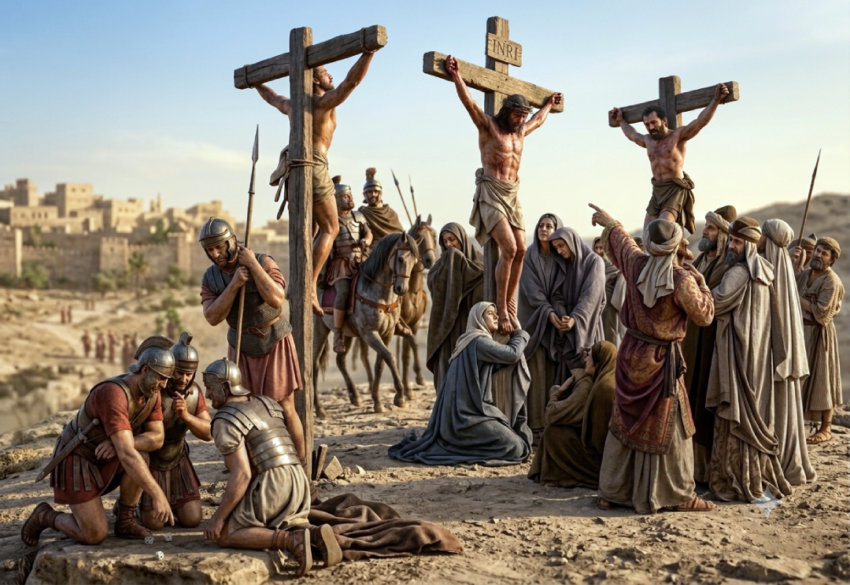
Ask a hundred traditional Christians where the atonement of Jesus Christ was accomplished, and ninety-nine will point to a hill outside Jerusalem’s wall called Golgotha, the Place of the Skull. Ask a hundred Latter-day Saints the same question, and the answer will be very different. A 2019 survey of students at Brigham Young University asked precisely where the atonement of Christ “mostly took place.” Eighty-eight percent of those young Saints answered: “In the Garden of Gethsemane.” Only twelve percent chose “On the Cross at Calvary.”
That divide is not a quirk of campus polling. It is the visible expression of a soteriology — a doctrine of salvation — that has come to define modern Latter-day Saint preaching, art, hymnody, and devotional life. Where the wider Christian tradition has, for two thousand years, fixed the eye of faith on the cross, the Church of Jesus Christ of Latter-day Saints has, by and large, fixed it on an olive grove. This essay asks a single question: Does the testimony of Scripture, the witness of the Old Testament prophets, the apostolic preaching of the New Testament, and the internal evidence of the earliest Latter-day Saint sources actually support the claim that Jesus accomplished the atonement — or even the greatest part of it — in the Garden of Gethsemane?
The argument that follows is offered in the spirit of 1 Peter 3:15. It is meant to be careful, charitable, and clear. Latter-day Saints are not mocked here; their devotion to Jesus Christ is genuine, and their reverence for Gethsemane is heartfelt. But love for our LDS neighbors requires that we tell them the truth as Scripture gives it. The garden was the place where the cup was lifted in trembling hands; the cross was the place where the cup was drunk to its dregs. The two are not interchangeable. And the difference between them is the difference between preparation and consummation, between the dread and the deed, between perspiration and expiation, between a Savior asking and a Savior accomplishing. “It is finished,” Jesus said. He did not say it under the olive trees. He said it on the cross.
✦ ✦ ✦
I. The Latter-day Saint Garden Atonement: A Fair Description
Before any rebuttal can be offered, the LDS position must be stated as its own teachers state it. The Church’s official Guide to the Scriptures defines Gethsemane as the place where Jesus “suffered in Gethsemane for the sins of mankind.” The Encyclopedia of Mormonism is more explicit still: “for Latter-day Saints, Gethsemane was the scene of Jesus’s greatest agony, even surpassing that which he suffered on the cross.” According to this same source, Jesus “suffered the pains of all men… principally in Gethsemane.”
Bruce R. McConkie, an apostle whose 1985 general conference address “The Purifying Power of Gethsemane” is considered the seminal LDS treatment of the doctrine, did not soften the point. In a passage Latter-day Saints today still read, McConkie wrote:
The sectarian world falsely suppose that the climax of his torture and suffering was on the cross — a view which they keep ever before them by the constant use of the cross as a religious symbol. The fact is that intense and severe as the suffering was on the cross, yet the great pains were endured in the Garden of Gethsemane. It was there that he trembled because of pain, bled at every pore, and suffered both in body and in spirit, and would that he ‘might not drink the bitter cup.’ It was there he underwent his greatest suffering for men, taking upon himself, as he did, their sins on conditions of repentance.
Bruce R. McConkie, Mormon Doctrine (1966), p. 555
McConkie was not alone. He stood squarely within a stream of LDS leadership going back to the early twentieth century. Tenth president Joseph Fielding Smith taught precisely the same thing, and in language that admits no ambiguity:
GREATEST SUFFERING WAS IN GETHSEMANE. We speak of the passion of Jesus Christ. A great many people have an idea that when he was on the cross, and nails were driven into his hands and feet, that was his great suffering. His great suffering was before he ever was placed upon the cross… That was not when he was on the cross; that was in the garden. That is where he bled from every pore in his body.
Joseph Fielding Smith, Doctrines of Salvation, vol. 1, p. 130
Thirteenth president Ezra Taft Benson said it with equal force: “It was in Gethsemane that Jesus took on Himself the sins of the world, in Gethsemane that His pain was equivalent to the cumulative burden of all men, in Gethsemane that He descended below all things so that all could repent and come to Him.” Seventeenth and current president Russell M. Nelson taught the same to a youth audience: “The Savior began shedding His blood for all mankind, not on the cross but in the Garden of Gethsemane. There, He took upon Himself the weight of the sins of all who would ever live.”
Two elements of this teaching deserve special notice—first, the symbol of the oil press. The Aramaic word gat-shemanim — “oil press” — has become for Latter-day Saints a controlling metaphor for the entire work of redemption. Just as olives are crushed under enormous stone weights so that the oil bleeds out beneath them, so (the argument runs) Christ in the garden was crushed under the weight of all human sin, until the lifeblood pressed out from every pore. President Nelson preached this directly: “Remember, just as the body of the olive, which was pressed for the oil that gave light, so the Savior was pressed. From every pore oozed the lifeblood of our Redeemer.”
Second, the role of two distinctively Latter-day Saint scriptural texts — Mosiah 3:7 in the Book of Mormon and Doctrine and Covenants 19:18 — both of which speak of Christ bleeding “from every pore.” These verses, rather than the four canonical Gospels, are the textual engine of the garden-atonement doctrine. The Gospels record only that Jesus’s sweat became “as it were great drops of blood” (Luke 22:44 KJV) — language commentators of the early nineteenth century already widely understood as a simile of intensity rather than a description of literal hematidrosis. But the LDS scriptural texts harden the simile into a description of expiatory bleeding, and modern LDS preaching has built the doctrine upward from there.
It must be said in fairness that some Latter-day Saints, especially in the last fifteen years, have begun to soften the garden-only emphasis. John Hilton III, an associate professor of ancient scripture at Brigham Young University, published a 2019 statistical study showing that the heavy emphasis on Gethsemane in general conference addresses is a comparatively recent phenomenon. He has urged Latter-day Saints to give equal weight to Calvary. The April 2021 Liahona, an official church magazine, carried his article “Jesus Suffered, Died, and Rose Again for Us,” with a subtitle that read: “The Savior’s atoning sacrifice began in Gethsemane but wasn’t complete without the events of Golgotha and the Garden Tomb.” That is a welcome and significant development, and we will return to it. But the simple historical fact remains: for most of the twentieth century and well into the twenty-first, the official, repeated, and culturally dominant LDS teaching has been that the central work of atonement was carried out in the garden, with the cross relegated to a completing afterthought.
✦ ✦ ✦
II. A Late Development, Not a Founding Doctrine
If the garden-atonement doctrine were truly a recovered apostolic teaching restored through Joseph Smith — as Latter-day Saints often presume — we would expect to find it clearly taught by the founding generation of the church. We do not. The most careful historical work on this question, an extensively documented 2022 study by Jeremy M. Christiansen published in Dialogue: A Journal of Mormon Thought, demonstrates with disarming candor that the garden atonement is “a later theological innovation” that emerged in earnest only at the close of the nineteenth century and was formalized in the twentieth.
Christiansen’s evidence is striking. Joseph Smith himself, in the corpus of his publicly available teachings, never connected Christ’s suffering in Gethsemane to the atonement for sins. When Joseph Smith spoke of the atonement, he spoke as a man with a Protestant background would speak. He taught that the atonement was “shedding the blood of the Only Begotten to atone for man, for this was the plan of redemption, and without the shedding of blood was no remission” of sins. In his 1830 revision of the Bible, when describing Enoch’s visions of the future coming of the Messiah, Joseph did not write about Jesus in a garden but of “the Son of man lifted upon the cross.”
John Hilton III and Joshua P. Barringer, both LDS scholars, reach the same conclusion: “Joseph Smith did not provide any teachings regarding Gethsemane.” They note that before 1900, the word “Gethsemane” appears in the entire Journal of Discourses — the collected sermons of nineteenth-century Latter-day Saint leaders — a total of five times. Out of 208 references to “atonement” in that same massive corpus, not one teaches that Christ suffered expiatorily in the garden. Brigham Young, Wilford Woodruff, George Q. Cannon, Orson Pratt, Heber C. Kimball, and Charles W. Penrose — none of them taught the garden atonement. When the suffering in the garden was mentioned at all, the early Latter-day Saint leaders described it the way historic Christianity had always described it: as Jesus’s anticipation of the impending agony of the cross.
Consider, for example, the testimony of Lorenzo Snow, who served as the fifth president of the church. Speaking in 1893, he said:
It was difficult for Jesus to accomplish the Atonement. Jesus, the Son of God, was sent into the world to make it possible for you and me to receive these extraordinary blessings… But He did not fail, though the trial was so severe that He sweat great drops of blood. When He knelt there in the Garden of Gethsemane, what agony He must have experienced in contemplating His sufferings on the cross!
Lorenzo Snow, The Teachings of Lorenzo Snow, p. 98
President Snow placed Gethsemane exactly where the Gospel writers placed it: as the nighttime vigil in which the Savior anticipated the cross. His agony there was the agony of contemplating what awaited Him at Golgotha. That is the historic Christian reading. And it was, for most of the nineteenth century, the Latter-day Saint reading as well.
The LDS catechisms of that era tell the same story. John Jaques’s Catechism for Children, used by Latter-day Saints from 1854 through at least 1877, asked, “How then was a redemption from the effects of the Fall wrought out?” The answer: “God sent His only begotten Son, who knew no sin, to die for the sins of the world, and thus satisfy the demands of justice.” Eliza R. Snow’s Bible Questions and Answers for Children spoke at length about Christ’s agony in the garden, but located the atonement itself at His death. James E. Talmage’s 1899 Articles of Faith, the foundational doctrinal exposition of the church at the close of the nineteenth century, described the atonement as “the vicarious nature of [Christ’s] death” achieved “on the cross,” and made no theological appeal to Gethsemane whatsoever.
Early Latter-day Saint hymnody told the same story. The 1835 Collection of Sacred Hymns contains no hymn that even mentions Gethsemane. The hymns of redemption sing of “yonder tree,” the “five bleeding wounds… received on Calvary,” and the “passion on the tree.” That is to say: the founding-era Saints sang what Christians have always sung. They sang the cross.
The Watershed: 1915
The decisive shift came with the publication of James E. Talmage’s monumental Jesus the Christ in 1915, with a revised edition the following year. By the time Talmage wrote this work, something had changed. The federal government’s suppression of polygamy in Utah had stripped from the Latter-day Saints the distinctive practice that had set them apart from the rest of American Christianity. As one historian of LDS theology put it, the result was “a profound transformation of Mormonism” in which Latter-day Saint authors turned their attention to “crafting a theology of Atonement.” It was a fertile but anxious period in which Mormonism was reaching simultaneously for assimilation into Protestant America and for new markers of distinctiveness from it.
In Jesus the Christ, Talmage made a theological move that, on Christiansen’s careful reading, no Latter-day Saint leader had ever made before him: he explicitly subordinated the suffering of the cross to the suffering in the garden. Talmage wrote that in Gethsemane, Christ
struggled and groaned under a burden such as no other being who has lived on earth might even conceive as possible. It was not physical pain, nor mental anguish alone, that caused Him to suffer such torture as to produce an extrusion of blood from every pore; but a spiritual agony of soul such as only God was capable of experiencing… In some manner, actual and terribly real though to man incomprehensible, the Savior took upon Himself the burden of the sins of mankind from Adam to the end of the world.
James E. Talmage, Jesus the Christ (1915), p. 613
Talmage then declared — and this is the crucial sentence — that “the further tragedy of the night, and the cruel inflictions that awaited Him on the morrow, to culminate in the frightful tortures of the cross, could not exceed the bitter anguish through which He had successfully passed.” Where Lorenzo Snow had read the garden as the contemplation of the cross, Talmage now read the cross as a postscript to the garden. The center of gravity of Latter-day Saint soteriology had been moved. From 1915 forward, the use of the word “Gethsemane” in general conference addresses rises in a steep, unmistakable curve.
The pattern was institutionalized in the mid-twentieth century. Joseph Fielding Smith taught the Garden of Eden atonement at the general conference in 1947 and codified it in print in his 1954 Doctrines of Salvation. Bruce R. McConkie made it the controlling motif of his 1958 Mormon Doctrine and crowned it with his 1985 general conference address. These same decades, not coincidentally, are precisely when the Latter-day Saint avoidance of the cross — what scholar Michael G. Reed has documented as the “cross taboo” — was being formalized as church culture. The two doctrines, as Christiansen demonstrates, developed alongside each other, each reinforcing the other. The cross became the symbol of an apostate Catholicism that Latter-day Saints sought to distance themselves from; the garden became the location of the atonement Latter-day Saints could call their own. The doctrinal motive and the cultural motive moved together.
None of this is offered as an accusation. It is offered as a fact in the historical record. The point is simply this: the garden-atonement doctrine is not the apostolic faith restored. It is a development of the late nineteenth and early twentieth centuries, and it is one that the founding generation of Latter-day Saints — including Joseph Smith himself — did not teach.
✦ ✦ ✦
III. “Both Garden and Cross”: Examining the Combined Defense
Confronted with the historical and biblical pressure of the cross, contemporary Latter-day Saint apologists have increasingly retreated to a “both/and” position. Yes (it is said), we honor the garden, but we also honor the cross. The atonement was a process. It began in Gethsemane, it continued through the trials and scourging, it culminated on Calvary, and it was crowned in the resurrection. The Liahona article by John Hilton III makes this exact case: “The Savior’s atoning sacrifice began in Gethsemane but wasn’t complete without the events of Golgotha and the Garden Tomb.”
This sounds reconciling. It even appears generous to traditional Christianity. But there are at least four serious problems with the combined defense as it currently stands.
1. It contradicts the dominant LDS tradition it claims merely to refine.
Hilton’s reasonable-sounding paragraph that the atonement “began in Gethsemane but wasn’t complete without” Calvary cannot be quietly grafted onto the McConkie-Smith-Benson tradition without breaking it. McConkie did not say that the atonement began in the garden. He said the atonement “took place primarily in Gethsemane.” He explicitly mocked the “sectarian world” for thinking otherwise. Joseph Fielding Smith did not say the atonement began in the garden. He said, “That was not when he was on the cross; that was in the garden.” Ezra Taft Benson did not say the atonement began in the garden. He said, “It was in Gethsemane that Jesus took on Himself the sins of the world.” Russell M. Nelson, even after acknowledging in 2018 that the atoning suffering was “intensified as He was cruelly crucified on Calvary’s cross,” had two decades earlier minimized the cross by saying “the agony of the Atonement was completed at Calvary” — the word “completed” telling against him.
The combined position cannot simultaneously be the historic LDS doctrine and a refinement of it. It is one or the other. And as a refinement, it represents a substantial move toward the traditional Christian view that the combined defense paradoxically denies. The very need for the refinement is itself an admission that the dominant tradition was off-center.
2. It cannot account for what the New Testament texts actually say.
Read the four Gospels’ accounts of Gethsemane carefully, and one fact leaps from the page: Jesus is not praying for us in the garden. He is praying for Himself. Matthew records three successive prayers, each variation of: “My Father, if it be possible, let this cup pass from me; nevertheless, not as I will, but as you will” (Matthew 26:39, 42, 44). Luke gives the parallel: “Father, if you are willing, remove this cup from me. Nevertheless, not my will, but yours, be done” (Luke 22:42). Eric Johnson of Mormonism Research Ministry, who has documented the LDS leaders’ Gethsemane teachings as carefully as anyone, registers the obvious observation:
Notice carefully, though, that He was only praying for Himself. The same is true for the parallel passage found in the shorter version in Luke 22… In the prayers recorded by Matthew and Luke, Jesus is concerned about Himself as He prays for His own needs. However, nowhere does He pray for the believers. If He were taking the sins for people upon Himself at this location, not praying for those whom He was atoning would be a strange omission that must be explained.
– Eric Johnson, Mormonism Research Ministry
This stands in stark contrast to the high-priestly prayer of John 17, which Jesus prays before entering the garden, in which He explicitly intercedes for His disciples and “for those who will believe in me through their word” (John 17:20). When Jesus is in the garden, He prays for the cup to pass. When He has crossed the brook Kidron and bears the weight of the world, He prays for those for whom He is about to die. The geographical and theological direction of his praying — pleading to escape in the garden, praying for sinners on the cross — is precisely the opposite of what we should expect if the garden were where the atonement happened.
3. It misreads the meaning of the “cup.”
In every Gospel account, Jesus refers to His coming suffering as “the cup.” He asks the Father, “Let this cup pass from me.” Apologists for the garden atonement frequently assume that the cup was drunk in the garden — that the trembling, the agony, the falling on His face was itself the receiving of the cup of divine wrath. But this misreads the metaphor. In the prophetic literature of the Old Testament, “the cup” is the cup of God’s wrath against sin, and it is something that is drunk to its dregs (Isaiah 51:17, 22; Jeremiah 25:15; Ezekiel 23:32–34). In the garden, the cup is not yet drunk. It is offered. Jesus looks into it. He trembles at what He sees in it. He asks if there is any other way. And then — submitting to the Father’s will — He rises and goes out to drink it. The drinking of the cup is the cross.
P. G. Mathew, in his sermon “Gethsemane: Preparation for Golgotha,” puts this with luminous clarity:
Jesus chose to look into the cup God the Father was extending to him. Having learned of its horrible contents — the wrath of God against all the sins of all the elect of all time — would Jesus drink it or would he turn away from it? This question formed the final temptation of Christ.
– P. G. Mathew, “Gethsemane: Preparation for Golgotha”
The cup is presented in the garden. The cup is drunk on the cross. To collapse those two acts into a single event is to misread the metaphor at the very heart of the Gospels’ Passion narrative.
4. It cannot satisfy the Bible’s own definition of what makes an atonement.
This is the deepest problem with the combined defense, and it carries us directly into the next section of this essay. The Bible does not let us define “atonement” however we please. The Bible defines it. And the Bible’s definition does not bend to fit the LDS “process” framework.
✦ ✦ ✦
IV. The Christian Distinction: Garden as Preparation, Cross as Consummation
Traditional Christianity is not indifferent to the Garden of Gethsemane. To the contrary, it has been part of Christian devotion since the earliest centuries. Christians have wept over the garden, knelt under its olive trees in imagination, sung of “the agony in the garden,” and contemplated the trembling submission of the incarnate Son. But Christianity has always understood the garden as preparation — as the prologue to the act of redemption, not the act itself.
What does the garden teach us? It teaches us at least four things essential to the Christian doctrine of Christ.
First, it teaches the real humanity of Jesus. John Calvin, commenting on the garden agony, wrote that “those who imagine that the Son of God was exempt from human passions do not truly and sincerely acknowledge him to be a man.” In Gethsemane, we see Jesus bowed under the weight of dread; we hear Him beg for an alternative; we watch Him sweat blood under the strain of what is coming. The early Christological heresy of Docetism — which claimed that Christ only seemed to suffer — is irrefutably crushed by Gethsemane. The Son of God really did become a man, and the man Jesus Christ really did tremble before the cup.
Second, the garden teaches us the cost of the cross. If Christ in the garden, before a single nail had been driven, was so weighed down with anticipation that his sweat fell like drops of blood, what does that tell us about the cup He was about to drink? The Puritan Jonathan Edwards saw rightly that Christ’s anguish in the garden was not the fear of physical death — many lesser men have faced death without flinching, and many Christian martyrs have died with joy. The trembling in the garden, Edwards argued, was the trembling of the spotless, infinitely holy Son of God at the prospect of bearing the filth and guilt of every human sin. The garden does not relieve the cross of its weight; the garden reveals the weight of the cross.
Third, the garden teaches the obedience of Christ. “Not my will, but thine, be done” is the line that reverses Eden. In the Garden of Eden, the first Adam said, in effect, “Not Thy will, but mine.” In the Garden of Gethsemane, the Last Adam said, “Not my will, but Thine.” The garden is the moment of definitive submission. It is the moment in which the human will of Jesus, in perfect union with His divine will, freely embraces the cup that will be drunk on the morrow. The whole drama of redemption hinges on that surrender.
Fourth, the garden teaches us how to pray in times of trial. “Watch and pray that you may not enter into temptation,” Jesus said. “The spirit indeed is willing, but the flesh is weak” (Matthew 26:41). This is the great pastoral lesson of the garden. The believer who suffers can take heart that Christ has been there before — that there is a high priest who knows what it is to plead with the Father for relief, who knows what it is to fall on the ground in anguish, who knows what it is to submit his will when no relief is granted.
All of this is precious. None of it is the atonement. The garden is the place where Christ accepted the cup. The cross is where He drank it. The garden is where He submitted to the sacrifice. The cross is where He offered it. The garden is where He prepared to die. The cross is where He died.
It is worth pausing here to register that this distinction is not a Protestant invention or a sectarian polemic. It is the distinction the Latter-day Saint historian Lorenzo Snow drew in 1893. It is the distinction the LDS scholars Monte S. Nyman and Charles D. Tate, Jr. registered when they wrote that “the sufferings of Jesus Christ that began in the Garden of Gethsemane were consummated on the cross.” That is, in fact, the historic Christian formulation. The work begun in the garden was consummated — completed, finished, brought to its end — on the cross. Note the word: consummated. Not continued. Not extended. Consummated.
✦ ✦ ✦
V. The New Testament’s Univocal Testimony: Atonement at the Cross
If the apostles preached the garden atonement, we will find it in their sermons in Acts. We will find it in the letters of Paul. We will find it in the catechetical instruction of Peter and John and the writer of Hebrews. We will find it in the book of Revelation, where the slain Lamb is the central image of redemption. And what do we find? The garden atonement is utterly absent. From cover to cover, the apostolic preaching of redemption locates the saving act of Christ at His death on the cross.
Consider the apostle Paul’s summary of the gospel — the gospel he received and that he passed on as “of first importance”:
For I delivered to you as of first importance what I also received: that Christ died for our sins in accordance with the Scriptures, that he was buried, that he was raised on the third day in accordance with the Scriptures.
– 1 Corinthians 15:3–4
Note carefully what is and is not in that creed. Christ died for our sins. Christ was buried. Christ was raised. There is no mention of Gethsemane. Paul, the most theologically systematic of the apostles, summarizing the gospel he preached, does not list the garden as a constitutive moment of the atonement. The cross alone is the saving act.
Paul says it again in Romans: “While we were still sinners, Christ died for us” (Romans 5:8). And again: “We were reconciled to God by the death of his Son” (Romans 5:10). And again: “Christ Jesus… God put forward as a propitiation by his blood, to be received by faith” (Romans 3:24–25). The death of Christ — not His sweat in the garden — is the propitiation.
Paul writes to the Galatians: “Far be it from me to boast except in the cross of our Lord Jesus Christ” (Galatians 6:14). To the Ephesians: Christ “reconcile[d] us both to God in one body through the cross” (Ephesians 2:16). To the Colossians: “And you, who were dead in your trespasses… God made alive together with him, having forgiven us all our trespasses, by canceling the record of debt that stood against us with its legal demands. This he set aside, nailing it to the cross” (Colossians 2:13–14). The atoning act is the nailing to the cross. It is not the sweating in the garden.
The author of Hebrews builds an entire theological argument on the necessity of Christ’s death for atonement. In Hebrews 9, the writer is at pains to demonstrate that under the Mosaic law, no covenant could be inaugurated, no atonement could be made, without the death of a sacrificial victim:
For where a will is involved, the death of the one who made it must be established. For a will takes effect only at death, since it is not in force as long as the one who made it is alive. Therefore not even the first covenant was inaugurated without blood… Indeed, under the law almost everything is purified with blood, and without the shedding of blood there is no forgiveness of sins.
– Hebrews 9:16–18, 22
The phrase “shedding of blood” must not be misread as the bursting of capillaries under sweat. In the entire biblical-Hebraic vocabulary of sacrifice, “shedding of blood” means the death of the victim. Leviticus 17:11, the great verse on which the whole sacrificial system rests, declares: “For the life of the flesh is in the blood, and I have given it for you on the altar to make atonement for your souls, for it is the blood that makes atonement by the life.” The atoning blood is blood poured out in death. The lamb’s life is given. The animal does not perspire to atone; it dies to atone. Anything less is not what Scripture means by the shedding of blood.
This is why traditional Christianity has always insisted on a critical distinction that one word in the Latin tradition makes plain. The atoning sacrifice of Christ is expiatory — that is, it is an offering whose efficacy depends upon the death of the offering. Perspiration in a garden is not expiation. Only the offering of Christ’s life, the death of the Lamb, satisfies the demands of divine justice. To use a phrase Eric Johnson has rightly seized upon: “an acceptable sacrifice in the eyes of God requires expiation, not perspiration.”
Peter, in his first epistle, drives the point home with finality:
He himself bore our sins in his body on the tree, that we might die to sin and live to righteousness. By his wounds you have been healed.
– 1 Peter 2:24
Where did Christ bear our sins? “In his body on the tree.” Not under the olive press. On the tree. Peter is writing as an eyewitness — he had been in the garden; he had seen the agony; he had heard the prayers. And when, decades later, he composed a summary of the saving work of his Master for the suffering church scattered across Asia Minor, he wrote: “on the tree.”
John gives us perhaps the most famous single word in the Passion narrative. Hanging on the cross, with His work complete, Jesus says, “It is finished” (John 19:30). In the Greek, this is tetelestai — a perfect-tense verb meaning “it has been brought to its end and stands completed.” Tetelestai was the word stamped on a paid bill of debt in the first century: paid in full. Jesus did not say tetelestai under the olive trees. He said it on the cross. And then He bowed His head and gave up His spirit. The work was finished there. Not begun there. Not partially complete there. Finished.
There is one further internal witness that ought to be noted. The Book of Mormon itself — the very scripture appealed to in support of the garden-atonement doctrine — repeatedly locates the saving work of Christ at the cross. In 1 Nephi 11:33, Nephi declares: “And I, Nephi, saw that he was lifted up upon the cross and slain for the sins of the world.” Slain — not sweated. Lifted up upon the cross — not crushed in the garden. The Book of Mormon, on its own terms, agrees with Paul. Bruce R. McConkie himself, in a moment of unguarded honesty, conceded that on the cross “the victory had been won, when the Son of God had fulfilled the will of His Father in all things — then He said, ‘It is finished.'” The internal testimony of the LDS canon cuts against the garden-atonement doctrine its modern apologists have built on top of it.
✦ ✦ ✦
VI. The Old Testament Witness: Isaiah 53:5 and the Suffering Servant
If the New Testament univocally places the atonement at the cross, the Old Testament prophesies it there with such precision that the nineteenth-century Hebrew scholar Franz Delitzsch, in his commentary on Isaiah 53:5, said the verse “looks as if it had been written beneath the cross upon Golgotha.” Isaiah 53 — written some seven centuries before Christ — is the great prophetic portrait of the Suffering Servant of Yahweh, and verse 5 is the heart of it. Read in any translation, it is impossible to miss what the prophet is describing:
But he was wounded for our transgressions, he was bruised for our iniquities: the chastisement of our peace was upon him; and with his stripes we are healed.
– Isaiah 53:5 (KJV)
Every clause of this verse points unambiguously to the cross. Not one of them points to the garden. Consider the four verbal images Isaiah uses, and consider them in their Hebrew specificity.
“Wounded for our transgressions.”
The Hebrew verb here is mecholal, a passive participle of the verb chalal — “to bore through, to perforate, to pierce.” Albert Barnes notes that the word “refers to some infliction of positive wounds on the body… some act of piercing, some penetrating wound that would endanger or take life.” The Cambridge Bible commentary calls it among “the strong verbs… probably metaphors expressing the fatal ravages” of the Servant’s affliction. The image is not of sweat squeezed from pores. The image is of a body run through. As the Pulpit Commentary observes, the Servant was “pierced (1) by the thorns; (2) by the nails; and (3) by the spear of the soldier. The wounds inflicted by the nails caused his death.” Where did Jesus suffer wounds of piercing? Not in the garden. In the garden, he sweated; in the garden He was unbruised. The piercing was at Golgotha — His hands and feet by the nails, His side by the centurion’s spear (John 19:34).
“Bruised for our iniquities.”
The Hebrew word dakka’ means to crush, to break to pieces, to grind into the dust. Job uses it of being utterly destroyed. The Pulpit Commentary observes: “No stronger expression could be found in Hebrew to denote severity of suffering — suffering unto death.” The Servant in this verse is not crushed in the way an apologist for the garden atonement might wish — under the metaphorical weight of sin alone, with the body intact. He is crushed in the way Isaiah 53:10 specifies: “It was the will of the LORD to crush him; he has put him to grief.” The crushing extends to death. Isaiah 53:8: “He was cut off out of the land of the living.” Isaiah 53:9: “They made his grave with the wicked.” Isaiah 53:12: “He poured out his soul to death.” The bruising of Isaiah 53:5 is the dying of Isaiah 53:8–12. It belongs to the cross, not to the garden.
“The chastisement of our peace was upon him.”
The Hebrew word for “chastisement” is musar — a word that can refer to discipline, correction, or punitive suffering. As the Cambridge Bible notes, this chastisement is “pain inflicted for moral ends and with remedial intent.” But in this verse, what makes the chastisement bring “peace” is not its remedial gentleness — it is its substitutionary completeness. As Albert Barnes explains, the word “means that he took upon himself the sufferings which would secure the peace of those for whom he died — those which, if they could have been endured by themselves, would have effected their peace with God.” Keil and Delitzsch put it with even more weight: this is “the chastisement that brings us peace,” the visitation of divine justice upon the Servant that, by being borne by Him, secures shalom — wholeness, reconciliation — for those who deserved to bear it themselves. Such a punishment is not satisfied by the trembling of anticipation. It demands the offering of life. Romans 5:1 sums up the apostolic understanding: “Therefore, since we have been justified by faith, we have peace with God through our Lord Jesus Christ.” Peace is not made in the garden. Peace is made by death.
“With his stripes we are healed.”
The Hebrew chabburah refers literally to a weal or bruise inflicted by a blow — the raised, bloody mark left by a scourge. Jamieson, Fausset, and Brown call this “minutely prophetical of His being scourged.” The Pulpit Commentary observes that Christ “was judicially scourged (Matthew 27:26). Such scourging would leave the ‘stripe-marks’ which are here spoken of.” The scourging — administered with a multi-thonged whip into whose leather strands were woven sharp bones and shards of metal — happened after the garden and before the crucifixion, as a prelude to the cross. The stripes that healed sinners were not the stripes of perspiration. They were the open furrows of the Roman flagellum on the back of the Suffering Servant, just before He was nailed to the wood.
The apostle Peter, again as an eyewitness, drops the curtain on any other reading. In 1 Peter 2:24, he quotes Isaiah 53:5 word for word and tells us its meaning:
He himself bore our sins in his body on the tree, that we might die to sin and live to righteousness. By his wounds you have been healed.
– 1 Peter 2:24
Peter takes the four images of Isaiah 53:5 — the wounding, the crushing, the chastisement, the stripes — and locates their fulfillment in a single sentence: in his body on the tree. The Holy Spirit, through the apostle, gives the inspired interpretation of the prophet’s words. The Servant’s atoning sufferings were borne on the tree.
If the garden atonement were true, Isaiah 53:5 ought to have read something like this: But he was crushed in a garden under the weight of sin, his sweat became as drops of blood, in an olive press he was pressed for our iniquities, and by his prostration we are healed. Isaiah said nothing of the kind. He said “wounded,” “bruised” unto death, “chastised,” and “stripped” — and every one of those terms is fulfilled at the place where the Roman cross stood outside the city gate.
Delitzsch was right. It does look as if Isaiah 53 had been written beneath the cross.
✦ ✦ ✦
VII. Why the Place of Atonement Matters
Some readers will ask, very reasonably: why does this matter? If a Latter-day Saint loves Jesus and trusts His suffering for salvation, why should the precise location of that suffering be a fighting issue? It would not be — except that the geography is not a neutral detail. The geography determines the theology.
When the place of atonement is the cross, the saving work of Christ is necessarily understood as a substitutionary death. The wages of sin is death, says Paul (Romans 6:23). Christ paid those wages by dying. Justice was satisfied not because Christ felt very bad about our sins, but because Christ died the death we deserved. The cross is a payment, a substitution, a once-for-all sacrifice that requires nothing of us but faith in the One who offered it. “Christ also suffered once for sins, the righteous for the unrighteous, that he might bring us to God” (1 Peter 3:18). The atonement is finished. Tetelestai.
When the place of atonement is the garden, the saving work of Christ tends — almost inevitably — toward something more diffuse. It becomes a process. It becomes a sympathetic identification with our pain. It becomes an empathetic experiencing of every human suffering, so that Christ can succor us by knowing what we feel. All of this is true and beautiful (and Hebrews 4:15 affirms the reality of Christ’s empathy), but it cannot bear the weight of redemption. A Christ who deeply sympathizes with my sin has not yet paid for my sin. A Christ who feels the cumulative weight of every human sorrow has not yet died for any of them. And a Christ whose atonement is conceived primarily as a sympathetic process is a Christ whose finished work always seems to need my finishing.
The fruit of this is visible in the doctrine of forgiveness that flows from the garden-centered atonement. President James E. Faust, a member of the LDS First Presidency, taught: “All of us have sinned and need to repent to fully pay our part of the debt. When we sincerely repent, the Savior’s magnificent Atonement pays the rest of that debt.” The Christ of Gethsemane, in this construction, pays the part of the debt I cannot pay; I must pay the part I can. This is not a rhetorical slip; it is the logic of a system that says, with 2 Nephi 25:23, that “it is by grace that we are saved, after all we can do.” In other words, grace does not save the helpless sinner, but the exhausted worker who has first done “all” within his power. The cross declares, “Paid in full”; the Book of Mormon adds, “after all we can do.”
The Christ of Calvary, by contrast, says: “It is finished. Paid in full. There is no part left for you to pay.” The New Testament pattern is not “grace picks up where my efforts leave off,” but “while we were still sinners, Christ died for us” and “to the one who does not work but believes in him who justifies the ungodly, his faith is counted as righteousness” (Romans 5:8; 4:5). Where LDS doctrine joins Gethsemane to “after all we can do,” forgiveness becomes a joint venture, a cooperative payment plan in which Christ’s blood covers only what my works and repentance do not. Where apostolic doctrine fixes atonement in the cross, forgiveness is received, not completed; rested in, not incrementally earned.
This is not a small theological difference. It is the difference between salvation as cooperation with an empathetic Christ and salvation as resting in the finished work of a substitutionary Christ. It is the difference between perspiration and expiation in another sense entirely — for the soul of the believer. The cross-centered gospel is the gospel Paul preached: “For by grace you have been saved through faith. And this is not your own doing; it is the gift of God, not a result of works, so that no one may boast” (Ephesians 2:8–9). The garden‑centered gospel, joined to “by grace…after all we can do,” always, finally, requires the disciple to finish what Christ in the olive press only began.
There is also a worship consequence. When the place of atonement is the cross, the symbol of the cross is precious. It is not a sign of a dying Christ (though it is that). It is the sign of a saving Christ. It is the sign of debt paid, of justice satisfied, of mercy poured out, of an empty tomb made possible. The apostle Paul could boast in nothing else: “May I never boast except in the cross of our Lord Jesus Christ” (Galatians 6:14). The traditional Christian’s love of the cross is not idolatry. It is the response of a redeemed people to the place where redemption happened.
Latter-day Saints have, by and large, been instructed away from this symbol. Joseph Fielding Smith called the wearing of crosses “repugnant.” Gordon B. Hinckley said the cross is the symbol of “the dying Christ,” while Latter-day Saints proclaim “a Living Christ” — as if the cross were less than essential to the resurrection. Christian theologian Paul Copan offers the more excellent answer:
If my brother happened to be Jesus of Nazareth and his death in an electric chair brought about my salvation and was the means by which evil was defeated and creation renewed, then he would have transformed a symbol of shame and punishment into something glorious.
– Paul Copan, Is God a Moral Monster?, p. 33
The cross is the means of the resurrection. The empty tomb presupposes the occupied cross. There is no Easter without Good Friday. To boast in the cross is to boast in the place where the Living Christ won His victory — and that is not a thing any Christian, of any tradition, should be embarrassed about.
✦ ✦ ✦
VIII. Conclusion: Honoring the Garden, Confessing the Cross
Let us be clear at the end about what this essay has argued and what it has not. It has not been argued that the Garden of Gethsemane is unimportant. The garden is sacred ground. There the incarnate Son of God knelt in dread of what was to come; there He sweated through what must rank as the most piercingly honest prayer ever offered to the Father; there He showed us that obedience to the Father’s will is what redemption sometimes asks of a soul that does not want to drink the cup. Every Christian, of every tradition, should treasure Gethsemane. We can learn from it the depth of Christ’s love, the cost of His obedience, the reality of His humanity, and the comfort of His sympathy with us in our own dark gardens.
But the essay has argued — and the evidence, I believe, has compelled — that the atonement itself was not accomplished in that garden. The garden was where Christ embraced the cup. The cross was where He drank it. The garden was where He set His face like flint to die. The cross was where He died. The garden was the prologue. The cross was the consummation. And no apologetic reframing of “both garden and cross” can erase the centrality of the cross without erasing the apostolic gospel itself.
The Latter-day Saint reader who has stayed with this essay to its conclusion is owed a final word. There is no malice here. There is, however, a plea. The garden-atonement doctrine that has been preached to you for three or four generations is not what Joseph Smith preached. It is not what Brigham Young preached. It is not what Lorenzo Snow preached. It is not what the Book of Mormon teaches when 1 Nephi 11:33 declares the Lamb “slain for the sins of the world.” It is not what Paul preached. It is not what Peter preached. It is not what the Hebrew writer argued for seven chapters straight. And it is not what Isaiah saw seven hundred years before a Roman cross was ever planted on a Judean hill.
The kindest thing one Christian can offer another is the truth, said as carefully and as lovingly as the truth allows. The truth is this: Jesus Christ, the eternal Son of God, the second Person of the Trinity, the Lamb without spot or blemish, made the atonement for the sins of His people by His substitutionary death on the cross. He was wounded for our transgressions there. He was crushed for our iniquities there. The chastisement of our peace was upon Him there. By His stripes — laid open in the scourging that immediately preceded the nailing — we are healed. And when He had drunk the cup down to its dregs, He bowed His head and said, “It is finished.”
Friend, if Christ said tetelestai on the cross, you do not have to add anything to it in the garden, at the temple, at baptism, or at the end of your obedient life. The cup has been drunk. The debt has been paid. The work is finished. Receive it by faith. Rest in it. And boast — with Paul, with Peter, with Isaiah, with every saint of every century — in the cross of our Lord Jesus Christ, through which the world has been crucified to you, and you to the world.
Soli Deo gloria.
✦ ✦ ✦
PRIMARY SOURCES
The following primary sources were consulted in the preparation of this essay. Quotations are cited in context throughout the text above.
• Eric Johnson, “Confusion over Gethsemane and the Atonement,” Mormonism Research Ministry — https://mrm.org/gethsemane-confusion
• Eric Johnson, “The Garden? Calvary? Tomb? Just Where Did the LDS Atonement Take Place?” MRM — https://mrm.org/gethsemane-atonement
• Bruce R. McConkie, “The Purifying Power of Gethsemane,” Ensign, April 2011 — https://www.churchofjesuschrist.org/study/ensign/2011/04/the-purifying-power-of-gethsemane?lang=eng
• Jeremy M. Christiansen, “The Garden Atonement and the Mormon Cross Taboo,” Dialogue: A Journal of Mormon Thought — https://www.dialoguejournal.com/articles/the-garden-atonement-and-the-mormon-cross-taboo/
• Douglas J. Davies, “Gethsemane and Calvary in LDS Soteriology,” Dialogue — https://www.dialoguejournal.com/articles/gethsemane-and-calvary-in-lds-soteriology/
• John Hilton III, “What Have Church Leaders Taught About Gethsemane?” — https://johnhiltoniii.com/what-have-church-leaders-taught-about-gethsemane/
• Kyle Beshears, “Why Latter-day Saints Emphasized Gethsemane — and Why Some Are Re-emphasizing the Cross,” ETS 2025 — https://www.kylebeshears.com/p/why-latter-day-saints-emphasized
• Bruce K. Satterfield, “Gethsemane and Golgotha: Why and What the Savior Suffered,” BYU Religious Studies Center — https://rsc.byu.edu/book-mormon-message-four-gospels/gethsemane-golgotha-why-what-savior-suffered
• Ross Anderson, “The Atonement: The Garden or the Cross?” Faith After Mormonism — https://faithaftermormonism.org/the-atonement-the-garden-or-the-cross/
• Saints Unscripted, “Why Did Jesus Choose Gethsemane?” — https://saintsunscripted.com/faith-and-beliefs/the-gospel-of-jesus-christ/why-did-jesus-choose-gethsemane/
• “Gethsemane,” For the Strength of Youth, June 2023 — https://www.churchofjesuschrist.org/study/ftsoy/2023/06/09-gethsemane?lang=eng
• Shawn Thomas, “Suffering Servant/Glorious King: The Cost and Benefits of His Atonement (Isaiah 53:5 sermon)” — https://shawnethomas.com/2024/02/12/suffering-servant-glorious-king-the-cost-and-benefits-of-his-atonement-isaiah-535-sermon/
• Bible Hub, Isaiah 53:5 Commentaries (Barnes, Cambridge, JFB, Keil-Delitzsch, Pulpit) — https://biblehub.com/commentaries/isaiah/53-5.htm
• P. G. Mathew, “Gethsemane: Preparation for Golgotha,” Grace Valley Christian Center — https://gracevalley.org/sermon/gethsemane-preparation-for-golgotha/
• Ligonier Ministries, “The Garden of Gethsemane,” Tabletalk devotional — https://learn.ligonier.org/devotionals/garden-gethsemane
A Note on Research Methods and Accuracy
In recent years, some have voiced concern that artificial intelligence may distort facts or introduce inaccuracies into serious research. That criticism deserves acknowledgment. However, AI has now evolved into the most powerful research instrument available to any dedicated scholar—capable of analyzing vast datasets, cross‑referencing historical records, and surfacing overlooked connections across sources. This work represents a collaboration between the author’s investigative inquiry, verified primary documentation, and the advanced analytic capabilities of AI research tools. Here, AI was not used as a ghostwriter or a shortcut for scholarship, but as a disciplined research partner devoted to rigor, accuracy, and transparency.
Every factual claim in this work has been subjected to active verification. Where AI‑generated content was used as a starting point, it was tested against primary sources, peer‑reviewed scholarship, official institutional documentation, and established historical records. Where discrepancies were found—and they were found—corrections were made. The author has made every reasonable effort to ensure that quotations are accurately attributed, historical details are precisely rendered, and theological claims fairly represent the positions they describe or critique.
That said, no work of this scope is immune to error, and the author has no interest in perpetuating inaccuracies in the service of an argument. If you are a reader—whether sympathetic, skeptical, or hostile to the conclusions drawn here—and you identify a factual error, a misattributed source, a misrepresented teaching, or a claim that cannot be substantiated, you are warmly and genuinely invited to say so. Reach out. The goal of this work is not to win a debate but to get the history right. Corrections offered in good faith will be received in the same spirit, and verified corrections will be incorporated into future editions without hesitation.
Truth, after all, has nothing to fear from scrutiny—and neither does this work.