
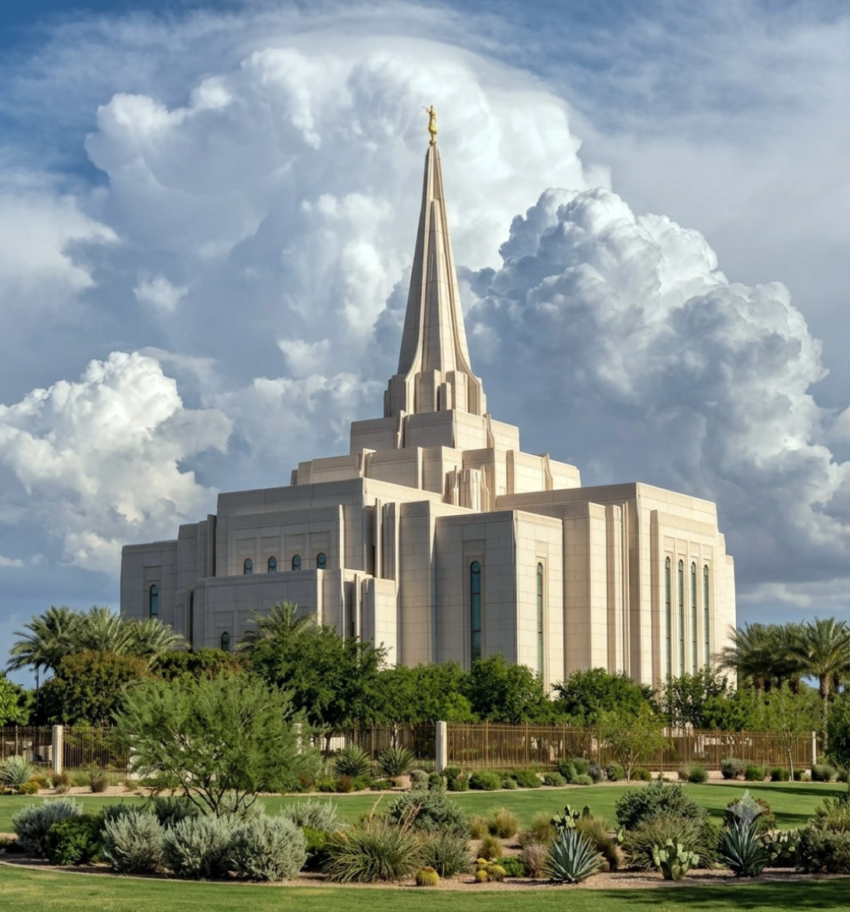
Image: A digitally enhanced photo by this author of the Gilbert, Arizona LDS Temple.
A Historical and Theological Examination of the Most Sacred Mormon Rituals
❦ ❦ ❦
Introduction: A Cathedral Built in Seven Weeks
On the second floor of a modest mercantile building in Nauvoo, Illinois, on the warm morning of May 4, 1842, nine men gathered behind drawn curtains. They washed and anointed one another. They received new names. They learned secret signs and grips. They were instructed in symbolic figures, pronounced oaths of fidelity, and were sworn never to disclose what they had seen or heard. The man presiding was thirty-six years old. He had been initiated as a Master Mason in the same town just seven weeks before. The building was a general store. The ceremony, when later transferred to a dedicated temple, would become the most ambitious ritual architecture ever erected on American soil: a graded system of washings, anointings, endowments, sealings, and proxy ordinances for the dead, declared to be essential for exaltation to godhood and unchangeable in substance from the foundation of the world.
Search the annals of religious history from the mysteries of Eleusis to the rites of Freemasonry, from the Temple of Solomon to the cathedrals of Rome, and nowhere will you find a more ambitious ceremonial architecture erected so swiftly, so secretly, and upon so thin a scriptural foundation as the temple ordinances Joseph Smith conjured into existence in the spring of 1842.
— Thesis statement
That sentence is the thesis under examination in this essay. It is a serious historical and theological claim, and it deserves serious treatment. The intent here is neither to wound nor to dismiss. Millions of Latter-day Saints, including some of the most decent and family-minded neighbors a community could ask for in the towns of Gilbert, Mesa, and Chandler, walk into temples each week with their hearts genuinely set on spiritual obligation and family. The question this essay raises is not whether they are sincere. They are. The question is whether the ceremony they enter has the historical pedigree, the scriptural authority, and the apostolic continuity that the institutional Church claims for it.
This examination proceeds along five tracks. First, what actually takes place inside an LDS temple, drawn from the Church’s own published materials. Second, how those ordinances arose between March and May of 1842 and how dramatically they have changed since. Third, the biblical proof-texts Joseph Smith offered for them, and whether those proof-texts can bear the weight he placed upon them. Fourth, the striking and uncomfortable parallel between modern temple Mormonism and the Pharisaic tradition of the elders that Jesus rebuked in Matthew 15 and Mark 7. And fifth, the related question of why these ordinances are held to be too sacred to discuss outside the temple walls — and what a candid Christian response to that argument looks like.
Through it all, the standard of measurement is the same one the Apostle Peter commanded believers always to be ready to apply: “Be ready always to give an answer to every man that asketh you a reason of the hope that is in you with meekness and fear” (1 Peter 3:15). Reasoned answers, given with reverence and fear, are what the matter requires.
❦ ❦ ❦
I. What Actually Takes Place in an LDS Temple
Before any theological assessment can proceed, the facts on the ground must be established. The temple ceremonies of the Church of Jesus Christ of Latter-day Saints are not secret in the sense of being unknown — their general structure has been published by the Church itself, described by hundreds of former participants, and analyzed in scholarly literature for more than a century. What follows is drawn primarily from the Church’s own published “Inside Temples” resource and from authorized publications such as the General Handbook.
Temple Recommend: The Gateway
No one enters a dedicated LDS temple without a temple recommend — a small card issued only after a member has passed two interviews, one with the bishop and another with a member of the stake presidency. The interviewer asks a set of standardized questions about belief in the LDS doctrine of the Godhead, sustaining of the current prophet, full payment of tithing, abstinence from coffee, tea, alcohol, and tobacco, moral worthiness, and several other matters. Only those who answer satisfactorily and are deemed worthy receive the card, which is renewed every two years.
Once dedicated, entrance into the temple is reserved for members of the Church who have committed to live the gospel of Jesus Christ and are ready to participate in further sacred ordinances. Members are greeted at this desk in the entrance foyer, where they present a small card called a recommend.
— Inside Temples, Church of Jesus Christ of Latter-day Saints
This stands in stark contrast to the historic Christian church, which has never since the apostolic age withheld its central rites from believers who confessed faith in Christ and were baptized. The bar of the temple recommends is not Christ’s atonement received by faith; it is a financial and behavioral certification of compliance with institutional standards.
Ordinances for the Living
Once inside, members participate in a layered series of distinct ordinances.
• Initiatory — Washing and Anointing. A symbolic ritual in which the patron is sprinkled with a drop of water and anointed with a drop of consecrated oil, said to purify and prepare the participant for temple service. The patron receives a priestly blessing promising to become a king or queen, and priest or priestess in the next life. The ordinance is said to derive from the consecration of Aaron and his sons in Exodus 29 and Leviticus 8.
• Endowment. The central ceremony lasts approximately ninety minutes to two hours. Participants make solemn covenants with God: the law of obedience, the law of sacrifice, the law of the gospel, the law of chastity, and the law of consecration. The ceremony enacts a symbolic journey from pre-mortal life through mortality and into the celestial kingdom. Each patron receives a “new name” not to be revealed. Specific signs, tokens, and keywords are taught and exchanged at the “veil” at the conclusion of the ceremony.
• Temple Marriage (Eternal Sealing). A husband and wife kneel at an altar in a sealing room and are pronounced sealed for time and for eternity, not merely until death do them part. Large mirrors on facing walls reflect the couple to apparent infinity, symbolizing the eternal continuity of the union.
• Sealing of Children to Parents. Children born before their parents were sealed can be brought to the sealing room and ritually attached to them. Children born after a sealing are deemed “born in the covenant” and need no further ceremony.
Proxy Ordinances for the Dead
Perhaps the most distinctive and theologically consequential feature of LDS temple practice is the performance of all ordinances by living members on behalf of the deceased ancestors, distant relatives, or strangers identified through genealogical research. The doctrine is grounded almost entirely on a single contested verse, 1 Corinthians 15:29. The Church’s own statistics indicate that more than ninety-nine percent of ordinances performed in LDS temples are proxy ordinances for the dead, not ordinances for the living.
“Else what shall they do which are baptized for the dead, if the dead rise not at all? why are they then baptized for the dead?”
– 1 Corinthians 15:29
• Baptism for the Dead, by immersion in a baptismal font typically mounted on the sculpted backs of twelve oxen.
• Confirmation for the Dead, by the laying on of hands, conferring the gift of the Holy Ghost vicariously.
• Proxy Initiatory, Endowment, and Sealings, with all the same covenants taken by a living member in the name of someone deceased.
Other Activities and the Second Anointing
At the conclusion of the endowment, participants enter the Celestial Room — an ornate space of plush furnishings, chandeliers, and gilded mirrors, intended to symbolize heaven. Prayer circles, in which participants form a ring around a central altar and recite a ritualized “true order of prayer,” are part of the endowment. Patrons may write names of people they wish to pray for and place them in a box; these are prayed over by temple workers at the close of each session.
Beyond these publicly acknowledged ordinances stands the Second Anointing, an exceptionally secretive rite reserved for top leaders and their spouses. Sometimes called having one’s “calling and election made sure,” it reportedly involves a foot-washing ceremony, the wife blessing her husband (a striking exception to LDS gender restrictions), and is said to guarantee the recipient celestial exaltation. The Church neither officially confirms nor publicizes this ordinance. Wikipedia notes plainly that it is the most secretive ritual practiced by Latter-day Saints, and that most church members are unaware of its existence. That a saving ordinance can be unknown to ninety-nine percent of the membership is itself a fact worth marking.
❦ ❦ ❦
II. How the Ordinances Have Evolved: 1842 to the Present
The institutional Church teaches that while the methods of administering temple ordinances have been periodically adjusted, the underlying covenants are eternal and unchanging. The First Presidency stated in 2019 that the ordinances “have been adjusted periodically, including language, methods of construction, communication, and record-keeping.” The documentary record, however, tells a more complicated story. What follows is a non-exhaustive timeline of substantive ceremonial elements that have been added or removed.
Nauvoo Foundations (1842–1844)
Joseph Smith was initiated as an Entered Apprentice and Fellow Craft Mason in the Nauvoo Lodge on March 15, 1842, and raised as a Master Mason the following day. On May 3, 1842, he prepared the second floor of his Red Brick Store “to represent the interior of a temple as circumstances would permit,” and on May 4, he introduced the Nauvoo endowment ceremony to nine male associates. This original group, later termed the Anointed Quorum, expanded to about fifty persons by the time of Smith’s death in June 1844.
Sealings were performed for the first time in 1843. The Second Anointing was also introduced that year, the first recipients being Joseph and Emma Smith. According to the diary of Wilford Woodruff, the early endowment ceremony already included a prayer for the Lord to take vengeance for all martyred prophets, drawing inspiration from Revelation 6:9–10. After Smith’s assassination in Carthage Jail, that vengeance prayer would mutate into the explicit Oath of Vengeance against the United States.
Early Utah Era (1845–1902): The Vengeance Period
The Nauvoo Temple endowment was introduced to the broader church in late 1845, with the temple attic divided by canvas partitions into ordinance rooms decorated with potted plants to represent the Garden of Eden. More than five thousand persons received their endowments in this temple before the westward exodus. In Utah, the practice was housed first in the Endowment House (constructed 1855), then in the St. George Temple (1877) and the Salt Lake Temple (1893).
Several practices added in this period have since been removed:
• Oath of Vengeance (c. 1845–1927). Participants swore an oath to pray and never cease to pray that God would avenge the blood of Joseph and Hyrum Smith upon the United States government. This was sufficient cause for serious concern during the 1904–1906 Reed Smoot Senate hearings, when witnesses testified to its content and the federal government questioned whether endowed Mormons could lawfully be seated in the U.S. Senate.
• Law of Adoption (c. 1843–1894). Members could be ritually sealed to prominent Church leaders rather than only to biological forebears, producing a theocratic kinship structure. Wilford Woodruff repudiated the practice in 1894.
• Adam–God Lecture at the Veil (1877–1902). Brigham Young introduced into the endowment ceremony his teaching that Adam was God the Father. The Adam–God doctrine was removed from the endowment in 1902, and the Church now officially repudiates it, but it was once formally taught as part of the most sacred ritual of the faith.
• Penalties (1842–1990). Participants made covenant-keeping oaths accompanied by graphic symbolic gestures miming self-disembowelment and throat-slitting as the consequence of revealing temple secrets. These were retained for one hundred and forty-eight years before being removed entirely in 1990.
• Baptism for Health and for Renewal of Covenants. Members were baptized repeatedly throughout life for the healing of illness and for the renewal of personal covenants. These practices were discontinued in 1922 and 1913, respectively.
Twentieth Century: Standardization and Streamlining
Across the twentieth century, the ordinances were progressively standardized for global use:
• 1920s: Ritual nudity during washing and anointing is partially curtailed; a shield is introduced; full submersion in a bathtub gives way to a symbolic seated washing.
• 1936: An explanation of the temple garment symbols is added.
• 1945: Endowments are administered in a language other than English for the first time.
• 1953: The first filmed versions of the endowment ceremony appear, including, remarkably, a scene of lava drawn from Disney’s Fantasia.
• Late 1960s: Wording describing Satan as having black skin is removed from the endowment.
• 1979: Two-piece temple garments are first permitted.
The 1990 Revisions: The Most Dramatic Cut
The most far-reaching revision of the endowment in the twentieth century came in 1990, when the Church quietly removed the penalties and their oaths, the five points of fellowship at the veil, the recitation of the Adamic phrase “Pay Lay Ale” in the prayer circle, the requirement that women covenant to obey their husbands, the lecture at the veil, the entire character of the Protestant minister depicted as Satan’s hireling, and the wording that faulted Eve for the Fall and that pronounced Adam should rule over Eve. The Los Angeles Times reported the changes as the most significant since 1978’s removal of the priesthood ban on Black members.
Mormons Modify Temple Rites Ceremony: Woman’s vow to obey husband is dropped. Changes are called most significant since 1978.
— Los Angeles Times headline, May 5, 1990
If, as the Church teaches, the ordinances are eternal and unchanging in their substance, what shall we make of a covenant requirement that women obey their husbands, retained from 1843 to 1990, then removed by an act of First Presidency revision? What of an oath of vengeance retained for eighty-two years, then quietly dropped? What of the Adam–God doctrine inserted into the most sacred ritual of the faith for twenty-five years, then officially repudiated? These are not adjustments of method. These are alterations of theology.
Twenty-First Century: Globalization, Inclusion, Streamlining
More recent changes continue the same pattern. In 2005, the remaining partial nudity in the initiatory was eliminated, and water and oil were applied only to the head. In 2019, women were authorized to serve as witnesses for baptisms and sealings. The wording in which women became priestesses to their husbands while men became priests to God was altered. Women were no longer required to cover their faces with the veil during portions of the ceremony. In 2023, the exchange of tokens (handshakes) during the endowment was sharply reduced, a depiction of the War in Heaven was added, the witness couple was removed, and the warning against “loud laughter and light-mindedness” was discontinued. In 2024, the endowment was again shortened by approximately eighteen minutes.
A reasonable observer might ask: when a sacred ritual can be shortened by eighteen minutes for the sake of more efficient session throughput, by what measure can it be said to be eternal?
❦ ❦ ❦
III. Biblical Precedent: Where the Case Is Made, and Where It Breaks Down
The honest question is not whether Joseph Smith offered a biblical defense for the ordinances. He did. The question is whether the proof-texts he cited actually support the elaborate ritual system he constructed. From a traditional Christian exegetical perspective, the answer in every case is no. The texts are real; the readings imposed upon them are not.
Baptism for the Dead and 1 Corinthians 15:29
This is Joseph Smith’s strongest biblical hook. In a funeral sermon for Seymour Brunson in August 1840, Smith seized upon Paul’s passing question, “Else what shall they do which are baptized for the dead, if the dead rise not at all?” and declared it apostolic warrant for the entire LDS proxy baptism program. The verse is cited again in Doctrine and Covenants 128, in which Smith wrote enthusiastically that this single verse alone vindicated the practice.
Three plain features of the text undermine that reading. First, Paul uses the third person: he says “they” are baptized for the dead, not “we.” The grammatical distance suggests he is citing the practice of some other group — most likely a fringe or splinter group operating in Corinth — to argue against them on their own terms for the bodily resurrection. Second, no other New Testament writer mentions the practice, and no apostolic father refers to it as a feature of normative early Christian worship. Third, the patristic record uniformly assumes that baptism is contingent upon personal faith in Christ — “he that believeth and is baptized shall be saved” (Mark 16:16) — a category that excludes proxy administration by definition.
If Paul were endorsing proxy baptism as an apostolic doctrine, the New Testament epistles would unmistakably reflect it. They do not. Acts records no proxy baptisms. The Pauline corpus, with its sustained polemics on the foundational doctrines of justification by faith, never reaches for it. The pastoral epistles never instruct elders concerning it. To build a multi-billion-dollar global genealogical and temple system on a single ambiguous third-person reference is the very definition of an architecturally top-heavy theology.
Washing and Anointing in Exodus 29 and Leviticus 8
The Mosaic consecration of Aaron and his sons is unquestionably an Old Testament ritual of washing and anointing. The LDS appropriation, however, departs from it in nearly every meaningful particular. The Aaronic consecration was performed publicly by Moses, in the sight of the assembly, in fulfillment of a national covenant code published in the books of Exodus and Leviticus. It was not a secret. It involved no Masonic-style tokens. It taught no doctrine of theosis. It was specifically restricted to the descendants of Aaron, not extended to every worthy male member of the religious community. And it was, by the explicit declaration of the New Testament, fulfilled and superseded by the priesthood of Christ (Hebrews 5–7).
The book of Hebrews is unambiguous on this point. Christ has obtained “a more excellent ministry” (Hebrews 8:6). The Levitical sacrifices were a “shadow of good things to come” (Hebrews 10:1). The veil of the temple was torn at His crucifixion. To reach back behind the New Covenant and reinstitute Levitical-style washings and anointings as essential for exaltation is precisely the move the writer of Hebrews warns against — a return to the shadow after the substance has appeared.
Eternal Marriage and Matthew 16:19
“And I will give unto thee the keys of the kingdom of heaven: and whatsoever thou shalt bind on earth shall be bound in heaven; and whatsoever thou shalt loose on earth shall be loosed in heaven.” Joseph Smith made this verse the proof-text for the sealing power and for eternal marriage.
But this reading is foreign to every major Christian interpretive tradition. Protestant exegetes have understood the binding-and-loosing language to refer to apostolic authority in church discipline and the proclamation of the gospel. Jesus repeats nearly identical language in Matthew 18:18 in the explicit context of church discipline (“if he refuse to hear the church…”). Marriage is not in view in either passage. The notion that marriage might be celestially perpetuated through a ritual sealing in a building dedicated for that purpose is read into the text from outside, not drawn out of it.
More striking still, Jesus himself addressed the question of marriage in the resurrection directly. When the Sadducees pressed him on which of seven brothers would have a particular wife in the resurrection, Jesus replied: “For in the resurrection they neither marry, nor are given in marriage, but are as the angels of God in heaven” (Matthew 22:30). The Lord’s own pronouncement contradicts the doctrine that the sealing ordinance is designed to secure.
Endowment and Luke 24:49
“And, behold, I send the promise of my Father upon you: but tarry ye in the city of Jerusalem, until ye be endued with power from on high.” This is the verse from which the very word endowment is borrowed. But the Lukan reference is explicit and self-interpreting: the promise of the Father is the Holy Spirit (Acts 1:8), and the endowment of power from on high occurred at Pentecost, in public, in the languages of the assembled nations, audible and visible to the multitude (Acts 2). It was not a secret ceremony in a closed building. It involved no signs, no tokens, no new name, no priestly aprons, no apprehension of a celestial geography. To map the elaborate Nauvoo endowment ceremony onto Pentecost is to assert a parallel where none exists in the text.
❦ ❦ ❦
IV. The Real Sources: A Convergence of Influences
If the biblical case is so weak, then where did the elaborate Nauvoo endowment come from? The scholarly consensus, including among some sympathetic LDS historians, is that the ceremony was a creative synthesis drawn from several non-biblical wells, organized through Smith’s evolving theological imagination, and presented under the rhetorical frame of restoration.
The Masonic Sources
The chronology alone is striking. Joseph Smith was initiated as a Master Mason on March 15–16, 1842. He introduced the first endowment ceremony just seven weeks later, on May 4, 1842. The overlap in content is not subtle. Both ceremonies feature secret handshakes (LDS “tokens”), passwords (LDS “key words”), penalties for revealing secrets (identical in form until 1990), ceremonial aprons, the five points of fellowship at a symbolic veil, prayer circles around an altar, dramatic ritual progression through symbolic degrees, and even particular elements of language and gesture.
Charles R. Harrell, a faithful LDS scholar, summarizes the matter candidly: the endowment incorporated “the same five points of fellowship… the same kinds of gruesome penalties… and the same compass and square symbols” as Masonic ritual. Heber C. Kimball, a Mormon Apostle and Mason, wrote to fellow Apostle Parley P. Pratt within weeks of receiving the endowment that the new priesthood ritual was “of the same nature” as Masonry, but “many things” had been restored which the Masons had lost. The LDS-affiliated FAIR organization concedes: “It is in the ritual presentation of the endowment teachings and covenants that the similarities between the LDS temple worship and Freemasonry are the most apparent.”
The LDS apologetic response is rhetorically elegant. Rather than denying the parallels (which are undeniable), it asserts that Masonic ritual is itself a degenerated remnant of an original Solomonic temple ceremony, and that Smith was restoring the pure original. Brigham Young claimed Joseph had said Masonry “was the apostate endowments, as sectarian religion was the apostate religion.” This is a clever move because it transforms every Masonic similarity into evidence of restoration and every Masonic difference into evidence of Masonic corruption. The argument cannot be disproved by any pattern of evidence, because every possible pattern confirms it. That is the technical definition of an unfalsifiable claim.
A simpler explanation, which fits all the evidence at once and does not require the importation of a vanished Solomonic ritual otherwise unattested in any documentary source, is that Smith was a man of formidable religious creativity who incorporated the Masonic system he had just been initiated into and adapted it for his own theological purposes. This explanation accounts for the timing, the content, the explicit acknowledgments of contemporaries, and the absence of any external evidence for a pre-Masonic original.
Hermetic, Occult, and Folk-Magic Influences
Smith’s religious environment included substantial folk-magic, hermetic, and occult elements. Before founding the LDS Church, he and his family were employed as treasure-seekers using seer stones; he carried a Jupiter talisman, retained the use of seer stones throughout his prophetic career, and incorporated ritual prayer circles into his developing theology. The scholarly literature on the relationship between Smith’s magic worldview and the formal Mormonism that emerged from it is extensive, and even sympathetic historians such as D. Michael Quinn have documented the continuities. The temple endowment, with its symbolic objects, key words, and ritualized gestures, sits comfortably within this hermetic framework.
The Book of Abraham and the Joseph Smith Translation
Smith himself tied the endowment’s content to the so-called “grand key words of the priesthood” that he claimed to extract from the Book of Abraham — a text he produced in 1842 from Egyptian papyri that have since been independently translated by Egyptologists and shown to be ordinary funerary documents, the Book of the Dead, having no relation whatever to Abraham. The creation narrative dramatized in the endowment draws heavily upon Smith’s own revision of Genesis in the Joseph Smith Translation.
The Restoration Framing
The genius of Smith’s presentation was not to claim invention but to claim recovery. To early followers steeped in the American restorationist impulse of the Second Great Awakening, the idea that the true church had been lost in a Great Apostasy and was now being restored through a new prophet was deeply attractive. Within that frame, the question “where did this ritual come from?” has only one allowable answer: from God, originally given in Eden, lost through apostasy, preserved in degenerated form by various traditions including Masonry, and now restored in pristine form through Joseph. The frame is theologically powerful and emotionally compelling. It is also, as a historical claim, untestable in principle.
❦ ❦ ❦
V. Joseph Smith’s Hermeneutics: Prophetic Supersession of the Text
Behind every claim about the temple ordinances stands a deeper question: by what method did Joseph Smith read the Bible? The answer is essential, because his hermeneutics determined what the text could and could not say. And his hermeneutics, in a single sentence, were these: prophetic revelation supersedes textual authority.
Traditional Protestant hermeneutics, following the Reformation principle of sola scriptura, treats the biblical text as the closed, self-interpreting norm for all doctrine. The interpreter is constrained by grammar, by historical context, by the analogy of faith with other passages. Smith inverted this hierarchy. For him, revelation was primary, and the text was derivative — and demonstrably corrupted. He stated openly that “the Bible, as it has gone forth through the hands of men, contains many errors,” which meant any interpretive difficulty could be resolved not by scholarly investigation but by direct prophetic correction through himself.
Joseph Smith is best described as a Bible-believer who wanted to improve the Bible.
— Heikki Räisänen, Dialogue: A Journal of Mormon Thought
The Finnish biblical scholar Heikki Räisänen, writing in the leading LDS scholarly journal Dialogue, described Smith as standing in the tradition of the church fathers and rabbinic Targum translators — but as one who took their interpretive liberty to its ultimate conclusion by altering the canonical text itself through prophetic fiat rather than expository argument.
Selective Literalism
Smith publicly proclaimed a rigorous literalism, famously asking: “What is the rule of interpretation? Just no interpretation at all. It should be understood precisely as it reads.” Yet his literalism was selectively deployed. When Revelation 4:6 spoke of “beasts in heaven,” Smith insisted these were literal creatures. When 1 Corinthians 15:29 mentioned baptism for the dead, he embraced absolute literalism. But when Paul’s language in Romans 7 described Christian life as still struggling with sin, Smith’s Joseph Smith Translation rewrote the text to remove the tension, transforming Paul’s present-tense confession into a mere past stage of life under the law.
In other words, Smith deployed literalism strategically. Where a literal reading supported his theology, he invoked it forcefully. Where it did not, he exercised prophetic license to revise the text. This is not exegesis. This is theological reverse-engineering.
The Joseph Smith Translation as Hermeneutical System
The Joseph Smith Translation is the clearest window into Smith’s interpretive method. Lacking Hebrew or Greek training, he produced the JST not by translating from original languages but by dictating theologically motivated revisions of the King James Version — the same method by which he had produced the Book of Mormon. Its governing logic is threefold: harmonization (resolving contradictions between Gospel accounts by inserting reconciling text), theological correction (altering passages that imply God’s mutability or limitation), and christological retrofitting (projecting explicit Christian soteriology backward into the Old Testament, so that Adam is baptized in the name of Jesus Christ and taught “the plan of salvation” from the Garden of Eden itself).
This last move solves a real theological problem — how can an unchanging God offer different terms of salvation in different eras? — but it does so by wholesale revision of the text rather than interpretive argument. Where Luther, Calvin, and the church fathers wrestled publicly with the text and disclosed their reasoning, Smith simply declared the correct reading by prophetic fiat and altered the text to match. The result was not exegesis — drawing meaning out of the text — but eisegesis institutionalized: a system in which the prophet’s theological commitments are read into the text, then canonized as God’s authoritative correction of Scripture.
The Restorationist Authority Claim
Smith’s hermeneutics were inseparable from his dispensational restorationism. The doctrine of a Great Apostasy following the deaths of the apostles meant that the biblical canon could not be trusted in its transmitted form (scribes had corrupted it), that scholarly tradition had no legitimate authority (it descended from an apostate church), and that only a new prophetic dispensation could restore true interpretation. The framework is self-sealing. Any objection grounded in manuscript evidence, original-language grammar, or patristic consensus can be dismissed in advance as the product of an apostate tradition. The prophet’s voice trumps the scholar’s argument by structural design.
From the standpoint of traditional Christian exegesis, the method suffers a foundational circularity: Smith’s prophetic authority validates his interpretations, and his interpretations demonstrate his prophetic authority. Any reading that confirms the system is evidence for the system. Any reading that disconfirms the system is evidence of apostate corruption. There is no way out from inside the system.
❦ ❦ ❦
VI. The Pharisaical Parallel: An Oral Tradition Behind a Closed Door
Of all the comparisons that may be drawn between modern temple Mormonism and earlier religious systems, the most theologically incisive is the one few are willing to draw out loud. The structural parallel between contemporary LDS temple practice and the Pharisaic Oral Law that Jesus repeatedly rebuked is not incidental. It is profound.
Who Were the Pharisees?
The Pharisees emerged as a distinct Jewish religious party in the second century before Christ, in the aftermath of the Maccabean revolt. They were known throughout the New Testament period for their zeal in observing the Law of Moses, their separation from ritual impurity, and their austerity. The crucial doctrinal distinction that set them apart from the rival Sadducean party was their belief in a twofold Torah: the written Law given to Moses at Sinai, and an additional Oral Law — “the tradition of the elders” — supposedly transmitted from Moses through a chain of authoritative interpreters.
The Pharisees, on the other hand, believed that the Law that God gave to Moses was twofold, consisting of the Written Law and the Oral Law — i.e., the teachings of the prophets and the oral traditions of the Jewish people.
— Encyclopedia Britannica, “Pharisee”
The function of this Oral Law was to interpret, supplement, and apply the written Torah. In principle, it sought to honor the Law by building “a fence” around it — additional rules and customs that would prevent any inadvertent violation of the written commands. In practice, as Jesus repeatedly demonstrated, the fence became a law unto itself, and the additional rules came to overshadow and even nullify the original divine command.
Christ’s Rebuke in Matthew 15 and Mark 7
Jesus’ sharpest theological confrontations with the Pharisees focused precisely on this point. When the Pharisees criticized his disciples for eating with unwashed hands — a violation of an Oral Law rule, not the written Mosaic Law — Jesus did not respond by tightening his disciples’ ritual practice. He responded by tearing the fence down.
He answered and said unto them, Why do ye also transgress the commandment of God by your tradition?… Thus have ye made the commandment of God of none effect by your tradition. Ye hypocrites, well did Esaias prophesy of you, saying, This people draweth nigh unto me with their mouth, and honoureth me with their lips; but their heart is far from me. But in vain they do worship me, teaching for doctrines the commandments of men.
— Matthew 15:3, 6–9 KJV
Jesus’ indictment is precise. The Pharisaic error was not that they cared about holiness. It was that they elevated human tradition to the level of divine command, that they used the tradition to set aside or to outshine the actual word of God, and that they enforced compliance through public, communal pressure that bound the conscience where God had not bound it. Mark 7:8 records the same scene in even starker form: “For laying aside the commandment of God, ye hold the tradition of men.”
Four Structural Parallels with LDS Temple Tradition
The structural parallel between Pharisaic tradition and contemporary LDS temple practice is not a rhetorical flourish. It can be specified along at least four axes.
1. A Supplemental Layer of Ritual Obligation Beyond Scripture
The Pharisees added an Oral Law to the written Torah, claiming both came from Moses at Sinai. The LDS Church adds a ritual layer to the New Testament gospel — temple endowment, sealing, proxy ordinances, and the Second Anointing — claiming these are essential to exaltation and were originally given to Adam in Eden but lost through apostasy. In both cases, an unwritten or extra-scriptural tradition is granted authority equal to or greater than the canonical text, and is treated as essential for the highest religious goods. The historic Christian gospel — “by grace are ye saved through faith” (Ephesians 2:8) — is, in LDS theology, insufficient for exaltation. Additional temple ordinances must be added.
2. Fence-Building Around the Garment
The Pharisees of Jesus’ day wore garments with enlarged fringes (tzitzit) and broad phylacteries to display their religious devotion. Jesus rebuked them: “But all their works they do for to be seen of men: they make broad their phylacteries, and enlarge the borders of their garments” (Matthew 23:5). The modern LDS Church has built an extensive Pharisaical fence around the wearing of the temple garment. Members are required to wear them day and night, with only obviously necessary exceptions; they must affirm compliance under interrogation by male priesthood leaders during temple recommend interviews; and an institutional oral tradition has grown up around the off-script teachings given by temple workers during initiatory orientation sessions, with the result that different members receive different unwritten rules depending on which worker addressed them. As one observer from inside the LDS tradition notes:
Like the Pharisees, the LDS Church has even institutionalized an oral tradition for passing down additional unwritten rules. When church members complete the temple initiatory for the first time, they attend a learning session where temple workers speak off script about garment-wearing rules…. Some members never realize they are strictly obeying garment-wearing rules that do not apply to other church members who heard a different speech from a different temple worker.
— Exponent II Blog, “7 Reasons Biblical Pharisees Would Love Latter-day Saint Garments”
The parallel here is not loose. It is exact. An oral tradition supplements a ritual obligation and varies from worker to worker, and members are bound to keep rules they may never have heard articulated, all to maintain access to the highest religious privileges. This is the architecture of Pharisaism, transplanted to a new context.
3. Barring Entry to the Kingdom Through Ritual Compliance
Jesus pronounced: “But woe unto you, scribes and Pharisees, hypocrites! for ye shut up the kingdom of heaven against men: for ye neither go in yourselves, neither suffer ye them that are entering to go in” (Matthew 23:13). The Pharisees made entry to the religious goods of Israel contingent upon compliance with their elaborate system. The temple recommend system functions identically. Access to the most sacred ordinances — ordinances declared essential to the highest celestial reward — is contingent upon passing an interview that audits behavior, belief, financial contribution, undergarment compliance, and consumption of coffee. The kingdom’s threshold is reset from “whosoever believeth in him should not perish, but have everlasting life” (John 3:16) to an institutional checklist.
4. Sacred Secrets and the Authority of the Initiated Class
The Pharisees were guardians of a body of tradition that distinguished them from the unlearned crowd. Their authority depended in significant part on the technicality of the rules they knew and the laity did not. The temple endowment functions structurally as a similar locus of sacred knowledge restricted to the initiated. Names, signs, tokens, and keywords are explicitly forbidden to be discussed outside the temple. The community is layered into those who know and those who do not. This is not the architecture of the New Testament gospel, which is preached publicly to all nations (Matthew 28:19–20) and which Paul declared he had “kept back nothing that was profitable unto you” (Acts 20:20). The apostolic gospel has no secret upper tier. The Pharisaic and the Mormon systems both do.
The Substance Beneath the Parallel
Why does the parallel matter? Because the Lord himself defined the spiritual failure of Pharisaism as the substitution of human tradition for divine command. He did not deny that the Pharisees were sincere. He did not deny that they were zealous. He denied that their tradition had divine authority, and he denied that ritual compliance with it constituted righteousness before God. The Apostle Paul, a former Pharisee himself, knew the system from the inside and identified it as the very pattern of religion that the gospel of grace had come to overturn (Philippians 3:4–9).
If the temple ordinances of the Church of Jesus Christ of Latter-day Saints were given by direct apostolic revelation and stood unaltered from the days of the apostles, this comparison would be unfair. But the historical record shows they were not. They were introduced in 1842 by a man with no apostolic credentials in any historic sense, after his initiation into a Masonic lodge, and have been substantively altered at least fifteen times since. They are precisely the kind of human tradition, treated as divine command, that Jesus warned against.
❦ ❦ ❦
VII. The Sacred Secrecy Question: A Logical Rebuttal
Latter-day Saint members are taught that the temple ordinances are too sacred to be discussed in detail outside the temple walls. The standard formulation is given by Elder David A. Bednar: “We should not disclose or describe the special symbols associated with the covenants we receive in sacred temple ceremonies. Neither should we discuss the holy information that we specifically promise in the temple not to reveal.” The principle is generally summarized in three words frequently repeated by Saints: “Sacred, not secret.”
This deserves an honest, charitable, and yet candid response. There are at least four serious problems with this position when measured against historic Christian theology and against the New Testament itself.
Problem One: The Original Penalty Oaths Were Secrecy Oaths
From 1842 until 1990, the endowment ceremony included explicit oaths binding participants to secrecy, accompanied by symbolic gestures depicting the bodily penalties that would be incurred for breaking those oaths — disembowelment, throat-cutting, the spilling of one’s bowels. The Lecture at the Veil, also removed in 1990, contained an explicit warning “never to speak outside of the temples of the Lord of the things you see and hear in this sacred place.” The current framing — that the ordinances are simply “sacred” rather than secret — is a later rhetorical refinement that does not match the actual covenants made by every endowed Mormon from 1842 to 1990 and substantially preserved in attenuated form thereafter. Members were not asked to reverence; they were bound by penalty oath to silence. That history cannot be erased by a change of vocabulary.
Problem Two: The New Testament Knows No Secret Doctrine
Jesus Christ, when interrogated by the high priest, expressly disclaimed any teaching of secret doctrine.
I spake openly to the world; I ever taught in the synagogue, and in the temple, whither the Jews always resort; and in secret have I said nothing. Why askest thou me? ask them which heard me, what I have said unto them: behold, they know what I said.
— John 18:20–21 KJV
Paul, defending his ministry before King Agrippa, affirmed the same: “For the king knoweth of these things… for I am persuaded that none of these things are hidden from him; for this thing was not done in a corner” (Acts 26:26). The apostolic gospel is, by structural conviction, a publicly proclaimed message. The Sermon on the Mount was preached on a hillside. The Great Commission sends disciples “to teach all nations” everything Christ commanded — not select things for the initiated. The book of Acts records no graduated initiation. The pastoral epistles instruct elders concerning public preaching and the open reading of Scripture in the assembly. The New Testament Church has no upper tier.
The mystery religions of the Greco-Roman world — the Eleusinian mysteries, the rites of Mithras, the cult of Isis — did have such secret initiations. They are the closest cultural parallel to the LDS temple ordinances in their structural features: graduated levels, secrecy oaths, signs, tokens, and restricted access. But the early Christian apologists — Justin Martyr, Tertullian, Origen — vigorously distinguished the gospel from those mystery religions precisely on the ground that the gospel had no secrets to keep. Whatever the Nauvoo temple ceremony is, the early apostolic Church is not its precedent.
Problem Three: The Argument Is Structurally Unfalsifiable
When a doctrine is held to be too sacred to be examined, the doctrine has been rendered immune to evaluation by ordinary means. The faithful Saint will say that the ordinances cannot truly be understood without participating in them, and that participation requires worthiness as defined by the Church. The seeker who has not entered the temple is thus barred from making a properly informed assessment. The seeker who has entered and finds the ordinances unconvincing has, by definition, failed to bring the proper spirit to them and is held responsible for the failure.
This is the same epistemic structure that the Lord rejected when he taught publicly in the synagogue and in the temple, openly inviting examination of his teaching and his works. “Believe me for the very works’ sake” (John 14:11). Christ’s claim to messianic authority was offered for public evaluation against the evidence of his fulfillment of Scripture, his miracles, and his resurrection. A truth claim that cannot be examined is a truth claim that cannot be tested, and a truth claim that cannot be tested is not subject to the discipline of evidence.
Problem Four: Secrecy Is Inconsistent with the Stated Purpose
The LDS Church publishes hundreds of pages on its website concerning what occurs in the temple. Saints Unscripted, FAIR, and other LDS-affiliated outlets publish video and written explanations of large portions of the ceremony. Saints are encouraged to talk to their children about the temple in general terms. The Church’s own video tour of the Washington D.C. Temple shows the ordinance rooms, the celestial room, and the sealing rooms. What, then, must be kept secret?
The answer, as Elder Bednar specifies it, is the special symbols, the new name, the signs, the tokens, the key-words. In other words, what must be kept secret is what is most distinctive and most religiously consequential. The wrapper may be displayed. The contents may not. This is not the architecture of a sacred mystery in the historic Christian sense — in which the holiness of God before sinners requires reverence — but the architecture of the initiate’s tradition, in which knowledge withheld from outsiders is the very thing that elevates the initiate above them. It is the Pharisaic pattern again.
The Christian critic does not press the question of temple secrecy from a desire to violate sacred trust. The press is theological: an apostolic gospel that is by structural conviction public cannot generate a saving rite that is by structural conviction private. The two architectures are incompatible. If one is biblical, the other cannot be.
❦ ❦ ❦
VIII. Refuting Claims of Ancient Hebrew Temple Continuity
The institutional LDS claim is that modern temples are patterned after Solomon’s Temple and are a restoration of authentic ancient temple practice. Kent R. Richards, formerly director of the LDS Church’s Temple Department, stated plainly: “Temples are patterned after Solomon’s temple and honor the Lord and express our gratitude.” The official “Inside Temples” resource notes that “modern temples have purposes similar to those of biblical temples — they are places of peace, learning, and inspiration.” The baptismal font is presented as following the tradition of the twelve oxen described in 1 Kings 7.
These claims must be carefully examined against the biblical text, because they form the principal scriptural defense for the institutional necessity of temples. From the standpoint of biblical theology, the claim of continuity fails along no fewer than seven distinct lines.
1. The Bible Recognizes Only One Legitimate Temple
In the entire Old Testament, the only divinely authorized temple is the one in Jerusalem, on Mount Moriah, built by Solomon and rebuilt after the Babylonian exile by Zerubbabel. Deuteronomy 12:13–14 sharply restricts sacrificial worship to “the place which the Lord shall choose in one of thy tribes,” explicitly forbidding worship in every other place. The Bible does not even acknowledge as legitimate the temple at Heliopolis in Egypt, built by Onias IV around 160 B.C. The LDS Church has nearly 400 temples either in operation, under construction, or announced worldwide. The biblical pattern is one. The LDS pattern is many. They are not the same.
2. The Biblical Priesthood Requires Aaronic Descent
Only men descended from Aaron, of the tribe of Levi, were permitted to serve as priests in the biblical temple (Numbers 3:10; Exodus 29:9; Hebrews 7:13–14). A recent genetic study published in the journal Nature found a strong common Y-chromosomal lineage among contemporary Jewish men claiming priestly descent, supporting their ancient genealogical tradition. The LDS Aaronic priesthood, by contrast, is conferred upon any worthy male over twelve years of age regardless of biological descent. The continuity claim, judged against the explicit requirement of biblical priesthood, fails.
3. Non-Priests Were Forbidden from Entry
In the biblical temple, only ordained Aaronic priests could enter the Holy Place. Only the High Priest could enter the Holy of Holies, and only once a year. The Court of Women, the Court of the Israelites, and the Court of the Gentiles were graded according to access permissions. Common Israelites worshipped in the outer courts but never set foot in the sanctuary proper. In LDS temples, by contrast, any endowed member with a current recommend may enter the celestial room, the sealing rooms, and the ordinance rooms freely. The biblical access architecture has been entirely abandoned.
4. The Function of the Biblical Temple Was Sacrificial Atonement
The biblical temple existed for one principal purpose: the offering of animal sacrifice for the atonement of sins, pointing forward to the once-for-all sacrifice of the Messiah. The bronze altar of burnt offering stood directly inside the only entrance, signifying that one approached God through sacrifice. The bronze basin (the “sea” on twelve oxen mentioned in 1 Kings 7) was used by the priests to wash themselves after offering animal sacrifices, in preparation for ministry in the sanctuary. It was not a baptismal font. No baptism of any kind is mentioned anywhere in the biblical temple.
LDS temples perform no animal sacrifices, no atoning rites in the Levitical sense, and no Day of Atonement service. What they do perform — baptisms for the dead, endowments, sealings, second anointings — has no analog in the biblical temple whatsoever.
5. The Veil Was Torn
At the death of Jesus Christ, the veil of the Jerusalem temple, which separated the Holy Place from the Holy of Holies and which barred everyone but the High Priest from God’s presence, was torn from top to bottom (Matthew 27:51). The book of Hebrews makes the theological consequence inescapable:
Having therefore, brethren, boldness to enter into the holiest by the blood of Jesus, by a new and living way, which he hath consecrated for us, through the veil, that is to say, his flesh; and having an high priest over the house of God; let us draw near with a true heart in full assurance of faith.
— Hebrews 10:19–22 KJV
The torn veil is the defining act of New Covenant temple theology. The graded inaccessibility of the Levitical temple is replaced by full and equal access of every believer through the once-for-all sacrifice of Christ. To rebuild a graded-access temple system after the veil has been torn is to undo at the level of practice what Christ accomplished at the level of redemption.
6. The Believer Is Now the Temple
The New Testament systematically transfers the temple language to the believer. “Know ye not that ye are the temple of God, and that the Spirit of God dwelleth in you?” (1 Corinthians 3:16). “What? know ye not that your body is the temple of the Holy Ghost which is in you, which ye have of God?” (1 Corinthians 6:19). “In whom ye also are builded together for an habitation of God through the Spirit” (Ephesians 2:22). The Greek word Paul uses in 1 Corinthians 6:19 is naos — the term for the inner sanctuary, the Holy of Holies itself. The dwelling place of God has been transferred from a building of stone to the bodies of believers in whom the Spirit lives. There is no longer a sacred geography in the church age.
7. Christ Is the True Temple
Jesus said of his own body: “Destroy this temple, and in three days I will raise it up… he spake of the temple of his body” (John 2:19, 21). The book of Revelation closes the canon with the explicit declaration that the heavenly city needs no temple, “for the Lord God Almighty and the Lamb are the temple of it” (Revelation 21:22). Biblical temple theology has a clear trajectory: from tabernacle to Solomonic temple, to the temple of Christ’s body, to the temple of the believer indwelt by the Spirit, to the consummation in which God himself is the temple. To build a system of stone temples in the latter days, restricted by ritual purity and access codes, is to invert this trajectory at every step.
The Conclusion of the Continuity Argument
The Institute for Religious Research summarizes the case with appropriate restraint: “A comparison of the activities of the Biblical temple and Mormon temples shows clearly that the two have nothing in common… They are the invention of Mormon founder Joseph Smith, not something taught in the Bible for Christians of the New Testament age.” The conclusion is not malicious. It is the only conclusion the evidence will sustain. Mormon temples are not a continuation of Solomon’s Temple. They are an architectural and theological invention of the nineteenth century, dressed in the iconography of Solomon’s Temple, but historically and theologically discontinuous with it.
❦ ❦ ❦
IX. Conclusion: A Cathedral of Sincere Hearts
It is necessary, at the end of an essay like this, to return to the matter of charity. Across the cities of Arizona and Utah, and now across the world, some men and women walk into LDS temples this very week with their hearts oriented toward their concept of a Heavenly Father, their love for family deep and abiding, their financial sacrifices for the institution genuine, and their moral conduct often exemplary. Many of them came into the LDS Church through the testimony of trusted family members. Many of them have known no other religious frame. They are not enemies of traditional Christianity. They are misinformed seekers after God who have been taught, with sincerity by sincere teachers, that the temple ordinances they participate in are essential, eternal, and divinely authorized.
The argument of this essay is not against them. It is for them, and for those of their family and friends who will be asked to follow them into the temple system in the years to come. The argument is simply this: the temple ordinances of the Church of Jesus Christ of Latter-day Saints, as they stand today and as they stood at their origin, lack the apostolic credential, the scriptural foundation, and the historic continuity that they claim. They were introduced in seven weeks in 1842 by a man recently initiated into Masonic ritual, defended by proof-texts that do not bear the weight placed upon them, altered at least fifteen times substantively since their introduction, structurally parallel to the very Pharisaic tradition the Lord condemned, and discontinuous at every meaningful point with the biblical temple they claim to restore.
The thesis with which this essay began stands, after consideration of the evidence, as a defensible historical and theological judgment. Across the long span of religious history — from the Eleusinian mysteries of pre-classical Greece, to the medieval mystery cults of Western Christendom, to the working lodges of Freemasonry, to the great stone temples of Solomon and Herod, to the cathedrals of Rome — the temple ordinances Joseph Smith introduced in the spring of 1842 are the most ambitious ceremonial architecture erected most swiftly, most secretly, and on the thinnest scriptural foundation.
What stands in their place, for the Christian who looks to the apostolic gospel, is not a poorer thing but an immeasurably greater one. The veil has been torn. The blood of Christ has opened the way of access. The Holy Spirit has made the believer himself a temple. The throne of grace is approachable in confidence, by faith, at any hour, in any place, without ritual purity code, without temple recommend, without secret name or token or sign — because the Son of God has himself, once for all, made the offering.
But Christ being come an high priest of good things to come, by a greater and more perfect tabernacle, not made with hands, that is to say, not of this building; neither by the blood of goats and calves, but by his own blood he entered in once into the holy place, having obtained eternal redemption for us.
— Hebrews 9:11–12 KJV
That is the temple architecture of the New Covenant. It is open. It is public. It is grounded in Scripture. It has stood for two millennia without revision. It was given not in seven weeks in Nauvoo, but at Calvary, by one greater than Solomon, who in his own person was the temple.
❦ ❦ ❦
Source List
The following sources informed the research and argumentation of this essay.
• Inside Temples (official LDS resource) — https://www.churchofjesuschrist.org/temples/inside-temples
• Mormon Temple Ritual (MormonBeliefs.org) — https://mormonbeliefs.org/temples-and-prophets/mormon_temples/mormon-temple-ritual/
• Adjustments to Temple Work (official LDS history) — https://www.churchofjesuschrist.org/study/history/topics/adjustments-to-temple-work?lang=eng
• History of Temples (official LDS resource) — https://www.churchofjesuschrist.org/temples/history-of-temples?lang=eng
• Timeline of changes to temple ceremonies in the LDS Church (Wikipedia) — https://en.wikipedia.org/wiki/Timeline_of_changes_to_temple_ceremonies_in_the_LDS_Church
• Joseph Smith (Wikipedia) — https://en.wikipedia.org/wiki/Joseph_Smith
• Endowment (Mormonism) (Wikipedia) — https://en.wikipedia.org/wiki/Endowment_(Mormonism)
• The Temple Endowment and Freemasonry (Mormonr) — https://mormonr.org/qnas/08q3pn/the_temple_endowment_and_freemasonry
• Did Joseph Smith Steal the Temple Endowment from Freemasonry? (Saints Unscripted) — https://saintsunscripted.com/faith-and-beliefs/laws-and-ordinances/joseph-smith-steal-temple-endowment-freemasonry/
• Case for Ancient Temple Ordinances (FAIR Latter-day Saints) — https://www.fairlatterdaysaints.org/blog/2016/05/25/case-ancient-temple-ordinances
• Source of the Temple Endowment (FAIR Latter-day Saints) — https://www.fairlatterdaysaints.org/answers/Source_of_the_temple_endowment
• What Latter-day Saints Can Say Outside the Temple (Saints Unscripted) — https://saintsunscripted.com/faith-and-beliefs/living-the-gospel/what-can-latter-day-saints-say-outside-temple/
• Joseph Smith’s Practice of Baptism for the Dead (BYU Religious Studies Center) — https://rsc.byu.edu/eye-faith/their-salvation-necessary-essential-our-salvation-joseph-smith-practice-baptism-confirmation-dead
• Garden of Eden as Ancient Temple (BYU RSC) — https://rsc.byu.edu/ascending-mountain-lord/garden-eden-ancient-temple-receiving-new-name
• Are Mormon Temples an Extension of the Biblical Temple? (IRR) — https://mit.irr.org/are-mormon-temples-extension-of-biblical-temple
• The LDS Temple Ceremony (Mormonism Research Ministry) — https://mrm.org/10-temple
• The Pattern of Mormon Temples (MRM) — https://mrm.org/the-pattern-of-mormon-temples
• 7 Reasons Biblical Pharisees Would Love Latter-day Saint Garments (Exponent II) — https://exponentii.org/blog/7-reasons-biblical-pharisees-would-love-latter-day-saint-garments/
• Who Were the Pharisees? (BibleInfo) — https://www.bibleinfo.com/en/questions/who-were-the-pharisees
• Introduction to the Religion of the Pharisees (JesusWalk) — https://www.jesuswalk.com/manifesto/pharisee-intro.htm
• Jesus and the Traditions of the Elders (Bible.org) — https://bible.org/seriespage/22-jesus-and-traditions-elders-matthew-151-20
• The Dangerous Ways We Add to Scripture (Crossway) — https://www.crossway.org/articles/the-dangerous-ways-we-add-to-scripture/
• Judaism and Mormonism (Wikipedia) — https://en.wikipedia.org/wiki/Judaism_and_Mormonism
• Joseph Smith as a Creative Interpreter of the Bible (Dialogue Journal) — https://www.dialoguejournal.com/articles/joseph-smith-as-a-creative-interpreter-of-the-bible/
• Translated Correctly: Interpretation (Rational Faiths) — https://rationalfaiths.com/translated-correctly-interpretation/
• Symbolism and Temple Preparation (Church of Jesus Christ) — https://www.churchofjesuschrist.org/study/new-era/2013/10/symbolism-and-temple-preparation?lang=eng
• Endowed from on High, Lesson 4 (Church of Jesus Christ) — https://www.churchofjesuschrist.org/study/manual/endowed-from-on-high/lesson-4?lang=eng
• Teachings of Joseph Smith, Chapter 36 (Church of Jesus Christ) — https://www.churchofjesuschrist.org/study/manual/teachings-joseph-smith/chapter-36?lang=eng
• History of Temples and Their Rituals (gileriodekel.com) — https://gileriodekel.com/2020/08/the-purpose-of-temples-and-their-rituals-and-how-i-would-change-them-part-1-history-of-temples/
• Bradshaw, Freemasonry and the Origins of LDS Temple Ordinances (PDF) — https://www.templethemes.net/publications/01-Bradshaw-TMZ%203.pdf
• LDS Endowment Infographic (Wikimedia) — https://upload.wikimedia.org/wikipedia/commons/f/f5/LDS_Endowment_infographic.pdf
• New Book Lifts Veil Surrounding LDS Temples (Salt Lake Tribune, Oct 24 2025) — https://www.sltrib.com/religion/2025/10/24/new-books-lifts-veil-surrounding/
• Mormon Stories interview on early Mormon endowment (Facebook) — https://www.facebook.com/mormonstories/posts/dr-john-turner-and-dr-john-dehlin-discuss-the-similarities-in-the-early-mormon-e/1328734235955433/
• Reddit r/mormon: The Temple Ordinances Are Not Scriptural — https://www.reddit.com/r/mormon/comments/189iljm/the_temple_ordinances_are_not_scriptural_they/
• Reddit r/mormon: Everything in the Temple Seems Forced and Strange — https://www.reddit.com/r/mormon/comments/1kq3rm5/for_me_everything_in_the_temple_seems_forced_and/
• Reddit r/mormon: Mormons vs Pharisees, A Closer Look — https://www.reddit.com/r/mormon/comments/1qwwtfv/mormons_vs_pharisees_my_closer_look/
A Note on Research Methods and Accuracy
In recent years, some have voiced concern that artificial intelligence may distort facts or introduce inaccuracies into serious research. That criticism deserves acknowledgment. However, AI has now evolved into the most powerful research instrument available to any dedicated scholar—capable of analyzing vast datasets, cross‑referencing historical records, and surfacing overlooked connections across sources. This work represents a collaboration between the author’s investigative inquiry, verified primary documentation, and the advanced analytic capabilities of AI research tools. Here, AI was not used as a ghostwriter or a shortcut for scholarship, but as a disciplined research partner devoted to rigor, accuracy, and transparency.
Every factual claim in this work has been subjected to active verification. Where AI‑generated content was used as a starting point, it was tested against primary sources, peer‑reviewed scholarship, official institutional documentation, and established historical records. Where discrepancies were found—and they were found—corrections were made. The author has made every reasonable effort to ensure that quotations are accurately attributed, historical details are precisely rendered, and theological claims fairly represent the positions they describe or critique.
That said, no work of this scope is immune to error, and the author has no interest in perpetuating inaccuracies in the service of an argument. If you are a reader—whether sympathetic, skeptical, or hostile to the conclusions drawn here—and you identify a factual error, a misattributed source, a misrepresented teaching, or a claim that cannot be substantiated, you are warmly and genuinely invited to say so. Reach out. The goal of this work is not to win a debate but to get the history right. Corrections offered in good faith will be received in the same spirit, and verified corrections will be incorporated into future editions without hesitation.
Truth, after all, has nothing to fear from scrutiny—and neither does this work.