
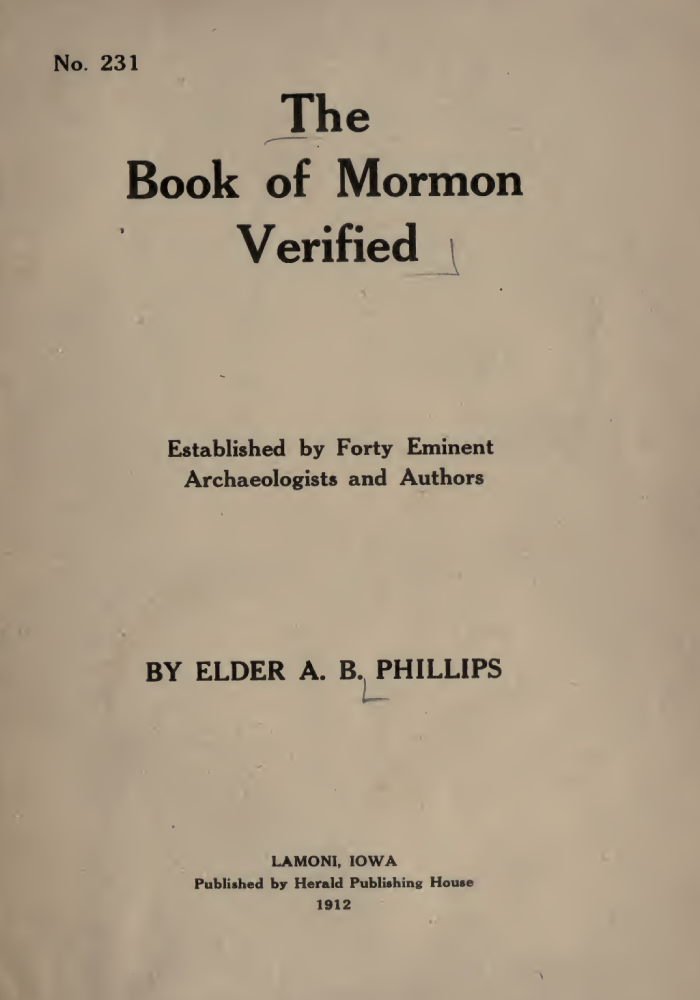
Bibliographic Context
The pamphlet, No. 231 in the Herald Publishing House series (Lamoni, Iowa — then the RLDS headquarters), was written by Elder A. B. Phillips and printed in 1912. Phillips’s central thesis is that forty “eminent archaeologists and authors” had, by the early twentieth century, unwittingly confirmed the Book of Mormon’s narrative of ancient American peoples, and that these confirmations proved Joseph Smith’s translation to be a genuine ancient record rather than a nineteenth-century invention.
Summary of the Argument
Framing and Method
Phillips opens by noting that the Book of Mormon was published in 1830, copyrighted 1829, and the plates allegedly delivered in 1827 — a period, he insists, when “little was written and much less known” about ancient American antiquities. He concedes that hostile critics such as John T. Short (North Americans of Antiquity, 1880) dismissed the book as a “pretentious fraud,” but argues that later discoveries vindicated the text “more than ten years in advance of science.”
The Jaredite Migration
Phillips claims the Jaredites came from the Tower of Babel ca. 2240 BC and that aboriginal American flood and tower traditions — recorded by St. Giles, Bancroft, Charnay, and Priest — corroborate the Book of Mormon. He cites Toltec traditions of a zacuali (tower), Aztec “confusion of tongues” legends, and a westerly migration to oceanic shores, then a transoceanic voyage to Central America.
Architecture, Arts, and Sciences
He marshals Nadaillac, Jones, and Pidgeon to argue that Mesoamerican architecture resembles Egyptian work, consistent with Jaredite proximity to Egypt. He cites embalming in Peru, the use of cement at Palenque, weaving and spinning among the Mound-builders (Baldwin, Maclean), advanced metallurgy, “all manner of ore,” surface mining in Upper Michigan, and Peruvian trephination as fulfillment of the Book of Mormon’s claims about Nephite and Jaredite material culture.
Pre-Columbian Animals
Phillips highlights the Book of Mormon’s mention of horses, oxen, sheep, swine, elephants, “cureloms,” and “cumoms” (Ether 9:19). He cites Larkin’s 1854 discovery of an alleged elephant-engraved copper relic, Winchell’s 1862 report of mastodon bones with human remains, and Dana’s Manual of Geology to argue that horses and elephants coexisted with humans in the Americas.
The Nephites and Highways
He cites Rivero, Tschudi, and Baldwin on a Cuzco tradition of “four brothers” — paralleling Lehi’s sons — and argues that the great Peruvian road system (the Qhapaq Ñan) confirms the Book of Mormon’s account of “highways cast up” from city to city.
Cataclysm at Christ’s Death
Phillips connects the Book of Mormon’s three-hour earthquake and three-day darkness (3 Nephi 8) to Aztec and Toltec traditions of “sun of air” hurricanes and “four ages” cycles recorded by Bancroft and St. Giles.
Christ’s New World Visit
He treats pre-Columbian crosses (Cozumel, Palenque, the Borgia codex), Quetzalcoatl iconography, Yucatec triune deity traditions (Yzona/Bacab/Echvah, from Kingsborough), and baptism and resurrection beliefs (De Roo, Rivero) as confirming 3 Nephi.
Light-Skinned and Hebrew-Connected Peoples
Phillips cites fine, brown, or auburn hair on mummies in New Mexico and Peru, the “white” Mandans and Menominees, and a Hebrew-Indian word list from Haines (1888) listing parallels like Ale/Alein for “God,” Shilo for “Shiloh,” and Yohewah for “Jehovah.”
Cliff-Dwellers as Gadianton Robbers
He equates the Gadianton robbers of Helaman with the Anasazi cliff-dwellers, citing F. V. Hayden’s 1874–76 reports and the American Antiquarian.
Ancient Writing and Coinage
Phillips cites the Grave Creek Tablet (1838), the Davenport Tablets (1877), the Newark “Decalogue Stone,” the Tiverton and Portsmouth rocks, and Le Plongeon’s “Maya hieratic alphabet” to argue for pre-Columbian writing systems comparable to “reformed Egyptian.” He also points to alleged copper coins at Palenque, Circleville, and a deep well-shaft find in Laconia.
Conclusion
Phillips closes with a comparative chart of Egyptian demotic, ancient Hebrew, Le Plongeon’s “Maya hieratic,” and characters Joseph Smith reportedly transcribed from the plates, declaring the resemblance sufficient to convince “any impartial jury on earth.”
Analysis of Validity
Phillips’s argument is essentially a parallelomania — accumulating surface resemblances and treating each as independent confirmation. Three problems undermine the entire enterprise.
1. Reliance on Sources Now Discredited
A striking proportion of Phillips’s “forty eminent” authorities have been thoroughly demolished by later scholarship:
- Ignatius Donnelly (Atlantis: The Antediluvian World, 1882) is a textbook of nineteenth-century pseudoscience, predicated on a literal sunken continent rejected by every geological discipline since plate tectonics was established.
- Augustus Le Plongeon (Sacred Mysteries Among the Mayas and Quiches, 1886), whose “Maya hieratic alphabet” Phillips treats as decisive, is regarded by Mesoamericanists as an eccentric whose decipherments were entirely fanciful. His translations were rejected even by his contemporaries; modern Maya epigraphy, built on the genuine breakthroughs of Knorozov, Proskouriakoff, and the late-twentieth-century decipherment, has no connection to Le Plongeon’s system.
- William Pidgeon (Traditions of De-Coo-Dah, 1852) was exposed as a fabricator. T. H. Lewis’s surveys in the 1880s demonstrated that Pidgeon’s mounds either did not exist or did not resemble his descriptions; “De-Coo-Dah” appears to have been invented.
- Josiah Priest (American Antiquities, 1833) is a compendium of credulous speculation, including the “lost tribes” framework Phillips elsewhere rejects.
- John Delafield and Caleb Atwater were antiquarians, not trained archaeologists; their work predates stratigraphic method.
- John D. Baldwin (Ancient America, 1871) and John T. Short were respectable popularizers for their day, but their hyperdiffusionism — assuming all New World civilization derived from Old World contact — was rejected after the rise of professional anthropology under Boas, Holmes, and Kidder.
2. The Inscribed Artifacts Are Forgeries or Misidentified
The “phonetic” inscriptions Phillips treats as Book of Mormon confirmations are precisely the cases that became canonical examples of nineteenth-century American antiquarian fraud:
- The Grave Creek Tablet (1838) was almost certainly planted. Stephen D. Peet and later scholars, including the Smithsonian under Cyrus Thomas, noted its anomalous mix of alphabets (Phoenician, Etruscan, Runic, Iberic — all on one small stone), and recent paleographic analysis identifies most characters as derivable from an 1804 Spanish-language reference book on world alphabets available in Wheeling at the time.
- The Davenport Tablets (1877), central to Phillips’s argument, were definitively shown to be forgeries by Marshall McKusick in The Davenport Conspiracy (1970) and The Davenport Conspiracy Revisited (1991). The tablets were manufactured by members of the Davenport Academy of Natural Sciences from a local roofing slate to embarrass a rival. The Smithsonian’s Cyrus Thomas exposed them as a hoax in 1885 — twenty-seven years before Phillips wrote.
- The Newark “Holy Stones” (Decalogue Stone, Keystone), “discovered” by David Wyrick in 1860, are universally regarded as nineteenth-century forgeries; the Hebrew script is a post-Talmudic form unknown in antiquity, and the geological context was compromised.
- The Kinderhook Plates (which Phillips wisely does not cite, but which figure in the same tradition) were a confirmed hoax — and Joseph Smith partially “translated” them.
- The Tiverton and Portsmouth (Dighton) Rock inscriptions are now generally interpreted as Algonquian petroglyphs or, in the case of the Dighton Rock, possibly a Portuguese inscription, not Phoenician or Hebrew writing.
3. The Anatomy of Parallelomania
Phillips’s parallels rarely survive scrutiny:
- The “four brothers” of Cuzco. The Ayar brothers of Inca origin mythology number four (Ayar Manco, Ayar Auca, Ayar Cachi, Ayar Uchu) and emerge from a cave at Pacaritambo. The Book of Mormon’s Lehi colony includes four sons of Lehi (Laman, Lemuel, Sam, Nephi), one daughter-bearing wife Sariah, Zoram, Ishmael’s family, and others — at least twenty people, not four siblings. The two narratives have entirely different structures, geographies, and theological functions; the “match” is superficial.
- The Mesoamerican “cross.” The cross-shaped foliated motif at Palenque (the Cross Group, dedicated by K’inich Kan B’alam II in 692 CE) is the Wakah-Chan, the world tree, an axis mundi symbol common across Mesoamerica. It is not a Christian crucifixion symbol; it long predates Spanish contact and has no soteriological function. The Catholic missionary identification of these crosses as evidence of pre-Columbian Christianity was a sixteenth-century interpretive error driven by the assumption that the Gospel must have reached the Americas (often attributed to St. Thomas).
- Quetzalcoatl as Christ. Modern Mesoamericanists (Nicholson, Carrasco, Florescano) have demonstrated that the Quetzalcoatl complex is a fusion of an actual Toltec ruler (Ce Acatl Topiltzin) with a feathered-serpent deity attested across Mesoamerica from at least the Olmec period. The “white bearded god” motif appears to be a post-Conquest projection rather than a pre-Hispanic tradition, as Hugh Nibley’s own LDS source materials inadvertently demonstrate.
- The Hebrew-Indian word list. Phillips’s parallels (Ale/Alein, Shilo, abba) come from James Adair’s 1775 History of the American Indians, which argued that Native Americans were the Lost Ten Tribes — exactly the “lost tribes” theory Phillips formally rejects. Comparative linguistics (Sapir, Greenberg, and now Campbell and Goddard) has demonstrated that no Native American language family shows genetic relationship to Semitic. Adair’s wordlist relies on cherry-picked phonetic resemblances of the sort that can be generated between any two unrelated languages.
4. The Anachronism Problem Phillips Does Not Address
Phillips claims the Book of Mormon was vindicated by later discoveries. The opposite is closer to the truth: discoveries since 1912 have intensified the anachronism problem.
- Horses. Equids became extinct in the Americas at the end of the Pleistocene (ca. 10,000 BCE) and were not reintroduced until the Columbian Exchange. The “elephant relic” Phillips cites from Larkin (1854) has no archaeological provenance and never entered the corpus of accepted artifacts. No domesticated horse remains have ever been recovered from a Book of Mormon-era stratum (ca. 2200 BCE – 421 CE) anywhere in the Americas.
- Steel and iron. Pre-Columbian Mesoamericans did not smelt iron. Cold-hammered meteoritic iron is attested in the Arctic; folk linguistic terms for “iron” Phillips cites are post-Contact loanwords for European metal. The Andean civilizations worked copper, gold, silver, and bronze (late) — but never the iron and steel weapons and tools the Book of Mormon repeatedly describes (1 Nephi 16:18; Jarom 1:8; Ether 7:9).
- Wheat, barley, silk. None of the Old World cultigens listed in the Book of Mormon (wheat, barley, silk) are attested in pre-Columbian Mesoamerican archaeobotany; an alleged “Mesoamerican barley” is Hordeum pusillum, little barley, a distantly related and uncultivated North American grass.
- Chariots and roads. The Inca road system Phillips invokes was built without wheeled vehicles and post-dates the Book of Mormon’s purported timeframe by centuries; it dates principally to the fifteenth century CE.
- Reformed Egyptian. No non-LDS Egyptologist or paleographer recognizes “reformed Egyptian” as an attested script. The “Anthon transcript,” which Phillips references via Joseph Smith’s transcribed characters, was shown by Charles Anthon himself in his 1834 letter to E. D. Howe to be a fraud he had not authenticated. Modern Maya epigraphy bears no resemblance to Egyptian or Hebrew script.
- Population genetics. Mitochondrial DNA, Y-chromosome haplogroups, and autosomal studies (Reich, Skoglund, Willerslev) place the Native American gene pool firmly within northeast Asian populations crossing Beringia in two or three pulses between ca. 23,000 and 13,000 BCE. There is no detectable Middle Eastern admixture predating Columbus.
5. The Chronological Sleight of Hand
Phillips repeatedly claims the Book of Mormon predicted discoveries “ten years in advance of science” or “forty years before Baldwin.” This claim depends on suppressing the considerable body of speculative pre-1830 literature about American antiquities — Ethan Smith’s View of the Hebrews (1823, 1825), James Adair (1775), Elias Boudinot’s Star in the West (1816), Josiah Priest’s earlier work, and the popular Mound-builder mythology already in circulation. Every major “predictive” claim Phillips highlights — Israelite ancestry, lost civilizations, Hebrew-like words, biblical-era migration, a destroyed advanced people preceding the Indians — was already in print and widely discussed in the religious and antiquarian literature of upstate New York before 1830. The Book of Mormon did not anticipate; it reflected.
Conclusion
Phillips’s pamphlet is a representative artifact of early-twentieth-century RLDS apologetics: confident, well-read in the popular antiquarian literature of its day, and methodologically incapable of distinguishing genuine archaeology from fraud, parallelomania, or pseudo-scientific speculation. Of his forty authorities, a substantial fraction wrote works no current archaeologist or anthropologist would treat as reliable. The artifacts on which his argument leans most heavily — the Grave Creek Tablet, the Davenport Tablets, the Newark Stones, Le Plongeon’s Maya alphabet — are either confirmed forgeries or eccentric misreadings. The parallels he draws between Mesoamerican and Old World traditions either depend on the post-Conquest interpretive overlay of Catholic missionaries or evaporate under closer ethnographic and epigraphic analysis.
What Phillips offered as the Book of Mormon’s vindication has, in the 114 years since publication, become a documented case study in how not to do comparative archaeology. The professional consensus — held by archaeologists, linguists, geneticists, and historians who have no theological stake in the matter — is that no element of Book of Mormon historicity has been confirmed by the material record, and that the affirmative cultural, biological, and linguistic evidence runs strongly the other way.