
Between the Keys and the Cosmos
Prelude: A Child at the Piano
When Armando Anthony Corea first sat down at the piano, he was four years old, and the instrument had been set before him by his father, a Boston trumpeter who led a Dixieland band in the 1930s and 1940s. That domestic scene—an Italian-American household in Chelsea, Massachusetts, alive with the sound of bebop records and a working musician’s horn—holds, in miniature, the two forces that would govern Corea’s long life. One was music, absorbed so early and so completely that it became indistinguishable from breath. The other was the restless human hunger to understand, to communicate, to make the inner life legible to the world. Corea would spend nearly eight decades pursuing both, and at a particular juncture, the second hunger led him to the writings of L. Ron Hubbard, the founder of Scientology.
This essay sets out to tell that story honestly. It is a tempting narrative—and one sometimes assumed by casual observers—that a great artist might dabble in a controversial belief system in his youth and then, chastened by experience or maturity, quietly walk away from it. The factual record of Corea’s life does not support that tidy arc. Far from distancing himself from Hubbard, Corea remained one of Scientology’s most devoted and visible adherents from 1968 until he died in 2021. What the record does reveal is something more interesting and more genuinely human: a decades-long negotiation between a man’s private convictions and his public identity as an artist, a negotiation conducted under pressures both internal and external, and one that occasionally forced upon him a separation he never personally chose. To understand Corea is to sit with that tension rather than to resolve it artificially.
❦ ❧ ❦
The Making of a Musician
Armando Corea was born on June 12, 1941, to Anna (Zaccone) Corea and Armando J. Corea. His father’s family had roots in Albi, a commune in the Calabrian province of Catanzaro in southern Italy, and the household was steeped in music from the start. The elder Corea introduced his son to the piano at four and, recognizing the boy’s seriousness, eventually arranged formal instruction. At the age of eight, young Corea began studying with the Italian concert pianist Salvatore Sullo. Sullo cared little for the boy’s passion for jazz and drilled him instead in the classical repertoire—but in doing so, he opened a door that would never close. The exposure to classical form and structure kindled in Corea a lifelong fascination with composition, and the dialogue between the rigor of European concert music and the freedom of American jazz would animate his entire career.
He came into possession of a drum set at eleven, an acquisition whose consequences can be heard in the percussive intelligence of his mature playing—the crisp, rhythmically alert left hand that admirers would later single out as a signature. Surrounded by his father’s records, he came under the spell of the bebop generation: Dizzy Gillespie, Charlie Parker, Bud Powell, Horace Silver, and Lester Young. Given a black tuxedo by his father, he began playing gigs while still in high school, listening to Herb Pomeroy’s band and leading a trio that worked through Horace Silver’s tunes at a local club.
Corea moved to New York City to study music, enrolling first at Columbia University and then transferring to the Juilliard School. Formal academia, however, proved too confining for a young man whose education was happening nightly on the bandstand, and he left school to devote himself to playing. The decision paid off quickly. In the early 1960s, he began recording and touring with a remarkable run of leaders—the Cuban percussionist Mongo Santamaría, Willie Bobo, Cal Tjader, Blue Mitchell, Herbie Mann, and the saxophonist Stan Getz—apprenticing in the Latin-jazz and hard-bop idioms that would leave permanent traces on his own compositions. In 1966, he recorded his debut as a leader, Tones for Joan’s Bones, and in March 1968, he cut the trio masterpiece Now He Sings, Now He Sobs with bassist Miroslav Vitouš and drummer Roy Haynes—a record that secured his place in jazz history, and that would be inducted into the Grammy Hall of Fame in 1999.
❦ ❧ ❦
1968: Dianetics and the Opening of a Door
The year 1968 was pivotal for Corea on two fronts that, in his own telling, were not unrelated. In the fall, he joined Miles Davis’s band, replacing Herbie Hancock and stepping directly into the laboratory where jazz fusion was being invented. He played electric piano—an instrument he initially resisted but soon mastered—on a sequence of epochal Davis albums: Filles de Kilimanjaro, In a Silent Way, Bitches Brew, and later On the Corner. It was an education in electricity, texture, and open-ended form.
At roughly the same moment, Corea encountered Dianetics: The Modern Science of Mental Health, Hubbard’s 1950 self-help book and a cornerstone of the Scientology movement. He would later describe the experience as a kind of expansion:
I came into contact with L. Ron Hubbard’s material in 1968 with Dianetics and it kind of opened my mind up and it got me into seeing that my potential for communication was a lot greater than I thought it was.
— Chick Corea, NPR interview, 2016
That phrase—potential for communication—is the hinge of the whole story. For Corea, the appeal of Hubbard’s system was never primarily metaphysical in the way a casual critic might assume. It was, he insisted, practical and artistic: a set of tools that he believed sharpened his ability to reach an audience. By the early 1970s, his interest had deepened into a defining commitment. He framed the shift in explicitly creative terms:
I no longer wanted to satisfy myself. I really want to connect with the world and make my music mean something to people.
— Chick Corea, Down Beat, 1976
Here it is worth marking a distinction that the historical record requires. Corea’s adoption of Scientology coincided with one of the most consequential artistic turns of his life, and he himself drew a causal line between the two. After leaving Davis following the 1970 Isle of Wight Festival, he briefly pursued the uncompromising avant-garde with the collective Circle, alongside bassist Dave Holland, drummer Barry Altschul, and multireedist Anthony Braxton. Then, around 1971, while in Los Angeles, he abruptly changed course. As the jazz magazine Down Beat recounted in its memorial, Corea “assimilated the precepts of Scientology, left the group and transitioned abruptly to a populist conception, making a permanent commitment to melody, structure and consonance.” Whether one regards that turn as a liberation or a narrowing—critics have argued both—it is inseparable from his engagement with Hubbard’s ideas. The free-jazz abstractionist became, almost overnight, a composer determined to be understood by ordinary listeners.
❦ ❧ ❦
Return to Forever and the Sound of Communication
Out of that conviction came Return to Forever, the band that would define Corea’s 1970s and rank among the most important ensembles in the history of jazz fusion. Named for its eponymous 1972 album, the group’s first incarnation drew more on Hispanic and Brazilian color than on rock, featuring vocalist Flora Purim, flutist and saxophonist Joe Farrell, the Brazilian percussionist Airto Moreira, and the young bassist Stanley Clarke. The 1973 album Light as a Feather introduced two of Corea’s most enduring compositions—the heraldic, flamenco-tinged “Spain” (which borrows its introduction from Joaquín Rodrigo’s Concierto de Aranjuez) and the airborne “500 Miles High.” Inspired by John McLaughlin’s Mahavishnu Orchestra, Corea soon electrified the band, adding drummer Lenny White and guitarists Bill Connors and then Al Di Meola for a harder, funk-and-rock-inflected sound on Hymn of the Seventh Galaxy, Where Have I Known You Before, No Mystery, and the celebrated Romantic Warrior.
It is significant that Stanley Clarke, too, was for a time a Scientologist; the cosmic imagery and aspirational titles that suffused the band’s work were not incidental. The very name “Return to Forever” gestures toward the kind of transcendence Hubbard’s writings promised. Yet the music’s appeal far outstripped any doctrinal frame. Audiences who had never heard of Dianetics responded to the joy, virtuosity, and melodic generosity of the playing. This would become the recurring pattern of Corea’s career: a private belief system that he credited as his engine, producing music whose pleasures were entirely available to listeners who neither knew nor cared about its source.
Corea’s restlessness never abated. He recorded luminous duets with vibraphonist Gary Burton, beginning with 1972’s Crystal Silence; he explored solo piano at the urging of ECM’s Manfred Eicher; he wrote the orchestral tone poems The Leprechaun, My Spanish Heart (featuring his second wife, the vocalist and pianist Gayle Moran, whom he married in 1972), and The Mad Hatter. In the 1980s and 1990s, he led both the acoustic-leaning Akoustic Band and the high-gloss Elektric Band, the latter showcasing bassist John Patitucci and drummer Dave Weckl, and in 1992, he founded his own label, Stretch Records.
❦ ❧ ❦
Making Hubbard Audible: From Space Jazz to To the Stars
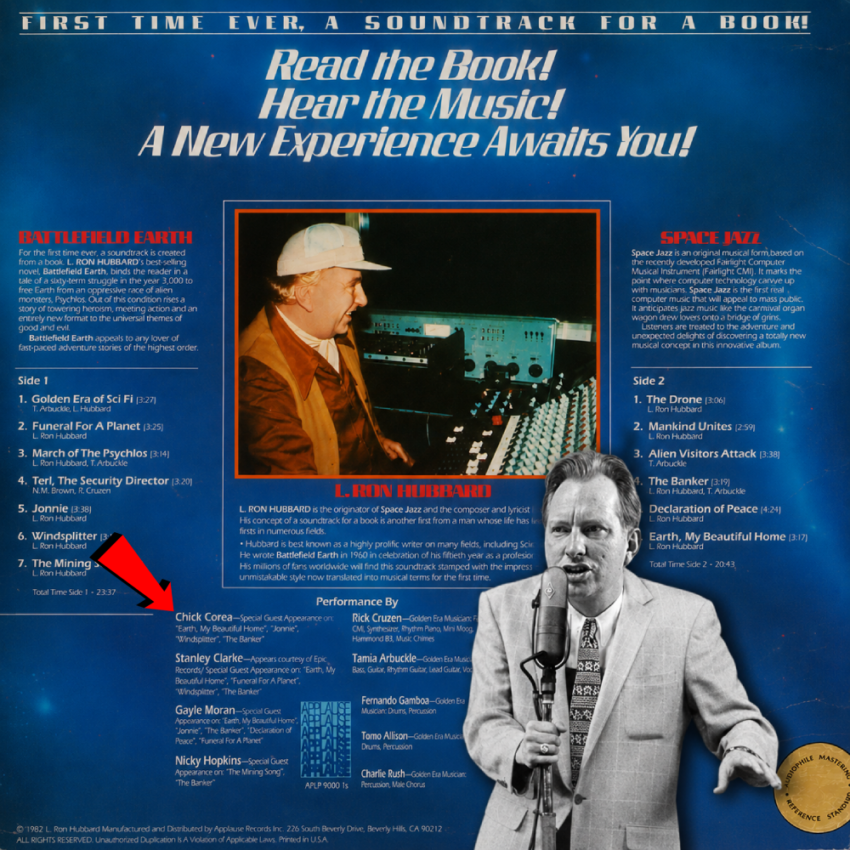
If Corea’s early work merely coincided with his beliefs, his later projects made those beliefs explicit. In 1982, alongside Stanley Clarke and the English pianist Nicky Hopkins, he played on Space Jazz: The Soundtrack of the Book Battlefield Earth, a concept album that Hubbard composed to accompany his sprawling science-fiction novel and that was marketed, improbably, as the first-ever soundtrack to a book. The record is, by general agreement, an oddity—one critic memorably called it perhaps not jazz’s worst but certainly its craziest—assembled in part on the then-novel Fairlight CMI sampler. Corea would return to Hubbard’s orbit again on the 1986 Church-released album The Road to Freedom, which gathered Scientologist performers, including John Travolta.
The fullest artistic expression of Corea’s devotion came in 2004 with To the Stars, an album by a reunited Chick Corea Elektric Band inspired by Hubbard’s 1954 novel of the same name. The book imagines an interstellar crew subject to Einsteinian time dilation, for whom a few days aboard ship correspond to centuries on Earth. Corea—who said he had read the novel eight or nine times—was captivated in particular by a scene in which the ship’s captain plays a melody on a piano, and he built the record as a tone poem, with ten of its seventeen tracks drawn directly from the book’s characters and concepts. Scientology-owned Galaxy Press reissued the novel simultaneously, a piece of cross-marketing that Publishers Weekly noted gave the project considerable promotional muscle. Corea did not hide the personal stakes:
The attraction to me was not only the challenge of writing music portraying characters in a fiction book but the fact that I’ve had such an intimate connection with L. Ron Hubbard and his work in Scientology for 40 years now.
— Chick Corea, The Washington Post, 2004
He went further still, telling The Harvard Crimson that the album represented a synergy of his three great passions: his work as a composer and performer, his love of the Elektric Band as an ensemble, and “my passion for L. Ron Hubbard as the ideal artist.” To the Stars reached number eight on Billboard’s contemporary jazz chart and earned a Grammy nomination; Corea called it his favorite recording in a discography approaching one hundred albums. Two years later he produced The Ultimate Adventure, again inspired by a Hubbard work, which won the Grammy for Best Jazz Instrumental Album. By any measure, this was not a man drifting away from his founder. This was a man building monuments to himself.
❦ ❧ ❦
The Separation He Did Not Choose: Germany, 1993–1997
If there is a chapter in Corea’s life that genuinely concerns disassociation, it is not a story of the artist leaving his beliefs behind but of his beliefs being used to push him out of public life—against his will. In the 1990s, Germany was gripped by an intense official anxiety about Scientology, which several state and federal authorities regarded as a totalitarian organization with designs on society, politics, and business. Corea became, in his own words, a lightning rod for that distrust.
The flashpoint came in 1993, when Corea was excluded from a concert tied to the World Championships in Athletics in Stuttgart after the government of Baden-Württemberg announced it would review subsidies for events featuring avowed Scientologists. The state broke off contract negotiations upon learning of his affiliation. Corea challenged the policy in the administrative courts and lost in 1996. He described the experience with weary disbelief:
All I know is it feels nuts. It’s just basically a kind of scene that the German government seems to have with minority groups and especially Scientology.
— Chick Corea, Religion News Service, 1996
The practical toll was real. Corea reported that promoters who had once booked him for a dozen or fourteen concerts on a German tour could now manage only two or three; newspapers that had interviewed him stopped calling. The 1996 U.S. State Department human rights report on Germany warned that artists and businesses with Scientology connections might face boycotts and discrimination, sometimes with government approval, and it named Corea among the affected. Members of the United States Congress, led by Representative Benjamin Gilman, formally protested to the State Department that Corea had been subjected to discriminatory treatment, and in 1997 Corea, John Travolta, and Isaac Hayes testified before the Helsinki Commission about the situation.
The episode is instructive precisely because it inverts the expected narrative. Here, a government attempted to force a wedge between the artist and his faith—to make Corea’s professional identity in Germany conditional on the suppression of his private belief. Corea refused to accept the terms. He did not renounce Scientology to recover his German bookings; he fought the policy in court and in the press, framing it as a matter of human rights and religious freedom. The separation between belief and professional life was imposed from outside, and Corea spent years resisting it. Notably, he was never banned from Germany outright, continued to perform at venues such as the jazz festival in Burghausen, and in 2011 was honored there with a plaque on the town’s “Street of Fame.”
❦ ❧ ❦
A Commitment Without Exit
The remainder of Corea’s life only deepened his identification with Hubbard’s movement. He moved from Los Angeles to Clearwater, Florida—the spiritual headquarters of Scientology—around 2001, telling interviewers that what began as renting rooms during regular visits with Gayle Moran became a permanent home he never wished to leave. He frequently supplied entertainment at Scientology events and was regarded by close observers of the Church as perhaps its most dedicated celebrity adherent of all. By the Church’s own reckoning, he attained the level known as Operating Thetan VIII (OT VIII), the highest rung on its “Bridge to Total Freedom”—and remarkably, he completed it twice, first in 1991 and again in 2016.
That second completion carries a poignancy that only became visible at the end. Scientology teaches that an OT VIII should, in principle, possess a measure of mastery over matter, energy, space, and time—abilities that Hubbard’s writings suggested could extend even to the body’s vulnerability to illness. When Corea died at his home in Tampa, Florida, on February 9, 2021, at the age of seventy-nine, the cause was a rare and aggressively fast form of cancer, discovered only very shortly before his death. Critics of Scientology, including the journalist Tony Ortega, observed the painful irony that an adherent who had reached the faith’s pinnacle was, like other upper-level Scientologists before him, unable to overcome a disease the movement’s literature implied its methods could defeat. Whatever one concludes from that, the fact remains: Corea died as he had lived for more than half a century, a committed Scientologist who never disassociated from the founder whose ideas he credited with shaping his art.
His final message to his audience, released on his Facebook page after his death, contained no doctrine—only the open-handed generosity that had always characterized him: “I want to thank all of those along my journey who have helped keep the music fires burning bright. It is my hope that those who have an inkling to play, write, perform or otherwise, do so. If not for yourself, then for the rest of us.” It is the voice of the same man who, in 1968, said that Hubbard had shown him his “potential for communication” was greater than he had thought.
❦ ❧ ❦
The Measure of the Music
To dwell on the controversy is to risk losing sight of why anyone tells Corea’s story at all. He was, by the end, one of the most decorated musicians in the history of recorded sound, the winner of twenty-three Grammy Awards in his lifetime—a total that continued to climb posthumously—from some seventy-nine nominations, and a National Endowment for the Arts Jazz Master. Alongside Herbie Hancock, McCoy Tyner, and Keith Jarrett, he is reckoned among the foremost pianists of the post-Coltrane era. His compositions “Spain,” “500 Miles High,” “La Fiesta,” “Armando’s Rhumba,” and “Windows” entered the permanent jazz repertoire as standards.
His curiosity was inexhaustible. He partnered with the banjo virtuoso Béla Fleck and the vocalist Bobby McFerrin; he toured in dueling-piano summits with Herbie Hancock; he wrote a piano concerto adapting “Spain” for the London Philharmonic and a string quartet with no keyboard at all; he reunited Return to Forever for an acclaimed world tour in 2008 and convened the all-star Five Peace Band with John McLaughlin. He celebrated his seventy-fifth birthday in 2016 by playing with more than twenty different groups across a six-week residency at New York’s Blue Note. “I pretty well ignore the numbers that make up ‘age,’” he said then. “I have always just concentrated on having the most fun I can with the adventure of music.”
That sentence is perhaps the truest key to the man. The deepest tension in Corea’s life was never resolved, because for him it may never have felt like a tension at all. The belief system that troubled his critics was, to Corea, simply part of the same adventure as the music—both of them instruments for the one purpose he named again and again across the decades: connection. He wanted, as he put it in 1976, to make his music mean something to people. Listeners who never shared a single one of his convictions found, in “Spain” or “Crystal Silence” or the trio recordings, exactly that meaning. The argument between belief and art that so many wanted Corea to settle, he instead declined to have. He simply kept playing—and in the playing, whatever its source, generations of listeners have heard something that needs no doctrine to explain its beauty.
❦ ❧ ❦
Selected Sources
Quotations and factual claims in this essay are drawn from the following primary and secondary sources. Direct quotations are attributed in the text; readers are encouraged to consult the originals.
• Wikipedia, “Chick Corea” https://en.wikipedia.org/wiki/Chick_Corea
• The New York Times, obituary (Russonello) https://www.nytimes.com/2021/02/11/arts/music/chick-corea-dead.html
• Encyclopaedia Britannica, “Chick Corea” https://www.britannica.com/biography/Chick-Corea
• NPR, “Chick Corea, Jazz Fusion Pioneer, Has Died Of Cancer At 79” https://www.npr.org/2021/02/11/967082282/chick-corea-jazz-fusion-pioneer-has-died-of-cancer-at-79
• DownBeat, “In Memoriam: Chick Corea” https://downbeat.com/news/detail/in-memoriam-chick-corea
• Cleveland Jazz Orchestra, “Remembering Chick Corea” https://www.clevelandjazz.org/blog/remembering-chick-corea
• The Vinyl Factory, “How L. Ron Hubbard made the craziest jazz record ever” https://www.thevinylfactory.com/features/l-ron-hubbard-music-space-jazz
• Wikipedia, “To the Stars (album)” https://en.wikipedia.org/wiki/To_the_Stars_(album)
• Tony Ortega, “Chick Corea, Scientology celebrity” (The Underground Bunker) https://tonyortega.org/chick-corea-scientology-celebrity/
• Tony Ortega, “Scientology icon and double OT 8 Chick Corea dies at 79” https://tonyortega.org/2021/02/11/scientology-icon-and-double-ot-8-chick-corea-dies-at-79-of-cancer/
• Religion News Service, “German fear of Scientology leaves jazz musician short of gigs” (1996) https://religionnews.com/1996/07/24/german-fear-of-scientology-leaves-jazz-musician-short-of-gigs/
• Distractify, “Chick Corea Was an Iconic Figure Amongst Scientologists” https://www.distractify.com/p/chick-corea-scientologist
• Wikipedia, “Scientology in Germany” https://en.wikipedia.org/wiki/Scientology_in_Germany
A Note on Research Methods and Accuracy
In recent years, some have voiced concern that artificial intelligence may distort facts or introduce inaccuracies into serious research. That criticism deserves acknowledgment. However, AI has now evolved into the most powerful research instrument available to any dedicated scholar—capable of analyzing vast datasets, cross‑referencing historical records, and surfacing overlooked connections across sources. This work represents a collaboration between the author’s investigative inquiry, verified primary documentation, and the advanced analytic capabilities of AI research tools. Here, AI was not used as a ghostwriter or a shortcut for scholarship, but as a disciplined research partner devoted to rigor, accuracy, and transparency.
Every factual claim in this work has been subjected to active verification. Where AI‑generated content was used as a starting point, it was tested against primary sources, peer‑reviewed scholarship, official institutional documentation, and established historical records. Where discrepancies were found—and they were found—corrections were made. The author has made every reasonable effort to ensure that quotations are accurately attributed, historical details are precisely rendered, and theological claims fairly represent the positions they describe or critique.
That said, no work of this scope is immune to error, and the author has no interest in perpetuating inaccuracies in the service of an argument. If you are a reader—whether sympathetic, skeptical, or hostile to the conclusions drawn here—and you identify a factual error, a misattributed source, a misrepresented teaching, or a claim that cannot be substantiated, you are warmly and genuinely invited to say so. Reach out. The goal of this work is not to win a debate but to get the history right. Corrections offered in good faith will be received in the same spirit, and verified corrections will be incorporated into future editions without hesitation.
Truth, after all, has nothing to fear from scrutiny—and neither does this work.