
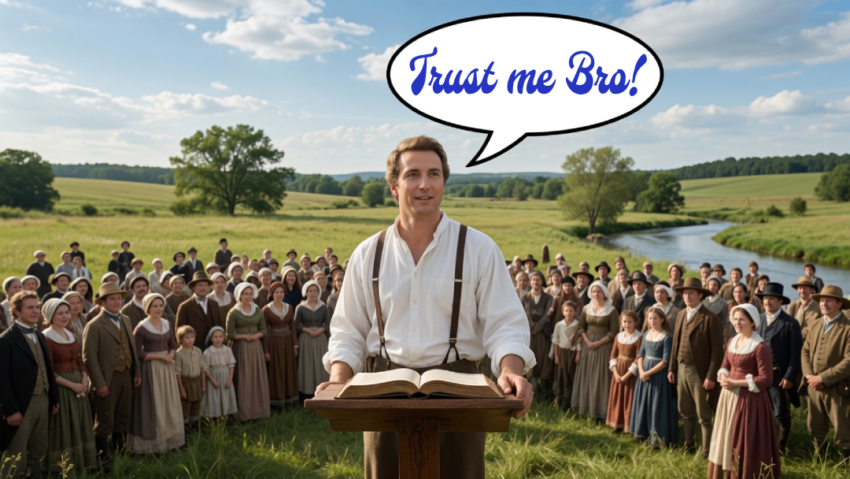
Why the Entire Mormon Restoration Stands or Falls on One Man, Joseph Smith
❦ ❦ ❦
Introduction: The Hinge on Which Everything Else Turns
There is a particular kind of theological conversation that, no matter where it begins, ends up in the same place. It may begin with the Book of Mormon. It may begin with temple ordinances, eternal marriage, baptism for the dead, the Word of Wisdom, polygamy, the Book of Abraham, or the rise of the Church of Jesus Christ of Latter-day Saints itself. It may begin with a doorstep conversation in Gilbert or Mesa, or with a quiet question raised by a returning missionary. However the conversation begins, it almost always ends with the same name.
Joseph Smith, Jr.
Did a Great Apostasy occur, leaving Christ’s true Church absent from the earth for some fourteen centuries? How do we know? Joseph Smith said so. Was priesthood authority lost from the earth and then restored through angelic visitation? How do we know? Joseph Smith said so. Did Peter, James, and John return in glorified bodies to lay hands upon him? How do we know? Joseph Smith said so. Were ancient temple ordinances reintroduced — endowments, sealings, baptism for the dead, the second anointing? How do we know? Joseph Smith said so. Was plural marriage commanded by God as essential to exaltation? How do we know? Joseph Smith said so.
At some point — at every point — every major load-bearing claim of the Latter-day Saint restoration narrative rests upon accepting Joseph Smith as a reliable witness to events that no other living person witnessed. Sharon Lindbloom of Mormonism Research Ministry has captured the structure of the problem with admirable economy:
Mormonism hinges upon the question of whether Joseph Smith was a prophet of God, but Christianity does not. Christianity has nothing whatsoever to do with Joseph Smith.
— Sharon Lindbloom, Mormonism Research Ministry (2017)
That observation is decisive. Traditional Christianity has stood on the historical resurrection of Jesus of Nazareth, the testimony of multiple apostolic eyewitnesses, two millennia of continuous proclamation, and a canon hammered out, copied, and preserved by tens of thousands of independent witnesses in dozens of languages. The Latter-day Saint restoration narrative, by contrast, stands on the personal credibility of a single nineteenth-century farmer’s son from western New York. This is not a hostile characterization. It is the structure that Latter-day Saint apologetics itself acknowledges. As the Articles of Faith volume of the Church concedes, ‘If his [Smith’s] claims to divine appointment be false, forming as they do the foundation of the Church… the superstructure cannot be stable.’
The question, then, is not whether traditional Christians should object to Mormonism based on unfamiliarity, cultural distance, or denominational pride. The question is whether the load-bearing pillar holds — whether the man who alone vouches for the restoration can himself be vouched for by the evidence he left behind. This essay surveys that evidence with care, respect, and what the Apostle Peter called gentleness and reverence (1 Peter 3:15). Latter-day Saint readers deserve to be engaged with the same seriousness with which they have engaged the question themselves.
What follows is not an attack on the Latter-day Saint people, whose sincerity, family devotion, and personal virtues are widely admired, including by those who do not share their theological commitments. It is, rather, a sustained examination of a single, foundational question that traditional Christianity has never been able to answer in the affirmative: Did Joseph Smith demonstrate the credibility necessary to support the extraordinary claims he made?
❦ ❦ ❦
I. Why Credibility Is Not a Side Issue
Latter-day Saint apologists sometimes object that focusing on the credibility of Joseph Smith is an exercise in ad hominem reasoning — attacking the messenger rather than weighing the message. The Foundation for Apologetic Information and Research (FAIR) makes this argument precisely, characterizing concerns about Smith’s character as ‘attacks on the messenger, rather than his claims.’ If this objection held, traditional Christian inquiry into Smith’s personal credibility would be a category error, like dismissing the Pythagorean theorem because Pythagoras kept odd dietary rules.
But the objection only works for messengers whose message is independently verifiable. The Pythagorean theorem can be checked against any right triangle ever drawn. The chemistry of water can be tested in any laboratory. The credibility of the messenger is irrelevant to the truth of the message because the message stands on independent confirmation. The Latter-day Saint restoration narrative does not enjoy this independence.
Rob Bowman of the North American Mission Board makes the point sharply. Mormonism, like biblical Christianity, advances historical claims — assertions that specific events occurred in real space and time. But where biblical Christianity rests its central claims on multiple, independent, often hostile witnesses (Paul’s persecution of the church; the empty tomb attested by women whose testimony was legally inadmissible; the more than five hundred who saw the risen Christ; the conversion of skeptics like James and Saul), the Latter-day Saint claims rest, at the decisive points, on the uncorroborated word of one man.
We have only Smith’s own word for it that this happened. In fact, to the best of my knowledge, we have only Smith’s word for it that anyone had even heard about this experience for over ten years after it happened. Compare the conversion of Saul of Tarsus: his previous persecution of the church was well known, he had traveling companions with him when he encountered the risen Christ, his conversion was shepherded by Christians in Damascus… Moreover, Paul was one of several witnesses to the risen Jesus.
— Rob Bowman, “Trusting in Joseph,” North American Mission Board
Bowman is not making a polemical move. He is noticing a feature of the evidentiary terrain. The First Vision had no other witnesses. The discovery of the plates had no other witnesses. The translation of the plates, even from those who served as scribes, was conducted with Smith’s face in a hat, looking at a seer stone, with the plates themselves hidden in another room or buried in the woods, sometimes for months at a time. The visit of John the Baptist to restore the Aaronic priesthood had only Smith and Oliver Cowdery as witnesses — and that account did not appear in any contemporary document; it was reconstructed years after the fact. The visit of Peter, James, and John to restore the Melchizedek priesthood is even more spectral: there is no date in the official record, no contemporaneous testimony, no place specified.
When credibility is the only available evidence, the credibility of the witness is not a side issue. It is the issue. And the biblical pattern, which Latter-day Saints themselves affirm as Scripture, is unmistakable. Deuteronomy 19:15 establishes the principle: ‘One witness shall not rise up against a man for any iniquity, or for any sin, in any sin that he sinneth: at the mouth of two witnesses, or at the mouth of three witnesses, shall the matter be established.’ Christ himself reaffirmed this rule (Matt. 18:16); Paul applied it to apostolic discipline (2 Cor. 13:1; 1 Tim. 5:19). Even the apostles, when defending the resurrection, multiplied witnesses (1 Cor. 15:5–8). Jesus, in John 5:31, conceded that his own self-witness was inadequate and pointed to the Father, John the Baptist, his own miracles, and the Scriptures as corroborating testimony.
Joseph Smith, by contrast, founded a restoration on his uncorroborated word.
❦ ❦ ❦
II. A Vision That Changed Its Mind
The Latter-day Saint movement traces itself to a single transformative event in the spring of 1820: the appearance of God the Father and Jesus Christ to the fourteen-year-old Joseph Smith in a grove of trees near his family’s farm in Palmyra, New York. This event, now known as the First Vision, is presented in the modern Pearl of Great Price (Joseph Smith — History) as the canonical foundation of everything that followed.
What is rarely acknowledged in Latter-day Saint Sunday School curricula, but is now fully documented in the Church’s own Joseph Smith Papers Project, is that Smith left at least four distinct, signed first-person accounts of this event, written between 1832 and 1842, plus several secondhand contemporary accounts. The Church’s own Gospel Topics essay ‘First Vision Accounts’ acknowledges these differing versions. The differences are not minor.
The 1832 Account
In Smith’s earliest written account, penned in his own hand in 1832, only one personage appears — ‘the Lord’ — and the central concern of the vision is the personal forgiveness of Smith’s own sins. The motivation for prayer is not, as in the later canonical account, confusion among the local denominations. It is personal repentance. No mention is made of the Father and the Son as two distinct beings.
The 1835 Account
By 1835, in a journal entry recorded by Warren Parrish, two ‘personages’ appear, surrounded by a ‘pillar of fire,’ and ‘many angels’ are present. The account is closer to the canonical version but still different in detail: the angels, conspicuous in 1835, will quietly disappear from the canonical 1838 narrative.
The 1838 Canonical Account
Finally, in 1838 — eighteen years after the alleged event — Smith dictated the version that would eventually be canonized. Now there are two distinct personages, identified explicitly as God the Father and Jesus Christ. The age is fixed at fourteen. The angels are gone. The trigger is no longer personal repentance but the religious confusion among Methodists, Baptists, and Presbyterians, with Christ instructing young Joseph that all their creeds are an abomination and their professors corrupt.
It is the 1838 version, not the 1832 or 1835 versions, that Latter-day Saint missionaries present today as the foundational event of the Restoration. The earlier versions are not lies; the Church now publishes them transparently. But they are evidence of an evolving memory, not a fixed apostolic deposit. As biographer Fawn Brodie concluded after surveying all the variants, the ‘awesome vision he described in later years was probably the elaboration of some half-remembered dream… or it may have been sheer invention.’
A traditional Christian observer is not required to adopt Brodie’s stronger conclusion to notice a simpler one: a foundational vision whose central details — number of personages, content of the message, age of the visionary, presence of angels — change significantly across multiple tellings by the same witness is a vision whose evidentiary weight is correspondingly reduced. In a court of law, an eyewitness whose testimony altered substantially across four sworn depositions would not be granted full credence on the most significant details. The biblical standard for prophetic witness is at least as exacting.
❦ ❦ ❦
III. The Translation in the Hat
The Book of Mormon, the keystone of the Latter-day Saint canon, was, according to the canonical account in the Pearl of Great Price, translated by Joseph Smith from ancient gold plates inscribed in ‘reformed Egyptian’ characters, with the aid of the Urim and Thummim — two seer stones set in silver bows fastened to a breastplate. The image, reinforced in countless Sunday School illustrations, depicts Smith seated at a table with the plates open before him, carefully rendering ancient script into modern English while a scribe records the result.
The historical record, including the testimony of those closest to the translation process and now affirmed by Joseph Smith Papers Project documentation, describes a strikingly different procedure. Smith’s own wife Emma — surely the most sympathetic witness imaginable — left this remarkable account:
In writing for your father I frequently wrote day after day, often sitting at the table close by him, he sitting with his face buried in his hat, with the stone in it, and dictating hour after hour with nothing between us.
— Emma Hale Smith, “Last Testimony of Sister Emma,” Saints’ Herald, October 1, 1879
David Whitmer, one of the Three Witnesses to the Book of Mormon and a man whose testimony the LDS Church continues to commend, confirmed and elaborated:
Joseph Smith would put the seer stone into a hat, and put his face in the hat, drawing it closely around his face to exclude the light; and in the darkness the spiritual light would shine. A piece of something resembling parchment would appear, and on that appeared the writing… Brother Joseph would read off the English to Oliver Cowdery, who was his principal scribe… Thus the Book of Mormon was translated by the gift and power of God, and not by any power of man.
— David Whitmer, An Address to All Believers in Christ (Richmond, MO, 1887), p. 12
The plates themselves, on this account, were generally elsewhere — hidden in the woods, or in a box, or in the Whitmer garden. The translation proceeded not from a careful reading of an ancient script but from images appearing in a seer stone placed in the bottom of a hat. The Church’s own Gospel Topics essay on Book of Mormon Translation now publicly affirms this procedure, while attempting to harmonize it with the more familiar ‘Urim and Thummim’ language.
What gives this scene additional weight as evidence is the identity of the seer stone itself. The stone Smith used in the hat is the same instrument — or one virtually indistinguishable from it — that he had used in the 1820s to claim he could locate buried treasure for paying customers. As the cold-case detective J. Warner Wallace has observed, the methodology was identical: Smith placed the same seer stone in the same hat, buried his face in the same way, and produced the same kind of revelatory text. The 1826 court record from Bainbridge, New York — in which Smith was tried as ‘a disorderly person and an impostor’ for exactly this kind of fraudulent treasure-divination — survives, and Smith’s own testimony in that record acknowledges that he had used the stone for ‘three years’ to claim he could find hidden treasures and lost property.
A traditional Christian reader, considering this evidence in the spirit of charitable historical inquiry, is forced to confront an uncomfortable convergence. The same instrument, used in the same manner, by the same man, in the same brief period of his life, was producing both fraudulent treasure-divination (for which he was charged and convicted) and sacred scripture (which now anchors the Latter-day Saint canon). The Church’s own historians do not deny the convergence. They reframe it as the providential reuse of a familiar instrument by a divinely chosen prophet. The traditional Christian reader is permitted, on the same evidence, to reach a less providential conclusion.
The Lost 116 Pages: A Test the Stone Failed
There is one episode in the translation history that bears particular scrutiny because it offers something rare: a falsifiable test. In June 1828, Martin Harris persuaded Smith to let him take the first 116 manuscript pages of the translation home to show his skeptical wife, Lucy. The pages were lost, almost certainly destroyed or sequestered by Lucy. Smith, by his own account, possessed the original plates — given to him by an angel, written in a language only he could read, translatable by stones given for that purpose. The straightforward response would have been to re-translate the lost section.
He did not. Instead, he produced what Latter-day Saint scripture today preserves as Doctrine and Covenants 10, a revelation explaining that evil men had altered the original manuscript and would alter any retranslation to embarrass him. He was therefore directed by the Lord to translate a different portion of the plates — the ‘Small Plates of Nephi’ — which God had providentially prepared in advance for exactly this circumstance. As Lucy Harris herself reportedly observed at the time: ‘If this be a divine communication, the same being who revealed it to you can easily replace it.’ The remark, delivered with the bracing clarity of a frontier woman who had paid much of the manuscript’s production costs, captures the difficulty exactly.
❦ ❦ ❦
IV. The Papyri That Refused to Cooperate
Of all the difficulties confronting the case for Joseph Smith’s prophetic credibility, the Book of Abraham is in a class by itself. Unlike the Book of Mormon, where the gold plates were conveniently returned to the angel and remain unavailable for examination, the source documents of the Book of Abraham — Egyptian papyri purchased by Smith in 1835 from a traveling antiquities dealer named Michael Chandler — partially survive. They were rediscovered in 1966 in the Metropolitan Museum of Art in New York. Egyptologists, both Latter-day Saint and non-Latter-day Saint, have now translated them.
Smith identified the papyri as ancient writings of Abraham himself, composed by the patriarch ‘by his own hand, upon papyrus.’ He produced an extensive ‘translation,’ now canonized in the Pearl of Great Price as the Book of Abraham, including three facsimiles with detailed explanations of each figure. The text introduces theology found nowhere in the Bible: a council of gods, a premortal existence of intelligences, the Kolob star nearest the throne of God, and a doctrine that the priesthood of Pharaoh descended from Ham through a curse that disqualified his lineage from priesthood — a passage that, until 1978, underpinned the Latter-day Saint policy of withholding the priesthood from those of African descent.
When the surviving papyri were finally translated by Egyptologists, the result was unequivocal. The fragments are not from Abraham. They are not even close to Abraham. They are portions of the Egyptian Book of Breathings (Shait en Sensen) and Book of the Dead, common funerary texts dating to roughly the Ptolemaic period (c. 200 B.C. to A.D. 200), more than fifteen hundred years after Abraham. Facsimile 1, which Smith identified as the binding of Abraham on a sacrificial altar by a wicked priest, is in fact a standard Egyptian resurrection scene depicting the deceased Hor on a lion-couch with the god Anubis preparing him for the afterlife.
Smith’s translation of the individual hieroglyphs in the facsimiles can now be compared, character by character, against the actual Egyptian. The match is zero. Robert K. Ritner, late professor of Egyptology at the University of Chicago, characterized the LDS defense of the translation as ‘simply indefensible.’ The Church’s own Gospel Topics essay ‘Translation and Historicity of the Book of Abraham’ now acknowledges the Egyptological consensus and offers two alternative theories: that the Book of Abraham was ‘inspired by’ rather than translated from the surviving fragments, or that it was translated from a portion of the papyri now lost. Both theories require abandoning Smith’s explicit, repeated claim that the surviving papyri contained the writings of Abraham himself.
This matters for the larger question of credibility in a way that no other Latter-day Saint scriptural claim does. The Book of Mormon’s source plates are unavailable for testing. The First Vision had no witnesses. The priesthood restoration accounts cannot be cross-checked against external records. But the Book of Abraham is the one case in which Joseph Smith made a specific, verifiable, falsifiable claim about an ancient document — and the document survived, was rediscovered, and was tested. The claim failed.
Cold-case detective J. Warner Wallace, whose investigative work centered on cumulative evidence, calls this ‘the one piece of hard physical evidence exposing Smith as a fraud.’ That is a strong word, and a traditional Christian writer ought to use it with care. But the structure of the matter is genuinely simple: a man who claimed the power of God to translate ancient languages translated a document of known content into something it does not say. Whatever else this means, it provides a specific test of the translator’s capacity, and the translator did not pass.
❦ ❦ ❦
V. The Deuteronomic Test: When the Word Did Not Come to Pass
The Bible has very little patience for false prophecy. Deuteronomy 18:21–22 lays down a deceptively simple test:
And if thou say in thine heart, How shall we know the word which the LORD hath not spoken? When a prophet speaketh in the name of the LORD, if the thing follow not, nor come to pass, that is the thing which the LORD hath not spoken, but the prophet hath spoken it presumptuously: thou shalt not be afraid of him.
— Deuteronomy 18:21–22, KJV
The standard is binary. A prophecy spoken in the name of the LORD that does not come to pass is, by Mosaic definition, a prophecy the LORD did not speak. The penalty under the law was death (Deut. 18:20). The test is not whether some of the prophet’s predictions are vague or symbolic. It is whether any specific prediction, made in the name of the LORD, failed.
Joseph Smith made specific, datable, named, geographically anchored prophecies in the name of the Lord. A representative sample, drawn entirely from the LDS Church’s own canonical scriptures and from the seven-volume History of the Church published under church authority, includes the following:
1. The Temple in Independence, Missouri (1832)
In Doctrine and Covenants 84:1–5 (September 1832), Smith prophesied in the name of the Lord that a temple would be ‘reared in this generation’ on the temple lot in Independence, Missouri, and that ‘this generation shall not all pass away until an house shall be built unto the Lord.’ The Saints were driven from Missouri by 1839. No temple was ever built on that lot in Smith’s generation. The generation has long since passed. The Church holding the property today is the small Hedrickite Church of Christ (Temple Lot), not the Utah-based LDS Church.
2. The Salem Treasure (1836)
In Doctrine and Covenants 111, given at Salem, Massachusetts, in August 1836, when church leaders were heavily in debt, the Lord supposedly promised Smith: ‘I have much treasure in this city for you, for the benefit of Zion… And it shall come to pass in due time that I will give this city into your hands… and its wealth pertaining to gold and silver shall be yours. Concern not yourselves about your debts, for I will give you power to pay them.’ No treasure was discovered, no city given, and within months the Kirtland Safety Society — a Smith-founded bank issuing notes without a state charter — collapsed, ruining many of his followers financially.
3. The Mission of David W. Patten (1838)
In Doctrine and Covenants 114:1 (April 17, 1838), Smith prophesied in the name of the Lord that David W. Patten would ‘perform a mission unto me next spring, in company with others, even twelve, including himself, to testify of my name.’ Patten was killed in the Battle of Crooked River in Missouri on October 25, 1838. He never went on the spring mission.
4. The Overthrow of the United States (1843)
On May 6, 1843, recorded in History of the Church 5:394, Smith prophesied: ‘I prophecy in the name of the Lord God of Israel, unless the United States redress the wrongs committed upon the Saints in the state of Missouri… in a few years the government will be utterly overthrown and wasted, and there will not be so much as a potsherd left.’ The Saints’ Missouri wrongs were not redressed, and yet the United States government, now in its third century, has not been ‘utterly overthrown and wasted.’
5. Coming of the Lord Within Fifty-Six Years (1835)
In History of the Church 2:182, Smith declared in 1835, by vision and by the Holy Spirit, that ‘even fifty-six years should wind up the scene’ — that is, that the Lord’s coming would occur by 1891. It did not.
6. Pestilence to Sweep Away the Wicked (1832)
In History of the Church 1:315–316, Smith prophesied that within ‘not many years’ a scene of bloodshed unparalleled in the nation’s history would occur, with ‘pestilence, hail, famine, and earthquake’ sweeping the wicked of that generation off the face of the land, opening the way for the return of the lost tribes from the north. Members of that generation died in the ordinary course; the lost tribes did not return; no such climactic destruction occurred.
Latter-day Saint apologists at FAIR offer several strategies to address these failures: that the prophecies were conditional, that the language was symbolic, that fulfillment is yet future, that the prophet was speaking ‘as a man’ rather than ‘as a prophet,’ or that the events technically did occur in a partial or analogical sense. Each of these interpretive moves softens the strict Deuteronomic test until it is no longer recognizable as a test. The biblical standard is not whether a prophecy might be plausibly reinterpreted to fit later events. It is whether the thing the prophet said would happen, happened.
Hugh B. Brown, an apostle of the LDS Church, in his 1955 BYU devotional ‘Profile of a Prophet,’ offered eleven characteristics of a true prophet of God. The sixth: ‘Such a man would predict future events in the name of the Lord, and they would come to pass, as did those predicted by Isaiah and Ezekiel.’ This is the LDS Church’s own internal standard, applied externally by its own apostle. By that standard, the failed prophecies above present a difficulty that the Latter-day Saint community has never satisfactorily answered.
❦ ❦ ❦
VI. The Secret That Was Publicly Denied
Of all the matters surrounding Joseph Smith’s credibility, none is more documented, more painful, and more difficult to reconcile with prophetic character than the introduction of plural marriage. The basic facts are no longer disputed. The Church’s own Gospel Topics essay ‘Plural Marriage in Kirtland and Nauvoo’ acknowledges them. Joseph Smith married between thirty and forty additional women beyond his first wife, Emma Hale. The youngest, Helen Mar Kimball, was fourteen years old at the time of their sealing. Approximately one-third of the women, perhaps twelve to fourteen of them, were simultaneously married to living husbands — a practice known as polyandry. Several were sealed to Smith without the knowledge or consent of Emma.
These facts, painful as they are, are not the primary credibility problem. Old Testament patriarchs practiced polygamy without clearly forbidding precedent; while traditional Christianity does not regard their practice as a model, neither does it use it to disqualify them as prophets. The credibility problem lies elsewhere: in the consistent, public, sworn denial of the practice by Joseph Smith himself, even while he was actively practicing it on a substantial scale.
On May 26, 1844, less than a month before his death, Joseph Smith stood before a public gathering in Nauvoo and declared:
What a thing it is for a man to be accused of committing adultery, and having seven wives, when I can only find one. I am the same man, and as innocent as I was fourteen years ago; and I can prove them all perjurers.
— Joseph Smith, History of the Church, 6:411 (May 26, 1844)
By that date, the documentary record of his sealings, now compiled by Latter-day Saint historians themselves, indicates he was married to approximately thirty to forty women. The 1835 edition of the Doctrine and Covenants, while Smith was already privately practicing plural marriage, contained an official Article on Marriage (Section 101 in that edition) declaring: ‘Inasmuch as this church of Christ has been reproached with the crime of fornication, and polygamy: we declare that we believe, that one man should have one wife.’ That section was published with apostolic authority while the practice was already underway.
The pattern is not isolated. The Nauvoo Expositor, the dissident newspaper whose destruction by Smith and the Nauvoo City Council in June 1844 directly precipitated his arrest and death, was published by former Smith intimates William Law, Wilson Law, and others — men who had been initiated into the doctrine and refused to accept it, and who exposed it in print precisely because they regarded Smith’s public denials as intolerable. Their first issue accused Smith of ‘whoredoms,’ ‘abominations,’ and ‘gross moral imperfections.’ Smith’s response was not to demonstrate the accusation false. It was to order the destruction of the press, an act for which he was promptly arrested and which ended in his death two weeks later in Carthage Jail.
A traditional Christian observer is not required to reach a verdict of malice here. It is possible to grant Smith a sincere conviction that the practice was divinely commanded, that public disclosure would have endangered the Church, and that his denials were therefore prudential rather than deceitful. Latter-day Saint apologists make this case precisely, and it deserves a fair hearing. But the case has its own difficulty. A prophet whose ministry depends on his being a trustworthy witness to the things of God cannot be a habitual public denier of his own private practice without raising the obvious question: if he will deceive the public — under oath, before God, repeatedly, for years — about his marriages, on what evidentiary basis should the public believe his other extraordinary uncorroborated claims?
The biblical qualifications for a teacher or overseer are explicit on this point. Paul instructs Timothy that an overseer must be ‘the husband of one wife’ (1 Tim. 3:2), ‘not double-tongued’ (1 Tim. 3:8), ‘blameless’ (Titus 1:7), and possessed of ‘a good reputation with outsiders’ (1 Tim. 3:7). However a Latter-day Saint may wish to qualify or contextualize these requirements, they remain in the scriptures the LDS Church itself accepts as canonical. By them, the documented record of Smith’s marriages and public denials raises substantial questions.
❦ ❦ ❦
VII. An Apostasy Nobody Else Noticed
The architecture of the Latter-day Saint restoration narrative depends on an unstated historical premise: that between the death of the last apostle and the spring of 1820, the Christian Church had ceased to exist on the earth in any authoritative form. This ‘Great Apostasy’ is the negative space that the restoration is meant to fill. Without it, there is nothing to restore.
The difficulty is that no contemporary source — not the apostolic fathers, not the early ecumenical councils, not the medieval theologians, not the Reformers, not the Counter-Reformation, not any pre-1820 Christian writer of any tradition — describes anything resembling the kind of total apostasy that the restoration narrative requires. The early church had heresies, schisms, abuses, and reformations. It also had unbroken sacramental life, an established canon of Scripture preserved with extraordinary fidelity across thousands of manuscript witnesses, monastic communities of remarkable holiness, missionary expansion across three continents, and a sustained intellectual tradition that produced Augustine, Athanasius, the Cappadocians, Aquinas, Bernard of Clairvaux, Luther, Calvin, and Wesley.
The Latter-day Saint position is that all of this was, at root, fallen. The priesthood had been lost. The ordinances were invalid. The Church Christ founded was absent from the earth for some fourteen centuries — a claim with no support outside of Joseph Smith’s own statements. There is no patristic source describing such an absence. There is no medieval saint, mystic, or reformer who anticipates a future restoration of a vanished priesthood by an angel named Moroni. The Protestant Reformers, who had every incentive to discover a discontinuity in the Catholic priesthood, never claimed one of this magnitude. They claimed corruption, not extinction.
Once again, the structure of the evidence reduces to a single witness. The Great Apostasy is not a historical observation made by hundreds of independent sources; it is a retroactive interpretation imposed on the historical record by one man to make space for his own restorationist movement. To accept it requires accepting his uncorroborated word. The traditional Christian, looking at the same historical evidence and seeing continuity rather than a vacuum, is not exercising blind denial. He is reading the historical record as it actually reads.
❦ ❦ ❦
VIII. Restorations Without Originals
If the Great Apostasy is presupposed without evidence, the things ‘restored’ compound the difficulty. A restoration, by definition, returns something to its original state. The thing restored must have existed in something like its restored form before being lost. Latter-day Saint distinctive practices, however, do not appear in either the New Testament or the earliest Christian sources. They appear in nineteenth-century Mormonism.
Consider the central Latter-day Saint temple ordinances. The endowment, with its washings, anointings, garments, signs, tokens, and veil, has no New Testament precedent. The earliest Christian baptismal liturgies, beautifully preserved in the Didache (late first century), the Apostolic Tradition of Hippolytus (early third century), and the Catechetical Lectures of Cyril of Jerusalem (fourth century), describe no such ordinances. They describe water baptism, the laying on of hands, and the Eucharist — practices that traditional Christianity has continued without interruption.
Baptism for the dead is more interesting because Paul does mention the practice in 1 Corinthians 15:29, and Latter-day Saints regularly cite this verse as evidence. But the citation proves less than it promises. Paul mentions the practice without endorsing it, in a sentence whose grammar strongly suggests he is referencing something certain Corinthians were doing as an argument from their own behavior, not as apostolic instruction. The early Christian fathers who comment on the verse — Tertullian, Chrysostom, Ambrosiaster, and others — universally treat the practice as either a non-apostolic local aberration or as a metaphor for something else entirely. No canonical apostolic source institutes or commands it. There is no continuous practice from the apostolic age that Smith could be restoring. The Latter-day Saint practice was introduced in Nauvoo in 1840, performed initially in the Mississippi River, then in temple fonts. It is, in the technical sense, an innovation, not a restoration.
Eternal marriage in the same form. The doctrine that marriage continues into the eternities and is essential to the highest degrees of glory is foreign to the New Testament, which records Christ’s explicit teaching that in the resurrection ‘they neither marry, nor are given in marriage, but are as the angels of God in heaven’ (Matt. 22:30; Mark 12:25; Luke 20:35). The Latter-day Saint sealing ordinance has no apostolic precedent.
Polygamy, despite its Old Testament occurrences, was nowhere commanded as a celestial requirement, and the New Testament moves decisively toward monogamy as the apostolic norm. Plural marriage as a Christian sacrament was not lost from the early church; it was never part of it.
The Second Anointing — the highest temple ordinance, performed in secret on select couples to seal their exaltation — has no New Testament reference whatever and is not described in any pre-Joseph-Smith Christian source. The white temple garment, the secret signs and tokens, the prayer circle — none of these appear in any apostolic text or early Christian liturgy. They appear with striking promptness, however, in the rituals of Smith’s Masonic lodge in Nauvoo, into which Smith was initiated in March 1842, six weeks before he introduced the endowment ceremony in May 1842.
Latter-day Saint scholars are aware of these parallels and have offered various explanations: that Masonic ritual is a degenerate descendant of true ancient temple worship that Smith restored to its pristine form; that the parallels are coincidental; that what was borrowed from Masonry was merely the outward form, while the inward content is divine. Each explanation requires substantial faith commitments to be persuasive. The traditional Christian reader, looking at the same evidence — temple ritual unknown to Christianity for eighteen centuries, appearing within weeks of Smith’s Masonic initiation — may reach a less providential conclusion without recourse to malice or contempt.
❦ ❦ ❦
IX. The Witnesses Who Did Not Witness
The Latter-day Saint reply to the credibility critique has long pointed to the Eleven Witnesses — three who signed a Testimony of the Three Witnesses (Oliver Cowdery, David Whitmer, Martin Harris) and eight who signed a Testimony of the Eight Witnesses (members of the Smith and Whitmer families). Their statements appear in every printed copy of the Book of Mormon. Surely, the argument goes, the testimony of eleven men, some of whom remained estranged from Smith and yet maintained their witness throughout life, demonstrates that Smith was no fraud.
The argument has rhetorical force but evidentiary weakness. As Rob Bowman has carefully noted, the Eleven Witnesses do not testify to anything theologically central. They testify that there were metal plates with curious markings. No one disputes that Smith had something metallic with markings on it. The witnesses do not testify that the markings corresponded to anything in the Book of Mormon, that an angel brought them, that they were ancient, or that they were inspired. For all the theological content of the Book of Mormon, the Eleven Witnesses add no independent attestation. The reader is referred back to Smith’s uncorroborated word.
The Three Witnesses, additionally, have left further testimony that complicates the simple picture. Martin Harris later stated explicitly:
I never saw the gold plates, only in a visionary or entranced state. … In about three days I went into the woods to pray that I might see the plates. While praying I passed into a state of entrancement, and in that state I saw the angel and the plates.
— Martin Harris, in Anthony Metcalf, Ten Years Before the Mast, p. 70–71
David Whitmer similarly clarified that he saw the plates ‘by the eye of faith’ rather than with his physical eyes. The vision was real to them, but it was a vision — a religious experience of the kind common in the burned-over district of upstate New York in that era — not an ordinary physical observation that an outside investigator could have shared.
Additionally, all three of the Three Witnesses were eventually excommunicated from the Church. Cowdery exposed Smith’s earliest polygamous relationship with Fanny Alger; Smith, in turn, denounced him as a ‘thief, liar, perjurer, counterfeiter, adulterer.’ Whitmer was called by Smith ‘a dumb beast to ride’ and an ‘ass to bray out coursings instead of blessings.’ These men were not, by Smith’s own assessment, of stable or commendable character. The Latter-day Saint defense — that they nevertheless maintained their witness to the plates throughout their lives — is correct as far as it goes, but it does not change the nature of what they witnessed: a visionary experience, not an empirical observation.
Of the eleven witnesses, two apostatized and left the Church entirely; one was excommunicated. Only five remained faithful to Smith’s movement, three of whom were blood relatives. The standard biblical pattern — multiple, independent, sometimes hostile witnesses — is not met.
❦ ❦ ❦
X. The Cumulative Case
Any single one of the difficulties surveyed above might, in isolation, be answered by Latter-day Saint apologetics. The First Vision accounts evolve, but evolving memories are common to recollections written years apart. The translation method is unusual, but unusual is not necessarily fraudulent. The Book of Abraham papyri do not say what Smith claimed, but perhaps the relevant portion is lost. Several prophecies failed, but perhaps they were conditional. Polygamy was publicly denied, but perhaps the public was not ready for the doctrine. The Great Apostasy is unattested, but perhaps God permitted the historical record to be obscured. Each separate problem admits a separate explanation.
What is harder to do — and what the Latter-day Saint apologetic literature does not do well — is to address all of them at once, while maintaining the original simple claim that Joseph Smith was a reliable witness sent from God to restore the true Church.
Cold-case detective J. Warner Wallace, whose investigative career taught him the methodology of cumulative circumstantial evidence, makes the point with particular force. Individual pieces of evidence may always admit of innocent explanations. But when many pieces of evidence converge in the same direction, each independently corroborating a particular hypothesis, the cumulative weight may become decisive even if no single piece is conclusive on its own. The historical case against the Latter-day Saint restoration narrative is precisely this kind of cumulative case.
Consider the convergence:
First, the founder was a documented practitioner of seer-stone treasure divination, charged in court in 1826 for that practice, and used the same instrument and procedure to produce his sacred scripture three years later.
Second, the founder’s foundational visionary experience exists in multiple, materially different versions written by his own hand across more than a decade.
Third, the source documents for one of the founder’s translations survive and can be tested against the translation; the translation fails the test entirely.
Fourth, specific, named, datable prophecies the founder made in the name of the Lord failed to come to pass.
Fifth, the founder publicly and repeatedly denied a practice that he was privately and actively engaged in on a substantial scale.
Sixth, the central ‘restored’ ordinances of the founder’s movement have no precedent in the New Testament or in any early Christian source, but do have striking parallels with rituals into which the founder was initiated weeks before he introduced them.
Seventh, the foundational premise of the restoration — a complete apostasy of Christ’s Church — has no attestation in any source outside of the founder’s own statements.
Eighth, the witnesses adduced to corroborate the founder’s claims either testify to nothing of theological consequence, describe their experiences as visions rather than physical observations, are themselves relatives, or have explicit reservations that the official record minimizes.
Each of these difficulties might, in isolation, be answered. The eight together describe a pattern. The pattern is not the pattern of an apostle of Jesus Christ. It is the pattern of a charismatic religious entrepreneur in the burned-over district of nineteenth-century New York, building a movement on his uncorroborated word, supported by a small circle of loyal intimates, in an era of religious ferment uniquely hospitable to exactly this kind of movement.
This is not a hostile conclusion. It is a reasonable conclusion. It is what the evidence, taken cumulatively rather than piecemeal, actually supports.
❦ ❦ ❦
XI. “But Should I Just Pray About It?” — Engaging Moroni 10:3–5
At this point in any conversation with a thoughtful Latter-day Saint missionary or member, the response is predictable, well-rehearsed, and entirely sincere. The investigator is invited to set aside all of the evidentiary difficulties surveyed above and instead to read the Book of Mormon, ponder it in his heart, and ask God in the name of Christ if these things are true. The promise, found in Moroni 10:3–5, is that ‘if ye shall ask with a sincere heart, with real intent, having faith in Christ, he will manifest the truth of it unto you, by the power of the Holy Ghost.’ This is sometimes called Moroni’s Promise. It is the centerpiece of Latter-day Saint missionary methodology.
The investigator is then often told: ‘You should not take my word or Joseph Smith’s word for it. You have to ask God if the Book of Mormon is true. He will tell you.’
There is a great deal that traditional Christianity has in common with this approach. We, too, believe in prayer. We, too, believe the Spirit of God bears witness to truth (Rom. 8:16). We, too, believe that the natural man cannot receive the things of God (1 Cor. 2:14). The methodology is not, in its general form, alien to biblical Christianity. The Berean Christians searched the Scriptures daily to see whether the things Paul taught were so (Acts 17:11), and they did so under the conviction that God’s Spirit would illuminate truth as they sought.
But here is the difficulty. The Berean Christians did not pray to determine whether the Old Testament Scriptures Paul cited were authentic. They searched those Scriptures to see whether what Paul preached was consistent with them. The test was external, not subjective. They had an objective standard of revelation already in hand against which to test the new claim.
The Moroni’s Promise methodology asks the investigator to do something different. It asks him to bypass the available evidence — the historical record of the founder’s character, the multiple First Vision accounts, the failed prophecies, the Book of Abraham fiasco, the secret polygamy, the absent Great Apostasy — and instead to submit the question to subjective spiritual confirmation. The investigator is to read with faith already extended, ask with the disposition of one already willing to believe, and trust that the resulting impression of warmth or peace or conviction is the voice of God Himself certifying the truth.
Traditional Christianity has several difficulties with this method, applied as the primary test of doctrinal truth claims.
First, the method proves too much. If the warm-confirmation-in-prayer test certifies the Book of Mormon, the same test, applied with equal sincerity by adherents of countless other religious movements, certifies their competing claims. Muslims testify of the Quran with this same kind of conviction. Sincere Hindus, sincere Jehovah’s Witnesses, sincere Christian Scientists, sincere Seventh-day Adventists, sincere adherents of countless other religious systems all report the same kind of inward witness to their respective scriptures. The method cannot be a reliable discriminator of truth claims, because it produces incompatible confirmations across mutually exclusive belief systems.
Second, the method is precisely what the Bible warns against. The Apostle Paul writes that even Satan disguises himself as an angel of light, and his servants as ministers of righteousness (2 Cor. 11:14–15). Jesus warned of false prophets in sheep’s clothing (Matt. 7:15). The apostle John commands believers to ‘test the spirits, whether they are of God: because many false prophets are gone out into the world’ (1 John 4:1). The biblical pattern is to test impressions against external revelation, not to use impressions to certify external revelation.
Third, and most pointedly, the method conveniently removes the case from the only ground on which it could be settled. The Book of Mormon makes specific, falsifiable historical claims — about pre-Columbian civilizations, about ancient Hebrew migrations, about steel and silk and horses and chariots and barley in pre-Columbian America. These claims can be tested by archaeology, paleontology, genetics, and linguistics. Every such test, conducted now for nearly two centuries, has yielded results inconsistent with the Book of Mormon’s historical claims. The Smithsonian Institution and the National Geographic Society have both publicly stated that they find no archaeological evidence supporting the Book of Mormon narrative. When the investigator is instructed to bypass these evidentiary problems and rely on subjective confirmation alone, the move is, evidentially, a redirection.
Fourth, the biblical model of prophetic confirmation is precisely the opposite. Moses authenticated his mission through specific, public, verifiable miracles before Pharaoh and the Israelites (Exod. 4–14). Elijah’s contest with the prophets of Baal was a public, empirical test (1 Kgs. 18). Christ pointed to his miracles as evidence that he was sent from God (John 10:38; 14:11). Paul defended his apostleship by the signs and wonders God had done through him (2 Cor. 12:12), by the testimony of independent witnesses (1 Cor. 15:5–8), and by the consistency of his preaching with the Old Testament Scriptures (Acts 17:2–3; Rom. 1:2). The biblical prophet does not say, ‘Just take it to God in prayer.’ The biblical prophet says, ‘Here is the evidence. Examine it.’
None of this is to say that prayer is irrelevant to discerning truth. It is rather to say that prayer is not a substitute for evidence. The Latter-day Saint inquirer is welcome — indeed, ought to pray. But he ought also to read, to investigate, to examine the multiple First Vision accounts, to study the Book of Abraham papyri, to compare the failed prophecies with the Deuteronomic standard, to consider the cumulative pattern. And then he ought to ask the God who is the Father of lights (James 1:17) — the God who has given us minds as well as hearts — to lead him to the truth, wherever the truth leads. Real prayer and real investigation are not opposed. They are partners.
❦ ❦ ❦
XII. A Word in Closing: What This Does Not Mean
It is necessary to say clearly, before ending, what this essay does not assert.
It does not assert that Latter-day Saints are dishonest. The Latter-day Saint people are, on the whole, an unusually honest, family-oriented, and admirably disciplined community whose civic and personal virtues are widely recognized. They are not, by and large, deceivers. They are men and women who have inherited a religious tradition from forebears they loved and trusted, who have experienced genuine love and meaning within that tradition, and who are doing their best with the light they have.
It does not assert that all Latter-day Saint religious experience is illusory. Religious experience is a real and complex phenomenon, and many sincere prayers offered within Latter-day Saint frameworks have brought real comfort, real moral reformation, and real meaning. The God who is no respecter of persons (Acts 10:34) hears and responds to sincere prayer wherever it is offered, even when it is offered within frameworks that distort his nature.
It does not assert that traditional Christianity has no difficulties of its own. The history of the Church visible is a history of sin and error as well as of grace and truth. No Christian tradition is without its scandals, its failures, its inconsistencies. The question is not whether traditional Christianity is morally pristine. It is whether its central historical claims — the death and resurrection of Jesus of Nazareth — rest on better evidence than the historical claims of the Latter-day Saint restoration. They do.
It does not assert that Joseph Smith is to be despised. He was, by all accounts, charismatic, sometimes generous, capable of inspiring deep loyalty, and possessed of organizational gifts that built an enduring institution. He was also, by the evidence surveyed above, not a reliable witness to the things he claimed to witness. These two assessments are compatible. Many remarkable men have been many things at once.
What the essay does assert is the position with which it began. The restoration narrative of the Latter-day Saint movement rests on a single load-bearing pillar — the personal credibility of Joseph Smith. That pillar, when examined with the same evidentiary rigor that the apostles and the early Church applied to the witness of the resurrection, does not hold the weight placed upon it. The First Vision accounts evolve. The translation method overlaps suspiciously with treasure-divination. The Book of Abraham fails its only test. The prophecies fail. The denials of polygamy are documented. The Great Apostasy is unattested. The restored ordinances have no originals. The witnesses witness less than they are credited with witnessing.
There is good news in this conclusion, not bad. The good news is that the question of whether traditional Christianity is true does not depend on the credibility of Joseph Smith. As Sharon Lindbloom rightly observed, Mormonism hinges on whether Joseph Smith was a prophet of God, but Christianity does not. Christianity hinges on whether Jesus of Nazareth rose from the dead, and that question is answerable on the evidence — on the empty tomb attested by multiple independent witnesses, on the appearances to more than five hundred, on the transformation of hostile witnesses like Paul and James, on the willingness of the apostles to die rather than recant. That evidence has been examined, defended, and confirmed across two thousand years by minds of every kind, in every culture, in every century.
The Latter-day Saint inquirer who finds the credibility of Joseph Smith insufficient to bear the weight placed upon it has not therefore lost the gospel. He has only set aside one nineteenth-century claim that has never been able to support its own weight. The gospel that remains — that the eternal God so loved the world that he gave his only begotten Son, that whosoever believeth in him should not perish but have everlasting life (John 3:16) — does not depend on golden plates, restored priesthoods, or a single voice in a grove in 1820. It depends on a Galilean tomb that was empty on the third day, and on a Person who is alive forevermore.
That is the keystone that holds. And it does not need restoration.
❦ ❦ ❦
Sources Consulted
• https://coldcasechristianity.com/writings/investigating-the-evidence-for-mormonism-in-six-steps/
• https://coldcasechristianity.com/writings/can-we-trust-the-prophecies-of-joseph-smith/
• https://novus2.com/righteouscause/2026/01/30/a-psychological-profile-of-latter-day-saint-founder-joseph-smith-jr/
• https://www.namb.net/apologetics/resource/trusting-in-joseph-why-mormonism-depends-on-testimony-of-one-man/
• https://www.churchofjesuschrist.org/study/manual/gospel-topics/joseph-smiths-character?lang=eng
• https://www.fairlatterdaysaints.org/answers/Joseph_Smith%27s_trustworthiness
• https://mit.irr.org/failed-prophecies-of-joseph-smith
• https://mrm.org/an-alarming-misunderstanding-of-joseph-smiths-significance-to-christianity
• https://christinprophecy.org/articles/three-irrefutable-reasons-why-joseph-smith-was-a-fraud/
• https://rationalfaiths.com/does-joseph-smith-pass-the-biblical-prophet-test/
• https://www.deseret.com/faith/2025/12/22/joseph-smith-integrity/
• https://en.wikipedia.org/wiki/Joseph_Smith
• https://www.josephsmithpapers.org/
❦ ❦ ❦
“But sanctify the Lord God in your hearts: and be ready always to give an answer to every man that asketh you a reason of the hope that is in you with meekness and fear.”
— 1 Peter 3:15, KJV
A Note on Research Methods and Accuracy
In recent years, some have voiced concern that artificial intelligence may distort facts or introduce inaccuracies into serious research. That criticism deserves acknowledgment. However, AI has now evolved into the most powerful research instrument available to any dedicated scholar—capable of analyzing vast datasets, cross‑referencing historical records, and surfacing overlooked connections across sources. This work represents a collaboration between the author’s investigative inquiry, verified primary documentation, and the advanced analytic capabilities of AI research tools. Here, AI was not used as a ghostwriter or a shortcut for scholarship, but as a disciplined research partner devoted to rigor, accuracy, and transparency.
Every factual claim in this work has been subjected to active verification. Where AI‑generated content was used as a starting point, it was tested against primary sources, peer‑reviewed scholarship, official institutional documentation, and established historical records. Where discrepancies were found—and they were found—corrections were made. The author has made every reasonable effort to ensure that quotations are accurately attributed, historical details are precisely rendered, and theological claims fairly represent the positions they describe or critique.
That said, no work of this scope is immune to error, and the author has no interest in perpetuating inaccuracies in the service of an argument. If you are a reader—whether sympathetic, skeptical, or hostile to the conclusions drawn here—and you identify a factual error, a misattributed source, a misrepresented teaching, or a claim that cannot be substantiated, you are warmly and genuinely invited to say so. Reach out. The goal of this work is not to win a debate but to get the history right. Corrections offered in good faith will be received in the same spirit, and verified corrections will be incorporated into future editions without hesitation.
Truth, after all, has nothing to fear from scrutiny—and neither does this work.