
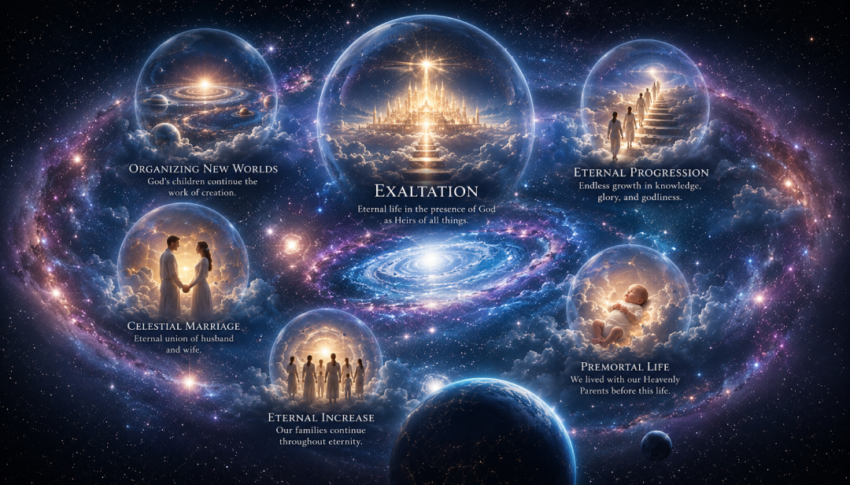
A Theological Examination of Eternal Progression,
Premortal Life, and the Eternal Presence of Heavenly Father
I. Two Promises, One Soul: The Knot at the Center
A faithful Latter-day Saint who has knelt at a sealing altar in a temple of the Church of Jesus Christ of Latter-day Saints has been given two promises that, on inspection, do not fit together. The first promise is that he and his wife — sealed by priesthood authority for time and all eternity — will go on, in the highest division of the celestial kingdom, to a state of glory called exaltation, in which they will become gods, organize new worlds, and beget spirit children of their own forever. The second promise is that this couple will dwell in that same celestial kingdom, in the very presence of Heavenly Father, never again to be separated from Him. The first promise hands the exalted pair an eternal vocation that, by its nature, requires them to be elsewhere — out among new worlds, organizing new earths, raising new spirit children. The second promise pictures them gathered eternally in the throne-room of the Father, from whose presence they were once separated by the veil of mortality. The LDS member is asked to hold both promises at once. He is asked to believe that he will become a god and that he will sit forever with the God who already is.
This essay examines that tension with the seriousness it deserves. It does not begin from the assumption that Latter-day Saints are insincere; many of them are among the most disciplined, family-oriented, charitable people in American religion, and they hold their faith with conviction. It does, however, proceed from the conviction that doctrine matters and that contradictions inside a doctrinal system are not impolite to name. If the system says A and the system says not-A, then the believer is being asked to live inside an unresolved knot. The most charitable thing an outside observer can do is to lay the strands of the knot side by side, in the words of the Church itself, and let the reader see what he is being asked to hold.
The doctrines under scrutiny here are central, not marginal. They are eternal progression, the teaching that man may become as God now is and that God Himself was once a man like us; celestial marriage and eternal increase, the teaching that exalted couples in the highest tier of the celestial kingdom will beget spirit offspring forever and organize worlds for them to dwell on; the three degrees of glory and the highest celestial tier, which simultaneously fixes the exalted family in the presence of Heavenly Father; and premortal life, the teaching that every human spirit existed as a literal child of heavenly parents before earthly birth, exercised a real moral choice in a council in heaven, and entered mortality with an unequal but earned starting line. These four doctrines do not stand alone. They prop each other up. Pull one out, and the others lean. Examine all four together, and the structural problem becomes visible.
My approach will be to let primary Latter-day Saint sources carry the argument. The Church’s own scripture — the Doctrine and Covenants, the Pearl of Great Price, the Book of Abraham — together with its own Gospel Topics essays and Gospel Principles manuals, will be quoted in full context. The teachings of Joseph Smith, Brigham Young, Lorenzo Snow, Joseph Fielding Smith, Spencer W. Kimball, Gordon B. Hinckley, and Russell M. Nelson will be presented in their own words. The Faithful apologetics of FAIR Latter-day Saints will be allowed to make their strongest case, and only then will the case be answered. Where I draw on evangelical and traditional Christian critiques, I will name the source — Mormonism Research Ministry, the Institute for Religious Research, the Christian Research Institute — and the reader can weigh the evidence for himself. My anchor throughout is 1 Peter 3:15: ready to give the reason for the hope I hold, with gentleness and respect.
What follows, then, is a long argument in nine movements. We will begin by laying out the architecture of LDS cosmology in the Church’s own terms, so that the reader knows exactly what is being claimed. We will examine the doctrine of eternal progression and trace its evolution from the Book of Mormon’s monotheism in 1830 to Joseph Smith’s King Follett Discourse in 1844 and beyond. We will then surface the first contradiction — between an endless chain of gods and the strict biblical monotheism the Bible itself proclaims — followed by the second contradiction, between exalted couples ruling their own celestial dominions and exalted couples dwelling eternally with the Father. We will consider how the Church’s 2014 Gospel Topics essay, “Becoming Like God,” attempts to soften this picture and why the softening does not, in the end, dissolve the knot. We will engage the FAIR Latter-day Saints defense of premortal existence directly, scripture by scripture, and we will surface the philosophical problems that even sympathetic Mormon writers admit. We will trace how these concepts have changed over time and ask whether ordinary Latter-day Saints themselves are confused about them — the evidence, from the Church’s own message boards and from LDS authors, is that they are. We will conclude by returning to the Bible and to historic Christian doctrine to ask what God Himself has revealed about the matter.
✦ ✦ ✦
II. The Architecture of Latter-day Saint Cosmology
Before any contradiction can be examined, the system itself must be in view. The shorthand version of Mormon cosmology that circulates on the Internet — “Mormons believe they get their own planet when they die” — is a caricature, and the Church has rightly objected to it. But the Church’s objection to the caricature has sometimes been mistaken for an objection to the substance, and that is not the case. The substance is robust, well-documented in canonized scripture, and openly taught in the standard curriculum. Let us see it in full.
The Plan of Salvation in Three Estates
Latter-day Saint theology divides the existence of every human soul into three estates. In the first estate, called the premortal life or the preexistence, every human spirit existed as a literal son or daughter of Heavenly Father and a Heavenly Mother. According to the Gospel Topics essay on “Becoming Like God,” published by the Church in 2014, Latter-day Saints understand “every person divine in origin, nature, and potential” and that “each person is ‘a beloved spirit son or daughter of heavenly parents.’” The Wikipedia summary of the canonical doctrine, drawing from Doctrine and Covenants and the Book of Abraham, states that in this premortal life “a Plan of Salvation was presented by God the Father (Elohim) with Jehovah (the premortal Jesus) championing moral agency,” and that Lucifer countered with a competing plan; when Lucifer’s plan was rejected, he led a third part of the host of heaven into rebellion and was cast out.
The second estate is mortality on this earth, in which the spirit child receives a physical body, passes through a “veil of forgetfulness” that erases conscious memory of the first estate, and must exercise free agency to choose between good and evil. As Gospel Principles, the Church’s standard curriculum manual, summarizes it: “In our premortal life we had moral agency. One purpose of earth life is to show what choices we will make.” Faithfulness in mortality, expressed through faith in Christ, repentance, baptism by proper priesthood authority, the gift of the Holy Ghost, and the keeping of temple covenants, qualifies the soul for the third estate, which is the resurrection and the final judgment.
After resurrection, every soul — except a small remnant called “sons of perdition” who are consigned to outer darkness — is assigned to one of three degrees of glory. The Doctrine and Covenants, in section 76, distinguishes the celestial kingdom (the highest), the terrestrial kingdom (a place for the morally upright who did not embrace the restored gospel), and the telestial kingdom (a place of glory exceeding mortal understanding but reserved for the wicked and unrepentant). It is within the celestial kingdom — and specifically within the highest of three further divisions inside that kingdom — that the doctrine of exaltation operates. Only those who have entered into the new and everlasting covenant of celestial marriage, sealed by priesthood authority in a temple, qualify for this highest tier.
Exaltation: What the Church Says It Is
If the structure above is the map, exaltation is the destination. The Church’s own definitions are remarkably direct. In its current edition of Gospel Principles (Chapter 47, on exaltation), the manual lists the blessings reserved for the exalted:
1. They will live eternally in the presence of Heavenly Father and Jesus Christ (see D&C 76:62). 2. They will become gods (see D&C 132:20–23). 3. They will be united eternally with their righteous family members and will be able to have eternal increase. 4. They will receive a fulness of joy. 5. They will have everything that our Heavenly Father and Jesus Christ have — all power, glory, dominion, and knowledge (see D&C 132:19–20).
— Gospel Principles (2009), Chapter 47, p. 277
The reader should pause on the five points together. They are presented as compatible. Point 1 places the exalted couple in the presence of Heavenly Father forever. Point 2 says they will become gods. Point 3 says they will have eternal increase — that is, an endless stream of spirit posterity. Point 5 says they will have, simply and without qualification, everything the Father and the Son have — all power, glory, dominion, and knowledge. The contradiction is not buried in obscure speculation. It is on the page of the standard curriculum manual the Church distributes to its members, side by side, in five plain bullets.
The Continuation of the Seeds
The mechanism by which exaltation occurs is celestial marriage. Doctrine and Covenants 132 — the revelation given to Joseph Smith on plural marriage in 1843 — is the foundational text. Verses 19 and 20 promise that those sealed by the new and everlasting covenant of marriage will inherit “all heights and depths.” The revelation continues:
Then shall they be gods, because they have no end; therefore shall they be from everlasting to everlasting, because they continue; then shall they be above all, because all things are subject unto them. Then shall they be gods, because they have all power, and the angels are subject unto them.
— Doctrine and Covenants 132:20
And in the same revelation, the promise of eternal increase — the promise of unending spirit posterity — is repeated under the language of “a continuation of the seeds forever and ever.” The Church’s Gospel Fundamentals manual, written in plain language for instruction worldwide, says of exalted persons: “They will receive everything our Father in Heaven has and will become like Him. They will even be able to have spirit children and make new worlds for them to live on, and do all the things our Father in Heaven has done.” That is the doctrine the Church itself teaches. The “planet” language may be a caricature; the substance — exalted beings making new worlds and populating them with spirit children — is not.
Bruce R. McConkie, one of the most influential apostolic theologians of the twentieth-century LDS Church, wrote in his widely circulated reference Mormon Doctrine that those who attain exaltation “inherit in due course the fulness of the glory of the Father, meaning that they have all power in heaven and on earth.” McConkie also wrote, with characteristic frankness, that polygamy will be reinstated in eternity, noting that “obviously the holy practice will commence again after the Second Coming of the Son of Man and the ushering in of the millennium.” The eternal increase doctrine, taken at full strength, has historically implied an eternal multiplicity of celestial wives, for one wife cannot bear an endless multitude of spirit children. The current Church has quieted that implication but has not repudiated it; D&C 132 remains canon.
✦ ✦ ✦
III. Eternal Progression: The Doctrine in Its Own Words
The doctrine that joins man’s exaltation to God’s exaltation — that makes the trajectory of the human soul not merely toward salvation but toward godhood — is called by Mormons eternal progression. It is the spine of the whole system. Without it, there is no path from mortal sinner to celestial creator. With it, there is no way to call Mormonism monotheistic without redefining the word. Let the doctrine speak in its own words first.
Lorenzo Snow’s Couplet
The classic summary, published and reaffirmed by the Church for more than a century, is the couplet formulated by Lorenzo Snow, the fifth President of the Church, in 1840:
As man now is, God once was; As God now is, man may be.
— Lorenzo Snow, repeated approvingly in Teachings of Presidents of the Church: George Albert Smith (2011), 71
Snow’s couplet is not a stray nineteenth-century enthusiasm that the modern Church has retired. As recently as 1994, Gordon B. Hinckley, then a counselor in the First Presidency and soon to be President of the Church, told a worldwide audience that the “whole design of the gospel is to lead us onward and upward to greater achievement, even, eventually, to godhood,” and he cited Snow’s couplet — quoting only its second line — as the “grand and incomparable concept” of that destiny. The couplet is reproduced in current curriculum materials and is endorsed as “acceptable and accepted doctrine” by the Church’s own magazine. Its first half (“As man now is, God once was”), the Church now teaches less loudly; its second half (“As God now is, man may be”) remains a centerpiece of the General Conference homiletic tradition.
The King Follett Discourse
The most extended statement of the doctrine came from Joseph Smith himself, on April 7, 1844, in what is remembered as the King Follett Discourse — preached at a general conference held in Nauvoo, Illinois, only three months before his death. The wind that day was strong, the transcription imperfect; four witnesses recorded the sermon in shorthand, and their accounts have been amalgamated. What Joseph said is nevertheless unmistakable:
God himself was once as we are now, and is an exalted man, and sits enthroned in yonder heavens! … I am going to tell you how God came to be God. We have imagined and supposed that God was God from all eternity. I will refute that idea … he was once a man like us; yea, that God himself, the Father of us all, dwelt on an earth, the same as Jesus Christ himself did … Here, then, is eternal life — to know the only wise and true God; and you have got to learn to be Gods yourselves, and to be kings and priests to God, the same as all Gods have done before you.
— Joseph Smith, King Follett Discourse, April 7, 1844 (Teachings of the Prophet Joseph Smith, 345–46)
Two sentences in that passage deserve to be lingered over. The first is, “I will refute that idea.” Joseph is not extending or harmonizing the historic Christian doctrine that God has been God from everlasting; he is, in his own words, refuting it. The second is, “the same as all Gods have done before you.” The phrase is plural, not generic. It implies a sequence of Gods — gods who have gone before, gods who will come after. Eleven weeks later, in the Sermon at the Grove of June 16, 1844, Joseph completed the thought: “Where was there ever a son without a father? And where was there ever a father without first being a son? … Hence, if Jesus had a Father, can we not believe that He had a Father also?” This is the chain. God the Father had a Father. That Father had a Father before him. The chain stretches backward without end.
Brigham Young, Joseph Fielding Smith, and B. H. Roberts
Joseph’s successors did not let the doctrine lapse. Brigham Young, in the Tabernacle on August 28, 1852, told his Saints:
After men have got their exaltations and their crowns — have become Gods, even the sons of God — are made Kings of kings and Lords of lords, they have the power then of propagating their species in spirit; and that is the first of their operations about organizing a world. Power is then given to them to organize the elements and then commence the organization of tabernacles.
— Brigham Young, August 28, 1852, Journal of Discourses 6:274–75
Joseph Fielding Smith, the tenth President of the Church, stated the inference openly: “Our Father in heaven, according to the Prophet, had a Father, and since there has been a condition of this kind through all eternity, each Father had a Father, until we come to a stop where we cannot go further, because of our limited capacity to understand.” And B. H. Roberts, one of the most respected systematic theologians the LDS Church ever produced, drew the diagram with unflinching clarity:
But if God the Father was not always God, but came to his present exalted position by degrees of progress as indicated in the teachings of the prophet, how has there been a God from all eternity? The answer is that there has been and there now exists an endless line of Gods, stretching back into the eternities, that had no beginning and will have no end. Their existence runs parallel with endless duration, and their dominions are as limitless as boundless space.
— B. H. Roberts, A New Witness for God (1895), 466
This is what eternal progression actually teaches. Not that there is one God who graciously shares His glory with adopted sons, but that “God” is a category, an open category, a status some have attained and others will. The God a Latter-day Saint worships is one in a series — preceded by His own Father, followed by His own faithful children, in an endless line of deities whose dominions tile the universe without limit. Whatever the modern public-relations smoothing of this teaching, it is the doctrine that has been preached from Joseph Smith forward, that is published in the canonical Doctrine and Covenants and the Book of Abraham, and that is summarized today in Gospel Topics essays on the Church’s official website.
✦ ✦ ✦
IV. The First Contradiction: An Endless Chain of Gods and the “Strict” Monotheism That Cannot Survive It
Latter-day Saints have long sought to defend themselves against the charge of polytheism. The defense is usually framed in technical terms borrowed from the academic study of religion: Mormons are not polytheists, the argument runs, but monolatrists or, more precisely, henotheists. They acknowledge the existence of many divine beings but reserve worship for only one — God the Father — together with the other members of the Godhead. The Wikipedia summary of LDS theology states the case directly: “While Mormonism accepts the existence of multiple, exalted beings, it is strictly a monolatristic (or henotheistic) practice. Members only worship and pray to the members of the Godhead.” The “Becoming Like God” essay puts a softer version of the same argument: “Latter-day Saints believe that God’s children will always worship Him. Our progression will never change His identity as our Father and our God.”
Let us grant the technical distinction. It is true that henotheism — worship of one god while acknowledging the existence of others — is not, in the dictionary sense, polytheism. But the technical distinction does not relieve Mormon theology of the deeper problem, which is not which god the Saints worship, but what the word God means in Mormon discourse. The historic Christian and Jewish use of the word God is not the name of a category that may contain many members; it is the proper name of a single, eternal, uncreated Being who alone has the attributes of deity. In Mormonism, by contrast, “God” is a status, a rank, a stage of progression. It is what a man becomes when he has been faithful enough, long enough. There is no logical limit to how many beings can attain that rank. And Joseph Smith, Brigham Young, Lorenzo Snow, Joseph Fielding Smith, and B. H. Roberts have all said — in their own words, quoted above — that an unbounded number have already attained it and that an unbounded number more will.
What Isaiah Says, Plainly
The biblical case against this picture is not a matter of fine theological argument. It is on the surface of the prophetic literature, repeated for emphasis. The God of Israel speaks through Isaiah:
Ye are my witnesses, saith the Lord, and my servant whom I have chosen: that ye may know and believe me, and understand that I am he: before me there was no God formed, neither shall there be after me.
— Isaiah 43:10, KJV
Thus saith the Lord the King of Israel, and his redeemer the Lord of hosts; I am the first, and I am the last; and beside me there is no God.
— Isaiah 44:6, KJV
I am the Lord, and there is none else, there is no God beside me: I girded thee, though thou hast not known me: that they may know from the rising of the sun, and from the west, that there is none beside me. I am the Lord, and there is none else.
— Isaiah 45:5–6, KJV
Isaiah 43:10 is a particularly sharp problem for the LDS doctrine of eternal progression. The verse denies both halves of Lorenzo Snow’s couplet at once: before God, no other God was formed (which contradicts the claim that the Father had a Father who was His God before Him); after God, no other God shall be formed (which contradicts the claim that faithful Mormons will be added to the category of God in the eternities). Joseph Smith’s 1844 doctrine and Isaiah’s eighth-century doctrine cannot both stand. They are not partial views of the same truth; they are mutually exclusive claims about whether the word God denotes a unique eternal Being or an open-ended rank.
The Psalmist makes the same point in a different language. “Before the mountains were brought forth, or ever thou hadst formed the earth and the world, even from everlasting to everlasting, thou art God” (Psalm 90:2). The text says “thou art,” not “thou hadst become.” The God of Israel did not progress into godhood; He has been God from everlasting. Malachi 3:6 closes the seam: “I am the Lord, I change not.” Mormonism’s God — the God who was once a man and progressed to His exaltation — is not the God of Malachi. He could not be. The God of Malachi does not progress.
The Infinite Regress Problem
There is also a strictly logical problem with the chain of gods that eternal progression posits. The chain has no beginning. Each Father was once a son who became a God; his Father was once a son who became a God; his Father was once a son who became a God; and so on without end. Logicians call this an infinite regress, and it carries a familiar difficulty: no member of the chain can supply the explanation for the chain’s existence. Every alleged God in the series is, on this account, a derived being — derived from a prior God who was Himself derived from a prior God before Him. The series, if taken seriously, contains no necessary Being at all. It is contingent beings all the way down — or rather, all the way up. The traditional Judeo-Christian doctrine that one absolutely eternal, uncreated Being is the ground of all reality is replaced by a sequence in which no member is the ground of anything.
B. H. Roberts was honest about this. He simply asserted that the line of Gods “runs parallel with endless duration” and let the regress stand. Joseph Fielding Smith, in Doctrines of Salvation, confessed that the chain proceeds “until we come to a stop where we cannot go further, because of our limited capacity to understand” — which is to say, the chain has no stopping point that the human mind can locate, but a stopping point is required for explanation, and Mormon theology does not supply it. The Bible’s solution — that the chain stops at a single eternal God who is, by definition, uncaused and self-existent — is the solution the historic creeds preserved. Mormonism rejects that solution and offers no replacement that can do the same explanatory work.
Robert L. Millet’s Defense
LDS scholar Robert L. Millet, formerly Dean of Religious Education at Brigham Young University, has spent much of his career attempting to soften the polytheistic edge of eternal progression by arguing that the doctrine of theosis — the deification of believers — is itself an ancient Christian teaching shared by the Eastern Orthodox churches and by certain Church Fathers. The Church’s own “Becoming Like God” essay reproduces this argument at length, quoting Irenaeus (“through His transcendent love, become what we are, that He might bring us to be what He is Himself”), Clement of Alexandria (“the Word of God became man, that thou mayest learn from man how man may become God”), and Basil the Great (“not just being made like to God, but … the being made God”).
The argument has a surface plausibility, but a careful reading of the patristic sources collapses it. The Greek Fathers who spoke of theosis understood the deification of the saint as a participation in the divine nature by grace, not the elevation of a created being to ontological equality with the uncreated God. Athanasius’s famous formula, “God became man so that man might become God,” is paired with his equally famous insistence in On the Incarnation that the Son alone is homoousios — of one substance — with the Father, and that no creature can become God in that sense. Pseudo-Dionysius is even more explicit: “Deification is the attaining of likeness to God and union with him so far as is possible.” The qualifier matters. The Fathers preserved the Creator-creature distinction; the saint is glorified, but is not added to the category of God. He participates in the divine life; he does not become a member of a pantheon.
Mormon eternal progression does precisely the opposite. It abolishes the Creator-creature distinction. Joseph Smith, in the King Follett Discourse, attacked that distinction explicitly: “The mind or the intelligence which man possesses is co-equal with God himself.” If man’s intelligence is co-equal with God’s, then man is not a creature in the historic sense; he is, ontologically, of the same order as God. The patristic doctrine of theosis is a doctrine of grace within a Creator-creature distinction; the Mormon doctrine of exaltation is a doctrine of progression across the Creator-creature distinction. They are not the same teaching. To present them as continuous is to flatten the very category that the Fathers were most careful to defend.
✦ ✦ ✦
V. The Second Contradiction: Two Eternities at Once
Now we come to the doctrinal knot that gives this essay its title. Set aside, for a moment, the question of how many Gods Mormonism countenances. Confine the question to the destiny of the exalted Latter-day Saint himself. The Church teaches, on the same page of the same manual, that he will dwell forever in the presence of Heavenly Father and that he will become a god, organize new worlds, and beget spirit children of his own. Both promises are presented as gifts of celestial marriage. Both are promised to the same temple-sealed couple in the same eternity. The question is whether they can both be true at once.
The Mechanics of Eternal Increase
The Church’s Gospel Principles manual states that exalted persons “will be reunited eternally with their righteous family members and will be able to have eternal increase.” The phrase “eternal increase” is a term of art in LDS theology and is unpacked in the manual Teachings of Presidents of the Church: Joseph Fielding Smith (2013):
Those who receive the exaltation in the celestial kingdom will have the “continuation of the seeds forever.” They will live in a family relationship. We are taught in the gospel of Jesus Christ that the family organization will be, so far as celestial exaltation is concerned, one that is complete, an organization linked from father and mother and children of one generation to the father and mother and children of the next generation, and thus expanding and spreading out down to the end of time.
— Teachings of Presidents of the Church: Joseph Fielding Smith (2013), p. 68
The 1976 priesthood manual, Achieving a Celestial Marriage, makes the mechanics explicit: “By definition, exaltation includes the ability to procreate the family unit throughout eternity. This our Father in heaven has power to do. His marriage partner is our mother in heaven. We are their spirit children, born to them in the bonds of celestial marriage.” In the same manual, the bracing sentence: “Consider this fact: Your marriage is a laboratory for godhood.” The vocabulary may have softened since 1976, but the doctrine is intact. Brigham Young described the same destiny in 1876: “Then will they become gods, even the sons of God; then will they become eternal fathers, eternal mothers, eternal sons and eternal daughters; being eternal in their organization, they go from glory to glory, from power to power; they will never cease to increase and to multiply, worlds without end. When they receive their crowns, their dominions, they then will be prepared to frame earths like unto ours and to people them in the same manner as we have been brought forth by our parents, by our Father and God.”
Two things are clear. The first is that exaltation, in its classical and still-canonical sense, requires the exalted couple to act as Heavenly Father has acted: to organize earths and people them with their own spirit children. The second is that this is not a one-time event but an endlessly expanding work — “worlds without end,” in Young’s phrase. The eternity of an exalted Latter-day Saint is filled with the work of being a god to his own posterity, on his own organized earth or earths, governing his own spirit children, just as Heavenly Father governs his.
Living Eternally in the Presence of Heavenly Father
Now place the second promise next to the first. Gospel Principles Chapter 47 also says: “They will live eternally in the presence of Heavenly Father and Jesus Christ.” Doctrine and Covenants 76:62, cited as the proof-text, says of the celestial residents that “these shall dwell in the presence of God and his Christ forever and ever.” The official Gospel Topics page on “Kingdoms of Glory” reaffirms this: the celestial kingdom is the dwelling place “in the presence of God the Father and His Son, Jesus Christ.” The blessing of the highest celestial tier is, precisely, never to be separated from the Father again.
There is no obvious way to hold both pictures. If the exalted Saint is to be a god of his own world, populating it with his own spirit children, then he is — in the obvious sense — not in the same place as Heavenly Father. Heavenly Father is busy being God of this creation. The exalted Saint is busy being a god of his. If, on the other hand, the exalted Saint is to spend eternity in Heavenly Father’s presence, then he is precisely not off organizing his own dominion. The two vocations are spatially and functionally exclusive. A father in his own household at noon cannot simultaneously be a guest in his neighbor’s parlor. A king on his own throne cannot simultaneously be a courtier in another king’s hall. The LDS theology of exaltation asks the believer to be both at once, perpetually, with no account given of how the two states are to be reconciled.
The “Multiverse” Speculation and Its Limits
Some LDS theologians have sensed the difficulty and tried to dissolve it speculatively. The Dialogue Journal essay by Kirk D. Hagen, “Eternal Progression in a Multiverse,” floats the possibility that Mormon cosmology implies a multiverse — that the “worlds” of the exalted are spatially or dimensionally distinct from the world of Heavenly Father, that the Saint may be “with” the Father in some non-physical or co-spatial sense even while ruling his own creation. This proposal has the merit of taking the problem seriously, but it does not survive examination. First, it has no anchor in canonical LDS scripture; it is a private speculation by an LDS academic working in the pages of a Mormon studies journal. Second, the doctrine of the resurrection in LDS theology insists on physical, embodied being — Heavenly Father is described in D&C 130:22 as having “a body of flesh and bones as tangible as man’s,” and the exalted are described as receiving glorified physical bodies as well. Embodied beings occupy space. A multiverse of physically separated dominions does not resolve the tension; it relocates it. The exalted Saint is still either in the throne-room of his Father or out organizing his own earth, and he cannot be both.
Third — and this is decisive — the language of the canonical texts is concrete, not metaphysical. D&C 132:20 says of the exalted, “then shall they be from everlasting to everlasting, because they continue; then shall they be above all, because all things are subject unto them.” The exalted Saint is not pictured as a perpetual guest at Heavenly Father’s table; he is pictured as a sovereign in his own right, with all things subject to him. The same revelation that authorizes celestial marriage authorizes celestial sovereignty. The text is not a metaphor. It is a charter for autonomous deification. To soften it into a multiverse of harmonious co-presence is to read the text against its plain sense to rescue it from a contradiction that the text itself created.
The Standard Apologetic Answer — and Why It Fails
LDS apologists faced with this contradiction will sometimes answer that the exalted Saint shares in Heavenly Father’s work — that the two are not competitors but collaborators. The Saint becomes “a co-worker with God,” as certain devotional manuals put it, organizing and governing under the Father’s direction. This is the Becoming Like God essay’s preferred framing: the exalted are not lone rulers of isolated fiefdoms but “stewards or administrators under the ultimate authority of God.”
The framing has rhetorical appeal but cannot bear the weight of the doctrine. D&C 132:20 promises the exalted all power, and that all things are subject unto them. McConkie’s Mormon Doctrine puts it this way: those who attain exaltation “inherit in due course the fulness of the glory of the Father, meaning that they have all power in heaven and on earth.” A being who has all power and to whom all things are subject is not a steward. A steward, by definition, is a subordinate manager exercising delegated power. The texts do not describe delegation. They describe inheritance — “all that the Father hath.” The “Becoming Like God” essay reads back into the doctrine a model of subordination that neither the canonical scripture nor the great LDS theologians of the past explicitly supported. Brigham Young: “Power is then given to them to organize the elements, and then commence the organization of tabernacles.” Lorenzo Snow: exalted men will “organize matter into worlds on which their posterity may dwell, and over which they shall rule as gods.” “Rule as gods” is not the language of stewardship.
So the standard apologetic answer fails not because it is dishonest — it is offered in good faith by Saints who hope to resolve the tension — but because it cannot reconcile the texts. The exalted Saint is either a god in his own right, with his own dominion, or he is a permanent subordinate in the Heavenly Father’s. He cannot be both. And if he is the former, he is not eternally in the presence of Heavenly Father in any meaningful sense; he is in his own world. If he is the latter, he is not a god in the sense the doctrine has historically promised; he is a steward. Eternal increase plus eternal presence is, on close inspection, two eternities asked of one soul, and the Latter-day Saint is asked to hold them both without ever being told how they fit together.
✦ ✦ ✦
VI. The 2014 Reframing: How the Church Has Softened the Doctrine Without Repudiating It
The Latter-day Saint Church does not stand still. Over the last three decades, the way the doctrine of exaltation is presented in official materials has shifted — not in substance, but in emphasis, vocabulary, and silence. The most consequential single document in that shift is the Gospel Topics essay titled “Becoming Like God,” published anonymously on the Church’s website in February 2014 and widely understood to have been vetted by the First Presidency. It deserves a careful reading, because it is the Church’s own attempt to address the very tension this essay has been describing — and because its strategy reveals how far the contemporary Church is willing to go in defending the classical doctrine and where it begins to flinch.
What the Essay Concedes and What It Quietly Drops
The essay is structured around seven questions and is, at one level, an able piece of theological communication. It does not deny the classical doctrine. It quotes Lorenzo Snow’s couplet. It cites the King Follett Discourse. It acknowledges that “the doctrine that humans can progress to exaltation and godliness has been taught within the Church.” It accepts that exaltation involves “becoming like God” in some robust sense. The 2014 essay does not — and could not, without a formal repudiation of canonized scripture — back away from the basic doctrine. D&C 132:20 still reads, “then shall they be gods.” That sentence is not going anywhere.
What the essay does do is reorient the reader’s imagination. It deflects the “own planet” caricature popularized by the Broadway musical The Book of Mormon by reframing exaltation as a matter of relationships rather than real estate. “Church members imagine exaltation less through images of what they will get and more through the relationships they have now and how those relationships might be purified and elevated.” It quotes Eliza R. Snow on Heavenly Mother. It emphasizes that the destiny of the exalted will preserve, not abolish, the worshipful relationship with Heavenly Father. And it leans heavily on the patristic doctrine of theosis to suggest that LDS exaltation belongs to a broader Christian tradition rather than departing from it. The argumentative goal of the essay is, transparently, to make Mormon exaltation seem less strange to outsiders and less troubling to insiders.
The Institute for Religious Research, in a carefully documented study by Robert M. Bowman Jr., has tracked the parallel softening in the Gospel Principles manual itself. The differences between the 1978, 1997, and 2009 editions are subtle but consequential. The 1978 edition stated plainly that exalted persons “will have their righteous family members with them and will be able to have spirit children also. These spirit children will have the same relationship to them as we do to our Heavenly Father.” The 2009 edition replaces that with the ambiguous “will be reunited eternally with their righteous family members and will be able to have eternal increase.” The phrase “spirit children” is gone; “eternal increase” takes its place. The implication that future exalted Saints will be worshipped by their own spirit posterity in the same way Heavenly Father is now worshipped — an implication explicit in the 1978 manual — is quietly withdrawn from the 2009 manual. Doctrine has not been repudiated; it has been made less easily visible.
The same pattern shows up in another sentence. The 1978 edition: “We can become Gods like our Heavenly Father.” The 1997 and 2009 editions: “We can become like our Heavenly Father.” The word Gods — the word that carries the whole weight of the doctrine — has been deleted. The new sentence is technically compatible with the old; “becoming like our Heavenly Father” is what the original sentence meant. But the new sentence is also compatible with much milder readings, and the Saint reading the manual today is no longer obliged to confront the bare claim that he will become a God. The doctrinal mountain is still there, but the path now winds around it instead of climbing over.
Gordon B. Hinckley’s Famous Demurral
The most striking instance of public softening came from the lips of President Gordon B. Hinckley himself in 1997, in a Time magazine interview with David Van Biema. Asked whether the Church still taught that God the Father was once a man, Hinckley answered: “I don’t know that we teach it. I don’t know that we emphasize it. I haven’t heard it discussed for a long time in public discourse.” He gave a similar answer to Don Lattin of the San Francisco Chronicle the same year: “That gets into some pretty deep theology that we don’t know very much about.”
Hinckley’s words were, to put it gently, difficult to credit. The doctrine in question — that God the Father was once a mortal man — is taught in canonized scripture (the necessary inference from D&C 130:22 and D&C 132 read together with Joseph Smith’s later sermons), is the foundation of Lorenzo Snow’s couplet that Hinckley himself had quoted from the pulpit only three years earlier, and is taught in every edition of Gospel Principles that had been in circulation during Hinckley’s presidency. To say that the Church does not teach the doctrine, or does not emphasize it, or that he has not heard it discussed for a long time, was simply incorrect — and Hinckley, the President of the Church and a man who had been an apostle for thirty-six years before assuming the presidency, knew it. The Institute for Religious Research published a documented response, Dodging and Dissembling Prophet?, chronicling the exchange and the Church’s reluctance to issue any clarification. The most charitable reading is that Hinckley was speaking pastorally and trying to reassure non-Mormon listeners. The less charitable reading is that he was hoping the doctrine would quietly recede. Either way, his words illustrate the strategy: do not repudiate, but do not advertise.
It is worth recording that the late researcher Sandra Tanner of Utah Lighthouse Ministry, who, together with her husband Jerald, devoted half a century to documenting the sources of Mormon doctrine, repeatedly observed that the public-relations strategy of the modern Church has consistently been one of gentle erosion — letting the more difficult doctrines fade from active teaching without ever formally retracting them. Sandra Tanner remains active at Utah Lighthouse Ministry, and her published research on this point is voluminous; the Tanners’ Mormonism: Shadow or Reality? remains the standard documentary collection. The pattern Tanner identified — the doctrine remains, but the emphasis recedes — fits the Hinckley demurral and the Gospel Principles redactions exactly.
✦ ✦ ✦
VII. The “Cartoonish” Argument Examined
The most public defense the Church has mounted against the planet-in-the-afterlife criticism appears in the same 2014 essay. The argument is essentially this: the popular image of receiving “your own planet” is a caricature, reducing a profound spiritual reality to a piece of real estate. The Saints do not believe they will receive planets in any vulgar literal sense; rather, they imagine exaltation through “the joy of bearing and nurturing children,” “the impulse to reach out in compassionate service to others,” and “the moments they are caught off guard by the beauty and order of the universe.” Sojourners summarized the Church’s position fairly: “While few Latter-day Saints would identify with caricatures of having their own planet, most would agree that the awe inspired by creation hints at our creative potential in the eternities.”
This is, again, a strategically able move. It is true that the Broadway musical The Book of Mormon’s song “I Believe” — with its cheerful refrain that “God has a plan for all of us … I believe that plan involves me getting my own planet” — flattens the doctrine into a punchline. It is also true that the language of “your own planet” suggests something proprietary, like a real-estate deed, when the LDS teaching is closer to a vocation — the calling of a god to create and govern a world. The Church is well within its rights to object to the caricature.
But the Substance Remains
The objection to the caricature, however, must not be confused with an objection to the doctrine. The Church’s Gospel Fundamentals manual, the elementary-language doctrinal manual translated and distributed worldwide for the Church’s developing-nation membership, states plainly: “They will receive everything our Father in Heaven has and will become like Him. They will even be able to have spirit children and make new worlds for them to live on, and do all the things our Father in Heaven has done.” That sentence is not a caricature; it is the curriculum. Apostle Joseph Fielding Smith taught the same in Doctrines of Salvation: exalted couples will engage in “a continuation of the seeds forever” and will have “spirit children” of their own. Brigham Young’s August 1852 sermon, quoted earlier, leaves no doubt: the exalted “have the power then of propagating their species in spirit … Power is then given to them to organize the elements, and then commence the organization of tabernacles.” That is, in plain English, organizing worlds and populating them with spirit offspring.
So when the Church protests that Mormons do not believe they will “get their own planet,” the qualifier hides almost nothing of substance. What the Church is denying is the cartoon — that a Saint will be handed a Saturn-like sphere with rings as a piece of personal property. What the Church is not denying — and indeed continues to teach — is that exalted couples will organize worlds (plural, in Brigham Young’s language) and populate them with their own spirit children, just as Heavenly Father has done. The cartoon is wrong about the mechanism (one is not handed a planet) and wrong about the proprietary attitude (one does not own a planet as private property), but the cartoon is correct in its essential claim: faithful Latter-day Saints, attaining exaltation, will become gods of worlds they organize and govern, populated by spirit children they beget. That is the doctrine. To object to the cartoon while continuing to teach the substance is a perfectly defensible communications strategy, but it does not change the underlying contradiction that this essay has been documenting.
FAIR’s Defense of the “Gods of Their Own Planets” Charge
FAIR Latter-day Saints — the principal LDS apologetics organization, currently styled the Foundation for Apologetic Information and Research — addresses the “gods of their own planets” charge on its public answers wiki. Its handling of the question is instructive. The page leans almost entirely on the 2014 “Becoming Like God” essay, reproducing the “cartoonish image” language and emphasizing the relational, family-centered framing of exaltation. What FAIR does not do is engage with the explicit doctrinal claims of Brigham Young’s August 1852 sermon, or with the Gospel Fundamentals manual currently in print, or with McConkie’s Mormon Doctrine, or with the canonical D&C 132:20. The defense is conducted at the level of caricature management, not doctrinal exposition. The reader is left with the impression that the criticism rests on a misunderstanding, when in fact the criticism rests on the Church’s own published teachings.
This is not unique to FAIR. It is the general posture of contemporary LDS apologetics on this question: the doctrine is reframed in the gentlest possible language, the sources are not engaged, and the burden of proof is rhetorically shifted onto the critic to specify what, precisely, he objects to. When the critic cites the sources, he is told he is reading them uncharitably. When he asks how the sources can be harmonized with the gentler reframing, he is told that the matter is beyond mortal comprehension and that the Lord will reveal it in the eternities. The result is a defense that is not, strictly, an argument. It is a posture of deflection. It is sustainable because most members never go back to the sources, and most outside critics are content to mock the caricature without examining the actual texts. But it is not, by the standards of theological argument, a defense at all.
✦ ✦ ✦
VIII. Premortal Life: The Doctrine Examined and the FAIR Defense Answered
If exaltation is the upper terminus of the LDS arc of the soul, premortal life is the lower. Latter-day Saints teach that every human spirit existed, before earthly birth, as a literal son or daughter of Heavenly Parents in a first estate. The Ensign magazine has stated bluntly that “of all the major Christian churches, only The Church of Jesus Christ of Latter-day Saints teaches that the human race lived in a premortal existence with God the Father and His Son, Jesus Christ.” Dieter F. Uchtdorf, then a member of the First Presidency, told a General Conference audience in 2013: “Back in that first estate, you knew with absolute certainty that God existed because you saw and heard Him. You knew Jesus Christ … You had faith in Him.” He continued, three years later: “We have always existed. We are the literal spirit children of divine, immortal, and omnipotent Heavenly Parents! We come from the heavenly courts of the Lord our God.”
The doctrine is striking, theologically consequential, and — this is the key point — biblically unsupported. The Bible does not teach a premortal existence of human souls. It teaches the opposite: that human beings, soul and body together, were made by God at a moment in time, in this world. The Mormon claim that the doctrine is found in Scripture rests on a handful of proof-texts read against their contextual grain. The FAIR Latter-day Saints apologetics wiki has assembled the strongest available case for the biblical roots of premortal life, focusing on four passages: Jeremiah 1:5, Job 38:4–7, Ecclesiastes 12:7, and John 9:1–3. Each deserves a direct response.
Jeremiah 1:5 — What “I Knew Thee” Actually Means
FAIR’s lead text is Jeremiah 1:5: “Before I formed thee in the belly I knew thee; and before thou camest forth out of the womb I sanctified thee, and I ordained thee a prophet unto the nations.” FAIR’s argument runs as follows: the words knew, sanctified, and ordained imply Jeremiah’s actual personal presence before his earthly conception, because sanctification and ordination are not merely mental exercises but events that require a participant. Therefore, FAIR concludes, Jeremiah pre-existed, and what is true of Jeremiah is true of every human soul.
The argument fails at the level of basic biblical interpretation. First, the verse describes God’s action toward Jeremiah, not Jeremiah’s existence before that action. The grammatical subject of all three verbs — knew, sanctified, ordained — is God; the direct object in each case is Jeremiah. The verse tells us what God did and decided regarding Jeremiah before Jeremiah’s earthly formation. It does not tell us where Jeremiah was while those decisions were made. The verse is silent on Jeremiah’s prior location, presence, or existence. To infer pre-existence from this verse is to read into the text a category — Jeremiah’s prior personhood — that the text neither affirms nor requires.
Second, the doctrine of God’s foreknowledge — that God knows the end from the beginning, including persons who do not yet exist — is not recent or controversial. It is in Isaiah 46:10 (“declaring the end from the beginning, and from ancient times the things that are not yet done”), in Psalm 139:16 (“thine eyes did see my substance, yet being unperfect; and in thy book all my members were written, which in continuance were fashioned, when as yet there was none of them”), in Ephesians 1:4 (“chosen us in him before the foundation of the world”). In every one of those passages, God’s foreknowledge of a person or event does not require the person or event already to exist. God can “know” Jeremiah by knowing whom He will form. He can “sanctify” Jeremiah for prophetic office by setting him apart in His own decree before forming him in the womb. He can “ordain” Jeremiah by appointing him to that office in advance of his existence. The doctrine of divine sovereignty allows for — indeed requires — exactly this. FAIR’s argument depends on the unstated and indefensible premise that knowing, sanctifying, and ordaining presuppose the existence of the object. That premise applies to creatures who cannot know, sanctify, or ordain what does not yet exist. It does not apply to the omniscient God of Israel, who knew His prophet before His prophet was.
Third — and this is the deepest point — Psalm 139:13–16 directly contradicts the premortal reading of Jeremiah 1:5. David there confesses to God: “For thou hast possessed my reins: thou hast covered me in my mother’s womb. I will praise thee; for I am fearfully and wonderfully made … My substance was not hid from thee, when I was made in secret, and curiously wrought in the lowest parts of the earth.” The Psalmist locates his own formation in the womb and “in the lowest parts of the earth” — that is, on the material plane — not in a pre-mortal council in heaven. Zechariah 12:1 makes the same point: it is God “that formeth the spirit of man within him.” Within him. Not in heaven before him. The spirit of man, on the biblical witness, is formed in the act of human conception and birth, not awakened from a prior celestial existence.
Job 38:4–7 — The Sons of God Are Not Job
FAIR’s second proof-text is the Lord’s rebuke of Job in chapter 38: “Where wast thou when I laid the foundations of the earth? declare, if thou hast understanding … When the morning stars sang together, and all the sons of God shouted for joy?” FAIR argues that the question “Where wast thou?” by its nature presupposes that Job was somewhere; therefore, Job must have existed before the foundations of the earth were laid, and the “sons of God” who shouted for joy at the creation are identified with the pre-mortal spirits of humanity, including Job.
This too misreads the text at the most basic level. The Lord’s question is rhetorical, in the tradition of Hebrew wisdom literature: it is an ironic question, designed to puncture Job’s presumption by emphasizing that Job was not there. The whole tenor of Job 38, read straight through, is the magnification of God’s transcendence and the corresponding diminishment of human pretension. “Hast thou commanded the morning since thy days?” (38:12) “Hast thou entered into the springs of the sea?” (38:16) “Hast thou perceived the breadth of the earth?” (38:18) The pattern is plain: Job has done none of these things, knows none of these things, was not there for any of these things. To read the “Where wast thou?” of verse 4 as implying that Job was somewhere is to misread the rhetorical mode of the entire chapter.
As for the “sons of God” in verse 7 — these are, in the consistent biblical usage of Job’s day, angelic beings, not pre-mortal human spirits. The same phrase, bene Elohim, appears in Job 1:6 and 2:1, where it manifestly refers to the heavenly host that presents itself before God; Satan appears “among them.” Genesis 6:2 and Genesis 6:4 use the phrase the same way. The “sons of God” who shouted for joy at the creation are angels — beings created by God to inhabit the heavenly courts. They are not, on any sober reading of the Hebrew, pre-mortal humans. FAIR’s interpretation collapses an established Hebrew technical phrase into the LDS doctrine of premortality, without explanation and against the consistent usage of the rest of the Bible. As the LDS scholar Charles R. Harrell, no Christian polemicist but a BYU religion professor, has observed: “There is no indication that Job was numbered among them.” The verse identifies the witnesses to creation as angelic beings. It does not identify the witnesses as the souls of unborn humans.
Ecclesiastes 12:7 — The Round Trip That Isn’t
The third proof-text: Ecclesiastes 12:7. “Then shall the dust return to the earth as it was: and the spirit shall return unto God who gave it.” FAIR argues that the verb return implies a prior journey — that the spirit cannot return to a place it has not been. Therefore, the spirit must have come from God in a pre-mortal sense, and at death it returns to its prior home.
This is the most easily answered of FAIR’s proof-texts because the parallelism in the verse refutes it. Two clauses are placed side by side: the dust returns to the earth, the spirit returns to God. The first clause does not mean that the body literally pre-existed in some earlier earthen form; it means that the body, made of earth, goes back to the earth at death. The second clause, in parallel, does not mean that the spirit literally pre-existed in some prior celestial form; it means that the spirit, given by God, returns to its Giver at death. The verb return in Hebrew, shuv, carries a wide semantic range that includes “to go (back) to,” “to be restored to,” “to be reunited with” — it does not entail prior physical co-location. The Preacher’s whole point in Ecclesiastes 12 is the dissolution of the body and the destination of the spirit at the close of life, not the origin of either before life began. To force the verse into a Mormon round-trip cosmology is to read into Hebrew wisdom literature a metaphysical schema that did not exist in Israel and that the Preacher would not have recognized.
John 9:1–3 — Jesus Did Not Affirm Premortal Sin
FAIR’s fourth and final proof-text is the disciples’ question in John 9: “Master, who did sin, this man, or his parents, that he was born blind?” FAIR’s argument has a certain rhetorical bite: the disciples ask whether the man’s blindness was caused by his own sin, even though he was born blind, and that question presupposes that he could have sinned before his birth. Jesus does not contradict the presupposition; therefore, FAIR concludes, Jesus tacitly endorsed the doctrine of premortal moral agency.
This argument confuses what Jesus did not say with what He affirmed. Jesus’ answer in John 9:3 is direct: “Neither hath this man sinned, nor his parents: but that the works of God should be made manifest in him.” He declines the dichotomy that the disciples have offered. He does not lecture them on the foolishness of one half of it. He simply gives the actual reason. That is not the same thing as endorsing the disciples’ theological premise. Jesus regularly declined to correct false framings of His interlocutors’ questions in the moment, preferring to redirect them; that is a feature of His teaching style throughout the Gospels (cf. Matthew 19:3–9, where He declines the dichotomy posed by the Pharisees and redirects to the original creation order).
Moreover, first-century Judaism was familiar with several speculative ideas about prenatal moral states — ideas that did not require a formal doctrine of preexistence. The Talmudic tradition records discussions of whether a fetus could sin in the womb (citing Esau’s struggle with Jacob in Rebekah’s womb in Genesis 25:22 as a possible case). The disciples’ question may reflect that strand of speculative rabbinic exegesis, not a settled doctrine of preexistence at all. Even if it did reflect such a doctrine — which is unclear — Jesus’ silence in not formally rebuking the disciples is not equivalent to His teaching the doctrine. The Lord cannot be made to teach by silence what He never affirmed by word.
And the affirmative biblical evidence runs the other direction. Genesis 2:7 — “the Lord God formed man of the dust of the ground, and breathed into his nostrils the breath of life; and man became a living soul” — describes the origin of the human soul, in the person of Adam, at a definite moment, on this earth. There is no prior celestial gestation; the soul comes into being in the act of God’s breathing the breath of life into the dust. The Mormon system requires that human spirits existed long before Adam, as literal sons and daughters of Heavenly Father and Heavenly Mother in a pre-mortal council. The Genesis account excludes that possibility. Zechariah 12:1 — “the Lord, which stretcheth forth the heavens, and layeth the foundation of the earth, and formeth the spirit of man within him” — places the formation of the human spirit within the man, not in a heavenly court before the man. The biblical pattern is consistent: souls do not have careers before their bodies; they are made with their bodies, by God, in this world.
The Logical Burdens of Premortality
Apart from the biblical case, the LDS doctrine of premortal life carries logical burdens that even sympathetic Mormon writers acknowledge. Charles R. Harrell, in his important BYU-published “This is My Doctrine”, notes that the doctrine of preexistence “was not a teaching during the first few years of the LDS Church’s existence,” that biblical passages now used to support it “were interpreted differently when cited by the Saints during the first decade of the Church,” and that the doctrine “does not appear in the scriptural or other writings and recorded sermons of Joseph Smith” until the mid-1830s. Premortality is, on the historical record, a doctrine that emerged within the Latter-day Saint movement gradually, not one that arrived as a primitive datum of the Restoration.
The philosophical difficulties of the doctrine are well canvassed in the LDS literature itself, and they amount to four substantial objections. First, the problem of accountability without memory: the Saints are told that conditions of mortal life — birth into a Mormon family or a Hindu one, into prosperity or poverty, with full mental health or with grave cognitive disability — were partly determined by the choices the spirit made in the preexistence. But the veil of forgetfulness ensures that no living person has any conscious memory of those choices. To be judged for actions one cannot remember is, by every standard of natural justice, an injustice. The Bible does not teach this; it teaches that men will be judged for what they have done in this body (2 Corinthians 5:10), not for choices in a forgotten prior life.
Second, the problem of unequal starting points. If conditions of mortal life reflect premortal performance, then those born into difficult circumstances were less faithful in the preexistence, and those born into easier circumstances were more faithful. This has, historically, generated some of the more unfortunate teachings in the LDS tradition — notably the explanation of the denial of priesthood to black men until 1978 in terms of premortal “less valiance,” a teaching the Church has since formally repudiated in its “Race and the Priesthood” essay but whose echoes remain in the underlying logic of the doctrine. A theology that links earthly station to premortal merit is, structurally, a theology of celestial caste.
Third, the problem of redundancy. If spirits exercised moral agency in the preexistence — choosing between the Father’s plan and Lucifer’s — and demonstrated the quality of their character in that prior estate, then what is the function of the mortal test? It cannot be to establish their moral character, because that has already been established. It can at most be to display what is already settled. But if the result is already settled, then the test is not a real test; it is theater. The Mormon doctrine of the second estate as a “probation” presupposes that the choices made here are the decisive ones, but the doctrine of the first estate insists that decisive choices were already made there. Both cannot be true at full strength.
Fourth, the problem of infinite regress. The LDS doctrine that human spirits are the literal offspring of Heavenly Parents, who were themselves once mortal and progressed to godhood under their Heavenly Parents, and so on into an unbounded past, is the same infinite regress that the doctrine of eternal progression carries. It provides no ultimate explanation for the origin of consciousness, of divinity, or of anything else; it merely pushes the question of origins infinitely far backward. The Bible’s solution — that one uncreated, eternal God is the source of all that exists — is rejected without replacement. The believer is asked to accept an endless chain of contingent beings as the metaphysical foundation of reality.
✦ ✦ ✦
IX. Children of God, Perfect in Premortality — But Judged After Mortality?
There is a particular tension inside the LDS doctrine of premortal life that deserves its own treatment, because the Latter-day Saint himself may feel it most acutely. The Church teaches that every spirit that was born into this earth was “valiant” in the preexistence. Dieter F. Uchtdorf, in his 2013 General Conference address, was unambiguous: “Nevertheless, everyone you see around you — in this meeting or at any other place, today or at any other time — was valiant in the premortal world. That unassuming and ordinary-looking person sitting next to you may have been one of the great figures you loved and admired in the sphere of spirits.” Robert D. Hales added, “Only those who accepted Jesus to be their Savior can have bodies of flesh and bones. We know, because we have bodies of flesh and bones, that we accepted Jesus to be our Savior. We chose the right things in heaven.”
Put those statements together. Every person now born — every person with a body of flesh and bones — was, in his first estate, faithful enough to accept the Father’s plan, valiant enough not to be cast out with Lucifer, and worthy enough to receive a mortal probation. The Saints have already been morally vetted before birth. They have already chosen the right side. They have already, in the words of the curriculum, “chosen the right things in heaven.”
Why, then, the rigor of the second estate? Why a veil of forgetfulness, a sin-prone fallen world, a lifetime of repentance, and a final judgment that — Joseph Fielding Smith reminds us — will see less than half of the Latter-day Saints attain the celestial kingdom? Smith’s exact phrasing is worth reproducing: “There will not be such an overwhelming number of the Latter-day Saints who will get there. President Francis M. Lyman many times has declared, and he had reason to declare, I believe, that if we save one-half of the Latter-day Saints, that is, with an exaltation in the celestial kingdom of God, we will be doing well.” Half the faithful are expected to fall short. And yet all of them were already “valiant” in the preexistence, “chose the right things in heaven,” and earned the right to mortal probation.
The math does not work. If the first-estate sieve was strict — if it filtered out one-third of the host of heaven with Lucifer and admitted only the valiant to mortality — then every mortal soul should be on track for exaltation, having already proven himself in the prior screening. If, on the other hand, the second-estate sieve is so strict that half of the most faithful Saints will not make it through, then the first-estate screening must not have been very predictive, which means that the “valiance” of the preexistent spirits was either fragile, or non-decisive, or that the entire mortal probation is more difficult than the spirit could foresee — in which case the mortal probation, not the premortal one, is the real test, and the doctrine of the first estate as a meaningful moral arena starts to look ornamental.
This is the kind of difficulty that ordinary Latter-day Saints occasionally voice in their own forums. The Mormon Dialogue online community has carried multi-page threads on the apparent inconsistencies between the doctrine of premortal valiance and the doctrine of mortal probation. A representative thread on the LDS subreddit r/latterdaysaints — titled “apparent contradictions regarding premortality” — gathered scores of replies from active members, with responses ranging from candid acknowledgement of the tension to attempts at synthesis to the cheerful admission that the question is bigger than the answer. The fact that the question is being asked by faithful members, and that the answers offered by their own community do not converge on any settled resolution, is itself evidence that the doctrine is not, as a system, internally coherent. Saints who never raise the question may not feel the tension; Saints who do raise it discover that the system has no agreed-upon way to dissolve it.
✦ ✦ ✦
X. Are Latter-day Saints Themselves Confused About These Doctrines?
The previous section gestured toward a phenomenon that deserves direct treatment. Are the members of the Church of Jesus Christ of Latter-day Saints, on the questions before us, themselves clear about what their Church teaches? The evidence — from Church-published research, from independent Latter-day Saint scholarship, and from the Saints’ own online discussions — is that they are not. The doctrines of exaltation, eternal progression, and premortal life are simultaneously central to the Mormon system and difficult for ordinary members to articulate, harmonize, or defend. This is not a polemical claim; it is what the Church’s own data, and its members’ own writing, show.
Consider, first, the matter of God the Father’s prior mortality. In a Pew Research survey of Latter-day Saints in 2012, only forty-five percent of respondents agreed that God the Father was once a mortal man. A majority of the Church’s American membership — a majority that grew up in the Church, attended seminary, served missions, and held callings — either disbelieved a foundational doctrine of the Restoration or were uncertain about it. The doctrine is plainly taught in the King Follett Discourse, in canonized D&C 132, in every standard work of LDS theology from Lectures on Faith forward (with adjustments), and in the writings of Brigham Young, Lorenzo Snow, Joseph Fielding Smith, and Spencer W. Kimball. And yet half the Saints did not affirm it. That is not a small fact.
The dynamic is partly the doing of the Church itself. As I documented earlier, Gospel Principles no longer states the doctrine in the bare terms it once did. Gordon B. Hinckley publicly declined to teach it in 1997. The 2014 Gospel Topics essay frames it as a quotation from the King Follett Discourse rather than as a contemporary affirmation. The pattern of soft retreat that Sandra Tanner identified two decades ago has continued. The result is a membership that has inherited a doctrine no longer being actively defended — a doctrine they will hear in passing when Lorenzo Snow’s couplet is quoted, but not one they are catechized into, not one they read about in current Ensign articles, not one they explicitly discuss in their wards. They believe vaguely in becoming like the Father; they are uncertain whether the Father was once like them.
The same pattern shows up in the doctrine of exaltation. Russell M. Nelson, the current President of the Church, has spoken often of the “covenant path” and of the goal of returning to live with Heavenly Father; he speaks far less often of the goal of becoming a God oneself. The Church’s recent emphasis on the family-relational frame of exaltation has crowded out the older language of celestial sovereignty. Members are encouraged to imagine eternity as a continuation of family relationships under the Father’s loving rule; they are not encouraged to imagine themselves as the heads of their own celestial dominions, organizing worlds and begetting spirit posterity. The Gospel Fundamentals manual quoted earlier — “they will even be able to have spirit children and make new worlds for them to live on” — still says what it says, but Saints in the United States do not hear that sentence quoted in General Conference. The doctrine has not been retracted, but the Saints themselves have been moved gently away from its sharper implications.
The result is a curious situation in which the Church’s official position on these doctrines is, in the strict sense, what it always was, while the Saints’ lived theology has drifted toward something more conventional. The Saints today, on average, sound more like generic evangelical Protestants when describing the afterlife — “to be with God and our families forever” — than like the spiritual heirs of Brigham Young, who taught that the exalted would frame earths like unto ours and people them in the same manner as they themselves were brought forth. The Saints who notice the gap between what is taught from the pulpit and what is preserved in the canonical and historical sources are sometimes called, in the Mormon idiom, “in transition”; some leave the Church, some remain and reinterpret the doctrines privately, some come to evangelical Christian faith. Sandra Tanner’s voluminous correspondence with such transitioning Saints, archived through Utah Lighthouse Ministry over the last half century, documents the phenomenon in detail. The doctrines that gave Mormonism its theological distinctiveness in the nineteenth century are, in the twenty-first century, increasingly carried more by the canonical texts than by the lived faith of the members.
✦ ✦ ✦
XI. How These Doctrines Have Changed Over Time
It will help to lay the historical evolution side by side with the doctrinal claims, because the trajectory of the doctrine is itself part of the case. What the modern Church teaches in 2026 is not what Joseph Smith dictated in 1830. The Latter-day Saint movement’s understanding of God, of man, and of their relationship has moved through at least four distinct phases.
Phase One: Book of Mormon Monotheism (1829–1834)
In the period during which Joseph Smith dictated the Book of Mormon and issued his earliest revelations, the LDS theology was effectively a variant of nineteenth-century American Protestantism. The Book of Mormon affirms, in language strikingly close to the historic doctrine of the Trinity, that the Father, Son, and Holy Ghost are “one God” (2 Nephi 31:21; Mormon 7:7). It affirms that God is “unchangeable from all eternity to all eternity” (Moroni 8:18). It affirms that God created all things (2 Nephi 2:13–14), that He is spirit in nature (Alma 18 and 22), and that there is no other God beside Him (Mosiah 3:5; Alma 13:7). The doctrine of premortal existence does not appear. The doctrine of multiple Gods does not appear. The doctrine of human deification does not appear. Joseph Smith’s earliest separate revelations, gathered in the Doctrine and Covenants section 20 (April 1830) and elsewhere, reaffirm the same monotheistic frame: “a God in heaven, who is infinite and eternal, from everlasting to everlasting the same unchangeable God” (D&C 20:17), and that “Father, Son, and Holy Ghost are one God, infinite and eternal, without end. Amen” (D&C 20:28).
Phase Two: The Transitional Years (1834–1842)
Beginning in 1833 with D&C 93’s startling claim that “Man was also in the beginning with God” and that intelligence is uncreated, Joseph began to introduce ideas that pulled at the seam of his earlier monotheism. The Lectures on Faith of 1834–35, included in the Doctrine and Covenants until 1921, still described the Father as “a personage of spirit” distinct from the Son’s “personage of tabernacle,” but the cracks were widening. The Book of Moses, written in this period, contains the powerful claim of Moses 1:39 that God’s work and glory is to bring about the “immortality and eternal life of man.” The Book of Abraham, dictated around 1835 though not published until 1842, attributed the creation to a council of “Gods” who “organized” rather than created ex nihilo: “they, the Gods, organized and formed the heavens and the earth” (Abraham 4:1). Polytheism, in embryonic form, was now present in the LDS scriptural canon.
Phase Three: The Nauvoo Period and the King Follett Revolution (1842–1844)
In Nauvoo, the doctrinal transformation became explicit. D&C 130, given on April 2, 1843, declared that “the Father has a body of flesh and bones as tangible as man’s,” making God the Father, for the first time in the history of the movement, an embodied being. D&C 132, dictated July 12, 1843, established the doctrine of plural marriage and tied exaltation to celestial marriage, promising that the sealed couple shall be “gods, because they have no end” (132:20). The King Follett Discourse of April 7, 1844 — preached eleven weeks before Joseph’s martyrdom — gave the doctrine its most fully realized form: God was once a man, became a God, and faithful men may become Gods themselves “the same as all Gods have done before you.” The Sermon at the Grove of June 16, 1844, added the explicit doctrine of an infinite regress of Heavenly Grandfathers. By the end of his life, Joseph Smith had transformed LDS theology from a near-Trinitarian monotheism into an explicit polytheism with an eternal chain of finite, exalted Gods. The doctrine is not a creep; it is a revolution.
Phase Four: Brigham Young to Joseph Fielding Smith — Codification (1844–1972)
Joseph’s successors did not merely preserve the King Follett doctrine; they elaborated it, taught it from the pulpit and the press, and built the Church’s institutional life around it. Brigham Young’s sermons in the Journal of Discourses repeat the doctrine in dozens of variations. Lorenzo Snow’s couplet, formulated in 1840 and shared with Joseph Smith in 1843, became the Church’s preferred shorthand for the doctrine. Joseph Fielding Smith’s Doctrines of Salvation gave it its most systematic twentieth-century treatment. Bruce R. McConkie’s Mormon Doctrine (1958, revised 1966) was the doctrine’s most aggressive popularizer, with bracing claims about plural marriage in eternity, the divine ancestry of Adam, and the ontological openness of the category “God.” During these 128 years, what may be called classical Mormonism — the Church of Brigham Young’s sermons and McConkie’s encyclopedic certainty — was the lived faith of the Saints. It is the Mormonism that most Christian apologetic literature was written against.
Phase Five: The Late Twentieth-Century Softening (1972–Present)
Beginning under Spencer W. Kimball and accelerating under Gordon B. Hinckley, the Church’s posture has shifted. Without retracting the canonical scriptures or repudiating the great teaching presidents, the contemporary Church has quietly let some of the harder doctrines recede from active emphasis. McConkie’s Mormon Doctrine went out of official print in 2010. The 1978 lifting of the priesthood ban on black men removed one of the most public flashpoints of premortal-life teaching. Hinckley’s 1997 demurral and Russell M. Nelson’s family-focused emphasis have made the public face of the Church more recognizably Christian to outsiders. The 2014 “Becoming Like God” essay represents the most considered attempt to reframe the doctrine of exaltation in language that can survive scrutiny by educated non-Mormons. The doctrines, in the canonical sense, are unchanged. The doctrines, in the experiential sense of how a Saint encounters them, are increasingly muted.
This is the context in which the present essay is written. The contradictions I have traced are not artifacts of an outdated nineteenth-century theology; they are live tensions inside a still-canonized doctrinal system whose contemporary public expression is increasingly at odds with its canonical source documents. A Saint reading Gospel Principles in 2026 will encounter both the five-point promise of exaltation that places him in the presence of the Father and makes him a god of his own posterity, and the “Becoming Like God” essay’s softer relational framing. He will read Lorenzo Snow’s couplet quoted on a Sunday and hear nothing about it for months at a time. He will hear President Nelson talk about families and the covenant path and not hear, for years, about eternal increase. The doctrinal system the Saint has inherited is, more than ever, a system in motion — moving away from its source texts under the impulse of pastoral prudence and missionary outreach, but not quite arriving anywhere stable. The contradictions remain because the canonical texts that generate them remain. The contradictions are simply less likely to be articulated aloud.
✦ ✦ ✦
XII. Where the LDS Concepts Depart from Historic Christian Doctrine
Let us draw the contrast cleanly. The historic Christian doctrine of God, as articulated in the ecumenical creeds of the first millennium and confessed by Roman Catholics, Eastern Orthodox, and traditional Protestants alike, rests on a small number of non-negotiable convictions. First, there is one God — not as a member of a category but as the sole occupant of the divine ontology. The Shema of Israel, “Hear, O Israel: The Lord our God is one Lord” (Deuteronomy 6:4), is preserved unchanged in the New Testament (Mark 12:29) and in the apostolic confession (1 Corinthians 8:6; 1 Timothy 2:5). The Mormon doctrine of an endless line of Gods, with each Father once a son and each son a future Father, simply does not survive contact with this confession.
Second, the historic Christian doctrine teaches that God is eternal, in the strong sense that He has no beginning, no end, no progression, and no development. “From everlasting to everlasting, thou art God” (Psalm 90:2). “I am the Lord, I change not” (Malachi 3:6). “I am Alpha and Omega, the beginning and the end, the first and the last” (Revelation 22:13). The Mormon doctrine that God “came to be God” — Joseph Smith’s own phrase in the King Follett Discourse — directly contradicts this. A being who came to be God is not eternal in the biblical sense; He has a history of becoming. The biblical God does not become; He is.
Third, the historic Christian doctrine teaches creation ex nihilo — that God is the sole eternal reality and that everything else, the universe and its laws and its matter and its inhabitants, came into being by His creative word. “In the beginning God created the heaven and the earth” (Genesis 1:1). “All things were made by him; and without him was not any thing made that was made” (John 1:3). “By him were all things created, that are in heaven, and that are in earth, visible and invisible” (Colossians 1:16). Latter-day Saint theology denies ex nihilo creation explicitly. Joseph Smith taught that “the elements are eternal,” that matter is co-eternal with God, and that creation is the organization of preexisting material. Brigham Young: “God never made something out of nothing.” The Book of Abraham’s “Gods organized and formed” the heavens and the earth. The Mormon God is, on this point, not the Creator but the Organizer — a great Architect working with materials He did not bring into being.
Fourth, the historic Christian doctrine maintains a sharp Creator-creature distinction. God is of one kind, and we are of another. We are made in His image — possessing reason, conscience, moral agency, the capacity for love and worship — but we are not of His ontological order. Created beings cannot become uncreated; finite beings cannot become infinite by addition; contingent beings cannot become necessary by progression. Mormonism abolishes this distinction. The intelligence of man, Joseph Smith taught, is co-equal with God himself. The Father was once a man; we may become as the Father is. The category “God,” in Mormon theology, is open at the bottom (new gods are being added) and open at the top (older gods continue to progress). The category “God” in historic Christianity is closed: there is one who has always been, who alone is.
Fifth, the historic Christian doctrine of salvation is a doctrine of grace. We are saved by faith in Jesus Christ, justified through His finished work on the cross, declared righteous by virtue of His imputed righteousness — not by our own merit, not by our own works, not by our own ordinances. Ephesians 2:8–9 states it without qualification: “For by grace are ye saved through faith; and that not of yourselves: it is the gift of God: Not of works, lest any man should boast.” Mormon salvation, by contrast, requires a covenant path — baptism by proper LDS authority, the gift of the Holy Ghost by the laying on of hands of one holding the Aaronic priesthood, the endowment in a temple, the sealing in celestial marriage, the continual keeping of temple covenants, and the ratifying of all of these by the Holy Spirit of Promise. The Christian gospel says “it is finished” (John 19:30); the Mormon gospel says “keep working.” These are not two emphases of the same gospel; they are two different gospels.
Sixth — and this is where the contradictions surveyed in this essay come fully into view — the historic Christian doctrine of eternal life is a doctrine of communion, not of ascension. Eternal life, in the biblical sense, is to know God (John 17:3), to dwell in His presence (Revelation 22:3–4), to see Him face to face (1 Corinthians 13:12), and to be conformed to the image of His Son (Romans 8:29). It does not involve becoming a member of the divine category, organizing new worlds, or begetting spirit children. The redeemed are not deified in the Mormon sense; they are glorified, which is the participation of the creature in the goodness of the Creator without ever ceasing to be a creature. The Mormon promise of exaltation, with all that it entails in eternal increase and celestial sovereignty, is a different promise. It is a promise of becoming gods. The Christian promise is a promise of being forever with the one true God. The two promises do not name the same destiny in different words. They name different destinies.
✦ ✦ ✦
XIII. Conclusion: A Knot No Charity Can Untie
This essay has been a long argument, and the reader who has followed it deserves a summary of where the argument has come out. I have laid before the reader the architecture of Latter-day Saint cosmology — the premortal council, the mortal probation, the resurrection and the three degrees of glory, the celestial kingdom with its three internal divisions, and the doctrine of exaltation that places certain Saints, sealed in celestial marriage, in the highest tier of the celestial kingdom. I have surveyed the doctrine of eternal progression in its own words — Lorenzo Snow’s couplet, Joseph Smith’s King Follett Discourse, Brigham Young’s sermons, B. H. Roberts’s endless line of Gods, and D&C 132’s promise that the faithful “shall be gods.” I have identified two contradictions that this doctrinal system generates. The first is that an endless chain of finite Gods cannot be harmonized with the Bible’s confession of one eternal God. The second is that the same exalted Saint cannot, in any meaningful sense, be both a god of his own world (organizing new earths, begetting spirit children) and a perpetual dweller in the presence of Heavenly Father.
I have examined the Church’s 2014 attempt to soften the doctrine through the “Becoming Like God” essay and shown that the softening is real, but the substance remains. I have shown that the “cartoonish caricature” argument, while honestly objecting to a Broadway-musical reduction, does not relieve the Church of the doctrinal substance still on the page of its own current curriculum manuals. I have engaged the FAIR Latter-day Saints defense of premortal life directly, scripture by scripture — Jeremiah 1:5, Job 38, Ecclesiastes 12:7, John 9 — and shown that none of the proof-texts will bear the weight that LDS apologists ask of them. I have surveyed the four philosophical burdens of the premortal-life doctrine — accountability without memory, unequal starting points, redundancy of the mortal test, and infinite regress — that even sympathetic Mormon writers have acknowledged. I have noted the strange tension between a premortal estate that filtered out the wicked and a mortal estate so severe that, in Joseph Fielding Smith’s words, only half of the most faithful Saints can expect to attain exaltation. I have documented that LDS members themselves are, on the data, confused or uncertain about doctrines their Church has not formally retracted but has stopped teaching vigorously. I have traced the doctrinal evolution from Book of Mormon monotheism through the Nauvoo polytheistic revolution to the late-twentieth-century softening. And I have set the resulting LDS picture against the historic Christian confession of one eternal God, creation ex nihilo, the Creator-creature distinction, salvation by grace through faith, and eternal life as communion with God rather than membership in the category of Gods.
The knot at the center is not dissolved by any of these surveys. The Latter-day Saint who has knelt at the sealing altar, and the Latter-day Saint who reads Gospel Principles Chapter 47, is still asked to hold the same two promises he was asked to hold at the beginning of this essay: that he will dwell forever with Heavenly Father, and that he will himself become a god, organizing worlds and begetting spirit children of his own. These are not promises that can both be kept by the same soul in the same eternity. The kingdom of God, in the biblical sense, has one throne. The Bible does not promise the redeemed that they will sit upon thrones of their own; it promises them that they will see the face of God who sits upon the one throne (Revelation 22:3–4). “And there shall be no more curse: but the throne of God and of the Lamb shall be in it; and his servants shall serve him: and they shall see his face; and his name shall be in their foreheads.”
This is the deeper grief of the LDS doctrinal system, and the reason this essay has been written with as much care as I could manage. The Latter-day Saint is a man or woman often raised in the faith from infancy, who has loved Heavenly Father with the depth of a child’s love, who has knelt at the sealing altar with the gravity of a person making the most consequential decision of his life, who has fasted and tithed and served and worked the covenant path with discipline most professing Christians could not match. He is offered a destiny so magnificent — to become as God, to organize worlds, to live forever in a family with those he loves — that the magnificence has obscured the contradiction. He is asked to want two eternities at once, and his Church has not told him that he must choose. The Bible, by contrast, offers him one eternity — to be forever with the one God, the eternal God, the God who has been God from everlasting and who alone is God — and offers it freely, as a gift of grace in the finished work of Christ. The Bible’s offer is smaller in one sense; the Latter-day Saint is not promised that he will become a member of the category of Gods. The Bible’s offer is greater in every other sense; it is the actual presence of the one true God, who alone can hold an eternity in His hand, and who alone is more than any creaturely magnificence can imagine.
This is what 1 Peter 3:15 commits the Christian to: to give the reason for the hope he holds, with gentleness and respect. I have tried to do that here. The argument has been long, and the contradictions painful to name. But it would have been a failure of love to look away. The Latter-day Saints are owed a serious accounting of what their Church teaches and what those teachings entail. The accounting has had to include a hard verdict: the system as it stands cannot be coherently held. The system, as it stands, is two promises asked of one soul, and the soul that tries to hold both will find, in the end, that he has been asked to want what cannot be wanted together. There is a different invitation extended in the Gospel of John, and it is the invitation with which I close: “This is life eternal, that they might know thee the only true God, and Jesus Christ, whom thou hast sent” (John 17:3). To know the only true God — the one who has always been, the one who alone is, the one whose name is I AM — is eternal life. It is the destiny the Bible promises. It is the destiny that, by grace, is offered to every reader of these pages, Latter-day Saint or not, freely and forever, in the name and through the finished work of Jesus Christ.
✦ ✦ ✦
PRIMARY SOURCES AND FURTHER READING
LDS Church Official Sources
• https://www.churchofjesuschrist.org/study/manual/gospel-topics-essays/becoming-like-god?lang=eng
• https://www.churchofjesuschrist.org/study/manual/gospel-principles/chapter-47-exaltation?lang=eng
• https://www.churchofjesuschrist.org/study/manual/gospel-topics/kingdoms-of-glory?lang=eng
• https://www.churchofjesuschrist.org/study/scriptures/dc-testament/dc/132?lang=eng [Doctrine and Covenants 132]
• https://www.churchofjesuschrist.org/study/scriptures/dc-testament/dc/76?lang=eng [Doctrine and Covenants 76]
• https://www.churchofjesuschrist.org/study/scriptures/dc-testament/dc/130?lang=eng [Doctrine and Covenants 130]
• https://www.churchofjesuschrist.org/study/manual/gospel-topics-essays/mother-in-heaven?lang=eng
• https://www.churchofjesuschrist.org/bc/content/shared/content/english/pdf/language-materials/31129_eng.pdf [Gospel Fundamentals, 2002]
LDS Apologetics — FAIR Latter-day Saints
• https://www.fairlatterdaysaints.org/answers/Mormonism_and_the_nature_of_God/Deification_of_man/Gods_of_their_own_planets
• https://www.fairlatterdaysaints.org/answers/Plan_of_salvation/Biblical_support_for_a_pre-mortal_existence
Reference & Historical Scholarship
• https://en.wikipedia.org/wiki/Mormon_cosmology
• https://en.wikipedia.org/wiki/Exaltation_(Mormonism)
• https://en.wikipedia.org/wiki/God_in_Mormonism
• https://en.wikipedia.org/wiki/Degrees_of_glory
• https://en.wikipedia.org/wiki/King_Follett_discourse
• https://en.wikipedia.org/wiki/Pre-existence_(Latter_Day_Saints)
• https://mormonr.org/qnas/6F7xbc/kolob
• http://www.mormonthink.com/QUOTES/plurality.htm
Christian Apologetics Sources
• https://mrm.org/exaltation-doctrine [Mormonism Research Ministry — Eric Johnson]
• https://mrm.org/celestial-marriage [Mormonism Research Ministry — Lane Thuet]
• https://mrm.org/exaltation-quotes [Citations on Exaltation]
• https://mrm.org/eternal-progression-mormonism
• https://mrm.org/progression-to-godhood-mormonisms-god
• https://mrm.org/progressing-toward-exaltation
• https://mrm.org/why-preexistence [Bill McKeever & Eric Johnson]
• https://mrm.org/preexistence-doctrine [Crash Course Mormonism: Preexistence]
• https://mrm.org/jeremiah-1-5
• https://mrm.org/striving-after-godhood [Mormonism Research Ministry mirror]
• https://mrm.org/does-mormonism-still-teach-god-the-father-was-once-a-man
• https://mrm.org/families-together
• https://mit.irr.org/monotheism-eternal-progression-evolution-of-mormon-doctrine-of-exaltation [Robert M. Bowman Jr., IRR]
• https://mit.irr.org/joseph-smiths-changing-doctrine-of-deity [Luke P. Wilson, IRR]
• https://www.equip.org/articles/mormonism-the-afterlife-and-striving-after-godhood/ [Christian Research Institute / Eric Johnson]
• https://christiandefense.org/mormonism/the-many-gods-of-morminisim/
• https://carm.org/mormonism/the-mormon-law-of-eternal-progression/
• https://beliefmap.org/mormonism/mormonism-teaches-polytheism
• https://www.allthingsallpeople.org/blog/he-is-not-the-same-lds-cosmology-and-gods
• https://godlovesmormons.com/the-christian-interpretation-of-jeremiah-15/
• https://www.4mormon.org/why-biblical-christians-reject-the-mormon-doctrine-of-premortal-life/
• https://tilm.org/are-mormons-christian/life-after-death/
• https://talkingtomormons.com/pre-mortality/
News & Journalism
• https://sojo.net/articles/mormons-counter-cartoonish-idea-planets-afterlife
• https://religionnews.com/2014/03/04/mormons-counter-cartoonish-idea-planets-afterlife/
• https://www.seattletimes.com/nation-world/mormons-people-dont-get-own-planets-in-afterlife/
• https://www.staugustine.com/story/lifestyle/faith/2014/02/28/mormons-people-dont-get-own-planets-afterlife/16125583007/
• https://www.nbcnews.com/news/religion/mormons-get-own-planet-not-so-fast-church-says-n40591
• https://lasvegassun.com/news/2014/feb/27/mormons-people-dont-get-own-planets-afterlife/
• https://www.scmp.com/news/world/article/1437369/mormons-reject-idea-believers-getting-their-own-planet-after-life
Community Discussions and Forums
• https://www.reddit.com/r/mormon/comments/v2su8q/is_it_true_mormons_believe_they_get_a_planet_when/
• https://www.reddit.com/r/exmormon/comments/1i0gixx/where_did_the_belief_that_we_get_a_planet/
• https://www.reddit.com/r/latterdaysaints/comments/1myq103/apparent_contradictions_regarding_premortality/
• https://www.mormondialogue.org/topic/71348-president-nelson-and-getting-our-own-planet/
• https://addfaith.org/forums/topic/66603-exaltation-and-eternal-life/
• https://addfaith.org/blog/faith/defending-the-faith/mornon-afterlife-planet/
• https://askgramps.org/how-many-gods-anywhere-and-everywhere-do-mormons-believe/
• https://christianity.stackexchange.com/questions/23739/does-lds-teaching-hold-to-a-multi-universe-theory-or-an-infinite-universe-theory
• https://christianity.stackexchange.com/questions/2885/what-is-the-mormon-doctrine-regarding-becoming-a-god
LDS Premortality Apologetics
• https://www.ldsliving.com/9-things-you-have-forgotten-about-your-premortal-life/s/77778
• https://rsc.byu.edu/latter-day-saint-essentials/premortal-life
• https://scripturecentral.org/knowhy/why-do-latter-day-saints-believe-in-a-premortal-existence
• https://www.davidnevue.com/studies/bookofmormon.htm
• https://probe.org/mormon-doctrine-of-jesus/
A Note on Research Methods and Accuracy
In recent years, some have voiced concern that artificial intelligence may distort facts or introduce inaccuracies into serious research. That criticism deserves acknowledgment. However, AI has now evolved into the most powerful research instrument available to any dedicated scholar—capable of analyzing vast datasets, cross‑referencing historical records, and surfacing overlooked connections across sources. This work represents a collaboration between the author’s investigative inquiry, verified primary documentation, and the advanced analytic capabilities of AI research tools. Here, AI was not used as a ghostwriter or a shortcut for scholarship, but as a disciplined research partner devoted to rigor, accuracy, and transparency.
Every factual claim in this work has been subjected to active verification. Where AI‑generated content was used as a starting point, it was tested against primary sources, peer‑reviewed scholarship, official institutional documentation, and established historical records. Where discrepancies were found—and they were found—corrections were made. The author has made every reasonable effort to ensure that quotations are accurately attributed, historical details are precisely rendered, and theological claims fairly represent the positions they describe or critique.
That said, no work of this scope is immune to error, and the author has no interest in perpetuating inaccuracies in the service of an argument. If you are a reader—whether sympathetic, skeptical, or hostile to the conclusions drawn here—and you identify a factual error, a misattributed source, a misrepresented teaching, or a claim that cannot be substantiated, you are warmly and genuinely invited to say so. Reach out. The goal of this work is not to win a debate but to get the history right. Corrections offered in good faith will be received in the same spirit, and verified corrections will be incorporated into future editions without hesitation.
Truth, after all, has nothing to fear from scrutiny—and neither does this work.