
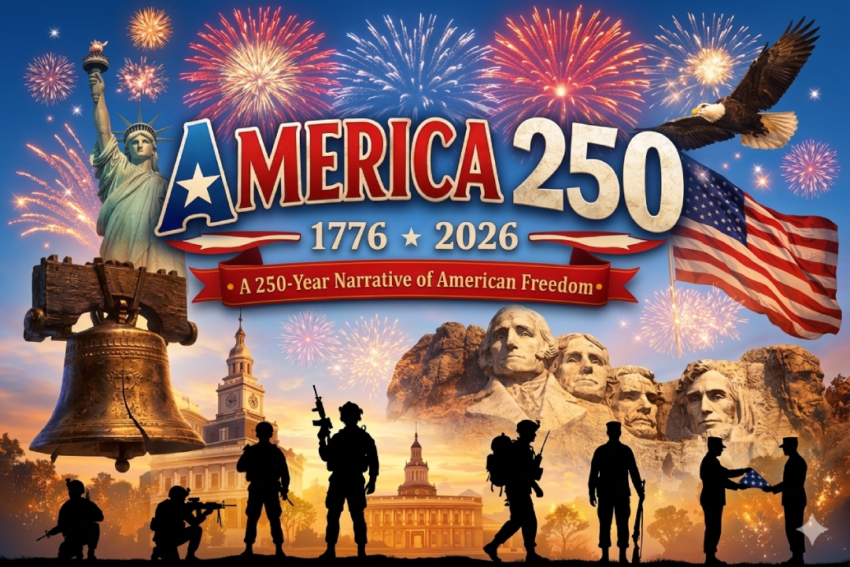
An American Journey Through Liberty
❖ ❖ ❖
Introduction: A Republic Still Being Written
On the reverse of the parchment Declaration of Independence, in a plain clerk’s hand, someone wrote a single docket line so the document could be identified when it was rolled up for storage: “Original Declaration of Independence dated 4th. July 1776.” For more than two centuries, that brittle sheet has faded under the gaze of millions, its ink dimming, its edges worn by handling and light. The National Archives now keeps it under the most exacting conditions human ingenuity can devise, sealed against the very air. And yet the words upon it have grown only more legible with time, as if each generation pressed harder on the page.
The Declaration of Independence states the principles on which our government, and our identity as Americans, are based. Unlike the other founding documents, the Declaration of Independence is not legally binding, but it is powerful.
— National Archives, “The Declaration of Independence” (archives.gov)
This is the paradox at the heart of the American story. The nation’s founding promise was never a finished fact but a standard held aloft — a measure against which the country would be judged, and would judge itself, for as long as it endured. Abraham Lincoln, who understood the Declaration better than almost anyone who came after him, called it “a rebuke and a stumbling-block to tyranny and oppression.” It was meant to trip up the powerful and to embarrass the comfortable. It still does.
Two hundred and fifty years is a long time for any experiment in self-government, and ours has been an experiment from the first — conducted in public, without a net, against the grain of all prior human history. Kings had ruled by blood and force since memory began. The notion that ordinary people might govern themselves, that legitimate power could flow upward from the consent of the governed rather than downward from a throne or an altar, was in 1776 a wager so audacious that even its authors were not certain it could be won. They pledged their lives, their fortunes, and their sacred honor to it anyway.
What follows is not a catalogue of dates to be memorized and forgotten. It is the story of a quarrel — the long, unfinished argument Americans have had with one another, and with themselves, over the meaning of a single luminous sentence about equality and unalienable rights. It is a story of soaring triumph and shameful betrayal, often in the same decade, sometimes in the same breath. The men who wrote that “all men are created equal” held other men and women in bondage. The republic that defeated fascism abroad maintained segregation at home. The country that put human beings on the Moon could not, for a long while, guarantee a Black child a seat in an integrated classroom.
To tell this history honestly is to refuse two easy comforts: the comfort of a flattering myth in which America was always already free, and the comfort of a cynical counter-myth in which the founding ideals were nothing but a mask for power. The truth is harder and more inspiring than either. The ideals were real, and so were the betrayals — and it was precisely by holding the nation to its own stated creed that the excluded forced their way in. Frederick Douglass, Susan B. Anthony, Martin Luther King Jr.: each turned the founders’ words back upon a country that had not yet lived up to them. The Declaration became, in their hands, exactly the stumbling block Lincoln promised it would be.
So let us begin where they began — in a hot Philadelphia summer, with a continent in rebellion, a war already underway, and a handful of men preparing to commit treason in the most eloquent prose ever bent to a political purpose.
❖ ❖ ❖
Part I — The Founding & the Early Republic (1776–1800)
The Shot Heard Round the World: The Revolutionary War
The American Revolution did not begin with a document. It began with gunfire. On the morning of April 19, 1775, on the village green at Lexington, Massachusetts, some seventy colonial militiamen — farmers, blacksmiths, tradesmen — stood in a ragged line as British regulars advanced. No one knows who fired first. When the smoke cleared, eight Americans lay dead. By the time the British column had marched on to Concord and back to Boston, harried every mile by minutemen firing from behind stone walls and barns, the empire had a war on its hands, and the colonies had their martyrs.
It is worth pausing on how improbable the whole enterprise was. The thirteen colonies had no standing army worthy of the name, no navy, no treasury, no central government with the power to tax. Arrayed against them was the most powerful empire on earth, master of the seas, fielding a professional army stiffened by hired Hessian mercenaries. By every conventional measure, the rebellion should have been crushed within a season. That it was not owed much to George Washington — not because he won many battles, for he lost a great many, but because he refused to lose the one thing that mattered: the army’s continued existence. As long as the Continental Army survived to fight another day, the Revolution lived.
The winter at Valley Forge in 1777–1778 became the crucible of that endurance. Encamped outside British-held Philadelphia, Washington’s men suffered cold, hunger, and disease that killed roughly two thousand of them — more than fell in many battles. Soldiers marched, it was said, leaving bloody footprints in the snow for want of boots. And yet the army that limped into Valley Forge emerged in the spring a disciplined fighting force, drilled by the Prussian volunteer Baron von Steuben into something that could finally stand against British regulars in the open field.
The turning point came at Saratoga in October 1777, where American forces compelled the surrender of an entire British army under General Burgoyne. The victory persuaded France — still smarting from its defeat by Britain a generation earlier — to enter the war openly on the American side. French money, French troops, and above all the French fleet transformed a colonial insurrection into a global conflict that Britain could no longer easily win. The end came at Yorktown, Virginia, in October 1781, where Washington’s army and a French expeditionary force trapped Lord Cornwallis against the sea while a French fleet barred his escape. As the British marched out to surrender, a band is said to have played a tune called “The World Turned Upside Down.” For the established order of the eighteenth century, it had been.
The cause for which they fought was, in the words of one modern account, “liberty, freedom, and republican ideals the likes of which had never before been seen in any style of organized government preceding them.” That sentence captures the stakes. This was not merely a tax revolt or a colonial squabble. It was an attempt to build a government on a wholly new foundation.
The American Revolutionary War is forever ingrained within our American identity, and provides all Americans a sense of who we are, or, at the very least, who we should be.
— American Battlefield Trust, “Overview of the American Revolutionary War” (battlefields.org)
The Revolution was also, from the beginning, more contested at home than the patriotic memory allows. The colonists were not a united people rising as one. Perhaps a third actively supported the rebellion, a third remained loyal to the Crown, and a third wished only to be left alone. Neighbor turned against neighbor; the war in the Carolina backcountry, in particular, degenerated into a savage civil conflict of ambush and reprisal. Tens of thousands of Loyalists fled the country when it was over, abandoning homes and fortunes rather than live under the new republic. Freedom, even at the founding, meant different things to different Americans — and was won over the bitter objection of many who shared the same streets and surnames.
Nor was the promise of liberty extended evenly to those who fought for it. Some five thousand Black men served in the Continental ranks, many of them promised freedom in exchange for their service; others escaped to British lines, where the Crown had offered liberty to any enslaved person who would take up arms against the rebels. The cruel arithmetic of the age meant that, for many of the enslaved, the cause of the British monarchy briefly offered a surer road to freedom than the cause of American liberty. That contradiction — a war for liberty fought by a society that held people in bondage — would not be resolved by the Revolution. It would be deferred, at terrible cost, to later generations.
And yet, for all its contradictions and all its violence, the victory the Revolution secured was genuinely new under the sun. The age was an age of kings; the map of the world was a map of empires and dynasties, of subjects who belonged to their rulers as surely as the land they tilled. Into that world, the American victory introduced a heresy: that a people might govern themselves, that authority might flow upward from the consent of the governed rather than downward from a throne or an altar. The republic that emerged from the war was small, poor, and fragile, dismissed by sophisticated Europeans as an experiment certain to fail. But the idea it embodied could not be unmade. Across the Atlantic, in France, Haiti, and the colonies of Spanish America, men and women watched what the Americans had done and began to imagine that they, too, might be free. The shot fired on Lexington green had indeed been heard round the world — and its echo has not yet died away.
“We Hold These Truths”: The Declaration of Independence
By the summer of 1776, more than a year of bloodshed had made reconciliation with Britain a fantasy. In June, the Continental Congress appointed a committee to draft a formal justification for independence, and the labor of composition fell to a thirty-three-year-old Virginian known for the felicity of his pen rather than the force of his oratory: Thomas Jefferson. Working in a rented room over the course of a few intense days, Jefferson produced a draft that Congress would prune — deleting some 630 words and adding 146 — before adopting it on July 4, 1776. Jefferson grumbled that they had “mangled” his manuscript. Posterity has largely concluded that Congress left the Declaration better than it found it.
What Congress produced was, in the judgment of the rhetorical scholar Stephen E. Lucas, something close to perfection. The Declaration’s opening paragraph is a single, stately, periodic sentence that lifts a colonial dispute into the realm of universal principle:
When in the Course of human events, it becomes necessary for one people to dissolve the political bands which have connected them with another, and to assume among the powers of the earth, the separate and equal station to which the Laws of Nature and of Nature’s God entitle them, a decent respect to the opinions of mankind requires that they should declare the causes which impel them to the separation.
— The Declaration of Independence, July 4, 1776 (archives.gov)
Lucas observes that the single most important word in that introduction is “necessary,” a term that in the eighteenth century carried the weight of fate — “that which cannot but be, or cannot be otherwise.” To call the Revolution necessary was to cast it not as a willful act of rebellion but as something as inevitable as the turning of the seasons. And by labeling the Americans “one people” and the British “another,” the document quietly accomplished a second purpose: two distinct peoples could not be waging a mere civil war, which meant foreign powers might lawfully come to America’s aid.
Then comes the preamble — the passage every American schoolchild half-remembers, and the moral engine of the entire republic:
We hold these truths to be self-evident, that all men are created equal, that they are endowed by their Creator with certain unalienable Rights, that among these are Life, Liberty and the pursuit of Happiness.
— The Declaration of Independence, July 4, 1776 (archives.gov)
In five sentences and barely two hundred words, the preamble compressed what John Locke had needed thousands of words to argue. Lucas notes that each word seems chosen for both sound and sense, following one another “with complete inevitability.” The argument builds like a logical proof: all are created equal; they are endowed with unalienable rights; governments exist to secure those rights, deriving their just powers “from the consent of the governed”; and when a government becomes destructive of those ends, the people may alter or abolish it. The right of revolution, so dangerous in other mouths, here arrives as the calm conclusion of self-evident premises.
There is a tragedy folded into that glorious sentence, and we should not look away from it. The man who wrote “all men are created equal” enslaved more than six hundred human beings across his lifetime. The Congress that adopted those words presided over a society in which one person in five was held in bondage. The contradiction was not hidden from contemporaries; the English critics of the Revolution gleefully pointed it out, asking how it was that the loudest yelps for liberty came from the drivers of slaves. The founders wrote a promise larger than they were prepared to keep — and in doing so, they armed every future American who would demand that the promise be kept in full.
Indeed, Jefferson’s original draft contained a passage denouncing the slave trade and laying it at the feet of the king — a clause that the Congress, deferring to the slaveholding interests of South Carolina and Georgia, struck out before adoption. The document that proclaimed equality had its most pointed words about slavery edited away before the ink was dry. The gap between the American promise and the American practice was thus present at the very moment of creation, written into the editing of the founding text itself. The story of the next two centuries would be, in large part, the story of Americans struggling to erase that edit — to make the document mean, in full, what it had always claimed to mean.
The Declaration did not emerge from nothing. It was built upon a torrent of revolutionary argument, most influentially Thomas Paine’s pamphlet Common Sense, published in January 1776, which sold in the hundreds of thousands and did more than any other single text to convince ordinary colonists that independence was both just and necessary. Paine had written that the cause of America was “in a great measure the cause of all mankind,” and that “we have it in our power to begin the world over again.” The Declaration distilled that sweeping ambition into the cool, deliberate cadences of a state paper — and in so doing gave it a permanence that no pamphlet could match. Paine stirred the blood; Jefferson and the Congress engraved the principle.
The Declaration closes by transforming an impersonal philosophical treatise into a drama with a villain (“the present King of Great Britain”) and a suffering protagonist (“us,” “our”), before resolving into one of the most quietly heroic sentences in the language. The signers pledged to one another “our Lives, our Fortunes and our sacred Honor.” For men committing treason against the Crown, this was no rhetorical flourish. Defeat meant the gallows. They knew it, and they signed.
❖ ❖ ❖
A More Perfect Union: The Constitution and the Bill of Rights
Winning independence proved easier than governing it. The first national framework, the Articles of Confederation, created what was less a government than a “league of friendship” among thirteen sovereign states. The central Congress could not tax, could not regulate commerce, could not effectively settle disputes among the states, or pay the debts of the war it had just fought. Paper money flooded the country; in some places, a pound of tea cost a hundred inflated dollars. Farmers sank into debt, lost their land to tax sales, and — in the case of the Massachusetts veteran Daniel Shays and his followers in 1786 — took up arms to shut down the courts. The uprising was suppressed, but it terrified men of property and convinced many that anarchy was near.
From his estate at Mount Vernon, George Washington wrote to James Madison with a sense of gathering crisis:
Wisdom and good examples are necessary at this time to rescue the political machine from the impending storm.
— George Washington to James Madison, as quoted by the National Archives, “A More Perfect Union” (archives.gov)
In May 1787, fifty-five delegates gathered in the Pennsylvania State House in Philadelphia, the windows shut against eavesdroppers despite the summer heat, the proceedings sworn to secrecy. They had been authorized merely to revise the Articles. Instead, led by the small, studious Madison — who had spent years reading deep in history and political theory searching for the flaws of past confederacies — they quietly resolved to build something new. Washington was elected to preside by unanimous vote; his mere presence, the young Madison believed, lent the gathering an air of legitimacy it could have found nowhere else.
Not everyone trusted the enterprise. Patrick Henry, the fiery orator, refused to attend, declaring that he “smelt a rat” — suspecting, correctly, that Madison intended a powerful central government that would absorb the authority of the states. Rhode Island boycotted the convention entirely. Those who did assemble — Franklin, gout-ridden at eighty-one; Hamilton, brilliant and ambitious; the eloquent Gouverneur Morris; the principled George Mason — left behind, thanks to Madison’s tireless note-taking, a remarkably complete record of one of history’s great deliberations.
What they forged through a summer of compromise was a Constitution that divided power three ways among legislative, executive, and judicial branches, set them to check and balance one another, and split authority again between the national government and the states. It was an ingenious machine designed on a frankly pessimistic premise: that men are not angels, that power corrupts, and that the only safe government is one in which ambition is made to counteract ambition. It has proven to be the most durable written constitution on earth.
Yet it was not enough for many Americans that government power be merely divided. They wanted it expressly limited — a written guarantee of individual rights that no majority and no official could violate. The promise of such a bill of rights helped secure ratification, and in 1791, the first ten amendments were added. The National Archives summarizes its purpose plainly:
The Bill of Rights is the first 10 Amendments to the Constitution. It spells out Americans’ rights in relation to their government. It guarantees civil rights and liberties to the individual—like freedom of speech, press, and religion.
— National Archives, “The Bill of Rights: What Does it Say?” (archives.gov)
The First Amendment alone — protecting speech, press, assembly, petition, and the free exercise of religion while barring the establishment of any state church — has shaped American life more profoundly than entire constitutions of other nations. The Ninth Amendment, easy to overlook, made a quietly radical claim: that the people retain rights beyond those the document happens to list. The founders were declaring, in effect, that liberty is not a gift doled out by government but a possession the people already hold and merely entrust government to protect.
By the time Washington voluntarily surrendered the presidency in 1797 — an act that astonished a watching world accustomed to rulers who clung to power until death — the basic architecture of the American republic stood complete. The scaffolding was up. The building would take centuries, and is not finished yet.
The early republic was no placid achievement. It was riven almost at once by the bitter rivalry between Alexander Hamilton, who envisioned a strong central government, a national bank, and an industrial future, and Thomas Jefferson, who feared all of those things and dreamed instead of a republic of independent farmers. From that quarrel emerged the first political parties — a development the founders had hoped to avoid and quickly found unavoidable. In Washington’s Farewell Address, he warned against the “baneful effects of the spirit of party,” even as that spirit was already taking root. The election of 1800, in which power passed peacefully from the Federalists of John Adams to the Republicans of Jefferson, is easy to overlook, but it was in its way as remarkable as anything in the founding. For the first time in modern history, a government surrendered power to its opponents not because it was forced to by arms, but because it had lost an election and the law required it. The peaceful transfer of power — so easily taken for granted, so precious and so fragile — became, in 1800, an American habit. Whether it would remain one was a question the republic would be made to answer again, in later and darker hours.
❖ ❖ ❖
Part II — Expansion & Division (1801–1865)
If the founding generation built the house, the generation that followed had to decide how large it would grow — and whether it could hold together a population stretching across a continent, divided ever more bitterly over a single, monstrous question. The years between Jefferson’s inauguration and Lincoln’s death were years of breathtaking expansion and deepening fracture, and the two were intertwined. Every new acre of territory raised the same incendiary question: would it be free, or would it be slave? In the end, the argument could not be settled by votes or compromises. It was settled by the bloodiest war in American history.
An Empire of Liberty: The Louisiana Purchase
In 1803, President Thomas Jefferson — the apostle of limited government and strict construction of the Constitution — found himself presented with an opportunity so enormous that it overrode his constitutional scruples. Napoleon Bonaparte, whose dreams of a French American empire were collapsing amid war and a slave revolution in Haiti, offered to sell the entire Louisiana Territory to the United States. For roughly fifteen million dollars — about four cents an acre — the young nation doubled in size overnight, acquiring some 828,000 square miles stretching from the Mississippi to the Rocky Mountains.
Jefferson had sent envoys to Paris merely to secure the port of New Orleans, vital to the farmers of the western settlements who floated their goods down the Mississippi. The offer of the whole territory stunned them. Nowhere did the Constitution authorize a president to purchase foreign land, and Jefferson agonized over whether he had the power to do it. In the end, he reasoned that the opportunity was too great to forfeit on a technicality, and the Senate ratified the treaty. To explore the vast acquisition, he dispatched Meriwether Lewis and William Clark, whose expedition up the Missouri and on to the Pacific became one of the epic journeys of American history.
The Purchase opened a continent to American settlement and secured the Mississippi as a national artery. But it also sharpened the central contradiction of the age. All that new land would have to be organized into territories and then states, and each would arrive carrying the same explosive question of slavery. Jefferson called his expanding nation an “empire of liberty.” For the Native peoples who already inhabited that empire, and for the enslaved who would be marched west to work its cotton lands, the word “liberty” would ring with a bitter irony.
The acquisition also revealed something enduring about the American character: a restless, almost insatiable hunger for the horizon. The frontier became the great organizing myth of the nineteenth-century nation — a place where, it was believed, a man could remake himself, where land was cheap and a fresh start always lay one more valley to the west. The reality was harsher and more crowded than the myth, and the “empty” land was not empty at all. But the idea of the West — of endless room for expansion, opportunity, and reinvention — lodged itself permanently in the national imagination, shaping everything from American politics to American literature to the American sense of self. It would later be christened “Manifest Destiny”: the conviction that the United States was divinely ordained to spread across the continent. That conviction drove the nation’s growth, and it drove, too, the wars and removals and broken treaties that growth left in its wake.
❖ ❖ ❖
The Trail of Tears: The Indian Removal Act
The expansion that thrilled white settlers fell as a catastrophe upon the Native nations in its path. The newly independent United States had, in its founding documents, set down a policy of dealing with Indian tribes through treaties — the instruments by which the federal government acquired the vast majority of its public lands. Between the Revolution and 1871, the United States ratified hundreds of such treaties. Many were negotiated in bad faith; nearly all were eventually broken.
The crisis came to a head under President Andrew Jackson. In 1830, Congress passed the Indian Removal Act, authorizing the federal government to exchange Native lands in the East for territory west of the Mississippi and to compel the removal of the southeastern nations — the Cherokee, Choctaw, Chickasaw, Creek, and Seminole, sometimes called the “Five Civilized Tribes” because many had adopted European-style farming, written constitutions, and even, in the Cherokee case, a written alphabet and newspaper. None of it spared them. White settlers and state governments coveted their land, and gold had been discovered on Cherokee territory in Georgia.
The Cherokee fought their removal in the courts, and in Worcester v. Georgia (1832), the Supreme Court, under Chief Justice John Marshall, ruled in their favor, recognizing the Cherokee Nation as a distinct political community over which Georgia’s laws had no force. Jackson is reputed to have responded that Marshall had made his decision; now let him enforce it. Whether or not he said those exact words, that was the policy. Federal troops and state militias drove the nations west at bayonet point.
The Cherokee removal of 1838–1839 became known as the Trail of Tears. Forced from their homes with little more than they could carry, herded into stockades, and marched roughly a thousand miles through a brutal winter, thousands died of exposure, disease, and starvation along the way — perhaps a quarter of those who set out. The Choctaw, Creek, and others endured comparable horrors. It was ethnic cleansing carried out under the color of law, by a democratic republic, against people whose only crime was to occupy land that others wanted. No honest account of American freedom can omit it. The same decades that expanded liberty for white Americans contracted it violently for others, and the nation has never fully reckoned with the contradiction.
❖ ❖ ❖
The Irrepressible Conflict: The Civil War
For seventy years, the United States had postponed its reckoning with slavery through a series of ever more strained compromises — the three-fifths clause, the Missouri Compromise of 1820, the Compromise of 1850, each one buying a few years of uneasy peace by drawing and redrawing a line between freedom and bondage across the map. But the acquisition of new western territory kept reopening the wound, and a series of shocks in the 1850s tore it past healing. The Fugitive Slave Act of 1850 conscripted the entire nation into the machinery of slave-catching, requiring even citizens of free states to assist in returning escapees. In 1857, the Supreme Court’s Dred Scott decision declared that Black Americans were not and could never be citizens, and that, in the chilling phrase often used to summarize Chief Justice Taney’s opinion, a Black man “has no rights which a white man must respect.”
The abolitionist movement, small but growing since the 1830s, had long insisted that the nation could not endure half slave and half free. Black Americans, enslaved and free, had never needed convincing; through sermons and speeches, newspapers and pamphlets, and above all through the daily resistance of those who fled north along the Underground Railroad, they forced the question of freedom onto a reluctant country. As the Smithsonian’s National Museum of African American History and Culture records, faith itself became a wellspring of that resistance — a means by which the enslaved seized “moments of meditation to envision freedom.”
When Abraham Lincoln — a Republican opposed to the spread of slavery, though initially cautious about abolishing it where it existed — won the presidency in November 1860, the slaveholding South concluded that the game was up. Within weeks, South Carolina seceded, and others followed. The secessionists themselves left no doubt about their cause. The records are blunt, as the Smithsonian notes in quoting the secession declarations:
Our position is thoroughly identified with the institution of slavery—the greatest material interest of the world. Its labor supplies the product which constitutes by far the largest and most important portions of commerce of the earth . . . a blow at slavery is a blow at commerce and civilization.
— Mississippi Declaration of Secession, quoted by the National Museum of African American History and Culture (nmaahc.si.edu)
Later mythology would recast the Confederate cause as a noble defense of states’ rights, abstracted from its purpose. The men who actually seceded were under no such illusion. They said plainly that they were leaving the Union to preserve slavery, which they called “the greatest material interest of the world.” In April 1861, Confederate guns opened fire on Fort Sumter in Charleston harbor, and the war began.
No one foresaw its scale. Both sides expected a short, glorious contest; they got four years of industrial slaughter that killed an estimated 750,000 men — more American dead than in any war before or since. The names of the battles became a litany of grief: Bull Run, Shiloh, Antietam, Fredericksburg, Chancellorsville, Gettysburg, the Wilderness. At Antietam in September 1862, more Americans fell in a single day than on any other day in the nation’s history. The new technologies of war — rifled muskets, massed artillery, the railroad, and the telegraph — outpaced the tactics of the generals who commanded with them, and the result was carnage on a scale the country had never imagined.
And yet through that valley of slaughter, the war became something more than a contest to preserve the Union. It became, as Lincoln would come to see and to say, a “new birth of freedom” — a second founding that would at last begin to redeem the promise the first founding had deferred.
To grasp the human meaning of that slaughter, it helps to dwell for a moment on a single day. At Gettysburg in July 1863, across three days of fighting in the Pennsylvania countryside, more than fifty thousand men became casualties — killed, wounded, captured, or missing. On the third day, General Lee ordered some twelve thousand Confederate soldiers across nearly a mile of open ground toward the center of the Union line in what became known as Pickett’s Charge. They marched in parade formation into a storm of artillery and rifle fire, and they were torn apart. Fewer than half returned. The high-water mark of the Confederacy was reached that afternoon, and the tide began to recede. Multiply that single field by the four years and the hundreds of engagements of the war, and one begins to sense the magnitude of the wound the nation inflicted upon itself — a wound from which, in some respects, it has never entirely healed.
The war transformed the country in ways that went far beyond the battlefield. It settled, by force of arms, the long-disputed question of whether the Union was a permanent nation or a revocable compact of sovereign states; the answer, written in blood, was that it was a nation. It accelerated the industrialization of the North and the impoverishment of the South for generations. It produced a vastly more powerful federal government, a national currency, an income tax, and a draft. And it gave the nation a new vocabulary of sacrifice and meaning, articulated above all by a self-educated frontier lawyer who had become, almost despite himself, the greatest prose stylist ever to occupy the presidency. The war made Abraham Lincoln, and Lincoln gave the war its meaning.
❖ ❖ ❖
“Henceforward Shall Be Free”: The Emancipation Proclamation
Frederick Douglass, the escaped slave who became the most powerful orator of his age, had pressed Lincoln relentlessly to make the war what it truly was: a war against slavery itself. “Fire must be met with water,” Douglass declared, “darkness with light, and war for the destruction of liberty must be met with war for the destruction of slavery.” He demanded, too, that Black men be permitted to fight — understanding that military service would forge an unbreakable claim to citizenship.
Lincoln moved cautiously at first, fearful of driving the border slave states into Confederate arms. But by the summer of 1862, he had resolved on emancipation as a measure of war, and he waited only for a victory from which to announce it so that it would not seem an act of desperation. The bloody Union stand at Antietam gave him his moment. On September 22, 1862, he issued the preliminary Emancipation Proclamation; and on January 1, 1863, under his authority as Commander-in-Chief, he declared that all enslaved persons in the territories still in rebellion “henceforward shall be free.”
On the last night of 1862, across the country, Black congregations gathered in their churches and waited through the dark hours for the new year and the freedom it would bring. They called it Watch Night, and Black churches keep the ritual still. As the Smithsonian records, when the news came, Pastor John C. Gibbs of Philadelphia’s First African Presbyterian Church proclaimed the meaning of the hour:
The Proclamation has gone forth, and God is saying to this nation by its legitimate constitute head, Man must be free.
— Pastor John C. Gibbs, 1863, quoted by the National Museum of African American History and Culture (nmaahc.si.edu)
The Proclamation’s legal reach was, on its face, limited — it freed the enslaved only in the rebel states, where the federal government had at that moment no power to enforce it, and left slavery untouched in the loyal border states. Critics then and since have pointed out the paradox. But to focus on the legal fine print is to miss the earthquake. The Proclamation transformed the moral character of the war and made every advancing Union soldier an agent of liberation. Wherever the army marched, slavery dissolved before it. And crucially, it opened the ranks of the Union Army to Black men. Roughly 180,000 of them would serve, fighting, as the Smithsonian puts it, “to liberate themselves, their loved ones, and their community.”
The final abolition of slavery throughout the United States came with the Thirteenth Amendment, ratified in December 1865, months after the war’s end and Lincoln’s assassination. At Gettysburg, dedicating a cemetery on the field where the war’s tide had turned, Lincoln had compressed the whole meaning of the struggle into a few hundred words, binding the war’s sacrifice to the founders’ creed: that the nation had been “conceived in Liberty, and dedicated to the proposition that all men are created equal,” and that from the honored dead the living must take increased devotion, so that “government of the people, by the people, for the people, shall not perish from the earth.”
He did not live to see the work completed — indeed, it would not be completed in the lifetime of anyone then living, nor is it yet. The promise of equality that the Civil War wrote into the Constitution would be betrayed within a decade by the collapse of Reconstruction and the rise of Jim Crow. But the words of the Declaration had been redeemed in blood and made, for the first time, the law of the land. The republic had survived its greatest trial, and it had survived as something nearer to what it had always claimed to be.
The betrayal deserves its own reckoning, for it shaped the century that followed. In the years immediately after the war, during the period known as Reconstruction, the nation took extraordinary steps toward racial equality. The Fourteenth Amendment guaranteed equal protection of the laws and birthright citizenship; the Fifteenth guaranteed the right to vote regardless of race. Black men were elected to Congress and to state legislatures across the South; Black schools and churches and institutions flourished; for a brief, luminous moment, it seemed that a genuinely multiracial democracy might take root in American soil. But the experiment was strangled. White Southerners, organized in terrorist groups like the Ku Klux Klan and backed by the steady erosion of Northern will, waged a campaign of violence and intimidation to restore white supremacy. By 1877, federal troops withdrew from the South, the bargain that ended Reconstruction was struck, and the brief experiment in equality collapsed. There followed nearly a century of legalized segregation, disenfranchisement, sharecropping, and the terror of lynching — a system that mocked the Fourteenth and Fifteenth Amendments while leaving them formally intact. The promise had been written into the Constitution and then, in practice, torn out of it. The struggle to make it real again would consume the next hundred years.
❖ ❖ ❖
Part III — Industrialization & Global Emergence (1866–1945)
The America that emerged from the Civil War was a different country, and it was about to become more different still. In the span of a single lifetime, it would transform from a largely agrarian republic into the foremost industrial power on earth, lace itself together with rails and wires, absorb millions of immigrants, stumble into empire, and twice cross the ocean to decide the fate of the world. The nineteenth-century nation that had looked inward toward its own frontier became, by 1945, the indispensable power of the twentieth century. The story of those eight decades is a story of iron and steel, of triumph and catastrophe — and of a freedom repeatedly tested by the very scale of the nation’s new power.
Iron Wedding of a Continent: The Transcontinental Railroad
On May 10, 1869, at Promontory Summit in the Utah Territory, officials drove a ceremonial golden spike to join the rails of the Central Pacific, building eastward from California, with those of the Union Pacific, building westward from the Missouri River. The telegraph carried the single word — “Done” — across the nation, and bells rang in cities from coast to coast. For the first time, a traveler could cross the continent in a matter of days rather than months. The journey that had killed pioneers by the thousands on the overland trails became a ride in a railway car.
The transcontinental railroad was the great national project of its age, an achievement of engineering and organization that knit the country into a single market and a single nation. It also rested on the backs of those rarely named in the celebrations. Thousands of Chinese laborers blasted and dug the Central Pacific’s path through the granite of the Sierra Nevada, working in conditions of appalling danger for lower pay than their white counterparts; many died in rockslides and avalanches and explosions, and their names went largely unrecorded. Irish immigrants and Civil War veterans laid the Union Pacific’s track across the plains. The railroad that bound the nation together was built by the labor of the marginalized, a pattern as old as the republic itself.
Its consequences rippled outward for generations. The railroad accelerated the settlement of the West and, with it, the final dispossession of the Plains nations, whose way of life depended on the buffalo that the railroads helped to annihilate. It created national time zones, national corporations, and national fortunes of unprecedented size. It turned the United States into a continental economy. The same iron that united the country also ground under it the peoples and the wildness that had defined the frontier. Progress, in America, has rarely come without a price extracted from someone, and rarely from those who paid it willingly.
The decades after the Civil War — the era Mark Twain mockingly named the Gilded Age, all glittering surface over base metal — saw the rise of industrial titans whose names still mark the landscape: Carnegie in steel, Rockefeller in oil, Morgan in finance, Vanderbilt in railroads. They built an industrial colossus of staggering productivity, and they accumulated fortunes of a scale never before seen, even as the workers in their mills and mines labored long hours for low wages in conditions of brutal danger. The age produced both the philanthropy that built libraries and universities across the country and the ruthless monopolies that crushed competition and corrupted politics. It produced, too, the first great wave of organized labor — strikes and unions and a long, often violent struggle over the terms on which industrial workers would live. The American promise of equality collided with the realities of industrial capitalism, and out of that collision came the reform movements — Populist and Progressive — that would seek, in the decades to follow, to bring the new economic order under democratic control. The question they raised has never gone away: whether political equality can survive vast economic inequality, and what a free people owes to those its prosperity leaves behind.
This was also the great age of immigration. Between the Civil War and the 1920s, tens of millions of newcomers — Irish and Italian, Jewish and Slavic, Chinese and Scandinavian — poured into the country through Ellis Island and the ports of the Pacific, fleeing poverty and persecution, drawn by the promise inscribed on the new Statue of Liberty: Welcome to the “huddled masses yearning to breathe free.” They built the cities, dug the canals, worked the factories, and remade the nation in their image, even as they faced fierce nativist hostility and, in the case of Chinese immigrants, outright exclusion by law. The America that entered the twentieth century was a nation of immigrants in a sense no other great power could claim — a country continually reinvented by those who came to it, and continually arguing with itself about whom to admit and on what terms. That argument, too, remains unsettled.
❖ ❖ ❖
A Splendid Little War: The Spanish-American War
By the 1890s, the United States had filled out its continent and begun to look beyond it. A restless industrial power with a growing navy and a hunger for markets and prestige, it found its opportunity in 1898 in Cuba, where a brutal independence struggle was challenging Spanish colonial rule. American newspapers — locked in a circulation war and never overburdened with scruple — filled their pages with lurid tales of Spanish atrocities, stoking public fury. When the U.S. battleship Maine exploded and sank in Havana harbor in February 1898, killing more than 260 American sailors, the cause of the blast was uncertain, but the cry was immediate and deafening: “Remember the Maine!”
The war that followed lasted only a few months. American forces defeated Spain in Cuba and, on the far side of the world, in the Philippines, where Commodore Dewey destroyed a Spanish fleet in Manila Bay. Theodore Roosevelt resigned his post as Assistant Secretary of the Navy to lead a volunteer cavalry regiment, the “Rough Riders,” up the heights near Santiago, and rode the fame straight toward the White House. One American statesman called it “a splendid little war.” It was certainly brief, and for the United States, relatively cheap in lives.
Its consequences were anything but little. By the peace treaty, Spain ceded the Philippines, Puerto Rico, and Guam to the United States, and Cuba passed under American domination. In the span of a few months, the old anti-colonial republic had acquired an overseas empire of its own — and with it, a profound contradiction. A nation born in revolt against imperial rule now governed distant peoples who had not consented to its authority. In the Philippines, Filipinos who had fought Spain for their independence soon found themselves fighting the United States in a long and savage war that cost hundreds of thousands of lives. The country founded on the consent of the governed had become a colonial power, and Americans have argued ever since about what that did to the national soul.
The debate split the country in ways that cut across the old party lines. The expansionists spoke of destiny and duty, of markets to be won and a civilizing mission to be fulfilled; they pointed to the great powers of Europe carving up Asia and Africa and asked whether America could afford to stand aside. Ranged against them were the anti-imperialists — an unlikely coalition that gathered industrialists and labor leaders, scholars and clergymen, and writers led by Mark Twain, whose mordant pen turned against the whole enterprise. To govern a people without their consent, the anti-imperialists argued, was to betray the Declaration itself; a republic could not play emperor abroad without corrupting the liberty it cherished at home. The Senate ratified the treaty by the narrowest of margins, and the argument it embodied — between America as exemplar and America as crusader, between minding its own liberty and remaking the world in its image — was never truly settled. It would echo through every foreign war of the century to come.
❖ ❖ ❖
The War to End All Wars: World War I
When war engulfed Europe in 1914, most Americans wanted no part of it. The conflict that began with a single assassination in Sarajevo and then cascaded through a web of alliances into a continental bloodbath seemed, to many across the Atlantic, a distinctly European madness. President Woodrow Wilson won re-election in 1916 on the slogan that he had “kept us out of war.” The slaughter in the trenches of the Western Front — industrialized killing on a scale that consumed a generation of young Europeans — only confirmed the American instinct to stay clear.
What dragged the United States into the war was Germany’s campaign of unrestricted submarine warfare, which sank American ships and killed American citizens, and the revelation of the Zimmermann Telegram, in which Germany proposed an alliance with Mexico against the United States. In April 1917, Wilson asked Congress for a declaration of war, casting the cause in the loftiest terms: the world, he said, must be made “safe for democracy.” It was a characteristically American framing — the transformation of a war of national interest into a crusade for a universal principle.
The American Expeditionary Force arrived in time to tip the balance. Fresh American troops — the “doughboys” — helped halt the final German offensives of 1918 and then drove the exhausted enemy back. The armistice came at the eleventh hour of the eleventh day of the eleventh month of 1918. Some 116,000 Americans had died, a fraction of the millions lost by the European powers but a shock to a nation unused to mass military death abroad.
The men who came home carried with them images that no Fourth of July oratory had prepared them for: the moonscape of no-man’s-land, churned to mud and laced with wire; the green fog of chlorine and mustard gas that seared the lungs and blinded the eyes; the chatter of machine guns that could scythe down a line of advancing men in seconds. War had become a vast industrial process, and the bodies of the young were its raw material. The Lost Generation that emerged from those trenches — Hemingway, Fitzgerald, and the disillusioned millions who never wrote a word — had learned to distrust the grand abstractions that had sent them to die. The gap between the noble language of the war’s purpose and the squalid reality of its conduct would haunt the American century.
At home, the war had remade the nation in ways no one had foreseen. The federal government reached into the economy as never before, fixing prices, running railroads, and mobilizing industry. African Americans left the fields of the South by the hundreds of thousands in the Great Migration, drawn north by the wartime demand for labor, planting the seeds of communities that would one day give the freedom struggle its decisive weight. Women, who took up jobs vacated by men in uniform, pressed their claim to the ballot with new urgency; within two years of the armistice, the Nineteenth Amendment would at last enshrine their right to vote. War, the great accelerant of history, had pushed America toward both its promise and its reckoning.
Wilson went to the Paris Peace Conference dreaming of a new world order founded on his Fourteen Points and a League of Nations that would make such carnage impossible forever. He was outmaneuvered by the vengeful Allied powers, and then, in a bitter irony, repudiated at home: the United States Senate refused to ratify the Treaty of Versailles or join the League. America had emerged from the war as the world’s leading creditor and a great power in fact, but it recoiled from the responsibilities of that power and retreated into isolation. The punitive peace and the wreckage left across Europe sowed the seeds of an even greater catastrophe to come. The “war to end all wars” had ended nothing; it had merely paused.
❖ ❖ ❖
The Bottom Falls Out: The Great Depression
The 1920s roared. The decade after the war brought booming industry, soaring stock prices, jazz, automobiles, radio, and a giddy faith that prosperity had become permanent. Then, in October 1929, the stock market collapsed, and the giddiness curdled into the worst economic catastrophe in the nation’s history. The Great Depression was not a brief panic but a decade-long calamity. At its depth, roughly one American worker in four was unemployed. Banks failed by the thousands, wiping out the savings of ordinary families. Factories fell silent. Farmers, already struggling, watched crop prices collapse and then, in the Dust Bowl, watched the very soil of the Great Plains lift into black blizzards and blow away.
The human suffering was immense and intimate: families evicted from their homes, men who had worked all their lives reduced to selling apples on street corners or queuing at soup kitchens, children gone hungry, whole communities of migrants — the “Okies” of Steinbeck’s novel — loading their possessions onto trucks and rolling west in search of work that often did not exist. The Depression shook something deeper than bank accounts. It shook the American faith that hard work was always rewarded, that the future was always brighter than the past, that the system was fundamentally fair.
And yet, amid the wreckage, the country discovered reserves of endurance it had not known it possessed. In the shantytowns that sprang up on the edges of cities — the “Hoovervilles,” named with bitter irony for the president many blamed — people organized, shared, and survived. Neighbors fed neighbors. Photographers dispatched by the federal government fanned out across the land and brought home images that seared themselves into the national memory: Dorothea Lange’s migrant mother, her face lined with worry, her children turned away from the camera, became the very portrait of a people enduring the unendurable. The documentary impulse of those years — the photographs, the folk songs of Woody Guthrie, the WPA murals and oral histories — was itself an act of faith, a refusal to let the suffering pass unwitnessed. A free people, the country was learning, could be knocked flat and still rise.
Franklin Delano Roosevelt, elected in 1932 as the economy hit bottom, offered the country two things it desperately needed: action and hope. “The only thing we have to fear,” he told a frightened nation at his first inauguration, “is fear itself.” His New Deal unleashed a torrent of federal programs — banking reform, public works, agricultural supports, the regulation of Wall Street, and, in Social Security, a permanent safety net for the old and the unemployed. Historians still debate how much the New Deal actually ended the Depression, as opposed to the vast mobilization of the Second World War that followed. But it changed the relationship between Americans and their government, establishing the expectation that Washington bore some responsibility for the economic welfare of its citizens. The question of how far that responsibility should extend has animated American politics ever since. The Depression taught the country, in the hardest possible way, that freedom without a measure of economic security can feel hollow to those who are hungry.
❖ ❖ ❖
The Arsenal of Democracy: World War II
The peace that followed the First World War had been a fragile and resentful thing, and in the 1930s it shattered. In Germany, Adolf Hitler rose to power on a tide of grievance, economic ruin, and racial hatred, building a totalitarian state bent on conquest and on the extermination of those he deemed unworthy of life. In Italy and Japan, militarist regimes pursued their own dreams of empire. By the late 1930s, the democracies of the world were in retreat, and a darkness was spreading across the globe.
Americans, scarred by the previous war and the Depression, clung hard to neutrality even as Hitler overran Europe and the Battle of Britain raged. Roosevelt, convinced that the survival of democracy itself was at stake, edged the country toward the role of what he called the “arsenal of democracy,” supplying Britain and later the Soviet Union with the materials of war. But it was the surprise Japanese attack on Pearl Harbor, on December 7, 1941 — “a date which will live in infamy” — that ended the argument in a single morning. The next day, the United States was at war, and within days at war with Germany and Italy as well.
What followed was the greatest mobilization in the nation’s history. American industry, idled by the Depression, roared back to life, building the ships, planes, tanks, and guns that would overwhelm the Axis by sheer productive might. Sixteen million Americans served in uniform. Women poured into the factories and shipyards, “Rosie the Riveter” becoming an icon of a workforce transformed. The war was fought across the world — in the jungles and islands of the Pacific, in the deserts of North Africa, in the skies over Germany, on the beaches of Normandy on D-Day, June 6, 1944, when the largest amphibious invasion in history opened the road to Berlin from the west while the Soviet army closed in from the east.
Victory in Europe came in May 1945, victory over Japan in August, after the United States dropped atomic bombs on Hiroshima and Nagasaki — a terrible new power that ended the war and inaugurated an age in which humanity could, for the first time, destroy itself. The war cost the lives of more than 400,000 Americans and tens of millions worldwide. But it left the United States not merely victorious but supreme: its homeland untouched, its economy dominant, its military unmatched, its currency the anchor of the world. The reluctant republic that had recoiled from world leadership after 1918 could recoil no longer. America had become the leader of the free world, and the question of what to do with that power would define everything that came after.
The war was also, for many Americans, a moment of moral clarity — a genuine fight against genuine evil. But the clarity was incomplete. The same nation that fought tyranny abroad maintained racial segregation at home, sent Japanese-American citizens to internment camps, and kept its armed forces segregated by race even as Black soldiers died for it. The veterans of that war came home to a country that owed them — and owed all its citizens — a fuller measure of the freedom they had defended. They would spend the next decades demanding it.
The contradiction was felt most sharply by those who served while their own rights were denied. Black servicemen fought fascism overseas and returned to a Jim Crow South where they could be lynched in their uniforms. The Tuskegee Airmen, the Nisei soldiers of the 442nd Regimental Combat Team — Japanese-Americans who volunteered out of the very internment camps that held their families and became one of the most decorated units in the history of the U.S. Army — these men gave a kind of double testimony, fighting for a country that did not yet treat them as equals and, by their service, building an unanswerable claim to the equality they were denied. The “Double V” campaign of the Black press during the war named the cause exactly: victory against fascism abroad, and victory against discrimination at home. The second victory would prove harder to win than the first, but the war had made it inevitable. A nation could not summon millions of its citizens to die for freedom and then deny them freedom forever. The civil rights movement of the coming decades was, in a real sense, born in the contradictions of the war.
❖ ❖ ❖
The Unmasterable Past: The Holocaust
Among the horrors that American and Allied soldiers uncovered as they advanced into the heart of the Nazi empire was one so vast and so deliberate that it strained the capacity of language to describe it. The United States Holocaust Memorial Museum defines it with grim precision: the Holocaust was “the systematic, state-sponsored persecution and murder of six million Jews by the Nazi regime and its collaborators.” It was not a byproduct of war but a central war aim of the Nazi state — the attempted annihilation of an entire people, pursued with the full bureaucratic and industrial machinery of a modern nation.
When American troops liberated camps such as Buchenwald and Dachau in the spring of 1945, hardened soldiers wept at what they found: the mass graves, the crematoria, the survivors reduced to skeletons, the evidence of murder organized on a factory scale. General Eisenhower, the Allied supreme commander, insisted on touring the camps himself and ordered them documented in exhaustive detail, fearing that future generations might otherwise refuse to believe that human beings had done such things. “The things I saw,” he wrote, “beggar description.”
The Holocaust stands as the central moral catastrophe of the twentieth century, and it casts a long shadow over any story of freedom. It is the ultimate demonstration of what becomes possible when a state declares whole categories of human beings to be without rights, without dignity, without the right to exist — the precise inversion of the Declaration’s claim that all are created equal and endowed with unalienable rights. The United States did not enter the war to stop the Holocaust, and its record in the years before the war — turning away refugee ships, maintaining restrictive immigration quotas — is one that historians have justly criticized. But in the aftermath, the full revelation of the genocide reshaped the moral imagination of the West and gave new urgency to the idea of universal human rights. “Never again” became a watchword. That the world has not always honored it does not diminish the force of the lesson: that the principles written in Philadelphia in 1776 are not the property of one nation but the birthright of all humanity, and that their abandonment leads into an abyss.
❖ ❖ ❖
Part IV — The Cold War & Civil Rights (1946–1990)
The Second World War ended one global struggle and began another. The alliance of convenience between the United States and the Soviet Union dissolved almost immediately into a forty-year confrontation between two superpowers and two incompatible visions of how human beings should live — a Cold War waged with proxy wars, nuclear arsenals, espionage, ideology, and propaganda, but never, mercifully, with direct combat between the two giants. It was a contest, the United States insisted, between freedom and tyranny. And that framing carried a sharp edge at home, for a nation that proclaimed itself the leader of the free world while denying basic freedoms to millions of its own citizens was a nation living a contradiction it could no longer sustain. The great drama of these decades is the drama of Americans — especially Black Americans — demanding that the country finally become what it claimed to be.
The Cold War shaped American life in ways both grand and intimate. It built the interstate highway system (justified as a defense measure) and sent men to the Moon; it funded the research universities and the great laboratories; it drove the space race and the arms race and the long, anxious decades of living under the shadow of the bomb, when schoolchildren practiced ducking beneath their desks and families built fallout shelters in their backyards. It also produced darker episodes — the anti-communist hysteria of McCarthyism, which ruined careers and trampled civil liberties in the name of fighting subversion, and a series of costly interventions abroad. Above all, it produced Vietnam: a long, grinding war in Southeast Asia that killed more than 58,000 Americans and vastly more Vietnamese, divided the nation as nothing had since the Civil War, and shattered for a generation the easy confidence that American power was always wielded in a righteous cause. The protests against that war, and the bitter arguments it provoked, were themselves an exercise of the freedoms the Cold War was supposedly being fought to defend. A free society, the era demonstrated, retains the right to question and condemn its own government — a right that authoritarian rivals could not abide, and that remained, for all the period’s failures, the deepest source of American strength.
Separate Is Not Equal: Brown v. Board of Education
For more than half a century after the Civil War, the Supreme Court’s 1896 decision in Plessy v. Ferguson had given constitutional blessing to the lie of “separate but equal.” Across the South, and in much of the rest of the country, Black Americans lived under a regime of legal segregation — Jim Crow — that touched every corner of life: separate schools, separate water fountains, separate railroad cars, separate seats on buses, the systematic denial of the vote, and behind it all the ever-present threat of lynching. The “equal” half of the formula was a fiction; the “separate” half was enforced with ferocity.
The assault on that system was patient, strategic, and brilliantly led. The NAACP Legal Defense and Educational Fund, under the direction of a lawyer named Thurgood Marshall — who would himself one day sit on the Supreme Court — mounted a methodical campaign to dismantle segregation through the courts, case by case, until it reached the citadel: public education. On May 17, 1954, in Brown v. Board of Education of Topeka, a unanimous Supreme Court, led by Chief Justice Earl Warren, struck down school segregation. The Court declared that in public education, the doctrine of “separate but equal” had no place, that separate educational facilities were inherently unequal, and that segregation deprived Black children of the equal protection of the laws guaranteed by the Fourteenth Amendment.
Brown did not desegregate a single school overnight; resistance was massive, prolonged, and sometimes violent, and a decade later, most Southern Black children still attended segregated schools. But its importance was incalculable. As historians have observed, Brown was less an ending than a beginning — the legal and moral foundation on which the entire modern civil rights movement would build. It signaled that the Constitution’s promise of equal protection was a living force, and it gave the movement a Supreme Court that had, at last, taken the side of the Declaration’s creed. The schoolhouse door had been opened by law; it would take a movement of extraordinary courage to walk through it.
❖ ❖ ❖
Let Freedom Ring: The Civil Rights Movement and the Civil Rights Act
The years after Brown saw the civil rights movement rise into one of the most morally compelling chapters in American history. In Montgomery, Alabama, in 1955, a seamstress named Rosa Parks refused to surrender her bus seat, and a young pastor named Martin Luther King Jr. led a boycott that lasted more than a year and ended in victory. There followed the lunch-counter sit-ins, the Freedom Rides that tested segregation on interstate travel in the face of mob violence, the voter registration drives, and the great mass demonstrations — met, again and again, with fire hoses, police dogs, beatings, bombings, and murder. The movement’s genius lay in its discipline of nonviolence, which placed the brutality of segregation on open display before a watching nation and a watching world. Americans who saw on their television screens what was being done to peaceful marchers in Birmingham and Selma could no longer pretend not to know.
In August 1963, a quarter of a million people gathered before the Lincoln Memorial in the March on Washington, where King delivered the speech that distilled the movement’s appeal into the language of the founders. He had come, he said, to cash a promissory note — the promise of the Declaration and the Constitution that all men, Black as well as white, would be guaranteed the unalienable rights of life, liberty, and the pursuit of happiness. And then he set against the nation’s failures a vision of what it might yet be: “I have a dream,” he told the multitude, “that one day this nation will rise up and live out the true meaning of its creed: ‘We hold these truths to be self-evident, that all men are created equal.’” He was not asking America to repudiate its founding. He was demanding that it finally honor it.
The legislative breakthrough came the following year. After the assassination of President Kennedy, his successor, Lyndon B. Johnson — a Southerner who turned the full force of his legendary political mastery to the cause — drove the Civil Rights Act of 1964 through a reluctant Congress, overcoming the longest filibuster in Senate history. The law outlawed discrimination based on race, color, religion, sex, or national origin; it ended segregation in public accommodations; and it banned employment discrimination. As HISTORY summarizes, it ended segregation in public places and banned employment discrimination, becoming one of the crowning legislative achievements of the movement. The Voting Rights Act of 1965 followed, at last giving teeth to the Fifteenth Amendment’s ninety-five-year-old promise that the right to vote would not be denied on account of race.
These were not gifts handed down from on high. They were wrested from a resistant nation by the courage of ordinary people who marched and were beaten, who sat and were jailed, who registered to vote and were murdered for it. The movement did not complete the work of equality — no law could do that, and the struggles over its meaning continue to this day. But it accomplished something monumental: it ended the legal architecture of American apartheid and forced the nation, after nearly two centuries, to make good on the most basic terms of its own creed. It was, in the deepest sense, a second redemption of the Declaration of Independence.
It is worth naming the cost in full, because the textbook version too often sands it smooth. Medgar Evers was shot in his own driveway. The four girls were killed in the bombing of the Sixteenth Street Baptist Church in Birmingham. The three young civil rights workers — Chaney, Goodman, and Schwerner — were murdered in Mississippi during Freedom Summer. The marchers were beaten bloody on the Edmund Pettus Bridge in Selma on a day that came to be called Bloody Sunday. And, in 1968, Martin Luther King Jr. himself was cut down by an assassin’s bullet on a Memphis balcony at the age of thirty-nine. The movement’s victories were purchased at the price of lives, and the people who paid that price did so knowing the danger. They marched anyway. That is what moved not merely a political campaign but one of the supreme moral achievements in the history of the republic — a demonstration that ordinary people, armed with nothing but courage and the moral authority of the nation’s own ideals, could move a country that had resisted moving for a hundred years.
❖ ❖ ❖
“One Giant Leap”: Apollo 11 and the Moon Landing
The Cold War was fought not only in jungles and back alleys but in the heavens. When the Soviet Union launched Sputnik, the first artificial satellite, in 1957, and then put the first human into orbit in 1961, it struck a blow at American confidence and prestige. President John F. Kennedy answered with one of the boldest commitments any leader has ever made, pledging in 1961 that the United States would land a man on the Moon and return him safely to Earth before the decade was out. It was an audacious promise — the technology to fulfill it did not yet exist — and it galvanized a national effort of staggering ambition.
On July 16, 1969, a Saturn V rocket — the most powerful machine ever built — thundered off its pad at Cape Canaveral carrying three astronauts: Neil Armstrong, Edwin “Buzz” Aldrin, and Michael Collins. Four days later, as Collins orbited overhead in the command module, Armstrong and Aldrin guided the fragile lunar module Eagle down toward the surface, Armstrong taking manual control in the final moments to steer clear of a boulder-strewn crater, landing with seconds of fuel to spare. “Houston, Tranquility Base here,” came the voice across a quarter-million miles of space. “The Eagle has landed.”
Hours later, as an estimated 600 million people — then the largest television audience in history — watched and listened around the world, Armstrong descended the ladder and set his boot upon the lunar dust. “That’s one small step for man,” he said, “one giant leap for mankind.” On a plaque left behind on the Moon were inscribed words that reached beyond the rivalries of the Cold War: “We came in peace for all mankind.” For a few luminous days, the divisions of Earth seemed to fall away, and human beings everywhere shared in an achievement that belonged, in some sense, to the species itself.
Apollo 11 was a triumph of the free society — of open science, of organized ingenuity, of a democratic nation marshaling its resources toward a peaceful goal of pure aspiration. It was also, undeniably, a Cold War victory, proof to a watching world of what American freedom and enterprise could accomplish. The astronaut Frank Borman would later reflect that the program had shown what free people could do when they set their minds to a great task. The Moon landing remains, more than half a century later, perhaps the purest expression of human reach — a reminder that the same nation capable of profound failures was also capable of lifting its eyes to the stars and, against all odds, touching them.
The achievement is easy to take for granted now, and that ease is itself a kind of forgetting. The computers that guided Apollo to the Moon had a fraction of the power of a modern pocket calculator. The men who flew the missions rode atop what was, in essence, a controlled explosion of staggering violence, sealed in a capsule from which there was no real escape if anything went seriously wrong — and a great deal could go wrong, as the fire that killed the Apollo 1 crew on the launch pad had shown. The engineers solved, in less than a decade, problems that had never been solved before, inventing whole fields of technology as they went. And they did it in the open, their failures televised alongside their triumphs, accountable to a public and a Congress that could have cut their funding at any time. It was government at its most ambitious and most competent, the work of hundreds of thousands of people — the engineers and technicians, the seamstresses who sewed the spacesuits, the mathematicians, many of them Black women whose contributions went long unrecognized, who calculated the trajectories. The footprints those astronauts left in the lunar dust will remain, in the airless silence, for millions of years — longer than any monument on Earth, a marker not of one nation’s pride alone but of the moment a species first touched another world.
❖ ❖ ❖
Tear Down This Wall: The Fall of the Berlin Wall
For nearly three decades, no structure on Earth embodied the division between freedom and tyranny more starkly than the Berlin Wall. Erected by the communist East German regime in 1961 to stop its own citizens from fleeing to the West, the Wall cut the city of Berlin in two with concrete, barbed wire, watchtowers, and a “death strip” where guards shot those who tried to cross. It was an extraordinary admission: a system that had to imprison its own people to keep them was a system that had already lost the argument. The Wall was the Cold War made visible, a scar of concrete running through the heart of Europe.
Through the long decades of the Cold War, the Wall stood, and Western leaders made their pilgrimages to it. Kennedy stood in its shadow in 1963 and declared his solidarity with the trapped people of the city: “Ich bin ein Berliner.” In 1987, Ronald Reagan stood at the Brandenburg Gate and issued a challenge to the Soviet leader Mikhail Gorbachev that seemed, at the time, almost quixotic: “Mr. Gorbachev, tear down this wall!” Few imagined how soon it would happen.
By 1989, the Soviet empire was crumbling under the weight of its own contradictions — economic stagnation, the costly arms race, and the refusal of subject peoples to be ruled any longer. Gorbachev’s reforms had loosened Moscow’s grip, and across Eastern Europe the captive nations rose, mostly without bloodshed, to reclaim their freedom. On the night of November 9, 1989, amid confusion over a hastily announced relaxation of travel rules, crowds of East Berliners surged toward the checkpoints. The overwhelmed guards, receiving no orders to shoot, stood aside. The people poured through. Strangers embraced atop the Wall; Berliners attacked the hated concrete with hammers and chisels and bare hands. The barrier that had divided a city, a nation, and a world for twenty-eight years simply fell.
Within two years, the Soviet Union itself dissolved, and the Cold War ended not with the nuclear catastrophe so many had feared but with the quiet triumph of the idea that human beings yearn to be free. It was, for the United States and its allies, a vindication of forty years of patience and resolve. The captive peoples of Eastern Europe walked into the light. For a brief, intoxicating moment, it seemed that history itself had reached a verdict, that the long argument between freedom and tyranny had been settled once and for all in freedom’s favor. The moment would not last — history is never so tidy — but the fall of the Wall remains one of the great liberations of the modern age, and a reminder that even the most fearsome-seeming tyrannies rest on foundations more fragile than they appear.
There was, in that triumph, a lesson the American republic had been teaching the world without always heeding it at home. The Wall fell not because of armies but because of an idea — the same idea a band of colonial pamphleteers had set down on paper in Philadelphia two centuries before, that legitimate government rests on the consent of the governed and that liberty is the birthright of all. The dissidents of Prague and Warsaw and Leipzig had read Jefferson and Lincoln; they had listened to smuggled broadcasts and dreamed in the vocabulary of American freedom. That a flawed and self-doubting republic, still wrestling with its own injustices, could nonetheless serve as a beacon to the imprisoned of distant lands was perhaps the deepest vindication of all — and a charge laid upon the generations to come, to keep faith with a promise whose power reached so far beyond its own borders.
❖ ❖ ❖
Part V — The Modern Era (1991–Present)
The United States entered the 1990s as the sole surviving superpower, its great ideological rival vanquished, its values seemingly ascendant across the globe. Some confident voices proclaimed the “end of history” — the final triumph of liberal democracy and free markets as the destination toward which all nations would now converge. It was a heady moment, and a brief one. The decades that followed would teach a more sobering lesson: that the end of one great struggle is only the beginning of new ones, that power brings its own temptations and burdens, and that the work of freedom is never finished but must be taken up anew by every generation, at home and abroad.
A New World Order: The Gulf War
The first great test of the post-Cold War order came swiftly. In August 1990, Saddam Hussein’s Iraq invaded and annexed its small, oil-rich neighbor, Kuwait, a naked act of aggression of a kind the world had hoped was passing into history. President George H. W. Bush, a veteran of the Second World War, responded by assembling an extraordinary international coalition — sanctioned by the United Nations and including Arab states alongside Western powers — to reverse the conquest. The Gulf War, or Operation Desert Storm, became the proving ground for a new American way of war.
After months of buildup, the coalition launched a devastating air campaign in January 1991, followed by a ground assault that liberated Kuwait in a hundred hours. The world watched, for the first time, a war broadcast live by satellite — the eerie green glow of night-vision footage, the precision-guided munitions striking their targets with uncanny accuracy, the long columns of surrendering Iraqi soldiers. American military technology and professionalism, rebuilt and refined since the trauma of Vietnam, proved overwhelming. The contrast with that earlier war was deliberate and unmistakable. “By God,” Bush declared, “we’ve kicked the Vietnam syndrome once and for all.”
The victory was swift, decisive, and limited. Bush chose not to drive on to Baghdad or topple Saddam, fearing the chaos that might follow — a restraint that some praised as wisdom and others later condemned as a missed opportunity, especially as Saddam survived to trouble the region for another decade. The Gulf War seemed, at the time, to herald a “new world order” in which aggression would be met by collective international action and American power would underwrite a stable peace. The reality would prove far more tangled. But for a moment, the United States had demonstrated that it could lead a unified world against a clear wrong — and the troops came home to parades and a grateful nation, a homecoming the Vietnam generation had been cruelly denied.
Yet beneath the triumph ran currents that would carry the country toward sorrows it could not yet imagine. American troops remained in the Saudi kingdom after the guns fell silent, their presence near Islam’s holiest places inflaming a young Saudi exile named Osama bin Laden, who began to dream of striking the far enemy that had planted its boots in the land of the Prophet. The clean, surgical war — watched on television like a sporting event, its dead largely unseen — also taught a generation of Americans a dangerous half-truth: that war could be cheap, quick, and bloodless for the side that wielded superior technology. The desert sands of 1991 would be revisited, and the price the second time would be paid in years and in thousands of lives. History, as ever, kept its accounts open.
❖ ❖ ❖
The Day the World Changed: September 11th
On a clear blue Tuesday morning, September 11, 2001, the post-Cold War interlude of American confidence ended in fire and ash. Nineteen terrorists belonging to the al-Qaeda network hijacked four commercial airliners. Two were flown into the twin towers of the World Trade Center in New York, which burned and then collapsed before the eyes of a horrified world. A third struck the Pentagon. The fourth, United Flight 93, was wrested back from the hijackers by its passengers — who, having learned the fate of the other planes by phone, chose to fight — and crashed into a Pennsylvania field, short of its target. As the Pew Research Center records, the attacks “left nearly 3,000 people dead in New York City, Washington, D.C., and Shanksville, Pennsylvania.” It was the deadliest attack on American soil in the nation’s history.
The emotional wound was as deep as the physical one. In the days afterward, as Pew’s research documented, the country was overwhelmed by grief and dread:
Shock, sadness, fear, anger: The 9/11 attacks inflicted a devastating emotional toll on Americans.
— Pew Research Center, “Two Decades Later, the Enduring Legacy of 9/11” (pewresearch.org)
In the immediate aftermath, there came also a moment of profound national unity — Americans of every background drawn together in mourning and resolve, lines forming to donate blood, flags appearing on every porch, a Congress divided on everything else standing together on the Capitol steps. The first responders who climbed the stairs of the burning towers as others fled down them, hundreds of whom never came back out, became the enduring image of that day’s courage. For a brief season, the country remembered that it was one people.
But 9/11 also set in motion consequences that would shape the new century in ways still unfolding. The United States launched a “war on terror” that began in Afghanistan within weeks and later extended to Iraq — wars that would last twenty years, cost thousands of American lives and many more Iraqi and Afghan ones, and end, in Afghanistan, in a chaotic withdrawal that left many Americans questioning what it had all been for. At home, the attacks ushered in a vast new security apparatus — the Department of Homeland Security, the USA PATRIOT Act, an expansion of government surveillance, and the now-familiar rituals of airport screening that trained a generation to accept inconvenience and intrusion as the price of safety. The enduring tension between liberty and security, as old as the republic, took on a sharp new urgency. How much freedom should a free people surrender in the name of protecting freedom? It is a question 9/11 forced upon the nation, and one it has never fully answered.
The Pew Research Center, surveying the two decades that followed, captured how the attacks reshaped not only what the American government did but what the American people feared. In the immediate aftermath, an overwhelming majority of Americans — some ninety-two percent — agreed that they felt sad watching the coverage, and most found it frightening even as they could not look away. Three weeks on, with the initial shock easing, eighty-seven percent still reported feeling angry. That mixture of grief, fear, and fury drove the politics of a generation. It produced a brief, almost unprecedented surge of national unity and trust in government — and then, as the wars dragged on and the original consensus frayed, a long erosion of that trust that has not reversed. Pew’s later finding that sixty-nine percent of Americans judged the United States to have mostly failed in its goals in Afghanistan measures the distance the country traveled from the resolve of September 2001 to the disillusionment of the withdrawal twenty years later. The attacks were a hinge of history, and the door they opened led somewhere no one in those first raw days could have foreseen.
There is a deeper lesson in the arc of those twenty years, and it bears on the whole story of American freedom. A free society is uniquely vulnerable precisely because it is free, open, trusting, and reluctant to surveil its own people or wall itself off from the world. The temptation, in the face of attack, is to trade away the openness for the promise of safety. Some of those trades were necessary; others, in hindsight, were not, and some did lasting damage to the liberties they were meant to defend. The generation that lived through 9/11 learned, or should have learned, that the hardest test of a free people is not whether they will fight their enemies, but whether they will remain free while doing so — whether fear will drive them to dismantle, in the name of security, the very freedoms that make them worth defending. The verdict on that test is still being written.
❖ ❖ ❖
The Great Disruption: The COVID-19 Pandemic
In early 2020, a novel coronavirus spread out of China and across the world with terrifying speed, and modern American life simply stopped. Schools closed; offices emptied; streets fell silent; hospitals overflowed. The COVID-19 pandemic would kill more than a million Americans — more than died in the Civil War, the deadliest event in the nation’s history — and infect tens of millions more. It was a catastrophe of a kind the country had not faced in a century, since the influenza pandemic of 1918, and it tested not only the nation’s medical and economic resilience but the very fabric of its social trust.
The toll was measured not only in numbers but in the quiet, accumulated griefs of a nation in isolation. There were funerals watched through phone screens by mourners barred from the graveside; there were elderly parents who died alone in hospital wards because no family member was permitted to hold their hand; there were nurses who pressed tablets to the faces of the dying so that distant children might say goodbye. The refrigerated trucks parked outside overwhelmed hospitals in the spring of 2020 became an image as haunting, in its way, as any from the nation’s wars. And yet ordinary Americans answered with ordinary grace — the neighbors who shopped for the housebound, the strangers who sewed masks, the millions who upended their lives to protect people they would never meet. In the teeth of the plague, the old habits of mutual aid that Tocqueville had noticed two centuries before flickered stubbornly on.
The pandemic revealed both the best and the worst of the country. It showcased extraordinary achievement: American science, in partnership with government and industry, developed effective vaccines in under a year — a feat that would once have seemed impossible — and the health care workers who labored through wave after wave of illness displayed a heroism as real as any on a battlefield. But it also exposed and deepened the nation’s divisions. Questions that should have been matters of public health — masks, vaccines, closures — became fierce political battles, refracted through the lens of a polarization that had been intensifying for years. Trust in institutions, already eroding, eroded further. Misinformation spread faster than the virus itself.
The pandemic accelerated changes that were already underway — the shift to remote work, the dominance of digital life, the fraying of the shared institutions and common facts on which democratic self-government depends. It posed, in acute form, the central challenge of freedom in a crisis: how a free society balances individual liberty against collective welfare, how it asks citizens to sacrifice for one another when trust runs low, how it holds together when the very nature of reality seems to be in dispute. The country came through — it always has — but it came through changed, and chastened, and more aware than it had been of its own fragilities.
❖ ❖ ❖
Part VI — The Challenges of the Twenty-First Century
As the United States approaches its two hundred and fiftieth year, it faces a cluster of challenges that are, in some ways, more daunting than any single enemy it has confronted before — not because they are more violent, but because they are more diffuse, more entangled, and harder to name. One recent analysis frames the predicament with unusual clarity: that America’s problems no longer arrive one at a time but all at once, each compounding the others.
America faces a stacked set of problems, not one crisis. Terrorism changed security after 2001, technology sped up work and misinformation, globalization shifted jobs and prices, and polarization made compromise far harder. The damage adds up because each pressure feeds the others.
— TransferCredit.org, “Major Challenges Facing America in the 21st Century” (transfercredit.org)
Consider the transformations crowding in upon the present. A technological revolution — the smartphone, social media, and now artificial intelligence — has reordered how Americans work, learn, shop, vote, and understand the world, delivering extraordinary capabilities while corroding shared truth and concentrating unprecedented power in a handful of companies. Globalization knit the world’s economies together and lifted billions from poverty, but it also hollowed out the industrial towns whose payrolls had supported families for generations, leaving behind a wound of resentment and dislocation that has reshaped the nation’s politics. Climate change presents a slow-moving challenge of a kind that the political system, built for crises with clear beginnings and ends, is poorly designed to meet. And over it all hangs the deepening of political polarization — the hardening of Americans into two camps that increasingly inhabit separate realities, distrust each other’s motives, and struggle to agree even on a common set of facts.
These pressures do not sit in separate boxes; they collide in a single citizen’s week, and in the life of the republic. Polarization makes it harder to govern technology or respond to a pandemic; economic dislocation feeds political anger; misinformation, supercharged by the very tools that were supposed to democratize knowledge, makes the shared deliberation that democracy requires ever more difficult. The country, as the analysis observes, can absorb one shock; it struggles when several arrive together.
There is, too, a subtler peril woven through all of these — a crisis not of resources or institutions but of belief. A republic depends, in the end, on a kind of faith: faith that the rules apply to all, that elections will be honored, that one’s political opponents are fellow citizens rather than enemies, that the words on the founding parchment still bind those who govern. When that faith erodes, no constitution can supply its place; the machinery may stand, but the spirit that animates it grows cold. The framers understood this. Benjamin Franklin, emerging from the Constitutional Convention and asked what kind of government the delegates had created, is said to have answered: “A republic, if you can keep it.” The conditional clause was the whole of the matter. Liberty was never a possession to be inherited and set on a shelf. It was a discipline to be practiced, a trust to be renewed by each generation or forfeited by its neglect.
The burden of that renewal now falls, as it always has, upon the young — upon a generation that has come of age amid the wreckage of old certainties, that has known economic precarity and pandemic isolation and the disorienting churn of a digital world, and that will inherit both the unpaid debts and the unkept promises of those who came before. It is fashionable to despair of them, as every aging generation has despaired of its successors. But the long roll call of American history offers a different counsel. The patriots of 1776 were mostly young. The soldiers who stormed the beaches of Normandy were boys. The students who sat at segregated lunch counters and rode the freedom buses into the teeth of mob violence were younger still. In every generation, when the hour demanded it, ordinary young Americans have proven equal to extraordinary things. There is no reason — save a failure of nerve — to suppose this generation will prove the exception.
And yet — and this is the lesson the long view teaches — the United States has faced existential challenges before and emerged not merely intact but enlarged. It has survived a civil war that killed three-quarters of a million of its people. It has survived a depression that idled a quarter of its workforce. It has survived the wrenching, often violent struggle to extend its founding promise to those it had excluded. Each time, the instrument of its survival has been the same: the capacity, written into its founding documents, to reform itself — to be amended, criticized, and improved by the very people it governs. The genius of the American system has never been that it produces perfect outcomes. It is that it provides the means for imperfect people to correct their own course, peacefully, over time, by holding their society to a standard it has not yet fully met.
❖ ❖ ❖
Conclusion: The Unfinished Republic
Two hundred and fifty years after fifty-six men pledged their lives, their fortunes, and their sacred honor to a sentence about human equality, the experiment they began is still running. That is itself a kind of miracle. Most of the governments that existed in 1776 are gone, swept away by revolution, conquest, or collapse. The American republic endures — battered, argued-over, perpetually disappointing the hopes of its idealists and confounding the predictions of its enemies, but enduring. It has outlasted every regime that wagered against it.
The reason it has endured is not that it has been faithful to its founding promise. Often it has betrayed that promise grievously — in the bondage of millions, in the dispossession of the first nations, in the long century of legal apartheid, in the camps where citizens were imprisoned for their ancestry. The honest history of American freedom is not a smooth ascent toward the light. It is a record of the gap between what the nation said and what it did — and of the relentless, costly, often bloody efforts of Americans to close that gap. The Declaration’s promise was always larger than its authors’ practice, and that very excess is what gave the excluded a weapon. Douglass and King did not appeal to some foreign ideal. They appealed to America’s own creed and demanded that it be honored.
This is the deepest truth about the document the National Archives keeps under glass. It was never meant to describe a finished reality. It was meant to set a standard — “a rebuke and a stumbling-block to tyranny and oppression,” in Lincoln’s words — against which every generation of Americans would measure themselves and, finding themselves wanting, be moved to do better. The promise that all are created equal was a debt the founders incurred and left to their descendants to pay, and Americans have been paying it down, in installments, ever since. The work is not complete. It will never be complete, because freedom is not a destination at which a nation arrives and then rests. It is a practice that must be renewed, defended, and extended by each generation in turn, or it withers.
So the question that faces Americans at the threshold of their two hundred and fiftieth year is the same question that faced them at the first: whether a people can govern themselves; whether liberty and equality can be reconciled; whether a society diverse, divided, and free can hold together without either flying apart or surrendering its freedom for the false comfort of order imposed from above. The founders did not know the answer. Neither did the generation that fought the Civil War, nor the one that marched from Selma, nor the one that watched the towers fall. Each had to discover the answer anew, by their own courage and their own choices. So must we.
It is tempting, surveying the present moment — the polarization, the distrust, the sense that the country has lost the thread of its common story — to conclude that the experiment is faltering, perhaps failing. But the long view counsels humility about such judgments. Every generation has believed itself to be living at a uniquely perilous hinge of history, and many have been right. The republic has stood at the edge before: in 1776, when the rebellion seemed doomed; in 1814, when the British burned the Capitol; in 1862, when the Union seemed likely to dissolve; in 1933, when democracy itself was failing across much of the world and a quarter of Americans had no work; in 1968, when the cities burned, and the leaders fell. Each time, the obituary written for the American experiment proved premature. Not because Americans were wiser or better than other people — they were not — but because they had inherited a system designed by men who distrusted human nature, to absorb conflict, to channel passion into argument and argument into law, and to correct its own errors over time without tearing itself apart. That system has been strained to breaking before, and has not broken. Whether it will hold again is, as it has always been, a matter of choice rather than fate.
The faded parchment in Washington does not promise that freedom will prevail. It promises only that the attempt is worth making — that human beings are endowed with rights no government may rightly take from them, and that a people who hold that truth to be self-evident, and are willing to defend it, may govern themselves in dignity. For two hundred and fifty years, Americans have held that truth and, however imperfectly, defended it. Whether they will continue to is not written on any parchment. It is written, as it has always been, in the choices of the living. The republic was handed to us unfinished. It always will be. That is not its weakness. That is the whole of its promise — and the whole of its demand.
❖ ❖ ❖
Source URLs
Primary and authoritative sources consulted in the preparation of this narrative:
• National Archives — Declaration of Independence: https://www.archives.gov/founding-docs/declaration
• National Archives — Stylistic Artistry of the Declaration (Stephen E. Lucas): https://www.archives.gov/founding-docs/stylistic-artistry-of-the-declaration
• National Archives — A More Perfect Union (Constitution): https://www.archives.gov/founding-docs/more-perfect-union
• National Archives — Bill of Rights, What Does It Say: https://www.archives.gov/founding-docs/bill-of-rights/what-does-it-say
• National Archives — Bill of Rights, How Did It Happen: https://www.archives.gov/founding-docs/bill-of-rights/how-did-it-happen
• Wikipedia — American Revolutionary War: https://en.wikipedia.org/wiki/American_Revolutionary_War
• American Battlefield Trust — Overview of the Revolutionary War: https://www.battlefields.org/learn/articles/overview-american-revolutionary-war
• Historum — Discussion: Interesting Aspects of the Revolutionary War: https://historum.com/t/what-is-the-most-interesting-part-about-the-revolutionary-war.195015/
• Legends of America — The Louisiana Purchase: https://www.legendsofamerica.com/ah-louisianapurchase/
• Encyclopedia Virginia — Louisiana Purchase: https://encyclopediavirginia.org/entries/louisiana-purchase/
• U.S. Dept. of State, Office of the Historian — Indian Treaties and Removal: https://history.state.gov/milestones/1830-1860/indian-treaties
• Native History Association — Indian Removal: https://www.nativehistoryassociation.org/removal.php
• Britannica — American Civil War, Military Background: https://www.britannica.com/event/American-Civil-War/The-military-background-of-the-war
• Gilder Lehrman Institute — The American Civil War: https://www.gilderlehrman.org/history-resources/essays/american-civil-war
• HISTORY — Emancipation Proclamation: https://www.history.com/articles/emancipation-proclamation
• Smithsonian NMAAHC — Emancipation Proclamation: Striking a Mighty Blow: https://nmaahc.si.edu/explore/stories/emancipation-proclamation-striking-mighty-blow-slavery
• Library of Congress — The Transcontinental Railroad: https://www.loc.gov/collections/railroad-maps-1828-to-1900/articles-and-essays/history-of-railroads-and-maps/the-transcontinental-railroad/
• HISTORY — Transcontinental Railroad: https://www.history.com/articles/transcontinental-railroad
• U.S. Dept. of State, Office of the Historian — Spanish-American War: https://history.state.gov/milestones/1866-1898/spanish-american-war
• EBSCO Research Starters — Spanish-American War: https://www.ebsco.com/research-starters/history/spanish-american-war
• Council on Foreign Relations Education — Why Did World War I Happen: https://education.cfr.org/learn/reading/why-did-world-war-i-happen
• EBSCO Research Starters — World War I: https://www.ebsco.com/research-starters/diplomacy-and-international-relations/world-war-i
• Library of Economics and Liberty — The Great Depression: https://www.econlib.org/library/Enc/GreatDepression.html
• Federal Reserve Education — The Great Depression (Wheelock): https://www.federalreserveeducation.org/resources/lessons/lesson–great-depression-introduction-essay-wheelock.pdf
• Gilder Lehrman Institute — World War II: https://www.gilderlehrman.org/history-resources/essays/world-war-ii
• Council on Foreign Relations Education — Why Did World War II Happen: https://education.cfr.org/learn/reading/why-did-world-war-ii-happen
• U.S. Holocaust Memorial Museum — Introduction to the Holocaust: https://encyclopedia.ushmm.org/content/en/article/introduction-to-the-holocaust
• Britannica — The Holocaust: https://www.britannica.com/event/Holocaust
• NAACP Legal Defense Fund — Brown v. Board: https://www.naacpldf.org/brown-vs-board/
• Supreme Court Historical Society — Brown as the Beginning: https://civics.supremecourthistory.org/article/brown-as-the-beginning/
• Wikipedia — Civil Rights Act of 1964: https://en.wikipedia.org/wiki/Civil_Rights_Act_of_1964
• HISTORY — Civil Rights Act: https://www.history.com/articles/civil-rights-act
• Wikipedia — Apollo 11: https://en.wikipedia.org/wiki/Apollo_11
• Britannica — Apollo 11: https://www.britannica.com/topic/Apollo-11
• Wikipedia — Fall of the Berlin Wall: https://en.wikipedia.org/wiki/Fall_of_the_Berlin_Wall
• BBC News — Berlin Wall Fall, 30 Years On: https://www.bbc.com/news/world-europe-50013048
• Wikipedia — Gulf War: https://en.wikipedia.org/wiki/Gulf_War
• HISTORY — Persian Gulf War: https://www.history.com/articles/persian-gulf-war
• Wikipedia — September 11 Attacks: https://en.wikipedia.org/wiki/September_11_attacks
• Pew Research Center — The Enduring Legacy of 9/11: https://www.pewresearch.org/politics/2021/09/02/two-decades-later-the-enduring-legacy-of-9-11/
• Wikipedia — COVID-19 Pandemic: https://en.wikipedia.org/wiki/COVID-19_pandemic
• ScienceDirect — COVID-19 Pandemic Research: https://www.sciencedirect.com/science/article/pii/S0753332220306922
• BBC Future — 50 Grand Challenges for the 21st Century: https://www.bbc.com/future/article/20170331-50-grand-challenges-for-the-21st-century
• LinkedIn (Ed Dieterle) — Grand Challenges Facing Humanity: https://www.linkedin.com/pulse/grand-challenges-facing-humanity-21st-century-ed-dieterle-qd4me
• TransferCredit.org — Major Challenges Facing America in the 21st Century: https://www.transfercredit.org/blog/us-history-2/major-challenges-facing-america-in-the-21st-century
A Note on Research Methods and Accuracy
In recent years, some have voiced concern that artificial intelligence may distort facts or introduce inaccuracies into serious research. That criticism deserves acknowledgment. However, AI has now evolved into the most powerful research instrument available to any dedicated scholar—capable of analyzing vast datasets, cross‑referencing historical records, and surfacing overlooked connections across sources. This work represents a collaboration between the author’s investigative inquiry, verified primary documentation, and the advanced analytic capabilities of AI research tools. Here, AI was not used as a ghostwriter or a shortcut for scholarship, but as a disciplined research partner devoted to rigor, accuracy, and transparency.
Every factual claim in this work has been subjected to active verification. Where AI‑generated content was used as a starting point, it was tested against primary sources, peer‑reviewed scholarship, official institutional documentation, and established historical records. Where discrepancies were found—and they were found—corrections were made. The author has made every reasonable effort to ensure that quotations are accurately attributed, historical details are precisely rendered, and theological claims fairly represent the positions they describe or critique.
That said, no work of this scope is immune to error, and the author has no interest in perpetuating inaccuracies in the service of an argument. If you are a reader—whether sympathetic, skeptical, or hostile to the conclusions drawn here—and you identify a factual error, a misattributed source, a misrepresented teaching, or a claim that cannot be substantiated, you are warmly and genuinely invited to say so. Reach out. The goal of this work is not to win a debate but to get the history right. Corrections offered in good faith will be received in the same spirit, and verified corrections will be incorporated into future editions without hesitation.
Truth, after all, has nothing to fear from scrutiny—and neither does this work.