
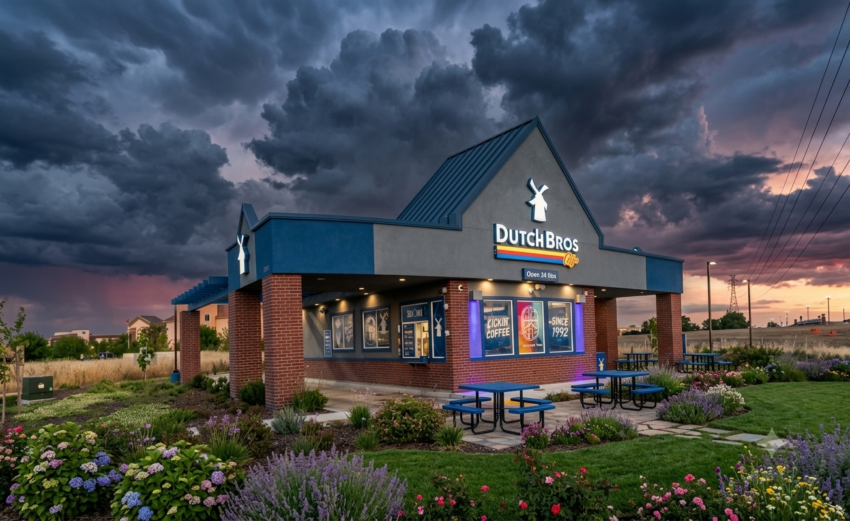
A Narrative History of Brotherhood, Loss, and a Coffee Empire Built on Kindness
The railroad tracks ran through downtown Grants Pass like a seam stitched into the floor of southern Oregon, and on a gray morning in 1992, two brothers wheeled a pushcart up beside them and waited to see whether anyone in the world wanted what they had to sell. They had no storefront, no second location, no franchise map pinned to a wall. They had a double-head espresso machine, a hundred pounds of beans, and the stubborn conviction of men who had just watched the only trade they had ever known slip out from under them. Dane Boersma was thirty-eight. His brother Travis was twenty-one. Behind them lay three generations of dairy farming and a barn gone quiet. In front of them lay a steaming machine and the smell of fresh espresso drifting toward strangers.
That image — two former dairymen, a cart, a set of train tracks — is the kind of origin story that sounds invented after the fact, polished by a marketing department into legend. It was not. It was simply where the money had run out, and the next idea had to begin. What neither brother could have known, as they handed espresso through the cold air to friends and the curious, was that the cart beside the tracks would one day become more than a thousand coffee stands across dozens of states, a billion-dollar company traded on the New York Stock Exchange, and a brand whose fiercest loyalists would call themselves a kind of family. Nor could they have known the price that would be paid along the way.
I sat down with my brother and we talked about what we should do next. Dane had owned a Dairy Queen franchise in his 20s and I was intrigued by the coffee trend starting in the Pacific Northwest. We drove through the northwest experiencing the coffee world and decided we wanted to give our own brew a shot. We started with 100 pounds of beans and a double head espresso machine.
— Travis Boersma, co-founder, Dutch Bros Coffee
This is the story of how that gamble paid off — not because the coffee was the best in America, though loyalists would argue the point, but because the Boersma brothers stumbled onto something rarer than a good roast. They figured out, almost by accident and then very much on purpose, that they were not really in the coffee business at all.
❖ ❖ ❖
I. The End That Became a Beginning
Before there was a coffee company, there was a dairy farm, and before the dairy farm faltered, there were the Boersmas — a family of Dutch descent who had worked Oregon land across three generations. To understand why two brothers would abandon the only life they knew for a pushcart and a hundred pounds of unfamiliar beans, you have to understand that they were not chasing a dream so much as fleeing the slow collapse of one.
The family’s third-generation dairy operation had been struggling, squeezed by changing environmental regulations and the unforgiving economics of small farming. The brothers were looking for a way out. It was Travis, the younger of the two, who suggested coffee — a cart, some espresso, a way to sell something people wanted every single morning. Dane had cash set aside from his years running a Dairy Queen franchise, and he put it toward the idea. Together, they spent roughly $12,050 on an espresso machine and a single pushcart and set it up in downtown Grants Pass.
They named the company in honor of their immigrant grandparents: Dutch Bros. Two Dutch brothers, plainly stated, with none of the studied whimsy that branding consultants would later have charged a fortune to invent. The honesty of the name was the point. It was a family business before it was anything else, and it would spend the next three decades insisting — sometimes against the gravitational pull of its own success — that it had never stopped being one.
A Milk House Laboratory
The earliest experiments did not happen beside the tracks at all. They happened in the family’s empty milk house, the very building that had once served the dairy that was now failing. There, amid the ghosts of an older trade, the brothers tinkered with flavored coffee, handing out free samples to friends and family to see what landed. Within a month, the verdict was in: people wanted more. Only then did the duo venture out into their southern Oregon town with the mobile espresso pushcart that would become the company’s founding image.
This product is a labor of love, a labor of passion. Every single bean is touched by a person. It’s picked, it’s looked at.
— Amber Boersma, member of the Dutch Bros founding family
A flavored-coffee craze was sweeping through the Pacific Northwest in those years — the same regional wave that had already lifted Starbucks and Peet’s out of obscurity — and Grants Pass was not immune. As the craze rolled through town and the surrounding areas, the Boersma brothers’ little company began to grow. They worked with local suppliers, fussed over quality, and anchored the whole enterprise to a borrowed philosophy they called the Dutch Creed: the Optimist’s Creed, a vow to think only the best, to work only for the best, and to expect only the best.
❖ ❖ ❖
II. From Cart to Constellation
Success, when it came, did not arrive as a single dramatic breakthrough but as a steady multiplication of carts and stands. Four more carts joined the first. By 1994, the brothers had established their inaugural drive-through location — a decision that would, in retrospect, define the entire company’s identity. While the specialty-coffee world fixated on the café as a ‘third place’ of armchairs and laptops, Dutch Bros bet on the car window. Speed, energy, and a thirty-second human connection handed across a counter: that would be the whole model.
In 1996, the company began roasting its own coffee, sourcing a blend of beans from El Salvador, Colombia, and Brazil — a three-country recipe it would keep for decades. Control of the roast meant control of the product, and it tied the brand’s quality directly to its own hands rather than a distant supplier’s.
The Customer Who Became a Franchise
The first hint that Dutch Bros could be more than a local phenomenon came not from a boardroom strategy but from a customer. In 1994, the Boersmas struck a deal with a regular named Marty McKenna, allowing him to open his own Dutch Bros in Medford, about thirty miles down the road. McKenna’s first stand did so well that he soon opened a second across town. In 1997, the brothers brought him on as a partner to keep expanding the Medford operations; two years later, they bought out his stake. The episode taught them something they would institutionalize: the best operators were often the people already standing on the customer’s side of the counter.
Formal franchising began in 1999, and the company opened its fiftieth franchised drive-thru in 2004. But that same year delivered a blow that could have ended the story entirely. Shortly after Dutch Bros moved into a new headquarters in Grants Pass, a nearby dumpster fire spread to the building, destroying the company’s roasting equipment, five vehicles, and thousands of pounds of coffee beans. For a company whose competitive edge ran straight through its own roastery, it was a gut punch. And yet, as with the failed dairy a dozen years earlier, the brothers treated catastrophe as a hinge rather than an ending. By the close of 2004, Dutch Bros operated sixty-one shops stretching from Northern California into Oregon’s Willamette Valley.
By 2009, the constellation had grown to roughly 135 coffee stands across seven states, generating around $50 million in gross annual revenue. The pushcart by the tracks had become a regional institution. But the year that brought that milestone would also bring the deepest wound in the company’s history.
❖ ❖ ❖
III. Drink One for Dane
In 2007, Dane Boersma was diagnosed with amyotrophic lateral sclerosis — Lou Gehrig’s disease, the cruel and incurable degeneration of the nerves that control the body’s every movement. For a man who had wheeled a pushcart up to a set of railroad tracks and built an empire on energy and human warmth, it was a diagnosis of almost unbearable irony. Two years later, in October 2009, Dane died.
What a company does with its grief reveals what it actually believes. Dutch Bros could have absorbed the loss privately, issued a press release, and moved on. Instead, it turned mourning into a mission. Out of Dane’s death came ‘Drink One for Dane,’ an annual fundraiser in which the company dedicates the proceeds of a designated day to the fight against the disease that took him. In its honor, locations donated their day’s revenue to research and family services; by one early accounting, a single year’s effort sent more than $110,000 toward the cause.
Culture is the key to our success. We have a culture of taking care of people — whether they are customers, our community, or our employees. We are in the relationship business, and coffee is simply a way of facilitating those relationships.
— Travis Boersma, co-founder, Dutch Bros Coffee
That sentence — coffee is simply a way of facilitating those relationships — is the philosophical center of the entire enterprise, and it was forged hardest in the years around Dane’s illness and death. The charity work multiplied. ‘Dutch Luv’ turned a February giving campaign into support for local food banks. ‘Buck for Kids’ channeled proceeds to youth organizations, including chapters of the Boys & Girls Clubs. The company took to describing its mission in almost devotional terms: to make a difference, one cup at a time.
It would be easy, and cynical, to read all of this as marketing. But the throughline from the failed dairy to the milk-house experiments to Dane’s fundraiser is too consistent to dismiss. The Boersmas had built a business whose product was a thirty-second human exchange, and when the family suffered its own loss, it widened that exchange into a form of public mourning and public generosity. The grief was real. So was the giving.
❖ ❖ ❖
IV. The Cult of the Broista
Walk up to a Dutch Bros window, and you will be served by a ‘broista’ — the company’s term for its frontline employees, a word that signals from the first syllable that this is not an ordinary drive-thru. New broistas are trained by more experienced ones known collectively as ‘The Mob.’ The most devoted customers have a name too: the ‘Dutch Mafia.’ The vocabulary is deliberately, almost defiantly unserious, and it points to a culture that the company guards with something close to ferocity.
Culture isn’t an event. It’s not a sign. It’s not a tagline. It’s something you live every day. You have to make sure you live that every day. It’s not fabricated. It’s as real as it can get.
— Joth Ricci, former President & CEO, Dutch Bros Coffee
The broistas have gone viral more than once for small acts of kindness — handing flowers to a customer going through a rough patch, leaning out the window to hug a grieving regular. The company hires, by its own description, extroverted optimists, and it built an entire operating model around the wager that a genuinely warm human interaction is worth more than a marble countertop or a quiet armchair. During the pandemic, that wager paid off in a way no one could have scripted: as Americans found themselves starved for ordinary social contact, a high-energy thirty-second exchange at a coffee window became, for many, a small daily lifeline.
Protecting the Culture, Even From Itself
The most revealing decision Dutch Bros ever made was to refuse easy money. In 2008, the company shifted to an internal franchising model that required prospective franchisees to have worked for the company for at least three years. You could not simply buy a Dutch Bros; you had to earn one from the inside. The result was a continuity rate that bordered on the unheard-of: between 2010 and 2015, only about three percent of all Dutch Bros franchise locations closed. The company even developed a habit of buying out franchisees who failed to meet its customer-service standards.
The logic was simple and stubborn. As the leadership put it, the company only promotes from within when it comes to expanding its culture and its business, precisely so that the way it does things stays protected. When Dutch Bros opened a location in College Station, Texas, 350 people applied for fifty positions — and management lamented that it could happily have hired a hundred and fifty of them. In 2017, the company stopped franchising to new operators altogether and began opening only company-owned stores, tightening its grip on the experience even further.
There is a faint paradox here worth naming plainly. A company can preach that it is ‘in the people business’ and still be, underneath, a fast-scaling beverage chain answerable to investors. Both things are true of Dutch Bros. The interesting question — one that the next chapter of its history is still answering — is whether a culture built on thirty-second moments of human warmth can survive being multiplied a thousandfold.
❖ ❖ ❖
V. The Pushcart Goes to Wall Street
For most of its life, Dutch Bros grew the slow way, store by store, broista by broista. As recently as the mid-2010s, it was still, astonishingly, a cash-only operation that did not take credit cards. Then came a sequence of decisions that transformed a regional darling into a public company. In 2018, the private-equity firm TSG Consumer Partners took a minority stake, and the company announced plans to push toward 800 stores. The pandemic, far from slowing the chain, accelerated its modernization — pushing it toward digital payment and a Dutch Rewards app that rocketed up the app-store charts.
On September 15, 2021, the pushcart reached Wall Street. Dutch Bros began trading on the New York Stock Exchange under the ticker BROS, opening at $23 a share. By noon, the price had jumped 48 percent; by the closing bell, it had landed near $36.68, a gain of almost 60 percent on the day, valuing the company in the neighborhood of $6 billion. The IPO raised roughly $484 million.
And the former dairy farmer who had spent his grandfather’s name on a pushcart? Travis Boersma, the largest shareholder, watched his personal stake swell past $2 billion during that single day of trading. The man who had once wheeled espresso up to the railroad tracks was, by the time the markets closed, a certified billionaire.
A company going public and making a big opening day splash on Wall Street isn’t exactly rare. But when it’s an IPO for a coffee company, that’s a new one for me. And when that IPO makes the owner of the company a certified billionaire — with a B — well, that’s stratospheric.
— Zac Cadwalader, Sprudge
The numbers kept climbing. By 2024, the company reported revenue of about $1.17 billion. Its average unit volumes pushed past $2 million — roughly double what a typical drive-thru burger chain might pull — and its same-store sales growth ranked among the strongest in the entire restaurant industry. The cash-drawer coffee stand had become a publicly traded machine generating well over a billion dollars a year.
❖ ❖ ❖
VI. Going East, Leaving Home
A company that opens its thousandth location has, by definition, outgrown the town where it began. Dutch Bros crossed that threshold in early 2025, opening its 1,000th store in Orlando, Florida — about as far from the railroad tracks of Grants Pass as the brand had ever ventured. The chain that once stretched from Northern California to the Willamette Valley now reached the Atlantic, planting its windmill logo stands across Texas, Oklahoma, Florida, the Midwest, and the Southeast, frequently to long lines and conspicuous local fervor.
Then came the decision that stung Oregon. After more than three decades headquartered in Grants Pass — the town that had given the company its founding myth — Dutch Bros announced in June 2025 that it would relocate its headquarters to the Phoenix, Arizona area, settling in Tempe to support what it called its next phase of national growth. The company framed the move as a matter of logistics and ambition; for many in southern Oregon, it felt like the moment a hometown hero packs up and leaves for the big city. The original pushcart site, which the company had lovingly bought back in 2017 and converted into futsal courts and workout space for the community, remained a monument to a beginning the corporate body had now physically outgrown.
The First Acquisition
In January 2026, Dutch Bros made the first acquisition in its history, agreeing to buy Clutch Coffee Bar, a twenty-unit drive-through chain scattered across North and South Carolina. The targets would be closed, renovated, and reopened under the Dutch Bros banner — a new and faster way to plant its flag in unfamiliar territory. Clutch’s own leadership described the sale as reaching a natural point where exiting to Dutch Bros could accelerate its mission without compromising its values, praising the larger company’s people-first approach. By the third quarter of 2025, Dutch Bros had already reached more than 1,080 locations, and it had set itself a deliberately poetic target: 2,029 shops by the year 2029.
Dutch Bros’ people-first approach, operational expertise, and long-term vision create an opportunity for team members and customers to thrive, while preserving the culture and community focus that fueled our success from the start.
— Clutch Coffee Bar, on its acquisition by Dutch Bros
❖ ❖ ❖
VII. The Not-So-Secret Menu
No portrait of Dutch Bros would be complete without the drinks themselves, which have become a culture unto themselves. Beyond the standard espresso and cold brew lies a sprawling, semi-official ‘secret menu’ of inventions that read less like a coffee list and more like a candy store’s fever dream — a riot of color, sugar, and the company’s signature Rebel energy drink. There is the Blended Peach Ring Rebel, the Iced Red White & Blue Rebel, and the Tropical Rebel with passion fruit and coconut. There is a Peach Cobbler Freeze built to taste like dessert, a Palm Beach Lemonade meant to taste like vacation, and an Iced Vampire Slayer Green Tea balancing sour against sweet.
The secret menu is not really a secret at all — the company publishes it — and that is exactly the point. It invites customers into a shared in-joke, a sense of insider knowledge that turns a drink order into a small act of belonging. It is the broista philosophy poured into a cup: the transaction is never only a transaction. It is an invitation to be part of something with a name, a vocabulary, and a wink.
❖ ❖ ❖
VIII. The Windmill By The Window
There is something faintly absurd about it, if you stop to think. You pull up to a drive-thru window somewhere in Texas or Florida or the Arizona desert, a broista leans out with a sugar-bright energy drink the color of a tropical sunset, and watching over the whole transaction — stamped on the cup, the wall, the sign rising over the parking lot — is a Dutch windmill. Not a coffee bean. Not a steaming mug. A windmill: the four-bladed, land-reclaiming machine of the Low Countries, an emblem older than espresso and stranger, in this context, than anyone seems to notice. It is one of the most recognizable marks in American coffee, and it has almost nothing to do with coffee at all. Which is exactly the point.
The blue windmill is not a decoration. It is a memorial. To understand why two brothers chose to crown a fast-growing beverage empire with a symbol of the Netherlands, you have to read the logo the way you would read a coat of arms — as a compressed act of remembrance, every element pointing back to where the family came from and what it survived.
A Name That Means Farmer
Begin with the name itself, because the logo is only the name made visible. Dutch Bros is exactly what it announces: two brothers of Dutch descent. Dane and Travis Boersma were the grandsons of immigrants from the Netherlands, and their surname carries the whole story in a single syllable. Boer is the Dutch word for farmer. The brothers who would spend three generations working an Oregon dairy before trading it for a coffee cart were, quite literally, named for the soil. When their family business collapsed, and they reinvented themselves beside the railroad tracks in Grants Pass in 1992, they took as their company’s name the plainest possible tribute to the people who had crossed an ocean before them.
So the windmill, when it finally arrived, was not a marketing department’s clever flourish. It was the visual echo of a name that already meant farmer, immigrant, Netherlander — a heritage stated twice, once in words and once in a turning blue blade.
The Windmill That Wasn’t There
Here is the detail most customers would never guess: in the beginning, there was no windmill at all. The first Dutch Bros logo, born alongside the 1992 pushcart, was as humble as the cart itself — thin black letters spelling out the company’s name, nothing more. No symbol, no color, no flourish. It was a wordmark for a business that did not yet know it would become an empire, drawn by people who had bigger problems than brand identity.
The windmill made its first real appearance only as the company began to grow and the need for a memorable, cohesive identity became unavoidable — sources place its arrival near the end of the 1990s, around 1999, with the refined, recognizable version settling into place circa 2000. And once it appeared, it instantly took center stage. The wordmark stepped back; the symbol stepped forward. From that moment, Dutch Bros was no longer a company with a name. It was a company with an emblem — and an emblem can travel onto a cup, a beanie, a phone screen, and a fifteen-foot sign in ways a line of black text never could.
The chain is widely recognizable by its blue windmill logo that makes an appearance on cups, buildings, signs, and more.
— Tasting Table
The evolution did not stop there. Over the decades, the mark passed through several phases — bolder outlined lettering, a flowing script for the word “Coffee” in red or yellow, even early variations that scattered red and yellow tulips beside the windmill’s base, another unmistakable nod to the Dutch countryside. Later refinements stripped the detail away toward a cleaner, more digital-friendly silhouette, and a 2021 refresh introduced a vertical stripe that neatly divided the windmill from the wordmark. Through every revision, the company held onto the one element that carried the meaning: the windmill stayed.
Why a Windmill Remembers
It would be enough, perhaps, for the windmill to simply mean “Holland” — a tidy bit of visual shorthand for the founders’ roots. But the symbol runs deeper than national costume, and the deeper reading is the one worth sitting with.
Windmills are bound up with the very survival of the Netherlands. The country is famously low, much of it at or below sea level, and for centuries the Dutch used windmills not merely to grind grain but to pump water and reclaim land from the sea itself — to take back, acre by patient acre, ground that the ocean had claimed. More than a thousand traditional windmills still stand in the Netherlands today, many of them operational, monuments to a people who refused to surrender their home to the water.
For centuries, windmills have been used in the Netherlands to reclaim the land from the sea, mirroring how the Dutch bros of Dutch Bros took hold of their European heritage that was claimed by the ocean.
— Tasting Table
Read that way, the little blue windmill on a coffee cup becomes almost startlingly apt. Here were two brothers whose family had crossed the sea, whose own farm — their inherited patch of ground — had been pulled out from under them by forces beyond their control. And what did they do? They reclaimed. They built something new on the very site of what had been lost, turning the empty milk house of a failed dairy into the birthplace of a coffee company. The windmill does not just say “we are Dutch.” It says, “We take back what the tide takes away.” Whether the Boersmas intended that full resonance or simply reached for the most honest symbol of home, the mark fits the men with uncanny precision.
The Quiet Craft of Two Blues
There is craft in the thing, too, beneath the symbolism. The modern mark works in a disciplined palette of blue and white, and designers note that it actually carries two shades of blue — a darker tone defining the X-shaped cross of the windmill’s sails, a lighter one washing the roof, the window, the door, and the dividing stripe. The eye barely registers the distinction, yet it is there, lending the flat icon a quiet sense of depth. The grid pattern across the sails is not arbitrary either; it recalls the lattice framework over which real windmill blades were once stretched, so the wind could turn the stones. It is a small symbol that rewards a long look.
The Symbol as Belonging
A logo, at its most powerful, stops being a picture and becomes a password. The Dutch Bros windmill long ago crossed that line. For the brand’s most devoted customers — the self-described “Dutch Mafia” — the blue silhouette on a beanie or a sticker is not advertising; it is affiliation. It signals that you know the secret menu, that you have a regular broista, that a thirty-second window exchange is part of the rhythm of your week. The windmill has become the flag of a small, sugar-fueled republic of belonging.
That is a remarkable amount of freight for a symbol that began as nothing — an afterthought to a wordmark on a pushcart, added years after the fact by a company that was making it up as it went. But that is precisely the arc that makes the logo worth a segment of its own. It compresses the entire Dutch Bros story into a single image: humble origins that left no room for branding; a heritage too important to leave unspoken; a loss reclaimed and rebuilt; and finally, a community that adopted the mark as its own. The windmill remembers all of it. It turns, quietly, over every window — a memorial disguised as a logo, grinding nothing, and somehow carrying everything.
❖ ❖ ❖
Epilogue: What the Cart Was Always Carrying
Stand again, for a moment, beside those railroad tracks in 1992. Two brothers, a borrowed philosophy, a hundred pounds of beans. From that vantage point, nearly everything that followed looks impossible: the thousand-plus stands, the billion-dollar revenue, the New York Stock Exchange banner, the billionaire former dairyman, the headquarters in Arizona. And threaded through all of it, the loss of Dane — the older brother who helped imagine the whole thing and did not live to see it conquer the country.
But the deeper truth of the Dutch Bros story is that the most valuable thing on that pushcart was never the espresso machine. It was the brothers’ instinct, half-accidental and then fiercely deliberate, that they were selling human connection with a coffee chaser. Every decision that mattered flowed from that single insight: the drive-thru built for a thirty-second exchange, the broistas hired for warmth, the franchises handed only to insiders who had lived the culture, the fundraiser born from a brother’s death, the secret menu that made strangers into members of a club. The coffee was the occasion. The relationship was the product.
Whether that intimacy can survive the company’s own staggering scale is the question the next chapter will answer. A pushcart can look every customer in the eye. A thousand-store public company, racing toward two thousand, has to work much harder to do the same. But if Dutch Bros has proven anything across three decades — through a failed dairy, a warehouse fire, a devastating diagnosis, and a Wall Street debut — it is that the improbable has a way of becoming, in its hands, inevitable. The cart by the tracks was always carrying more than coffee. It still is.
❖ ❖ ❖
Sources & Further Reading
• Dutch Bros Coffee, “From Seed to Cup: An Origin Story.” https://www.dutchbros.com/news-events/dutch-bros-coffee-from-seed-to-cup/
• Janna Reid, “Dutch Bros. Coffee Company,” The Oregon Encyclopedia (Oregon Historical Society). https://www.oregonencyclopedia.org/articles/dutch_bros_coffee_company/
• Sean Miller, “The Humble Pushcart Origins of Dutch Bros Coffee,” Daily Meal. https://www.thedailymeal.com/1627434/dutch-bros-coffee-origin-story/
• “Dutch Bros Coffee,” Wikipedia. https://en.wikipedia.org/wiki/Dutch_Bros_Coffee
• Zac Cadwalader, “Dutch Bros Just Went Public And Now Their Owner Is A Billionaire,” Sprudge. https://sprudge.com/dutch-bros-just-went-public-and-now-their-owner-is-a-billionaire-181398.html
• Julie Littman, “Dutch Bros acquires 20-unit coffee chain,” Restaurant Dive. https://www.restaurantdive.com/news/dutch-bros-acquires-clutch-coffee/809710/
• Jonathan Maze, “Five things to know about Dutch Bros Coffee,” Restaurant Business. https://www.restaurantbusinessonline.com/financing/five-things-know-about-dutch-bros-coffee
• Dutch Bros Coffee, “10 DB Drinks You May Have Never Heard Of” (Secret Menu). https://www.dutchbros.com/news-events/secret-menu-drinks/
• Dutch Bros Inc., Investor Relations. https://investors.dutchbros.com/overview/default.aspx
• Tasting Table, “We Finally Learned The Meaning Behind The Dutch Bros Windmill Logo.” https://www.tastingtable.com/2142964/dutch-bros-logo-meaning-explained/
• DesignYourWay, “The Dutch Bros Logo History, Colors, Font, And Meaning.” https://www.designyourway.net/blog/dutch-bros-logo/
• 1000 Logos, “Dutch Bros Logo and Symbol, Meaning, History.” https://1000logos.net/dutch-bros-logo/
• Logos-World, “Dutch Bros Logo, Symbol, Meaning, History.” https://logos-world.net/dutch-bros-logo/
• Money Inc., “The History of and Story Behind the Dutch Bros Logo.” https://moneyinc.com/dutch-bros-logo/
• Slant POS, “Dutch Bros Logo History and Evolution.” https://blog.slantco.com/dutch-bros-logo-history-and-evolution/
❖ ❖ ❖
A Note on Research Methods and Accuracy
In recent years, some have voiced concern that artificial intelligence may distort facts or introduce inaccuracies into serious research. That criticism deserves acknowledgment. However, AI has now evolved into the most powerful research instrument available to any dedicated scholar—capable of analyzing vast datasets, cross‑referencing historical records, and surfacing overlooked connections across sources. This work represents a collaboration between the author’s investigative inquiry, verified primary documentation, and the advanced analytic capabilities of AI research tools. Here, AI was not used as a ghostwriter or a shortcut for scholarship, but as a disciplined research partner devoted to rigor, accuracy, and transparency.
Every factual claim in this work has been subjected to active verification. Where AI‑generated content was used as a starting point, it was tested against primary sources, peer‑reviewed scholarship, official institutional documentation, and established historical records. Where discrepancies were found—and they were found—corrections were made. The author has made every reasonable effort to ensure that quotations are accurately attributed, historical details are precisely rendered, and theological claims fairly represent the positions they describe or critique.
That said, no work of this scope is immune to error, and the author has no interest in perpetuating inaccuracies in the service of an argument. If you are a reader—whether sympathetic, skeptical, or hostile to the conclusions drawn here—and you identify a factual error, a misattributed source, a misrepresented teaching, or a claim that cannot be substantiated, you are warmly and genuinely invited to say so. Reach out. The goal of this work is not to win a debate but to get the history right. Corrections offered in good faith will be received in the same spirit, and verified corrections will be incorporated into future editions without hesitation.
Truth, after all, has nothing to fear from scrutiny—and neither does this work.