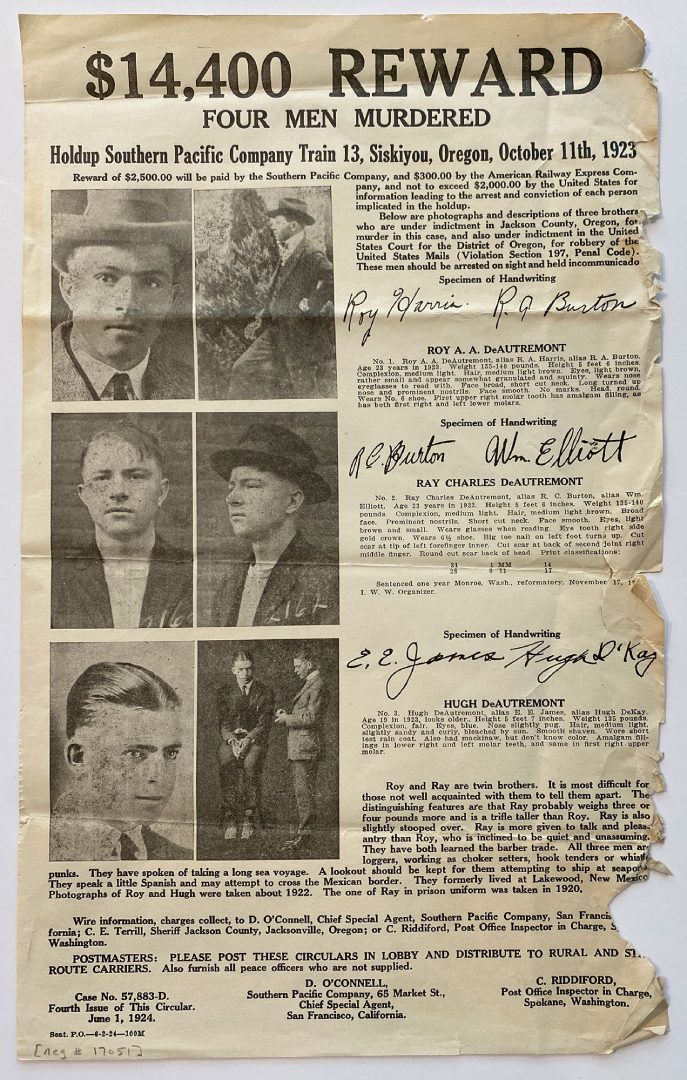
Image: Wanted poster, distributed June 1, 1924. Courtesy Southern Oregon
Historical Society 1988.11-8.5, MS 672 (via Smithsonian)
A Narrative History of the West’s Last Great Train Robbery
❖ ❖ ❖
On the morning of October 11, 1923, engineer Sidney Bates had exactly one day of work left in him. After a long career on the Southern Pacific main line, he was scheduled to begin his retirement the following morning. He would not live to see it. Before noon, he would be standing beside his locomotive at the dark mouth of a mountain tunnel, hands raised in surrender, a shotgun leveled at his head by a nineteen-year-old who wanted no witnesses.
What happened in the next half hour high in Oregon’s Siskiyou Mountains was so bungled, so gratuitously cruel, and so completely without profit that it would come to be remembered by two contradictory names. To the newspapers, it was the Siskiyou Massacre. To the historians, it became the West’s last great train robbery — though in truth there was nothing great about it, and not a single dollar was taken. Four men died for nothing. And out of that nothing, almost by accident, came something that would change the way the modern world catches criminals.
On that fateful day in 1923, the DeAutremont brothers entered Tunnel 13 in one era, and came out in another.
— Chelsea Rose, research archaeologist, Southern Oregon University Laboratory of Anthropology
This is the story of three brothers who dreamed of a fortune in gold and left behind only corpses and a pair of greasy overalls — and of the quiet, self-taught chemist in a basement laboratory across the California line who looked at those overalls and, as if by sorcery, named the men who had vanished into the wilderness.
~
A personal note. This story is, for me, not only a chapter of national history but a piece of family geography. When the dynamite tore open that mail car high in the Siskiyous, my father was one month old, an infant in southern Oregon not far from the very mountains where the killing took place. He would grow up in that country in the long shadow of the crime — among the wreaths laid at Tunnel 13, the Jacksonville courthouse where the brothers were tried, and the grim local memory of the morning four working men did not come home. The DeAutremont tragedy was, quite literally, put on the national map in the month my father drew his first breaths. I tell it here with that nearness in mind: not as a distant legend of the Old West, but as something that happened down the road, in living memory, to people whose neighbors my family knew.
❖ ❖ ❖
I. Three Brothers and a Dream of Gold
The DeAutremonts were not born to crime. They were the sons of Paul DeAutremont, a barber of French descent, and Isabella Bertha Wombacher, of German stock. Twins Roy and Ray were born on March 30, 1900, in Iowa; their younger brother Hugh arrived on February 21, 1904, in Arkansas. The family drifted, as so many did in that restless age, and the boys grew up hard. After their father left the family, the twins struck out on their own as teenagers, riding freight trains from town to town and taking whatever itinerant work they could find — picking fruit, felling timber, surviving.
Ray was the one who first brushed against the law. During the First World War, he had joined the Industrial Workers of the World — the radical labor union whose members were known as the “Wobblies” — and in the Red Scare sweeps that followed the war, he was caught in the dragnet. He spent roughly a year in custody. The experience did not reform him so much as embitter him. According to the Offbeat Oregon historian Finn J.D. John, the jail term convinced Ray that the system was not worth saving, and that he might as well become an outlaw and take what he could grab.
Hugh, the youngest, was cut from seemingly finer cloth. He had been a good student and a quarterback on his high school football team, graduating in New Mexico in June 1923 before joining his brothers at an Oregon logging camp. The newspapers, when the trials finally came, would marvel at the contradiction. “These boys weren’t cut out for a life of crime,” a Southern Oregon Historical Society staffer later reflected. “What a shame.”
Crime, however, was precisely what they kept reaching for — and failing at. The brothers had already bungled their way through two earlier attempts to enter the underworld. They traveled to Chicago, hoping to join a gang, and were turned away. Back in the Pacific Northwest, they cased a bank and were, in one of the great absurdities of criminal history, beaten to the punch: as they approached their chosen target, a carload of actual gangsters pulled up and robbed “their” bank in front of their astonished eyes. Defeated, they took jobs on logging crews near Silverton and bided their time.
The Number 13 Gold Special
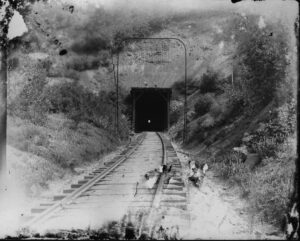
Then they fixed upon the train. Southern Pacific’s Train No. 13 ran south from Portland toward San Francisco, and it carried a romantic, dangerous nickname: the “Gold Special.” In the Gold Rush years, it had hauled “color” — bullion and coin — over the Siskiyous, and although the California gold fields had long since played out, the cachet clung to the train like woodsmoke. The brothers had heard rumors. Some accounts say they believed the mail car held $40,000; one local history records a figure as wild as half a million dollars in gold. Whatever the true number in their heads, they convinced themselves it was worth killing for.
Their chosen ground was a masterstroke of grim logic. Tunnel 13 had been bored through more than half a mile of bedrock in 1887, directly beneath Siskiyou Pass — the highest point on the Southern Pacific main line between Portland and southern California. The grade up the north side was a punishing 3.67 percent, the steepest on the route, and railroad safety rules required the train to slow near the summit to test its brakes before the long descent into California. A train crawling to a near-stop at the mouth of a tunnel was a train a man could climb aboard. Better still, the brothers had found an abandoned cabin in the timber above the tunnel, and they made it their arsenal — stockpiling food, firearms, a full box of dynamite stolen from a construction crew, and a plunger-type detonator.
The most famous train holdup in Oregon was a ham-fisted disaster… an attempt by brothers Ray, Roy, and Hugh DeAutremont to rob a Southern Pacific Railroad train at Tunnel 13, high in Oregon’s Siskiyou Mountains, ended with a burned-out mail car, no payout, and four men dead.
— Jeff LaLande, The Oregon Encyclopedia
❖ ❖ ❖
II. Thirty Minutes of Slaughter
Late on the morning of October 11, the trap was set. Ray waited at one portal of the tunnel with the box of dynamite. His brothers — Roy with a sawed-off shotgun, Hugh with a Colt .45 automatic — concealed themselves in the brush at the other end, where the train would emerge. At about 12:30 in the afternoon, southbound Train No. 13 labored up to the summit: engine, mail car, baggage cars, and passenger coaches. The helper engine that had pushed it up the grade uncoupled and switched away. Before engineer Sidney Bates and his fireman Marvin Seng could finish the brake test, Roy and Hugh swung aboard the locomotive and leveled their weapons.
They forced Bates to pull the engine forward and stop with the locomotive and mail car just clear of the tunnel’s far portal — leaving the passenger coaches behind, still inside the bore, so that the travelers could not see what was happening. It was a calculated cruelty that would nearly suffocate the innocent: as coal smoke and, soon, far worse drifted back into the tunnel, the passengers were trapped in the dark like rats, coughing and panicking, with no idea what had seized their train.
“Blown to Bits”
Everything now turned on the mail car — and everything now fell apart. The brothers shouted at the railway mail clerk, Elvyn Dougherty of Ashland, to open the door. Dougherty did the brave and fatal thing: he locked himself inside the secured car. The DeAutremonts, knowing nothing of the science of demolition, did not wire a few measured sticks to spring the door. Roy used the entire box of dynamite. Decades later, in a sworn statement, he described the moment with a flatness more chilling than any melodrama:
Roy gave the detonator a push and the mouth of the tunnel was rocked by a tremendous explosion. It was far stronger than we had planned. In fact, the blast was so severe that the mail clerk was blown to bits.
— Roy DeAutremont, sworn confession (cited in Michael Newton, The Encyclopedia of Robberies, Heists, and Capers)
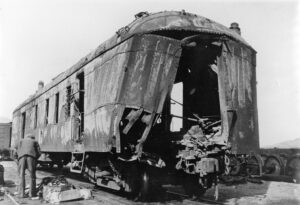
The explosion did not open the mail car. It obliterated it. The wooden coach was torn apart and set ablaze, the interior instantly transformed into a smoke-choked inferno. Elvyn Dougherty was killed where he stood. The $40,000 in imagined treasure — if any treasure had ever truly been aboard — was now being consumed by fire along with the federal mail. The brothers had destroyed the very thing they had come to steal.
What followed was not robbery but butchery. A brakeman, Coyle O. Johnson, hearing the blast and thinking perhaps the engine’s boiler had burst, made his way forward through the smoke-filled tunnel to investigate. He emerged from the portal directly into the brothers’ panic. They shot him down — Roy with the shotgun, Hugh firing his .45, and then, as Roy’s own confession records, Hugh walked over to the dying man and shot him again, in cold blood.
Now, some witnesses had to die. The brothers ordered Bates to move the engine forward and Seng to uncouple the burning mail car, intending to flee aboard the locomotive — but the blast had damaged the couplers, and the wheels merely spun. The plan was finished. So, the brothers decided, were the men. Engineer Sidney Bates and fireman Marvin Seng were made to stand with their arms raised and were shot through the head. The detail recorded by the coroner is one a novelist would hesitate to invent: the bullets passed through the men’s upraised arms before striking their temples. One day from retirement, Bates died with his hands in the air.
In Roy’s own words, the decision was as cold as the morning air:
Ray and I had a brief consultation as to what we should do. We decided to kill the fireman… I shouted at him to bump him off and then we would clear out. We didn’t want any witnesses.
— Roy DeAutremont, sworn confession
Four men were dead — Dougherty, Johnson, Bates, and Seng — and the brothers had precisely nothing to show for it. They fled into the woods toward their cache two to three miles from the tunnel, dragging gunny sacks soaked in creosote behind them to throw off the bloodhounds. “That is the reason your dogs wouldn’t do any good,” Roy would later write in his confession. Behind them, they left widows, fatherless children, a burning train, and a tunnel full of terrified survivors.
❖ ❖ ❖
III. The World’s Greatest Manhunt
The crime stunned the nation. That a gang could murder four working men in the modern year of 1923 — not in the lawless 1870s of Jesse James, but in the age of the automobile and the telephone — and then simply vanish into the mountains seemed an affront to the entire idea of progress. The response was correspondingly enormous.
Armed posses fanned out from Tunnel 13. The Oregon National Guard checked houses and barns along the Pacific Highway. Southern Pacific’s own investigators, postal inspectors, and sheriffs from both Oregon and California combed the rugged country. And overhead — in what was very likely a law-enforcement first in the United States — U.S. Army and Forest Service patrol planes circled low over the Siskiyous, scanning the timber for fugitives. It was a strikingly modern dragnet thrown after a strikingly old-fashioned crime.
And yet, for nearly two weeks, the brothers were hiding almost under the searchers’ noses, holed up in their well-stocked cabin in the dense brush. They watched the unfamiliar airplanes crisscross the sky without understanding why. It was only when Roy slipped down to Ashland for supplies, sat in a diner with a cup of coffee, and looked down at the newspaper that he understood: there on the front page were photographs of himself and his brothers. The hunt was on, and they were its quarry.
The scale of the pursuit became legendary. Postal authorities printed wanted posters by the millions — most accounts settle near 2.5 million, in English, Spanish, French, Portuguese, German, and Dutch — and distributed them across the United States, Canada, Latin America, and Europe. They were tacked up in post offices, railroad depots, barbershops, and jewelry stores around the globe. The combined reward climbed to $15,900, split among the three brothers: a federal contribution, a Southern Pacific share, and a sum from the Railway Express. The investigation would ultimately consume more than half a million dollars — the equivalent of several million today — and stretch across nearly four years, earning its reputation as one of the largest and most expensive manhunts in American history.
But money and manpower had produced no names. The searchers knew exactly how the crime had been committed. They had no idea who had committed it. The evidence gathered at the scene — a Colt .45 automatic, a pair of “Pay Day” brand bibbed overalls, the detonator, shotgun and pistol shells, a black travel bag, gunny sacks reeking of creosote — sat in the Jackson County sheriff’s office, mute. Over a dozen suspects were jailed and questioned. None could be tied to the killings. The case was going cold.
❖ ❖ ❖
IV. The Wizard of Berkeley
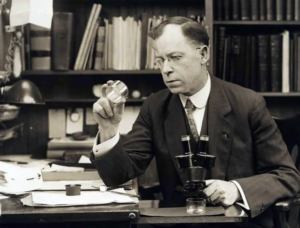
In a moment of either desperation or inspiration, the authorities did something almost no American police force had done before. They packed up their scant evidence and shipped it across the state line to a forty-two-year-old chemistry lecturer at the University of California who ran a private crime laboratory out of the basement of his Berkeley home. His name was Edward Oscar Heinrich.
It is difficult, a century on, to convey how radical this was. In the early 1920s, crime laboratories existed only in Europe. The FBI’s famous forensics division would not be founded until 1932 — and, by several accounts, the DeAutremont case helped inspire its creation. To hand a murder investigation to a university professor and his microscope was, in 1923, a genuine leap of faith.
Heinrich was an unlikely wizard. His father had died by suicide when Heinrich was a teenager, throwing the family’s survival onto the boy’s shoulders. He trained himself as a pharmacist, passed the boards at eighteen, and then talked his way into the University of California despite lacking a high-school diploma, entering as a special-status student and graduating in chemistry in 1908. He taught himself ballistics, handwriting analysis, ink and typewriting analysis, blood-spatter interpretation — an entire science assembled by sheer will. By the summer, he was teaching what is generally regarded as the first criminology course offered anywhere in the country. He was, as one archivist put it, a jack-of-all-trades who taught himself almost everything he knew.
What the Overalls Confessed
The authorities had nearly thrown the overalls away. A grease-like stain on the denim had convinced them the garment belonged to a local automobile mechanic — a dead end. Heinrich bent over the cloth in his laboratory and saw an entire biography. The stain was not engine grease. It was fir pitch. The fine dust packed into the seams and pockets was Douglas-fir sawdust, the signature of a man who worked the timber of the Pacific Northwest.
From the cut and wear of the cloth, the contents of the pockets, and the set of the suspenders, Heinrich reconstructed a portrait of breathtaking specificity. His own report — recovered decades later in the Bancroft Library archives and published for the first time by forensic scientists Pepper Trail and Edgard Espinoza — reads less like a lab note than a séance:
From a microscopic examination of the dust, hair, and fibers collected from the pockets… I am of the opinion that the wearer and owner was a lumber jack employed in a fir or spruce logging camp. I computed him… to be a white man not over five feet ten inches tall, probably shorter; weight not over 165 pounds, probably less. Age between 21 and 25… medium light brown hair, complexion fair; has light brown eyebrows.
— Edward Oscar Heinrich, original forensic report (cited by Pepper Trail & Edgard Espinoza, Jefferson Public Radio)
He went further. By studying how the suspenders and pockets had been worn — the left suspender set three-quarters of an inch higher than the right, the left-side pockets most frequently used — he determined the man was left-handed. A left-handed logger swinging his axe would present his right side to the tree, and so his right pocket would catch the flying chips; that pocket held wood chips. In a breast pocket Heinrich found neatly trimmed fingernail clippings, rolled cigarette butts, and traces of mustache wax — the marks of a vain, fastidious man who, the chemist predicted, would be caught wearing a new jacket and a hat. When Roy DeAutremont was at last taken, he was reportedly smoking a cigarette and wearing exactly such a jacket and hat.
The Receipt in the Pencil Pocket
The decisive clue was the smallest. Jammed deep in the narrow pencil pocket of the bib was a crumpled slip of paper, faded and blurred by repeated washings, that every other investigator had overlooked. Heinrich coaxed it back to legibility with iodine vapor. It was a receipt for a registered letter, postmarked Eugene, Oregon, September 14, 1923, and it carried a number that could be traced. The registered article had been a $50 money order sent by Roy DeAutremont to his brother Hugh in Lakewood, New Mexico.
With that, the faceless killers had a name. Heinrich linked the recovered .45 to the family through serial-number restoration; hair from the overalls placed Roy at the scene; handwriting on supply receipts placed Hugh at the planning cabin. Investigators questioned the brothers’ father, Paul DeAutremont, who confirmed that all three sons were lumberjacks and that Roy was left-handed. The portrait conjured from a pair of greasy overalls had become a wanted poster with three faces. The press, dazzled, christened Heinrich the “Wizard of Berkeley” and the “Edison of crime detection.”
From a forensic point of view, these inferences from a pair of overalls are amazing — better than TV scripts for popular CSI shows.
— Pepper Trail & Edgard Espinoza, “Tunnel 13: How Forensic Science Helped Solve America’s Last Great Train Robbery,” Jefferson Public Radio
The DeAutremont case did more than catch three killers. It validated, before a watching nation, the very idea that a crime could be solved in a laboratory. Within months, Los Angeles established the first municipal police crime laboratory in the United States, directed by August Vollmer, a former Berkeley police chief and a student of Heinrich’s. The remote, rain-soaked wilderness of southern Oregon had become, improbably, the cradle of American forensic science.
❖ ❖ ❖
V. Four Years, Three Captures
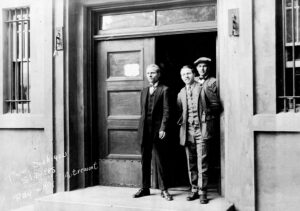
Naming the brothers was not the same as catching them. Even with their faces on millions of posters, the DeAutremonts slipped south, split up, and disappeared into ordinary American lives. For nearly four years, the most wanted men in the country simply… worked, married, and waited. The resolution, when it finally came, owed less to the great machinery of the manhunt than to a single pair of eyes that happened to land on a wanted poster.
Hugh had joined the U.S. Army under the alias James C. Price — a name he reportedly chose because he used “James” in every alias in honor of his idol, the outlaw Jesse James. He served in the Philippines. In early 1927, a soldier who had known him there recently transferred to the Army prison on Alcatraz Island — saw Hugh’s photograph on a wanted poster and recognized his former comrade. Hugh was arrested in the Philippines on February 15, 1927. He admitted his identity but denied the murders, and managed to stall his return to the United States until March.
His arrest threw the brothers’ faces back onto the nation’s front pages — and that publicity undid the twins. Ray and Roy had drifted to Ohio, living under the name Goodwin. Ray had even married and fathered a child. Someone recognized them in Steubenville from the renewed posters; Ray’s bleached hair had not been a disguise enough. FBI agents arrested the pair on June 8, 1927. They offered no resistance.
The Jacksonville Trials
The brothers were extradited to Jackson County, Oregon, where the old Jacksonville courthouse would have its last great moment before the county seat moved to Medford. Hugh’s first murder trial ended in a mistrial when a juror died; a second began on June 10, 1927, just two days after the twins were taken in Ohio. On June 21, after only ninety minutes of deliberation, a jury convicted Hugh of the first-degree murder of brakeman Coyle Johnson, though the jurors recommended leniency. Faced with the evidence and with Hugh’s conviction, Ray and Roy pleaded guilty to all four murders to escape near-certain death sentences.
The bargain enraged the railroad and postal men who had wanted to see the killers hang. A San Francisco editorial caught the public’s bitterness:
It was one of the most dastardly and contemptible crimes in recent history and involved the killing of three workingmen, whose deaths were not even necessary to the carrying out of the robbery… Somehow the punishment does not seem to fit the crime.
— Editorial, San Francisco News Letter (1927)
All three brothers were sentenced to life imprisonment at the Oregon State Penitentiary in Salem. The West’s last great train robbery was, at last, closed.
❖ ❖ ❖
VI. The Long Shadow

Prison did strange and human things to the three men who had behaved so inhumanely on that October morning. Hugh founded and edited an inmate magazine called Shadows, which twice won national honors as the best prison publication in the country, earning him the wry title “Dean of Prison Journalism.” Ray worked in the prison flax mill, taught himself French, Spanish, and Latin, instructed other inmates, and took up landscape painting — several of his canvases won prizes in local exhibitions, and one, Solitude, Silence and Mountains, survives today in the Oregon Historical Society’s museum collection. Roy, who had likely been the most disturbed of the three from the beginning, worked as a prison barber and contributed to his brother’s magazine before his mind gave way.
Their ends were as melancholy as their crime was brutal. Roy was diagnosed with schizophrenia in 1949, transferred to the Oregon State Hospital, and subjected to a prefrontal lobotomy that left him unable to care for himself. Paroled at last in the early 1980s, he died in a Salem nursing home in 1983. Hugh was paroled in 1958, went to work as a printer in San Francisco, and died of stomach cancer on March 30, 1959 — his fifty-fifth birthday — only months after his release.
Ray lived the longest and, perhaps, repented the most openly. Paroled on October 27, 1961, he settled in Eugene and worked for years as a part-time custodian at the University of Oregon, painting and studying languages in his quiet hours. In 1972, Governor Tom McCall commuted his sentence after Ray asked simply “to be a free man before I die.” Asked by reporters how it felt to walk out of prison, he gave an answer that serves as the truest epitaph for the whole sorry affair:
For the rest of my life I will struggle with the question of whatever possessed us to do such a thing?
— Ray DeAutremont, upon his release, 1961
Ray died in a Eugene nursing home on December 20, 1984, the last of the brothers. All three are buried together beneath a single grave marker beside their mother, Belle, in Belcrest Memorial Park in South Salem — three men who chased a fortune that never existed and paid for it with four other men’s lives and most of their own.
An Unsolved Whisper
History left one tantalizing loose thread. The brothers are universally remembered as having fled empty-handed — and they almost certainly did. Yet in their search of the long-buried Jackson County case files, forensic scientists Trail and Espinoza found witness statements that do not quite fit the tidy story. In December 1923, weeks after the robbery, a small, dark stranger reportedly retrieved a heavy, carefully wrapped bundle — supposedly “walnuts” — from the loft of a remote woodcutter’s cabin near the Siskiyou foothills. The woodcutter, T. B. Gosnell, doubted the walnut story; another man found a slashed Mackinaw coat in a nearby creek; and on the door of a nearby unoccupied cabin, someone had penciled the words “DeAutremont Bros.”
It is almost certainly nothing — the romantic imagination’s reluctance to accept that four men died for an empty mail car. But it lingers. As the woodcutter’s neighbor, Frank Stullenberger, observed with frontier common sense, walnuts left unguarded in an open cabin would have been carried off by squirrels the first night. “It appears to me,” he said, “that some foul play has been committed in that vicinity.” The Southern Pacific, which kept meticulous shipping records, never publicly detailed what, if anything, had truly been aboard Train No. 13. The question, like the echo of that explosion, has never entirely died away.
❖ ❖ ❖
VII. The Meaning of Tunnel 13
There is a temptation to romanticize the DeAutremont brothers — to fold them into the gallery of dashing Western outlaws beside Butch Cassidy and the James gang. The temptation should be resisted. There was no daring here, only incompetence; no Robin Hood gallantry, only the murder of four ordinary working men whose deaths, as the editorial writers noted, were not even necessary to the robbery they failed to commit. Sidney Bates, Marvin Seng, Coyle Johnson, and Elvyn Dougherty left behind widows and children and were, for too long, remembered less vividly than the men who killed them. That imbalance is itself a small injustice worth correcting.
Yet the story endures, and deservedly so, because of what came out of the wreckage. In the same dark hour that revealed the depths of human folly and cruelty, it also revealed the reach of human ingenuity. A self-taught chemist in a basement laboratory looked at a pair of overalls that everyone else had discarded and read in them a man’s height, his trade, his handedness, his vanity, and finally his name. The crime belonged to the dying age of the train robber. The solution belonged to the dawning age of the forensic scientist.
The brothers walked into Tunnel 13 in one era and walked out into another — and so, in a sense, did we all. Every modern courtroom drama, every crime-lab analysis of a fiber or a fingerprint or a stain, traces a thread back through August Vollmer and the FBI’s forensic division to a rain-swept Oregon mountainside and the patient genius of the Wizard of Berkeley. Out of the worst that three men could do came one of the better things our justice system would learn to do. That, more than any phantom gold, is the true treasure that came out of Tunnel 13.
❖ ❖ ❖
SOURCES & BIBLIOGRAPHY
This narrative draws on the following primary and secondary sources. Direct quotations are attributed in the text; URLs are provided for online sources.
• Anne Brice, “How a botched train robbery led to the birth of modern American criminology,” Berkeley News (UC Berkeley), April 30, 2019. https://news.berkeley.edu/2019/04/30/heinrich-collection-at-the-bancroft-library/
• “DeAutremont Brothers,” Wikipedia. https://en.wikipedia.org/wiki/DeAutremont_Brothers
• Jeff LaLande, “DeAutremont Brothers Train Hold-up at Tunnel 13,” The Oregon Encyclopedia (Oregon Historical Society). https://www.oregonencyclopedia.org/articles/deautremont-brothers-train-hold-up-at-tunnel-13/
• “Train ‘Robbery,'” Behind the Badge, Smithsonian National Postal Museum. https://postalmuseum.si.edu/exhibition/behind-the-badge-case-histories-thefts-robberies-and-burglaries/train-robbery
• “Tragedy at Tunnel 13,” Oregon Historical Society blog. https://www.ohs.org/blog/tragedy-at-tunnel-13.cfm
• “The Last Great American Train Robbery of the West,” U.S. Postal Inspection Service. https://www.uspis.gov/history-spotlight-2023/the-last-great-american-train-robbery-of-the-west
• Dennis Powers, “The D’Autremont Brothers and the Old West’s Last Train Robbery,” Southern Oregon Past & Present. https://southernoregonpastandpresent.com/articles/DAutremont-Brothers-Old-Wests-Last-Train-Robbery.pdf
• “Last great train robbery was brutal, clumsy fiasco,” McKenzie River Reflections. https://www.mckenzieriverreflectionsnewspaper.com/story/2026/06/04/history/last-great-train-robbery-was-brutal-clumsy-fiasco/9392.html
• “Trial of the DeAutremont Brothers,” Historic Jacksonville, Inc. https://www.historicjacksonville.org/stop2/
• Kathy Alexander, “DeAutremont Brothers – Wanna Be Train Robbers,” Legends of America. https://www.legendsofamerica.com/deautremont-brothers/
• “1923 botched train holdup nears anniversary,” Brotherhood of Locomotive Engineers and Trainmen (reprinting the Statesman Journal). https://blet.org/news/1923-botched-train-holdup-nears-anniversary/
• Pepper Trail & Edgard Espinoza, “Tunnel 13: How Forensic Science Helped Solve America’s Last Great Train Robbery,” Jefferson Public Radio. https://www.ijpr.org/history/2013-12-31/tunnel-13-how-forensic-science-helped-solve-americas-last-great-train-robbery
• “Brothers’ bungled train robbery buried in Salem,” Statesman Journal (Headstones of History). https://www.statesmanjournal.com/story/news/headstones-of-history/2015/07/16/brothers-bungled-train-robbery-buried-salem/30267705/
• “Oregon’s Trails: The Great Train Robbery,” The Oregonian / OregonLive. https://www.oregonlive.com/O/2009/10/oregons_trails_the_great_train.html
• Finn J.D. John, “‘Last great train robbery’ was brutal, clumsy fiasco,” Offbeat Oregon History. https://offbeatoregon.com/1701a.part1-deautremont-train-rob-robbery-424.html
Print sources referenced in the cited works include: Michael Newton, The Encyclopedia of Robberies, Heists, and Capers (Facts On File, 2002); Scott Mangold, Tragedy at Southern Oregon’s Tunnel 13 (History Press, 2013); Art Chipman, Tunnel 13 (Pine Cone Press, 1977); Bert Webber, Oregon’s Great Train Holdup (Ye Galleon Press, 1974); and James & Jo Yuskavitch, Outlaw Tales of Oregon (Globe Pequot, 2006).
A Note on Research Methods and Accuracy
In recent years, some have voiced concern that artificial intelligence may distort facts or introduce inaccuracies into serious research. That criticism deserves acknowledgment. However, AI has now evolved into the most powerful research instrument available to any dedicated scholar—capable of analyzing vast datasets, cross‑referencing historical records, and surfacing overlooked connections across sources. This work represents a collaboration between the author’s investigative inquiry, verified primary documentation, and the advanced analytic capabilities of AI research tools. Here, AI was not used as a ghostwriter or a shortcut for scholarship, but as a disciplined research partner devoted to rigor, accuracy, and transparency.
Every factual claim in this work has been subjected to active verification. Where AI‑generated content was used as a starting point, it was tested against primary sources, peer‑reviewed scholarship, official institutional documentation, and established historical records. Where discrepancies were found—and they were found—corrections were made. The author has made every reasonable effort to ensure that quotations are accurately attributed, historical details are precisely rendered, and theological claims fairly represent the positions they describe or critique.
That said, no work of this scope is immune to error, and the author has no interest in perpetuating inaccuracies in the service of an argument. If you are a reader—whether sympathetic, skeptical, or hostile to the conclusions drawn here—and you identify a factual error, a misattributed source, a misrepresented teaching, or a claim that cannot be substantiated, you are warmly and genuinely invited to say so. Reach out. The goal of this work is not to win a debate but to get the history right. Corrections offered in good faith will be received in the same spirit, and verified corrections will be incorporated into future editions without hesitation.
Truth, after all, has nothing to fear from scrutiny—and neither does this work.