The Tangled Life and Tall Tales of Raymond Hatfield Gardner — “Arizona Bill” (1845–1940)
❖ ————❖———— ❖
On a gray winter morning in 1940, an old man lay dying in the charity ward of a San Antonio hospital. He had no money, no verifiable family, and, the Army insisted, no record of ever having served. When the end came on January 28, the body of the man the country had known for three decades as Arizona Bill was lowered into a pauper’s grave—an unmarked plot for a man who had spent his life insisting he had ridden with Custer, scouted against Geronimo, and witnessed Lincoln deliver the Gettysburg Address. It was a quiet, almost anonymous ending for someone who had, by his own telling, lived a dozen lifetimes.
And yet the story did not end there. Thirty-six years later, on Veterans’ Day 1976, that same body would be exhumed and reburied with full military honors beneath the white headstones of Fort Sam Houston National Cemetery. Somewhere between the pauper’s grave and the soldier’s honors lies one of the most beguiling puzzles of the American frontier: who, exactly, was Arizona Bill—and how much of his extraordinary life was true?
Historians generally accept (albeit hesitantly) that Raymond Hatfield Gardner was an Army scout during the Indian Wars. Beyond that, nothing about his life has been conclusively verified. His genealogy has never been successfully traced, and his flamboyant stories have never been verified. It’s not even established that Raymond Gardner was his real name.
— Parker Anderson, “Who Was the Mysterious ‘Arizona Bill’?”, Sharlot Hall Museum
That confession of uncertainty is the only honest place to begin. What follows is not a chronicle of confirmed facts but the portrait of a man who turned the act of self-invention into a vocation—and, in doing so, became a small, perfect mirror of the myth-making West itself.
❖ ————❖———— ❖
A Birth Lost to Legend
By the account that survives, Raymond Hatfield Gardner was born on July 5, 1845, in Logansport, Louisiana, on the Texas line. Even this is shakier than it sounds. The date appears on his tombstone, but as the Sharlot Hall Museum’s Parker Anderson dryly notes, even that birthdate came from Gardner’s own statements—a man vouching for himself across the silence of a vanished past.
The legend proper begins with an act of violence. While Gardner was still an infant—some accounts say two years old—his family is said to have been crossing the Texas frontier when raiding Comanches swept down and carried the child away. In the most colorful version, preserved in family lore, the boy was later traded to the Sioux for a frontier ransom: nine ponies, several blankets, and two girls. He grew up, the story goes, inside the Plains Indian world, learning its languages and its country, until as a teenager he crossed back into the white man’s world and put that hard-won knowledge to use as a government scout.
It is a captivating origin—the captive child raised between two worlds—and it is impossible to confirm. No genealogy has ever pinned down his parents; no captivity narrative independent of Gardner himself has surfaced. What we can say is that the tale follows a template deeply familiar to nineteenth-century America, the captivity story, and that Gardner told it consistently for decades. Whether memory or invention, it became the keel of his identity.
He was captured by Comanche Indians while on a wagon train crossing Texas, and he was traded to the Sioux. He escaped, and became a government scout at age 17.
— Arizona Origins, “Arizona Bill (1845–1940) Signed Photo”
❖ ————❖———— ❖
The Scout, the Soldier, and the Shadow of Custer
If one thread in Gardner’s tapestry holds, it is the claim that he served, at some point, as an Army scout during the Indian Wars. This is the single assertion historians have been willing to grant him, however cautiously. Around that thread he wove a tapestry of astonishing richness.
By his own telling and that of those who chronicled him, Gardner packed into a single lifetime nearly every role the frontier had to offer. He was, the accounts say, a Civil War veteran, cavalryman, courier, Pony Express rider, Indian fighter, government scout, deputy U.S. Marshal, Arizona Ranger, prospector, mule trader, and Wild West performer. The nickname itself, “Arizona Bill,” was said to have been earned campaigning against the Apaches in the Arizona Territory.
The crown jewel of his repertoire was Custer. Gardner claimed to have served as a scout under George Armstrong Custer and—most dramatically—to be the sole survivor of the Battle of the Little Bighorn, spared because the general had supposedly dispatched him on an errand moments before the fighting erupted. The story is irresistible. It is also almost certainly false.
He also claimed to be the only survivor of the Battle of Little Big Horn, saying that General Custer sent him on an errand before the fighting began—a story similar to those of other phony “survivors” of the battle.
— Parker Anderson, Sharlot Hall Museum
Here, interpretation must be plainly separated from fact. The “last survivor of Little Bighorn” was, by the early twentieth century, a well-worn American con; numerous men claimed the distinction, each conveniently sent away by Custer before the arrows flew. Gardner’s version slots neatly into that crowded, discredited tradition. To present it as history would be to repeat the very credulity that made him famous. The honest verdict is that the claim cannot be substantiated and almost surely is not true.
❖ ————❖———— ❖
A Witness to Everything
What lifts Gardner from ordinary frontier braggart to something stranger and more fascinating is the sheer reach of his claimed presence at history’s turning points. He did not merely fight Indians; he insisted he had been everywhere that mattered.
According to the catalogue of his tales, Gardner had witnessed the capture of Geronimo, stood among the crowd at the Gunfight at the O.K. Corral in Tombstone, and looked on at the secret parley between New Mexico Governor Lew Wallace and Billy the Kid. He claimed to have been held captive by the Jesse James gang for a month, to have ridden for the Pony Express, to have toured with Buffalo Bill’s Wild West, and—reaching back to his supposed boyhood—to have personally heard Abraham Lincoln deliver the Gettysburg Address in 1863. In one of the most vivid local legends, he is even said to have “buffaloed” Doc Holliday—pistol-whipped the famous gambler-gunman—in 1881.
Laid end to end, the claims collapse under their own improbability. No single human being could have been a witness at Gettysburg, the O.K. Corral, Geronimo’s surrender, and the Little Bighorn while also riding for the Pony Express and surviving a month in Jesse James’s clutches. The chronology alone strains past breaking. These are not the recollections of a participant but the curated highlight reel of an entire era, gathered into one biography by a master storyteller who understood exactly which names made an audience lean forward.
And lean forward they did. Therein lies the deeper truth of Arizona Bill: he was less a liar than a kind of living folk-anthology, a one-man oral tradition who absorbed the West’s greatest hits and retold them in the first person.
❖ ————❖———— ❖
The Wandering Years: A Celebrity of the Back Roads
Whatever Gardner had or had not done in his youth, the role he unquestionably mastered was that of the old frontiersman himself. For the last thirty years of his life, he became a fixture of rural America—a wandering celebrity who traded stories for survival.
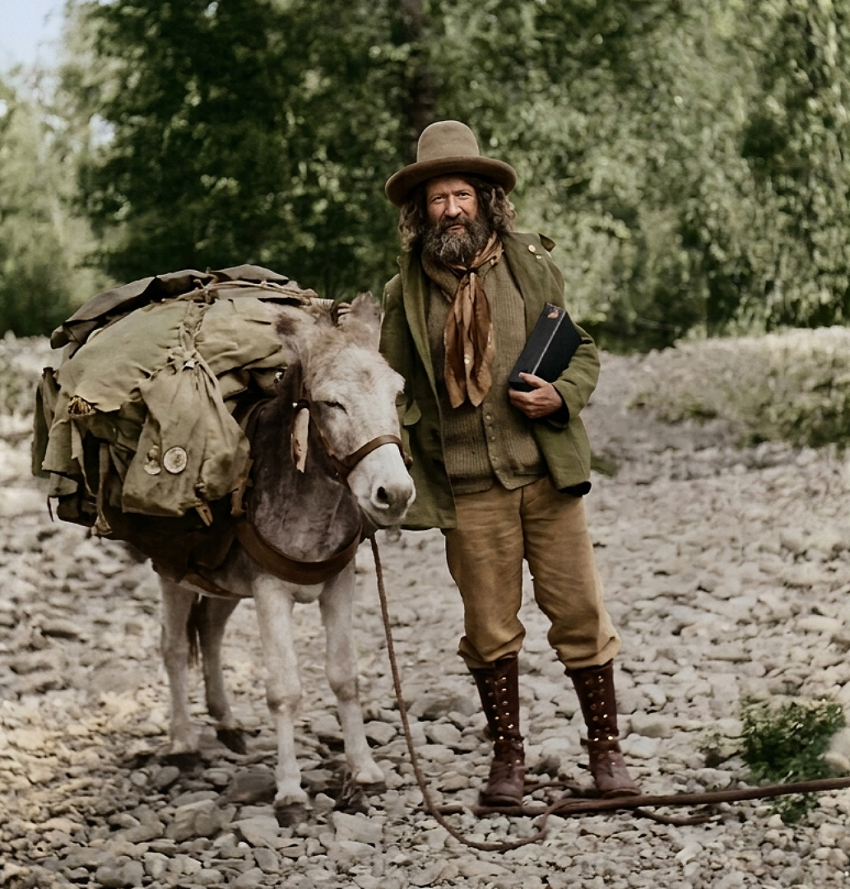
He looked every inch the part. Trailed usually by two burros, dressed in frontier-era rags, his hair and beard tumbling past his shoulders, Gardner drifted from town to town and regaled citizens with exciting (and often contradictory) stories about his life in exchange for food, money, and lodging. He was, in effect, a self-employed legend, and he was good enough at it that small-town newspapers across the country reported his arrivals as local events.
The newspaper record, ironically, gives us some of our few fixed points. The Prescott Weekly Journal-Miner of February 24, 1915, noted that he was well known in Prescott. A year earlier, in April 1914, the Coconino Sun reported that Gardner had wintered camping and trapping near Camp Wood in Yavapai County, and it dutifully printed his claim to have bagged seventy-two mountain lions, twenty-one wildcats, fourteen coyotes, and twenty-eight bears. As Anderson wryly observes, the paper never thought to ask what became of all those pelts.
Today, “Arizona Bill” comes across as a tall-tale spinner, but rural Americans of the era, hungry for heroes, believed in him.
— Parker Anderson, Sharlot Hall Museum
That hunger is the heart of the matter. By the 1910s and 1920s, the open frontier was already gone, fenced and railroaded and paved into memory. Arizona Bill arrived in town as the past made flesh—a breathing relic of a vanished age. People wanted to believe, and he gave them exactly what they wanted. In an era before the romanticized West was packaged by Hollywood, he was the genuine-seeming article, walking down Main Street with his burros.
❖ ————❖———— ❖
Tipperary, the Radio, and the Refuge of Fort Sam Houston
As the years thinned his audiences and the old performer slowed, Gardner found an anchorage in the place that would eventually claim his bones: Fort Sam Houston in San Antonio. He had long frequented the post in his wanderings, and in time, he simply stayed.
In 1935, by the account preserved at the fort’s museum, the commander of the Eighth Corps Area, Major General Johnson Hagood, permitted Gardner to live on any Army post he chose—an extraordinary courtesy extended to a man whose service the Army could not even document. At Fort Sam, Gardner became a beloved fixture, often choosing to bed down in the artillery post stables beside his cherished donkey, Tipperary. (The fort’s museum long labeled the animal a mule; those who knew him insisted Tipperary was a donkey.)
Nor had he given up performing. In the 1930s, Gardner hosted his own radio program, spinning his Old West yarns for a new electronic audience—the frontier storyteller meeting the modern airwaves. The dime-novel relic had become a broadcaster. There is something poignant in the image: an old man, perhaps truly born before the Mexican War, narrating a frontier that may have been half-imagined, into microphones that were carrying the twentieth century into every parlor in America.
❖ ————❖———— ❖
Death, Doubt, and a Soldier’s Redemption
The final act of Gardner’s life turned on the cruel question that had always shadowed him: could he prove he was a soldier? For most of his roaming years, when illness struck, he had talked his way into military and veterans’ hospitals on the strength of his stories. But as the 1930s wore on, the Army grew more careful, and a man who could not document his service found doors closing.
Turned away from Brooke General Hospital, Raymond Hatfield Gardner died in a San Antonio charity ward on January 28, 1940. If his own claimed birthdate is accepted, he was ninety-four or ninety-five years old. He was buried in a pauper’s grave—the legend, in the end, unable to pay for his own funeral.
Then came the long redemption. A former Army medic named George Miller, who had treated the old scout and believed in him, refused to let the matter rest. For roughly three and a half decades after Gardner’s death, Miller dug through records, chasing the ghost of a man whose very name was uncertain. At last, he located an old enlistment record for a Raymond Gardner and persuaded the Veterans Administration to act.
Gardner’s body was exhumed, and on Veteran’s Day 1976, he was reburied with full military honors in Fort Sam Houston National Cemetery. But despite advances in genealogy research since then, the mystery of who “Arizona Bill” really was remains unsolved.
— Parker Anderson, Sharlot Hall Museum
And so the man who died a pauper was at last laid to rest as a soldier, beneath a government headstone, his memory marked even by a small road on the post—Gardner Circle that bears his name. Four years after his death, his ghostwritten memoir, The Old Wild West: Adventures of Arizona Bill, had appeared in print, filled, as Anderson puts it, with exciting and highly dubious stories. The legend had outlived the man, and then the honors had caught up with the legend.
❖ ————❖———— ❖
Myth, Reality, and the Meaning of Arizona Bill
What are we to make of Raymond Hatfield Gardner? It would be easy and lazy to dismiss him as a fraud. The harder and truer reading is that he embodied a tension at the very core of the American frontier story—the seam where memory blurs into myth.
The West that Gardner peddled was already, in his lifetime, becoming more legend than landscape. Buffalo Bill Cody had turned the frontier into a traveling spectacle; dime novels had rendered gunmen into demigods; and a public severed from the actual hardships of the trail hungered for heroes who could make the romance feel real. Gardner met that hunger the way a craftsman meets a demand. His genius was not invention from nothing but curation—the gathering of the era’s greatest dramas under a single weathered hat.
In this sense, he was less an impostor than an artist of identity, and his life poses a genuinely modern question: in a culture that prizes the story above the verifiable fact, who gets to author a life? Gardner authored his own, and authored it so persuasively that the United States government eventually ratified at least part of it with a rifle salute and a folded flag. The pauper’s grave and the soldier’s honors are not contradictions. They are the two halves of a single, very American bargain.
The deepest poignancy is that we still do not know him. His genealogy remains untraced; his real name is uncertain; the boy supposedly carried off by the Comanches has never been found in any record but his own. Arizona Bill spent a lifetime telling the world who he was, and the result is that we have no idea. He vanished, in the end, into the very mist of legend he had spent his life manufacturing—which may be exactly the immortality he was after.
Raymond Hatfield Gardner, better known as “Arizona Bill,” was perhaps the last noted Indian scout of the American West.
— Arizona Origins / Find a Grave Memorial
Perhaps the last noted scout; perhaps merely the last great storyteller of a West that was always part story. The grizzled figure with his two burros, ambling into town to trade tall tales for supper, was the frontier’s closing argument about itself—that the line between what happened and what we choose to remember was never as firm as we like to pretend. Arizona Bill knew that better than anyone. He spent ninety-five years—give or take—proving it.
❖ ————❖———— ❖
Primary Sources & Further Reading
• Anderson, Parker. “Who Was the Mysterious ‘Arizona Bill’?” Days Past, Sharlot Hall Museum (Sep. 3, 2022). https://archives.sharlothallmuseum.org/articles/days-past-articles/1/who-was-the-mysterious-arizona-bill
• “Arizona Bill (1845–1940) Signed Photo (Extremely Rare).” Arizona Origins. https://arizonaorigins.com/products/arizona-bill-signed-photo-super-rare
• New York Times. “Arizona Bill, 96, Famous as Scout; Army Veteran of 50 Years’ Service” (Jan. 30, 1940). https://www.nytimes.com/1940/01/30/archives/arizona-bill-96-famous-as-scout-army-veteran-of-50-years-service.html
• Arizona Origins (Facebook). “The Legend of Arizona Bill, 1845–1940.” https://www.facebook.com/ArizonaOrigins/photos/the-legend-of-arizona-bill-1845-1940raymond-hatfield-gardner-better-known-as-ari/942889513205888/
• Marries, Dan (Facebook). “The Legend of Arizona Bill.” https://www.facebook.com/DanMarries/posts/the-legend-of-arizona-bill/311085390373563/
• Garland County Historical Society (Facebook). New Year greeting featuring “Arizona Bill.” https://www.facebook.com/GarlandCountyHistoricalSociety/posts/happy-2022-greetings-from-gchsenjoy-a-tip-of-the-hat-from-col-r-e-aka-arizona-bi/2063994110417392/
• Facebook group post on Raymond Hatfield Gardner (group 302370449955014). https://www.facebook.com/groups/302370449955014/posts/2241565899368783/
• Facebook group post on Arizona Bill (group 729839877052650). https://www.facebook.com/groups/729839877052650/posts/2415075781862376/
• Facebook group post on Arizona Bill (group 221626187994666). https://www.facebook.com/groups/221626187994666/posts/1966456070178327/
A Note on Research Methods and Accuracy
In recent years, some have voiced concern that artificial intelligence may distort facts or introduce inaccuracies into serious research. That criticism deserves acknowledgment. However, AI has now evolved into the most powerful research instrument available to any dedicated scholar—capable of analyzing vast datasets, cross‑referencing historical records, and surfacing overlooked connections across sources. This work represents a collaboration between the author’s investigative inquiry, verified primary documentation, and the advanced analytic capabilities of AI research tools. Here, AI was not used as a ghostwriter or a shortcut for scholarship, but as a disciplined research partner devoted to rigor, accuracy, and transparency.
Every factual claim in this work has been subjected to active verification. Where AI‑generated content was used as a starting point, it was tested against primary sources, peer‑reviewed scholarship, official institutional documentation, and established historical records. Where discrepancies were found—and they were found—corrections were made. The author has made every reasonable effort to ensure that quotations are accurately attributed, historical details are precisely rendered, and theological claims fairly represent the positions they describe or critique.
That said, no work of this scope is immune to error, and the author has no interest in perpetuating inaccuracies in the service of an argument. If you are a reader—whether sympathetic, skeptical, or hostile to the conclusions drawn here—and you identify a factual error, a misattributed source, a misrepresented teaching, or a claim that cannot be substantiated, you are warmly and genuinely invited to say so. Reach out. The goal of this work is not to win a debate but to get the history right. Corrections offered in good faith will be received in the same spirit, and verified corrections will be incorporated into future editions without hesitation.
Truth, after all, has nothing to fear from scrutiny—and neither does this work.