A storytelling history of the desert farmers who built the largest irrigation network in
ancient North America — and of the descendants who never truly left.
circa 200 – 1450 A.D.
❖ ◆ ❖
The City That Rose From Ashes
In the winter of 1867, a Confederate veteran and sometime prospector named Jack Swilling reined in his horse on a dry plain east of the Salt River and saw something that most travelers had ridden past for centuries. The valley floor was scored with shallow depressions — long, deliberate channels running arrow-straight across the desert, half-filled with sand and creosote, leading nowhere a living person could explain. They were canals—ancient ones. And whoever had cut them had understood the fall of the land well enough to carry river water for miles into ground that received scarcely eight inches of rain a year.
Swilling grasped at once what the channels meant. If water had once flowed here, it could flow again. Within months, he had organized an irrigation company, cleared the old ditches, and turned river water back onto fields that had lain fallow for four hundred years. When the time came to name the settlement that grew around those reborn canals, one of his companions, an Englishman with a taste for the classical, proposed a name freighted with meaning. They would call it Phoenix — the city risen from the ashes of a vanished civilization.
The companion’s instinct was truer than he knew. The people who had dug those canals were not a myth. They had farmed the Salt and Gila river valleys for more than a thousand years, raised towns of thousands, traded for seashells and tropical birds across deserts and mountains, watched the solstice sun through holes cut in stone, and then — sometime in the fifteenth century — drew down their great works and dispersed into the surrounding country. Archaeologists would later borrow a word from the people who remembered them and call them the Hohokam.
The Hohokam were, in the words of archaeologist Emil Haury, masters of the desert.
— U.S. National Park Service, “Hohokam Culture”
This is the story of how they earned that title — and of why the word that names them is also, in the language of their descendants, an elegy.
❖ ◆ ❖
A Word for Those Who Came Before
Begin with the name, because the name carries the whole tragedy and the whole continuity in a single breath. Hohokam is not what these people called themselves; no one knows what they called themselves, for they left no writing. The term is an anglicized borrowing from the O’odham language of the Native peoples who live in southern Arizona today. Translators have rendered it variously as “those who have gone,” “all used up,” or “those who are exhausted.” The National Park Service glosses it plainly:
The word Hohokam is a Piman language term for “all used up” or “exhausted.”
— U.S. National Park Service
Yet the O’odham themselves use a gentler and more telling word. They speak of the Huhugam — the ancestors, those who came before — and they do not regard them as a people who vanished so much as a people who continued, changed, into the present. Archaeology Southwest, a respected research organization in Tucson, frames the distinction with care, noting that what scholars label “Hohokam” may be less a single ethnic group than a shared way of seeing the world:
O’odham peoples of the Sonoran Desert refer to their ancestors … as Huhugam.
— Archaeology Southwest, “Who or What Is Hohokam?”
Hold both words in mind as the story unfolds. “Hohokam” is the archaeologist’s term — a label for a material culture of distinctive pottery, architecture, and canals that flourished and then faded. “Huhugam” is the descendants’ term — a claim of unbroken kinship across the centuries. The history that follows lives in the tension between them: a civilization that, by one measure, used itself up, and by another measure, never left at all.
❖ ◆ ❖
The Land That Asked Everything
To understand what the Hohokam accomplished, one must first feel the place that demanded it. The Sonoran Desert of central and southern Arizona is not the soft, rolling desert of romantic imagination. It is a furnace valley where summer temperatures climb past 110 degrees, where rain falls in two brief, unreliable seasons, and where the difference between a full granary and a starved village can be a single failed monsoon. Across roughly 27,000 square miles, the Hohokam left behind ruins, rock art, and canals — the physical record of a people who, in the words of the Arizona Heritage Waters project at Northern Arizona University, achieved something genuinely rare in such a country.
And yet the desert was not only an adversary. Two rivers — the Salt and the Gila — ran through it, fed by snowmelt from distant mountains, and along their banks the soil was deep and fertile. The genius of the Hohokam lay in recognizing that the rivers’ gift could be carried away from the rivers themselves, spread across thousands of acres of otherwise useless ground, if only one understood water well enough to lead it by the hand. The Arizona-Sonora Desert Museum describes a people who did not merely endure their environment but read it like a text — who knew which canyon held juniper for house beams, which slope held agave for fiber and food, which season brought the saguaro fruit, and which the mesquite bean.
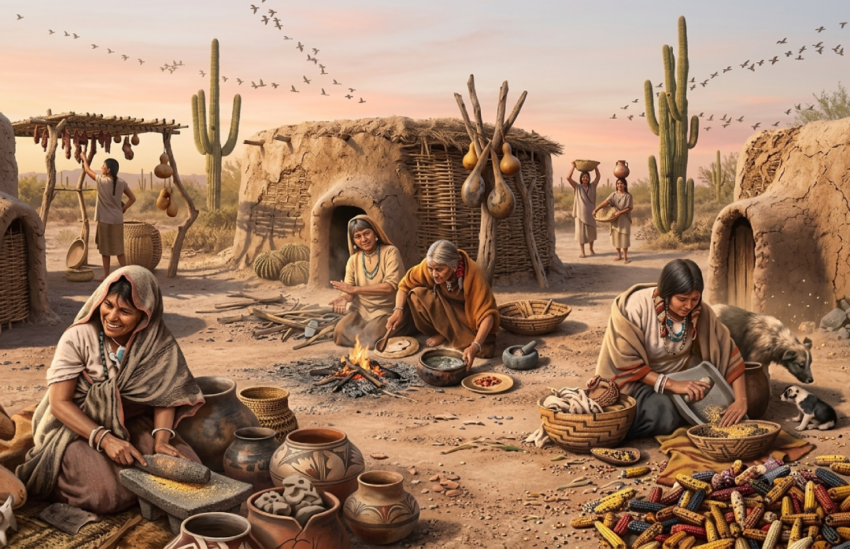
They drew on nearly two hundred species of Sonoran Desert plants. They did not simply subsist; in the phrase of the heritage waters researchers, they thrived on a diet richer and more varied than that of many peoples in far gentler lands — corn and several kinds of beans, squash and barley and amaranth, cactus fruit and roasted agave hearts, fish and waterfowl drawn to the very canals they had dug.
They did not simply subsist in the Salt and Gila River Valleys — they thrived.
— Arizona Heritage Waters, Northern Arizona University
❖ ◆ ❖
The Canals: An Engineering Marvel Cut by Hand
If the Hohokam are remembered for one thing above all others, it is water — the moving of it, the mastering of it. Their irrigation network was the largest and most sophisticated in all of ancient North America, surpassing anything built north of Peru. Not even the great civilizations of central Mexico engineered canals on this scale. Along the Salt and Gila rivers, the Hohokam excavated hundreds of miles of channels — more than five hundred miles documented in the Phoenix Basin alone, some of them over twenty miles long, watering on the order of a hundred thousand acres of cropland at the system’s height.
The achievement becomes almost incomprehensible when one remembers the tools. The Hohokam had no metal. They had no draft animals — no oxen, no horses, no plows. Every cubic yard of earth was loosened with stone and wood, lifted in baskets, and carried away on human backs. They surveyed gradients so precise that water would flow gently for miles without either stalling into stagnant pools or rushing fast enough to tear out the channel walls. As Hohokam engineering matured, they refined their craft, cutting canals narrower and deeper to reduce the water lost to evaporation and to thirsty ground. The City of Tempe’s historians, drawing on what pioneer farmers discovered when they re-excavated the ancient ditches, marveled at the result:
The Hohokam canals were very well engineered, as later discovered by European American farmers.
— Tempe History Museum, “The Hohokam”
Such precision implies organization, and organization implies society. A canal twenty miles long is not the work of one family or one season. It must be planned, dug, and then maintained forever — cleared of silt after every flood, its head-gates rebuilt, its water shared out among dozens of communities strung along its length. This was public works on a scale that required leadership, division of labor, and cooperation between villages that might otherwise have been rivals. The Tempe historians infer a likely social consequence: those who controlled the water at the head of a canal system controlled, in some measure, everyone downstream.
Here is one of the quiet ironies of Hohokam history. The very canals that made their civilization possible may also have made it fragile. A people who congregate around a man-made river become dependent on it; when the river-of-their-own-making fails, there is no falling back. We will return to that irony at the end.
The Long Memory of Water
The most haunting testament to Hohokam engineering is that we are still using it. When Jack Swilling cleared the old channels in 1868, he was not inventing Phoenix’s water system so much as inheriting it. Central Arizona’s modern canals follow many of the original Hohokam routes; the metropolis of millions that now sprawls across the Valley of the Sun is watered, in part, along lines first surveyed by people working with stone tools fifteen centuries ago. Archaeology Southwest notes the continuity bluntly: European settlers cleared out and reused many Hohokam canals hundreds of years later. The desert remembers, and so does the water.
❖ ◆ ❖
Villages, Ballcourts, and the Architecture of Power
The Hohokam did not build cliff palaces like the Ancestral Puebloans to the north, and for that reason, their towns are easier to walk past and harder to romanticize. But their settlements were remarkable for something the cliff-dwellings often were not: endurance. Where many ancient pueblo towns were abandoned after a few decades, some Hohokam villages were occupied continuously for a thousand years or more — a stability that speaks to just how successfully they had solved the problem of living in that place.
In the early centuries, families lived in pit houses — dwellings built over a shallow excavation, framed with posts and brush and sealed with adobe mud, the partly sunken floor moderating the desert’s brutal swings of temperature. These houses clustered in courtyard groups, doorways facing a shared central space with its ovens and storage pits and ramadas, so that the basic unit of Hohokam life was not the isolated household but the cooperating cluster of kin. Larger villages arranged these courtyard groups around a central plaza.
The Ballcourt World
Then, beginning around A.D. 750, something extraordinary appeared on the landscape: ballcourts. These were large oval basins dug into the earth, their excavated soil heaped into berms around the rim, where spectators could gather to watch a game whose rules are lost to us but whose ancestry is not. The ballgame was a Mesoamerican tradition, played for centuries in central Mexico and the Maya lands and still played, in variant forms, in parts of Central America today. Its arrival in Arizona is among the clearest signs that the Hohokam were no isolated desert backwater but a northern node in a vast web of cultural exchange.
Hundreds of ballcourts were built across the Hohokam world. They were more than playing fields. Archaeology Southwest describes them as engines of connection — places where people from scattered villages came together to watch, to worship, to trade raw materials and finished goods, to see kin and arrange marriages, and settle the thousand small affairs that knit a society together:
Watching or participating in ball games brought people together.
— Archaeology Southwest, “Who or What Is Hohokam?”
From Open Courts to Walled Mounds
Around A.D. 1100 to 1150, the Hohokam world passed through a great and still-imperfectly-understood transformation. The ballcourts fell out of use, not all at once but steadily, across generations. In their place rose a different kind of monument: the platform mound. The earliest mounds had been low, capped piles of earth where ceremonies were conducted in the open, visible to the whole community. But the later platform mounds were deliberate constructions — large, flat-topped edifices of earth, rock, and adobe, eventually crowned with rooms and courtyards, and increasingly hidden behind enclosing walls.
The Arizona State Museum reads architectural change as social change, and the reading is sobering. When walls went up around the mounds, access to ritual was restricted, and a new distance opened between a community’s leaders and its ordinary people:
The enclosing wall likely marks a significant change in the relationship between the community’s leaders and the general populace.
— Arizona State Museum, “Culture History of Southern Arizona”
Where the open ballcourt had gathered everyone into a shared spectacle, the walled platform mound elevated a few above the many. Roughly every three miles along the major canals stood a platform-mound village — Pueblo Grande on the Salt, and dozens of others — and it is likely these served as management stations, where a theocratic or secular elite directed the construction of canals, the timing of labor, and the all-important allocation of water. He who sat atop the mound at the canal’s head held the lives of the farmers below in his accounting.
The grandest surviving monument of this age is Casa Grande — the “Big House” — near the Gila River, a four-story tower of caliche adobe walls facing the four cardinal directions, one of the largest prehistoric structures ever raised in North America. Its purpose remains debated. But holes cut high in its walls align with the sun on the solstices and equinoxes, and the building may have served at once as observatory, ceremonial center, and seat of authority. UC Berkeley archaeologist Steven Shackley described villages of this era as places where, at the center, the elites lived amid platform mounds and great-houses while the laborers farmed the fields beyond.
❖ ◆ ❖
Art, Shell, and the Reach of a Desert People
A civilization reveals its soul in what it makes when survival is not the only thing at stake, and here the Hohokam were prolific. Their potters, working without the wheel, used a paddle-and-anvil technique — bracing a smooth stone inside the vessel and beating the clay walls into shape from without — to produce the buff-colored ware, painted in iron-red designs, that is the archaeological signature of their world. The motifs ranged from tight geometric hatching to lively figures of birds, lizards, deer, and dancing human forms, abstract and realistic by turns. To find a sherd of red-on-buff in the Arizona ground is to know that the Hohokam passed that way.
But it was in shell that their artistry reached furthest — literally. The Hohokam were master shell-workers, carving and even acid-etching the shells of marine mollusks into bracelets, pendants, and ornaments of striking delicacy. The nearest source of such shells was the Gulf of California, a hard journey south. That these shells arrived in quantity, along with turquoise from the north, tells us that the Hohokam sat at the crossroads of a trade network of continental ambition.
The full extent of that network has only recently come into focus. By analyzing the chemical signatures of obsidian — volcanic glass prized for cutting tools — Berkeley’s Steven Shackley traced Hohokam exchange across an enormous territory and concluded that this was no small or simple society:
The Hohokam were a diverse multiethnic and multilingual society.
— Steven Shackley, Phoebe Hearst Museum, UC Berkeley (2001)
Their trade and kinship ties spread across at least fifty thousand square miles of desert, perhaps reaching the Pacific coast of southern California and Baja. From the south came the unmistakable luxuries of ancient West Mexico — copper bells cast in the lost-wax technique, pyrite mirrors, conch-shell trumpets, and brilliantly colored macaws, tropical birds carried hundreds of miles north to the edge of their range. The Hohokam did not work copper themselves; the finished bells must have come up the long trade roads as prestige goods. Archaeology Southwest lists the markers of Hohokam exchange — palettes of reflective stone, clay figurines, turquoise mosaic, marine-shell armlets — and notes that many were inspired by, or imported from, the great cultures to the south.
Yet perhaps the most remarkable feature of this sprawling, multiethnic world is what it lacked. Across six centuries of skeletal remains, Shackley found almost no evidence of war:
We can’t find any evidence of warfare … anywhere in the Hohokam region for 600 years.
— Steven Shackley, UC Berkeley (2001)
A diverse society of many languages, bound together by water, trade, and a shared ballgame, holding the peace across a desert larger than many nations — it is a portrait worth setting beside the more familiar tale of the violent thirteenth-century collapse among the Ancestral Puebloans to the north.
❖ ◆ ❖
Reading the Sky: Spirit and the Desert Calendar
For a farming people in a land of unforgiving seasons, the sky was not decoration but instruction. Knowing when to plant, when the monsoon might come, when the days would lengthen or fail — these were matters of life, and the Hohokam watched the heavens with the attention such stakes demand. Because they left no writing, their spiritual world must be reconstructed from rock art, ceremonial architecture, and the living oral traditions of their O’odham descendants. But the picture that emerges is of a people deeply, expertly attuned to the movements of sun and star.
The archaeologist and rock-art scholar Todd Bostwick, who spent two years walking the petroglyph sites of South Mountain in Phoenix, concluded that the Hohokam were practiced and deliberate observers of the heavens:
We believe the Hohokam were dedicated skywatchers and thoroughly familiar with the annual movements of certain celestial bodies.
— Todd W. Bostwick, Landscape of the Spirits (via Night Sky Tourist)
The evidence is etched into stone across the Valley of the Sun. On South Mountain, on Shaw Butte, on a hundred dark boulders, the Hohokam pecked petroglyphs — and some of these mark with real precision the points on the horizon where the sun rises and sets at the solstices and equinoxes. At Hole-in-the-Rock in what is now Papago Park, notches cut along a wind-carved opening align with the setting sun of the summer solstice. At Casa Grande, sunlight on the solstice still threads through holes in the great walls to strike the opposite side. Archaeologists have identified three distinct Hohokam timekeeping methods — horizon calendars, light-and-shadow markers, and counts of the moon’s phases — the same family of techniques used by the Puebloan peoples to the north.
What did the sky mean to them? Their cosmology, like their ballgame, drew on Mesoamerican currents while remaining distinctly their own. The oral traditions of the O’odham preserve a vision of the heavens as a vast vault, fashioned by the creator-figure Earth Doctor, who spat water into the sky to make the stars and set the sun in its course; alongside him stands Elder Brother, the hero of the people. Night Sky Tourist records the O’odham telling:
The sky is seen as a vault, with Earth Doctor spitting water into the sky to create stars.
— O’odham oral tradition (via Night Sky Tourist)
In a culture that revered the sun, those who could predict its turnings held real power. The skywatcher who could announce the solstice, name the planting day, and tie the calendar to ceremony occupied a position of high responsibility — and, very likely, high status. Here, religion, knowledge, and authority braid together: the same elite who sat atop the walled platform mounds may also have been the keepers of the calendar, their command of the sky underwriting their command of the canals.
The Cremation and the Vessel
In death as in life, the Hohokam followed their own distinct path. For centuries, almost without exception, they cremated their dead — burning the body with personal belongings, gathering the ashes, and burying them in decorated ceramic vessels in community cemeteries. This near-universal practice set them apart from many neighboring peoples and speaks to a particular and deeply held view of what becomes of a person after death. Strikingly, the practice itself changed during the great transformation of the twelfth and thirteenth centuries: after about 1200, more of the dead were buried whole, in extended graves, with their tools and jewelry beside them — another sign that the Hohokam world was being remade from within even before its outward decline.
❖ ◆ ❖
The Long Unraveling
Sometime in the fourteenth and fifteenth centuries, the great Hohokam world came apart. This is the part of the story that draws the most speculation and admits the least certainty, and honesty requires that the uncertainty be stated plainly. The National Park Service does not pretend otherwise:
Why this once-flourishing cultural pattern came to an end remains a mystery.
— U.S. National Park Service
What can be said is that the decline was gradual, not sudden — a long unraveling rather than a single catastrophe. By the late 1300s, the large villages of the Phoenix Basin were emptying; by around 1400, the population had fallen sharply, and the surviving settlements had shrunk and scattered. The Tucson Basin and other regions were swept into the same breakdown over the following generations. By the time Spanish missionaries such as Father Kino arrived at the close of the seventeenth century, the great towns were long gone.
The likely causes form a grim convergence rather than a single villain. The thirteenth-century Great Drought (1276–1299) and a subsequent stretch of sparse, unpredictable rainfall strained the agricultural base. Then, in the late 1300s, the opposite calamity struck: at least two enormous floods tore down the Salt River, destroying the head-gates of the major canal systems — and this time, tellingly, the canals were not rebuilt. Layered beneath these blows were slower poisons that the canals themselves had brewed. Generations of irrigation had salinized the soil. Growing villages had stripped the riverbanks of timber and pushed hunters ever farther afield, until people grew dangerously dependent on irrigated crops alone. The Desert Museum’s account traces how the very success of the canals sowed the seeds of crisis: larger villages, greater distances to wild food, rising malnutrition, altered riverbanks — and then the floods that pushed a strained system past recovery.
The social fabric frayed alongside the physical one. The centralized, hierarchical order that had marshaled thousands of laborers to dig and maintain the canals depended on confidence in its leaders and in the system itself. As the harvests failed and the floods came, that confidence may have collapsed; the populations that had concentrated around the platform mounds dispersed once more into smaller, decentralized communities. The Tempe historians offer a subtle version of this view — that “the Hohokam” was always a coalition of many groups operating under one cultural and economic system, and that when the system broke down, each group simply went its own way.
❖ ◆ ❖
They Never Truly Left
And here the story turns, and the elegy becomes something closer to a homecoming. The Hohokam did not vanish in the way that word implies. They dispersed; they reorganized; they carried their knowledge of the desert and its waters into smaller settlements and quieter lives. And their descendants are not a matter of speculation but of living testimony. The Akimel O’odham — long known as the Pima — and the Tohono O’odham of southern Arizona hold oral histories that name the Hohokam, the Huhugam, as their own ancestors.
The archaeological caution and the descendants’ certainty meet at an honest middle. The Desert Museum, weighing the evidence, acknowledges both the limits of proof and the weight of continuity:
The O’odham way of living with the desert is remarkably similar to what we find in the archaeological record.
— Arizona-Sonora Desert Museum, sonorensis
Berkeley’s research deepened the claim rather than narrowing it. Because the Hohokam were a multiethnic, multilingual world, their inheritance flows not into one tribe alone but into many — the Akimel O’odham and Tohono O’odham of the desert basins, and very likely other peoples across Arizona and into northern Mexico and southern California. The Hohokam ancestry, in Shackley’s framing, is broad enough to give many contemporary Native communities a rightful claim to it.
The Oro Valley Historical Society, writing of the Santa Cruz Valley, captures the descendants’ own understanding most gracefully — that this was not a disappearance but an adaptation, a people moving and enduring rather than ending. Their canals, their pottery designs, and the very place-names of the land remain embedded in southern Arizona, reminders of lives lived in long balance with desert and water. Indeed, the deep roots run deeper still: near Marana, the Las Capas site has revealed irrigation canals dating to around 1200 B.C. — among the oldest known in North America — proof that the mastery of desert water in this valley reaches back more than three thousand years, a single unbroken conversation between people and place.
❖ ◆ ❖
The Lesson in the Ditch
Stand today on the bank of a Phoenix canal — concrete now, expanded and obscured, carrying water to one of the fastest-growing metropolitan regions in the United States — and you stand on a Hohokam idea. The modern Valley of the Sun is, in the most literal sense, built along its lines. A system that once brought water to tens of thousands now sustains millions, and the questions that pressed on the Hohokam in the fourteenth century press on their successors in the twenty-first.
For the Hohokam story is, at its heart, a parable of sustainability — of the magnificent reach and the hidden limits of human ingenuity in an arid land. They transformed a furnace valley into a garden, and they did it by hand, with stone tools and patient genius, sustaining a complex society for longer than most civilizations endure. That is the triumph, and it is enormous. But the same canals that fed their cities also salted their soil, stripped their banks, and bound their fate to a man-made river that drought and flood could break. They did not fail for want of skill. They failed, if they failed at all, at the outer edge of what their world could bear.
A modern desert city drawing down its rivers and aquifers, watering lawns and pools across the same baking plain, might find in the Hohokam neither a simple cautionary tale nor a triumphant ancestor-myth, but something more useful: a mirror. The Hohokam were not naive. They were among the most accomplished water-engineers the continent ever produced, and they still ran up against the limits of their landscape. The question they leave to those who inherited their canals is not whether ingenuity can transform a desert — they proved it can — but whether ingenuity can also recognize, in time, when a thriving system is quietly approaching the edge.
Their name, the O’odham, has two meanings. Hohokam — all used up, exhausted, the warning. Huhugam — those who came before, the ancestors, the continuity. The desert holds both truths at once. The canals are still here. So are the people. And the river still has to be shared.
❖ ◆ ❖
Primary Sources & Further Reading
This narrative draws on the following institutional, museum, and scholarly sources. Quotations are reproduced briefly for attribution; readers are encouraged to consult the originals in full.
National Park Service, “Hohokam Culture” — https://www.nps.gov/articles/hohokam-culture.htm
Arizona State Museum, “Culture History of Southern Arizona: Hohokam” — https://statemuseum.arizona.edu/online-exhibit/culture-history-southern-arizona/hohokam
Encyclopaedia Britannica, “Hohokam culture” — https://www.britannica.com/topic/Hohokam-culture
Tempe History Museum, “The Hohokam” — https://www.tempe.gov/government/community-services/tempe-history-museum/history-and-research/the-hohokam
Arizona Heritage Waters (NAU), “Hohokam Canal System” — http://www.azheritagewaters.nau.edu/loc_hohokam.html
Archaeology Southwest, “Who or What Is Hohokam?” — https://www.archaeologysouthwest.org/free-resources/fact-sheets/who-or-what-is-the-hohokam/
Archaeology Southwest, “Hohokam” (Ancient Cultures) — https://www.archaeologysouthwest.org/ancient-cultures/hohokam/
UC Berkeley News, S. Shackley research on the Hohokam (2001) — https://newsarchive.berkeley.edu/news/media/releases/2001/01/30_arch.html
Night Sky Tourist, “Hohokam Archaeoastronomy in the Phoenix Area” — https://nightskytourist.com/hohokam-archaeoastronomy-in-the-phoenix-area/
Arizona-Sonora Desert Museum, sonorensis, “The Hohokam” — https://www.desertmuseum.org/members/sonorensis/week8.php
Archaeology Magazine Archive, “A Doomed People” — https://archive.archaeology.org/9811/abstracts/hohokam.html
Oro Valley Historical Society, “The Hohokam and Huhugam” — https://ovhistory.org/the-hohokam-and-huhugam/
A Note on Research Methods and Accuracy
In recent years, some have voiced concern that artificial intelligence may distort facts or introduce inaccuracies into serious research. That criticism deserves acknowledgment. However, AI has now evolved into the most powerful research instrument available to any dedicated scholar—capable of analyzing vast datasets, cross‑referencing historical records, and surfacing overlooked connections across sources. This work represents a collaboration between the author’s investigative inquiry, verified primary documentation, and the advanced analytic capabilities of AI research tools. Here, AI was not used as a ghostwriter or a shortcut for scholarship, but as a disciplined research partner devoted to rigor, accuracy, and transparency.
Every factual claim in this work has been subjected to active verification. Where AI‑generated content was used as a starting point, it was tested against primary sources, peer‑reviewed scholarship, official institutional documentation, and established historical records. Where discrepancies were found—and they were found—corrections were made. The author has made every reasonable effort to ensure that quotations are accurately attributed, historical details are precisely rendered, and theological claims fairly represent the positions they describe or critique.
That said, no work of this scope is immune to error, and the author has no interest in perpetuating inaccuracies in the service of an argument. If you are a reader—whether sympathetic, skeptical, or hostile to the conclusions drawn here—and you identify a factual error, a misattributed source, a misrepresented teaching, or a claim that cannot be substantiated, you are warmly and genuinely invited to say so. Reach out. The goal of this work is not to win a debate but to get the history right. Corrections offered in good faith will be received in the same spirit, and verified corrections will be incorporated into future editions without hesitation.
Truth, after all, has nothing to fear from scrutiny—and neither does this work.