
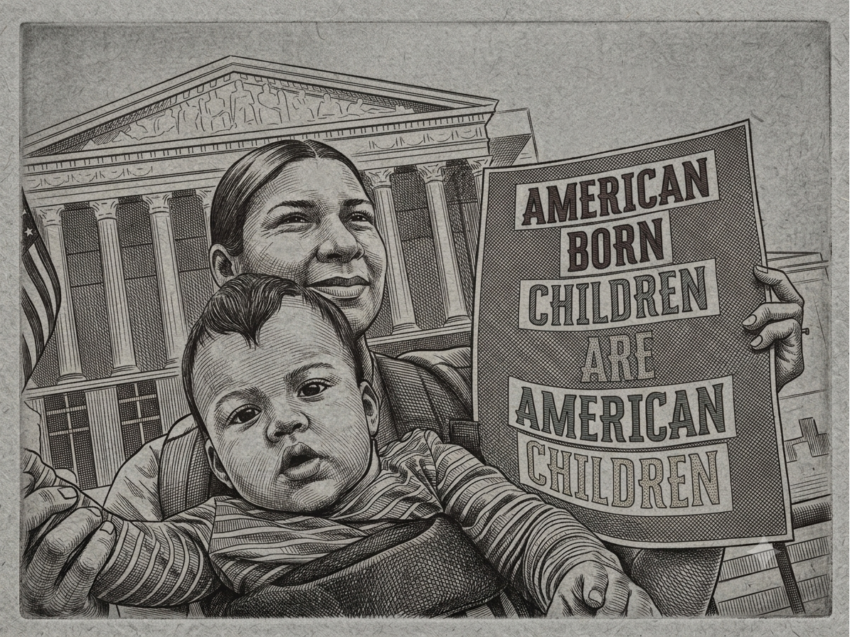
Why Birthright Citizenship Rests on a Feudal Mistake
❖ ❖ ❖
Introduction: A Question the Founders Never Answered — Because We Never Asked It Rightly
On June 30, 2026 — in the two hundred and fiftieth year of American independence — the Supreme Court of the United States handed down its decision in Trump v. Barbara. By a vote of six to three, with Chief Justice John Roberts writing for the majority, the Court struck down the executive order by which the administration had sought to withhold automatic citizenship from children born on American soil to parents who were here either unlawfully or on temporary visas. The Chief Justice grounded the opinion in a lineage that reached back through the 1898 case of United States v. Wong Kim Ark, past Blackstone’s Commentaries, all the way to the English court’s 1608 ruling in Calvin’s Case. Citizenship by birth alone, Roberts wrote, was an inheritance the colonists carried across the Atlantic and enshrined, after the Civil War, in the Fourteenth Amendment. “We keep that promise today,” the opinion concluded.
This essay respectfully dissents from that conclusion. It does so not with the heat of grievance but with the deliberateness the question deserves, for the stakes are not small. The argument advanced here is that the Court answered the wrong question — that in tracing the pedigree of English subjectship, it overlooked the deeper transformation the American Founding worked upon the very idea of political membership. The contention is straightforward to state and, I will argue, difficult to refute: the men who wrote and ratified the Citizenship Clause did not intend to constitutionalize the feudal doctrine of birth-on-soil allegiance that the American Revolution had expressly repudiated. They intended something both narrower and nobler — a citizenship grounded in the consent of the governed.
The thesis of this examination is therefore this: Birthright citizenship, as it is presently applied to the children of aliens who owe their presence in this country to the violation of its laws, cannot be squared with the original meaning of the Fourteenth Amendment, with the political philosophy of the Declaration of Independence upon which that Amendment rests, or with the sovereign right of a self-governing people to define the terms of its own membership.
That is a legal claim, a historical claim, and a claim about national self-understanding, and this essay will defend it on all three grounds — while giving the strongest opposing arguments the fair hearing that a serious debate requires.
A word about method and tone. The reader will find here no anecdote paraded as evidence, no caricature of those who disagree, and no pretense that this is a settled matter beyond honest dispute. It is not settled; six Justices found one way and three the other, and the three included two of the Court’s most rigorous originalists. What follows distinguishes carefully between what the historical record establishes, what it merely suggests, and what remains genuinely contested. Where the argument is strong, it is pressed. Where it is speculative, it is labeled as such. The aim is persuasion by reason, which is the only kind of persuasion worth attempting.
❖ ❖ ❖
I. The Clause That Does Real Work: “Subject to the Jurisdiction Thereof”
Every argument about birthright citizenship begins, and most of them end, with a single sentence. The first section of the Fourteenth Amendment, ratified in 1868, provides that “all persons born or naturalized in the United States, and subject to the jurisdiction thereof, are citizens of the United States and of the State wherein they reside.” The popular understanding compresses this to its first half: born here, citizen here. But the Amendment is written in two parts joined by a conjunction, and the second part — subject to the jurisdiction thereof — is not decoration. It is a condition.
The interpretive fault line runs precisely through the meaning of that condition. Defenders of universal birthright citizenship read “jurisdiction” to mean territorial jurisdiction: if the laws of the United States can reach you — if you can be arrested, tried, taxed, or sued — then you are subject to its jurisdiction, and any child you bear on American soil is a citizen. On this reading, the clause excludes only a vanishing few: the children of accredited foreign diplomats, who enjoy immunity, and (until 1924) members of sovereign Indian tribes. Everyone else, lawful or not, permanent or transient, is swept in.
The competing reading — the one this essay defends — holds that the framers meant political jurisdiction, or what the debates of the Thirty-Ninth Congress repeatedly called “complete” jurisdiction: subjection not merely to the coercive reach of American law but to the full and undivided political allegiance that membership in a self-governing community entails. On this view a tourist, a temporary sojourner, or an alien present in defiance of the nation’s immigration laws is subject to American law in the sense that he must obey it, but he is not subject to the jurisdiction of the United States in the deeper sense the Amendment contemplated, because he retains his allegiance to another sovereign. His child, on this reading, is not automatically a citizen.
This is not a modern invention conjured to serve a political moment. It was the reading advanced by the Heritage Foundation’s Hans von Spakovsky long before the present controversy, and he stated it with characteristic precision:
The fact that a tourist or illegal alien is subject to our laws and our courts if they violate our laws does not place them within the political ‘jurisdiction’ of the United States as that phrase was defined by the framers of the 14th Amendment.
Hans von Spakovsky, The Heritage Foundation
The distinction between territorial and political jurisdiction is not a rhetorical convenience. It is embedded in the legal architecture of the Reconstruction era, and it is the hinge on which the entire debate turns. If the framers meant only territorial jurisdiction, the jurisdictional clause adds almost nothing, for nearly everyone physically present in a country is subject to its laws. Words in a constitution are presumed to do work. The question is what work these words were meant to do.
II. What the Framers Said: The Debates of 1866
The men who drafted the Citizenship Clause left a record. It is not a perfect record — legislative debates rarely are — and honest interpreters concede that it contains passages that cut in more than one direction. But read as a whole, and read against the immediate problem the Amendment was written to solve, that record supports a reading of “jurisdiction” richer than mere territorial reach.
Senator Jacob Howard: the author’s own gloss
Senator Jacob Howard of Michigan introduced the Citizenship Clause on the floor of the Senate. His explanation of its scope is the single most-cited passage in the entire debate, and for good reason: the author of language is a privileged witness to its meaning. Howard said the clause would not include “persons born in the United States who are foreigners, aliens, who belong to the families of ambassadors or foreign ministers.” Defenders of the universal reading seize on the diplomatic examples as the whole of the exclusion. But the sentence opens with a broader category — foreigners, aliens — and the diplomatic families follow as instances. The natural reading is that Howard understood the clause to exclude those whose allegiance ran elsewhere, of whom diplomats were the clearest but not the only case.
Senator Lyman Trumbull: “not owing allegiance to anybody else”
Senator Lyman Trumbull of Illinois, chairman of the Senate Judiciary Committee and principal author of the Civil Rights Act of 1866 from which the Amendment’s language descended, was more explicit still. To be subject to the jurisdiction of the United States, Trumbull explained, meant to be subject to its “complete” jurisdiction — “not owing allegiance to anybody else.” The Civil Rights Act itself had used the formula “not subject to any foreign power,” and the Fourteenth Amendment’s drafters understood the jurisdictional clause to carry that same meaning forward. A child whose parents owe allegiance to a foreign sovereign — as illegal entrants and temporary visitors by definition do — does not satisfy this condition.
The Reconstruction Congress was speaking of something more profound than traffic laws and criminal jurisdiction. It was defining membership in the American political community. … Every foreign visitor is obliged to obey American law while here. … But mere obedience to law is not the same thing as complete political allegiance. If it were, the jurisdictional language would add almost nothing to the constitutional text.
John C. Eastman, The American Mind (June 30, 2026)
Senator Reverdy Johnson and Representative James F. Wilson
Senator Reverdy Johnson of Maryland understood “subject to the jurisdiction thereof” to mean, in substance, not subject to some foreign power — the same construction Trumbull offered. And in the House, Representative James F. Wilson of Iowa, chairman of the House Judiciary Committee, confirmed on March 1, 1866, that the general rule of natural-born citizenship carried a recognized exception:
We must depend on the general law relating to subjects and citizens recognized by all nations for a definition, and that must lead us to the conclusion that every person born in the United States is a natural-born citizen of such States, except that of children born on our soil to temporary sojourners or representatives of foreign Governments.
Rep. James F. Wilson (Iowa), House Judiciary Committee, March 1, 1866
Wilson’s exception for “temporary sojourners” is difficult to reconcile with the universal reading. If everyone born on the soil were a citizen regardless of parentage, the sojourner exception would be incoherent. That a chairman of the House Judiciary Committee stated it as settled, and that no one rose to dispute him, is evidence — not conclusive, but weighty — that the Congress did not understand itself to be enacting citizenship by soil alone.
Senator Edgar Cowan’s warning
Honesty requires acknowledging the passage most often cited on the other side. Senator Edgar Cowan of Pennsylvania, alarmed that the language might sweep too broadly, asked whether it would make citizens of the children of Chinese immigrants in California and of Gypsies in his own state. Senator John Conness of California answered that it would. Defenders of the universal reading treat this exchange as decisive: a framer asked the very question at issue, and the answer was yes. But two observations temper its force. First, Cowan was an opponent of the clause, voting ultimately against the Amendment; his alarmed hypotheticals describe what he feared, not what the drafters intended. Second, both Cowan’s question and Conness’s answer concerned lawfully present immigrants, for in 1866, there was no category of “illegal” entrant at all, and federal immigration restriction not yet exist. The exchange tells us how the clause applies to lawful residents. It cannot tell us how it would apply to a category that did not yet exist.
The Naturalization Act debates of 1870
The point is reinforced by the debates over the Naturalization Act of 1870, only two years after ratification. Representative Aaron Sargent of California argued that the Fourteenth Amendment’s Citizenship Clause was not a de facto grant of citizenship to aliens. No one came forward to dispute the conclusion. Had the Congress that framed the Amendment understood it to confer citizenship on the children of all aliens by mere birth, Sargent’s contention would have drawn immediate correction. It drew none.
❖ ❖ ❖
III. 1776, Not 1608: The Revolution the Common-Law Argument Forgets
The deepest objection to the universal reading is not about any single senator’s sentence. It is about the political theory the Fourteenth Amendment presupposes — and here the argument advanced by Edward Erler, Michael Anton, and John C. Eastman across two decades of Claremont Institute scholarship deserves careful statement, because it is the intellectual foundation on which the entire case rests.
Under English common law, as declared in Calvin’s Case in 1608 and expounded by Blackstone, nearly everyone born within the king’s dominions became a natural-born subject. Birth within the sovereign’s territory created a perpetual and indissoluble allegiance to the Crown, because the child was born under the king’s protection. Blackstone himself traced this to the “feudal system,” describing natural allegiance as the debt “due from all men born within the king’s dominion immediately upon their birth.” It was, in the frankest description offered during the Reconstruction debates, an “indefensible feudal doctrine of indefeasible allegiance.”
That doctrine made sense in a monarchy. It made no sense in the republic that the American Revolution founded. The Declaration of Independence did more than sever the political bands connecting the colonies to Britain; it repudiated the philosophy of subjectship on which those bands rested. Governments, Jefferson wrote, derive “their just powers from the consent of the governed.” And the Declaration’s closing words made the rejection of perpetual allegiance explicit: the new states were “absolved from all allegiance to the British Crown.” A doctrine of citizenship built on the premise that allegiance is imposed by birth and can never be renounced is precisely the doctrine the Founders threw off.
Edward Erler put the historical inheritance in its sharpest form: the Declaration grounded citizenship in consent, and “the natural law argument of the Declaration was a repudiation of the notion of birthright citizenship that had been the basis of British citizenship … ever since it was first articulated in Calvin’s Case in 1608.” Thomas Jefferson, in his Summary View of the Rights of British America (1774), had argued that it was a natural right of all men to leave the country where “chance and not choice” had placed them. A right of expatriation is unthinkable under a regime of indefeasible birthright allegiance. The two ideas cannot coexist, and the American Founding chose consent.
This is why the central move in the Trump v. Barbara majority — beginning the analysis in Westminster in 1608 rather than in Philadelphia in 1776 — is, on this account, a category error. As Eastman wrote in direct response to the Roberts opinion:
The issue is not whether America inherited English legal language. It plainly did. The issue is whether America also inherited England’s understanding of political membership. … Roberts proves that England followed jus soli. … What he never quite proves is why the American people, after repudiating monarchy and proclaiming government by consent, should be presumed to have constitutionalized that English doctrine rather than adapting inherited legal language to their own revolutionary understanding of citizenship.
John C. Eastman, “1776, Not 1608”
The framers of the Fourteenth Amendment, on this reading, were not preserving English constitutionalism. They were completing the work begun in 1776. The Declaration proclaimed that all men are created equal; Dred Scott denied that promise to an entire class of Americans; the Fourteenth Amendment repudiated Dred Scott — but it did so by restoring the principles of the Founding, not by reviving the legal doctrines of the British Crown. To read the Citizenship Clause as a codification of Calvin’s Case is to read the Reconstruction as a restoration of the very monarchical premises the Revolution had overthrown. That, the Claremont scholars argue, cannot be right.
The Native American analogy
One consequence of the framers’ design clinches the point. American Indians born within the geographic United States but owing allegiance to their tribes were held, in Elk v. Wilkins (1884), not to be citizens under the Fourteenth Amendment — and it took the Indian Citizenship Act of 1924 to make them so. If the Amendment conferred citizenship on everyone born on the soil regardless of allegiance, the 1924 statute would have been unnecessary. Erler’s observation follows with force: it is hard to conclude that the framers meant to confer citizenship on the children of aliens unlawfully present when they explicitly withheld it from Native Americans lawfully present but subject to a competing jurisdiction. The person born on the soil but owing allegiance elsewhere was, in the framers’ own application, outside the clause.
❖ ❖ ❖
IV. What Wong Kim Ark Held — and What It Did Not
The precedent that anchors the universal reading, and that the majority of the Barbara leaned upon most heavily, is United States v. Wong Kim Ark (1898). It is essential to state precisely what that case decided, because a great deal of the modern debate rests on giving the decision a reach its facts do not support.
Wong Kim Ark was born in San Francisco to Chinese parents who were lawfully and permanently domiciled in the United States, engaged in a lawful business, and who had never been subject to any bar on their residence. The question was whether their son, born of such parents, was a citizen. Justice Horace Gray’s opinion for the Court held that he was. The holding — the actual rule necessary to decide the case — is therefore this: a child born on American soil to parents lawfully and permanently domiciled here is a citizen. That is a significant holding. It is not, however, the holding that the modern universal reading requires.
The word “illegal” appears nowhere in the opinion, for the sufficient reason that the legal category of the illegal alien scarcely existed in 1898. The Court had no occasion to decide, and did not decide, whether a child born to parents who were in the country unlawfully, or merely as temporary sojourners, was a citizen. Richard Epstein, writing at the Civitas Institute, made the point with a scholar’s exactness:
[The Wong Kim Ark] decision at no point addressed, either explicitly — the word ‘illegal’ is not used in the opinion — or implicitly, the legal status of the children born in the United States of illegal aliens. Rather, that case dealt explicitly with the common situation where the plaintiff was the child of lawful permanent aliens in the United States who had long engaged in a lawful business.
Richard A. Epstein, Civitas Institute
To extend Wong Kim Ark from the children of lawful permanent residents to the children of illegal entrants and temporary visitors is not to apply the case but to expand it — to treat Justice Gray’s broad common-law dicta as though they carried the force of a holding on facts never before the Court. Von Spakovsky made the same observation from a different angle: even under Wong Kim Ark’s reasoning, the Court extended citizenship to the child of lawful, permanent residents; it is “just plain wrong” to claim the same for the children of those present temporarily or unlawfully. The distinction the modern reading erases — between the lawfully domiciled and the unlawfully present — is precisely the distinction on which the case actually turned.
❖ ❖ ❖
V. The Architects of the Argument: Eastman, Barnett, Blackman
No account of the modern case against birthright citizenship would be complete without attention to the scholars who have built it. Chief among them is John C. Eastman, senior fellow at the Claremont Institute and founding director of its Center for Constitutional Jurisprudence, who is widely recognized as the primary legal architect of the movement to narrow the Citizenship Clause. Eastman has represented parties or amici in more than two hundred Supreme Court cases, including the Barbara litigation itself, and it was Eastman who first pressed the consent-based reading into public prominence — famously raising, in 2020, the question of how the clause applied to those born of temporary residents.
Eastman’s contribution is not merely doctrinal but philosophical. His insistence that the Fourteenth Amendment must be read “through the constitutional understandings of the American Republic, not simply those of the British Empire” reframes the entire inquiry. Where defenders of the universal reading ask what English courts held, Eastman asks what Americans understood citizenship to mean after they had rejected English subjectship. That reframing — the demand that the originalist inquiry begin with the Revolution rather than with Blackstone — is the intellectual core of the position, and it found its fullest expression in his response to the Barbara majority, in which he argued that the Court, in the 250th year of the Declaration, had “overlooked” the document that answered the very question before it.
Eastman does not stand alone. Georgetown’s Randy Barnett — a leading originalist and no reflexive ally of the administration on other questions — joined with Ilan Wurman to argue, in a widely noted New York Times essay, that “Trump Might Have a Case on Birthright Citizenship.” Their argument is characteristically careful: they do not claim the framers adopted citizenship by blood, and they expressly reject the notion that only parental citizenship counts. What they claim, rather, is that even under the birthright rule, the status of the parents mattered — that the common-law rule the Amendment absorbed was itself sensitive to whether the parents were lawfully and permanently present. Wurman has since refined the position into an “allegiance-for-protection” account of the common-law rule, under which the reciprocal bond of allegiance and protection, not mere geographic birth, is what the clause requires.
Josh Blackman, the constitutional scholar and prolific commentator, has likewise pressed the case that the constitutionality of a narrower reading is at minimum a serious open question rather than the frivolous position its critics allege — and that a matter of this magnitude, touching the composition of the political community itself, ought to be resolved by rigorous engagement with text and history rather than by the weight of administrative habit. That Barnett and Blackman — scholars of unimpeachable originalist credentials, and in Barnett’s case a frequent critic of executive overreach — regard the question as genuinely contestable is itself significant. It refutes the claim, examined below, that only motivated reasoning could produce doubt about the universal rule.
The convergence is worth naming plainly. The case against automatic birthright citizenship for the children of illegal aliens is not the property of one faction. It draws on Claremont’s political philosophy (Erler, Anton, Eastman), on classical-liberal legal theory (Epstein), on mainstream originalist scholarship (Barnett, Wurman, Blackman), and on the practical constitutionalism of the Heritage Foundation (von Spakovsky, Meese). These are not fellow travelers who happened to arrive at the same slogan. They are independent lines of reasoning that converge on a shared conclusion: the universal rule rests on a reading of the clause that its framers did not hold.
❖ ❖ ❖
VI. The Traditional View and Its Difficulties: Volokh and Yoo
A serious argument must meet the strongest form of the opposing case, not the weakest. Two defenders of the traditional reading deserve direct engagement: Eugene Volokh, who has grounded birthright citizenship in the English common-law inheritance, and John Yoo, who has argued that the case against it is “shaky.” Both are formidable. Neither, I will argue, overcomes the difficulty at the heart of the universal reading.
Eugene Volokh and the common-law inheritance
Eugene Volokh of UCLA has defended the traditional view by tracing the phrase “natural-born” to English common law, which — as he correctly notes — defined natural-born status by birth rather than by the parents’ citizenship, and which the Framers of 1787 are said to have written into the Constitution. On this account, Wong Kim Ark simply confirmed what was already the rule: those born in the United States are natural-born citizens regardless of their parents’ status. Volokh’s scholarship on the common-law lineage is meticulous, and the essay concedes its central historical premise: England did follow jus soli, and its legal vocabulary did cross the Atlantic.
But the common-law argument proves less than it appears to. To show that the English rule was jus soli, and that its language was inherited, is not to show that the American republic adopted the political theory beneath the language. This is the precise point at which the Claremont critique bites. The question is not whether “natural-born” is an English phrase — it plainly is — but whether a people who had, in the Declaration, repudiated the feudal premise of indefeasible allegiance nonetheless silently re-adopted that premise when they defined citizenship. Volokh’s argument answers the philological question and passes over the philosophical one. The inheritance of a word is not the inheritance of the worldview that first gave it meaning.
There is a further difficulty. Volokh’s reading, like the Barbara majority’s, must explain away Elk v. Wilkins and the necessity of the 1924 Indian Citizenship Act. If birth on the soil sufficed, the Fourteenth Amendment would have made tribal Indians citizens in 1868, and Congress’s later action would have been superfluous. The traditional view has answers to this — it points to tribal sovereignty as a special case — but the answers concede the essential premise: that allegiance, not mere birth, is what the clause finally requires. Once that concession is made, the debate is no longer about whether allegiance matters, but about which competing allegiances suffice to defeat citizenship. And an alien who has entered in violation of the nation’s laws, retaining allegiance to a foreign sovereign, is at least as plausible a candidate for exclusion as a tribal Indian born within a domestic dependent nation.
John Yoo and the “shaky case”
John Yoo — himself a Civitas fellow and, notably, Epstein’s frequent interlocutor — has argued that the Supreme Court showdown exposed a “shaky” case against birthright citizenship, and that Trump’s effort to overturn the traditional reading should not, and did not, succeed. Yoo’s argument rests on two pillars: the Cowan-Conness colloquy, in which a framer’s question about the children of Chinese and Gypsy immigrants drew an affirmative answer, and the observation that courts have “never questioned” the broad understanding since Wong Kim Ark.
Both pillars have been addressed above, but the response bears restating in Yoo’s own terms. The Cowan-Conness exchange concerned lawfully present immigrants in an era before immigration restriction existed; it establishes how the clause reached lawful residents, not how it would reach a category — the illegal entrant — that had not yet been created by any statute. And the claim that courts have never questioned the rule proves too much: an unbroken line of administrative practice and lower-court assumption is not the same as a considered Supreme Court holding on the specific question of children born to the unlawfully present. As Epstein observed, the fact that a practice is “ingrained in American legal culture” is not an argument that it is correct; entrenchment and truth are different things. Yoo’s own preferred remedy — more vigorous visa enforcement and a crackdown on birth-tourism businesses rather than a constitutional reinterpretation — is telling. It concedes that the practice produces the very abuses its critics decry, and proposes to treat the symptoms while leaving the doctrine that generates them in place.
The American Enterprise Institute and the “no surplusage” reply
The most sophisticated version of the defense, advanced in Yoo’s American Enterprise Institute essay, meets the surplusage objection head-on. “Subject to the jurisdiction thereof,” the argument runs, is not mere surplusage even on the territorial reading, because at ratification there really were narrow categories — foreign diplomats, enemy soldiers in occupation, tribal Indians — who were within American territory yet outside its laws. The clause did work; it just did narrow work.
This is the best argument on the other side, and it must be credited. But notice what it concedes and what it still cannot explain. It concedes that “jurisdiction” means something more than physical presence — otherwise the diplomatic and tribal exceptions would themselves be incoherent. Having conceded that jurisdiction turns on a form of allegiance or legal subjection deeper than mere presence, the territorial reading must then explain why that deeper subjection is present in the child of an illegal entrant but absent in the child of a tribal Indian. The AEI answer — that tribes were quasi-sovereign while illegal aliens are simply lawbreakers — does not resolve the difficulty; it deepens it. The tribal Indian was born within a recognized domestic dependent nation under a competing but lawful authority. The illegal entrant owes allegiance to a wholly foreign sovereign and has entered in defiance of American law. If the former’s competing allegiance defeated citizenship, it is far from obvious why the latter’s should not. The “no surplusage” reply saves the clause from redundancy only by admitting the very premise — that allegiance governs — on which the case for a narrower rule is built.
❖ ❖ ❖
VII. Where Trump v. Barbara Went Wrong: A Rebuttal to the Majority
With the theoretical ground laid, the specific failings of the June 2026 majority opinion can be stated with precision. Chief Justice Roberts’s opinion is, as even its critics acknowledge, learned and careful. Its error is not one of scholarship but of framing — and framing, in a case of this kind, is everything.
The wrong starting point
The majority begins in 1608 and proceeds forward: Calvin’s Case, Blackstone, the antebellum American authorities, Wong Kim Ark. It treats the Citizenship Clause as “declaratory” of a settled birth-on-soil principle carried across the Atlantic and adopted, in Roberts’s phrase, “with little fanfare” after the Revolution. But “declaratory” invites the decisive question the opinion never squarely answers: declaratory of what? Of the English common law of royal subjectship? Or of the transformed American law of citizenship that the Declaration, the Revolution, and nearly a century of republican self-government had produced? The majority assumes the former. It does not prove it. And the assumption is precisely what is in dispute.
Justice Thomas, in dissent, put the objection at the center where it belongs. He called the majority’s account “not historically accurate” and warned that it “adds to the sad history of the Fourteenth Amendment, which was designed and understood to secure equal rights for the freed blacks but has instead been repurposed for political projects that the Reconstruction Congress did not support.” That is a grave charge from the Court’s most committed originalist, and it identifies the core defect: the majority answers how English courts defined the king’s subjects, when the constitutional question is how Americans defined the members of a self-governing republic.
The domicile evasion
The majority also rejected the government’s argument that the key question was whether a child owed “primary allegiance” to the United States, which turned on domicile — the place of one’s permanent home. Roberts found “scant evidence” for what he called this “dramatically revisionist view,” and added that if Congress had meant to limit citizenship to the children of the domiciled, nothing in the “succinct language” of the clause conveyed that design.
But this reverses the burden improperly. Wong Kim Ark itself turned on domicile: its holding extended to the child of parents “lawfully and permanently domiciled” in the United States. The domicile principle is not a modern invention smuggled in against the precedent; it is the precedent’s own limiting principle, present on the face of Justice Gray’s opinion. To dismiss domicile as “revisionist” is to disregard the actual basis of the very case the majority claims to be faithfully applying. And the demand that the clause’s “succinct language” spell out the domicile requirement proves too much, for by the same logic, the clause’s succinct language does not spell out the diplomatic exception either — yet the majority accepts that exception without hesitation, because it is understood to inhere in the meaning of “jurisdiction.” What inheres for diplomats can inhere for the unlawfully present.
A near thing, not a vindication
Finally, the decision’s own character undercuts the claim that the matter is now closed. This was a six-to-three decision that produced multiple dissents, including a lengthy originalist dissent from Justice Thomas joined by Justice Gorsuch, a separate dissent from Justice Alito declaring that “the Court has made a serious mistake,” and a further dissent from Justice Gorsuch suggesting the order might at least be valid as applied to the children of those who do not intend to remain permanently. Justice Kavanaugh, concurring only in the judgment in part, went out of his way to note that Congress “could amend” the governing statute “or otherwise enact new legislation establishing exceptions to birthright citizenship for children born to foreign citizens unlawfully or temporarily in the country” — pointedly adding that “Congress has not yet done so.” A ruling that draws three dissents on the merits and an invitation from a fourth Justice to legislate is not a serene restatement of settled law. It is a contested judgment on a genuinely open question — and open questions can be reopened.
❖ ❖ ❖
VIII. The Strongest Objections, Fairly Stated and Answered
Intellectual honesty requires meeting the best objections, not merely the convenient ones. Four stand out.
Objection 1: “The consent theory would have startled the framers”
The most serious scholarly objection is that the framers of the Fourteenth Amendment did not think of themselves as adopting a new, consent-based theory of citizenship at all. Gerald Neuman and others have argued that the Reconstruction Congress sought to overturn Dred Scott’s innovation and to reaffirm, on a racially neutral basis, the same jus soli principles that had governed American citizenship for persons of European descent all along — and that reading a novel consent theory into the Amendment repeats, rather than corrects, the sin of Dred Scott by making citizenship turn on the political community’s judgment about who belongs.
This objection has real force, and the honest response is to narrow the claim rather than to overstate it. The argument of this essay does not require that the framers self-consciously enacted a philosophical theory of consent; it requires only that they understood “jurisdiction” to entail complete, undivided allegiance — a proposition supported by Trumbull’s and Howard’s own words and by the Native American exclusion. One may grant Neuman that the framers thought they were restoring an existing rule while still maintaining that the rule they restored contained an allegiance requirement that the children of illegal entrants do not satisfy. The consent theory is the philosophical explanation of why the rule took that shape; it is not an additional requirement that the framers had to articulate for the allegiance condition to be real.
Objection 2: “This punishes children for the acts of their parents”
The ACLU’s Cecillia Wang, who argued the Barbara case, framed the moral objection memorably: in America, we do not punish children for the sins of their fathers; the Amendment deliberately confers citizenship on the child, not the parent. This is the objection that carries the most emotional and ethical weight, and it should not be waved away.
The answer is that declining to confer a benefit is not the same as imposing a punishment. A child born abroad to two American tourists is not a citizen of the country of his birth if that country follows jus sanguinis, and no one describes this as punishing the child. The question is not whether the child has done wrong — plainly the child has not — but whether the accident of birthplace, engineered through a parent’s unlawful act, should by itself transfer the child from his parents’ political community into ours without the consent of the community he thereby joins. Richard Epstein framed the underlying principle in the ancient legal maxim ex turpi causa non oritur actio — no right arises from a dishonorable cause — which addresses precisely the case where a person uses his own illegal act to advance the position of his child. To decline to reward the parent’s violation with the child’s citizenship is not to punish the child; it is to refuse to let the violation be the instrument of its own success.
Objection 3: “This creates a hereditary, stateless underclass”
A powerful prudential objection warns that ending birthright citizenship for the children of the unlawfully present risks creating a permanent, multi-generational class of stateless or quasi-stateless residents — people born here, raised here, belonging nowhere else, yet denied membership. This is a serious concern, and it must be taken seriously, for a policy that manufactured a hereditary caste of the excluded would be both unjust and destabilizing.
But the objection is an argument against a badly designed reform, not against reform as such. It is answered by the design of the remedy, and here the work of Yale’s Peter Schuck and Penn’s Rogers Smith is instructive. They propose not the blunt denial of citizenship but its replacement, for this class of children, with a citizenship that vests upon a demonstrated attachment to the country — a period of residence after birth and a measure of education in American schools, conditions that in practice overlap and that guarantee at least a minimal command of English and knowledge of American history and society. Such a rule severs the automatic reward for unlawful entry while ensuring that children who are in fact growing up as Americans are not cast into statelessness. The choice is not between the present rule and a hereditary underclass. It is between the present rule and a more deliberate one.
Objection 4: “The practical costs of ending it exceed the benefits”
Finally, defenders warn of a bureaucratic nightmare: if a birth certificate no longer suffices to prove citizenship, every parent — including citizen parents — faces new documentary burdens, and vulnerable newborns risk losing access to health and nutrition programs during the interval of proof. This is a genuine administrative cost, and it counsels caution about the method of reform. It does not, however, speak to the constitutional and moral question of what the clause means. A rule can be correct in principle and require careful implementation in practice; the difficulty of administering a narrower rule is a reason to design the transition thoughtfully, not a reason to accept a reading of the Constitution the framers did not hold. Notably, even John Yoo — a defender of the traditional rule — concedes the abuse of birth tourism is real and calls for its suppression, which shows that the practical case for some reform is broader than the constitutional disagreement.
❖ ❖ ❖
IX. Sovereignty, Incentives, and the Meaning of Membership
The legal argument does not float free of consequences, and the framers of a self-governing republic did not think it should. Three considerations of policy and principle reinforce the constitutional case.
The first is the incentive structure. Epstein’s observation is difficult to answer: the entire civil and criminal law is organized to discourage illegal conduct and to support lawful conduct, yet automatic birthright citizenship for the children of illegal entrants inverts that logic, attaching one of the most valuable benefits a polity can confer to an act the polity has declared unlawful. A legal order that rewards its own violation at the point of greatest consequence — the composition of the citizenry — works against its own coherence. This is not an argument that the Constitution means whatever produces good incentives; it is an argument that a reading which produces such perverse incentives should not be attributed to the framers absent clear evidence that they intended it, and that evidence, as Part II showed, is lacking.
The second is sovereignty. The defining attribute of a sovereign people is the power to determine the terms of its own membership. To hold that the composition of the citizenry is set not by the deliberate judgment of the political community but by the unilateral act of any person who succeeds in crossing the border to give birth is to locate that sovereign power in the very persons the community has not authorized to exercise it. The phenomenon of birth tourism — in which foreign nationals, some of them citizens of adversary states, purchase package stays for the express purpose of securing an American passport for a child who will be raised abroad — is the reductio of the universal rule. When a benefit designed to bind people to the American political community is instead exported to the homelands of foreign rivals, the benefit has been severed from its purpose.
The third is national security, a dimension too often omitted from the debate. Where citizenship attaches automatically and without regard to allegiance or intent, it can be cultivated as an instrument. A foreign intelligence service, as one brief before the Court observed, could arrange for an expecting mother to bear a child on American soil and thereby obtain, for a future asset, the access and cover that citizenship confers. The point is not to indulge alarm but to notice that a rule of membership indifferent to allegiance is, at the margin, a rule indifferent to the very concern — undivided loyalty — that the framers wrote into the word “jurisdiction.”
❖ ❖ ❖
Conclusion: A Question Worth Reopening
The Supreme Court has spoken, and in a constitutional order, the Court’s word governs unless and until it is changed. But the Court has been wrong before on questions of citizenship — it was wrong in Dred Scott, and it took a civil war, and three amendments to correct it — and the mere fact of a ruling does not settle whether the ruling is right. Trump v. Barbara was decided six to three, over the dissents of the Court’s leading originalists, with a concurring Justice all but drafting the legislation that could narrow the rule the majority upheld. That is the posture of an open question, not a closed one.
The case for reopening it rests on a single, stubborn proposition that the majority never dispelled: the Fourteenth Amendment was ratified in 1868, not 1768, and it should be read through the constitutional understanding of the republic that framed it rather than the feudal doctrine of the monarchy that the republic overthrew. The framers who wrote “subject to the jurisdiction thereof” meant those words to require complete allegiance, as Trumbull said, and as their own exclusion of allegiance-divided Native Americans confirmed. The Wong Kim Ark decision extended citizenship to the child of a lawfully and permanently domiciled person, and no further. And the Declaration of Independence — in this, its two hundred and fiftieth year — grounded American citizenship in the consent of the governed, not in the accident of birthplace under a sovereign’s protection.
None of this requires cruelty toward the children caught in the question, and the argument here has insisted on a remedy — earned citizenship vesting on demonstrated attachment — that protects them from statelessness while restoring to the American people the power to define their own membership. The debate is not between compassion and law; it is between two readings of the law, one of which happens also to honor the sovereign self-government the Founders bled for.
The Court, this term, chose 1608. The better reading — the one truer to text, to history, and to the revolution that made us a nation of consent rather than a nation of subjects — begins in 1776. That is the reading this essay commends to lawmakers, to scholars, and to the citizens whose community, in the end, is theirs to define. The question of birthright citizenship deserves not the false peace of a closed case but the honest labor of a reopened one.
❖ ❖ ❖
See an updated companion article, “How the Justice Department Turned to “Birth Tourism” After Losing at the Supreme Court”
Hours after the Supreme Court upheld birthright citizenship in Trump v. Barbara (6–3) on June 30, 2026, the Justice Department pivoted from constitutional argument to criminal enforcement. This companion segment examines AAG Colin McDonald’s memorandum directing prosecutors to prioritize “birth tourism schemes” — targeting not the child or the citizenship but the underlying fraud, from visa fraud to money laundering — and Acting AG Todd Blanche’s description of birth tourism as a “booming industry.” It presents the honest numbers (a contested estimate near 26,000 births a year against 3.5 million total), corrects the myth that America’s rule is the global norm using Pew data, develops the national-security stakes without smearing families, and gives the crackdown’s critics a fair hearing on proportion, proof, and scope. Its conclusion: the Court settled who is a citizen, but not the deeper question of what citizenship means — which now belongs to the people and their representatives.
Primary Sources and Citations
The following sources were consulted and, where quoted, are cited in the text above. Direct quotations have been kept brief and attributed; readers are encouraged to consult the originals in full.
• Roberts majority & dissents, Trump v. Barbara — SCOTUSblog analysis: https://www.scotusblog.com/2026/06/supreme-court-strikes-down-trumps-order-ending-birthright-citizenship/
• SCOTUSblog, “Breaking down the birthright-citizenship decision”: https://www.scotusblog.com/2026/06/breaking-down-the-birthright-citizenship-decision/
• John C. Eastman, “1776, Not 1608: What the Supreme Court Got Wrong on Birthright Citizenship,” The American Mind: https://americanmind.org/salvo/1776-not-1608-what-the-supreme-court-got-wrong-on-birthright-citizenship/
• Richard A. Epstein, “The Case Against Birthright Citizenship,” Civitas Institute: https://www.civitasinstitute.org/research/the-case-against-birthright-citizenship
• Hans von Spakovsky, “Birthright Citizenship: A Fundamental Misunderstanding of the 14th Amendment,” Heritage Foundation: https://www.heritage.org/immigration/commentary/birthright-citizenship-fundamental-misunderstanding-the-14th-amendment
• Edward Erler, “Defining Citizens: Congress, Citizenship, and the Meaning of the Fourteenth Amendment,” Heritage Foundation: https://www.heritage.org/the-constitution/report/defining-citizens-congress-citizenship-and-the-meaning-the-fourteenth
• John Yoo, “Supreme Court Showdown Exposes Shaky Case Against Birthright Citizenship,” AEI: https://www.aei.org/op-eds/supreme-court-showdown-exposes-shaky-case-against-birthright-citizenship/
• Eugene Volokh on the common-law lineage (Constitution Center summary of the Eastman–Volokh exchange): https://constitutioncenter.org/blog/the-birthright-citizenship-debate-returns-for-2020-election
• Randy Barnett & Ilan Wurman, “Birthright Citizenship: A Reply to Critics,” Volokh Conspiracy / Reason: https://reason.com/volokh/2025/02/18/birthright-citizenship/
• Peter H. Schuck & Rogers M. Smith, “The Question of Birthright Citizenship,” National Affairs: https://www.nationalaffairs.com/publications/detail/the-question-of-birthright-citizenship
• Amy Howe, “A guide to some of the briefs in support of ending birthright citizenship,” SCOTUSblog: https://www.scotusblog.com/2026/02/a-guide-to-some-of-the-briefs-in-support-of-ending-birthright-citizenship/
• Michel Paradis, “The National Security Dimension of Birthright Citizenship,” Lawfare: https://www.lawfaremedia.org/article/national-security-dimension-birthright-citizenship
“Revisiting Subject to the Jurisdiction” (Aaron Sargent, 1870 debates): https://www.federalistblog.us/2007/09/revisiting_subject_to_the_jurisdiction/
• The Hill, birthright citizenship Supreme Court / 14th Amendment coverage: https://thehill.com/regulation/court-battles/5935548-birthright-citizenship-supreme-court-trump-14th-amendment/
• Civitas Institute, “The Case Against Birthright Citizenship” (research page): https://www.civitasinstitute.org/research/the-case-against-birthright-citizenship
❖ ❖ ❖
A Note on Research Methods and Accuracy
In recent years, some have voiced concern that artificial intelligence may distort facts or introduce inaccuracies into serious research. That criticism deserves acknowledgment. However, AI has now evolved into the most powerful research instrument available to any dedicated scholar—capable of analyzing vast datasets, cross‑referencing historical records, and surfacing overlooked connections across sources. This work represents a collaboration between the author’s investigative inquiry, verified primary documentation, and the advanced analytic capabilities of AI research tools. Here, AI was not used as a ghostwriter or a shortcut for scholarship, but as a disciplined research partner devoted to rigor, accuracy, and transparency.
Every factual claim in this work has been subjected to active verification. Where AI‑generated content was used as a starting point, it was tested against primary sources, peer‑reviewed scholarship, official institutional documentation, and established historical records. Where discrepancies were found—and they were found—corrections were made. The author has made every reasonable effort to ensure that quotations are accurately attributed, historical details are precisely rendered, and theological claims fairly represent the positions they describe or critique.
That said, no work of this scope is immune to error, and the author has no interest in perpetuating inaccuracies in the service of an argument. If you are a reader—whether sympathetic, skeptical, or hostile to the conclusions drawn here—and you identify a factual error, a misattributed source, a misrepresented teaching, or a claim that cannot be substantiated, you are warmly and genuinely invited to say so. Reach out. The goal of this work is not to win a debate but to get the history right. Corrections offered in good faith will be received in the same spirit, and verified corrections will be incorporated into future editions without hesitation.
Truth, after all, has nothing to fear from scrutiny—and neither does this work.