
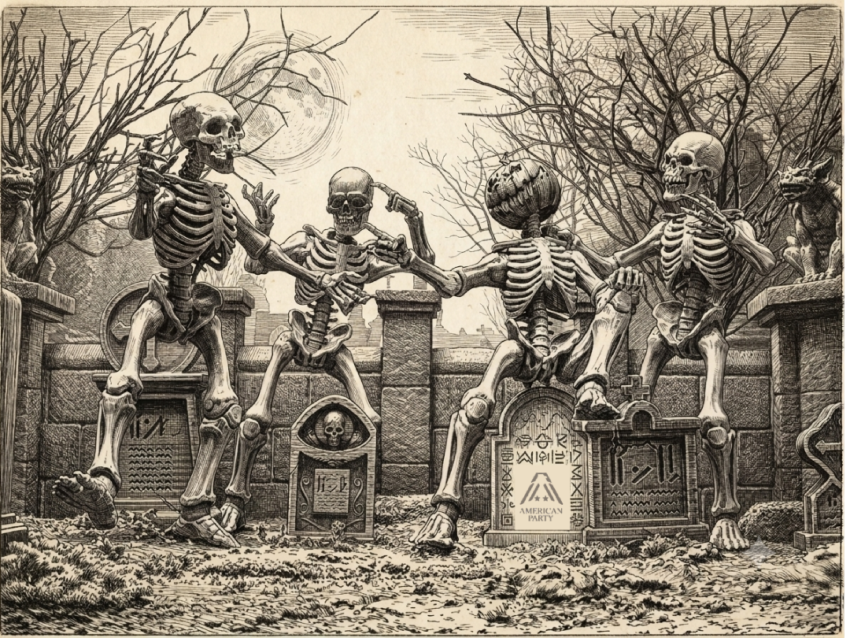
This Third-Party Gambit Runs Aground on American Political Arithmetic
❧ ✦ ❧
On the first day of July 2026, from a taxidermy-cluttered barn in the Maine woods, Tucker Carlson announced that he intended to break the American political system in two. Speaking to the Columbia Journalism Review, the former Fox News host framed his ambition not as a campaign but as a rescue mission. The two major parties, he argued, are functionally indistinguishable on the questions that matter most, and both have abandoned the ordinary citizen.
I do know what really matters is war and finance. Where does the money come from? Where does it go? And who gets killed? And on those questions, the parties are in lockstep solidarity with each other. That’s not a democracy. That’s a one-party state posing as a democracy, and it needs to be broken, and there’s going to be a third party, and I’m going to do everything I can to bring that about.
— Tucker Carlson, Columbia Journalism Review (July 1, 2026)
It is a compelling piece of rhetoric, and Carlson is, by nearly universal agreement, a preternaturally gifted rhetorician. But rhetoric is not arithmetic. The claim examined in this essay is a specific and testable one: that a third party, catalyzed by a media personality with a vast audience, could “break” the American duopoly and reorder national politics. This essay argues that the claim is mistaken—not because the grievances animating it are trivial, but because the diagnosis misidentifies the disease, the prescription ignores the structural pharmacology of American elections, and the physician has, over the past several years, disqualified himself from prescribing at all.
The tension underneath Carlson’s proposition is genuine and worth naming honestly. There is a real appetite for political innovation in a country where large majorities tell pollsters they are dissatisfied with both parties. Yet the history of American third parties is a graveyard of exactly such appetites—movements that captured a moment, moved a debate, and then evaporated. Understanding why requires setting aside both the populist’s optimism and the establishment’s reflexive dismissal, and looking instead at the machinery.
❧ ✦ ❧
I. What Carlson Actually Proposed
Precision matters here because Carlson’s proposal is both more modest and more slippery than the headlines suggest. He did not announce a party. He announced an intention to help build one, declined to name it, offered no platform beyond a mood, set no timeline, and explicitly ruled himself out as a candidate.
I’m going to help build a third party. There should be a good-faith effort to figure out what benefits the country.
— Tucker Carlson, via Breitbart News (July 1, 2026)
Asked directly whether he would run, Carlson was unambiguous: “I don’t want to be a candidate.” As Breitbart’s Mariane Angela reported, he “did not provide details about what the proposed third party would look like or when any formal effort to organize it might begin.” This is not a small omission. Every serious third-party effort in American history has been anchored either to a candidate willing to carry its banner or to a coherent, single-issue program capable of surviving its founder. Carlson has offered neither. What he has offered is a sentiment—that the welfare of ordinary Americans should outrank foreign entanglements—wrapped around a grievance about the Iran war that precipitated his rupture with the Republican Party.
The substantive core, insofar as one exists, is economic and anti-interventionist. Carlson pointed to stagnant wages, declining life expectancy, and diminished prospects for the young.
If you make sixty thousand dollars a year, you’re degraded. Your life expectancy has gone down, and the promise of your children’s lives is likely gone. No one seems to care. It’s not even a factor.
— Tucker Carlson, Columbia Journalism Review (July 1, 2026)
These are not fringe concerns; they are, in fact, widely shared across the political spectrum. But a diagnosis of pain is not a party. And the leap from “both parties agree on war and finance” to “therefore a third party will break the system” is precisely the leap that American electoral history refuses to support.
❧ ✦ ❧
II. The Graveyard: A Short History of American Third Parties
The United States has produced exactly one durable party realignment through the birth of a genuinely new party: the rise of the Republican Party in the 1850s, which displaced the Whigs. That single exception is instructive precisely because it was not a media personality’s project but the coalescence of an existing mass movement—antislavery—around a collapsing party structure. Every subsequent third-party surge has followed a very different and far more dispiriting pattern: a burst of energy, a respectable showing, and then dissolution.
Theodore Roosevelt and the Bull Moose, 1912
The high-water mark for a third-party presidential candidate remains Theodore Roosevelt’s 1912 Progressive Party run. As Newsweek’s Hannah Parry recounted in her coverage of Carlson’s announcement, Roosevelt—a former president with universal name recognition and a genuine national following—finished second, outpolling the sitting Republican president, William Howard Taft. And yet: he lost. He handed the White House to Woodrow Wilson by splitting the Republican vote, and the Progressive Party, in Parry’s summary, “quickly faded after the election.” A former president at the peak of his fame could not make a third party stick. Carlson, who has never held or sought office, proposes to try with less.
Ross Perot and the Reform Party, 1992–1996
The modern template for the media-fueled outsider is Ross Perot, and it is the template Carlson’s admirers implicitly invoke.
Businessman Ross Perot mounted another notable challenge in 1992, winning nearly 19 percent of the popular vote as an independent candidate—the strongest showing for a non-major-party presidential candidate in decades.
— Newsweek (July 1, 2026)
Perot had what Carlson lacks: a willingness to be the candidate, a self-funded war chest of personal billions, and a single crystalline issue—the federal deficit. He commanded nearly a fifth of the national vote. And he won zero electoral votes. Not a single one. His Reform Party, launched on the momentum of that showing, fractured within a decade and is today a historical footnote. The Perot episode is not evidence that a third party can break the system; it is the most powerful available evidence that even a maximally resourced, maximally famous, candidate-driven third party cannot.
The Perennial Minor Parties
The Libertarian and Green parties have contested presidential elections for decades. They occupy ballot lines, host conventions, and occasionally draw enough votes to alter the outcome of a close race—the perennial “spoiler” function. What they have never done, in Newsweek’s precise formulation, is “build sustained national support or win significant federal office.” They are permanent guests at the table who are never served.
The lesson of this history is not that Americans are content. It is that discontent, however intense, does not by itself overcome the structural machinery that converts a two-party equilibrium into a self-reinforcing one. That machinery deserves its own examination.
❧ ✦ ❧
III. The Machinery: Why the Duopoly Endures
Carlson’s error is to treat the two-party system as a conspiracy of will—a “one-party state posing as a democracy”—when it is more accurately understood as a mathematical consequence of institutional design. The barriers to a third party in the United States are not primarily attitudinal. They are architectural, and they operate whether or not the electorate is satisfied.
Winner-Take-All and Duverger’s Law
The single most important fact about American elections is that almost all of them are decided in single-member districts by plurality—the candidate with the most votes wins, and everyone else gets nothing. Political scientists have a name for the predictable result of this arrangement: Duverger’s Law, which holds that plurality, winner-take-all systems tend inexorably toward two-party competition. The reason is intuitive. A vote for a third party that cannot win is, functionally, a vote withdrawn from whichever major party the voter prefers to the other. Rational voters, understanding this, abandon third parties even when those parties best represent their views. Newsweek’s coverage stated the structural point plainly:
Political scientists generally attribute the limited success of third parties to the U.S.’s winner-take-all electoral system, strict ballot access requirements and fundraising challenges, all of which favor the two established parties.
— Newsweek (July 1, 2026)
This is not a barrier that a charismatic monologue can dissolve. It is the physics of the room. A parliamentary system with proportional representation rewards a party that wins ten percent of the vote with roughly ten percent of the seats; the American system rewards it with nothing. Until the underlying electoral rules change—a project requiring state-by-state legislative victories that the two incumbent parties have every incentive to block—the arithmetic will keep returning the same answer.
Ballot Access and the Fifty-State Gauntlet
Even before a third party reaches a single voter, it must reach the ballot, and the pathway there is a patchwork of fifty separate state regimes, many deliberately engineered by the incumbent parties to be onerous. Signature thresholds, filing deadlines, distribution requirements across counties, and litigation from major-party lawyers form a gauntlet that consumes money and time before a single argument is made to the public. The Libertarian Party spends a substantial fraction of its entire national effort simply maintaining ballot lines it has already won. A movement that does not yet exist, has no candidate, and has published no platform is not positioned to begin this work, and Carlson has given no indication that he grasps its scale.
It is worth dwelling on the deliberateness of these barriers because it exposes the deepest flaw in Carlson’s framing. He speaks of the two parties as if they were passively converged—two sleepwalkers who happen to be marching in the same direction on war and finance. But on the question of their own survival, the two parties are anything but passive, and they are anything but converged in interest with a would-be rival. The rules that make third parties impossible were, in many states, written by Democratic and Republican legislators acting in rare and perfect bipartisan harmony to raise the drawbridge behind themselves. This is the one arena in which the “one-party state” metaphor contains a grain of truth—and it is precisely the arena Carlson’s proposed remedy must conquer first and is least equipped to touch. The duopoly does not merely benefit from the structure; it actively defends and maintains it, cycle after cycle, in fifty statehouses at once.
The Money and the Machine
Modern campaigns are institutions: data operations, field organizers, compliance lawyers, media buyers, and fundraising apparatus sustained across cycles. The major parties have spent a century and a half building these machines. Perot substituted personal wealth for the machine and still won nothing at the electoral-vote level. Carlson has explicitly disclaimed both the candidacy and, by implication, the sustained institutional labor that a party requires. “All I have is the power to talk and be heard,” he told CJR. That is a description of influence, not of organization, and parties are built from organization.
❧ ✦ ❧
IV. The Messenger Problem
A movement is inseparable from its most visible champion, and here Carlson’s proposition encounters a difficulty distinct from electoral mechanics: the champion himself has become, for a large and growing share of the electorate, radioactive. This is a delicate matter to address fairly. Carlson’s defenders would say—and it is a legitimate argument—that hostility toward him from establishment quarters is a feature, not a bug, of an authentic outsider. But the specific liabilities he carries are not the ordinary scars of a truth-teller. They are the product of documented choices.
A Coalition That Cannot Hold
A third party viable enough to “break the system” must assemble a coalition broader than any single media niche. Carlson’s recent trajectory has instead narrowed his appeal in both directions at once. To his right and center, he has ruptured with the sitting Republican president and much of the party apparatus over the Iran war. To his left, whatever goodwill his anti-war stance earned has been repeatedly undercut. As the Anti-Defamation League documented at length in its April 2026 backgrounder, Carlson has hosted and lent legitimacy to figures such as the white nationalist Nick Fuentes and the Holocaust revisionist Darryl Cooper, and has personally advanced a series of conspiracy theories about Israel and Jewish influence. Whatever one makes of the ADL as an organization, the underlying events—the interviews, the on-air statements—are matters of public record that Carlson has not denied and in some cases has defended.
The consequence is a would-be coalition-builder who repels the center-right as a heretic and the center-left as a bigot, while retaining an intensely loyal but numerically bounded core. That is a recipe for a movement with a high floor and a low ceiling—exactly the profile of every third party in the graveyard.
The mathematics of coalitions is unforgiving. A party that aspires to break a two-party system must, almost by definition, assemble a plurality or near-plurality of the electorate; it must draw simultaneously from disaffected voters of both existing parties and from the disengaged. This requires a leader capable of addressing multiple constituencies without alienating any of them—a figure of unusual breadth and discipline. Carlson’s gift is the opposite. His talent is intensity: the capacity to bind a devoted audience ever more tightly to a narrowing set of preoccupations. That is an excellent formula for a podcast and a ruinous one for a party. The very qualities that make him a magnetic broadcaster—the willingness to entertain the forbidden, the disdain for the median viewer’s sensibilities, the pursuit of the outrage that will hold an audience for two hours—are disqualifying in a coalition-builder, whose task is to enlarge rather than to concentrate. Carlson has spent three years, by his own account, following “smell and instinct” toward whatever holds his audience. A party cannot be built on instinct alone, and certainly not on an instinct tuned to intensity rather than breadth.
The Verdict From His Own Side
The most damaging testimony against Carlson’s viability as a movement leader comes not from the left but from within the conservative coalition he would need to fracture. Senator Ted Cruz, in a November 2025 town hall, offered an assessment that has only hardened since:
I think Tucker is dangerous. I think what he’s saying is wrong. And I’m calling him out and I’m calling him out over and over and over again… And Tucker’s gone down a very dark path.
— Sen. Ted Cruz, via Mediaite (November 20, 2025)
Cruz’s warning—that a road beginning in antisemitism “very quickly leads you to anti-capitalism and anti-Americanism”—is a partisan judgment, and readers should weigh it as such. But it illustrates a structural problem no monologue can fix: the leaders of the very voters Carlson would need to peel away regard him as disqualified, and they are making that case relentlessly to the same audience.
The Question of Sincerity
There is, finally, the recurring charge of incoherence—that Carlson’s positions shift with his interests. The International Business Times reported that within days of declaring there was “no chance” he would support the Republican Party, Carlson publicly praised Vice President J.D. Vance and suggested he could back him in a future presidential race, prompting critics to call the posture self-contradictory. A columnist at the Augusta Free Press, no admirer of the establishment, put the skeptic’s case with unusual candor:
Given the historically malleable nature of his personality, it’s hard to view his current shift as anything other than a calculated move to abandon a sinking ship.
— Michael Schoeffel, Augusta Free Press (May 14, 2026)
Even critics willing to credit Carlson’s anti-war stance struggle to locate a fixed principle beneath the shifting alliances. A party is a promise of consistency across time and personnel. A figure whose commitments appear to track the prevailing wind is poorly suited to make that promise, and voters—even disaffected ones—sense it.
❧ ✦ ❧
V. Where Carlson Is Not Wrong
Intellectual honesty requires conceding the strongest form of Carlson’s case, because it contains real truth. The dissatisfaction he channels is not manufactured. Large majorities of Americans do tell pollsters they wish for alternatives to the two major parties. The convergence of both parties on an interventionist foreign policy and a financialized economy is a defensible empirical observation, not merely a slogan. Wage stagnation, deaths of despair, and the anxieties of a generation facing automation are documented realities, and the columnist at the Augusta Free Press was struck, listening to Carlson, by how much of it “seemed reasonable and fair enough”—to the point of sounding, at moments, like Bernie Sanders.
This cross-ideological resonance is the genuinely interesting feature of the moment. When a figure of the populist right and figures of the populist left arrive at overlapping critiques of war and oligarchy, something real is being registered in the electorate. The dissatisfaction is the true premise. But a true premise can support a false conclusion, and here it does. The leap from “the electorate is dissatisfied” to “a third party can therefore break the duopoly” skips over everything examined in Sections II and III: the history that shows dissatisfaction alone is insufficient, and the machinery that shows why.
There is a further irony worth naming. If the parties truly are converged on the questions Carlson cares about, the most plausible route to change is not exit but capture—the strategy that actually worked in living memory. The MAGA movement did not build a third party; it took over an existing one from within, precisely because the structural barriers to a new party are prohibitive while the barriers to a hostile takeover of a major-party primary are comparatively low. Carlson, of all people, watched this happen and participated in it. His proposal to abandon that proven mechanism in favor of the one that has failed for a century and a half is, at minimum, strategically curious.
❧ ✦ ❧
VI. The Likely Consequences
Suppose Carlson proceeds. What would the realistic effect be? Not the collapse of the duopoly, but something the incumbent parties understand well and fear appropriately: the spoiler effect. Newsweek’s analysis was direct about the mechanism.
If even a small share of Republican voters follows Carlson into a new movement, it could prove consequential in competitive House and Senate races.
— Newsweek (July 1, 2026)
This is the paradox that dooms the enterprise on its own terms. A Carlson-aligned party would draw disproportionately from disaffected Republican and populist-right voters. In a winner-take-all system, subtracting those votes from Republican candidates does not build a new majority; it hands marginal races to Democrats. The likeliest achievement of a third-party built on Carlson’s coalition is therefore the election of the very politicians his voters oppose most—the identical dynamic by which Roosevelt’s Bull Moose delivered 1912 to Woodrow Wilson. The movement would function not as a battering ram against the system but as a thumb on the scale within it, and against its own supporters’ interests.
The timing sharpens the point. With midterm elections months away, a fracture on the right does not reorder American politics; it redistributes a fixed pool of votes in a handful of close districts. That is an influence of a kind. It is not the breaking of a one-party state. It is, if anything, a demonstration of how firmly the two-party structure holds even under stress—absorbing the shock, converting the rebellion into a marginal advantage for the other incumbent, and grinding on.
❧ ✦ ❧
VII. Conclusion: The Power to Talk, and Its Limits
Tucker Carlson is right that many Americans feel unrepresented. He is right that the two parties converge on questions of war and money in ways that ought to trouble a self-governing people. He is even right that the resulting arrangement can feel, to the citizen on the outside, like a single machine wearing two masks. Where he is wrong is in believing that a third party is the instrument that will shatter it, and in imagining himself as the figure who could wield that instrument.
The obstacles are not rhetorical, and so they are immune to rhetoric. Winner-take-all elections and Duverger’s Law convert third-party votes into wasted votes. Fifty separate ballot-access regimes bleed money and time from movements before they begin. The graveyard of Roosevelt and Perot testifies that even former presidents and self-funded billionaires cannot make the arithmetic yield. And the particular messenger in this case has, through documented choices, forfeited the broad coalition a system-breaking party would require, alienating the center-right and the center-left simultaneously while retaining a loyal but bounded core.
Carlson described his own situation with more accuracy than perhaps he intended. “All I have,” he said, “is the power to talk and be heard.” It is a considerable power, and he wields it with rare skill. But talking is not organizing, an audience is not a coalition, and being heard is not being elected. The American two-party system has survived civil war, depression, and realignment not because it is beloved but because it is built, at the deepest structural level, to survive exactly the kind of challenge Carlson proposes. The one-party state he described is a rhetorical figure. The two-party system he would break is a fact of engineering. And facts of engineering are not moved by monologues, however compelling—delivered from however picturesque a barn.
Those who share Carlson’s diagnosis would be better served by the harder, less glamorous work the American system actually rewards: contesting primaries, changing electoral rules state by state, and building institutions that outlast any single personality. That work is slow, unglamorous, and unsuited to a video podcast. It is also the only kind that has ever worked. The appetite for innovation is real. The proposed vehicle cannot carry it. And recognizing the difference is the beginning of political seriousness.
❧ ✦ ❧
SOURCES CONSULTED
Primary reporting and documentation underlying this analysis. Quotations are drawn directly from these sources.
• Barshad, Amos. “‘All I Have Is the Power to Talk and Be Heard.'” Columbia Journalism Review, July 1, 2026. https://www.cjr.org/the-interview/all-i-have-is-the-power-to-talk-and-be-heard-tucker-carlson-interview-pitying-trump-podcast-new-third-party-nicotine-pouch-alp-fox-news-fired-anti-war-gaza-immigration.php
• Angela, Mariane. “‘I’m Going to Help Build a Third Party’: Tucker Carlson Drops Political Bombshell.” Breitbart, July 1, 2026. https://www.breitbart.com/politics/2026/07/01/im-going-help-build-third-party-tucker-carlson-drops-political-bombshell/
• Parry, Hannah. “Tucker Carlson Says He’s Starting a New Party: Should Republicans Worry?” Newsweek, July 1, 2026. https://www.newsweek.com/tucker-carlson-says-hes-starting-a-new-party-should-republicans-worry-12148698
• “Tucker Carlson” (Backgrounder). Anti-Defamation League, May 5, 2026. https://www.adl.org/resources/backgrounder/tucker-carlson
• Griffing, Alex. “Ted Cruz Argues Tucker Carlson Is Going Down ‘Dark Path.'” Mediaite, November 20, 2025. https://www.mediaite.com/politics/ted-cruz-argues-tucker-carlson-is-going-down-dark-path-from-anti-semitism-to-anti-americanism/
• Schoeffel, Michael. “Do I Like Tucker Carlson Now? No, but Maybe I Dislike Him a Little Less.” Augusta Free Press, May 14, 2026. https://augustafreepress.com/news/do-i-like-tucker-carlson-now-no-but-maybe-i-dislike-him-a-little-less/
• Longino, Crisnel. “Tucker Carlson Branded a ‘Complete Fraud’ After Backing JD Vance Despite GOP Exit Claims.” International Business Times UK, June 25, 2026. https://www.ibtimes.co.uk/tucker-carlson-gop-controversy-jd-vance-1804991
• Lehmann, Chris. “What Happened to Tucker Carlson?” The Nation, April 7, 2026. https://www.thenation.com/article/society/tucker-carlson-jason-zengerle-hated-by-all-right-people/
• Barclay, Rabbi Michael. “Tucker Carlson and Alex Jones: A Psy-Op or Just Plain Stupid?” PJ Media, June 24, 2026. https://pjmedia.com/rabbi-michael-barclay/2026/06/24/tucker-carlson-and-alex-jones-a-psy-op-or-just-plain-stupid-n4954339
❧ ✦ ❧
A Note on Research Methods and Accuracy
In recent years, some have voiced concern that artificial intelligence may distort facts or introduce inaccuracies into serious research. That criticism deserves acknowledgment. However, AI has now evolved into the most powerful research instrument available to any dedicated scholar—capable of analyzing vast datasets, cross‑referencing historical records, and surfacing overlooked connections across sources. This work represents a collaboration between the author’s investigative inquiry, verified primary documentation, and the advanced analytic capabilities of AI research tools. Here, AI was not used as a ghostwriter or a shortcut for scholarship, but as a disciplined research partner devoted to rigor, accuracy, and transparency.
Every factual claim in this work has been subjected to active verification. Where AI‑generated content was used as a starting point, it was tested against primary sources, peer‑reviewed scholarship, official institutional documentation, and established historical records. Where discrepancies were found—and they were found—corrections were made. The author has made every reasonable effort to ensure that quotations are accurately attributed, historical details are precisely rendered, and theological claims fairly represent the positions they describe or critique.
That said, no work of this scope is immune to error, and the author has no interest in perpetuating inaccuracies in the service of an argument. If you are a reader—whether sympathetic, skeptical, or hostile to the conclusions drawn here—and you identify a factual error, a misattributed source, a misrepresented teaching, or a claim that cannot be substantiated, you are warmly and genuinely invited to say so. Reach out. The goal of this work is not to win a debate but to get the history right. Corrections offered in good faith will be received in the same spirit, and verified corrections will be incorporated into future editions without hesitation.
Truth, after all, has nothing to fear from scrutiny—and neither does this work.