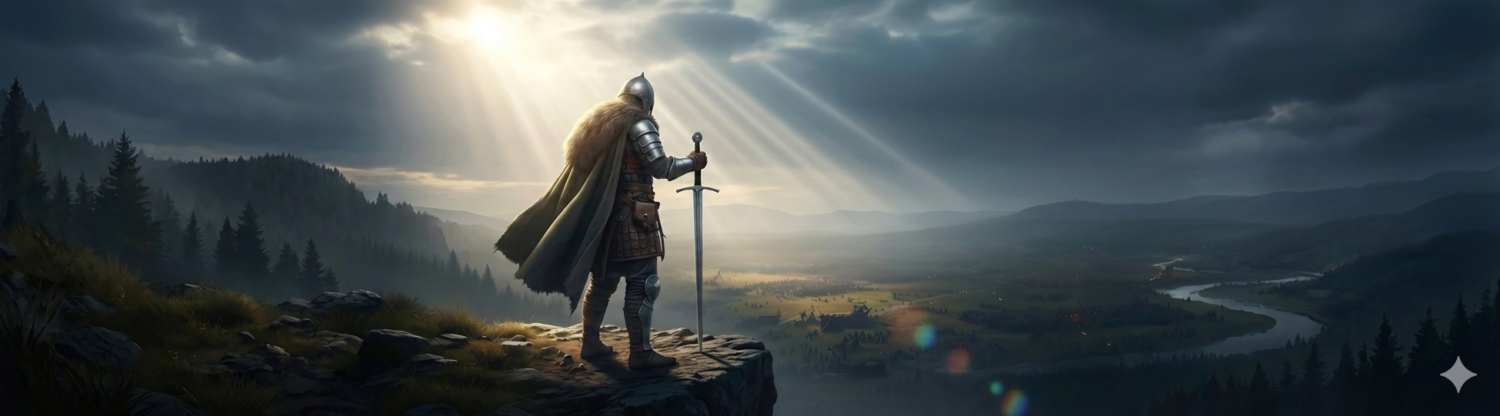
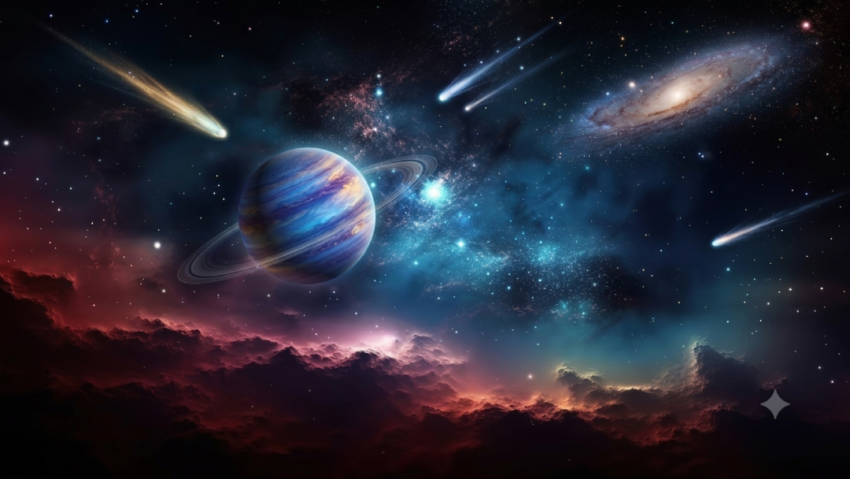
A Philosophical and Theological Essay
❦ ❖ ❦
I. The Terror and the Question
More than three centuries ago, the mathematician and Christian apologist Blaise Pascal set down a confession that has haunted every thoughtful reader since: the eternal silence of the infinite spaces frightened him. He was not a man given to fright. He had reasoned his way to the foundations of probability and the vacuum, and he had wagered his soul with a cold logician’s clarity. Yet when he lifted his eyes from the page to the night sky, something in the sheer scale of things pressed upon him a vertigo that no equation could dissolve. The stars did not speak. The dark between them did not answer. And a finite, fragile, thinking creature stood beneath a canopy so vast that his imagination broke against it like surf against a cliff.
We are the heirs of Pascal’s vertigo, only ours is enormously magnified. He looked up at a few thousand visible stars and trembled. We now know that the observable universe alone is a sphere roughly ninety-three billion light-years in diameter, a volume so large that the numbers describing it read like incantations rather than measurements. And beyond that observable horizon, the cosmos may stretch on — perhaps hundreds of times larger, perhaps without limit at all, perhaps infinite in the strict and dizzying sense of the word. The silence has grown deeper. The spaces have grown wider. And the ancient question presses harder than ever: what does it mean that we, who can be measured in meters and years, find ourselves inside something that may have neither edge nor end?
This essay takes up that question at the precise seam where two great human enterprises meet and strain against each other — the empirical inquiry of modern cosmology and the faith-claim of an infinite Creator. My thesis is deceptively simple to state and endlessly rich to unfold: the infinite (or very nearly infinite) character of the physical universe poses a philosophical conundrum that runs strikingly parallel to the religious assertion of an infinite God. Both confront us with an object that exceeds our comprehension. Both force us to reason about magnitudes we can name but cannot picture. And both, I will argue, ultimately return us to the same threshold — the recognition that human understanding has limits, and that what lies past those limits must be approached with a different posture than the one we bring to the laboratory bench.
I write as a Christian, and I will not pretend otherwise; the apostle Peter’s charge to give a reasoned defense of hope, always with gentleness and respect, is the discipline under which I work. But I have no wish to bully the evidence or to dress speculation in the robes of proof. Where science speaks clearly, I will let it speak, and I will honor the difference between what has been measured and what has been merely surmised. Where faith goes beyond what instruments can, I will say so plainly. My aim is not to win a skirmish but to hold two infinities up to the light at once — the one astronomers chart and the one theologians confess — and to ask, honestly, what their resemblance might mean.
The eternal silence of these infinite spaces frightens me.
— Blaise Pascal, Pensées
❦ ❖ ❦
II. The Cartography of the Unimaginable
Before we can weigh what the universe’s size means, we must be honest about what that size actually is — and about how much of it we can genuinely know. Here, the empirical record is both magnificent and humbling.
The Observable Universe
Astronomers begin with a fixed and stubborn fact: the universe has an age. By analyzing the faint relic radiation left over from the Big Bang — the Cosmic Microwave Background — cosmologists have established that the universe is roughly 13.8 billion years old. Because light travels at a finite speed, this age imposes a horizon on what we can see. Any object more distant than light could have traversed in 13.8 billion years lies, quite literally, beyond our sight. This bounded region is what astronomers call the observable universe — not the whole of reality, but the portion of it from which light has had time to reach us.
One might expect the observable universe to be 13.8 billion light-years in radius, and 27.6 billion across. But space itself has been expanding the entire time the light was in transit, carrying its sources ever farther from us. When this expansion is accounted for, the objects whose ancient light reaches us today now lie some forty-six billion light-years away in every direction. The Encyclopedia Britannica states the resulting figure plainly:
The observable universe is more than 46 billion light-years in any direction from Earth and about 93 billion light-years in diameter.
— Karen Sottosanti, Encyclopaedia Britannica, “Observable Universe”
The mind reaches for a comparison and finds none adequate. The BBC’s Sky at Night magazine puts the volume of this sphere at roughly 410 nonillion cubic light-years — that is, 410 followed by thirty zeros. Within that volume are perhaps two trillion galaxies, each a city of hundreds of billions of stars. The largest single galaxy yet catalogued, IC 1101, spans some five to six million light-years and contains on the order of a hundred trillion stars; the giant radio galaxy Alcyoneus stretches an almost inconceivable sixteen million light-years from end to end. And structures larger still — the great walls and filaments and voids of the cosmic web — run for more than a billion light-years apiece. Against such a backdrop, the astrophysicist Ethan Siegel’s summary is not hyperbole but sober description: within this universe, we are merely a drop in the cosmic ocean.
The Universe Beyond the Horizon
Here, the certainties thin out, and intellectual honesty requires that we say so. The ninety-three-billion-light-year figure describes only what we can observe. About the universe beyond that horizon — the far larger reality of which our visible bubble is presumably a small part — science can say remarkably little. Alastair Gunn, a radio astronomer at Jodrell Bank, does not soften the point:
One idea is that if the cosmos expanded at the speed of light during its earliest inflation phase, then it should be 100 sextillion times bigger than the observable Universe… But, ultimately, science has no reliable estimate of the actual size of the entire Universe.
— Alastair Gunn, BBC Sky at Night Magazine
This is a crucial admission, and I want to dwell on it because it will matter greatly when we turn to theology. The scientist here is not confessing ignorance of some trivial detail. He is confessing that the total size of what exists is, and may forever remain, beyond the reach of measurement. The astrophysicist Sara Webb of Swinburne University is even blunter, telling Popular Science that there is, physically, absolutely zero way that we will ever know how large the universe truly is. The observable horizon is not merely a limit on our present instruments; as the cosmologist Paul Sutter observes, it is a limit on what we can ever know, because there is a finite quantity of information we could ever receive, even across an infinite future.
Notice what has happened. We set out to chart the universe with the most powerful methods humanity has ever devised — space telescopes, redshift surveys, the exquisite mapping of the microwave background — and those very methods have delivered us to a wall marked thus far and no farther. The cartography of the cosmos ends not in a completed map but in a horizon, and the honest cartographer writes across the margin beyond it: here we cannot go.
❦ ❖ ❦
III. Is the Universe Infinite?
We arrive now at the sharpest edge of the empirical question, the one that gives this essay its title and its tension. Is the universe finite — very large but bounded — or is it infinite, without limit in extent? The answer, remarkably, turns not on how far our telescopes can see but on the geometry of space itself.
The Question of Shape
Einstein’s General Theory of Relativity permits three broad geometries for the cosmos, and cosmologists have long compared them to familiar surfaces: a flat universe, like an infinite sheet of paper; a closed universe, curved like the surface of a sphere; and an open universe, curved like a saddle. Which one we inhabit depends on the total density of the universe and its rate of expansion — quantities astronomers can, with great labor, actually measure.
The method is elegant. In a curved universe, the path of light bends as it crosses billions of light-years, subtly distorting the apparent size of features in the microwave background. Cosmologists know from the physics of the early plasma how large those temperature splotches ought to appear. They compare the prediction to the observation. Paul Sutter describes the verdict with disarming simplicity: the splotches are exactly the size we expect them to be, and that is how we know the universe is flat. A flat universe, extended without curvature, would be spatially infinite.
But the story does not end there; here, the scientists themselves model the intellectual humility I am commending. The measurement of flatness is made from inside our observable bubble, and as Sutter warns, a curvature too gentle to detect across tens of billions of light-years might yet close the universe on scales far larger than we can survey — just as a surveyor confined to a single neighborhood would find the curved Earth indistinguishable from a plane. And the BBC’s Alastair Gunn notes that some recent studies have suggested the universe may actually be closed, and therefore finite after all. The most candid summary is his:
Frustratingly, astronomers are currently unable to say whether the Universe is infinite or finite.
— Alastair Gunn, BBC Sky at Night Magazine
The Strange Freedom of a Finite Cosmos
One further subtlety deserves attention, because it dismantles a common misconception. Even if the universe is finite, it need not have an edge. The analogy that recurs throughout the literature is the surface of the Earth: finite in area, yet boundless — one may walk forever without arriving at a rim or falling off. A finite universe could curve back upon itself in the same way, so that a traveler moving in a straight line long enough would, in principle, return to the starting point. There is, in the words of the astronomers, no reason to suspect that the limit of the observable universe is an actual edge, nor that whatever lies beyond it has an edge at all.
The philosophical residue of all this is worth naming carefully. Modern cosmology has not proven the universe to be infinite. It has been shown that the universe is, at minimum, unimaginably larger than anything we can observe, and that whether its true extent is finite-but-unbounded or genuinely infinite may lie permanently beyond empirical resolution. We stand, in other words, before a magnitude that functions, for all human purposes, as an encounter with the infinite — even though we cannot prove that the word applies. That is a philosophically unstable and fascinating place to stand, and it is precisely the place where the theologian has always claimed to live.
❦ ❖ ❦
IV. What We Mean, and Cannot Mean, by “Infinite”
Before pressing the parallel between cosmic and divine infinity, we must reckon honestly with the concept of infinity itself — for it is one of the most treacherous words in any language, wearing the costume of a number while behaving like nothing a number ever did.
When the mathematician says a set is infinite, he does not mean very large. He means something categorically stranger. An infinite collection can be placed in one-to-one correspondence with a proper part of itself: the whole numbers can be matched perfectly against the even numbers alone, though the evens are, in an obvious sense, only half of them. David Hilbert famously dramatized the paradox with his hotel of infinitely many rooms, all occupied, which can nonetheless always accommodate one more guest — indeed, infinitely many more — by shuffling its residents down the corridor forever. Infinity, in short, does not obey the arithmetic of the finite. It is not the top of a ladder we could climb given enough time; it is a different kind of thing altogether, and every attempt to picture it collapses, because a picture is by nature bounded, and infinity is precisely the negation of a bound.
This has a sobering consequence for both the cosmologist and the theologian. When either one uses the word infinite, he is not naming a very big object that his mind almost encompasses. He is naming the point at which comprehension gives out. The physicist and priest Michał Heller, a Templeton laureate whose work concerns the singularity problem in general relativity, made the point with the precision of one who loves both mathematics and God:
Because I like mathematics, I also like to regard God as infinity — not only as far as numerical infinity is concerned but, let us say, in an apophatic way. Even for a mathematician, the word “infinity” is in-finity, the negation of finity. It is difficult to speak about these matters because to put transcendence into words is to betray it.
— Michał Heller, John Templeton Foundation interview
Here is the hinge of the whole essay, and I ask the reader to pause on it. Heller has noticed that the mathematician’s infinity and the theologian’s God share a grammar. Both are known chiefly by negation — by what they are not, by the finitudes they exceed. The ancient Christian tradition called this the via negativa or apophatic theology: we say most truly what God is by confessing what He is not. Not bounded. Not temporal. Not contingent. Not comprehensible. And when the cosmologist reaches the edge of the observable and writes here we cannot go, he too is speaking apophatically — describing the beyond by the boundary it exceeds. The parallel my thesis proposed is not a rhetorical flourish. It is a structural resemblance in the very logic of how finite minds approach the unlimited.
❦ ❖ ❦
V. The Deeper Tension: Origins and the Limits of Explanation
Thus far, we have circled the question of the universe’s extent. But underneath the debate over size lies a still deeper tension — the one between empirical science and faith over the question of origins. If the universe is vast beyond measure, where did all of it come from? And can the methods that mapped its expansion also account for its beginning?
The Universe Had a Beginning
For most of intellectual history, the default assumption of naturalistic thought was that matter is eternal — that the universe simply is, and always was, requiring no cause and no Creator. The twentieth century overturned that assumption with a suddenness that still reverberates. The discovery of cosmic expansion, and then in 1964 the detection of the Cosmic Microwave Background by Arno Penzias and Robert Wilson, established that the universe had a definite beginning in a hot, dense state some 13.8 billion years ago. Penzias, who won the Nobel Prize for the discovery and who read the data as consonant with the opening words of Genesis, later reflected on the resistance his findings met:
The dogma comes from the intuitive belief of people (including the majority of physicists) who don’t want to accept the observational evidence that the universe was created — despite the fact that the creation of the universe is supported by all the observable data astronomy has produced so far.
— Arno Penzias, Nobel Laureate in Physics
One need not share Penzias’s theological conclusions to grant the force of his historical observation. The evidence for a cosmic beginning is now overwhelming, and it presses a question that is not scientific but philosophical: what does it mean for the totality of space, time, and matter to have begun?
The Singularity and Its Undoing
For decades, the beginning was pictured as a singularity — a mathematical point of infinite density and temperature from which space and time themselves emerged. Extrapolating Einstein’s equations backward yields exactly such a point. But here honesty compels an important qualification that is too often omitted from popular accounts. The initial singularity is not a confident description of the origin; it is the place where our best theory breaks down. As the physics literature states plainly, extrapolating general relativity to that limit produces a singularity precisely because the classical theory is inadequate to describe conditions of such extremity, where quantum effects dominate and general relativity, on its own, fails to make accurate predictions. The singularity marks the failure of the map, not the discovery of the territory.
Matters grew subtler still with the theory of cosmic inflation, developed in the early 1980s, which proposes that a phase of exponential expansion preceded the hot Big Bang. Ethan Siegel argues that the 2003 and later measurements of super-horizon fluctuations in the microwave background constitute strong evidence that such an inflationary phase really occurred — that, in his provocative phrasing, there truly was a universe before the Big Bang, at least in the sense that the hot dense state was not itself the absolute beginning. Yet inflation does not banish the beginning; it relocates it. The Borde-Guth-Vilenkin theorem, published by Arvind Borde, Alan Guth, and Alexander Vilenkin in 2003, demonstrates that any universe that has been expanding on average throughout its history cannot be extended infinitely into the past — that such a universe is, in the theorem’s careful language, incomplete in past directions. A past boundary remains. The beginning, pushed back, refuses to be pushed away.
Why Is There Something Rather Than Nothing?
And so we arrive at the question that science, by its own admission, cannot answer — the question the philosopher Leibniz posed three centuries ago and that no instrument has since dislodged: why is there something rather than nothing? The physicist Stephen Barr frames the boundary between what science can and cannot reach with an analogy I find genuinely illuminating:
The first words of a play — say Hamlet — may obey the laws of English grammar. They may also fit into the rest of the plot in a natural way… However, that would not explain why there is a play. There is a play because there is a playwright. When we ask about the origin of the play, we are not asking about its first words, we are asking who wrote it and why.
— Stephen Barr, physicist, University of Delaware
This distinction — between the universe’s first moment and the ground of its existence — is the philosophical fulcrum of the entire origins debate, and it is one that careful thinkers on both sides can affirm. Even Stephen Hawking, no friend of theism, framed the mystery in these terms when he asked what it is that breathes fire into the equations so that there is a universe for them to describe. Science may one day write the equations of the first instant. It cannot, in principle, explain why the equations are enfleshed in a real cosmos rather than remaining forever unrealized abstractions. That question lies on the far side of a boundary as firm as the observable horizon itself.
❦ ❖ ❦
VI. Two Infinities, One Threshold
We are now in a position to draw the parallel my thesis promised, and to test whether it holds under pressure. Consider what the honest inquirer confronts at the end of each road.
At the end of the cosmological road stands a universe of unmeasurable and possibly infinite extent, whose true size lies beyond what we can ever know, whose beginning marks the breakdown of our finest theories, and whose existence poses a question: why is there anything? — that the empirical method is structurally unequipped to answer. The scientist, following the evidence with rigor, is delivered to a threshold and told: beyond this, measurement cannot pass.
At the end of the theological road stands the classical confession of an infinite God — uncaused, non-spatial, atemporal, immaterial — whom the tradition has always insisted cannot be comprehended by the finite mind, but only approached through negation, analogy, and revelation. The theologian, reasoning as far as reason goes, is delivered to a threshold and told: beyond this, comprehension cannot pass.
The resemblance is not that both roads reach the same object — that would be to smuggle the conclusion into the premise, and I have no wish to do so. The resemblance is that both roads reach the same kind of threshold: an encounter with something that exceeds the finite mind’s capacity to encompass, an object known chiefly by what it is not, a horizon past which our native tools fail. J. Warner Wallace, reasoning from the finitude of the universe toward its cause, states the classical inference cleanly:
All the space, time and matter in our universe sprang into existence from nothing and this moment of creation was most reasonably caused by a non-spatial, a-temporal, non-material, all powerful first cause.
— J. Warner Wallace, Cold Case Christianity
The theist presses the parallel toward identity: the very properties a first cause of space, time, and matter would need to possess — timelessness, spacelessness, immateriality, immense power, and the sheer capacity to exist without deriving existence from anything prior — are the properties the tradition has always ascribed to God. The mathematician-priest Michał Heller sharpens the logic to its point: if we ask about the cause of the universe, we are really asking about the cause of the mathematical laws themselves, and that question drives us back to Leibniz — to a cause unlike any other cause investigated by science, because it is the cause of existence itself.
The skeptic will resist this final step, and the resistance deserves a fair hearing. One may hold that the threshold is simply a threshold — that the universe’s brute existence is a fact requiring no further explanation, that to demand a reason for everything, including the totality of things, is to misuse the concept of reason. The cosmologist George Ellis, himself sympathetic to theism, is scrupulously fair about where the line falls: the choice between a universe that is pure happenstance and one in which purpose or intent somehow underlies existence is, he insists, a metaphysical question that science cannot decide. I think that is exactly right, and it is why I have not claimed that cosmology proves God. What I claim is narrower and, I think, harder to dismiss: that the universe’s vastness and its origin deliver us to a genuine philosophical threshold, that the theistic reading of that threshold is intellectually serious rather than naive, and that the parallel between the two infinities is real and not merely rhetorical.
❦ ❖ ❦
VII. The Deeper Miracle: That We Can Understand at All
There is a final turn to the argument that I find more compelling than any inference from size or beginning, and it inverts Pascal’s terror in a way worth savoring. The wonder is not merely that the universe is vast. The wonder is that we — small, late-arriving, carbon-based creatures on a minor planet — can understand so much of it at all.
Einstein caught the paradox in a sentence that has become justly famous: the most incomprehensible thing about the universe is that it is comprehensible. Why should the mathematics dreamt up by human minds map so uncannily onto the deep structure of galaxies and quantum fields? Why should a species shaped by the pressures of survival on an African savanna possess minds capable of general relativity and the microwave background? The climatologist Sir John Houghton turned Pascal’s question inside out in an exchange I have long treasured. Asked why God would make so much of the cosmos incomprehensible, he replied by asking instead why it is that we can comprehend so much.
For the Christian theist, the comprehensibility of the cosmos is not a lucky accident but a signature. If the same rational Mind that authored the laws of nature also authored the human mind — if we are, in the ancient phrase, made in the image of the One who made the mathematics — then the astonishing fit between thought and world is exactly what we should expect. The physicist and mathematician John Lennox concludes:
Both the real world and mathematics are traceable to the Mind of God who created both the universe and the human mind. It is, therefore, not surprising when the mathematical theories spun by human minds… find ready application in a universe whose architect was that same creative Mind.
— John Lennox, University of Oxford
This is not proof, and I decline to inflate it into one. A naturalist may reply that a universe intelligible enough to produce intelligent observers will, unsurprisingly, be found intelligible by them. The argument does not close like a trap. But it does something a trap could not: it reframes Pascal’s silence. The infinite spaces that frightened him are also, on this reading, legible spaces — a vast text written in a language a finite mind can, astonishingly, begin to read. And a text implies an Author, even when — especially when — the reader can make out only the opening lines.
❦ ❖ ❦
VIII. Standing at the Horizon
I began with Pascal trembling beneath the stars, and I have argued that his vertigo was not weakness but insight. He had perceived, before the instruments existed to confirm it, that the human mind is a finite thing set within something that overwhelms it — and that this predicament is, at bottom, a spiritual one and not merely a scientific one.
The modern picture has only deepened his intuition. Cosmology has handed us a universe at least ninety-three billion light-years across, expanding, flat so far as we can measure, possibly infinite and possibly finite-but-unbounded, with a true extent we may never know. It has traced the cosmos back to a beginning that marks the breakdown of our best theories, and left standing the one question the method cannot touch: why is there anything at all? At every turn, the empirical road runs up against a threshold and stops — not from failure of nerve or instrument, but from the structure of inquiry itself.
The theological tradition has stood at that threshold for millennia, and it comes bearing not a rival measurement but a different posture. Where science measures, faith worships; where the instrument reaches its limit, the believer confesses a Mind beyond the limit — infinite as the mathematician’s infinity is infinite, known by negation, approached by analogy, exceeding every picture the imagination can form. I have not claimed that the vastness of the universe proves this God. I have claimed something I believe is both more modest and more durable: that the two infinities rhyme. That the conundrum of an unbounded cosmos and the confession of an unbounded Creator lead the finite mind to the same astonished silence, and pose, in different dialects, the same ultimate question.
Perhaps that is where an honest essay on such a theme ought to end — not with a Q.E.D. but with an invitation. The eternal silence of the infinite spaces frightened Pascal. It need not only frighten. For the one willing to entertain that the silence is not empty but reticent — that behind the horizon there may be not a void but a Presence, not an absence of meaning but a surplus of it too great for the eye to bear — that same silence becomes something else entirely. It becomes the hush before a word. And the oldest word of the tradition, spoken into exactly this darkness, is also the simplest: In the beginning, God.
The question this essay has raised cannot be closed by argument alone, and I would distrust any argument that claimed to close it. It can only be lived toward, with the mind fully engaged and the heart fully awake. I leave it, therefore, where every genuine inquiry into ultimate things must leave it — open, luminous, and pressing — an invitation to keep looking up, and to keep asking what the silence might yet be trying to say.
❦ ❖ ❦
Sources & Citations
This essay draws on the following sources. Empirical claims are grounded in the scientific and cosmological references; interpretive and theological claims are the author’s own, developed in dialogue with the apologetic sources noted below.
Cosmology & the Size of the Universe
• Gunn, Alastair. “How big is the Universe?” BBC Sky at Night Magazine. https://www.skyatnightmagazine.com/space-science/how-big-universe
• Sottosanti, Karen. “Observable universe.” Encyclopaedia Britannica. https://www.britannica.com/topic/observable-universe
• Siegel, Ethan. “17 pictures that show how mind-bogglingly large the Universe is.” Big Think. https://bigthink.com/starts-with-a-bang/how-large-universe/
• Leffer, Lauren. “Is the universe really infinite? Astrophysicists explain.” Popular Science. https://www.popsci.com/science/is-the-universe-infinite/
• Sutter, Paul. “Is the Universe Infinite?” Universe Today. https://www.universetoday.com/articles/is-the-universe-infinite
Origins, the Singularity & Inflation
• “Initial singularity.” Wikipedia. https://en.wikipedia.org/wiki/Initial_singularity
• Siegel, Ethan. “The strongest evidence for a Universe before the Big Bang.” Big Think. https://bigthink.com/starts-with-a-bang/evidence-universe-before-big-bang/
• Borde, A., Guth, A., & Vilenkin, A. (2003). “Inflationary Spacetimes Are Incomplete in Past Directions.” Physical Review Letters 90, 151301.
Theology, Apologetics & the Case for a Creator
• Wallace, J. Warner. “Yet Another Reason to Believe Our Finite Universe Points to the Existence of God.” Cold Case Christianity. https://coldcasechristianity.com/writings/yet-another-reason-to-believe-our-finite-universe-points-to-the-existence-of-god/
• Boling, Mike. “Creation: Why, How, and When Did God Create the Universe?” Servants of Grace. https://servantsofgrace.org/creation-god-create-universe/
• Robinson, Robert Clifton. “Noted Ph. D.s and Scientists Who Believe God Created the Universe.” (Quotations of Penzias, Barr, Lennox, Ellis, Heller, Houghton.) https://robertcliftonrobinson.com/noted-ph-ds-and-scientists-who-believe-god-created-the-universe/
❦ ❖ ❦
A Note on Research Methods and Accuracy
In recent years, some have voiced concern that artificial intelligence may distort facts or introduce inaccuracies into serious research. That criticism deserves acknowledgment. However, AI has now evolved into the most powerful research instrument available to any dedicated scholar—capable of analyzing vast datasets, cross‑referencing historical records, and surfacing overlooked connections across sources. This work represents a collaboration between the author’s investigative inquiry, verified primary documentation, and the advanced analytic capabilities of AI research tools. Here, AI was not used as a ghostwriter or a shortcut for scholarship, but as a disciplined research partner devoted to rigor, accuracy, and transparency.
Every factual claim in this work has been subjected to active verification. Where AI‑generated content was used as a starting point, it was tested against primary sources, peer‑reviewed scholarship, official institutional documentation, and established historical records. Where discrepancies were found—and they were found—corrections were made. The author has made every reasonable effort to ensure that quotations are accurately attributed, historical details are precisely rendered, and theological claims fairly represent the positions they describe or critique.
That said, no work of this scope is immune to error, and the author has no interest in perpetuating inaccuracies in the service of an argument. If you are a reader—whether sympathetic, skeptical, or hostile to the conclusions drawn here—and you identify a factual error, a misattributed source, a misrepresented teaching, or a claim that cannot be substantiated, you are warmly and genuinely invited to say so. Reach out. The goal of this work is not to win a debate but to get the history right. Corrections offered in good faith will be received in the same spirit, and verified corrections will be incorporated into future editions without hesitation.
Truth, after all, has nothing to fear from scrutiny—and neither does this work.