
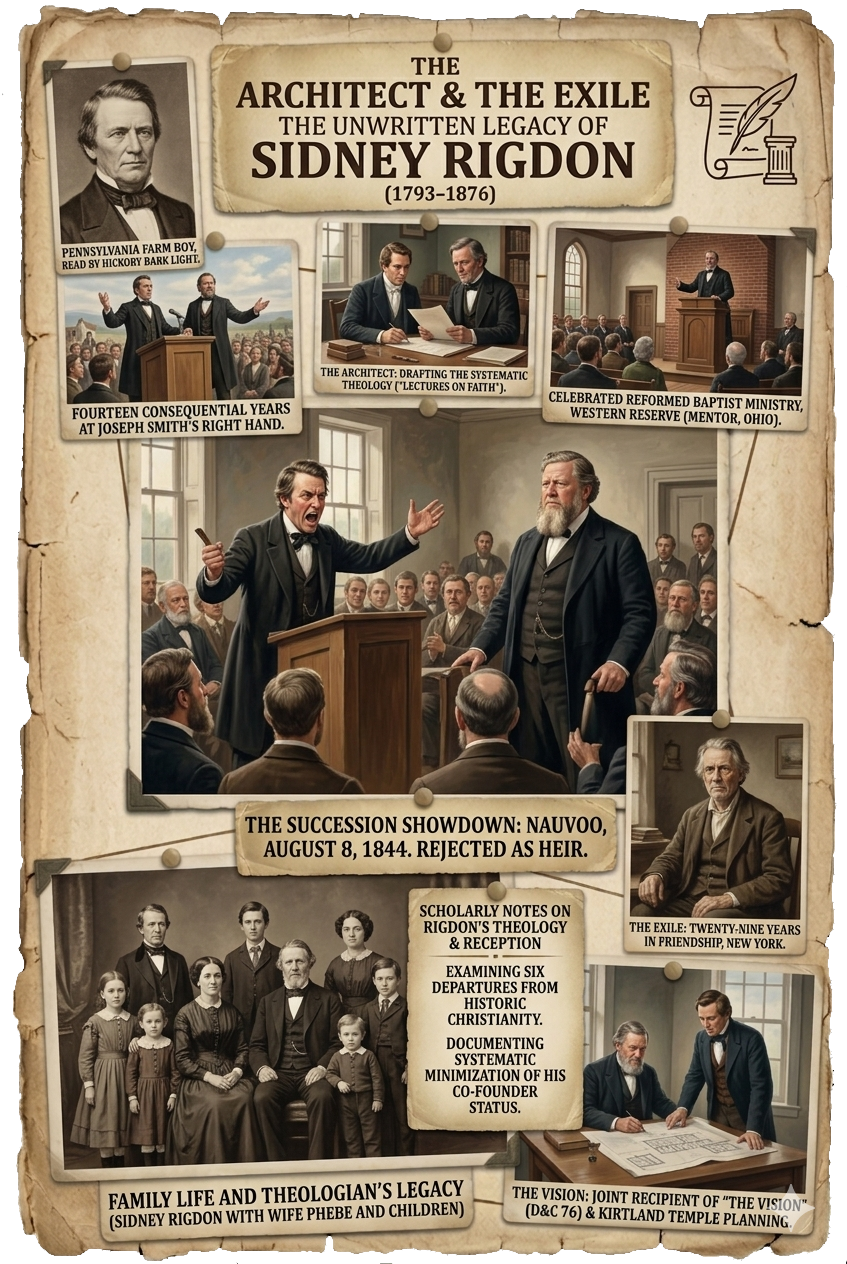
The Walking Bible Who Lost His Way
Sidney Rigdon — Co-Founder, Spokesman, and Cautionary Tale of the Latter-day Saint Movement
Early Mormon Personalities Series · Volume Three
❦ ✦ ❦
A Knock on the Door in Mentor
Late in the autumn of 1830, on a cold Ohio afternoon when the maples of the Western Reserve had already begun to drop their fire, four travel-stained missionaries climbed the steps of a modest parsonage in the village of Mentor. They had walked nearly two hundred miles out of their way to reach this particular front door. Inside, a thirty-seven-year-old Reformed Baptist preacher named Sidney Rigdon was finishing his sermon notes for the coming Sabbath. His congregation was building him a new house. He was, by every measurable standard, a man whose life was finally settling into its proper shape — respected throughout the Mahoning Association, beloved by his flock, the husband of a steady wife, and the father of healthy children. He could not have known, opening that door, that he was about to surrender all of it for a book he had not yet read.
The leader of the four travelers was Parley P. Pratt, a former parishioner whose own conversion to a strange new movement out of upstate New York had become the talk of the Reserve. With him stood Oliver Cowdery, the principal scribe of a translation Pratt now insisted was Holy Scripture. They carried with them a slim volume bound in dark leather: the Book of Mormon. Pratt offered the book to his old mentor. Rigdon took it, examined it for less than an hour by his daughter Nancy’s later recollection, and threw it back down with the announcement that he did not believe a word of it. Then, slowly, over fourteen agitated days of reading and prayer, he began to believe every word of it. By November, he had been baptized, and by December, he was on the road to New York to meet the prophet who had translated it. With him went hundreds of his Ohio congregation, the educated nucleus of what would become Mormonism’s first major demographic explosion.
That moment in Mentor is one of the great hinge-points in nineteenth-century American religious history. Before Pratt knocked on Rigdon’s door, Joseph Smith led a scattered band of perhaps two hundred and fifty followers in upstate New York and Pennsylvania, with no clear theological architecture, no settled community, and no preacher of any rhetorical weight. Within months of Rigdon’s conversion, Mormonism had moved its headquarters to Ohio, absorbed an entire network of Reformed Baptist congregations, acquired its first systematic theology, and begun to articulate the doctrines — communal property, restored priesthoods, multiple heavens, an open canon — that would distinguish it from every other movement on the American religious frontier. None of that happens without Sidney Rigdon. And almost none of it survives, in recognizable form, in his own life.
This is the third installment in our Early Mormon Personalities series, and it tells the story of a man who began as a sincere seeker after primitive Christianity, became the indispensable co-founder of a new religion, and ended his days a frustrated, half-mad, half-forgotten exile in a small New York village, sustained only by the conviction that he, and not Brigham Young, had been the rightful heir to Joseph Smith. It is the story of how a brilliant, restless, ambitious mind became captive to a vision that flattered every ambition he had — and then crushed him with consequences he could not foresee. It is also, from the standpoint of historic Christian theology, a sobering case study in what happens when the appetite for spiritual experience and the hunger for apostolic restoration outrun the discipline of Scripture and the humility of the cross.
❦ ✦ ❦
Origins and Early Life: The Boy Who Read by Hickory Light
Sidney Rigdon was born on February 19, 1793, in St. Clair Township, Allegheny County, Pennsylvania, the youngest of four children of William and Nancy Rigdon. His father was a hardworking Baptist farmer of Maryland stock, a man of stern and practical Christianity who measured a young man’s worth by the work his hands could do. His mother was God-fearing and Bible-reading. The family belonged to that vast and largely undocumented body of frontier Christians whose faith was earnest, whose theology was simple, and whose written records were thin. There was no library, no music school, no Latin tutor on the Rigdon farm — only the ground, the seasons, and the King James Bible.
A Brother’s Education and a Young Man’s Resentment
Sidney Rigdon later recalled, through family testimony preserved by his son John W. Rigdon, that his older brother Loammi was sent to school and trained for a profession because he was physically unable to do farm labor. Sidney wanted the same opportunity, but his father declined, apparently believing the family could support higher education for only one son and that Sidney, being healthy, was needed for work on the farm. Sidney reportedly took the refusal hard and resolved to educate himself as thoroughly as his brother had been educated.
There was a log schoolhouse near the family farm where Sidney learned to read, but his formal schooling appears to have been limited. Later accounts, including John W. Rigdon’s 1906 recollection, say he borrowed history books, read the Bible intensely, and often read at night by firelight after his father refused him a candle. According to that testimony, he would gather hickory bark, place it on the hearth fire, and read until late unless his parents sent him to bed.
That story is one of the clearest early windows into Rigdon’s intellectual habits. It suggests a young man who pursued education on his own initiative, developed a strong command of language, and became deeply immersed in the Bible and historical reading. Those traits later shaped his reputation as a powerful speaker and an unusually learned religious controversialist.
His son John W. Rigdon, who recorded these recollections in 1906, captured the picture in a single sentence that has done more than any other to fix his father’s young character in the historical record:
He used to get it [the hickory bark] and at night throw it on the old fire place and then lay with his face headed towards the fire and read history till near morning unless his parents got up and drove him to bed before that time.
— John W. Rigdon, Lecture on Early Mormon Church, 1906
That image — the boy reading by hickory light, intellectual ambition burning hotter than the family hearth — is the closest thing we have to a Rosetta Stone for Sidney Rigdon’s later life. Out of it grew everything: the precise, almost ostentatious command of English grammar that startled his hearers, the encyclopedic recall of biblical and historical detail that earned him the nickname “the walking Bible” among his Reformed Baptist colleagues, and the ferocious autodidact’s pride that would make him, in turn, an irresistible orator, an unmanageable subordinate, and finally a man unable to bend his knee to any authority that did not first acknowledge his stature. By his own son’s testimony, he never played with the other boys. Reading was the only pleasure he sought. The Bible and the history of the world ran together in his imagination as a single grand narrative, and he came to interpret all post-apostolic history through the lens of biblical prophecy.
Conversion, Calling, and the Baptist Pulpit
In 1817, at the age of twenty-four, Sidney professed a conversion experience under the ministry of the Reverend David Phillips at the Peter Creek Baptist Church in Library, Pennsylvania, and was baptized on May 31. His pastor, recognizing in this serious young man an unusual gift for speech, encouraged him toward the ministry. When his father died in 1810, Sidney remained on the farm to support his widowed mother, but his eyes were fixed elsewhere. By the winter of 1818-1819, he had moved north to Beaver County to apprentice himself to the Reverend Andrew Clark, a Regular Baptist minister, with whom he read the Bible systematically. In March 1819, he received his license to preach.
From the very beginning, he was a striking presence in the pulpit. Contemporaries described him as a man of full medium height — five feet, nine and a half inches — and somewhat heavy build, around two hundred fifteen pounds, with a fine-featured, expressive face framed by hair and beard that gave him the dignity of an Old Testament prophet. The early Disciples historian Amos Sutton Hayden, no friend to the Mormons, left perhaps the most memorable physical and rhetorical portrait of him in his 1876 history of the Disciples in the Western Reserve:
[He was] an orator of no inconsiderable abilities… his personal influence with an audience was very great… his actions graceful, his language copious, fluent in utterance, with articulation clear and musical.
— Amos S. Hayden, Early History of the Disciples in the Western Reserve, 1876
In May 1819, he moved to Trumbull County, Ohio, to work alongside the popular Baptist minister Adamson Bentley, the leader of the Mahoning Baptist Association at Warren. Through Bentley, he met Phebe Brooks, Mrs. Bentley’s sister, a quiet and resilient woman whose loyalty would prove the most stable element of his entire turbulent career. They were married on June 12, 1820. He was twenty-seven; she was twenty-four. Eleven children would eventually be born to them, and she would follow her husband through every wrenching upheaval that lay ahead, including a moment a decade later when he asked her, in effect, whether she was prepared to be poor again. Her answer would echo down through Mormon historiography. But that test was still ten years away. In 1820, the young Reverend Rigdon was a rising figure in a respected frontier denomination, and the great religious crisis of his life had not yet begun.
❦ ✦ ❦
The Spiritual Quest: From Campbellite Reformer to Latter-day Convert
To understand Sidney Rigdon’s conversion to Mormonism, one must first understand the restorationist religious atmosphere of the Western Reserve in the 1820s. Many frontier Protestants had come to believe that historic Christianity had been fractured by human traditions, creeds, and denominational division. Influenced by the Second Great Awakening, they looked for a return to the New Testament church and treated existing denominations as imperfect, and sometimes deeply compromised, departures from that ideal. The central question was not whether Christianity needed renewal, but how that renewal could be accomplished and by whom.
The view that mainstream denominations were corrupted was real and influential, but it belonged to a broad current of revivalist and restorationist Protestants rather than to all Christians or even all frontier Protestants. The broader religious culture of the early republic was highly volatile: revivals, denominational competition, and Bible-centered reform movements made many people receptive to the idea that the visible church had drifted from the New Testament pattern. In that sense, suspicion of creeds, clerical control, and sectarian division was widespread enough to shape major movements like the Stone–Campbell Restoration Movement.
Established churches such as Methodists, Presbyterians, Congregationalists, Episcopalians, and Baptists continued to be large, organized, and institutionally confident bodies, and many of their leaders explicitly rejected restorationist critiques. Even on the frontier, many believers preferred reform within existing churches rather than a wholesale rejection of denominational Christianity. In the Western Reserve and similar settings, the idea could feel dominant because competing churches, revivals, and reformers were especially visible. But nationally, it remained one interpretation among several, even if it was an influential one.
The Encounter with Alexander Campbell
In the spring of 1821, Rigdon and his brother-in-law, Adamson Bentley, read a pamphlet by a young Scotch-Irish reformer named Alexander Campbell, who was advocating the priority of the New Testament over the Old as the binding rule for Christian doctrine and practice. Intrigued, the two ministers traveled to Campbell’s home, where they spent an entire night and the better part of the next day in earnest theological discussion. Campbell would later remember the meeting as one of the great recruiting moments of his career, but he also remembered something else: a worry, almost premonitory, about the temperament of his new convert. Rigdon, he observed, was zealous and gifted, but he was also intellectually compulsive, prone to overstatement, and incapable of being restrained when he had seized upon an idea. Campbell felt obliged, even at the moment of welcome, to slow him down rather than urge him forward.
That single evaluative judgment — coming from a man who knew Rigdon better than almost any contemporary outside his own family — would prove the most accurate single sentence ever written about him. The pattern would repeat itself many times over the next quarter-century. Whatever Rigdon believed, he believed totally. Whatever he disbelieved, he disbelieved with equal totality. He had no instinct for theological compromise, no taste for the slow, patient process by which mature traditions test new ideas against old wisdom. When Campbell sought to recover the New Testament, Rigdon went further and began to demand the recovery of New Testament miracles. When Campbell wanted reform, Rigdon wanted restoration. When Campbell preached, Rigdon erupted.
Pittsburgh, Schism, and the Tanner’s Bench
On the strength of Campbell’s recommendation, Rigdon arrived in Pittsburgh in January 1822 to assume the pastorate of the First Baptist Church. His ministry there was, at first, brilliant. The congregation became one of the most respected in the city. But Rigdon was already moving theologically faster than his Baptist superiors could tolerate. He embraced baptismal regeneration — the doctrine that baptism was for the remission of sins, not merely a symbol — and other positions that aligned him more with Campbell than with the conservative leadership of the Redstone Baptist Association. By July 1823, his congregation had split, with each side disfellowshipping the other. On October 11, 1823, the Redstone Association formally excluded him from Baptist fellowship. He was thirty years old, married, with several small daughters to feed, and he had just lost his pulpit on principle.
For the next two years, he supported his family as a journeyman tanner working in his brother-in-law’s shop, and at one point also as a journeyman printer for the Philadelphia publisher Patterson — a detail that would later assume disproportionate importance in critical theories about the origin of the Book of Mormon. On Sundays, he obtained permission to preach in the Pittsburgh courthouse, where a portion of his old congregation followed him into religious exile. In 1826, he accepted a pastorate at Mentor, Ohio, in the Mahoning Baptist Association, and there, alongside Campbell, Bentley, and Walter Scott, he became one of the four most influential ministers in the burgeoning Reformed Baptist (later Disciples of Christ) movement on the Western Reserve. The years 1826-1830 were the high tide of his Campbellite career. He held revival meetings in Mentor, New Lisbon, Mantua, Kirtland, Perry, and Pleasant Hills. The Disciples historian Hayden described his March 1828 effort in Mentor as “the great religious awakening” of the region. By 1830, hundreds of Reformed Baptists across northeastern Ohio considered Sidney Rigdon their pastor, mentor, and spiritual exemplar.
The Break with Campbell
And yet, even at the height of his Campbellite influence, Rigdon was already pulling away from his mentor. Two issues divided them. The first was the question of charismatic gifts. Campbell, a serious student of New Testament Greek and a man of essentially rational temperament, taught that the miraculous gifts of the Holy Spirit — tongues, prophecy, visions, healings — had been confined to the apostolic age and had ceased with the closing of the apostolic generation. Rigdon, whose theology was running on hotter and more experiential fuel, insisted that no restoration of New Testament Christianity could be complete without the restoration of New Testament miracles. He yearned for the supernatural. He wanted to see the gifts.
The second issue was communalism. Rigdon read Acts 2:44-45 — “all that believed were together, and had all things common; and sold their possessions and goods, and parted them to all men, as every man had need” — as a binding pattern for the apostolic church and therefore as a pattern that any genuine restoration must reproduce. He encouraged some of his Mentor parishioners, notably Isaac Morley and his “Family” near Kirtland, to begin an experiment in shared property. Campbell, more sober about the dangers of utopian economics on the frontier, refused to incorporate communalism into the Disciples program. By the spring of 1830, the friction had become unmanageable. Rigdon withdrew his Mentor congregation from the Mahoning Baptist Association. He was, for the first time since his licensure in 1819, a free agent — a respected, eloquent, and theologically restless preacher with hundreds of followers and no denominational home. The timing could not have been more remarkable.
Pratt’s Visit and the Two-Week Reading
In late October 1830, Parley P. Pratt — a former Rigdon disciple who had himself been baptized into Joseph Smith’s new Church of Christ only the month before — arrived at the Mentor parsonage with three companions, including Oliver Cowdery. Pratt’s mission was technically directed toward the American Indians west of Missouri, but he had insisted on the two-hundred-mile detour for the sake of his old mentor. Their initial reception was cool. Rigdon’s daughter Nancy, then eight years old, would remember the scene vividly seventy-four years later. She watched her father take the Book of Mormon, examine it for about an hour, set it down with finality, and declare he did not believe it. The visitors offered to debate. Rigdon refused to debate but agreed to read.
For fourteen days, he read. He compared the new book against the Bible. He tested its doctrine against his own restorationist convictions. And he discovered — or thought he discovered — something extraordinary. The Book of Mormon affirmed baptism by immersion for the remission of sins. It taught the continuing operation of the Holy Spirit’s miraculous gifts. It promised a literal gathering of Israel in the last days. It asserted, in the words of its prophet Moroni, that angels had not ceased to minister to the children of men. Every theological question that had separated Rigdon from Campbell was answered by this book in Rigdon’s favor. Every restoration impulse he had nourished for a decade found its echo in its pages. To Rigdon, the Book of Mormon was not merely persuasive; it was the missing piece. He concluded that Mormonism was the apostolic church divinely restored to the earth.
There remained the cost. Rigdon knew his Mentor congregation was, at that very moment, building him a new house. He knew that to declare for Mormonism was to forfeit not only his pulpit but his roof. According to the standard nineteenth-century account preserved by John Jaques in the Improvement Era, he turned to his wife and asked whether she was willing once again to follow him into poverty. Her reply has become one of the iconic moments of early Latter-day Saint biography:
I have weighed the matter, I have counted the cost, and I am perfectly satisfied to follow you; it is my desire to do the will of God, come life or come death.
— Phebe Brooks Rigdon, c. 1830, recounted in John Jaques, Improvement Era, 1899-1900
On November 14, 1830, Sidney and Phebe Rigdon were baptized into the Mormon faith. Within two weeks, many members of Rigdon’s Mentor congregation had followed them into the water. From a traditional Christian standpoint, these rapid baptisms suggest a movement driven less by careful doctrinal discernment than by charisma, emotional persuasion, and the influence of a prominent leader. The haste of the conversions raises serious questions about how fully the new adherents understood Mormon claims, especially since the movement’s theology was still taking shape and many early converts seem to have embraced it before weighing it against historic Christian teaching.
In December 1830, Rigdon and Edward Partridge — also a former parishioner — traveled east to Fayette, New York, to meet the prophet they had not yet seen. The man who emerged to greet them at the door was twenty-five years old, lightly educated, six years younger than Rigdon, the son of an impoverished farming family with a checkered local reputation. The contrast was startling. Rigdon, the polished orator, the walking Bible, the celebrated preacher of the Western Reserve, was about to subordinate himself to a young farmer-prophet whose only formal credential was the claim to have translated golden plates by the gift and power of God. That subordination was, on its surface, an act of stunning humility. The historical record suggests that beneath the surface, it was, from the very beginning, never quite complete.
❦ ✦ ❦
Spokesman Unto the Prophet: Rigdon’s Role in the Young Church
Within days of meeting Joseph Smith in Fayette, Sidney Rigdon was the recipient of a revelation that would frame his entire Mormon career. In what is now Doctrine and Covenants 35, the voice of the Lord through Smith addressed Rigdon by name and assigned him a role drawn directly from the imagery of the Gospels: he was to be a forerunner, a herald, like John the Baptist preparing the way before the coming of the Lord. He was to write for the prophet, preach for the prophet, and be a “spokesman unto my servant Joseph.” The 2 Nephi prophecy of a spokesman appointed for a seer of the last days seemed, to Rigdon, to be speaking of him. He embraced the office with the seriousness of a man who has spent his entire life waiting for an angelic summons and has finally received one.
Kirtland: The Headquarters Rigdon Built
Almost immediately, Smith announced a revelation directing the New York saints to gather in Ohio (D&C 37). The reason was demographic and obvious: Rigdon’s converts in the Western Reserve already outnumbered Smith’s New York followers, perhaps by three or four to one, and they were settled, prosperous, and eager to host the new prophet in their own communities. Kirtland, Ohio — a few miles from Mentor — would serve as the church’s headquarters from early 1831 until the first weeks of 1838. The historian F. Mark McKiernan called Kirtland “Rigdon’s city,” and the description was scarcely an exaggeration. The basic theological architecture of Mormonism, the establishment of its first temple, the launching of its first banking experiment, the publication of its first compiled scripture, the development of its priesthood structures, the founding of its first communal experiment, and the publication of its first systematic theology — all of these unfolded in Kirtland during the years when Rigdon stood at Joseph Smith’s right hand.
On June 3, 1831, Rigdon was ordained a high priest. Less than a year later, on March 8, 1832, Smith organized the first iteration of the church’s First Presidency and named Jesse Gause and Sidney Rigdon as his two counselors. When Gause apostatized later that year, Rigdon was promoted to First Counselor on March 18, 1833, a position he would hold, with one significant interruption, until Smith’s murder in 1844. Throughout the Kirtland years, he served as Smith’s principal scribe in the work that Mormons call the Joseph Smith Translation of the Bible — an inspired revision of the Authorized Version begun in earnest after Rigdon arrived. Several scholars have noted that the translation project, which had languished in the hands of earlier scribes, surged to life only after Rigdon picked up the pen. The earlier manuscripts in the handwriting of Oliver Cowdery and John Whitmer were extensively reworked once Rigdon assumed scribal responsibilities.
It was during this translation work, on February 16, 1832, in a farmhouse at Hiram, Ohio, that Smith and Rigdon together claimed to have received the most theologically consequential vision of the Mormon canon — what is now Doctrine and Covenants 76, the so-called Vision of the Three Degrees of Glory. According to the joint account, the two men were seated together pondering the words of John 5:29 when, in their words, “the Lord touched the eyes of our understanding, and they were opened.” For more than an hour, by the testimony of those present, the two men carried on a strange and unsettling conversation in which each, in turn, reported what he was seeing and the other confirmed having seen the same. Philo Dibble, who was present, left a description of the scene that has become a familiar artifact of Mormon devotional literature:
Joseph would, at intervals, say: ‘What do I see?’ as one might say while looking out the window and beholding what all in the room could not see. Then he would relate what he had seen or what he was looking at. Then Sidney replied, ‘I see the same.’ Presently Sidney would say ‘What do I see?’ and would repeat what he had seen or was seeing, and Joseph would reply, ‘I see the same.’
— Philo Dibble, Autobiography, c. 1880s
By Dibble’s testimony, Joseph sat firmly and calmly through the experience, while Sidney became pale and limp, “as limber as a rag.” When the vision concluded, Joseph remarked, smilingly, that Brother Sidney was not as used to it as he was. The episode is doctrinally important for two reasons. First, it produced the framework of Mormon eschatology — the celestial, terrestrial, and telestial kingdoms — that decisively departs from the historic Christian doctrine of heaven and hell. Second, and more remarkably, it elevated Sidney Rigdon to a status no other early Mormon ever attained: he was not merely Smith’s spokesman, but a co-revelator. As historian Steven Shields has argued, several early sections of the Doctrine and Covenants were given to both men simultaneously, and section 90 explicitly accounts Rigdon and Frederick G. Williams as equal with Joseph Smith in holding the keys of the kingdom. Whatever Mormonism was in its first decade, it was not the work of Joseph Smith alone.
The Tarring at Hiram and the First Mental Crisis
On the night of March 24, 1832, only weeks after the great vision, a mob of disgruntled neighbors and former associates dragged Joseph Smith and Sidney Rigdon from their respective homes at the John Johnson Farm in Hiram, beat them, and tarred and feathered them. Smith was bruised and humiliated but escaped without serious injury. Rigdon’s experience was far worse. The mob dragged him from his bed by his heels, with his head bouncing on the frozen ground, lacerating his scalp severely. He was, by Joseph’s own account, written soon after, found in a delirious state the next morning, asking his wife to bring his razor so that he could kill himself, then asking Joseph to bring the razor so that he could kill his wife. Smith’s words from the History of the Church remain one of the most chilling primary descriptions of post-traumatic mental crisis in nineteenth-century American religious literature:
The next morning I went to see elder Rigdon, and found him crazy, and his head highly inflamed, for they had dragged him by his heels, and those too, so high from the earth he could not raise his head from the rough frozen surface, which lascerated it exceedingly; and when he saw me he called to his wife to bring him his razor.
— Joseph Smith, History of the Church, vol. 1
Rigdon would remain delirious for some days. Modern observers, including the LDS historian Richard Van Wagoner, have suggested that the trauma of the tarring may have contributed to a broader pattern of recurrent mental illness — periods of exalted mania alternating with deep depressions — that would shadow Rigdon for the rest of his ministerial life. Whether one accepts that diagnosis or not, the documentary record from this point forward shows a man whose theological brilliance was increasingly entangled with episodes of erratic behavior, prophetic overreach, and emotional collapse. The pattern began almost at once.
The Keys of the Kingdom Episode, 1832
Only four months after the tarring, on July 5, 1832, with Joseph Smith out of town and Rigdon left to preside over the saints in Kirtland, Rigdon delivered a public sermon in which he announced that “the keys of the kingdom were taken from us.” His hearers wept. When someone tried to dismiss the meeting in prayer, Rigdon said that prayer would do them no good, and the meeting broke up in confusion. The word went around the region that Sidney Rigdon was about to publicly expose Mormonism. Hyrum Smith was dispatched to retrieve Joseph, who returned to Kirtland on July 7. According to Philo Dibble’s account, Joseph rebuked Rigdon publicly in a barn meeting and uttered a striking prophecy:
I can contend with wicked men and devils — yes, with angels. No power can pluck those keys from me, except the power that gave them to me; that was Peter, James, and John. But for what Sidney has done, the devil shall handle him as one man handles another.
— Joseph Smith, July 1832, recorded in Philo Dibble’s Autobiography
About three weeks later, by Dibble’s account, Rigdon was lying on his bed alone when an unseen power reportedly lifted him from the bed and threw him violently from one side of the room to the other, the noise drawing his family in to see him being tossed about. He was bedridden for five or six weeks afterward. On July 28, 1832, Joseph Smith re-ordained Rigdon to the high priesthood after the latter had “repented like Peter of old.” From a Christian theological standpoint, the episode raises difficult questions. Whether one reads the strange physical phenomena as supernatural, psychosomatic, or simply legendary, the underlying pattern is clear: Rigdon was prone to dramatic spiritual claims that ran ahead of any settled doctrine, was capable of contradicting his own prophet, and was nevertheless retained in the highest office because the movement could not, organizationally, do without him. He was both an asset and a liability, and he would remain both for the next twelve years.
Lectures on Faith, the Kirtland Temple, and the High Priesthood
Despite these crises, Rigdon’s contributions to Mormonism’s early intellectual architecture during the Kirtland period were enormous. He was the chief instructor in the School of the Prophets, a curriculum that included not merely religious topics but also grammar, history, geography, and Hebrew. During the 1834-1835 winter term, he prepared and delivered a seven-part series of theological lectures to a group of prospective missionaries. These Lectures on Faith — also called the Lectures on Theology — were canonized in the 1835 edition of the Doctrine and Covenants and designated by the First Presidency as the doctrine of the church. They held equal scriptural status with Smith’s revelations until they were quietly removed from the LDS Doctrine and Covenants in 1921. Rigdon, in other words, wrote the first systematic theology of Mormonism, and that systematic theology was officially binding scripture for nearly nine decades.
It was also during the Kirtland years that Rigdon proposed, by his own apparent initiative, the introduction into Mormon ecclesiology of the concept of two distinct priesthoods — an Aaronic and a Melchizedek — corresponding to the lower and higher orders. The early Mormon witness David Whitmer would later complain bitterly that this was not original to Joseph Smith but was an importation by Rigdon out of his prior Disciples training:
This matter of the two orders of priesthood in the Church of Christ, and lineal priesthood of the old law being in the church, all originated in the mind of Sydney Rigdon. He explained these things to Brother Joseph in his way, out of the old Scriptures, and got Brother Joseph to inquire, etc.
— David Whitmer, An Address to All Believers in Christ, 1887
Whitmer’s testimony is corroborated by a chorus of other early witnesses — Parley and Orson Pratt, John Whitmer, Lyman Wight, William E. McLellin, John Corrill, and William Smith — all of whom recalled that the Melchizedek Priesthood as a distinct order was not introduced into the Mormon movement until June 3, 1831, six months after Rigdon’s arrival, and not, as later official accounts would assert, in May 1829 under the hands of Peter, James, and John. The implications for LDS claims of priesthood authority are not modest, and they will be revisited in our section on theological departures below.
Rigdon was a strong advocate for the construction of the Kirtland Temple and gave a powerful discourse at its dedication in March 1836. Two days later, in the temple’s solemn assembly, he and Joseph Smith first instituted the ordinance of the washing of feet — a ritual whose theological grammar Van Wagoner traces to the Sandemanian theology Rigdon had absorbed in the late 1820s through his ministry alongside Walter Scott in Pittsburgh. Rigdon also became the first president of the Kirtland Safety Society, the church’s ill-fated banking experiment, with Joseph Smith serving as cashier. When the bank collapsed under the panic of 1837, Rigdon and Smith were both blamed by Mormon dissenters, many of whom had been fellow Kirtland residents only months earlier.
Far West, the Salt Sermon, and the Fourth of July Oration
By early 1838, the Kirtland community was disintegrating. Smith and Rigdon fled to Far West, Missouri, in January and established a new headquarters there. It was in Missouri that Rigdon delivered the two most consequential — and most disastrous — sermons of his career. The first, in June 1838, was the so-called “Salt Sermon,” preached against Mormon dissenters and based on Christ’s words about the salt of the earth losing its savor. The dissenters were, in effect, threatened by Rigdon’s rhetoric of rejection. Several fled the county within days.
The second sermon was even more incendiary. On July 4, 1838, in a carefully prepared and pre-approved address at the Far West square, Rigdon proclaimed Mormon independence from mob rule. The address closed with a vow that the saints would “pursue them till the last drop of their blood is spilled, or else they will have to exterminate us.” The speech was published as a pamphlet and circulated widely. To the Missourians, it sounded like a declaration of war by an armed religious minority against the legitimate political community. Within four months, Governor Lilburn Boggs had issued his Extermination Order. Within five months, Joseph Smith and Sidney Rigdon were imprisoned in Liberty Jail. The historian Van Wagoner has argued, with considerable force, that no other speech in early Mormon history did more to set the conditions for the 1838 Mormon War. Rigdon was the rhetorical author of the catastrophe that drove the saints out of Missouri.
Liberty Jail itself broke him. Rigdon was older than the other prisoners, in poor health to begin with, and emotionally fragile. By the testimony of his fellow inmates, his oscillation between manic exaltation and weeping despondency wore them severely. Van Wagoner records that he was heard to mutter, more than once, that the sufferings of Christ had been a fool to his own. He was eventually released on a writ of habeas corpus and made his way to Illinois, where the saints had relocated to the bluffs above the Mississippi at the place that would become Nauvoo. He would never again hold the same operational influence over the church that he had held in Kirtland. Something inside him, never quite recovered from the tarring or the jail, was slipping permanently out of place.
❦ ✦ ❦
Nauvoo, Polygamy, and the Slow Estrangement
If Kirtland was Rigdon’s city, Nauvoo was Joseph Smith’s. The Illinois years (1839-1844) saw the consolidation of new doctrines, new ordinances, and new personal arrangements within the Smith circle that left Rigdon increasingly outside the inner ring. He did not move into Nauvoo permanently. He spent extended periods back in Pittsburgh on church business, ostensibly establishing residency for his role as Smith’s vice-presidential running mate in the 1844 election. He served in a local presidency in Pennsylvania. He suffered persistent ill health, including a serious bout of malaria. And he watched, with growing horror, as Joseph Smith introduced into the Nauvoo community the practice that, more than any other, would shape the rest of Rigdon’s life: plural marriage.
The Nancy Rigdon Affair
In the summer of 1842, Joseph Smith reportedly approached Rigdon’s nineteen-year-old daughter Nancy with a proposal of plural marriage. Nancy, by all accounts a strong-willed and articulate young woman, refused him in indignant terms. According to a contemporary account that has been the subject of considerable historiographical debate, Smith subsequently sent or had sent on his behalf a letter — known to Mormon history as the “Happiness Letter” — defending the principle of plural marriage with the now-famous argument that what is wrong under one circumstance may be right under another, and that blessings offered but rejected are no longer blessings. The Rigdon family was outraged. A confrontation followed between Smith and the Rigdons, in which Smith reportedly denied raising the matter at all. From that moment forward, by the testimony of contemporaries, the two families lived within a few rods of each other in Nauvoo and were seldom on speaking terms.
Rigdon never forgave the prophet. Van Wagoner records that hatred of plural marriage burned in Rigdon’s heart well after Smith was dead, and that Rigdon eventually concluded that if the Smith brothers had not introduced the system into Nauvoo, they would not have died as they did. Whether Rigdon was right about the cause of Smith’s death is debatable; whether he was right to refuse plural marriage as a Christian father defending his daughter is not. From a biblical standpoint, Rigdon’s instincts on this single point were more in accord with Genesis, the Sermon on the Mount, and the Pauline epistles than were the public teachings of the prophet to whom he had pledged his life. The tragedy is that he could not see how that fact alone might have been the warning he most needed to heed about the entire system.
The October 1843 Trial of Sidney Rigdon
By October 1843, the relationship between Smith and Rigdon had deteriorated to the point that Smith called a special conference to consider “the case and standing of Elder Sidney Rigdon.” The charges were serious: that Rigdon had engaged in disloyal correspondence with John C. Bennett, with the former governor Carlin, and “with the Missourians”; that he had leagued with dishonest persons in attempts to defraud the innocent; and that he had been responsible, through indirect testimony, for informing Smith’s enemies of his planned visit to Dixon, Illinois, where Smith was nearly captured. Rigdon delivered an eloquent and emotional defense, denied the charges, and made what the Times and Seasons described as a “moving appeal.” The conference voted to retain him in the First Presidency.
Joseph Smith publicly accepted the vote. But what he said in private — preserved in the History of the Church but suppressed in the contemporary Times and Seasons account — has become one of the most-quoted moments of the strained relationship:
I have thrown him off my shoulders, and you have again put him on me. You may carry him, but I will not.
— Joseph Smith, October 1843, History of the Church, vol. 6, p. 49
The two accounts of this episode — the Times and Seasons sanitized version and the History of the Church record — provide one of the clearest documentary cases of LDS historical revisionism that we will have occasion to examine in this essay. The contemporaneous Mormon press told its readers that Smith had “wholly removed suspicion” from Rigdon and was “willing to have elder Sidney Rigdon retain his station.” The later, fuller compilation tells a different story altogether. The same conference, the same prophet, the same counselor, two materially different historical records — depending on which one a researcher consults, the final relationship between the two co-founders looks either restored or fractured beyond repair. The fracture was the truth.
The 1844 Vice-Presidential Campaign
Despite this fracture, when Joseph Smith launched his 1844 campaign for the presidency of the United States, his first two preferred running mates declined the office, and the third — Sidney Rigdon — was chosen by elimination. Rigdon was sent to Pittsburgh to establish residency in a different state, since the Twelfth Amendment forbade a presidential elector from voting for both a president and vice president from the elector’s own state. By June 1844, Rigdon was in Pennsylvania. By the end of June, Joseph and Hyrum Smith had been killed at Carthage Jail. The senior surviving member of the First Presidency was, technically, Sidney Rigdon. Whether he was the rightful heir to the prophet — and what kind of heir he would have been — became, almost overnight, the most consequential question in the Mormon movement.
❦ ✦ ❦
Two Contenders: Rigdon, Brigham Young, and the Succession Crisis
Joseph Smith died on June 27, 1844. The mob that murdered him at Carthage Jail had, in a single afternoon, plunged the Mormon movement into the most consequential leadership crisis of its history. Smith had named a half-dozen possible successors over the years — and indicated, at one time or another, his son Joseph Smith III, his brother Hyrum, the Quorum of the Twelve Apostles, the Council of Fifty, and Sidney Rigdon — but he had left no settled, written, public mechanism for transferring authority. The Doctrine and Covenants contained nothing on the subject. The result was a power vacuum into which several plausible claimants would be drawn, but only two — Rigdon and Brigham Young — would seriously contend for the loyalty of the Nauvoo majority in the days immediately after the martyrdom.
The Return from Pittsburgh and the Guardian Claim
Rigdon was already in Pittsburgh when the news reached him. He hurried back to Nauvoo, arriving on August 3, 1844. The next day, he announced at a public meeting that he had received a revelation appointing him “Guardian of the Church.” His framing was deliberate. He did not claim to be the prophet’s replacement; he claimed to be a regent, an interim trustee, holding the office until either the late prophet’s young son could grow into it or the Lord could provide further direction. The framing was theologically defensible and structurally modest, and it had the support of the Nauvoo Stake president, William Marks. Of the surviving members of the original First Presidency, Rigdon was the senior. By any conventional reading of the church’s existing organization, his claim was at minimum plausible.
Rigdon urged a rapid decision. Most members of the Quorum of the Twelve were scattered on missions throughout the United States and Britain. If Rigdon could secure a vote of the Nauvoo congregation before they returned, the question would, in his mind, be settled. The Stake president scheduled a meeting for the following Thursday for the purpose of choosing a guardian. To Brigham Young’s loyalists, including the diary-keeping William Clayton, Rigdon’s haste looked like a maneuver — a bid to force a decision before the Twelve could arrive. The arrival of Brigham Young and four of the apostles in Nauvoo on August 6 changed everything. The decisive meeting was now scheduled for August 8.
August 8, 1844: The Confrontation
On the morning of August 8, 1844, Sidney Rigdon spoke first. By his own preference and his own theology, he argued his case for nearly two hours under leaden Illinois skies. The transcripts of Thomas Bullock, who took shorthand notes, show a man preaching the case of his life — invoking Old Testament patterns of guardianship, citing the principle that no man could replace Joseph Smith, asserting that he himself had been called to build up the church to Joseph and that all blessings would henceforth flow through Joseph’s name. The structure of his theology was already moving away from the standard Mormon position, but his rhetorical power was undiminished. He made a strong impression. According to several contemporary observers, he might have prevailed if the meeting had ended at the noon recess.
It did not end. In the afternoon, Brigham Young rose to reply. By Young’s own theology, the keys held by Joseph Smith had passed at his death not to a single guardian but to the Quorum of the Twelve as a body — and Young, as president of that quorum, was therefore the senior administrative officer of the church. Young’s argument was structural and prosaic, whereas Rigdon’s had been emotional and prophetic. But something else, according to the testimony of multiple eyewitnesses, occurred during Young’s speech. A great many in the audience reported that as Young spoke, his voice and even his appearance briefly took on the voice and appearance of Joseph Smith. “I gave a jump off my seat and said, ‘our Prophet Joseph has come to life, we have our Prophet back!'” — so recorded one fifteen-year-old listener whose account would become a staple of LDS devotional literature.
Whatever one makes of the so-called “transfiguration of Brigham Young” — and serious historians have noted that the experience was reported by relatively few of the thousands present, that the most detailed accounts were composed years and decades later, and that the early contemporaneous record is far thinner than the later devotional record — the result of the August 8 meeting was decisive. The vast majority of the saints in Nauvoo voted to sustain the Twelve. Rigdon, sensing the tide running against him, declined the opportunity to speak again and asked William W. Phelps to speak for him. Phelps spoke against him. Sidney Rigdon, in a single afternoon, had lost the leadership of the church he had spent fourteen years helping to build.
Excommunication and Exile
On September 8, 1844, Rigdon was tried in absentia by a Common Council of the Church convened by Presiding Bishop Newel K. Whitney and was excommunicated. He had refused to attend the trial, claiming a threat to his life from Young’s supporters. In return, he excommunicated the members of the Twelve. Within days, he was on his way to Pittsburgh by river steamboat. By mid-September, he had persuaded the Mormon community in Pittsburgh to follow him; within a month, he had begun publishing a periodical, the Messenger and Advocate, to support his claims. On April 6, 1845 — the fifteenth anniversary of the founding of the original Church of Christ — he convened a conference in Pittsburgh and reorganized what he called the Church of Christ as the rightful continuation of Joseph Smith’s movement. He named a new First Presidency, called a new Quorum of Twelve Apostles, and for a brief season, his reorganized church appeared to flourish.
It did not last. Within two years, internal disputes, failed prophecies, and Rigdon’s own administrative incapacity had reduced the Pittsburgh community to a small remnant. In September 1846, Rigdon convened what was intended to be a six-month conference in a barn in Greene County, Pennsylvania. During this strange gathering, he taught some doctrines that drove away most of the remaining followers, and it has been credibly reported that on at least one night, Rigdon and his loyalists knelt in the meadow behind the barn from sunset until dawn, awaiting the return of the Messiah, who failed to appear. By the spring of 1847, the church was dissolved as an organized body.
Rigdon would live for another twenty-nine years. He moved first to a farm at Antrim, Pennsylvania, then ultimately to the village of Friendship in Allegany County, New York, where he spent the last decades of his life in obscurity. In 1856, he authorized one of his old followers, Stephen Post, to revive a Rigdonite movement under his nominal leadership. The movement that resulted was called the Church of Jesus Christ of the Children of Zion. It survived in tenuous form until Rigdon’s death and disbanded in 1882. The only line of his ecclesiastical descendants that has survived to the present day is the Bickertonite Church of Jesus Christ, organized in 1862 by William Bickerton, who had been Rigdon’s last apostle. The Bickertonites today number roughly twenty-six thousand worldwide, headquartered in Monongahela, Pennsylvania, with most of their growth concentrated in West Africa, the Philippines, and Latin America. They are the only continuing organizational expression of the Rigdonite branch of early Mormonism.
Sidney Rigdon died on July 14, 1876, in Friendship, New York, at the age of eighty-three, and was buried in Maple Grove Cemetery. To the end of his life, he maintained his testimony of the Book of Mormon and of Joseph Smith’s prophetic calling. In his last conversation with his son John, who had returned from Salt Lake City unconvinced by Brigham Young’s polygamous theocracy, the old man — by the son’s later account — raised his hand above his head, with tears glistening in his eyes, and swore before high heaven that he had not written the Book of Mormon, that he had no part in its production, and that he believed Joseph Smith had found the plates exactly as he had said and was a true prophet, and that the world would one day discover the truth. Whether or not one credits the son’s account fully, the deeper testimony is consistent: Rigdon’s identity was so completely bound up with Mormonism that he could not abandon it even when the movement had abandoned him.
❦ ✦ ❦
Theological Departure: Where Rigdon Left Historic Christianity Behind
To examine Sidney Rigdon’s theology from the standpoint of historic Christian orthodoxy is to examine the doctrinal architecture of early Mormonism itself, because so much of that architecture passed through Rigdon’s pen, his pulpit, and his sustained instruction. The departures are not minor adjustments at the edges of Christian belief; they are structural revisions of the foundation. Six in particular deserve consideration.
1. The Reopening of the Canon
Historic Christianity has always confessed, with the Reformers and with the Fathers before them, that the canon of Scripture closed with the death of the apostles. The principle of sola Scriptura is not merely a Protestant slogan; it is a recognition of what the apostle Paul wrote to Timothy: that all Scripture is God-breathed and is sufficient to make the man of God thoroughly equipped for every good work (2 Timothy 3:16-17). Jude, in his short epistle, urged his readers to contend earnestly for “the faith which was once delivered unto the saints” (Jude 3) — the past tense being the operative grammatical fact. The canon does not remain open.
Rigdon, by contrast, came to Mormonism precisely because it offered him a new revelation, a new scripture, and the prospect of more to come. Within a year of his conversion, he was personally collaborating with Joseph Smith on a wholesale rewriting of the Bible itself — the so-called Joseph Smith Translation — adding entire passages, including most notably the Prophecy of Enoch in Genesis 7, that have no manuscript witness in any extant biblical text in any language. He helped to compile, edit, and canonize the Book of Mormon, the Doctrine and Covenants, and his own Lectures on Faith. He produced a new revelation in the first person plural with Smith. He participated in the production of the Book of Abraham. From a traditional Christian standpoint, this is the central theological catastrophe of his life. Once a man has accepted the principle that scripture remains open, every subsequent doctrinal innovation can be defended as further restoration. There is no longer any objective standard by which the new revelation can be judged.
2. The Restoration of “Lost” Priesthood Authority
Closely related to the open canon is the doctrine that the historic Christian church lost its priesthood authority during a great apostasy and required the restoration of two distinct priesthoods — Aaronic and Melchizedek — by the literal angelic ministrations of John the Baptist and of Peter, James, and John, respectively. We have already noted David Whitmer’s testimony that the doctrine of two distinct priesthoods originated, in his view, with Sidney Rigdon and was imported into Mormonism out of Rigdon’s prior Disciples training. The chronological evidence supports Whitmer’s claim: the angelic priesthood narratives were not in circulation during the production of the Book of Mormon, were not announced at the church’s founding, and only emerged in the years after Rigdon’s arrival, with the dating of the alleged Peter, James, and John ordination filled in retrospectively in the mid-1830s.
Biblical Christianity, by contrast, teaches the priesthood of all believers (1 Peter 2:9) and the unique high priesthood of Christ (Hebrews 7:24-25), of which there is, in the very words of Hebrews, no successor: “this man, because he continueth ever, hath an unchangeable priesthood.” The Greek word translated “unchangeable” (aparabaton) means literally non-transferable. The book of Hebrews exists, in part, precisely to refute the idea that any subsequent ecclesiastical office could inherit Christ’s priestly mediation. The Mormon construct of a restored, transferable Melchizedek Priesthood is therefore not merely an addition to historic Christianity; it is a direct contradiction of the central argument of one of its foundational New Testament books.
3. Three Degrees of Glory in Place of Heaven and Hell
The vision Rigdon and Smith claimed jointly to have received in February 1832 produced the doctrine that the eternal destiny of the resurrected dead is divided not into heaven and hell but into three kingdoms of differing glory — celestial, terrestrial, and telestial — with even the lowest of the three exceeding mortal comprehension. The texts of Jesus, however, draw a far starker line. He spoke of two final destinies — the kingdom prepared from the foundation of the world and the everlasting fire prepared for the devil and his angels (Matthew 25:34, 41). He spoke of the wide gate that leads to destruction and the narrow gate that leads to life (Matthew 7:13-14). He warned of weeping and gnashing of teeth in the place of outer darkness. The Mormon tripartite afterlife, however appealing as an explanation of differential reward, has no foundation in the words of Christ and considerable counterevidence against it.
4. Communalism as a Restored New Testament Pattern
Rigdon’s communalism — the so-called Order of Enoch or United Order — drew its scriptural warrant from his reading of Acts 2:44-45 and Acts 4:32-35 as binding apostolic patterns rather than as descriptions of a particular voluntary response to a particular crisis in the life of the Jerusalem church. The New Testament’s own narrative complicates the simple primitivist reading: the Jerusalem experiment in shared property was apparently abandoned within a generation; Paul collected funds from gentile churches precisely to relieve a Jerusalem community impoverished, in part, by the original arrangement; and the Pauline epistles consistently presuppose private property as the ordinary economic basis of Christian generosity (e.g., 1 Corinthians 16:2; 2 Corinthians 8-9; 1 Timothy 6:17-19). Rigdon’s communal experiments collapsed repeatedly, for the same prosaic reasons that all such utopian experiments tend to collapse. The lesson he might have drawn — that primitivism is not the same thing as obedience — was not the lesson he drew.
5. Continuing Charismata as a Sign of the True Church
The single most important issue in Rigdon’s break from Alexander Campbell was his demand that the New Testament charismatic gifts — tongues, prophecy, visions, healings — be restored as ordinary marks of the true church. From a biblical standpoint, this is the most defensible of his innovations; one can read 1 Corinthians 12-14 and conclude that some such gifts continue, and many serious evangelical traditions today affirm a continuing ministry of the Spirit that includes such phenomena. The biblical objection is not to the gifts as such but to the lack of any New Testament test by which their genuineness might be evaluated. Paul provides such tests: “Try the spirits whether they are of God” (1 John 4:1); “Let all things be done decently and in order” (1 Corinthians 14:40); “the testimony of Jesus is the spirit of prophecy” (Revelation 19:10). Rigdon’s charismata, however, were never subjected to those tests. They were authenticated by the office of the prophet. They were validated by the very institutional structure they were supposed to be authenticating. The result was a closed loop in which any spiritual experience confirmed the system, and no spiritual experience could ever falsify it.
6. A Plurality of Gods and an Exalted Humanity
By the late Nauvoo period, Smith was teaching, most famously in the King Follett Discourse of April 1844, that God Himself was once a man and that men may become gods, and that there exists a vast plurality of exalted divine beings. Rigdon does not appear to have personally embraced the most extreme forms of this teaching, and his post-1844 churches generally moved away from it. The Bickertonite descendants who hold formally to Rigdon’s lineage today reject many of the distinctive Smith doctrines, including the plurality of gods, eternal progression, plural marriage, and temple endowments. Nevertheless, Rigdon was unquestionably the principal architect of the doctrinal soil — the open canon, the restored priesthoods, the multi-tiered heavens, the continuing revelations, the experiential charismata — in which the more extreme later innovations could grow. Without Rigdon’s foundation, Smith’s later edifice almost certainly could not have stood.
From the standpoint of the historic Christian creeds — Apostles’, Nicene, Athanasian — the cumulative effect of these six departures is sufficient to place early Mormonism, and Rigdon along with it, outside the boundaries of orthodox Christian confession. That conclusion is offered not as an act of polemical denunciation but as an act of intellectual honesty. The Mormonism that Rigdon helped Smith build was, and remains, a genuinely new religion. It is more than a denomination, more than a sect within historic Christianity, more even than a heterodox departure. It is a reconstruction of Christianity around a different center, with a different canon, a different priesthood, a different gospel, a different anthropology, and a different eschatology. To pretend otherwise is to do a disservice to both Christians and Mormons, and ultimately to the truth itself.
❦ ✦ ❦
Character Study: The Man Behind the Pulpit
To understand Sidney Rigdon as a human being — to render him more than a name in a footnote, more than a foil for Joseph Smith, more than a cautionary tale or a polemical target — requires holding several apparently contradictory things in view at once. He was not a charlatan. He was not a fraud. He was not, in the simple sense, a hypocrite. He was, on the contrary, one of the most relentlessly sincere figures in nineteenth-century American religion, and the tragedy of his life is precisely that his sincerity carried him so far in the wrong direction.
Strengths: Intellect, Eloquence, Loyalty
First, the strengths. Rigdon was, by every contemporary description, a formidable intellect. The autodidact who had read history by hickory light grew into a man whose biblical recall was such that contemporaries called him a “walking Bible.” He knew his English grammar with a precision that gave his sermons an almost stately cadence. He knew his Hebrew well enough to teach it in the Kirtland School. He had absorbed, by the time he met Joseph Smith, the entire Reformed Baptist and Disciples theological tradition of the Western Reserve. He was, as Van Wagoner has observed, more learned, better read, and more steeped in biblical interpretation than any other early Mormon, despite his common-school education. To call him merely a scribe for the Joseph Smith Translation is to miss what he actually did: he functioned as a scribe in the Old Testament sense — a man of learning who could read and explain the Law to the people.
He was also, by all accounts, a man of genuine personal warmth. He took a real interest in the lives of the people he met. He shook their hands. He listened to their stories. He testified to them out of what he believed to be his own conversion. He was loyal to his wife through every upheaval, and loyal to Joseph Smith through tarrings, beatings, jail, exile, and humiliation, almost up until the very end. When the Smith family asked Hyrum to plead for Sidney’s retention in the First Presidency in 1843, Hyrum did so willingly, knowing that Sidney had earned the loyalty of the larger community even when he had lost the prophet’s. Rigdon’s congregation in Mentor wept openly when he announced he could no longer preach Baptist doctrine. His Pittsburgh exiles followed him into the courthouse meetings. His mentor parishioners followed him into Mormonism. His Pittsburgh saints followed him into schism. People did not love Sidney Rigdon casually; they loved him with the fierce attachment of people who had been treated as worthy of his time.
Weaknesses: Vanity, Volatility, Compulsion
And yet — Alexander Campbell’s premonitory warning in 1821 stood the test of every subsequent decade. Rigdon was, by temperament, ungovernable. He had no instinct for moderation. Whatever he believed, he believed completely. Whatever he wanted, he wanted with a single-mindedness that brooked no rival. He could not endure being subordinate. Even within Mormonism, he supplanted Oliver Cowdery, the original “Second Elder” of the church, almost from the moment of his arrival. His preaching reached emotional registers that contemporaries described as overwhelming, but those same registers, applied in the wrong moment, produced the keys-of-the-kingdom debacle, the Salt Sermon, the Fourth of July Oration, and the August 8 succession defeat. The same passion that drew thousands to baptism in the Chagrin River drove the saints out of Missouri and lost Rigdon his guardianship of the church.
There is also, woven through every honest account of his Mormon career, the documentary fact of recurrent mental illness. The tarring at Hiram, by the assessment of multiple contemporary observers, marked the onset of a pattern that would never fully resolve. He oscillated between periods of soaring confidence and periods of immobilizing despair. He was incapacitated for weeks at a time. He was found, on more than one occasion, in such severe states that close associates feared for him. The Liberty Jail months were almost more than he could bear. By the end of his life, in the failed Pittsburgh and Greene County years, his behavior had become sufficiently erratic that even his own followers began to doubt him. Whether one labels these episodes manic-depressive, traumatic, or simply the consequences of a brilliant mind under unbearable stress, they were a real and observable feature of his ministry that the official LDS record has consistently underplayed.
Blind Spots and the Tragic Pattern
Rigdon’s fatal weakness was his failure to test the new claim against the Scriptures already given. The Bereans were commended because they “searched the scriptures daily, whether those things were so” (Acts 17:11), and that standard ought to have governed Rigdon’s response to the Book of Mormon. Instead, he appears to have welcomed it because it matched the restorationist hopes he had already set on it. From a traditional Christian standpoint, that was not discernment but credulity. Scripture should have been the judge of the claim; instead, the claim was allowed to judge Scripture. A revelation that merely flatters prior expectations is not thereby confirmed as divine, and a man who has already decided that the churches are corrupt may be especially vulnerable to any message that promises to vindicate his suspicions. Rigdon’s mistake was therefore not only emotional but theological: he did not subject the new teaching to the apostolic standard, but received it as though fulfillment alone were proof of truth.
And yet, having said all this, one must also say that Sidney Rigdon was, in some genuine sense, a believer to the end. He never recanted his testimony of the Book of Mormon, even when bitter, even when impoverished, even when dying. He was wrong about a great deal. He was deceived about more. He was, at moments, clearly outside himself. But he was not insincere. He believed what he taught. He paid for what he taught. He died for what he taught. The Christian who reads his life ought to read it with the seriousness due to a brother in Adam — a man who genuinely sought God and ended in a tragic place, not because he was uniquely wicked, but because the path he chose led inexorably there.
❦ ✦ ❦
Legacy and Impact: What Rigdon Left Behind
It is easy, in the wake of his defeat in the succession crisis and his decades of subsequent obscurity, to underestimate the size of Sidney Rigdon’s footprint on the Latter-day Saint movement. The temptation is reinforced by the official LDS narrative, which has consistently minimized his contributions in favor of the Smith-and-Young succession line. The historical record, however, is unambiguous on the magnitude of what he left behind. The historian Steven Shields, writing in Dialogue in 2019, has argued — with documentary evidence that is difficult to dispute — that Joseph Smith and Sidney Rigdon ought properly to be regarded as co-founders of the Mormon movement, and that the very name “Smith-Rigdon Movement” would more accurately describe the academic study of its formative years than the conventional terminology.
The Theological Architecture
Consider, first, the theological architecture. Half of the original Quorum of the Twelve Apostles in 1835 — Parley and Orson Pratt, Orson Hyde, Luke and Lyman Johnson, John F. Boynton — had been Rigdon’s converts or fellow Disciples ministers before they became Mormons. The first systematic theology of the new church, the Lectures on Faith, was Rigdon’s composition, taught by him in the School of the Prophets and canonized as scripture by his own First Presidency. The first organized communal experiment, the Order of Enoch, drew on Rigdon’s prior Mentor experiments. The first temple, at Kirtland, was built under Rigdon’s day-to-day supervision and dedicated with his discourse. The first ordinance of washing of feet was adapted from the Sandemanian practice Rigdon had absorbed in Pittsburgh. The Joseph Smith Translation of the Bible languished until Rigdon picked up the pen and surged forward as long as he held it. The Vision of the Three Degrees of Glory, now Doctrine and Covenants 76, was a joint experience for which Rigdon was an equal claimant. The doctrine of two priesthoods — Aaronic and Melchizedek — was, by the testimony of David Whitmer and a chorus of other early witnesses, a Rigdon importation.
Subtract Rigdon, and Mormonism in its Kirtland-and-Nauvoo form is barely recognizable. There is no temple. There are no Lectures on Faith. There is no joint vision of the kingdoms. There are no Pratt brothers. There is no Edward Partridge as bishop. There is no Frederick G. Williams as counselor. There is no doctrinal architecture of restored priesthoods. There is, almost certainly, no headquarters at Kirtland, and so no Kirtland Safety Society debacle, no Missouri exodus, no Liberty Jail, no Nauvoo, no martyrdom — at least not in the form history actually recorded. Whatever else one says about him, Sidney Rigdon was indispensable to the early movement in the strict sense: it could not have become what it became without him.
The Rhetorical Inheritance
Rigdon also left a rhetorical inheritance. The Salt Sermon and the Fourth of July Oration set patterns of in-group / out-group rhetoric that have never quite left Mormon religious discourse. The Mormon habit of speaking about “the Lord’s people” and “the world” with exceptionally sharp boundaries owes something to Rigdon’s influence, however much later leaders have softened the public presentation. So, too, does the genre of high-temperature, prophetically-framed political speech — the Mormon willingness to address civil authorities in millennial register — that has surfaced periodically throughout the movement’s history, from Brigham Young’s Utah War defiance to certain twentieth-century apostolic addresses to American politicians.
The Surviving Branch
As for the institutional legacy, the Bickertonite Church of Jesus Christ — headquartered today in Monongahela, Pennsylvania, with about twenty-six thousand members worldwide — is the only continuing organizational descendant of Rigdon’s branch. The Bickertonites have evolved in interesting directions: they accept the Bible and the Book of Mormon but reject the Doctrine and Covenants, the Pearl of Great Price, plural marriage, eternal progression, baptism for the dead, sealings, temple endowments, and most of the distinctive Smith doctrines that emerged after Rigdon’s effective departure from the prophet’s inner circle in 1843-1844. They are, theologically, far closer to historic Christianity than is the Salt Lake City church, while still retaining several distinctively Mormon features. They are arguably the most direct living witness to what Rigdon’s branch of the movement might have looked like had it not been driven into schism.
The Foundational Witness for the Origin of the Book of Mormon
There is one other element of legacy that no honest treatment of Rigdon can ignore. From at least 1834 onward, when E. D. Howe published Mormonism Unvailed, critics have advanced the so-called Spalding-Rigdon theory of Book of Mormon authorship — the suggestion that Rigdon obtained from the Pittsburgh publisher Patterson a manuscript by the failed novelist Solomon Spalding and reworked it, with Smith, into the Book of Mormon. The theory has been vigorously contested. A 2008 computer stylometric analysis by Jockers, Witten, and Criddle supported a Rigdon-as-author conclusion using nearest-shrunken-centroid classification. A 2011 reply by Schaalje, Fields, Roper, and Snow demonstrated that the original methodology, when replicated, also assigned Rigdon as the probable author of the Federalist Papers, which were written five years before he was born — a result that does not absolutely refute the Rigdon hypothesis but does cast significant doubt on the methodology used to support it.
On Rigdon’s own deathbed testimony to his son John, he denied any role in producing the Book of Mormon. His grandson Walter Sidney Rigdon, by contrast, told the Salt Lake Daily Tribune in 1888 that the family had always understood the Book of Mormon to be a hoax contrived by Rigdon and Joseph Smith based on the Spalding manuscript. The two testimonies cannot both be fully true. The honest historian, regardless of which way he leans, must concede that the question of Rigdon’s pre-1830 acquaintance with Smith and the Book of Mormon manuscript remains one of the genuinely open historical problems of nineteenth-century American religion. The series of detours Pratt made, the decade Rigdon spent in Pittsburgh near the Patterson publishing house, the precision with which the Book of Mormon answered Rigdon’s pre-1830 theological wish-list, and the speed of his conversion are all data points that do not, individually or collectively, prove the Spalding-Rigdon theory, but neither do they make it unreasonable to entertain. It is enough, for our purposes, to note that the question is unsettled, that good-faith Christian researchers in the apologetic tradition continue to investigate it, and that no honest biography of Sidney Rigdon can simply wave it away.
❦ ✦ ❦
How Official LDS Sources Have Sanitized the Rigdon Story
One of the most striking features of Sidney Rigdon’s posthumous reception is the systematic flattening of his story by the Salt Lake City branch of the movement he co-founded. The phenomenon is not subtle. It is documentable across more than a century of LDS publishing, from B. H. Roberts’s edition of the History of the Church in the early twentieth century down to the present-day Gospel Topics essays on the Church’s official website. The pattern is consistent enough that the late LDS historian D. Michael Quinn — himself an eventual victim of the same institutional impulse — observed that no character in early Mormonism has been treated with more hostility and false accusation than Sidney Rigdon.
The Two Versions of October 1843
Consider, first, the documented divergence between the contemporaneous Times and Seasons account of the October 1843 special conference and the later History of the Church account of the same proceeding. The Times and Seasons, edited at the time by John Taylor under Smith’s general supervision, told its readers that the prophet had “wholly removed suspicion” from Sidney Rigdon and was “willing to have elder Sidney Rigdon retain his station,” though there remained a “lack of confidence in his integrity and steadfastness, judging from their past intercourse.” The History of the Church, compiled later under B. H. Roberts’s editorship, reports the same conference but adds Smith’s bitter remark to the congregation: “I have thrown him off my shoulders, and you have again put him on me. You may carry him, but I will not.” Both accounts cannot be fully accurate. Either the Times and Seasons softened the prophet’s words for public consumption, or the History of the Church inserted a quotation that the contemporary record specifically omitted. The LDS-affiliated FAIR (Faithful Answers, Informed Response) website itself acknowledges the divergence and characterizes it under the heading “censorship and revision.” That is, on the question of how the prophet really regarded his own counselor, the official LDS record has produced two materially different historical narratives, which an ordinary reader cannot reconcile without consulting both.
Soft-Pedaling the Mental Crises
The Church’s official Gospel Topics essay on Sidney Rigdon — to which a present-day inquirer is most likely to be directed by a member missionary — runs to fewer than nine hundred words. It mentions the tarring and feathering at Hiram in a single sentence, with no description of the resulting delirium. It says nothing about the keys-of-the-kingdom episode of July 1832 or about Rigdon’s reported physical convulsions afterward. It says nothing about the mania at Liberty Jail. It says nothing about the Adam-ondi-Ahman wrestling incident in which Joseph Smith reportedly tore Rigdon’s coat from collar to waist after Rigdon tried to break up a Sabbath wrestling match with a sword. It says nothing about Joseph Smith’s alleged proposal to Nancy Rigdon. It says nothing about the Happiness Letter. It says nothing about any of the documented spiritual or psychological crises that punctuated Rigdon’s fourteen years in the prophet’s inner circle. It mentions his “controversial” Fourth of July address in a single phrase without quoting any of the inflammatory language. It refers to his attempt to lead the church after Smith’s death, using the neutral noun “guardian” without any indication of the larger ecclesiological case Rigdon actually advanced.
The contrast with the BYU Religious Studies Center treatment in Lawrence Flake’s volume on the prophets and apostles is illuminating. The BYU essay does include the famous “thrown him off my shoulders” quotation, includes the joint vision, and at least mentions the eccentricity of his later years. But even there, the narrative is carefully framed: the tarring receives one sentence; the Liberty Jail experience is described in heroic terms with no mention of mania; the succession crisis is presented as a clear-cut moral failure on Rigdon’s part. The reader emerges with the impression of a man who started well, failed late, and was righteously displaced. The subtler reality — that Rigdon was an indispensable co-founder whose theological contributions remain canonized to the present day, whose mental and emotional struggles were chronic rather than terminal, and whose marginalization began long before his rejection at the August 8 meeting — does not survive the editorial process.
The Erasure of the Co-Founder
The deepest revision is structural rather than episodic. The official narrative consistently presents Joseph Smith as the sole prophetic source of early Mormonism. Rigdon, when he appears, is a counselor, a spokesman, a scribe — never an originator. The doctrines of communalism, restored priesthoods, the three degrees of glory, the Lectures on Faith, the temple ritual elements, even the structural decision to make Kirtland the headquarters — all are presented as products of Smith’s revelation, with Rigdon’s role limited to faithful execution. The contemporaneous documentary record, as the Dialogue Journal scholarship has shown, does not support this presentation. Several of the early revelations were given to both men jointly. Doctrine and Covenants 90 explicitly accounts Rigdon and Frederick G. Williams as equal with Joseph Smith in holding the keys of the kingdom. The Lectures on Faith were Rigdon’s composition, not Smith’s. To present Rigdon as a junior associate is to misrepresent the foundational moment of the movement.
Why does this matter? It matters because the structure of the official narrative serves a present-day institutional purpose. If Rigdon was merely a counselor whose contributions were peripheral, then his eventual excommunication, his failed succession claim, and his subsequent decades of obscurity are easy to assimilate into a triumphalist account: the true church discarded him, and prospered. If, however, Rigdon was a co-founder whose theological architecture remains canonized to the present day, then his rejection raises uncomfortable structural questions. How can a movement coherently claim divine authority for the doctrines of a co-founder while simultaneously declaring that co-founder excommunicated, fallen, and outside the kingdom? The simplest way to manage that tension is to minimize the co-founder. The official LDS treatment of Sidney Rigdon is precisely that minimization, applied steadily for one hundred and eighty years.
The point of noting this is not to score polemical points but to encourage all readers — Latter-day Saints and Christians alike — to examine the documentary record for themselves. The primary sources are not hidden. The Joseph Smith Papers project has published most of them online, and serious scholarship from Van Wagoner, McKiernan, Shields, Bushman, Quinn, and others lays out the picture in detail. Anyone who reads carefully can see the structural revision in action. The Sidney Rigdon presented in the Church’s Gospel Topics essay is not so much a person as a managed memory.
❦ ✦ ❦
Closing Reflection: A Walking Bible Who Stopped Walking with Scripture
Sidney Rigdon’s nickname among his Reformed Baptist colleagues — the “walking Bible” — was not entirely an honor. It was an acknowledgement of his memory, his fluency, his recall of chapter and verse, but it was also, perhaps, a quiet observation that he carried Scripture in the way one carries a tool: ready to be deployed in any argument, at the ready for any disputation. The deepest tragedy of his life is that the man who could quote the Bible from memory more readily than any other early Mormon never seems to have allowed Scripture to function as the final court of appeal in his own theological judgments. He measured the Book of Mormon by his prior restorationist convictions, not by the apostolic Word. He measured Joseph Smith’s revelations by the subjective sense that they fulfilled his spiritual longings, not by the Berean test of conformity to what God had already said. He measured himself by the offices and visions he received, not by the fruit of the Spirit and the steady marks of holy character that the New Testament identifies as the surest signs of authentic apprehension of God.
There is a sense in which the apostle Paul could have written Sidney Rigdon’s epitaph. In Philippians 3, Paul lists his own credentials as a religious overachiever — circumcised the eighth day, of the stock of Israel, of the tribe of Benjamin, a Hebrew of the Hebrews, a Pharisee touching the law, blameless in righteousness — and then declares that he counts all of it as loss for the excellency of the knowledge of Christ Jesus his Lord. Rigdon never made that exchange. He was a sincere, brilliant, ambitious, restless seeker who counted his credentials as gain and built his own restorationist cathedral upon them. The cathedral collapsed in the Greene County barn in the winter of 1846-1847, when the Messiah did not return as he had prophesied. The man who emerged from those failed prophecies, who lived another twenty-nine years in obscurity in Friendship, New York, was — by his son’s deathbed account — still a believer in Joseph Smith and the Book of Mormon, still convinced that the world would one day acknowledge his vindication. The vindication did not come. It will not come. But the same Christ who confronted the Pharisee on the road to Damascus is the Christ who can be apprehended even now by anyone, Mormon or otherwise, who will set down the credentials and look only to the Lamb.
For the Christian engaged in outreach to Latter-day Saints today — and this essay belongs to a series written specifically for such Christians and for Latter-day Saints willing to look honestly at their own founding history — Sidney Rigdon’s life offers several practical lessons. First, the appetite for restoration without sufficient submission to Scripture is a perennial Christian temptation, not a Mormon peculiarity. We are all liable to it. The Bereans (Acts 17:11) were commended precisely because they checked the apostle Paul’s preaching against the Scriptures they already had. Second, the desire for the supernatural — for visions, for charismata, for evidence of God’s continuing presence — is not in itself improper, but it must be subjected to the apostolic tests (1 John 4:1-3; 1 Corinthians 14:29; Galatians 1:8-9). Third, intellectual brilliance, rhetorical power, and personal sincerity are no substitute for the discipline of doctrine. A man can be every bit the walking Bible Sidney Rigdon was, and still walk away from biblical Christianity, if he is more impressed by his own discernment than by the plain witness of the apostles.
Finally, Rigdon’s life is an invitation to humility. None of us, reading his story, can be certain that we ourselves would have responded differently to that knock on the door in Mentor in October 1830. The Book of Mormon answered the questions Rigdon had been asking. It came at the precise moment of his theological crisis. It promised everything he had longed for. It might have come in a different form, with different content, to any of us at any hour. The protection against such moments is not superior intelligence; it is the daily, quiet, unspectacular submission of one’s mind to the written Word of God. The faith once delivered to the saints (Jude 3) is sufficient. Christ alone is the Apostle and High Priest of our profession (Hebrews 3:1). The Spirit of truth does not contradict the words of truth He has already inspired. These are old, old protections, but they are the only reliable ones, and they are available to every believer who chooses to take them up.
Sidney Rigdon, the boy who read history by hickory bark in his father’s farmhouse, deserves to be remembered honestly. He was a man of genuine gifts and deep convictions, who paid an enormous personal price for what he believed, and who left a footprint on the religious history of his country that has only recently begun to be properly recovered from the institutional memory that erased it. He was wrong about many things, and the consequences of his errors fell heavily upon his own family and upon the larger Mormon community. But he was a man, made in the image of God, lived under the providence of God, and judged finally by a God whose mercy is greater than any of us yet understand. May the Christ whom Rigdon never quite found in the right place be more clearly seen by the readers of his story than he was by Rigdon himself.
❦ ✦ ❦
Primary Sources and Citation URLs
The following primary and secondary sources informed this essay. URLs are provided for verification and further study.
• Wikipedia, “Sidney Rigdon.”
🔗https://en.wikipedia.org/wiki/Sidney_Rigdon
• The Church of Jesus Christ of Latter-day Saints, “Sidney Rigdon.”
🔗https://www.churchofjesuschrist.org/study/history/topics/sidney-rigdon?lang=eng
• BYU Religious Studies Center, Lawrence R. Flake, “Sidney Rigdon.”
🔗https://rsc.byu.edu/prophets-apostles-last-dispensation/sidney-rigdon
• F. Mark McKiernan, “The Conversion of Sidney Rigdon to Mormonism,” Dialogue
🔗http://www.dialoguejournal.com/articles/the-conversion-of-sidney-rigdon-to-mormonism
• Steven L. Shields, “Joseph Smith and Sidney Rigdon: Co-Founders of a Movement,” Dialogue
🔗http://www.dialoguejournal.com/articles/joseph-smith-and-sidney-rigdon-co-founders-of-a-movement
• Eric Johnson, Mormonism Research Ministry, Review of Van Wagoner
🔗http://mrm.org/rigdon-review
• Mormonism Research Ministry, “Church of Christ (Bickertonite).”
🔗https://mrm.org/church-of-christ-bickertonite
• Latter-day Saint Magazine, “On the Conversion of Sidney Rigdon.”
🔗https://latterdaysaintmag.com/on-the-conversion-of-sidney-rigdon
• BYU Studies, Hans Rollmann, “The Early Baptist Career of Sidney Rigdon in Warren, Ohio.”
🔗https://byustudies.byu.edu/article/the-early-baptist-career-of-sidney-rigdon-in-warren-ohio
• Saints Unscripted, “Was Sidney Rigdon the Rightful Successor?”
🔗https://saintsunscripted.com/faith-and-beliefs/the-restoration-of-christs-church/sidney-rigdon-rightful-successor-to-joseph-smith
• Doctrine and Covenants Central, “Two Contenders” podcast
🔗https://doctrineandcovenantscentral.org/podcast-episode/two-contenders-sidney-rigdon-vs-brigham-young-the-twelve
• Doctrine and Covenants Central, “Sidney Rigdon.”
🔗https://doctrineandcovenantscentral.org/people-of-the-dc/sidney-rigdon
• MormonThink Glossary, “Sidney Rigdon.”
🔗http://www.mormonthink.com/glossary/sidney-rigdon.htm
• Latter Day Truth, primary biographical sketch (RLDS)
🔗https://latterdaytruth.org/pdf/101039.pdf
• BYU ScholarsArchive, Daniel P. Stone et al., on Rigdon’s post-1844 career
🔗https://scholarsarchive.byu.edu/cgi/viewcontent.cgi?article=1838&context=msr
• Richard S. Van Wagoner, Sidney Rigdon: A Portrait of Religious Excess (Signature)
🔗https://www.amazon.com/Sidney-Rigdon-Portrait-Religious-Excess/dp/156085197X
• Liberty University doctoral dissertation, “Restoring the Restoration.”
🔗https://digitalcommons.liberty.edu/cgi/viewcontent.cgi?article=7666&context=doctoral
• Doctrine and Covenants Central KnoWhy on Rigdon’s conversion
🔗https://doctrineandcovenantscentral.org/knowhy/what-converted-sidney-rigdon-to-the-book-of-mormon
• SidneyRigdon.com, Comprehensive primary source archive (RigHist)
🔗http://sidneyrigdon.com/righist/righist1.htm
• SidneyRigdon.com, Continued (RigHist 2)
🔗http://sidneyrigdon.com/righist/RigHist2.htm
• sitatcit, “1844 Vision of Sidney Rigdon.”
🔗https://sitatcit.home.blog/2025/08/04/1844-vision-of-sidney-rigdon
• This Used To Count As Home Teaching, “Rough Life Arc of Sidney Rigdon.”
🔗https://thiscountsashometeaching.blogspot.com/2019/09/the-rough-life-arc-of-sidney-rigdon.html
• Gospel Tangents, John Hamer interview on Rigdon and LDS succession
🔗https://gospeltangents.com/2025/08/sidney-rigdon-affects-lds-succession
• SidneyRigdon.com, Smith biographical materials
🔗http://www.sidneyrigdon.com/books/2006Smth.htm
• SidneyRigdon.com, Criddle stylometric materials
🔗http://sidneyrigdon.com/criddle/rigdon1.htm
• WasMormon.org, “Did Sidney Rigdon Influence the Priesthood Restoration?”
🔗https://wasmormon.org/did-sidney-rigdon-influence-the-priesthood-restoration
• Jockers, Witten & Criddle, Reassessing Authorship of the Book of Mormon (PDF)
❦ ✦ ❦
EARLY MORMON PERSONALITIES SERIES · VOLUME III
The Righteous Cause
“For we have not followed cunningly devised fables.” — 2 Peter 1:16 (KJV)
A Note on Research Methods and Accuracy
In recent years, some have voiced concern that artificial intelligence may distort facts or introduce inaccuracies into serious research. That criticism deserves acknowledgment. However, AI has now evolved into the most powerful research instrument available to any dedicated scholar—capable of analyzing vast datasets, cross‑referencing historical records, and surfacing overlooked connections across sources. This work represents a collaboration between the author’s investigative inquiry, verified primary documentation, and the advanced analytic capabilities of AI research tools. Here, AI was not used as a ghostwriter or a shortcut for scholarship, but as a disciplined research partner devoted to rigor, accuracy, and transparency.
Every factual claim in this work has been subjected to active verification. Where AI‑generated content was used as a starting point, it was tested against primary sources, peer‑reviewed scholarship, official institutional documentation, and established historical records. Where discrepancies were found—and they were found—corrections were made. The author has made every reasonable effort to ensure that quotations are accurately attributed, historical details are precisely rendered, and theological claims fairly represent the positions they describe or critique.
That said, no work of this scope is immune to error, and the author has no interest in perpetuating inaccuracies in the service of an argument. If you are a reader—whether sympathetic, skeptical, or hostile to the conclusions drawn here—and you identify a factual error, a misattributed source, a misrepresented teaching, or a claim that cannot be substantiated, you are warmly and genuinely invited to say so. Reach out. The goal of this work is not to win a debate but to get the history right. Corrections offered in good faith will be received in the same spirit, and verified corrections will be incorporated into future editions without hesitation.
Truth, after all, has nothing to fear from scrutiny—and neither does this work.