
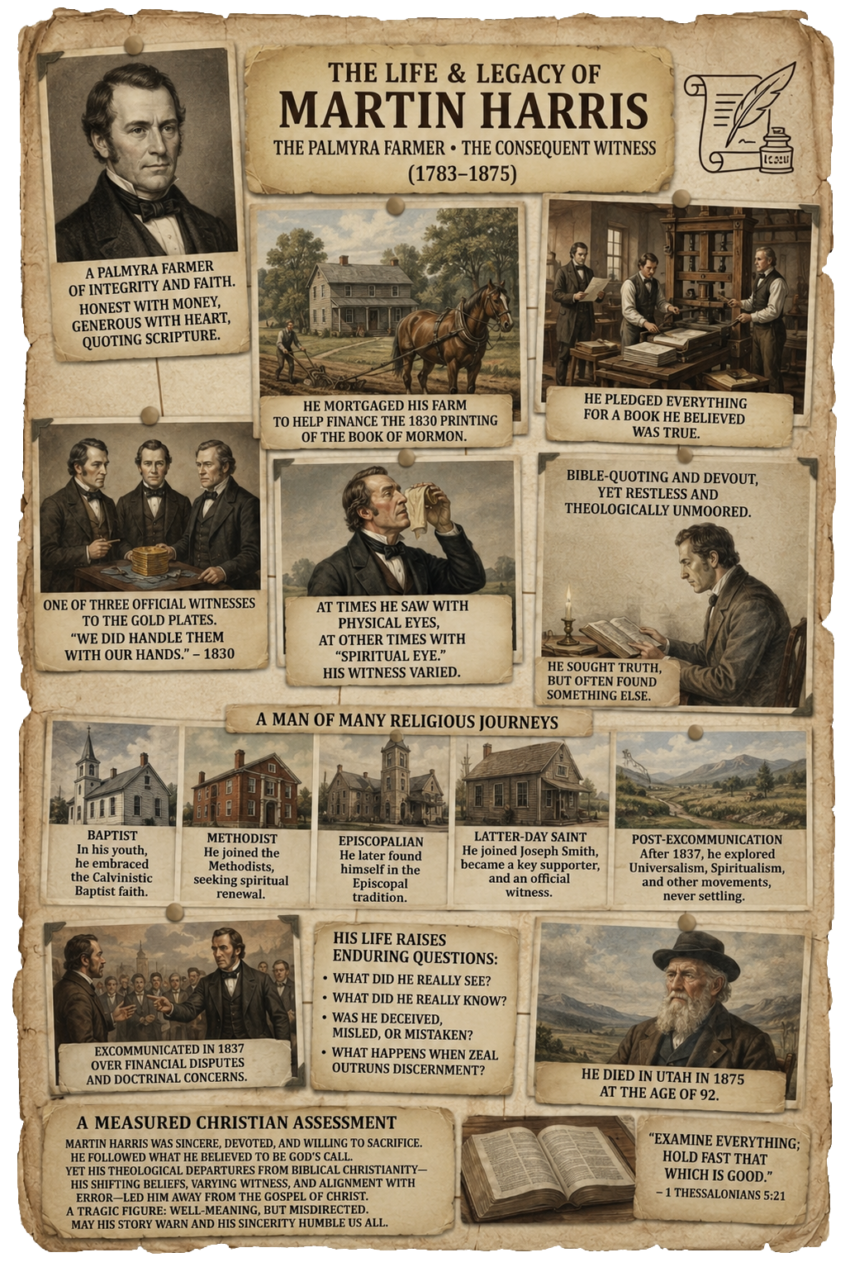
Fifth Post in the Early Mormon Personalities Series
The Man Who Lost a Manuscript and Found a Religion
❦ ❦ ❦
I. A Knock in the Lancashire Twilight
It began in the autumn of 1874 with a knock at a quiet Utah farmhouse, an interruption to the Pilkingtons’ evening devotions. The stranger at the door was tall once, perhaps, but stooped now, the cold of a Cache Valley October pressing at the seams of his coat. He had come, he said, to hire a boy. Room and board, a two-year-old heifer, in exchange for a year of labor. Fourteen-year-old Willie Pilkington, only months removed from the soot of a Lancashire sweatshop, was bundled out of his father’s house and seated in the stranger’s wagon, headed toward a log cabin on the far rim of the valley.
The man fed Willie a pan of bread and milk, gave him two thin quilts against the mountain night, and disappeared without a word into the back of the cabin. The boy thought he was alone. Then, from a corner the lamp could not reach, came a rustle, and a voice.
Now, Willie, tomorrow night after your chores are done and we have had supper and all the folks have gone to bed, I want you to sit down in this chair, close to mine, for I have lots to tell.
— Martin Harris to Willie Pilkington, autumn 1874, in W. H. Pilkington Reminiscence
For the next nine months, the old man told and retold his story whenever the boy would sit and listen. Some nights, he could scarcely contain it. He spoke of money and ancient plates, of an angel in a grove, of a voice from the throne of God, of a religion that had risen and a prophet who had fallen and a kingdom that, against all odds, had still gone forward. And in all of it, he claimed a part. His money had been crucial. His eyes had seen what other men only dared to dream. His ears had heard a voice.
At one moment in those long winter conversations, the old man rose painfully to his full ninety-two years, set his cane in his left hand, struck his right hand against his breast, and announced his name with the gravity of a man who knew it would echo:
I am Martin Harris.
— Reported by William H. Pilkington, in Ronald W. Walker, “Martin Harris: Mormonism’s Early Convert,” Dialogue 19, no. 4 (1986)
It was, in fact, a name worth remembering. He had been the first patron of a movement that would become the fastest-growing American religion of the nineteenth century. He had mortgaged his farm to print a book that now lives in nearly two hundred million copies. His signature stands at the front of every one of them. He had walked away from that church in disgust and into half a dozen others, then walked back again as an old man weighed down by poverty, regret, and the unshakable conviction that, decades earlier, in a New York grove, he had seen what he had seen. To understand Mormonism’s beginnings, one must reckon with this man — restless, generous, gullible, brave, vain, and theologically mistaken in ways that still shape millions of lives. To dismiss him is to misunderstand the early Restoration. To canonize him is to misunderstand his troubles. The honest path runs between, and it begins on a hardscrabble farm in upstate New York.
❦ ❦ ❦
II. Of Dissenters and Hunters: The Harris Inheritance
Religious enthusiasm came down to Martin Harris through the blood. His earliest American forebear, Thomas Harris, had crossed the Atlantic among the first wave of seventeenth-century Dissenters, refusing the religious compromise of the Thirty-nine Articles. He had walked with Roger Williams in England, followed him to Massachusetts Bay, and then trailed Williams into the wilderness of Rhode Island when the Bay colony grew uncongenial. According to family lore, Thomas one day returned to Boston, mounted a Puritan pulpit uninvited, and delivered a sermon so scorching that he was dragged out of the church by his hair, lashed with a cat-o’-nine-tails, and jailed without bread or water. Whatever the precise details, the Harris pattern was set: the willingness to break ranks for conscience, to suffer for a private vision of truth.
By the 1780s, Martin’s father, Nathan, had migrated from four generations of Rhode Island Harrises to the green frontier of Ontario County, New York. By 1794, Nathan had purchased six hundred acres of rich loamed soil near a settlement so new it was still called Swift’s Landing, after the general who had sold the pioneers their titles. Nathan was a hunter of legendary skill in the regional folk memory. He was credited with slaying the last wolf in the locality, killed as the aging settler galloped him down on horseback. A later generation pulled his distinctive musket balls out of trees throughout the surrounding woods. His son Martin, born in Easton, Saratoga County, on May 18, 1783, grew up clearing his father’s timber, learning to plant and harvest the wheat for which the region became famous, and absorbing the rough-hewn theological climate of frontier New York.
Education on that frontier was thin. Until New York mandated common schools in 1812, settlers shifted for themselves; Palmyra erected its first formal log schoolhouse in 1792, when Martin was already ten. He learned reading, writing, and the ciphering necessary for farming, but no more. “Small literary acquirements,” wrote a later associate. What he did possess in abundance was the practical Yankee shrewdness that turned timber into wheat and wheat into capital. By 1813, at age thirty, he paid eight hundred dollars in cash for a hundred-and-twenty-one acres on the north end of his father’s farm. Within fourteen years, he had assembled at least six more parcels and held a working estate valued, by his first wife’s account, at near ten thousand dollars.
Palmyra recognized him as a man of weight. Beginning in 1814, the township elected him seven times as one of its twenty-eight Overseers of Highways, often with the additional honor of Fence Viewer. He won prizes at the local fair for his bed ticking, coverlets, worsted stockings, and rose blankets. He helped judge swine. He served as one of two Palmyra managers for the Ontario Agricultural Society. He sat on a committee raising funds for the Greek Revolution, and he served on the local Vigilance Committee in the anti-Masonic agitation that swept the region in the late 1820s. In dress, he was substantial and respectable: gray homespun, a stiff broad hat, blue eyes set in a fair complexion, hair combed sideways and curling about his ears in the style of prosperous yeomen. He stood about five feet eight, fleshy and healthy, and at age forty-four, with his hands “altogether untied,” as he announced, he was contemplating hiring a man to mind his farm so he could travel.
On March 27, 1808, at age twenty-five, Martin had married his first cousin Lucy Harris, then nearly sixteen. Between 1809 and 1822, they would have at least five children together; three lived to adulthood. He served briefly and without injury as orderly sergeant in the 39th Regiment of the New York State Militia during the War of 1812, hiring a substitute for active service except for nine days that included a skirmish at Sodus Point and the defense of Pulteneyville against a British landing in 1814. Outwardly, by 1827, he was a man whose life had gone well. The townspeople called him honest, industrious, benevolent, a worthy citizen. Even those who would later regard his religious choices as madness conceded the moral foundation.
Mr. Harris was among the early settlers of this town, and has ever borne the character of an honorable and upright man, and an obliging and benevolent neighbor. He had secured to himself by honest industry a respectable fortune — and he has left a large circle of acquaintances and friends to pity his delusion.
— Wayne Sentinel (Palmyra, NY), May 27, 1831, on Harris’s departure for Ohio
❦ ❦ ❦
III. Tossed to and Fro: The Religious Seeker
The respectability of Martin Harris in the Palmyra of the 1820s rested on his hands and his land. The restlessness of Martin Harris in the same years rested somewhere deeper. About the age of thirty-five, in the rolling crests of the Second Great Awakening, the itinerant preachers caught him by the soul. He found himself, as one neighbor remembered, “tossed to and fro,” turning from one revivalist’s offer of certainty to another, drawn especially to the most extravagant. G. W. Stoddard, who had known him for thirty years, summarized the trajectory with sarcasm:
He was first an orthodox Quaker, then a Universalist, next a Restorationer, then a Baptist, next a Presbyterian, and then a Mormon.
— G. W. Stoddard affidavit, Palmyra, November 28, 1833, in E. D. Howe, Mormonism Unvailed (1834)
Harris’s own version was less dramatic and more revealing. He had occasionally worshiped with the Society of Friends in his youth — the Quaker connection ran in the family — but he never joined formally. He visited Palmyra’s several churches and was, he said, called brother by them all. Yet a deeper instinct kept him from belonging to any. In 1818, by his own dating, he received what he later described as a private spiritual instruction:
In the year 1818 — 52 years ago — I was inspired of the Lord and taught of the Spirit that I should not join any church, although I was anxiously sought for by many of the sectarians… The Spirit told me to join none of the churches, for none had authority from the Lord, for there will not be a true church on the earth until the words of Isaiah shall be fulfilled.
— Martin Harris, autobiographical statement, c. 1870
The attentive reader will notice that this account bears a remarkable resemblance to the narrative structure of Joseph Smith’s First Vision. In Smith’s canonical telling, he, too, was a sincere young seeker surrounded by competing religious claims, spiritually instructed not to join any existing church, and told that all the sects had gone astray and lacked divine authority. The parallels are not incidental — they are architectural. Harris’s retrospective account, recorded around 1870, follows the same dramatic contours: the anxious seeker, the competing sectarians, the private divine instruction, and the authoritative declaration that no true church yet existed on the earth. Whether Harris’s memory genuinely preserved an independent 1818 experience or whether decades of immersion in Smith’s founding narrative had shaped the way he recalled and retold his own spiritual biography is a question the text cannot answer on its own. What it does suggest is that the First Vision template had become, for early Mormon believers, the expected shape of a credible conversion prologue — and Harris’s account fits that template with a tidiness that is difficult to regard as purely coincidental.
Two doctrinal scruples kept him out. First, the Trinity defied his reason; the conventional formula seemed convoluted, even absurd, and the resulting deity too remote to please or offend. “I have more proof to prove nine persons in the Trinity than you have of three,” he taunted his Methodist neighbors. Second, no church could demonstrate to him a divine authority to act for God. “I might just as well plunge myself into the water as to have any one of the sects baptize me,” he said. He was, in short, a Restorationist before the Restoration arrived — already convinced that the New Testament church had vanished and waited to be remade.
He read the Bible omnivorously. Acquaintances reported he could quote more Scripture than any man in the neighborhood, that he had mastered entire books, that he would defy any man to show him a passage he was not familiar with. His favorite paraphrase was 1 Corinthians 1:27 — “God has chosen the weak things of this world to confound the wise.” He saw himself in that verse. He believed God had a work for him. He even, by his later recollection, anticipated specific events: an angel would restore divine power; a great gathering of Israel was at hand; a new book of scripture was coming forth to join the Bible in a latter-day work. Whether memory shaped these recollections after the fact is impossible to say with certainty, but the conviction was real.
From a biblical-Christian perspective, the spiritual portrait that emerges is sobering. Harris stood at precisely the place the New Testament warns the unanchored soul not to stand. He had rejected the historic Trinitarian creeds without grasping their depth and necessity. He had rejected the visible church without examining whether the apostolic witness it carried was the ground of his Bible’s authority in the first place. He had embraced a private inner spirit as the final court of appeal — the very ground Paul warned against in Galatians 1:8: “But though we, or an angel from heaven, preach any other gospel unto you than that which we have preached unto you, let him be accursed.” An angel was, in fact, what Harris was waiting for.
His religious imagination was fevered. Pomeroy Tucker, a Palmyra observer who liked the man, reported that “marvelousness” was Harris’s predominant phrenological development. He believed in dreams, ghosts, hobgoblins, special providences, terrestrial visits of angels, and the interposition of devils to afflict sinful men. The Episcopalian John A. Clark called him a man with a “manifest disputatious turn of mind.” The Presbyterian Jesse Townsend — installed at Palmyra’s Western church in 1817 — was harsher: “an unlearned conceited hypocrite” and a “visionary fanatic.” John Gilbert, the village printer, simply called him “superstitious,” a man who “pretended to see things.” Lorenzo Saunders, who knew the family well, defended Harris’s basic decency but conceded the strangeness:
There can’t anybody say a word against Martin Harris. Martin was a good citizen… a man that would do just as he agreed with you. But, he was a great man for seeing spooks.
— Lorenzo Saunders interview, c. 1884
Some of these visions were stranger still. Once while reading scripture by candlelight, Harris reportedly mistook the candle’s sputtering for a sign that the devil was trying to stop him. Another night, he startled awake, convinced that a creature the size of a dog had been sitting on his chest, though a companion in the room could find nothing. Hostile sources, perhaps unreliable, claimed that he once reported seeing Christ poised on a roof beam, and on another occasion declared he had walked alongside the Lord Jesus, who had appeared to him in the shape of a deer for two or three miles, conversing as familiarly as one man with another. A Christian reader, even granting the possibility of malicious exaggeration, cannot read these accounts without theological alarm. The biblical Christ, the eternal Word made flesh in a particular Jewish body, does not appear as a deer; the spirit that produces such an apparition is, by the Bible’s own diagnosis in 1 John 4:1–3, not the Spirit of God. The disturbing question is what kind of spiritual openness leaves a person vulnerable to such visions, and the answer in Harris’s case appears to be a longing for the supernatural untethered from the doctrinal moorings of historic Christianity.
There was, then, by the autumn of 1827, a Palmyra farmer with a respectable fortune, an irascible but devoted wife, a Bible memorized to its margins, a private conviction of a coming new revelation, and a credulity for the visionary that no creed had restrained. Into this prepared field walked Lucy Mack Smith with news that her son had at last brought home the gold plates.
❦ ❦ ❦
IV. The Smith Connection: Wells, Stones, and a Brass Kettle
The Smith family had moved to Palmyra in 1816, when Joseph Jr. was a small boy. By 1824, with the family struggling against debt and crop failure, Martin Harris hired the patriarch Joseph Smith Sr. to dig him a well and a cistern. During those days of labor, the elder Smith confided in Harris something extraordinary: an angel had visited his son Joseph Jr., who had been shown the location of an ancient record buried in a nearby hill. Harris listened, intrigued. He hired Joseph Jr. as a fifty-cent-a-day laborer, hoeing corn beside him. He liked the boy. He thought him a good worker. And he had personally observed something the village argued about endlessly — the boy’s stone.
Once, Harris later recalled, he had dropped a pin among shavings and straw and could not find it. He challenged Joseph: “Take your stone.” The young seer placed his stone in his battered white stovepipe hat, squatted, and gazed into it. Harris watched closely:
I watched him closely to see that he did not look [to] one side. He reached out his hand beyond me on the right, and moved a little stick, and there I saw the pin, which he picked up and gave to me. I know he did not look out of the hat until after he had picked up the pin.
— Martin Harris interview, in Joel Tiffany, Tiffany’s Monthly (1859)
From the moment Lucy Smith came to him in autumn 1827 with news of the plates, Harris was not approaching the matter cold. For a year already, his wife later complained, he had been growing very intimate with the Smith family. Henry Harris, perhaps a cousin, alleged that Martin had met privately with the Smiths and others as part of what neighbors called “the Gold Bible Company.” Harris himself reportedly conceded an active role in finding the plates, although he would later strenuously deny saying so. His first guess, when news of the gold first reached him, had been mundane: “My thoughts were that the money-diggers had probably dug up an old brass kettle, or something of the kind.”
That guess illuminates a feature of the early Smith circle that modern Latter-day Saint sources tend to handle with gloved hands. Joseph Smith Jr. and his immediate associates — including Harris — operated in the folk-magical world of upstate New York treasure-digging. The Palmyra Reflector spoke openly of the practice in 1831: “Men and women without distinction of age or sex became marvelous[ly] wise in the occult sciences. Many dreamed, and others saw visions disclosing to them, deep in the bowels of the earth, rich and shining treasures.” Harris believed in seer stones, in second sight, in guardian spirits who tested initiates. According to Joel Tiffany’s 1859 interview, Harris and two others, after Joseph received the plates, ventured to the Hill Cumorah with tools, hoping to find more boxes of gold. They located what Harris claimed was a stone box; when they tried to dig around it, “some unseen power slid the box into the hill, as we stood there looking at it.” One of the men struck the lid with a crowbar and broke off a corner, kept afterward as a relic. “Some day that box will be found,” Harris insisted.
These details matter theologically. Harris did not move from biblical Christianity to Mormonism in a clean conversion. He moved from a folk world already saturated with seer stones, divining rods, treasure spirits, and visionary ecstasies — a world the established churches had spent two centuries trying to root out — into a religious framework that ratified those instincts and clothed them in the vocabulary of restoration. The official Latter-day Saint manuals describe Harris’s openness as “perhaps it was this openness to the presence of the supernatural in daily life that allowed him to at least consider Joseph’s claims.” That is one way to phrase it. A more candid account would say that Harris had been spiritually conditioned to receive precisely this kind of message, and that the very faculties his neighbors called superstition were the faculties that proved decisive in his conversion.
When Lucy Smith came to him with the news, Harris postponed her with calculated caution. He privately visited Manchester within a day or two, interviewed Emma Smith and each member of the Smith family separately, and at last sat with Joseph alone. He lifted the box that contained, he was told, the plates. Their density convinced him that the impoverished Smiths could not afford to fake the contents with lead. He challenged Joseph one last time: “Joseph, you know my doctrine, that cursed is every one that putteth his trust in man, and maketh flesh his arm. We know that the devil is to have great power in the latter days to deceive, if possible, the very elect; and I don’t know that you are one of the elect.”
Joseph held steady. At noon, Martin returned home, knelt in his bedroom, and made a covenant. If Joseph’s work was God’s work, he would do his utmost to bring it to the world. He felt, he said, a confirmation in the form of “the still small voice spoken in the soul.” He had heard no voice. He had seen no angel. But he was, by his own reckoning, now under covenant. He would assist Joseph. The Palmyra farmer had become Mormonism’s first patron.
❦ ❦ ❦
V. Charles Anthon and a Sealed Book
In February 1828, Harris set out for New York City carrying a copy of characters that Joseph Smith claimed to have transcribed from a set of ancient golden plates — a record Smith said he had unearthed from a hill in Manchester, New York, in September 1827, under the direction of an angel named Moroni. Smith described the plates as thin metallic leaves bound with rings, engraved in what he called “reformed Egyptian,” and said to contain the religious history of ancient inhabitants of the American continent. It was this extraordinary claim — that a buried sacred record had been divinely delivered to an unlettered young man for translation — that Harris now carried eastward in the form of a handwritten transcription, seeking scholarly validation.
The story of what happened in the city has come down to us in two flatly contradictory versions. By Harris’s account — preserved in Joseph Smith’s 1838 history — he visited the Columbia College linguist Charles Anthon, who examined the characters, declared their translation correct, and gave Harris a written certificate. When Anthon learned that the plates had come from an angel, he reportedly demanded the certificate back, tore it to pieces, and announced: “that there was no such thing now as ministering of angels.” When Harris explained that part of the plates were sealed and could not be brought, Anthon allegedly replied: “I cannot read a sealed book.”
Anthon told the story differently in two later letters, in 1834 and 1841. He insisted he had told Harris from the start that he was the victim of a fraud, that no characters of any known language appeared on the paper, and that he had urged him to go home and demand to see the plates locked in their chest. The professor’s two accounts contradict each other on whether he had given any written opinion at all, but they agree that he had warned Harris, and they agree that Harris had returned to his confidence undisturbed.
What is certain is that Harris came home a more committed believer than he left. Whatever Anthon said, Harris and Joseph Smith read the encounter through the lens of Isaiah 29:11 — “And the vision of all is become unto you as the words of a book that is sealed, which men deliver to one that is learned, saying, Read this, I pray thee: and he saith, I cannot; for it is sealed.” The visit had become, in their telling, the fulfillment of biblical prophecy. From that interpretation flowed the next, fateful step. Harris was now ready to mortgage his farm. But before that step came a darker one.
❦ ❦ ❦
VI. The Lost Manuscript and the “Wicked Man”
Beginning April 12, 1828, Harris served as Joseph Smith’s principal scribe at Harmony, Pennsylvania. By June, they had produced one hundred and sixteen pages of foolscap manuscript — what Joseph called the “Book of Lehi.” Throughout this period, Harris remained, despite his covenant, an empirical investigator. He once switched Joseph’s seer stone for a similar-looking stone of his own to test whether the prophet would notice. When Joseph, attempting to translate, exclaimed that “all is as dark as Egypt,” Harris confessed and produced the original stone, explaining that he had wanted to “stop the mouths of fools” who claimed Joseph was merely reciting memorized passages. The episode reads like an honest man’s effort to catch fraud. It also reads, less flatteringly, like a man already so committed that he was looking for evidence to sustain a conclusion he had already reached.
Then came Lucy. Her opposition had stiffened from skepticism into bitter resentment. She had been rebuffed in her own attempts to see the plates — Joseph had answered her offer of help with the brusque remark, “I always prefer dealing with men, rather than their wives” — and she now beleaguered Martin to produce some evidence of Joseph’s translation gift. To soothe her, Harris pressed Joseph for permission to take the manuscript home. Joseph inquired of the Lord and was refused. Harris pressed again. Joseph inquired and was refused again. On the third inquiry, permission was reluctantly granted with strict conditions: the pages were to be shown only to Lucy, Martin’s parents, and his brother and sister-in-law. Within weeks, the manuscript was gone.
What followed that disappearance is one of the most theologically consequential — and most carefully managed — episodes in early Mormon history. The loss of those 116 pages triggered a crisis that reshaped the Book of Mormon’s narrative structure, produced a new set of revelations, and raised questions about the nature of Smith’s prophetic gifts that have never been fully resolved. Readers who wish to explore the full dimensions of this episode — its implications for the translation claims, the revelatory response, and what the missing pages may or may not reveal about the book’s origins — are encouraged to consult our extensive essay, “The Book of Mormon’s Missing 116 Pages,” which examines the incident and its theological fallout in considerable depth.
Precisely how it disappeared has been disputed for nearly two centuries. Lucy Mack Smith and Joseph believed Lucy Harris stole and probably burned the pages; Lucy denied it; some have speculated about a wider conspiracy to alter the text and trap Joseph in a discrepancy. What is undisputed is that Martin tore his bedroom apart looking for the manuscript, even ripping open beds and pillows, and could not find it. He walked the three miles to the Smiths’ Manchester home with his hat drawn low over his eyes. When at last he confessed, he pressed his hands to his temples and cried out:
Oh! I have lost my soul!
— Lucy Mack Smith, History, 1844–1845, in The Joseph Smith Papers
It was the central crisis of his early discipleship. Joseph returned to Harmony, prayed, and dictated a revelation now canonized as Doctrine and Covenants 3, in which the Lord rebuked the prophet for fearing man more than God and described Harris in language that, in any modern Latter-day Saint pulpit, would be carefully buffered with context: he had “delivered up that which was sacred into the hands of a wicked man, who has set at nought the counsels of God, and has broken the most sacred promises which were made before God, and has depended upon his own judgment and boasted in his own wisdom.” The phrase “wicked man” — a divinely sanctioned descriptor of the Three Witnesses’ future patriarch — is one of the most awkward inheritances of the Doctrine and Covenants, and most modern devotional treatments soften it considerably. The text itself is remorseless.
Joseph would not use Martin Harris as a primary scribe again. When the translation resumed the following spring under Oliver Cowdery, Harris was still a financial backer, but his role had shifted to outsider. He longed for restoration. He longed, especially, for some firmer evidence than the still small voice — and he longed for a witness experience that might convince his wife. The path that led him into the Sacred Grove of June 1829 was paved by his shame over the lost manuscript and his hunger for a vision that would settle his soul.
❦ ❦ ❦
VII. The Witness in the Grove: Sight, Spirit, and the Eye of Faith
In late June 1829, with the translation nearing completion at the Whitmer farm in Fayette, New York, Harris, Cowdery, and David Whitmer asked Joseph Smith to plead with God for the privilege of seeing the plates as the witnesses promised in the dictated text. Joseph received the revelation now canonized as Doctrine and Covenants 17. The four men withdrew into a wooded grove.
By Joseph Smith’s later account, the men prayed and prayed without success. Harris confessed that he feared his presence was the cause of their failure. He withdrew. Shortly thereafter, Cowdery and Whitmer reported that an angel descended in a glory of light, displayed the plates by turning them leaf by leaf, and pronounced a heavenly endorsement of the translation. Joseph then found Harris alone, deeper in the grove, and joined him in prayer. By Harris’s account, the angel and the plates appeared to him separately. He cried out:
Tis enough; tis enough; mine eyes have beheld; mine eyes have beheld.
— Joseph Smith, History, 1838–1856, vol. A-1, in The Joseph Smith Papers
The signed testimony of the Three Witnesses, printed at the front of every Book of Mormon since, declares unambiguously: “And we declare with words of soberness, that an angel of God came down from heaven, and he brought and laid before our eyes, that we beheld and saw the plates, and the engravings thereon… we beheld and bear record that these things are true.” The unequivocal physicality of that statement is one reason the Three Witnesses are central to the Latter-day Saint apologetic. Three sober men, in broad daylight, claim to have seen tangible plates and a bodily angel. If their testimony is honest and accurate, the Book of Mormon’s heavenly origin is virtually conceded; if their testimony is false or misled, the foundation of the Restoration cracks. The historical record, regrettably for any simple verdict, will not let the matter rest there.
Across the rest of Harris’s life, his statements about the experience oscillate between two registers — the physical and the spiritual — in ways that have generated nearly two centuries of debate. To the printer John H. Gilbert, who set the type for the Book of Mormon, Harris is reported to have answered the direct question “Martin, did you see those plates with your naked eyes?” by looking down for an instant, raising his eyes again, and saying, “No, I saw them with a spiritual eye.” The Episcopalian John A. Clark recorded in 1840 a Palmyra report that Harris had said, “I did not see them as I do that pencil-case, yet I saw them with the eye of faith.” Pomeroy Tucker, foreman in the printing office, reported that Harris “used to practice a good deal of his characteristic jargon and ‘seeing with the spiritual eye,’ and the like.” Two other Palmyra residents independently reported Harris saying he had seen the plates with “the eye of faith” or “spiritual eyes.”
The single most damaging statement on record comes from Stephen Burnett, an early Mormon disillusioned in the 1838 Kirtland crisis, who wrote to Lyman E. Johnson on April 15, 1838, that he had heard Harris “state in public that he never saw the plates with his natural eyes only in vision or imagination,” that the same was true of Cowdery and Whitmer, and that the Eight Witnesses “never saw them & hesitated to sign that instrument for that reason, but were persuaded to do it.” Burnett continued:
Martin Harris arose and said he was sorry for any man who rejected the Book of Mormon for he knew it was true. He said he had hefted the plates repeatedly in a box with only a tablecloth or a handkerchief over them, but he never saw them only as he saw a city through a mountain.
— Stephen Burnett to Lyman E. Johnson, April 15, 1838, Joseph Smith Letterbook
The image of seeing a city through a mountain is striking. It is, plainly, a vision rather than ordinary sight. And the same Harris who, in his published testimony, declared that an angel laid the plates “before our eyes” is here reportedly admitting that the plates were never seen by his natural eye at all, but only as a city is seen through a mountain — that is, by an interior, spiritual perception of an object physically obscured. Latter-day Saint apologists have argued, plausibly, that the comment about hefting the plates under a cloth refers to the period when Harris was scribing rather than the witness experience, and that Harris’s later “natural eye” affirmations should be read as the more careful clarifications. Critics have replied that Harris’s earliest, less-edited statements regularly use spiritual-eye language, and that the later natural-eye affirmations look like apologetic course corrections.
The Christian theological observation, made without animus, is simpler than either polemic: a witness who oscillates is a witness whose testimony cannot be settled in court. The Apostle Paul, defending the bodily resurrection of Christ, did not invoke spiritual eyes. He invoked five hundred living men who had eaten with the risen Lord, walked with Him on dusty roads, and put their hands into His side. The biblical category of resurrection appearance is open, public, falsifiable, and physical — “this Jesus hath God raised up, whereof we all are witnesses” (Acts 2:32). The category Harris kept reaching for, despite his own efforts to anchor it in the natural eye, was the category of inner vision. From a Christian standpoint, the question is not whether Harris experienced something. He almost certainly did. The question is what kind of experience it was, and whether the entity that appeared to him fits the Christ revealed in Holy Scripture. The same man who claimed to have seen Jesus walking beside him in the form of a deer, and the devil in the shape of a sleek-haired jackass, is asking the modern reader to trust his identification of an angel and his certification of an extra-biblical scripture. Christians may, with all due charity, hesitate.
Harris’s later statements to disprove the spiritual-eye reports are not without weight. To David B. Dille in 1853, he insisted he had held the forty- to sixty-pound plates on his knee for an hour and a half. To William M. Glenn, around 1870, he held out his hand and declared:
Gentlemen, do you see that hand? Are you sure you see it? Or are your eyes playing you a trick or something? No. Well, as sure as you see my hand so sure did I see the angel and the plates.
— Martin Harris, statement to William M. Glenn, c. 1870
And on his deathbed, he told his grandson and a relative named George Godfrey:
The Book of Mormon is no fake. I know what I know. I have seen what I have seen and I have heard what I have heard. I have seen the gold plates from which the Book of Mormon is written. An angel appeared to me and others and testified to the truthfulness of the record, and had I been willing to have perjured myself and sworn falsely to the testimony I now bear I could have been a rich man.
— Martin Harris on his deathbed, July 1875, in Eldin Ricks, The Case of the Book of Mormon Witnesses
These late affirmations are, in their own way, profoundly moving. They describe a man who, after losing his fortune, his first wife, his social standing, his second wife, three church homes, and his health, would not deny what he claimed to have seen. The sincerity is impossible to doubt; the perception is another question.
❦ ❦ ❦
VIII. The Farm in Mortgage: “Thou Shalt Not Covet Thine Own Property”
On August 25, 1829, Martin Harris signed a mortgage to the Palmyra printer Egbert B. Grandin to secure the printing of five thousand copies of the Book of Mormon for three thousand dollars — roughly ninety-one thousand dollars in 2025 currency. He had walked, by then, a long road from his autumn 1827 declaration that his hands were untied and he could come and go as he pleased. Joseph Smith dictated for him a revelation, now Doctrine and Covenants 19, which named the offering with surgical precision:
I command thee that thou shalt not covet thine own property, but impart it freely to the printing of the Book of Mormon… Misery thou shalt receive if thou wilt slight these counsels: yea, even destruction of thyself and property. Impart a portion of thy property; yea, even a part of thy lands and all save the support of thy family. Pay the printer’s debt.
— Doctrine and Covenants 19:26, 33–35 (1830 wording)
When sales of the printed book lagged, Harris reportedly returned to Joseph in distress. “The Books will not sell for no Body wants them,” he is recorded as saying. “I want a Commandment.” Joseph referred him back to the revelation already given: “Fulfill what you have got.” “But I must have a commandment,” Harris insisted. He received no further commandment. To honor the existing one, he sold off one hundred fifty-one acres of his farm. The largest single private subsidy in early Mormon history was the dismantling of Martin Harris’s estate. Without it, no Book of Mormon — at least not in the form and timing the Restoration required.
From a strictly Latter-day Saint vantage, this is the act of consecration that makes Harris one of the great benefactors in their tradition. From an outside vantage, it has another character. The wording of the revelation — “thou shalt not covet thine own property” — quietly redefines the natural moral instinct of stewardship as covetousness, with God Himself implicated as the agent of the redirection. The threat — “misery… even destruction of thyself and property” — supplies an explicit penalty if Harris fails to comply. Even readers sympathetic to the Latter-day Saint cause have wrestled with the moral weight of a private revelation that names a sum of money and threatens a family’s livelihood. The Apostle Paul’s instruction in 2 Corinthians 9:7 — “every man according as he purposeth in his heart, so let him give; not grudgingly, or of necessity: for God loveth a cheerful giver” — describes a different theology of giving. The Christian reader, watching Harris liquidate his land while his wife retreats to a separate property and his neighbors pity his delusion, may be forgiven a hesitation that lasts longer than a sentence.
❦ ❦ ❦
IX. The Wreck of a Marriage
Lucy Harris was, by all accounts, including Lucy Mack Smith’s, a difficult woman: peculiar, jealous, suspicious, hard of hearing, and “pretty high on combativeness,” as Lorenzo Saunders dryly remembered. She had been Martin’s first cousin, married to him at sixteen, mother of his children, partner in his prosperity. She had also been deeply wounded by his absorption into Joseph Smith’s project, by the mysterious plates she was forbidden to see, and by the steady draining of the family fortune toward a book her neighbors regarded as a fraud. Her affidavit of November 29, 1833, collected by E. D. Howe for his hostile compilation Mormonism Unvailed (downloadable PDF), is the testimony of a woman past mending. She accused Martin of repeated physical abuse:
He has whipped, kicked, and turned me out of the house… In one of his fits of rage he struck me with the but end of a whip, which I think had been used for driving oxen, and was about the size of my thumb, and three or four feet long. He beat me on the head four or five times, and the next day turned me out of doors twice, and beat me in a shameful manner.
— Lucy Harris affidavit, November 29, 1833, in E. D. Howe, Mormonism Unvailed (1834)
She is also the only known source for the persistent rumor that Martin had committed adultery with a neighboring “Mrs. Haggard,” describing how Martin would pretend to go on errands and instead steer for the Haggard house, sometimes staying “till twelve or one o’clock at night, and sometimes until day light.” Latter-day Saint historians have generally regarded these allegations with skepticism, treating them as the bitter overstatements of a wounded wife with motives to discredit. A measured Christian observer should grant the skepticism without ignoring the testimony. Lucy was no neutral witness, but neither was she without standing. Her sister-in-law, Abigail Harris, recorded a remark Martin allegedly made in her hearing in February 1828, after Lucy had pleaded with her husband to drop the gold-plates business as false:
What if it is a lie: if you will let me alone I will make money out of it!
— Reported by Abigail Harris, affidavit, November 28, 1833, in E. D. Howe, Mormonism Unvailed
If the words are accurately reported, they reveal a man with mixed motives — at once spiritually convicted and commercially calculating. If they are not, they at least reveal what those closest to him in 1828 believed his motives to be. E. D. Howe, who knew the man, claimed Harris had taken on the Bible business “with a view of making a handsome sum of money from the sale of the books.” Whether or not the financial motive was as cynical as Lucy and Abigail painted it, the marriage ended in 1830, the year of the Book of Mormon’s publication. Lucy stayed in Palmyra. She died in 1836 at age forty-four. Martin had already moved to Kirtland.
❦ ❦ ❦
X. Kirtland: From High Priest to Excommunicate
Harris was baptized into the new Church of Christ on April 6, 1830, the day of its founding, the second convert after Joseph Smith and Oliver Cowdery. By June 1831, at a conference at Kirtland, Ohio, he was ordained a high priest. He served a mission in 1832 to northeastern Pennsylvania and southern New York with his older brother Emer, founding a church in Springfield, Pennsylvania, and reportedly baptizing eighty-two members. His mission ended badly. In December 1832, a woman in Springfield sued him for slander, alleging he had told a public crowd that “she had a bastard child.” He was arrested in January 1833, jailed for two weeks until friends posted the thousand-dollar bail, and was eventually found not liable when the case came to trial.
On February 12, 1834, Sidney Rigdon hauled him before the Kirtland High Council on charges that included telling a Mr. A. C. Russell “that Joseph drank too much liquor when he was translating the Book of Mormon and that he wrestled with many men and threw them.” Another charge was that Harris had exalted himself above Joseph by claiming the prophet did not understand the contents of the Book of Mormon until after it was translated. Harris denied much, conceded that he “had said many things inadvertently calculating to wound the feelings of his brother,” and was forgiven.
Five days later, on February 17, 1834, he was ordained to the Kirtland High Council. He marched with Zion’s Camp to Missouri later that year. In February 1835, he, Cowdery, and Whitmer were given the responsibility of selecting and ordaining the Quorum of the Twelve Apostles — a body Harris was never part of, despite scattered later claims that he had been ordained an apostle himself. Harris’s selection of the Twelve included Brigham Young’s nephew Heber C. Kimball, and Brigham’s brother John Young — a connection that would matter when, on November 1, 1836, Harris remarried.
His new wife was Caroline Young, twenty years old to his fifty-three, a niece of Brigham Young. Heber C. Kimball officiated. The age gap was striking; the social calculation, in the close quarters of Kirtland’s Mormon community, perhaps not. Caroline would bear Martin seven children. She was, by all accounts, a woman of patient faith — a striking contrast to Lucy. The wife who left him in 1856 to follow her people to Utah was the same wife who, on his return at age eighty-seven, declined to live with him again, having since been sealed in the Endowment House to another man during the long years of his absence. The pathos of his second marriage equals that of his first, but it is the pathos of a man failed by his own choices, not by his partner.
The fracture came in 1837. The Kirtland Safety Society, the bank Joseph Smith had organized partly as a response to the Panic of 1837, collapsed within months. Investors lost everything. Harris, who had borne so much of the early financial weight of the church, called the bank a “fraud” — Joseph’s own word for what others did to him, now turned back on the prophet. He aligned with Warren Parrish and other Kirtland dissenters who attempted to reorganize the church on the original revelations and the Book of Mormon, repudiating Joseph’s later innovations. In December 1837, while Joseph and Sidney Rigdon were relocating the church’s headquarters to Far West, Missouri, the Kirtland High Council excommunicated twenty-eight people, Harris among them.
From the Liberty Jail in Missouri the following year, Joseph Smith wrote a letter to the church that, in passing, dispensed with all three of the Book of Mormon’s chief witnesses in a single sentence. After cataloging the apostates of Far West, he added:
Such characters as McLellin, John Whitmer, David Whitmer, Oliver Cowdery, and Martin Harris, are too mean to mention; and we had liked to have forgotten them.
— Joseph Smith to the Church, December 16, 1838, in History of the Church 3:232
The line is jarring even on a sympathetic reading. The men whose signatures bound the credibility of the Book of Mormon were now too mean to mention. The same year, dissenters reported that Harris had publicly denied that the witnesses had ever seen the plates with natural eyes — the assertion at the heart of the Burnett letter. Whether or not the report was accurate, it was sufficiently public that, by Burnett’s account, three apostles and other senior figures left the church on the strength of it. The very witness Joseph had needed in 1829 had become, by 1838, a man whose private remarks were dissolving the foundation.
❦ ❦ ❦
XI. The Wandering Years and the Custodian’s Cottage
Between 1837 and 1870, the man whose name appeared in the front of every Book of Mormon was affiliated with at least eight separate religious movements, most of them schismatic offshoots of the church he had helped found. Richard L. Anderson catalogues them: the Parrish-Boynton dissenters, a 1842 rebaptism by a Nauvoo missionary, a 1846 mission to England for James J. Strang’s group (Strang having claimed his own set of supernatural plates and witnesses. See our essay, “James Strang: Fake Mormon Prophet, Self-Crowned King, and Master of the Ultimate Confidence Game“), participation in William E. McLellin’s 1847–48 attempts to reorganize the Whitmerite remnant, a sympathetic interest in Shakerism, support for Gladden Bishop (a self-styled Kirtland prophet who claimed to possess the original plates, the Urim and Thummim, the breastplate of Moroni, the Liahona, the sword of Laban, and even Harris’s own lost 116 pages), an alignment with William Smith — Joseph’s surviving brother — in 1855, and finally, in 1870, his return to the Utah church.
Each of these affiliations matters. The Strangite mission to England in 1846 ended in humiliation when the Latter-day Saint conference at Birmingham declined to hear him; he tried to preach in the street and was removed by police. George Mantle, who witnessed the rebuff, recalled that Harris, beset by a hostile crowd in the street and asked whether Joseph Smith was a true prophet of God, answered yes. The pattern would recur: Harris affiliating with one body, ejected or disillusioned, but unwilling to deny the Book of Mormon. He was a man with one fixed star — his witness experience — orbiting unstably around it.
The Shaker entanglement is theologically the most curious (See our essay, “The Fascinating and Odd Story of The Shakers“). The Shakers believed in spiritual gifts, the imminent return of Christ, and — most relevantly — angelic communications recorded in scripture. In 1843, a new Shaker book, A Holy, Sacred, and Divine Roll and Book, claimed to come from angels to prepare the world for the millennium. Harris was reportedly intrigued by it. Phineas Young wrote to Brigham Young on December 31, 1844, that Harris’s testimony “of Shakerism was greater than it was of the Book of Mormon.” Latter-day Saint apologists have urged caution about the second-hand quality of the report, and have pointed out that Harris never adopted Shaker celibacy and never joined the nearby Shaker community at North Union — facts that argue against full conversion. Yet the very willingness to entertain a parallel angel-revealed scripture, after his own published testimony to a parallel angel-revealed scripture, illustrates the fundamental susceptibility of his epistemology. Anyone whose final court of appeal is the inner spiritual eye is permanently vulnerable to the next person who claims to have one.
By the late 1850s, Harris had drifted free of every successor movement and settled into the role of self-appointed custodian of the Kirtland Temple, conducting tours for visitors. His second wife, Caroline, left for Utah in 1856 with their children, the trip culminating in a difficult plains crossing during which she nearly died of hemorrhage. Harris remained in Kirtland for fourteen more years, increasingly poor, increasingly alone.
In December 1869, a returning Latter-day Saint missionary, William H. Homer, stopped at the Kirtland Temple with his cousin and asked the landlord who the custodian was. He was directed to a poorly clad, emaciated little man on whom, in Homer’s words, “the winter of life was weighing heavily.” The two men introduced themselves; Harris bristled at the mention of Brigham Young’s Utah church, raging at length against “those Brighamite Mormons.” But when Homer at last asked the right question — did Harris still believe the Book of Mormon was true and Joseph Smith a prophet of God — Homer would later report that the entire man transformed:
Young man, do I believe it! Do I see the sun shining! Just as surely as the sun is shining on us and gives us light, and the moon and stars give us light by night, just as surely as the breath of life sustains us, so surely do I know that Joseph Smith was a true prophet of God, chosen of God to open the last dispensation of the fulness of times; so surely do I know that the Book of Mormon was divinely translated. I saw the plates; I saw the Angel; I heard the voice of God.
— Martin Harris to William H. Homer, Kirtland Temple, December 1869
Pressed about how he could bear so wonderful a testimony having left the church, Harris gave the answer his Latter-day Saint biographers love most:
Young man, I never did leave the Church. The Church left me.
— Martin Harris to William H. Homer, Kirtland Temple, December 1869
It is the line of a man who, after thirty-two years outside the institutional church, still believed the original revelation was true, and the original prophet had become unworthy of it. It is also the line of a man whose attachment to a foundational personal experience could not be dislodged by a generation of disappointments. From a Christian standpoint, the line illustrates a tragic fixity: the unwillingness to revisit the foundation when every superstructure built upon it has shaken loose.
❦ ❦ ❦
XII. Utah: The Return of the Witness
Homer reported the Kirtland encounter to church leaders in Salt Lake City. A subscription was raised — about two hundred dollars — and Edward Stevenson was dispatched to bring the old man west. They arrived in Ogden on August 30, 1870. Brigham Young personally greeted Harris and reconciled their old differences. On September 17, 1870, Stevenson rebaptized him in the Endowment House. He was then baptized by proxy for his deceased father and brother. He spoke at the morning session of the October 1870 General Conference, bearing his testimony of the Book of Mormon to the assembled church.
He would live four and a half more years, mostly with his eldest son, Martin Harris Jr., in Smithfield and later Clarkston in Cache Valley. Caroline was nearby but did not live with him; she had been sealed to John C. Davis in 1860, and although that marriage too had foundered, the sealing was not undone until 1959. Harris received a steady stream of visitors who came to take his testimony. Willie Pilkington — whose autumn 1874 first encounter began this essay — was one such grandson by marriage. The aged man’s compulsion to retell the founding story was not weariness but conviction. He had been struck with paralysis in November 1874. He died on July 10, 1875, in Clarkston, age ninety-two, having outlived nearly all of the original Mormon generation. He was buried, by his own direction, with a Book of Mormon in his right hand and a Doctrine and Covenants in his left.
He had not, in his final reckoning, denied his testimony. He had not denied Joseph. He had not denied the Book of Mormon. He had, however, denied many other things along the way — the bank, the prophet’s worthiness, every successor movement, and his own marriages. To say that he died faithful is true only with elaborate qualifications. To say that he died unfaithful is also untrue. He died, in the language of his own theology, as one who had been called to a witness office, who had stumbled, and who had been received again. In the language of the New Testament, the question is not whether his return was sincere but whether the gospel he bore was the gospel of the Apostles. To that final question, we must turn before closing.
❦ ❦ ❦
XIII. The Theological Departure from Biblical Christianity
Martin Harris’s contribution to early Mormonism was not chiefly doctrinal. He was not a Sidney Rigdon or a Parley Pratt. He did not author scriptural commentaries, sermon courses, or theological systems. What he contributed was foundational: the financial guarantee of the Book of Mormon and a signature on its frontispiece. But the witness he supplied carried a freight of doctrine, and the soul that bore witness had been formed by departures from the historic Christian faith long before the angel was reported in the grove.
The first departure, by his own statement, was Trinitarianism. The young Harris regarded the Nicene formulation as absurdly convoluted, reduced God to a remote abstraction, and could not be argued out of the rejection. The historic creeds — Apostles’, Nicene, Athanasian — were not rebutted; they were dismissed by an autodidact’s sense of arithmetical tidiness. The triune God revealed in Scripture (Matthew 28:19; 2 Corinthians 13:14; John 1:1–18; Hebrews 1:1–4) became, in Harris’s grasp, an obstacle rather than the wonder of revelation. He did not move from the Trinity to a Mormon theology of separate, embodied gods because he understood Mormon theology better than the Trinity. He moved because the Trinity had never moved him in the first place. From a biblical standpoint, this matters: the witness who would later certify a new scripture had begun by being deaf to the central mystery of the older one.
The second departure was authority. Harris held that no church on earth was properly authorized — a Restorationist conviction shared by many in the Burned-Over District. The biblical case for the visible church (Matthew 16:18; Ephesians 2:19–22; Acts 2:42) was outweighed for him by the brokenness and dispute of the actual churches he saw around him (Readers are encouraged to check out our essay, “The Gates Did Not Prevail: A Biblical and Historical Case Against the LDS Great Apostasy Doctrine“ which overwhelmingly demonstrates the continuity of authentic Christian faith.). The Restorationist longing was not in itself heretical; many sober Christians have prayed for revival and reformation. The Restorationist conclusion — that all existing Christian bodies have lost the gospel and require complete supersession by a new revelation through a new prophet — was. The biblical pattern of God’s faithfulness to His covenant people, even through long apostasies, leaves room for repentance, reform, and renewal, but not for the abolition of the body of Christ followed by its reinstitution through extra-biblical revelation. Galatians 1:6–9 closes that door explicitly. Harris kept the door open, and an angel came through.
The third departure was epistemic. Harris’s deepest religious certainty came not from Scripture, the apostolic witness, or the fellowship of the saints, but from private impressions, dreams, visions, divinations, and the still small voice within. The biblical category of testing the spirits (1 John 4:1) was foreign to his practice. When the Spirit told him in 1818 to join no church, he obeyed. When the still small voice in his bedroom in 1827 told him to assist Joseph Smith, he obeyed. When the angel in the grove in 1829 told him a Book of Mormon was true, he obeyed. At no point in this sequence was a private revelation tested against the public revelation of Scripture. The pattern, viewed honestly, is the pattern Paul warned against in 2 Corinthians 11:3–4: an openness to “another Jesus,” “another spirit,” and “another gospel” because the discernment that anchors the soul to the apostolic witness was missing.
A fourth departure, less often discussed, lies in the visions themselves. Harris reportedly saw Christ as a deer walking beside him for two or three miles, conversing as familiarly as one man with another. He reportedly saw the devil as a sleek-haired creature with four feet and a head like a jackass. He reportedly mistook a sputtering candle for the devil’s interference with his Bible reading and a nightmare creature for an actual incubus on his chest. These visions are not the lives of the saints. The Christ of the New Testament is the Word made flesh in a real Jewish body that ate broiled fish in the upper room (Luke 24:42–43). He does not appear as a deer. The biblical Satan is described in many ways — a lion, a serpent, an angel of light — but the impression of his iconography in Scripture is dignified evil, not zoological caricature. The spirit that produces the visions Harris reported is not the Holy Spirit. From the Christian standpoint, those visions are not curiosities of an eccentric American farmer. They are evidences of the kind of spiritual environment in which the foundational angel of Mormonism appeared.
Mormonism’s classical teaching, drawn from the Book of Mormon and the Doctrine and Covenants and developed in subsequent revelations, departs from biblical Christianity at every point that matters most for salvation. Its God is an exalted man, embodied and progressing; the biblical God is eternal, immutable, and uniquely God (Isaiah 43:10–11; Malachi 3:6; Psalm 90:2). Its Christ is one of many spirit children of the Father, of the same kind as Lucifer; the biblical Christ is the only-begotten Son, eternally the Word, by whom all things were made (John 1:1–3, 14; Colossians 1:15–17). Its salvation is by faith plus the ordinances of a restored priesthood and the temple endowment; the biblical gospel is salvation by grace through faith, not of works (Ephesians 2:8–9). Its scripture is open and its prophets continuing; the apostolic deposit was once for all delivered to the saints (Jude 3), and the canon closes with a warning against additions (Revelation 22:18–19). Martin Harris did not invent these departures, but his witness underwrote them.
To assess Harris’s theology fairly, one must reckon both with his sincerity and with the doctrinal trajectory his testimony binds itself to. Sincerity, as Harris himself would have agreed in any other matter, is no guarantee of truth. He had once been a sincere Quaker, then a sincere Universalist, then a sincere Restorationer, then a sincere Methodist (by some accounts), then a sincere Mormon, then a sincere Strangite, then a sincere Whitmerite, then briefly enthusiastic for Shakerism. The very lifetime of religious migrations that proves him sincere proves the same thing about sincerity: it cannot, by itself, distinguish the Spirit of God from the spirit of error. And Harris is hardly alone in this. The Muslim who weeps at the recitation of the Quran is sincere. The Catholic mystic who reports visions of the Virgin is sincere. The Hindu devotee who rises before dawn for decades of prayer is sincere. The Jehovah’s Witness who surrenders a blood transfusion on the altar of doctrinal conviction is sincere unto death. Sincerity saturates the entire religious landscape of human history — it is the one quality that virtually every tradition produces in abundance, and the one quality that cannot, on its own, adjudicate between them. If sincerity were sufficient evidence of divine favor, then all contradictory truth claims would carry equal weight, which is to say none of them would carry any weight at all. The question has never been whether Martin Harris believed. The question is whether what he believed was true — and that question his biography, for all its passionate conviction, does not answer.
❦ ❦ ❦
XIV. Character Study: The Man Behind the Witness
What kind of man was Martin Harris? Honest about money, by every account. The Wayne Sentinel’s farewell on his departure from Palmyra — “an honorable and upright man, an obliging and benevolent neighbor” — was not the verdict of his admirers but of his neighbors, who pitied his delusion. He was generous; he loaned the Smiths money before he was committed; he gave fifty dollars to Joseph in silver in 1827 with the simple statement, “I give this to you to do the Lord’s work,” and refused at first to call it a loan. He was industrious, an early adopter of better farming methods, a fixture at the agricultural fair, a winner of prizes.
He was also vain. Willie Pilkington’s recollection of the night Harris drew himself up and announced his name with theatrical solemnity catches a strain that runs through his whole life. He believed God had a work for him. He believed he was, as the Palmyra Courier later wrote, “peculiarly fit to act as seer and prophet.” In 1830, he prophesied that Andrew Jackson would be the last president of the United States and that all who did not embrace Mormonism within two years would be stricken from the earth. In 1832, he wrote out and signed prophecies to a friend declaring that within four years from September 1832, “there will not be one wicked person left in the United States” and threatening to consent to have his hand separated from his body if it did not come to pass. The hand stayed attached. The wicked, regrettably, remained.
He was a man whose first marriage cracked under the weight of his religious enthusiasm and whose first wife accused him in writing of beating her with a whip handle and visiting another woman. Even discounting the bitterness, the picture is not flattering. He was a man whose second marriage was to a woman thirty-three years his junior — a niece of the man who would become the second prophet of the church — and whose second wife eventually left him for the same reason as the first: he would not gather with the saints when the saints were gathering. He was a man who was charged before a high council in 1834 with telling neighbors that Joseph drank too much liquor while translating, and who admitted he had said many things “inadvertently calculating to wound the feelings” of the prophet. He was a man who, in 1837, called the Kirtland Safety Society a fraud and watched himself excommunicated for saying so. He was a man who, in 1838, was reported to have publicly admitted that none of the witnesses had seen the plates with their natural eyes.
And he was a man who, after all of this, with his fortune gone, his marriages cold, his social standing in Kirtland reduced to that of a curiosity-shop guide for visitors to an abandoned temple, would not deny what he had reported in the grove of June 1829. The Christian charity owed to such a figure is real. So is the Christian sobriety. Harris was a man whose fundamental sincerity was clear to everyone who met him, and whose fundamental susceptibility to spiritual error was equally clear to everyone who watched him for thirty years. He was both. To honor him as a saintly witness for the Restoration is to flatten him; to dismiss him as a fraud is to libel him. He was the kind of man on whom religious history pivots: not the architect, but the foundation stone. The architect chose the foundation. The foundation cannot bear all the weight of the question of whether the architect was sent from God.
❦ ❦ ❦
XV. The Sanitized Harris: How LDS Sources Reshape the Story
It must be acknowledged frankly: nearly all of the documentary record of Martin Harris’s life passes through Latter-day Saint or Latter-day Saint-adjacent hands. The Joseph Smith Papers, the BYU Religious Studies Center, the Maxwell Institute, the Ensign, FAIR Latter-day Saints, and the modern Church History Library hold most of the primary sources, do most of the editing, and shape most of the secondary literature. Independent voices — Dialogue, Signature Books, Dan Vogel’s Early Mormon Documents, the Tanner archive — exist, but the Latter-day Saint-affiliated infrastructure is dominant. This affects how the story comes down to outsiders.
Several patterns of soft-pedaling are visible. First, the folk-magical context of Harris’s pre-Mormon spirituality is generally minimized in correlated curriculum and devotional articles. The seer-stone, the treasure-digging, the Cumorah box-hunt, the Christ-as-deer vision, the candle-as-devil incident, the dog-on-chest visitation — these surface in scholarly literature like Walker’s Dialogue article but rarely in Sunday-school manuals or the Ensign. The Harris of the manuals is industrious, generous, sincere, and occasionally prone to vanity; the Harris of the historical record is industrious, generous, sincere, prone to vanity, and a man who saw spirits in candle flames.
Second, the harshness of D&C 3’s “wicked man” language is regularly softened. Modern devotional treatments tend to emphasize the mercy in the same revelation (“Remember God is merciful”) and to characterize Harris’s failure as a relatable lesson in fearing man more than God, which it was. But Harris is the only living Latter-day Saint of any prominence ever directly named a “wicked man” in canonized scripture, and the awkwardness is glossed.
Third, the multiple religious migrations — Strangite, Whitmerite, Gladdenite, Shaker-curious, William Smithite — are typically presented as the wandering of a confused but earnest man who was always preaching the Book of Mormon. Richard L. Anderson’s “every affiliation… was with some Mormon group” is the standard formula. This is true in a narrow definition. It elides the magnitude of the religious instability and the implications for any methodology of witness reliability. A witness who in his lifetime swears for eight successive prophets — Joseph Smith, then Parrish, then Strang, then McLellin’s Whitmerism, then Gladden Bishop, then William Smith, then again the Utah church, with Shakerism on the side — has a different epistemic profile than a witness who stays put.
Fourth, the Burnett letter and the Stoddard, Abigail Harris, and Lucy Harris affidavits are typically dismissed as hostile or misunderstood. They may be hostile, but they were also contemporaneous and from people who knew Harris intimately. The pattern across them — that Harris was prone to speak of seeing with the spiritual eye, that he had told his wife the project was a way to make money, that he had abused her — converges from independent sources. The apologetic that explains each one in turn is often a plausible piece by piece; it is less plausible as a comprehensive theory of all of them at once.
Fifth, Harris’s own oscillating language about the witness experience — “spiritual eye,” “eye of faith,” “as a city through a mountain,” set against “these eyes saw,” “as sure as you see my hand,” “my belief is swallowed up in knowledge” — is harmonized in the apologetic literature by privileging the latter set as the considered statements and reading the former as careless or scriptural. A more candid harmonization would acknowledge that both registers are present in the record and that they sit in genuine tension. The witness, in his own words across his own lifetime, did not always say the same thing.
None of these observations should be taken as a charge of bad faith against Latter-day Saint historians, many of whom — Walker, Marquardt, Bushman, MacKay, Susan Easton Black — have produced work of high quality. The point is more modest: the documentary stream that reaches the modern reader is filtered through a tradition with theological investments, and a Christian inquirer needs to read the stream with an awareness of the filtration. The basic outline of Harris’s life is clear; the basic theological problem of his witness is clearer than the official literature acknowledges.
❦ ❦ ❦
XVI. Legacy: The Patron Saint of Mormon Beginnings
Without Martin Harris, the Book of Mormon would not have been published in 1830. There is no other figure in Joseph Smith’s circle in 1829 with the means or the willingness to underwrite five thousand copies at three thousand dollars. Harris’s farm bought the press time, the paper, and the binding. His signature, with Cowdery’s and Whitmer’s, appears in nearly two hundred million copies in scores of languages. His Pilkington-era reminiscences shaped the Latter-day Saint hagiography of its own beginnings. His grave in Clarkston is a pilgrimage site, marked by an annual pageant — “Martin Harris: The Man Who Knew” — performed since 1983.
His doctrinal contribution was thinner than Joseph Smith’s, Sidney Rigdon’s, or Parley Pratt’s, but his cultural contribution was foundational. The Three Witnesses are the closest thing to an empirical foothold the Latter-day Saint apologetic for the Book of Mormon possesses. The argument is simple in outline: three sober men, each of whom later quarreled with Joseph and could have exposed him, did not. They went to their graves affirming what they had seen. The argument has weight. It is not the whole of the question, but it is part of it, and Latter-day Saint missionaries to this day press it as a centerpiece of their case for the divinity of the Restoration.
From the Christian perspective, the legacy is more complicated. The Three Witnesses’ attestation, examined closely, does not resolve the question they are asked to resolve. Harris’s lifetime of oscillation between physical and spiritual descriptions, his susceptibility to other prophetic claimants, his affiliations with Strangites and Shakers and Bishopites, his deep involvement in the folk-magical world out of which Joseph Smith’s project grew — these are not the marks of a witness whose testimony settles the matter. They are the marks of a man whose spiritual life ran deep but ran in channels not cut by Scripture. The Christian observer can hold both that Harris was sincerely convinced and that what he was sincerely convinced of was not from God.
More than a century and a half after Harris’s death, the question his life poses to the Christian church is not principally about him. It is about the religious movement that rests upon his witness. The biblical answer to that question turns on whether the gospel preached by the Latter-day Saints conforms to the gospel preached by Paul, Peter, and John — “and if any man preach any other gospel unto you than that ye have received, let him be accursed” (Galatians 1:9). The kindest, clearest verdict is that it does not. Martin Harris’s farm bought the publication of a book whose teachings, however earnestly defended, depart from the apostolic deposit at every doctrinal joint that matters for salvation. The man who paid for the printing did not know that. He thought, sincerely, that he was midwifing the restoration of the New Testament church. The Christian historian, looking back, sees something else: the publication of an alternative gospel and an alternative Christ, financed by a Palmyra farmer of decent character and disastrous discernment.
❦ ❦ ❦
XVII. The Old Man at Clarkston
He died in his son’s small frame house in Clarkston, Utah Territory, at five o’clock on the afternoon of July 10, 1875. He had been bedridden for eight months following a stroke. He was ninety-two years old, the last of the original Three Witnesses (Whitmer would die in 1888; Cowdery had died in 1850). He was buried with a Book of Mormon in his right hand and a Doctrine and Covenants in his left, in the Clarkston cemetery, beneath a stone that names him a Witness.
He had walked, in his lifetime, from the Hudson Valley to the Cache Valley, by way of Palmyra and Harmony and Kirtland and Far West and Birmingham and Salt Lake City, in the company of prophets and pretenders, presidents of the church and presidents of the United States. He had won prizes for his rose blankets and signed mortgages for printing presses. He had heard the still small voice in his bedroom and seen, by his own ardent testimony, an angel in a grove. He had lost his fortune, his first wife, and his second wife. He had been called by his own scripture a wicked man and by the prophet of his own church, too mean to mention. He had survived all of these to tell, in his last decade, his single, stubborn story to anyone who would sit by his cabin fire.
From a Latter-day Saint angle, his life is the arc of a flawed disciple restored — pride humbled, prosperity surrendered, witness preserved, fellowship regained. From a Christian angle, his life is the arc of a deeply religious man who was never anchored to the apostolic gospel and was therefore vulnerable to every charismatic claimant who appeared in his path. Both readings are honest within their frames. Neither is the whole.
The whole is what Willie Pilkington saw on those long nights in 1874–75: an emaciated old man in the corner of a frontier cabin, beckoning a boy toward a chair, certain that the story he had to tell mattered more than anything else in the world. He was right that it mattered. He was wrong about what it meant. And in the strange and somber economy of religious history, those two facts — both that it mattered and that he was wrong about what it meant — must be allowed to coexist in any honest portrait of Mormonism’s first patron, the Reluctant Witness, Martin Harris.
❦ ❦ ❦
Primary Sources Consulted
• Wikipedia: Martin Harris (Latter Day Saints): https://en.wikipedia.org/wiki/Martin_Harris_(Latter_Day_Saints)
• LDS Church: The Contributions of Martin Harris: https://www.churchofjesuschrist.org/study/manual/revelations-in-context/the-contributions-of-martin-harris
• LDS Church: Bio of Martin Harris: https://www.churchofjesuschrist.org/study/history/doctrine-and-covenants-historical-resources-2025/people/bio-martin-harris
• Dialogue Journal: Walker, “Martin Harris: Mormonism’s Early Convert”: https://www.dialoguejournal.com/articles/martin-harris-mormonisms-early-convert/
• Scripture Central: Why Was Martin Harris Cut Off From the Church: https://scripturecentral.org/knowhy/why-was-martin-harris-cut-off-from-the-church
• LDS Church History: Museum Treasures – Martin Harris: https://history.churchofjesuschrist.org/content/museum/museum-treasures-martin-harris-great-benefactor
• BYU RSC: Caroline Young Harris: The Kirtland Wife of Martin Harris: https://rsc.byu.edu/regional-studies-latter-day-saint-church-history-ohio-upper-canada/caroline-young-harris-kirtland-wife-martin-harris
• FAIR Latter-day Saints: The Witness of Martin Harris: https://www.fairlatterdaysaints.org/answers/The_witness_of_Martin_Harris
• Trent Dee Stephens, PhD: Who Was Martin Harris?: https://www.trentdeestephens.com/post/who-was-martin-harris
• BYU Studies: Martin Harris Comes to Utah, 1870: https://byustudies.byu.edu/article/martin-harris-comes-to-utah-1870
• LDS Ensign: The Life of Martin Harris: Patterns of Humility and Repentance: https://www.churchofjesuschrist.org/study/ensign/2012/07/the-life-of-martin-harris-patterns-of-humility-and-repentance
• Early Mormonism: Martin Harris (1783–1875): https://earlymormonism.com/martin-harris-1783-1875/
• Scripture Central: Why Did Martin Harris Come Back to the Church: https://scripturecentral.org/knowhy/why-did-martin-harris-come-back-to-the-church
• Analyzing Mormonism: Martin Harris: https://www.analyzingmormonism.com/martin-harris/
• Gospel Doctrine: Martin Harris Falls Away: https://www.gospeldoctrine.com/book-mormon/introductory-pages/testimony-witnesses/martin-harris-falls-away
• Book of Mormon Online: Martin Harris, the Mormon (1841): https://bookofmormon.online/history/1841-06-23-martin-harris-the-mormon
• Ensign Peak Foundation: Mr. Harris as an Honest Man: https://ensignpeakfoundation.org/wp-content/uploads/2013/08/Mr.-Harris-as-an-Honest-Man.pdf
• LDS Ensign: Was Martin Harris Ever Excommunicated?: https://www.churchofjesuschrist.org/study/ensign/1979/06/i-have-a-question/was-martin-harris-ever-excommunicated-from-the-church
• Familypedia: Martin Harris (1783–1875): https://familypedia.fandom.com/wiki/Martin_Harris_(1783-1875)
• Fuller Consideration: Sources on Martin Harris: https://www.fullerconsideration.com/sources.php?cat=HP-MH
• History Harris Family: Last Testimony of Martin Harris: https://historyharrisfamily.blogspot.com/2011/11/last-testimony-of-martin-harris.html
• Scripture Central: How Did Martin Harris Help Bring Forth the Book of Mormon: https://scripturecentral.org/knowhy/how-did-martin-harris-help-bring-forth-the-book-of-mormon
• BYU RSC: The Lost 116 Pages Story: https://rsc.byu.edu/coming-forth-book-mormon/lost-116-pages-story-what-we-do-know-what-we-dont-know-what-we-might-know
• CES Letter: Witnesses: https://read.cesletter.org/witnesses/
❦ ❦ ❦
A Note on Research Methods and Accuracy
In recent years, some have voiced concern that artificial intelligence may distort facts or introduce inaccuracies into serious research. That criticism deserves acknowledgment. However, AI has now evolved into the most powerful research instrument available to any dedicated scholar—capable of analyzing vast datasets, cross‑referencing historical records, and surfacing overlooked connections across sources. This work represents a collaboration between the author’s investigative inquiry, verified primary documentation, and the advanced analytic capabilities of AI research tools. Here, AI was not used as a ghostwriter or a shortcut for scholarship, but as a disciplined research partner devoted to rigor, accuracy, and transparency.
Every factual claim in this work has been subjected to active verification. Where AI‑generated content was used as a starting point, it was tested against primary sources, peer‑reviewed scholarship, official institutional documentation, and established historical records. Where discrepancies were found—and they were found—corrections were made. The author has made every reasonable effort to ensure that quotations are accurately attributed, historical details are precisely rendered, and theological claims fairly represent the positions they describe or critique.
That said, no work of this scope is immune to error, and the author has no interest in perpetuating inaccuracies in the service of an argument. If you are a reader—whether sympathetic, skeptical, or hostile to the conclusions drawn here—and you identify a factual error, a misattributed source, a misrepresented teaching, or a claim that cannot be substantiated, you are warmly and genuinely invited to say so. Reach out. The goal of this work is not to win a debate but to get the history right. Corrections offered in good faith will be received in the same spirit, and verified corrections will be incorporated into future editions without hesitation.
Truth, after all, has nothing to fear from scrutiny—and neither does this work.