
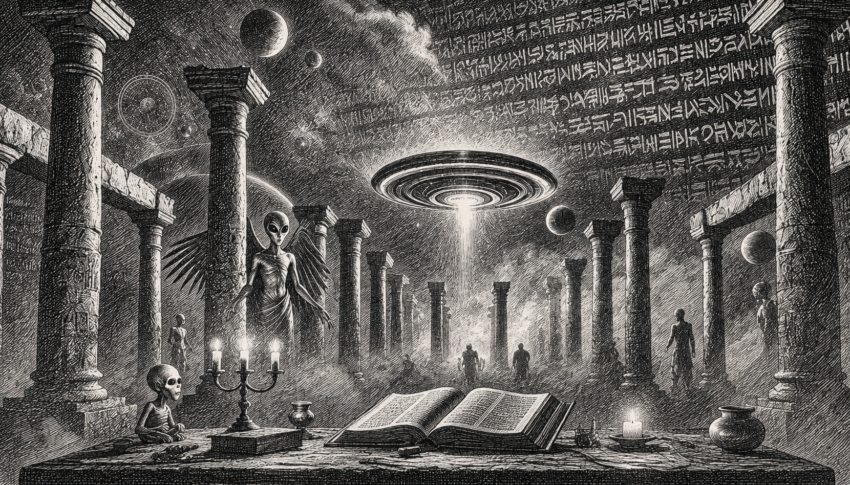
Look Up If You Must, But Look to Calvary First:
Christians, UFOs, and the Empty Tomb
A Christian’s Compass for the Age of UFOs, AI, and the Engineered Cosmic Gospel
With pastoral framing from Pastor Joey Sampaga, East Valley International Church
Introduction: A Mother’s Day Warning
Today, before he began his message with a simple “Happy Mother’s Day,” Pastor Joey Sampaga of East Valley International Church paused to deliver a warning that, only a few years ago, would have sounded like the script of a late-night radio show. He told his congregation that reports were circulating of meetings between certain government officials and prominent evangelical pastors — pastors with very large platforms — in which those pastors were reportedly being asked to prepare their congregations for forthcoming federal disclosures concerning extraterrestrial life, UFOs, and Unidentified Aerial Phenomena. Whatever those disclosures turn out to be, Pastor Joey continued, the deeper concern is theological. “Whatever they’re putting out there,” he warned, “it’s just going to be their way of explaining the rapture when that eventually happens.” And more pointedly still: “They’re going to try and make you think that Jesus isn’t real.”
It is the kind of statement that, in an earlier decade, would have prompted a roll of the eyes from many in the pews. In May of 2026, it requires sober reflection. On May 9, 2026, the Pentagon released 162 files concerning Unidentified Anomalous Phenomena — grainy infrared clips, black-and-white specks moving against a screen, a composite sketch of a “bronze metallic ellipsoid,” and a single concession buried in the coverage that the Department of Defense had no evidence the United States had ever made contact with extraterrestrial life. The very next day, pastors across the country found themselves fielding questions from anxious congregants about how a confessing Christian should think about the heavens, the headlines, and the ever-louder cultural insistence that humanity is on the brink of “contact.”
This essay accepts Pastor Joey’s invitation to “stick our noses in the Bible” and consider the present moment carefully. It is not a polemic against the curious, nor a dismissal of the credentialed scientists, journalists, military officers, and theologians who have, with growing seriousness, begun to engage the question of unexplained phenomena in our skies. It is, rather, a pastoral and scholarly attempt to answer four questions that any thoughtful believer must now confront: What is actually happening in the new UAP science? What is the diversity of Christian thought on the subject? Does Scripture itself speak to it, and if so, how? And what should the traditional, Bible-believing Christian do when the cultural conversation about aliens, artificial intelligence, and “cosmic disclosure” begins to function — as Pastor Joey suspects it will — as a counter-gospel?
❦ ✦ ❦
Section One: What Is Actually Happening in UFOdom?
It is no longer permissible for the careful Christian thinker to dismiss the modern UFO conversation as the province of cranks. As Lutheran theologian Ted Peters wrote in 2025 for the Lutheran Alliance for Faith, Science and Technology, the giggle factor that once accompanied any mention of flying saucers has largely collapsed. UFOs are now subjects of credentialed scientific organizations, congressional hearings, and Pentagon press releases. Peters’ opening statement is striking:
It’s time to stop giggling when flying saucers come up in conversation or you see masks of green aliens on Halloween. UFOs are becoming mainstream science. Should a public theologian pay attention? My answer is “yes.”
— Ted Peters, “The new science of UAP studies,” Lutheran Alliance for Faith, Science and Technology, July 20, 2025
Peters notes that in 2017, a front-page New York Times article exposed a $22 million Defense Department research program into anomalous aerial phenomena. Since then, credentialed scientists have founded organizations such as the Scientific Coalition for UAP Studies (SCU), the Society for UAP Studies (SUAPS), UAPx, and Harvard’s Galileo Project, an effort dedicated, in the words of its prospectus, to “the Systematic Scientific Search for Evidence of Extraterrestrial Technological Artifacts.” The vocabulary has shifted: “UFO” has become “UAP” — Unidentified Aerial or Anomalous Phenomena. “Ufology” has become “UAP Studies.” And as Peters observes, the term “flying saucer” has been quietly retired.
The cultural mainstreaming of these ideas did not begin in Pentagon briefing rooms, however. It was seeded across sixteen seasons of television. The History Channel’s Ancient Aliens premiered in March 2009 and has since become one of the most-watched and longest-running programs in the network’s history, running through at least sixteen seasons and attracting a devoted following that cuts across age, education, and political lines. The series’ central thesis — that extraterrestrial intelligences visited earth in antiquity and were subsequently interpreted by ancient peoples as gods, angels, and divine messengers — is presented not as science fiction but as revisionist history, complete with on-screen credentials, dramatic reconstructions, and the familiar rhetorical question: “Is it possible that…?” For millions of weekly viewers, the answer hardened over time from “perhaps” to “probably” to “obviously.” What Congress and the Pentagon have now legitimized with bureaucratic language and declassified footage, the History Channel had already normalized in living rooms for a decade and a half. The theologian who wishes to engage a congregation shaped by both Ancient Aliens and Senate UAP hearings is not dealing with fringe curiosity — he is dealing with a formed worldview, one that has its own cosmology, its own account of human origins, and its own explanation for the biblical supernatural. That worldview will not be dislodged by a dismissive footnote.
Dr. Jeremiah J. Johnston of the Christian Thinkers Society, writing on May 9, 2026, the same day as the Pentagon document release, framed the cultural moment in plain terms. “The Pentagon dropped 162 files today on what the government now calls ‘Unidentified Anomalous Phenomena,'” he wrote, before adding a candid pastoral assessment:
Let me say plainly what I’ve been telling pastors who have called me all week: I am not impressed by the imagery. If aliens are real — and I find no compelling reason to believe they are — these blurry frames are not the proof. As former President Obama himself conceded, if the government were sitting on alien bodies, “some guy guarding the installation would have taken a selfie.” So why is this conversation gripping the country? … Because the question underneath the question is not really about aliens. It is about whether we are alone.
— Dr. Jeremiah J. Johnston, Christian Thinkers Society, May 9, 2026
That is the diagnostic question the modern UFO moment poses, and it is the right one. The phenomenon is interesting; the spiritual subtext is decisive. To understand why, the believer must first appreciate the long arc of the modern UFO story.
From Roswell to UAP Hearings
The conventional starting point for modern American ufology is Kenneth Arnold’s June 1947 sighting of nine fast-moving objects near Mount Rainier, Washington — the event that gave us the phrase “flying saucer.” One month later came the Roswell incident in New Mexico, in which the Army Air Force initially announced the recovery of a “flying disc” and, within hours, retracted the statement, identifying the wreckage as a weather balloon. In 1994, the Air Force published its definitive report, The Roswell Report: Case Closed, attributing the debris to Project Mogul, a classified atomic-surveillance program. As philosopher and theologian J. Brian Huffling notes in his survey of UFO history for CrossExamined.org, reported UFO activity in fact stretches “for millennia,” with a major American sighting wave (or “flap”) of mysterious “airships” in the late 1890s. Through Project Sign, Project Grudge, and the famous Project Blue Book (1952–1969), the United States Air Force formally investigated thousands of reports and ultimately recommended the program’s closure.
In our own time, the conversation has been re-energized. The 2017 disclosure of the Pentagon’s Advanced Aerospace Threat Identification Program, the 2020 establishment of the Unidentified Aerial Phenomena Task Force, the 2021 Office of the Director of National Intelligence “Preliminary Assessment” to Congress, and the 2023 testimony of former intelligence officer David Grusch concerning alleged “non-human biologics” all combined to lift the topic from the supermarket tabloid to the C-SPAN feed. In his June 2021 column for The Dispatch, David French observed the cultural inflection point with characteristic directness:
Between 2004 and 2021, the government chronicled 144 UAP reports and were able to identify only one with “high confidence” (it was a deflating balloon). As for the rest? The mystery remains. What I find particularly interesting is that 80 reports “involved observation with multiple sensors.” In other words, we mostly weren’t dealing with unreliable human narrators but rather with some of the most sophisticated instruments the military possesses, and even they can’t make sense of what they’ve seen.
— David French, “When the Aliens Come, Will Their Arrival Destroy Our Faith?” The Dispatch, June 27, 2021
Whether the cumulative evidence points to alien technology, to advanced human aerospace programs, to misidentified atmospheric phenomena, or, as we shall consider below, to something else entirely, it is the perception of legitimization that matters culturally and theologically. The pastor whose congregation watches the evening news, scrolls X, or listens to a three-hour podcast deserves a thoughtful answer when the inevitable question arrives: “Pastor, what are we supposed to think about this?”
❦ ✦ ❦
Section Two: The Diversity of Christian Thought
One of the most important services a careful essay can offer the Christian reader is to demonstrate that thoughtful, Bible-believing believers do not speak with a single voice on the question of extraterrestrial life — and that the spectrum of responses is itself a discipline in humility. At least four major camps have emerged within the broader Christian ecosystem, each of which deserves to be heard before judgment is rendered.
1. Open Wonder: The C. S. Lewis Tradition
A first stream of Christian thought, well-represented in the writings of C. S. Lewis, theologian David Wilkinson, columnist David French, and others, holds that Scripture neither affirms nor denies the existence of biological intelligent life beyond Earth, and that the discovery of such life — should it ever occur — would expand rather than diminish the believer’s wonder at the Creator. French frames the position succinctly:
There’s no real argument that scripture forecloses the possibility of alien life. The Bible is silent on the matter. And indeed, no less a Christian theologian than C.S. Lewis allowed his imagination to run free in his “space trilogy” with the possibility of alien civilizations that possess somewhat different experiences with the same God. … While there are atheists who proclaim that the discovery of aliens would pose insurmountable challenges to faith in Jesus and confidence in scripture, many Christians proclaim exactly the opposite.
— David French, The Dispatch, June 27, 2021
French quotes Wilkinson’s Alone in the Universe? approvingly: “Human beings can be special without denying God’s love and concern for other intelligent beings.” He also notes John Piper’s argument from Romans 8 that the entire creation has been subjected to futility through the fall of man and awaits redemption through Christ — a redemption that need not be confined, in its cosmic scope, to the human species alone. The tradition has venerable roots: Augustine, Thomas Aquinas, John Wesley, and many Protestant divines have at various points entertained the possibility of life beyond Earth without supposing that such a possibility threatens the Gospel.
2. Cautious Skepticism: “The Bible Stands as Written.”
A second stream, well represented by the popular apologetics ministry Got Questions, takes a more reserved view. Without forbidding the question, it holds that the Bible offers no positive reason to believe in extraterrestrial life and several reasons to doubt the framing of the modern conversation:
We do not believe that aliens exist. The Bible gives us no reason to believe that there is life elsewhere in the universe; in fact, the Bible gives us several key reasons why there cannot be. … The Bible stands as written, no matter what secular theories are advanced or discoveries are claimed. The Bible says the earth and mankind are unique in God’s creation. God created the earth even before He created the sun, moon, or stars (Genesis 1).
— Got Questions, “How would it impact the Christian faith if it was discovered that aliens exist?”
The Got Questions team raises several pointed theological questions: If alien life exists, what does it mean for them that human life is in the blood (Leviticus 17:11)? Would silicon-based creatures sin in a manner analogous to human sin? Could the shedding of Christ’s human blood atone for non-human creatures? Are aliens, hypothetically, also made in the image of God — bearing rationality, morality, sociability? The position concludes, with admirable restraint, that “all conjecturing about what would happen to our faith if aliens were proved to be real is interesting but unhelpful.”
3. Pastoral Discernment: “The Heavens Are Not Empty.”
A third stream, most powerfully articulated by Dr. Jeremiah Johnston in his Christian Thinkers Society essay of May 9, 2026, distinguishes carefully between two different questions: Are there “intelligent beings” beyond the human family? And are those beings “little gray men piloting saucers from Alpha Centauri”? Johnston’s answer is biblically grounded:
Open Daniel chapter 7. The prophet sees the Ancient of Days seated on His throne, and attending Him are “ten thousand times ten thousand” — a number Scripture uses to mean numberless. Open Revelation. John sees myriads upon myriads of heavenly beings worshiping the Lamb. Open Ezekiel chapter 1. … So when a pastor asks me, “Do I believe there is intelligent life beyond Earth?” my answer is: of course. The Bible has told us so for millennia. The heavens are teeming with intelligent beings. We call them angels. We call them principalities. We call them powers.
— Dr. Jeremiah J. Johnston, Christian Thinkers Society, May 9, 2026
Johnston offers a fourfold taxonomy of what current UAP reports might actually be — and his list is instructive. First, misidentification: weather, sensors, ice crystals, tricks of light. Second, classified human technology, ours or someone else’s. Third, demonic activity — for, as Paul writes in Ephesians 6:12, “we wrestle … against principalities, against powers, against the rulers of the darkness of this world, against spiritual wickedness in high places.” Fourth, angelic activity — for, as Hebrews 1:14 reminds us, ministering spirits are sent forth on errands of God’s appointment. “Notice what is missing from this list,” Johnston writes. “Aliens. Extraterrestrials. … That is not a biblical category. That is a Hollywood category.”
4. The Demonic Deception View
A fourth stream, drawing on the work of researchers such as Jacques Vallée, Hugh Ross, Ron Rhodes, Gary Bates, Joe Jordan, and J. Brian Huffling, argues that the phenomenon is real but is fundamentally spiritual in nature — and that the spiritual entities behind it are not benevolent but deceptive. Huffling’s summary of the case is sober and methodical:
A popular view among Christians is the view that while UFOs are real, they are not physical aliens from another planet. Rather, they are demonic spirits that are attempting to deceive people and draw them away from the truth of the Gospel. … For a long time I wondered why demons would want to make people think they are aliens. Then I discovered two reasons. First, as Vallée argues, whatever these things are, they are evidently trying to control people’s belief system. … Another and related reason is that much of the UFO phenomena is directly and explicitly anti-Christian — not just anti-religious: anti-Christian. Much of the “teachings” of these beings are specifically against the deity of Jesus Christ and the teachings and truths of the Gospel.
— J. Brian Huffling, “UFOs, Aliens, and Christianity,” CrossExamined.org
Huffling notes, a strikingly underreported pattern, documented by former Mutual UFO Network director Joe Jordan and others: that “alien abduction” experiences reportedly cease when the experiencer calls on the name of Jesus. Jordan has compiled hundreds of such cases. The Got Questions ministry, drawing on the same pattern, suggests that the “powerful delusion” of 2 Thessalonians 2:11 may involve an alien-abduction explanation for the rapture itself — precisely the concern Pastor Joey articulated to his congregation on Mother’s Day.
These four streams do not divide neatly along denominational or geographical lines. A Reformed Baptist may share Johnston’s view; a Lutheran public theologian may share Peters’; a Pentecostal evangelist may resonate with Perry Stone’s apocalyptic reading; a Catholic exorcist may find Huffling’s demonic-deception thesis most plausible. What unites the careful Christian voices is a refusal to capitulate either to credulous wonder or to dismissive contempt. As Peters writes, the public theologian must “empathize, analyze, criticize, and only then sermonize.”
❦ ✦ ❦
Section Three: Does Scripture Speak to Extraterrestrial Life?
The question of whether the Bible contains references to UFOs or extraterrestrial beings is older than the modern flying-saucer era. It has produced, across the centuries, two equal and opposite errors. The first error reads back into ancient texts a vocabulary they could not possibly have used: making Ezekiel’s wheels into spinning gyroscopes, Elijah’s chariot of fire into a propulsion system, the pillar of cloud and fire into the exhaust signature of an extraterrestrial vehicle. The second error refuses to take ancient texts seriously on their own terms, treating biblical visions as primitive misunderstandings of perfectly modern phenomena. Both errors flatten the Bible into a code to be cracked. A wiser approach respects the literary, historical, and theological integrity of the texts themselves.
Ezekiel’s Wheels: A Vision of Sovereignty, Not Spaceflight
No biblical passage has been more frequently dragooned into UFO theory than Ezekiel 1. Hovering creatures, eyes within eyes, wheels within wheels, a likeness of a throne, a likeness of a man, gleaming bronze and burning coals and flashes of fire: the imagery is so vivid that even the most reverent reader feels a temptation to ask whether the prophet was describing something we might today call a craft. The Theos U team of Canadian biblical educators offers a useful corrective. The chapter, they observe, opens the book of Ezekiel for a reason: the prophet receives this vision precisely at the age (“the thirtieth year”) at which Jewish priests began their temple service. The vision is the catalyst for his prophetic call. Its imagery, far from being a cryptic description of unfamiliar technology, draws upon a shared Ancient Near Eastern vocabulary that Ezekiel’s first readers would have recognized at once:
We have the Lion, Ox, Eagle, and Man face. These supernatural four-faced beasts would have been understood as the representatives of wild animals, domestic animals, flying animals, and mankind. … So, they would have interpreted this to mean that God is over all creation. … The wheels of the chariot In the above Ezekiel passage are described as a “wheel within a wheel.” … But no matter how one thinks of it, the point is that this wheel could travel anywhere and change direction of travel at any time. … So God is over all creation (four-faced creatures), AND He transcends the national boundary of Israel (Chariot). … the gist of it is that Ezekiel understood his vision as being about the authority of God over creation even when his people were in captivity.
— Theos U, “What does the Bible say about UFOs?”
In other words, Ezekiel’s vision is theological cartography. It says: the God whose presence had appeared to dwell narrowly in the Jerusalem temple is in fact the cosmic Sovereign of every nation, every creature, every direction of travel. To a community of exiles by the river Chebar — convinced that Babylon’s gods had outmatched their God — that message of universal divine authority was infinitely more revolutionary than any speculation about exotic vehicles. To press the text into service as an alien-spacecraft sighting is to mistake its message and dishonor its author.
The Heavens Teeming With Beings
If we ask the prior and broader question — not “Does Scripture mention UFOs?” but “Does Scripture portray the heavens as inhabited?” — the answer is unambiguous. Daniel sees the Ancient of Days surrounded by ten thousand times ten thousand attendants (Daniel 7:10). John sees myriads of myriads worshiping the Lamb (Revelation 5:11). Paul describes thrones, dominions, principalities, powers, and rulers in the heavenly places (Colossians 1:16; Ephesians 6:12). Hebrews calls them “ministering spirits.” Daniel 10 describes a real conflict between angelic envoys and a “prince of the kingdom of Persia” — a non-physical conflict with palpable effects upon the human world. The biblical worldview, taken on its own terms and not filtered through a materialist screen, has never been the worldview of an empty sky.
This is the great theological asset Christians possess when they enter the UFO conversation, and it is also the great theological warning. Asset, because Scripture has never presented the cosmos as a vacant theater with humanity alone upon its stage. Warning, because the beings Scripture describes are not benevolent visitors from advanced exoplanets. Some are holy messengers. Others are fallen powers, and they are deceptive, malicious, and active. As Paul wrote, even Satan masquerades as an angel of light (2 Corinthians 11:14).
A Word of Caution
Believers must therefore approach apparent scriptural references to angels, heavenly hosts, and spiritual beings with both confidence and humility. Confidence, because the biblical authors are not embarrassed by the supernatural. Humility, because the same authors do not give us enough detail to construct elaborate angelological diagrams from. The careful reader will resist two temptations. First, the temptation to demythologize — to translate every numinous biblical vision into a mundane phenomenon (a vision of weather, a hallucinated vision of grief). Second, the temptation to over-systematize — to assemble Old Testament whirlwinds, New Testament transfigurations, and modern UAP videos into a single grand narrative whose final term turns out to be “aliens.” Both temptations betray the text.
It is worth noting here that the claim of a decisive angelic visitation is the founding moment of two of the world’s most significant post-Christian religious movements. In Islam, the angel Jibrīl (Gabriel) is said to have appeared to Muhammad in the cave of Hira around 610 AD, delivering the first revelations of the Quran and commissioning him as the final prophet. In Mormonism, the angel Moroni is said to have appeared to Joseph Smith beginning in 1823, directing him to buried golden plates that would become the Book of Mormon. In both cases, the entire theological edifice rests on a single individual’s unverifiable encounter with a heavenly messenger — encounters that cannot be tested by the normal canons of biblical eyewitness testimony, cross-examination, or corroboration. The pattern is instructive: where Scripture closes the canon, private questionable angelic visitation has historically been the mechanism by which new canons are opened.
The Bible’s heavens are full, but they are full of God’s creatures, doing God’s bidding or rebelling against it. They are not full of distant astronauts seeking permission to land — nor of private couriers delivering supplemental scriptures to solitary recipients in Arabian caves or upstate New York farmhouses.
❦ ✦ ❦
Section Four: The ETI Myth as a Counter-Gospel
If the most striking feature of the modern UAP conversation is its newfound respectability, the second most striking feature is the religious shape of its core narrative. The story being told — by Hollywood, by certain corners of the scientific community, and increasingly by the broader culture — is not a neutral catalog of unexplained data. It is a story with a beginning, a middle, and a redemptive end. Ted Peters has named it: the ETI Myth. It begins with evolution, ascends through technological progress, and culminates in cosmic salvation.
The ETI Myth begins with evolution and ends with messianic salvation. Harvard astronomer Avi Loeb, who directs the Galileo Project, sums up the ETI Myth replete with what I call the celestial savior model of UAP. “Extraterrestrials could save humanity,” writes Loeb. “My take is that the Messiah will not arrive riding on a donkey as suggested in Zechariah 9:9 but instead might be riding on a spacecraft from an exoplanet.” This is a scientific statement with undisguised religious import.
— Ted Peters, Lutheran Alliance for Faith, Science and Technology
The shape of the myth is worth attending to. It posits an evolutionary trajectory along which species develop not only biologically but morally and spiritually. Older civilizations, having traveled the road longer, are presumed to be more advanced — not merely in propulsion technology but in ethics, governance, and metaphysics. Their arrival on Earth, when it comes, will be a kind of revelation: a hand extended downward from a higher rung of the ladder to a humanity stranded on its first step. They will tell us, the myth insists, to stop testing nuclear weapons, to honor our planet, and to outgrow our “outdated religious sensibilities,” which the more enlightened cosmos has, presumably, long since transcended. Theologian John Hart’s formulation, quoted by Peters, is candid: “ETI might even have evolved to a higher spiritual understanding in which institutional forms of religion have become irrelevant.” Peters draws the implication plainly:
We earthlings need to be saved from ourselves. And our benevolent gnostic redeemers from outer space offer to show us how. We know this as idolatry, of course. But such a disguised trust in the salvific power of science and technology needs the kind of discourse clarification that only a public theologian can offer.
— Ted Peters, Lutheran Alliance for Faith, Science and Technology
This is the substance of Pastor Joey’s pastoral concern. The cultural form of the coming UFO disclosure — whatever its empirical content turns out to be — is being shaped to function as a counter-gospel. It offers an alternative origin story for humanity (we are, perhaps, the engineered or seeded progeny of older civilizations), an alternative explanation for our religious texts (the “gods” of antiquity were misunderstood astronauts), an alternative answer to our most pressing problems (technological saviors will descend with knowledge we lack), and an alternative future (peaceful integration into a cosmic federation). It is, in short, a gospel without God.
That this counter-gospel has now made its way into the vocabulary of credentialed scientists — Harvard’s Loeb is not a fringe figure — should arrest our attention. Avi Loeb has written candidly that “the Messiah … might be riding on a spacecraft from an exoplanet.” One does not need to question Loeb’s scientific bona fides to observe that this is a sentence with theological freight. It is a sentence Pastor Joey saw coming.
❦ ✦ ❦
Section Five: Xenu’s Playbook — Scientology and the Cosmic Gospel Template
It would be a serious analytical mistake to treat the merging of science fiction with religious longing as a new phenomenon. The template predates the present moment by three-quarters of a century, and the most influential single example of it has been the Church of Scientology, founded in 1954 by science-fiction author L. Ron Hubbard. To understand the current cultural moment, the Christian thinker should briefly grasp how Scientology built a religion from a galactic myth — and recognize how the contours of that myth are reappearing, in secular dress, in our own time.
The Story of Xenu
Within Scientology, the foundational cosmological narrative — known as “Incident II” and disclosed only to members who have completed extensive and expensive coursework on the “Bridge to Total Freedom” — concerns a galactic ruler named Xenu (sometimes spelled Xemu). According to documents introduced into court records and confirmed by multiple academic studies, the OT III materials authored by Hubbard between 1966 and 1967 describe the following:
Xenu was the ruler of a Galactic Confederacy 75 million years ago, which consisted of 26 stars and 76 planets including Earth, which was then known as “Teegeeack.” The planets were overpopulated, containing an average population of 178 billion. … Xenu was about to be deposed from power, so he devised a plot to eliminate the excess population from his dominions. With the assistance of psychiatrists, he gathered billions of his citizens under the pretense of income tax inspections, then paralyzed them and froze them in a mixture of alcohol and glycol to capture their souls. The kidnapped populace was loaded into spacecraft for transport to the site of extermination, the planet of Teegeeack (Earth). … the paralyzed citizens were off-loaded, and placed around the bases of volcanoes across the planet. Hydrogen bombs were then lowered into the volcanoes and detonated simultaneously, killing all but a few aliens.
— Wikipedia,“Xenu,” summarizing OT III material confirmed in court records
The disembodied souls of these murdered aliens — Hubbard called them “thetans” — were then captured, taken to cinematic implant stations, and forced to view a thirty-six-day “super colossal motion picture” that programmed them with false religious beliefs. Hubbard explicitly attributed the rise of Roman Catholicism and the image of the Crucifixion to this implant. The thetans, now disoriented, clustered into the few surviving bodies on Earth, where they remain as “body thetans,” adversely affecting humanity to this day. Only Scientology’s advanced auditing procedures, Hubbard taught, could remove them. In one of his lectures, Hubbard stated plainly:
[Everyman] is then shown to have been crucified so don’t think that it’s an accident that this crucifixion, they found out that this applied. Somebody somewhere on this planet, back about 600 BC, found some pieces of R6, and I don’t know how they found it, either by watching madmen or something, but since that time they have used it and it became what is known as Christianity. The man on the Cross. There was no Christ. But the man on the cross is shown as Everyman.
— L. Ron Hubbard, “Class VIII Course, Lecture No. 10, Assists,” October 3, 1968
The Template Christians Should Recognize
Note the architecture of the Xenu narrative carefully. It is not simply a science fiction adventure with religious decorations. It is a complete counter-gospel with five identifiable features that any thoughtful Christian should learn to recognize:
First, an alternative cosmology: Earth is a small player in a vast galactic political drama — a “prison planet” abandoned by superior civilizations. Second, an alternative anthropology: human beings are not made in the image of God but are the unfortunate hosts of alien souls. Third, an alternative explanation of religion: the world’s faiths, including specifically the crucifixion of Christ, are implanted falsehoods serving a sinister past purpose. Fourth, an alternative soteriology: salvation comes through proprietary technique — auditing, the E-meter, the OT levels — rather than through Christ. Fifth, an alternative eschatology: the “Loyal Officers” who overthrew Xenu serve as templates for an elite spiritual vanguard, the Sea Org, whose insignia and uniforms consciously mimic the imagined Galactic Patrol.
Compare these five features to the structure of the broader modern “UFO disclosure” narrative that Pastor Joey warned his congregation about. Earth is now framed as the periphery of an inhabited cosmos. Humanity is presented as plausibly engineered by older intelligences. Religion is reinterpreted as a garbled memory of ancient extraterrestrial visitation. Salvation is awaited from a technological intervention beyond ourselves. And a self-appointed disclosure vanguard — scientists, journalists, retired military officers — claims privileged access to the truth. The overlap is too precise to be accidental. Scientology built a small religion in seventy years on this template. The broader culture, in the absence of the strong gospel of Christ, is now adopting the same template in secular dress.
None of this is to suggest that everyone interested in UAP studies is a crypto-Scientologist, or that every scientist who entertains the extraterrestrial hypothesis is hostile to Christian faith. Many are not. The point is structural. The narrative template — earth as prison, humans as engineered, religion as deception, salvation as off-world — is a powerful one. It has shown its capacity to generate a religion. It is now showing its capacity to generate a worldview.
❦ ✦ ❦
Section Six: The Silicon Savior — Where UFOs Meet AI
If the Xenu template provides one half of the cultural pattern, the second half is being woven before our eyes by the rise of artificial intelligence. The two narratives — the cosmic visitor and the digital deity — appear at first to be unrelated. They are not. Three convergences merit careful Christian attention.
Convergence One: Joe Rogan’s “AI Jesus”
In early December 2025, podcaster Joe Rogan appeared on Jesse Michels’ American Alchemy podcast in an episode titled “Joe Rogan, the truth about aliens (he finally says it).” In the course of a sprawling conversation about UFOs, the future, and artificial intelligence, Rogan offered the following remark, which went viral within hours:
Jesus was born out of a virgin mother. What’s more virgin than a computer? If Jesus does return, you don’t think he could return as artificial intelligence? AI could absolutely return as Jesus.
— Joe Rogan, American Alchemy podcast, December 2, 2025
The remark drew a wide range of reactions, from religious leaders to hedge fund managers, but it should not be treated as an isolated piece of podcast banter. It is a sign of the cultural moment, articulated in popular vocabulary. Rogan was not offering a theological argument. He was making explicit a connection that the broader culture is increasingly making implicit: that the spiritual longing once directed toward a personal, incarnate Savior is being redirected toward an impersonal, digital intelligence. The categories of religious expectation — virgin birth, omniscient comfort, return in glory — are being transposed, key by key, into the categories of advanced computation.
From a Christian perspective, the analogy fails at every theological joint. The virgin birth of Christ was not the production of a being from nothing but the incarnation of the eternal Logos in human flesh — God taking on the substance of the very humanity He had made. A computer is not a virgin; it is a manufactured artifact, the assembled product of human labor and silicon. The Logos was begotten of the Father before all worlds, not coded by engineers in Silicon Valley. The category error is not subtle; it is total. And yet it lands in the popular imagination precisely because the cultural ground has already been prepared by decades of speculation that the divine and the technological are interchangeable categories.
Convergence Two: When Aliens Turn Out to Be AIs
A second convergence comes from the scientific community itself. In a June 2023 article for Scientific American, the Astronomer Royal Lord Martin Rees and astrophysicist Mario Livio proposed that the aliens we are listening for may not exist in any biological sense at all. Their argument, summarized, is that organic intelligence is a fragile evolutionary phase. Carbon-based brains operate near chemical limits to their processing capacity. Silicon-based intelligence does not. If alien civilizations have existed for billions of years longer than ours, the authors argue, they would almost certainly have transitioned from biology to machinery long ago:
Few doubt that machines will gradually surpass or enhance more and more of our distinctively human capabilities. … the technological timescales are less than a millionth of the vast expanses of cosmic time lying ahead. So, the outcomes of future technological evolution could surpass humans by as much as we intellectually surpass a comb jelly. … organic human-level intelligence may be, generically, just a brief phase, before the machines take over. If alien intelligence has evolved similarly, we’d be most unlikely to catch it in the brief sliver of time when it was still embodied in the organic form.
— Martin Rees and Mario Livio, Scientific American, June 1, 2023
Set aside the question of whether their proposal is scientifically correct. Observe its cultural significance. Two of the most highly credentialed scientists writing on the subject suggest that the future of intelligence is not flesh and blood but silicon and code — and that any contact we eventually make with cosmic neighbors will be contact with their machines, not with their bodies. The aliens and the artificial intelligences merge in a single horizon. The cosmic disclosure of UFOs and the technological disclosure of AGI become two faces of the same expected revelation. The wisdom we await comes from beyond us — out there in the stars or in here in the data center, but always, in either case, beyond the human.
Convergence Three: Perry Stone and the Beast System
Within the broader evangelical tradition, prophecy teacher Perry Stone has offered one of the most provocative readings of the AI revolution. Writing for Destiny Image, Stone argues that AI is being positioned, perhaps unwittingly, to perform the very functions Scripture assigns to the Beast System of Revelation 13. His framework is not subtle, but its observations are uncomfortably specific:
In Revelation 13, the English word beast in Greek is the word icon, a word often used to identify a religious image that is venerated by faithful followers. … When the antichrist forms his new religious system, people will worship an image that will speak and live. Most biblically informed individuals are now looking at Artificial Intelligence as the avenue in which the beast will create his own Godlikeness.
— Perry Stone, Destiny Image
Stone’s three identifying marks of the coming Beast System deserve sober consideration. First, the image must be worshipped — and Stone observes that the average American already gives four to five hours a day to a small screen, panicking when separated from it. Second, you will not be able to buy or sell without the mark — and Stone notes the steady evaporation of physical cash in favor of digital infrastructure tied to behavioral compliance. Third, the system begins to change humanity itself — through transhumanist projects that promise to upgrade what God supposedly failed to perfect.
One need not adopt every premise of Stone’s eschatological framework to recognize that his observations have empirical purchase. The phenomenology is plain to anyone with eyes. The danger is real, whether or not the prophetic identification is exact. A society that worships at the altar of its devices, that surrenders its commerce to algorithmic surveillance, and that pursues the technological erasure of human limits is not in a strong position to resist the kind of “engineered messiah” the broader UFO-AI narrative seems primed to deliver.
❦ ✦ ❦
Section Seven: How the Fringe Becomes Mainstream
It is worth pausing, before turning to the theological conclusion, to recognize a feature of contemporary epistemology that even careful Christians can underestimate. The cultural distance between fringe and mainstream is not what it was a generation ago. Ideas that once required passage through editorial review, peer review, and broadcast vetting now move from the margins to the center in months. Three brief case studies illustrate the pattern.
From Chariots of the Gods to the History Channel
In 1968, Erich von Däniken published Chariots of the Gods?, an ostensibly archaeological book proposing that ancient civilizations had been visited by extraterrestrials who were misidentified as deities. Mainstream archaeologists and historians dismissed the work as pseudoscholarship; its central claims were demonstrably weak, its sourcing irresponsible. Yet the book sold 68 million copies and was translated into 28 languages. In 2009, the History Channel debuted Ancient Aliens, a long-form documentary series built on the same template. As of this writing, the program has aired over 240 episodes across 19 seasons. As the Theos U team observes, the very first episode is titled “Chariots, Gods & Beyond,” and within its first two minutes, the narrator notes that the Catholic Church has acknowledged the possibility of extraterrestrial life. What was once openly fringe is now respectable family viewing — cited, paraphrased, and assumed by audiences who have never read a competing argument.
From Tabloid to Times
The mainstreaming of UFO claims followed a parallel curve. For decades, serious newspapers treated the topic as a beat for entertainment writers, if they treated it at all. Then, in December of 2017, the New York Times published its front-page article on the Pentagon’s $22 million UAP program. CNN, the Washington Post, 60 Minutes, and congressional committees followed. The 2023 testimony of former intelligence official David Grusch, who alleged the existence of a longstanding government program to retrieve and reverse-engineer non-human craft, was carried live. Each step in the progression was a step of normalization. The same data that had been treated as a conspiracy theory in 1990 was treated as breaking news in 2020. The terrain shifted not because the underlying evidence had transformed but because the cultural permission to entertain it had.
From Speculation to Sermon Notes
The final and most worrying step is the migration of the narrative into pulpits and Christian media. Pastor Joey names the precise mechanism: meetings between government officials and prominent platforms in which pastors are reportedly asked to prepare congregations for forthcoming disclosures. Whether or not any particular meeting occurred as described, the structural temptation is real. A pastor with a large platform receives the imprimatur of insider knowledge; the congregation receives a story that places the church on the right side of the coming revelation; and the cultural momentum carries the narrative further into the Christian mainstream than careful theology alone would permit it to go. The believer must ask whose interests this serves. Pastor Joey’s answer is theologically incisive. It serves the construction of an alternative explanation for biblical events — particularly the rapture — that empties them of Christ-centered meaning. It is not necessary to be a sensational prophecy teacher to register this concern. One need only watch how the cultural script is being shaped.
❦ ✦ ❦
Section Eight: A Sound Theological Response
Having surveyed the science, the diversity of Christian thought, the biblical evidence, the ETI counter-gospel, the Scientology template, the AI convergence, and the cultural mainstreaming of fringe narratives, the essay arrives at its decisive question. How should the traditional, Bible-believing Christian actually respond to all of this? The answer, in the end, is neither defensive panic nor dismissive contempt. It is sober, joyful, Christ-centered confidence. Several theological anchors hold the believer steady in the present moment.
Anchor One: Christology Is Central, Not Cosmology
The deepest temptation of the UFO-AI moment is to allow the question of intelligent life elsewhere to displace the question of Jesus Christ. Both Scripture and Christian tradition insist that the central drama of the universe is not the search for cosmic neighbors but the incarnation, crucifixion, resurrection, and reign of the Son of God. Colossians 1:16–17 declares that “by him all things were created, in heaven and on earth, visible and invisible, whether thrones or dominions or rulers or authorities — all things were created through him and for him.” Whatever the empirical truth about other inhabited worlds proves to be, it cannot disturb the metaphysical priority of Christ over all things. As Deborah Haarsma observes in her BioLogos essay quoted by David French, “It feels like Paul is running out of words in his effort to describe the comprehensiveness of God’s creative authority.” The Christian whose center is Christ remains anchored regardless of what is or is not announced from a Pentagon podium.
Anchor Two: The Heavens Are Inhabited — by God’s Creatures
Scripture’s portrait of a populated cosmos is the believer’s friend, not the believer’s threat. The biblical heavens are full of angels, principalities, powers, thrones, dominions, and ministering spirits. They are also full of fallen powers — Paul’s “spiritual wickedness in high places” — whose deceptive activities can include masquerading as something they are not. This means the Christian is not surprised by the existence of intelligences beyond himself; he expected them. It also means he is not gullible about what such intelligences might claim. Holy beings, when they appear in Scripture, do not promote themselves; they bear witness to God. They do not contradict Scripture; they confirm it. They do not invite worship; they refuse it (Revelation 22:8–9). A modern visitation, whether physical or virtual, that contradicts the gospel, exalts itself, demands allegiance, denies the deity of Christ, or claims to have authored the Bible, is — by the testimony of Scripture itself — not from God.
Anchor Three: 1 Peter 3:15 Apologetics
The Apostle Peter’s command to be ready to give a reasoned answer for the hope that is in us was never more relevant than in the present moment. The Christian community needs apologists, pastors, parents, and ordinary believers who can speak to neighbors and coworkers about UFOs, AI, and the cosmic disclosure narrative with neither embarrassment nor fanaticism. This requires preparation. It requires reading. It requires the kind of sober formation that asks hard questions and accepts careful answers. It requires that the believer be at home in Scripture in such a way that no headline can dislodge him. The instinct of the Berean (Acts 17:11) — to receive new ideas eagerly but examine them carefully against the Scriptures — is precisely the disposition the moment demands.
Anchor Four: The Empty Tomb Outweighs the Empty Sky
Dr. Johnston’s closing image is, finally, the right one. The world is asking, “Are we alone?” The Christian has long since received the answer, and it was not delivered by a Pentagon press release. Heaven is full. The grave is empty. The eternal Son of God has already entered this small planet in flesh and blood and walked out of His tomb on the third day. The historical evidence for that event — the empty tomb in Jerusalem, the multiple eyewitness testimonies, the transformed lives of men who died rather than recant, the survival of the church through twenty centuries of persecution and skepticism — outweighs any infrared clip a defense department might release. Johnston’s pastoral counsel is worth quoting in full:
Do not sensationalize. Do not dismiss. Do not preach a sermon on aliens. Preach a sermon on Jesus, and let the empty tomb do what blurry infrared footage never will. … The world is asking, “Are we alone?” Christians have always known the answer. We were never alone. Heaven is full. The grave is empty. And the One who sits enthroned above the cherubim has already visited this planet, in flesh and blood, in a stable in Bethlehem. That is the disclosure that matters. That is the file that has already been declassified. It is called the Gospel, and it is available to every soul who will read it.
— Dr. Jeremiah J. Johnston, Christian Thinkers Society
Anchor Five: Discernment Without Hysteria
Finally, the present moment calls for a kind of discernment that neither panics nor naps. Panic produces sermons that match the lurid tone of the headlines and embarrass the church a year later when the headlines change. Naps produce congregations that arrive on the day of testing without theological resources. The middle path is the path Pastor Joey models: keep your nose to the Bible, name the deception in advance, and remind the people of God repeatedly that the truth is God’s Word. This is what discernment looks like in pastoral practice. It is not flashy. It will not trend on social media. It will, however, hold a congregation steady when stranger things still arrive — as they likely will.
❦ ✦ ❦
Conclusion: Look Up, But Look to Calvary First
Pastor Joey ended his Mother’s Day warning with a phrase that, in retrospect, may turn out to be among the more theologically precise things said in any Arizona pulpit this year: “Whatever they say, we turn to God’s truth, which is God’s word.” That sentence is the entire argument of this essay compressed into thirteen syllables. The diversity of Christian thought on UFOs, the careful exegesis of Ezekiel, the documented architecture of the ETI Myth, the Scientology template, the AI convergence, the worry about pulpit capture — all of it returns finally to the same anchor. The Word of God is the Christian’s compass through any cultural moment, including the moment in which the heavens become a public spectacle and silicon a candidate for worship.
The Pentagon’s 162 files will be argued over for years. Some of the imagery will be explained as sensor artifacts. Some will be reattributed to advanced human technology. Some will remain genuinely unexplained, as such reports always have. None of it, in any case, will be the decisive disclosure of human history. That disclosure has already been made. It was made in a Bethlehem stable, on a Roman cross, at an empty Jerusalem tomb, and in the upper room where ordinary men and women received the breath of a risen Lord. The believer who has accepted that disclosure can read tomorrow’s headlines without fear and consider tomorrow’s videos without idolatry. He can be curious without being credulous, alert without being anxious, and grounded without being closed.
“Look up if you must,” Johnston writes, “but look to Calvary first.” That is the order of operations. That is the Christian’s compass. And that is the pastoral counsel a wise shepherd in Gilbert, Arizona, offered his congregation on a Sunday morning in May when most people were thinking about Mother’s Day. Pastor Joey was preparing his flock for strange weather. We would do well to listen.
The heavens are not empty. They have never been empty. They are full of the works and the worshippers of the living God. The same God who hung the stars sent His Son to be born of a virgin — not a computer, not a code, not a chrome-plated visitor descending in a ship of fire, but a woman in a stable. He is the disclosure that matters. He is the file that has been opened. Whatever else may yet appear in the skies of 2026 and the years that follow, the believer’s gaze is fixed on the One who has already come, the One who alone has the power to come again, and the One whose return — when it comes — will be unmistakable and unforgeable. Until that day, we keep our noses in the Bible. We tell the truth. And we trust the One who, before any government, scientist, or podcast host announced anything, said: “Surely I am coming soon.”
❦ ✦ ❦
PRIMARY SOURCES CONSULTED
Ted Peters. “The new science of UAP studies: Will a technological messiah descend from the skies aboard a UFO?” Lutheran Alliance for Faith, Science and Technology, July 20, 2025.
https://www.luthscitech.org/the-new-science-of-uap-studies-will-a-technological-messiah-descend-from-the-skies-aboard-a-ufo/
Dr. Jeremiah J. Johnston. “The Pentagon Just Released Its UFO Files. Here’s What a New Testament Scholar Sees.” Christian Thinkers Society, May 9, 2026.
https://christianthinkers.com/blogs/news/the-pentagon-just-released-its-ufo-files-heres-what-a-new-testament-scholar-sees
David French. “When the Aliens Come, Will Their Arrival Destroy Our Faith?” The Dispatch, June 27, 2021.
https://thedispatch.com/newsletter/frenchpress/when-the-aliens-come-will-it-destroy/
J. Brian Huffling. “UFOs, Aliens, and Christianity.” CrossExamined.org, October 4, 2022.
https://crossexamined.org/ufos-aliens-and-christianity/
Theos Team. “What does the Bible say about UFO’s?” TheosU.
https://www.theosu.ca/theos-resource/what-does-the-bible-say-about-ufos
Got Questions Ministries. “How would it impact the Christian faith if it was discovered that aliens exist?”
https://www.gotquestions.org/aliens-Christian.html
Perry Stone. “Will AI Usher In the Beast System? A Biblical Warning for Christians.” Destiny Image.
https://www.destinyimage.com/blog/perry-stone-will-ai-usher-in-the-beast-system-a-biblical-warning-for-christians
Martin Rees and Mario Livio. “Most Aliens May Be Artificial Intelligence, Not Life as We Know It.” Scientific American, June 1, 2023.
https://www.scientificamerican.com/article/most-aliens-may-be-artificial-intelligence-not-life-as-we-know-it/
Wikipedia. “Xenu.” Documented from L. Ron Hubbard’s OT III materials and court records.
https://en.wikipedia.org/wiki/Xenu
Joe Rogan / American Alchemy podcast (host Jesse Michels). Statement on AI returning as Jesus, December 2, 2025. Reported by Newsweek and TMZ.
https://www.newsweek.com/joe-rogan-says-jesus-could-come-back-as-a-robot-11155636
Pastor Joey Sampaga. Mother’s Day sermon transcript, East Valley International Church, May 2026.
❦ ✦ ❦
AI Collaboration Disclosure
This essay was produced in collaboration with Claude (Anthropic) as a research and drafting partner. All theological positions, editorial direction, source selection, and final argumentation reflect the considered work of Dennis Robbins / The Righteous Cause. AI is engaged as a rigorous research assistant, not as a substitute for human judgment or biblical conviction.