
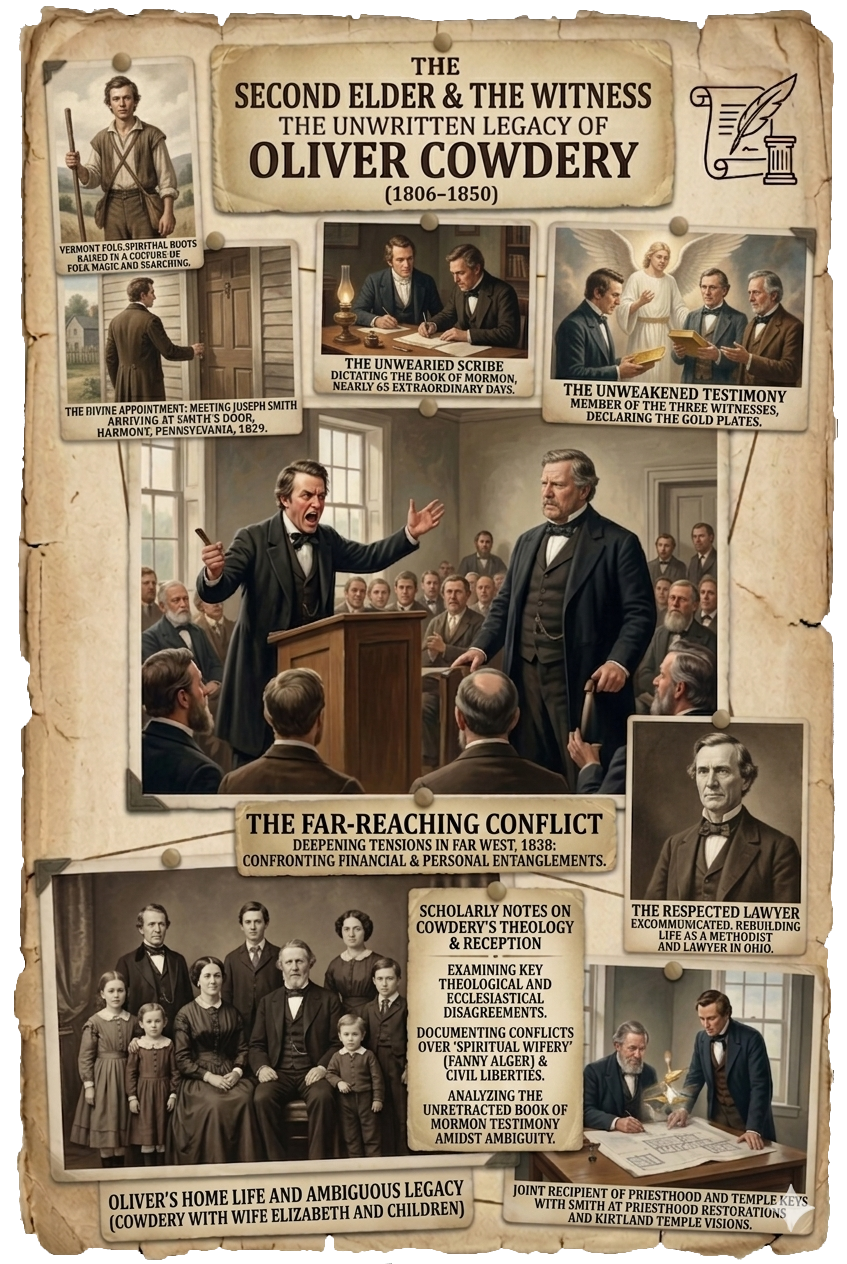
Between God and Joseph Smith: The Tragic Arc of Oliver Cowdery
Early Mormon Personalities Series — Fourth Post
Introduction: A Man Between Two Worlds
In the late spring of 1829, somewhere along the green banks of the Susquehanna River in northeastern Pennsylvania, a young schoolteacher named Oliver Cowdery knelt beside a young farmer named Joseph Smith, and together they prayed for something the Christian world had been told it would never receive again: a direct visitation from heaven. What happened next—or what they claimed happened next—would alter the course of American religious history.
Oliver Cowdery would go on to become the second-most important figure in the founding of Mormonism. He was the principal scribe of the Book of Mormon, one of its Three Witnesses, the second baptized member of the new Church of Christ, and for several years, the man who held the title “Assistant President,” second only to Joseph Smith himself. Scholars and apologists have rightly called him the co-founder of this dispensation.
And nine years later, in April 1838, a High Council in Far West, Missouri, excommunicated Oliver Cowdery on a raft of charges ranging from misusing church funds to “seeking to destroy the character of Joseph Smith, Jun., by falsely insinuating that he was guilty of adultery.” He refused to appear before the council. He walked away from the movement he had helped birth—and for ten and a half years, he stayed away.
Oliver Cowdery’s story is not the story of a simple apostate. It is the story of a man of unusual intelligence and legal precision who found himself at the absolute center of the most extraordinary religious claims of his century, and who never—not even in his darkest years outside the church—publicly denied that he had been part of something supernatural. It is also the story of a man who raised uncomfortable questions about authority, integrity, and prophetic power that the institutional LDS Church has never quite found comfortable to answer. His biography is, in many ways, Mormonism’s most revealing mirror.
✶ ✶ ✶
Part One: The World He Came From—Vermont, Loss, and a Family Steeped in the Supernatural
Oliver Cowdery was born on October 3, 1806, in Wells, Vermont, the youngest son of William Cowdery Jr. and his first wife, Rebecca Fuller. The birth came during a summer of severe drought, as though nature itself were registering the difficult conditions into which the child arrived. Wells was a small hill town in Rutland County, and the Cowdery family was an established, if modestly situated, household of New England farmers.
His mother, Rebecca, died just three years later, probably of tuberculosis—the same disease that would claim Oliver at the age of forty-three. The death of a mother when a child is barely formed shapes something at the core. Oliver was left first in the care of his aunt and uncle, who themselves may have perished of typhoid fever a few years later, and then in the care of his father’s new family after William Cowdery remarried in 1810.
Oliver was born in the Town of Wells in the state of Vermont. When he was three years of age Father married my Mother she resided in the Town of Poultney so Oliver was brought up in Poultney Rutland County Vermont and when he arrived at the age of twenty he went to the State of New York where his older brothers were married and Settled.
— Lucy Cowdery Young, Oliver’s sister. Cited in Larry E. Morris, “Oliver Cowdery’s Vermont Years and the Origins of Mormonism,” BYU Studies, Vol. 39:1.
The family’s religious background was Calvinist-inflected Congregationalism. Oliver’s paternal grandfather, William Cowdery Sr., served as a deacon and occasional preacher in the Reading, Vermont, Congregational Church. The grandmother’s family, the Emmons line, similarly carried traces of New England Reformed piety into the household. But the broader Vermont of Oliver’s youth was also a place of considerable religious ferment—the “burned-over district” had not yet earned that name, but the spiritual combustion that would eventually ignite it was already building. Revivalism, millennialism, folk magic, and the use of divining rods and seer stones were woven through the culture of rural New England with a casualness that modern observers find startling.
This cultural fact matters enormously for understanding Oliver Cowdery’s receptivity to Joseph Smith’s claims. The divining rod—a forked stick used to find water or buried treasure—was not considered disreputable in this culture. It was considered a legitimate spiritual gift. According to an early revelation now found in Doctrine and Covenants 8, Joseph Smith told Oliver that he possessed “the gift of Aaron”—a reference almost certainly to a divining rod. The original manuscript of D&C 8 actually used the phrase “the gift of working with the sprout,” later softened to “the gift of Aaron” in the 1835 revision. Oliver Cowdery’s comfort with such folk-spiritual tools made him a natural collaborator for Joseph Smith’s enterprise.
Around 1827, Oliver left Vermont for upstate New York, where his older brothers had already settled. He clerked in a store for two years, then in 1829 obtained a position as a schoolteacher in the Manchester, New York, district—the very district where the Smith family farmed. This was not a coincidence. It was the pivot point of his entire life.
✶ ✶ ✶
Part Two: The Road to Harmony—Oliver Meets Joseph Smith
As a schoolteacher in Manchester, Oliver Cowdery was entitled to room and board from the families of his students. He lodged with the Smith family, and there he heard the story that would consume the rest of his life. Joseph Smith Sr.—the prophet’s father—eventually confided in the young teacher about his son’s claimed discovery of golden plates buried in a nearby hill. The family had been guarding this secret carefully. But Oliver’s intelligence and spiritual earnestness apparently persuaded them to speak.
The effect on Oliver was electric. According to later accounts, he was unable to think of anything else. The Joseph Smith Papers and other early sources record that before Oliver had even met the young prophet, he had already subjected the story to sustained personal prayer and arrived at a kind of pre-conversion conviction that it was true.
It was working in my bones and I couldn’t think of anything else. And he made it a matter of prayer and he was converted to the truthfulness of Joseph Smith’s story before he ever met Joseph Smith.
— Scholar Larry E. Morris, describing Oliver Cowdery’s pre-conversion state. From the Oliver Cowdery Scholars Discussion, Joseph Smith Papers Television Series.
The journey from Manchester to Harmony, Pennsylvania—where Joseph and Emma Smith were living—was roughly 130 miles, and Oliver made it in the raw chill of late March and early April 1829. He suffered frostbite along the way. He arrived on April 5, 1829, and met Joseph Smith for the first time. Two days later, on April 7, they began the translation that would produce the Book of Mormon.
What followed was, by any measure, a remarkable feat of sustained composition. The Book of Mormon runs to approximately 270,000 words—longer than the New Testament, comparable in length to a long Victorian novel. The period of dictation, from April 7 to the end of June 1829, was no more than sixty-five working days. Oliver sat across from Joseph, who either used two transparent stones called the Urim and Thummim or a brown seer stone placed in a hat, and Oliver wrote word by word as Joseph dictated. He then produced a fair copy for the printer. He had virtually no time to compare, cross-reference, or revise.
These were days never to be forgotten—to sit under the sound of a voice dictated by the inspiration of heaven, awakened the utmost gratitude of this bosom. Day after day I continued, uninterruptedly to write from his mouth, as he translated, with the Urim and Thummim, or as the Nephites would have said, ‘Interpreters,’ the history, or record, called ‘The Book of Mormon.’
— Oliver Cowdery, Letter No. 1 to W.W. Phelps, Messenger and Advocate, September 7, 1834.
Oliver was not merely a passive transcriptionist. He attempted to translate himself at one point and failed — a failure that Joseph attributed to Oliver’s unwillingness to “take no thought save it was to ask me.” The failed experiment is recorded in what became Doctrine and Covenants 9, and it reveals something important about Oliver’s psychology: he was not content with a subordinate role. He wanted to be an active agent in the restoration, not merely its secretary.
That failed translation attempt also invites a broader question about the nature of the translation process itself — one that bears directly on the Book of Mormon’s origins. If translation were a spiritual gift sovereignly administered, why could Oliver not access it? And if the process was as mechanically straightforward as some LDS accounts suggest, why did proximity to Joseph Smith not replicate it? Readers interested in a thorough examination of what the compositional record actually reveals are encouraged to visit our post, “Sixty-Five Days, Four Years, and One Young Man: How a 23-Year-Old Could Have Written the Book of Mormon,” a scholarly analysis concluding that the Book of Mormon, whatever its religious significance to millions of readers, does not require a supernatural origin to be accounted for — and is fully consistent with the documented capacities, environment, and creative energy of its most likely human author.
The Priesthood restoration narratives, too, involve Oliver as an equal participant. On May 15, 1829, Smith and Cowdery reported that John the Baptist appeared to them in a blaze of light along the Susquehanna and conferred upon them the Aaronic Priesthood, after which they baptized each other. Later, they reported that the Apostles Peter, James, and John appeared and conferred the Melchizedek Priesthood. Oliver’s accounts of these events, published in the Messenger and Advocate in 1834 and 1835, are among the most detailed first-person narratives of any Restoration event—and notably more vivid than Smith’s own accounts published around the same time.
Where was room for doubt? No where; uncertainty had fled; doubt had sunk, no more to rise, while fiction and deception had fled forever… what joy filled our hearts, and with what surprise we must have bowed, (for who would not have bowed the knee for such a blessing?) when we received under his hand the holy priesthood.
— Oliver Cowdery, Letter No. 1 to W.W. Phelps, Messenger and Advocate, 1834.
✶ ✶ ✶
Part Three: The Three Witnesses and the Question of What They Saw
In the summer of 1829, before the Book of Mormon had gone to press, Joseph Smith arranged for three men to serve as official witnesses to the golden plates: Oliver Cowdery, David Whitmer, and Martin Harris. Their signed testimony, published in every edition of the Book of Mormon, states plainly that an angel brought the plates before them, that they saw and heard the voice of God declaring the translation to be true, and that they bear witness of these things “with words of soberness.” Martin Harris’s experience occurred separately from the other two—a detail that later critics would find significant.
The LDS Church has traditionally cited the Three Witnesses as powerful corroboration for the Book of Mormon. What critics—and thoughtful historians—have noted is more complex. All three witnesses eventually left the church, two permanently. By 1847, not one of the surviving original eleven witnesses remained a member of the LDS Church. If the experience of seeing an angel and hearing the voice of God is taken at face value, the question of why such men would then abandon the institution built on that revelation deserves more than institutional dismissal.
There is also the question of the nature of the experience itself. Subsequent accounts by the witnesses suggest that what they “saw” may have been a visionary or spiritual experience rather than a physical, open-eyed encounter with tangible metal plates. David Whitmer, in later years, described seeing the plates “with eyes of faith” and “with spiritual eyes.” Martin Harris reportedly told one early church member that he had not seen the plates with his natural eyes, but as one sees through a curtain, meaning in a visionary state. These accounts do not necessarily impugn the sincerity of the witnesses, but they do raise questions about how the LDS Church presents its testimony to investigators and new members.
Oliver’s case is distinctive. He never, through all the bitterness of his excommunication, the years of legal practice in Ohio, or his brief membership in a Methodist congregation, ever publicly denied being a witness. This consistency is frequently cited by LDS apologists as proof of the testimony’s authenticity. But it may also reflect Oliver’s legal mind at work: he was acutely conscious of his reputation, and a lawyer who retracts testimony becomes subject to accusations of perjury. The consistency of his witness may say as much about his character and his circumstances as it does about the objective validity of what he claimed to have experienced.
Did Oliver Cowdery ever deny his Book of Mormon witness? Thomas B. Marsh, himself a defector from the Mormon fold, asked the two witnesses if they still held to the beliefs as proclaimed in their published Book of Mormon testimony. Both David and Oliver answered emphatically, ‘Yes.’
— FairLatterdaySaints.org
The Institute for Religious Research has documented a more nuanced picture, however. After leaving the church, Oliver Cowdery associated with the Methodist Protestant Church of Tiffin, Ohio. A committee of church members interviewed him about his connection to Mormonism before accepting his membership. According to an 1885 affidavit by G.J. Keen:
We accordingly waited on Mr. Cowdery at his residence in Tiffin, and there learned his connection, from him, with that order, and his full and final renunciation thereof. He arose and addressed the audience present, admitted his error and implored forgiveness, and said he was sorry and ashamed of his connection with Mormonism.
— G.J. Keen affidavit, 1885. Cited in Shook, 1914, pp. 58-59.
Whether Cowdery’s “renunciation” at the Methodist church extended to his testimony of the plates—or merely to his membership in Mormonism as an institution—is a question the historical record does not definitively resolve. That ambiguity is itself instructive.
✶ ✶ ✶
Part Four: The Second Elder—Oliver’s Role in Building the Early Church
When the Church of Christ was officially organized on April 6, 1830, Joseph Smith was ordained “First Elder” and Oliver Cowdery “Second Elder.” These were not merely honorific titles. They reflected the theological architecture of the new movement: Oliver was understood to hold apostolic authority co-extensive with Joseph’s, received from the same heavenly messengers, making him, in the language of Doctrine and Covenants, a second witness in the biblical sense—a second Moses to Joseph’s Aaron, or, more precisely, a second Aaron to Joseph’s Moses.
In the early 1830s, Oliver was everywhere the movement needed to go. He helped edit and publish the church’s early periodicals, including the Evening and Morning Star and the Messenger and Advocate. He helped oversee the landmark mission to the Lamanites (Native Americans) in Missouri in 1831, leading a small group of missionaries west in what was the first major evangelistic effort of the new church. He was on the editorial board of the Northern Times and helped to publish the early revelations that became first the Book of Commandments and then the Doctrine and Covenants. He was present in the Kirtland Temple in 1836 when Joseph Smith reported visions of the Savior, of Moses, of Elias, and of Elijah—and Oliver stood beside him.
In the evening, I met with the officers of the church in the Lord’s house. The spirit was poured out. I saw the glory of God, like a great cloud come down and rest upon the house and fill the same like a mighty rushing wind. I also saw cloven tongues, like as of fire rest upon many, for there were 316 present, while they spake with other tongues and prophesied.
— Oliver Cowdery, personal journal account of events at the Kirtland Temple, 1836. Cited in the Oliver Cowdery Scholars Discussion.
By December 5, 1834, Oliver was elevated to the position of Assistant President of the Church—the formal recognition of what had always been his theological status. The 1835 edition of the Doctrine and Covenants listed him second in the First Presidency, after Joseph Smith and before Sidney Rigdon. Scholar Richard L. Anderson has described this as Oliver having “a latent or hidden passive power to preside over the church”—a power that would have activated only upon Joseph’s death. Oliver was, in effect, the designated heir of the Mormon restoration.
He was also a man in severe financial distress. The Kirtland Safety Society—the church’s ill-fated banking venture of 1837—drew Oliver into obligations that left him deeply in debt. He had co-signed promissory notes totaling what one scholar has estimated at over $123,000 in aggregate value. When the bank collapsed, Oliver felt victimized, and with reason. The financial entanglements of the Kirtland period were not Oliver’s personal failing alone—they were the systemic failure of a movement that had attempted to build an economic Zion without adequate capitalization or conventional business oversight.
✶ ✶ ✶
Part Five: The Breaking Point—Fanny Alger, Financial Ruin, and the Limits of Deference
By early 1838, the relationship between Oliver Cowdery and Joseph Smith had deteriorated beyond repair. The proximate cause was complex and deeply personal. Oliver had become aware of Joseph’s relationship with Fanny Alger, a teenage domestic servant living with the Smith household in Kirtland. Joseph would later describe this relationship as the first plural marriage of the Restoration. Oliver Cowdery described it differently—he called it a “dirty, nasty, filthy affair.”
[We] had some conversation in which in every instance I did not fail to affirm that which I had said was strictly true. A dirty, nasty, filthy affair of his and [Fanny Alger]’s was talked over in which I strictly declared that I had never deserted from the truth in the matter, and as I supposed was admitted by himself.
— Oliver Cowdery, letter to his brother Warren Cowdery, January 1838. Cited in Wikipedia, “Oliver Cowdery.”
Oliver refused to retract his characterization of the relationship. This was not merely a moral objection—it was a challenge to Joseph’s authority to define revelation in ways that overrode Oliver’s own ethical judgment. The two men had been partners in the most intimate theological enterprise imaginable; now they stood on opposite sides of a moral divide that neither would cross.
Beyond the Fanny Alger matter, Oliver had broader objections to the direction the church was taking. He believed that Joseph’s integration of economic planning, political ambition, and ecclesiastical governance was erasing the boundary between church and state—a boundary Oliver considered sacrosanct, both as an American and as a lawyer. His letter to the Far West High Council, read at his excommunication trial, makes clear that his objection was principled, not merely personal:
This attempt to control me in my temporal interests, I conceive to be a disposition to take from me a right guaranteed to every American citizen… the very principle of which I conceive to be couched in an attempt to set up a kind of petty government, controlled and dictated by ecclesiastical influence, in the midst of this national and state government, to the correctness of which I cannot in conscience subscribe.
— Oliver Cowdery, letter to the Far West High Council, April 12, 1838. Cited in History of the Church, Vol. III, pp. 16-17.
The charges against Oliver, as sustained by the High Council, were extensive: persecuting brethren through vexatious lawsuits, seeking to destroy Joseph Smith’s character, treating the church with contempt by non-attendance, selling Jackson County lands contrary to revelation, writing an insulting letter to the Council’s presiding officer, abandoning his calling for the sake of “filthy lucre,” being connected to “bogus business,” and dishonestly retaining paid notes. Several of these charges appear to have been, at least in part, the kind of character assassination that was common during the violent Missouri period. Others reflect genuine disputes about Oliver’s conduct. On April 12, 1838, he was excommunicated in absentia.
✶ ✶ ✶
Part Six: The Wilderness Years—Law, Integrity, and the Lonely Life of a Famous Witness
After leaving Far West, Oliver Cowdery returned to Kirtland, Ohio. By 1840, he had been admitted to the Ohio bar and was practicing law. He eventually settled in Tiffin, in northwestern Ohio, where he remained for seven years. His legal practice grew steadily. His reputation in the secular community was excellent. William Lang, a Tiffin attorney who had studied law under Cowdery’s supervision, left a memorable account of the day news of Joseph Smith’s murder reached Tiffin in June 1844:
[Joseph] Smith was killed while [Oliver] Cowdery lived here. I well remember the effect upon his countenance when he read the news in my presence. He immediately took the paper over to his house to read to his wife. On his return to the office we had a long conversation on the subject, and I was surprised to hear him speak with so much kindness of a man that had so wronged him as Smith had. It elevated him greatly in my already high esteem, and proved to me more than ever the nobility of his nature.
— William Lang, Tiffin attorney, quoted in Scott H. Faulring, “The Return of Oliver Cowdery.”
That single observation—“the nobility of his nature”—may be the most penetrating description of Oliver Cowdery that the historical record contains. Even his enemies, by and large, did not accuse him of being vicious. They accused him of being proud, of being unwilling to subordinate his judgment, of valuing his legal reputation over his ecclesiastical duties. But no credible source suggests he was cruel. He was, in the nineteenth-century idiom, a gentleman.
Oliver spent the years outside the church in a distinctive kind of spiritual suspension. He maintained warm personal relationships with former church members such as his brother-in-law Phineas H. Young (who happened to be Brigham Young’s brother), kept abreast of church developments, and clearly yearned for some form of resolution. A letter he wrote to Phineas Young in 1846 captures the ache of his position:
It has been a long time, nearly six years—the winds and waves, floods and storms, have been arrayed to oppose me; and I need hardly say to you, that the Lord alone has upheld me, till I have fought up, labored up, and struggled up, to a fair reputation and a fair business in my present profession.
— Oliver Cowdery, Christmas 1843 letter in reply to the Quorum of the Twelve. Cited in Faulring, “The Return of Oliver Cowdery.”
Were it not for this [prior Mormon connection], I believe I could rise to the height of my ambition. But, shame on the man, or men, who are so beneath themselves as to make this a barrier. My God has sustained me, and is able still to sustain me—and through his own mysterious providence to lift me above all my foes.
The word “ambition” is revealing. Oliver Cowdery was not a man who had abandoned the world for quiet obscurity. He wanted recognition, influence, and professional standing—and he resented that his Mormon past made those goals harder to achieve. This is the very human complexity that the LDS narrative tends to flatten: not a simple apostate, not a simple saint, but a gifted and ambitious man caught between the extraordinary claims of his past and the ordinary demands of his present.
During the years outside the church, Oliver also had a documented connection with the Methodist Protestant Church in Tiffin. An 1885 affidavit by G.J. Keen describes his being received into that congregation after a committee of inquiry. Whether his statements to that committee constituted a formal denial of his Book of Mormon testimony, or merely an acknowledgment that he had left Mormonism, remains genuinely ambiguous. What is clear is that he participated actively in Methodist church life—attending meetings, serving as a Sunday school superintendent, and keeping membership records in his own handwriting.
✶ ✶ ✶
Part Seven: The Prodigal Returns—Rebaptism and a Death That Echoed
The LDS leadership never entirely gave up on Oliver Cowdery. As early as April 1843, Joseph Smith directed the Quorum of the Twelve to write to Oliver and invite him back. The letter was addressed to him as “one of the Three Witnesses of the Book of Mormon” and expressed that his “brethren are ready to receive you; we are not your enemies, but your brethren.” Through an unexplained administrative delay, the letter was not sent until December 1843, and Oliver did not receive it until the 20th of that month. He replied on Christmas Day.
After Joseph Smith’s death in June 1844, Oliver’s path back became clearer, though it took four more years. Brigham Young and the Quorum of the Twelve, who had assumed leadership under the Succession Crisis, continued the campaign to bring Oliver home. In August 1848, Oliver addressed a political convention in Wisconsin—he had moved there after leaving Tiffin—and publicly announced his intention to rejoin the church. The speech reportedly produced tears in many who heard it.
Friends and neighbors, strangers and acquaintances: I would call your attention for a short time to a few remarks that I wish to make concerning myself and a people with whom I expect shortly to go and live. I have been a member of the Church of Jesus Christ of Latter-day Saints, and I now expect to take my family and go west to that people.
— Oliver Cowdery, public address before a Wisconsin political audience, 1848. Cited in Faulring, “The Return of Oliver Cowdery.”
On November 12, 1848, in the cool waters of Mosquito Creek near Council Bluffs, Iowa, Apostle Orson Hyde rebaptized Oliver Cowdery. Orson Hyde then confirmed him and reordained him an elder in the Melchizedek Priesthood. The man who had once been “Second Elder” and “Assistant President” came back not as a ranking officer but as a humble elder, acknowledging by the very act of rebaptism the authority of the Brigham Young-led church.
Oliver never made it to Utah. The tuberculosis that had taken his mother decades earlier now overtook him. He died on March 3, 1850, at the age of forty-three, in Richmond, Missouri, at the home of David Whitmer—his friend, his former brother-in-law (through Elizabeth Ann Whitmer, whom Oliver had married in 1832), and his fellow Three Witness. According to accounts from those present, Oliver’s last words were a reaffirmation of his testimony:
David Whitmer said, in the presence of witnesses and at his home in Richmond, Missouri, that he attended Oliver Cowdery, who died at Richmond, Missouri, Sunday, March 3, 1850, on his deathbed, and that during his last sickness Oliver admonished him to be faithful to his testimony for it was true.
— From Oliver Cowdery’s ‘Defence’ document, with added Whitmer deathbed testimony appended.
✶ ✶ ✶
Part Eight: Theological Reflection—Where Oliver Cowdery Departed from Biblical Christianity
Oliver Cowdery was no crude enthusiast. He was a thoughtful, literary man who understood the theological implications of the movement he had helped found. That is precisely why the doctrinal departures of early Mormonism, which Oliver accepted, promoted, and defended, require careful evaluation from a biblical standpoint.
The Restoration Premise and the Authority Claim
At the core of Oliver’s theological framework was the claim that all Christian churches had fallen into apostasy—that priestly authority had been lost, that ordinances had become invalid, and that God was now restoring his church through Joseph Smith. Oliver’s 1834 letters in the Messenger and Advocate hammer this theme repeatedly: the other churches “had no authority from God to administer the ordinances of the Gospel.”
This is a direct contradiction of the New Testament witness. Jesus promised that the gates of hell would not prevail against his church (Matthew 16:18). The Apostle Paul proclaimed the church as “the pillar and ground of the truth” (1 Timothy 3:15). The Book of Hebrews establishes a permanent and unchangeable high priesthood in Jesus Christ himself (Hebrews 7:24–25). The biblical picture is not of a church that failed and needed restoration, but of a church sustained by a living Savior who “always lives to make intercession” (Hebrews 7:25). The Great Apostasy doctrine, which Oliver fervently endorsed, requires the reader to dismiss or reinterpret the plain testimony of the New Testament about the durability of Christ’s body. It should be noted that this doctrine receives no small examination in our post, “The Gates Did Not Prevail: A Biblical and Historical Case Against the LDS Great Apostasy Doctrine,” where the biblical and historical evidence against the Great Apostasy claim is treated at length.
The Nature of Revelation and the Seer Stone
Oliver’s own letters describe the Book of Mormon translation in terms that suggest an experience of direct dictation—a voice from heaven, a supernatural compulsion, a sense of the divine presence so overwhelming that “uncertainty had fled.” Yet the mechanism itself—a seer stone in a hat, producing words that had to be read off before they would disappear—is closer in methodology to folk magic than to the prophetic tradition of Scripture. Moses received the Law through a direct encounter on Sinai. Isaiah received visions. The Apostles received the Holy Spirit at Pentecost. None of these involved looking into a stone in a dark hat.
This matters because it touches the reliability of the revelations Oliver transcribed. If the translation method was a form of divination rather than biblical prophecy, the content produced by that method inherits the same epistemological fragility. Oliver accepted the process without apparent critical examination because it resonated with the folk-spiritual framework of his Vermont upbringing. What felt supernatural was supernatural; what produced results was from God. This circular reasoning was characteristic of early Mormonism’s approach to epistemology — and it foreclosed the one question that orthodox Christian discernment has always demanded: not merely whether a spiritual experience is real, but whether its source is holy.
That question is not a minor one. The New Testament is unambiguous that supernatural experiences, spiritual gifts, and even angelic visitations are not self-authenticating. Paul warned the Galatians that “even if we or an angel from heaven should preach to you a gospel contrary to the one we preached to you, let him be accursed” (Galatians 1:8). Readers willing to engage that standard seriously are encouraged to consider our post, “Examining the Biblical Case for Demonic Influence in the Religious Claims of Joseph Smith“ — a study that, working from within the framework of historic, orthodox Christianity, constructs a careful biblical and logical case for asking whether Joseph Smith’s religious system originated, at least in part, from a source other than God. It is a controversial proposal, but not an unreasonable one — and it is precisely the kind of discernment question that Oliver Cowdery, for all his intelligence, never appears to have seriously entertained.
Priesthood Restoration and the Nature of the Church
The Aaronic and Melchizedek Priesthood restoration narratives, which Oliver co-authored as a participant, establish a structure of institutional authority that has no direct parallel in the New Testament. The New Testament knows of elders, deacons, and bishops—but the elaborate hierarchical priesthood structure of the LDS Church, with its quorums, keys, and sequential ordinations, reads Mosaic-era Levitical categories into the Christian age in ways that directly contradict the argument of Hebrews. It bears noting that rigorous textual criticism and careful Biblical exegesis were virtually unknown disciplines among the participants in Mormonism and the broader religious awakening of that era. The frontier revivalism of early nineteenth-century America produced passionate readers of Scripture, but not trained ones. Men like Oliver Cowdery and Joseph Smith engaged the Bible as a quarry for proof texts rather than as a document to be read in its literary, historical, and canonical context—a habit common to most popular religious movements of the day. Had the tools of exegesis been applied, the Letter to the Hebrews alone would have foreclosed the entire priesthood restoration project. That letter was written precisely to establish that the Old Testament priesthood had been fulfilled, superseded, and replaced by Christ’s once-for-all sacrifice and ongoing heavenly intercession. To restore Aaronic and Melchizedek priests on earth is not a recovery of ancient authority—it is a misreading of the very texts that announce its permanent abolition. To miss the argument of Hebrews 7–9 is not an incidental oversight; it is to misread the architectural logic of the entire New Testament’s theology of mediation.
✶ ✶ ✶
Part Nine: The Sanitized Version—How Official LDS History Handles Oliver Cowdery
Oliver Cowdery’s story is one that the LDS Church finds useful in some dimensions and deeply awkward in others. The institutional management of his biography reveals much about the church’s broader approach to historical self-presentation.
The useful Oliver is easy to find. Every edition of the Book of Mormon begins with his signed testimony. He is presented in church materials as the humble scribe, the faithful Second Elder, the witness who never denied his testimony, the prodigal son who ultimately returned. This Oliver validates the Book of Mormon, validates the Priesthood restoration, and validates Brigham Young’s line of succession by returning to it.
The difficult Oliver is less visible in official LDS treatments of his biography. The charges against him at his 1838 excommunication are often presented as administrative misunderstandings rather than as substantive moral and doctrinal disputes. His characterization of the Joseph Smith–Fanny Alger relationship as “a dirty, nasty, filthy affair” is typically framed as Oliver being unaware that this was actually the beginning of plural marriage—an explanation that conveniently rehabilitates Smith while implicitly casting Cowdery’s moral judgment as defective. The irony, of course, is considerable: the institutional church that now offers this defense is the same church that ultimately and vigorously denounced plural marriage, formally abandoning it under the 1890 Manifesto and spending the generations since distancing itself from the very practice Oliver was supposedly too uninformed to recognize. If plural marriage was the sacred principle that redeems Smith’s relationship with Alger and discredits Oliver’s objection, the modern Church finds itself in the uncomfortable position of defending a founding prophet by appealing to a doctrine it has since repudiated. Oliver’s moral instinct, dismissed as ignorance by official apologists, has effectively been vindicated by the Church’s own institutional trajectory—though that vindication goes conspicuously unacknowledged.
His association with the Methodist church during his years outside Mormonism is handled with great care by LDS apologists, who are anxious to demonstrate that his joining a Methodist congregation did not constitute a denial of his Book of Mormon witness. The FAIR LDS website, for instance, devotes considerable attention to arguing that Cowdery never formally repudiated his testimony. This is a legitimate historical argument—but the energy expended on it reveals how troubling this episode is to the institutional narrative.
George Q. Cannon’s characterization of Oliver from the LDS First Presidency—“he transgressed the law of God; he committed adultery; the Spirit of God withdrew from him”—was a standard accusation leveled by Mormon leadership at apostates during the violent Missouri period. Whether the adultery charge was factually true or simply a useful tool of character assassination is difficult to determine. The Institute for Religious Research has documented that most of the accusations against Cowdery appear to have been at least partially motivated by the desire to discredit him as an apostate leader.
[Cowdery] transgressed the law of God; he committed adultery; the Spirit of God withdrew from him, and he, the second elder in the Church, was excommunicated from the Church.
— George Q. Cannon, LDS First Presidency. Juvenile Instructor, 1885, p. 360. Cited at the Institute for Religious Research
The LDS practice of rebaptism as the mechanism for Cowdery’s return—requiring him to acknowledge that the First Presidency under Brigham Young held the keys and authority of the Restoration—serves a narrative function as well as a ritual one. By submitting to rebaptism by Orson Hyde, Oliver officially validated the Young succession and implicitly delegitimized the competing claims of the Reorganized Church (which would later use David Whitmer’s continued witness to argue for a different line of authority). The church gained far more from Oliver’s return than a single soul.
The “Defence” document associated with Oliver Cowdery’s 1839 period—in which the document’s author claims to have received a vision of Christ condemning Joseph Smith’s leadership—raises additional questions about how far Oliver’s disaffection extended at its deepest point. Whether that document represents a genuine composition by Oliver himself, a forgery, or an early unauthorized construction remains a matter of historical debate. What is clear is that the LDS institutional narrative prefers the Oliver who came back to the Oliver who questioned everything during the years in between.
✶ ✶ ✶
Part Ten: Character Study—A Man of Principle, Pride, and Uncommon Gifts
To caricature Oliver Cowdery is to miss the historical lesson he offers. He was not a dupe, not a fraud, and not a coward. He was an intelligent, proud, principled man who found himself at the epicenter of an extraordinary religious movement and who, when the movement’s demands conflicted with his own moral and legal convictions, chose to walk away—at enormous personal cost.
His pride was both his greatest strength and his most significant vulnerability. It gave him the independence to refuse to be silenced about the Fanny Alger affair when silence would have been safer. It gave him the courage to send a letter of principled dissent to his excommunication council rather than prostrating himself for mercy. It drove him to rebuild his life as a respected attorney in Ohio when the Mormon community would have been a much easier company. But it also made him, as one scholar has observed, prone to viewing himself as Joseph Smith’s equal rather than his subordinate—a disposition that inevitably produced friction in a church structured around prophetic authority.
His legal training sharpened the tension. Oliver Cowdery thought in terms of evidence, testimony, and the rights of individuals against institutional power. When he observed Joseph Smith exercising what he considered unlawful spiritual coercion over the temporal affairs of church members, he responded not as a disciple but as a constitutionalist. He invoked “the three great principles of English liberty”: security, personal liberty, and private property. These are not the categories of a man who has surrendered his independent judgment to prophetic authority. They are the categories of a man who never fully made that surrender.
This is precisely why Oliver Cowdery’s story matters to the Christian evaluator. He was not destroyed by ignorance, poverty, or credulity. He was a man of unusual gifts who accepted the Mormon claims at the most intensive level of personal involvement—who transcribed the Book of Mormon word by word, who stood in the water at the Priesthood restoration, who signed his name to the Three Witnesses testimony—and who still, in the end, found that the institution built on those claims could not accommodate a man of his particular character. The movement that required absolute submission to prophetic authority could not hold a man who believed in the separation of church and state, the right of private property, and the principle that no man’s word—not even a prophet’s—should override the plain evidence of his own eyes.
✶ ✶ ✶
Part Eleven: Legacy—What Oliver Cowdery Leaves Behind
Oliver Cowdery died at forty-three years old, his lungs already failing, in the home of David Whitmer in Richmond, Missouri, far from the Utah Zion he had intended to reach. He left behind a wife, Elizabeth Ann Whitmer, and a daughter; most of his six children had died in infancy. He left behind a legal career of solid reputation, a pile of unsettled debts, a Book of Mormon testimony he never formally retracted, and a story that the LDS Church has never quite known what to do with.
His long-term influence on Mormonism is paradoxical. The institution has used his witness to validate the Book of Mormon at every subsequent edition—his name appears on that testimony page regardless of everything that came after. The Aaronic and Melchizedek Priesthood restoration narratives, which he co-authored, became foundational to LDS ecclesiology. His Messenger and Advocate letters provided the first extended first-person account of the early Restoration events, and those letters have shaped how Mormons understand their own origins.
But Oliver also left behind questions that the institution prefers not to ask. What does it say about the Book of Mormon translation if the second most important witness had “seasons of skepticism” (as the “Defence” document suggests)? What does it say about prophetic authority if the one man who held authority equal to the prophet chose to prioritize civil liberty over ecclesiastical command? What does it say about the nature of witness testimony if the man who wrote every word of the Book of Mormon from Joseph’s dictation spent a decade outside the church that book founded?
For the Christian apologist and the thoughtful inquirer, Oliver Cowdery’s life offers a cautionary and clarifying text. The extraordinary claims of Mormonism rest, at their foundation, on the testimony of a small number of individuals who were bound together by family ties, financial obligations, and shared social location in rural upstate New York. Oliver was the most intellectually gifted of those witnesses, the one most capable of independent evaluation—and his life’s arc reveals not the uncomplicated glory of an angelic visitation, but the long, costly, ambiguous struggle of a man trying to reconcile what he had seen (or believed he had seen) with what the movement built on that vision had become.
The Bible sets a clear standard for prophetic authority: “If what a prophet proclaims in the name of the LORD does not take place or come true, that is a message the LORD has not spoken” (Deuteronomy 18:22). It also sets a clear standard for witness: testimony given under pressure, surrounded by interested parties, in the context of an urgent religious enterprise, must be examined with care rather than accepted at face value. Oliver Cowdery’s witness deserves exactly that examination—honest, unhurried, and without predetermined conclusions.
What emerges from that examination is not the stainless portrait that LDS devotional literature prefers, but a genuinely human figure: a man of remarkable gifts and significant flaws, who stood at one of the strangest crossroads in American religious history and left us, in his testimony and his silence, more questions than answers.
✶ ✶ ✶
Primary Resources:
• https://en.wikipedia.org/wiki/Oliver_Cowdery
• https://www.churchofjesuschrist.org/study/history/topics/oliver-cowdery?lang=eng
• https://www.fairlatterdaysaints.org/answers/Question:_Did_Oliver_Cowdery_ever_deny_his_Book_of_Mormon_witness_because_he_thought_that_Joseph_Smith_was_a_fallen_prophet%3F
• https://novus2.com/righteouscause/wp-content/uploads/2026/05/The-Return-of-Oliver-Cowdery-7.pdf
• https://scripturecentral.org/knowhy/why-did-oliver-cowdery-come-back-to-the-church
• http://www.mormonthink.com/witnessesweb.htm
• https://www.mormonstories.org/home/truth-claims/the-book-of-mormon/book-of-mormon-witnesses/
• https://doctrineandcovenantscentral.org/history/oliver-cowdery-1806-1850-selected-writings-in-messenger-and-advocate/
• https://novus2.com/righteouscause/wp-content/uploads/2026/05/Oliver-Cowdery-discussion.pdf
• https://web.archive.org/web/20221001202619/https://witnessesofthebookofmormon.org/questions/methodists/
• https://byustudies.byu.edu/article/oliver-cowderys-vermont-years-and-the-origins-of-mormonism
• https://doctrineandcovenantscentral.org/history/oliver-cowdery-his-life-character-and-testimony/
• https://rsc.byu.edu/days-never-be-forgotten-oliver-cowdery/oliver-cowderys-correspondence-joseph-smith
• https://www.gospeldoctrine.com/book-mormon/introductory-pages/testimony-witnesses/oliver-cowdery-falls-away-church
• https://www.josephsmithpapers.org/paper-summary/journal-march-september-1838/9#full-transcript
• https://latterdaysaintmag.com/oliver-cowderys-testimony-of-the-book-of-mormon/
• https://doctrineandcovenantscentral.org/history/oliver-cowdery/
• https://novus2.com/righteouscause/wp-content/uploads/2026/05/Letters-of-Oliver-Cowdery.pdf
• https://novus2.com/righteouscause/wp-content/uploads/2026/05/Defense-of-Cowdery.pdf
• https://mormonwiki.com/Oliver_Cowdery
• https://www.fullerconsideration.com/sources.php?cat=ER-OC
• https://novus2.com/righteouscause/2026/05/02/sixty-five-days-four-years-and-one-young-man-how-a-23-year-old-could-have-written-the-book-of-mormon/
• https://novus2.com/righteouscause/wp-content/uploads/2026/05/Reassessing_authorship_of_the_Book_of_Mormon_using-2.pdf
• https://latterdaysaintmag.com/how-are-oliver-cowderys-messenger-and-advocate-letters-to-be-understood-and-used/
• https://rsc.byu.edu/days-never-be-forgotten-oliver-cowdery/guilty-such-folly-accusations-adultery-polygamy-against-oliver-cowdery
• https://www.lostmormonism.com/oliver-cowderys-divining-rod/
• https://mrm.org/review-witnesses
• https://mit.irr.org/facts-on-book-of-mormon-witnesses-part-2
A Note on Research Methods and Accuracy
In recent years, some have voiced concern that artificial intelligence may distort facts or introduce inaccuracies into serious research. That criticism deserves acknowledgment. However, AI has now evolved into the most powerful research instrument available to any dedicated scholar—capable of analyzing vast datasets, cross‑referencing historical records, and surfacing overlooked connections across sources. This work represents a collaboration between the author’s investigative inquiry, verified primary documentation, and the advanced analytic capabilities of AI research tools. Here, AI was not used as a ghostwriter or a shortcut for scholarship, but as a disciplined research partner devoted to rigor, accuracy, and transparency.
Every factual claim in this work has been subjected to active verification. Where AI‑generated content was used as a starting point, it was tested against primary sources, peer‑reviewed scholarship, official institutional documentation, and established historical records. Where discrepancies were found—and they were found—corrections were made. The author has made every reasonable effort to ensure that quotations are accurately attributed, historical details are precisely rendered, and theological claims fairly represent the positions they describe or critique.
That said, no work of this scope is immune to error, and the author has no interest in perpetuating inaccuracies in the service of an argument. If you are a reader—whether sympathetic, skeptical, or hostile to the conclusions drawn here—and you identify a factual error, a misattributed source, a misrepresented teaching, or a claim that cannot be substantiated, you are warmly and genuinely invited to say so. Reach out. The goal of this work is not to win a debate but to get the history right. Corrections offered in good faith will be received in the same spirit, and verified corrections will be incorporated into future editions without hesitation.
Truth, after all, has nothing to fear from scrutiny—and neither does this work.