
EARLY MORMON PERSONALITIES — INSTALLMENT XIII
The Blunt Apostle Who Helped Build the Kingdom in the Mountains
❦ ❦ ❦
A Light in the Eastern Sky
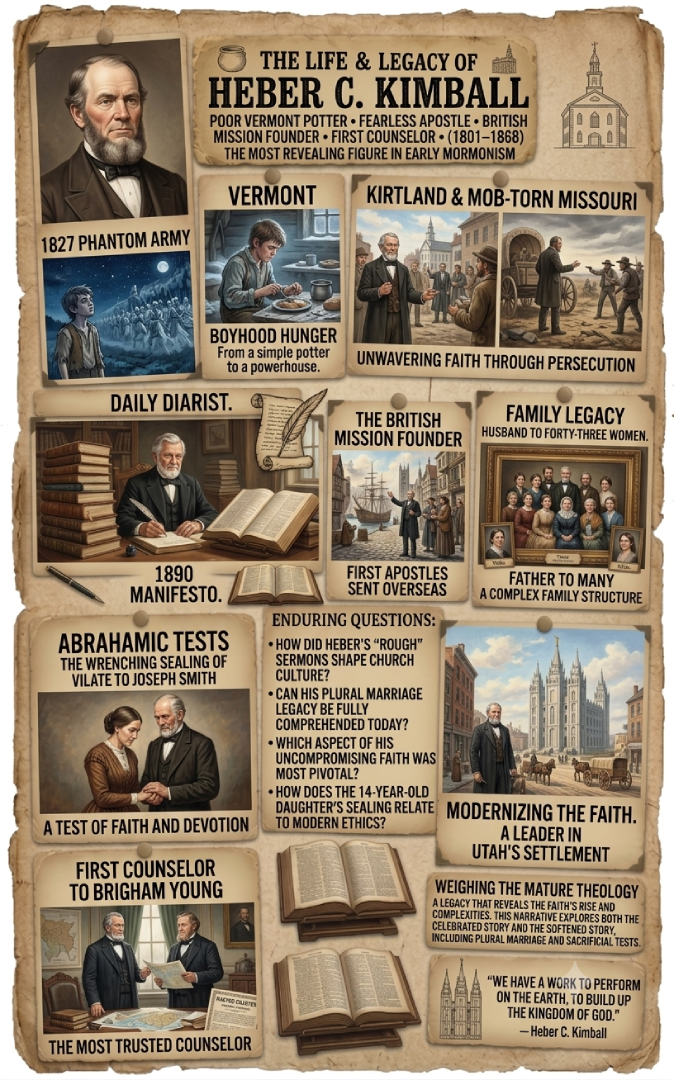
On a clear September night in 1827, in the rural quiet of Mendon, New York, a young potter was roused from his bed by a neighbor pounding at his door. John P. Greene wanted him to come outside and look at the sky. Heber Chase Kimball woke his wife Vilate and a guest, Fanny Young, and the little household stepped out into a starlit darkness so transparent, he would later say, that a man could have stooped and picked up a pin. They looked toward the eastern horizon, and there they saw an army.
We looked to the eastern horizon, and beheld a white smoke arise toward the heavens; as it ascended it formed itself into a belt… In this bow an army moved, commencing from the east and marching to the west… We could distinctly see the muskets, bayonets and knapsacks of the men, who wore caps and feathers like those used by the American soldiers in the last war with Britain… No man could judge of my feelings when I beheld that army of men, as plainly as ever I saw armies of men in the flesh; it seemed as though every hair of my head was alive.
— Heber C. Kimball, in Orson F. Whitney, Life of Heber C. Kimball
Kimball insisted he gazed at the spectral host “for hours,” until it dissolved. Years afterward, he claimed the date carried a hidden significance: it was, he said, the very night Joseph Smith retrieved the golden plates from the angel Moroni on a hillside not many miles away. Whatever a modern reader makes of the account—atmospheric phenomenon, embellished memory, or genuine wonder—the story tells us something essential about the man. Heber Kimball lived in a world drenched in signs and portents, a world where the membrane between heaven and earth seemed thin enough to tear. He would spend the rest of his life reading omens, hearing voices, seeing devils, and submitting himself, with a blacksmith’s stubborn literalism, to a prophet he was certain spoke for God.
This is the thirteenth installment in our series on the personalities who gathered around Joseph Smith and built the Latter-day Saint movement out of frontier zeal and improvised revelation. Heber C. Kimball is among the most arresting of them all—not because he was the most original thinker (he was not), nor the most polished (he was emphatically not), but because in him the early Mormon character is concentrated to its essence: fierce loyalty, raw courage, prophetic confidence, an appetite for the miraculous, and a willingness to obey commands that other men would have found unthinkable. To understand Kimball is to understand how ordinary nineteenth-century Americans came to believe extraordinary things, and how those beliefs carried them across an ocean, across a continent, and across a theological frontier that left historic Christianity behind. We will follow him with sympathy and with candor, letting the evidence speak—both the evidence the Church loves to tell and the evidence it has long preferred to soften.
❦ ❦ ❦
Origins: The Forge, the Wheel, and the Empty Stomach
Heber Chase Kimball was born on June 14, 1801, in Sheldon, Franklin County, Vermont, the fourth of seven children of Solomon Farnham Kimball and Anna Spaulding Kimball. The Kimballs were old New England stock, descendants of English immigrants who had reached Massachusetts in 1634; Heber was named for a local judge, Heber Chase, who had helped the family settle. His father was a blacksmith who also worked a farm, an honest and industrious man whose fortunes were undone by forces far beyond Vermont. The trade embargo that preceded the War of 1812 wiped out Solomon’s investments, and around 1811, the family pulled up stakes and moved west to the religiously turbulent country of western New York, settling near West Bloomfield in Ontario County.
It was a hard, lean boyhood. Kimball left school at fourteen and was apprenticed to learn the blacksmith’s and potter’s trades. At nineteen, the family’s poverty forced him out on his own. The recollection he left of those years is one of the most poignant things he ever wrote, and it explains a great deal about the man he became:
At this time I saw some days of sorrow; my heart was troubled, and I suffered much in consequence of fear, bashfulness and timidity. I found myself cast abroad upon the world, without a friend to console my grief. In these heart-aching hours I suffered much for want of food and the comforts of life, and many times went two or three days without food to eat, being bashful and not daring to ask for it.
— Heber C. Kimball, quoted in Whitney, Life of Heber C. Kimball, 7
There is no condescension in observing that this hunger—literal and emotional—shaped him. A man who has gone hungry from sheer timidity learns either to despise weakness or to convert it into iron resolve; Kimball did the latter. Around 1820, he moved with his brother to Mendon, in Monroe County, and there in November 1822, he married Vilate Murray, a steady, devout young woman who would become the moral anchor of his life. He bought out his brother’s pottery business, acquired five and a half acres, built a house and a barn, planted an orchard, and settled into the respectable rhythm of a small-town artisan.
Two facts from these Mendon years deserve attention, because both would echo strangely into his later life. The first is Freemasonry. In 1823, Kimball received the three craft degrees in the Masonic lodge at Victor Flats, and the following year petitioned for the higher York Rite degrees at Canandaigua—only to find the chapter building burned down amid the anti-Masonic hysteria then sweeping the region. He remained a warm admirer of the fraternity for life, later remarking, “I wish that all men were masons and would live up to their profession, then the world would be in a much better state than it is now.” When the Saints later built Nauvoo, Kimball would be among the original petitioners for a Masonic lodge there and would serve as its first Junior Deacon. The deep imprint that Masonic ritual left on the Nauvoo temple endowment is the subject of another essay; here it is enough to note that Kimball entered Mormonism already fluent in the language of secret oaths, signs, and tokens.
The second fact is sorrow. Between 1824 and 1826, tuberculosis tore through the family: his mother died in February 1824, his father in the spring of 1826, followed quickly by his brother Charles and Charles’s wife. Of the children Vilate bore him in these years, only two survived infancy—William Henry, born in 1826, and a daughter, Helen Mar, born in 1828. That daughter’s name should be marked well. She will return to this story under circumstances that have troubled honest readers for a century and a half.
❦ ❦ ❦
The Spiritual Quest: A Soul “Cast Abroad” Finds a Home
Kimball was, by his own testimony, a religious seeker long before he was a Mormon. “As early as age twelve,” he recalled, he “had many serious thoughts and strong desires to obtain a knowledge of salvation, but not finding anyone who could teach me the things of God, I did not embrace any principles of doctrine, but endeavored to live a moral life.” Western New York in the 1820s and 1830s was the “burned-over district,” so named because successive waves of revivalism had swept through it until, it was said, there was no fuel left to burn. Methodists, Baptists, Presbyterians, Shakers, Millerites, and a dozen restorationist experiments competed for souls. Into this spiritual marketplace, Kimball at last stepped, joining the Baptists and submitting to baptism.
But he was a Baptist for only a matter of weeks. In late 1831, three elders of the new “Church of Christ” founded by Joseph Smith arrived at the home of his neighbor and friend Phineas Young, brother of a young carpenter and painter named Brigham. Kimball came to listen and was electrified. Here was a religion that did not merely preach about the apostolic gifts but claimed to possess them. He witnessed what the participants called the gift of tongues and its interpretation; he believed he felt “the power of God.” With several of the Youngs, he traveled to Pennsylvania to spend nearly a week with the elders, soaking in the new gospel and reportedly seeing visions of the gathering of the Saints to Zion. For a man who had hungered after certainty since boyhood, the appeal was overwhelming. On April 16, 1832, Heber C. Kimball was baptized in a stream near his pottery shop by Alpheus Gifford. Vilate followed him into the water two weeks later.
It is worth pausing on the psychology here, because it recurs across the early Mormon biographies in this series. Kimball was not a credulous fool; he was a literate, hardworking, morally serious man. But he was also a man for whom the established churches had offered words without power—doctrine without the fire of present revelation. Mormonism’s genius was to promise the New Testament church restored in full: apostles, prophets, miracles, tongues, healings, and a living oracle who spoke for God in the present tense. To a seeker shaped by the revival culture of the burned-over district, that promise answered the deepest ache of his soul. He would later distill his whole epistemology into a single, characteristically blunt sentence: “truth is light, and light is life.” He felt the truth before he could argue it, and feeling, for Heber Kimball, was proof enough.
❦ ❦ ❦
A Firm Believer: Kirtland, Zion’s Camp, and the Apostleship
Conversion for Kimball meant total relocation of life. With his close friend Brigham Young—the friendship that would shape both men’s destinies—he made a preliminary journey to Kirtland, Ohio, expressly to meet the Prophet. The bond formed among Smith, Young, and Kimball was instant and lifelong. Where many converts admired Joseph, Kimball venerated him with an intensity that would later cross, by any orthodox Christian measure, into something close to worship. “You call us fools,” he once thundered at hostile listeners, “but the day will be, gentlemen and ladies, whether you belong to this Church or not, when you will prize brother Joseph Smith as the Prophet of the Living God, and look upon him as a God.” On another occasion, he declared that Joseph “has [passed] behind the veil, but there never will a person in this dispensation enter into the celestial glory without his approbation.” We will weigh those astonishing claims theologically in due course; for now, simply note the temperature of the devotion.
In the fall of 1833, Kimball moved his family to Kirtland, the gathering place. He helped build his own home, the temple, and—when mobs threatened—the Prophet’s defense. “We had to go and buy guns, and stand in his defence,” he remembered, “to keep the hellyons from him in Kirtland.” In 1834, he marched in Zion’s Camp, the quasi-military expedition Joseph organized to redeem the persecuted Saints of Missouri. The campaign achieved none of its stated military aims and was ravaged by cholera, which struck Kimball himself. Yet he and other faithful participants regarded it as a refiner’s fire. When mocking apostates demanded what the camp had accomplished, Kimball’s answer was simply: “Just what we went for.”
The reward came on February 14, 1835, when Kimball was ordained one of the original Twelve Apostles of the restored Church, fourth in seniority. He understood the office in revelatory, not merely administrative, terms: “The office of an apostle is to tell the truth, to tell what he knows. Has the Lord spoken to me? He has. I have heard His voice.” In March 1836, he participated in the emotional dedication of the Kirtland Temple, where Joseph administered a partial endowment to selected leaders. Kimball’s theology of the temple—expressed years later—reveals how thoroughly the new faith had reoriented his hope around sealed families and an inheritance passed to posterity “for ever and for ever.”
“Truth Will Prevail”: The Apostle Goes to England
Kimball’s most consequential achievement was the opening of the British Mission, the single act for which he is most honored in Latter-day Saint memory. In June 1837, amid a season of bitter apostasy in Kirtland that nearly tore the leadership apart, Joseph approached Kimball in the temple and whispered a startling commission:
Brother Heber, the Spirit of the Lord has whispered to me: ‘Let servant Heber go to England and proclaim my Gospel, and open the door of salvation to that nation.’
— Joseph Smith to Heber C. Kimball, June 1837, in Whitney, 103–104
The assignment terrified him. He felt his own inadequacy keenly, and the dissenters in the leading councils mocked the venture savagely. One member of the Twelve, John Boynton, sneered that if Kimball were fool enough to follow “the fallen Prophet” to England under such perilous circumstances, he would not lift a finger to rescue him even if he were shipwrecked. Kimball went anyway. He sailed in the summer of 1837 with Orson Hyde, Willard Richards, and Joseph Fielding, and on landing was so eager that he leaped from the boat while it was still six or seven feet from the pier.
The mission opened in Preston, Lancashire, and Kimball recorded a moment that has passed into Mormon folklore. As the missionaries’ coach halted amid an election-day spectacle of parades and banners, a flag unfurled almost over their heads bearing the words, in large letters, “TRUTH WILL PREVAIL.” To the travel-worn elders, the coincidence felt like a benediction. “It being so very seasonable,” Kimball wrote, “we cried aloud, ‘Amen! Thanks be to God, TRUTH WILL PREVAIL!’” The British Mission was an extraordinary success. Within Kimball’s first stay of roughly eight months, some two thousand souls were baptized; by the time the apostles’ collective labors in Britain matured, the figure ran into many thousands, supplying the demographic lifeblood that would sustain Mormonism for decades and populate the wagon trains to the Salt Lake Valley.
England also became the stage for one of the most vivid supernatural episodes Kimball ever reported. In a house at Preston, he and his companions claimed to have been assaulted by a visible horde of evil spirits—an account that, whatever its origin, he never recanted and frequently retold:
We saw devils coming in legions… They came towards us like armies rushing to battle. They appeared to be men of full stature, possessing every form and feature of men in the flesh, who were angry and desperate; and I shall never forget the vindictive malignity depicted in their countenances as they looked me in the eye.
— Heber C. Kimball, in Whitney, 130–131
From such experiences, Kimball drew a settled conviction that he lived in perpetual, tangible warfare with an unseen world of malevolent spirits—the disembodied dead, he taught, “the spirits of wicked men” who linger near the earth and tempt the living. This demonology, more medieval than Protestant in flavor, would color his preaching for the rest of his life and is one of several threads that mark how far the restored gospel had traveled from the sober biblicism of the Reformation. He returned home in 1838, then sailed again in 1839 on a second British mission—departing, famously, from a sickbed in a wagon beside an equally ill Brigham Young, the two apostles rising on their elbows to swing their hats and cry “Hurrah, hurrah for Israel!” to their fevered wives. It is a scene of almost reckless devotion, and it is quintessential Kimball.
❦ ❦ ❦
Fire and Sword: Missouri, Martyrdom, and the Test of Loyalty
Between his English labors, Kimball was plunged into the Missouri persecutions of 1838, among the darkest chapters of the early Church. With Brigham Young—by then the ranking apostle—he helped organize the removal of some twelve thousand Latter-day Saint refugees across the border into Illinois while Joseph languished in Liberty Jail. Because his English absence had left him relatively unknown to the Missouri mobs, Kimball could move about the state with comparative freedom, carrying letters to and from the imprisoned Prophet and shouldering the thankless errand of seeking legal redress that never came.
It was in this crucible that Kimball’s defining trait—absolute, unbending loyalty to Joseph Smith—was tested and proved. When the apostate William E. McLellin, who had abandoned the Church, taunted him at fallen Far West—“Brother Heber, what do you think of your fallen prophet now? Are you satisfied with Joseph?”—Kimball’s reply was withering: “Yes, I am more satisfied with him a hundred-fold than ever I was before, for I see you in the very position that he foretold you would be in… Have you not betrayed Joseph and his brethren into the hands of the mob, as Judas did Jesus?” The instinct to read every dissenter as a Judas, every critic as a tool of the devil, would harden over the years into something less admirable than steadfastness. But in 1838, it kept Kimball at his post when weaker men fled.
The murder of Joseph and Hyrum Smith at Carthage on June 27, 1844, devastated him. Like the other apostles, he was away on a mission in the eastern states; he reported feeling an unaccountable mental anguish on the night of his martyrdom. His grief curdled quickly into a vengefulness that modern readers will find jarring, and that sits in flat contradiction to the Sermon on the Mount. Of the men who killed the Smiths, he preached: “I wish they were in hell… and if they have not literally gone down into hell they will go there, as the Lord God lives, every one of them.” He then added, with no apparent irony, that this was “loving the wicked”—consigning them to the flames to be “purified.” When the question of succession arose, Kimball threw his full weight behind Brigham Young, and when in 1847 Young reorganized the First Presidency, he chose Heber Kimball as his First Counselor, a position Kimball would hold until his death.
❦ ❦ ❦
The Abrahamic Test: Vilate, Sarah Noon, and a Fourteen-Year-Old Daughter
No part of Heber Kimball’s life is more wrenching, more revealing, or more carefully managed by official narrative than his entry into plural marriage. The story is preserved in detail by his own grandson and biographer, Orson F. Whitney—himself later an apostle—which means the most disturbing version of events comes not from enemies of the Church but from its most devoted insiders.
According to Whitney, Joseph Smith introduced the principle to Kimball by way of an ordeal. Before revealing plural marriage to him, the Prophet allegedly tested Heber by demanding that he surrender Vilate—his beloved wife of two decades—to Joseph in marriage. For three days, Kimball fasted, wept, and tormented himself. At last, he led Vilate to the Prophet’s house and presented her, prepared to give up the dearest thing he possessed. Joseph, moved to tears, then revealed that the demand had been a trial only—“a sort of Abrahamic test”—and that Heber had passed as Abraham passed at the binding of Isaac. The Prophet sealed Heber and Vilate to each other instead.
The test did not end there. Joseph next commanded Kimball to take a plural wife—and to conceal the marriage from Vilate. The woman chosen was Sarah Noon, an Englishwoman in difficult circumstances. Kimball recoiled; he had to be commanded, by Whitney’s account, three separate times, and was warned that refusal would cost him his apostleship and his soul. The deception of Vilate tortured him. She, sensing his distress and unable to extract its cause, took the matter to God in prayer—and, in the family’s telling, received her own vision of celestial marriage, after which she went to her husband and told him not to grieve, for the Lord had shown her the principle, and she would sustain it. It is a story the Church tells as a triumph of faith. Read with open eyes, it is also a study in how a charismatic leader can bend devoted people, by stages, to accept what they had found unthinkable only days before.
Before revealing polygamy to Heber Kimball, Joseph tested him by requiring Heber to surrender his wife, Vilate, to Joseph for marriage… Heber was told, by Joseph, to take a certain woman for a plural wife three times. Only after Joseph commanded Heber ‘in the name of the Lord’ to do so did he obey. Joseph instructed Heber to hide this plural marriage from his first wife Vilate.
— Summary of Whitney, Life of Heber C. Kimball, ch. XLVI, at Thoughts on Things and Stuff
Then comes the episode that no amount of devotional framing can entirely soften. In 1843, Heber and Vilate gave their daughter Helen Mar Kimball—then fourteen years old—to Joseph Smith as a plural wife. Helen later recorded that her father offered her to the Prophet, having “a great desire to be connected with the Prophet Joseph.” She also wrote, in a phrase that has haunted her descendants, that her father had “but one Ewe Lamb,” and “willingly laid her upon the altar.” The transaction was framed for the Kimballs as the gateway to eternal exaltation for their whole family. Whatever theological gloss is applied, the plain facts are that a grown prophet married a fourteen-year-old girl, and that her parents, under intense religious pressure and the promise of eternal glory, consented. Honest Latter-day Saint historians no longer dispute the basic outline; the Church’s own Gospel Topics essays now acknowledge Helen’s age. The questions this raises about agency, coercion, and the abuse of spiritual authority are not the inventions of anti-Mormon polemicists. They are the questions any thoughtful person—Latter-day Saint or not—must face.
Kimball embraced plurality wholeheartedly thereafter. He eventually married a remarkable forty-three women, though it is fairly noted that a number of these were caretaking or dynastic sealings without conjugal relations, especially the unions with elderly or widowed women contracted during the chaotic Nauvoo and Winter Quarters years. He fathered sixty-six children by seventeen of his wives. His public preaching on the subject was exuberant, theological, and at times jarring to modern ears. He taught that plural marriage was “one of the most holy principles that God ever revealed to man,” and that those who opposed it would be “damned.” He insisted, in a much-quoted sally, that the monogamist withers while the polygamist flourishes:
I have noticed that a man who has but one wife, and is inclined to that doctrine, soon begins to wither and dry up, while a man who goes into plurality looks fresh, young, and sprightly. Why is this? Because God loves that man, and because he honors His work and word.
— Heber C. Kimball, Journal of Discourses 5:22
Other sayings attributed to him are cruder still. He once warned departing missionaries not to court the prettiest converts before returning home, joking that they must “bring them all here” so the leaders could “all have a fair shake,” and elsewhere likened prospective wives to “sheep” belonging not to the missionaries but to the One who sent them. The most notorious line of all—“I think no more of taking another wife than I do of buying a cow”—deserves a careful word, precisely because integrity demands it. That sentence is endlessly repeated as the epitome of Kimball’s callousness, yet its provenance is shaky: it traces to Ann Eliza Young’s hostile memoir and Irving Wallace’s popular The Twenty-Seventh Wife, and it has never been corroborated in Kimball’s own published sermons. A scrupulous critic will set it aside as unverified. The trouble for Kimball’s memory is that the documented sayings are damaging enough without it. A man who could compare wives to sheep in a recorded discourse does not need an apocryphal cow to establish that his theology of marriage reduced women, too often, to instruments of male exaltation and divine bookkeeping.
❦ ❦ ❦
Savior on Mount Zion: The Pioneer, the Counselor, the Prophet
When the Saints were driven from Nauvoo, Kimball met the catastrophe with characteristic bravado. “Just before I left Nauvoo, I had finished me a good house,” he recalled, “and when compelled to start, I told the devil to take it and stick it in his hat, and I would go to the mountains and get rich.” He was a member of the vanguard company that reached the Salt Lake Valley in July 1847, and the following winter, Brigham Young named him First Counselor in the reorganized First Presidency. In the new Zion, he became one of the most powerful men in the territory: chief justice and lieutenant-governor of the provisional State of Deseret, a member of the upper house of the territorial legislature, and a tireless preacher who crisscrossed the Mormon settlements exhorting the faithful. He supported his vast family by farming, ranching, freighting, and milling at the Heber C. Kimball Gristmill. It should be recorded plainly, as part of the full picture, that, like other prominent Saints of the era, he was entangled in the territory’s system of unfree labor: a Black man named Green Flake, given to the Church as tithing, served as his driver.
Kimball’s preaching in Utah made him beloved and feared in equal measure. He called himself a plain man who refused to dress up hard truths, boasting that he would “not give a dime for anything that is not rough.” His sermons crackled with barnyard humor, threats, prophecy, and an unshakable confidence that the Saints would outlast every enemy. In one celebrated discourse, he promised that the despised Latter-day Saints would one day feed their persecutors: “The day will come when the people of the United States will come lugging their bundles under their arms, coming to us for bread to eat… and we will be your saviors here upon Mount Zion.” He urged the Saints toward economic self-sufficiency—“go to work and manufacture your own clothing”—and his famous prophecy that goods would soon sell in the streets of Salt Lake City more cheaply than in New York was, the faithful believed, fulfilled by the windfall of the California Gold Rush.
His most enduring prophecy, however, was darker and more interior. Near the end of his life, Kimball warned that prosperity and persecution together would sift the Church to its foundations—a passage modern apostles still quote in General Conference:
The time is coming when… it will be difficult to tell the face of a Saint from the face of an enemy to the people of God. Then… look out for the great sieve, for there will be a great sifting time, and many will fall.
— Heber C. Kimball, quoted in Whitney, Life of Heber C. Kimball, 446
That Kimball could be both a clownish jokester and a solemn seer in the same sermon is part of what makes him so vivid. He died on June 22, 1868, in Salt Lake City, at sixty-seven, from the effects of a fall, telling his family, the day before, that Moroni had appeared to him in the night to say his work on earth was finished. He was buried on the bench above the city that bore his name. His descendants would include a prophet of the Church, Spencer W. Kimball, and the irrepressible J. Golden Kimball, whose salty tongue was inherited honestly from his father.
❦ ❦ ❦
Theological Departure: Where Kimball Left Historic Christianity Behind
Heber Kimball was not a systematic theologian, and he would have been impatient with the label. Yet precisely because he spoke without filter, his sermons offer an unusually clear window into how far the restored gospel had diverged from the Christianity of the creeds and councils—the faith “once for all delivered to the saints” (Jude 3). Three departures stand out, and each can be measured against Scripture without rancor.
1. The Plurality and Exaltation of Gods
Kimball preached, with Brigham Young, a doctrine of eternal progression in which faithful men become gods. “You will never leave [this earth],” he told his hearers, “until you become qualified, and capable, and capacitated to become a father of an earth yourselves.” This is the Mormon doctrine of exaltation in its native, unguarded form: God was once as man is, and man may become as God is, presiding over worlds and propagating spirit-children through the eternities. Plural marriage, in this scheme, was not a sociological accident but a theological engine—the means by which an exalted man would build his eternal kingdom and posterity. Set beside the witness of Scripture, the contrast is stark. The God of the Bible declares Himself unique and uncreated: “Before me there was no God formed, neither shall there be after me” (Isaiah 43:10), and “I am the first, and I am the last; and beside me there is no God” (Isaiah 44:6). The promise held out to the redeemed is not godhood but adoption—to become “joint-heirs with Christ” (Romans 8:17), beholding and reflecting God’s glory, never replacing or replicating His being. The gulf is not one of emphasis but of kind.
2. Salvation Mediated Through Joseph Smith and Priesthood Leaders
Recall Kimball’s claim that no one in this dispensation would “enter into the celestial glory” without Joseph Smith’s “approbation,” and that men should “look upon him as a God.” Recall, too, his counsel that salvation requires drawing near to the living priesthood leaders: “How can you draw near to the throne of God, except you draw near to those men who are placed as His representatives in the flesh?… If you expect the favor of God, favor His servants and sustain them.” Here Mormonism interposes a human mediator—indeed, a chain of them—between the believer and God. The New Testament permits no such intermediary. “There is one God, and one mediator between God and men, the man Christ Jesus” (1 Timothy 2:5). Jesus Himself said, “I am the way, the truth, and the life: no man cometh unto the Father, but by me” (John 14:6), and the apostles preached that “there is none other name under heaven given among men, whereby we must be saved” (Acts 4:12). The believer is invited to “come boldly unto the throne of grace” (Hebrews 4:16)—not by way of a prophet’s approbation, but through the finished work of Christ alone.
3. Salvation by Obedience, and a Gospel of “Rough” Works
Kimball’s entire spiritual posture was one of obedience as the price of glory—“be passive and be like clay in the hands of the potter,” submitting without question to the prophet’s commands, even commands that violated conscience and law. The metaphor is his own, drawn from his trade and from Jeremiah 18, and it is genuinely beautiful when applied to God’s sovereign shaping of a soul. But Kimball applied it to the demands of men, teaching that the disobedient ‘lump of clay must be cut off from the wheel and laid aside.’ The result was a religion in which exaltation is earned by works, ordinances, and submission. The apostle Paul cuts against this at the root: “For by grace are ye saved through faith; and that not of yourselves: it is the gift of God: not of works, lest any man should boast” (Ephesians 2:8–9). Salvation, in the gospel of the New Testament, is not a wage paid to the obedient but a gift given to the trusting. And the spirit of that gospel is not the relish for hell that Kimball voiced over his enemies, but the command of Christ: “Love your enemies, bless them that curse you… pray for them which despitefully use you” (Matthew 5:44).
None of this is said to caricature Kimball as a villain. He was, by the standards of his own world, a man of fierce sincerity and real virtue. But sincerity is not the same as truth, and a faithful Christian assessment must say plainly that the doctrines Kimball preached—eternal godhood, salvation mediated through Joseph Smith, exaltation earned by obedience—are not a variation on historic Christianity but a different gospel built on a different foundation.
❦ ❦ ❦
A Character Study: The Virtues and the Blind Spots
To portray Heber Kimball fairly is to hold several truths at once. He was genuinely brave: he bought guns to defend a friend, marched into hostile Missouri, and crossed an ocean while ill to preach a gospel he could have abandoned for ease and popularity. He was loyal to the point of self-erasure, never once breaking with Joseph or Brigham across decades of strain. He was generous, putting his own family on short rations during the Utah famine so that he could feed others. He was funny, self-deprecating, and beloved by the rank-and-file Saints, who saw in his rough speech a man without pretense. And he was, in his way, humble—forever insisting that God had chosen “just such weak instruments as myself” to do great things.
▸ The blind spot of obedience. Kimball’s supreme virtue and his supreme weakness were the same thing. His total submission to authority made him an immovable pillar of the kingdom—and also made him capable of surrendering his wife on command and his fourteen-year-old daughter to a marriage no father’s conscience should permit. He had trained himself never to question the prophet, and a conscience that cannot question can be led anywhere.
▸ The hardening toward enemies. The same loyalty that defended Joseph curdled, over time, into a reflexive contempt for dissenters and outsiders, expressed in language—wishing critics in hell, calling apostates Judases—that is impossible to square with the charity of Christ.
▸ The reduction of women. His theology of marriage, however exuberantly he preached it, treated women as means to male exaltation. His recorded comparison of converts to sheep, his quip about a ‘fair shake’ among missionaries, and the lifelong suffering of plural wives like those in his own household reveal a blind spot he never examined.
▸ The appetite for the marvelous. Armies in the sky, legions of visible devils, money miraculously replenished, angels announcing his death—Kimball inhabited a world so saturated with the supernatural that the line between revelation and imagination effectively dissolved. This made him a powerful witness and a credulous one.
And yet the portrait must end in sympathy as well as judgment. Kimball was a poor, hungry, half-educated potter who hungered after God and gave everything he had to the one voice that promised him certainty. That the voice led him astray on the great questions does not make his hunger contemptible; it makes his story a tragedy in the classical sense—a good man undone by a fatal misplacement of trust. The Christian reader who would learn from him should feel the pull of that hunger before pronouncing on the answer he embraced.
❦ ❦ ❦
Legacy and the Management of Memory
Heber Kimball’s legacy is woven into the fabric of the Latter-day Saint Church. He founded the British Mission, whose converts became the human foundation of Mormon survival and expansion. He helped lead the exodus to Utah and served two decades as Brigham Young’s right hand. His prophecies are still quoted from the pulpit; his bloodline produced a Church president. By any measure, he is a major figure in the movement’s history.
It is here, finally, that we must note how official Latter-day Saint sources tend to present him—and what they tend to leave in shadow. The pattern is not crude suppression so much as selective curation. Faith-promoting accounts, including the fine and sincere BYU Religious Educator profile that anchors much of his devotional memory, dwell lovingly on the heavenly army, the Preston banner, the courage in Missouri, and the generosity in famine. They print at length his testimonies of Joseph and his trials of faith. What recedes, or vanishes, is the harder material: the precise mechanics of the ‘Abrahamic test’ in which a wife was demanded and a marriage concealed; the marriage of fourteen-year-old Helen Mar to a man of thirty-seven; the recorded sermons reducing women to livestock and sheep; the relish for the damnation of enemies; the entanglement with unfree labor. The supernatural claims are reproduced uncritically as faith; the morally troubling claims are abridged, contextualized, or quietly omitted.
This is the ordinary work of institutional memory, and the Latter-day Saint Church is hardly unique in performing it. But the effect is a sanitized Kimball—all faith and folksy charm, with the contradictions sponged away. The honest biographer’s task, and the equipped Christian’s, is to restore the whole man: to credit the courage and the kindness without erasing the coercion and the doctrinal error. Helen Mar Kimball was a real fourteen-year-old girl with a name and a face and a lifetime of complicated testimony to give about what was done to her. To remember her father truthfully is to remember her, too.
❦ ❦ ❦
Conclusion: Clay on the Wheel
Heber C. Kimball loved the image of the potter and the clay. He had spent his young manhood at the wheel, watching shapeless earth become a vessel under patient hands, and he made of it the governing metaphor of his discipleship: to be passive, yielding, formed entirely by another’s will. It is a profound image, and the Scriptures use it of God’s sovereign and loving work upon a soul. But Kimball gave his clay to the wrong potter. He surrendered the shaping of his conscience not to God revealed in Christ and Scripture, but to men who claimed to speak for God—and the vessel they formed, for all its strength, was set upon a foundation that the New Testament will not bear.
That is the lesson his life offers to the Christian who would witness, today, to his Latter-day Saint neighbors—many of them as sincere, as hungry for certainty, and as admirable in their devotion as Heber Kimball himself. We do not honor them by sneering at the army in the sky or the legions of devils. We honor them by taking their faith seriously enough to test it against the only sure word, and by holding out—as Kimball never quite found—the gospel of grace: a God who needs no successor world to rule, a Mediator who needs no prophet’s approbation, and a salvation that is not earned at the wheel but given at the cross. “Sanctify the Lord God in your hearts,” Peter wrote, “and be ready always to give an answer to every man that asketh you a reason of the hope that is in you with meekness and fear” (1 Peter 3:15). Heber Kimball gave his answer with his whole life. The question he leaves us is whether we will give ours with the same courage—and a truer hope.
❦ ❦ ❦
Primary Sources and Further Reading
• Heber C. Kimball (biographical overview), Wikipedia. https://en.wikipedia.org/wiki/Heber_C._Kimball
• Brian K. Ray, “Heber C. Kimball—Man of Faith and Integrity,” BYU Religious Educator 3, no. 2 (2002). https://rsc.byu.edu/vol-3-no-2-2002/heber-c-kimball-man-faith-integrity
• “Heber Chase Kimball,” BYU Religious Studies Center, Prophets & Apostles of the Last Dispensation. https://rsc.byu.edu/prophets-apostles-last-dispensation/heber-chase-kimball
• Matthew B. Brown, “The Heavenly Sign Heber C. Kimball Saw…,” LDS Living. https://www.ldsliving.com/the-heavenly-sign-heber-c-kimball-saw-the-night-joseph-smith-received-the-golden-plates/s/90965
• “Heber C. Kimball,” Doctrine and Covenants Central. https://doctrineandcovenantscentral.org/history/heber-c-kimball/
• Heber C. Kimball, “Divine Mission of Joseph Smith, Etc.,” Journal of Discourses 5:2. https://journalofdiscourses.com/5/2
• Heber C. Kimball, “Wickedness Among the Saints, Etc.,” Journal of Discourses 3:242. https://jod.mrm.org/3/242
• Orson F. Whitney, Life of Heber C. Kimball (1888), full text (Project Gutenberg / Internet Archive). https://www.gutenberg.org/cache/epub/35333/pg35333.txt
• “Heber C. Kimball,” Latter Day Light. https://latterdaylight.com/heber-chase-kimball/
• “Heber C. Kimball,” History of Mormonism. https://historyofmormonism.com/2013/12/03/heber-c-kimball/
• “Heber C. Kimball—Passing the Abrahamic Test of Polygamy,” Thoughts on Things and Stuff. https://thoughtsonthingsandstuff.com/heber-c-kimball-passing-the-abrahamic-test-of-polygamy/
• FAIR Latter-day Saints, on Kimball and missionary “best convert women.” https://www.fairlatterdaysaints.org/answers/Question:_Was_Heber_C._Kimball_concerned_that_missionaries_would_%22take_all_the_best%22_convert_women_as_plural_wives_before_they_returned_to_Salt_Lake_City%3F
• “The Heber C. Kimball Prophecy,” After the Manner of Chemish. https://afterthemannerofchemish.blogspot.com/2016/12/the-heber-c-kimball-prophecy.html
• Heber C. Kimball’s tool chest, Church History Museum. https://history.churchofjesuschrist.org/content/museum/heber-c-kimballs-tool-chest?lang=eng
❦ ❦ ❦
A Note on Research Methods and Accuracy
In recent years, some have voiced concern that artificial intelligence may distort facts or introduce inaccuracies into serious research. That criticism deserves acknowledgment. However, AI has now evolved into the most powerful research instrument available to any dedicated scholar—capable of analyzing vast datasets, cross‑referencing historical records, and surfacing overlooked connections across sources. This work represents a collaboration between the author’s investigative inquiry, verified primary documentation, and the advanced analytic capabilities of AI research tools. Here, AI was not used as a ghostwriter or a shortcut for scholarship, but as a disciplined research partner devoted to rigor, accuracy, and transparency.
Every factual claim in this work has been subjected to active verification. Where AI‑generated content was used as a starting point, it was tested against primary sources, peer‑reviewed scholarship, official institutional documentation, and established historical records. Where discrepancies were found—and they were found—corrections were made. The author has made every reasonable effort to ensure that quotations are accurately attributed, historical details are precisely rendered, and theological claims fairly represent the positions they describe or critique.
That said, no work of this scope is immune to error, and the author has no interest in perpetuating inaccuracies in the service of an argument. If you are a reader—whether sympathetic, skeptical, or hostile to the conclusions drawn here—and you identify a factual error, a misattributed source, a misrepresented teaching, or a claim that cannot be substantiated, you are warmly and genuinely invited to say so. Reach out. The goal of this work is not to win a debate but to get the history right. Corrections offered in good faith will be received in the same spirit, and verified corrections will be incorporated into future editions without hesitation.
Truth, after all, has nothing to fear from scrutiny—and neither does this work.