
EARLY MORMON PERSONALITIES — FOURTEENTH INSTALLMENT
He Proved a Prophet Wrong with the Prophet’s Own Bible.
❦ ❧ ❦
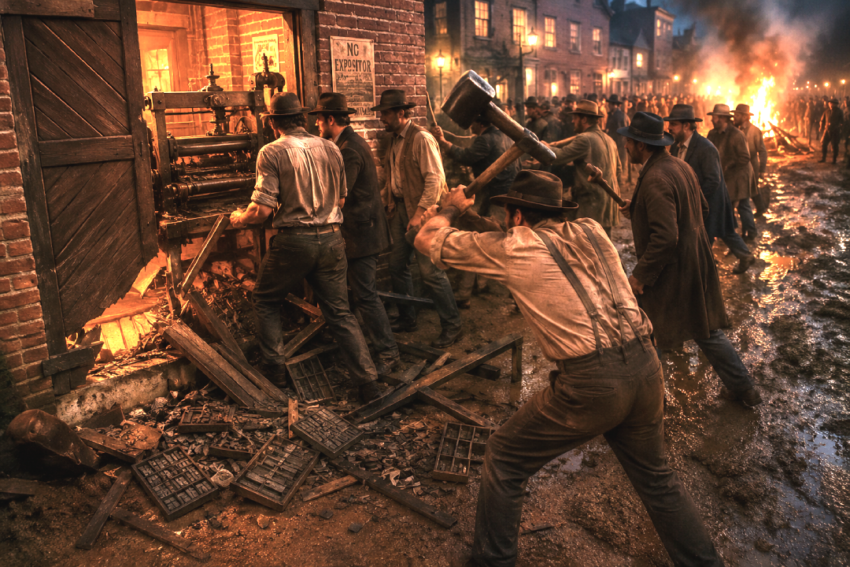
On the warm evening of June 10, 1844, a column of nearly one hundred men marched through the streets of Nauvoo, Illinois, toward a modest brick print shop. They carried a sledgehammer. Inside stood a single new printing press—three days old as a public instrument, its ink scarcely dry on the only issue it would ever produce. The marshal’s men broke down the door, dragged the press into the dirt, smashed it to fragments, scattered the trays of metal type across the road, and set the wreckage alight. By the time the flames died, the most consequential newspaper in nineteenth-century American religious history had been reduced to ash and twisted iron. It had lived exactly one issue.
The man whose money had bought that press was not present to watch it die. William Law—former second counselor in the First Presidency of the Church of Jesus Christ of Latter-day Saints, once among the most beloved and trusted men in the city, a wealthy mill owner who had crossed an ocean and a continent in pursuit of a restored gospel—was away in Carthage when the order fell. When he returned, he and his brother rode their carriage over their own broken type lying in the street, the silver letters glittering in the dust like coins scattered from a looted treasury. Within seventeen days, the man Law had once called “honest and honourable in all our transactions” would be dead, shot down in the Carthage jail by a mob, and William Law would carry, to the end of a long life, the label of Judas.
How does a man travel from the inner sanctum of a prophet’s confidence to the role of the prophet’s most infamous betrayer? How does the second-ranking officer of a church become its most dangerous dissident—and then spend nearly half a century insisting, with tears in his steel-blue eyes, that he had done only his duty? The story of William Law is not the cartoon of malice that official Latter-day Saint memory long preserved. It is the far more unsettling story of a conscience that would not be bought, a friendship that curdled into horror, and a single sheet of newsprint that proved more powerful than an empire of revelation. It is also a study in how movements remember—and reshape—the men who tell them the truth.
❦ ❧ ❦
From Tyrone to Churchville: The Making of a Sober Man
William Law was born on September 8, 1809, in County Tyrone, in the north of Ireland, the youngest of five sons of Richard Law and Ann Hunter. The family was of Scottish Presbyterian descent—the dour, disciplined, covenant-keeping stock that had been planted in Ulster generations earlier and that carried in its bones a deep suspicion of priestcraft and a deep reverence for the written Word. His father, by his son’s later account, was a prosperous farmer. When William was a boy of about nine or ten, the Laws joined the great early-century tide of emigration and crossed to North America, settling for a time in Pennsylvania, where William received his education in Philadelphia and Pittsburgh.
The young man who emerged from that schooling was, by every surviving description, the opposite of a hothead. He was studious, articulate, financially shrewd, and possessed of a magnetic public presence that would later cause his own son to claim he might have rivaled Henry Ward Beecher on the lecture platform had he chosen that path. By his early twenties, Law had migrated north into Upper Canada, settling near Churchville, some twenty-five miles south of Toronto. There, at the age of twenty-four, he married nineteen-year-old Jane Silverthorn, a union that would produce eight children and that contemporaries on every side of the later controversy described as extraordinarily devoted. Together they prospered.
This is the first and most easily forgotten fact about William Law: he had nothing to gain. He was not a desperate seeker fleeing poverty, nor a marginal man hungry for status. He was a settled, comfortable, respectable husband and father with a thriving livelihood and a happy marriage. Whatever drew him toward the new American prophet, it was not need. That makes the question of his conversion—and his later defection—all the more interesting.
“Honest and Honourable”: The Path to the Prophet
The vehicle of Law’s conversion was the same one that carried thousands of Canadians and Britons into the new faith: a pair of persuasive Latter-day Saint missionaries. In 1836, the apostle John Taylor—a future president of the church—and the elder Almon W. Babbitt preached in the region where the Laws lived. Their message was potent precisely because it spoke to the restlessness that lay beneath the placid surface of frontier Protestantism: the promise that the true New Testament church, with living apostles, present revelation, and miraculous gifts, had been restored to the earth after centuries of apostasy. To a man steeped in the Scripture-saturated certainties of Scots Presbyterianism, the idea of a church purged of the corruptions of the ages had an undeniable pull.
William and Jane were baptized in 1836. He was ordained an elder under the hands of Parley P. Pratt in April 1837 and soon presided over the Churchville branch. By 1839, he had liquidated his Canadian interests and led a company of Canadian Saints to the new gathering place rising out of the malarial swamps of the Mississippi at Commerce, Illinois—soon to be renamed Nauvoo, “the beautiful.” There, Law swiftly became one of the city’s wealthiest and most useful citizens, building a steam-powered flour and saw mill, operating a store, serving on the city council, and acting as registrar of the University of Nauvoo.
What is striking, and what the documentary record preserves with unusual clarity, is how genuinely Law admired Joseph Smith in these years. He had every opportunity to observe the prophet at close range—he built his home near the Smith homestead—and what he saw, he liked. In a letter written to his friend Isaac Russell in late 1840, before any cloud had gathered, Law’s assessment is unguarded and warm:
“I have carefully watched his movements since I have been here, and I assure you I have found him honest and honourable in all our transactions which have been very considerable. I believe he is an honest upright man, and as to his follies let who ever is guiltless throw the first stone at him, I shant do it.”
— William Law to Isaac Russell, November 29, 1840, in Lyndon W. Cook, William Law (Grandin Book, 1994)
There is no irony in that line—only, in retrospect, a terrible foreshadowing. Law borrowed his image from the Lord’s defense of the woman taken in adultery (“He that is without sin among you, let him first cast a stone at her,” John 8:7), pledging that he, for one, would never be the first to throw. Four years later, he would pick up a stone the size of a printing press and hurl it with all his strength. The man who would not condemn in 1840 would, by 1844, brand his prophet a demon in human shape. Understanding what happened in between is the heart of his story.
The Second Counselor: Trust at the Summit
On January 19, 1841, the Lord—speaking through Joseph Smith in the lengthy revelation now canonized as Section 124 of the Doctrine and Covenants—named William Law to the First Presidency of the church as second counselor, the position vacated by Frederick G. Williams. He was thirty-one years old. The revelation did not merely appoint him; it wrapped him in extraordinary promises, instructing the Saints to hearken to his counsel and pledging divine blessing upon his household. For a convert of barely five years, it was a dizzying elevation—placing him, by revealed decree, among the three highest officers of the kingdom.
For roughly two years, he filled the office with evident honor. He defended Joseph publicly against the slanders of apostates such as the disgraced John C. Bennett. He served on the city council and helped administer the rapidly swelling city. Joseph, for his part, returned the affection. In a passage from his journal recorded in this period, the prophet named Law among a circle of friends whose loyalty moved him, declaring that these were men who loved the God he served and the truths he promulgated, and that his heart felt to reciprocate their unwearied kindnesses. The bond was real. That is precisely why its rupture would be catastrophic.
The Breaking: Polygamy, Power, and the Poisoned Cup
The fracture did not come from a single blow but from a slow accumulation of alarm. By Law’s own later testimony and the surviving documents, three pressures converged. The first was political and legal: Law grew increasingly uneasy at Joseph’s fusion of ecclesiastical, civil, and military authority in Nauvoo—the repeated use of the city’s charter and municipal courts to issue writs of habeas corpus shielding the prophet from extradition to Missouri, and the deployment of the church’s bloc vote to bend Illinois politics. The second was economic: Law and his brother Wilson had purchased the higher, more desirable land on the city’s outskirts, and they bristled when Joseph directed new arrivals to buy church-owned bottomland first, a policy that cut against the Laws’ financial interests. Latter-day Saint apologists have made much of this quarrel, and it is real; a fair portrait must hold it alongside the rest.
But the third pressure was the one that broke him, and it was moral and theological to its core: the secret practice of plural marriage. Joseph was teaching and privately living polygamy while publicly denying it—and he was teaching it to the inner circle as a binding commandment of God. To a Presbyterian-bred husband who revered his wife and read his New Testament, the doctrine was not a refinement of marriage but its desecration. The collision was inevitable. According to a recollection his non-Mormon son Richard preserved decades later, there was an interview around 1842 in which Law, weeping, with his arms around the prophet’s neck, begged Joseph to abandon the doctrine, predicting that without it Mormonism might one day dominate the Christian world. Joseph wept too, the account says, but answered that he could not withdraw what God had commanded.
The decisive moment came when Joseph’s brother Hyrum handed Law the written revelation on celestial and plural marriage—the text now canonized as Section 132—and told him to take it home, read it, and bring it back. Forty years later, Law still remembered the vertigo of that night:
“Hyrum gave it to me in his office, told me to take it home and read it and then be careful with it and bring it back again. I took it home, and read it and showed it to my wife. She and I were just turned upside down by it; we did not know what to do.”
— William Law, interview with Dr. Wilhelm Wyl, Salt Lake Daily Tribune, July 31, 1887
Law took the document to Joseph, half-hoping the prophet would repudiate it as a forgery. Instead, Joseph affirmed it. When Law objected that the Doctrine and Covenants already contained a revelation flatly forbidding polygamy, Joseph gave the answer that, by Law’s account, sealed the breach forever—an answer that revealed a theology of revelation as something fluid, escalating, and finally unanswerable:
“That was given when the church was in its infancy, then it was all right to feed the people on milk, but now it is necessary to give them strong meat.”
— Joseph Smith, as recalled by William Law, Salt Lake Daily Tribune, July 31, 1887
For Law, the metaphor was monstrous. The “milk” had been monogamy, fidelity, the plain ethics of the Bible; the “strong meat” was a secret license to take other men’s daughters and other men’s wives. A revelation that could reverse the moral law by appeal to the congregation’s supposed maturity was, to him, no revelation at all but a self-authorizing engine of appetite. From that conversation, he said, the breach “became more open and more decided every day.” In his private diary, on the day he learned he had been dropped from the First Presidency in January 1844, he recorded both his wound and his relief in a single breath:
“I cannot fellowship the abominations which I verily know are practiced by this man, consequently I am glad to be free from him.”
— William Law, “Record of Doings at Nauvoo in 1844,” January 8, 1844, in Cook, William Law
The Question of Jane
No element of Law’s story has generated more heat—or more contradictory testimony—than the allegation that Joseph Smith approached Jane Law to take her as a plural, indeed polyandrous, wife while she was still married to William. The sources do not agree, and an honest narrative must lay the disagreement bare rather than resolve it by fiat.
The most vivid version descends from Ann Eliza Young—a later wife of Brigham Young who became a famous critic of polygamy—who reported that Jane said Joseph had visited her at night, knowing William would be away, and proposed that it was God’s will she enter a marriage with him. In this telling, Jane quoted Joseph as asking her to give him half her love, leaving the other half for her husband. Critics have long cited this as the final outrage that drove Law to war. Yet the source is at two removes and decades late, and Ann Eliza was not even born until after Joseph’s death—so the account, whatever its emotional truth, can only be hearsay.
The Latter-day Saint counter-narrative, drawn from the journal of Joseph’s scribe Alexander Neibaur, reverses the polarity entirely: it holds that Jane Law begged to be sealed to Joseph after he refused to seal her to William, and that Joseph turned her down—allegedly because William himself had confessed to adultery. There is no corroboration for the adultery charge beyond Neibaur’s single line, and it has the convenient shape of a smear. Complicating everything further, William’s own son Richard insisted in the 1887 interview that the seduction story was simply false—adding, tellingly, that had Joseph truly attempted his mother, his father “would have shot his head off” rather than merely start a newspaper.
What can be said with confidence is narrow but important. The rumor existed; it wounded; and whether Joseph propositioned Jane, or Jane sought Joseph, or neither, the very fact that a prophet’s polygamy could place such a question over a faithful couple’s marriage was, for William Law, intolerable. The doctrine itself was the scandal. Everything else is the fog of a war fought largely in whispers.
❦ ❧ ❦
Cut Off: Excommunication and the “True Church”
Events now moved with the logic of tragedy. On January 8, 1844, Law learned he had been quietly removed from the First Presidency. Stung that the action violated the procedures owed to an officer called by revelation, he demanded a rehearing. It was granted—but on April 18, 1844, he was tried instead as an ordinary member, and on the following day, a council of more than thirty leaders excommunicated him, his wife Jane, and Robert Foster for “unchristian conduct,” none of them having been summoned to defend themselves. To Law, the proceeding was a sham, and it severed the last cord of his allegiance.
He did not, however, abandon the restorationist framework. This is the crucial and most misunderstood fact of his dissent. On April 21, 1844, Law publicly declared Joseph a fallen prophet and organized a reformed church—styled the True Church of Jesus Christ of Latter Day Saints—with himself as president. Its program was not a return to Protestant orthodoxy but a return to early Mormonism: it still affirmed the Book of Mormon, still honored the Restoration of the 1830s, and proposed to strip away only what Law regarded as Joseph’s later corruptions—polygamy, the new doctrines about the nature of God, the secret temple oaths, and the confusion of church with state. Law was not, in the spring of 1844, a Christian apologist. He was a Mormon purist trying to save Mormonism from its prophet.
When emissaries—Hyrum Smith, Almon Babbitt, and Sidney Rigdon—came seeking reconciliation, Law named a price that revealed exactly where his conscience had planted itself. He would make peace only if Joseph would publicly confess that he had taught and practiced plural marriage, produce the revelation that supposedly sanctioned it, and “own the whole system (revelation and all) to be from Hell.” It was an ultimatum no prophet could accept and survive. Reconciliation was impossible. What remained was the press.
The Nauvoo Expositor: “The Truth, the Whole Truth”
With roughly two thousand dollars—most of it his own—William Law and six associates purchased a printing press. The publishers listed on the masthead read like a roll of Nauvoo’s wounded elite: William Law, his brother Wilson Law, Charles Ivins, Francis M. Higbee, Chauncey L. Higbee, Robert D. Foster, and Charles A. Foster. On Friday, June 7, 1844, the first and only issue of the Nauvoo Expositor appeared on the streets, its banner carrying the motto of every honest witness who has ever taken an oath:
“The Truth, the Whole Truth, and Nothing but the Truth.”
— Masthead, Nauvoo Expositor, Vol. I, No. 1, June 7, 1844
Modern memory imagines the Expositor as a scurrilous scandal sheet. The document itself tells a different story. Its lengthy Preamble is written in the cadence of men who believe they are risking everything—“hazarding every earthly blessing, particularly property, and probably life itself”—for conscience’s sake. They appeal to Jehovah for the rectitude of their intentions and, remarkably, affirm their continuing faith in the religion as Joseph had first taught it. The publishers declared that they verily believed the original gospel of the Latter Day Saints, as contained in the Bible, the Doctrine and Covenants, and the Book of Mormon, to be true, and that its first principles were the immutable principles of heaven. Their stated grievance was not that Joseph had founded a false religion but that he had betrayed a true one. The single sentence that the official Latter-day Saint history would later quote against them was in fact a confession of injured loyalty:
“We are earnestly seeking to explode the vicious principles of Joseph Smith, and those who practice the same abominations and whoredoms; which we verily know are not accordant and consonant with the principles of Jesus Christ and the Apostles.”
— Preamble, Nauvoo Expositor, June 7, 1844, p. 1 (primary source)
The body of the paper laid out a coherent indictment. It charged that Joseph had introduced the secret practice of plural marriage—“spiritual wifery”—while denying it publicly; that he had introduced “false and damnable doctrines,” including a plurality of Gods above the God of this universe and the notion that God himself was capable of falling; that he had entangled the Saints in secret societies and penal oaths; and that he had usurped political power, blurring church and state in a way that menaced the liberties of Hancock County. The Expositor’s thirteenth resolution called upon the honest in heart to return to the pure doctrines of Christ as outlined in the Bible, the Book of Mormon, and the Book of Covenants. It was, in form, a reformation manifesto—Luther’s theses nailed to a Mississippi door.
It is worth pausing on how the paper struck a careful later reader who came to it expecting villainy. One long-time student of Nauvoo, raised to despise Law, confessed that when he finally read the Expositor, he was “blown away” by how little in it he could disagree with—that he found in its pages a whistle-blower telling the truth about polygamy, not a liar inventing scandal. Whatever one makes of his theology, the observation cuts to the bone of the historical irony: many Latter-day Saints who know their history dislike William Law not because he lied about Joseph Smith, but because he told the truth.
The Press in the Street and the Road to Carthage
Law expected the Expositor to provoke reformation. Instead, it provoked annihilation. On June 8 and again on June 10, 1844, the Nauvoo City Council—with Joseph presiding as mayor—debated what to do. Joseph argued, and Hyrum seconded, that the paper was so incendiary that it would summon the old mob spirit of Missouri down upon the city. Reading from the Illinois constitution and from Blackstone on the abatement of nuisances, the council declared the Expositor a public nuisance and voted to destroy not only the offending issue but the press itself. That same evening, the marshal and his men carried out the order. In his diary, Law had written, on the day the paper appeared, with the proud confidence of a man who thought facts alone would carry the day:
“This day the Nauvoo Expositor goes forth to the world, rich with facts, such expositions as make the guilty tremble and rage.”
— William Law, Nauvoo Diary, June 7, 1844, in Cook, William Law
He had badly misjudged the consequences. The destruction of the press did indeed make the guilty tremble and rage—but it was Joseph, not Law, who would pay. The suppression of a newspaper, however the council dressed it in legal robes, was political dynamite in a nation that revered the freedom of the press, and the surrounding non-Mormon population erupted. The firebrand editor Thomas Sharp of the Warsaw Signal called for powder and ball. Warrants flew. To quell the storm, Joseph and Hyrum surrendered themselves at the county seat of Carthage under Governor Thomas Ford’s personal guarantee of safety—a guarantee Ford proved unable or unwilling to keep. On June 27, 1844, an armed mob with blackened faces stormed the Carthage jail and shot Joseph and Hyrum Smith to death. The press that William Law’s conscience had built had become, within seventeen days, the fuse on the prophet’s assassination.
Law was not in Carthage when the murders occurred. He had been there earlier in the day, his diary records, but had left; he would spend years denying the persistent charge that he had been part of the mob. By his own account, he had “no idea” of any plot to kill Joseph and would have moved to stop it had he known, adding that he considered the killing a wrong action and that he would have far preferred to see Joseph tried in a court and sent to the penitentiary. Yet his private journal also recorded a verdict on the dead prophet of chilling, almost Old Testament severity, invoking the words of Christ on false prophets in sheep’s clothing:
“He claimed to be a god, whereas he was only a servant of the Devil, and as such he met his fate.”
— William Law, Nauvoo Diary, 1844, in Cook, William Law
❦ ❧ ❦
Eyewitness: The Old Man of Shullsburg
The fullest portrait of William Law comes not from 1844 but from 1887, when an aging physician living quietly in Shullsburg, Wisconsin, consented—reluctantly—to be interviewed by the German-born investigator Dr. Wilhelm Wyl for the Salt Lake Tribune. Wyl found a venerable figure of seventy-eight, dressed in black, with remarkable deep steel-blue eyes and the bearing of a thinker and a benevolent, just man. Forty-three years after Nauvoo, the wound had not closed; more than once during the conversation, the old man’s eyes filled with tears and his voice trembled.
The interview is the single richest eyewitness document on the inner life of Nauvoo from a dissenter’s vantage. In it Law claimed Joseph had personally admitted sending Orrin Porter Rockwell to kill former Missouri Governor Lilburn Boggs; described elaborate schemes to “freeze out” the dissenters by forbidding anyone to buy their property; recounted a thwarted attempt to poison him at a so-called “reconciliation dinner” he prudently declined; and detailed the political double-dealing by which Hyrum claimed a last-minute “revelation” to swing the Mormon vote. Through it all, Law insisted on a few points of honor—that he had originated the Expositor and paid the largest share, that his brother Wilson had stood by him “like a man,” and that he himself had wanted only “to do my duty and nothing else.” Of the financial ruin it cost him, he was unsentimental:
“It would have been the smart thing to do, to remain quiet, sell our property without noise for what we could get and move away. But I wasn’t cool and smart then. I wanted to do my duty and nothing else, and didn’t care for the consequences, not a bit.”
— William Law, interview with Dr. Wilhelm Wyl, Salt Lake Daily Tribune, July 31, 1887
The neighbors Wyl questioned in Shullsburg confirmed the impression: “Dr. Law is a fine old gentleman, the most popular man we have round here,” the hotel-keeper told him. Here was no monster of malice, but an old country doctor beloved of his patients, who had carried for half a century a private grief that his life had somehow been a failure—ruined, as he saw it, by his entanglement with a man he had once loved and trusted.
Two Departures: Law, Joseph, and the Faith of the Bible
For a Christian reader, William Law presents a genuinely complex theological case, and it will not do to flatten it. The truth is that there were two departures from biblical Christianity in this story, running in opposite directions, and Law stood at the hinge between them.
The system Law embraced
First, Law himself, in becoming and remaining a Latter-day Saint, had embraced a religious system that historic Christianity cannot recognize as its own. He accepted the Book of Mormon as scripture alongside the Bible, affirmed continuing canonical revelation through a modern prophet, and submitted to a restored priesthood and temple order foreign to the apostolic church. Even in his reforming “True Church,” he did not renounce these things; he sought to preserve the Mormonism of the 1830s while excising the innovations of the 1840s. Measured against the Reformation principle of sola Scriptura—the sufficiency and finality of the written Word—Law’s restorationism was already a departure. The Berean standard, that we test all teaching against the Scriptures (Acts 17:11), and the apostolic warning against any “other gospel” even from an angel (Galatians 1:8), set a boundary that the whole Latter Day Saint movement had crossed at its founding.
The departures Law resisted
And yet—here is the paradox that makes Law so arresting—his rebellion was, on its two central points, a recoil toward the God of the Bible. Consider the doctrines the Expositor singled out for condemnation.
On the nature of God, Law and his fellow dissenters attacked Joseph’s emerging teaching—given its fullest expression in the King Follett discourse delivered that same spring—of a “plurality of Gods above the God of this universe” and of a God himself liable to fall. Against this, Scripture is immovable. “Before me there was no God formed, neither shall there be after me,” the LORD declares in Isaiah 43:10; “I am the first, and I am the last; and beside me there is no God” (Isaiah 44:6). The God of Israel does not climb to deity from a mortal estate, nor can he fall from it: “I am the LORD, I change not” (Malachi 3:6); “the Father of lights, with whom is no variableness, neither shadow of turning” (James 1:17). When Law objected that a changeable, ascending God could not be the proper object of saving faith, he was—whether he fully knew it or not—standing on the bedrock of biblical monotheism against a doctrine that historic Christianity has always regarded as the gravest of errors.
On marriage, Law’s revulsion at plural marriage likewise aligned him with the plain teaching of the New Testament. Jesus grounded marriage in the creation order of one man and one woman: “they twain shall be one flesh” (Matthew 19:5–6). Paul required that an overseer be “the husband of one wife” (1 Timothy 3:2). A secret revelation commanding the multiplication of wives and the taking of other men’s spouses could not be squared with the gospel of peace, and Law said so in nearly those words.
Most poignantly, Law reached instinctively for the Scriptures’ own test of prophecy. The Bible commands the people of God to weigh every prophet and every spirit: “Beloved, believe not every spirit, but try the spirits whether they are of God: because many false prophets are gone out into the world” (1 John 4:1); “Beware of false prophets, which come to you in sheep’s clothing, but inwardly they are ravening wolves” (Matthew 7:15). Law applied that very text to Joseph, naming him a false prophet in sheep’s clothing. This is the apologetic instinct of 1 Peter 3:15—to be ready to give a reasoned defense—turned against a teacher Law had once revered. His tragedy was that he applied the biblical test to the prophet without ever following it back to the biblical gospel.
By the end of his life, Law’s disillusionment had hardened into something closer to corrosive unbelief than to Christian recovery. In an 1885 affidavit, he wrote that there “never was a Church of Christ, but a most wicked, blasphemous humbug gotten up for the purpose of making money,” and in 1887, he called his involvement with Mormonism “the great mistake of my life.” There is no clear evidence that he ever found his way home to the historic Christian faith of his Presbyterian boyhood. He had escaped a counterfeit, but the documents do not show him embracing the original. He ended, so far as we can see, a wounded and private man who had lost a false god without visibly recovering the true one—a sobering reminder that exposing error is not the same as embracing truth, and that the work of the evangelist is not finished when a delusion is broken, but only when Christ is found.
Character Study: Conscience, Pride, and the Cost of Telling the Truth
What manner of man was William Law? The caricatures—Judas on one side, fearless whistle-blower on the other—are each too clean. The documents reveal a more layered figure, and the honest portrait must hold the tensions together.
He was, first, a man of real and costly conscience. By every account, his objection to polygamy was sincere and principled; he could have sold out quietly and walked away wealthy, and he chose instead to spend roughly thirty thousand dollars of accumulated property on a stand that ruined him. That is not the behavior of a mere opportunist. His insistence that he wanted “to do my duty and nothing else” rings true precisely because it was so manifestly against his interest.
He was, second, a proud and prosperous man, and his enemies were not wholly wrong to see wounded self-regard in his break. The land dispute was real; the sting of being demoted from the First Presidency by a procedure he considered illegal clearly rankled, and there is in his diary and his interview a recurring note of the affronted gentleman who cannot believe he has been treated so. A fair Christian assessment recognizes that the highest motives and the most ordinary ones often share the same human heart, and that God works his purposes through flawed and mixed instruments—as the whole sweep of Scripture, from Jacob to Peter, attests.
He was, third, a man of physical and moral courage. Whatever else may be said, he did not flinch. He confronted Joseph face to face in the street and called him a hypocrite and a scoundrel; he rode openly through Nauvoo in an open carriage after the destruction of his press, to show he was not afraid; he kept armed watch through a night when he believed assassins had been sent to his door. Cowardice was not among his vices.
And he was, finally, a man marked for life by grief. The pathos of the old doctor of Shullsburg—weeping at the memory of his wife, brooding that his life had been “a failure,” unable to make capital of what he knew when a lesser man would have lectured the country for profit—is the most human thing about him. He had bet everything on a prophet, lost, and never quite recovered his footing. His blind spot was not malice; it was that, having seen through the false, he could not find his way to the true.
A Footnote That Swallows the Story: The Suspect Diary
There is a final irony that any honest scholar must confront, and it cuts in an unexpected direction. Much of what makes William Law sympathetic—the anguished, reflective, conscience-stricken voice of the 1844 Nauvoo diary, the “Record of Doings at Nauvoo”—comes to us through a single typescript published by the historian Lyndon Cook in 1994, and that document’s provenance is genuinely uncertain.
As the historian Benjamin Park has detailed, no modern scholar has examined the original holograph; Cook himself apparently worked from a transcript supplied by the family, and the manuscript has never surfaced. Records from the papers of the Latter-day Saint church historian Leonard Arrington show that in the late 1970s, a Law descendant possessed family documents, including a diary, but the family was anxious to avoid controversy and reluctant to release them. The typescript carries strikethroughs of uncertain origin—were they Law’s, or a later hand’s?—and it is odd that so reflective a man should have kept so meticulous a journal for only six months of a long life and never before or since. The shadow of the master forger Mark Hofmann, who salted Mormon history with brilliant fakes in exactly this era, hangs over any unverifiable document of this period. The editors of the Joseph Smith Papers, who know the period as well as anyone, make only “limited use” of it.
The point is not that the diary is forged—its internal details are consistent with the period, and it may well be authentic. The point is subtler and more sobering for the careful historian: the very portrait of Law as the tender, betrayed believer rests in part on a source the experts handle with tongs. A descendant eager to present an ancestor as a true believer flummoxed by polygamy is exactly the kind of interested party who shapes documents. Even our sympathy for William Law is, in part, a construction, which is a useful warning that history is rarely as clean as either its defenders or its accusers would like it to be.
How the Story Was Told: Memory, Hagiography, and the Judas Frame
If the historical William Law is a complex and largely sincere dissenter, the William Law of official Latter-day Saint memory is something flatter and darker: a Judas. The contrast between the documentary record and the institutional retelling is itself a case study in how a movement curates the men who expose it.
The framing was set early and deliberately. In a December 1843 address—before the final break—Joseph Smith warned the Saints that there was “a Judas in our midst,” one who had been with them in their councils, taken them by the hand, and would betray them with a kiss. Later Latter-day Saint biographies seized on the image and made it definitive. A representative church-published biographical sketch flatly identifies Law as the fulfillment of that prophecy, describes him as full of “bitterness and hatred to the end of his life,” and repeats the claim—traceable to Willard Richards’s list in the church’s History of the Church—that Law was among the mob that murdered Joseph. The official narrative history published by the church in 2018, while more measured in tone, still casts Law primarily as a conspirator: it foregrounds a dramatic reminiscence, recorded forty years after the fact, of teenage spies who supposedly infiltrated Law’s secret meetings and barely escaped with their lives, and it frames the destruction of the Expositor under the reassuring chapter title “A Public Nuisance.”
Set the documents beside the telling, and the seams show. The murder charge rests on thin and partisan ground: Law denied it under no compulsion decades later, placed himself away from the jail, and said he would have stopped the killing had he known—and even the church’s own apologists concede it is unclear whether Willard Richards meant he had actually seen Law in the mob or merely suspected him. The History of the Church that supplies the accusation was, as Latter-day Saint scholars now acknowledge, compiled after Joseph’s death and written in the first person as though Joseph himself had penned it—a documentary practice that should make any reader cautious about treating it as Joseph’s own contemporaneous testimony.
The handling of the Expositor’s destruction is more instructive still. Faithful apologetics today—most fully developed in the work of the apologetic organization FAIR—concedes that destroying the press and type exceeded the council’s legal authority, while insisting that destroying the issue was lawful, that the First Amendment did not yet bind state or local action, that the decision belonged to the city council rather than to Joseph alone, and that fear of mob violence made the act understandable. Each of these points has some merit. But the cumulative effect is a careful re-engineering of memory: the suppression of a free press by a religious leader who was simultaneously mayor, militia commander, and presidential candidate is recast as a regrettable but defensible exercise in nuisance abatement. Tellingly, the same apologetic literature now identifies its principal modern critic on this question as the excommunicated podcaster John Dehlin—the very figure the LDS Church pursued through the federal courts over its trademarks—so that the old battle over who may tell the truth about Nauvoo continues, in new forms, into our own decade.
Even the basic facts of Law’s life have been smudged in the retelling: published sources cannot agree whether he died on January 12, January 19, or August 5, 1892, nor consistently on his age. Such small confusions are revealing. A man whom a movement has decided to remember chiefly as a betrayer is a man it has little incentive to remember accurately. The sanitizing impulse is not unique to Mormonism—every institution flatters its founders and shadows its critics—but the William Law case shows the mechanism with unusual clarity: a sincere reformer who told an inconvenient truth is transmuted, by selective sourcing, dramatic anecdote, and the gravitational pull of a prophet’s “Judas” prophecy, into a one-dimensional villain. The historian’s task, and the apologist’s, is to read the documents back against the legend.
Legacy: The Page That Outlived the Press
William Law lived another forty-eight years after Nauvoo, longer than Joseph Smith lived in all. He moved to Burlington, Iowa, then to Illinois, then settled at last in Shullsburg, Wisconsin, where for some four decades he practiced medicine and became, by universal local report, the most beloved physician for ten miles around. His reformed church evaporated almost at once. He published nothing, lectured nowhere, kept no Nauvoo papers; his wife, he said, burned the Book of Mormon and the Doctrine and Covenants, declaring no Mormon work could find a place in her house. He died in January 1892 at the age of eighty-two and was buried in Evergreen Cemetery, a country doctor at rest.
Yet his historical footprint is wildly out of proportion to that quiet ending, and it is almost entirely the work of a single page. The Nauvoo Expositor, published once and destroyed within hours, set in motion the chain of events—suppression, outrage, arrest, mob—that led directly to the deaths of Joseph and Hyrum Smith at Carthage. Those deaths, in turn, produced the succession crisis from which Brigham Young emerged, the exodus to the Great Basin, and the shape of the Latter-day Saint movement as the world now knows it. It is not too much to say that the modern history of Mormonism pivots on the conscience of William Law. The prophet’s blood, which the faithful regard as a martyr’s seal upon his testimony, was spilled because one wealthy, principled, and grief-bound counselor decided he could no longer keep a secret he believed to be from Hell.
For the Christian observer, Law’s legacy carries a double lesson. His courage in confronting a powerful religious deception, and his appeal to the Scriptures’ own tests of true and false prophecy, model something of the discernment to which every believer is called. But his unfinished journey—out of a false gospel, yet not visibly into the true one—stands as a warning that the negative work of refutation must always be joined to the positive proclamation of Christ. To pull a man out of the river is not enough; he must be brought to dry land. William Law saw clearly that Joseph Smith’s revelation could not be the voice of the unchanging God of Isaiah and Malachi. Whether he ever heard and heeded the voice of that God speaking the true gospel of grace, the record does not say. And that silence is, perhaps, the most sobering line in his whole long story.
❦ ❧ ❦
Soli Deo Gloria.
PRIMARY & DOCUMENTARY SOURCES
Selected sources consulted for this essay, with links. Quoted matter from nineteenth-century documents (Law’s 1840 letter, his 1844 diary, the 1844 Nauvoo Expositor, and the 1887 Salt Lake Tribune interview) is in the public domain; modern scholarly framing is paraphrased.
• Nauvoo Expositor, Vol. I, No. 1 (June 7, 1844) — primary source, page 1. https://www.fairlatterdaysaints.org/answers/Primary_sources/Nauvoo_Expositor_Full_Text
• “William Law (Latter Day Saints),” Wikipedia. https://en.wikipedia.org/wiki/William_Law_(Latter_Day_Saints)
• Lawrence R. Flake, “William Law,” BYU Religious Studies Center. https://rsc.byu.edu/prophets-apostles-last-dispensation/william-law
• Susan Easton Black, “William Law,” Doctrine and Covenants Central. https://doctrineandcovenantscentral.org/people-of-the-dc/william-law/
• “An Interview with William Law” (Wyl, 1887), Mormonism Research Ministry. https://mrm.org/law-interview
• Benjamin Park, “William Law’s Amazing (and Suspect) Diary.” https://professorpark.wordpress.com/2017/03/06/william-laws-amazing-and-suspect-diary/
• “A Public Nuisance,” Saints, Vol. 1, ch. 43, The Church of Jesus Christ of Latter-day Saints. https://www.churchofjesuschrist.org/study/history/saints-v1/43-a-public-nuisance?lang=eng
• “Joseph Smith and the Nauvoo Expositor,” FAIR. https://www.fairlatterdaysaints.org/answers/Joseph_Smith_and_the_Nauvoo_Expositor
• “William Law — One of the Truly Great Men of the Kingdom,” Because I Am Watching. https://onewhoiswatching.wordpress.com/2012/08/05/william-law-one-of-the-truly-great-men-of-the-kingdom-part-one/
• Lyndon W. Cook, “William Law, Nauvoo Dissenter,” BYU Studies 22:1 (Winter 1982). https://scholarsarchive.byu.edu/cgi/viewcontent.cgi?article=2151&context=byusq
A Note on Research Methods and Accuracy
In recent years, some have voiced concern that artificial intelligence may distort facts or introduce inaccuracies into serious research. That criticism deserves acknowledgment. However, AI has now evolved into the most powerful research instrument available to any dedicated scholar—capable of analyzing vast datasets, cross‑referencing historical records, and surfacing overlooked connections across sources. This work represents a collaboration between the author’s investigative inquiry, verified primary documentation, and the advanced analytic capabilities of AI research tools. Here, AI was not used as a ghostwriter or a shortcut for scholarship, but as a disciplined research partner devoted to rigor, accuracy, and transparency.
This essay was researched and drafted with the assistance of an AI language model (Anthropic’s Claude) working under the author’s direction, editorial judgment, and theological framing. All primary-source quotations were drawn from the documents and archival transcriptions cited above; nineteenth-century materials are in the public domain. The author has reviewed the content for accuracy and conformity to the standards of The Righteous Cause, which holds that faithful witness requires both rigorous honesty about the historical record and charitable clarity about the gospel of Jesus Christ (1 Peter 3:15).
Every factual claim in this work has been subjected to active verification. Where AI‑generated content was used as a starting point, it was tested against primary sources, peer‑reviewed scholarship, official institutional documentation, and established historical records. Where discrepancies were found—and they were found—corrections were made. The author has made every reasonable effort to ensure that quotations are accurately attributed, historical details are precisely rendered, and theological claims fairly represent the positions they describe or critique.
That said, no work of this scope is immune to error, and the author has no interest in perpetuating inaccuracies in the service of an argument. If you are a reader—whether sympathetic, skeptical, or hostile to the conclusions drawn here—and you identify a factual error, a misattributed source, a misrepresented teaching, or a claim that cannot be substantiated, you are warmly and genuinely invited to say so. Reach out. The goal of this work is not to win a debate but to get the history right. Corrections offered in good faith will be received in the same spirit, and verified corrections will be incorporated into future editions without hesitation.
Truth, after all, has nothing to fear from scrutiny—and neither does this work.