
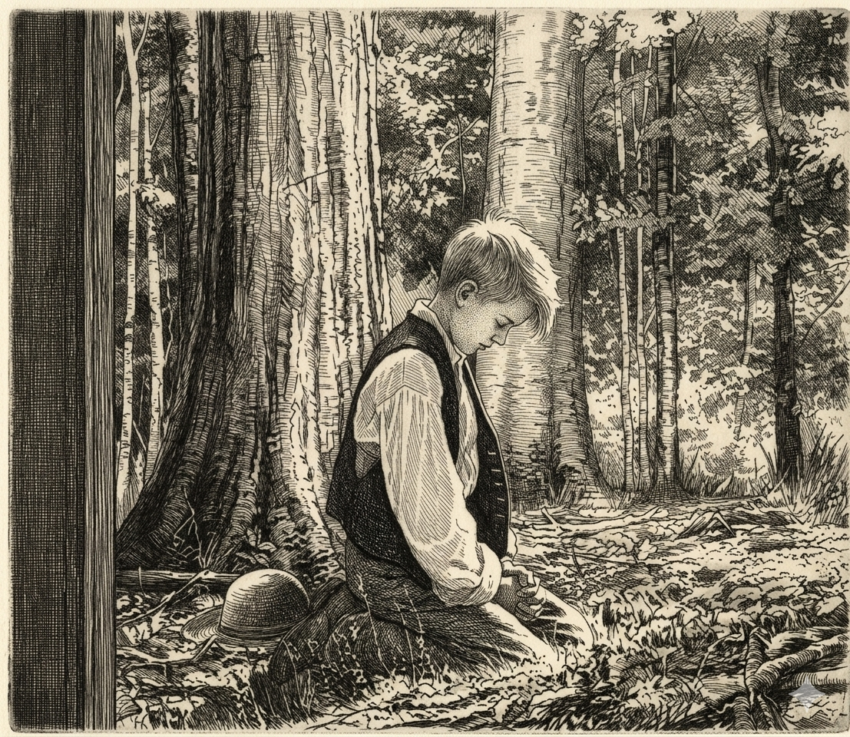
First: An Observation.
A casual observer who reads Joseph Smith’s “search for truth” as noted at BYU Studies, is met with an obvious question: “Joseph Smith (1805–1844) inhabited a visionary world and belonged to a visionary family. At about age twelve, he began to worry about his soul and started searching the Bible. As he compared the scriptures to the Christian denominations where he lived in western New York State, he found discord. For two or three years, he worried about “the darkness which pervaded the minds of mankind.” He became “exceedingly distressed” and “convicted” of his sins, a problem compounded by his inability to find any “society or denomination that built upon the gospel of Jesus Christ as recorded in the New Testament.”
That question is: If Joseph was using the scriptures, assuming it was the King James version of the Bible, and he was using it as an authoritative source, why did he not default to the clear teaching contained in its pages about salvation? Instead of immediately submitting the Word he held in his hands to prayer and supplication, he merely “went to the woods.”
THE WISDOM ALREADY IN HIS HANDS
James 1:5, the First Vision Accounts, and the Question of Scriptural Sufficiency
If any of you lack wisdom, let him ask of God, that giveth to all men liberally, and upbraideth not; and it shall be given him.
— James 1:5 (KJV)
It is the verse that sent a fourteen-year-old boy into the woods, and by his own later testimony, it changed the religious history of a continent. Joseph Smith would recount that, amid the revival fever of western New York, this single sentence “entered with great force into every feeling of my heart.” He read it, he said, and concluded he must either remain in darkness or do precisely what the verse instructed—ask of God. The casual reader of the Latter-day Saint origin story, encountering the line at BYU Studies and elsewhere, is rarely invited to slow down at this hinge. Yet the hinge is everything. The question that the verse is made to answer, and the question the verse actually answers in its own context, are not the same question at all.
James writes to scattered Christians “falling into divers temptations” (James 1:2). The wisdom he offers is not a celestial directory of true and false churches; it is the steadiness to endure trial without being “tossed” and “double-minded” (James 1:6–8). The promise is pastoral and practical: when suffering bewilders you, ask God for the wisdom to stand. To make the verse a charter for adjudicating denominational disputes is to lift it cleanly out of the paragraph that gives it meaning. And once that is seen, a sharper question presses upon the whole narrative—one that traditional Christian theology has every right to ask.
❦ ❦ ❦
The Question the Bible Already Answered
By the standard accounts, the young Joseph was not merely curious; he was convicted. He worried about his soul, felt the weight of his sins, and grieved over “the darkness which pervaded the minds of mankind.” This is the language of a man under conviction—and it is precisely here that the doctrine of Scripture comes to bear. For the Bible he held in his hands was not silent about the soul under conviction. It was, on the historic Christian view, abundantly, sufficiently, and clearly vocal.
Paul tells Timothy that “from a child thou hast known the holy scriptures, which are able to make thee wise unto salvation through faith which is in Christ Jesus” (2 Timothy 3:15). The text addressed to a sinner aware of his sin is not which church? but behold the Lamb of God. Repentance and faith in the finished work of Christ; justification freely by grace; the forgiveness of sins to all who call upon the name of the Lord—these are not buried mysteries requiring a new dispensation to unearth. They are the plain surface of the New Testament. The Reformers called this the perspicuity of Scripture: the conviction that the saving message is clear enough that a plowboy, or a farm boy in Palmyra, can grasp it directly from the page.
Here, then, is the observation that no amount of sympathy for a confused adolescent can dissolve. The distress Joseph described was soteriological—it concerned sin, the soul, and salvation. The answer to that distress was already in his hands. The proper response to scriptural conviction, in the historic Christian scheme, is submission to and obedience of what the Word already declares: to repent and believe. It is not the pursuit of an experiential confirmation that stands above, beside, or in judgment over the text. The man who is convicted by Scripture does not need a theophany to tell him what Scripture has already told him. He needs to bow.
❦ ❦ ❦
What the Accounts Reveal
The objection gains its real force not from theology alone but from Joseph’s own records—for he told the story more than once, and the versions do not say the same thing. There are at least four primary firsthand or dictated accounts, composed between 1832 and 1842, and the differences among them are not trivial embroidery. They mark a migration in the very nature of the problem the vision was summoned to solve.
The 1832 Account: A Soul Seeking Forgiveness
The earliest narrative, written in Joseph’s own hand in 1832, is strikingly personal and strikingly soteriological. Its burden is the welfare of his soul and the forgiveness of his sins. In it Joseph reports that he had already concluded from the Scriptures and the world around him that no denomination was living the gospel rightly—so the question of churches is, in a sense, settled before he prays. What he seeks in the woods is mercy. And what he reports receiving is exactly that: the Lord appears and says his sins are forgiven.
This is the detail that ought to arrest the careful Christian reader. In the earliest stratum of Joseph’s testimony, the climax of the vision is the very thing the New Testament already offers any penitent who comes to Christ—the assurance of pardon. The boy went to the woods to receive what the Word in his hands had been holding out to him the entire time.
The 1838 Account: A Boy Choosing a Church
The canonized 1838–39 account, the version most members know, has shifted its center of gravity. The soul’s forgiveness recedes; the ecclesiastical verdict advances. Now two Personages appear, and the decisive word is no longer “thy sins are forgiven” but a command to join none of the existing churches, “for they were all wrong” and their creeds “an abomination.” The all-or-nothing claim—every church false, every creed corrupt, a total apostasy requiring total restoration—is, in the documentary record, an emphasis that intensifies over time rather than one present with equal force from the first telling.
We need not allege fraud to notice the trajectory. Memory reshapes; later concerns recolor earlier events; a movement’s needs press upon its founding story. But the trajectory itself is the point. The earliest account describes a man receiving the gospel’s own answer to conviction; the later, canonized account reframes the episode as the founding charter of a new and exclusive church. The salvation problem has become a true-church problem—and the casual observer’s instinct, that something has been quietly relocated, is tracking a genuine seam in the evidence.
❦ ❦ ❦
The Category That Was Quietly Changed
This relocation is the theological crux, and it deserves to be named plainly. A man convicted of sin asks, in effect, “How shall I be saved?” The Bible answers him. A man founding a church asks, “Which institution carries divine authority?” That is a different question, and the necessity of the First Vision depends entirely upon substituting the second for the first. For if the Bible was sufficient and clear concerning salvation—and the historic church has always held that it was—then no new revelation, no restored priesthood, no additional testament was required to rescue a distressed boy from his sins. The very indispensability of the vision presupposes that Scripture alone could not resolve what, on the traditional reading, it plainly resolves.
And the irony folds back upon the prooftext. James 1:5, read in its own paragraph, never promised to tell anyone which church to join. It promised wisdom to endure trial. Had the verse been read as James wrote it, it would not have sent a soul searching for a new institution; it would have steadied a soul to trust the Christ already proclaimed in the same Bible. The text that supposedly authorized the search points, in context, in the opposite direction—toward steadfast faith in what had already been revealed.
A Pattern, Not an Episode
It would be a mistake to treat this misreading as the private stumble of one anxious boy. The same inversion of Scripture’s plain sense runs like a watermark through the whole founding generation of the movement. The men who would carry Mormonism forward did not come to it despite the Bible but through a shared habit of reading it—the habit of treating the sacred page not as the sufficient word that already answered the soul’s deepest need, but as a body of unresolved questions awaiting some fresh revelation to settle them. They read the New Testament and saw not a finished gospel to be believed, but a lost church to be restored.
Oliver Cowdery, Martin Harris, and the Whitmers came seeking signs and witnesses rather than resting in the testimony of the Word already given. Sidney Rigdon and Parley Pratt arrived from the restorationist ferment of the day, already conditioned to believe that the true church had vanished and must be rebuilt from the ground up—so that a Bible promising the gates of hell would not prevail against the church (Matthew 16:18) was read, against its own grain, as the chronicle of that church’s total collapse. Brigham Young would later confess he found the Bible alone insufficient and the sermons of Christendom empty until Mormonism gave him a key. In each case, the pattern is identical to Joseph’s own: the Scriptures are made to raise the question rather than supply the answer, and the answer is then sought outside them. The plainest truths of the gospel—grace, atonement, forgiveness, the abiding church of Christ—lay open on the page, and a whole generation walked past them in search of a door that the page itself had never said was locked.
❦ ❦ ❦
Anticipating the Reply
An honest treatment must grant the strongest Latter-day Saint response and weigh it fairly. The reply runs along three lines, and each merits a charitable hearing before an answer.
First, that Scripture itself models seeking God in prayer—Solomon asking for wisdom, Cornelius at prayer, Saul on the Damascus road. A bewildered boy praying for guidance is hardly unbiblical. True enough. Yet none of those figures sought a different gospel or a new church; each was brought into conformity with revelation already given. Saul, tellingly, is not handed a private substitute for the church but sent to Ananias and to the word the church already carried.
Second, that the Bible is authoritative only “as far as it is translated correctly” (Articles of Faith 1:8), and that the Great Apostasy had so corrupted text and interpretation that Scripture could not settle the matter unaided. This is the real fault line—and it is worth pressing rather than dodging, because it concedes the Protestant point. It admits that if Scripture were sufficient, the Restoration would be unnecessary, and it stakes everything on the apostasy premise. That premise, in turn, is vulnerable on its own ground: the doctrines Joseph reportedly could not find—Christ’s atonement, grace, repentance, forgiveness—are not obscure or corrupted readings buried in a damaged text. They are its plainest and best-attested teaching.
Third, that Joseph was young and the revival chaos was real. Granted, and gladly. But youth and confusion explain his distress; they do not establish the legitimacy of resolving that distress by extra-biblical vision rather than by the gospel lying open before him.
❦ ❦ ❦
The Seam Worth Working
The most useful way to carry this observation into conversation is not the easily parried charge that Joseph should have known better than to pray. It is the quieter, weightier point: the Bible he held already answered the question he was actually asking. His distress was over sin and the soul, and Scripture’s reply to that distress is Christ—not a survey of denominations, not a verdict on creeds, not a new church. The reframing of a salvation problem into a true-church problem is the move that necessitates everything that follows, and it is precisely the move the doctrine of Scripture’s sufficiency denies he ever needed to make.
This is not an argument to be wielded as a cudgel but a door to be opened gently. The Latter-day Saint neighbor across the street is, very often, a soul genuinely hungry for assurance—the same hunger the 1832 account so movingly records. The kindest thing a Christian can do is to point, as Peter directs, with “meekness and fear” (1 Peter 3:15), back to the wisdom that was always within reach: that the answer to a convicted heart is not a better church but a sufficient Savior, and that the Word giving Him is able to make thee wise unto salvation—no woods required.
❦ ❦ ❦
Sources & Further Reading
BYU Studies — “Raising the Stakes: How Joseph Smith’s First Vision Became All-or-Nothing”: https://byustudies.byu.edu/article/raising-the-stakes-how-joseph-smiths-first-vision-became-all-or-nothing
The Joseph Smith Papers — First Vision Accounts (1832, 1835, 1838, 1842): https://www.josephsmithpapers.org/site/accounts-of-the-first-vision
The Church of Jesus Christ of Latter-day Saints — Gospel Topics Essay, “First Vision Accounts”: https://www.churchofjesuschrist.org/study/manual/gospel-topics-essays/first-vision-accounts
A Note on Method
This essay was researched and drafted by Dennis Robbins for The Righteous Cause, examining Latter-day Saint origin claims from the standpoint of historic Christian theology and grounded in 1 Peter 3:15. Scripture quotations are from the King James Version. The argument engages Latter-day Saint sources directly and is offered to equip ordinary Christians for respectful, evidence-based dialogue rather than polemic. Composition was assisted by Claude AI, an AI writing tool under the author’s direction; all claims, sources, and conclusions were reviewed and are the responsibility of the author.