
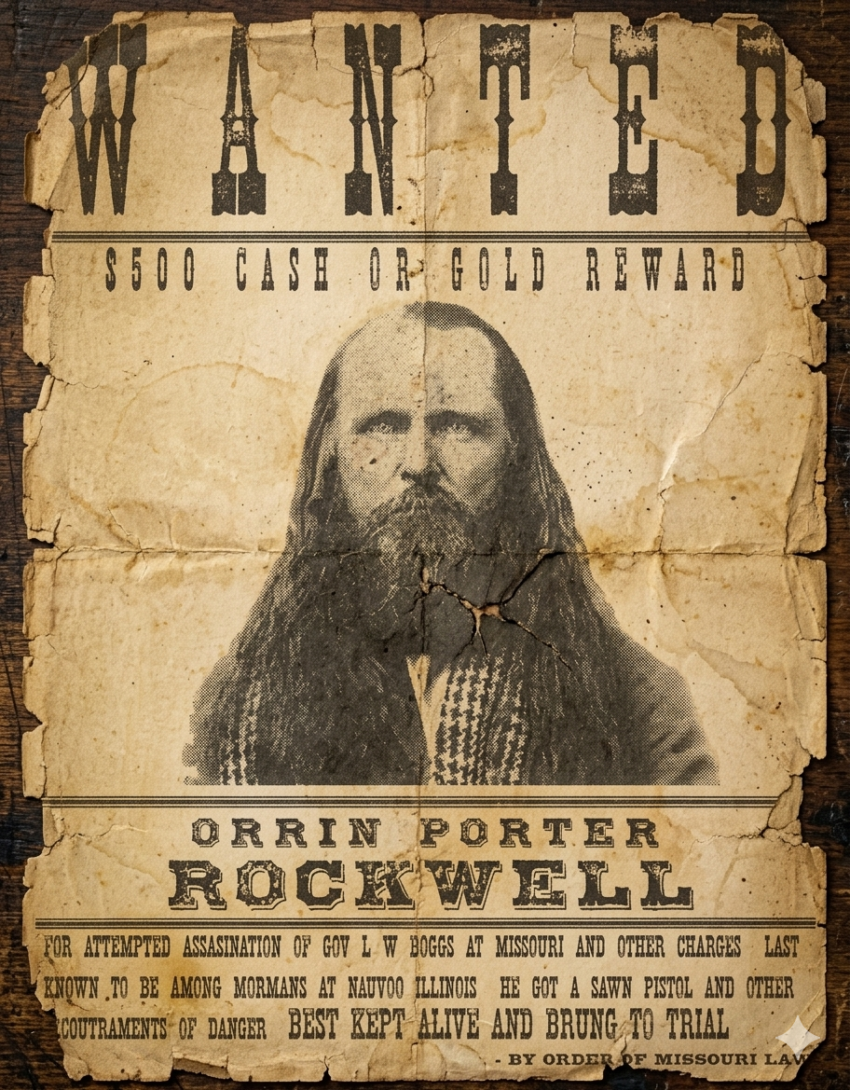
EARLY MORMON PERSONALITIES — SIXTEENTH INSTALLMENT
Cut Not Thy Hair: The Samson of Mormondom and the Cost of Misplaced Faith
❖ ❖ ❖
A Stranger at the Christmas Door
On Christmas night in 1843, a gaunt and filthy stranger pushed his way into the Mansion House at Nauvoo, Illinois, where Joseph Smith and his family were keeping the feast. The man’s hair fell wild past his shoulders; his clothes hung in tatters from a frame worn down by nine months in a Missouri jail. Mistaking him for a drunken Missourian come to make trouble, the Prophet ordered the captain of the police to throw the intruder into the street. A scuffle followed. Then Joseph looked the ruffian full in the face.
“during the festivities, a man apparently drunk, with his hair long & falling over his shoulders, came in and acted like a Missour[i]an. I commanded the capt of the police to put him out of doors in the scuffle. I lookd him full in the face and, to my gr[e]at supprize and Joy untold, I discove[re]d it was orren Porter Rockwell.”
— Joseph Smith, Journal, December 1843 (Joseph Smith Papers)
It is one of the most quietly arresting scenes in early Latter-day Saint history: the founding prophet of a new American religion, embracing in front of his guests a man the wider world would soon call “the Destroying Angel of Mormondom.” According to the legend that grew from that night, Joseph then made his friend a promise that would define the rest of Rockwell’s life—a pledge of supernatural protection so long as he never cut his hair. The echo of the biblical Samson was unmistakable, and it was meant to be.
Orrin Porter Rockwell would go on to become the most mythologized enforcer of the nineteenth-century Mormon frontier: gunfighter, lawman, scout, hotelier, brewer, bodyguard, and—by the accusation of his enemies and the suspicion of more than a few historians—a killer of men in the service of his church. He is a figure around whom fact and folklore are so tangled that his finest biographer despaired of ever fully separating them. Yet beneath the dime-novel legend lies a genuinely human story, and beneath that human story lies a theological question that ought to interest any thoughtful Christian: what happens to a sincere and fearless soul when its whole capacity for devotion is fixed upon a man and a movement rather than upon Christ?
This essay attempts to recover Porter Rockwell, the man—born into the religious ferment of the early republic, swept up in the rise of a new faith, and forged on the anvil of persecution and frontier violence—while taking with equal seriousness the doctrines that gave his loyalty its shape. He was, as one observer wrote, “a strange mixture, only to be found on the American Continent.” He was also a mirror in which the convictions of early Mormonism are reflected with unusual and sometimes uncomfortable clarity.
❖ ❖ ❖
Origins and Early Life
Orrin Porter Rockwell was born on or about June 25, 1813, in the section of Belchertown, Massachusetts, known with frontier bluntness as the “Dark Corner.” His parents, Orin and Sarah Witt Rockwell, were New England farming people of modest means, the kind of family for whom land, weather, and providence were daily and inseparable concerns. Both parents had been caught up in the rolling waves of religious revival that historians call the Second Great Awakening—the great spiritual weather system of the early American republic, which scattered camp meetings, conversions, and competing prophets across the countryside like seed.
When Porter was about four years old, the Rockwells joined the westward stream of New Englanders pouring into the fertile country of western New York. They settled near Manchester and Palmyra, in a region so scorched by successive revivals that it earned the name the “Burned-over District.” There, the Rockwells became neighbors—their farm roughly a mile distant—of another transplanted family of seekers: the Smiths of Vermont, whose son Joseph was then a boy of eleven.
A Friendship Forged in Poverty
The two families were on friendly terms, and the boys formed a bond that would outlast everything. Porter was some seven and a half years younger than Joseph, but the gap closed in the easy democracy of frontier labor. Both carried a physical mark of their hard beginnings: each walked with a limp, Joseph from a childhood leg surgery and Porter from a bone that had been set badly, leaving one leg shorter than the other. In the imagery later beloved of Latter-day Saint storytellers, the two limping boys became fast friends, and the younger man’s devotion to the elder was sealed long before either understood where it would lead.
That devotion was tested early in the most practical of ways. When Joseph Smith’s family lacked the funds to publish the Book of Mormon, the teenage Porter is said to have picked berries by night and hauled wood into town by day to help raise the money. Whatever the precise truth of the anecdote, it captures something essential about Rockwell that the documentary record consistently confirms: his loyalty was physical, costly, and rendered in deeds rather than words. This was a temperament, not a theology—but the theology, when it came, would attach itself to that temperament with extraordinary force.
One later reminiscence, gathered by an assistant church historian from an elderly Latter-day Saint woman, preserves a glimpse of the watchful boy:
“Joseph Smith’s father and mother used to come to his father’s house and tell his parents of the wonderful things that were being revealed to their son Joseph. Bro. Rockwell said that he used to watch for their coming and plead with his mother to let him stay up.”
— Elizabeth D. E. Roundy, recollection of Rockwell (Church History Library, MS 11894)
The detail is poignant and revealing. Before Porter Rockwell ever fired a shot in anger, he was a child straining to catch the words of the visitors who spoke of revelations from heaven. The hunger for the marvelous, for a religion of present-tense angels and tangible miracles, took root in him young.
❖ ❖ ❖
Spiritual Quest and the Path to Mormonism
It is one of the ironies of Rockwell’s story that, unlike many of the early converts whose biographies fill this series, he left almost no record of an inward spiritual struggle. He could barely read and never learned to write; the letters that survive under his name were dictated to scribes. We have no journal of doubts, no anguished account of seeking and finding. What we have instead is proximity. Where other men came to Joseph Smith through argument or vision, Porter Rockwell came to him through the long, unliterary intimacy of a neighbor and friend who had heard the new gospel from the inside before it was a gospel at all.
This matters theologically. The classic Christian conversion narrative—conviction of sin, the hearing of the Word, repentance, faith in Christ—requires a measure of reflection that the sources simply do not show in Rockwell. His was a conversion of allegiance rather than of doctrine. He attached himself to a person and to a people, and the propositions came afterward, if they came in any examined form at all. The Burned-over District had produced in him not a theologian but a partisan, and the object of his partisanship was Joseph Smith.
The Youngest of the First
When the Church of Christ was organized in Fayette, New York, in the spring of 1830, Porter Rockwell was baptized into it—by tradition on April 6, the very day of the church’s founding, though some documents point to a date a few weeks later. He was sixteen, and likely the youngest of that founding cohort. From that moment the trajectory of his life was set. As the infant church migrated to Kirtland, Ohio, and then dispatched its members toward the gathering-place in Jackson County, Missouri, Rockwell went with it. In Missouri, in February 1832, he married Luana Hart Beebe; there, too, on the violent frontier, he became a skilled and increasingly feared hand with firearms.
The reader schooled in historic Christianity should pause here over what conversion meant in this setting. To join the Latter-day Saints was not merely to accept a set of beliefs but to enter a covenant people gathering to a literal Zion, governed by a living prophet who spoke new scripture and issued binding commands. The center of gravity was not, as in the New Testament church, the finished work of Christ proclaimed to the nations (1 Corinthians 15:3–4), but an ongoing restoration mediated through a single charismatic figure. For a man of Rockwell’s temperament—loyal, physical, hungry for the marvelous, untroubled by abstraction—such a faith was not a system to be examined but a chief to be followed. He followed.
❖ ❖ ❖
Protector of the Prophet: Rockwell’s Role in the Movement
Rockwell’s significance to early Mormonism was never doctrinal. He preached no sermons of note, authored no revelations, and held no high office in the church’s teaching hierarchy. His role was that of the loyal right hand—the man who did the dangerous and unglamorous work that kept the prophet alive and the movement intact. In an era when the Latter-day Saints were hounded from county to county and state to state, that work was indispensable, and it was bloody.
During the Missouri conflicts of the late 1830s, Rockwell was associated with the Danites, the secretive armed band that arose among the Saints to defend the community and enforce loyalty. Even his sympathetic biographer Harold Schindler concedes that Rockwell’s precise activities in Missouri are difficult to trace; he was, at this stage, a minor and shadowy figure whose movements the record only dimly preserves. But the pattern of his life was already forming: where the church was threatened, Porter Rockwell appeared, armed and willing.
Liberty Jail and the Smuggled Augers
The most cherished of the early stories belongs to the winter of 1838–39, when Joseph Smith lay imprisoned in the notorious Liberty Jail. Rockwell, by the affectionate tradition, served as the prophet’s messenger and supplier, bringing food and comfort—and, the legend insists, smuggling in the augers with which the prisoners bored at the four-foot walls. Whether or not the augers are historical (the Church History Library treats the tale with caution), the impulse behind the story is well attested. When other men debated and dissembled, Rockwell carried the bread and dug at the wall.
By the Nauvoo years of the early 1840s, Rockwell had become one of Joseph Smith’s most trusted personal protectors. The modern word “bodyguard” oversimplifies the relationship—the church’s own historians are careful to note that he never held such a post in any formal, modern sense—but in substance he was exactly that: the friend who stood between Joseph and his enemies. It was Rockwell who, when the Smith brothers fled across the Mississippi in June 1844 ahead of arrest, rowed the leaking boat through the night while Joseph and Hyrum bailed water with their boots. When the brothers wavered over whether to return and face certain arrest, Rockwell’s answer was the plain creed of his whole life:
“As you make your bed I will lay with you.”
— Orrin Porter Rockwell to Joseph Smith, June 1844 (History of the Church, 6:549)
He rowed them back. He walked with them part of the way to Carthage, until Joseph, fearing for his friend’s safety, sent him home. It was the last time Rockwell saw the prophet alive. When word came of the murders at Carthage Jail, the stricken Rockwell is remembered to have said, “They killed the only friend I ever had.” Whether or not the words are verbatim, they are true to the man. His religion had a human face, and that face had just been shot dead through a jailhouse window.
❖ ❖ ❖
Blood and Suspicion: The Controversies of a Hunted Life
If Rockwell’s loyalty was his glory, the uses to which it was put became the great shadow over his name. Three episodes in particular—the shooting of Lilburn Boggs, the killing of Frank Worrell, and the Aiken affair—fixed his reputation as the “Destroying Angel,” and each repays careful, fair-minded attention.
The Shooting of Lilburn Boggs
Lilburn W. Boggs was the governor of Missouri who, on October 27, 1838, issued the infamous Executive Order 44—the “Extermination Order”—directing that the Mormons “must be treated as enemies, and must be exterminated or driven from the state.” In the violence that followed, Latter-day Saints were robbed, beaten, raped, and murdered; the Haun’s Mill massacre was its blackest hour. To the Saints, Boggs was the author of their suffering.
On the evening of May 6, 1842, an unknown assailant fired through the window of Boggs’s study in Independence as the former governor read his newspaper. Boggs was gravely wounded but survived. Suspicion fell at once upon the Mormons, and soon upon Rockwell in particular. The accusation was given its sharpest form by John C. Bennett, a recently excommunicated Mormon turned bitter enemy, who published a letter implicating both Rockwell and Smith:
“In 1841, Joe Smith predicted or prophesied in a public congregation in Nauvoo, that Lilburn W Boggs, ex-Governor of Missouri, should die by violent hands within one year. From one or two months prior to the attempted assassination of Gov. Boggs, Mr. O. P. Rockwell left Nauvoo for parts unknown. I was then on terms of close intimacy with Joe Smith, and asked him where Rockwell had gone? “Gone,” said he, “GONE TO FULFILL PROPHECY!””
— John C. Bennett, Sangamo Journal, July 15, 1842
Smith and his followers denied the account vehemently. Rockwell was eventually arrested, jailed in Missouri for some nine months, and yet—crucially—never indicted for the shooting. A grand jury found insufficient evidence to charge him with attempted murder; he was convicted only of a trifling jailbreak, for which the jury, perhaps moved by the months he had already served, imposed a sentence of five minutes. The historical verdict remains genuinely divided. Schindler believed Rockwell probably did it, resting partly on a later report that Rockwell admitted as much to a federal officer. Others, including the historian Monte B. McLaws, point out that a hostile Missouri jury would have seized on any real evidence that Boggs had political enemies aplenty, and that Bennett was a notoriously unreliable witness, and conclude that Rockwell was likely innocent. The honest answer is that we do not know.
What is theologically arresting is not the ballistics but Bennett’s phrase: “gone to fulfill prophecy.” Whether or not Joseph Smith ever uttered such a prediction, the very plausibility of the accusation reveals a worldview in which a prophet’s word might be made true by a loyal man’s rifle. The biblical test of a prophet runs precisely the other way: “when a prophet speaketh in the name of the LORD, if the thing follow not, nor come to pass” (Deuteronomy 18:22), the word was not from God. A prophecy that requires a confederate with a gun to come true is not vindicated by its fulfillment; it is exposed by it.
The Killing of Frank Worrell
After Joseph Smith’s death, open warfare smoldered between the Saints and their neighbors in Hancock County, Illinois. On September 16, 1845, Rockwell shot and killed Lieutenant Frank Worrell—who had commanded the guard at Carthage Jail on the day the Smiths were murdered—during a confrontation in which the non-Mormon sheriff William Backenstos had deputized Rockwell and others. The church has consistently framed the killing as lawful self-defense under the sheriff’s authority; some accounts add the striking detail that Rockwell later returned to Nauvoo on Brigham Young’s instructions, deliberately to be arrested, drawing the wrath of the mob onto himself and away from the impoverished Saints preparing to flee west. He was tried and acquitted. Here again, the line between lawman and avenger blurs, as it would for the rest of his career.
The Utah Years and the Aiken Affair
Following the exodus, Rockwell entered the Salt Lake Valley with Brigham Young’s vanguard company in July 1847. In 1849, he was appointed a deputy marshal of Great Salt Lake City, and he remained a peace officer until his death, while also running the Hot Springs Hotel and Brewery at the Point of the Mountain and serving as a guide and mail carrier. In this period, his enforcement work hardened. In 1851, leading a posse in pursuit of Goshute and Ute people accused of taking horses, Rockwell personally executed several captives after a botched confrontation—an act of frontier brutality that the romantic legend rarely pauses over.
Darkest of all is the Aiken affair of 1857, during the tense months of the Utah War. Six Californians—gamblers suspected by Mormon leaders of spying for the approaching federal army—were escorted from the territory and murdered en route; the killings have long been laid, at least in part, at Rockwell’s door. He was indicted for the crime two decades later, but died before he could be tried. The truth remains shrouded, but the suspicion was not idle. To his admirers, Rockwell answered such charges with the line that became his epitaph in the popular imagination:
“I never killed anyone who didn’t need killing.”
— Attributed to Orrin Porter Rockwell, c. 1869
It is a line that John Wayne would later borrow for the screen, and it has been quoted ever since with a certain admiring frontier swagger. But set beside the executed Goshute captives and the murdered Aiken brothers, the swagger curdles. The phrase assumes the very thing a Christian conscience cannot grant: that a private man, however loyal, may sit in final judgment over who deserves to die.
❖ ❖ ❖
Eyewitness Perspectives: How Contemporaries Saw Him
Few figures of the frontier were described in such contradictory terms by those who actually met them. The most penetrating portrait comes from the travel-writer Fitz Hugh Ludlow, who encountered Rockwell in 1860 and left a description that no biographer has been able to improve upon:
“He was that most terrible instrument that can be handled by fanaticism; a powerful physical nature welded to a mind of very narrow perceptions, intense convictions, and changeless tenacity. In his build, he was a gladiator; in his humor, a Yankee lumberman; in his memory, a Bourbon; in his vengeance, an Indian. A strange mixture, only to be found on the American Continent.”
— Fitz Hugh Ludlow, The Heart of the Continent, 1870
Ludlow’s phrase—“the most terrible instrument that can be handled by fanaticism”—is worth dwelling upon, for it locates the moral problem exactly where a Christian analysis would: not in the strength of the man but in the cause that wielded it. A “powerful physical nature welded to” narrow perceptions and “changeless tenacity” is a description of misdirected zeal, of devotion uncoupled from discernment.
The explorer Sir Richard Francis Burton, who shared a long evening and a bottle of Valley Tan whiskey with Rockwell, found him a gracious and shrewd frontiersman, full of practical wisdom about surviving the trail. Hostile contemporaries saw something else entirely. A correspondent recalling Salt Lake City wrote, in the secular press of the period, of the dread that clung to the man:
“Porter Rockwell, with his long, wild locks flowing over his shoulders, and his running mate, Brig Hampton, bore the reputation of being the two leading destroying angels of the Mormon Church.”
— Reno Evening Gazette, February 1891
And at the end, the contradiction was preached over his very grave. The funeral eulogy delivered by the apostle Joseph F. Smith—nephew of the founding prophet and a future president of the church—did not deny the accusations so much as transcend them by appeal to loyalty:
“They say he was a murderer; if he was, he was the friend of Joseph Smith and Brigham Young, and he was faithful to them, and to his covenants, and he has gone to Heaven and apostates can go to Hell.”
— Joseph F. Smith, funeral eulogy for Orrin Porter Rockwell, June 1878
The Salt Lake Tribune, no friend of the church, answered the eulogy within days: “Porter Rockwell is another of the long list of Mormon criminals whose deeds of treachery and blood have reddened the soil of Utah.” Between the apostle’s heaven and the newspaper’s indictment lies the whole unresolved question of the man—and, behind him, of the movement that claimed him.
❖ ❖ ❖
Theological Departure from Biblical Christianity
Porter Rockwell was no doctrinal innovator, but precisely because he was a plain man of action, his life displays the practical theology of early Mormonism in unusually pure form. Three doctrines in particular shaped him, and each marks a real departure from historic Christian teaching.
The Samson Prophecy and the Talisman of the Hair
At the heart of the Rockwell legend stands the prophecy attributed to Joseph Smith at that Christmas gathering in 1843:
“I prophesy, in the name of the Lord, you—Orrin Porter Rockwell—so long as ye shall remain loyal and true to thy faith, need fear no enemy. Cut not thy hair, and no bullet or blade can harm thee.”
— Attributed to Joseph Smith; earliest source a manuscript by James Jepson (in Schindler, Man of God, Son of Thunder)
The biblical allusion is deliberate. In Judges 13–16, an angel promises the barren wife of Manoah a son who shall be a Nazirite “from the womb,” upon whose head no razor shall come. But the point of Samson’s long hair was never that the hair itself held power; it was the outward sign of a vow of consecration to God. Samson’s strength was the Spirit of the LORD coming upon him (Judges 14:6), and his catastrophe came not from a haircut as such but from the breaking of his consecration—the betrayal of the covenant the hair symbolized. The Rockwell prophecy quietly inverts this. The uncut hair is transformed from a sign of consecration into a charm of invulnerability, a frontier talisman. When Rockwell at last cut his hair to weave a wig for a widowed sister-in-law left bald by typhoid fever—an act of real tenderness—he reportedly blamed his subsequent weakness for whiskey and swearing on that single haircut. The logic is the logic of magic, not of grace. Scripture knows nothing of protective hair; it knows of a God who is our refuge and strength (Psalm 46:1) and who is no respecter of talismans.
The “Destroying Angel” and the Doctrine of Blood
Rockwell’s grim nickname draws on the biblical destroying angel—the agent of judgment in Exodus 12 and 2 Samuel 24. To apply such a title to a human enforcer is to claim for a man a prerogative Scripture reserves to God alone. The deeper backdrop is the doctrine of blood atonement preached in Utah under Brigham Young: the teaching that certain grievous sins were so serious that the shedding of the sinner’s own blood was required for their remission, beyond the atonement of Christ. Whatever the precise extent of its practice—a matter of long historical dispute—the doctrine supplied the moral atmosphere in which a “destroying angel” could be imagined as doing God’s work with a shotgun.
Here, the contrast with the New Testament is total. The book of Hebrews declares that “without shedding of blood is no remission” (Hebrews 9:22)—and then proclaims, decisively, that the blood required has already been shed, once for all, by Christ: “we are sanctified through the offering of the body of Jesus Christ once for all” (Hebrews 10:10), and “by one offering he hath perfected for ever them that are sanctified” (Hebrews 10:14). The whole point of the gospel is that no further blood—least of all the sinner’s own, shed by a human avenger—can add anything to a finished work. And vengeance itself is expressly removed from human hands: “Dearly beloved, avenge not yourselves… Vengeance is mine; I will repay, saith the Lord” (Romans 12:19).
Salvation by Loyalty: The Theology of the Epitaph
Perhaps the clearest doctrinal departure is carved on Rockwell’s headstone in the Salt Lake City Cemetery:
“He was brave and loyal to his faith. True to the Prophet Joseph Smith. A promise made him by the prophet. Through obedience, it was fulfilled.”
— Epitaph of Orrin Porter Rockwell, Salt Lake City Cemetery
Read it slowly. The structure of the man’s hope, as his church understood it, runs: promise → obedience → fulfillment. Loyalty to the prophet is the hinge of the whole sentence. This is the architecture of a covenant of works, and it is exactly the architecture the New Testament dismantles. “By grace are ye saved through faith; and that not of yourselves: it is the gift of God: not of works, lest any man should boast” (Ephesians 2:8–9). The eulogy’s confidence that Rockwell “has gone to Heaven” rests not on the finished work of Christ received by faith but on a lifetime of fidelity to Joseph Smith and Brigham Young. The apostle Paul anticipated the danger precisely: “Though we, or an angel from heaven, preach any other gospel unto you than that which we have preached unto you, let him be accursed” (Galatians 1:8). A gospel anchored in loyalty to a prophet is, by that exacting standard, another gospel.
❖ ❖ ❖
Character Study: The Tragedy of a Faithful Heart
To portray Porter Rockwell as a mere thug would be both unjust and untrue. The same man who executed prisoners on the trail cut off the hair he believed to be his shield to comfort a sick and balding widow. The same man feared as the Destroying Angel was, by Burton’s testimony, generous and shrewd around a campfire, freely sharing the hard-won wisdom that might keep a stranger alive. He fathered some twenty-one children, kept hotels, carried the mail, and was mourned by nearly thirteen hundred people at his funeral. His loyalty, whatever its objects, was real, costly, and lifelong—a virtue genuinely admirable in itself.
And that is precisely where the tragedy lies. Scripture has a category for Rockwell, and it is not the category of the villain but of the zealot. Of his own pre-conversion self, the apostle Paul wrote that he had been “zealous toward God” (Acts 22:3) and “concerning zeal, persecuting the church” (Philippians 3:6)—a man whose sincerity and energy were beyond question and whose cause was catastrophically mistaken. Of his fellow Israelites, Paul wrote the line that fits Rockwell as if tailored: “they have a zeal of God, but not according to knowledge” (Romans 10:2).
This is the heart of a fair moral evaluation. Rockwell’s great strength—the totalizing loyalty that made him useful, fearless, and beloved—was also his great blindness, because it was loyalty to a man rather than to the truth, and it never paused to ask whether the chief it served could command it to sin. He obeyed; he did not weigh. The New Testament knows a higher law: “We ought to obey God rather than men” (Acts 5:29). A conscience that cannot, in principle, disobey its leader has surrendered the very faculty by which it might have been saved from its leader’s errors. Rockwell’s contradictions—the tenderness and the killing, the faith and the violence—are not really contradictions at all. They are what happens when a single, undivided devotion is poured out upon an unworthy object. The fault, the Christian must finally say, lies less in the loyalty than in its aim.
❖ ❖ ❖
Legacy and the Manufacture of a Folk Hero
Rockwell died of natural causes on June 9, 1878—a quiet end for so violent a life. He had taken his daughter to the theater the night before; he complained of chills, fell unconscious, and could not be revived. At the time of his death, he had been a baptized Latter-day Saint longer than any living person. His grave, his statues at Lehi and at the Point of the Mountain, the trail and the restaurant that bear his name, and three full-length biographies attest to a posthumous fame that has only grown.
That fame, however, has come at the cost of the historical man. Harold Schindler, whose 1966 biography remains the standard work, frankly set himself the task of writing “the history of a myth, a folk legend, not less than the history of a man,” and even he, with all his primary research, could not finally say where Rockwell the man ended and “Old Port” the legend began. Much of the most colorful material descends, as the reviewer Richard Cracroft noted, from frankly hostile and unreliable sources such as the pseudonymous pamphlet The Destroying Angels of Mormondom, while much of the most faith-promoting material descends from oral tradition gathered decades after the fact.
Sanitizing the Son of Thunder
The framing of Rockwell’s story illustrates, with unusual clarity, the broader pattern of Latter-day Saint historical revisionism that this series has traced again and again. The instinct is not crude suppression—the modern church does not hide that Rockwell was accused of killing—but selective softening. Consider how the official record manages the man. The church’s own children’s magazine, The Friend, ran a 1984 article holding Porter Rockwell up “as an example for Latter-day Saint children,” built around the gentle story of his carrying food to the prisoners at Liberty Jail, while the executions, the Aiken affair, and the indictment for murder do not trouble the page.
More sophisticated is the careful work of the present-day Church History Library, which in a widely shared “Ask Us” article addresses the hard questions with real candor—acknowledging the thinness of the sources, the second-hand nature of the prophecy accounts, Rockwell’s illiteracy—and yet, on the Boggs shooting, leans toward the verdict of innocence and reframes the bodyguard relationship as something softer:
“while Porter never served as Joseph’s bodyguard in a modern sense, he was definitely his close friend and protector.”
— Church History Library, “Ask Us: Top Five Reference Questions about Orrin Porter Rockwell,” 2021
This is not dishonesty; it is curation. The difficult material is admitted but framed, contextualized, and gently subordinated to the faith-promoting arc, while the prophecy of the uncut hair is presented as plausibly true, and the eulogy’s assurance of heaven goes unexamined. The effect, accumulated across a children’s magazine, a reference article, a trail, and a statue, is the steady transformation of a frontier enforcer accused of multiple killings into a lovable, larger-than-life Samson of the Restoration—“Man of God, Son of Thunder.” The thunder is celebrated; the blood is managed.
For the historian and the Christian alike, the antidote is the same: the patient preference of documented evidence over cherished legend, and the willingness to let a man be as complicated as he actually was. Rockwell deserves neither the demonization of his enemies nor the sanctification of his church. He deserves the truth.
❖ ❖ ❖
Conclusion: Cut Not Thy Hair
Porter Rockwell believed that his life hung on a strand of uncut hair and a promise spoken by a prophet at a Christmas party. He kept the faith of that promise to the end, and his church carved his obedience into stone. There is something genuinely moving in such constancy—and something genuinely tragic, for the New Testament offers a security that no talisman and no leader can supply. “Who shall separate us from the love of Christ?” Paul asks, and answers that neither death nor life nor any created thing can do so (Romans 8:35–39). That is the true invulnerability, and it is grounded not in a man’s loyalty but in God’s.
The story of the Destroying Angel is, in the end, a parable about the direction of devotion. Rockwell had a heart built for fidelity, fearless and entire. Had that heart been fixed upon Christ and tested against His Word, the same man might have been not a son of thunder but a son of consolation. The lesson is not for Latter-day Saints alone. Every age tempts the faithful to attach their whole loyalty to a leader, a movement, a cause—and to silence the conscience that would weigh the chief’s commands against the will of God. Porter Rockwell’s long shadow falls as a warning across that temptation. Be loyal, the gospel says, but be loyal to the One who is worthy, and “be ye not the servants of men” (1 Corinthians 7:23).
❖ ❖ ❖
Primary Sources & Further Reading
This narrative draws on the documentary record assembled in the standard biographies and the following published sources. Quotations from nineteenth-century materials (Joseph Smith’s journal, John C. Bennett’s Sangamo Journal letter, Fitz Hugh Ludlow, the funeral eulogy, the Salt Lake Tribune, and contemporary newspapers) are cited within the text and reproduced from the sources below.
• Wikipedia, “Orrin Porter Rockwell” — https://en.wikipedia.org/wiki/Porter_Rockwell
• Church History Library, “Ask Us: Top Five Reference Questions about Orrin Porter Rockwell” — https://history.churchofjesuschrist.org/blog/ask-us-top-five-reference-questions-about-orrin-porter-rockwell?lang=eng
• Harold Schindler review, “Man of God, Son of Thunder” (BYU Studies) — https://byustudies.byu.edu/article/orrin-porter-rockwell-man-of-god-son-of-thunder
• BYU Studies, “Orrin Porter Rockwell” — https://byustudies.byu.edu/article/orrin-porter-rockwell
• BYU Studies, “The Boggs Shooting and Attempted Extradition” — https://byustudies.byu.edu/article/the-boggs-shooting-and-attempted-extradition-joseph-smiths-most-famous-case
• LDS Living, “The Most Famous Porter Rockwell Stories: Fact or Fiction?” — https://www.ldsliving.com/the-most-famous-porter-rockwell-stories-fact-or-fiction-church-history-library-explains/s/94474
• LDS Living, “The Gunslinging General Authority … 7 Facts” — https://www.ldsliving.com/the-gunslinging-general-authority-who-went-to-prison-on-the-prophets-orders-7-unbelievable-facts-about-porter-rockwell/s/77142
• Legends of America, “Porter Rockwell — Destroying Angel of Mormondom” — https://www.legendsofamerica.com/porterrockwell/
• Intermountain Histories, “Orrin Porter Rockwell” — https://www.intermountainhistories.org/items/show/15
• Latter-day Saint Magazine, “Porter Rockwell” — https://latterdaysaintmag.com/article-1-5724/
• Post Register, “Days of ’47: Porter Rockwell, a Frontiersman Above All” — https://www.postregister.com/chronicle/features/days-of-47-porter-rockwell-a-frontiersman-above-all-else/article_9663ba72-d7d4-5cb4-8f61-f1704d0461d9.html
• Jacob Barlow, “Orrin Porter Rockwell” — https://jacobbarlow.com/2026/01/04/orrin-porter-rockwell-3/
• Latter Day Light, “Orrin Porter Rockwell” — https://latterdaylight.com/orrin-porter-rockwell/
• Book of Mormon Evidence, “The Porter Rockwell Project” — https://bookofmormonevidence.org/the-porter-rockwell-project-prp/
• Porter Rockwell Timeline — https://porter-rockwell.com/timeline/
• John W. Rockwell, Stories from the Life of Porter Rockwell (Amazon) — https://www.amazon.com/Stories-Life-Porter-Rockwell-John/dp/1621087360
❖ ❖ ❖
A Note on Research Methods and Accuracy
In recent years, some have voiced concern that artificial intelligence may distort facts or introduce inaccuracies into serious research. That criticism deserves acknowledgment. However, AI has now evolved into the most powerful research instrument available to any dedicated scholar—capable of analyzing vast datasets, cross‑referencing historical records, and surfacing overlooked connections across sources. This work represents a collaboration between the author’s investigative inquiry, verified primary documentation, and the advanced analytic capabilities of AI research tools. Here, AI was not used as a ghostwriter or a shortcut for scholarship, but as a disciplined research partner devoted to rigor, accuracy, and transparency.
Every factual claim in this work has been subjected to active verification. Where AI‑generated content was used as a starting point, it was tested against primary sources, peer‑reviewed scholarship, official institutional documentation, and established historical records. Where discrepancies were found—and they were found—corrections were made. The author has made every reasonable effort to ensure that quotations are accurately attributed, historical details are precisely rendered, and theological claims fairly represent the positions they describe or critique.
That said, no work of this scope is immune to error, and the author has no interest in perpetuating inaccuracies in the service of an argument. If you are a reader—whether sympathetic, skeptical, or hostile to the conclusions drawn here—and you identify a factual error, a misattributed source, a misrepresented teaching, or a claim that cannot be substantiated, you are warmly and genuinely invited to say so. Reach out. The goal of this work is not to win a debate but to get the history right. Corrections offered in good faith will be received in the same spirit, and verified corrections will be incorporated into future editions without hesitation.
Truth, after all, has nothing to fear from scrutiny—and neither does this work.