
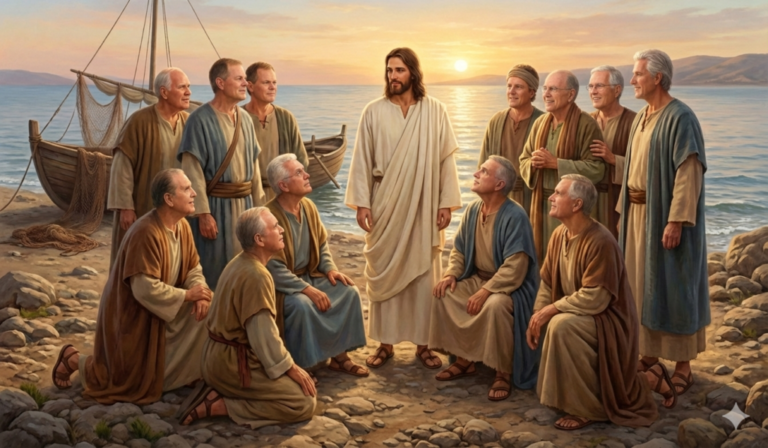
Image: Google Gemini’s Nano Banana imagines the Quorum of the
Twelve Apostles meeting with Jesus for some prophetic updates.
A Comprehensive Biblical and Theological Analysis
Borrowed Names, Vanished Signs
❖ ❖ ❖
Introduction: A Claim That Bears All the Weight
The Church of Jesus Christ of Latter-day Saints stakes everything on a single, breathtaking assertion: that God still speaks through living prophets and apostles who hold the very same authority, power, and divine mandate as Moses, Isaiah, Peter, and Paul. This is not a footnote to Mormon theology. It is the load-bearing wall. Remove it, and the temples, the exclusive priesthood, and the claim to be “the only true and living church upon the face of the whole earth” (D&C 1:30) have nothing left to stand on.
Because the claim carries so much weight, it deserves to be tested—not with hostility, but with the same measuring rod the Bible applies to anyone who says, “Thus saith the Lord.” Official LDS teaching frames the office this way:
A prophet is someone who has been called by God to give guidance to the entire world. From Abraham and Moses to living prophets today, God follows a pattern of guiding His children through prophets.
— The Church of Jesus Christ of Latter-day Saints, churchofjesuschrist.org
This essay asks one question and follows the evidence wherever it leads: do the prophetic and apostolic offices of the modern LDS Church genuinely resemble their biblical originals, or are they something else entirely, wearing borrowed names? We will let both Scripture and the Church’s own sources speak for themselves, with respect for sincere Latter-day Saints and without softening the conclusions the evidence demands.
❖ ❖ ❖
The Biblical Pattern of Prophets and Apostles
What a Prophet Was
In the Hebrew Scriptures, the prophet (nabi’) was God’s covenant messenger—never self-appointed, but divinely drafted, often against his will. Moses (Exodus 3), Samuel (1 Samuel 3), Isaiah (Isaiah 6), Jeremiah (Jeremiah 1), and Ezekiel (Ezekiel 1–3) did not volunteer; the call interrupted their lives. Jeremiah felt the word as “a burning fire shut up in my bones” (Jeremiah 20:9), and Jonah fled from it (Jonah 1:1–3).
Four marks defined the office. First, prophets received direct divine revelation:
Numbers 12:6 — If there be a prophet among you, I the Lord will make myself known unto him in a vision, and will speak unto him in a dream.
Second, they were covenant mediators calling Israel back to faithfulness, not innovators introducing new covenants (Jeremiah 6:16). Third, they showed extraordinary moral courage, confronting kings at personal cost—Nathan rebuking David (2 Samuel 12), Elijah facing Ahab (1 Kings 18), Jeremiah imprisoned for his message (Jeremiah 37–38). Fourth, hundreds of prophecies pointed with precision to Christ—the virgin birth (Isaiah 7:14), Bethlehem (Micah 5:2), the suffering servant (Isaiah 53), the Messianic timeline (Daniel 9:24–27). The office existed to prepare God’s people for the Messiah.
What an Apostle Was
The apostolic office was a distinct New Testament development with non-negotiable qualifications. First, apostles were chosen personally by Christ: “Ye have not chosen me, but I have chosen you” (John 15:16). Second, and decisively, they were eyewitnesses to the resurrection. When the Eleven replaced Judas, the criterion was explicit:
Acts 1:21–22 — So one of the men who have accompanied us during all the time that the Lord Jesus went in and out among us, beginning from the baptism of John until the day when he was taken up from us—one of these men must become with us a witness to his resurrection.
Third, their ministry was confirmed by “the signs of an apostle”—wonders, healings, and mighty works (2 Corinthians 12:12; Hebrews 2:3–4). Fourth, the office was foundational, not perpetual:
Ephesians 2:20 — [The church is] built upon the foundation of the apostles and prophets, Jesus Christ himself being the chief corner stone.
Foundations are laid once. The New Jerusalem bears “twelve foundations, and in them the names of the twelve apostles of the Lamb” (Revelation 21:14)—a fixed number commemorating a completed work.
The Office Fulfilled in Christ
The prophetic office always pointed beyond itself to a greater Prophet. Moses foretold him (Deuteronomy 18:15), and the New Testament names him as Jesus (Acts 3:22–23). The author of Hebrews marks the turning point:
Hebrews 1:1–2 — God, who at sundry times and in divers manners spake in time past unto the fathers by the prophets, hath in these last days spoken unto us by his Son, whom he hath appointed heir of all things, by whom also he made the worlds.
The shift from “prophets” to “Son” signals a qualitative change. Fragmentary revelation through many prophets gives way to the complete, final revelation in Christ—“the radiance of the glory of God and the exact imprint of his nature” (Hebrews 1:3). With Christ’s work finished, the New Testament does not envision a perpetual top-down succession of prophets and apostles directing the church. It presents apostolic teaching, preserved in Scripture, as the authoritative standard by which all later teaching is measured.
❖ ❖ ❖
How Mormonism Actually Built Its Offices
The development of these offices in Mormonism reveals a pattern strikingly unlike the biblical one. Historian Benjamin Park, author of American Zion: A New History of Mormonism, traces the origin:
Church founder Joseph Smith’s earliest revelations saw calling apostles as part of the ‘primitivist impulse,’ trying to re-create what was happening in Jesus Christ’s time… it actually took Joseph five years until Feb. 14, 1835 [to assemble a Quorum of the Twelve]. That initial quorum was ordered by age. They were the ‘traveling quorum,’ and their primary duties were outside of church headquarters.
— Benjamin Park, Salt Lake Tribune
Note the transformation: from itinerant missionaries laboring away from headquarters to the highest administrative body of a global corporation. The succession crisis after Joseph Smith died in 1844 was then locked in the pattern that still governs. Brigham Young secured leadership not by any clear prophetic designation but by appealing to his seniority in the Quorum of the Twelve. Seniority—eventually fixed by ordination date—became the rule.
For most of LDS history, leadership was dominated by what Park calls “Mormon royalty.” The leader J. Golden Kimball quipped that the two drivers for calling authorities were “revelation and relation.” The pattern was remarkable: between 1835 and 2023, there were only twenty-five years without a descendant of Joseph Smith Sr. in the Quorum, and the apostles serving between 1890 and 1910 nearly all had an apostolic father or grandfather. Contemporary selections have diversified, yet the logic remains institutional rather than charismatic:
It’s not a surprise that when it becomes public that the church has these massive financial reserves, they call Elder Gary Stevenson. He has a very successful business background and knows how to work with massive accrual of wealth.
— Benjamin Park, Salt Lake Tribune
Where the biblical God chose David, the youngest son, Amos the herdsman, and Saul the persecutor—confounding human expectation—the LDS pathway selects proven administrators for skills that meet institutional needs. That is the behavior of a corporation managing its future, not of a God who upends it.
❖ ❖ ❖
Apostles in Name, Without the Signs
The Church asserts that its modern apostles carry “the same divine responsibility” as the New Testament Twelve. President Dallin H. Oaks states it officially:
Apostles who hold the keys of the priesthood have the right and responsibility to preside over and direct the activities of the priesthood of God and the Church of Jesus Christ upon the earth. This includes the performance and supervision of the essential ordinances of the gospel.
— President Dallin H. Oaks, Liahona, March 2020
The Test of Miraculous Signs
Paul named “the signs of an apostle” as the distinguishing mark of authentic authority: “Truly the signs of an apostle were wrought among you in all patience, in signs, and wonders, and mighty deeds” (2 Corinthians 12:12). Acts documents them relentlessly—Peter’s shadow healing the sick (Acts 5:15), Peter raising Dorcas (Acts 9:40), Paul unharmed by a viper (Acts 28:3–6) and raising Eutychus (Acts 20:9–12), miracles through cloths he had touched (Acts 19:11–12). Hebrews 2:4 confirms that God bore witness “with signs and wonders, and with divers miracles.” Modern LDS apostles claim the authority but display none of the validating signs: no verifiable healings, no resurrections, no supernatural protection. The absence is itself a verdict.
The Eyewitness Qualification They Cannot Meet
Scripture anchors apostleship to one irreducible credential: direct, physical eyewitness encounter with the risen Christ. Peter set the bar when Matthias was chosen (Acts 1:21–22), narrowing the field to men who had companied with Jesus from his baptism to his ascension and could testify to the resurrection. The apostles’ message rested on their senses—seeing the scars (John 20:27), hearing his voice (John 20:16), touching his flesh (Luke 24:39; 1 John 1:1). Even Paul, the “abnormally born” exception, asked, “Have I not seen Jesus Christ our Lord?” (1 Corinthians 9:1), having beheld the risen One on the Damascus road (Acts 9:3–6; 1 Corinthians 15:8).
No LDS apostle—past or present—meets this bar. Brigham Young saw Joseph Smith shot, not Christ resurrected. Russell M. Nelson and Dallin H. Oaks testify as “special witnesses” by spiritual impression, not by a Mount-of-Olives manifestation of the bodily, risen Lord. A subjective conviction, however sincere, is not the empirical sighting that certified the Twelve. By the Bible’s own definition, the credential is missing—and the title without the credential is exactly what Paul warned against (2 Corinthians 11:13).
❖ ❖ ❖
Corporate Climbers, Not Galilean Fishermen
The Church promotes the image of apostles who “leave behind their careers for full-time service.” In reality, nearly every man called to the Quorum has already finished his career by the time he is elevated. Appointees average their mid-sixties at calling, many in their seventies. Russell M. Nelson was sixty-eight, having retired from a world-renowned career in heart surgery. Dallin H. Oaks was sixty-six, leaving the Utah Supreme Court after decades in law and academia. Jeffrey R. Holland was sixty-six after serving as BYU’s president. These men do not abandon thriving enterprises mid-stride; they step from emeritus positions and board seats into apostleship. The “sacrifice” is a capstone, not a crucible—no uprooted families, no forfeited promotions, no scramble for health insurance.
Their résumés read like a corporate registry rather than a fishing village. Gary E. Stevenson ran ICON Health & Fitness, the continent’s largest fitness-equipment maker, before his call. Quentin L. Cook was vice chairman of a major hospital system and a managing law partner. Ronald A. Rasband led Huntsman Chemical operations and Deseret Management. Nelson pioneered open-heart surgery; Dale G. Renlund was a transplant cardiologist. Oaks was a University of Chicago law professor and a state Supreme Court justice. Dieter F. Uchtdorf captained airliners for Lufthansa. This is an elite gerontocracy chosen for administrative polish, not prophetic grit.
Contrast the New Testament. Jesus summoned working fishermen—Peter, Andrew, James, John—in their prime, nets in hand (Matthew 4:18–22; Mark 1:16–20). Matthew abandoned a lucrative tax booth on the spot (Matthew 9:9). Amos protested that he was no professional at all: “I was no prophet, nor a prophet’s son, but I was a herdsman” (Amos 7:14). Moses kept sheep; Elisha was plowing. God called laborers for spiritual sensitivity, not laureates for administrative competence.
The economics invert the gospel, too. Peter could say, “Lo, we have left all, and followed thee” (Luke 18:28); Paul counted his former gains “as rubbish” and endured hunger, beatings, and shipwreck (Philippians 3:7–8; 2 Corinthians 11:23–27). Their obedience demanded total, tangible forfeiture. Modern LDS apostles, underwritten by a financial portfolio reported above one hundred billion dollars, inherit stipends, offices, travel, and the deference of millions. Where biblical apostles begged and bivouacked, the modern Quorum administers a conglomerate. The role-reversal trades Peter’s Pentecost for PowerPoint.
❖ ❖ ❖
A Conveyor Belt, Not a Calling
LDS presidential succession runs on an algorithm. When a president dies, the First Presidency dissolves; the Quorum of the Twelve presides under its senior-most member by ordination date; that man—invariably—becomes the new president after a pro forma vote and solemn assembly. The protocol, codified since 1900 and grounded in D&C 107:21–24, guarantees orderly transitions. It also eliminates divine spontaneity. Public trackers chart the queue years in advance: Nelson, then Oaks, then Bednar, and so on, simply by reading ordination dates. “Thus saith the Lord” has been reduced to actuarial tables.
Scripture knows nothing of such a queue. God’s leaders emerged through sovereign surprises—Moses at the burning bush (Exodus 3), Saul anointed unexpectedly (1 Samuel 10), David summoned from the sheepfold (1 Samuel 16), apostles called from their boats (Mark 1:16–20), and Matthias chosen by Spirit-guided lot (Acts 1:24–26). Succession by laying on of hands (Joshua, Numbers 27:18–23) was confirmed by evident divine power, not by tenure math. “He changes times and seasons; he removes kings and sets up kings” (Daniel 2:21)—without a spreadsheet.
Why Not a Faithful Member from Gilbert, Arizona?
Here, the discontinuity becomes unmistakable. In Scripture, God repeatedly bypassed the institutional pipeline—choosing the overlooked youngest son (1 Samuel 16:11–13), the herdsman with no pedigree (Amos 7:14–15), the church’s chief persecutor (Acts 9:1–16). Yet in the LDS system, a spiritually sensitive, morally exemplary, genuinely called member from Gilbert, Arizona has precisely zero chance of becoming president—unless he first spends decades climbing institutional ranks, is appointed to the Quorum, and then outlives every senior apostle. That constraint exposes the true nature of the system: it is a human administrative ladder, not a pattern of divine calling. The Spirit may guide choices, leaders say—but only from a narrow pool of senior administrators, and only the longest survivor reaches the top.
❖ ❖ ❖
The Great Apostasy Myth
The whole edifice of unique LDS authority rests on the claim of a “Great Apostasy”—a total corruption of Christ’s church requiring a complete restoration through Joseph Smith. The Church teaches it plainly:
There is vast evidence and history of an apostasy from the doctrine taught by Jesus and his Apostles, that the organization of the original Church became corrupted, and sacred ordinances were changed to suit the convenience of men.
— David B. Haight, General Conference, October 1979
The trouble is that the New Testament makes no provision for any such total apostasy. It warns repeatedly of partial falling away and false teachers, while confidently affirming the church’s continuance until Christ returns. Apologist Robert M. Bowman, Jr. puts it precisely:
The New Testament speaks of the apostles as a first-generation, foundational ministry only. The danger that the church was going to face after the apostles died was not a lack of apostles or prophets, but the teachings of false apostles and prophets. For that reason, both Jesus and his apostles warned repeatedly about false apostles and prophets, but never once expressed concern about the church losing its way with a lack of apostles or prophets.
— Robert M. Bowman, Jr., North American Mission Board
Peter and Jude: Remember, Don’t Replace
Writing near the end of the apostolic era, Peter confronts the church’s future amid scoffers and false teachers (2 Peter 3:1–4). His remedy is not new apostles—it is memory:
2 Peter 3:1–2 — This second epistle… I now write unto you; in both which I stir up your pure minds by way of remembrance: that ye may be mindful of the words which were spoken before by the holy prophets, and of the commandment of us the apostles of the Lord and Saviour.
“Remembrance,” not restoration. Peter assumes apostolic teaching endures and is sufficient—and he places Paul’s letters alongside “the other scriptures” (2 Peter 3:15–16). His closing solution to deception is maturation, not replacement: “But grow in grace, and in the knowledge of our Lord and Saviour Jesus Christ” (2 Peter 3:18). Jude says the same with a hammer blow:
Jude 3 — Beloved, when I gave all diligence to write unto you of the common salvation, it was needful for me to write unto you, and exhort you that ye should earnestly contend for the faith which was once delivered unto the saints.
“Once delivered” (hapax—once for all, never to be repeated) torpedoes the restorationist premise. The faith arrived complete through Christ and his eyewitnesses; believers are told to contend for it, not wait for a sequel. Jude then echoes Peter exactly: “Remember ye the words which were spoken before of the apostles” (Jude 17). John seals the canon with a warning against adding to it (Revelation 22:18–19).
Paul’s Plan for After the Apostles
Paul’s final letters make no provision for continuing apostolic offices. He hands the gospel forward horizontally, not hierarchically:
2 Timothy 2:2 — And the things that thou hast heard of me among many witnesses, the same commit thou to faithful men, who shall be able to teach others also.
When hard times come, Paul tells Timothy not to await new apostles but to continue in what he has learned and to rely on Scripture, which is “able to make thee wise unto salvation” and “profitable for doctrine… that the man of God may be perfect” (2 Timothy 3:14–17). The transmission is one of doctrinal fidelity, not perpetuated office.
The Conspiracy of Silence That Never Happened
History compounds the problem. The total-apostasy claim requires believing that distinctive LDS doctrines—God as an exalted man, human progression to godhood, celestial marriage, temple endowments, proxy baptism for the dead, the three degrees of glory—were taught by Christ and the apostles, then vanished without a trace. Yet the Apostolic Fathers writing within decades of the apostles (Clement, Ignatius, Polycarp), the second-century apologists (Justin Martyr, Irenaeus), and centuries of theologians across continents never mention these doctrines—not to teach them, not to defend them, not to mourn their loss. The great councils argued about the Trinity and the nature of Christ, never about whether God was once a man. To accept the Great Apostasy is to posit a conspiracy of silence so perfect that it left not one manuscript, not one dissenting voice, not one artifact across eighteen centuries. The absence of evidence becomes its own testimony: these doctrines were not lost—they were never there to lose. And if the church truly apostatized completely, who faithfully preserved the very Bible Mormonism now uses to judge it apostate?
We have examined this claim in greater detail in our essay, “Book of Mormon: The Most Correct Book on Earth — Except for the Doctrines That Aren’t in It.”
🧐Thought Experiment Three: The Conspiracy of Silence
The Great Apostasy demands a silence so total, so perfectly coordinated across every branch of Christianity for eighteen centuries, that it leaves no dissenting voice, no manuscript, no archaeological artifact. Such an erasure defies all historical plausibility. To affirm that the true church vanished from the earth shortly after the apostolic age — taking with it sacred ordinances, priesthood authority, and essential doctrines that would only resurface in nineteenth-century America — requires asserting that every geographical region, every linguistic tradition, every theological school, and every persecuted community of believers participated, knowingly or unknowingly, in a coordinated suppression spanning roughly eighteen hundred years.
The historical record is not silent. It is a roaring archive of disputes, schisms, councils, anathemas, and competing claims. Arians wrote against Athanasians. Nestorians wrote against Cyrillians. Donatists wrote against Catholics. Iconoclasts wrote against iconodules. The Reformers cataloged every perceived corruption Rome had introduced over a thousand years, naming them in painstaking detail. Yet across this cacophony of accusation and counter-accusation, no voice — not one — laments the disappearance of doctrines later claimed to be essential. No bishop, no obscure heretic, no village priest, no dying martyr scrawled on a parchment that the temple endowment had been taken from us, that the plurality of gods had been forgotten, that we no longer baptize for the dead. The Gnostic writings survived. The Ebionite traditions left traces. Even movements ruthlessly persecuted by imperial power left behind enough evidence for modern scholars to reconstruct them in considerable detail. Yet the supposedly lost truths of the original church left nothing — no fragment, no echo, no artifact, no hostile witness, no marginal preservation.
The argument from silence cuts in only one direction here. Ordinarily, an absence of evidence is not evidence of absence. But this is no ordinary absence. This is the absence of any trace whatsoever of doctrines and practices alleged to have been central to Christian worship and salvation. When something genuinely existed and was later suppressed, fragments survive. The supposedly lost truths of the original church left nothing. The honest historian must therefore ask: is it more plausible that an unbroken chorus of believers across eighteen centuries somehow conspired in perfect silence to erase the same truths in the same way without leaving a single trace of dissent, or that those truths were never part of apostolic Christianity to begin with?
The silence is not the residue of a lost faith. The silence is the answer.
❖ ❖ ❖
Pep Rallies, Not Prophecy
Contemporary apostles spend the bulk of their time on administration that bears little resemblance to New Testament ministry: overseeing departments, standardizing curriculum, training area authorities, dedicating temples, coordinating conferences, and negotiating with governments. These are the tasks the early apostles deliberately delegated. When the daily distribution to widows threatened to consume them, the Twelve appointed deacons and declared, “It is not reason that we should leave the word of God, and serve tables… But we will give ourselves continually to prayer, and to the ministry of the word” (Acts 6:2–4). Modern Mormonism inverts this: it crowns the managers as apostles and buries the irreplaceable core—eyewitness testimony and authenticating power—under the very drudgery Peter pawned off.
The most visible apostolic activity, the semi-annual General Conference, illustrates the shift. The addresses—ten to fifteen minutes on faith, family, obedience, and sustaining leaders—resemble motivational seminars more than prophetic declarations. They offer real moral encouragement, but rarely, if ever, contain specific prophetic content: no dated predictions, no warnings of impending judgment, no new doctrine revealed in God’s own voice. Compare the biblical prophets, who named specific judgments (Isaiah 13–23), foretold a seventy-year captivity (Jeremiah 25:11), charted the succession of empires (Daniel 2; 7), and predicted a coming famine and Paul’s arrest (Acts 11:28; 21:10–11). Modern apostles make no such testable claims. Their “prophetic” role has been quietly redefined from forth-telling God’s specific will to offering the general counsel any seasoned pastor could give.
A Century Without Canon
Most telling of all: no new revelation has been canonized in the LDS Church in over a hundred years. The last addition to the Doctrine and Covenants was Section 138, received in 1918 and canonized in 1976. This is a striking drought against Joseph Smith’s torrent of more than 138 sections dictated mostly between 1830 and 1844. Apostle Spencer W. Kimball candidly described what replaced it:
The great volume of revelation… come[s] to today’s prophets in the less spectacular way—that of deep impressions, but without spectacle or glamour or dramatic events accompanying. Expecting the spectacular, one may not be fully alerted to the constant flow of revealed communication.
— Spencer W. Kimball, The Instructor, August 1960
This concedes the point. Modern “revelation” consists of “deep impressions” rather than the specific, recorded, “thus saith the Lord” communications of the founding era. Kimball frames the change as mature faith; the contrast remains jarring.
❖ ❖ ❖
Revelation—or Personal Preference?
The ‘Name Change’ Revelation
In August 2018, President Russell M. Nelson announced that the Lord had “impressed upon [his] mind” the importance of the Church’s full name, calling the nickname “Mormon” a “victory for Satan.” But Nelson had argued the identical position twenty-eight years earlier, in his 1990 address “Thus Shall My Church Be Called.” It was rejected then; six months later, Gordon B. Hinckley countered with “Mormon Should Mean ‘More Good,’” embracing the nickname as an evangelistic asset. As president, Hinckley greenlit enormous “Mormon” branding campaigns—the multimillion-dollar “I’m a Mormon” initiative and the film Meet the Mormons. Nelson’s 2018 “revelation” was the same argument he had always held, now backed by the office—no new canon, just a policy flip executed through the Church’s vast communications apparatus. His own wife described the mechanism with unintended clarity:
It is as though he’s been unleashed. He’s free to finally do what he came to earth to do… he’s free to follow through with things he’s been concerned about but could never do. Now that he’s president of [the Church], he can do those things.
— Wendy Nelson, LDS Newsroom
Read plainly, that is the whole pattern: leaders implement long-held personal preferences once they hold enough authority to do so, then frame those preferences as divine revelation.
Revealed, Then Reversed in Forty-One Months
In November 2015, the Church adopted a policy barring children of same-sex couples from blessing and baptism until age eighteen. Nelson, then senior apostle, described its origin in the most sacred terms:
We wrestled at length to understand the Lord’s will… We met repeatedly in the temple in fasting and prayer… And then, when the Lord inspired His prophet, President Thomas S. Monson, to declare the mind of the Lord and the will of the Lord, each of us during that sacred moment felt a spiritual confirmation.
— Russell M. Nelson, January 10, 2016
Just three and a half years later, in April 2019, he reversed it—again invoking revelation:
These policy changes come after an extended period of counseling with our brethren in the Quorum of the Twelve Apostles and after fervent, united prayer to understand the will of the Lord on these matters.
— Russell M. Nelson, April 4, 2019
From revealed truth to reversed truth in under four years. If God genuinely revealed the 2015 policy—with leaders feeling “spiritual confirmation”—why reverse it so quickly? Or did social pressure, not divine communication, drive both the policy and its repeal?
The Biblical Test vs. the Mormon Maybe
Scripture provides a precise, public, falsifiable standard:
Deuteronomy 18:22 — When a prophet speaketh in the name of the Lord, if the thing follow not, nor come to pass, that is the thing which the Lord hath not spoken, but the prophet hath spoken it presumptuously: thou shalt not be afraid of him.
The standard was binary by design, and the penalty for presumption was death (v. 20). Either a prophet’s word came to pass, or he had not spoken for God. Jonah’s word against Nineveh was fulfilled; Hananiah’s confident timeline collapsed, and he died within the year, exactly as Jeremiah warned (Jeremiah 28). Biblical prophecy was a verifiable claim that history could confirm or condemn.
The LDS system relocates the test from objective fulfillment to subjective feeling. Moroni 10:4–5 invites investigators to pray and receive confirmation through an inner impression. No external test is offered; no falsification is possible. The result is a convenient asymmetry: failed or controversial pronouncements—Brigham Young’s Adam-God doctrine, the race-based priesthood ban, the reversed 2015 policy—are retroactively reclassified as “personal opinion” or “speculation,” while accepted teachings keep the stamp of prophetic authority. A standard that can absorb every failure and claim every success is not a standard at all; it is an escape hatch. Members are asked to trust the institution’s own assessment of itself, and to treat any resulting doubt as a personal spiritual deficiency. Moses gave Israel a test they could apply independently. Mormonism never has.
❖ ❖ ❖
The Questions That Linger
This examination leaves a series of questions that deserve honest reflection rather than reflexive defense:
- If modern apostles hold “the same divine responsibility” as the New Testament Twelve, why do they show none of the “signs of an apostle” that validated biblical ministry—and why can none claim to have seen the risen Christ?
- If prophets cannot lead the church astray, how do we account for major reversals—polygamy as essential then forbidden, the priesthood ban as God’s will then attributed to racism, the 2015 policy as revelation then repealed?
- If God selects prophets, why does succession follow an entirely predictable seniority clock—and why could a genuinely called member from Gilbert, Arizona, never be considered?
- Why has no new revelation been canonized in over a century if living prophets receive a “constant flow” of it, and why do modern “impressions” so reliably match the president’s own preferences and prevailing social pressures?
- If the church needed restoration because of total apostasy, why did the New Testament apostles never predict it, and instead tell believers to remember and contend for what was already delivered?
- How could an utterly apostate church faithfully preserve the very Bible by which Mormonism judges it apostate?
❖ ❖ ❖
Conclusion: The Prophet Who Has Already Come
Measured against the biblical standard, the prophetic and apostolic offices of the modern LDS Church fall short at every load-bearing point. The biblical prophet received specific revelation, performed authenticating miracles, confronted power, and pointed to Christ. The biblical apostle was chosen by Christ, saw the risen Lord, worked confirming signs, and laid a once-for-all foundation. Modern LDS leaders demonstrate none of these marks. They perform no verifiable miracles, bear no eyewitness testimony to the resurrection, issue no specific predictive revelation, ascend by a seniority clock rather than divine surprise, and govern through a corporate structure foreign to the New Testament—while the apostasy narrative on which their authority depends contradicts both Scripture and history.
The recurring pattern is the one Wendy Nelson described: personal preference, ratified by office, rebranded as revelation. Joseph Smith himself revealed the principle in his “Happiness Letter,” written to justify a marriage proposal to a teenage girl:
This is the principle on which the government of Heaven is conducted, by revelation adapted to the circumstances in which the children of the kingdom are placed. Whatever God requires is right, no matter what it is, although we may not see the reason thereof till long after the events transpire.
— Joseph Smith, Happiness Letter, 1842
That logic—whatever the leader requires is right—inadvertently exposes the machinery: “revelation” serves the desires of the one claiming to receive it. Against this stands the sufficiency of Christ and Scripture. God has spoken finally “by his Son” (Hebrews 1:2), the exact imprint of his nature (Hebrews 1:3). The Scriptures can make us “wise unto salvation” and to leave the man of God “perfect, throughly furnished unto all good works” (2 Timothy 3:15–17). Peter declared that God’s “divine power hath given unto us all things that pertain unto life and godliness” (2 Peter 1:3). If Scripture already makes believers complete, what could additional offices, scriptures, or revelations add—except to imply that what God gave in Christ was not enough?
This conclusion is offered in love for Latter-day Saint neighbors and respect for their sincerity. The question Jesus posed to his disciples is still the decisive one: “Whom say ye that I am?” (Matthew 16:15). The invitation remains what it has always been—to trust the finished work of Christ, to test every teaching by Scripture, and to rest not in human prophets but in “the Apostle and High Priest of our profession” (Hebrews 3:1), Jesus Christ, who is “the same yesterday, and to day, and for ever” (Hebrews 13:8). By the test of Deuteronomy 18:22, and by the whole weight of biblical criteria, the prophetic and apostolic claims of the LDS Church do not demonstrate divine origin. Honesty—and love—require saying so.
❖ ❖ ❖
Works Cited and Recommended Resources
Primary LDS sources, historical analysis, and traditional Christian responses consulted for this article are listed below.
Primary LDS Sources
The Church of Jesus Christ of Latter-day Saints. “The Lord Leads His Church through Prophets and Apostles.” Liahona, March 2020. https://www.churchofjesuschrist.org/study/liahona/2020/03/the-lord-leads-his-church-through-prophets-and-apostles
David B. Haight. “Joseph Smith the Prophet.” General Conference, October 1979. https://www.churchofjesuschrist.org/study/general-conference/1979/10/joseph-smith-the-prophet
The Church of Jesus Christ of Latter-day Saints. “Quorum of the Twelve Apostles.” https://www.churchofjesuschrist.org/learn/quorum-of-the-twelve-apostles
Historical and Analytical Sources
Benjamin Park. “LDS Apostles: A Deeper Look at the History.” Salt Lake Tribune, February 1, 2026. https://www.sltrib.com/religion/2026/02/01/lds-apostles-deeper-look-history/
Benjamin Knoll. “Ten Models of Prophetic Revelation in an LDS Context.” Rational Faiths, January 20, 2019. https://rationalfaiths.com/ten-models-of-prophetic-revelation-in-an-lds-context/
The Righteous Cause. “Do the LDS Prophets Speak for God?” February 1, 2026. https://novus2.com/righteouscause/2026/02/01/do-the-lds-prophets-speak-for-god/
The Righteous Cause. “Failure of LDS Apostolic Claims.” November 5, 2025. https://novus2.com/righteouscause/2025/11/05/failure-of-lds-apostolic-claims-analysis-of-the-absence-of-nt-apostolic-powers-in-modern-mormon-leadership/
Traditional Christian Perspectives
Robert M. Bowman, Jr. “LDS Apostles and Prophets: What Did the New Testament Apostles Say?” North American Mission Board, March 30, 2016. https://www.namb.net/apologetics/resource/lds-apostles-and-prophets-what-did-the-new-testament-apostles-say/
Midwest Christian Outreach. “Prophets Today: Prophets in Bible and in LDS Church.” https://mit.irr.org/prophets-today-prophets-in-bible-and-in-lds-church
Ligonier Ministries. “Prophets and Apostles.” https://learn.ligonier.org/devotionals/prophets-and-apostles
Scripture references are from the King James Version unless otherwise noted.
❖ ❖ ❖
A Note on Research Methods and Accuracy
In recent years, some have voiced concern that artificial intelligence may distort facts or introduce inaccuracies into serious research. That criticism deserves acknowledgment. However, AI has now evolved into the most powerful research instrument available to any dedicated scholar—capable of analyzing vast datasets, cross‑referencing historical records, and surfacing overlooked connections across sources. This work represents a collaboration between the author’s investigative inquiry, verified primary documentation, and the advanced analytic capabilities of AI research tools. Here, AI was not used as a ghostwriter or a shortcut for scholarship, but as a disciplined research partner devoted to rigor, accuracy, and transparency.
Every factual claim in this work has been subjected to active verification. Where AI‑generated content was used as a starting point, it was tested against primary sources, peer‑reviewed scholarship, official institutional documentation, and established historical records. Where discrepancies were found—and they were found—corrections were made. The author has made every reasonable effort to ensure that quotations are accurately attributed, historical details are precisely rendered, and theological claims fairly represent the positions they describe or critique.
That said, no work of this scope is immune to error, and the author has no interest in perpetuating inaccuracies in the service of an argument. If you are a reader—whether sympathetic, skeptical, or hostile to the conclusions drawn here—and you identify a factual error, a misattributed source, a misrepresented teaching, or a claim that cannot be substantiated, you are warmly and genuinely invited to say so. Reach out. The goal of this work is not to win a debate but to get the history right. Corrections offered in good faith will be received in the same spirit, and verified corrections will be incorporated into future editions without hesitation.
Truth, after all, has nothing to fear from scrutiny—and neither does this work.