
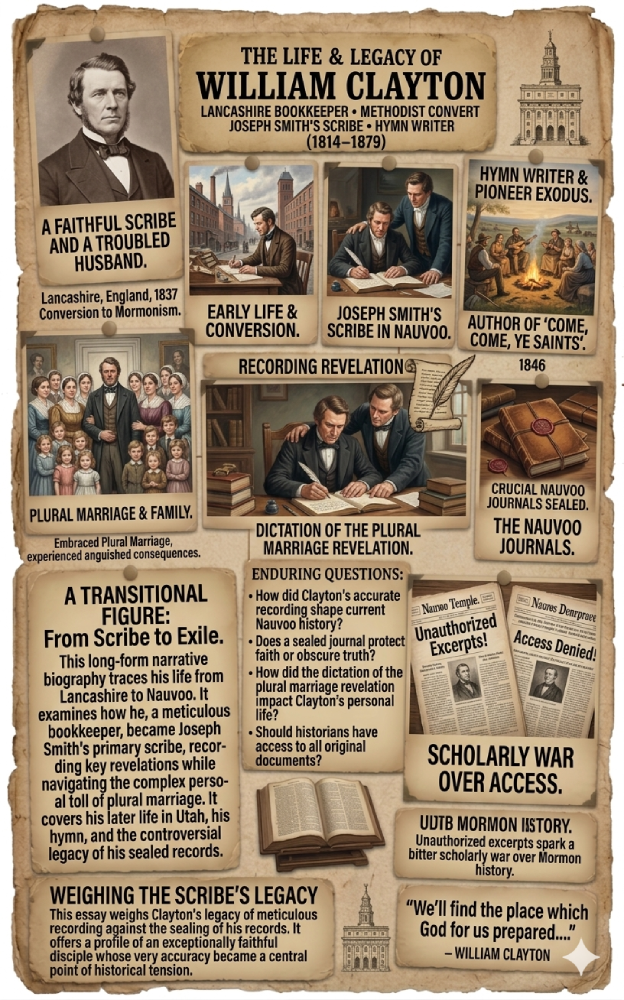
EARLY MORMON PERSONALITIES — SEVENTEENTH INSTALLMENT
William Clayton and the Records the Church Tried To Lock Away
❖ ❖ ❖
It was past one o’clock in the morning on Sunday, the twenty-third of June, 1844, when the knock came. William Clayton rose in the dark, dressed quickly, and made his way down to the Mississippi, where the prophet of his church stood at the water’s edge preparing to flee. Joseph Smith leaned close and whispered an instruction that must have struck the younger man like a blow: the records of the Kingdom—the secret minutes of the Council of Fifty, the most precious papers Clayton had spent two years compiling—were to be hidden, or given to a faithful man, or burned. Clayton hurried home through the sleeping city, gathered the sacred books along with the public records in his keeping, and buried them in the earth. Ten days later, after Joseph lay dead in Carthage, he dug them up again—only to discover that in his haste he had failed to seal them against the damp. The moisture had crept in. Some of the most important documents in early Mormon history were stained and swollen in his hands.
It is a scene that captures the whole of William Clayton’s strange and consequential life: the loyal servant entrusted with everything, laboring in obscurity at the very center of events, holding in his own ink-stained fingers the documentary record upon which an entire religion would later rest—and discovering, too late, that the record was more fragile, and more compromised, than he had imagined, for Clayton was no mere clerk. He was the man who took down the revelation on plural marriage as Joseph dictated it. He was the man whose private journals would become the source for sections of Latter-day Saint scripture. He was the man whose notebooks the Church would keep locked in the First Presidency office for a century and a half. And he was the man who, in a tent on the Iowa plains, wrote the words of the hymn that Mormonism still sings.
To the Latter-day Saint, Clayton is a minor saint of the pioneer epic—the author of “Come, Come, Ye Saints,” the inventor of the wagon odometer, the faithful follower who walked the last nine miles into Nauvoo because he could not wait to meet his prophet. To the historian, he is something far more important and far more troubling: a primary witness whose testimony cannot be removed from the foundations of the faith, and whose records expose tensions the institution has spent generations managing. To the Christian, he is a study in the perilous power of devotion—a good and gifted man whose loyalty became, in the end, the instrument by which doctrines profoundly foreign to the New Testament were carried into permanence. This is his story.
❖ ❖ ❖
Origins and Early Life
A Lancashire Childhood
William Clayton was born on the seventeenth of July, 1814, in the village of Penwortham, in Lancashire, England, the eldest of fourteen children of Thomas Clayton and Ann Critchley. The family lived at Charnock Moss, a hundred acres of farmland reclaimed from a peat bog—a flat, drained, working landscape that says something about the people who tilled it. They were Methodist by inclination, literate, respectable, and poor in the way that the industrious working classes of the English Midlands were poor: never destitute, never secure. Thomas Clayton kept school, and under his father’s tutoring, young William acquired what would become the defining instruments of his life—a fine hand, a head for figures, and music. He learned the violin and the piano as a boy, and in time the drum and the French horn as well.
By the time he reached his early twenties, he had become a factory bookkeeper in the industrial sprawl around Manchester, one of the great furnaces of the Industrial Revolution. It was meticulous, methodical work, suited to a meticulous, methodical man. He married Ruth Moon on the ninth of October, 1836. He was, by every account that survives, ambitious in the quiet way of a man who senses that his talents exceed his station and waits for a door to open. He was also, beneath the competence, a searcher—a young man with a Methodist conscience and a hunger for certainty that the chapels of his boyhood had not satisfied.
Spiritual Quest and the Road to Mormonism
In the summer of 1837, a small company of American missionaries arrived in England—the first Latter-day Saint mission to the Old World, led by the apostle Heber C. Kimball. They preached in the cotton towns of Lancashire a message engineered to land precisely upon men like William Clayton: that the true Church of Jesus Christ, lost in a Great Apostasy not long after the death of the apostles, had at last been restored through a living American prophet; that the heavens were open again; that ordinances, authority, and revelation had returned to the earth. To a serious-minded young Methodist dissatisfied with the cool formality of established religion, the claim was electric. Here was not a denomination among denominations but the very thing itself, reconstituted by the hand of God.
Clayton investigated, and Clayton believed. He was baptized on the twenty-first of October, 1837, by Heber C. Kimball himself—the beginning of a friendship that would last until Kimball died in 1868. His progress in the new faith was meteoric. Ordained a priest in December, a high priest by the first of April, 1838, he was, within six months of his conversion, a member of the British Mission presidency, serving as second counselor to mission president Joseph Fielding alongside Willard Richards. In October 1838, he quit his job to give himself wholly to the ministry. Assigned to Manchester, he labored there for two years and built the congregation into one of the largest in England, some two hundred and forty souls. His parents, his ten surviving siblings, and members of his wife’s family followed him into the water.
What drew him? The psychological and theological pull of early Mormonism upon English converts is well documented, and Clayton embodies it. The movement offered the working-class believer an extraordinary dignity: a place in a cosmic drama, a literal priesthood conferred by the laying on of hands, a prophet who spoke for God as casually as Moses had. It offered certainty in an age of doubt and a community that was also a destiny—Zion, gathering in America. For a gifted clerk whose abilities had found no scope in a Lancashire counting-house, it offered, too, a vocation. The man who could write a fair hand and keep an honest ledger would discover in Mormonism that these were not mere trades but sacred callings. That discovery would define, and ultimately compromise, his life.
❖ ❖ ❖
Scribe to a Prophet: Clayton’s Rise in Nauvoo
The Long Walk to Nauvoo
In September 1840, Clayton led a company of British converts aboard the ship North America bound for the United States, arriving in New York that October. The official account preserves a telling detail of his arrival in the new gathering-place of the Saints: the boat down the Mississippi stopped short of Nauvoo for the night, and Clayton, unwilling to wait, walked the final nine miles on foot through a wintry morning to arrive just before noon on the twenty-fourth of November, 1840. He had crossed five thousand miles and an ocean to meet a prophet, and he would not be delayed by nine miles more.
His first year was bitter. He bought land across the river in Iowa and tried to farm at the failing Mormon settlement of Zarahemla, but a factory bookkeeper had neither the skill nor the constitution for it; crop failure and a long siege of malaria broke him. On the advice of Heber C. Kimball, he moved his family back across the river into Nauvoo in December 1841, and there, almost at once, he found the work for which Providence and his own temperament had fitted him. On the tenth of February, 1842, Kimball sent him to report to Joseph Smith’s office. Willard Richards, the prophet’s secretary, was overworked and needed a clerk he could trust.
“Be Sure You Are Right, and Then Go Ahead”
Over the next two and a half years, William Clayton stood closer to Joseph Smith than almost any other man alive. He was with him nearly every day. On the third of September, 1842, Joseph called him in and gave him a charge that Clayton would treasure for the rest of his life—appointing him Temple Recorder and adding, “when I have any revelations to write, you shall write them.” The friendship between the forty-something prophet and the twenty-eight-year-old Englishman deepened into something the surviving sources describe in the language of Scripture: they were David and Jonathan. A note Joseph dashed off to Clayton in October 1842, on the very day he fled Nauvoo to escape Missouri officers, survives to show the warmth between them.
Brother Clayton—Dear Sir: I received your short note. I reply in short—be sure you are right and then go ahead David Crocket like, and now Johnathan what shall I write more only that I am well and am your best Friend.
Joseph Smith to William Clayton — or David — or his mark ——X——
— Joseph Smith, note to William Clayton, 7 October 1842 (in James B. Allen, No Toil Nor Labor Fear, 73–74)
The list of Clayton’s offices in Nauvoo reads like a directory of the city itself. He was city treasurer, recorder, and clerk of the Nauvoo City Council; secretary pro tem of the Nauvoo Masonic Lodge; an officer of the Music Association; and a member of the brass band. He was admitted to Joseph Smith’s most intimate circles: the private prayer circle, or Quorum of the Anointed, where the temple endowment was first introduced in 1844; and the secretive Council of Fifty, the body that planned for the political “kingdom of God” on earth and directed Joseph’s campaign for the presidency of the United States. On the twelfth of March, 1844, Clayton was made “Clerk of the Kingdom,” keeper of the council’s minutes—a title he relished. When the council voted to crown Joseph Smith its “Prophet, Priest, and King,” confirming him with loud hosannas, it was Clayton’s hand that recorded the moment.
The Records That Became Scripture
Here lies the deepest reason Clayton matters. As Joseph’s scribe, he recorded the most significant revelations and sermons of the prophet’s final years, and several of those private journal entries passed, sometimes almost word for word, into Latter-day Saint scripture. The instructions Joseph gave on the ninth of February, 1843, on discerning true heavenly messengers from satanic counterfeits by the test of a proffered handshake, were written in Clayton’s journal and became Doctrine and Covenants section 129. Joseph’s teachings at Ramus, Illinois, on the second of April, 1843—that God possesses a body, that all time is present before Him, that our relationships endure into eternity—became, through Clayton’s record, section 130. Section 131, on the orders of the priesthood and the “new and everlasting covenant” of marriage, is composed largely of short journal entries Clayton kept in May 1843. And section 132, the revelation on celestial and plural marriage, was dictated by Joseph Smith to William Clayton on the twelfth of July, 1843.
Beyond his own diaries, Clayton wrote out roughly three hundred and seventy pages of the “Book of the Law of the Lord,” a leather-bound record of revelations, letters, and tithing donations that became a source for Joseph Smith’s official History of the Church. He sat on the committee that began to prepare that History—a document in which, as Latter-day Saint historians freely acknowledge, much was assembled from the journals of scribes and then quietly converted from the third person into the prophet’s own first-person voice, an accepted editorial practice of the day. His was one of four transcriptions amalgamated to reconstruct the famous King Follett discourse, Joseph’s last great sermon on the plurality and exaltation of gods. When the Latter-day Saint reads his scriptures today, he is, in places, reading William Clayton.
Eyewitness Perspectives: How Clayton Saw, and Was Seen
Clayton’s own letters home to England, written in the first flush of his Nauvoo experience, are among the warmest portraits of Joseph Smith we possess from any convert. They are also a study in the kind of total devotion that would prove so consequential. To his friends in Manchester in December 1840, he wrote of evenings spent in the prophet’s company.
Last night many of us were in company with Brother Joseph, and our hearts rejoiced to hear him speak of the things of the Kingdom. If I had come from England purposely to converse with him a few days I should have considered myself well paid for my trouble.
— William Clayton, letters from Nauvoo, 1840 (quoted in “Our Hearts Rejoiced to Hear Him Speak,” Revelations in Context)
To William Hardman in March 1842, he wrote with the same unguarded ardor that all evil reports of Joseph he treated “with utter contempt,” and that the more he was with the prophet, the more he loved him. James B. Allen, Clayton’s principal biographer and a former assistant Church historian, is candid about what this devotion did to Clayton’s pen: nothing was intentionally whitewashed in his journals, which are in fact full of frank comment on the problems of the Church and even criticism of its leaders—yet his loyalty to Joseph “probably blinded him to any of the Prophet’s weaknesses,” so that the prophet “came off almost perfect in anything Clayton wrote about him.” It is an honest and important observation, and we shall return to it, for a witness who cannot see the faults of the one he loves is a particular kind of witness.
Others saw Clayton himself with similar admiration. At a meeting in January 1845, Brigham Young and Heber C. Kimball pronounced a blessing upon him that he recorded twice, in the minutes and in his own journal: that he should be “a scribe for this church in the resurrection.” Decades later, Brigham Young would describe him to the School of the Prophets as the most capable man in the community for drafting wills in strict conformity to law. At Clayton’s funeral in 1879, the apostle Joseph F. Smith would say that it was to Clayton’s pen, to a very great extent, that the Church was indebted for the history of its Nauvoo years. Among the Saints, he was the faithful workhorse, the trusted hand, the man who could be relied upon to get it right and to keep it safe.
❖ ❖ ❖
Controversies, Conflicts, and Personal Struggles
The First Plural Wife
Clayton accepted plural marriage as a religious principle when Joseph Smith introduced it to him privately, and he embraced it with a wholeheartedness that produced both doctrine and tragedy. His first plural wife was Margaret Moon—his own sister-in-law, the younger sister of his wife Ruth—whom he married on the twenty-seventh of April, 1843, while the practice was still strictly secret. The circumstances were anguished. Margaret had been engaged to a man named Aaron Farr, away on a mission; when Farr returned, and Margaret was already bound to Clayton and pregnant by him, Clayton went to Joseph Smith to ask whether the union might be annulled. The prophet said no. Margaret’s mother, Lydia Moon, on learning that her daughter was a second wife, threatened to take her own life or leave. To quiet the rumors of Margaret’s pregnancy, Joseph advised that she remain at home until the child was born. The baby, a boy, arrived in February 1844 and died at six months.
This was the world Clayton’s journals open to us—a world of secrecy, emotional wreckage, and improvised damage control conducted under the banner of revelation. Over a lifetime, Clayton married ten women and fathered at least forty-two children. He married four in Nauvoo and five more in Utah, several of them teenagers: Augusta Braddock at seventeen; Sarah Ann Walters at eighteen; Amasa Lyman’s daughter Maria Louisa at seventeen; Anna Elizabeth Higgs at seventeen. Three of his wives ultimately left or divorced him. He was, in 1873, reported to have preached that a man could enter the highest heaven only by taking more than one wife—a teaching other Latter-day Saint leaders rejected even then.
Defenders and Doubts
Latter-day Saint apologists have labored to rescue Clayton’s character from the harsher readings of these facts. The organization FAIR argues that critics disparage him “through innuendo,” using him as a surrogate for attacks on Joseph Smith, and points to an 1843 episode in which Clayton, tempted by his affection for a woman named Sarah Crookes whom he had known in England, prayed to be preserved from “impure affections” and strove against the feeling—evidence, Allen and FAIR contend, not of laxity but of a man wrestling honestly with temptation. They note, too, that the charge of immorality leveled against him during his 1852–53 mission to England arose only from his open advocacy of polygamy and was raised by an apostate who, Clayton said, had maliciously distorted his words into what he called the most painful experience of his life.
Allen’s own biography is more frank than the apologetic literature. He records that Clayton had an “off-and-on problem with alcohol,” that his many businesses in Utah largely failed, that he was “never really comfortable financially,” and that the second English mission collapsed in accusations of drunkenness and immorality serious enough that he was sent home in under six months. This is the texture of a real and flawed human life, neither saint nor monster—a man of genuine faith and genuine appetite, of fierce loyalty and visible weakness, who recorded his blessings in a New Year’s Reflection with the same pen that recorded his bitterness at his prophet’s murder.
The Locked Archive: A Case Study in Historical Management
If Clayton’s life illustrates the human cost of early Mormon polygamy, his journals illustrate something equally revealing about the institution that grew from it: the long, deliberate management of inconvenient history. Three of his Nauvoo notebooks—covering the period from November 1842 to January 1846, the very years of secret polygamy and the dictation of section 132—were deposited after he died in the Church archives and then transferred to the office of the First Presidency, where they remained closed to scholars for generations. They were, in effect, locked away.
The story of how their contents leaked out is a small drama of Mormon studies. In 1979, the historian James B. Allen, then assistant Church historian, was among a handful of researchers permitted to examine the original Nauvoo journals; over three weeks, he and his colleague Dean Jessee produced a three-hundred-page typescript. A copy reached Andrew Ehat, a BYU graduate student, whose research excerpts were then copied without authorization and circulated underground until, in 1982, Jerald and Sandra Tanner of Utah Lighthouse Ministry—the most prominent evangelical critics of Mormonism of their generation—published them. Ehat sued for copyright infringement; a federal court ruled that his transcript of preexisting historical material was not copyrightable. From these contested excerpts, the publisher George D. Smith assembled the Nauvoo portion of his 1991 volume, An Intimate Chronicle: The Journals of William Clayton.
The publication ignited a remarkable and clarifying quarrel between Smith and Allen in the pages of Dialogue: A Journal of Mormon Thought. Allen, reviewing the book, judged the Nauvoo material a flawed “agglomeration of unconnected and out-of-context excerpts,” objected that Smith had never been permitted to check the transcription against the originals, and questioned whether the excerpts should have been published at all in such a form. Smith answered that Allen’s scholarly objections masked a deeper agenda—that he was “speaking on behalf of the silent but incessant voice of those church authorities who did not want this important document published.” Smith’s closing words frame the real issue with unusual force.
What should one say to an historian, however well-meaning, who advocates depriving a community of its history? … Any goal less than full access to the historical record is ultimately unacceptable.
— George D. Smith, “A Rejoinder,” Dialogue 30, no. 2 (Summer 1997)
Smith’s most pointed thrust was that the underground copies everyone now relied upon could be traced in part to Allen’s own unauthorized verbatim typescript—made, by Allen’s sworn testimony, with permission to “use” the journal but not to copy it. The institution had restricted access so tightly that even its own faithful historians were driven to bend the rules, and the very excerpts the Church most wished to control had escaped precisely because they were controlled. Only in October 2017 did the Church History Department announce that it would at last publish Clayton’s complete diaries—a promise that, as the apologetic organization FAIR confirmed in 2025, was still awaiting fulfillment, with a full scholarly edition then anticipated through Yale University Press.
❖ ❖ ❖
Theological Departure from Biblical Christianity
It would be possible to tell Clayton’s story as a mere biography—a gifted Englishman swept up in a frontier religion. But the prompt of his life was theological, and so its critique must be as well. For the doctrines Clayton recorded, defended, and lived are precisely the doctrines that mark Mormonism as a departure from the historic Christian faith, and his journals are the documentary umbilical cord connecting those doctrines to their origin. Three deserve particular attention, examined not with contempt but with the open Scriptures.
The Plurality and Exaltation of Gods
Clayton’s record of the Ramus teachings (D&C 130) and his transcription of the King Follett discourse preserve Joseph Smith’s mature theology of God: that God the Father possesses a body of flesh and bones, that He was once a man, and that faithful men may themselves progress to godhood. This is the doctrine of eternal progression and the plurality of gods. Against it, the Scripture is not ambiguous. “Before me there was no God formed, neither shall there be after me” (Isaiah 43:10). “I am the LORD, and there is none else, there is no God beside me” (Isaiah 45:5). The God of the Bible is not an exalted man but the eternal Creator who is spirit (John 4:24) and who does not change (Malachi 3:6). The promise of Eden—“ye shall be as gods” (Genesis 3:5)—is in Scripture the serpent’s lie, not the gospel’s hope.
Celestial and Plural Marriage
Section 132, which Clayton’s hand first set down, makes eternal—and, in its original Nauvoo practice, plural—marriage the gateway to the highest exaltation. Yet the New Testament knows nothing of marriage as a requirement for salvation or a feature of the world to come. Jesus taught plainly that “in the resurrection they neither marry, nor are given in marriage, but are as the angels of God in heaven” (Matthew 22:30). Salvation in the apostolic gospel is by grace through faith in the finished work of Christ (Ephesians 2:8–9), not by entrance into a marital covenant; and an overseer in the church is to be “the husband of one wife” (1 Timothy 3:2). The doctrine that made Clayton the husband of ten women and the father of forty-two children stands at the furthest remove from the monogamous, grace-centered vision of the New Testament household.
A Restored Priesthood and a New Scripture
Underlying all of it is the foundational Mormon claim—the claim that first drew Clayton from his Methodist chapel—that the true Church had vanished from the earth in a Great Apostasy and required restoration through a new prophet, new priesthood, and new scripture. The historic Christian confession is otherwise: that Christ promised the gates of hell would not prevail against His Church (Matthew 16:18), that the faith was “once delivered unto the saints” (Jude 3), and that the Scriptures already make the believer “wise unto salvation” and “thoroughly furnished unto all good works” (2 Timothy 3:15–17). Where Mormonism offered Clayton a living oracle and an open canon, the gospel offers the sufficiency of Christ and the closed witness of His apostles. The tragedy of William Clayton is that the very hunger for certainty and authority that is so admirable in him led him to find both in the wrong place.
Character Study and Moral Evaluation
What manner of man was William Clayton? The temptation, for the apologist and the critic alike, is caricature—the spotless pioneer hymnodist or the “despicable liar.” Both portraits fail him. The truer picture is of a man whose greatest strength and gravest weakness were the same trait: an absolute, uncritical fidelity. The qualities that made him invaluable—diligence, accuracy, discretion, devotion—were real and admirable. He buried the records of the Kingdom in the ground rather than betray them, and grieved when the damp got in. He wept over the troubles of poor branch members in Manchester and recorded the oranges and shillings they pressed on a missionary traveling without purse or scrip. He was generous, musical, dutiful, and brave.
And yet that same fidelity, turned toward a fallible man and a false revelation, became the engine of real harm. It produced a journal that, by his biographer’s own admission, could not see the prophet’s faults. It produced a household built on secrecy and the displacement of younger women, including the sister-in-law whose engagement he and Joseph declined to release. It made him the willing instrument of a doctrine that wounded his own family. The blind spot was not in his competence but in his conscience—a conscience that had surrendered its independent judgment to an authority it would not question. Here is the moral center of the story, and it is one the Christian recognizes with sorrow rather than scorn: a good man’s virtues, detached from the discernment that Scripture commands—“try the spirits whether they are of God” (1 John 4:1)—can serve an error as faithfully as they would have served the truth.
❖ ❖ ❖
Legacy, Impact, and the Sanitized Saint
Clayton’s legacy is woven so deeply into Mormonism that it cannot be extracted. His odometer, devised with Orson Pratt and built by the carpenter Appleton Harmon on the 1847 trek, produced The Latter-day Saints’ Emigrants’ Guide, the first scientifically measured handbook of the overland trail, used by Mormon and Gentile emigrants alike. His pioneer journal remains one of the finest firsthand accounts of the crossing. And in a tent near Locust Creek in April 1846, on the news that his plural wife Diantha had borne him a healthy son, he composed the hymn now known as “Come, Come, Ye Saints,” whose refrain of “All is well” became the anthem of the Mormon migration and endures as perhaps the single most beloved hymn in the tradition. Through sections 129, 130, 131, and 132 of the Doctrine and Covenants, his pen shaped Latter-day Saint scripture itself.
It is precisely because his legacy is so central that the management of his memory is so instructive. The official Latter-day Saint portrait of Clayton—seen, for instance, in the Church’s own Revelations in Context essay “Our Hearts Rejoiced to Hear Him Speak”—is a masterpiece of selective emphasis. It dwells lovingly on the devoted scribe who recorded precious teachings, the convert who walked nine miles in his eagerness, the faithful diarist whose delight in Joseph’s words still blesses the Saints. It does not mention that this same scribe took the dictation of the polygamy revelation; it does not mention his ten wives or his teenage brides; it does not mention the alcohol, the failed mission, the divorces, or the century-and-a-half during which his most important journals were sealed away. The reader is given a Clayton scrubbed clean—a hymnodist and a recorder of doctrine, with the doctrine he chiefly recorded, and lived, quietly removed from the frame.
This is not a unique case — it is a representative one, and therein lies its deepest significance. The sanitized handling of William Clayton’s life is not an editorial oversight or an isolated retelling of a complicated man’s complicated story. It is built into the historical DNA of Latter-day Saint revisionism itself. The same pattern runs like a fault line through the whole institutional handling of Clayton and dozens of figures like him: foreground the inspiring, omit the embarrassing, and control access to the documents that would complicate the approved narrative. From the locked archive to the devotional biography scrubbed of plural wives and blood oaths, the method is consistent because the institutional incentive is consistent — the story must serve the Church, not the other way around.
To observe this is not anti-Mormon animus. It is simple historiography — and the observation is not unique to outside critics. Faithful Latter-day Saint scholars, including James B. Allen and George D. Smith, have quarreled bitterly and publicly over exactly this question of access and candor. When believing members who love the Church find themselves fighting their own institution for honest engagement with primary sources, the problem is not the critics. The problem is the pattern.
This matters beyond the walls of any archive. The Christian who would engage his Latter-day Saint neighbor with both honesty and love does well to know the fuller story — not as a weapon to be wielded, but as the truth that, told plainly and with genuine care for the person hearing it, does exactly what Jesus promised it would do: set people free (John 8:32). A faith built on a carefully managed version of its own past is not a foundation. It is a liability waiting to be discovered — and for a growing number of Latter-day Saints who eventually find the unguarded documents, the discovery arrives with the force of a collapsed floor.
Conclusion: The Witness Who Could Not See
William Clayton died in Salt Lake City on the fourth of December, 1879, a prominent and respected citizen, leaving four widows and a city that still sings his hymn. He had given his whole life to keeping the records of a kingdom—and in the keeping, he had become a record himself: a primary witness whose testimony historians cannot remove and the faith cannot fully display. His journals are the bridge between Joseph Smith’s secret Nauvoo and the scriptures of a global church; his hymn is the soundtrack of its founding myth; his marriages are the human face of its most controversial doctrine; and his locked notebooks are a parable of how institutions tend their inconvenient pasts.
For the Christian, the lasting impression is neither triumph nor contempt but a kind of grief. Clayton possessed exactly the virtues the Scriptures praise—faithfulness, diligence, courage, love—and poured them out upon a foundation that could not bear them. He sought a restored church and found a man; he sought open heavens and recorded a revelation that led his own daughter-figures and sister-in-law into sorrow; he sought to be a scribe in the resurrection and gave his earthly pen to doctrines that the risen Christ’s apostles never knew. He is, in the end, the most sympathetic of cautionary tales: a reminder that devotion is not the same as discernment, that sincerity is no guarantee of truth, and that the most faithful hand can write the most consequential error. The God who is none beside Him (Isaiah 45:5) asks for both our hearts and our minds—and William Clayton, for all his gifts, gave only the first.
❖ ❖ ❖
Primary Sources & Further Reading
This essay draws on the following documented sources. Readers are encouraged to consult them directly.
• https://en.wikipedia.org/wiki/William_Clayton_(Latter_Day_Saint)
• https://rsc.byu.edu/preserving-history-latter-day-saints/william-clayton-records-church-history
• https://byustudies.byu.edu/article/an-intimate-chronicle-the-journals-of-william-clayton
• https://www.dialoguejournal.com/articles/editing-william-clayton-and-the-politics-of-mormon-history/
• https://www.churchofjesuschrist.org/study/manual/revelations-in-context/our-hearts-rejoiced-to-hear-him-speak?lang=eng
• https://www.fairlatterdaysaints.org/answers/Question:_Was_William_Clayton_an_example_of_the_evils_and_problems_of_plural_marriage
• https://www.fairlatterdaysaints.org/blog/2025/07/25/fair-questions-are-william-claytons-journals-and-other-evidences-suggesting-joseph-smith-practiced-plural-marriage-just-revised-history
• https://heritage.uen.org/pioneers/Wc2ad47954792b.shtml
• https://rsc.byu.edu/sites/default/files/pub_content/pdf/William_Clayton_and_the_Records_of_Church_History.pdf
• https://files.lib.byu.edu/mormonmigration/articles/ClaytonEditedComplete2.pdf
• https://sunstone.org/wp-content/uploads/sbi/articles/086-32-35.pdf
• https://novus2.com/righteouscause/wp-content/uploads/2026/05/WilliamClaytonJournal.pdf
❖ ❖ ❖
A Note on Research Methods and Accuracy
In recent years, some have voiced concern that artificial intelligence may distort facts or introduce inaccuracies into serious research. That criticism deserves acknowledgment. However, AI has now evolved into the most powerful research instrument available to any dedicated scholar—capable of analyzing vast datasets, cross‑referencing historical records, and surfacing overlooked connections across sources. This work represents a collaboration between the author’s investigative inquiry, verified primary documentation, and the advanced analytic capabilities of AI research tools. Here, AI was not used as a ghostwriter or a shortcut for scholarship, but as a disciplined research partner devoted to rigor, accuracy, and transparency.
Every factual claim in this work has been subjected to active verification. Where AI‑generated content was used as a starting point, it was tested against primary sources, peer‑reviewed scholarship, official institutional documentation, and established historical records. Where discrepancies were found—and they were found—corrections were made. The author has made every reasonable effort to ensure that quotations are accurately attributed, historical details are precisely rendered, and theological claims fairly represent the positions they describe or critique.
That said, no work of this scope is immune to error, and the author has no interest in perpetuating inaccuracies in the service of an argument. If you are a reader—whether sympathetic, skeptical, or hostile to the conclusions drawn here—and you identify a factual error, a misattributed source, a misrepresented teaching, or a claim that cannot be substantiated, you are warmly and genuinely invited to say so. Reach out. The goal of this work is not to win a debate but to get the history right. Corrections offered in good faith will be received in the same spirit, and verified corrections will be incorporated into future editions without hesitation.
Truth, after all, has nothing to fear from scrutiny—and neither does this work.