
EARLY MORMON PERSONALITIES — TWENTIETH INSTALLMENT
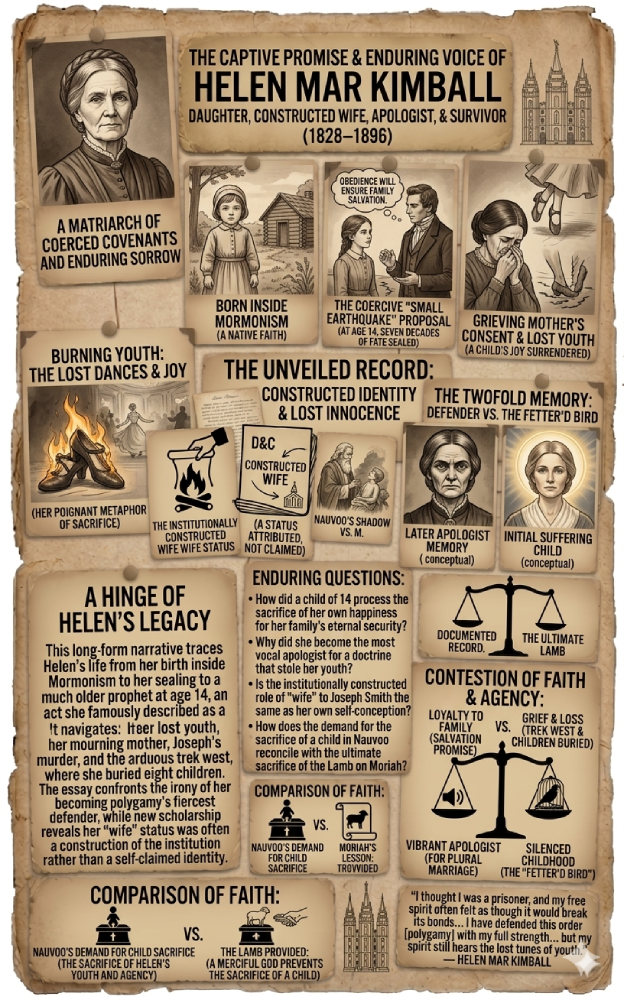
Helen Mar Kimball, the Doll, the Altar, and the Making of a Mormon Memory
❖ ❖ ❖
On a warm afternoon in Nauvoo, Illinois, sometime in 1841, a twelve-year-old girl named Helen Mar Kimball still loved her dolls. She kept a small company of china dolls, gifts her father, Heber, had carried home from his mission to England, and she dressed them, sewed clothes for them, and set them in a place of honor in the family home. One day, the Prophet Joseph Smith came to hear a letter from Heber read aloud, and while he was there, he knocked one of those dolls to the floor and broke its head. To a man with a kingdom on his mind, it was a trifle; he turned the accident into prophecy. “As that has fallen,” he told the child, “so shall the heathen gods fall.” Helen, by her own later account, was too young “to understand or appreciate the prophetic words” and thought them “a rather weak apology for breaking my doll’s head off.”
It is one of the most disarming images in all of early Mormon history: the founder of a new American religion, his thoughts fixed on toppling the idols of the nations, standing over the wreckage of a little girl’s plaything. Two years later, that same doll-loving girl would be sealed in plural marriage to that same man. He was thirty-seven. She was fourteen.
Her name has become a kind of pressure point in the long argument over Joseph Smith and polygamy—the single fact most likely to make a believer uneasy and a critic certain. Yet Helen Mar Kimball was far more than the youngest entry on a list. She was an intelligent, devout, and tenacious woman who buried child after child, who crossed a continent behind an ox team, who became one of the most prolific female writers of nineteenth-century Mormonism, and who spent the last years of her life defending in print the very institution that had bound her at fourteen. To understand her is to watch the rise of early Mormonism from the inside—its sacrifices and its certainties, its tenderness and its terrible asks—and to weigh, with care and without contempt, how far its gospel had traveled from the gospel of the New Testament.
❖ ❖ ❖
A Daughter of the Restoration: Origins and Early Life
Helen Mar Kimball was born on August 22, 1828, in Mendon, New York, the third of nine children and the only daughter to survive childhood. Her father was Heber Chase Kimball, a Vermont-born potter and blacksmith of fierce loyalty and few pretensions; her mother was Vilate Murray Kimball, a woman whose patience would be tested to its breaking point. When Helen was three, her parents were baptized into Joseph Smith’s young Church of Christ, alongside the family of a neighbor named Brigham Young. The two households became, in Helen’s words, “like one,” a bond that would shape the rest of her life and eventually entangle it.
The Kimballs gathered with the Saints at Kirtland, Ohio, in 1833. There, in the dead of winter, Helen was baptized by “Uncle Brigham” in the frozen Chagrin River; her father had to cut a hole in the ice. She remembered feeling “no cold or inconvenience from it,” for she had “longed for this privilege.” It is an early glimpse of the temperament that would define her: a child already practiced in the language of longing and sacrifice, already learning that discomfort embraced for the faith was a kind of triumph.
In 1835, Heber was ordained one of the original Twelve Apostles of the restored church, a calling that carried him away on long missions and left the household to Vilate and the children. Helen grew up fast. When she was nine, the family followed the Saints to Far West, Missouri, arriving just as the Mormon-Missouri war reached its pitch. Within months came Governor Lilburn Boggs’s infamous Extermination Order, and the Kimballs fled the state in the depths of winter, walking, Helen remembered, simply to keep from freezing. They washed up at last in a malarial bend of the Mississippi that Joseph Smith would rename Nauvoo—“the beautiful”—and there, Heber built a house near the rising temple and grew ever closer to the Prophet he revered.
This is the world that formed Helen: a world of persecution and pilgrimage, of fathers absent on the Lord’s errands and mothers holding families together by faith, of a people who had learned to read every hardship as the hand of God refining His chosen. It was a world in which the word of the Prophet was, quite literally, the word of the Lord.
❖ ❖ ❖
The Faith of Her Fathers: A Childhood Inside the New Religion
Most accounts of conversion to early Mormonism trace a spiritual quest—a seeker dissatisfied with the churches of the day, drawn by Joseph Smith’s claims of angels and golden plates and a restored priesthood. Helen Mar Kimball had no such quest, and this is the first thing a fair observer must understand about her. She did not choose Mormonism; she was born inside it before she could speak. By the time she was old enough to weigh competing claims, there were, for her, no competing claims. The Prophet was a guest in her parlor. The Apostles were her father’s friends. Brigham Young had cut the ice for her baptism. Her entire moral and religious imagination had been built within a single edifice, and she had never stood outside it long enough to see its walls.
This matters enormously for what follows, because the great turning point of her young life was not a decision of the soul reached in solitude. It was an act of obedience pressed upon a child by the two men she trusted most on earth—her father and her prophet—inside a system that had taught her since infancy that their word was God’s. When we ask, later, what it meant for Helen to “consent,” we must hold this fact steadily before us.
❖ ❖ ❖
The Summer of the Small Earthquake
In the late spring of 1843, the principle of plural marriage was spreading quietly and explosively through the inner circle of Nauvoo. Joseph Smith had been teaching it privately to trusted associates for at least two years; Heber Kimball had already taken a plural wife, Sarah Noon, an ordeal that had nearly broken Vilate. Now, Heber turned to his only daughter.
He approached her, she recalled, “one morning in the summer of 1843, without any preliminaries,” asking whether she would believe him if he told her it was right for married men to take other wives. Her reaction was not faith but fury. She had been raised, like every respectable young woman of her time, to regard such a thing as “a heinous crime, improper and unnatural,” and she said so. It was, she wrote, the first time she ever openly showed anger toward her father. He seemed pleased rather than offended—for her indignation proved her virtue—and then he sat her down and reasoned with her, and left her to turn it over for twenty-four hours.
It was the most consequential day of her life, and she described its arrival with an image no reader forgets:
My father was the first to introduce it to me, which had a similar effect to a sudden shock of a small earthquake. When he found (after the first outburst of displeasure for supposed injury) that I received it meekly, he took the first opportunity to introduce Sarah Ann [Whitney] to me as Joseph’s wife.
— Helen Mar Kimball Whitney, “Scenes and Incidents in Nauvoo,” Woman’s Exponent (1883)
The next morning, the Prophet himself came to the Kimball home and, with Helen seated between her father and mother, taught and explained the principle. Then he made her a promise—the promise that would echo through the rest of her writings and through every argument about her ever since:
Joseph … said to me, “If you will take this step, it will ensure your eternal salvation and exaltation and that of your father’s household and all of your kindred.” This promise was so great that I willingly gave myself to purchase so glorious a reward.
— Helen Mar Kimball Whitney, autobiographical letter to her children, 30 March 1881
Consider what was placed on the scale. On one side, a fourteen-year-old’s natural revulsion and her mother’s evident anguish. On the other hand, the eternal salvation of everyone she loved, offered by the man she had been taught was God’s living oracle, in language that left her no honorable exit. She did not weigh romance against duty, for there was no romance; there is little evidence she and Joseph ever shared more than the ceremony. She weighed her own happiness against heaven’s, and she chose heaven. Her own verb for it is unbearably precise: she gave herself “to purchase” a reward.
Her mother’s consent came in a sentence that has the weight of a sigh. When Joseph asked Vilate whether she was willing, Helen recorded the answer:
None but God & his angels could see my mother’s bleeding heart—when Joseph asked her if she was willing, she replied, “If Helen is willing I have nothing more to say.”
— Helen Mar Kimball Whitney, 1881 autobiographical letter
Vilate Kimball had “witnessed the sufferings of others, who were older & who better understood the step they were taking,” Helen wrote, and “in her mind she saw the misery which was as sure to come as the sun was to rise and set; but it was all hidden to me.” There, in a single clause, is the moral center of the whole story. The grown woman saw what was coming. The child could not. And the marriage went forward anyway.
The sealing took place in 1843—the exact month is itself a historical puzzle to which we will return—and was kept secret. Helen continued to live as a daughter under her father’s roof, a wife in name and ordinance but not in any ordinary sense a wife at all. The most candid account of her father’s motive came from Helen herself, and it is not the motive a modern reader expects:
He [Heber C. Kimball] taught me the principle of Celestial marriage, and having a great desire to be connected with the Prophet Joseph, he offered me to him; this I afterwards learned from the Prophet’s own mouth.
— Helen Mar Kimball Whitney, 1881 autobiographical letter
Her father offered her. The phrase is jarring, but it points to the strange theology that underlay the whole transaction. This was not, in the family’s understanding, an arrangement for Joseph’s pleasure or even chiefly for Helen’s salvation. It was a dynastic weld—a means of binding the house of Kimball eternally to the house of Smith. Her son, the future Apostle Orson F. Whitney, would later describe it in exactly those terms, as we shall see. Helen was, in the cold logic of Nauvoo’s new cosmology, a link in a chain.
❖ ❖ ❖
A Life Sacrifice: Sorrow, Survival, and a Long Obedience
Whatever the sealing meant in heaven, on earth, it took something from her at once. A sealed girl could not court, could not dance with the freedom of her unmarried friends, could not give her heart to a boy her own age. That winter, her father warned, she said, by the Prophet himself about the “blacklegs and certain ones of questionable character” who frequented the Nauvoo balls, kept her home while her brother William went off to dance. She “felt quite sore over it” and thought herself “a much abused child.” Looking back across forty years, she set the feeling into verse, in the most quoted lines she ever wrote:
I thought through this life my time will be my own,
The step I now am taking’s for eternity alone …
Thy happy dreams all o’er thou’st doom’d also to be
Bar’d out from social scenes by this thy destiny …
And like a fetter’d bird with wild and longing heart,
Thou’lt dayly pine for freedom and murmur at thy lot.— Helen Mar Kimball Whitney, retrospective poem, 1881
“For eternity alone”—the phrase has persuaded most historians, faithful and critical alike, that this particular marriage was never consummated, that it was an eternal sealing rather than an earthly union. The fettered bird, the doomed dreams, the angels who in another line of the poem “wept” over her—these are the cries of a girl who felt her youth taken, not necessarily her body. We will weigh that question soberly in its place. What the poem makes unmistakable is the cost. Even decades later, even as a fervent defender of the system, Helen could not write of her fourteenth summer without reaching for the language of captivity.
Thirteen months after the sealing, on June 27, 1844, Joseph Smith was shot dead at Carthage Jail. Helen was not yet sixteen. The secret husband she had scarcely known was now a martyr, and the church he left behind was fracturing. In February 1846, in the last frantic days before the Saints abandoned Nauvoo, she married Horace Kimball Whitney—a young man five years her senior and the brother of her closest friend, Sarah Ann Whitney. In the Nauvoo Temple, she was sealed to Horace “for time” and re-sealed to the dead Joseph “for eternity,” with Horace standing proxy for the Prophet; the next day, Horace was sealed for eternity to a deceased woman, Elizabeth Sikes, with Helen standing proxy. The dizzying arithmetic of those ordinances tells its own story about how fluid and how strange the sealing system had become.
Then came the wilderness. The Whitneys crossed Iowa in the mud and snow of 1846 and wintered at the Missouri River. What followed was a decade of nearly unimaginable loss. Helen’s first child, born while Horace was away with the pioneer companies, was stillborn; she was nineteen. Her second was born on the plains in 1848 and died within days, near her twentieth birthday, after a childbirth that nearly killed her. Her third was born and died on a single September day in 1849. In time, she bore eleven children; the first three did not survive infancy, an eldest daughter died of consumption at sixteen, a youngest of scarlet fever at four, and a grown son died by gunfire in 1886. Helen herself was often gravely ill. Horace, with her consent, took plural wives of his own, and Helen knew firsthand the jealousy she would later counsel other women to master.
Out of this furnace came, improbably, one of the most articulate female voices of the Mormon West. Encouraged by the editor Emmeline B. Wells, Helen began in 1880 to publish a long series of reminiscences in the Woman’s Exponent, and she filled the Deseret News and her own journals with hundreds of thousands of words. When Joseph Smith’s own son, Joseph Smith III, traveled west, declaring that his father had never taught or practiced plural marriage, it was Helen who answered him in two combative pamphlets—Plural Marriage as Taught by the Prophet Joseph (1882) and Why We Practice Plural Marriage (1884). The doll-loving child had become the doctrine’s most relentless defender. She died in Salt Lake City on November 13, 1896, at sixty-eight years old, mourned by Apostles and a future Church President, and was buried beside the long obedience that had defined her. Her son Orson F. Whitney became an Apostle—the dynastic link her father had sought, made flesh and seated in the highest councils of the church.
❖ ❖ ❖
Eyewitness to Her Own Heart: Voices from Inside the Story
Because Helen wrote so much, and because those who loved her wrote about her, we can hear this episode in several voices at once—something rare in nineteenth-century women’s history. The voices do not always agree, and their disagreements are part of the truth.
Her father, just weeks after the sealing, wrote to her from Pittsburgh with a tenderness shadowed by an unmistakable theology of works. Salvation, he reminded his teenage daughter, would depend on what she did and how she did it:
My child, remember the care that your dear father and mother have for your welfare in this life, that all may be done well, and that in view of eternal worlds, for that will depend upon what we do here, and how we do it; for all things are sacred.
— Heber C. Kimball to Helen Mar Kimball, 10 July 1843
A hostile witness, the apostate Catherine Lewis, who lived briefly with the Kimball family before leaving the church, reported overhearing Helen speak words that have haunted the record ever since:
I would never have been sealed to Joseph had I known it was anything more than a ceremony. I was young, and they deceived me, by saying the salvation of our whole family depended on it.
— Catherine Lewis, Narrative of Some of the Proceedings of the Mormons (1848)
Lewis was a bitter ex-Mormon and a secondhand source, and faithful historians have rightly cautioned against taking her every word at face value—especially since the same passage seems to suggest, implausibly, that Heber wanted to marry his own daughter. Yet her report rhymes uncomfortably with Helen’s own admission, made in print, that she had been “too young or too ‘foolish’ to comprehend and appreciate all” that Joseph taught her. Whatever Lewis got wrong, the core note—deception, youth, a salvation held hostage—was not invented from nothing.
And yet alongside the captivity there was conviction—genuine, hard-won, and never abandoned. The same woman who called herself a fettered bird also wrote of plural marriage in language of soaring sacrifice, and meant every syllable:
No earthly inducement could be held forth to the women who entered this order. It was to be a life-sacrifice for the sake of an everlasting glory and exaltation.
— Helen Mar Kimball Whitney, Woman’s Exponent (1 March 1883)
Her son, Orson F. Whitney, writing his reverent 1888 biography of his grandfather, gave the marriage its most exalted frame—and inadvertently confirmed that it was a transaction between families, not a romance:
Soon after the revelation was given, a golden link was forged whereby the houses of Heber and Joseph were indissolubly and forever joined. Helen Mar … was given to the Prophet in the holy bonds of celestial marriage.
— Orson F. Whitney, Life of Heber C. Kimball (1888)
Given to the Prophet. The phrase recurs, from the daughter and from the grandson alike, and no amount of later softening can quite dissolve it. Helen was given. The question that has divided historians, and divides the church’s own thinkers to this day, is what exactly she was given into—and whether a fourteen-year-old, inside such a world, could meaningfully give herself at all.
❖ ❖ ❖
The Question Everyone Asks, and the Limits of the Record
It must be addressed plainly, because it is the first thing most readers want to know and the last thing the sources will settle. Was the marriage of Joseph Smith and fourteen-year-old Helen Mar Kimball a sexual one? The honest answer is that we do not know, and that the weight of evidence leans toward no.
Helen never confirmed or denied physical intimacy. Her own description—“for eternity alone”—convinced careful scholars such as Stanley Kimball that the union was a sealing without earthly relations, and even Todd Compton, the historian who documented Joseph’s wives most exhaustively and who believed many of those marriages were sexual, concluded that the evidence for Helen “is entirely ambiguous.” The Latter-day Saint scholar J. Spencer Fluhman, surveying the same record, judged simply that “the question of sexuality … remains open.”
There is one telling piece of circumstantial evidence. In 1892, during the Temple Lot lawsuit, the Utah church needed living witnesses to prove that Joseph Smith had practiced real, marital polygamy. Several of his aging plural wives were deposed, and each testified to genuine marital relations. Helen—who lived in Salt Lake City, who was the youngest of the wives, and who had spent a decade defending the practice in print—was never called. Had she been able to testify to a full marriage, she would have been an ideal witness. Her absence suggests she could not. The reasonable historical conclusion is that Helen’s sealing to Joseph was, in the language of the time, “for eternity”—a dynastic and ceremonial bond rather than a consummated marriage.
This is an important fact, and a Christian writer should state it clearly rather than imply the worst. The absence of a sexual relationship does not, however, dissolve the moral and theological problem; it relocates it. The disturbing thing was never reducible to a question of the body. It was that a man of thirty-seven, holding in his hands what a child believed to be the keys of her family’s eternal salvation, asked that child to bind herself to him for eternity—and that she, and her grieving mother, felt they could not refuse. That would remain troubling if no one had ever touched her at all.
❖ ❖ ❖
Constructing Helen: Memory, Revision, and the Uses of the Past
Here the story takes a turn that few readers expect, and that complicates the easy narratives of both sides. For most of the twentieth century, the figure of “fourteen-year-old Helen, the Prophet’s youngest bride” was treated as one of the best-documented facts in Mormon history. Recent scholarship has shown that the documentary foundation is far thinner, and far stranger, than its confident retelling suggests—and that the history of how this memory was built is itself a case study in how religious institutions manage an uncomfortable past.
The startling fact, established most fully in Michelle Brady Stone’s 2026 historiographical study “Constructing Helen,” is this: across the enormous body of writing Helen produced in her lifetime—decades of public reminiscences, two pamphlets defending polygamy, a collaborative published biography, and years of private journals—she never once identified herself as a wife of Joseph Smith. She named other women as his wives and pointed to them as witnesses. She wrote with startling candor about her hatred of polygamy in her youth, about jealousy, about her marriage to Horace Whitney. But of a sealing to Joseph, she said, in public, nothing at all. The single exception is the 1881 autobiographical letter to her children—the source of nearly every vivid line quoted in this essay—which was first catalogued in a church archive in 1975 and has no documented history before that date.
Meanwhile, the public institutional identification of Helen as Joseph’s wife was constructed largely without her. The first such claim in a Latter-day Saint publication appeared in 1886, when the church leader Joseph F. Smith—who had been four years old in 1843—published an affidavit he himself had drafted and had William Clayton sign, listing Helen among Joseph’s wives. Helen learned of it from her own journal, only after the newspaper appeared; she had not been consulted. The genealogist Andrew Jenson followed in 1887 with a published list and a marriage date of “May, 1843,” citing no source beyond that same affidavit. When Jenson visited Helen twice, asking her to write her testimony as Joseph’s wife, she declined and instead gave him details about another woman’s life. The reverent “golden link” narrative came from her son in 1888, after her death-bed silence had already been overtaken by the institution’s need for witnesses.
Even the famous date is unstable. The institutional tradition fixed on May 1843; Helen’s own accounts consistently place her introduction to the principle in the summer, specifically the days before her father left on a mission on June 10. A patriarchal blessing her father gave her on May 28, 1843, promised that she “shalt be blessed with a companion”—language suggesting she was not yet married at all—yet this contemporaneous document, catalogued the very same year as the 1881 letter, sat unused for decades while the late, dramatic letter became the lens through which everything else was read. Stone’s sober conclusion is that the towering narrative rests, to a remarkable degree, on one unprovenanced document, while the woman’s own voluminous voice was quietly subordinated to it.
None of this means the sealing did not happen. The 1881 letter is genuinely in Helen’s hand, and it plainly affirms both the sealing and her faith in Joseph Smith; it cannot be waved away. But it does mean that the history we have inherited is, in significant part, a construction—assembled after the fact, shaped by the needs of an institution under legal and cultural siege, and harmonized at every point of tension rather than examined. That is a finding with sharp edges for everyone. It rebukes critics who have read lurid certainties into ambiguous lines, and it equally rebukes the apologetic habit of resolving every difficulty in the institution’s favor.
It is here that the modern church’s handling of Helen comes into view, and it deserves to be described fairly. For most of the twentieth century, marriage was simply not mentioned in official materials; the internet age made that silence untenable. Today, the Church of Jesus Christ of Latter-day Saints openly acknowledges marriage in its Gospel Topics essays and its Church History Topics, names Helen’s age, and characterizes the sealing as “for eternity alone,” framing it as an act of sacrifice and faith that crowned her with later happiness. This is a real and welcome movement toward candor. It is also, unmistakably, a framing—one that foregrounds the dynastic and eternal reading, emphasizes her mature testimony, and quietly leaves in shadow the coercive pressure, the language of “purchase,” and the very contested historiography just described. The troubling facts are admitted; they are simply admitted in their least troubling form.
How this framing operates can be watched in real time. In late May 2026, on the faithful Latter-day Saint forum Times and Seasons, a thoughtful discussion of Stone’s article unfolded into exactly this pattern. Defenders argued, reasonably, that Helen’s gloomy poem should be read as a mature woman’s ironic recreation of teenage feeling, set against her sober adult contentment—that her sealing was a dynastic bond, not a child marriage, and that the most salacious readings should be “put to rest.” A dissenting voice answered that this is precisely the difficulty: that when a young woman’s own words about being “doom’d” and “fetter’d” must be reframed as melodrama, the question being answered has quietly shifted from what happened to how to read it carefully enough to avoid saying what it was. A child who did not understand; an adult authority who did; a structure that reprocessed her distress into sacred sacrifice recognizable only through the institution’s own lens—this, the dissenter argued, is the structure of grooming in its plainest, least sensational sense. One need not endorse every word of that exchange to see that it captures something real about how an uncomfortable history is continually metabolized into something bearable.
❖ ❖ ❖
A Theological Departure: Weighing Nauvoo’s Gospel Against Scripture
Helen Mar Kimball’s story is wrenching as a biography, but for the Christian, it is finally a doctrinal story, because the marriage was the fruit of doctrines, and it is the doctrines, not the human frailty, that mark the deepest departure from the faith of the New Testament. Four threads of Nauvoo’s teaching deserve to be laid beside Scripture.
Plural marriage as a celestial law
Joseph Smith taught, in the revelation now canonized as Doctrine and Covenants 132, that plural marriage was a restored “new and everlasting covenant” essential to the highest exaltation. The Bible’s witness runs the other way. From the beginning the pattern is one man and one woman: “Therefore shall a man leave his father and his mother, and shall cleave unto his wife: and they shall be one flesh” (Genesis 2:24). When questioned, Jesus reached back past every cultural accommodation to that creation order: “Have ye not read, that he which made them at the beginning made them male and female … they twain shall be one flesh” (Matthew 19:4–5). The polygamy of the patriarchs is recorded in Scripture not as an ideal to be restored but as a source of grief—Sarah and Hagar, Leah and Rachel, the bitter households of David and Solomon. The apostolic standard for those who would lead Christ’s church is explicit: “the husband of one wife” (1 Timothy 3:2; Titus 1:6). To restore polygamy as a higher law is not to advance beyond the New Testament but to retreat behind it.
Exaltation, eternal families, and the sealing power
The promise that hooked Helen was not merely marriage; it was that her sealing would “ensure your eternal salvation and exaltation.” Behind it lay the distinctive Mormon hope of eternal families and human exaltation—the belief that marriage rightly sealed continues into eternity and is the gateway to godhood. Yet Jesus addressed this very point with startling directness. Asked about a much-married woman in the resurrection, He answered: “For in the resurrection they neither marry, nor are given in marriage, but are as the angels of God in heaven” (Matthew 22:30). The Christian hope is not the perpetuation of earthly marriage into godhood, but the marriage of Christ and His church (Ephesians 5; Revelation 19), in which every redeemed soul is a guest at the wedding of the Lamb. The whole architecture that made Helen a “link” in an eternal chain rested on a hope the Lord Himself gently set aside.
A salvation to be purchased
The most quietly devastating word in all of Helen’s writing is the verb purchase: “This promise was so great that I willingly gave myself to purchase so glorious a reward.” Here, a teenage girl describes her own body and future as the coin with which she buys salvation for her family. It is the exact inversion of the gospel. “For by grace are ye saved through faith; and that not of yourselves: it is the gift of God: not of works, lest any man should boast” (Ephesians 2:8–9). The prophet Isaiah cried, “Ho, every one that thirsteth, come ye to the waters … buy wine and milk without money and without price” (Isaiah 55:1). Salvation that can be purchased—by obedience, by sacrifice, by a sealing—is no longer the free gift of God in Christ; it is a wage, and “if by grace, then is it no more of works” (Romans 11:6). The transaction in the Kimball parlor was a counterfeit of Calvary, where the only purchase ever sufficient was made once, by Another, with His own blood (1 Peter 1:18–19).
The altar at Moriah, and the Lamb who was provided
Helen understood her own ordeal through the story of Abraham. She called herself her father’s “one Ewe Lamb,” “willingly laid … upon the alter,” and Latter-day Saint writers have framed her sealing ever since as an Abrahamic test—“anguish and faith,” in one scholar’s phrase, “the twin inheritances of any redemptive sacrifice.” But the account in Genesis 22 ends in a way that indicts the Nauvoo version of it. God stopped Abraham’s hand. “Lay not thine hand upon the lad,” the angel cried, “neither do thou any thing unto him” (Genesis 22:12). And God Himself provided the substitute: “Abraham lifted up his eyes … and behold behind him a ram” (Genesis 22:13). The whole point of Moriah is that the child is spared and the Lord provides the offering—a shadow of the cross, where God did not spare His own Son (Romans 8:32) so that no other child would ever need to climb that mountain. The tragedy of Nauvoo is that the knife was not stayed. The ewe lamb was laid upon the altar in earnest, and no voice from heaven called the father back. A gospel that still requires the daughter to be sacrificed has not understood the gospel at all, for “Behold the Lamb of God, which taketh away the sin of the world” (John 1:29)—and that Lamb has already been provided.
“Though an angel from heaven.”
Finally, the deepest issue is authority. The entire weight of Helen’s decision rested on a single conviction: that the Prophet’s word was God’s word, so that to question it was to question God. Heber Kimball was said to have been driven to obey by an angel with a flaming sword. Helen received “every word as the word of the Lord.” But the New Testament refuses to let any messenger—however exalted—stand above the gospel itself. “Though we, or an angel from heaven, preach any other gospel unto you than that which we have preached unto you, let him be accursed” (Galatians 1:8). “Beloved, believe not every spirit, but try the spirits whether they are of God” (1 John 4:1). The very faculty Helen was taught to surrender—the God-given conscience that recoiled at fourteen and called the doctrine “improper and unnatural”—is the faculty Scripture commands us to keep. A system that defines obedience as the silencing of that conscience has placed a man, or an angel, where only Christ may stand.
❖ ❖ ❖
Character and Conscience: A Portrait Without Caricature
It would be a failure of both history and charity to leave Helen Mar Kimball as a mere victim, a passive lamb, and nothing more. She was a person of formidable gifts and real agency, and her dignity must be honored even by those who grieve her choices.
She was intelligent and self-aware, capable of describing her own fourteen-year-old self with rueful humor as “a much abused child.” She was courageous, defending in print an unpopular and even criminalized practice while federal marshals hunted polygamists across Utah. She was loyal to the marrow, to her father, to her church, to the memory of a prophet she had every reason to resent and chose instead to honor. She was, by any measure, one of the most accomplished female chroniclers of her generation, leaving behind a body of writing that historians of Mormon women now call a “gold mine.” Her faith was not a pose; it was the spine of a life that buried eight of her own children and refused to break.
And yet the same gifts reveal the tragedy. A mind that was so perceptive, a conscience that was initially so clear, a will that was so strong—all of it was bent, from infancy, toward a single end: trust in men who told her that God required her surrender. Her great virtue, obedience, became the instrument of her wound. This is the particular sorrow of those formed wholly inside a closed system. Their best qualities—devotion, sacrifice, loyalty, the longing to please God—are precisely the qualities the system harnesses. Helen was not foolish; she was faithful, and her faithfulness was spent on a promise that could not pay.
Where, then, does moral judgment fall? Not, surely, on the fourteen-year-old. A child pressed by her father and her prophet, inside a world that offered her no alternative and threatened her family’s salvation, cannot bear the weight of that decision. The weight belongs to the grown men who held the power and defined the terms: to Heber Kimball, who offered his only daughter to advance his standing in eternity, and above all to Joseph Smith, who taught a fourteen-year-old that her family’s exaltation hung on her consent to marry him. To say so is not to deny their other virtues, their courage, or their sincerity. Sincere men have done grievous things in God’s name. It is simply to refuse the reframing that would make a child’s anguish into a triumph and call the whole thing well.
❖ ❖ ❖
Legacy: The Golden Link and the Long Shadow
Helen Mar Kimball’s influence reaches far beyond her own century, and it runs in two directions at once. Within Mormonism, she became the dynastic link her father had dreamed of: her son Orson F. Whitney rose to the Quorum of the Twelve Apostles, joining the houses of Kimball and Smith not merely in heaven but in the church’s living hierarchy. Her voluminous writings became foundational sources for the history of early Latter-day Saint women, and her defense of plural marriage helped a besieged people hold their ground through the bitter anti-polygamy decades.
But in the long shadow of the present, Helen has become something her contemporaries could not have foreseen: the single most pointed test of Joseph Smith’s prophetic credibility. In an age that has rightly grown vigilant about the protection of children, “the fourteen-year-old bride” is the fact that no framing fully neutralizes, the place where the machinery of harmonization audibly strains. The church’s movement from silence to acknowledgment, and the live internal debates her case still provokes, show a tradition wrestling honestly—and incompletely—with its own origins.
For the Christian, the meaning of her life is finally pastoral. Helen Mar Kimball is a warning and a grief, not a weapon. She warns us how a counterfeit gospel—salvation purchased, families exalted, conscience surrendered to prophetic authority—can capture even the most sincere and gifted soul, and exact its price from the youngest and least powerful. She grieves us because she was, by every indication, a woman who loved God and wanted nothing more than to do His will, and who poured that longing into a system that could not return it. Her story should send us to our Latter-day Saint neighbors not with scorn but with the same compassion Christ showed the rich young ruler whom He looked upon and loved, even as He told him the truth he did not want to hear.
She purchased, she thought, “so glorious a reward.” The gospel’s reply to her, and to all who labor to buy what cannot be bought, is the oldest and freest of invitations: “Come unto me, all ye that labour and are heavy laden, and I will give you rest” (Matthew 11:28). The Ewe Lamb did not need to climb the mountain. The Lamb of God had already been provided.
❖ ❖ ❖
Principal Sources & Further Reading
Direct quotations from Helen Mar Kimball Whitney and her family are drawn from her nineteenth-century reminiscences, pamphlets, and the 1881 autobiographical letter, all in the public domain. The following sources were consulted directly for this essay:
• https://en.wikipedia.org/wiki/Helen_Mar_Kimball
• https://www.fairlatterdaysaints.org/answers/Joseph_Smith/Polygamy/Plural_wives/Helen_Mar_Kimball
• https://www.churchofjesuschrist.org/study/history/topics/helen-mar-kimball-whitney?lang=eng
• https://josephsmithspolygamy.org/plural-wives-overview/helen-mar-kimball/
• https://rsc.byu.edu/womans-view/appendix-one
• https://addfaith.org/blog/uncategorized/joseph-smiths-14-year-old-bride/
• https://www.fairlatterdaysaints.org/answers/Question:_Was_Helen_Mar_Kimball%27s_plural_marriage_to_Joseph_Smith_consummated%3F
• https://doctrineandcovenantscentral.org/history/helen-mar-kimball-whitney/
• https://thoughtsonthingsandstuff.com/smithskimball-proposition/
• https://novus2.com/righteouscause/wp-content/uploads/2026/05/Why-We-Practice-Plural-Marriage-Helen-Mar-Whitney.pdf
• https://timesandseasons.org/index.php/2026/05/historiography-and-helen-mar-kimball/
• https://rsc.byu.edu/womans-view/introductory-essay
• https://www.reddit.com/r/mormon/comments/ep6wab/why_joseph_had_no_offspring_to_helen_mar_kimball/
• https://rsc.byu.edu/no-weapon-shall-prosper/subject-can-bear-investigation
• https://josephsmithfoundation.org/mothering-faithful-wayward-children-helen-mar-kimballs-inspiring-example/
• https://novus2.com/righteouscause/wp-content/uploads/2026/05/Stone_ConstructingHelen.pdf
• https://www.reddit.com/r/exmormon/comments/71srbc/some_important_information_about_helen_mar_kimball/
• https://www.reddit.com/r/mormon/comments/1rdw4vr/semantic_analysis_of_the_phrase_for_eternity/
A Note on Research Methods and Accuracy
In recent years, some have voiced concern that artificial intelligence may distort facts or introduce inaccuracies into serious research. That criticism deserves acknowledgment. However, AI has now evolved into the most powerful research instrument available to any dedicated scholar—capable of analyzing vast datasets, cross‑referencing historical records, and surfacing overlooked connections across sources. This work represents a collaboration between the author’s investigative inquiry, verified primary documentation, and the advanced analytic capabilities of AI research tools. Here, AI was not used as a ghostwriter or a shortcut for scholarship, but as a disciplined research partner devoted to rigor, accuracy, and transparency.
Every factual claim in this work has been subjected to active verification. Where AI‑generated content was used as a starting point, it was tested against primary sources, peer‑reviewed scholarship, official institutional documentation, and established historical records. Where discrepancies were found—and they were found—corrections were made. The author has made every reasonable effort to ensure that quotations are accurately attributed, historical details are precisely rendered, and theological claims fairly represent the positions they describe or critique.
That said, no work of this scope is immune to error, and the author has no interest in perpetuating inaccuracies in the service of an argument. If you are a reader—whether sympathetic, skeptical, or hostile to the conclusions drawn here—and you identify a factual error, a misattributed source, a misrepresented teaching, or a claim that cannot be substantiated, you are warmly and genuinely invited to say so. Reach out. The goal of this work is not to win a debate but to get the history right. Corrections offered in good faith will be received in the same spirit, and verified corrections will be incorporated into future editions without hesitation.
Truth, after all, has nothing to fear from scrutiny—and neither does this work.