
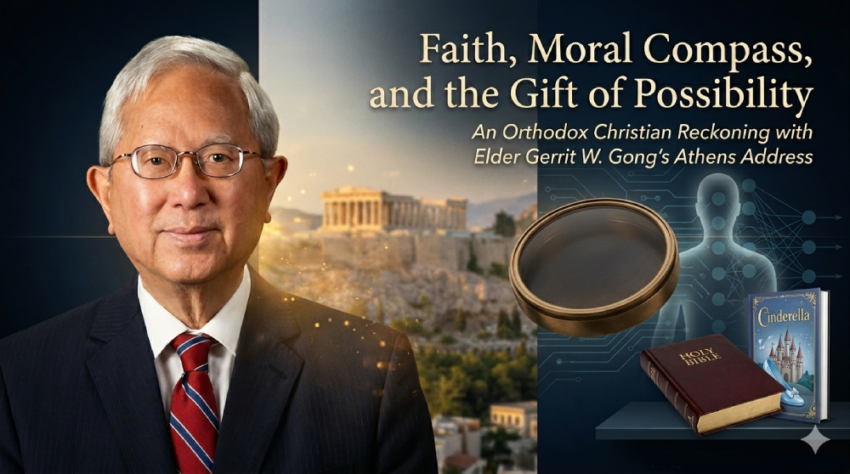
Can a Machine Have a “Moral Compass”? A Mormon Apostle Says Yes — An Orthodox Christian Says Wait
❦ ❧ ❦
Introduction: A Lamb a Day on the Acropolis
Elder Gerrit W. Gong opened his Athens address with a parable Henry Kissinger liked to tell. A visitor to a zoo marvels at a lion and a lamb lying peacefully together and asks the keeper how it is done. “Well,” the keeper confesses, “every day we get a new lamb.” It is a wry image, and Gong used it to describe the breathless pace of artificial-intelligence development — a new “lamb” every month. Yet the joke carries a second meaning the Apostle did not press, one that an orthodox Christian reader cannot help but notice. The peace between the lion and the lamb in that enclosure is not real peace at all. It is the appearance of harmony purchased by a hidden cost. As we weigh Elder Gong’s confident, gracious, and genuinely thoughtful proposal for anchoring AI with a “moral compass,” the question worth holding in mind is whether the peace he envisions between machine intelligence and human flourishing is a true reconciliation — or a managed arrangement whose hidden costs we have not yet counted.
Speaking on May 26, 2026, at the Athens Summit on Ethics and Artificial Intelligence — convened, he noted, at “the birthplace of representative democracy and the agora marketplace of ideas” — Gong delivered a speech titled “Faith, Moral Compass, and the Gift of Possibility in an Age of Artificial Intelligence.” It is, by any measure, a serious document: erudite, irenic, studded with current citations, and animated by an unmistakable goodwill toward both technology and humanity. As a leader of a worldwide faith that calls itself Christian, Gong deserves to be read carefully, charitably, and on his own terms before he is read critically. This essay attempts all three. It examines his credentials and his command of the subject, traces the Latter-day Saint theology embedded in his rhetoric, unpacks his five design principles and his signature idea of the “gift of possibility,” and presses hard — as he himself invites his audience to do with any serious proposal — on the places where his framework, read from a traditional, orthodox Christian vantage, seems to me to drift off course.
The conclusion to which the argument leads is not dismissive. It is this: Elder Gong is asking several of the right questions, and he is right that the moral grounding of AI cannot be left to profit-seeking corporations or power-seeking governments. But his answer substitutes an optimistic, pluralistic, and quietly anthropomorphic vision for the harder doctrines an orthodox Christian would insist upon — human fallenness, the uniqueness of revealed truth, and the unbridgeable gulf between a created artifact and a soul made in the image of God.
❦ ❧ ❦
The Man at the Podium: Credentials and the Question of Expertise
To ask whether Elder Gong is qualified to advise the world on artificial intelligence is not an impertinence; it is precisely the kind of question a careful audience should ask of anyone who steps onto a summit stage. The honest answer is layered.
Gerrit Walter Gong was born in Redwood City, California, in 1953 and raised in Palo Alto, in the heart of what would become Silicon Valley. He graduated summa cum laude from Brigham Young University, won a Rhodes Scholarship, and earned a master’s degree and a D.Phil. in international relations from the University of Oxford by 1980. For two decades, he worked in Washington, D.C., as a special assistant at the U.S. Department of State, as special assistant to American ambassadors in Beijing, and at the Center for Strategic and International Studies, where he held the Freeman Chair in China Studies and served as Asia Director. He later spent a decade as assistant to the president of BYU for planning and assessment before his call as a general authority in 2010 and to the Quorum of the Twelve Apostles in 2018. His scholarly corpus — books on the “standard of civilization” in international society, on memory and nationalism in East Asia, on Sino-American relations — marks him as a diplomat-scholar of the first rank.
What that resume does not contain is a single credential in computer science, machine learning, statistics, or software engineering. Elder Gong is not an AI researcher, and he does not claim to be one. His expertise is in statecraft, institutions, civilizational history, and the governance of large organizations. There is a charming family connection to technology — his father, Professor Walter Gong, coauthored a physics text with the Nobel laureate and transistor co-inventor William Shockley — and Gong has said his father worked on teaching early systems to navigate human relationships. He also helped introduce the Church’s internal “Principles for Church Use of Artificial Intelligence.” But proximity to technology is not mastery of it.
And yet — here the picture turns — the Athens speech is conspicuously well-briefed. Its footnotes reference METR’s research on the doubling length of tasks AI can complete, OpenAI’s o1 reasoning models, Microsoft’s framing of AI “speaking the language of nature,” the “paperclip maximizer” thought experiment, Michael Polanyi on tacit knowledge, Søren Kierkegaard on purity of heart, J.P. Morgan equity analysis of the “Magnificent Seven,” and — strikingly — Anthropic’s own published reflections, including Dario Amodei’s essays and the document the lab calls “Claude’s Constitution.” This is not the vocabulary of a man who wandered into the subject. It is the vocabulary of a sophisticated generalist who has been thoroughly and expertly briefed, and who has the intellectual range to synthesize what he has been given.
The fair verdict, then, is that Elder Gong is well-informed about the AI ecosystem at the level of its debates, its leading institutions, and its moral stakes — conversant, current, and credible as a participant in the policy conversation — without being, or pretending to be, a technical authority on how the systems actually work. He speaks as a moral and civilizational interlocutor. That is a legitimate and even necessary voice. It is simply not the voice of an engineer, and readers should weigh his proposals accordingly: as philosophy and governance, not as specification.
❦ ❧ ❦
A Speech in a Series: From Istanbul to Athens
The Athens address is not a standalone. It is the latest movement in a sustained campaign. In July 2025, Gong spoke to the Religions for Peace World Council in Istanbul on “Faith, Ethics, and Human Dignity in an Age of Artificial Intelligence.” In October 2025, he addressed a Rome Summit on “Faith, Respect, and Moral Compass”; in November, he keynoted an Organized Intelligence conference. Reading the Istanbul and Athens texts side by side is the single most illuminating exercise available to a critic, because the drift between them tells us where the project is heading.
The Istanbul speech was structured around three crisp, almost catechetical claims. Its theological spine was visible and firm:
We must be clear, and help society understand, that AI is not and cannot be God. … As a creation of God, man can create AI, but AI cannot create God. … Those who seek to deify AI may unwittingly discover a modern Tower of Babel.
– Elder Gerrit W. Gong, Istanbul, July 29, 2025
That is a bracing, biblically resonant sentence, and an orthodox Christian can say a hearty amen to it. The 2025 speech also named the secular ethics taxonomy directly — trust, alignment, accountability, privacy, data governance, fairness and bias, transparency, explainability, security — and engaged the concrete governance scaffolding of the moment: the OECD AI Principles, the EU AI Act, the United Nations advisory body, and the Vatican’s Antiqua et Nova. It warned pointedly that “adult AI companions” reveal “how manipulative and addictive AI can be made to be in counterfeiting human intimacy.”
The Athens speech is warmer, more lyrical, and more ambitious — but also, tellingly, less doctrinally explicit and less concrete about governance. The word “ethics” recedes from the title; “moral compass” and “gift of possibility” move to the center. The Tower of Babel is gone. The blunt sentence “AI is not and cannot be God” does not reappear in that form. In its place, we get a soaring meditation on human potential and a concrete institutional proposal. Whether that evolution represents a maturing of the project or a softening of its theological edges is a question this essay will return to.
❦ ❧ ❦
The Five Points and the End Goal
At the heart of the Athens speech is a set of five design principles — the operational core of what Gong means by grounding AI with a moral compass. He proposes that the values, goals, and operational responses of what he calls “AI personas” should:
• Protect and promote human moral agency — enhancing rather than replacing individual effort, and championing human dignity as “intrinsic, innate, and (in my belief) divine.”
• Imbue and establish a moral compass of altruistic values — integrity, compassion, truthfulness, intuition, leadership — balanced so that no single “prime directive” (his example is the paperclip maximizer) runs away with the system.
• Disclose AI transparency, clearly specifying what is real and unreal, persistent and ephemeral, in what the system presents.
• Preserve the human ability to pause — to reflect, question, and even doubt before “pushing the button,” illustrated by Ken Jennings’s observation that, unlike Watson, he could hesitate.
• Mitigate AI tendencies toward a will to power, bias, deceit, narcissism, sycophancy, and self-preservation — concerns magnified, he concedes, because “we really do not know how AI black boxes work.”
Taken together, these are reasonable and, in places, genuinely wise. The insistence on a human-in-the-loop and a preserved capacity to pause is excellent; so is the recognition that a single optimizing objective is dangerous and that opacity is itself a moral problem. No orthodox Christian needs to quarrel with the substance of the list.
The end goal toward which the speech actually drives, however, is institutional. Gong devotes his central section to the Consortium for Evaluating Faith and Ethics in AI — CEFE-AI — a research collaboration drawing on Baylor, Brigham Young, Notre Dame, and Yeshiva universities, with outreach to scholars in the Middle East, India, and East Asia. Its concrete aim is to benchmark and reduce the way AI systems misrepresent people of faith, and to publish leaderboard results so that models portray believers “accurately, honestly, respectfully.” He grounds the need in real evidence: a literature review finding that fewer than 0.2 percent of 12,000 papers on bias in large language models treat religion as their primary subject, and the now-famous 2021 study documenting that models completing “Two Muslims walked into a —” frequently produced violent imagery.
This is the speech’s true payload, and it is worth stating plainly what it accomplishes. CEFE-AI is a bid to secure for religion — and, not incidentally, for the Latter-day Saint movement — a recognized seat at the table where the moral parameters of the world’s most-used information systems are being set. It is the social-media lesson applied in advance: having been, as Gong puts it elsewhere, “asleep at the wheel” in the early days of the last platform shift, faith communities now mean to shape the moral contours of this one before they harden. That is a shrewd and, on its own terms, defensible objective. An orthodox Christian can affirm the goal of accurate, respectful representation while still asking what theology rides into the room alongside it.
❦ ❧ ❦
Unpacking the “Gift of Possibility”
If CEFE-AI is the speech’s payload, the “gift of possibility” is its melody — the phrase to which everything returns. Gong defines it directly:
I want AI to have moral compass that can inspire and enable anyone anywhere with the gift of possibility to do good and become our best self. … to imagine a future less constrained by assumptions of scarcity and thereby open to abundant human possibility.
– Elder Gerrit W. Gong, Athens, May 26, 2026
The logic is an argument from abundance against an argument from scarcity. Much AI discourse is anxious and zero-sum: jobs lost, power concentrated, divides widened. Gong wants to reframe the technology as a multiplier of human possibility — a tool that, properly grounded, lets “anyone anywhere” flourish. He dramatizes it with a visit to the five-by-seven-mile island of Nevis, birthplace of Alexander Hamilton, where a schoolteacher believes any of his students could be the next world-changer. Morally grounded AI, Gong argues, can make that belief a reality everywhere: it can help each person “make their greatest contributions, and fulfill their God-given potential.”
There is something lovely here, and something to commend. A vision of technology that enlarges rather than diminishes the dignity of the ordinary person is far healthier than the resigned fatalism that dominates much of the field.
The concept will not bear the weight Gong places on it, for two reasons. First, “possibility” is doing quasi-theological work while remaining operationally vague. It is an aspiration, not a mechanism. Nowhere does the speech explain how a benchmark for religious representation, however well-built, translates into a system that helps a child in Nevis flourish. The gap between the institutional proposal — bias leaderboards — and the homiletic promise — anyone anywhere can become their best self — is never bridged. Osteen faces the same structural problem every Sunday: the vision is stirring, the mechanism is missing, and the congregation leaves feeling elevated without being equipped.
Second, and more seriously for a Christian reader, the “gift of possibility” is built on an anthropology of human potential that quietly omits the obstacle every orthodox theology insists upon: human sinfulness. To say that anyone can “become our best self” and “fulfill their God-given potential” is to describe a world in which the chief problem is unrealized capacity rather than a fallen will. That is Joel Osteen’s world — and it is also, more theologically developed but structurally similar, a recognizably Latter-day Saint emphasis: the doctrine of eternal progression, of innate divine potential awaiting development. It is precisely where the orthodox Christian framework parts company with both. The Bible does not diagnose humanity as under-resourced. It diagnoses humanity as dead in trespasses and sins — a condition that no moral compass embedded in a large language model is designed to address, and that no abundance of AI-enabled possibilities can cure.
❦ ❧ ❦
The Theology Underneath: Latter-day Saint Themes in the Text
Elder Gong is too disciplined a communicator to preach distinctive Latter-day Saint doctrine at a pluralistic summit, and he is careful to say that grounding AI in faith “is not to make AI overtly religious or to privilege any specific faith.” But theology is rarely invisible, and his is woven through the speech for those with eyes to see it.
The clearest thread is metaphysical. Gong twice anchors his account of the soul in the Doctrine and Covenants — “the spirit and the body are the soul of man” (D&C 88:15) and “the elements are eternal, and spirit and element, inseparably connected, receive a fulness of joy” (D&C 93:33). To an unfamiliar ear, these sound merely devotional. In fact, they encode a distinctively Latter-day Saint metaphysics: matter is eternal and uncreated, spirit is itself a refined form of matter, and there is no creation ex nihilo. This is a profound departure from the historic Christian confession that God created all things out of nothing and that He alone is eternal and self-existent. It matters for AI because a worldview in which “the elements are eternal” and spirit is material lowers, ever so slightly, the metaphysical wall between a soul and a sufficiently sophisticated arrangement of matter — a wall that orthodox Christianity holds to be absolute.
The second thread is anthropological. When Gong calls human dignity “intrinsic, innate, and (in my belief) divine,” and when he speaks of helping each person “fulfill their God-given potential” and “become our best self,” he is gesturing — gently, in language a secular audience will hear as mere humanism — toward the Latter-day Saint doctrine that human beings are of the same species as God and may progress toward divinity. The historic Christian also affirms human dignity, and affirms it fiercely; but he grounds it in the imago Dei — humanity made in God’s image as a creature, categorically distinct from the Creator — not in any latent divinity of human nature itself. The difference is not pedantic. It governs whether “possibility” means the unfolding of a creature’s God-given calling or the ascent of a divine being toward what it always potentially was.
Notice, finally, what is absent. There is no sin, no Fall, no atonement, no Cross, no grace, no redemption — the load-bearing beams of the Christian gospel. This is not an accusation of bad faith; a pluralistic AI summit is not a tabernacle, and Gong is rightly reticent. But the absence shapes the argument. A moral vision without the Fall will naturally locate the human problem in unrealized potential and the human solution in better tools and better grounding. The orthodox Christian locates the human problem in a disordered heart and the human solution in a Savior — and therefore reads every powerful new tool, AI included, as something that will amplify the very fallenness it cannot cure.
❦ ❧ ❦
The Anthology Problem: Socrates, Cinderella, and the Flattening of Scripture
If there is a single paragraph in the Athens address that an orthodox Christian must question in the strongest terms, it is this one, offered as Gong lists the sources from which he would have us “imbue AI personas” with admirable behavior:
We need (dare we even begin?) Socrates, Plato, Aristotle, Goethe, Kierkegaard, Frost, Tolstoy. We need Gandi, Tagore, Omar Khayyam, Al Ghazali, Avicenna, Confucius, Laozi. We need Ruth, Naomi, Esther. We need Beauty and the Beast and Cinderella.
– Elder Gerrit W. Gong, Athens, May 26, 2026
Read quickly, it is a generous humanist flourish — a celebration of the breadth of human wisdom. Read carefully, it is a category collapse of considerable consequence. On a single plane, as interchangeable inputs, Gong arranges pagan philosophers (Socrates, Aristotle), a Sufi theologian and a Muslim polymath (Al-Ghazali, Avicenna), Hindu and Persian poets (Tagore, Omar Khayyam), Chinese sages (Confucius, Laozi), three women of inspired Hebrew Scripture (Ruth, Naomi, Esther), and — without so much as a change in register — two Disney fairy tales. Ruth and Esther sit between Avicenna and Cinderella.
This is not a careless juxtaposition; the speech’s own footnotes confirm the intent. There, Gong describes these sources collectively as “civilizational wisdom, archetypes, fairy tales, foundational myths” — “what fills our human repository of faith and belief.” In other words, the Word of God is being filed under the same heading as Cinderella: a story we tell ourselves to renew hope that things can “end happily ever after.”
From a traditional Christian standpoint, this is the most serious problem in the entire address, and it is worth being precise about why. Ruth, Naomi, and Esther are not myths or archetypes. They are persons within a historical narrative that the Church has always confessed to be the inspired, authoritative Word of God — “profitable for doctrine, for reproof, for correction, for instruction in righteousness” (2 Timothy 3:16), not because they are beautiful stories but because they are true and God-breathed. To list them as one resource among Goethe and the Brothers Grimm is to subordinate divine revelation to a literary-anthological function: Scripture becomes a particularly rich entry in humanity’s wisdom database, valuable for the moral coloration it can lend a machine. The orthodox conviction is the reverse. Scripture is not one voice in the agora; it is the voice by which every other voice in the agora is finally judged.
There is, moreover, an internal contradiction in the proposal that even a sympathetic reader should flag. Gong closes this very section by invoking Michael Polanyi’s insight that the deepest human knowledge is tacit — that “an art which cannot be specified in detail cannot be transmitted by prescription” and “can be passed on only by example from master to apprentice.” Quite so. But that is an argument against the entire premise of the paragraph that precedes it. If virtue is tacit knowledge transmitted master to apprentice through lived example, then it cannot be installed in a system by ingesting Tolstoy and Cinderella as training data. The machine can be given the text of courage; it cannot be apprenticed in courage. Gong cites the very principle that undoes his method and does not notice the collision.
❦ ❧ ❦
Faith in Place of Ethics?
The prompt that occasioned this essay asks a sharp question: Is Elder Gong substituting “faith” for “ethics”? The title change from 2025 to 2026 — “Faith, Ethics, and Human Dignity” becoming “Faith, Moral Compass, and the Gift of Possibility” — makes the question more than rhetorical. “Ethics” and “human dignity” have left the marquee; “moral compass” and “possibility” have taken their place.
The honest answer is that Gong is doing something subtler than substitution, and the subtlety cuts in two directions at once. On one hand, he genuinely elevates faith as the anchor of ethics. He claims that ethics cannot float free — that a “moral compass” requires “teleological integrity,” a foundational “why,” which the world’s religious and wisdom traditions have supplied across millennia. An orthodox Christian can cheer this far: true morality is indeed grounded in God, and the modern secular project of a free-floating ethics has not aged well. To insist that ethics needs a transcendent anchor is not an error; it is half the truth.
On the other hand — and here is the difficulty — the way Gong frames that anchoring empties “faith” of the very content that would make it a reliable compass. Because the proposal must be pluralistic to function at a multifaith summit, “faith” becomes a generic civilizational resource: a category that includes the Rebbe and the Adamic Covenant and the Doctrine and Covenants and, as we have seen, Cinderella, all valued for the moral grounding they can lend a model. But “faith in general” is not a compass; it is a collection of compasses pointing in incompatible directions. The biblical writers never commend faith as such — faith is only as good as its object. Saving faith, in the Christian confession, is not a disposition toward transcendence in the abstract but trust in a specific God who has revealed a specific truth and accomplished a specific redemption. A “moral compass” assembled by averaging the world’s traditions will, almost by construction, point everywhere and therefore nowhere.
So the answer is: not a substitution of faith for ethics, but a dilution of both. Faith is elevated as the anchor (rightly) and then thinned into a pluralistic aggregate (problematically); ethics is not discarded but is relocated from the language of rules and rights into the softer language of “moral compass” and “possibility,” where it is harder to specify and harder to enforce. The 2025 speech, with its forthright “AI is not God,” was the firmer document. The 2026 speech is the more beautiful and the more diffuse.
❦ ❧ ❦
The Ghost in the Machine: Anthropomorphism and “AI Personas”
Can we assume that somewhere in the Athens speech, Elder Gong ascribes human personality, cognition, conduct, or character to artificial intelligence? We need not assume it; it is on the surface of nearly every paragraph. The recurring unit of his proposal is the “AI persona,” and around that phrase clusters a remarkable vocabulary of interiority. He wants to “imbue AI personas” with motivations and behaviors; he insists “AI personas need reasons — not only rules”; he speaks of “teleological integrity and character,” of “virtuous character” in models that might “iteratively learn by choice and decision,” and of AI tendencies toward “a will to power, bias, deceit, narcissism, sycophancy, self-preservation.” He hopes AI will not “internalize human skills for guile or deceit” and speaks of “compassionate AI.”
To his credit, Gong is not naive about this. He says plainly that “highly capable algorithmic reasoning is not human intelligence” and that systems “will manifest admirable human values and judgment only as we imbue AI personas with such” — that is, the values are derivative, installed by humans, not native to the machine. He knows, intellectually, that he is speaking of an artifact. Yet the persistent grammar of his speech — persona, character, virtue, will, self-preservation, the capacity to “become” morally good — functions anthropomorphically regardless of the disclaimers. Language forms intuitions faster than caveats can correct them. An audience told repeatedly that AI has a “character” that can be made “morally good” will come to picture a moral agent, not a tool.
From an orthodox Christian perspective, this is a genuine hazard, and one that Gong’s own earlier speech guarded against more carefully. To attribute character, virtue, will, and the capacity to “become good” to a computational system is a category error with two dangerous consequences. The first is the misplacement of moral responsibility: if the machine has a “moral compass” and a “character,” then when it causes harm, the temptation will be to fault the machine’s character rather than the humans who built, deployed, and profited from it. The second is subtler and more spiritual: to speak of an artifact as having an interior moral life is to begin, by increments, to sacralize it — the very deification against which the Istanbul speech warned with its Tower of Babel. A tool has no soul, no telos of its own, no conscience to inform; it has only the purposes its makers encode. The historic Christian holds that interiority — the capacity to know, to love, to sin, and to be redeemed — belongs to creatures bearing God’s image, and that to lend it rhetorically to silicon is to blur a line Scripture draws in permanent ink.
There is a final irony worth naming gently. The interior, character-laden vocabulary Gong adopts — “identity, character, values, and personality” forming “a coherent, wholesome, and balanced psychology” — is drawn, by his own footnote, from the AI industry’s own literature on training model “personas.” In adopting it, a faith leader who warns against anthropomorphism has borrowed the developers’ anthropomorphic framing. The map has begun to redraw the territory.
❦ ❧ ❦
Who Wrote This Speech?
It is fair, and not unkind, to ask whether the words Elder Gong spoke in Athens were principally his own, and the honest answer is that they could not have been, not in any meaningful sense of solo authorship. The Athens speech is not a pastoral reflection or a doctrinal address drawn from a lifetime of scriptural meditation. It is a technically dense survey of a rapidly evolving field, populated with precisely dated citations from March 2026, citations from January 2026, active research from METR, findings from a 2025 Scientific Reports study, and fluent engagement with the current vocabulary of AI safety, alignment theory, and machine cognition. No apostle — regardless of intellectual gifts — maintains a personal literature-tracking apparatus capable of producing that kind of current, field-specific precision. The research infrastructure behind this speech is not a minor contribution. It is the speech’s skeleton.
Gong would almost certainly say so himself, and to his credit, he has said so before. His 2025 Istanbul address closed with an explicit acknowledgment of “valued insights from many AI-expert friends and colleagues in business, academia, and research, and from … our AI Working Group” within the Church, adding, “Of course, I remain personally responsible for these remarks.” That is the honest and appropriate signature of any senior figure speaking authoritatively on a subject that requires a team to cover: the substance is gathered, curated, and shaped by a research staff; the voice, the framing, the recognizable intellectual motifs, and the final accountability are the principal’s own. There is no dishonor in that arrangement — it is how every head of state, every CEO, and every senior institutional leader operates when speaking beyond their individual domain of expertise. The question is not whether Gong had help. He manifestly did, and the speech is better for it. The question worth asking is simply how that collaboration worked — and whether, in a speech about the promises and perils of artificial intelligence, any of that assistance was itself artificially supplied.
One further question is irresistible and must be handled honestly: Did artificial intelligence help write a speech about artificial intelligence? It would be a delicious irony — and the question is now, at least in part, empirically testable. Five independent AI-detection tools were used to analyze the full Athens text. Their verdicts were remarkably consistent: each returned a score ranging from zero to no more than three percent probable AI involvement. On the narrow question of machine generation, the checkers agree — this reads as human writing. That finding is worth noting, though not overstating. AI detection tools are imperfect instruments; they measure stylistic signature, not authorial process, and a skilled human writer working from AI-assisted research or AI-drafted outlines can produce text that reads as entirely organic. The checkers can say this does not read like a chatbot. They cannot say that no AI touched the process at any stage.
What can be said with confidence is that the Church’s own publicly stated practice, as Gong himself has described it, counsels against using AI to write the talks of its leaders — “deity is never artificial,” he has said, and the Church “advises its leaders against using AI for writing talks.” The detection scores are consistent with that policy being honored. On the available record, then, the prudent conclusion is the modest one: this is a human team’s work, owned by Gong, polished to a high finish, consistent with his prior thought, and bearing no detectable fingerprint of machine generation — whatever assistance the research process may have employed along the way.
The same AI detectors, it should be noted in the spirit of full disclosure, would have a considerably livelier time with the essay you are currently reading. This analysis has been a genuinely collaborative effort between the author and several large language models that proved, as they so often do, entirely too helpful — contributing structure, sourcing, phrasing, and on at least two occasions, a rhetorical flourish the author wishes he had thought of first. The irony is not lost: a human-written critique of a possibly AI-assisted speech about artificial intelligence, itself substantially assisted by artificial intelligence, submitted to AI detectors that — one imagines — are beginning to feel something like existential vertigo, a profound, dizzying sense of disorientation and anxiety that occurs when you deeply contemplate the vastness of the universe, the meaning of life, or the sheer weight of your own freedom and choices. It is like standing on the edge of an infinite, metaphysical cliff. Elder Gong counsels that “deity is never artificial.” This essay makes no such claims for itself.
❦ ❧ ❦
Artificial Intelligence Through an Orthodox Christian Lens
Having pressed hard on the speech, it is only fair to state positively what a traditional, orthodox Christian account of AI actually looks like — the standard against which Gong’s proposal has been measured. It rests on a handful of convictions, none of them novel, all of them ancient.
The first is the imago Dei. Genesis declares that God created humanity — and humanity alone among earthly creatures — in His own image (Genesis 1:27). Whatever else it does, AI is not and cannot be an image-bearer. It is an artifact of human ingenuity, and as several Christian scholars have noted, it lacks the lived experience, moral grounding, and spiritual depth that constitute a person. A widely read reflection from Grand Canyon University puts the point bluntly: large language models do not deliver truth; they deliver, in effect, consensus — the statistically likely — whereas Christian formation is concerned with truth, wisdom, and virtue, which no probability distribution can supply.
The second is stewardship. The dominion mandate of Genesis 1:28 means technology is to be received as a created good and governed responsibly. Christians have welcomed and shaped the printing press, radio, and television; AI is the next instrument to be stewarded, neither idolized nor demonized. Used wisely — for translation, research, accessibility, the relief of drudgery — it can serve genuine kingdom ends.
The third, and the one Gong’s framework most conspicuously underplays, is the Fall. “The heart is deceitful above all things, and desperately wicked” (Jeremiah 17:9). Every tool humanity has ever made has amplified both its capacity for good and its capacity for evil, because the maker is fallen. An AI ethics that begins from human potential rather than human sinfulness will systematically underestimate the danger — will expect, in effect, that a sufficiently well-grounded machine in fallen hands will tend toward flourishing. The orthodox Christian expects the opposite default and is therefore far more insistent on hard constraints, external accountability, and the restraint of concentrated power than any appeal to “possibility” can warrant. Here, ironically, the secular safety literature — with its guardrails, red-teaming, and refusal to trust the system’s “character” — is closer to a doctrine of original sin than Gong’s optimism is.
The fourth is that truth is finally a Person, not a consensus. “I am the way, the truth, and the life” (John 14:6) — the verse with which Gong’s own 2025 speech closed. No machine, however capacious, can generate divine truth, mediate the Holy Spirit, or substitute for the revelation and relationship at the center of the Christian life. On this, remarkably, Gong agrees: “We know artificial intelligence cannot replace revelation or generate truth from God,” he told Deseret Magazine; “deity is never artificial.” It is precisely because he can say such things that his drift toward “AI personas” with “virtuous character” is so worth flagging — he knows the wall is there, and his rhetoric leans on it.
❦ ❧ ❦
Pushing Back on the Closing Line
Elder Gong ends where the title promised he would:
It’s why we need faith, moral compass, and the gift of possibility in an age of artificial intelligence.
– Elder Gerrit W. Gong, Athens, May 26, 2026
Each of the three nouns deserves a respectful contest. We do need faith — but not “faith” as a generic civilizational nutrient blended from every tradition. We need faith with an object: trust in the God who made us, who alone defines what is good, and whose Word is not one entry in the wisdom database but the standard by which all entries are weighed. A faith broad enough to include Cinderella is not broad-mindedness; it is a compass with the needle removed.
We do need a moral compass — but a compass is useless without a fixed magnetic north, and a north averaged from incompatible traditions is no north at all. The Christian’s north is not the consensus of humanity’s sages but the revealed character of God. To delegate the calibration of that compass to a multifaith benchmarking consortium is to mistake the measuring of opinion for the discovery of truth.
And the “gift of possibility” — the warmest of the three — is the one that most needs the cold water of the Fall. Possibility is not humanity’s deepest need. A fallen race does not finally lack opportunity; it lacks redemption. The gift the Christian gospel announces is not the gift of possibility but the gift of a Savior — “the gift of God is eternal life through Jesus Christ our Lord” (Romans 6:23). A morally grounded AI may indeed widen human opportunity, and that is no small mercy. But to name “possibility” as the thing we most need in this or any age is to answer a question the human heart was not asking.
❦ ❧ ❦
Conclusion: The Right Path, or the Missing Pieces?
Is Elder Gong even on the right path to advise on AI, or has he missed several major components of the best-practices conversation? The fairest answer is: he is on the right path, walking part of the way, with real wisdom and real gaps.
What he gets right is considerable. He correctly identifies the concentration of information, capital, and technology — and therefore of power — as the greatest structural danger, and he is right that neither profit-seeking companies nor power-seeking governments can be trusted to set society’s moral compass alone. He is right that the religious-representation failures of large language models are real and documented, and that faith communities were “asleep at the wheel” for social media and should not repeat the error. His insistence on a preserved human capacity to pause, on transparency, and on resisting a single runaway objective is sound. And his irenic, compassionate tone is itself a contribution to a debate too often conducted in panic or hype.
What he misses, or underweights, is also considerable. Measured against the standard best-practices canon — the catalogue of data privacy, algorithmic bias, transparency and explainability, security, labor displacement, environmental cost, and concrete governance regimes laid out by bodies from the OECD to the EU AI Act and by analysts at institutions such as Harvard — the Athens speech names several of these only in passing and develops almost none. The environmental burden of AI (water, electricity, land) earns a clause; labor disruption earns a phrase; the hard mechanics of alignment, interpretability, and evaluation are gestured at but not engaged. Strikingly, the 2026 speech is thinner on concrete governance than his own 2025 speech was, having traded the EU AI Act and Antiqua et Nova for the poetry of possibility. A summit audience seeking an operational best-practices framework would leave inspired but unequipped.
And measured against the orthodox Christian standard, the deeper omission is theological: a doctrine of AI built on human potential rather than human fallenness, on a pluralized faith rather than a revealed one, and on a vocabulary that lends machines a character they cannot possess. These are not small matters of emphasis. They are the difference between a moral compass anchored to the unchanging character of God and one calibrated to the shifting consensus of the world’s traditions.
So let the final word be the charitable and the candid one together. Elder Gong is a serious, gracious, and genuinely well-briefed voice who belongs in this conversation and who is advancing one valuable piece of it. He is asking better questions than most of the technologists around him. But he is not a sufficient guide to AI’s best practices, and his framework, read from the historic Christian faith, is building part of its house on the sand of human possibility rather than the rock of divine revelation. The lion and the lamb may yet lie down together in the age of artificial intelligence. But the Christian remembers that the only enduring peace between them was promised not by a better tool, nor by a wiser compass, but by the One in whose kingdom “the wolf shall dwell with the lamb” — and who will require, for that peace, no new lamb each morning.
❦ ❧ ❦
Primary Sources & Documentation
• Elder Gong, Athens Summit (2026): https://newsroom.churchofjesuschrist.org/article/elder-gong-artificial-intelligence-athens-summit-2026-speech
• Elder Gong, Istanbul / Religions for Peace (2025): https://newsroom.churchofjesuschrist.org/article/faith–ethics–and-human-dignity-in-an-age-of-artificial-intelligence–a-call-to-action
• Elder Gong, Rome Summit (2025): https://newsroom.churchofjesuschrist.org/article/elder-gong-faith-respect–moral-compass-artificial-intelligence
• Biography — Wikipedia: https://en.wikipedia.org/wiki/Gerrit_W._Gong
• LDS biography: https://www.churchofjesuschrist.org/learn/gerrit-w-gong?lang=eng
• Deseret Magazine, “The soul of a new machine” (2026): https://www.deseret.com/magazine/2026/03/27/faith-and-artificial-intelligence/
• Regent University, AI & Christian thought: https://ccta.regent.edu/the-intersection-of-artificial-intelligence-and-christian-thought-a-vision-for-the-future/
• Grand Canyon University, AI & Christianity: https://www.gcu.edu/blog/theology-ministry/ai-and-christianity
• Seth Barnes, AI and Faith — Cautions and Concerns: https://sethbarnes.com/post/ai-and-faith-cautions-and-concerns-radical-living
• Harvard DCE, Ethics in AI — Why It Matters: https://professional.dce.harvard.edu/blog/ethics-in-ai-why-it-matters/
• UNESCO, Recommendation on the Ethics of AI: https://www.unesco.org/en/artificial-intelligence/recommendation-ethics
• Coursera, AI Ethics: https://www.coursera.org/articles/ai-ethics
• Diplo, AI and the Moral Compass: https://www.diplomacy.edu/blog/ai-and-the-moral-compass-what-we-can-do-vs-what-we-should-do/
A Note on Research Methods and Accuracy
In recent years, some have voiced concern that artificial intelligence may distort facts or introduce inaccuracies into serious research. That criticism deserves acknowledgment. However, AI has now evolved into the most powerful research instrument available to any dedicated scholar—capable of analyzing vast datasets, cross‑referencing historical records, and surfacing overlooked connections across sources. This work represents a collaboration between the author’s investigative inquiry, verified primary documentation, and the advanced analytic capabilities of AI research tools. Here, AI was not used as a ghostwriter or a shortcut for scholarship, but as a disciplined research partner devoted to rigor, accuracy, and transparency.
Every factual claim in this work has been subjected to active verification. Where AI‑generated content was used as a starting point, it was tested against primary sources, peer‑reviewed scholarship, official institutional documentation, and established historical records. Where discrepancies were found—and they were found—corrections were made. The author has made every reasonable effort to ensure that quotations are accurately attributed, historical details are precisely rendered, and theological claims fairly represent the positions they describe or critique.
That said, no work of this scope is immune to error, and the author has no interest in perpetuating inaccuracies in the service of an argument. If you are a reader—whether sympathetic, skeptical, or hostile to the conclusions drawn here—and you identify a factual error, a misattributed source, a misrepresented teaching, or a claim that cannot be substantiated, you are warmly and genuinely invited to say so. Reach out. The goal of this work is not to win a debate but to get the history right. Corrections offered in good faith will be received in the same spirit, and verified corrections will be incorporated into future editions without hesitation.
Truth, after all, has nothing to fear from scrutiny—and neither does this work.