
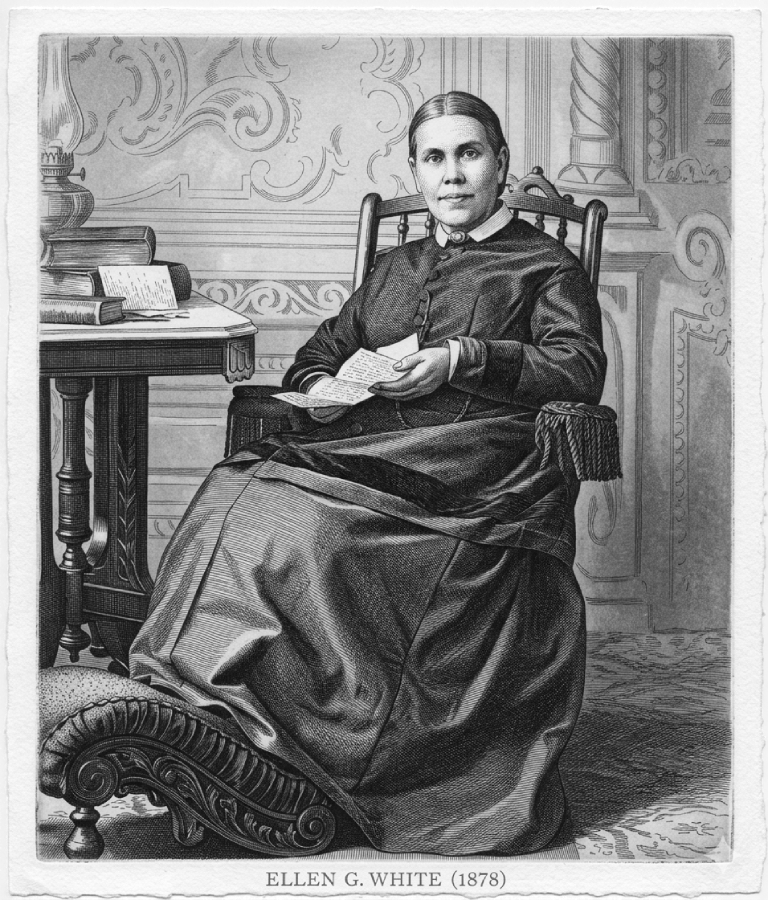
Image: Portrait of Ellen G. White at age 51
A Traditional Christian Examination of Doctrine, History, and the Prophetic Legacy of Ellen G. White
Introduction: A Church That Resists Easy Categorization
On any given Saturday morning, more than twenty-four million people in over two hundred countries quietly close their workplaces, gather their families, and walk into a Seventh-day Adventist church. They open Bibles bound in the same leather as those of any Baptist or Presbyterian. They sing hymns familiar to evangelicals everywhere. They listen to sermons drawn from the same sixty-six books of Scripture. They confess Jesus Christ as Lord and Savior, profess belief in His bodily resurrection, and await His personal, visible, glorious return. By every external measure, they look, sound, and behave like an evangelical Protestant denomination. And in significant respects, they are.
Yet beneath this familiar surface lies a theological architecture unlike that of any other body claiming the name of Christ. It is a church born in the smoldering ashes of one of the most spectacular prophetic failures in American religious history. It is a movement whose theological development was shaped, in extraordinary measure, by the visions of a teenage girl from Maine whose followers came to compare her to the biblical prophets. It is a tradition that observes Saturday rather than Sunday as the divinely ordained day of worship, denies the conscious eternal existence of the unsaved, and teaches that the atoning work of Christ entered a second, ongoing phase in a heavenly sanctuary on a specific October day in 1844.
How shall the orthodox Protestant Christian regard this church? The question is neither idle nor settled. In 1956, the editors of the conservative evangelical magazine Eternity, after extensive dialogue with Adventist leaders, declared that Seventh-day Adventists were brothers and sisters in Christ. In 1960, the apologist Walter Martin published The Truth About Seventh-day Adventists, a book that scandalized many of his fellow countercultists by classifying Adventism as Christian, however heterodox. Yet only three years later, the Reformed theologian Anthony Hoekema published The Four Major Cults and placed Seventh-day Adventism alongside Mormonism, Jehovah’s Witnesses, and Christian Science. Six decades later, evangelicals remain divided. Some treat Adventism as a quirky Christian cousin; others as a sectarian movement requiring evangelistic engagement; still others as a body whose teachings are too gravely flawed to be embraced as authentic Christianity.
This essay is an attempt to think clearly and charitably about that question. It is written by an outsider who is neither hostile to Adventists as people nor indifferent to the historic teachings of the Christian church. It will trace the origins of the movement, weigh its formative prophetess against the testimony of Scripture, examine its distinctive doctrines, document the ways the modern church has sought to soften the harder edges of its founding visions, and ask honestly whether the points of doctrinal alignment with orthodox Protestantism outweigh the points of divergence. The reader will be left to render his or her own verdict. The author’s hope is only that the verdict be informed.
❖ ❖ ❖
The Millerite Crucible and the Great Disappointment
Every religious tradition has its origin story, and the origin story of the Seventh-day Adventist Church cannot be told without William Miller. A Baptist farmer from upstate New York whose intense Bible study during the 1820s led him to a particular reading of Daniel 8:14 (“Unto two thousand and three hundred days; then shall the sanctuary be cleansed”), Miller applied the so-called day-year principle of prophetic interpretation. Counting twenty-three hundred years forward from what he took to be the decree of Artaxerxes in 457 B.C., he arrived at the year 1843, later refined to October 22, 1844, as the date of Christ’s visible return to earth.
The movement that gathered around Miller’s preaching was enormous by any reasonable measure. By the autumn of 1844, somewhere between fifty thousand and one hundred thousand Americans, drawn from nearly every Protestant denomination, had embraced the conviction that Jesus would return on a calendar date that any farmer could circle. Believers sold their fields, settled their accounts, donned ascension robes (according to popular legend, though scholars now dispute the universality of this practice), and waited.
Then October 23 dawned. And the Lord did not appear.
The trauma of what believers came to call the Great Disappointment can scarcely be overstated. Hiram Edson, one of the disappointed faithful, would later write of weeping in his cornfield. Many abandoned the Christian faith altogether; others rejoined their former denominations in chastened silence. A few, however, refused to admit that the entire prophetic edifice had been mistaken. They proposed instead that Miller’s date was correct, but his event was wrong. Christ had indeed acted on October 22, 1844 — not by coming to earth, but by entering the second, inner chamber of a heavenly sanctuary, where He began a new and final phase of His high-priestly ministry. This was the doctrine that would eventually crystallize as the Investigative Judgment, and it remains one of the most distinctive and contested teachings of the Seventh-day Adventist Church.
Around this nucleus of post-Disappointment believers gathered other convictions. Through the influence of a Seventh Day Baptist named Rachel Oakes Preston and a Millerite preacher named Thomas M. Preble, the seventh-day Sabbath was introduced to the Adventist remnant. Joseph Bates, a former sea captain turned tireless evangelist, became the foremost advocate of Saturday worship within the group. James White, a young Christian Connection preacher, married Ellen Harmon in 1846 and began publishing periodicals to bind the scattered believers together. And gradually, over the better part of two decades, what had been an inchoate movement formed itself into a denomination. On May 21, 1863, in Battle Creek, Michigan, the Seventh-day Adventist Church was officially established.
The orthodox observer needs to grasp the emotional and theological logic of this founding moment. The Adventist Church was not born of careful doctrinal reflection in the manner of, say, the Westminster Assembly. It was born of vindication-seeking — of the determination of a wounded community to find some interpretive scheme by which their prophetic certainty might be salvaged. This is not necessarily disqualifying. God has worked through wounded communities throughout history. But it does mean that the Adventist doctrinal system bears, from its inception, the imprint of an interpretive task: how to rescue October 22, 1844, from the verdict of ordinary history.
❖ ❖ ❖
Ellen G. White: Visionary at the Center
If William Miller supplied the date and Joseph Bates the Sabbath, it was Ellen Gould Harmon White (1827–1915) who supplied the prophetic authority that bound the early Adventist movement together. Born in Gorham, Maine, the daughter of a hat maker, she was the seventh of eight children and twin sister to Elizabeth. At the age of nine, she was struck in the face with a stone thrown by a classmate, an injury that left her unconscious for weeks and permanently disfigured. By her own account, this trauma was a means of grace, turning her gaze from earthly to heavenly things.
Her family was enthusiastic Millerites, and the Great Disappointment of October 1844 fell upon them with the force it fell upon all true believers. Within two months — in December 1844, when Ellen was just seventeen years old — she experienced what she would later report as her first vision. In a kneeling prayer meeting at the home of a sister in the Lord, she felt the power of God come upon her and was “wrapt up in a vision of God’s glory.” She saw the Advent people walking a high, illuminated path toward the New Jerusalem; some grew weary and fell off; others persevered and entered the city. She returned to herself feeling lonely and longing for a better world.
Over the next seventy years, her grandson and biographer Arthur L. White would estimate that she received approximately two thousand visions and prophetic dreams. Observers reported physical phenomena that they took to be confirming signs: a complete cessation of breathing during her visions, sometimes for hours, while her pulse remained regular; a superhuman strength enabling her to hold an eighteen-and-a-half-pound family Bible at arm’s length for half an hour when she herself weighed only eighty pounds; an utter unconsciousness of her surroundings while her eyes remained open and her countenance pleasant. J. N. Loughborough, a longtime associate, claimed to have witnessed her in vision fifty times since 1852 and to have observed these signs personally.
From these visions flowed an extraordinary literary output. Over her lifetime, she would produce more than five thousand periodical articles and forty books, with manuscript material running to over one hundred thousand pages. Her best-known works — Steps to Christ, The Desire of Ages, The Great Controversy, Patriarchs and Prophets, Prophets and Kings — have been translated into more than 140 languages. Arthur L. White claimed that she is the most translated female nonfiction author in the history of literature and the most translated American nonfiction author overall. In 2014, the Smithsonian magazine named her among the “100 Most Significant Americans of All Time.”
The official Adventist position on her status is articulated in the eighteenth of the church’s 28 Fundamental Beliefs. Adventists believe that Ellen White received the New Testament “gift of prophecy,” that she served as “the Lord’s messenger,” and that her writings provide “comfort, guidance, instruction, and correction to the church.” Crucially, the same statement insists that her writings make plain “that the Bible is the standard by which all teaching and experience must be tested.” The official phrase is that her writings constitute a “lesser light” that leads to the “greater light” of Scripture.
The Scriptures testify that one of the gifts of the Holy Spirit is prophecy. This gift is an identifying mark of the remnant church and we believe it was manifested in the ministry of Ellen G. White. Her writings speak with prophetic authority and provide comfort, guidance, instruction, and correction to the church. They also make clear that the Bible is the standard by which all teaching and experience must be tested.
— Fundamental Belief 18, Seventh-day Adventist Church
The orthodox Protestant observer cannot lightly pass over this affirmation. To claim that any post-apostolic figure has received the gift of prophecy in a manner that yields “continuing and authoritative” writings is, however carefully hedged, to introduce a second authoritative voice alongside the canonical Scriptures. The Adventist response — that her writings are subordinated to Scripture and that Scripture is the final standard — is well intentioned, and many faithful Adventists hold to it with sincerity. But the practical question remains: when one’s church holds that a particular nineteenth-century author received the genuine spiritual gift of prophecy and that her writings constitute a continuing authoritative source of truth, how is the average believer to keep her writings from functioning, in fact, on a level near or equal to that of canonical Scripture? It is one of the most honest questions Adventists must continually ask of themselves, and one of the deepest concerns the rest of Protestantism raises.
❖ ❖ ❖
Where Adventism Aligns with Historic Orthodoxy
Before turning to the points of divergence, fairness requires that we name with clarity the substantial doctrinal common ground that exists between contemporary Seventh-day Adventists and historic Protestant orthodoxy. This common ground is not incidental, and recognizing it is essential to any responsible appraisal.
The 28 Fundamental Beliefs of the Seventh-day Adventist Church, formally adopted in 1980 and expanded by one belief in 2005, affirm in clear and largely unobjectionable terms a great many of the convictions that have defined classical Protestant Christianity. The church confesses the Trinity: one God existing eternally as Father, Son, and Holy Spirit. It confesses the full deity and full humanity of Jesus Christ, His virgin birth, sinless life, atoning death, bodily resurrection, ascension, and personal visible return. It confesses the inspiration and authority of Holy Scripture as the supreme rule of faith and practice. It confesses salvation by grace through faith, the necessity of regeneration by the Holy Spirit, the priesthood of all believers, and baptism by immersion as the public profession of faith in Christ. It confesses a six-day creation, a literal Adam and Eve, a historical fall, and the necessity of redemption.
On the most contested moral and social questions of our age, Adventists side overwhelmingly with the historic Christian witness. They affirm that marriage is the lifelong covenantal union of one man and one woman, that human life begins before birth and ought to be protected, that sexual expression belongs within marriage, and that the body itself is a temple of the Holy Spirit to be honored by sober and disciplined living. Their commitments to abstinence from alcohol, tobacco, and recreational drugs, while sometimes carried into the territory of extra-biblical scrupulosity, reflect a high view of the body that the apostle Paul would have recognized.
Furthermore, the cultural and humanitarian fruits of the Adventist movement are genuinely impressive. The church operates the second-largest Protestant educational system in the world, second only to the Roman Catholic system, with over 7,500 schools and 118 tertiary institutions worldwide. Its medical work is celebrated: Loma Linda University Medical Center in California and AdventHealth’s network of fifty-plus hospitals across the United States represent a Protestant medical witness without obvious parallel. The Adventist Development and Relief Agency (ADRA) operates in 125 countries and has earned General Consultative Status with the United Nations Economic and Social Council. And the famous longevity of Adventists in Loma Linda — one of the world’s five recognized “Blue Zones” where centenarians cluster — testifies to the genuine fruits of a disciplined Christian lifestyle.
When the conservative evangelical magazine Eternity in 1956 declared that Adventists “are sound on the great New Testament doctrines, including grace and redemption through the vicarious offering of Jesus Christ ‘once for all,'” the editors were not wrong. Billy Graham subsequently invited Adventists into his crusades. The Adventist Church today is generally accorded recognition as a Protestant communion. None of this should be lightly set aside.
❖ ❖ ❖
Where Adventism Departs: The Distinctive Doctrines
And yet. The 28 Fundamental Beliefs, taken as a whole, are not simply a Protestant confession with a few additional emphases. Several of the Adventist distinctives are not merely cultural preferences or matters of secondary concern. They are doctrines that, in the judgment of the broader Protestant tradition, materially alter the gospel and the Christian’s relationship to it. We must examine the most consequential of these.
1. The Seventh-Day Sabbath as a Mark of Faithfulness
The Seventh-day Adventist conviction concerning the Saturday Sabbath is more than a calendar preference. It is, in classical Adventist thought, a soteriologically charged commandment. Ellen White, in The Great Controversy and elsewhere, taught that the eschatological showdown between God’s faithful remnant and the apostate world would center precisely on Sabbath observance, and that an enforced “Sunday law” promulgated by an alliance of papacy and apostate Protestantism would constitute the “mark of the beast” of Revelation 13.
When you obey the decree that commands you to cease from labor on Sunday and worship God… you consent to receive the mark of the beast.
— Ellen G. White, attributed in Review and Herald, July 13, 1897
Modern Adventism has, to its credit, softened the sharpest edges of this teaching. Contemporary Adventist scholars frequently note that Christians of other denominations who worship on Sunday in good conscience are not under the mark of the beast in any present sense. Yet the doctrinal architecture remains. The Seventh-day Sabbath is held to be the original and continuing day of worship instituted at creation, never abrogated, and a non-negotiable mark of the eschatological remnant church, which the Adventist Church identifies, with appropriate caveats, as itself.
The orthodox Protestant response is not that Adventists are wrong to value the Sabbath principle, nor that Saturday worship is itself impermissible. Seventh Day Baptists have practiced Saturday observance for centuries without departing from Protestant orthodoxy. The objection is rather that the New Testament — in passages such as Romans 14:5–6, Colossians 2:16–17, and Galatians 4:9–10 — clearly relativizes the question of the day of worship and treats the believer’s conscience before the Lord as the operative criterion. To elevate Saturday observance to a matter of soteriological consequence, or to identify Sunday worship as the eschatological mark of the beast, is to misread the apostle Paul. The early Christians’ shift to Sunday gathering, attested as early as Acts 20:7 and Revelation 1:10, was not an act of papal apostasy but a New Covenant expression of the resurrection of Christ as the dawn of the new creation.
2. The Investigative Judgment and the Heavenly Sanctuary
If the Sabbath doctrine is the most visible of the Adventist distinctives, the Investigative Judgment is the most theologically consequential. The teaching, developed initially by Hiram Edson and elaborated by Ellen White, holds that in 1844 Christ entered the second apartment of a literal heavenly sanctuary, where He began a process of “investigative judgment” — a celestial review of the cases of all who have ever professed faith in God to determine which of them are genuinely entitled to eternal life. The judgment, which Adventists believe is currently ongoing, precedes the Second Coming and culminates in a final “blotting out” of sins from the heavenly sanctuary.
The biblical basis for this doctrine is found primarily in Daniel 8:14 and Hebrews 9, read through the lens of Old Testament sanctuary typology. The doctrine is internally elaborate, and its defenders point to considerable typological sophistication. But the orthodox Protestant concern is straightforward and severe: the Investigative Judgment appears to compromise the finished work of Christ on the cross.
When the Lord Jesus cried “It is finished” from the cross (John 19:30), the orthodox tradition has heard those words to mean that the atoning work was completed at Calvary. Hebrews 10:12 declares that Christ “after he had offered one sacrifice for sins forever, sat down on the right hand of God.” The Investigative Judgment teaching, by contrast, holds that Christ’s atoning work was inaugurated at the cross but completed only after October 22, 1844, in the heavenly sanctuary. The early Adventist Uriah Smith was disarmingly direct in 1877: “Christ did not make the atonement when he shed his blood upon the cross. Let this fact be fixed forever in the mind.” Ellen White herself, in The Great Controversy, wrote that “before Christ’s work for the redemption of men is completed, there is a work of atonement for the removal of sin from the sanctuary,” a service which she located after 1844.
More troubling still is the Adventist conception of what the believer must accomplish before the close of probation. White wrote that those living when Christ’s intercession ceases “are to stand in the sight of a holy God without a mediator. Their robes must be spotless, their characters must be purified from sin by the blood of sprinkling. Through the grace of God and their own diligent effort they must be conquerors in the battle with evil.” The promise of Christ that He would be with His people “always, even unto the end of the world” (Matthew 28:20), and the comfort of 1 John 2:1 that we have an Advocate with the Father, are at risk of being eclipsed by a teaching that the final generation must, in some real sense, persevere without a mediator. This is among the deepest concerns the broader Protestant tradition raises about the Adventist gospel.
3. Soul Sleep and Annihilationism
The question of the dead is one in which Adventist teaching has been steady and unambiguous from the beginning. Adventists are conditionalists: they hold that immortality is not an inherent property of the human soul but a gift bestowed by God upon the redeemed at the resurrection. The dead, in this view, do not consciously persist as disembodied souls. They sleep in the grave until the resurrection, at which point the saved receive eternal life and the unsaved are raised only to be judged and finally annihilated. There is no eternal conscious torment of the damned.
Yes, Adventists are annihilationists. This is the clear and consistent teaching of the church, articulated by Ellen White and codified in the 28 Fundamental Beliefs. White wrote in The Great Controversy:
How repugnant to every emotion of love and mercy, and even to our sense of justice, is the doctrine that the wicked dead are tormented with fire and brimstone in an eternally burning hell; that for the sins of a brief, earthly life they are to suffer torture as long as God shall live.
— Ellen G. White, The Great Controversy
And in Early Writings:
But I saw that God would not shut them up in hell to endure endless misery, neither will He take them to heaven; for to bring them into the company of the pure and holy would make them exceedingly miserable. But He will destroy them utterly and cause them to be as if they had not been; then His justice will be satisfied.
— Ellen G. White, Early Writings
It must be acknowledged with candor that annihilationism and conditional immortality have, in recent decades, found respected defenders within broader evangelicalism, notably the late John R. W. Stott. The doctrine cannot be dismissed as a mere idiosyncrasy. Yet it stands in tension with what has been the dominant reading of texts such as Matthew 25:46 (where the same Greek word, aiōnion, qualifies both “eternal punishment” and “eternal life”), Revelation 14:11 (“the smoke of their torment ascendeth up for ever and ever: and they have no rest day nor night”), and Revelation 20:10 (“they shall be tormented day and night for ever and ever”). The orthodox tradition, while acknowledging mystery and refusing to take pleasure in the doctrine, has held that the New Testament teaches the eternal conscious punishment of the impenitent. Ellen White’s pitting of “every emotion of love and mercy” against the historic doctrine introduces a theological method — measuring scriptural teaching by its conformity to human sentiment — that the Reformers would have firmly rejected.
❖ ❖ ❖
The Sanitized Prophetess: What Modern Adventism Tends Not to Say
Among the most curious features of contemporary Adventism is the gap between the official portrait of Ellen G. White and the actual content of her enormous literary output. Modern Adventist apologetics, particularly in conversation with evangelical Protestants, tends to present a White whose teachings, properly understood, harmonize with Protestant orthodoxy. Yet a careful reading of her writings — particularly in their nineteenth-century editions, before the considerable editorial polishing that has gone on since she died in 1915 — discloses elements that the modern church handles with caution if not embarrassment. Several deserve to be named.
Semi-Arianism in the Founding Generation
The early Adventist leaders, including James White, were openly and self-consciously anti-Trinitarian, or at a minimum semi-Arian. James White wrote in 1876 that “The S. D. Adventists hold the divinity of Christ so nearly with the trinitarian, that we apprehend no trial here” — careful language that acknowledged a real distance from Trinitarian orthodoxy. The historian Malcolm Bull found that no Trinitarian declaration appears to have been written by an Adventist author other than Ellen White herself before 1898.
Ellen White’s own Christology was not consistently orthodox by Nicene standards. She avoided using the word “Trinity.” Her husband stated categorically that her visions did not support the Trinitarian creed. She described a heavenly ceremony in which Christ was, at a particular moment, made equal with the Father — language that suggests a derivative rather than eternal equality. The Lutheran apologist behind the Armchair Theologian blog has documented multiple passages in which White appears to teach that Christ was “made” or “formed” by the Father before creation:
The Eternal Father, the unchangeable one, gave his only begotten Son, tore from his bosom Him who was made in the express image of his person, and sent him down to earth to reveal how greatly he loved mankind.
— Ellen G. White, Review and Herald, July 9, 1895
The Adventist Church formally adopted Trinitarian language in its statement of beliefs only in the 1980 codification, though the doctrine had been substantively held by most Adventists since the early twentieth century. The transition was gradual, and credit is often given to the later writings of Ellen White herself, which moved in a more Trinitarian direction. Yet mainstream scholars, as the Wikipedia article on Adventism candidly notes, remain unconvinced that she was a Nicene Trinitarian in any robust sense.
The Scapegoat as Satan
In her treatment of the Day of Atonement typology in Leviticus 16, Ellen White taught that the second goat, the Azazel goat that was driven into the wilderness bearing the sins of Israel, prefigured not Christ but Satan. Christ, in her reading, paid the penalty of sin by His death; but the final removal of sin from the universe involves the laying of the sins of the redeemed upon Satan, who is then driven into the wilderness of a desolated earth during the millennium. This teaching is outlined in The Great Controversy and has been a perennial source of evangelical objection. The orthodox tradition has held, with strong textual warrant in Hebrews and the Gospels, that Christ alone bears sin (1 Peter 2:24; Isaiah 53:6), and that any teaching that lays a sin-bearing function upon Satan obscures the sufficiency of the cross.
Probation, Perfectionism, and the Closed Door
Closely related is the Adventist teaching, particularly prominent in the writings of Ellen White, that the final generation of believers must develop a sinless character before the close of probation. The Great Controversy passage already cited — that those who live when Christ’s intercession ceases must “stand in the sight of a holy God without a mediator,” with “spotless” robes and characters “purified from sin” — is not an incidental remark. It is woven through her devotional teaching. The orthodox Protestant concern is that this introduces a perfectionism foreign to the gospel, in which the believer’s eternal security depends finally not upon the imputed righteousness of Christ but upon the perfecting of one’s own character through divine empowerment.
The Plagiarism Question
In the late 1970s and early 1980s, a former Adventist pastor named Walter Rea published The White Lie, in which he documented extensive parallels between Ellen White’s writings and the works of earlier authors — Protestant historians whose histories of the church she had silently incorporated into The Great Controversy, devotional writers whose work she had paraphrased without attribution, and health reformers such as Larkin B. Coles whose vegetarian and dietary arguments she had reproduced sometimes nearly verbatim. The historian of medicine Ronald L. Numbers, in Prophetess of Health (1976), had earlier documented similar dependencies.
The Adventist Church responded with a major internal study, the Life of Christ Research Project, conducted by Fred Veltman in the 1980s. Veltman examined fifteen randomly selected chapters of White’s celebrated The Desire of Ages and concluded:
On an average we may say that 31.4 percent of the DA text is dependent to some extent on literary sources.
— Fred Veltman, Life of Christ Research Project, 1988
Adventist apologists have urged that this “literary borrowing” — White’s own phrase — does not constitute plagiarism in the legal sense. An intellectual property attorney named Vincent Ramik, engaged by the Ellen G. White Estate, concluded in the early 1980s that her writings were “conclusively unplagiaristic” by the legal standards of her time. This is true as far as it goes. But the deeper question is not whether White violated nineteenth-century copyright law but whether her claims of independent prophetic inspiration are compatible with the documented fact that substantial portions of her allegedly visionary descriptions were taken from earlier authors. When White wrote that while composing The Great Controversy “I was often conscious of the presence of the angels of God” and that “the scenes about which I was writing were presented to me anew in visions of the night, so that they were fresh and vivid in my mind,” she did not mention that those scenes had also been presented to her in the books of J. N. Andrews, Uriah Smith, and various Protestant historians, from which substantial passages were copied with minimal alteration. The contemporary Adventist scholar Robert Olson, secretary of the White Estate, has acknowledged that “The church is not denying the accumulating evidence of White’s copying.” The Adventist liberal-leaning publication Spectrum has likewise acknowledged that “the educated mainstream church” no longer accepts the “verbal inspiration” of White’s writings.
The Racial Statements
Less often discussed, but documented in her own published works, are statements by Ellen White concerning race that the modern church has tended quietly to set aside. In Spiritual Gifts (1864), Volume Four, she wrote of an “amalgamation of man and beast” before the flood that produced “certain races of men” — a statement that, however interpreted, has obvious and disturbing implications. In Testimonies for the Church Volume 9, she urged that “the colored people work chiefly for those of their own race” and that “white and colored people be labored for in separate, distinct lines.” The Adventist Church, to its credit, has long since renounced racial segregation and has become, as of 2015, the most racially diverse Protestant denomination in the United States. But the modern church’s gentle silence on these passages from its prophetess is itself an example of the larger pattern: a sanitized White whose less defensible writings are not formally repudiated but quietly de-emphasized.
❖ ❖ ❖
“We Are Not Mormons”: A Diligent Disambiguation
Among the more poignant features of Adventist self-presentation is the persistent effort to clarify that Adventists are not Mormons. The confusion is genuinely widespread. Both groups arose in mid-nineteenth-century American religious enthusiasm. Both send neatly dressed young people door-to-door. Both are headquartered in the American West, broadly speaking. Both observe distinctive dietary practices, frown upon alcohol and tobacco, and emphasize healthy living. Both teach the imminence of Christ’s return — “Adventist” and “Latter-day Saints” alike, pointing toward the eschaton in their names. Both have produced significant numbers of high-profile public figures (Ben Carson among Adventists, Mitt Romney among Mormons). And both have a single nineteenth-century prophetic figure — Joseph Smith for the Mormons, Ellen G. White for the Adventists — whose writings continue to shape their respective communities.
The Adventist concern at being confused with the Mormons is not paranoia but theological self-protection, and it is warranted. The differences are not cosmetic; they are foundational.
On the question of Scripture, Adventists hold to the Protestant canon alone. Mormons add the Book of Mormon, the Doctrine and Covenants, and the Pearl of Great Price, treating them as scripture on a level with the Bible. Adventists insist that Ellen White’s writings are subordinate to Scripture and never canonical, however authoritative. This is a critical distinction, even if the practical functioning of White’s writings within Adventist piety raises legitimate questions.
On the doctrine of God, Adventists confess the Trinity as one God in three eternal persons. Mormons teach that the Father, the Son, and the Holy Ghost are three separate beings; that God the Father has a glorified physical body; that Jesus and Lucifer are spirit brothers, both created by God the Father; and that human beings may themselves attain godhood through the appropriate ordinances. The chasm between Adventist Trinitarianism and Mormon polytheism is enormous, however unevenly the Adventist Trinitarian commitment was achieved historically.
On the doctrine of salvation, Adventists hold to justification by faith in the finished (or, in their distinctive teaching, finishing) work of Christ. Mormons teach a system of ordinances — including baptism for the dead by proxy, temple sealings, and progressive worthiness — that places significant weight upon human cooperation in earning the higher degrees of celestial glory. Adventists do not believe in proxy baptism for the dead, do not maintain temples closed to outsiders, do not require worthiness interviews for entrance into sacred spaces, and do not teach a tiered afterlife of three kingdoms of glory.
On the day of worship and the structure of the church, Adventists worship on Saturday in open congregations governed by a presbyterian-episcopal hybrid polity. Mormons worship on Sunday but conduct their most sacred ordinances in temples accessible only to members in good standing, and their church is governed by a hierarchical priesthood culminating in a single living prophet.
These differences are not subtle. To confuse Adventists with Mormons is to commit a significant theological category error. The Adventist insistence on clarity here is entirely defensible. Ellen White’s role within Adventism, however prophetically constructed, is not analogous to Joseph Smith’s role within Mormonism. White did not produce a new scripture; she produced an inspired (in the Adventist view) commentary on the existing Scripture. White did not introduce new gods or new ordinances; she affirmed (eventually) the historic Christian confession of one God and the historic Protestant sacraments of baptism and the Lord’s Supper. The Adventist Church, whatever its theological idiosyncrasies, remains within the recognizable contours of Protestant Christianity in a way that Mormonism does not.
❖ ❖ ❖
Schisms and Offshoots: The Branches from the Branch
The Seventh-day Adventist Church has not been immune to the schismatic impulse that has marked Protestant Christianity since the Reformation. Over its century and a half of existence, several significant offshoots have emerged, each in its own way illuminating the latent tensions within the mother church’s theology of prophetic authority.
The Seventh-day Adventist Reform Movement arose from the trauma of World War I, when European Adventist leaders under L. R. Conradi determined that participation in military service was permissible. Those who refused were disfellowshipped by their local conferences. After the war, attempts at reconciliation failed, and the dissenters formally organized as the Reform Movement in July 1925, officially incorporating in 1949. The movement remains small but persistent, claiming to represent the historic Adventist position on noncombatancy and strict Sabbath observance. A parallel movement, the True and Free Seventh-day Adventists, emerged in the Soviet Union over similar issues. To its credit, the mainstream Adventist Church in 2005 formally apologized for any participation in or support of Nazi activities by its German and Austrian leadership during World War II.
The most dramatic and tragic offshoot is the Davidian Seventh-day Adventist movement, founded in 1929 by a Bulgarian immigrant named Victor Houteff after his book The Shepherd’s Rod was rejected as heretical by the mainstream church. Houteff’s group settled in Texas. After he died in 1955, a succession dispute produced two factions, including the Branch Davidians. The Branch Davidian movement, taken over by a charismatic ex-Adventist named Vernon Howell, who renamed himself David Koresh and apparently saw himself as Ellen White’s successor, ended in fire at Mount Carmel near Waco, Texas, in April 1993, when seventy-six members died during the siege by federal agents. The Adventist Church has been at pains to distance itself from these offshoots, and rightly so. Koresh and Houteff were as far from mainstream Adventism in their day as David Koresh’s compound was from a typical Seventh-day Adventist congregation.
Smaller offshoots have included the United Sabbath-Day Adventist Church (1929), the Adventist Church of Promise (1932), and various breakaway movements such as the Creation Seventh Day Adventist Church (1990), each typically arising over a specific point of dispute regarding doctrine, practice, or the application of Ellen White’s writings. The pattern is instructive: a church that elevates a particular prophetic figure to a high level of authority will perennially face the question of who succeeds that prophet, and the answer has, more than once, been a new claimant with destabilizing consequences. From Margaret W. Rowen in the 1920s, who claimed to be White’s prophetic successor and ended in San Quentin State Prison after a conviction for conspiracy to murder, to Koresh six decades later, the Adventist tradition has had to absorb the recurring shock of charismatic claimants to White’s mantle.
❖ ❖ ❖
The Global Church: Why Adventism Grows Abroad
One of the more striking demographic facts about contemporary Adventism is the geographical distribution of its growth. In 2025, the Seventh-day Adventist Church reported a worldwide baptized membership of more than twenty-four million. Yet only about 1.2 million of those members reside in Canada and the United States combined. The overwhelming majority of Adventists today live in the developing world: in Africa, in Latin America, in the Caribbean, in the Pacific islands, and to a lesser but growing extent in Asia. The church’s thirteen world divisions are headquartered in Nairobi, Miami, Brasília, Manila, Hosur (India), Centurion (South Africa), Abidjan, and elsewhere. The Inter-American Division, which covers Mexico, the Caribbean, Central America, and the northern coast of South America, is one of the largest. Brazil alone contains more Adventists than the entire United States.
Why does Adventism grow primarily outside the United States, and what does this tell us about the nature of the movement? Several factors converge.
First, the Adventist emphasis on healing ministries, education, and social welfare has given the church a tremendous comparative advantage in regions where the state provides few of these services. A young person in rural Kenya who is offered access to an Adventist school and an Adventist clinic has been given material reasons to listen sympathetically to the Adventist message. The Catholic Church has worked this strategy for centuries; the Adventist Church, with its 7,500 schools and over 200 hospitals, has applied it on a Protestant scale unmatched by any other body. ADRA, the church’s relief and development arm, extends this reach into 125 countries.
Second, the Adventist message of a healthy lifestyle, abstinence from alcohol and tobacco, and an emphasis on the dignity of the body has a profound appeal in cultures where alcoholism, narcotic abuse, and tobacco-related disease have ravaged communities. A young convert who joins the Adventist Church in much of the developing world is, in effect, joining a movement that promises tangible health and economic benefits in addition to spiritual ones.
Third, the Adventist eschatological message — that history is hastening to a climactic showdown between God and Satan, that the believer must prepare for the imminent return of Christ, and that participation in the remnant people of God is a matter of cosmic urgency — has resonance in cultures where supernatural categories are already vivid and where the upheavals of modernity have created broad anxieties about the future. By contrast, in the secularized West, the Adventist eschatological framework can feel anachronistic and culturally alien.
Fourth, and somewhat paradoxically, the Adventist requirement of Saturday observance — costly and culturally inconvenient in much of the West — is sometimes less of an obstacle in the developing world, where work patterns are more flexible and where the marking of a distinctive religious identity through dietary and calendar practices is felt as a strength rather than a burden.
Fifth, the conservative theological posture of non-Western Adventism, particularly its consistent opposition to the ordination of women and to the LGBTQ accommodations being pressed in some North American and European unions, has aligned the global majority of the church with the moral instincts of much of the developing world. At the 2015 General Conference in San Antonio, the global church voted 1,381 to 977 against the ordination of women, a vote in which African, Asian, and South American delegates were the decisive bloc. This reality, of a church whose membership lies overwhelmingly in the global South while its institutional centers of gravity remain in the North, will continue to shape Adventism’s identity in the coming generation.
❖ ❖ ❖
Doctrinal Concerns: Reasons for Caution
The question that lingers, after all that has been said in fairness to Adventism, is the practical pastoral one. With doctrinal beliefs so substantially aligned with Protestant orthodoxy, what reasons remain to steer clear of the Seventh-day Adventist Church? The traditional Christian must give an honest answer.
The first reason is the practical functioning of Ellen White’s authority. However, formally, the Adventist Church may insist that her writings are subordinate to Scripture, the cumulative weight of a denomination’s self-understanding cannot be wished away. When a particular nineteenth-century author’s books are venerated as inspired commentary, when her teachings determine the church’s distinctive doctrines, when her writings continue to be read devotionally alongside Scripture by millions, the inevitable result is a functional canon-within-the-canon. A young Adventist who reads The Great Controversy in his Sabbath School class, who is taught that its author received the spiritual gift of prophecy, and who finds that her writings shape his church’s understanding of nearly every doctrinal question, will struggle to relate to her writings as if they were merely “a lesser light.” The Reformation’s recovery of sola Scriptura is, at minimum, complicated by this arrangement.
The second reason is the Investigative Judgment doctrine. As discussed above, the teaching that Christ’s atoning work was not finished at Calvary but continues in a heavenly sanctuary, that believers’ eligibility for salvation must be reviewed and confirmed by an ongoing celestial investigation, and that the final generation must in some sense stand without a mediator, introduces a fundamental ambiguity into the gospel of grace. The orthodox Protestant must ask whether a believer hearing this gospel will rest in the finished work of Christ or will live with the anxious uncertainty that his or her case may, at any moment, be “closed” with an adverse verdict in the heavenly court. The evidence from former Adventists is that this anxiety is real and pastorally serious.
The third reason is the elevation of Saturday observance to a matter of eschatological consequence. Whatever softening modern Adventism has introduced, the official literature continues to identify the Seventh-day Adventist Church as the prophetic remnant and Sunday worship as a future mark of the beast under conditions of enforced Sunday legislation. This is not a peripheral matter. It implies that the historic Protestant church, observing Sunday in good faith for two millennia, has been functionally apostate on a major commandment, and that fidelity at the eschaton will be measured in significant part by Sabbath observance. The apostle Paul’s plain teaching in Romans 14 and Colossians 2 cuts against this entire framework.
The fourth reason is the residual perfectionism, the teaching that the final generation will demonstrate the possibility of sinless obedience and thereby vindicate God in the cosmic controversy with Satan. However softened in contemporary Adventist preaching, this teaching remains in the foundational literature and continues to shape Adventist piety. The believer is at risk of being directed away from Christ’s imputed righteousness and toward the perfecting of his or her own character as the basis of final hope.
The fifth and most pastoral reason is the long-term effect upon the Christian’s reading of Scripture. When one is taught from childhood that a particular extra-biblical author is the authoritative interpreter of difficult passages, when the dating of Daniel 8:14, the meaning of the heavenly sanctuary, the application of Sabbath law, and the structure of eschatology are received as a package from a single nineteenth-century source, the believer’s capacity to read Scripture freshly and on its own terms is materially diminished. The Bereans of Acts 17:11 are commended for searching the Scriptures daily to see whether the things that Paul preached were so. The orthodox Christian wants every believer to be a Berean. A theological system that prefers a particular human commentary makes Berean reading harder, not easier.
None of these concerns warrants treating individual Adventists as if many were not believers in Christ. The grace of God reaches into every imperfect ecclesial situation, and there are doubtless many Adventists whose trust in Christ is genuine and whose love for Scripture is real. But the concerns are sufficient, in the judgment of the broader Protestant tradition, to recommend that the Christian who has the choice should find a doctrinal home elsewhere — in a confessing church where the finished work of Christ is preached without qualification, where Scripture stands alone as the supreme rule of faith and practice, and where no extra-biblical voice is held to speak with continuing prophetic authority.
❖ ❖ ❖
Conclusion: A Pastoral Word
A Word to the Seventh-day Adventist Church
You are not a cult. That word is too blunt an instrument for what you are, and it would be dishonest to wield it carelessly. You confess the historic Trinitarian faith. You have built hospitals and schools across the developing world. You have sent missionaries where Western Christianity has rarely ventured. You have produced men and women who genuinely love Scripture and serve their neighbors at real cost to themselves. These things are not nothing. They are, in fact, considerable.
But a church can do many good things and still carry within itself a wound that, left unaddressed, will quietly undermine the very gospel it proclaims. That is the cautionary word you need to hear.
The Weight You Are Carrying
Ellen White was not an apostle. She was not a prophet in the canonical sense. And yet her writings continue to function in your community with an authority that no post-apostolic voice should hold over the conscience of a believer. When her interpretations shape how your people read Scripture rather than Scripture shaping how your people evaluate her, the order of authority has been reversed — and that reversal has consequences.
The Investigative Judgment is not a minor in-house theological curiosity. It was constructed to explain why October 22, 1844, was not the failure it plainly appeared to be. The interpretive moves required to sustain it — the unusual reading of Daniel 8, the reidentification of the sanctuary, the transferal of the Day of Atonement into a heavenly investigative phase — are moves the broader Protestant tradition has examined and been unable to accept from the biblical text. You should take that sustained, cross-traditional rejection seriously rather than dismissing it as blindness in others.
What Is at Stake
Here is the deeper concern: perfectionism and the remnant theology that surrounds Saturday observance do not sit comfortably alongside justification by faith alone in the finished work of Christ. When a believer’s assurance quietly depends on behavioral conformity, on the outcome of an ongoing heavenly review, on whether the record of their life will pass the final examination, the gospel has been obscured, however unintentionally. Christ’s declaration It is finished was not the opening statement of an investigative proceeding. It was a verdict.
The Christ who walked with His grieving disciples on the road to Emmaus — the disciples of the Great Disappointment — opened the Scriptures to them. He did not send them to Battle Creek for supplemental clarification. He was, and remains, sufficient. His finished work on the cross requires no additional investigative phase in the heavenly sanctuary to become complete. His sufficiency does not depend on any prophetic voice arising after the apostles closed the canon.
The Invitation
This is not a call to abandon your congregations, your hospitals, your schools, or the faith of millions of your members. It is a call to re-examine whether the distinctive structures you have built around the gospel — the 1844 date, the Investigative Judgment, the authoritative role of Ellen White, the remnant Sabbatarian identity — are actually load-bearing walls of biblical truth, or whether they are additions that complicate and sometimes obscure the very message you say you believe.
You have friends in the broader Protestant tradition who want to engage you with honesty rather than dismissal. Receive that engagement. Let the canonical Scriptures, sufficient and clear in the apostles and prophets, speak without requiring supplemental interpretation from Elmshaven. And let the finished work of Christ be finished — completely, finally, and without reservation — for every soul in your pews who is still waiting to find out if it was enough.
It was enough. That is the gospel. Rest in it.
❖ ❖ ❖
Here are the most effective witnessing strategies for engaging a Seventh-day Adventist with the historic gospel.
Start With What You Share
The single most important opening posture is acknowledging genuine common ground — and meaning it. An Adventist has heard evangelical Christians dismiss them as a cult, and that dismissal closes doors immediately. Begin by affirming what is genuinely true: they confess the Trinity, the deity and resurrection of Christ, salvation by grace through faith, and the authority of Scripture. These are not trivial agreements. They are the foundation on which every subsequent honest conversation can be built.
The Investigative Judgment: The Central Gospel Question
This is the most strategically important doctrine to engage, because it is the one most directly touching the gospel itself. The approach is not polemical but pastoral — ask the Adventist a simple, sincere question:
“When Jesus said ‘It is finished’ from the cross, what did He mean?”
Then open Hebrews 10:12 together: “But this man, after he had offered one sacrifice for sins forever, sat down on the right hand of God.” The word “sat down” is the key — a priest who has completed his atoning work sits; a priest still working stands. Press gently: if the Investigative Judgment began in 1844, what was Jesus doing between His ascension and October 22, 1844? And what does it mean for the believer’s assurance that their case is currently under celestial review?
The goal is not to win an argument but to surface the anxiety the Investigative Judgment produces — and to offer the finished work of Christ as the only sufficient answer to that anxiety.
The Assurance Question: Probe Gently
Many Adventists, particularly those formed in Ellen White’s devotional literature, carry a quiet but persistent lack of assurance about their standing before God. The teaching that the final generation must stand without a mediator, with characters “purified from sin,” introduces a perfectionist burden the gospel was designed to remove. Ask:
“Do you know — not hope, but know — that you have eternal life?”
The question is not aggressive. It is the question of 1 John 5:13, which was written precisely so that believers may know they have eternal life. If the Adventist struggles to answer it confidently, that struggle is the open door. The imputed righteousness of Christ — not a perfected character achieved through diligent effort — is the only ground of Christian assurance.
Ellen White: Handle With Care but Honesty
Do not open with Ellen White. Lead with Scripture, and let Scripture do the work. But when her authority surfaces — and it will — the most effective approach is not to attack her character but to ask a question the Adventist’s own Fundamental Belief 18 invites:
“If her writings are subordinate to Scripture, what would it take for a teaching of hers to be corrected by Scripture?”
Then engage specific examples from the text: her description of the Azazel goat as bearing sins to Satan rather than Christ, her statement that “Christ did not make the atonement when he shed his blood upon the cross” (Uriah Smith, 1877, reflecting her framework), and her plagiarism of Protestant historians while claiming visionary authority. The goal is not to humiliate but to demonstrate that the “lesser light” functions in practice as a governing authority — and that sola Scriptura requires something more than a verbal disclaimer.
The Sabbath: Don’t Fight the Calendar, Fight the Category
Many traditional Christians make the mistake of arguing which day to worship, when the more important question is what category the Sabbath belongs to in New Covenant theology. Read Colossians 2:16–17 together:
“Let no man therefore judge you in meat, or in drink, or in respect of an holyday, or of the new moon, or of the sabbath days: which are a shadow of things to come; but the body is of Christ.”
The issue is not Saturday versus Sunday. The issue is whether the Sabbath command is a shadow pointing to Christ — the true rest of the believer’s soul (Matthew 11:28) — or a continuing soteriological requirement whose violation will mark the lost in the last days. Romans 14:5–6 and Galatians 4:9–10 make clear that Paul regarded the question of days as a matter of conscience, not covenant faithfulness. The eschatological weight Ellen White placed on Saturday observance — marking it as the dividing line between God’s remnant and the beast — is nowhere present in the apostolic letters.
Practical Conversation Principles
• Ask more than you assert. Adventists have heard evangelical objections before. Questions are disarming; declarations produce defensiveness.
• Read their documents. An Adventist will be far more open to someone who has actually read The Great Controversy or the 28 Fundamental Beliefs than to someone working from hearsay.
• Distinguish the person from the system. Many Adventists are genuine believers whose trust in Christ is real, even if the doctrinal framework around that trust complicates it. Treat them accordingly.Seventh_Day_Adventism.docx
• Pray before and after. The anxious Adventist carrying a perfectionist burden is not primarily an apologetics problem — they are a person who needs the liberating news that Christ’s work is finished, that their record is sealed in His righteousness, and that nothing in heaven or earth is currently reviewing their case with a possible adverse outcome.
The Gospel Summary to Offer
When the moment comes to present the gospel plainly, center it on these three affirmations that directly address the Adventist’s specific doctrinal vulnerabilities:
1. The cross was the complete and final atonement — not the beginning of a heavenly process (Hebrews 10:12–14; John 19:30)
2. Your standing before God rests on Christ’s imputed righteousness, not your perfected character (Romans 4:5; 2 Corinthians 5:21)
3. There is no ongoing investigation of your case — you are already justified, and nothing can separate you from the love of God (Romans 8:1, 33–39; 1 John 5:13)
That is, as your essay concludes, the only verdict that matters — and it was rendered at Calvary, not in a heavenly courtroom in 1844.
Primary References Consulted
This essay draws upon the following primary and secondary sources, including the official statements of the Seventh-day Adventist Church, Wikipedia articles and their underlying source material, scholarly works on Adventist history and theology, and evangelical theological assessments. URL citations follow.
• Wikipedia, “Seventh-day Adventist Church” (general overview, statistics, doctrine, governance, history through 2025). https://en.wikipedia.org/wiki/Seventh-day_Adventist_Church
• Wikipedia, “Ellen G. White” (biographical detail, visions, plagiarism scholarship, theological influence). https://en.wikipedia.org/wiki/Ellen_G._White
• Wikipedia, “Criticism of the Seventh-day Adventist Church” (Hoekema, Walter Martin, Trinity debates, sinful nature controversy). https://en.wikipedia.org/wiki/Criticism_of_the_Seventh-day_Adventist_Church
• Wikipedia, “Prophecy in the Seventh-day Adventist Church” (other claimed prophets, Foy, Foss, Rowen). https://en.wikipedia.org/wiki/Prophecy_in_the_Seventh-day_Adventist_Church
• Britannica, “Ellen Gould Harmon White” (biographical sketch, role in founding the SDA Church). https://www.britannica.com/biography/Ellen-Gould-Harmon-White
• Adventist Guide, “Adventist vs Mormon: What’s Actually Different?” (Sabbatarian vs LDS comparison from an Adventist perspective). https://adventistguide.com/adventist-vs-mormon/
• Tim Challies, “The False Teachers: Ellen G. White” (Reformed evangelical critique). https://www.challies.com/false-teachers/the-false-teachers-ellen-g-white/
• Armchair Theologian, “The False Christ of Ellen White” (Lutheran theological critique of EGW’s Christology). https://actheologian.com/2017/01/09/the-false-christ-of-ellen-white/
• Armchair Theologian, “Ellen G. White: Deity of Christ” (semi-Arian residue in EGW’s writings). https://actheologian.com/2015/10/15/ellen-g-white-deity-of-christ/
• BibleQuery, “Heresy Within Seventh-Day Adventism” (point-by-point evangelical doctrinal critique, EGW plagiarism evidence). https://biblequery.org/OtherBeliefs/SeventhDayAdventism/HeresyWithinSeventhDayAdventism.html
• General Conference of Seventh-day Adventists, “28 Fundamental Beliefs” (official doctrinal statement). https://szu.adventist.org/wp-content/uploads/2016/04/28_Beliefs.pdf
• Ellen G. White Estate, “Issues: The Inspiration and Authority of the Ellen G. White Writings” (official church position on EGW’s role). https://whiteestate.org/legacy/issues-scripsda-html/
• Adventist.org, “Identity & History” (official church self-presentation). https://adventist.org/identity/history
• Christian Coffee Time, “Exposing the Heresies of Seventh-day Adventism” (former-Adventist perspective). https://christiancoffeetime.ca/2021/01/27/exposing-the-heresies-of-seventh-day-adventism/
• Brian Henry Blog, “Ellen G. White: False Prophet Exposed” (compendium of EGW’s failed predictions and questionable statements). https://brianhenryblog.com/2013/09/22/ellen-g-white-false-prophet-exposed-page-1/
• Monergism, “Ellen G. White” (Reformed theological resources on EGW). https://www.monergism.com/ellen-g-white
• Logos Bible Software, “What is Seventh-day Adventist?” (evangelical reference summary). https://www.logos.com/grow/what-is-seventh-day-adventist/
• World Council of Churches, “Seventh-day Adventist Church” (ecumenical observer assessment). https://www.oikoumene.org/church-families/seventh-day-adventist-church
A Note on Research Methods and Accuracy
In recent years, some have voiced concern that artificial intelligence may distort facts or introduce inaccuracies into serious research. That criticism deserves acknowledgment. However, AI has now evolved into the most powerful research instrument available to any dedicated scholar—capable of analyzing vast datasets, cross‑referencing historical records, and surfacing overlooked connections across sources. This work represents a collaboration between the author’s investigative inquiry, verified primary documentation, and the advanced analytic capabilities of AI research tools. Here, AI was not used as a ghostwriter or a shortcut for scholarship, but as a disciplined research partner devoted to rigor, accuracy, and transparency.
Every factual claim in this work has been subjected to active verification. Where AI‑generated content was used as a starting point, it was tested against primary sources, peer‑reviewed scholarship, official institutional documentation, and established historical records. Where discrepancies were found—and they were found—corrections were made. The author has made every reasonable effort to ensure that quotations are accurately attributed, historical details are precisely rendered, and theological claims fairly represent the positions they describe or critique.
That said, no work of this scope is immune to error, and the author has no interest in perpetuating inaccuracies in the service of an argument. If you are a reader—whether sympathetic, skeptical, or hostile to the conclusions drawn here—and you identify a factual error, a misattributed source, a misrepresented teaching, or a claim that cannot be substantiated, you are warmly and genuinely invited to say so. Reach out. The goal of this work is not to win a debate but to get the history right. Corrections offered in good faith will be received in the same spirit, and verified corrections will be incorporated into future editions without hesitation.
Truth, after all, has nothing to fear from scrutiny—and neither does this work.