
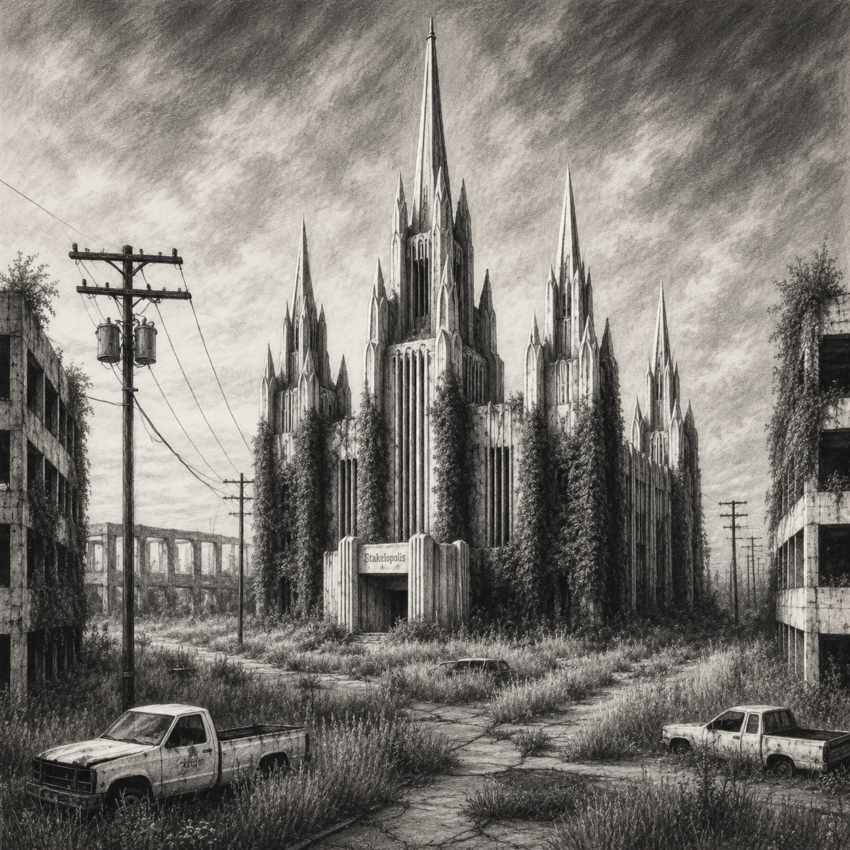
The Quiet Erosion of LDS Sunday School, Home Study, and Tithing
❦ ❦ ❦
I. A Headline the Church Did Not Want to Write
On April 16, 2026, The Salt Lake Tribune ran a sentence that, in any prior year of Latter-day Saint history, would have been unthinkable. Independent demographer Matt Martinich, summarizing Church-released data, reported that for the first time on record, the United States posted a net annual decline in Latter-day Saint membership. The drop was small — a net loss of 186 members, ending 2025 with 6,929,770 reported Saints in the country that has historically been the heartland of the Restoration. The figure is statistically modest, but symbolically immense. For a movement whose self-understanding has always tied institutional vitality to numerical expansion, a negative line on the American ledger is not just a data point. It is a question.
And yet, almost in the same breath, the Church’s defenders moved to soften the news. Two weeks later, Brigham Young University religious education professor Justin Dyer published an analysis in the Deseret News arguing that headline percentages can mislead, that Pew and the Public Religion Research Institute remain the gold standard, and that, by the more rigorous measures, Latter-day Saint retention in the United States is still higher than that of most other Christian denominations. The two stories are not contradictory; they describe the same landscape from different elevations. But laid side by side, they reveal a particular kind of institutional posture — one in which a small but historically unprecedented loss is acknowledged and then immediately contextualized away.
This essay is not interested in scoring rhetorical points against The Church of Jesus Christ of Latter-day Saints. It is interested in something narrower and, in the long run, more important: the condition of three core practices that the LDS Church itself has always treated as the load-bearing pillars of its discipleship — Sunday School attendance, home scripture study, and the payment of tithing. Each pillar can be examined on its own. But when they are studied together, and when the most recent independent data is laid alongside the Church’s own structural responses, a picture emerges that is harder to dismiss than any single headline. It is the picture of an institution whose external numbers are still moving forward in some regions of the world, while its internal formation infrastructure is quietly under strain in the very places that built it.
“For the first time, the U.S. experienced a drop in Latter-day Saints, with a net decrease of 186 members.”
— Matt Martinich, summarizing Church data, The Salt Lake Tribune, April 16, 2026
From a traditional Christian vantage point — one anchored in the historic creeds, in the sufficiency and finality of the biblical canon, and in the conviction that the gospel of Jesus Christ has been preserved by the Spirit through every generation of the Church — these LDS trends are not a cause for celebration. There is no Christian charity in rejoicing when any neighbor’s faith community weakens. What follows, instead, is an attempt to read the data soberly, to credit the LDS leadership where its diagnoses are honest, to note where its public framing softens or sanitizes the harder evidence, and to ask what these participation trends actually mean for the millions of Latter-day Saint members whose spiritual lives are shaped by them. This is, in the end, a pastoral and apologetic question as much as a sociological one. When the institution that promised to be the only true and living church on the face of the earth begins to lose its own members’ Sunday hours, daily reading, and quiet financial commitments, the right question is not ‘how do we feel about that?’ It is ‘what does that say about the system itself?’
❦ ❦ ❦
II. Three Pillars, One Foundation
It will help to begin with the architecture. The Church of Jesus Christ of Latter-day Saints, especially since the 2018 restructuring announced by President Russell M. Nelson, has been built on a tripod of weekly devotional life. The first leg is institutional attendance — sacrament meeting and Sunday School, the public, congregational expression of the member’s covenant identity. The second leg is the home — daily, family-based scripture study using the Come, Follow Me curriculum, designed to extend the Sunday lesson into every day of the week. The third leg is financial — the payment of a full tithe of one’s income, which is gatekept behind the temple recommend and tied directly to the ordinances LDS theology teaches are necessary for the highest exaltation.
Remove any one leg, and the structure wobbles. Remove two, and it collapses. The genius of Nelson’s 2018 redesign was its candor: he openly acknowledged that the Sunday-only formation model was no longer adequate to produce deeply rooted Saints, and he therefore moved the center of doctrinal life into the home. The First Presidency’s letter at the time included a sentence that, in retrospect, reads as a frank confession. President Nelson reminded members that each person is responsible for individual spiritual growth and that parents bear primary responsibility for teaching doctrine in the home. That is the language of an institution recognizing that its classroom model had run out of road, and so the tripod was re-engineered to lean more heavily on the home leg. But re-engineering depends on members actually doing what the new design requires.
The same logic applies to tithing. The LDS Church does not publish attendance statistics; it does not even publish reliable activity rates for its 17.8 million reported members. What members give, by contrast, can be measured — at least in those few jurisdictions where the Church is legally compelled to disclose its financial records. Tithing, therefore, functions as the most honest activity indicator the outside observer possesses. It is voluntary. It is gatekept. It cannot be inflated by counting baptismal records of people who never return. When tithing participation moves, it tells the truth about the underlying community in a way that nothing else does.
These three pillars are also where LDS theology most distinctively diverges from historic Christianity, which makes their condition a matter not only of sociology but of doctrine. Sunday School is where the restoration narrative is taught. Home study is where the Doctrine and Covenants and the Pearl of Great Price — texts unique to the Latter-day Saint canon — receive their formative work in the believer’s imagination. Tithing is the financial expression of covenant loyalty to a priesthood structure whose claims of exclusive authority no other Christian tradition recognizes. To weaken any of these is to weaken the distinctively Mormon shape of Mormonism. To weaken all three at once is to begin transforming the religion from within.
❦ ❦ ❦
III. Sunday School: A Curriculum Designed for a Membership That Is Not There
The Come, Follow Me Architecture
Since January 2019, the Latter-day Saint Sunday School has operated under a single integrated curriculum called Come, Follow Me — For Home and Church. The program rotates on a four-year cycle through the LDS standard works: the Bible (Old Testament one year, New Testament the next), the Book of Mormon, the Doctrine and Covenants, and the Pearl of Great Price. The same material is used simultaneously in Sunday School, Primary, Young Women, and the Aaronic Priesthood quorums, and in the home. The architectural intent is unified household formation — parent, teenager, and child all engaged with the same chapters at the same time, reinforcing the same doctrinal frame across the kitchen table and the classroom.
For 2026, the curriculum focuses on the Old Testament. The Church’s December 2025 announcement explicitly describes the resource as supporting gospel learning for individuals, families, and Church classes, and notes that wards will receive fewer free print copies than in previous years — a detail that quietly reflects the Church’s growing digital orientation and, perhaps, a recalibration of the print runs against actual usage. Members are directed to the Gospel Library app, weekly verse-of-the-day prompts, and study plans that pace the canonical text through the calendar year. From a purely educational standpoint, this is an impressive infrastructure. The lesson designers have produced thousands of pages of correlated material accessible in dozens of languages.
The Theological Frame Embedded in the Curriculum
What deserves notice from a Christian perspective is not the quality of the production but the interpretive frame that runs through it. Traditional Protestant Bible study, at its best, reads the Old Testament as the unfolding redemptive history of God’s covenant people, culminating in Jesus Christ as the promised Messiah and reaching its full doctrinal expression in the New Testament canon. The Come, Follow Me Old Testament curriculum reads the same texts, but the interpretive horizon is significantly different. Joseph Smith functions as the authoritative reader of all prior scripture. The Joseph Smith Translation, the King Follett Discourse, and selections from the Doctrine and Covenants are positioned as clarifying or completing what the Hebrew prophets only partially understood. The covenants of Genesis and Deuteronomy are read forward through the lens of temple ordinances and eternal marriage rather than backward through the lens of Christ’s death and resurrection.
The full theological weight of this approach becomes most visible in the Doctrine and Covenants year, which falls every fourth year on the rotation. There, the curriculum’s structure is not Bible-based Christianity with a Mormon flavor; it is the systematic exposition of doctrines — eternal progression, three degrees of glory, priesthood restoration through angelic visitation, temple endowments, baptism for the dead, and the embodied nature of God the Father — that have no foundation in the canonical Old or New Testament texts. The Apostle Paul’s words to the Galatians, that even an angel from heaven who brings another gospel is to be regarded as accursed (Galatians 1:8), point precisely at the kind of additional revelation that the D&C year treats as foundational. This is not a peripheral distinction. It is the watershed between Latter-day Saint theology and the historic Christian faith.
The Sacrament-to-Sunday-School Attendance Gap
Now turn from the curriculum’s design to its actual reception. Internal reports from active members — including Sunday School presidency members posting in Latter-day Saint forums — describe a consistent pattern across many wards: a meaningful fraction of the congregation arrives for sacrament meeting and then quietly leaves before Sunday School begins. Within a two-hour block, the first hour is the public, sacramental, identity-forming moment of the week. The second hour, where the doctrinal teaching happens, is where the attendance leakage occurs. If 60 to 70 percent of worldwide members are already classified as less-active, and the active fraction further self-divides between those who stay for the full block and those who leave after the sacrament, then the people actually sitting in Sunday School to receive Come, Follow Me instruction are a small subset of a small subset of total reported membership.
This is the participation problem behind the participation problem. The Church’s headline figure — 17.8 million members globally — is built on a baptismal roll that includes everyone who has ever been baptized and not formally removed. The Widow’s Mite Report, working from financial filings and survey triangulation, estimates that the genuinely active membership in 2024 was between 3.8 and 5.4 million people worldwide, with roughly half of those living in the United States. That is the realistic population from which Sunday School attendance is drawn. And of that population, a significant share is choosing the sacrament hour over the instruction hour.
“Church statistics on membership and ward units imply 3.8 to 5.4 million active members in 2024, of which roughly 24 percent live in Utah and Idaho and 50 percent live in the United States.”
— The Widow’s Mite Report, U.S. Membership Trends, 2025
The March 2026 Schedule Revision: Reading the Institutional Signal
On March 30, 2026, the First Presidency issued a letter announcing significant adjustments to the Sunday meeting schedule, to take effect September 6, 2026. The alternating biweekly format introduced in 2019 — where Sunday School met one Sunday and quorum or class meetings the next — will be replaced by a weekly schedule in which both Sunday School and quorum or class meetings occur every Sunday, in shorter twenty-five-minute blocks separated by brief transitions. President Dallin H. Oaks’s signature is at the bottom of the letter, alongside his counselors. The Church framed the change as a way to strengthen learning, fellowship, and worship.
Read carefully, the announcement is a quiet acknowledgment that the 2019 redesign was not producing what was hoped for. When an institution restructures its educational program twice in seven years, it is not signaling confidence in the prior design. The shorter twenty-five-minute blocks are a concession to attention span and competing demands; the weekly rather than biweekly cadence is a concession to the reality that members were missing classes on the alternating weeks and losing the curricular thread entirely. The intent is the same as the 2018 redesign — to keep members engaged and doctrinally formed — but the mechanism has been adjusted because the original mechanism plainly underperformed. None of this is dishonorable. It is, in fact, evidence of an institution paying attention to the gap between its formation goals and its actual results. But the gap itself is the story.
Primary Sources Cited in This Section
▸ Salt Lake Tribune — Mormon Land, April 16, 2026: https://www.sltrib.com/religion/2026/04/16/lds-membership-drops-first-time-us/
▸ Church Newsroom — Changes to the Sunday Meeting Schedule: https://newsroom.churchofjesuschrist.org/article/changes-sunday-meeting-schedule
▸ Church Newsroom — 2026 Curriculum: Old Testament: https://newsroom.churchofjesuschrist.org/article/church-of-jesus-christs-2026-curriculum-will-be-the-old-testament
▸ The Widow’s Mite Report — Active Membership Indicators: https://thewidowsmite.org/
❦ ❦ ❦
IV. Home Study: A Pillar Built on a Habit That Is Not Happening
Nelson’s 2018 Vision and Durrant’s Plea
When President Russell M. Nelson stood before the October 2018 general conference and announced the move to home-centered, Church-supported gospel learning, he was making the most consequential pedagogical shift of his presidency. The two-hour Sunday block was not a reduction in formation; it was a reallocation. The hours subtracted from the chapel were meant to be added to the kitchen table. Tad R. Callister, then Sunday School General President, summarized the ambition in an interview the following year by saying that the Church wanted to move members from being page-turners of the scriptures to disciples who study and ponder them. The aspiration was unmistakably evangelistic in its tone, even as the underlying theology remained Latter-day Saint.
The same April 2018 conference featured a talk by Sunday School First Counselor Devin G. Durrant, titled Teaching in the Home — A Joyful and Sacred Responsibility. Brother Durrant directed his remarks to all parents and prospective parents, describing parenthood as the introduction of children to Heavenly Father and to Jesus Christ, the first prayer, the path to baptism, and the daily teaching of commandments and stories of prophets. The pastoral warmth of the talk should not be dismissed; it expresses a real conviction that the home is the primary classroom. The difficulty, however, lies in the gap between the aspiration as preached and the practice as measured.
“We are each responsible for our individual spiritual growth. Parents have the primary responsibility to teach the doctrine to their children.”
— President Russell M. Nelson, October 2018 general conference announcement
The B.H. Roberts Foundation Survey — All-In and Selective
The most comprehensive recent measure of how LDS members actually use the home-study curriculum is the 2023 Current and Former Latter-day Saints Survey conducted by the B.H. Roberts Foundation, an independent organization led by sympathetic researchers and drawing on a representative sample of 3,865 respondents. The survey’s cluster analysis divided self-identified active members into two statistically distinct groups, and the contrast between them is the most important single finding of the past decade for understanding LDS formation.
The All-In cluster, comprising roughly 81 percent of active members, reports reading scripture several times per week, attending sacrament meeting every week, accepting the Book of Mormon as literal history at a 98 percent rate, paying a full tithe at a 94 percent rate, and holding a current temple recommend at a 95 percent rate. The Selective cluster, comprising the remaining 19 percent, reports reading scripture roughly once a week, attending two to three times per month, accepting the Book of Mormon as literal history at a 31 percent rate, paying full tithing at a 38 percent rate, and holding a temple recommend at roughly a 50 percent rate. These are not two churches under one roof; they are two pastorates with overlapping demographics and very different inner lives.
Several observations follow. First, even the All-In cluster, at several scripture readings per week, does not meet the daily standard that the Come, Follow Me curriculum is structurally designed to support. The lesson architecture assumes daily engagement with the assigned chapters. Several times per week, practice produces curricular gaps that interrupt the doctrinal sequence the lesson designers carefully built. Second, the Selective cluster is essentially Sunday-only at best, which means the Come, Follow Me program — whose Sunday hour is meant to supplement and reinforce home reading, not to deliver freestanding content — is structurally a poor fit for one in five active members. Third, and most striking, the proportion of self-identified active members who do not believe the Book of Mormon is literal history is approaching one in three. The foundational truth claim of the entire Restoration is functionally optional for a significant minority of the people sitting in the pews.
The Doctrine and Covenants Year Problem
If intermittent home study were merely producing reduced familiarity with the biblical narrative, that would be one kind of problem — though not a small one. But the Come, Follow Me rotation makes the consequence sharper. Every fourth year, Latter-day Saints work through the Doctrine and Covenants and the Pearl of Great Price, which is where the distinctively LDS doctrinal content lives. The plan of salvation as understood in LDS theology, the three degrees of glory, the King Follett Discourse on God’s progression, the priesthood restoration narrative, eternal marriage, baptism for the dead — these doctrines are concentrated in particular sections, and an intermittent attender who misses four to six Sundays during a D&C year may entirely skip the sections that most distinguish Latter-day Saint theology from orthodox Christian teaching.
The implication is paradoxical. For the historic Christian who hopes that LDS friends and neighbors might come into a deeper engagement with the Bible as the sufficient and final word of God, an LDS member whose home study is thin is, in one sense, less doctrinally rooted in the distinctives that separate Mormonism from Christianity. In another sense, however, that same member is more vulnerable to a kind of cultural identification with the Church that lacks doctrinal substance — institutional loyalty without a clear grasp of what the institution actually teaches. The pastoral pathway forward is therefore not to celebrate doctrinal thinness but to extend honest, prepared, charitable conversation about what the Bible itself, read attentively and in its own context, actually says. The intermittent home-study reality is not a vindication of Christian apologetics. It is an invitation to it.
Primary Sources Cited in This Section
▸ B.H. Roberts Foundation — 2023 Current and Former LDS Survey: https://bhroberts.org/2023BHRSurveySummary.pdf
▸ Religious Studies Center, BYU — The New Home-Centered, Church-Supported Curriculum: https://rsc.byu.edu/vol-20-no-1-2019/new-home-centered-church-supported-curriculum
▸ Devin G. Durrant — Teaching in the Home (April 2018): https://www.churchofjesuschrist.org/study/general-conference/2018/04/teaching-in-the-home-a-joyful-and-sacred-responsibility?lang=eng
▸ LDS Daily — No Seriously, We Don’t Have Time for Scripture Study: https://www.ldsdaily.com/home-and-family/no-seriously-we-dont-have-time-for-scripture-study/
❦ ❦ ❦
V. Tithing: The Most Honest Activity Metric in an Opaque System
Why Tithing Cannot Lie When Other Numbers Can
There is no Latter-day Saint statistic more closely guarded than worldwide attendance. The Church does not publish it. It releases convert baptism numbers, total reported membership, stake and ward counts, temple openings, and missionary deployment figures — all useful, all imperfect. What it withholds is the single number that would settle, more than any other, the question of how many of its 17.8 million members are actively engaged. In the absence of that disclosure, the outside observer must triangulate, and tithing is by far the most reliable variable available.
The reason is structural. Tithing in LDS theology is not a suggestion. It is a covenant requirement, declared each year in the temple recommend interview, in which the member must affirm that they are a full tithe payer in order to qualify for the temple ordinances that the Church teaches are necessary for the highest exaltation. A member who stops paying tithing has, by the Church’s own definition, withdrawn from the sacramental life of the institution. Unlike attendance, which can be social or cultural or familial, tithing is a quantifiable monthly transaction recorded by the Church and, in five countries, disclosed publicly under national charity-law requirements.
The Widow’s Mite Report — From 25.1 Percent to 20.8 Percent
Those five disclosure countries — the United Kingdom, Canada, Australia, New Zealand, and the Netherlands — are the foundation of the most careful independent financial analysis of the LDS Church, the Widow’s Mite Report. By summing reported tithing receipts and dividing by the relevant household-eligible membership in each jurisdiction, the report calculates a tithing participation rate that approximates the fraction of members actually making meaningful financial contributions to the institution. The 2025 update of that calculation showed a rate of 25.1 percent in 2016, falling to 20.8 percent in 2024 — a decline of more than four percentage points, or roughly 17 percent of the 2016 base, in eight years.
Two qualifications matter. First, this metric tends to understate true activity because some genuinely active members are not paying full tithing. The 20.8 percent figure is thus a ceiling, not a floor, on the share of the membership that is sacramentally and financially active. Second, the disclosure countries are not necessarily representative of the global Church. Membership growth in Africa and Latin America may not track the same participation pattern. Nevertheless, in the jurisdictions where the data is auditable, the trajectory is clear and consistent. Tithing participation has been falling for the better part of a decade. The decline did not begin with the 2019 SEC enforcement action against Ensign Peak Advisors, but it appears to have continued through and beyond it.
“Active membership appears to have declined from 2016 to 2024, based on analysis of three distinct time-series datasets: member donations, surveys, and male missionary service.”
— The Widow’s Mite Report, Active Membership Indicators, 2025
Ensign Peak, the $100 Billion Reserve, and the Trust Rupture
It is impossible to discuss LDS tithing in 2026 without acknowledging the Ensign Peak revelations. In December 2019, a whistleblower complaint filed by former Ensign Peak investment manager David Nielsen alleged that the Church’s investment arm had accumulated a reserve fund estimated at more than $100 billion, drawn primarily from member tithing, while publicly presenting the institution as financially dependent on ongoing donations. The Securities and Exchange Commission’s February 2023 settlement order documented systematic violations of federal securities disclosure law from 1999 through 2019, including the use of shell limited liability companies to obscure the size of the investment portfolio in Form 13F filings. The Church paid a $5 million penalty; Ensign Peak Advisors paid an additional $4 million. The financial cost was nominal. The reputational cost has not yet been fully reckoned.
For a believing Latter-day Saint who had paid a full tithe for decades on the express premise that the funds were needed for the work of the kingdom, the discovery that those tithes had been substantially diverted into a stockpile growing at investment returns rather than deployed for ministry was, in many testimonies, the catalyst for serious doctrinal reconsideration. The Widow’s Mite analysts, the journalists at The Salt Lake Tribune, and the affected members themselves have all noted the same pattern: tithing participation declines and faith deconstruction conversations both accelerated visibly after 2019. Correlation is not causation, but the temporal coincidence is too close to ignore. When trust ruptures around the question of how a Church handles money, the question often migrates inward to the question of whether the Church has handled truth.
The Temple Recommend Bottleneck — And a Curious Pulpit Shift
There is a further implication of the tithing decline that deserves direct theological attention. The LDS Church teaches that temple ordinances — endowment, sealing, and the saving ordinances performed by proxy for the dead — are required for the highest degree of exaltation in the celestial kingdom. Access to those ordinances is restricted to members holding a current temple recommend, which in turn is contingent on a full tithe declaration. If the Widow’s Mite estimate of 20.8 percent tithing participation in the disclosure countries is even directionally correct globally, the inescapable arithmetic is that the overwhelming majority of the Church’s own reported membership is, by the Church’s own theological standards, disqualified from the ordinances it teaches are necessary for their highest salvation.
This is not a marginal observation. It is, in fact, what the Lucifer’s Lantern review of General Conference discourse from 2024 surfaces from a different angle. The analysis, drawing on a database of General Conference talks, found that references to tithing have declined steadily over the past several decades while references to temples have skyrocketed. The financial requirement has not been relaxed — temple recommend interviews still ask the question — but the rhetorical center of gravity has moved from the payment itself to temple worthiness. President Lorenzo Snow in 1899 predicted a future day when the Church would no longer need to ask members for tithing because its reserves would be sufficient. More than a century later, the reserves are sufficient many times over, and the pulpit has indeed quieted on the subject of tithing while the temple has multiplied. Whether by design or by drift, the rhetorical retreat from tithing language coincides with the financial reality that the Church no longer depends on member contributions to operate.
Primary Sources Cited in This Section
▸ The Widow’s Mite Report — Tithing Participation Rates: https://thewidowsmite.org/tithing-participation/
▸ Lucifer’s Lantern — The Temple Emphasis and Decline of Tithing: https://www.luciferslantern.com/2026/03/the-temple-emphasis-and-decline-of.html
▸ Wikipedia — Tithing in Mormonism: https://en.wikipedia.org/wiki/Tithing_in_Mormonism
▸ Church Newsroom — First Presidency Tithing Declaration: https://newsroom.churchofjesuschrist.org/article/first-presidency-tithing-declaration
❦ ❦ ❦
VI. The Generational Verdict: What Millennials and Gen Z Are Doing
Jana Riess, the GSS, and the 55 Percent Loss
In December 2025, Religion News Service columnist Jana Riess published an analysis, supported by quantitative research from Alex Bass and Benjamin Knoll, drawing on the General Social Survey and three iterations of the Pew Religious Landscape Study. The findings were unusually direct for an academic treatment. Whereas the LDS Church retained roughly three-quarters of those raised in the faith through the 1970s, 1980s, and 1990s, the General Social Survey shows retention falling to approximately 38 percent in the 2020s. Pew’s most recent data, generally regarded as more reliable for LDS sample sizes, shows the U.S. retention figure dropping from 70 percent in 2007 to 64 percent in 2014 to 54 percent in 2023–24.
The generational breakdown is sharper still. According to the GSS, only 29 percent of Greatest and Silent generation members raised LDS left the church in adulthood. The figure rose to 33 percent for baby boomers and 37 percent for Generation X. For millennials and Gen Z, it jumped to 55 percent — a near doubling within two generational cohorts, with a sample large enough to rule out statistical noise as an explanation. The sociologist Christian Smith, whose National Study of Youth and Religion was cited approvingly by Church News in 2005, 2008, 2009, 2010, and 2013 as evidence that LDS youth were unusually retained, reversed his published assessment in 2025, observing that millennial Saints have left the LDS Church in dramatic, unprecedented numbers as they have moved through emerging adulthood.
The LDS-Aligned Response — Justin Dyer and the Best-Data Argument
It would be irresponsible to present the disaffiliation data without engaging the Latter-day Saint researchers who have pushed back. Justin Dyer, professor of religious education at Brigham Young University, published an April 28, 2026, Deseret News analysis arguing that the Cooperative Election Study — which suggested a 45 percent decline in the LDS share of the U.S. population from 2014 to 2025 — uses online recruitment methods that produce less reliable estimates than Pew’s mailed random-sample methodology. By Pew’s measures, the LDS share of the U.S. population declined approximately 8 percent from 2014 to 2024, which is one of the smaller declines among Christian denominations. Baptists, Presbyterians, and Methodists each exceeded 20 percent declines in the same period. Dyer concludes that while retention has decreased over time, Latter-day Saints continue to retain a higher proportion of those raised in the faith than most other Christian denominations, particularly when the measure focuses on those who both identify as LDS and attend services regularly.
Dyer’s argument is methodologically defensible and worth granting in its strongest form. Comparative retention does favor the LDS Church among Christian groups in the United States, especially when activity is layered into the definition. It is fair to note that the broader American religious landscape is in steep decline across denominations, and that Latter-day Saints have weathered the storm better than mainline Protestants. But the comparison must not become a sleight of hand. The same data Dyer relies on shows LDS retention dropping from 82 percent in the 1980s to 50 percent in the most recent measurement — a 32-point decline that is, by any honest reading, an enormous historical event for a movement built on covenant continuity and intergenerational transmission. Comparing favorably to a declining benchmark does not erase the absolute trajectory. The Latter-day Saint house is losing rooms, even if other houses in the neighborhood are losing more. The proper response is sober diagnosis, not selective comparison.
“While Mormon retention looked solid in the early 2000s, in the years since, as Millennial Mormons moved through emerging adulthood, they began exiting the LDS church in dramatic, unprecedented numbers.”
— Christian Smith, sociologist, quoted in Religion News Service, December 10, 2025
Belief Without Believing — The 31 Percent Who Doubt
The most quietly destabilizing finding in the recent research is not the disaffiliation rate but the belief profile of those who remain. The 2023 B.H. Roberts Foundation survey reported that 31 percent of self-identified active LDS members do not believe the Book of Mormon is literally historical. Among the Selective cluster, that proportion rises to 69 percent. Even among the All-In cluster, the literal-historical view is held by 98 percent — meaning that for the people sitting in Sunday School, paying full tithing, holding a temple recommend, and serving in ward callings, near-universal belief in the foundational text is matched by a much smaller, much more skeptical cohort of attenders who have apparently kept their pew while losing their conviction.
This is the deeper formation crisis. A church can grow numerically while its center hollows. A church can hold its members in their seats while losing them in their hearts. From the standpoint of historic Christianity, the question this raises is not ‘how do we exploit this for evangelistic advantage?’ That would be both crass and pastorally counterproductive. The question is, ‘what is the actual condition of the person sitting in the pew, and what kind of conversation is appropriate to where they actually are?’ The answer is an honest, prepared, scripturally grounded conversation about Jesus Christ as he is presented in the canonical Gospels, and about the sufficiency of the biblical witness for salvation. The 31 percent figure is not a target. It is a description of a real spiritual condition, and the proper Christian response is the proper Christian response to any condition: faithful presence, careful listening, and the offer of the gospel as the apostles preached it.
Primary Sources Cited in This Section
▸ Religion News Service via Jana Riess — Gen Zers and Millennials Leaving the LDS Church: https://religionnews.com/2025/12/10/us-gen-zers-and-millennials-are-leaving-the-lds-church-data-confirms/
▸ Deseret News — Justin Dyer, For Accurate Conclusions, Look at the Best Data: https://www.deseret.com/faith/2026/04/28/latter-day-saint-retention/
▸ Reddit r/mormon — Membership Decline in LDS Church, a Faithful Discussion: https://www.reddit.com/r/mormon/comments/1stx1iq/membership_decline_in_lds_church_a_faithful/
❦ ❦ ❦
VII. The Sanitizing Response: How LDS Leadership Frames the Numbers
Institutions under pressure tend to develop characteristic rhetorical patterns. The Latter-day Saint leadership’s public posture toward declining participation since 2019 displays several of these patterns, and identifying them is not an act of cynicism but of close reading. The pattern is consistent enough to be described, and the description matters because it shapes how the broader Latter-day Saint community understands its own situation.
Selective Optimism
When General Authorities publicly address formation data, they consistently highlight indicators that point upward — convert baptisms, missionary applications, temple construction, Institute enrollment — while leaving indicators that point downward unaddressed. Apostle Dale G. Renlund’s May 2026 Facebook post is a representative example. He pointed to remarkable growth in missionary applications and credited Come, Follow Me specifically with strengthening family scripture study and altering Sunday worship practices. The post is factually accurate as far as it goes. Missionary applications have indeed risen, particularly following the November 2025 decision to lower the missionary age for women from 19 to 18. But the post is silent on tithing participation, on retention rates, on the sacrament-to-Sunday-School attendance gap, and on the 31 percent of active members who do not believe the Book of Mormon is literal history. Selective optimism is not deception. It is, however, a curated truth — and the curation itself tells us where the institution would prefer the conversation not to go.
Reframing Decline as Stability
A second pattern is what might be called rate stabilization rhetoric — the framing of an ongoing loss as a steady continuation of a long-term trend rather than as a crisis. According to a report on a stake leadership meeting from late 2023, Apostle Quentin L. Cook reportedly told stake leadership that youth and young adult attrition was at a steady rate rather than a worsening one. The point of such framing is to translate a hemorrhage into a baseline. Whether the underlying rate is steady or accelerating, the rhetorical purpose is identical: to remove the perception of escalation. Yet a steady rate of loss, compounded across generations, is precisely how the 82 percent retention of the 1980s became the 50 percent retention of the 2020s. The arithmetic of constant decline produces dramatic generational results.
Structural Adjustment Without Theological Acknowledgment
A third pattern is the issuance of structural adjustments — schedule changes, leadership expansions, curriculum revisions — without ever publicly acknowledging the theological or evidential pressures that necessitate them. The March 2026 Sunday meeting schedule revision is the clearest current example. The Church’s own framing presented the change as a refinement intended to strengthen learning and worship. Independent observers, including members in Sunday School presidencies whose discussions have surfaced in Latter-day Saint forums, read the change as an admission that the 2019 redesign produced gaps the Church now wishes to close. A similar pattern accompanied the broadening of Sunday School leadership earlier in March 2026 — including the decision to allow women to serve in ward Sunday School presidencies — which the Church framed as expanding opportunities rather than as a response to underperformance. When an institution adjusts its structure, the adjustment itself is a confession that the public messaging will not deliver.
What the Leadership Is Not Saying
The deepest silence is around the doctrinal-confidence data. The 31 percent of active members who do not affirm the literal historicity of the Book of Mormon has received no official acknowledgment from the Quorum of the Twelve Apostles. The Widow’s Mite tithing decline has received no official acknowledgment. The implications of the Ensign Peak reserve for the Church’s stated dependence on member donations have been addressed only through carefully worded explanations of asset management. None of these omissions is sinister; they are the predictable behavior of any institution facing data it cannot easily integrate into its public narrative. But cumulatively, the omissions produce a particular effect on the engaged Latter-day Saint who is paying attention. The effect is the slow recognition that the official story and the available data are not telling the same story.
“Yet none of this is to say that all is well in Zion. We should seek out and care for those who disconnect from the church.”
— Justin Dyer, BYU, Deseret News, April 28, 2026
Professor Dyer’s closing observation in the Deseret News piece deserves more weight than it has received. The phrase he used — that not all is well in Zion — is itself a Book of Mormon allusion (2 Nephi 28:21) describing the spiritual complacency of the last days. That a defender of the Church’s retention numbers concludes his methodological argument with that scriptural caution suggests that even from within the most faithful reading of the data, the situation calls for honest reckoning rather than reassurance. The Christian observer can only agree.
❦ ❦ ❦
VIII. Methods of Offset: What the Church Is Implementing
The Church’s responses to the trends are substantial and worth describing fairly. They do not represent a passive institution. They represent an active institution working hard within the framework of its theological commitments. Whether those responses can reverse the underlying trajectory is a separate question. The responses themselves fall into several distinct categories.
The September 2026 Schedule Adjustment
Beginning September 6, 2026, all wards and branches will move to the new weekly two-block second hour in which Sunday School and quorum or class meetings each run for twenty-five minutes rather than alternating biweekly at fifty minutes. Elder David P. Homer, executive director of the Priesthood and Family Department, explained in a Church News interview in late May 2026 that the change is intended to connect home and church experience more directly. Sunday School General President Paul V. Johnson noted that the total instructional time is unchanged — twenty-five minutes per week rather than fifty minutes every other week — but that the new cadence avoids the loss of curricular continuity that the biweekly format produced when members missed alternate Sundays.
Expanded Sunday School Leadership
In March 2026, the First Presidency announced that ward Sunday School presidencies could now include women, broadening leadership opportunities. The Salt Lake Tribune reported that the decision drew measurable internal pushback from some Latter-day Saints who described the move as woke or feminist, while others celebrated it as overdue. From a purely institutional standpoint, the change is best read as an effort to expand the leadership pool drawn upon to revitalize Sunday School instruction — a quietly significant move for a Church whose ward-level leadership has historically been overwhelmingly male.
Missionary Force Expansion
In November 2025, the Church lowered the missionary age for women from 19 to 18, matching the male threshold. Jana Riess described the move as long-overdue and sociologically astute, given that the highest-risk period for religious disaffiliation in the LDS context is the gap between high school graduation and age 19. Closing that gap with mission service is a defensible retention strategy on its own terms, regardless of whether one shares the theological premises of the mission program itself.
Institute Program Expansion and BYU-Pathway Requirements
The Church has expanded the Institute’s religious education program to include young adults up to age 35, broadening the eligibility pool, and has required students in the BYU-Pathway college-degree program to attend the Institute. Both changes increase reported Institute enrollment. They also illustrate a recurring institutional pattern in which expanded definitions and required participation produce upward-trending engagement numbers even where the underlying behavior of the original target population may be stable or declining.
Temple Construction as Visible Vitality
Under the late President Russell M. Nelson and continuing under President Dallin H. Oaks, the Church has announced an unprecedented expansion of temple construction worldwide. Temples are simultaneously a sacred space, a symbolic affirmation of institutional health, and a physical infrastructure for ordinances that the Church teaches are required for exaltation. The Lucifer’s Lantern analysis correctly identified that temple-centered rhetoric has displaced tithing-centered rhetoric in General Conference discourse over recent decades, and the construction push reinforces that pulpit shift. Whether the visible expansion of temples can produce the lived discipleship the institution is hoping for, in an environment where home study is intermittent, and Sunday School attendance is leaking, is precisely the question the next decade will answer.
Primary Sources Cited in This Section
▸ Religious Studies Center, BYU — Home-Centered, Church-Supported Learning: https://rsc.byu.edu/winter-2019/home-centered-church-supported-learning
▸ Salt Lake Tribune — Women Sunday School Presidents: https://www.sltrib.com/religion/2026/04/11/women-lds-sunday-school-presidents/
▸ Church Newsroom — First Presidency on Sunday Schedule Adjustments (PDF): https://newsroom.churchofjesuschrist.org/multimedia/file/first-presidency-letter-sunday-meetings-2026.pdf
❦ ❦ ❦
IX. Future Indicators in the Data — Five Trajectories to Watch
Forecasting religious behavior is hazardous. Yet several indicators in the current data permit reasonable projection of what the next five to ten years are likely to surface, particularly in the United States and the older Latter-day Saint diaspora countries, where the disclosure data is most robust.
First, the U.S. Membership Curve Will Probably Cross Zero Permanently
The 2025 U.S. net decrease of 186 members is statistically modest, but it is the first such crossing in the institution’s history. Given that the decrease occurred despite a 17 percent jump in convert baptisms, the underlying drivers — falling birth rates among active members, the automatic removal of unbaptized children of record after age 8, deaths, and resignations — are structural rather than cyclical. Unless convert baptisms accelerate further, the U.S. line is likely to remain at or below zero through the rest of the decade, even as global membership continues to grow on the strength of African and Latin American gains.
Second, the Tithing Participation Rate Will Continue Drifting Downward
The Widow’s Mite trajectory — from 25.1 percent in 2016 to 20.8 percent in 2024 — has not yet shown a stabilization point. Absent a significant external event that restores trust in Church financial transparency, the drift is likely to continue. The Church’s financial reserves are large enough that ongoing tithing decline poses no operational threat. The threat is different: it is the slow demonstration, year over year, that the Church’s covenant community is contracting while its institutional presence remains.
Third, the Doctrinal Confidence Gap Among Active Members Will Widen
The 31 percent of active members who do not affirm Book of Mormon historicity is the leading edge of a broader epistemological shift. As more LDS members access nuanced historical research — including the Church’s own Gospel Topics essays, the work of independent historians, and the Joseph Smith Papers Project — the gap between traditional faithful narratives and the historical record is more visible than at any prior point in the institution’s history. The Selective cluster of the B.H. Roberts survey is, in this reading, a leading indicator of what the All-In cluster’s children will encounter in their own faith development.
Fourth, the Sanitization Reflex Will Become Less Effective
Selective optimism worked as a public communications strategy when independent data was thin and members had limited access to financial disclosures, demographic research, and academic surveys. In 2026, that landscape has changed permanently. Substacks like Mormon Metrics, organizations like the B.H. Roberts Foundation and the Widow’s Mite Report, mainstream coverage by Religion News Service and The Salt Lake Tribune, and the Church’s own Gospel Topics admissions have collectively made the official institutional narrative harder to maintain in the precise way the Church has historically maintained it. Members who care about the institution and want to defend it find themselves increasingly required to do so on harder factual ground.
Fifth, the Global South Will Define the Next Twenty Years
Fourteen of the twenty fastest-growing LDS countries in 2025 were in Africa or the South Pacific. The Democratic Republic of Congo, Nigeria, Brazil, Mexico, and the Philippines led the global net-increase rankings. The Church’s center of gravity is migrating south and east, just as the Catholic Church’s center of gravity migrated in the second half of the twentieth century. What this will mean for LDS theology, leadership demographics, and the institutional culture that has long been shaped by Intermountain West Anglo-American identity is the most interesting open question of the next generation. The Church that emerges in 2045 may bear less resemblance to its 2025 self than its 2025 self bears to its 2005 self.
❦ ❦ ❦
X. A Compassionate Christian Reading
What does any of this mean for the Christian who watches these developments from outside the Latter-day Saint community? The first answer is that the data does not vindicate triumphalism. Every soul among the 17.8 million reported Latter-day Saints worldwide is a person Jesus Christ loves and a person for whom Christ died. Decline in any religious community produces real human suffering — broken families, isolated young adults, parents who do not know how to respond to a child’s faith crisis, retirees whose entire framework of meaning is being slowly destabilized by information they did not previously possess. The Christian response to that suffering is not satisfaction. It is sober compassion.
The second answer is that the data carries a particular theological lesson. The Bible’s witness about the gospel is that it is preserved by the Spirit through the apostolic deposit — the written canon that the New Testament’s own authors treat as complete and sufficient. Movements that locate authority in additional revelation, in a living prophet whose words carry weight equal to or exceeding the written canon, and in priesthood structures traced through physical ordination lines, have always been susceptible to a particular kind of historical pressure. When the additional revelation produces specific empirical claims, those claims must withstand investigation. When an investigation creates pressure, the institution must absorb the pressure or recalibrate. The LDS Church’s history with the Book of Abraham papyri, the Kirtland Safety Society, the multiple First Vision accounts, the post-1844 evolution of priesthood succession, and the financial concealment surrounding Ensign Peak each illustrate the same recurring dynamic. Cumulatively, the dynamic produces the kind of confidence erosion that the 2023 B.H. Roberts survey now measures.
The third answer concerns posture. The Christian who hopes for a Latter-day Saint friend, neighbor, or family member to come into the historic Christian faith does not need the data to do their work for them. The data does not convert anyone. The gospel does. What the data offers is a clearer understanding of where the people in front of us are actually standing. Some are All-In Latter-day Saints who hold every doctrinal proposition with deep sincerity. Some are Selective members whose hearts have drifted while their bodies remain in the pew. Some have already left and are processing the loss without a framework. Each requires a different conversation. None requires hostility. All require the truth, offered patiently, in the same Christ-formed manner that the apostles modeled.
Sandra Tanner, who, together with her late husband Jerald, spent more than six decades documenting the historical and doctrinal questions surrounding Latter-day Saint origins through Utah Lighthouse Ministry, has often said that the goal is never to defeat anyone. The goal is to tell the truth carefully enough and lovingly enough that the truth itself does its own work in the hearer’s conscience. That is the right posture for any Christian engaging the trends documented in this essay. The participation collapse is not an opportunity for argument. It is a season of unusual openness for unusually careful, unusually loving, unusually scripturally grounded conversation.
❦ ❦ ❦
XI. Conclusion — Standing in the Gap
The Church of Jesus Christ of Latter-day Saints in May 2026 stands in an unfamiliar place. Its global headline numbers continue to advance, driven by remarkable growth across the Global South. Its U.S. heartland has crossed zero for the first time. Its Sunday School curriculum is the most ambitious unified pedagogical program any modern American religious body has produced — and the data shows that the program’s daily-home-study foundation is performing significantly below its designed level among the very members it was built for. Its tithing participation rate, the cleanest available indicator of true engagement, has declined approximately 17 percent in eight years. Its youngest generations are leaving at rates the institution’s leaders have publicly denied and its own researchers now privately concede. And its temples — visible, multiplying, beautifully built — increasingly stand as the public face of an institution whose private formation infrastructure is under quiet, persistent strain.
From a traditional Christian standpoint, none of this is to be celebrated. It is to be observed soberly, prayed over earnestly, and engaged thoughtfully. The Latter-day Saints among us are our neighbors, often our colleagues, sometimes our family members. They are people whom Jesus Christ came to seek and to save, and whose Christian neighbors are called to love them in deed and in truth (1 John 3:18). The trends documented here open doors for honest conversation that were closed a generation ago. They invite the Christian community to be unusually careful, unusually well-prepared, and unusually charitable. They invite the Latter-day Saint community, especially its leaders, to address the data their own researchers have surfaced rather than to manage public perception around it.
The pew is still full on Sunday morning in most LDS wards. The Sunday School classroom, an hour later, is conspicuously less full. The home, Monday through Saturday, is fuller in some households than the curriculum designers had hoped, and emptier in many more. The tithing slip, year over year, is signed by fewer hands. These are not the marks of a vibrant covenant community. They are the marks of an institution that has built a magnificent house and is discovering, room by room, that some of the lights are quietly going out. Whether the lights can be restored — and on what foundation — is the question the next decade will answer. Until then, those of us who believe that the gospel preserved by the apostles and prophets in the canonical Scriptures is the gospel sufficient for salvation will continue to stand in the gap, ready with the same answer the Church has always offered to those whom God brings to ask: Jesus Christ, crucified and risen, is the way, the truth, and the life, and no one comes to the Father except through him (John 14:6).
❦ ❦ ❦
A Note on Research Methods and Accuracy
In recent years, some have voiced concern that artificial intelligence may distort facts or introduce inaccuracies into serious research. That criticism deserves acknowledgment. However, AI has now evolved into the most powerful research instrument available to any dedicated scholar—capable of analyzing vast datasets, cross‑referencing historical records, and surfacing overlooked connections across sources. This work represents a collaboration between the author’s investigative inquiry, verified primary documentation, and the advanced analytic capabilities of AI research tools. Here, AI was not used as a ghostwriter or a shortcut for scholarship, but as a disciplined research partner devoted to rigor, accuracy, and transparency.
Every factual claim in this work has been subjected to active verification. Where AI‑generated content was used as a starting point, it was tested against primary sources, peer‑reviewed scholarship, official institutional documentation, and established historical records. Where discrepancies were found—and they were found—corrections were made. The author has made every reasonable effort to ensure that quotations are accurately attributed, historical details are precisely rendered, and theological claims fairly represent the positions they describe or critique.
That said, no work of this scope is immune to error, and the author has no interest in perpetuating inaccuracies in the service of an argument. If you are a reader—whether sympathetic, skeptical, or hostile to the conclusions drawn here—and you identify a factual error, a misattributed source, a misrepresented teaching, or a claim that cannot be substantiated, you are warmly and genuinely invited to say so. Reach out. The goal of this work is not to win a debate but to get the history right. Corrections offered in good faith will be received in the same spirit, and verified corrections will be incorporated into future editions without hesitation.
Truth, after all, has nothing to fear from scrutiny—and neither does this work.