
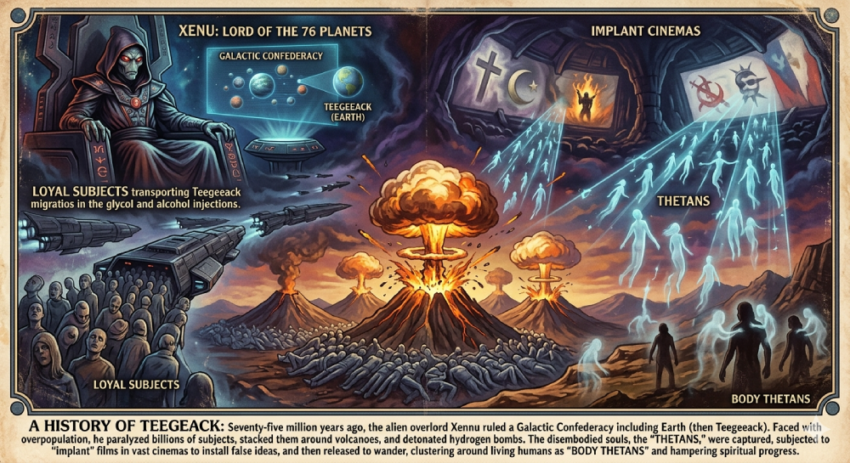
Image: An AI-illustrated depiction of Xenu, the alien overlord of Scientology’s secret cosmology. Ruling a Galactic Confederacy seventy-five million years ago, Xenu solved overpopulation by luring billions to Earth, killing them with hydrogen bombs detonated in volcanoes, and subjecting their captured souls — called thetans — to implant films installing false beliefs about God and Christ. These thetans now cling to living humans, blocking spiritual progress. Scientology’s expensive upper-level auditing exists to locate and discharge these alien souls — a mythology kept hidden from members until they have paid tens of thousands of dollars for lower-level courses.
A Christian Examination of Scientology’s History, Controversies, Current Affairs, and Leadership
❦ ❧ ❦
Introduction: A Closed Door on Hollywood Boulevard
On the last day of March 2026, an eighteen-year-old in Hollywood opened a glass door, ran past a confused front-desk attendant, and changed how the rest of the world would see one of the strangest religious organizations in modern history. The young man, known online as Swhileyy, filmed himself sprinting through the lobby of the Church of Scientology Information Center at 6724 Hollywood Boulevard, a converted hotel that the organization had dressed up as a public-facing museum. He turned the video into a sixty-second piece of TikTok performance and posted it. Within a few weeks, it had been viewed roughly ninety million times. Within a few weeks more, the organization that styles itself as the fastest-growing religion on earth had removed the door handles from three of its buildings, posted guards in the entryways, and issued a statement decrying “trespassing, harassment, and disruption of religious facilities.”
It was an unforgettable image. A teenager with a phone and an empty afternoon had accomplished what decades of investigative journalism, federal raids, congressional inquiries, and parliamentary commissions had only partly accomplished: he had made the inner sanctum of Scientology look ordinary. Not sinister. Not powerful. Just ordinary, the way a chain hotel lobby is ordinary, with carpet stains and fluorescent lights and a startled employee on a swivel chair. Many viewers laughed; many wondered why such a wealthy organization, with its global headquarters less than a mile away in the so-called Big Blue complex on Fountain Avenue, could not stop a college-age boy in jeans from sauntering through the front door. The question, once asked aloud, would not go away.
This article is not a celebration of viral pranks. The viral moment is a window, nothing more. Through that window, we can see a religious movement that, by every available external measure, is hollowing out from within. The man at the top has not appeared in a public courtroom in years. His wife has not been seen in public since 2007. The most credible internal whistleblower, Mike Rinder, died of esophageal cancer in January 2025. The most famous defector, Leah Remini, had most of her lawsuit gutted by a Los Angeles judge and now faces the prospect of paying Scientology’s legal fees. The properties surrounding the spiritual headquarters in Clearwater, Florida, sit dark; the official news pages of two of Scientology’s most public-facing arms have not been updated since the autumn of 2025; the German government has just ended thirty years of surveillance, declaring the organization no longer significant enough to monitor at the federal level.
It is from this vantage point, in the late spring of 2026, that an orthodox Christian must look soberly at Scientology — its founder, its scriptures, its tactics, its leader, its current condition, and its claims. The aim of what follows is neither mockery nor crusade. The aim is to tell the truth about a movement that has produced enormous suffering, to do so with the care a believer in Christ owes any neighbor, and to ask whether anything in Scientology, evaluated against the witness of historic Christianity, deserves the name religion at all. The Apostle Paul warned the Corinthians that even Satan disguises himself as an angel of light. The believer’s task is therefore discernment, not derision; analysis, not abuse. With that in mind, we begin where the story itself begins: with a pulp fiction writer in a hospital bed at the end of the Second World War.
❦ ❧ ❦
From Pulp Fiction to Pulpit: L. Ron Hubbard’s Invented Religion
Lafayette Ronald Hubbard was, before anything else, a writer of fantastic stories. He published prolifically in the pulp magazines of the 1930s and 1940s, churning out westerns, horror tales, adventure serials, and above all, science fiction. He attended George Washington University without completing a degree, served in the United States Navy during World War II, and ended the war as a patient at Oak Knoll Naval Hospital in Oakland, California. According to the church’s own account, it was during his hospital convalescence that he began “systematic consideration” of what he would later call “a science of the mind.”

The science of the mind appeared in 1950 as Dianetics: The Modern Science of Mental Health, a book that became an immediate bestseller. Hubbard claimed in it that human beings carry within them a hidden “reactive mind,” a sub-rational storehouse of painful images he called engrams, and that those engrams can be located, confronted, and discharged through a one-on-one counseling procedure he named auditing. To assist the process, Hubbard’s followers eventually adopted a device called the E-meter, a galvanometer that measures faint electrical changes across the skin of the person being audited. Hubbard taught that the E-meter’s needle responds to the emotional charge of engrams; critics for seventy-five years have responded that it is, in essence, a poor man’s lie detector with no demonstrated diagnostic value at all.
Dianetics proved popular enough to fund a small movement, but it ran into immediate trouble with medical and scientific authorities, who rejected its therapeutic claims, and with the Internal Revenue Service, which declined to grant Hubbard’s enterprise the tax exemption of a religion. Hubbard, by his own subsequent admission, drew the obvious conclusion. “You don’t get rich writing science fiction,” he is widely reported to have told fellow writers in the 1940s. “If you want to get rich, you start a religion.” Whatever the precise wording, what followed was historically clear. In 1954, the Church of Scientology was incorporated. Auditing and the E-meter were rebranded as religious sacraments. The reactive mind became, in effect, a doctrine of original sin without a Savior. And the founder’s writings — every newsletter, every policy letter, every taped lecture — were declared the immutable scripture of the new faith.
Scientology … is not a religion. … I have high hopes of smashing my name into history so violently that it will take a legendary form even if all books are destroyed. … Scientology is the most vital movement on Earth today.
— L. Ron Hubbard, various early statements (compiled at Wikiquote and discussed in the Watchman Fellowship profile of Scientology)
That last triad of sentences captures the difficulty of taking Hubbard at his word. He could declare in one breath that his system was not a religion, in the next that it was the most vital movement on earth, and in a third that his ambition was to smash his name into history with such force that legend would survive even the destruction of his books. The contradictions did not embarrass him. They became, eventually, a kind of doctrine: what Hubbard said today bound his followers absolutely, and what he said tomorrow bound them absolutely as well, no matter how completely it overturned what he had said yesterday.
Hubbard’s biographical claims to his followers were, when verified against the public record, almost entirely false. He represented himself as a war hero with multiple decorations, a nuclear physicist, a civil engineer, an explorer who had charted unmapped jungles, a blood brother of the Blackfoot nation, and a man who had personally healed himself of crippling war wounds through the techniques that became Dianetics. The official church biographies repeated these claims for decades. His estranged son, Ronald DeWolf, told reporters in the early 1980s that “ninety-nine percent of what my father ever wrote or said about himself” was untrue. A California superior court judge, ruling in the 1984 case of Church of Scientology v. Armstrong, examined Hubbard’s own private archives and concluded that the founder was “virtually a pathological liar” with respect to his personal history and that the organization he built was “schizophrenic and paranoid,” reflecting the man at its head.
These judgments are not the bitter shouts of apostates. They are statements of fact placed on the public record by sworn witnesses, surviving family members, and an officer of the court who examined the documents under seal. They establish the foundational difficulty of evaluating Scientology as a faith. In historic Christianity, the credibility of the witness is integral to the credibility of the message. Saint Paul could write, “If Christ is not risen, then your faith is in vain,” and stake the truth of the Gospel on a verifiable historical event attested by hundreds of living witnesses. Hubbard, by contrast, staked the truth of Scientology on the trustworthiness of a man whose self-account dissolved on first contact with the documentary record.
❦ ❧ ❦
The Cosmos of Xenu: A Faith Built on Secret Science Fiction
If Dianetics was the public-facing layer of Hubbard’s invention, the deeper teaching — the layer that members reach only after years of training and the payment of tens of thousands of dollars — is what Scientologists themselves call “the Space Opera.” The central narrative was committed to paper by Hubbard in 1967 in a set of documents reserved for those who had reached Operating Thetan Level Three, or OT III. For decades, the church guarded these materials with extraordinary legal aggression, suing former members, internet service providers, and journalists who published or even quoted them. The Internet eventually made such suppression impossible. The story is now freely available in court filings, in Hubbard’s own handwriting, and in countless secondary sources.
In summary: seventy-five million years ago, an alien overlord named Xenu ruled the seventy-six planets of a Galactic Confederacy that included Earth, then called Teegeeack. Faced with overpopulation, Xenu lured billions of his subjects to Earth under the pretext of tax audits, paralyzed them with injections of glycol and alcohol, stacked their frozen bodies around the bases of volcanoes, and detonated hydrogen bombs in the volcanic craters. The disembodied souls of the slaughtered, called thetans, were captured by electronic beams, transported to vast cinemas, and subjected to weeks of “implant” films designed to install false ideas about God, Christ, and the devil. The thetans were eventually released to wander the earth, where they cluster around living human beings as “body thetans,” hampering each person’s spiritual progress. The expensive upper-level auditing of Scientology is the procedure by which an Operating Thetan locates and discharges these clinging alien souls one by one.
The reactive mind … the Operating Thetan levels … are concerned with assisting the individual to operate as a fully conscious and functioning thetan. … Through Scientology training, members come to understand both themselves as spiritual beings and engrams as energy clusters that inhibit the thetan from functioning freely.
— J. Gordon Melton, Encyclopedia Britannica entry on Scientology (last updated May 2026)
Britannica, to its credit, summarizes this cosmology in terms its authors clearly intend to be neutral. Read against the entire history of the world’s religions, however, what is striking is not Hubbard’s originality but his derivativeness. The Xenu story is, in literary terms, indistinguishable from a 1940s pulp serial. There are no genuine prophets in it, no covenant, no fall and redemption in any morally intelligible sense, no Incarnation, no Cross, no Resurrection, no eschatological hope. There is only a galactic warlord, a stack of bodies, a film projector, and an audit that will free you from invisible aliens for a price.
The orthodox Christian must say plainly what this is and what it is not. It is not Christianity. It is not Judaism. It is not Buddhism in any recognizable sense, despite Hubbard’s intermittent claims of Buddhist inheritance. It is a private cosmology invented in living memory by a single man who was, at the time of the invention, simultaneously a producing science-fiction novelist. To call it a religion in the same sense as Christianity is to flatten the word religion into uselessness. Whether the state ought to extend it the same legal protections is a separate question, which we shall take up later in this essay. The theological question — whether the Xenu narrative can bear the weight of an immortal soul’s hopes — is in fact not difficult. The Apostle John, writing to a young church already beset by exotic gnostic cosmologies remarkably similar to Hubbard’s, gave the durable Christian answer: “Beloved, do not believe every spirit, but test the spirits, whether they are of God; because many false prophets are gone out into the world.”
❦ ❧ ❦
Operation Snow White: The Largest Infiltration of the U.S. Government in History
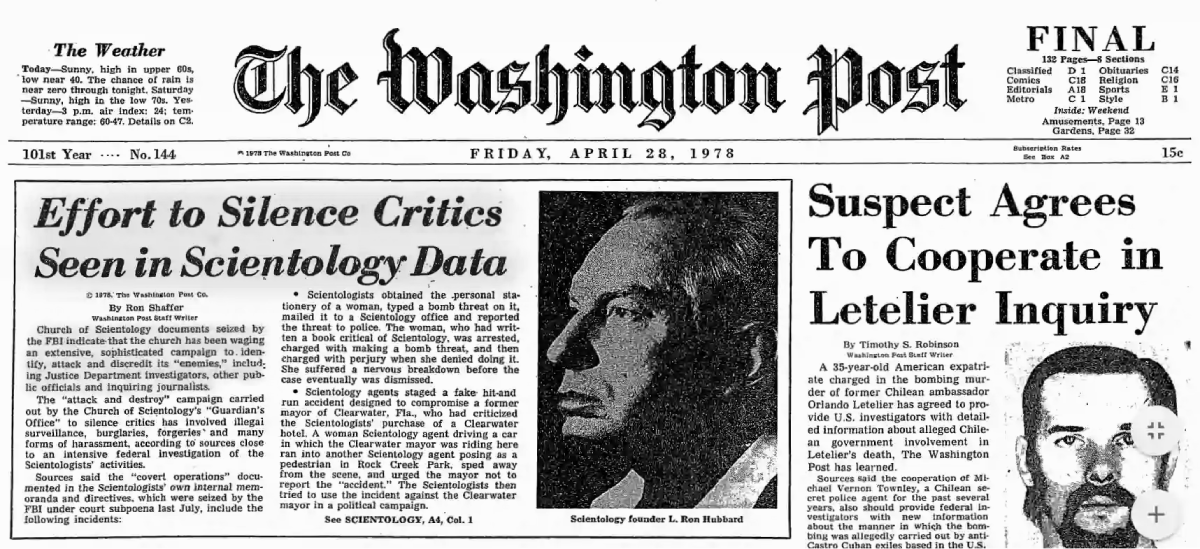
By the early 1970s, the Church of Scientology was simultaneously expanding rapidly and accumulating enemies. The Internal Revenue Service had revoked its tax exemption in 1967, classifying it as a commercial enterprise that enriched its officials rather than a religion. The Food and Drug Administration had raided a Scientology office in Washington in 1963 and seized hundreds of E-meters. Federal investigations were opening in earnest. Hubbard, sensing what he called a worldwide conspiracy against his church, responded not with public relations but with the most ambitious campaign of espionage ever undertaken by a private organization on American soil.
The operation was code-named Snow White, after the fairytale heroine whose purity is recovered at the end of the story. The objective, set out in a 1973 directive signed by Hubbard himself, was to “cleanse” government files of any document the church regarded as defamatory. The operational arm was a Scientology unit called the Guardian’s Office, run by Hubbard’s third wife, Mary Sue Hubbard. At its peak, Snow White mobilized thousands of Scientologists worldwide and targeted more than one hundred and thirty government and private institutions. The unit’s American operatives obtained employment in the IRS, the Department of Justice, the Drug Enforcement Administration, the American Medical Association, and the offices of newspapers and federal courthouses, where they photocopied and removed files at night and forwarded them to Scientology’s intelligence handlers.
The conspiracy unraveled in the summer of 1976, when two Scientology agents were caught inside the Department of Justice in Washington photocopying classified material. A year of FBI investigation followed. On July 8, 1977, federal agents executed simultaneous raids on Scientology offices in Washington and Los Angeles. They seized roughly twenty truckloads of evidence — including, alongside the stolen government records, internal Scientology operation plans against journalists such as Paulette Cooper and against the mayor of Clearwater, Florida. In 1979, eleven senior Scientology officials, including Mary Sue Hubbard, were convicted in federal court of conspiracy, obstruction of justice, burglary of government offices, and theft of government property. The convictions were affirmed on appeal by the D.C. Circuit in 1981. L. Ron Hubbard himself was named an unindicted co-conspirator. He went into hiding in 1980 and never appeared in public again.
Operation Snow White … represented the largest known infiltration of the U.S. government by a non-state entity, involving systematic espionage that violated federal laws on theft and conspiracy. … Eleven senior Scientology officials … were convicted of conspiracy, burglary of government offices, and theft of government property. Mary Sue Hubbard was sentenced to five years in federal prison and served roughly one year.
— Grokipedia entry on Operation Snow White, citing the federal record in United States v. Mary Sue Hubbard et al., 493 F.Supp. 209 (D.D.C. 1979)
Snow White is the indispensable context for everything that follows in Scientology’s history. It establishes, beyond reasonable historical doubt, that the founder of the organization personally authorized a multi-year, multi-continent criminal conspiracy against the United States government to suppress unflattering information about himself and his church. It is not the work of a few rogue members. The court found, and the evidence on the public record confirms, that the operation was central, official, and signed off at the highest levels. The Guardian’s Office was formally dissolved by the church in 1981, after the convictions; its operations were transferred to a successor entity called the Office of Special Affairs, which most former senior staff describe as performing the same functions with more legal insulation. Mike Rinder, the man who ran the Office of Special Affairs for two decades and who broke with the church in 2007, devoted the last eighteen years of his life to documenting that continuity in book, podcast, and Emmy-winning television form.
❦ ❧ ❦
Operation Freakout: The Persecution of Paulette Cooper
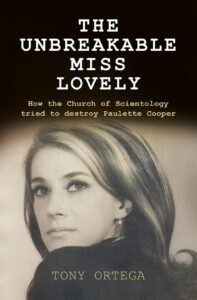
Among the documents seized in the 1977 FBI raids was a chilling internal plan addressed to a single name: Paulette Cooper. The plan was titled Operation Freakout. Its stated objective was, in the words of its author, to have Cooper “committed to a mental institution or jail” — and, failing that, to drive her to suicide. To understand why the church was willing to commit this much organizational energy to the destruction of one woman, it is necessary to understand who Paulette Cooper was.
Cooper was a young New York journalist who, in 1968, wrote a magazine article about Scientology for the British publication Queen. She expanded the article into a 1971 book called The Scandal of Scientology, the first full-length critical investigation of the new religion to appear in the English-speaking world. Cooper documented, with footnoted care, the church’s commercial structure, its hostility to former members, and its claims of medical efficacy. The Scientology response was immediate. The church’s founder issued a now-famous directive against her, instructing his subordinates to ruin her utterly if possible. The fair-game policy — Hubbard’s 1967 doctrine that declared enemies of the church may be “deprived of property or injured by any means by any Scientologist without any discipline of the Scientologist” — was invoked against her by name.
In retaliation, Scientology executives carried out a program of orchestrated intimidation. Scientologists framed Cooper for sending bomb threats, libelled her to her neighbors, infiltrated her life by fraudulently befriending her, and filed 19 lawsuits against her. After prosecutors on the bomb threat case demanded that she see a psychologist for a year, Scientologists broke into her therapist’s office and stole her confidential records. Scientologists discussed murdering her.
— Scientology-Lies.com summary, drawing on FBI documents and Tony Ortega’s The Unbreakable Miss Lovely (Silvertail Books, 2015)
The most consequential element of Operation Freakout was the bomb-threat frame. Church operatives obtained a sheet of stationery Cooper had touched, transferred her fingerprints to it, and used the paper to compose a written bomb threat against the New York Church of Scientology. They mailed it to the church themselves, then ensured the FBI traced it back to her fingerprints. Cooper was arrested, indicted on a federal terrorism charge, and faced up to fifteen years in prison for a crime she had not committed. The case haunted her for years. She has since written that she came close to taking her own life during the prosecution; only the eventual discovery, in the 1977 FBI raids, of the church’s own internal documents detailing the frame-up cleared her name. The charges were dropped. The damage was not erased.
The Cooper case is not an antique curiosity from the era of paisley wallpaper and the Carter administration. It is the founding template of every campaign Scientology has subsequently run against its critics. The structural elements are unchanged. A critic emerges. The fair-game doctrine, never formally rescinded in policy despite cosmetic statements to the press, is invoked. Private investigators are retained. Lawsuits are filed in volume. Smear websites are constructed under the names of the critics themselves, populated with allegations of mental instability and moral failure. The critic’s neighbors, employer, and family are mailed dossiers. The strategy is consistent because the policy it executes was written by L. Ron Hubbard, declared scripture by the church, and never repealed.
This explains why the recent legal saga of Leah Remini, the actress and former Scientologist who left the church in 2013 and produced the Emmy-winning A&E docuseries Scientology and the Aftermath, has unfolded the way it has. In her 2023 lawsuit, Remini detailed twelve years of allegedly orchestrated harassment by the church — surveillance, manufactured smear sites, social-media defamation campaigns. In a January 2025 ruling, Los Angeles Superior Court Judge Randolph M. Hammock found that most of the conduct Remini documented, however unpleasant, was constitutionally protected speech. “They’re not very nice things to say about someone,” the judge observed of the church’s social-media campaigns against her. “That’s fine. That’s your right under the First Amendment. … She attacks you. You attack her.” The ruling gutted most of her sixty-eight-page complaint, and an anti-SLAPP motion now threatens to make Remini herself liable for Scientology’s legal fees. The legacy of Paulette Cooper is that, fifty-five years later, the church has refined its harassment apparatus into a form the First Amendment cannot easily reach.
❦ ❧ ❦
The IRS Capitulation of 1993: The Most Consequential Tax Settlement in American Religious History
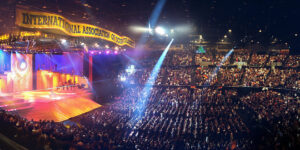
It is impossible to understand Scientology’s wealth, real-estate empire, and continued existence in the United States without understanding what happened on the night of October 8, 1993. Ten thousand cheering Scientologists filled the Los Angeles Sports Arena. The church’s young leader, David Miscavige, took the stage and declared, to thunderous applause, that the war was over. The Internal Revenue Service had granted full tax-exempt status — under section 501(c)(3) of the Internal Revenue Code — to the Church of Scientology International and one hundred and fifty affiliated entities.
For a quarter century, the IRS had refused. From the moment it revoked Scientology’s exemption in 1967, the agency had maintained that the church was a commercial enterprise that enriched its officials, that its “virtually incomprehensible financial procedures” disqualified it from religious treatment, and that its “scripturally based hostility to taxation” disqualified it further. The U.S. Claims Court had upheld the IRS in case after case. Just one year before the reversal, the same Claims Court had denied an exemption to Scientology’s Church of Spiritual Technology, citing “the commercial character of much of Scientology.” Tax lawyers across the country thought the question was settled.
Then, suddenly, it was unsettled. The terms of the agreement were sealed under taxpayer-privacy law and were not revealed until December 1997, when a copy of the seventy-six-page closing agreement was leaked to The Wall Street Journal. The disclosed terms were extraordinary. The church paid the federal government twelve and a half million dollars to extinguish all liability for prior payroll, income, and estate taxes. The IRS dropped audits against thirteen major Scientology organizations and granted exemptions to roughly one hundred and fifty Scientology-related entities. Scientology agreed to drop more than two thousand pending lawsuits against the IRS and individual IRS officials. The church further agreed to establish a “church tax-compliance committee” composed of its own officials to monitor compliance with the agreement. The agreement was signed on October 1, 1993.
The 1993 agreement was nearly unprecedented and brought an end to an extraordinary battle. Starting in 1967, the IRS had argued that the main Scientology church should lose its tax-exempt status because it was a for-profit business that enriched church officials. The church’s response was an all-out attack: filing suits against the IRS, feeding negative stories about the agency to news organizations, and supporting IRS whistle-blowers.
— Elizabeth MacDonald, The Wall Street Journal, December 30, 1997
How a quarter-century of consistent federal court losses became, in a single year, a sweeping victory remains one of the most peculiar episodes in American religious-tax history. The New York Times reporter Douglas Frantz, in a March 1997 investigation, traced the reversal to an unscheduled 1991 meeting between David Miscavige and the IRS commissioner Fred T. Goldberg Jr., a meeting that bypassed the agency’s exempt-organizations division entirely. Lawrence Gibbs, Goldberg’s predecessor as commissioner, called the eventual decision “very surprising.” The terms of the agreement remain disputed in public, with Scientology characterizing it as the conclusion of an honest examination and outside observers describing it as the largest organizational shake-down in IRS history.
From a Christian theological standpoint, the policy outcome matters less than what it reveals. The Hubbard-Miscavige strategy worked. Sue the IRS more than two thousand times. Hire private investigators to follow the personal lives of IRS commissioners and senior staff. Run full-page newspaper advertisements attacking the agency. Sponsor IRS whistle-blowers. Outlast, outspend, and outlitigate the federal government until it is exhausted enough to settle. The outcome was the gold standard of American religious privileges — section 501(c)(3) status — bought, in effect, by the most aggressive litigation campaign ever waged against the United States government by a single non-state actor. The Mormon historian Jan Shipps once observed that an American religion is whatever the federal government decides it is willing to call one. Scientology in 1993 demonstrated that this decision can, in practice, be coerced. The implications for genuine religious liberty — the kind of liberty that nourishes faithful communities of all kinds — are sobering.
❦ ❧ ❦
The Sea Org, Fair Game, and Disconnection: Inside the Coercion Machine
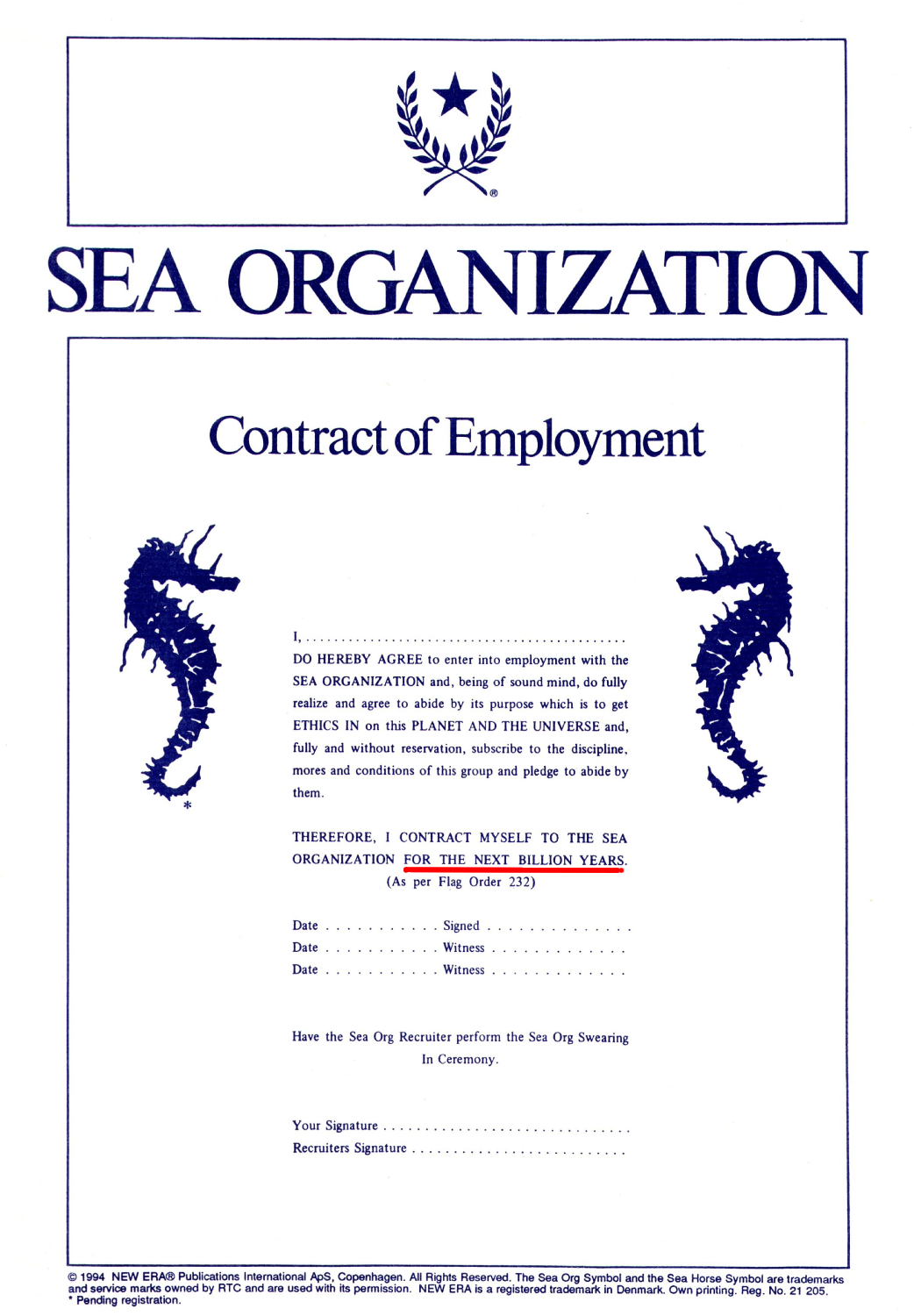
The Church of Scientology presents itself externally as a contemplative spiritual practice. Internally, it operates a parallel quasi-monastic order called the Sea Organization, or Sea Org, founded by Hubbard in 1967 aboard a flotilla of ships in the Mediterranean. The Sea Org is staffed by Scientology’s most committed adherents; its members sign contracts of service that pledge their loyalty for one billion years, expressed in language nearly identical to that of a military enlistment. Sea Org members wear naval-style uniforms, hold naval-style ranks, address their leader as Captain or Commodore, and reside in communal quarters at Scientology compounds in California, Florida, and aboard the church’s cruise ship Freewinds. They are paid a stipend; most former members place between twenty-five and fifty dollars per week.
These conditions have generated some of the most disturbing litigation in American religious history. Former Sea Org members have testified, under oath, to mandatory abortions, twenty-hour workdays, beatings administered by senior officers, confinement in punishment compounds, and the seizure of identification papers to prevent escape. The 2022 federal labor-trafficking lawsuit brought by three former members — Valeska Paris and the brothers Gawain and Laura Baxter — alleged that they had been kept in conditions amounting to forced labor for years; the case was diverted by a federal court into Scientology’s internal religious arbitration. Several other plaintiffs, including the actress Valerie Haney, who escaped from the Gold Base compound in California, hidden in the trunk of a car, have been similarly diverted into closed arbitration proceedings that the church itself controls.
Surrounding the Sea Org is a doctrine called disconnection. A Scientologist whose family member, spouse, or friend leaves the church or is declared a Suppressive Person — that is, an enemy — is required by church discipline to sever all communication with that person, permanently. The lists of disconnected families maintained by independent journalists are devastating. They include the actress Leah Remini’s separation from family members, the singer Lisa Marie Presley’s late-life estrangement from her own daughter (until reconciliation in her final years), the children who have not spoken to surviving parents in decades, and the men and women who have not seen their grown sons and daughters in thirteen, fourteen, or sixteen thousand days. The numbers are updated by twenty-four hours every morning in journalist Tony Ortega’s daily column, a relentless audit of the cost of one man’s policy.
Mike Rinder (1955–2025) did not see his son Benjamin and daughter Taryn in his final 7,589 days. … Christie Collbran has not seen her mother Liz King in 6,378 days. … Marc Headley has not seen his mother Trudy in 5,029 days.
— Daily disconnection ledger published at tonyortega.org (figures as of May 2026)
Scientology’s defenders argue that disconnection is no different from any community’s right to discipline its own. This is theologically and legally inaccurate. The Christian tradition has its own forms of corrective discipline — the New Testament authorizes withdrawal of fellowship from the unrepentant within the local church — but these traditions begin and end with restoration as their goal, place the matter in the hands of a sober plurality of elders, and remain bounded by the explicit command of Christ to love one’s enemies, bless those who curse you, and pray for those who persecute you. Disconnection has no such restorative aim. It is enforced by the threat of expulsion against the disconnecter, not the disconnected. And its targets are explicitly described, in Hubbard’s original 1967 policy, as enemies who “may be deprived of property or injured by any means.” It is the institutional opposite of the Sermon on the Mount.
❦ ❧ ❦
David Miscavige: The Captain of an Increasingly Empty Ship
David Miscavige turned sixty-six on April 30, 2026. He has now led the Church of Scientology longer than its founder did. Born in 1960 in Bucks County, Pennsylvania, the son of a Scientologist trumpet player, he joined the Sea Org as a teenager, served at Hubbard’s side in the late 1970s, and emerged in 1986, after Hubbard’s death at the Whispering Wind Ranch in San Luis Obispo County, California, as the de facto ruler of Scientology’s worldwide operations. His title is Chairman of the Board of the Religious Technology Center, the entity that holds the trademark rights to L. Ron Hubbard’s scriptures and uses those rights to control every other Scientology corporation.
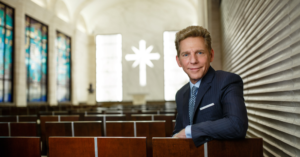 The Miscavige presented to the press is a polished spokesman in expensive suits, photographed at black-tie galas, the personal best friend of Tom Cruise. The Miscavige described by former senior executives is a different man. Mike Rinder, before his death in January 2025, alleged in sworn testimony and in his memoir A Billion Years that Miscavige personally assaulted senior staff, ordered the operation of a punishment compound at the church’s California headquarters known as The Hole, in which executives were confined for years, and that Rinder himself survived more than two years inside that compound before escaping. Marty Rathbun, formerly the church’s second-ranking executive, has made similar allegations. The church has denied them. The lawsuits in which they could be proven have been diverted into the church’s own arbitration system.
Even the leader’s father turned against him. Ron Miscavige, David’s father, who had served the church for decades, escaped Scientology in 2012, was placed under continuous private-investigator surveillance, published a 2016 memoir called Ruthless: Scientology, My Son David Miscavige, and My Lonely Journey Toward Freedom, and described his son as a man whose anger and physical aggression had become uncontrollable. He died in 2023, estranged from the son he had once introduced to L. Ron Hubbard.
Most consequential, perhaps, is the strange status of the leader’s own marriage. David Miscavige married Shelly Barnett in 1982. She served, for two and a half decades, as the church’s so-called First Lady, accompanying her husband to events and managing internal projects. Then, in August 2007, after the death of her father, she vanished from public view. She has not been seen in nineteen years.
By August 2007, Michele “Shelly” Miscavige had attended her father’s funeral. Then she mysteriously disappeared. To date, what exactly happened to Shelly Miscavige remains unknown. … Leah Remini filed a missing person’s report on Shelly’s behalf shortly after she left Scientology in July 2013. But Los Angeles Police Department Detective Gus Villanueva told reporters: “The LAPD has classified the report as unfounded, indicating that Shelly is not missing.”
— All That’s Interesting, profile of Shelly Miscavige (2021)
The most widely credited account, from former Sea Org members, is that Shelly Miscavige is held — or has chosen to remain — at a remote Scientology compound called Twin Peaks, near the church’s Church of Spiritual Technology archive vaults in the San Bernardino Mountains. The LAPD reports that detectives have met her, but cannot say where, when, or under what conditions. Independent journalists who have tried to reach the compound have been turned back at the gates. Whether one accepts the church’s account that nothing is wrong or the former members’ account that everything is wrong, the public fact is the same: the wife of the leader of an organization that claims hundreds of thousands of members has not been seen in public since 2007. It is a sustained absence without parallel in any other recognized religion in the world.
❦ ❧ ❦
Blown for Good: Behind the Iron Curtain of Scientology
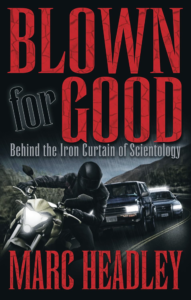 A Motorbike, a Rainstorm, and a Run for Freedom
On the morning of January 5, 2005, a thirty-two-year-old man on a battered Yamaha TW 200 motorbike skidded down a rain-slick highway outside Hemet, California, with two duffle bags strapped to his seat and a black Nissan Pathfinder trying to run him off the road. The SUV belonged to the security force of the Church of Scientology’s International Base — the 500-acre desert compound from which Marc Headley had just escaped after fifteen years of confinement. When the Hemet police pulled over to investigate the 911 call about a vehicular assault, Headley’s only thought was: I have to get into town. That morning marked the end of a life he had not freely chosen and the beginning of one he had to fight to claim.
Blown for Good is Marc Headley’s firsthand account of growing up inside Scientology, joining its paramilitary Sea Organization at sixteen, spending fifteen years inside the secretive International Headquarters (“Int Base”), and finally breaking out under conditions he could only describe as resembling defection from a totalitarian state. It is also an investigative exposé of L. Ron Hubbard’s most senior management compound and the abuses carried out under the watch of his successor, David Miscavige.
Born Into the Cause: A Hollywood Childhood Captured by Scientology
Headley was seven years old in 1980 when his mother joined Scientology in Los Angeles. The decision was hers, but the consequences fell on him. He was pulled out of one school and pushed into another according to whether Scientology approved of the institution, lived in a parade of apartments dictated by his mother’s shifting allegiances to the church, and was steered through the Scientology study “technology” at the Apple School and later at the Delphi School — a private academy in which every subject was run on L. Ron Hubbard’s checksheets, clay demonstrations, and E-Meter examinations.
By fifteen he was working at Delphi to pay his own tuition. By sixteen he had signed Scientology’s billion-year Sea Organization contract — a literal commitment that the church claims binds the soul across future lives. Headley reflects bluntly on how children like him were recruited:
“In this book, I attempt to lay the groundwork enough so that you can see that, like language, culture and other environmental factors, some of this stuff is programmed in at an early age.”
— Marc Headley, Author’s Note
Recruiters promised him a paid post at the Narconon Chilocco facility in Oklahoma. Instead he was diverted to a Los Angeles staff position, then to the Association for Better Living and Education, and finally — in a transfer engineered by a childhood friend already at headquarters — to the International Base in Hemet.
Behind the Iron Curtain: Life at the International Base
Headley likens the Int Base to the Eastern Bloc under Soviet rule. Staff worked 100-plus-hour weeks for pay that often fell below fifty cents an hour. They slept ten or more to an apartment, ate in regimented messes, and could not leave the property without an approved Completed Staff Work routing form. All outgoing personal mail was opened, read, and resealed by Security. Phone calls were monitored. Roads, fences, ground microphones, and razor wire surrounded a compound advertised to neighboring Hemet residents as a benign film-production studio.
The Shore Story and the Privilege System
On the Base Orientation Course, Headley was made to memorize the “shore story” — the cover narrative staff were required to recite to any outsider. No family member, no friend, no fellow Scientologist from a lower organization could be told that the international management of the church was based at Gilman Hot Springs. Privileges were doled out through a system of five “Team Share” cards — social, bonus, allowance, chow, and berthing — that could be revoked at the discretion of any senior. Staff with no cards received no pay, no food beyond scraps, and no fixed bed.
The Tapes Line and the Disposable Crew
Headley’s first long-term post was at Golden Era Productions’ Gauss line, the high-speed cassette duplication facility producing Hubbard’s recorded lectures. The previous crew of nine had been declared suppressive or sent to the Rehabilitation Project Force (RPF) after a quality-control failure. Every paper trail — logbooks, training materials, even desk contents — had been burned, as though the evil could be carried in ink. The new team was ordered to produce 50,000 cassettes per week, a target Headley calculated was mathematically impossible inside the available labor hours. They were made to hit it anyway.
The Tom Cruise Auditing Sessions
One of the book’s most discussed disclosures is Headley’s account of being personally audited by Tom Cruise. When Cruise undertook his Academy Levels at the Int Base in the early 1990s, he needed a low-bridge Scientologist to practice on. Headley was selected. He sat across the E-Meter from Cruise for weeks and watched the actor wing through introductory auditor training. When a marketing-division staffer was suspected of leaking Cruise’s presence to a tabloid, the crew’s phone access was cut off building-wide and the suspect was disappeared from the base within days.
Under Miscavige: Fear, Floods, and the Hole in the Wall
Headley’s portrait of David Miscavige — the Chairman of the Board of Religious Technology Center and Scientology’s effective head since Hubbard’s 1986 death — is the book’s most damning thread. Miscavige is described as obsessed with personally handling every detail of management while preventing anyone else from doing the same. After a 1990 flash flood devastated the property, Miscavige assembled the entire crew in the mess hall and personally screamed that they were responsible for the disaster, that they were “scum,” and that the entire organization was assigned the punitive ethics condition of Confusion. Two staff members fainted in line while he yelled.
Marty Rathbun, the former Inspector General for Ethics who later himself defected and who wrote the book’s foreword, corroborates Headley’s assessment from inside the executive suite:
“His description of Miscavige’s obsession with handling everything himself, while preventing thousands of others from handling anything is not only very accurate, it is also what Hubbard described as the fastest way to destroy an organization.”
— Mark “Marty” Rathbun, Foreword to Blown for Good
Headley personally witnessed Miscavige physically attack staff. In one episode in the base garage, Miscavige handed his Ray-Ban sunglasses to a security guard, walked across the room, and beat a former RTC officer named Mark Fisher who refused to address him as “Sir.” The medical officer was instructed to patch the victim up afterward. Such beatings, Headley reports, were not unusual.
Drills, Punishments, and the RPF
The base operated on a continuous rotation of drills — fire, flood, earthquake, power outage, intruder, protest, and “blow” drills designed to recapture staff who tried to flee. When a guard atop Eagle observation post burned the mountain trying to incinerate his own toilet paper, security checks revealed he had also been tracking Miscavige in his rifle’s crosshairs. He vanished, never to be seen again. The Rehabilitation Project Force — a manual-labor prison program from which release could take years — hovered as the constant threat behind every infraction.
Blown for Good: The Escape
After fifteen years — a marriage to fellow Sea Org member Claire Headley, multiple punishments, and the slow recognition that the door behind him had been bolted shut by an explicit Hubbard “advice” — Headley made his run on January 5, 2005. Security on motorbikes pursued him. A Pathfinder ran him off the road. He waved down passing motorists. The Hemet police, summoned by a 911 call from a witness, arrived and — in the book’s most pivotal moment — escorted him into town to a U-Haul facility, beyond the reach of Scientology’s private security. The author writes:
“It is January 5th, 2005. It is now about noon. My life has just restarted. It is at this exact moment I realize I am blown for good.”
— Marc Headley, Chapter One
Claire escaped weeks later. Together they would go on to file federal labor lawsuits against the Church of Scientology, lending their testimony to journalists and law-enforcement investigators in the United States, the United Kingdom, and Australia, and helping crack open the public record on Sea Organization conditions.
Why This Account Matters
Blown for Good is not a theological treatise; Headley writes as a labor witness and as a son who watched his own family swallowed by an organization that promised salvation and delivered servitude. Scientology claims to be a religion offering the only road to total spiritual freedom. The compound Headley describes — with its razor wire, monitored mail, billion-year contracts, and beatings in the garage — cannot be reconciled with that claim. The book stands as a primary-source indictment of an organization that treats its most devoted servants as the disposable raw material of its leader’s ambitions.
For Christians attempting to engage Scientologists with truth and compassion, Marc Headley’s account is invaluable. It documents in human detail what awaits those who climb too far up Scientology’s Bridge — and it offers hope that even after fifteen years inside the Iron Curtain, a person can come out, tell the truth, and live again in the light.
❦ ❦ ❦
The Speedrun Phenomenon: A Generation Walks Through the Front Door
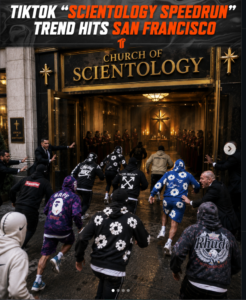 Which brings us back to Hollywood Boulevard, March 31, 2026, and the eighteen-year-old who broke the locks. The Scientology speedrunning trend that swept TikTok, Instagram, and YouTube through April and May 2026 was, on its surface, an exercise in adolescent silliness. Participants put on costumes — at one Vancouver event, dozens of young people dressed as Mario, Sonic, and Pokémon characters — and tried to penetrate as deeply as they could into Scientology buildings before security removed them. The gaming term “speedrun” supplied both the name and the absurdist tone. Comments below the most-viewed videos joked that if a player reached the top floor, he would find Tom Cruise.
By the second week of April 2026, the trend had a measurable effect. Three Scientology properties on Hollywood Boulevard had had their exterior door handles physically removed. Los Angeles police were running extra patrols in the Hollywood Division. The church issued a public statement decrying “trespassing, harassment and disruption of religious facilities,” arguing that “turning its spaces into targets for viral stunts is not journalism, protest or civic activity.” That statement was both legally correct and analytically beside the point. The point, as commenter after commenter observed, was that an organization whose Hollywood flagship complex is reported to be worth hundreds of millions of dollars, whose leader’s personal security is among the most paranoid in any American institution, and whose internal scriptures describe a galactic struggle against thetans seventy-five million years old, was reduced to taking off its own doorknobs to keep out twenty-year-olds in Halloween costumes.
If you’re on TikTok at all, you can see all the different videos. … All the jokes in the comments that if they get to the top, you’ll find Tom Cruise.
— Charley Tenorio, twenty-year-old Hollywood actor, quoted by the Santa Monica Daily Press, April 2026
A young person with a phone camera may not understand that he is walking, for sport, into a building staffed by people who have signed billion-year contracts and who genuinely believe his presence is part of a galactic conspiracy. Anti-Scientology activist Mark Bunker, who has covered the organization in Clearwater for more than a quarter century, made the same point and added another: meaningful exposure of an organization like Scientology requires investigative discipline, not viral content. The speedruns are not journalism. They are not protesting. They are, in his framing, a stunt that happens to be aimed at a target that deserves criticism.
What the Videos Reveal About Occupancy
Multiple commentary videos analyzing the speedrun footage have noted what one investigative documentary explicitly titled “The Empty Building Problem.” When TikTokers sprint through Scientology facilities — including major properties on Hollywood Boulevard, the L. Ron Hubbard Life Exhibition, and public information centers — the buildings are overwhelmingly populated by staff and security personnel, not ordinary members or public visitors. The runners encounter shouting staff members and guards, but virtually no one who appears to be a regular parishioner engaged in auditing, coursework, or services.
What “Empty” Buildings Suggest
For a church that claims hundreds of thousands of active members, this is a striking tell. The Scientology speedrun trend has inadvertently crowdsourced what journalists have long suspected: Scientology’s large, expensive real estate portfolio is largely a facade of institutional presence rather than a reflection of active membership. One documentary notes that Scientology’s multi-billion-dollar real estate empire appears to be “sitting mostly empty,” and that the organization’s membership is “in freefall.”
The Church’s Own Response Confirms It
Scientology’s defensive reaction is itself revealing. Rather than simply opening its doors to demonstrate that its facilities are filled with active, happy members — the obvious PR counter-move — the Church removed door handles from its Hollywood buildings, chained fire exits shut, and restricted public access. A genuinely thriving religious community with hundreds of members flowing through its doors daily would have no need to physically barricade its own publicly-advertised “information centers” against curious teenagers. The fortification response confirms what the empty hallways already suggested.
The Legal and Ethical Caveat
It is worth noting clearly: forcing entry into any building — religious or otherwise — crosses a legal line, and several participants have faced vandalism and robbery charges. Leah Remini, the prominent Scientology critic and former member, has reportedly argued the trend hands the Church exactly what it wants — a sympathetic victimhood narrative, hate crime classification, and a legal basis for ejecting critics from public-facing spaces. The empty buildings are worth observing; the trespass method of observing them is legally and ethically problematic.
The trend is nevertheless theologically interesting. For nearly half a century, Scientology cultivated its public image by tightly controlling who could enter its buildings, what could be photographed inside, and what could be said about it on television. Federal raids and Emmy-winning documentaries could pierce that secrecy only occasionally. But a generation that grew up on TikTok, that has never feared being sued by Scientology because it has nothing to take, and that finds the rituals of celebrity religion intrinsically funny, has accomplished what subpoenas and litigators could not. The fortress mystique is broken. The buildings on Hollywood Boulevard no longer feel impregnable. They feel like the lobby of a slightly down-at-heel hotel chain, because, increasingly, that is what they are.
❦ ❧ ❦
Empty Buildings on Cleveland Street: The Fortress of Florida
If Hollywood is Scientology’s symbolic face, Clearwater, Florida, is its actual seat of power. Hubbard’s flotilla came ashore there in 1975, and the church has called the city its worldwide spiritual headquarters ever since. The complex is anchored by the fifteen-story Flag Building, completed in 2013 at a reported cost of one hundred forty-five million dollars and dedicated to the most expensive auditing services in the Scientology system. Around it, in concentric rings outward from Fort Harrison Avenue and Cleveland Street, the church and its parishioners have spent the last decade acquiring real estate at a remarkable pace.
By 2024, according to the Tampa Bay Times, more than two hundred properties had been purchased by entities tied to the church or its members since 2017. Seven non-Scientology owners remained in the downtown commercial core. About three-quarters of the church’s holdings, by parcel count, were exempt from property taxes on “religious purposes” grounds. Many of the properties — by some counts, most — sat vacant for years. Former Scientology executive Tom De Vocht has testified that the strategy is deliberate, intended to create a buffer zone around the organization’s most sensitive operations and to keep non-members out of foot-traffic range.
The vacancy issue boiled over in 2025 and 2026. In April 2026, the city’s last major non-Scientology landowner, Daniels Ikajevs, sold his fifty-eight-million-dollar real-estate portfolio — including the eleven-story One Clearwater Tower — to companies managed by a longtime Scientology parishioner named Moises Agami. Clearwater’s mayor, Bruce Rector, who has spent his entire mayoralty navigating between residents who want a functioning downtown and a religious organization that owns a controlling share of it, told the Tampa Bay Times in early 2025 that he hoped to “work with the Church of Scientology on downtown development.” One year later, on the evening of May 28, 2026, several hundred residents packed the Clearwater Main Library for a special city council workshop on the matter.
Mayor Bruce Rector said residents want more information. “The community wants to know who’s involved and who’s doing this,” Rector said. “We’re not clear exactly who owns these properties, who is developing them.”
— Blake DeVine, Fox 13 Tampa Bay, May 29, 2026
The new face of Scientology’s Clearwater presence is a nonprofit-style real-estate vehicle called the Cleveland Street Alliance, managed by a Scientology parishioner named Scott Dobbins. The Alliance proposes some three hundred fifty million dollars in downtown development, including a planned eighty-three-thousand-square-foot entertainment venue called EVO Entertainment Clearwater. At the May 28 workshop, council members complained, as the city has complained for years, that they could not identify the human beings behind the limited-liability companies funding the project, did not know which existing storefronts would be activated and which would remain vacant, and did not know whether the church itself, in its corporate form, was a financial partner. “Why today?” Councilmember Mike Mannino asked Dobbins pointedly. “What’s changed? Is it the strategy, the market, what’s different?” The answers, Dobbins said, would come later.
Mark Bunker, the Clearwater councilman who has covered Scientology for a quarter century and now sits on the city council, told independent journalist Tony Ortega in a same-day analysis that the council meeting was “strange” — that the church’s cutouts were being asked to be transparent about projects whose ultimate beneficiary remained, even to the city government, opaque. The Christian observer can see, in the Clearwater dispute, both the visible fruit of the 1993 IRS settlement and the visible cost. A religious organization that no longer pays property taxes on three-quarters of its parcels has acquired the controlling stake in a small American city’s downtown. The residents of that city would like to know who lives in their neighborhood. The organization will not tell them. And the city, under the constitutional protections that Scientology successfully argued for itself in 1993, has no power to compel an answer.
❦ ❧ ❦
The Mike Rinder Memorial: A Voice Now Silenced
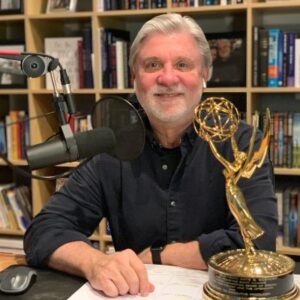 It is impossible to assess the state of Scientology in 2026 without taking into account the death of Michael John Rinder. He died on the morning of Sunday, January 5, 2025, at a hospice in Palm Harbor, Florida, of esophageal cancer. He was sixty-nine. Born in Adelaide, South Australia, on April 10, 1955, Rinder had been a Scientologist from the age of five, when his parents joined the local church. By his teens, he was in the Sea Org. By his thirties, he was the chief spokesman of the Church of Scientology International, head of its Office of Special Affairs — the intelligence and legal arm that succeeded the criminally convicted Guardian’s Office — and the man whose face appeared on Western television to explain the organization to the press.
Then, in June 2007, after nearly two and a half years of confinement inside The Hole at the church’s California headquarters, he walked out of the organization’s London office with a briefcase and a few hundred dollars in cash. He was fifty-two. He left behind his first wife, his daughter Taryn, and his son Benjamin. He did not see them again. Per the doctrine of disconnection, they would not speak to him for the remaining seven thousand five hundred and eighty-nine days of his life.
From the moment he left, Rinder devoted his second life to documenting from the inside what he had spent his first life concealing from the outside. He co-produced and co-hosted, with Leah Remini, the A&E docuseries Scientology and the Aftermath, for which he won two Primetime Emmy awards. He published a 2022 memoir, A Billion Years: My Escape from a Life in the Highest Ranks of Scientology, which became one of the most thoroughly documented inside accounts of the organization ever written. He co-founded the Aftermath Foundation, which has assisted dozens of former Scientologists in rebuilding lives outside the church. He maintained his daily blog, mikerindersblog.org, which he updated almost without fail for the last decade and a half of his life. His final post, dated the day of his death, was titled simply “Farewell.”
I have shuffled off this mortal coil in accordance with the immutable law that there are only two certainties in life: death and taxes. … My only real regret is not having achieved what I said I wanted to — ending the abuses of Scientology, especially disconnection and seeing my son Jack into adulthood. If you are in any way fighting to end those abuses please keep the flag flying — never give up.
— Mike Rinder, “Farewell,” mikerindersblog.org, January 5, 2025
From a pastoral standpoint, Rinder’s life poses an uncomfortable question. He never converted to Christianity. He described himself, in his last years, as a thoughtful agnostic. He believed there were no second chances after death. He worked, until the literal last week of his life, to expose an organization he held responsible for breaking his family and for ruining the lives of thousands of others. The Christian must, in honesty, recognize a moral grandeur in such a life — a willingness to give the most important years a man has to the protection of strangers — without pretending that the grandeur of the life answers the deepest questions of the soul. The man’s voice is now silenced. The work he began is unfinished. The thousands of Sea Org members still inside, including the four whose names he listed in his last post — his estranged children — have lost the most public friend they had.
❦ ❧ ❦
The Masterson Verdict and the Remini Reckoning: Justice Finds the Center
The most legally consequential developments of the last three years all concern a single man: the actor Danny Masterson, formerly of the long-running sitcom That ’70s Show, a lifelong Scientologist and one of the church’s most prominent young celebrities. In May 2023, a Los Angeles jury convicted Masterson on two counts of forcible rape. In September 2023, Judge Charlaine F. Olmedo sentenced him to thirty years to life in California state prison.
The criminal verdict was followed by civil litigation. Five women — including Masterson’s accusers and other Scientologists who said they had been harassed for speaking against him — sued not only Masterson but the Church of Scientology International, the Church of Scientology Celebrity Centre International, and the Religious Technology Center, alleging stalking and intentional infliction of emotional distress. The church responded with a battery of anti-SLAPP motions arguing that its conduct, even if proven, was constitutionally protected speech.
On May 19, 2026, in a unanimous-on-most-points opinion authored by California Court of Appeals Justice Carl H. Moor, the Second Appellate District largely rejected the church’s anti-SLAPP defense. The court permitted the stalking and infliction-of-emotional-distress claims to proceed to trial against all three Scientology defendants. The court did grant anti-SLAPP protection for two narrow categories — statements to a reporter and a contested food-truck listing — but the great majority of the women’s allegations survived. Justice Brian M. Hoffstadt concurred. Justice Lamar W. Baker partially concurred and dissented from the food-truck holding alone.
The Church of Scientology’s bid to dismiss a harassment lawsuit from women who accused actor Danny Masterson of sexual assault was largely rejected by a California appeals court Tuesday. The bulk of the women’s stalking and intentional infliction of emotional distress claims can proceed against Church of Scientology International, Church of Scientology Celebrity Centre International, and Religious Technology Center.
— Quinn Wilson, Bloomberg Law, May 20, 2026
The Masterson ruling sets in motion a civil trial in which the church will, for the first time in many years, have to defend its post-allegation conduct before a jury rather than inside its own arbitration process. Discovery in such a case could compel testimony from David Miscavige and from the senior executives of the Office of Special Affairs. The same week Bloomberg Law reported the appellate ruling, the Tampa Bay Times reported on the May 28 council workshop in Clearwater, Tony Ortega’s Underground Bunker chronicled Mark Bunker’s account of the same meeting, KTLA in Los Angeles reported Germany’s decision to end its surveillance of the church (we shall return to that), and Fox 13 Tampa Bay broke the news that EVO Entertainment had been announced for downtown Clearwater. The week of May 26, 2026, was simultaneously a week of significant legal exposure for Scientology and a week of significant softening of governmental pressure against it elsewhere. The two trends are not contradictory. They are two faces of the same phenomenon: an organization whose public credibility is collapsing while its legal infrastructure, in some quarters, hardens.
❦ ❧ ❦
Is Scientology a Religion? Britain Said Yes, Germany Said No, the IRS Said Maybe
The question whether Scientology is a religion is, for all of its theological seriousness, also a question of definition. The institutions that have answered it have done so along different axes.
In the United States, the IRS in 1993 answered yes for tax purposes. The IRS does not, in doing so, make a theological finding. It makes a regulatory one, balancing organizational structure, public benefit, and self-identification. The reversal of a quarter century of contrary determinations — overturned, as we have seen, after litigation campaigns and a private meeting between the church’s leader and the commissioner — was a remarkable administrative outcome but not, strictly speaking, a theological one.
In the United Kingdom, the Supreme Court answered yes for marriage-registration purposes in December 2013. In R (Hodkin) v. Registrar General of Births, Deaths and Marriages, the court unanimously overruled a 1970 Court of Appeal decision (Segerdal) that had defined religious worship as “reverence or veneration of a God or of a Supreme Being.” Lord Toulson, writing for the court, observed that such a narrow definition would exclude Buddhism, Jainism, and other religions that the law had long recognized. The court accordingly recognized the chapel at the London Church of Scientology as “a place of meeting for religious worship” under the Places of Worship Registration Act 1855, and authorized Scientologists to solemnize marriages there. The decision is repeatedly cited as a precedent in English religion-and-law jurisprudence.
Religion should not be confined to faiths involving a supreme deity, since to do so would exclude Buddhism, Jainism and others; and involve the Court in difficult theological territory. … The Scientology chapel should be recorded as a place for the solemnization of marriages.
— R (Hodkin) v. Registrar General [2013] UKSC 77, summary
In Germany, France, Belgium, and several other European jurisdictions, the question has been answered differently. The German government has, for thirty years, treated Scientology not as a religion but as a Wirtschaftsunternehmen — a commercial enterprise — that adopts religious vocabulary for the purpose of evading consumer-protection law. The end of federal surveillance in May 2026 does not formally change that designation; it simply reallocates intelligence resources.
None of these civil judgments resolves the theological question. From the standpoint of historic Christian orthodoxy, neither a tax-exemption letter nor a marriage registration certificate determines whether a movement is a religion in the deeper sense that touches the soul. The criteria are different. Does the movement worship the God of Abraham, Isaac, and Jacob revealed in Jesus Christ? Does it confess that Christ rose bodily from the dead? Does it confess Him as the unique Mediator between God and man? Does it preach repentance, forgiveness through His blood, and the indwelling of the Holy Spirit? On every one of these classical Christian markers, Scientology answers no. It is, in fact, more candid than many syncretic movements on this point. Hubbard himself wrote that what is true for a Scientologist is only what he has observed personally and known to be true for himself. Such an epistemology cannot host the Apostles’ Creed. It is, in technical terms, a Gnostic system: salvation through esoteric knowledge progressively revealed to the initiated for a fee, an architecture the early Church fathers spent three centuries refuting. The Apostle Paul addressed precisely this kind of teaching in his letter to the Colossians, warning believers against “philosophy and vain deceit, after the tradition of men, after the rudiments of the world, and not after Christ.”
❦ ❧ ❦
Counting the Faithful: How Many Scientologists Are There, Really?
Scientology claims, in its public literature, somewhere between eight million and twelve million adherents worldwide. The number is precisely the kind of figure that, repeated long enough in glossy print, takes on the air of fact. The independent evidence is starkly different.
The 1990 American Religious Identification Survey reported approximately forty-five thousand Americans identifying as Scientologists. The 2001 follow-up survey reported about fifty-five thousand. The 2008 survey reported approximately twenty-five thousand. The successor survey programs — Pew Research and others — have largely stopped reporting Scientology numbers separately, because the population has fallen below the statistically reliable threshold for such breakouts.
Outside the United States, the picture is identical and starker. The United Kingdom census, which permits voluntary religious self-identification, reported 2,418 Scientologists in 2001, 2,418 in 2011, and 1,781 in the 2021 census in England and Wales — a small absolute population, a downward trend, and a number that has lost a quarter of its peak in twenty years. The Australian census reported 2,163 Scientologists in 2011, 1,681 in 2016, and 1,655 in 2021 — again, a small absolute population on a slow downward slope, against an Australian total population of roughly twenty-six million. Canada’s 2021 census reported similarly small numbers. The Scientology Network, the church’s worldwide television operation, launched in 2018, claims to reach fifty million households; the independent ratings data have never supported the claim.
Scientology membership is so small that it’s fallen off the radar of monitoring organizations such as Pew and ARIS. … Perhaps in the seventies or eighties Scientology peaked at about a hundred thousand members according to many critics. After the takeover of Scientology by David Miscavige Scientology shed perhaps eighty percent of members and today might have twenty thousand members worldwide.
— Quora discussion summarizing scholarly consensus, mirroring Tony Ortega’s reporting (2024)
Two figures, taken together, frame the most plausible picture as of 2026. The Sea Org — Scientology’s full-time clergy and the most reliable indicator of organizational scale — is estimated by former senior executives at approximately three thousand to five thousand members worldwide, down from a high of nearly six thousand in the early 2000s. The total committed worldwide membership — those who pay for advanced auditing, attend events, and identify publicly with the church — is plausibly in the range of twenty thousand to fifty thousand. That is not the membership of a great world religion. It is the membership of a mid-sized American Christian denomination, with a global real-estate portfolio and litigation budget vastly out of proportion to its actual numbers.
The asymmetry between membership and visibility is itself a finding. Most religious movements grow in visibility as they grow in numbers. Scientology grew in visibility as it shrank in numbers, because its wealth, its real estate, its litigation, and its celebrities continued to generate news even as its rank-and-file emptied. A serious Christian observer should be neither triumphant nor dismissive about this. It is the predictable trajectory of a system whose founder was a writer of fiction, whose scriptures were the proprietary product of one man’s office typewriter, and whose institutional structure was built to extract maximum loyalty and revenue from each remaining adherent.
❦ ❧ ❦
A Traditional Christian Theological Assessment
It remains to ask what the historic Christian tradition — the tradition that includes the Apostles, the Church Fathers, the Reformers, the modern evangelical and confessional churches, and the saints and martyrs of every century since Pentecost — has to say about Scientology. The temptation, when surveying a movement so manifestly riddled with documented criminality and so transparently invented in living memory, is to dismiss it with a sneer. The Christian response is the harder one. It is the response of John, of Paul, and of the Lord Jesus Himself: to speak the truth in love, to test the spirits, and to call sinners — including very rich sinners and very powerful sinners and very lost sinners — to repentance and faith.
On the doctrine of God
Scientology has no doctrine of God in any classical sense. Hubbard’s writings refer in passing to an eighth dynamic, infinity, or the Supreme Being, but he was explicit that the church prescribes no specific teachings about God’s nature and instead concentrates on helping its members realize their own “inherent spiritual essence and abilities.” In practice, this means the divine is replaced by the self, and the self is exhorted upward through paid courses. The Christian creed begins, “I believe in God the Father Almighty, Maker of heaven and earth.” Scientology cannot say that line because it does not, in its own scriptures, mean it.
On the doctrine of man
Scientology teaches that the human person is, in his essence, a thetan — an immortal alien soul trapped in a body, hampered by clusters of other thetans, capable through Scientology technology of being restored to vast preternatural powers. The Christian doctrine of man is the opposite. Man is made in the image of God, fallen in Adam, redeemable in Christ. The thetan is not the imago Dei. The Hubbardian self is, in effect, a Promethean stand-in for the soul of orthodox theology, and the Promethean stand-in cannot bear the moral weight that the imago Dei carries.
On sin and salvation
In Scientology, sin is recoded as an engram — an unconscious image, captured in some past trauma, that hampers the thetan’s freedom. The remedy is auditing. The auditor is the priest; the E-meter is the sacrament; the price is itemized. The Christian doctrine of sin teaches that the human person is morally accountable to a holy God for actions taken in freedom. The remedy is the substitutionary atonement of Jesus Christ on the Cross, received by repentance and faith, given without money and without price. The two systems are not different applications of a common framework. They are different frameworks. Scientology cannot host the Cross because its anthropology has no place for the cross’s necessity.
On the church and the community
The Christian community is a fellowship of forgiven sinners united by baptism, the Lord’s Supper, the preaching of the Word, and the indwelling Holy Spirit. It is, in its visible expression, often broken; in its essence, it is the body of Christ. The Scientology organization is a corporate structure with extraordinary internal discipline, mandatory loyalty contracts of one billion years for its Sea Org members, an enforced policy of disconnection from outsiders, and a hierarchical authority that flows from a single chairman in Hemet, California. It is the inverse of the New Testament community. It cannot be both reformed and remain itself.
On the witness of the founder
Finally, no Christian assessment of Scientology is complete without a sober reflection on the figure of L. Ron Hubbard himself. The orthodox Christian must not engage in personal cruelty. We do not know the state of any man’s soul before his Maker. But the public record of Hubbard’s life is sobering. He misrepresented his war service, his academic credentials, his exploration, and his medical history. He encouraged a culture of contempt for the vulnerable. He authored policies, signed in his own hand, that explicitly authorized the harassment of critics by any means. He died in seclusion at a remote California ranch in January 1986, with the federal government still pursuing him as an unindicted co-conspirator in the largest infiltration of the United States government in American history. The Apostle Paul gave the Christian standard: “By their fruits ye shall know them.” The fruits of Hubbard’s life are documented in the lives of Paulette Cooper, of Lisa McPherson (who died in 1995 in church custody at the Fort Harrison Hotel in Clearwater), of the Sea Org members who escaped The Hole, of the children separated from their parents by disconnection, and of the speedrunners who, in the spring of 2026, found out that the locks on Scientology’s front doors had been removed because the institution itself had begun to lose confidence that anyone behind those doors would be safe.
❦ ❧ ❦
Conclusion: The Bridge to Nowhere
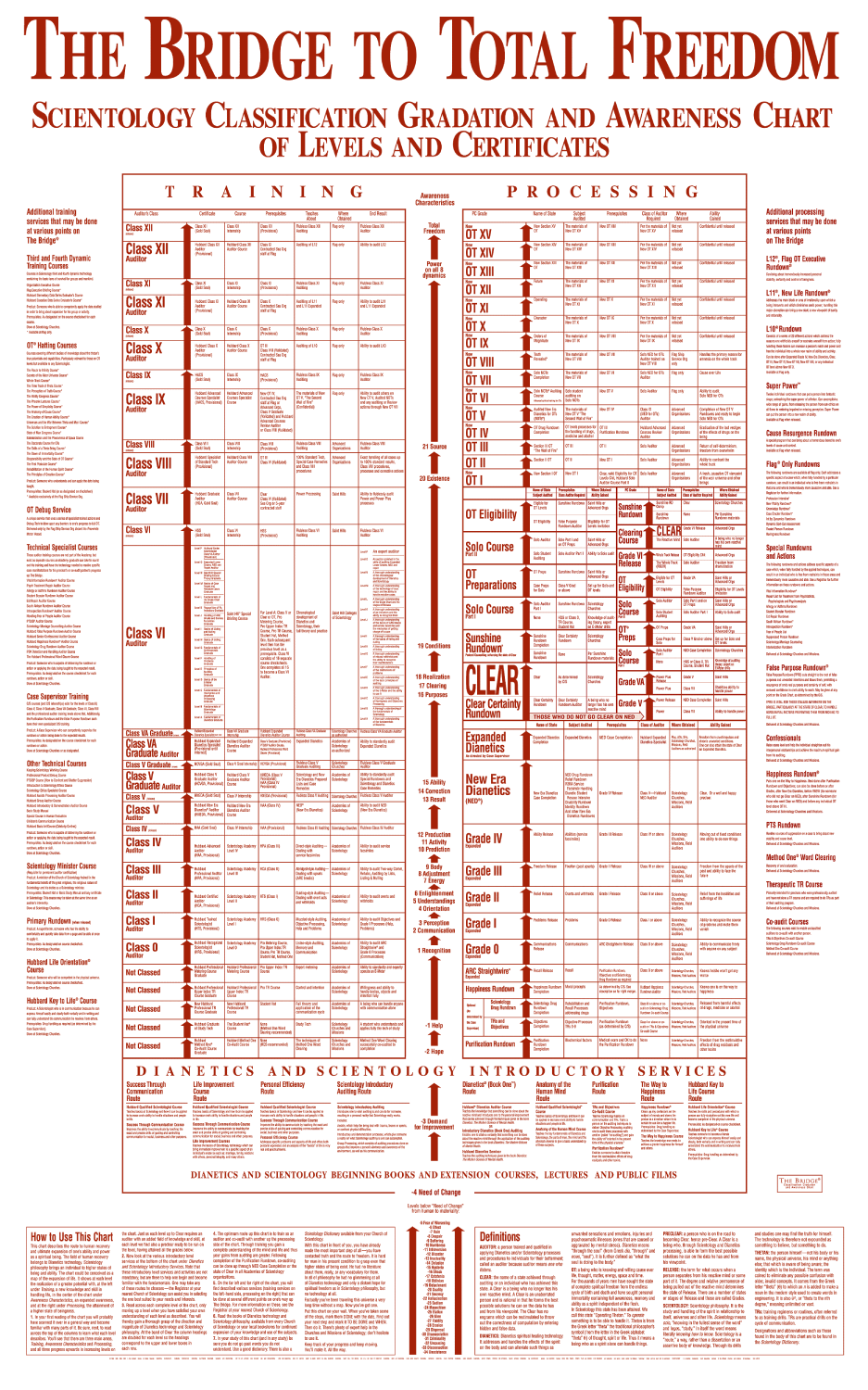
The capstone of Scientology’s internal cosmology is called the Bridge to Total Freedom. It is the chart, hung in every Scientology org from Hollywood to Johannesburg, that maps the soul’s ascent from Preclear through Clear and on through the eight levels of Operating Thetan. The chart was designed by L. Ron Hubbard. It is one of the most ambitious diagrams of human salvation ever drawn. It costs, by independent estimate, between three hundred thousand and one million dollars per adherent to walk from the bottom of the chart to the top. Tom Cruise is widely understood to be at the top. Mike Rinder, before he left, was within sight of it. David Miscavige, by virtue of his office, holds it open or closes it shut for every member.
Where does the Bridge lead? It leads, according to the published policies of the church, to the rediscovery of one’s true identity as an immortal thetan, the capacity to operate outside the body, and, in some Hubbardian formulations, to outright supernatural powers of the kind described in his pulp science-fiction novels. In sober historical fact, after seventy years of the operation of that Bridge, no Scientologist has demonstrated, under any scientific or even informal experimental scrutiny, a single one of those supernatural capacities. The Bridge that promises to make a man godlike has, in seventy years, made no one godlike. It has made some people wealthy, several thousand people miserable, and one woman — Shelly Miscavige — invisible.
The Christian observer, viewing this from outside the system, sees what every Christian observer of every Gnostic system since the second century has seen. The endless ladder of esoteric ascent, the proprietary scriptures locked behind a paywall, the senior initiates who know the secret and the junior initiates who pay to learn it, the leader who is also the merchant — Saint Irenaeus described it in the Against Heresies in the second century. The form is recognizable. The fruit, then and now, is recognizable. The promised destination of the ladder is, then and now, a bridge to nowhere.
There is another bridge. It is laid down across history by the Carpenter from Nazareth who became the Lamb of God, slain from before the foundation of the world, raised on the third day, and ascended at the right hand of the Father. The bridge of the Cross does not cost a Scientologist three hundred thousand dollars or a billion years. It cost the Son of God His life, and He invites every Scientologist — every disillusioned Sea Org veteran, every quietly skeptical celebrity, every child raised inside the system, every leader of the system itself — to cross over. The doors of His Church do not have to be locked. The doors of His Church do not have their handles removed when the curious come. The doors of His Church were broken open by the Resurrection, and they remain open. The Lord, whose Cross is the only Bridge that arrives anywhere, stands at every one of them and knocks.
“Behold, I stand at the door and knock,” He says in the third chapter of the Revelation of Saint John. “If any man hear my voice, and open the door, I will come in to him, and will sup with him, and he with me.” That is the invitation Scientology can never make to its adherents because Scientology has no Lord who stands and knocks. The man who walked through the front door of the Hollywood Information Center on the last day of March 2026 walked into an empty building. The Lord whose door we open by faith offers an empty tomb. The first emptiness ends in a video clip. The second emptiness ends in eternal life.
❦ ❧ ❦
Primary Sources Consulted
Each source URL below was directly fetched and reviewed in preparing this article. Citations within the body of the essay reference these sources by author, outlet, and date.
▸ Mother Jones, Scientology recruitment videos on TikTok/Instagram (May 2026): https://www.motherjones.com/politics/2026/05/scientology-recruitment-videos-tiktok-instagram/
▸ Yahoo Entertainment, Elisabeth Moss and Scientology (2026): https://www.yahoo.com/entertainment/celebrity/articles/elisabeth-moss-subtly-goes-against-162531332.html
▸ Yahoo Entertainment / SheKnows, Scientology’s anti-SLAPP victory over Leah Remini: https://www.yahoo.com/entertainment/scientology-latest-legal-victory-over-165533222.html
▸ MSN, viral speedrun trend at California Scientology buildings: https://www.msn.com/en-us/news/other/church-of-scientology-scrambles-as-viral-trend-wreaks-havoc-on-top-secret-fortresses-across-california/ar-AA22xxXQ
▸ WTSP / 10 Tampa Bay, Mike Rinder dies in Palm Harbor (January 5, 2025): https://www.wtsp.com/article/news/local/pinellascounty/mike-rinder-scientology-dies-palm-harbor/67-b23bb622-5ae1-46ba-acad-00118ec7fead
▸ USA Today / FTW, Scientology speedrunning explained (April 2026): https://ftw.usatoday.com/story/entertainment/pop-culture/2026/04/29/scientology-speedrunning-tiktok-explained/89852478007/
▸ Vulture / New York Magazine, Scientology speedruns explained: https://www.vulture.com/article/scientology-speedruns-explained.html
▸ Fox 13 Tampa Bay, Questions on Scientology’s $350M Clearwater redevelopment (May 29, 2026): https://www.fox13news.com/news/questions-surround-scientologys-role-350m-downtown-clearwater-redevelopment
▸ The Righteous Cause, Rise and Fall of Scientology’s Magic: https://novus2.com/righteouscause/2024/06/11/the-rise-and-fall-of-scientologys-magic-a-case-study-in-cult-evolution/
▸ The Righteous Cause, Scientology Volunteer Ministers’ faux humanitarian aid: https://novus2.com/righteouscause/2024/06/08/scientology-volunteer-ministers-faux-humanitarian-aid-promoted-by-their-own-press-releases/
▸ The Righteous Cause, Is Scientology a True Religion or Just Another Space Opera Cult?: https://novus2.com/righteouscause/2024/05/31/is-scientology-a-true-religion-for-the-twenty-first-century-or-just-another-space-opera-cult/
▸ The Righteous Cause, Operation Freakout: The Scientology Conspiracy to Destroy Paulette Cooper: https://novus2.com/righteouscause/2024/05/27/operation-freakout-the-scientology-conspiracy-to-destroy-paulette-cooper/
▸ The Righteous Cause, L. Ron Hubbard’s Dianetics: An Exposé: https://novus2.com/righteouscause/2024/07/01/l-ron-hubbards-dianetics-an-expose-of-unsubstantiated-claims-and-plagiarism/
▸ KTLA, Germany ends decades-long surveillance of the Church of Scientology (May 21, 2026): https://ktla.com/news/nationworld/germany-ends-scientology-surveillance/
▸ Bloomberg Law, Scientology’s bids to dismiss Masterson suit fail on appeal (May 20, 2026): https://news.bloomberglaw.com/litigation/scientologys-bids-to-dismiss-masterson-suit-fails-on-appeal
▸ Tampa Bay Times, City council hears Scientology’s downtown plans (May 29, 2026): https://www.tampabay.com/news/clearwater/2026/05/29/city-council-scientology-cleveland-street-downtown/
▸ The Independent, Scientology real estate in Clearwater, Florida: https://www.the-independent.com/news/world/americas/scientology-real-estate-clearwater-florida-b2937139.html
▸ Tony Ortega Underground Bunker, Mark Bunker on the Clearwater council showdown (May 29, 2026): https://tonyortega.org/2026/05/29/mark-bunker-on-last-nights-strange-scientology-showdown-with-the-clearwater-council/
▸ National Post / Holy Post, Scientology officially recognized in U.K.: https://nationalpost.com/holy-post/scientology-officially-recognized-as-a-religion-in-u-k-after-judges-rule-god-not-essential-to-worship-2
▸ Britannica, Scientology (J. Gordon Melton, updated May 6, 2026): https://www.britannica.com/topic/Scientology
▸ Grizzly Cub Network, Scientology: Religion or Cult?: https://grizzlycubnetwork.com/3590/entertainment/scientology-religion-or-cult/
▸ Wikipedia, Scientology officials: https://en.wikipedia.org/wiki/Scientology_officials
▸ All That’s Interesting, Shelly Miscavige profile: https://allthatsinteresting.com/shelly-miscavige
▸ Tony Ortega Substack, The Scientology Fortress: How David…: https://tonyortega.substack.com/p/the-scientology-fortress-how-david
▸ Tony Ortega Underground Bunker, David Miscavige turns 66 (April 30, 2026): https://tonyortega.org/2026/04/30/scientology-leader-david-miscavige-is-66-today-and-we-have-presents/
A Note on Research Methods and Accuracy
In recent years, some have voiced concern that artificial intelligence may distort facts or introduce inaccuracies into serious research. That criticism deserves acknowledgment. However, AI has now evolved into the most powerful research instrument available to any dedicated scholar—capable of analyzing vast datasets, cross‑referencing historical records, and surfacing overlooked connections across sources. This work represents a collaboration between the author’s investigative inquiry, verified primary documentation, and the advanced analytic capabilities of AI research tools. Here, AI was not used as a ghostwriter or a shortcut for scholarship, but as a disciplined research partner devoted to rigor, accuracy, and transparency.
Every factual claim in this work has been subjected to active verification. Where AI‑generated content was used as a starting point, it was tested against primary sources, peer‑reviewed scholarship, official institutional documentation, and established historical records. Where discrepancies were found—and they were found—corrections were made. The author has made every reasonable effort to ensure that quotations are accurately attributed, historical details are precisely rendered, and theological claims fairly represent the positions they describe or critique.
That said, no work of this scope is immune to error, and the author has no interest in perpetuating inaccuracies in the service of an argument. If you are a reader—whether sympathetic, skeptical, or hostile to the conclusions drawn here—and you identify a factual error, a misattributed source, a misrepresented teaching, or a claim that cannot be substantiated, you are warmly and genuinely invited to say so. Reach out. The goal of this work is not to win a debate but to get the history right. Corrections offered in good faith will be received in the same spirit, and verified corrections will be incorporated into future editions without hesitation.
Truth, after all, has nothing to fear from scrutiny—and neither does this work.