
From Babel to Bethlehem—Or to Seattle? A Christian Critique of the Jaredite Ocean Journey
I. Introduction: A Voyage in Search of a Map
There is a particular pleasure in looking at a map and tracing a story. Children do it with adventure novels; theologians do it with the wanderings of Abraham; armchair travelers do it with Marco Polo and Columbus. The pleasure rests on a quiet assumption: the map is real, and the story landed somewhere a curious mind could later go and stand. When a writer purports to place a sacred narrative on a modern atlas—down to the coastline near a named city—he is borrowing some of that pleasure. He is also borrowing the public’s instinct to credit specificity. A claim labeled “near Kuwait” sounds firmer than a claim labeled “somewhere east.”
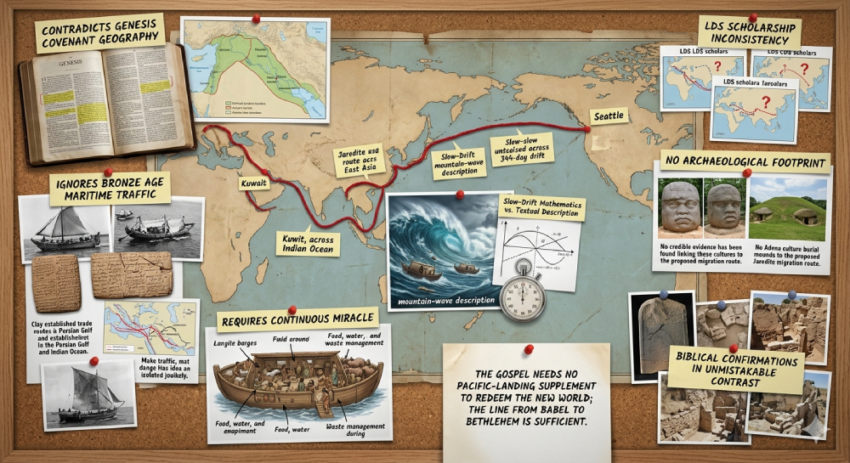
It is precisely this borrowing that warrants a careful look at two recent essays by Rian Nelson, posted on Book of Mormon Evidence and circulated within the wider “Heartland” community of Latter-day Saint geographers. The first, dated May 2, 2025, is titled “344 Days—First Ships Built near Kuwait.” The second, dated 2023, bears the title “Jaredites 2 Sets of Barges; Pacific Landing.” Together they propose nothing less than a precise itinerary for the Jaredite migration: the descendants of Jared, having departed the Tower of Babel around 2200 BC, walked some four hundred miles south-southeast from Mesopotamia to “near Kuwait,” there built a first set of barges, sailed through the Persian Gulf and across a chain of seas to Japan, Taiwan, or Shanghai, paused four years to build a second set of barges, and then rode the Kuroshio Current and North Pacific Drift across the open ocean for three hundred and forty-four days to make landfall, of all places, near Seattle, Washington. The reader is encouraged to examine both of these URLs.
The thesis is bold. It is also, by Mr. Nelson’s own candid admission, his own. The 2023 essay carries a prominent disclaimer that the post represents the author’s personal opinions and does not speak for The Church of Jesus Christ of Latter-day Saints. That sentence, prominently displayed at the head of the essay, is itself a useful starting point for any examination, and we will return to it. For the moment, it is enough to observe that the Pacific-landing thesis is one private theory among many in a long, unresolved internal LDS argument. The essay below considers whether—measured against the Hebrew Scriptures, against the historical and archaeological record of the ancient Near East, against the basic physics of small-craft ocean voyaging, and against the documented disagreements within LDS scholarship itself—Mr. Nelson’s chart can survive a steady gaze.
A note on method. This essay is written from a traditional Christian perspective, but the goal is not polemic. Where the Book of Ether and the Book of Mormon are cited, they are cited as the primary text Mr. Nelson is interpreting, with the understanding that adherents and critics alike must reason from what the text actually says. Where the Bible is invoked, it is invoked as the canonical Old Testament shared by Christians and Jews and recognized by the LDS Church itself as scripture. And where modern sources are quoted, the quotations are kept short, and the broader argument is paraphrased, in the conviction that careful argument does its own work without leaning heavily on borrowed phrasing.
II. Who Is Rian Nelson, and What Is the Heartland Model?
Mr. Nelson is a long-time advocate of what is generally called the “Heartland” model of Book of Mormon geography—the view that the events of the Nephite record took place not in Mesoamerica (the dominant view among credentialed LDS scholars since the 1980s) but in the central and eastern United States, with the Hill Cumorah in upstate New York, Zarahemla across the Mississippi from Nauvoo, and Manti in Missouri. He is closely associated with Jonathan Neville, Rod Meldrum, and Wayne May, and his work appears at bookofmormonevidence.org, moronisamerica.com, and the Firm Foundation conferences. The Book of Mormon Geography Lands directory describes his cartography as drawing on this Heartland triad, with maps showing Book of Mormon lands covering roughly half the United States.
The Heartland model is itself a minority position within LDS Book of Mormon scholarship. Most credentialed LDS Mesoamericanists—John L. Sorenson (Emeritus Professor of Anthropology, Brigham Young University) being the most prominent—locate the entire Book of Mormon drama in southern Mexico and Guatemala, with the Isthmus of Tehuantepec as the “narrow neck of land.” Sorenson’s argument, laid out in An Ancient American Setting for the Book of Mormon (1985) and Mormon’s Codex (2013), has been broadly endorsed by FARMS, by the Maxwell Institute at BYU, and by most readers of BYU Studies Quarterly. The fact that Mr. Nelson must locate the Jaredite landing near Seattle is in part a consequence of the Heartland framework: to keep the entire Book of Mormon narrative in North America, one must explain how Mesopotamian migrants got to the central United States, and a Pacific crossing onto the west coast is one of the few options.
It is important to be clear about the LDS Church’s own position. The Church publishes no official map of Book of Mormon lands. The 2013 edition of the Book of Mormon, like every edition since 1920, contains no historical or geographical footnotes. As one Dialogue Journal contributor accurately summarizes the situation, the Church maintains an explicitly hands-off policy on the scholarly elements of these unofficial studies. Mr. Nelson, in other words, is not merely declining to represent the Church; the Church is, as a matter of policy, declining to be represented by any model.
“Note: This blog post is my own researched and well thought out opinions, and not those of Firm Foundation or Rod Meldrum. I do not ever represent The Church of Jesus Christ of Latter-day Saints.”
— Rian Nelson, “Jaredites 2 Sets of Barges; Pacific Landing,” bookofmormonevidence.org (2023)
That disclaimer matters. It frames the Nelson thesis honestly as a private interpretive exercise. The reader is therefore entitled—indeed, obligated—to test the exercise on its own evidentiary merits.
III. The Nelson Itinerary in His Own Words
In summary form, Mr. Nelson’s route can be reconstructed from his blog posts as follows.
First, after the confusion of tongues at Babel (which he places, conventionally, in Mesopotamia near present-day Iraq), Jared, his brother, their families, and friends—numbering perhaps a few dozen—travel on foot roughly 405 to 655 miles south-southeast through the wilderness toward the head of the Persian Gulf, somewhere “near Kuwait.” There, they built the first set of barges.
Second, they cross “many waters”—Mr. Nelson lists the Persian Gulf, the Gulf of Oman, the Arabian Sea, the Laccadive Sea, the Bay of Bengal, the Andaman Sea, the Malacca Strait, the South China Sea, and the Yellow Sea—stopping eventually somewhere on the East Asian coast at a place he names “Moriancumer.”
Third, after a four-year layover during which a second set of barges is built, the company rides the Kuroshio Current and the North Pacific Drift for three hundred and forty-four days across the open ocean, making landfall in the Pacific Northwest near Seattle, Washington. From there, he argues, the Jaredites broke up into family groups: a Ham line migrating south to California and Mesoamerica (the future “Olmecs”), a Shem line moving east toward the Great Lakes (the future “Adena”), and a Japheth line spreading elsewhere across the Americas.
The principal “evidence” he offers may be summarized in three categories. The first is scriptural: the text of Ether 2 and 6 in the Book of Mormon. The second is oceanographic: a passing email correspondence with British sailor Philip Beale, captain of the modern Phoenicia replica ship, in which Beale reportedly states that ocean currents move at roughly half a mile per hour, or twelve miles per day—numbers that, multiplied across a 4,000-mile Japan-to-North America transect, yield approximately 333 days at sea. The third is archaeological: the broad chronological window of the Olmec and Adena cultures, which Mr. Nelson connects, without independent archaeological support, to the Jaredite migration.
Each strand deserves separate treatment, and to those we now turn.
IV. Where the Geography Departs from the Biblical Record
The Book of Ether, like the Pentateuch, opens its account at the Tower of Babel. The Hebrew Bible names the place Babel, locates it on “the plain in the land of Shinar” (Genesis 11:2), and identifies that plain with southern Mesopotamia—the alluvial flat between the lower Tigris and Euphrates, in or near what is today the south of Iraq. The LDS Church’s own Old Testament Geography manual concurs: Babylon or Babel was the location of the Tower of Babel. So far, so unobjectionable. Where the biblical record and the Nelson thesis begin to diverge is in what follows the dispersion.
Genesis 10, the so-called Table of Nations, traces the descendants of Noah’s three sons—Japheth, Ham, and Shem—across a coherent and bounded ancient Near Eastern world. Prof. John Day of Oxford observes that the seventy nations of Genesis 10 extend, at their furthest reach, only to Elam in the east (south-west Iran), Tarshish in the west (southern Spain), Seba and Sheba in the south (East Africa and Yemen), and Ashkenaz in the north (the Scythian peoples of what is now Ukraine). The world of Genesis 10 is the world the Israelites knew, and it does not include the Americas, the Pacific, or East Asia. There is no Joktanite branch tracing to Seattle, no descendant of Eber making landfall in Oregon, and no fourth direction added to the compass.
This is not a minor matter of theological style; it goes to the heart of the biblical narrative’s geographic self-understanding. The “land which is choice above all the lands of the earth” of Ether 1:42 is, in Mr. Nelson’s reading, transparently North America. But in the Hebrew Bible, the chosen land is Canaan. The Lord swears to Abraham, “Unto thy seed have I given this land, from the river of Egypt unto the great river, the river Euphrates” (Genesis 15:18). The covenanted territory of Genesis, Exodus, Joshua, and Kings is a particular and bounded inheritance. To posit a second, parallel, hemispheric “promised land” given to Jaredite migrants from Babel is to introduce a covenant theology the biblical text neither names nor anticipates. Even the LDS scripture-help manual itself, in laying out Old Testament geography, confines the entire scriptural narrative to the region between the Mediterranean Sea, the Persian Gulf, and Egypt. Nothing in the canonical Old Testament so much as hints at a Mesopotamian remnant crossing the Pacific.
“Most of the events of the Old Testament took place in what is called the ancient Near East, known today as the Middle East. This includes the region between the Mediterranean Sea and the Persian Gulf, as well as Egypt.”
— Scripture Helps: Old Testament, “Old Testament Geography,” The Church of Jesus Christ of Latter-day Saints (churchofjesuschrist.org)
There is a deeper problem still. The Tower of Babel narrative in Genesis 11 is unambiguous about who is scattered and where. “So the LORD scattered them abroad from thence upon the face of all the earth” (Genesis 11:8). The text gives no exception clause. There is no remnant whose language was not confounded, no protected family granted a private commission to sail to a New World. The Jaredite frame—that the language of Jared and his brother was preserved while every other tongue was scrambled, and that they alone were given a hemispheric promised land—is an editorial addition to the biblical record, not an extension of it. A traditional Christian reader will note this is exactly the structural pattern a nineteenth-century American author would invent to graft a New-World epic onto the Genesis stem: borrow the dispersion, exempt one family, and send that family west across an ocean that the Hebrew Bible nowhere knows.
V. “Into That Quarter Where There Never Had Man Been”: The Empty-Quarter Problem
Ether 2:5 records that the Lord commanded the Jaredites to go forth “into the wilderness, yea, into that quarter where there never had man been.” Mr. Nelson reads this verse to vindicate his route through the Persian Gulf and Arabian Sea, on the argument that the so-called Empty Quarter of Saudi Arabia (the Rub’ al-Khali) was uninhabited and therefore matches the scriptural description.
This reading runs into an immediate empirical wall. Around 2200 BC—the date Mr. Nelson assigns to the Babel dispersion—southern Mesopotamia and its littoral were among the most densely populated regions on the planet. Ur of the Chaldees, the city the Bible identifies as the birthplace of Abraham, was a major urban center by 2200 BC, with the great ziggurat of Ur-Nammu rising before 2100 BC. The Persian Gulf was an active commercial sea; the Bronze Age trading network linking Mesopotamia (Sumer and Akkad), Dilmun (modern Bahrain), Magan (Oman), and Meluhha (the Indus Valley) is well-documented in cuneiform tablets and archaeological remains. The Indus Valley civilization, contemporaneous with the alleged Jaredite voyage, flourished at Mohenjo-Daro and Harappa from roughly 2600 to 1900 BC. A small Mesopotamian flotilla, claiming to be the first humans ever to traverse the Gulf, Gulf of Oman, Arabian Sea, and on to the Bay of Bengal, would have passed through some of the most heavily trafficked maritime corridors in the early Bronze Age. Pre-existing populations would have been everywhere along the coast.
The problem worsens at each subsequent leg. By the time the supposed barges reach the Bay of Bengal, they are entering waters fished and sailed by the Dravidian peoples of the Indian subcontinent. The Gulf of Thailand and the South China Sea were navigated by Austronesian seafarers whose great expansion was already underway. To call any of this a “quarter where there never had man been” is, on the ordinary meaning of the words, simply mistaken. Mr. Nelson’s response—that the Jaredites veered through the deep desert interior of the Arabian peninsula’s Empty Quarter on their way to the coast—does not solve the problem; it relocates it. The maritime portion of the route, the great majority of the journey, runs through long-occupied seas.
There is also an internal LDS difficulty here. The Heartland blogger Del at NephiCode—himself an advocate of a Pacific-crossing route, but a different one—observes that Mesopotamia-to-East-Asia overland is not at all direct or easy because of mountain barriers, hostile steppe terrain, and the practical limits of pre-domesticated transport. He proposes a Southern Ocean (the so-called Roaring Forties, Furious Fifties, and Screaming Sixties) route as a closer match to the textual description of mountain waves and a constant west-to-east driving wind. The point is not that the Southern Ocean reading is correct; it has problems of its own. The point is that even within LDS Pacific-crossing theory, Mr. Nelson’s specific Kuwait-to-Seattle route is contested.
VI. The 344-Day Drift: Oceanographic Possibility versus Textual Probability
Mr. Nelson treats the figure of 344 days in Ether 6:11 as a key. If Jaredite barges drifted at the speed of the North Pacific currents, he argues, the timing fits a passage from Japan to the Pacific Northwest. His correspondent Philip Beale, captain of the modern Phoenicia replica voyages, is quoted as saying that ocean currents move at roughly half a mile per hour, or twelve miles per day; multiplied across roughly four thousand miles, this yields about three hundred and thirty-three days. The reader is invited to admire the closeness of the fit.
A few observations bring the apparent precision back down to earth.
First, the Book of Mormon does not describe a passive drift. Ether 6:5–8 is emphatic that the Lord caused a furious wind to blow across the waters, that the barges were tossed before the wind, repeatedly buried in the depths of the sea because of mountain waves and terrible tempests. A furious wind capable of mountain waves does not push a boat at twelve miles per day. Hurricane-force winds drive significant ocean swell at vastly higher speeds; even a sustained Beaufort-7 gale (near-gale, around 30 knots) propels small craft at multiples of the Kuroshio Current’s drift velocity. The textual description and the slow-drift model are not compatible. To get the 344 days to match, one must imagine the most violent storm-driven passage in human seafaring history—and then have it conclude with the ordinary speed of a piece of debris.
Second, an analyst at the Latter-day Saint Q&A site Ask Gramps attempts the math the other way: 7,000 nautical miles in 344 days requires an average speed of less than one knot. A small sailing vessel makes six to eight knots; even a poorly trimmed raft makes two or three. To average under one knot for almost a year, the voyage would have to be largely stationary, drifting in eddies, with brief productive bursts—the opposite of a wind-driven crossing. So in the very calculations of those most invested in the Pacific theory, the numbers force a slow voyage, but the text demands a fast and violent one. The two cannot be reconciled by tuning the route.
Third, the appeal to the Kuroshio Current and North Pacific Drift is anachronistic to the way the Book of Mormon describes the voyage. The Kuroshio is a directional current, predominantly northeast-flowing along Japan and curving across the central North Pacific. Drift voyages along it have been documented—debris from the 2011 Tohoku tsunami famously reached the Pacific Northwest about a year later. But that drift assumed floating debris that did not sink, capsize, or submerge many times. Mr. Nelson cites a tsunami-debris timeline as a confirming analogy. The analogy is the wrong one. Floating fishing buoys do not roll over; the Jaredite barges in Ether 2:20 require holes in both top and bottom precisely because they were expected to overturn repeatedly.
Fourth, the most modest sea trial we have is also a clue. Captain Beale’s own replica Phoenicia, sailing a Phoenician-style ship from Tenerife to Santo Domingo in 2019, took thirty-nine days for the Atlantic crossing. The same captain has repeated Atlantic and Indian Ocean passages on similar timescales. If a wind-driven, sail-equipped, blue-water vessel takes weeks—not most of a year—to cross either ocean, the question becomes why the Lord, having promised constant wind in the right direction, would deliberately retard the voyage to nearly a year. The simplest explanation is that the figure of 344 days is a textual feature of the Book of Mormon, not a target for modern oceanography to chase.
VII. The Barges Themselves: Engineering and Common-Sense Problems
Even if one grants the route and the timing, the vessels described in Ether 2–6 raise their own set of problems. The text describes them as tight like unto a dish (Ether 2:17), peaked at both ends, sealed top and bottom, propelled solely by wind, designed to be buried in the depths of the sea and to right themselves, lit not by fire or windows but by sixteen luminous stones touched by the finger of the Lord, and carrying men, women, children, flocks and herds, fowls of the air, fish of the waters, swarms of bees, and seeds of every kind, for nearly a year.
Kent Ponder, who taught at the United States Naval Academy and studied historical shipbuilding at Mystic Seaport, has set out forty common-sense questions about this passage that deserve summary here. His central observation, restated: how does a group of competent shipwrights, having already built similar barges four years earlier, finish all eight of the new vessels — each watertight, windowless, and sealed at top and bottom — before anyone notices that there is no air supply and no light inside? The Brother of Jared, the text says, raised the question only after the construction was complete (Ether 2:19). Working in the Bronze Age with hand tools, the construction of eight ocean-going semi-submersible craft of any size would have taken months; eight crews of carpenters and joiners would have spent that entire period working inside the hulls. That not one of them thought to mention, across months of labor in sealed wooden darkness, that human beings require both air and light to survive defies every recognizable standard of competent planning — and of basic human instinct.
A few additional questions follow naturally. How does a single hole, opened in either the top or bottom, depending on which way the barge is currently oriented, ventilate a hold packed with breathing humans, sheep, cattle, fowl, bees, and seed stocks for 344 days? Body-warm air inside a sealed barge would be at higher pressure than the cooler atmosphere outside; without active cross-ventilation, fresh air will not flow in through a single aperture. How do the human occupants, animals, food stores, and water supplies remain functional through repeated capsizings—when the floor becomes the ceiling, and a thousand pounds of grain comes down on the family below? Where does the fresh water come from? A single goat consumes two to three pounds of feed and several quarts of water per day; even a small flock would require tons of fodder and thousands of gallons of fresh water for a year-long passage. The barges, described as light upon the water like a fowl, cannot be massive enough to carry these reserves.
The standard apologetic reply is that the entire voyage is presented as a miracle, and that one should not press miracle accounts for engineering plausibility. That reply is theologically respectable for a believer — it is, after all, a possible move within revealed religion, but it immediately raises a question the text itself invites: if the answer to every structural problem is simply divine suspension of physics, why does the narrative bother describing the construction in such specific detail at all? Miracles in Scripture are typically recounted with brevity precisely because their point is the power of God, not the specifications of the vessel. The Jaredite account, by contrast, lingers over the materials, the dimensions of the problem, and the back-and-forth negotiation between the Brother of Jared and God over ventilation and lighting — the kind of detail that signals a text making an argument for historical plausibility, not one content to rest on the bare assertion of divine action. To then retreat, under scrutiny, to “it was all a miracle anyway” is to abandon the very register the narrative chose for itself. And if the only sustainable defense of a literal Jaredite voyage is direct, repeated, manifold divine suspension of physics across nearly a year at sea, then the case is no longer being made on the grounds of evidence at all. It has retreated to a pure faith claim, and a pure faith claim is precisely what Mr. Nelson’s “Evidence” branding is asking the reader to accept as evidence.
A traditional Christian respondent here would draw a careful contrast. The miracles of the Bible are pointed, occasional, and tightly anchored to specific covenantal moments—the parting of the Red Sea, the manna in the wilderness, the multiplied loaves, and the Resurrection. The Jaredite voyage, by contrast, requires an unbroken miracle for nearly a year, with every physical law (gravity, fluid dynamics, gas exchange, animal husbandry, food spoilage) suspended in continuous favor of a single family. The Bible’s miracles are theological signposts; the Jaredite voyage, as Mr. Nelson reconstructs it, requires a miracle as the working principle of an entire migration, an entire ecosystem, and an entire navigation.
VIII. Olmecs, Adena, and the Question of Archaeological Footprint
Mr. Nelson’s most concrete claim is that the descendants of the Jaredite landfall populated the major Pre-Columbian cultures of North and Central America—specifically the Olmec of southern Mexico (fl. ca. 1500 BC) and the Adena of the Ohio River Valley (fl. ca. 1000 BC). The chronological window roughly fits: the Jaredites land around 2200 BC; the Olmec and Adena appear several centuries later.
Set aside the chronology and consider the material record. The Olmec are famous for their colossal stone heads, their elaborate ceremonial centers at La Venta and San Lorenzo, and their development of one of the earliest writing systems in the Americas. Their physical anthropology and material culture have been intensely studied for nearly a century. There is no detectable Mesopotamian, Semitic, or East Asian signature in their language, their religion, their iconography, their pottery, their architecture, or their genetics. They appear in the archaeological record as an indigenous Mesoamerican development drawing on prior Pre-Classic foundations.
The Adena present the same picture. They are known from earthwork mounds in present-day Ohio, West Virginia, Kentucky, and Pennsylvania. Their distinctive burial practices, their tubular smoking pipes, their copper bracelets and ornaments, and their pottery traditions are well within the developmental trajectory of the Late Archaic and Early Woodland eastern North American cultures from which they arose. DNA testing on Adena and adjacent ancestral populations consistently identifies northeast Asian and Siberian origins, consonant with the Beringian migration route that brought Paleo-Indians into the Americas more than 13,000 years ago. There is no Adena Semitic-language inscription, no Adena Sumerian artifact, no Adena bee-keeping evidence, no Adena ceremonial trace pointing back to a Mesopotamian Babel.
Honeybees deserve a separate mention because the Book of Ether names them. Ether 2:3 places swarms of bees among the cargo of the Jaredite voyage. Apis mellifera, the Western honeybee, is not native to the Americas; it was introduced by European colonists in the early seventeenth century. There are stingless Meliponine bees in Mesoamerica, but those are a different family from the Apis hivebee implied by the biblical and ancient Near Eastern apicultural background. If the Jaredites had carried Apis swarms to a North American landing in 2200 BC, the species would have established itself across the continent millennia before Europeans arrived; it did not.
But the transportation problem precedes the arrival problem entirely. A honeybee colony requires consistent temperature regulation between 92 and 95 degrees Fahrenheit inside the brood nest, continuous ventilation to prevent carbon dioxide buildup, access to forage for food, and the ability to expel waste through regular flight activity. A sealed, windowless, watertight vessel — the precise design the text specifies — eliminates every one of those conditions simultaneously. Entomologists and apiculturists are uniform on this point: a confined Apis colony deprived of ventilation, light, and foraging access will collapse within days, not weeks. The Jaredite crossing, by the text’s own chronology, lasted approximately 344 days (Ether 6:11). No known mechanism of bee biology, and no serious apicultural literature, supports the survival of a productive honeybee colony under those conditions for anything approaching that duration. The bees, in short, could not have made the journey the text describes — and unlike the ventilation and lighting problems, this is not a question that retreats gracefully into miracle language, since the text makes no claim of divine preservation for the bees specifically. They are simply listed as cargo, as though their survival across a year in a sealed hull were unremarkable.
It should be noted now that the broader Mormon archaeology question has long been candidly assessed. Even sympathetic LDS commentators acknowledge the asymmetry. The non-Mormon archaeologist Michael Coe of Yale, a leading Mesoamerican specialist, famously observed in 1973 that there is no professionally trained, non-Mormon archaeologist who sees scientific justification for the historicity of the Book of Mormon. That assessment has not materially changed in fifty years. Where Biblical archaeology can show the Cyrus Cylinder (confirming the return from Babylon), the Merneptah Stele (the oldest extra-biblical reference to Israel as a nation), the Moabite Stone (independently confirming King Mesha and the kings of Israel), the Tel Dan Stele (confirming the dynasty of King David), the Lachish Reliefs (depicting the siege described in 2 Kings), and the Dead Sea Scrolls (corroborating the textual transmission of the Hebrew Bible across more than a millennium), Book of Mormon archaeology has produced no comparable artifact, no inscribed Nephite city wall, no Jaredite ziggurat, no Olmec or Adena object identifiable to a Semitic or Sumerian source.
“There have been no spectacular finds … no Zarahemla discovered, no gold plates brought to light, no horses uncovered ….”
— Dialogue Journal, “Book of Mormon Archaeology: The Myths and the Alternatives” (dialoguejournal.com)
The contrast cuts hard. A reader who is convinced of the Bible’s reliability on archaeological grounds cannot consistently extend the same epistemic generosity to a parallel narrative that has produced no comparable confirmations and that contradicts the developing material record at multiple points.
IX. Internal LDS Disagreement: Nelson against Sorenson, Nibley, May, and Neville
Mr. Nelson is candid that his Pacific-landing thesis differs from other Latter-day Saint reconstructions. He writes that Jonathan Neville also favors a Pacific landing while Wayne May favors the Atlantic, and that he himself is convinced after much research that the Pacific is most feasible. The candor is admirable; the implication is significant. There is no LDS consensus on the Jaredite route, on the Jaredite landing point, on the Jaredite vessel design, or on the Jaredite identification with any New World archaeological culture.
Consider the spread. Hugh Nibley, the most influential mid-twentieth-century LDS apologist, favored a Pacific crossing but routed the Jaredites overland through the Eurasian Steppes, not down the Persian Gulf. John L. Sorenson, the founding figure of LDS Mesoamerican geography, defended a Pacific crossing in his 1985 Ancient American Setting but then, by 2013, switched to an Atlantic crossing in Mormon’s Codex. Milton R. Hunter, the LDS apostle, argued for the Atlantic. Wayne May argues for the Atlantic. Del at NephiCode argues for a Southern Ocean route through the Roaring Forties. Book of Mormon Resources analyst David Rosenvall has the Jaredites turning east through the Caspian Sea and across China to Mount Laoshan. Mr. Nelson has them turning southeast to Kuwait and then up the Asian coast to a generic Moriancumer. No two of these reconstructions agree.
Mr. Nelson’s confidence that his particular route is the most feasible must be set against this background of unresolved internal disagreement. Each of the proposed routes claims fidelity to the same brief and ambiguous scriptural text. The fact that competent LDS readers, examining the same passages, arrive at radically different reconstructions is itself probative. It suggests that the underlying text is too underdetermined to support a confident geographic specification, and that the apparent precision of any one map—including Mr. Nelson’s—rests not on the text but on the assumptions of the cartographer.
A traditional Christian observer notes that this is a characteristic problem of texts asked to do work they were not designed to do. The Book of Ether, like most ancient mythographic narratives, supplies a frame but not a survey. Pressing it for a port near Kuwait or a landing near Seattle is exactly the move scholars caution against when reading, say, the geographical asides of the Iliad or the voyage of Odysseus. Either the text yields a place, and competent readers should be able to find it; or the text is doing something other than charting a literal sea route, and the search for the port is misconceived.
X. The Biblical Contrast: What Confirmation Actually Looks Like
This essay has been about what the Nelson thesis claims and where it fails. It is worth closing the inquiry by stating, briefly and positively, what biblical archaeology has produced—because the contrast is what gives the critique its weight.
Within the past century and a half, biblical archaeology has accumulated independent, datable, and externally corroborated confirmations of the Old Testament narrative at scale. The Merneptah Stele, dated to about 1208 BC, names Israel as a settled people in Canaan—the earliest extra-biblical reference to the nation. The Tel Dan Stele names the House of David, ending two centuries of scholarly skepticism about the historicity of the Davidic monarchy. The Moabite Stone, inscribed by King Mesha around 840 BC, parallels the account of 2 Kings 3 and confirms the historical relationship between Moab and Israel. The Cyrus Cylinder confirms the policy by which the Persian conquest permitted the Jews to return from Babylonian exile and rebuild the Temple, fulfilling Ezra 1:1–3. The Lachish Reliefs depict, in stunning narrative panels carved on the walls of Sennacherib’s palace, the very siege described in 2 Kings 18–19 and 2 Chronicles 32. Hezekiah’s Tunnel and the Siloam Inscription confirm the engineering work described in 2 Kings 20:20. The Ketef Hinnom silver scrolls preserve the Priestly Benediction of Numbers 6:24–26 in seventh-century BC Hebrew. The Dead Sea Scrolls confirm the textual stability of the Hebrew Scriptures across more than a millennium of transmission.
Each of these confirmations is independently produced, professionally dated, and broadly accepted by scholars without confessional commitment to the Christian or Jewish faith. None of these is faith-dependent. They constitute exactly what scholarly historians ask for: external corroboration of a narrative by evidence the narrative did not itself produce.
The Book of Ether and the broader Book of Mormon have produced nothing equivalent. No Coriantumr inscription, no Ramah ziggurat, no Jaredite ship-timber radiocarbon-dated to 2200 BC and bearing Semitic markings, no Olmec or Adena artifact carrying a Hebrew or Sumerian name. The asymmetry is not a matter of degree; it is a matter of kind.
“When evaluated by identical empirical criteria … the Bible demonstrates historical reliability unmatched by any other ancient religious text.”
— Robert Clifton Robinson, “A Scholarly Examination of the Book of Mormon and the Bible” (robertcliftonrobinson.com, 23 November 2025)
A reader who is moved by the archaeological case for the Old Testament should be prepared to weigh the same kind of case for the Book of Ether—and to draw the conclusion that the absence of comparable evidence implies.
XI. A Theological Coda: The Deeper Question
We have lingered over geography, oceanography, archaeology, and engineering because those are the categories Mr. Nelson invites his readers to weigh. But a Christian critique cannot end with material questions. It must ask a final theological question: what is the Jaredite narrative actually doing in the wider Book of Mormon, and how does it relate to the gospel?
The Book of Mormon presents itself as another testament of Jesus Christ—a witness, parallel to the Bible, that the same Lord ministered to people in the western hemisphere. The Jaredite frame establishes the deep antiquity of that hemispheric ministry: the Lord was at work in the Americas not only from 600 BC (Lehi) but from the dispersion at Babel. It is a narrative that wants to do significant theological work—extending the covenant geography, expanding the redemptive timeline, anchoring a new scripture to the most ancient layer of biblical primeval history.
A traditional Christian will note, soberly, that the Hebrew Scriptures and the New Testament present the redemptive story as one of progressive concentration, not expansion. From Adam, to Noah, to Abraham, to Israel, to Judah, to David, to the Christ, the line narrows—not to exclude the nations but, in due time, to bless them through the singular descent of the Messiah. The Great Commission, when it comes, goes out from Jerusalem in concentric expansion (Acts 1:8). It does not require a parallel descent of the Messiah to a separate hemisphere; it requires faithful proclamation of the one descent. The Apostle Paul makes the point explicitly in Galatians 1:8: even an angel from heaven preaching another gospel is anathema. From a traditional Christian standpoint, the deepest question raised by the Jaredite narrative is not whether the barges could have made it from Kuwait to Seattle. It is whether the New World needs a second redemptive frame to be loved by the one true God.
This is not a question Mr. Nelson is obligated to answer in a blog post about ocean currents. But it is the question every reader of those blog posts must eventually face. If the barges did not sail—if there is no port near Kuwait, no Moriancumer on the Asian coast, no landfall near Seattle, no Jaredite Adena or Olmec descendants—then the entire apologetic architecture is doing something other than confirming the Book of Ether’s historical claim. It is constructing a parallel testimony that the canonical Scriptures neither require nor support.
XII. Conclusion
Mr. Nelson is a serious man working in a serious tradition, and his maps are drawn with care. But the chart he proposes for the Jaredite migration—Babel, to Kuwait, across the Indian Ocean and South China Sea, to Japan or China, across the Pacific to Seattle—does not survive close inspection. The route’s claimed Empty Quarter is not empty; the supposed maritime corridors were busy with Bronze Age trade; the 344-day drift figure cannot be reconciled with the violent storm-driven voyage the text actually describes; the barges of Ether 2 are an engineering and animal-husbandry impossibility outside continuous miracle; the alleged Olmec and Adena descendants show no Mesopotamian signature in DNA, material culture, or language; the Western honeybee is not pre-Columbian in the Americas and certainly would not have survived the journey as detailed; and even competent LDS Pacific-route advocates disagree among themselves about every leg of the journey. Above all, the entire reconstruction requires a hemispheric promised land the Hebrew Scriptures do not name and a Babel-remnant the biblical text does not exempt.
A faithful Christian reader honors the Latter-day Saint pursuit of an honest answer. Many advocates of the Heartland or Pacific models are sincere, sober, and devout in their motivation. But sincerity is not evidence, and motivation is not a map. The Hebrew Scriptures, archaeologically attested across two millennia and theologically coherent in their progressive narrowing toward the Messiah, do not need a New-World supplement to redeem the New World. They redeem it through the singular descent of Jesus of Nazareth, born in Bethlehem, crucified outside Jerusalem, raised on the third day, and proclaimed to the ends of the earth.
That proclamation goes out from a real place to real people, by real witnesses, to real continents that the Apostles, in due time, will reach—not by miraculous Bronze Age submersibles, but by the slow, costly, archaeologically traceable obedience of the Church. The road from Babel to a real promised land is the road the Bible draws. It runs through Abraham to Christ, and it has no port at Kuwait.
❦ ⬩ ❦
PRIMARY SOURCES CONSULTED
• https://bookofmormonevidence.org/344-days-first-ships-built-near-kuwait/
• https://bookofmormonevidence.org/jaredites-2-sets-of-barges-pacific-landing/
• https://bookofmormonevidence.org/jaredites-2-sets-of-barges/
• https://bookofmormonevidence.org/empty-quarters-of-the-jaredites/
• https://en.wikipedia.org/wiki/Jaredites
• https://en.wikipedia.org/wiki/Jared_(founder_of_Jaredites)
• https://en.wikipedia.org/wiki/Valley_of_Nimrod
• https://www.churchofjesuschrist.org/study/manual/scripture-helps-old-testament/000-intro/004-old-testament-geography?lang=eng
• https://www.thetorah.com/article/the-table-of-nations-the-geography-of-the-world-in-genesis-10
• https://www.dialoguejournal.com/articles/critique-of-a-limited-geography-for-book-of-mormon-events/
• https://biblearchaeologyreport.com/2019/01/12/top-ten-discoveries-in-biblical-archaeology-relating-to-the-old-testament/
• https://packham.n4m.org/ships.htm
• https://nephicode.blogspot.com/2015/01/the-lords-route-for-jaredite-voyage.html
• https://askgramps.org/why-did-it-take-the-jaredites-344-days-at-sea-to-reach-the-new-world/
• https://robertcliftonrobinson.com/2025/11/23/a-scholarly-examination-of-the-book-of-mormon-and-the-bible-undocumented-inaccurate-deception-compared-to-historical-archeological-and-literary-accuracy/
• https://favs.news/ask-mormon-archaeological-evidence-big-events-book-mormon/
• http://bookofmormonresources.blogspot.com/2020/01/jaredites-crossed-pacific.html
• http://www.supportingevidences.net/the-jaredites-came-from-the-to/
• https://rsc.byu.edu/illuminating-jaredite-records/jaredite-journey-symbolic-reflection-our-own-journey-along-covenant-path
• https://rsc.byu.edu/they-shall-grow-together/tower-babel-jaredites-nature-god
A Note on Research Methods and Accuracy
In recent years, some have voiced concern that artificial intelligence may distort facts or introduce inaccuracies into serious research. That criticism deserves acknowledgment. However, AI has now evolved into the most powerful research instrument available to any dedicated scholar—capable of analyzing vast datasets, cross‑referencing historical records, and surfacing overlooked connections across sources. This work represents a collaboration between the author’s investigative inquiry, verified primary documentation, and the advanced analytic capabilities of AI research tools. Here, AI was not used as a ghostwriter or a shortcut for scholarship, but as a disciplined research partner devoted to rigor, accuracy, and transparency.
Every factual claim in this work has been subjected to active verification. Where AI‑generated content was used as a starting point, it was tested against primary sources, peer‑reviewed scholarship, official institutional documentation, and established historical records. Where discrepancies were found—and they were found—corrections were made. The author has made every reasonable effort to ensure that quotations are accurately attributed, historical details are precisely rendered, and theological claims fairly represent the positions they describe or critique.
That said, no work of this scope is immune to error, and the author has no interest in perpetuating inaccuracies in the service of an argument. If you are a reader—whether sympathetic, skeptical, or hostile to the conclusions drawn here—and you identify a factual error, a misattributed source, a misrepresented teaching, or a claim that cannot be substantiated, you are warmly and genuinely invited to say so. Reach out. The goal of this work is not to win a debate but to get the history right. Corrections offered in good faith will be received in the same spirit, and verified corrections will be incorporated into future editions without hesitation.
Truth, after all, has nothing to fear from scrutiny—and neither does this work.