
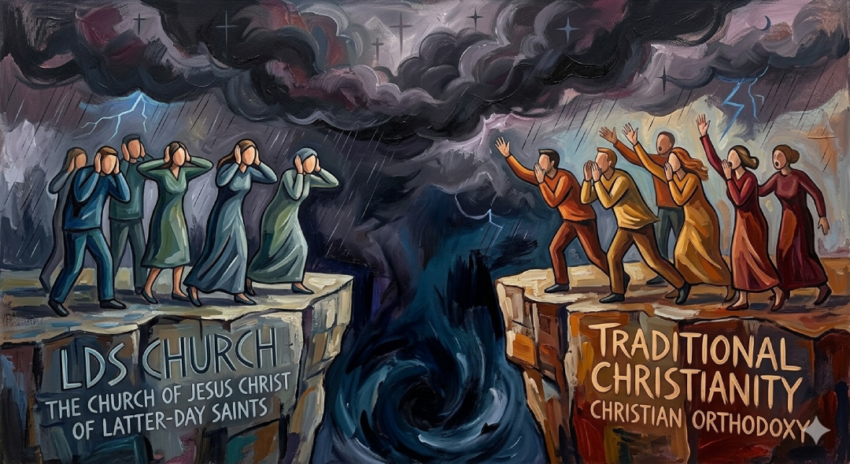
A Comparative Analysis of Method, Authority, and Argument
Introduction: The Same Bible, A Different Book
When a missionary from The Church of Jesus Christ of Latter-day Saints and a Reformed evangelical pastor open the King James Bible to the same page, are they reading the same book? On the surface, the answer is plainly yes — the text is identical, the chapter numbers agree, the words in italics remain words in italics. Beneath the surface, the answer is less clear. Each reader brings to the page a different set of authorities, a different conception of what makes a text reliable, a different account of what happened in the centuries between the apostolic age and the present, and a different method for resolving the moments at which the text seems to resist their tradition. Two readers, one volume, two books.
This essay attempts to map the comparative terrain. It examines how LDS apologetic writers and modern traditional Christian theologians treat the biblical canon, how each group is trained for that work, where each enters and exits the broader conversation of biblical scholarship, and how each handles those uncomfortable moments at which the historical record and the inherited doctrine fail to align. It also examines a question that increasingly preoccupies observers on both sides: whether modern LDS apologetics has begun to drift into linguistic strategies that produce — in the apt phrase coined by critics — a kind of theological word salad, in which familiar Christian vocabulary is used in unfamiliar Mormon senses.
The argument that follows is critical of LDS apologetic method in several important respects, but it tries to be critical in the way that a serious reader is critical: with attention to primary sources, with citations one can verify, and without the easy heat of polemic. Latter-day Saints are, by any honest measure, devoted, hard-working, family-oriented, and morally serious. The faithful Mormon scholar is no different from the faithful Reformed scholar in his desire to honor God with the life of the mind. The disagreements explored below are about method, evidence, and reasoning — not about the sincerity of the men and women who hold the contested positions.
A note on terminology is in order. In the pages that follow, “traditional Christian” means the broad ecumenical tradition that confesses the Nicene-Constantinopolitan Creed of 381 and reads the sixty-six-book Protestant canon — or, in the case of Roman Catholic and Orthodox readers, the wider canons of those communions — as the inspired Word of God. “LDS” refers to The Church of Jesus Christ of Latter-day Saints and the broader body of writers who defend its claims. “Apologetic” is used in its older sense — from the Greek apologia, a reasoned defense of the faith — and not in the modern sense of saying one is sorry.
Historical Origins: Two Streams from a Common Source
Traditional Christian theology, as it exists today across the Catholic, Orthodox, and Protestant communions, is the product of two thousand years of doctrinal refinement under public scrutiny. The Apostolic Fathers — Ignatius, Polycarp, Clement of Rome — wrote within living memory of those who had known the apostles. The Apologists of the second century, Justin Martyr and Irenaeus, chief among them, defended a clearly recognizable Christology against pagan philosophers and Gnostic distortions. The ecumenical councils of the fourth and fifth centuries — Nicaea in 325, Constantinople in 381, Ephesus in 431, Chalcedon in 451 — settled the core questions of who Jesus is and who God is, in formulations that have governed the faith ever since. The Reformation of the sixteenth century did not overturn this trinitarian and Christological consensus; it returned to the Scriptures as the supreme authority for testing every later development, while preserving the creedal core.
Within this long stream, the Westminster Confession of 1646 represents one of the most carefully worded summaries of the historic doctrine of God. It teaches that there is but one God, “infinite in being and perfection, a most pure spirit, invisible, without body, parts, or passions; immutable, immense, eternal, incomprehensible, almighty, most wise, most holy, most free, most absolute.” This is not the private opinion of a particular Puritan committee; it is the codified consensus of the catholic — that is, universal — church across centuries. James Dolezal traces it back to Irenaeus in the second century and forward through Athanasius, the Cappadocian Fathers, Augustine, Aquinas, and the Reformers.
Mormonism arose in a strikingly different historical setting. Joseph Smith was born in 1805 into the religious chaos of upstate New York — the so-called Burned-Over District — at the height of the Second Great Awakening. As one LDS Church source candidly observes, the “unchurched” settlers of western New York were largely cut off from established theological traditions; revivals roiled their communities; competing denominations vied for converts. Smith, by his own account, was bewildered by the proliferation and, at fourteen, retreated to a grove to ask which church he should join. His answer, recorded in the Pearl of Great Price, was that he should join none of them, for they were all corrupt and their creeds an abomination.
The earliest Latter-day Saints came from a society dominated by English-speaking Protestants, most of whom accepted both ex nihilo creation and the Westminster Confession’s definition of God as a being “without body, parts, or passions.” They likely knew little or nothing about the diversity of Christian beliefs in the first centuries after Jesus Christ’s ministry or about early Christian writings on deification. But revelations received by Joseph Smith diverged from the prevailing ideas of the time and taught doctrine that, for some, reopened debates on the nature of God, creation, and humankind.
— Gospel Topics Essay, “Becoming Like God,” The Church of Jesus Christ of Latter-day Saints
That candid admission from the LDS Church itself is revealing on multiple levels. First, it concedes that Joseph Smith’s theological context was a popular Protestantism with limited exposure to patristic scholarship. Second, it frames the early Christian creeds as one option among many. Third, it locates the source of Mormon doctrinal innovation in private revelation rather than in continuity with the ecumenical councils. By 1844, in the King Follett Discourse, Smith would teach that God himself was once a man — an exalted, embodied being who progressed to godhood — and that men in turn might become gods. This is a remarkable departure from the Westminster, the Athanasian, and the Nicene confessions. It is also the foundation upon which all subsequent LDS theology has been built.
Source: https://www.churchofjesuschrist.org/study/manual/gospel-topics-essays/becoming-like-god
Compare: https://en.wikipedia.org/wiki/Mormonism_and_Nicene_Christianity
Two Approaches to the Biblical Canon
Nothing reveals the methodological gulf between LDS and traditional Christian apologetics more clearly than the question of canon. For the historic Protestant Christian, the sixty-six books of the Old and New Testaments are sola Scriptura — the sole, sufficient, infallible written authority for faith and practice. For the Latter-day Saint, the Bible is one of four standard works, the others being the Book of Mormon, the Doctrine and Covenants, and the Pearl of Great Price.
Even the Bible itself does not stand on equal footing within the LDS canon. The eighth Article of Faith — Joseph Smith’s 1842 statement of fundamental beliefs — declares:
We believe the Bible to be the word of God as far as it is translated correctly; we also believe the Book of Mormon to be the word of God.
— Articles of Faith 1:8, Pearl of Great Price
The phrase “as far as it is translated correctly” is doing enormous work in that sentence. In ordinary English, it suggests a modest disclaimer — that the Authorized Version might occasionally render a Greek or Hebrew word inelegantly. In LDS apologetic practice, however, the qualification has functioned as what the historians Leonard Arrington and Davis Bitton described as “a huge loophole.” Whenever a biblical passage appears to contradict an LDS doctrine, the apologist can claim that this particular verse was corrupted in transmission, mistranslated, or stripped of its “plain and precious” meaning by the apostate Christian church before the modern canon was fixed.
The Book of Mormon itself supplies the doctrinal warrant for this loophole. In First Nephi 13, the prophet Nephi describes a vision in which the Bible — a “record of the Jews” that contains “the fulness of the gospel of the Lord” — passes through the hands of “the great and abominable church,” after which “many plain and most precious things” are taken away. The standard LDS interpretation, found in Bruce R. McConkie’s Doctrinal New Testament Commentary and elsewhere, is that the present biblical text is significantly corrupted and that Joseph Smith’s revelations restore the missing material.
The traditional Christian theologian, by contrast, treats the biblical text with the high regard customary in mainstream textual criticism. The Dead Sea Scrolls, discovered between 1947 and 1956 at Qumran, contain Hebrew manuscripts of the Old Testament dating from the third century B.C. through the first century A.D. — that is, from a period before any “great and abominable church” could have tampered with them. The Qumran texts substantially confirm the integrity of the Masoretic Text. As Anthony A. Hutchinson noted in his landmark 1982 study published in Dialogue: A Journal of Mormon Thought:
The discovery of pre-Christian manuscripts of the Hebrew scriptures at Qumran which substantially support the authenticity of the Masoretic text of the Old Testament … seriously impeaches any attempt at applying the Nephi passage to the Old Testament text itself, since Nephi specifically states that the book went forth in purity from the Jews to the gentiles. Since the Qumran texts were written long before the gentile church even existed, and since they basically support the traditional text of the Old Testament, the difficulty with this use of Nephi is obvious.
— Anthony A. Hutchinson, “LDS Approaches to the Holy Bible,” Dialogue, Spring 1982
Source: https://www.dialoguejournal.com/articles/lds-approaches-to-the-holy-bible/
Hutchinson, himself a Latter-day Saint writing in a Mormon journal, was not attacking his own tradition; he was urging it toward greater scholarly honesty. His observation cuts to the heart of the methodological problem. If the present biblical text can be dismissed whenever it conflicts with LDS doctrine, then there is no possibility of being corrected by Scripture — the text is permitted to teach only what the tradition has already decided it must teach.
Religious Training: Hebrew, Greek, and Hermeneutics
A second comparative axis is religious training. The traditional Christian theological tradition, across its Catholic, Orthodox, and Protestant branches, has for centuries required clergy and serious scholars to study the Bible in its original languages, to engage the history of interpretation from the Fathers through the Reformers to the moderns, and to acquire the tools of historical-critical analysis. The typical Master of Divinity program at an accredited evangelical seminary — Westminster, Trinity Evangelical Divinity School, Reformed Theological Seminary, Southern Baptist, Dallas, Fuller, Gordon-Conwell — requires Hebrew, Greek, hermeneutics, systematic theology, church history, biblical theology, and a graduating exegetical thesis. A Reformed pastor preparing a sermon on Romans 9 is expected to consult, at minimum, the Greek text, the patristic and Reformed exegetical tradition, the modern critical commentaries, and the lexicons. The doctoral programs at the Catholic University of America, Notre Dame, Yale Divinity, Princeton, Duke, and their equivalents extend this training to its scholarly limits.
LDS theological training operates on a different model. The Church of Jesus Christ of Latter-day Saints has no professional clergy in the traditional sense, no theological seminary that ordains its bishops, and no formal academic credential required for lay leadership. The general authorities are typically called from careers in business, law, education, and medicine. Brigham Young University maintains a substantial Religious Education college, but its primary mission is the religious formation of LDS undergraduates, not the academic training of theologians for ordained ministry. The Maxwell Institute, formerly FARMS, conducts apologetic and scholarly work, but it does not function as a seminary. The Foundation for Apologetic Information and Research (FAIR), now FAIR Latter-day Saints, is an independent, volunteer-driven organization that produces apologetic content.
This difference in training shows up in the historical record. Hutchinson, surveying twentieth-century LDS biblical commentators, observed that even the most prominent figures of the early Mormon intellectual tradition were operating without biblical-language competence:
Even the “classic” LDS authors of the early twentieth century such as James Talmage or B. H. Roberts were ignorant of the languages of the Bible, and generally unaware of many of the technical reasons underlying the critical approaches of their own day toward the Bible. Their work is primarily apologetic and theological. Likewise, even the major modern writer whom most Saints mention when asked to name an LDS scriptural scholar, Hugh Nibley, has produced very little exegesis of the Bible. Most of his work is in LDS scripture or apologetics.
— Anthony A. Hutchinson, Dialogue, Spring 1982, footnote 7
This is not a polemical claim from an outsider; it is a sober scholarly observation from within the LDS academic community. Nibley, whose erudition in ancient Near Eastern languages was genuine, devoted his energies almost entirely to defending the antiquity of the Book of Mormon and the Book of Abraham rather than to biblical exegesis as the term is understood in mainstream scholarship. Talmage, the author of Jesus the Christ — a book still in use as a missionary primer a century after its publication — relied upon Protestant commentaries for his philological and historical detail. McConkie, whose Mormon Doctrine and Doctrinal New Testament Commentary were among the most influential LDS apologetic works of the twentieth century, was a lawyer by training and used standard Protestant reference works such as J. R. Dummelow’s one-volume commentary.
The point is not that Talmage, Roberts, Nibley, or McConkie were unlearned men — they were not. The point is that the comparative bar of professional theological credentialing is set at a markedly different height in the two traditions. A Reformed Bible commentator without Hebrew and Greek would be a curiosity; an LDS Bible commentator without Hebrew and Greek has historically been the rule.
The Hutchinson Typology: How LDS Writers Engage Scripture
Hutchinson’s 1982 article in Dialogue remains the most useful taxonomy of LDS biblical hermeneutics produced from within the tradition. He divided twentieth-century Mormon commentators into four groups along a spectrum from harmonization to critical analysis. The framework still illuminates the field today.
Group I: The Harmonizing Hermeneutic
The largest cluster includes Joseph Fielding Smith, Bruce R. McConkie, W. Cleon Skousen, Monte S. Nyman, Mark E. Petersen, and similar writers. Their method is to read the Bible through the prism of LDS doctrine and to subordinate the biblical text — when it resists — either to the Joseph Smith Translation (JST), to parallel passages in the Book of Mormon, or to the pronouncements of living prophets. As Hutchinson summarizes, they “subscribe to the propositional model of revelation and stress the absolute authority and inerrancy of God’s word,” but they do not extend this inerrancy to the present biblical text, which they regard as significantly corrupted. The result is what philosopher Edmund Cherbonnier characterized as a willingness to “avail himself of fanciful or bizarre interpretations in defiance of literary or historical context.” Within the LDS community, this approach has enormous pastoral appeal; outside it, the approach largely forecloses dialogue.
Group II: The Critically Modified Corrective Hermeneutic
Closer to the methods of mainstream biblical scholarship are figures like James Talmage and B. H. Roberts early in the century, and later Sidney Sperry, J. Reuben Clark Jr., Robert J. Matthews, Keith Meservy, and Ellis Rasmussen. These writers exhibit some familiarity with biblical languages and modern critical methodology, and they treat textual problems with more care than Group I. They still operate within a corrective framework — when the text and the doctrine conflict, the text typically loses — but they engage the difficulties more honestly. Hutchinson notes that an apologetic tone still pervades their work, sometimes at the expense of credibility, as when Clark insisted on the priority of the Byzantine textual tradition partly because newer critical texts would dissolve traditional LDS proof texts.
Group III: The Critical Hermeneutic with Corrective Tendencies
Hugh Nibley, C. Wilford Griggs, S. Kent Brown, Richard L. Anderson, Thomas W. MacKay, and Benjamin Urrutia represent a third approach. Most of these scholars hold philological or historical training; many engage the historical-critical method seriously. Yet their work tends to be apologetic in orientation, aimed at defending the antiquity of the Book of Mormon, the historicity of Joseph Smith’s translations, or specific LDS doctrines. Hutchinson observed that this group occasionally lapses into harmonizing when doctrinal stakes are involved, and that — for all its scholarly attainments — it has produced “no real biblical commentaries or introductions.” Its primary public function within Mormonism is reassurance: it allows skeptical members to feel that intellectually serious people remain in the fold.
Group IV: The Critical Historical and Philological Hermeneutic
A small minority — Heber Snell, Sterling McMurrin, Lowell Bennion, John Sorenson, Melodie Moench Charles, Richard Sherlock, Michael T. Walton, Edward Ashment, and several younger LDS scholars — engages the biblical text on its own historical and linguistic terms with little or no recourse to LDS loci for textual emendation. This group does the work that mainstream biblical critics would recognize as biblical scholarship proper. It has produced honest, careful, sometimes courageous work. It has also, throughout the twentieth century, brought repeated trouble upon its practitioners. The Snell-Sperry controversy of 1948-49, the dismissal of three modernist BYU professors in 1911, and — more recently — the September Six excommunications of 1993 all involved scholars whose methods fall into this fourth group. The pattern suggests an ecclesial culture that prefers the harmonizing approach as a matter of institutional comfort.
Hutchinson’s evaluation of the harmonizing program is worth quoting in full:
It is unable to cope with technical problems in scripture because it refuses to take them seriously. It is a totally closed system of reasoning with very few points of contact with believers of other faiths apart from the invitation to take the leap of accepting the authority of the LDS interpretive loci. In its feeling of self-satisfaction in having the truth — the whole truth, with no ambiguities to darken its light — it runs the risk of making religion appear irrelevant and unresponsive to the human need to seek beyond the present fulfillment, of recognizing a need for further light and knowledge.
— Anthony A. Hutchinson, Dialogue, Spring 1982
This is, again, a critique offered from within Mormonism by a believing scholar — not the language of an evangelical polemic. Its force is the greater for that.
The “Translated Correctly” Loophole in Practice
A handful of concrete examples show how the eighth Article of Faith functions in apologetic argument. Suppose a traditional Christian opens to John 17:3, where Jesus says, “And this is life eternal, that they might know thee the only true God, and Jesus Christ, whom thou hast sent.” The traditional reader takes this as Christ’s own affirmation of strict monotheism. The LDS apologist, faced with a verse that resists the doctrine of multiple gods taught in the King Follett Discourse, has several options. He may argue that the Greek monos here means something narrower than “only.” He may appeal to context — “only true God” in contradistinction to the false gods of paganism, not to the Son. Or, more characteristically, he may set the verse aside under the rubric of textual or translational corruption.
Or consider Isaiah 43:10: “Before me there was no God formed, neither shall there be after me.” The traditional Christian reads this as God’s solemn declaration that no other gods exist before, alongside, or after him. The LDS doctrine of pre-existent spirits progressing toward exaltation — the “as man is, God once was; as God is, man may become” aphorism attributed to Lorenzo Snow — runs directly into this verse. Joseph Smith resolved the difficulty by relocating the doctrine in time and metaphysics: there is no God of this world before or after the Father, but there are countless gods of countless worlds. The reader who has not absorbed the unstated premise will not see this resolution as the natural reading.
Robert J. Matthews, the most prominent twentieth-century LDS authority on the Joseph Smith Translation, illustrates the methodological consequences. In A Plainer Translation, Matthews concedes that the JST manuscript was a “starting point” and that the prophet often added new material rather than recovering ancient material. Hutchinson observed that Matthews then nonetheless insists that the additions are “blocks of information that were once in the Bible or were directly related to the biblical events.” The premise — that the JST restores rather than expounds — is held to even when the evidence suggests otherwise.
The Qumran problem already mentioned above is decisive on this point. The Old Testament texts in the Dead Sea Scrolls predate any conceivable “great and abominable church” by several centuries, and they substantially confirm the textual tradition that came down to the King James translators. What makes this especially telling is that the very ground yielding those scrolls — the arid soils of the ancient Near East — is the same ground that has produced precisely *nothing* corroborating the historical claims of Mormonism: no inscriptions, no coins, no artifacts, no archaeological footprint of the civilizations the Book of Mormon describes. The earth, in other words, is not silent. It speaks clearly when records exist to be preserved — and the Dead Sea Scrolls prove it. The absence of LDS corroboration from that same reliable ground is therefore not an argument from silence but an argument from a ground already proven to speak.
Whatever else may be said about the corruption thesis, it cannot survive contact with the manuscript evidence as a general claim about Old Testament transmission. The LDS apologist who continues to rely on that thesis is, in effect, holding a position the evidence does not support — and doing so in the shadow of a discovery that exposes the double failure: a biblical text stubbornly intact, and a Book of Mormon history stubbornly invisible.
The Faith Fallback: When Evidence Conflicts with Doctrine
The user of this essay has put the question pointedly: What is the usual fallback position for LDS writers when the facts do not align with doctrine? The empirical answer, drawn from a generation of apologetic literature, is that the fallback is faith — and, more particularly, a distinctive form of subjective religious experience known within the LDS tradition as the “burning in the bosom.”
The doctrinal basis for this epistemology is found in Moroni 10:4-5, where the Book of Mormon’s final author invites readers to ask God whether the book is true: “if ye shall ask with a sincere heart, with real intent, having faith in Christ, he will manifest the truth of it unto you, by the power of the Holy Ghost.” Doctrine and Covenants 9:8-9 develops the same idea: “if it is right, I will cause that your bosom shall burn within you; therefore, you shall feel that it is right.” In practice, this places the final adjudication of historical and theological claims in the realm of private spiritual sensation.
The collision points are well known. Book of Mormon archaeology has not produced the cities, the metallurgy, the horses, the wheeled chariots, or the Old World plants and animals that the text describes in pre-Columbian America. The Book of Mormon assumes a population of millions of Hebrew migrants whose civilization the spades of working archaeologists have not turned up. DNA evidence, accumulating since the early 2000s, indicates that Native American populations descend overwhelmingly from East Asian rather than Semitic stock. The Book of Abraham, whose papyri were recovered in 1967 after being thought lost in the Chicago fire, has been examined by Egyptologists — both Mormon and non-Mormon — and identified as standard funerary texts that bear no resemblance to Joseph Smith’s translation.
When confronted with these difficulties, the typical LDS apologetic response is to deploy several layers of defense in sequence. The first is the limited geography model — proposing that the Book of Mormon describes events in a small region of Mesoamerica rather than the entire hemisphere. The second is the “loose translation” theory — that Joseph Smith rendered the meaning rather than the words of his sources, importing anachronisms unconsciously. The third is the claim that ancient evidence is incomplete and the absence of evidence is not evidence of absence. When all three have been exhausted, the final move is what Wayne Arnett, speaking at a FAIR conference, called the apologetic appeal to spiritual testimony:
Sometimes we don’t have all the answers. Why does it matter? The hidden struggles that sometimes happen with individuals, and sometimes you’ll see a tip of the iceberg but often if they have not received answers to questions it’s been boiling within them.
— Wayne Arnett, “Apologetics 101,” FAIR Conference, August 2006
Source: https://www.fairlatterdaysaints.org/conference_home/2009-2005-fair-conferences/august-2006-fair-conference/apologetics-101
Traditional Christian apologetics is not, of course, indifferent to spiritual experience; the inner witness of the Holy Spirit is a recognized doctrine in Reformed and broader evangelical theology. But the inner witness is understood to attest the truth that the Spirit has already objectively revealed in Scripture, not to override the historical and textual evidence about that Scripture. The discipline of Christian apologetics — from Justin Martyr through Augustine, Aquinas, Pascal, Butler, Paley, Schaeffer, Plantinga, Craig, and Habermas — has self-consciously engaged the empirical record. When archaeological evidence challenged the historicity of the patriarchs in the early twentieth century, evangelical scholars did the digging that has since vindicated the broad outlines of the biblical narrative. When higher critics dated the Pentateuch to the post-exilic period, conservative scholars produced linguistic, archaeological, and source-critical responses. The fallback, in mature traditional Christian apologetics, is not pure subjectivity; it is further evidentiary work.
The Theological Bubble
A recurring observation among ex-LDS apologists and outside scholars alike is that much LDS apologetic writing takes place inside a closed conversation. The participants cite one another’s work, engage one another’s objections, and confine themselves to a limited set of journals and conferences — BYU Studies, FAIR conferences, Interpreter Foundation publications, the Maxwell Institute, Religious Educator. This is not in itself disqualifying; every scholarly community has its journals and its in-group conversations. But the LDS apologetic community is notably reluctant to engage the broader peer-reviewed biblical studies literature on the literature’s own terms, and it tends to treat outsider criticism as inherently hostile.
Hutchinson described the dynamic in 1982:
It is a totally closed system of reasoning with very few points of contact with believers of other faiths apart from the invitation to take the leap of accepting the authority of the LDS interpretive loci. … Its greatest problem is that in its refusal to evaluate evidence on its own merits, it tends toward the worst type of authoritarian irrationality and may lose its credibility to anyone familiar with the technical problems this system refuses to address.
— Anthony A. Hutchinson, Dialogue, Spring 1982
The traditional Christian apologetic community, by contrast, is in continuous dialogue with the wider academic guild. Evangelical biblical scholars publish in the Journal of Biblical Literature, present at the Society of Biblical Literature, and engage their critical colleagues at Harvard, Yale, Tübingen, and Cambridge on the strength of shared linguistic and historical methods. Catholic theologians engage Lutheran, Reformed, and Orthodox interlocutors in formal ecumenical dialogues. The various Christian traditions disagree among themselves — sometimes sharply — but the disagreements take place inside a recognizable common discourse of textual criticism, historical investigation, and creedal reference.
Symptomatic of the LDS bubble is the way Mormon-themed scholarship cycles back to the same small list of insider authorities. Open any FAIR article on a contested doctrine, and one encounters the same names — Nibley, Skousen, Sperry, McConkie, Welch, Peterson, Givens — defending the same claims with appeals to the same sources. The encounter with serious outside biblical scholarship is generally brief, dismissive, or absent. Where it appears, it is often framed as the work of “critics” rather than as the work of working scholars whose conclusions reflect the operation of the same standards a serious LDS scholar would otherwise endorse.
Even the LDS Church’s own “rebranding” effort — which deserves its own treatment below — has been described from outside as a concerted attempt to use Christian theological vocabulary in such a way that LDS distinctives are obscured rather than illuminated. Insiders sometimes notice this. Jeffery Ventrella, writing for TruthXchange, summarizes the dynamic this way:
The Mormons are also leavening the waters of scholarship, seeking to diminish, occlude, or spackle over the perception of its unorthodox theological novelties among broader evangelicalism. And, now, well-established evangelicals, who should know better, are buttering the Mormon manna.
— Dr. Jeffery Ventrella, “Same Words, Different Dictionary,” TruthXchange (April 2025)
Source: https://truthxchange.com/same-words-different-dictionary-mitigating-mormon-mischief/
Continuing Revelation and the Problem of a Consistent Theological Base
Among the most distinctive features of LDS theology is the doctrine of continuing revelation. The ninth Article of Faith declares: “We believe all that God has revealed, all that He does now reveal, and we believe that He will yet reveal many great and important things about the Kingdom of God.” In principle, this commitment to ongoing revelation could be a methodological strength — a humility before the possibility that present understanding is incomplete. In practice, it has created a doctrinal record that any careful historian must concede is unstable.
Consider four major examples.
First, the Adam-God doctrine. Brigham Young taught from at least 1852 that Adam — the first man of Genesis — was, in his exalted state, God the Father; that he had organized the earth and had returned to physically father Jesus by Mary. This was Young’s settled public teaching for decades, defended as revealed truth. The doctrine was renounced by Spencer W. Kimball in 1976 as a “false doctrine.” A revelation taught by one prophet was thus declared a false doctrine by a successor, without a clear methodology for distinguishing future cases.
Second, plural marriage. Joseph Smith taught it privately in the 1840s; Brigham Young codified it as Doctrine and Covenants 132, framing the practice as essential to exaltation. In 1890, under federal pressure, President Wilford Woodruff issued the Manifesto, withdrawing official sanction. In 1904, President Joseph F. Smith issued the Second Manifesto disciplining members who continued the practice. The doctrine survives among the Fundamentalist LDS sects who declined the Manifesto, and it is awkwardly preserved within mainstream LDS theology — still in the Doctrine and Covenants, still bearing on temple sealings for the deceased.
Third, the priesthood ban on Black members. From the mid-nineteenth century until 1978, men of African descent were barred from holding the Aaronic and Melchizedek priesthoods and from receiving temple ordinances. The ban was defended as a matter of revelation by Brigham Young, John Taylor, Wilford Woodruff, Heber J. Grant, George Albert Smith, David O. McKay, Joseph Fielding Smith, Harold B. Lee, and Spencer W. Kimball — until Kimball, in June 1978, announced the revelation lifting the ban. Bruce R. McConkie, who had defended the ban in print, told Latter-day Saints in August 1978, “Forget everything I have said, or what President Brigham Young or President George Q. Cannon or whomsoever has said in days past that is contrary to the present revelation.” The reversal was welcome on its merits; the methodological cost remains.
Fourth, the nature of God. The Lectures on Faith of 1834-35, prepared under Smith’s authority and incorporated into the Doctrine and Covenants in 1835, taught a binitarian view of the Godhead — “two personages,” the Father a personage of spirit, the Son a personage of tabernacle. The 1838 First Vision account introduced the embodied Father as a distinct personage. The King Follett Discourse of 1844 declared that God himself had once been a man. The Lectures on Faith were quietly removed from the Doctrine and Covenants in 1921. The official LDS theology of the Godhead today is the formulation of B. H. Roberts, John A. Widstoe, and James E. Talmage from the early twentieth century — itself a substantial development of, and in some respects a departure from, what Joseph Smith taught in the 1830s.
For the LDS apologist, these reversals can be defended as the legitimate workings of a living prophetic office. For the traditional Christian theologian, they pose a fundamental difficulty: if “revelation” can be revealed and unrevealed across successive administrations, what is the stable ground on which the LDS apologist proposes to stand when arguing with — say — a Reformed Baptist who appeals to a stable canon, an unchanging creed, and a continuous interpretive tradition? The LDS reply — that the prophets are guided by the Spirit and the Church is led only into truth — is itself a claim that requires the kind of evidentiary support the reversal record makes hard to provide.
The Excommunicated Witnesses
A peculiar feature of modern Mormon intellectual life is the influence of writers who have been formally separated from the institutional church. The Church of Jesus Christ of Latter-day Saints has, since the 1980s, exercised church discipline against scholars whose research the institution judged corrosive. Their work has nonetheless continued to shape Mormon thought, often more powerfully after excommunication than before.
The September Six of 1993 are the most prominent example: D. Michael Quinn, Lavina Fielding Anderson, Maxine Hanks, Paul Toscano, Avraham Gileadi, and Lynne Kanavel Whitesides, all disciplined within the same month for various combinations of feminist, historical, and theological writing. Quinn’s Early Mormonism and the Magic World View, with its meticulously documented account of the folk-magical context of Joseph Smith’s early career, remains a standard reference. Fielding Anderson’s “Church and the Abusive Relationship” forced uncomfortable institutional reflection. Toscano’s writings on the divine Mother have been quietly absorbed into the broader LDS theological imagination even as their author remained outside the fold.
Earlier figures had set the pattern. Sterling McMurrin, whose 1965 work The Theological Foundations of the Mormon Religion remains one of the most acute philosophical analyses of LDS thought, was never excommunicated but lived under the cloud of institutional disfavor; his nuanced reading of Mormon theology continues to be read both inside and outside the tradition. Fawn Brodie’s No Man Knows My History (1945), the founding modern biography of Joseph Smith, cost her her standing in the LDS community and made her career at UCLA; the book remains in print and on graduate-level Mormon studies syllabi.
John Dehlin, the host of Mormon Stories, was excommunicated in 2015 for promoting positions the church judged incompatible with membership; his podcast has nonetheless become one of the most widely consumed Mormon-themed media products of the past decade and a primary venue through which Latter-day Saints encounter the historical and theological questions the institutional church has been slower to address.
The husband-and-wife team of Jerald and Sandra Tanner — both ex-LDS evangelicals who founded Utah Lighthouse Ministry in the 1960s — produced an enormous documentary corpus, including the 1500-plus-page Mormonism: Shadow or Reality?, that has functioned for sixty years as the principal repository of LDS historical documents inconvenient to the official narrative. Whatever one makes of the Tanners’ polemical tone, their archival work has been validated repeatedly by later mainstream historians, including those at the Joseph Smith Papers Project.
The recurring pattern is striking. Each generation of LDS thought is, in part, defined by its argument with the writers the institution has expelled or marginalized. This is not a feature of traditional Christian theology in the same way. The mainstream Christian conversation has its critics and its heretics, of course, but its tradition is sturdy enough to absorb critical scholarship without resorting to ecclesial discipline against historians who simply document the record. When the dominant LDS apologetic posture toward its own historians is excommunication, it should not surprise the outside observer that the resulting body of work appears self-protective rather than self-corrective.
The Word Salad Phenomenon: Linguistic Strategy in Modern LDS Apologetics
A final methodological development deserves attention. Beginning around 2018, the LDS Church under President Russell M. Nelson undertook what observers have called a comprehensive rebranding campaign — the deliberate displacement of the terms “Mormon” and “LDS” in favor of “The Church of Jesus Christ of Latter-day Saints” or “the Church of Jesus Christ.” The shift is, on its face, innocuous; an institution has every right to be called by its preferred name. But the broader rhetorical pattern, of which the rebranding is only the most visible element, is something else.
The pattern is the systematic deployment of historic Christian vocabulary — grace, atonement, Trinity, Christ-centered, born again, salvation by grace — in ways that drain those terms of their historic theological content and refill them with Mormon distinctives. The result, in the apt phrase that has gained currency, is theological word salad: a discourse in which the words look familiar but the meanings have been quietly relocated.
Stephen E. Robinson’s 1997 dialogue with the Reformed evangelical Craig Blomberg, How Wide the Divide?, is widely regarded as the inaugural exhibit. Robinson, an LDS scholar with theological training, presented an LDS doctrine of salvation in terms so close to evangelical Reformation language that many evangelical readers came away believing the disagreements had been largely overstated. Mormon scholars who pressed the case further — Grant Underwood’s recent Latter-Day Saint Theology Among Christian Theology, published by Eerdmans in 2025, is the latest installment — have argued that Mormonism deserves to be considered a species within the genus of Christian theology rather than a separate religion. Some evangelical scholars, notably Richard Mouw of Fuller Theological Seminary, have endorsed the project.
Ventrella’s TruthXchange essay registers the objection from the Reformed side:
Did you catch that? Did you see the sleight of hand? This title shifts from a qualitative analysis to a quantitative one. In other words, the reader is nudged by this title to think of the Mormon view as one among many bona fide Christian theologies. Mormon theology, the idea goes, is but a species of the genus, Christian theology. But of course, this begs the question.
— Jeffery Ventrella, TruthXchange, 2025
Concrete examples make the point. Within LDS discourse, “grace” still means the divine enabling power that supplements obedience to LDS ordinances — faith, baptism by an LDS priesthood holder, endowment, celestial marriage, tithing — rather than the unmerited divine favor through which the sinner is justified by faith alone, as the Reformation tradition has taught. “Trinity,” when LDS speakers use it, denotes three distinct beings unified in purpose — a social trinitarianism that in fact resolves into tritheism by every traditional Christian measure. “God” means an exalted embodied man who progressed to godhood, not the simple, immutable, uncreated, eternal Spirit of the Westminster Confession. “Christ” means the spiritual elder brother of Satan and of all human spirits, the literal son of an embodied Heavenly Father, not the eternal second Person of the Trinity whose existence is co-eternal with the Father. Each shared term is a word with two dictionaries.
Michael Flournoy, an ex-LDS apologist writing on Beggar’s Bread, captures the practical effect of this lexical strategy with unusual clarity:
Mormons can win the argument for their deviant form of Christianity, but merely on a technicality. Relying on a textbook definition to be saved is like relying on another driver’s blinker to keep from being hit. It’s the intentions that matter, not whether someone has their blinker on.
— Michael Flournoy, “Apologist v. Apologist: Are Mormons Christian?” Beggar’s Bread (December 2021)
Source: https://beggarsbread.org/2021/12/05/apologist-v-apologist-are-mormons-christian/
Flournoy’s point goes to the heart of the methodological objection. The question is not whether the LDS speaker is sincere or whether the LDS believer loves Jesus; both can be granted without controversy. The question is whether the use of inherited Christian theological vocabulary in deliberately altered senses serves clarity in dialogue or obscures it. Where the underlying definitions differ at the ontological level — what God is, what man is, what salvation accomplishes, what the church does — the use of shared words without shared meanings is not bridge-building. It is word salad.
Reasoning Strengths and Weaknesses: A Balanced Assessment
Honesty requires a balanced ledger. The traditional Christian theological tradition has its own faults — fragmentation across denominational lines, lapses into uncharitable engagement with theological neighbors, the inertia of inherited error, and a recurring tendency to claim more certainty than the evidence warrants. The Reformation’s confessional fractures have not always been healed. Evangelical popular theology often runs on slogans rather than on the deep wells of Augustine, Aquinas, Calvin, Owen, Edwards, Bavinck, Warfield, and Vos. Catholic and Orthodox theology have their own internal disputes and contested histories. None of this is denied.
LDS apologetics has corresponding strengths. The Latter-day Saint community is one of the most demonstrably devoted faith communities in the United States. Its members tithe at high rates, serve missions at high rates, raise stable families, fill leadership callings in their congregations, and produce work that — within its own boundaries — exhibits genuine erudition and pastoral concern. The narrative coherence of the LDS account of history (apostasy, restoration, latter-day kingdom) gives its members a powerful sense of place in the unfolding plan of God. The integration of family, ordinance, and salvation in LDS practice produces a religious life of striking warmth and concreteness. These are not small goods.
Set against these strengths, however, the methodological weaknesses surveyed above are real. The LDS apologetic enterprise depends upon a series of moves that, individually and cumulatively, place an enormous burden upon faith to do the work that evidence is reluctant to do — the corruption of the biblical text, the historicity of the Book of Mormon, the antiquity of the Book of Abraham, the reliability of the prophet’s translation methods, the doctrinal consistency of the prophetic office across reversals. Each of these has been defended ably by intelligent LDS scholars; none has been settled in the way that, say, the consensus on the Trinity was settled by the work of the church across three centuries of public conversation.
The strongest weakness, perhaps, is the closed character of the conversation. A theological tradition that cannot freely acknowledge its problems is a tradition that cannot fully grow. Hutchinson’s plea in 1982 — that LDS biblical scholarship engage the text honestly, on its own terms, without the constant pressure to harmonize toward predetermined doctrinal conclusions — remains today an open invitation. Some LDS scholars have accepted that invitation; many have not. The Latter-day Saint community is poorer for those who have not.
The strongest strength of the traditional Christian apologetic, by contrast, is its embeddedness in a public conversation that has been going on, with full access to the relevant evidence, for two thousand years. The traditional Christian’s confession of the Nicene Creed is not the private opinion of a single nineteenth-century American with a stone in a hat; it is the working consensus of the global church, refined under public scrutiny by some of the most rigorous minds in the history of human thought. To stand in that tradition is to inherit its self-correcting habits as well as its substantive content.
Conclusion: An Invitation to Honest Dialogue
The Latter-day Saint and the traditional Christian theologian, at the end of the day, both stand before the same Bible and the same Jesus. They differ — sometimes profoundly — on who that Jesus is, what that Bible means, and which authorities legitimately interpret it. Those differences are not trivial, and they are not bridgeable by the rhetorical strategies of theological word salad. They will be bridged, if at all, only by the long and demanding work of taking each other’s claims seriously, examining the evidence together, and being willing to be corrected by what one finds.
The Apostle Peter’s first letter contains the locus classicus of Christian apologetic vocation: “Sanctify the Lord God in your hearts: and be ready always to give an answer to every man that asketh you a reason of the hope that is in you with meekness and fear” (1 Peter 3:15). The word translated “answer” is apologia, the reasoned defense from which the discipline takes its name. Peter’s command is binding upon every Christian — including, by every measure of self-identification, both the LDS apologist and the evangelical theologian. The Christian apologist is to be ready to give a reason. The reason must be reasonable. And the giving is to be done with meekness and fear, not with bluster or evasion.
The path forward, for both traditions, is the same path: open the texts, weigh the evidence, listen to the critics, do the hard scholarly work, and pray that the God who is there will lead his people into all truth. For the traditional Christian, the discipline involves continual return to the Scriptures as the final authority above every later tradition. For the Latter-day Saint, the discipline would involve a more honest reckoning with the biblical text, the documentary record of Mormon origins, the inconsistencies in the prophetic office, and the gap between historical Christian doctrine and what Joseph Smith taught in Nauvoo. The Hutchinson essay remains a forty-three-year-old standing invitation to that reckoning. It has not been declined; it has not yet been fully accepted.
If this comparative analysis serves any purpose, it is to make the terms of that invitation clearer to both parties. Latter-day Saints deserve traditional Christian neighbors who will engage them with honesty, fairness, and serious theological respect — not with caricatures and clichés. Traditional Christians, in turn, deserve LDS interlocutors who will engage them with the same honesty, who will resist the temptation to redefine the historic vocabulary out of recognition, and who will reason from public evidence rather than from authoritative claims their interlocutors cannot share. Both deserve the apologetics that meekness and fear before the God of truth would produce.
That is the conversation worth having. Anything less is two parties shouting past each other across a chasm of meanings, each convinced the other is missing the obvious, neither doing the work of meeting in the open field where evidence and reason can be examined together. The chasm is real, but it is not unbridgeable. The first plank is honesty about what the chasm is.
✦ ✦ ✦
Primary Resources:
• https://www.quora.com/Who-were-the-greatest-LDS-intellectuals-whose-faith-influenced-their-works
• https://www.dialoguejournal.com/articles/lds-approaches-to-the-holy-bible/
• https://en.wikipedia.org/wiki/Articles_of_Faith_(Latter_Day_Saints)
• https://en.wikipedia.org/wiki/List_of_Mormon_studies_scholars
• https://christianity.stackexchange.com/questions/78315/what-are-the-sources-of-lds-theology-that-an-lds-theologian-need-to-consult-to-w
• https://www.wayfaremagazine.org/p/the-theological-turn-in-book-of-mormon
• https://en.wikipedia.org/wiki/Mormon_fiction
• https://en.wikipedia.org/wiki/Mormonism_and_Nicene_Christianity
• https://www.namb.net/apologetics/resource/comparison-chart-mormonism-and-christianity/
• https://www.thegospelcoalition.org/article/stories-mormonism-christianity/
• https://rsc.byu.edu/latter-day-saint-essentials/lds-doctrine-compared-other-christian-doctrines
• https://www.fairlatterdaysaints.org/conference_home/2009-2005-fair-conferences/august-2006-fair-conference/apologetics-101
• https://beggarsbread.org/2021/12/05/apologist-v-apologist-are-mormons-christian/
• https://archive.timesandseasons.org/2017/09/review-of-perspectives-on-mormon-theology-apologetics/index.html
• https://www.fairlatterdaysaints.org/answers/Mormonism_and_apologetics
• https://byustudies.byu.edu/article/open-and-relational-theology-an-evangelical-in-dialogue-with-a-latter-day-saint
• https://truthxchange.com/same-words-different-dictionary-mitigating-mormon-mischief/
• https://theparticularbaptist.net/2022/05/06/mormonism-and-the-denial-of-classical-theism/
• https://2understandlatterdaysaints.com/documents/Scholarly/apologetics.pdf
• https://www.biblicalauthorityministries.org/2026/05/the-doctrine-of-biblical-apologetics.html
• https://christianpublishinghouse.co/2023/06/21/christian-apologetics-a-look-at-mormonism-mormons-or-latter-day-saints/
• https://catalog.byu.edu/colleges/religious-education
• https://lds365.com/2017/09/01/lds-gospel-learning-resources-for-doctrinal-historical-and-social-questions/
• https://www.reddit.com/r/exmormon/comments/utl4j5/so_why_does_mormon_leadership_not_have_formal/
• https://www.thegospelcoalition.org/essay/theological-method/
• https://en.wikipedia.org/wiki/Theology
A Note on Research Methods and Accuracy
In recent years, some have voiced concern that artificial intelligence may distort facts or introduce inaccuracies into serious research. That criticism deserves acknowledgment. However, AI has now evolved into the most powerful research instrument available to any dedicated scholar—capable of analyzing vast datasets, cross‑referencing historical records, and surfacing overlooked connections across sources. This work represents a collaboration between the author’s investigative inquiry, verified primary documentation, and the advanced analytic capabilities of AI research tools. Here, AI was not used as a ghostwriter or a shortcut for scholarship, but as a disciplined research partner devoted to rigor, accuracy, and transparency.
Every factual claim in this work has been subjected to active verification. Where AI‑generated content was used as a starting point, it was tested against primary sources, peer‑reviewed scholarship, official institutional documentation, and established historical records. Where discrepancies were found—and they were found—corrections were made. The author has made every reasonable effort to ensure that quotations are accurately attributed, historical details are precisely rendered, and theological claims fairly represent the positions they describe or critique.
That said, no work of this scope is immune to error, and the author has no interest in perpetuating inaccuracies in the service of an argument. If you are a reader—whether sympathetic, skeptical, or hostile to the conclusions drawn here—and you identify a factual error, a misattributed source, a misrepresented teaching, or a claim that cannot be substantiated, you are warmly and genuinely invited to say so. Reach out. The goal of this work is not to win a debate but to get the history right. Corrections offered in good faith will be received in the same spirit, and verified corrections will be incorporated into future editions without hesitation.
Truth, after all, has nothing to fear from scrutiny—and neither does this work.