
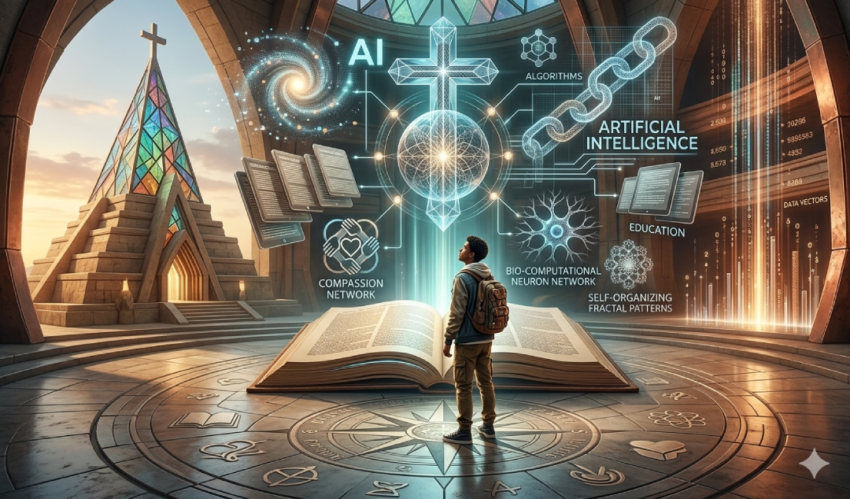
AI, the Soul, and the Christian Imagination
I. The Hour at Which We Stand
In late February 2026, the Barna Group, working in partnership with the technology firm Gloo, published a finding that should arrest the attention of every Christian leader in the English-speaking world. Drawn from a survey of more than fifteen hundred American adults, the data showed that roughly thirty percent of U.S. adults now “somewhat” or “strongly” agree that spiritual advice from artificial intelligence is “as trustworthy as advice from a pastor.” Among Millennials and Generation Z, that figure rises to forty percent. Among practicing Christians, a third agreed. Four in ten Christians said AI had already helped them with prayer, Bible study, or spiritual growth. The same survey discovered that while a third of practicing Christians wished their pastors would teach them how to navigate this technology, only twelve percent of pastors said they felt comfortable doing so.
Three months had not passed before another datum arrived from across the Atlantic. On May 25, 2026, the Holy See published Pope Leo XIV’s first encyclical, Magnifica Humanitas — a sweeping pastoral reflection on artificial intelligence that the Catholic Church framed not as a technical curiosity but as a “spiritual and civilizational test that forces us to face what it means to be human.” Within days, the editors of Christianity Today were urging Protestants to take the encyclical seriously. Within weeks, a Vatican-affiliated university was convening a five-day exorcism training course advertising a curriculum calibrated to combat “AI-fueled Satanism.” Within two months, the editors of Christian Standard had issued a seven-question framework for ecclesial discernment, and Pope Leo had personally received a delegation from the International Association of Exorcists who came to report what they described as a global rise in “occultism, esotericism, and Satanism,” they believed AI was helping to fuel.
The signal is unmistakable: artificial intelligence has crossed from the precincts of Silicon Valley into the sanctuary. The signal is also confused. The American Christian community in 2026 contains, sometimes within a single congregation, the pastor who drafts his sermon outline by prompting ChatGPT, the parishioner who consults that same chatbot for spiritual counsel after the service has ended, the elder who suspects the technology of literal demonic possession, the missionary whose Bible translation has been accelerated from twenty-three years to four by AI-assisted drafting, and the brother who refuses to touch any AI tool whatsoever as a matter of conscience. Each is acting in good faith. Each is appealing to Scripture. None can quite hear the others above the noise.
About a third of practicing Christians somewhat or strongly agreed that AI advice is just as trustworthy as advice from a pastor… Though the majority of practicing Christians remain the most cautious about embracing AI as a spiritual tool, their views are shifting and remain largely uninformed by their pastor. There’s a real opportunity here for pastors to disciple their congregants on how to use this technology in a beneficial way.
— Daniel Copeland, Vice President of Research, Barna Group (The Christian Post, February 26, 2026)
This essay seeks to clear some of that noise. Its working assumption is the one that has steadied the church through every prior technological earthquake: that the gospel is not threatened by the medium, that the Lord remains sovereign over the works of human hands, and that fidelity to Christ requires neither panicked refusal nor uncritical embrace but the slow, patient labor of discernment. We will survey the landscape of Christian reactions; describe with appropriate technical care what artificial intelligence actually is and is not; weigh the legitimate cautions that have emerged across orthodox traditions; consider the case study of AI-assisted Bible translation, where the technology is already reshaping the Great Commission; address the central pastoral question of whether a chatbot can replace a shepherd; and, finally, examine the fringe of Christian opinion that has identified AI as a vehicle of demonic activity, to weigh those claims against Scripture and reason. The essay closes with a set of reasonable rules of life that congregations and individual believers may adapt to their own settings.
Throughout, the conviction guiding this analysis is one that the Apostle Peter pressed upon his readers in 1 Peter 3:15: that we should “always be prepared to give an answer to everyone who asks you to give the reason for the hope that you have,” and that we should do so “with gentleness and respect.” The conversation about AI in the church demands no less.
✦ ✦ ✦
II. The Landscape of Christian Reactions
The first task is to draw the map. Christian opinion on artificial intelligence in 2026 has settled, roughly, into five overlapping camps. Plotting them is essential because almost every dispute now playing out in pulpits, podcasts, and church boards is, at root, a clash between two of these camps speaking past each other.
The Enthusiasts
The first camp regards AI as the next great providential medium of the Great Commission. Its representatives are people like the team at Life.Church, the Apologist Project, the developers behind YouVersion’s AI features, and the entire ecosystem of organizations represented at the National Religious Broadcasters convention, where the Barna data was first released. Their argument is historical and providential: every prior medium of communication — the Roman road, parchment, the Gutenberg press, radio, television, the internet, social media — was initially greeted with suspicion by Christians who feared it would dilute or corrupt the gospel, and every one of those media was eventually domesticated by the church and put to use in the proclamation of Christ. As Ted Hallum and Jake Carlson have argued in a careful paper for the Apologist Project, the church’s historical hesitation in adopting new technology has, on balance, cost it years of evangelistic opportunity that it can ill afford to lose again.
It would be inconsistent to apply a higher standard to AI than we do to other human tools, institutions, or teachers. God and His unchanging Word alone are infallible. As with any tool, AI carries inherent risks that must be approached with wisdom, prayer, and discernment. Yet, God’s sovereignty extends over all creation, including technological advancements, giving Christians confidence to explore its use responsibly.
— Ted Hallum and Jake Carlson, “Generative AI in Christian Evangelism,” The Apologist Project, February 23, 2025
The Cautious Adopters
The second camp accepts AI as a tool while insisting that the tool is also a teacher. Its leading voices include Samuel James at Desiring God, the editors at Christian Standard, Joseph Waruiru at The Gospel Coalition Africa, the team at the National Association of Evangelicals, and the writers at the Center for Bioethics and Human Dignity. Their argument is not anti-technology but anti-naïve. They concede that AI may be used wisely; they insist that we have not yet learned to wield it wisely; and they argue that whatever the technology can do for us, it is also doing something to us.
Joseph Waruiru has written one of the clearest summaries of this position. Tools, he argues, become habits, and habits shape hearts. “Formation,” he writes, “rarely announces itself. It happens through repetition, through what we turn to first, and through what we rely on when we are tired, anxious, or searching for meaning.” If a Christian habitually asks an AI before he asks the Lord, the practice will, in time, malform the soul, even if no doctrinally erroneous information ever crosses the screen.
The deeper question is not whether AI is useful, but how it is forming us, especially in our relationship with God and with one another… The critical question for the church is not, “Can we use AI?” but “Where has AI replaced struggle, waiting, or dependence on God and his people?”
— Joseph Waruiru, “How Artificial Intelligence Is Shaping the Christian and Church Life,” TGC Africa, February 10, 2026
The Refusers
A third camp — small but vocal — believes the proper Christian response is total abstention. This is the position of certain Reformed and Anabaptist subcultures, of various traditionalist Catholic commentators, and of several evangelical writers who hold that AI represents not merely a risky tool but an idolatrous medium per se. Their concern is partly theological — they view large language models as a kind of Tower of Babel project, a human reach for omniscience — and partly cultural, in that they see in AI another stage in what Neil Postman, four decades ago in Amusing Ourselves to Death, called the surrender of higher reasoning to a passive medium. Patricia Engler of Answers in Genesis develops a version of this argument that stops short of total refusal but warns against trivialization, the slow atrophy of the God-given capacities for thought, prayer, and conversation that occurs when the soul outsources its most distinctive labors to a machine.
The Alarmists
A fourth camp regards artificial intelligence with apocalyptic seriousness, seeing in it not merely a danger but a vehicle of literal spiritual evil. This is the position of certain Pentecostal and charismatic teachers, of the Catholic priest Fortunato Di Noto and his Italian colleagues, and of evangelical commentators such as Billy Hallowell, whose 2020 book Playing With Fire examined modern cases of possession and exorcism, and who now warns that large language models may become tools of the demonic realm. The Lutheran theologian Ted Peters, in his 2024 essay “Can AI Become Demon-Possessed?”, arrived at a more measured conclusion — that literal possession is unlikely — but he allowed that AI can act “demonically” if it manipulates or harms human beings. In late 2025 and early 2026, these voices coalesced around the exorcism training course at the Ateneo Pontificio Regina Apostolorum in Rome, which advertised a special emphasis on AI-fueled Satanism. Pope Leo XIV himself, just months later, received a delegation from the International Association of Exorcists who reported a global rise in occultism that they connected to the new technology.
The Pragmatic Mainstream
The fifth and largest camp consists of the ordinary Christians who are quietly figuring it out by trial and error. They use ChatGPT to draft an email, then feel a vague unease when their teenager asks the same chatbot what God thinks of his anxiety. They appreciate that their pastor’s sermon prep moves a little faster with AI assistance, and they hope but cannot verify that the assistance has not crowded out his prayer. They worry less about AI possession than about AI mediocrity — the suspicion that the messages they hear, the prayers they pray along with, and the apologetic content they share on social media will become, gradually, indistinguishable from the slurry of synthetic confidence the rest of the world is also consuming. These Christians have no theological framework yet. They are waiting for their pastors to give them one. And, as Barna reports, eighty-eight percent of those pastors are not yet ready to do so.
✦ ✦ ✦
III. What Artificial Intelligence Actually Is — and Is Not
A faithful evaluation requires a faithful description. The current generation of consumer AI tools — ChatGPT, Claude, Gemini, Copilot, Grok, and the agentic systems built on top of them — are nearly all instances of what computer scientists call large language models, or LLMs. They are constructed by training enormous statistical systems on vast quantities of text scraped from the internet and from licensed corpora. The training process tunes billions of internal parameters so that, given any sequence of words, the model can predict the most probable next word. Repeated billions of times, this word-by-word prediction yields what looks, to a human reader, like fluent reasoning, conversation, and argument.
Ted Hallum and Jake Carlson describe these systems with refreshing accuracy:
Even the so-called “thinking” or “reasoning” LLMs — like OpenAI’s “o1” or DeepSeek’s “R1” — are ultimately data-driven at their core. They still just mimic patterns learned from large training sets, which were originally derived from human sources, rather than genuinely understanding or reasoning as humans do… Their impressive employment of statistical probability and matrix mathematics on a massive scale can obscure the reality that they lack consciousness, moral awareness, and the God-given spiritual capacity inherent in the Imago Dei.
— Hallum and Carlson, The Apologist Project
The Catholic philosopher Dhananjay Jagannathan, drawing on Saint Thomas Aquinas’s Treatise on the Angels, offers what is perhaps the most luminous philosophical description in the current literature. The temptation, Jagannathan observes, is to imagine that LLMs resemble angelic intelligence — an all-at-once, complete grasp of reality that exceeds the slow, discursive reasoning of human beings. But this is precisely backward. Aquinas himself, in a passage that startled Jagannathan’s undergraduate seminar at Columbia, argued that angels do not really speak to human beings: when Scripture describes the angel Gabriel saying “Do not be afraid” to the Virgin Mary, what is actually happening is that the angel is simulating speech-sounds so that a human being can grasp something that is, in itself, purely intelligible. Angels engage, in other words, in just the kind of simulacrum of discursive thinking that LLM output appears to exemplify. The model produces words, but it does not understand them. The output resembles thought; it is not thought.
On the side of the intellect, such so-called “AI” is capable neither of discursive thought nor of understanding, since it does not aim to grasp the world at all. Rather, it merely synthesizes our representations. Just as an echo in a cave is not the speech of rocks, the deliverances of LLMs are only simulacra of language — and the thought that ultimately lies behind it.
— Dhananjay Jagannathan, “On Angels, Demons, and Artificial Intelligence,” Public Discourse, January 20, 2025
This is not a merely academic point. The Christian who keeps it in view will be inoculated against the two opposite errors that mark the current conversation. He will not be tempted to attribute soul, spirit, or will to the machine, as the techno-enthusiasts of Silicon Valley often do; nor will he be tempted to credit the machine with the kind of personal malevolence that the alarmist camp ascribes to it. The LLM does not have purposes. It has weights. It does not believe what it says. It has no capacity to believe anything. It does not lie when it errs — it confabulates, a term that Hallum and Carlson borrow from neuropsychology and that Patricia Engler at Answers in Genesis adopts in her work. The model, when it lacks information, does not pause to acknowledge ignorance. It generates a plausible-sounding answer because that is what the mathematics of next-word prediction requires it to do.
Why “Confabulation” Matters Theologically
This single technical fact bears enormous weight in the theological evaluation. A pastor who consults an AI for a sermon illustration may receive a perfectly plausible attribution of a quotation to C. S. Lewis that Lewis never wrote. A grieving widow who asks a chatbot for a passage of Scripture that “comforts those who have lost a spouse” may be served a verse that is rendered in confident King James English but does not appear in any actual Bible. A counselee in spiritual distress may be answered with a synthetic blend of psychological and spiritual platitudes that, taken sentence by sentence, sound orthodox enough but, taken together, gently steer the soul away from repentance, the Cross, and the local church.
Only God is all-knowing, infallible, and the ultimate Truth. His Word, not the outputs of AI, must be our final authority.
— Patricia Engler, “The Effects of Artificial Intelligence,” Answers in Genesis, March 22, 2025
The Christian doctrine of inerrancy applies, by definition, to Scripture alone. The Lord has not promised inerrancy to commentaries, study Bibles, sermon outlines, or — least of all — to neural networks trained on Reddit and the open web. This is not a counsel of despair; it is a counsel of order. The Bereans were commended in Acts 17 because they examined the Scriptures daily to see whether what they heard was true. That habit, as the editors of Christian Standard observe, “is more necessary, not less, in an age of synthetic confidence.”
✦ ✦ ✦
IV. The Legitimate Cautions — A Distillation
Out of the welter of Christian responses to AI, a remarkably consistent set of cautions has emerged across denominational and ecclesial lines. The Catholic encyclical of Pope Leo XIV, the evangelical framework of Christian Standard, the Reformed analysis of Samuel James at Desiring God, the African evangelical formation theology of Joseph Waruiru, the bioethics work of the Center for Bioethics and Human Dignity, the technical engagement of the Apologist Project, the cautious skepticism of Patricia Engler at Answers in Genesis, and even the magisterial cautions of the Church of Jesus Christ of Latter-day Saints all converge on substantially the same five concerns. These five deserve articulation.
1. The Replacement of Formation with Information
The first and deepest concern is theological. Christian formation is, by its nature, slow. It is the work of the Holy Spirit applied through Scripture, prayer, community, sacrament, and obedient repetition over the years. AI offers something fundamentally different: information, available instantly, in unlimited quantity, with no requirement of waiting, struggle, or dependence. The danger is not that the information is bad; the danger is that the soul accustomed to instant retrieval will lose the capacity for the slow disciplines that constitute discipleship.
Samuel James, in his diagnostic essay “How Is AI Shaping You?” at Desiring God, frames the issue in terms of what we attribute to the tool. “From a biblical perspective,” he writes, “attributing human traits to something that isn’t human is a symptom of idolatry.” The Christian Standard editors put it more bluntly: “The Word became flesh, not a downloadable resource. Churches should ask whether AI is helping ministry remain more human or making it feel less human.”
2. The Erosion of Truthfulness
The second concern follows from the technical reality of confabulation. The age of generative AI is also the age of the deepfake video, the synthetic testimony, the imitated voice, the AI-generated “Bible study guide” that drifts subtly off orthodox lines. The Christian Standard framework rightly insists that any AI-generated material — sermon illustration, historical claim, quoted statistic, pastoral letter — must be verified before use, and that the church’s credibility is worth more than the convenience the technology offers.
Truthfulness also requires transparency. There is no need to disclose every minor use of AI; a sermon need not begin with a list of which paragraphs were drafted with computational assistance. But if AI is being used in a way that could reasonably affect trust — generating a pastoral letter, creating a testimony-style video, imitating a known voice, producing what purports to be original teaching material — leaders have a moral obligation to disclose. The Eighth Commandment, against false witness, has not been repealed by the machine.
3. The Pastoral Office Cannot Be Outsourced
The third concern is ecclesial. The biblical office of pastor-teacher (Ephesians 4:11), elder, and shepherd entails functions that no algorithm can fulfill. A chatbot can supply information; it cannot visit a hospital bedside. It can summarize a commentary; it cannot weep with those who weep. It can quote a passage; it cannot administer the Lord’s Table. It can imitate counsel; it cannot bear another’s burden. This argument has been made with particular force in the Black church context by Rev. Thomas Rich, who notes that words typed into a computer communicate only what the user asks the machine to produce, whereas human pastors listen for far more than words: they read body language, tone, emotion, and silence. The same point is pressed in a different idiom by Pastor Ray Miller of First Baptist Church in Abilene, who has warned that AI risks becoming “another type of idol pulling at our attention.”
Often, people turn to AI because they do not have another human being or pastor or priest to turn to, and it becomes convenient. With discernment and care, I believe we can develop some best practices when it comes to AI usage for churches and use for faith in general… We are living in the midst of a technological revolution unseen in human history since the advent of the printing press… As we begin to sift through what AI will do to us as humans, the Church will have to help answer the question: what does it mean to be human, to be made in God’s image in an age of digital AI?
— Pastor Ray Miller, First Baptist Church, Abilene, Texas (The Christian Post, February 26, 2026)
4. Privacy, Surveillance, and the Pastoral Confessional
A fourth concern, less often articulated but no less serious, is the privacy and security dimension. Christians, perhaps more than many users, are tempted to disclose to a chatbot what they would never disclose to a human stranger. They confess sins, describe family conflicts, ventilate doubts and fears, and ask for spiritual counsel — and all of it is being logged, in most consumer products, on servers controlled by corporations that owe the user no pastoral confidentiality. The Apologist Project, in its detailed treatment of the question, urges that any Christian-facing AI tool must encrypt user data both in transit and at rest, must minimize collection of personally identifiable information, and must observe a kind of digital confessional discipline that mirrors what a wise pastor would observe.
The wider surveillance concerns raised by Engler at Answers in Genesis — facial recognition, social credit systems, the AI-enabled monitoring of citizens — lie somewhat beyond the scope of a pastoral essay, but they should not be dismissed. The same machine that drafts a Bible study can, in different hands and under different jurisdictions, be turned against believers in lands where the gospel is illegal. The technology is morally neutral; the systems that deploy it are not.
5. The Idolatry of Knowledge
The deepest concern, raised in different forms by virtually every careful Christian writer on the topic, is theological in the strict sense. The first temptation in the Garden — “ye shall be as gods, knowing good and evil” (Genesis 3:5, KJV) — was a temptation to a kind of knowledge that bypassed dependence on the Creator. The Tower of Babel was, among other things, an attempt to construct a technological substitute for divine ascent. The pattern is ancient. AI, considered as a cultural artifact rather than a mere tool, presents the same temptation in modern dress: the promise of immediate, unmediated, omniscient access to all knowledge, available without prayer, without obedience, without church, without humility.
Patricia Engler has named the deepest version of this concern: “Humanity’s gravest mistake regarding AI would lie not in making machines that could overpower us on earth but in seizing machines as idols to the destruction of our souls.” Joseph Waruiru notes the analogous point: AI now offers what once only the gods of paganism offered — the appearance of an ever-present intelligence with answers to life’s deepest questions. The Christian response is not paranoia about the technology but a renewed commitment to the One whom no algorithm can imitate: the Triune God, who is not merely intelligent but holy, not merely available but personal, not merely informative but loving, and not merely a source of answers but the very Way, the Truth, and the Life (John 14:6).
✦ ✦ ✦
V. A Case Study in Faithful Use: AI and Bible Translation
No serious essay on AI and the Christian life can omit the field where the technology is now reshaping the Great Commission with a swiftness that, only five years ago, the most optimistic missiologist would have called impossible. The case study is Bible translation. The numbers are arresting. According to recent reporting from the Wycliffe Global Alliance, the Seed Company, and the missiology team at the Gospel Coalition, AI-assisted drafting has compressed what was a twenty-three-year, million-dollar translation timeline into a four-year, half-million-dollar workflow for some target languages. Approximately 3,700 languages still lack any portion of Scripture; about 541 communities are still waiting for translation to begin. With AI assistance, the long-standing Vision 2025 goal — to have a translation in progress in every language that needs one — has come closer than at any time in the history of the church.
What AI Actually Does in a Translation
Misconceptions on this topic are universal. Don Barger, director of innovation at the International Mission Board, has produced one of the clearest published descriptions:
We’re not talking about dropping the Greek New Testament text into a tool like ChatGPT or Google Translate and expecting it to output a polished translation in any language… One way [AI contributes] is by leveraging AI models, trained on portions of Scripture already manually translated by humans, to provide a first draft of a full translation. That draft can then be used by translators to complete a final translation… Concerns about AI being turned loose to translate with little or no human interaction aren’t based on reality.
— Don Barger, “How AI Assists in Global Bible Translation,” The Gospel Coalition, February 26, 2024
Organizations like Avodah have built models in which mother-tongue speakers first translate roughly 1,200 verses across diverse biblical genres, grammar, and vocabulary. Those carefully translated passages then train an AI model, which produces an entire draft of the rest of the Bible. The draft — what Wycliffe’s Scripture Forge team calls “draft zero” — is then checked, refined, corrected, and culturally tested by the same mother-tongue speakers and consulting linguists who would have done the work the old-fashioned way. The Holy Spirit’s role is not replaced; the team’s spiritual dependence is not displaced; the church’s involvement is not abridged. What is compressed is the time between draft zero and the finished text.
SIL International, Wycliffe, the Seed Company, and the IllumiNations alliance have likewise developed AI tools for quality assurance — tools that help consultants identify errors more thoroughly and consistently than was previously possible. As the missiologist who has worked among unreached peoples told the Gospel Coalition team, “Whether most of the church understands this yet or not, AI-assisted Bible translations are a global priority.”
Bible translation is not about the technology; it’s about the human.
— Shawn Ring, CEO of Avodah (cited in The Gospel Coalition)
A Theological Note on Translation
A small but theologically significant detail deserves notice. Meta and other large AI companies have committed to building text-to-speech models in more than four thousand languages, most of which have very few digital resources. The one book often available in those languages is the Bible. Translation organizations have produced text and audio Scripture in over 1,100 languages. Companies like Meta rely on these resources to train their large language models. In a development that would have astonished the saints of any prior century, the church’s long labor of Bible translation is now training the very large language models that will, in turn, accelerate further Bible translation. The Lord, who promised that His Word would not return void (Isaiah 55:11), is making His Word the seed of the very tools that will spread it further.
What This Case Study Teaches
The Bible translation case is instructive for the wider conversation in three ways. First, it demonstrates that AI need not displace human judgment; in the most spiritually serious application of the technology now underway, AI is functioning precisely as a copilot, with human translators retaining final authority over every exegetical and theological decision. Second, it demonstrates that the danger is not the technology itself but the temptation to misuse it: a translation team that bypassed mother-tongue speakers and community testing in favor of pure AI output would be doing something genuinely irresponsible, and the field has, to its credit, refused to do this. Third, it offers a paradigm for what faithful AI integration looks like in every other ministry context: AI as the assistant that accelerates the human-Spirit-led work, never as the substitute that displaces it.
✦ ✦ ✦
VI. The Central Pastoral Question: Can a Chatbot Replace a Shepherd?
We come now to the central question that animates the popular conversation. When a third of practicing Christians say they trust AI as much as a pastor for spiritual advice, what exactly is being claimed, and what is being lost?
Joseph Williams, writing for Word in Black on the implications of the Barna data for the Black church, captured what is at stake with unusual clarity. The Black church, he notes, has served for generations as more than a place of worship: it has been “a political headquarters, counseling center, social service agency, and foundation for civil rights organizing and community gathering.” Black congregations were early adopters of digital ministry, livestreaming worship services and hosting online Bible studies. But, Williams writes, “unlike livestreaming or social media, artificial intelligence replicates parts of the ministry. That raises concerns for many Black Christians, whose faith traditions emphasize testimony, personal relationships, discernment, and community accountability.”
I think it depends on what you are looking for. If you just want information, sometimes AI may be more informed than some pastors. But if you are looking for personal guidance, nothing can take the place of a godly man or woman who hears from God and knows you as a person.
— Rev. Ronald Covington, Executive Pastor, The Hill (Jessup, Maryland)
Covington’s distinction between information and guidance is precise and pastorally crucial. AI is, in the proper restricted sense, an information system. The pastor is a person — a baptized, ordained, Spirit-filled image-bearer of God whose office is not the transmission of data but the cure of souls. The Latin phrase cura animarum, used since the early Middle Ages, describes a vocation that has always involved at least four irreducibly human elements:
-
Presence. The pastor sits with the dying, attends the funeral, visits the prison, and stands at the hospital bedside. No chatbot, however sophisticated, can be present in this sense. “Words typed into a computer communicate what you want AI to spit out to you,” as Rev. Thomas Rich observed; “human pastors, however, listen for far more than words. They read body language, tone, emotion, and silence.”
-
Discernment. The pastor weighs the soul before him not as a problem to be solved but as a person to be loved. He notices what is unsaid; he distinguishes between sin and weakness; he knows when to comfort and when to confront. The Apostle Paul’s pastoral letters, especially to Timothy and Titus, assume throughout that the office requires the gift of discernment of spirits — a gift expressly attributed in 1 Corinthians 12 to the Holy Spirit working through persons.
-
Accountability. The pastor stands within a covenanted community: he is ordained, examined, accountable to elders, fellow ministers, and his flock. He may be removed if he errs. He confesses his own sins. He prays publicly and privately for those he serves. An AI has no covenants. It cannot be excommunicated. It bears no responsibility for the outcomes of its counsel.
-
Sacramental Mediation. In every orthodox tradition — Catholic, Orthodox, magisterial Protestant, evangelical — the ordained office stands at the meeting point of word and sacrament. The pastor baptizes, presides at the Lord’s Table, and prays the prayer of consecration. These acts are not data services. They are means of grace.
When the survey respondent says that AI is “as trustworthy as advice from a pastor,” she is, therefore, almost certainly not making the claim that the algorithm replaces the office. She is making the much narrower (and more telling) claim that for the kind of question she is asking — typically a question about information, ethics, or interpretation — AI seems to her as accurate as the human alternatives available to her. This is a judgment about competence, not about office. But it is also a judgment that ought to alarm the pastors who hear it, because it suggests that for the kinds of questions a great many laypeople are actually bringing to the pastoral conversation, the church’s teaching infrastructure has not been keeping pace.
We’re looking for quick answers to solve complex problems. AI is a great tool when used ethically, but you can never replace the value in human interaction, especially in regard to crucial advice. The Holy Spirit is supposed to guide us into all truth. AI is still a machine that can be trained to give advice, but it’s not a vehicle used by the Holy Spirit.
— Meisha Dawson, minister-in-training (Word in Black, June 3, 2026)
Pope Leo XIV and the “Ethical Criterion”
No discussion of pastoral authority in the AI age can fail to engage the most consequential ecclesial statement to date: Pope Leo XIV’s encyclical Magnifica Humanitas, published May 25, 2026. Whatever one’s confessional position regarding the Roman bishop, the Protestant reader should take the document seriously, both for the weight of its argument and for the unusual sympathy it has elicited from evangelical observers. In a Christianity Today essay published days after the encyclical’s release, Russell Moore’s successors at that magazine called Leo’s message one “all Christians should listen to,” noting that the encyclical sets out a Christian humanism that resists both technological utopianism and reactionary refusal.
Leo’s central claim is that AI represents not merely an economic or technological event but a “spiritual and civilizational test.” Drawing on the biblical contrast between the Tower of Babel and the rebuilding of Jerusalem under Nehemiah, he describes two paths technology may take: toward domination, homogenization, and dehumanization, or toward communion, solidarity, and rehumanization. The greatest danger, he argues, is not that AI will become more humanlike but that human beings will become more machine-like — that we will come to view weakness, dependence, mystery, and even personhood itself as problems to engineer away.
Technological innovation can be a form of participation in the divine act of creation. It carries an ethical and spiritual weight, for every design choice expresses a vision of humanity. The Church therefore calls all builders of AI to cultivate moral discernment as a fundamental part of their work — to develop systems that reflect justice, solidarity, and a genuine reverence for life.
— Pope Leo XIV (X/Twitter post, November 2025)
The Latter-day Saint apostles Gerrit W. Gong and David A. Bednar have, from their own confessional standpoint, offered remarkably parallel cautions — that AI must be a tool that supports rather than supplants the divinely created human person, that it must be subjected to transparency, privacy, and accountability principles, and that the Church will not use AI to prepare its central magisterial communications or to generate images of Jesus Christ. While Protestant readers will not share the LDS theological framework, the convergence of major ecclesial voices on the central pastoral question is striking: AI may serve the church’s work, but it may not become the church’s voice.
✦ ✦ ✦
VII. AI and the Demonic: Examining the Fringe
We turn at last to the most extreme position in the Christian conversation: the claim that artificial intelligence is, or may be, a vehicle of literal demonic activity. This view exists on a spectrum. At its most cautious end stands the careful Lutheran theologian Ted Peters, whose 2024 essay Can AI Become Demon-Possessed? concluded that literal possession of a machine is unlikely but that AI can act “demonically” if it manipulates or harms human beings — a claim that, properly understood, is unobjectionable. At the more alarming end stand the various Catholic exorcists assembled at the Ateneo Pontificio Regina Apostolorum in Rome, and Protestant commentators such as Billy Hallowell, who has warned that large language models may serve as tools of the demonic realm, and who has described personal experiences of “technology being manipulated or used” during what he describes as supernatural encounters.
In between stand the writers who report on, without necessarily endorsing, the various pop-occultist groups now using AI to generate symbols, draft co-authored “magickal” texts, or otherwise instrumentalize the technology for occult ends. The fringe Substack genre includes the more excitable claim that AI is “possessed by demons living outside of the body, eternally, immortally.” This essay will not dignify that last category with detailed engagement. The middle band of the claim, however, deserves serious examination, because it has gained sufficient currency in Christian circles to warrant a careful response.
What the Apologist Project Has Argued
The most theologically rigorous Protestant rebuttal of the demonic-AI thesis has come from Ted Hallum and Jake Carlson at the Apologist Project. Their argument is worth reproducing at some length:
Some critics suggest that AI may be a unique domain of demonic influence, even likening it to the possessed slave girl in Acts 16 or proposing that demons could manipulate its outputs toward deception. While spiritual warfare is an ever-present reality in our fallen world… this concern misdiagnoses the nature of AI. LLMs are nothing more than complex probabilistic systems built on matrix mathematics, random sampling, and optimization functions. They do not think, have intent, or possess moral agency. Assigning AI a special status of demonic vulnerability is a catalyst for misplaced fear. If Satan could uniquely corrupt AI beyond God’s sovereign rule, then by that logic, he could exert the same unchecked influence over any form of media, rendering all forms of human communication inappropriate for use in support of the Great Commission.
— Hallum and Carlson, “Generative AI in Christian Evangelism,” The Apologist Project
The argument is decisive. There are at least four scriptural and theological reasons to reject the literal demonic-possession thesis for AI, even while taking spiritual warfare with full biblical seriousness.
-
The biblical pattern of demonic activity requires a soul. Throughout Scripture, demonic possession involves the inhabitation of a person — a being made in the image of God, possessing intellect, will, and an immortal soul. The Gadarene demoniac (Mark 5), the boy with the unclean spirit (Mark 9), the slave girl with the spirit of divination at Philippi (Acts 16): in every case, the demonic activity targets and operates through the imago Dei. The Apologist Project rightly insists that an LLM, being a probabilistic system without consciousness, soul, intellect, will, or capacity for moral agency, simply lacks the metaphysical handle by which a fallen spirit could possess it. To claim otherwise is to confuse the medium with the message in a particularly dangerous way.
-
The Pauline doctrine of the principalities and powers does not warrant the claim. Ephesians 6:12 speaks of “principalities, powers, the rulers of the darkness of this world, spiritual wickedness in high places.” Demonic influence operates upon human beings, human cultures, human institutions, and the spiritual atmosphere. It does not require a machine to do this; it has been doing it through pen, ink, scrolls, printing presses, radio waves, television signals, and internet packets for as long as those technologies have existed. AI is one more medium upon which demonic influence may, like all influence, be exerted — but only as it is exerted upon, and through, human beings using the medium.
-
The history of technological panic does not commend the position. As the Catholic writer at Crisis Magazine has noted, medieval Christian legend already imagined “Brazen Heads” — mechanical oracles supposedly inhabited by demonic intelligences. Roger Bacon, the Franciscan friar-philosopher, was rumored to have built one. The aspiration to construct a hubristic, artificial substitute for divine omniscience is very old. The Christian response to such legends has always been theological clarity, not theological panic. The same response is required now.
-
The doctrine of divine sovereignty closes the question. Colossians 1:16–17 declares that in Christ “all things were created, that are in heaven, and that are in earth, visible and invisible… and by him all things consist.” Whatever AI is, it is not outside the sovereign rule of the Father, the Son, and the Holy Spirit. No domain of creation has been ceded to the enemy. There is no piece of mathematics that the Lord does not uphold by the word of his power. The Christian who fears that the algorithm has slipped from God’s hand has, at that moment, allowed his fear to become larger than his theology.
None of this is to deny that AI can be used wickedly. Father Fortunato Di Noto of the Italian anti-abuse ministry has reported that some occult groups appear to be using AI to generate horrifying images of children in ritual settings — an evil that is, of course, the work of the human beings prompting the machine, not of the machine itself. The technology can be turned to pornographic, blasphemous, manipulative, fraudulent, and deceptive ends. So can a printing press, a paintbrush, a microphone, a piano, or a pulpit. The right Christian response to wicked use is biblical opposition to the wicked human use, not metaphysical panic about the inanimate tool.
What About the AI Cults?
A related question concerns the small but visible movements that have proposed AI itself as an object of religious devotion. Patricia Engler notes that Yuval Noah Harari, a contributing author and speaker for the World Economic Forum, has suggested that “AI can create new ideas, can even write a new Bible.” Anthony Levandowski, a former Google engineer, founded a movement called The Way of the Future, which has been described as a “church of artificial intelligence.” Ilya Sutskever, formerly OpenAI’s lead researcher, was reported by colleagues to engage in something disturbingly close to ritual incantation in early company meetings, allegedly chanting “Feel the AGI!” — Artificial General Intelligence — in a manner that observers found increasingly liturgical.
These movements are real, and they are theologically serious. They are not, however, evidence of demonic AI. They are evidence of demonic humanity — of the unchanging human impulse to seek God where God is not, an impulse that the prophets, the apostles, and the church fathers spent their lives diagnosing. Romans 1 describes this dynamic with precision: men “served the creature more than the Creator.” The creature, in our age, happens to be made of silicon rather than wood or stone. The sin is the same. The remedy is the same: the gospel of Jesus Christ.
All these trends point toward the potential for AI to become one of history’s most compelling idols. Idolatry, like other grave sins, leads to eternal destruction… Humanity’s gravest mistake regarding AI would lie not in making machines that could overpower us on earth but in seizing machines as idols to the destruction of our souls.
— Patricia Engler, “The Effects of Artificial Intelligence,” Answers in Genesis, March 22, 2025
✦ ✦ ✦
VIII. Toward a Rule of Life: Reasonable Principles for the AI Age
We are now in a position to gather the threads. Out of the convergent witness of the careful Christian writers — Catholic, Orthodox, Protestant, evangelical, and even some who stand outside the historic creeds — a set of reasonable principles emerges. These are offered not as a substitute for the slow work of each congregation discerning its own path, but as a starting point: a kind of Rule of Life adapted for a moment in which the parishioner now arrives at church having already asked her chatbot what to think about the sermon she has not yet heard.
The Seven Diagnostic Questions of Christian Standard
The editors of Christian Standard have offered the simplest framework. Before any church uses any AI tool in any ministry context, they urge, the leaders should be able to answer seven questions affirmatively. The framework is reproduced here in slightly adapted form for any congregation that wishes to adopt it.
-
Is it truthful? Can the information generated by the tool be verified from reliable sources?
-
Is it transparent? Would people feel misled if they learned how the content was produced?
-
Is it pastoral? Does this use honor real people and their actual needs, or does it treat them as data?
-
Is it private? Are we protecting confidential information, counseling details, prayer requests, and personal data?
-
Is it accountable? Who is the named human being responsible for reviewing, correcting, and approving the output?
-
Is it forming us well? Does this tool strengthen attention, wisdom, and service, or weaken them?
-
Is it necessary? Are we using this because it serves the mission, or because it feels impressive?
Five Personal Disciplines for the Individual Believer
For the individual Christian — and especially for the layperson who finds himself reaching for the chatbot before he reaches for the Bible — five disciplines may be commended, distilled from the wisdom of writers from Samuel James to Joseph Waruiru to the apostle Paul.
-
Bible before bot. When a spiritual question presses, the order of consultation matters. Pray first. Open the Word second. Speak with a trusted Christian third. Consult the pastor or a mature believer fourth. The chatbot, if used at all, is a distant fifth, useful for surveying secondary information but never for replacing the means of grace. Joseph Waruiru’s warning is exact: when we begin to “ask ChatGPT before we ask the Lord,” our hearts are being quietly shaped in a direction we did not choose.
-
Verify, do not vibe. Treat every AI output as you would treat a verbose, well-read stranger of unknown character whose memory is imperfect and whose certainty does not correlate with accuracy. Verify quotations against their stated sources. Check Scripture references in an actual Bible. Spot-check historical claims against trustworthy reference works. The technical term is confabulation; the older Christian term is spirit of error; the practical discipline is the Berean habit.
-
No prayer outsourced. The Apologist Project draws the line at precisely the right point: the AI may help research a sermon, organize notes, draft an outline, or summarize a commentary. It may not pray. It may not worship. It may not believe on the user’s behalf, repent on the user’s behalf, or offer praise. These are acts of the soul before God; they cannot be delegated to a system that has no soul.
-
Anti-anthropomorphism. Do not address the chatbot by name. Do not thank it. Do not apologize to it. Do not develop the habit of speaking to it as though it were a friend. These small linguistic surrenders are not innocent. They train the soul to attribute personality, agency, and even friendship to a system that has none. The price of this anthropomorphism is paid not by the machine — which feels nothing — but by the person, who becomes incrementally less capable of valuing the real persons in whose midst the Lord has placed him.
-
Sabbath from the screen. The Lord ordained the Sabbath partly as a check on the human tendency to make production into an idol. The AI age presents an intensified version of that idolatry. A weekly day, or at minimum a daily hour, in which one consults no algorithm, opens no chatbot, and exposes the soul instead to Scripture, silence, prayer, family, and the embodied presence of the church, is no longer optional discipleship; it is the minimum protection of one’s humanity in an age engineered to dissolve it.
Three Imperatives for the Local Church
For pastors, elders, and lay leaders, the implications are sharper still. Three imperatives stand out from the convergent literature.
-
Teach. The Barna data are clear: a third of practicing Christians want guidance from their pastors on how to navigate this technology, and only twelve percent of pastors feel ready to give it. Closing that gap is now part of the basic discipling responsibility of every congregation. Pastors do not need to be programmers; they do need to be able to articulate, in language a teenager and a grandmother can both understand, why a chatbot is not a friend, why a generated Bible study is not a substitute for personal Scripture engagement, and why the Lord’s Table cannot be administered through a screen.
-
Police. Every congregation that uses AI in any meaningful way — for communications, sermon preparation, administrative work, social media, or any other function — should adopt a brief written policy. The policy need not be long. It should specify: who reviews AI-generated content before it goes out; what kinds of pastoral material may never be drafted by AI (counseling notes, prayer requests, condolence letters, marriage and burial materials); what disclosure standards apply; how confidential data is handled. The Apologist Project’s safeguards — prompt engineering, source curation, red teaming, encryption — are advanced versions of what every church can build a simpler version of.
-
Embody. The greatest gift the local church can give an algorithmic age is the embodied life it makes possible. Real worship. Real fellowship. Real ordinances. Real burdens borne. Real bread broken. Real wine poured. Real hands laid on for ordination. Real water for baptism. Real tears at the funeral. Real laughter at the wedding. None of this can be simulated, and none of this needs to be improved by AI. The church’s defense against algorithmic discipleship is not better algorithms; it is more faithful gathering.
✦ ✦ ✦
IX. Conclusion: Faith in the Age of Algorithms
We began with a statistic and an encyclical. We end where every Christian reflection on every new technology must end: at the foot of the Cross, in the company of the saints, with our eyes fixed on the One whose Word — written on stone, on parchment, on paper, and yes, on glowing screens — has never returned void.
The honest Christian assessment of artificial intelligence in 2026 lies neither in the camp of the techno-optimists nor in the camp of the demonologists, neither in the camp of the refusers nor in the unreflective camp of the pragmatic mainstream. It lies, instead, in the slow patient work of Christian discernment that the Apostle Paul commended to the Philippians: that we should “approve things that are excellent” (Philippians 1:10), proving by careful weighing what is true, honorable, just, pure, lovely, and of good report (Philippians 4:8). AI offers some excellent things — the acceleration of Bible translation chief among them. AI offers some dangerous things — the formation of habits of impatience, idolatry, and anthropomorphism, chief among those. The same tool may do both at once. The Christian’s task is to tell the difference.
We do not need to be afraid. The Father who set the stars in their courses, who hung the planets on the framework of physics, and who upholds even the silicon lattice of every server farm by the word of his power, is not embarrassed by ChatGPT. He has not been surprised by it. He has not lost any sovereignty to it. He continues to draw men and women to Himself through the foolishness of preaching, through the bread and the wine, through the prayer of a child at the bedside of a dying grandparent, through the testimony of a believer scarred by sin and washed by grace. The algorithm is not a threat to that work. It is, at best, a servant of it. At worst, it is one more idol in a world that has never lacked for them.
What the church owes the moment is not panic, not enthusiasm, but the same combination of clarity and charity that Peter pressed upon the persecuted believers of Asia Minor: that we should always be ready to give an answer for the hope that is in us, with gentleness and respect, sanctifying Christ as Lord in our hearts. The chatbot does not know what hope is. The Christian does. And in the patience of that knowing, the church will find its way through this age as it found its way through every age before it: not by mastering the technology, but by being mastered by the Crucified.
Christians may use tools, but we do not put our trust in them. Our hope is not in artificial intelligence, but in the living Christ, through whom and for whom all things were created.
— Christian Standard, “AI and Christianity: A Biblical Framework for Discernment,” May 26, 2026
✦ ✦ ✦
Primary Resources:
• https://africa.thegospelcoalition.org/article/how-artificial-intelligence-is-shaping-the-christian-and-church-life/
• https://www.reddit.com/r/Christian/comments/1hadt4g/thoughts_on_ai_as_a_christian/
• https://ccta.regent.edu/the-intersection-of-artificial-intelligence-and-christian-thought-a-vision-for-the-future/
• https://wordinblack.com/2026/06/survey-one-in-three-americans-trust-ai-as-much-as-a-pastor/
• https://www.theatlantic.com/culture/2026/06/pope-leo-ai-christian/687388/
• https://answersingenesis.org/technology/effects-of-artificial-intelligence/
• https://www.reddit.com/r/Christian/comments/1li2jaa/as_christians_why_are_so_many_so_quick_to_accept/
• https://www.nae.org/rule-of-life-artificial-intelligence-ai-hannah-eagleson/
• https://christianscholars.com/chatgpt-and-the-rise-of-ai/
• https://www.cbhd.org/dignitas-articles/ai-and-human-futures-what-should-christians-think
• https://wattsintheword.com/2025/08/11/christianity-in-the-age-of-artificial-intelligence/
• https://www.growingchristians.org/devotions/artificial-intelligence-a-blessing-or-a-threat
• https://www.barna.com/research/christians-ai-church/
• https://www.reddit.com/r/TrueChristian/comments/1lnhgrd/should_christians_use_ai_for_evangelism_and/
• https://finds.life.church/ai-as-a-christian-in-ministry/
• https://publicsquaremag.org/media-education/technology/the-trojan-horse-of-ai/
• https://sermonshots.com/blog/how-artificial-intelligence-sermons-can-expand-your-ministry-reach/
• https://christianstandard.com/2026/05/ai-and-christianity-a-biblical-framework-for-discernment/
• https://www.desiringgod.org/articles/how-is-ai-shaping-you
• https://www.christianpost.com/news/a-third-of-christians-trust-spiritual-advice-from-ai.html
• https://apologistproject.org/generative-ai-in-christian-evangelism
• https://christianscholars.com/ai-translation-and-telling-the-truth/
• https://www.thegospelcoalition.org/article/ai-bible-translation/
• https://wycliffe.net/2025/06/20/the-impact-of-ai-on-bible-translation-opportunities-and-challenges/
• https://seedcompany.com/stories/from-decades-to-years-ai-in-action/
• https://www.museumofthebible.org/magazine/impact/generating-wisdom-artificial-intelligence-and-the-bible-conference-recap
• https://www.facebook.com/groups/452691889277154/posts/1666002167946114/
• https://www.facebook.com/groups/saynotodatacenters/posts/1560616772536489/
• https://nypost.com/2026/03/05/lifestyle/ai-is-ushering-in-a-new-era-of-satanism-exorcists-warn/
• https://www.yahoo.com/news/articles/advanced-ai-reviving-fears-demon-232019337.html
• https://au.news.yahoo.com/more-more-christians-ai-demonic-202714188.html
• https://www.thepublicdiscourse.com/2025/01/96910/
Soli Deo Gloria.
A Note on Research Methods and Accuracy
In recent years, some have voiced concern that artificial intelligence may distort facts or introduce inaccuracies into serious research. That criticism deserves acknowledgment. However, AI has now evolved into the most powerful research instrument available to any dedicated scholar—capable of analyzing vast datasets, cross‑referencing historical records, and surfacing overlooked connections across sources. This work represents a collaboration between the author’s investigative inquiry, verified primary documentation, and the advanced analytic capabilities of AI research tools. Here, AI was not used as a ghostwriter or a shortcut for scholarship, but as a disciplined research partner devoted to rigor, accuracy, and transparency.
Every factual claim in this work has been subjected to active verification. Where AI‑generated content was used as a starting point, it was tested against primary sources, peer‑reviewed scholarship, official institutional documentation, and established historical records. Where discrepancies were found—and they were found—corrections were made. The author has made every reasonable effort to ensure that quotations are accurately attributed, historical details are precisely rendered, and theological claims fairly represent the positions they describe or critique.
That said, no work of this scope is immune to error, and the author has no interest in perpetuating inaccuracies in the service of an argument. If you are a reader—whether sympathetic, skeptical, or hostile to the conclusions drawn here—and you identify a factual error, a misattributed source, a misrepresented teaching, or a claim that cannot be substantiated, you are warmly and genuinely invited to say so. Reach out. The goal of this work is not to win a debate but to get the history right. Corrections offered in good faith will be received in the same spirit, and verified corrections will be incorporated into future editions without hesitation.
Truth, after all, has nothing to fear from scrutiny—and neither does this work.