
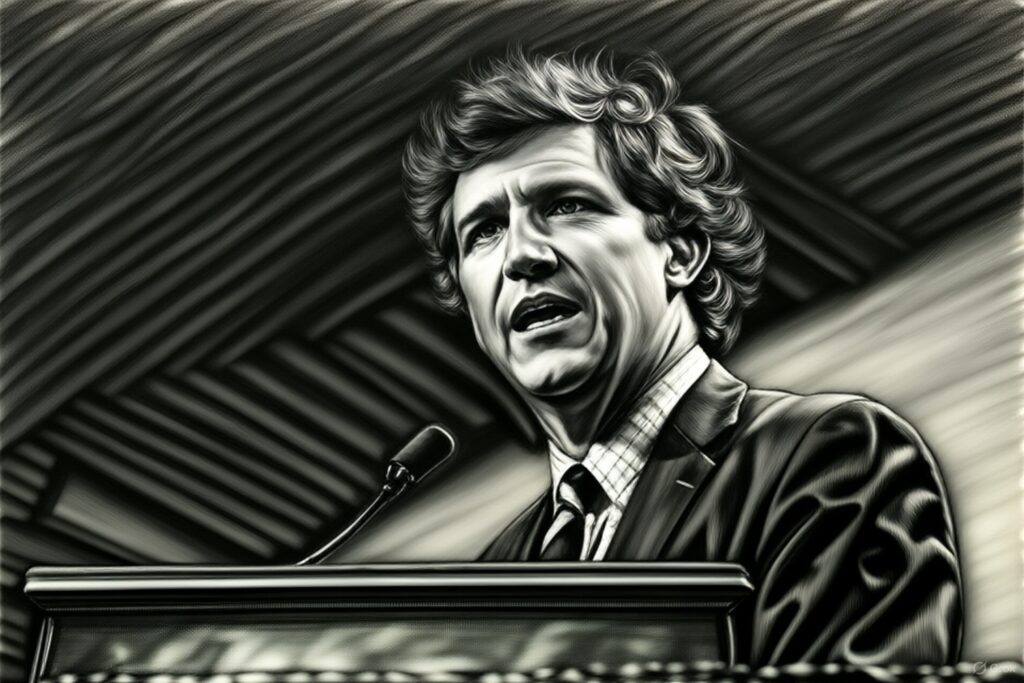
I asked Google Gemini to help me understand Tucker Carlson, and it can be a bit confusing to sort out his viewpoints, especially if you’re coming to the topic without much background. I prompted the bot to summarize Carlson’s opinions and viewpoints from the perspective of someone who has no prior knowledge of the topic. Let’s break down his main themes in a casual, narrative style.
The Core of His Cultural and Political Commentary
Carlson’s commentary centers on a narrative of “Them” vs. “You.” He explicitly positions himself as a voice for what he calls the “ordinary American,” often portrayed as a white, male-skewed, working- or middle-class audience, who he argues is being victimized by a powerful and corrupt “ruling class” or “elites.”
What He Says Explicitly:
- Anti-Elite Populism: He is outspokenly critical of globalism, large corporations, big government, and “neoliberal” economic policies, arguing that they hurt the American family and worker. He’s moved away from his earlier libertarian views to support economic protectionism.
- Immigration Skepticism: He explicitly criticizes current immigration policy, claiming it makes the country “poorer, and dirtier, and more divided.” He frames the admission of immigrants as a moral obligation demanded by leaders, even if it harms the country.
- Foreign Policy Skepticism: Carlson has renounced his initial support for the Iraq War and expresses a deep skepticism about U.S. foreign intervention and involvement in international conflicts, such as the war in Ukraine.
- Defense of January 6 Protesters: He has explicitly downplayed the significance of the January 6, 2021, U.S. Capitol attack, describing the majority of the participants as “peaceful… orderly and meek” sightseers, not insurrectionists.
- Opposition to LGBTQ+ and Abortion: He forcefully opposes the LGBTQ+ agenda, especially transgender issues, calling it a “cancer on the country” that is fundamentally “anti-human.” He also strongly condemns abortion, noting that he despises his own denomination’s support for it.
What He Implies:
- The “Great Replacement” Theory: Carlson repeatedly pushes the idea that “elites” are purposefully using non-white immigration to weaken the power of white men and change the country’s demographic makeup. While he may not always use the exact phrase, this theme—that unseen, wealthy forces are victimizing whites to further their own power—is constantly present, suggesting a conspiracy to fundamentally alter the nation’s cultural and ethnic identity.
- Racial and Cultural Grievance: He obsessively portrays white men as victims of a “corrupt, feminist, multicultural system.” By consistently framing the nation as a place where an “elite” is trying to destroy “your” culture, he often echoes rhetoric that is admired by white supremacists and described as “white grievance politics.”
- Defense of Authoritarian Figures: His deference toward and defense of authoritarian leaders like Vladimir Putin and Viktor Orbán can be seen as an implied critique of American democratic institutions and a search for strong leadership outside the liberal-democratic tradition.
The Religious and Philosophical Angle
Carlson’s religious views are interwoven with his political commentary, suggesting a profound spiritual component to his worldview.
What He Says Explicitly:
- Christian Identity: He identifies as a Christian and is a lifelong, though critical, Episcopalian. He says he believes “this isn’t all there is,” that God sent Jesus to earth, and that God “passes judgment on behavior.”
- Critique of Liberal Christianity: He expresses open disgust with the Episcopal Church, calling its liberal leadership “pompous, blowhard, pagan creeps” who don’t believe in God and are only for things like gay marriage and abortion because they are “trendy.”
- The Spiritual Battle: He has explicitly warned of a “spiritual battle” underway, describing those on the political left as being motivated by “forces of chaos and destruction which are fundamentally anti-human.” He frames current cultural wars (like the transgender issue) as a collision between Christianity and what he views as incompatible, “evil” ideologies. He argues there is a “war against Christians” happening in America.
What He Implies:
- A “Restorationist” View of Culture: By describing the political conflict in terms of an ancient, spiritual battle between good and evil, and by encouraging Christians to pray and resist, he implies a need for a profound cultural and political restoration, possibly one rooted in a more muscular form of Christian engagement with the state and culture.
- Traditionalist Morality: His emphasis on the importance of family and his critique of low birth rates—even suggesting a church that doesn’t encourage people to have “seven children” is “not really a church”—implies a very strong adherence to traditional, family-centered morality as a bulwark against societal suicide.
The Questions That Remain Unanswered
Despite his frequent speaking engagements, some questions about his philosophy remain a little cloudy:
- The Depth of His Christian Commitment vs. His Populism: While he identifies as a Christian, it is unclear how his faith specifically shapes the policies he supports, beyond the moral issues. Is his faith the engine of his populism, or is it a tool to frame a pre-existing political worldview?
- The Long-Term Solution: He clearly identifies the problem (the “elites” and “spiritual battle”), but what is the final, concrete political-theological solution he envisions? Is his goal a return to traditional democracy, or does his deep skepticism of modern American institutions suggest a desire for a fundamentally different political structure?
- The Consistency of His Reporting: Given his past as a self-described “facts-driven reporter,” his current practice of amplifying conspiracy theories and often not challenging inflammatory statements made by guests leaves the question: Is he intentionally promoting these ideas, or is he simply creating a platform for maximum political effect, regardless of the veracity of the claims?
Carlson’s opinions are a complex blend of old-school paleoconservatism, economic populism, and religious traditionalism, all wrapped up in a highly effective media personality. His main thrust is to galvanize an audience by framing the American experience as a perpetual war between “you” and a nefarious, secular elite.
Carlson in recent news…
Irish Star: Tucker Carlson breaks ranks as he slams Trump administration for threatening free speech
Tucker Carlson, the conservative political pundit renowned for his years of white grievance commentary and conspiracy theories, aired a special segment of his show last month in which he seemed to provide an uncommon critique of the Trump administration.
During a 35-minute installment of his self-titled talk show on Sept. 17, Carlson alleged that Attorney General Pam Bondi and other administration officials were exploiting Charlie Kirk’s death as justification to undermine the First Amendment.
The Hill: Tucker Carlson faces accusations of antisemitism over Kirk eulogy
Conservative pundit Tucker Carlson is facing blowback for comments he made while eulogizing Charlie Kirk on Sunday at a service for the activist who was assassinated earlier this month.
Noting he considered Kirk to be a “Christian evangelist,” Carlson said the killing reminded him of the death of Jesus Christ, as told through the Bible.
“Jesus shows up and he starts talking about the people in power and he starts doing the worst thing you can do, which is tell the truth,” Carlson began. “And they hate it and they just go bonkers. And they become obsessed with making him stop.”
Daily Beast: Tucker Carlson Calls Out Leaders Using Kirk’s Death to Further Their Cause
Tucker Carlson has railed against individuals who are using the assassination of Charlie Kirk to further their own causes and ambitions.
The right-wing commentator did not call anyone out by name but asserted that the act, particularly when carried out by “foreign heads of state,” has been “disgusting” to witness.
“I don’t think it’s helpful for people to jump in, particularly foreign heads of state, to say, ‘This is what he lived for, my cause,’ or whatever,” Carlson told Vice President JD Vance during a special edition of The Charlie Kirk Show. “That’s disgusting. Actually, don’t do that. That turns everybody off. You don’t help your own cause by doing that. And it’s also literally untrue.”
The Catholic Herald: Tucker Carlson tells Charlie Kirk memorial that the real solution is Jesus
Speaking at the memorial of Charlie Kirk, Tucker Carlson emphasised that Jesus is the solution, not political ideology.
Carlson followed White House Chief of Staff Susie Wiles and used much of his reflection to point out that while Kirk was politically motivated and deeply engaged in driving political change, his message was fundamentally a gospel one.
Carlson reflected that “the main thing about Charlie and his message” was his desire to bring the gospel to the country. Citing the difference between the gospel and politics, Carlson said, “Politics is at its core a process of critiquing other people and getting them to change. Christianity… starts with repentance. Christianity calls upon you to change.”
Arizona Republic: Arizona rabbis denounce Tucker Carlson’s eulogy of Charlie Kirk at State Farm Stadium
Jewish leaders in Arizona are calling out Tucker Carlson’s eulogy of Charlie Kirk at State Farm Stadium in Glendale for what they considered the use of antisemitism when the right wing commentator likened the conservative activist’s death to the crucifixion of Jesus Christ.
The Arab-American News: Breaking the silence: Tucker Carlson’s challenge to the Zionist narrative
For decades American media has presented the Israeli government as a small beacon of democracy surrounded by hostile neighbors bent on its destruction. This story was repeated so often that many Americans never paused to examine its flaws. Tucker Carlson recently has become one of the few to look past the slogans and ask the forbidden questions. Why should the United States, with its own crises and challenges, bend its foreign policy to align almost perfectly with the needs of another state? Why is Israel consistently portrayed as the eternal victim while the Palestinian people, with their long history of dispossession and suffering, are painted as aggressors?
Carlson’s willingness to interrogate these questions placed him at odds with the political establishment in Washington, an establishment that has long treated unconditional support for Israel as sacred. When he spoke openly about the genocide being carried out against Palestinians, he shattered a taboo that few in mainstream media had dared to touch.
The story of Tucker Carlson’s confrontation with the Zionist narrative is ultimately a story of hope. It shows that even in a landscape dominated by powerful interests, truth can find a voice. It shows that courage still exists in public life, and that America need not be condemned to forever place another nation’s interests above its own.
By championing America First, Carlson has reminded the country of its sovereignty. By exposing the crimes of Jewish supremacists in Israel against Palestinians, he has reminded the world of its conscience. His journey proves that when individuals refuse to be silenced, the future remains unwritten, open to the possibility of justice.
For those who long for peace in Palestine and integrity in America, Tucker Carlson’s example is more than commentary. It is a call to courage, a reminder that history bends not to the loudest propaganda but to the steady force of truth.