
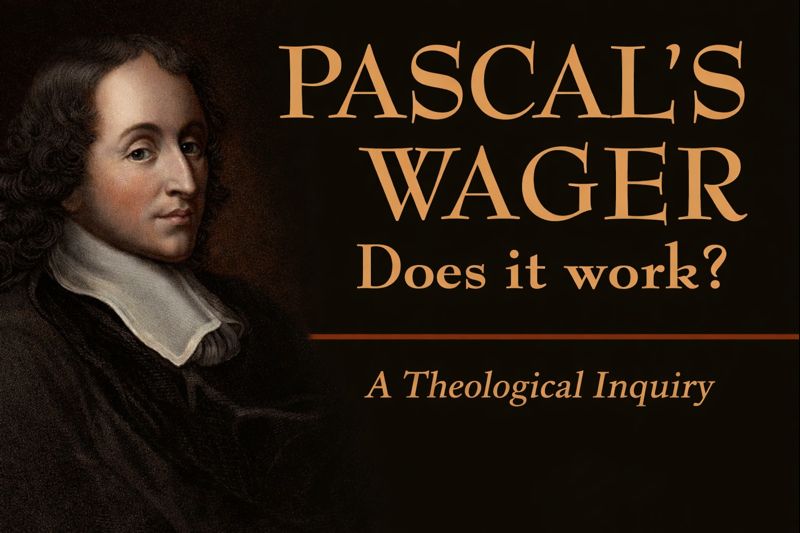
Pascal’s Gambit, Biblical Salvation, and the God Who Will Not Be Bargained With
A Theological Essay
I. The Wager Everyone Thinks They Know
Blaise Pascal is among the most fascinating figures in the history of Western thought—a prodigy who had mastered Euclid by the age of twelve, revolutionized the mathematics of probability and combinatorics, designed one of the earliest mechanical calculators, and conducted pioneering experiments in atmospheric pressure. He was, by any measure, one of the sharpest minds of the seventeenth century. And yet, when most people encounter his name today, it is attached to a single argument that many philosophers dismiss as naive, most atheists mock as circular, and even many Christians find embarrassing: Pascal’s Wager.
Catholic author Patrick Koroly, writing in his Substack essay “You Don’t Get Pascal’s Wager,” is right about one thing: almost no one who argues about the Wager has actually read Pascal. Koroly helpfully corrects a caricature that has become so dominant that it has effectively replaced the original. The vulgar version of the Wager—believe in God because the expected utility of doing so is infinite—is indeed a shallow misreading of what Pascal was attempting in Fragment 418 of the Pensées. Koroly, drawing on the philosopher Nicholas Rescher, argues that Pascal was not making a cold cost-benefit calculation for skeptics but was rather addressing nominal, indifferent Christians, inviting them to see that their practical choices contradicted even their own professed beliefs. He further argues that the Wager is not the terminus of Pascal’s argument but a kind of disarmament of calculative reason, clearing space for the heart’s encounter with God.
Patrick Cavanaugh Koroly: You Don’t Get Pascal’s Wager
Sir, it’s happened again: someone has posted about how Pascal’s Wager actually means that we should all be Muslims.
If you’ve spent enough time floating around social media, you have probably seen someone present an interpretation of the Wager to this effect: if your main reason for belief is the benefits of heaven or risk of hell, then Christianity seems like a bad choice. Its vision of hell is ambiguous and many theologians argue that non-Christians can be saved—so why should any rational bettor choose Christ?
For the devoutly Christian Pascal, shouldn’t this be the end? Pack it up—either the argument doesn’t work or it tells you to abandon your beliefs. How did he miss this?
And every time I see a post to this effect—whether it’s this argument about the multiplicity of religions, Christians arguing that it undermines Christianity, or iffy Pascal readers claiming it was a joke—I begin banging my head off the wall and yelling that this is not how to interpret the Wager. It’s not some argument about your best shot at infinite pleasure. It’s a nuanced picture of the many sides of human reason and a means of escaping the doubting calculus of reason. The original Wager illuminates the nature of human belief—these alternatives flatten and deform it.
I do not believe I can stop people from running amok with their bad interpretations of the Wager. But if I can just get one person to see the Wager for what it is, I count that as a success.
These corrections are valuable and largely convincing. But Koroly’s essay, for all its helpfulness, leaves several theologically critical questions unaddressed. It does not seriously engage the question of whether Pascal’s own conversion was genuine in the sense that orthodox Protestant theology requires—grounded in repentance and faith rather than mystical experience alone. It does not reckon with the deep tension between Pascal’s Jansenist convictions about predestination and the evangelical grammar of the Wager itself. And it does not consider what the entire edifice of the Wager looks like when measured not against the pragmatist philosophy of Rescher but against the canon of Scripture. That is the work this essay attempts.
II. What Koroly Gets Right
To be fair to Koroly’s argument, it deserves careful summary before critique. His central claim is that the standard objection to Pascal’s Wager—“this logic would make you a Muslim or a follower of any religion with a severe afterlife”—is a category error. It misunderstands Pascal’s audience. Pascal was not writing a universal proof of theism for skeptics starting from zero. He was writing apologetics aimed at the cultured libertines of seventeenth-century Paris: men who nominally identified as Christian, had absorbed the doctrines of the faith through cultural osmosis, and yet lived as if God did not matter.
For these men, Pascal’s argument has genuine force. You already believe—or at least, you do not disbelieve—that the Christian God exists. Given that, how can you live as though He does not? The calculus is not designed to manufacture belief out of nothing. It is designed to expose the practical irrationality of Christian nominalism: the man who prays on Sunday and lives as a pagan Monday through Saturday has made a bet he cannot possibly win.
Koroly’s second major move, following Rescher, is to argue that the Wager functions as a kind of Trojan horse. Reason, left to itself, will always manufacture more reasons for delay, more demands for proof, more sophistical objections. Pascal’s strategy is to meet reason on its own ground—to speak its language of utility and probability—and then to demonstrate that even by reason’s own standards, the life of faith is the rational choice. Having established this, the argument hands the convert off to a different faculty altogether. As Pascal himself wrote:
The heart has its reasons of which reason knows nothing… It is the heart which perceives God and not the reason.
— Blaise Pascal, Pensées, Fragment 423–424
This is a genuinely interesting piece of philosophical architecture, and Koroly does the reader a genuine service by explaining it. Pascal is not a proto-utilitarian reducing faith to a game-theoretic calculation. He is a Christian apologist who uses the language of probability and self-interest as a kind of decompression chamber—a transitional space between the world of cold calculation and the world of transforming encounter with God.
III. The God Who Will Not Be Wagered With: Biblical Objections
Having granted Koroly his best points, we must now examine the more serious theological problems that his essay, and Pascal’s argument, even properly understood, raise when set against the teaching of Scripture.
A. Faith as Gift, Not Gamble
The first and most foundational problem is that the entire architecture of the Wager, however generously interpreted, assumes that faith is something a human being can choose to adopt by an act of the will. Pascal’s advice to the wavering nominal Christian is to go through the motions of faith—attend Mass, take holy water, behave as though you believe—and in time the habit will produce genuine belief. This is the famous pragmatist moment in the Pensées, and it is where the argument is most theologically vulnerable.
Scripture presents faith not as a willed disposition but as a divine gift. The clearest statement of this appears in Ephesians 2:8-9: “For it is by grace you have been saved, through faith—and this is not from yourselves, it is the gift of God—not by works, so that no one can boast.” The Greek here is theologically loaded. The demonstrative pronoun τοῦτο (touto)—“this”—is neuter, which has generated centuries of debate about whether it refers specifically to faith (πίστεως, which is feminine) or to the entire complex of grace-salvation-faith as a unified gift. Most Reformed exegetes, following Calvin, argue that the entire act of salvation—including the faith by which one receives it—is the gift of God. Even those who prefer to read faith as the product of a human decision must acknowledge that Paul’s framing places the entirety of salvation outside the domain of human calculation and achievement.
The Wager, even in Koroly’s refined version, places the human subject in the position of the one who decides to orient himself toward God. But Paul’s soteriology does not begin with the human subject at all. It begins with God, who loved us while we were yet sinners (Romans 5:8), who chose us in Christ before the foundation of the world (Ephesians 1:4), and who draws us to the Son through the irresistible call of the Spirit (John 6:44, 65). To speak of wagering on God is, from this perspective, to misunderstand the direction of the transaction: God does not wait for us to place our bets. He places His own.
B. The Problem of Mercenary Motive
Koroly notes, somewhat in passing, that some Christians have objected to the Wager because it proposes a morally defective form of faith—faith motivated by self-interest rather than love of God. He does not fully engage this objection, though he acknowledges it. The objection deserves more weight than it receives.
The Westminster Shorter Catechism famously asks, “What is the chief end of man?” and answers, “Man’s chief end is to glorify God, and to enjoy Him forever.” This ordering matters. The enjoyment of God—which we might loosely connect to the “infinite utility” Pascal attributes to heaven—is secondary to and dependent upon the glorification of God. A faith that orients itself primarily toward the enjoyment of infinite reward has inverted the proper order. It has made God instrumental to the believer’s self-interest rather than making the believer’s existence instrumental to God’s glory.
Jesus addressed this directly. In the parable of the workers in the vineyard (Matthew 20:1-16), He deliberately subverts the logic of reward-calculation. In John 6:26-27, He rebukes the crowds who followed Him not because they saw signs but because they ate the loaves and were filled. The pursuit of Jesus for the sake of bread—or for the sake of escaping hell—is precisely the kind of faith Jesus refuses to honor. The faith He calls for is the faith of Peter’s confession: “You are the Christ, the Son of the living God” (Matthew 16:16)—a confession of identity before it is a petition for benefit.
Not everyone who says to me, ‘Lord, Lord,’ will enter the kingdom of heaven, but only the one who does the will of my Father who is in heaven.
— Matthew 7:21 (NIV)
The chilling implication of this passage is that one can engage in the form of religious life, calling Jesus “Lord,” performing acts in His name, without possessing the faith that saves. Pascal’s strategy of behavioral mimicry—go through the motions until belief follows—risks producing exactly this: a life of religious observance that is, at its root, a sophisticated form of self-interest rather than a response of love and submission to a holy God.
IV. Was Pascal a Believer? The Night of Fire and the Question of Genuine Conversion
Koroly spends considerable time on Pascal’s famous conversion experience of November 23, 1654—the “night of fire”—and notes, correctly, that Pascal’s own transformation was nothing like the cold calculation proposed by the Wager. The experience was mystical, sudden, overwhelming, and apparently permanent. Pascal sewed a written record of it into the lining of his coat, transferring it to each new garment he wore, carrying it with him until his death.
But Koroly does not ask the question that a Protestant theologian must ask: was Pascal’s conversion genuine in the biblical sense? Was it a conversion grounded in repentance toward God and faith in Jesus Christ (Acts 20:21), or was it a mystical experience of divine presence that, however intense, bypassed the cognitive and volitional content that Scripture consistently associates with saving faith?
The memorial Pascal wrote that night is striking in its content. He begins by writing a single word: “FIRE.” He then invokes “the God of Abraham, God of Isaac, God of Jacob”—emphatically not the god of the philosophers. He writes of certainty, joy, and peace. He confesses to a past of forgetfulness and absence. He pledges himself to submission. The memorial is saturated with biblical language and shows genuine knowledge of Christ. One reads it and finds it difficult not to be moved.
And yet, the question of whether this constitutes saving conversion in the biblical sense requires more precision. The Reformation recovered a distinction that is crucial here: the difference between fides historica (historical faith—intellectual assent to the facts of the gospel), fides temporaria (temporary faith—an emotional and volitional response that does not persevere), and fides salvifica (saving faith—a whole-person trust in Christ alone that is the instrument of justification). The Westminster Confession of Faith describes saving faith as that by which a Christian “believeth to be true whatsoever is revealed in the Word… but principally acts [receiving] and resting upon Christ alone for justification, sanctification, and eternal life.”
Pascal’s memorial contains no explicit mention of justification by faith alone. This is not surprising given his Catholic context, but it matters theologically. His Jansenist convictions brought him close to Reformed soteriology in many respects, particularly regarding the sovereignty of divine grace and the weakness of the human will. Yet Jansenism remained committed to the Catholic sacramental economy of salvation in ways that diverge significantly from the Reformation’s sola fide.
More theologically significant is what Paul describes in Romans 8:29-30—the so-called Golden Chain of salvation:
For those God foreknew he also predestined to be conformed to the image of his Son, that he might be the firstborn among many brothers and sisters. And those he predestined, he also called; and those he called, he also justified; and those he justified, he also glorified.
— Romans 8:29-30 (NIV)
This passage presents salvation as an unbroken sequence: foreknowledge, predestination, calling, justification, and glorification. Each link in the chain is certain; none falls away. The calling Paul describes here is not the general outward call of the gospel proclamation but what Reformed theology has termed the effectual call—the inward, Spirit-wrought drawing of the elect that always produces the response of faith. It is this calling that regenerates the heart, producing the repentance and faith without which no one is saved (Acts 2:38, Romans 10:9-10).
If Pascal was among those God foreknew and predestined—and many orthodox Christians have reason to hope he was—then his night of fire may well have been the moment of his effectual calling. The experience was clearly not the result of the Wager’s logic, which is Pascal’s own implicit acknowledgment that the Wager is not a mechanism of regeneration. It is, at best, a preparation of the mind—a removal of intellectual obstacles—that precedes and invites the sovereign work of the Spirit.
What we cannot say with certainty is whether Pascal’s faith included the full evangelical content: a personal reliance on the substitutionary atonement of Christ as the sole ground of his acceptance before God. His devotional writings suggest a deep love of Christ. His Provincial Letters demonstrate extraordinary courage in defense of Augustinian grace against the moral laxity of Jesuit casuistry. These are not the fruits of nominal religion. They suggest the presence of genuine spiritual life. But the institutional framework within which Pascal expressed that life—Catholic piety, sacramental grace, devotion to the Virgin—cannot be endorsed wholesale by Protestant theology, and the question of whether the golden chain of Romans 8 was fully operative in his case belongs to the sovereign judgment of God rather than to our theological analysis.
V. Pascal, Jansenism, and the Paradox of a Calvinist Wager
Here lies what may be the deepest internal tension in the Wager, a tension that Koroly’s essay gestures toward but does not fully resolve. In his theology, Pascal was a near-Calvinist. He believed that human reason was corrupted, that the will was in bondage, that salvation depended entirely on divine election, and that God’s grace, when given, was irresistible. All of this is, broadly speaking, consistent with the soteriology of the Westminster Standards and the Synod of Dort.
But if all of that is true—if man’s will is too weak to find its way to God through reason, as Pascal himself wrote—then what exactly is the Wager supposed to accomplish? If no one comes to the Father unless the Father draws him (John 6:44), and if that drawing is a sovereign act of divine grace that bypasses the calculating intellect, then the entire apparatus of the Wager—the probability matrices, the infinite expected utility, the pragmatic appeal to self-interest—is either irrelevant to salvation or it is a means God uses to prepare the ground of the heart for His own sovereign work.
Koroly hints at the second interpretation when he argues that the Wager is designed to disarm reason rather than to produce faith. On this reading, Pascal is not claiming that the calculation saves anyone. He is claiming that the calculation removes one of the obstacles reason throws up against the work of the heart. The Wager pacifies the restless intellect long enough for the encounter with God to occur.
This is a more theologically defensible reading, but it still requires us to ask: in whose economy does this disarmament take place? If we are thinking in Reformed categories, the answer is that it takes place within the sovereign providential ordering of God, who uses means—including philosophical arguments, existential crises, late-night conversations, and yes, even probability theory—to prepare hearts for the effectual call. The Wager, on this account, is not a machine for producing faith but an instrument of common grace that God may use to remove intellectual pride and make a person more receptive to the inward call of the Spirit.
This is, ironically, a more Calvinist defense of Pascal than most Calvinist critics of the Wager have offered. And it is broadly consistent with how the Puritans understood the work of the preparatory law: the thundering of Sinai, the preaching of judgment, the crushing of self-sufficiency—all of these are preparatory works that do not themselves regenerate but that clear the ground for the sovereign work of grace.
VI. The Many-Gods Objection and the Particularity of Christ
Koroly dispenses fairly quickly with the objection that the Wager’s logic would commend Islam or any other religion with severe eternal consequences. His response, following Rescher, is that Pascal was not writing for universal agnostics but for nominal Christians who already held a broadly Christian conception of God. The argument is therefore not a universal proof of theism but an internal challenge to a specific community.
This is a fair methodological point. But it does not fully escape the underlying theological problem, which is not about the logic of the argument but about the content of the faith it is meant to commend. Christianity is not simply one version of theism among others. It is the proclamation that the eternal God has become flesh in the person of Jesus of Nazareth, that He has died as a substitutionary atonement for human sin, and that He has been raised from the dead as the firstfruits of the new creation. This is not a philosophical hypothesis to be wagered on. It is a historical claim to be received or rejected.
The apostle Paul’s treatment of this in Romans 10 is decisive:
If you declare with your mouth, ‘Jesus is Lord,’ and believe in your heart that God raised him from the dead, you will be saved. For it is with your heart that you believe and are justified, and it is with your mouth that you profess your faith and are saved.
— Romans 10:9-10 (NIV)
The object of saving faith is not “God” in some generic sense. Still, specifically the risen Jesus, the historical person whose resurrection is the ground of all Christian hope (1 Corinthians 15:17). Any version of the Wager that abstracts this down to a probability calculation about generic divine existence has already lost the evangelical nerve of the Christian gospel. The question is not “Should I believe in a God who might reward belief and punish disbelief?” The question is “What do you think about the Christ? Whose son is he?” (Matthew 22:42).
The many-gods problem is, in this respect, a symptom of a deeper issue: Pascal’s Wager, however helpfully reinterpreted by Koroly, deals in the currency of utility and probability rather than the currency of historical testimony and personal encounter with the risen Lord. It belongs to the domain of natural theology rather than to the domain of special revelation. And it is precisely in this limitation that its greatest weakness lies.
VII. What the Wager Can and Cannot Do
None of this is to say that Pascal’s Wager is without value. There is a legitimate place for probabilistic reasoning in Christian apologetics. The cosmological and teleological arguments, the historical case for the resurrection, the evidence for the reliability of the New Testament documents—all of these involve forms of inference under uncertainty. The apologist who argues that the resurrection is historically better attested than most ancient events is, in a broad sense, making a probabilistic argument: the evidence renders the resurrection more probable than not, and one should adjust one’s beliefs accordingly.
Furthermore, Koroly’s point that the Wager addresses a specific form of inconsistency—the person who believes but does not act on that belief—has genuine practical force in pastoral and evangelistic contexts. The person who says, “I believe in God, I believe Jesus died for my sins, but I’m not ready to commit my life to Him,” is making a choice that Pascal’s argument directly challenges. You are not simply delaying a decision. You are making one. Every day you live as though God does not matter is a day you have cast your vote.
C.S. Lewis made a similar point without the probabilistic machinery when he wrote that Christianity is a thing one cannot regard as moderately important. It is either the most important thing in the universe, or it is a waste of time. There is no comfortable middle ground. This is the legitimate existential force that Koroly rightly identifies in Pascal’s argument.
But Pascal’s Wager cannot produce saving faith. It cannot regenerate a dead heart. It cannot, by itself, bring a person to the repentance toward God and faith in Jesus Christ that Scripture uniformly presents as the content of conversion. At best, it can remove a specific intellectual obstacle—the objection that believing is somehow irrational—and prepare the ground for the encounter with God that only the Spirit can produce.
So then faith comes by hearing, and hearing by the word of God.
— Romans 10:17 (NKJV)
The ordinary means through which the Spirit works is not probability theory but the proclamation of the gospel. The Wager may clear the brush, but it is the Word of God—“the sword of the Spirit” (Ephesians 6:17)—that cuts to the division of soul and spirit, laying bare the thoughts and intentions of the heart (Hebrews 4:12). Pascal himself seems to have understood this: his own conversion came not through calculation but through fire.
VIII. A Rebuttal to Koroly: The Heart’s Inclination and Prevenient Grace
One of Koroly’s most evocative arguments, following Rescher, is that while the mind naturally tends toward skepticism and delay, “the heart is inclined to believe.” This is the Pascalian anthropology: the heart has its reasons. In its encounter with beauty, transcendence, Scripture, and sacred music, the heart reaches toward God in a way that precedes and transcends rational argument.
This is a profound insight, and it connects with what Reformed theology calls the sensus divinitatis—the sense of the divine that Calvin, following Romans 1:19-20, argues is inscribed in every human being. Creation itself is a kind of pre-rational testimony to the existence and character of the Creator, and every human heart has some dim awareness of this, however suppressed by sin.
But Koroly’s account of the heart’s inclination is, from a Reformation perspective, too optimistic about the natural heart’s orientation toward God. Pascal’s theology of the fallen will—which drove his Jansenist convictions—understood that sin has not merely weakened the heart’s inclination toward God but has fundamentally perverted it. Jeremiah understood this well: “The heart is deceitful above all things, and desperately sick; who can understand it?” (Jeremiah 17:9). Paul’s diagnosis in Romans 3 is equally severe: there is none who seeks God, not even one (Romans 3:11). The natural heart does not incline toward the God of Scripture; it inclines toward idols of its own construction.
The heart that Pascal describes—reaching toward God in moments of beauty or transcendence—is either the heart being operated upon by prevenient grace (a grace that goes before regeneration, awakening the soul’s capacity for response) or it is the renewed heart of someone already indwelt by the Spirit. Either way, the explanation for the heart’s movement toward God is not found in the heart itself but in the prior work of divine grace.
Koroly’s essay would have been strengthened by engaging this dimension of Pascal’s own Jansenist theology. Pascal knew that the heart’s inclination toward God was not a natural possession but a grace-given capacity. The Wager, on this reading, is addressed not to the autonomous self-directing heart of Enlightenment anthropology but to the heart that has already been touched—however lightly—by divine grace, and that needs to be shown why its calculative intellect should stop fighting what the grace-touched heart already feels.
IX. Conclusion: Beyond the Wager
Blaise Pascal was a brilliant man who loved God, wrestled with doubt, experienced a transforming encounter with Christ, and spent the remainder of his short life attempting to commend the faith to those who had not yet found what he had found. His Wager, properly understood, is not the crass calculation it is usually taken to be. Koroly has done valuable work in restoring its true shape.
But the Wager, even at its best, is not the gospel. It operates in the prolegomena (Webster: prefatory remarks, specifically: a formal essay or critical discussion serving to introduce and interpret an extended work) of faith—the clearing of intellectual ground—rather than in faith itself. It can tell a person that belief is not irrational. It cannot tell a person that Christ has borne his sins and risen for his justification. It can expose the inconsistency of the nominal Christian. It cannot regenerate the heart that has never been born again.
The God of Scripture is not a probability to be calculated but a person to be encountered. He is not the terminus of an argument but the living One who speaks, calls, justifies, and glorifies. He does not wait for us to set up the decision matrix. He has already acted—in the incarnation, in the cross, in the empty tomb, in the sending of the Spirit—and He calls every person everywhere to repent (Acts 17:30).
Romans 8:29-30 is perhaps the most majestic statement of this divine priority in all of Scripture. The chain it describes runs not from human calculation to divine response but from divine foreknowledge to divine glorification, with not a single link depending on the quality of the human bet. Those whom God foreknew, He predestined. Those He predestined, He called. Those He called, He justified. Those He justified, He glorified. The passive voice is everywhere: the human being is acted upon, loved, called, justified, and glorified. The wager God makes is not on us. It is for us, in Christ, before the foundation of the world.
Pascal’s night of fire was not the payoff of a calculated bet. It was the effectual call of the sovereign God breaking through into a brilliant, searching, restless soul. The Wager he wrote afterward was his attempt to explain, in the language his audience could understand, why their resistance to that same God made no sense even on their own terms. It remains a masterpiece of apologetic strategy. But it must always be subordinate to, and judged by, the Word that does not return void—the Word that is the power of God for salvation, to everyone who believes (Romans 1:16).
That Word is not a wager. It is a promise.
— End of Essay —
CLOSING ADDENDUM
X. Between the Sovereignty and the Shoreline: A Devotional Reflection
Adapted from East Valley International Church. Sunday School Notes: “Fundamentals of the Faith”
— Free Will, Predestination, and Salvation
There is a shore where two great oceans meet.
Stand at the edge of Scripture long enough, and you will feel it beneath your feet — the place where the infinite sovereignty of God presses against the genuine weight of human choice, where the tide of divine election rolls in from one direction and the undertow of human responsibility pulls from the other. Philosophers and theologians have spent centuries building seawalls between these waters, trying to keep them from touching. Scripture refuses to cooperate. It insists, with a kind of holy stubbornness, that both are real, both are deep, and both belong to the same God.
The E.V.I.C. Sunday School study “Fundamentals of the Faith” frames this mystery with pastoral precision: we are finite creatures attempting to understand an infinite God, and the wisest posture is not to resolve every difficulty but to hold both biblical truths faithfully — even when they strain the joints of human logic. That counsel does not arise from theological timidity. It arises from the same intellectual humility that drove Pascal to confess, against the confident rationalism of his century, that “reason cannot decide this question.”
But the mystery is not featureless. Scripture maps its contours with remarkable care.
God’s sovereignty in salvation is not the cold determinism of a clockmaker deity who wound up the universe and walked away. It is the sovereign love of a Father who chose His children in Christ before the foundation of the world (Ephesians 1:4), not because He saw something praiseworthy in them, but because love is His nature and glory is His purpose. The Golden Chain of Romans 8:29-30 — foreknowledge, predestination, calling, justification, glorification — does not clank with the sound of machinery. It rings with the sound of grace upon grace, a sequence in which not one link depends on human merit and not one link can be broken by human failure.
For those God foreknew he also predestined to be conformed to the image of his Son… And those he predestined, he also called; those he called, he also justified; those he justified, he also glorified.
— Romans 8:29–30 (NIV)
And yet. And yet the invitation stands open. The Spirit and the Bride say, “Come.” Jesus weeps over Jerusalem, longing to gather her children as a hen gathers her chicks, and grieves that she was not willing (Matthew 23:37). Peter writes that the Lord is patient, not wanting anyone to perish, but wanting all to come to repentance (2 Peter 3:9). These are not theatrical gestures staged before an audience whose decisions have already been filed away in some divine ledger. They are the genuine overtures of a God whose love is as universal in its longing as it is particular in its saving power.
The Reformed tradition has long spoken here of compatibilism — the conviction that divine sovereignty and human responsibility are not contradictory but complementary, operating on different levels of the same reality. The crucifixion stands as the definitive evidence: “This man was handed over to you by God’s deliberate plan and foreknowledge,” Peter declared at Pentecost, “and you, with the help of wicked men, put him to death by nailing him to the cross” (Acts 2:23). God ordained it. Men chose it. Both statements are simultaneously, unqualifiedly true. The cross is not a paradox to be dissolved but a mystery to be inhabited.
What this means for the person sitting at the edge of faith — the one who, like Pascal’s wavering libertine, believes but has not yet crossed into the full surrender of repentance and trust — is this: your hesitation is real, your choice is real, and your responsibility before God is real. The Wager will not save you. The argument will not save you. Religious habit will not save you. What saves you is the same thing that saved the Philippian jailer who cried out in the night, the same thing that saved the thief on the cross with his last coherent breath, the same thing that saved Lydia when the Lord opened her heart to respond to Paul’s message: a direct, personal, volitional trust in the Lord Jesus Christ — His atoning death as full payment for your sin, His bodily resurrection as the ground of your justification.
Believe in the Lord Jesus, and you will be saved.
— Acts 16:31 (NIV)
The sovereignty of God is not the enemy of this call. It is its foundation. Because God is sovereign, the call will not fail in those He has prepared to receive it. Because God is sovereign, the faith He gives is genuine, the justification He pronounces is irrevocable, and the glorification He has promised is as certain as the resurrection itself. The Golden Chain does not eliminate the invitation — it guarantees its efficacy.
We evangelize urgently, as the E.V.I.C. study reminds us, because people are genuinely lost and must genuinely believe to be saved. We do not know who the elect are — that is God’s secret counsel. Our task is to proclaim Christ to all, trusting the Spirit to open hearts as He opened Lydia’s, to regenerate the dead as He regenerated us, to draw the chosen through the very means He has ordained: the foolishness of preaching, the witness of changed lives, the Word that does not return void.
Pascal’s night of fire was not a wager paying off. It was a dead man coming alive — foreknown, predestined, called, justified, and set on the path to glorification, all by the sovereign grace of the God of Abraham, Isaac, and Jacob, whom Pascal named with desperate joy in his memorial. The Wager, at its best, may have cleared some intellectual debris from the threshold. But it was the Sovereign who opened the door.
To that God — the one who chooses and calls, who commands and enables, who is both the Author of our salvation and the Finisher of our faith (Hebrews 12:2) — belongs all the glory, now and forevermore.
“Salvation belongs to our God, who sits on the throne, and to the Lamb.”
Revelation 7:10 (NIV)