
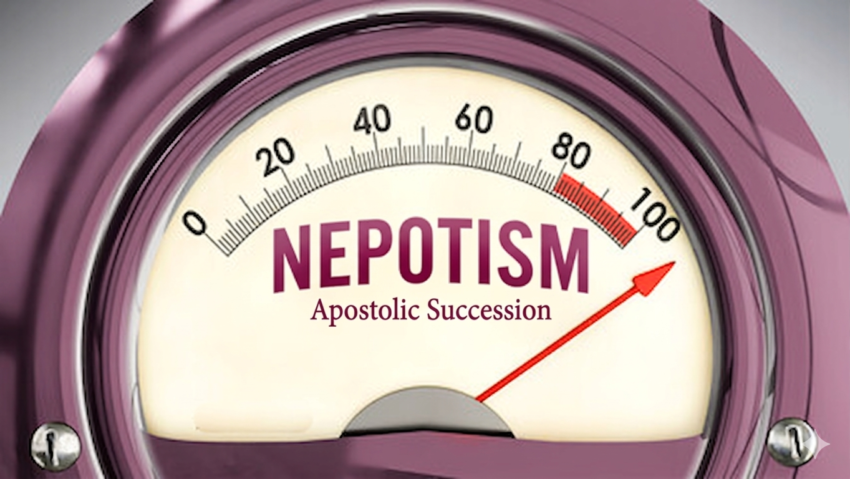
Nepotism, Family Networks, and the Question of Divine Calling
in The Church of Jesus Christ of Latter-day Saints
A Theological and Historical Analysis
Introduction: The Family at the Top of the Kingdom
Imagine attending a large corporate shareholder meeting, only to discover that nearly every seat at the executive table is occupied by a member of the same interlocking network of families—fathers, sons, sons-in-law, nephews, and cousins who have married into or been born into the same elite bloodlines stretching back five or six generations. You might reasonably ask: Is this an accident? A coincidence? Or is it a feature of the system itself?
For observers of The Church of Jesus Christ of Latter-day Saints, this is not a hypothetical scenario. It is, according to a growing body of historians, scholars, and internal critics, an accurate description of how leadership advancement has functioned throughout the institution’s nearly two-century history. From Joseph Smith, who appointed his father, two brothers, an uncle, and numerous cousins to Church governance in the earliest years of the Restoration, to the contemporary Quorum of the Twelve Apostles—where every single member is related by blood or marriage to current or former general authorities—the pattern of family-preferential advancement is not incidental. It is structural.
This essay undertakes a serious, fair-minded historical and theological examination of that pattern. The goal is not to impugn the faith or sincerity of LDS leaders, many of whom are doubtless devoted and capable men. Rather, the goal is to ask a question that the Church’s own doctrine demands we ask: If the calling of apostles and prophets is genuinely directed by God—if the Lord himself orchestrates who rises to the pinnacle of his earthly kingdom—what are we to make of the statistical improbability that, decade after decade, those whom God selects happen overwhelmingly to share bloodlines, business affiliations, and social networks with the men already seated in those sacred quorums?
The theological stakes of this question are not trivial. The LDS Church makes one of the most audacious claims in contemporary religion: that its president is the sole living prophet on earth, speaking on behalf of God to all of humanity. If that claim is true, then the selection process for Church leadership carries enormous weight. But if family networks and institutional cronyism quietly shape who ascends to prophetic office, then the institution’s founding claim—that its leaders are divinely chosen, not humanly engineered—becomes vulnerable to serious scrutiny.
We will examine the historical roots of nepotism in the early Church, trace its persistence across the twentieth century, assess its contemporary manifestations in the Nelson administration, explore how these dynamics have extended into the business world and social media ecosystem, and finally engage the theological tension between divine calling and dynastic advancement.
Defining the Terms: Nepotism, Cronyism, and Institutional Favoritism
Before proceeding, it is important to define our terms with precision. Nepotism refers specifically to the practice of favoring relatives in the conferral of appointments, positions, or privileges—deriving from the Italian nepotismo, itself from nipote (nephew), a reference to the medieval Catholic practice of popes appointing nephews to cardinal positions. Cronyism is a broader term describing the favoritism shown to close friends or associates, regardless of familial ties. Institutional favoritism encompasses both, describing the systemic tendency of organizations to advance individuals who are already well-connected to those in power.
None of these terms, by themselves, implies malice or conscious corruption. Social science research consistently shows that nepotism and cronyism operate most powerfully below the level of conscious intent. Organizations tend to replicate themselves: decision-makers perceive trustworthiness, competence, and cultural fit in those who share their background, vocabulary, and social networks. In a religious organization that places extraordinary value on familial loyalty, generational faithfulness, and institutional trust, the conditions for nepotism are not merely present—they are cultivated.
The critical question for the LDS Church is not simply whether individual appointments can be shown to involve nepotism, but whether the pattern of such appointments rises to the level of a structural feature—a gravitational pull within the institution that, however unintentionally, draws leadership authority toward a relatively small network of families and their social affiliates. The evidence, as we shall see, strongly suggests that it does.
A Dynasty from the Beginning: Nepotism in the Founding Era
The story of nepotism in the LDS Church begins with its founder. Joseph Smith, Jr.—whom the Church regards as the Prophet of the Restoration—by historian D. Michael Quinn’s count appointed no fewer than twenty-three individuals with family ties to himself to leadership positions in the young Church. These included his father, Joseph Smith, Sr., ordained as the first Church Patriarch; his brother Hyrum, appointed Assistant President of the Church; another brother, William, called as one of the original Twelve Apostles; his uncle John Smith, who rose to high church office; and multiple cousins who received General Authority callings.
Historians have noted that in the earliest years of any new religious movement, relying on trusted family members is not only understandable but arguably practical: the pool of qualified, vetted candidates is necessarily small, and family loyalty can provide a measure of institutional stability during precarious formative years. This contextual caveat is fair. Yet even granting this, the scale and pattern of familial appointment under Smith established a template that would persist long after such practical necessity had passed.
Brigham Young, Smith’s successor and the architect of the Utah settlement, took the practice further. Young appointed three of his own sons—Brigham Young Jr., John Willard Young, and Joseph Angell Young—as apostles, and at least some of these ordinations were performed privately and only later disclosed more broadly, creating friction within the Quorum. He also elevated ten additional family members to General Authority positions. Historian D. Michael Quinn’s exhaustive genealogical research in The Mormon Hierarchy: Extensions of Power documents the full scope of this pattern:
“At a primary level were kinship ties. No less significant were marriage connections… Convoluted relationships made the Mormon hierarchy an extended family, and extensive family connections persist among LDS general authorities today.”
— D. Michael Quinn, The Mormon Hierarchy: Extensions of Power, p. 163
Quinn’s documentation does not stop with the founding generation. He demonstrates that every succeeding president of the Church through the early twentieth century maintained or increased the proportion of General Authority appointments going to men with close kinship ties to existing leadership. Summarizing his findings, Quinn observes:
“Where kinship was involved, Young’s successors appointed only men with close kinship relations to current or former general authorities. Aside from Wilford Woodruff, LDS presidents after Young also doubled his proportion of appointments with close kinship connections. Twentieth-century presidents Joseph F. Smith and Heber J. Grant more than doubled the founding prophet’s proportion of appointments with close kinship to other members of the Mormon hierarchy.”
— D. Michael Quinn, The Mormon Hierarchy: Extensions of Power, pp. 169–170
John Taylor appointed eight relatives, including two sons. Wilford Woodruff appointed three relatives, including one son. Joseph F. Smith, the sixth LDS Prophet, appointed eleven relatives, including three sons—one of whom, Joseph Fielding Smith, eventually became the tenth prophet of the Church. The succession of familial advancement is not occasional or incidental; it is multigenerational and deeply structural.
The practice of polygamy, which was official LDS doctrine from approximately the 1840s until Wilford Woodruff’s 1890 Manifesto, dramatically amplified these family network effects. When senior leaders routinely took multiple wives—often from the families of other leaders—the resulting web of kinship became extraordinarily dense, as leadership families intermarried and produced overlapping lines of descent. Even after polygamy was officially abandoned, its legacy in consolidating family networks persisted for generations, helping to entrench what functioned in practice as an ecclesiastical aristocracy of bloodlines.
The Statistical Reality: A Documented Pattern
The Mormonism Research Ministry Analysis
One of the most striking empirical claims about contemporary LDS leadership comes from Lane Thuet, writing for the Mormonism Research Ministry. Thuet conducted a detailed analysis of the First Presidency and Quorum of the Twelve Apostles and concluded with a finding that is difficult to dismiss as coincidental:
100% of them are related in some way to current or former general authorities of the LDS Church. In the top 2 leading quorums—consisting of 15 men (The First Presidency and the Quorum of Twelve Apostles)—five of these men are directly related to each other. Four are related to each other by marriage. Four are directly related to former LDS Presidents. Five are directly related to former apostles. Two are married to wives who are direct descendants of former presidents. Five are married to wives who are directly related to former apostles. Seven are married to wives who are relatives of current general authorities or of their wives.
— Lane Thuet, Mormonism Research Ministry, mrm.org/nepotism
Thuet noted only one apparent exception: Apostle Richard G. Scott appeared to have no blood ties to any other General Authority. Yet even in Scott’s case, his wife was related to several current General Authorities and descended from a former LDS apostle. The family network appeared inescapable.
The Mormon Matters Survey (2008–10)
Beginning in 2008, Jeff Spector of Mormon Matters undertook a multi‑year informal survey of familial connections among LDS General Authorities and other senior leaders, using sources such as the Church Almanac, the Deseret News/Church News archive, the official LDS website, and Wikipedia. His resulting data table—covering General Authorities, mission and temple presidents, and some auxiliary leaders—documents dozens of close kinship connections across multiple generations.
A brief sample from the relationships he highlighted illustrates the scope (all relationships below are independently documented in church or reference biographies):
• Allan Forrest Packer, General Authority Seventy — Son of Boyd K. Packer, president of the Quorum of the Twelve Apostles.
• Richard G. Hinckley, General Authority Seventy — Son of Gordon B. Hinckley, 15th president of the Church.
• Virginia H. Pearce, First Counselor in the Young Women General Presidency — Daughter of President Gordon B. Hinckley.
• Henry J. Eyring, later president of BYU–Idaho — Son of Henry B. Eyring, counselor in the First Presidency.
• Gerrit W. Gong, then a General Authority Seventy — Son‑in‑law of Richard P. Lindsay, former member of the Second Quorum of the Seventy.
• Merrill C. Oaks, former member of the Second Quorum of the Seventy — Brother of Dallin H. Oaks, apostle and later president of the Quorum of the Twelve.
In his 2010 update, Spector noted what he saw as a modest trend away from direct father‑child or similarly obvious nepotism in some mission president callings, as the Church increasingly called presidents from the geographic regions where they would serve. At the same time, he observed that “BYU professors, high‑ranking Church and CES employees and ‘well‑known’ Church people continue to get calls,” suggesting that even if strict blood‑line nepotism was tapering at certain levels, advancement through professional and social proximity to Church power—what might be termed institutional cronyism—appeared to be filling some of that space.
Times & Seasons: The Academic Perspective
Writing in the LDS-aligned academic blog Times & Seasons in October 2022, scholar Stephen C. offered a measured but pointed assessment of the structural dynamics at play. His analysis is notable precisely because it comes from within a community of faithful Latter-day Saints who are also serious scholars:
Nepotism is the most natural of vices and needs to constantly be proactively guarded against, or else it will almost certainly creep into any large institution. In the early Church there just weren’t a lot of options to choose from because it was so small, but as the Church becomes larger and more diverse it becomes increasingly unlikely that the best suited person for a high status calling happens to be the close relative of somebody else in a high status calling.
— Stephen C., “Nepotism in High Church Offices,” Times & Seasons, October 23, 2022
Stephen C. went on to document several specific contemporary examples: President Monson’s daughter serving in the Young Women’s General Presidency; President Eyring’s son serving as President of BYU-Idaho; President Hinckley’s son called as a General Authority Seventy; and Elder Jeffrey Holland’s son being appointed President of Utah Valley University despite having no educational administration experience. He also noted a telling observation from a BYU-Idaho professor who quipped that the institution “takes nepotism very seriously…except at the top.”
The Times & Seasons author was careful to note that any individual appointment might be genuinely meritorious, while still arguing that the pattern as a whole creates a legitimacy problem:
I suspect that, since only a fraction of sons of apostles are general authorities, there is an anti-nepotism norm operating at the highest level of the Church, but those guardrails need to be constantly refurbished since violating them is the most natural thing in the world, and within-family appointments, no matter how sincere, start to poke holes in that dam.
— Stephen C., Times & Seasons, October 23, 2022
The Nelson Administration: A Case Study
The administration of Russell M. Nelson, sustained as the seventeenth president of The Church of Jesus Christ of Latter-day Saints in January 2018, offers a particularly clear contemporary case study in LDS leadership nepotism and networked advancement. Much of the documentation comes not from hostile critics but from observers who collate publicly available sources—mission president announcements in Church News, biographical notes on the Church’s official site, LinkedIn profiles, and reference works such as Wikipedia.
In January 2018, the Mormon Eye blog published an analysis of President Nelson’s extended family that highlighted a striking cluster of high‑level callings among his sons‑in‑law and their professional associates. The post notes:
“Four of Russell M. Nelson’s sons‑in‑law have been called as mission presidents (one was additionally called as a temple president), potentially saving his family thousands of dollars in tuition money if his grandchildren chose to attend a church school.”
The same analysis traced notable overlaps between Nelson’s family network and the corporate careers of those connected to him. One son‑in‑law, Bradley E. Wittwer (widower of Nelson’s daughter Emily, who died in 1995), served as a senior vice president at the health‑data company Ingenix in 2004–2005. During roughly the same period, Kevin W. Pearson, later a General Authority Seventy, was CEO of Ingenix (1998–2005) and soon afterward was called as mission president in Tacoma, Washington (2005–2008), during which mission he was named a General Authority. Another son‑in‑law, Michael T. Ringwood (husband of Nelson’s daughter Rosalie), worked as a vice president at Huntsman Corporation while Ronald A. Rasband served as Huntsman’s president and COO; Rasband was later called as a mission president in New York City, then as a General Authority, and in 2015 was sustained to the Quorum of the Twelve Apostles.
These connections, by themselves, do not prove that Nelson’s family relationships were the decisive cause of any particular calling; Church leaders would emphasize prayerful discernment and individual qualifications. Yet the extraordinary density of these ties—multiple sons-in-law called as mission presidents, their former corporate superiors elevated to General Authority and even apostolic rank—begs the deeper theological question: Does God Himself exercise a divine prerogative to favor familial and professional networks above all else in selecting His leaders? If so, this would mark a stark departure from the biblical God who bypassed bloodlines for herdsmen and outcasts; if not, the persistence of such clustering indicts the discernment process as insufficiently heavenly to overcome earthly gravitational pull.
Mormon Eye also underscored the material dimension of such callings. Drawing on leaked mission president benefit information and secondary summaries, the blog noted that mission presidents receive housing, transportation, health insurance, and other substantial support, and that their dependent children are eligible for significant tuition assistance or waivers up to the level of BYU tuition at Church‑owned schools such as BYU, BYU–Idaho, and BYU–Hawaii. When four sons‑in‑law of a sitting prophet serve as mission presidents (with one also becoming a temple president), the cumulative financial and educational advantages accruing to the extended family, while not the only issue at stake, are substantial rather than trivial.
The M. Russell Ballard Lineage
The Ballard lineage provides another instructive example. Elder M. Russell Ballard, who served as Acting President and then President of the Quorum of the Twelve Apostles before his death in November 2023, was the grandson of two apostles, Melvin J. Ballard and Hyrum Mack Smith, and thus a great‑grandson of Hyrum Smith, brother of Church founder Joseph Smith Jr. A direct family connection to the founding Smith generation therefore extended into the twenty‑first‑century executive leadership of the Church. Similarly, Henry B. Eyring (First Counselor in the First Presidency under President Nelson) is the nephew—through his aunt Camilla Eyring Kimball—of former Church President Spencer W. Kimball. And M. Russell Ballard’s son‑in‑law, Bradford James Brower, was called in 2010 to preside over the Canada Toronto West Mission, adding yet another link in the interlocking chain of familial advancement.
Nepotism Extended: The Business World and the LDS Network
The scope of this analysis would be incomplete if it remained confined to strictly ecclesiastical callings. The LDS Church is also a major institutional economic actor, with business holdings and investments concentrated under Deseret Management Corporation and related entities, including Beneficial Life Insurance, Deseret Book, the Deseret News, and KSL media outlets, and agricultural subsidiaries operating large tracts of land. In addition, its investment arm, Ensign Peak Advisors, has been reported by the Wall Street Journal and other outlets as managing a portfolio that reached on the order of 100 billion dollars by the late 2010s, highlighting the scale at which LDS institutional wealth intersects with global capital markets.
Several General Authorities come from business careers that, by the nature of the LDS social ecosystem, intersect closely with their ecclesiastical networks. Gary E. Stevenson, sustained as an apostle in October 2015, is a representative figure. Before his call as a General Authority, he served as chief operating officer of ICON Health & Fitness (now iFIT), a leading fitness‑equipment manufacturer with significant national and international reach. Biographical notes state that he sat on the Marriott School of Management National Advisory Council at BYU and on the Utah State University Foundation Board, and he is a graduate of what is now the Jon M. Huntsman School of Business at Utah State University—an institution named after one of the Church’s most prominent business families.
The Huntsman family connection is particularly illustrative of how LDS business and ecclesiastical networks overlap. Industrialist and philanthropist Jon Huntsman Sr. served as an Area Authority Seventy and was the son‑in‑law of apostle David B. Haight, making him part of an apostolic family network as well as the founder of a global chemical empire. His son, Jon Huntsman Jr., went on to become governor of Utah and U.S. ambassador to China and Russia, further embedding the family at the intersection of LDS, business, and political elites. Within Huntsman Corporation itself, Ronald A. Rasband—now a member of the Quorum of the Twelve Apostles—served as president and chief operating officer of Huntsman Chemical, while President Nelson’s son‑in‑law, Michael T. Ringwood, spent roughly 14 years as a vice president in various Huntsman units before later being called as a General Authority. The Church hierarchy, the Huntsman business empire, and the apostolic quorums thus form a triangle of interlocking relationships that is neither purely religious nor purely commercial.
Beyond the Huntsman nexus, LDS business influence and networked leadership extend into real estate, media, healthcare, and finance. The Deseret News and KSL television and radio stations, owned through Deseret Management, function as prominent media platforms that amplify LDS perspectives and whose leadership sits squarely within the Church’s institutional orbit. In healthcare, the nonprofit system now known as Intermountain Health was created in 1975 when the Church transferred ownership of 15 church‑run hospitals (including LDS Hospital and Primary Children’s) to a new independent foundation, leaving a legacy in which a major regional health network still bears the imprint of LDS institutional origins and ongoing social and leadership ties in a heavily Latter‑day Saint region.VII. The Theological Contradiction: Divine Calling and Human Networks
We have now assembled sufficient historical and contemporary evidence to pose the central theological question: Does the documented pattern of nepotism and cronyism in LDS leadership advancement conflict with the Church’s foundational claim that its leaders are divinely called rather than humanly selected?
Official Latter‑day Saint teaching is clear. The calling of apostles and prophets is framed as a matter of divine revelation, not human ambition or institutional maneuvering. Doctrine and Covenants 121, a key text on priesthood leadership, insists that “no power or influence can or ought to be maintained by virtue of the priesthood, only by persuasion, by long‑suffering, by gentleness and meekness, and by love unfeigned; by kindness, and pure knowledge…” and warns that many are “not chosen” because “their hearts are set so much upon the things of this world, and aspire to the honors of men.” Drawing on this passage, Jacob Tubbs and Brianna Holmes argue in Public Square Magazine that LDS governance is rooted in “divine calling and service,” fundamentally different from corporate hierarchies and oriented toward “service over self, duty over dominion, and faithfulness over personal advancement,” concluding that “it is not men who decide who should be called to lead and who should not. It is Jesus Christ.”
Taken on its own terms, this seems a sincere and theologically coherent defense. In LDS ideology, men do not campaign for apostolic office, do not openly lobby for advancement, and are repeatedly told that leadership is a burden, not a prize. There is apparent faith and real sacrifice among many who occupy these roles. Yet this very claim—that God alone controls who rises—creates a theological problem when juxtaposed with the empirical record. If God is truly the primary determiner of who becomes an apostle or prophet, and if, across generations, those callings statistically cluster around a relatively small set of interrelated families and business elites, then one of two conclusions seems inescapable. Either God has a marked preference for men from LDS apostolic bloodlines and established networks (a claim that sits uneasily with the Church’s rhetoric about the universality and impartiality of the gospel), or human social structures are exerting far more influence on the selection process than the official theology is willing to concede.
This tension is sharpened by LDS teaching on prophetic succession. Spencer W. Kimball, in reflections often quoted in Church literature, emphasized God’s control over life and death and suggested that the Lord could prevent tragedies but often does not, because there is “a time to die” and God’s purposes ultimately prevail. Within LDS discourse, this has undergirded a common assumption: because the next prophet is always the longest‑serving apostle, and because God ultimately oversees the timing of apostolic deaths, it is the Lord who decides which senior apostle lives to become president. Mormonism Research Ministry presses the logic: if succession is by seniority in a quorum whose membership has historically been shaped by kinship and elite networks, then “the answer… to the question, ‘how does one get to be the prophet of the LDS Church?’ seems to be by having the right family ties, coupled with longevity.” In other words, structural and familial factors heavily condition who can ever plausibly be in the “spiritual line of fire” for the top office.
When placed alongside the New Testament witness, the LDS model diverges even more starkly. In Acts 1:21–22, Peter stipulates that Judas’s replacement must be a man who “companied with us all the time that the Lord Jesus went in and out among us… unto that same day that he was taken up from us,” so that he might be “a witness with us of his resurrection.” Historic Christian interpretation has seen here not only the specific choice of Matthias, but also a pattern: the apostolic office is tied to firsthand eyewitness of the risen Christ and functions as a foundational, not perpetually recurring, role in the Church’s life. Critics such as Life After Ministry and others therefore argue that “not one of the Mormon apostles” meets the Acts‑1 standard, since LDS apostles neither claim to have walked with the mortal Jesus nor to have seen the resurrected Christ in the public, evidential way Peter describes. Whatever one thinks of modern LDS apostleship, the biblical text nowhere lists dynastic lineage or institutional family connection among the qualifications Peter enumerates.
Thus, the theological difficulty is not merely sociological but doctrinal. LDS scripture insists that priesthood leadership must eschew the “honors of men” and cannot be maintained by worldly power; LDS apologists insist that Christ, not human preference, selects leaders; yet the actual distribution of high office is heavily skewed toward certain families and networks in ways that are difficult to attribute to divine impartiality. If leadership elevation were random with respect to kinship and social capital, the official story would fit more comfortably. Instead, the Church’s own history and contemporary patterns suggest that, whatever role personal revelation may play, human social structures, kinship loyalties, and institutional cronyism are doing significant, perhaps decisive, work in determining who rises—a reality that sits in deep tension with the Church’s foundational narrative of divinely orchestrated, universally accessible calling.
For a rigorous examination of both biblical texts and LDS historical records, this extensively researched essay dives into another view of the LDS prophet question: It examines whether the prophetic and apostolic offices as currently constituted in the LDS Church bear genuine resemblance to their New Testament antecedents, or whether they represent a fundamental departure from the biblical pattern.
The Prophetic Office and Family Dynasties: A Biblical Perspective
The biblical record is instructive on the question of nepotism and divine calling. Again and again, the Hebrew Scriptures depict God raising prophets and leaders in ways that cut across, or even directly confront, existing religious and social power structures. Amos, for example, insists that he was not part of any prophetic dynasty or guild: “I was no prophet, nor a prophet’s son, but I was a herdsman and a dresser of sycamore figs” (Amos 7:14). Jeremiah, though from a priestly town (“the priests who were in Anathoth,” Jeremiah 1:1), is called by God over his own protest and quickly finds his ministry in collision with the religious and political establishment, including death threats from men in his own priestly community who want to silence his message. Isaiah’s commissioning comes through a direct vision of the Lord in the temple—“I saw the Lord sitting upon a throne, high and lifted up” (Isaiah 6:1)—not by inheritance of an office or election by an institutional council. When God chooses David, he explicitly passes over Jesse’s older sons, whom Samuel initially assumes are the likely candidates; only after the youngest son is summoned from the sheepfold does the Lord declare, “Arise, anoint him, for this is he.” (1 Samuel 16:6–13).
This pattern is theologically significant. In story after story, Scripture portrays God’s choice as subverting human expectations about status and lineage rather than ratifying them. Paul generalizes this principle when addressing factionalism in the Corinthian church: “For consider your calling, brothers: not many of you were wise according to worldly standards, not many were powerful, not many were of noble birth.” (1 Corinthians 1:26). As commentators note, Paul’s point is not that God never calls the educated or well born, but that the divine pattern normally runs against conventional hierarchies, so that “not many” of the wise, mighty, and noble make up the core of the called community. God chooses what is weak and low in the world precisely to undermine boasting in human networks and prestige.
Viewed from this biblical‑theological vantage point, the question surrounding LDS leadership is not merely sociological but genuinely prophetic. An institution that claims to be led by the same God who bypassed Eliab for David, took a herdsman like Amos from his flocks, and set Jeremiah in opposition to his own priestly milieu ought, over time, to display a leadership pattern that breaks rather than reproduces entrenched family and status hierarchies. When the opposite pattern emerges—when high leadership is repeatedly concentrated within overlapping family and social networks, generation after generation—the claim that such appointments are direct continuations of the biblical calling pattern invites careful and sober re‑examination.
The Church’s Response: Divine Calling and the Problem of Opacity
It is important to note that the LDS Church has not been entirely unaware of concerns about nepotism. When Richard G. Hinckley—son of President Gordon B. Hinckley—was called to the First Quorum of the Seventy in April 2005, President Hinckley publicly disavowed any role in initiating his son’s call and even joked about issuing a disclaimer before the sustainings. Commentators at Times & Seasons and Mormon Matters have pointed to this moment as evidence that an anti‑nepotism norm at least exists in the Church’s self‑consciousness, even if that norm has not been strong enough to prevent a broader pattern of familial clustering in leadership.
The institutional defense of this pattern typically rests on two pillars. First is the claim that Church callings—especially to high office—are made through prayerful, revelatory processes and are therefore categorically different from corporate promotions based on lobbying or self-advocacy. Official materials emphasize that leaders are “called by proper authority” and that “no prophet or any other leader in this Church… has ever called himself;” the President of the Church seeks inspiration and may solicit recommended names, but the final choice is described as the Lord’s.
Second is the observation that growing up in a General Authority household—often as so-called “cradle Mormons” immersed from birth in Church doctrine, culture, and expectations without meaningful exposure to opposing viewpoints or critical perspectives—can plausibly foster the qualities the Church values in leaders: deep doctrinal familiarity, unshakeable institutional loyalty, polished public speaking and administrative skills honed through lifelong service, and a cultural fluency that feels tailor-made for high office. On this view, the correlation between family connection and leadership is not favoritism but the natural fruit of environments that systematically nurture these traits from infancy, insulating cradle Mormons from the intellectual and spiritual friction that might challenge orthodoxy or broaden their worldview.
Both arguments have real force and should be fairly acknowledged. The difficulty, however, lies in structural opacity. The LDS Church does not disclose how candidates for the Quorum of the Twelve or First Presidency are identified, evaluated, or eliminated. Public explanations from leaders like Elder D. Todd Christofferson acknowledge that the President of the Church may ask other apostles for suggested names, then privately seek confirmation and bring one or more “inspired” names back to the council, but they explicitly state that “what process he goes through exactly… is something private he pursues.” The General Handbook describes calling processes in general terms—recommendations, confidential discussion, and prayer—but provides no detailed, auditable criteria for top‑level selections. There are no public minutes, no independent oversight, and no way for members or observers to see how heavily informal networks, prior working relationships, or family connections weigh in the discernment process.
Because the entire mechanism is presented as an act of divine revelation shielded from external scrutiny, it becomes impossible in practice to distinguish between two very different possibilities: a genuinely revelation‑driven selection that happens, in a given case, to favor a family‑connected candidate, or a socially driven selection shaped by kinship and professional networks that is subsequently narrated as revelation. The same opaque process can generate both outcomes, and from the outside, they are indistinguishable.
This opacity is not incidental to the problem; it is constitutive of it. In any institution where selection procedures are confidential and their results repeatedly favor individuals tied to existing power networks, the burden of proof on claims of meritocracy—or, in this case, of divine direction—is substantial. For a church that asserts prophetic guidance and insists that God himself chooses its highest officers, the bar is higher still: it must not only be fair by human standards, but must credibly demonstrate that its leadership patterns reflect a guidance that transcends, rather than simply reproduces, the kinship and social structures in which its leaders are embedded.
The Rank-and-File Perception
Whatever the institutional reality, how ordinary Latter‑day Saints perceive these patterns matters both theologically and sociologically. As one author at Times & Seasons notes, awareness of nepotism is not confined to critics: “people notice, even the orthodox who only speak about this in whispers to certain people.” In the same reflection, he recounts a comment from a BYU–Idaho professor who joked that the university “takes nepotism very seriously…except at the top,” a quip offered not by an outside opponent but by an insider who recognized and named the tension between stated principles and visible practice.
For many current and former Latter‑day Saints, the perception that leadership advancement is shaped by family and insider networks becomes more than a sociological observation; it can precipitate a spiritual crisis. When the calling of a mission president, a Seventy, or an apostle is presented to the membership as the result of divine revelation—as the Lord’s own selection of “the right man in the right place”—evidence that such callings cluster disproportionately within the extended families and close associates of existing leaders produces a deep dissonance. Either the Lord’s guidance systematically favors those already connected to institutional power, which raises difficult questions about divine impartiality, or the language of revelation is at least partly overlaying and sanctifying choices significantly shaped by human relationships and structures.
For the institution, this tension is not merely a public‑relations concern; it becomes a question of prophetic credibility. The Church’s ability to command the trust and spiritual loyalty of a global membership depends heavily on the plausibility of its claim that God directly guides its leadership choices. In such a context, every well‑documented instance where advancement tracks closely with family or social networks—and where the opaque process offers no clear way to distinguish it from ordinary institutional nepotism—incrementally erodes that plausibility for those who are paying attention.
A Sociological Framework: Why This Is Predictable
Lest this analysis appear to single out the LDS Church unfairly, it is important to place these findings in a broader sociological frame. Research on organizations and social networks has long shown that nepotism and insider preference are not aberrations caused by unusually bad actors; they are predictable outcomes of how trust, familiarity, and perceived competence function in human groups. Studies of “similarity‑attraction bias” and homophily—the tendency to prefer people who resemble us in background, values, or status—demonstrate that decision‑makers consistently evaluate candidates more favorably when they share demographic traits, institutional pedigrees, or social ties, because similarity feels like a cue of safety and reliability.
In high‑stakes appointments, where failure is costly, and performance is hard to measure in advance, leaders tend to fall back on proxies for trustworthiness: shared history, overlapping networks, and family connections. Organizational behavior literature notes that kinship and prior relational ties offer especially strong “trust shortcuts,” because family members are assumed to be loyal and more predictable, even when objective competence signals are ambiguous. In that sense, institutional nepotism is simply the most concentrated form of a more general pattern: when in doubt, people choose those who feel familiar and “known quantities” to them.
In a setting like the LDS Church, where trust is framed in explicitly theological categories—worthiness, faithfulness, covenant loyalty—the proxies for trustworthiness are densely cultural as well as relational. A man raised in a General Authority’s home offers decades of observable evidence of loyalty, doctrinal conformity, and institutional fluency, vouched for personally by those at the center. By contrast, a spiritually gifted convert from rural Brazil or West Africa remains largely “unknown” beyond mediated reports. This stark asymmetry tilts decisions toward the familiar—but why would divine leadership systematically exclude the global outsider in favor of the American insider? If God truly directs, the pattern indicts not His exclusionary preference, but the discernment process’s failure to transcend earthly familiarity.
Crucially, this dynamic does not require anyone to sit in a room and deliberately conspire to advance their relatives. It operates automatically, through well‑documented mechanisms of homophily and similarity‑based attraction, in which leaders sincerely experience those within their own networks as more trustworthy, more “ready,” and more obviously suited to leadership. In religious contexts, theological language—“we felt a confirming impression,” “the Spirit confirmed this brother is the right man”—can function as a sincere but incomplete account of a process that is also being powerfully shaped by these implicit sociological forces.
Recognizing this broader sociological reality should neither excuse LDS leaders’ sincerity nor foster complacency about the structural issues. What it exposes instead is a profound irony: leaders who claim direct, ongoing divine guidance appear unable to perceive—or overcome—the predictable human pressures that propel their decisions. Sociological patterns like similarity-attraction bias and homophily, well-documented across organizations, exert a gravitational pull toward family ties and insider networks that is automatic and subconscious, yet the LDS hierarchy has produced no discernible counterforce despite nearly two centuries of dominance by the same dynastic clusters.
Secular and religious bodies routinely mitigate such biases through transparent criteria, diverse nominating pools, and accountability checks—steps that demand no supernatural intervention, merely deliberate design. For men professing prophetic revelation, however, the failure to transcend these forces is theologically damning. If God truly directs the Quorum of the Twelve, why has the pattern of apostolic bloodlines and BYU-CES pipelines persisted so stubbornly, untouched by heavenly correction? The persistent replication of elite networks, generation after generation, suggests not divine transcendence but human unawareness: leaders mistaking sociological inertia for spiritual confirmation, their claims of heaven’s hand unwittingly masking earth’s.
The Question of Declining Nepotism and the Rise of International Leadership
It is fair and important to acknowledge the genuine diversification that has occurred in LDS leadership in recent decades. Dieter F. Uchtdorf—a German Latter-day Saint whose family joined the Church in postwar Europe and who became the first apostle from Germany and the first non–U.S.-born apostle in over 50 years—was called to the Quorum of the Twelve in 2004 and to the First Presidency in 2008, marking a significant departure from the nearly uninterrupted run of U.S.-born apostles with deep pioneer ancestry. Likewise, Patrick Kearon, a British convert with no pioneer Utah lineage, was called to the Quorum of the Twelve Apostles in December 2023 and ordained that same day, after serving as Senior President of the Seventy and as a General Authority based in Europe and the Middle East. As of 2026, he is a member of the Twelve; he has not been publicly announced as “President of the Quorum” in the same formal sense as long-serving senior apostles who preside when the First Presidency is organized, so it is more precise simply to identify him as an apostle rather than as President of the Quorum.
The quorums of Seventy have clearly become more international. Area and General Authority Seventies now routinely come from Latin America, Africa, Asia, and Europe, and Church Newsroom announcements explicitly describe the organization of Area Seventy quorums along global regional lines (Africa, Asia, Brazil, the Caribbean and Central America, Europe, Pacific, etc.), underscoring an intentional effort to have regional leaders from the areas they serve. This represents a real shift away from an earlier era when North Americans dominated nearly every quorum.
Jeff Spector’s multi‑year analysis at Mormon Matters also documents a modest trend away from direct bloodline nepotism in some mission president callings by around 2010. In his 2010 update, he notes that “the trend away from nepotism continues with a lot of leaders called from the areas they will serve in,” even as he observes that “BYU professors, high-ranking Church and CES employees and ‘well known’ Church people continue to get calls.” Concrete examples include mission presidents without General Authority ancestry called from Latin America and other non‑U.S. regions, indicating that at least at this level, converts and non‑elite members have more pathways into leadership than in the 19th and early 20th centuries.
Several caveats remain important, however. First, the Quorum of the Twelve Apostles—the body from which the next President of the Church is chosen by seniority—has historically been the most resistant to outsiders and remains heavily drawn from established North American leadership networks, despite the notable exceptions of men like Uchtdorf and Kearon. The multigenerational family-network concentration at this level has been the most persistent and theologically consequential. Second, while the internationalization of the Seventies and Area Seventies is real and welcome, it has not yet translated into broad diversification at the very top of the hierarchy, where presidents and apostles are still overwhelmingly from a relatively narrow band of cultural, educational, and economic backgrounds. Third, as Spector and others have pointed out, professional proximity to Church power continues to function as a powerful alternative pipeline: BYU and Church Educational System employment, Deseret Book authorship, service in key Church departments, and senior roles in Church‑adjacent corporations (like Huntsman or other major Utah firms) repeatedly show up in the biographies of those called as General Authorities and mission presidents.
Because the Church does not publish detailed criteria or procedures for selecting apostles, Seventies, or mission presidents, it is difficult to say definitively whether the observed diversification reflects a big structural change or a more superficial broadening at lower levels combined with continued concentration at the top. What can be said is that any shift away from kinship‑based selection has been gradual and incomplete, and that the theological rationale for more thoroughgoing reform—the Church’s own insistence that leadership is governed by divine direction rather than human preference—remains as strong as ever.
The Gospel Imperative
From an evangelical Christian perspective, the LDS pattern of leadership nepotism strikes at the heart of biblical theology. The New Testament deliberately upends human hierarchies at every turn: Galilean fishermen like Peter, Andrew, James, and John—unlettered laborers from a despised region (John 1:46; Acts 4:13)—are elevated as the apostolic foundation (Ephesians 2:20). A Roman-collaborating tax collector, Matthew (Matthew 9:9), joins them. Women like Mary Magdalene, Joanna, and Susanna—whose legal testimony was routinely dismissed in first-century courts (Luke 8:1-3; John 20:1-18)—become the first resurrection witnesses commissioned by the risen Christ Himself.
Jesus reinforces this reversal: He calls the Twelve from obscurity, declares the “last will be first” (Matthew 20:16), and praises childlike faith over elite status (Matthew 18:3-4). Paul crystallizes the principle: “God chose what is foolish in the world to shame the wise… what is weak in the world to shame the strong… what is low and despised in the world… so that no human being might boast in the presence of God” (1 Corinthians 1:27-29). James echoes it, warning against favoritism toward the rich while scorning the poor (James 2:1-7).
This is no incidental quirk but God’s deliberate design: divine calling dismantles human prestige, nullifies network leverage, and glorifies the unlikely precisely to eliminate boasting in pedigree or power (1 Corinthians 1:31; Jeremiah 9:23-24). An ecclesiastical aristocracy where sacred office clusters in multigenerational bloodlines and institutional orbits does not merely deviate from this pattern—it inverts it, sanctifying the very dynamics Scripture condemns.
Conclusion: A Family Portrait of the Kingdom
The image with which the Life After Ministry analysis opens is starkly simple: “It’s been said that looking at pictures of the General Authorities in Mormonism is like looking at family reunion photos—not your family, mind you, but of a family you probably don’t belong to.”
That image cuts to the core. Over nearly two centuries, the leadership of The Church of Jesus Christ of Latter-day Saints has been molded by family and professional networks so concentrated, so enduring, and so exhaustively documented that their reality is beyond reasonable dispute. From Joseph Smith’s documented appointment of 23 relatives to high office, through Brigham Young’s private ordinations of his sons as apostles, through D. Michael Quinn’s mapping of multigenerational dynasties, to the contemporary tangle of Nelson’s sons-in-law as mission presidents, corporate executives rising to apostleship, and persistent clustering among BYU faculty and Church-adjacent elites, the pattern holds firm.
Nothing here should impute bad faith to individual leaders; the evidence permits no such judgment. What it demands is unflinching clarity about the structural truth: an institution that asserts divine oversight of its leadership has, from inception to present, produced selections that track ordinary human networking with striking fidelity. The statistical weight of family-linked advancement—persistent across generations, resistant to diversification at the apex, and amplified by polygamous intermarriage and professional proximity—is too pronounced to dismiss as coincidence or mere happenstance.
For the evangelical observer, this discrepancy strikes at a foundational test of prophetic legitimacy. Scripture portrays God routinely upending human hierarchies: herdsmen over priests, youngest sons over firstborns, fishermen over scholars. Institutions claiming that same divine hand should, over time, yield leaders whose origins defy social predictability, not replicate an ecclesiastical aristocracy. The LDS record, by contrast, aligns too closely with what sociology anticipates from closed elite networks, challenging the claim of transcendent selection.
For the committed Latter-day Saint, this evidence demands a far more troubling question than defensiveness or rationalization can evade: If the Church’s doctrine holds that God Himself selects leaders through direct revelation—unbound by worldly ties or human preference—why has the pattern of kinship dominance persisted so relentlessly, untouched by any divine intervention? No sociological explanation, however robust, can neutralize the dissonance. A leadership that consistently reproduces itself through bloodlines and insider networks is not merely culturally predictable; it flatly contradicts the claim that heaven overrides earthly dynamics.
The absence of structural change—transparent vetting, expanded pools beyond elite orbits, accountability beyond apostolic fiat—is not incidental. It undermines the very foundation of LDS authority. If God directs the Quorum of the Twelve, why has He permitted nepotism’s gravitational pull to define His prophets for two centuries? A faith staked on heavenly selection cannot indefinitely abide earthly dynasties without calling its own prophetic claims into serious question. The evidence compels every faithful LDS member to confront whether what is claimed as God’s voice is, in reality, the echo of human networks wearing divine robes.
Primary Sources and References
• Quinn, D. Michael. The Mormon Hierarchy: Extensions of Power. Signature Books, 1997, pp. 163–170.
• Thuet, Lane. “Nepotism and Church Leadership – It’s All In The Family.” Mormonism Research Ministry, February 6, 2007.
• Spector, Jeff. “Nepotism in the Church.” Mormon Matters, April 14, 2008.
• Spector, Jeff. “Nepotism in the Church – 2010 Update.” Mormon Matters, May 7, 2010.
• Stephen C. “Nepotism in High Church Offices.” Times & Seasons, October 23, 2022.
• “Nepotism in the Russell M. Nelson Administration?” Mormon Eye, January 20, 2018.
• “Nepotism in the Mormon Church.” Life After Ministry, January 13, 2016.
• Tubbs, Jacob, and Brianna Holmes. “Ambition and Faith in The Church of Jesus Christ.” Public Square Magazine, July 22, 2024.
• “Gary E. Stevenson.” Wikipedia.
• Kimball, Spencer W. “We Thank Thee O God for a Prophet.” Ensign, January 1973, p. 34.
• Doctrine and Covenants, Section 121.
• The Holy Bible, English Standard Version. 1 Corinthians 1:26; Acts 1:12–26; Isaiah 6; Amos 7:14; 1 Samuel 16:6–13.