A Comprehensive Examination of Non-LDS Theories on the
Origins of the Book of Mormon and the Pearl of Great Price
Introduction: The Problem of Provenance
Few questions in the history of American religion are more freighted with consequence than this: where did Joseph Smith get his material? The question is not merely academic. For faithful Latter-day Saints, the answer is obvious — Smith was a prophet who translated an ancient record by the gift and power of God and received direct revelation from heaven. For everyone else, the question demands a different kind of investigation, one that treats the texts with the same critical scrutiny applied to any historical document making extraordinary claims. What follows is a comprehensive survey of the major theories proposed by non-LDS scholars, historians, skeptics, and former believers to account for the prodigious literary and doctrinal output that Smith attributed to divine sources.
The texts in question are substantial. The Book of Mormon, first published in 1830, runs to roughly 270,000 words organized across fifteen books, and purports to be a translation of ancient golden plates depicting the history of Israelite migrations to the Americas from approximately 600 BC to 421 AD. The Doctrine and Covenants preserves 138 sections of alleged direct revelation received by Smith between 1823 and 1847. The Pearl of Great Price contains the Book of Moses (an alleged expansion of Genesis given by revelation), the Book of Abraham (purportedly translated from Egyptian papyri), portions of Joseph Smith’s history, and the Articles of Faith. Taken together, these texts constitute an enormous body of material for which any naturalistic theory must account.
AI-generated image asks, “When the earth parts and the mist swirls… are we witnessing revelation or illusion?” Everything about this moment feels supernatural. Yet that very feeling invites doubt. Is this a glimpse of something sacred—or a powerful story brought to life through imagination?
The theories surveyed here fall into several broad categories: environmental and literary borrowing; psychological and neurological explanations; collaborative composition; deliberate fraud; and combinations thereof. Each theory carries its own evidential strengths and weaknesses, and no single non-LDS explanation commands universal scholarly acceptance. That disarray is itself instructive — it reflects both the genuine complexity of Smith’s personality and context and the difficulty of proving any origin theory beyond a reasonable doubt when primary witnesses are long dead and key physical artifacts (the golden plates, chief among them) are unavailable for examination.
What can be established with confidence is this: Joseph Smith did not work in a cultural vacuum. He emerged from a specific historical matrix — rural upstate New York in the 1820s, saturated with revivalism, occultism, anti-Masonic sentiment, speculative frontier theology, and popular fascination with the ancient origins of the American Indian. Any serious theory of origins must account for that matrix and demonstrate how its elements found their way — whether consciously, unconsciously, or supernaturally — into the texts Smith produced.
The Environmental Theory: Joseph Smith as a Product of His World
The environmental theory treats the Book of Mormon not as an isolated revelation but as a plausible product of the religious, intellectual, and cultural currents that shaped Joseph Smith’s early‑nineteenth‑century America. In this framework, Smith is less an unmediated prophet than a highly imaginative interpreter of the ideas and anxieties already circulating in his milieu.
The Burned‑Over District and Its Spiritual Ferment
Historian Whitney R. Cross coined the term “burned‑over district” in 1950 to describe western New York’s extraordinary religious intensity between 1800 and 1850—a region repeatedly “scorched” by revivals, camp‑meeting frenzy, millennial expectation, and perfectionist zeal. That area was the epicenter of the Second Great Awakening, producing waves of itinerant preachers, experimental communes, and heterodox movements such as the Millerites, Shakers, and later Spiritualists, all of which normalized dramatic visions, ecstatic conversion, and claims of restored truth. In this environment, Smith was not an outlier; he was one of several “prophetic” figures whose claims were shaped by, and often competed with, rival revelations.
Native American Origins and the “Lost Tribes” Trope
The early nineteenth century was obsessed with the question of Native American origins, and one of the most popular explanations was that Indigenous peoples were descended from the Ten Lost Tribes of Israel. This idea had roots in the Reformation and colonial‑era speculation, but by Smith’s youth, it enjoyed wide circulation in American Protestant circles as a way of making sense of the New World within a biblical framework. Congregationalist minister Ethan Smith of Poultney, Vermont, gave the theory respectable standing in his 1823 book View of the Hebrews, expanded in 1825, in which he argued that remnants of Israel had migrated to the Americas, split into a “civilized” and a “barbaric” faction, and that the more advanced group had been destroyed. That narrative arc closely mirrors the Book of Mormon’s account of Nephite decline and Lamanite ascendancy, leading many historians to note at least a dozen thematic parallels between the two works.
Oliver Cowdery, Poultney, and the Transmission of Ideas
Oliver Cowdery, who would serve as Joseph Smith’s principal scribe during the translation of the Book of Mormon, grew up in Poultney, Vermont, where Ethan Smith pastored the Congregational Church and published View of the Hebrews. The Cowdery family appears in the 1820 Poultney census, and Oliver’s later work as a printer situates him in a milieu where local ministers actively produced and circulated speculative histories of Native peoples. While there is no direct documentary proof that Joseph Smith read Ethan Smith’s book before 1830, many scholars argue that Cowdery’s familiarity with it, combined with the broader cultural preoccupation with “Hebrew‑Indian” theories, made those motifs readily available as raw material for the Book of Mormon.
B. H. Roberts and the Internal Critique of the Environmental Case
B. H. Roberts, an LDS general authority and senior historian, conducted a detailed comparative study in the 1920s and identified at least eighteen significant parallels between View of the Hebrews and the Book of Mormon, including shared themes of Israelite migration, sea voyages, millennarian hope, and the eventual destruction of a more “civilized” group by a “barbaric” one. Roberts did not conclude that these parallels proved forgery; he remained a believer in the Book of Mormon’s divine origin. Nevertheless, he regarded the similarities as troubling enough to deserve an answer, and he compiled his findings in a manuscript known today as Studies of the Book of Mormon. The LDS Church effectively suppressed the manuscript during his lifetime, and it was not published until 1985, underscoring the sensitivity of the environmental argument even among faithful Latter‑day Saints. That episode is significant because it shows that seasoned LDS insiders themselves recognized the intellectual force of the “environmental theory” and felt compelled to grapple with, rather than simply dismiss, the parallels.
The Library Theory: Source Texts and Intellectual Borrowing
Fawn M. Brodie’s No Man Knows My History: The Life of Joseph Smith (1945) stands as the most influential non-hagiographic biography of Joseph Smith, framing the Book of Mormon as a creative synthesis of his cultural milieu rather than ancient scripture. Brodie meticulously cataloged how the book’s major themes—infant baptism, free grace versus works, the nature of the Trinity, secret societies (echoing Anti-Masonic fears post-1826), republicanism versus monarchy, and baptismal modes—mirrored live controversies in 1820s upstate New York and broader Protestant America. She argued that Smith, an autodidact steeped in revivals and Scripture, wove these debates with popular “Hebrew Indian” theories, biblical idiom, and narrative flair into a text resembling a nineteenth-century theological novel.
Psychological Portrait: Visionary, Not Cynic
Brodie avoided portraying Smith as a deliberate fraud, instead tracing a sophisticated psychological arc: a young visionary who internalized his imaginative productions, evolving from treasure-seeker to self-convinced prophet amid the Second Great Awakening’s fervor. Her analysis drew on Freudian influences and contemporary psychoanalysis, emphasizing Smith’s “rich imagination and high intelligence,” responding to Jacksonian-era intellectual currents. This nuanced view—that Smith believed his own “evolutionary fantasy”—has endured, influencing secular scholarship despite LDS critiques of her sources and excommunication in 1946.
Refinements in the “Library Thesis” Subsequent scholars have built on Brodie’s “environmental” or “library thesis” with granular source analysis. Dan Vogel’s Joseph Smith: The Making of a Prophet (2004), a psychobiography covering Smith’s life to 1831, posits the Book of Mormon as a “primary source” reflecting his psyche, drawing parallels between its events (e.g., family conflicts, failed crops) and Smith’s biography. Vogel incorporates sources like Solomon Spalding’s unpublished Manuscript Found (circulated via printer rumors), Gilbert J. Hunt’s The Late War Between the United States and Great Britain (1816)—a schoolbook in pseudo-KJV style sharing over 100 rare phrases and battle motifs with the Book of Mormon—and regional biblical commentaries. His multi-volume Early Mormon Documents (1996–2003) provides the documentary backbone, making his work the most rigorous modern iteration of literary borrowing theories.
Stylometric Analyses and Textual Origins
Computational stylometry has bolstered the environmental theory by revealing authorship patterns in the Book of Mormon that align more closely with nineteenth-century production than ancient origins. A landmark 1980 study by BYU researchers Larsen, Rencher, and Layton used multivariate analysis on noncontextual word patterns, finding distinct styles for claimed Book of Mormon authors like Nephi and Alma, but excluding Joseph Smith, Oliver Cowdery, and Solomon Spalding as sources. John Hilton’s 1990s wordprint refinement, validated on 1800s texts, confirmed these multiple-author distinctions while ruling out single authorship by Smith or contemporaries. However, critics like Paul J. Fields (2004) and Matt Roper (2019) highlight methodological flaws in skeptics’ work, such as Fields’ disputed NSC method; meanwhile, Matt Jockers’ 2008 Stanford dissertation (PDF download) applied principal components analysis to 5,000-word blocks, concluding the text clusters with 19th-century candidates like Sidney Rigdon over internal authors or Smith alone.
Linguistic Claims and Uto-Aztecan Speculation Brian Stubbs’ work on Uto-Aztecan (UA) languages, culminating in Exploring the Explanatory Power of Semitic and Egyptian in Uto-Aztecan (2015, revised 2020), proposes hundreds of Semitic/Egyptian cognates, sparking debate in 2019–2023 as LDS apologists touted it for Nephite evidence, while linguists criticized methodological issues like loose sound correspondences and lack of mainstream peer review. Stubbs’ claims remain controversial, with no consensus support for ancient Old World infusion into UA.
Anachronisms and Archaeological Silence
The Book of Mormon’s historicity faces empirical hurdles from anachronistic elements absent in pre-Columbian Americas (ca. 2500 BC–400 AD), including horses (extinct post-Pleistocene until Spanish arrival), cattle/oxen/goats, Old World wheat/barley, steel swords/scimitars, chariots/wheels, silk, and elephants. Mesoamerican archaeology, spanning over a century, yields no corroboration for Book of Mormon cities (e.g., Zarahemla), massive battles (e.g., Cumorah’s millions slain), or artifacts, despite extensive LIDAR surveys revealing complex sites like those at Teotihuacan or Maya lowlands. Apologists propose loan-shifting (e.g., “horse” for tapir) or limited geography models, but the lack of positive DNA, epigraphic, or material evidence tilts toward viewing the text as a 19th-century composition reflecting Smith’s world, as viewed in the CES Letter.
The Psychological Theory: Smith’s Interior World
Visionary Personality and the Treasure-Seeking Context
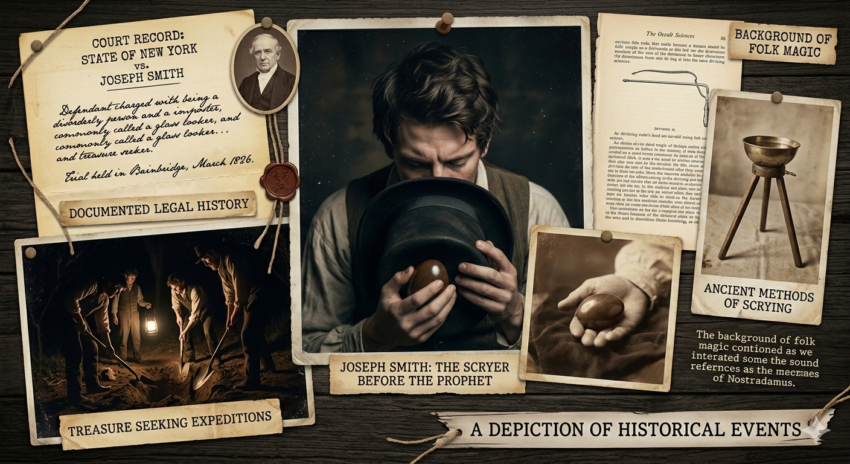
Before Joseph Smith was a prophet, he was a scryer. The historical record is unambiguous on this point: from his teenage years, Smith used a seer stone — a smooth brown rock he placed in a hat, burying his face in it to block light — to locate buried treasure. He was hired by neighbors to perform this service, and he was charged in 1826 in Bainbridge, New York, under an 1813 statute governing “glass lookers” and treasure diggers. The trial record survives. This is not a hostile fabrication; it is documented legal history.
AI-generated image imagining the setting in a 16th-century study filled with ancient scrolls and astronomical tools, Nostradamus captures a moment of “illumination,” translating ethereal images from the water into the poetic verses of Les Prophéties.
You don’t need to be Nostradamus to scry successfully. Discover how to scry with all the scrying tools and techniques you need to harness this ancient divination method…
Scrying rose to popular fame thanks to none other than Disney. The Queen in Snow White’s famous line, ‘Magic mirror on the wall…’ is, for many, our first introduction to the age-old divination practice of scrying. Yet scrying can reveal so much more than ‘the fairest of them all’. It has long been used as a lens into past, present and future.
The first recorded examples of scrying appear in China in around 3000 BCE, in Egypt in 2500 BCE, and in Greece in 2000 BCE. Nevertheless, it was the infamous French prophet, Michel de Nostredame, more commonly known as Nostradamus (1503-1566), who first put scrying on the map.
Nostradamus and scrying
Nostradamus used a scrying method familiar to ancient Greece; a scrying bowl filled with water. Erika Cheetham describes Nostradamus’ technique of placing a brass bowl of water upon a tripod in her book, The Prophecies of Nostradamus (1973). He would gaze upon this water until he perceived ‘a slight flame out of the emptiness’. It is through this perceived illumination that Nostradamus gained insight for his predictions about momentous future events. He recorded these predictions in a book of poetic verses, Les Prophéties, in 1955. Scholars are still analysing these quatrains today. From them, they have deciphered events such as the rise of Hitler and the assassination of John F Kennedy.
When we begin to scry, we send a message to our unconscious mind that we are seeking information that is beyond the reach of our senses and conscious awareness. The mind projects symbols and images onto our scrying tool to convey the information to our conscious awareness. These symbols and images are then translated by the scryer into meaning – whether that be for the sitter, or in answer to an enquiry made by the scryer. This translation of symbols and images is an essential part of the scrying process.
AI-generated collage depicting Joseph Smith’s early scrying and treasure-digging period, featuring him using a seer stone in a hat, the 1826 Bainbridge trial record, and symbolic elements of 19th-century folk magic like divining rods and scrying bowls.
Treasure-Seeking Roots in Smith Family Culture
Joseph Smith’s early immersion in folk magic and treasure seeking provides crucial context for naturalistic explanations of his prophetic claims, bridging occult practices with emerging Mormon revelations. Court records from 1826 confirm Smith’s conviction as a “disorderly person” for “glass-looking” in Bainbridge, New York, using a seer stone to locate buried treasure for Josiah Stowell. His father, Joseph Sr., was a habitual digger, employing divining rods and participating in the “New Israelites” group with William Cowdery (Oliver’s father), which emphasized dowsing for treasure and water; contemporaries like Willard Chase and Peter Ingersoll attested to the Smiths’ money-digging pursuits. Protective rituals—magic circles etched with Joseph Sr.’s ritual dagger, animal sacrifices to appease guardian spirits (e.g., toads or salamanders)—were commonplace, as treasure lore warned of enchanted guardians thwarting seekers.
Lucy Mack Smith’s Visionary Household
Lucy’s 1845 dictated memoir details a family steeped in dreams and visions amid financial ruin from failed crops and ginseng ventures: her dream of a pure stream between two trees symbolized salvation paths for Joseph Sr. (bitter water) and herself (sweet); another foretold their Vermont farm’s destruction. These experiences reflect a household blending orthodox Christianity with folk spirituality, where Joseph’s rod-to-stone evolution mirrored familial practices rather than an abrupt divine pivot.
Quinn’s “Magic World View” Continuity
D. Michael Quinn’s Early Mormonism and the Magic World View (1987, rev. 1998) documents this continuum through artifacts like Joseph’s Jupiter talisman (seized 1877, inscribed for wealth/protection), dagger, parchments with seals, and seer stones used for both treasure and translation. Quinn argues Smith’s “magic worldview”—perceiving supernatural forces in matter via rituals—underpinned genuine visionary experiences, not orthodox Protestantism; the Book of Abraham’s Egyptian papyri and temple rites echo folk magic patterns. Excommunicated in 1993, partly for this work, Quinn maintained these were authentic to Smith’s milieu, naturalistic yet sincere.
Psychological Theories: Fraud vs. Visionary
Naturalistic views bifurcate: “conscious fraud” (e.g., Rev. Wesley P. Walters) sees Smith exploiting credulity via cons; the subtler “pious fraud” or “genuine visionary” posits sincere subjective experiences misinterpreted as objective revelation. Scholars like Dan Vogel (Joseph Smith: The Making of a Prophet, 2004) and psychologist Robert D. Anderson (Inside the Mind of Joseph Smith, 1999) align with the latter, tracing visions to imagination amid revivalist fervor and family stress—Smith believed his seer stone translations, blurring psyche from performance. This sophisticated lens fits affidavits, journals, and Smith’s 1832 First Vision account, prioritizing psychological realism over polemic.
If the old attempts at defining Joseph Smith, Jr. as something other than a prophet are no longer useful, then what new definition might we plausibly attach to him? If “con man” stands at the lower end of a scale, and “prophet” stands at the higher end, are there any mediatory possibilities between these two extremes? Dan Vogel’s “pious fraud” category merges into the definition of “prophet;” and the term “con man” can be extended to the pretensions of “religious fraud.” Between the religious fraud of an unbeliever and the pious fraud of an unscrupulous believer, is there any place for Joseph Smith, Jr.? Upon careful consideration, there appears to be no simple definition for the man — that is, no credible explanation for the non-Mormon to fall back upon with any assurance.
Perhaps the best explanation useful for those outside the ranks of the Latter Day Saints, is that Smith was continually evolving in his faith-promoting role — his confidence-building role. At times his methods appear to overlap those of a con man, or a religious fraud. At other times his professed sincerity and seemingly selfless actions elevate the man to some indeterminate position overlapping a pious fraud and a would-be prophet. The Joseph Smith of modern reflection is a moving target and observers will discern what they will from the motion blur he has left in his wake. He presents to the non-Mormon observer the phenomenon that Jan Shipps might call a “prophet puzzle.”
It cannot be expected that contemporary LDS apologists will retreat and allow a puzzling “Joseph Smith version 3.0” to become the consensus conclusion, both outside and inside “the Church.” The revised Joe Smith is all good and well for propagation among the unbelieving Gentiles. He may even merit the reputation of a great religious genius and ecclesiastical architect, but this pious, evolving new Smith still looks too much like an impious “conscious impostor” for any official integration with latter day doctrine. Besides which, it may not bother religious liberals like some of the Reorganized LDS, that Smith is credited with authoring the Book of Mormon, but such a notion can never be allowed to take root among “God’s peculiar people,” headquartered in Salt Lake City, Utah. No — something must be done about Vogel’s “pious fraud” of a Prophet. And so, Richard L. Bushman, Reid Larkin Neilson, and Jed Woodworth devote a little attention to the matter in their 2004 Believing History —
[a new breed of “tolerant” readers], I suggest, may not be satisfied with the choices that Dan Vogel… offers to readers of Joseph Smith biographies. In describing some of the supernatural events in Joseph’s early life, Vogel says that we have three choices: (1) Joseph Smith consciously deceived people by making up events and lying about them; (2) he unconsciously deceived people by imagining events and calling them real; (3) he told the truth. Vogel asserts that we cannot believe that Joseph told the truth without abandoning all “rationalist categories of historical investigation.”
… Like Brodie, Vogel leans toward conscious deceit. Vogel believes Joseph Smith knowingly lied by claiming that he translated the Book of Mormon when in fact Joseph was making it up as he went along.
For my hypothetical body of twenty-first century readers, Vogel’s alternatives represent a hard choice. Readers are being asked to consider the revelations as either true or a form of deception. Joseph Smith either spoke for God or duped people. There is no middle ground…
Vogel thinks of Joseph Smith as a sincere deceiver. He sympathetically concludes, “I suggest Smith really believed he was called of God to preach repentance to a sinful world but that he felt justified in using deception to accomplish his mission more fully.”
(pp. 266-67 — duplicated on-line in Bushman’s “A Joseph Smith for the Twenty-First Century, Part 2”)
Well then, where in all of this 21st century revisionism do we find a place for “Joseph Smith: 19th Century Confidence Man?” Has the question become irrelevant in the post-modernist era? It is doubtful that the thoroughly conservative LDS Church will ever subscribe to such a notion. “Joe Smith the sincere deceiver” does not look very different from “Joe Smith the disreputable con man” when viewed in the light of traditional LDS doctrine. But perhaps writers like Bushman are attempting to look beyond the ecclesiastical walls of their own domain, to make some impression upon “a new breed of ‘tolerant’ readers” who are never destined to make a personal acquaintance with an LDS baptismal font. For the benefit of such a class of curious onlookers there may be some value in blurring the lines of demarcation laid out by Mr. Vogel. Perhaps there is room, somewhere, for “Joseph Smith 4.0” — the sincere deceiver and conscious fraud, who inexplicably was also made “a smooth and polished shaft in the quiver of the Almighty.”
The Dissociative and Hypnotic Models
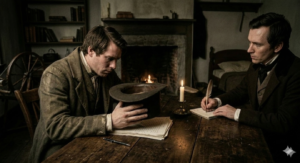
AI-generated image with a glimpse into the 19th-century translation process, as Joseph Smith sits at a table with Oliver Cowdery. Smith holds his face close to a top hat, a method some researchers suggest facilitated a self-induced trance or dissociative state, during which he dictated the text that became the Book of Mormon.
The Seer Stone Process and Trance-Like States
Joseph Smith’s Book of Mormon “translation” method—dictating for hours with his face buried in a hat containing a seer stone, blocking light to focus on ethereal characters—mirrors folk scrying techniques and aligns with self-induced trance or dissociation, per eyewitnesses like Martin Harris, Emma Smith, and David Whitmer. Eyewitnesses described him staring fixedly, words flowing rapidly without manuscripts or revisions, emerging only for brief breaks; Emma noted he had no books or papers nearby. Scholars like Lawrence Foster and Ann Taves interpret this as hypnotic induction via the stone, triggering “imaginative storytelling mode” and automated narrative flow akin to trance productions (e.g., Pearl Curran’s Ouija-channeled Patience Worth).
Anderson’s Psychobiographical Insights
Robert D. Anderson’s Inside the Mind of Joseph Smith: Psychobiography and the Book of Mormon (1999) employs object relations theory to unpack the text as an unconscious projection of Smith’s psyche, shaped by ten family relocations in 16 years, poverty from Joseph Sr.’s failed ventures, paternal alcoholism, maternal depression, and leg surgery trauma without anesthesia. He identifies narcissistic traits and “pseudologia fantastica“ (fabricated tales believed by the teller), linking Book of Mormon motifs—fractured families (Lehi’s rebellion), authority quests (kingmen vs. freemen), absent fathers—to Smith’s dynamics without formal diagnosis. Parallels abound: Lamanite curses echo Smith’s “dark” family visions; Nephite migrations reflect frontier instability.
Neurological Speculation on Visions
Temporal lobe transients offer a neurological lens for Smith’s adolescent visions (e.g., 1820 Sacred Grove, Moroni 1823), as Michael Persinger’s “God Helmet” experiments (1980s–2000s) induced vivid auditory/visual phenomena via magnetic stimulation, mirroring religious ecstasies. Temporal lobe epilepsy (TLE) traits like hyper-religiosity (Geschwind syndrome) produce quasi-sensory narratives; Persinger hypothesized microseizures evoke mystical states, reinforced by crises. No medical records confirm pathology for Smith, but his pattern—nighttime visions, trance dictation, “unusual” revelations noted by observers like Abner Cole—fits lability predispositions amid revival stress. Neurologist D. Jeffrey Meldrum (BYU, pro-LDS on anachronisms) has not published on this; speculation draws from broader TLE-religion links.
Hypnotic Suggestibility and Confabulation
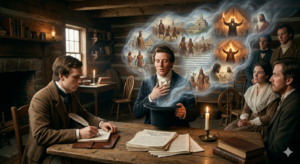
AI-generated image illustrates Automatic Writing in Action: Illustrating theories by scholars like Ann Taves, this scene captures the concept of “automatic writing.” As the scribe diligently records, the dictating figure experiences a spontaneous flow of vivid, real-time imagery, filling experiential voids with rich, fabricated details without conscious plotting.
Confabulation and Spontaneous Narrative Production
The confabulation model posits the Book of Mormon as emerging from Joseph Smith’s exceptional capacity for real-time, unconscious narrative generation, akin to neuropsychological confabulation—fabricating plausible details to fill memory/experience gaps without deceitful intent. Clinically, spontaneous confabulation (frontal/temporal lesions) produces “fantastic” stories via impaired reality monitoring; provoked variants respond to queries with sincere but false recalls. In religious contexts, it manifests as “sincere” fillings of experiential voids with culturally primed motifs (e.g., revivalist sermons, Indian origin tales), believed true by the producer, mirroring Smith’s trance-like dictation. William D. Morain’s The Sword of Laban (2015) and Ann Taves’s (Revelatory Events, 2016) frame this as “automatic writing,” where trance states yield coherent texts without conscious plotting.
Dictation Mechanics and Evidentiary Fit Witnesses uniformly describe a process defying premeditated fraud: 3–8 months (April 1828–June 1829), ~65 working days yielding 530 pages at 8–10 pages/hour; no manuscripts/notes visible, dictation in 20–30 word bursts, scribe reads back for accuracy, seamless resumption post-breaks without review. Martin Harris: Smith “had no books or manuscripts… save it were one small stone”; David Whitmer: “no reference of any kind to any manuscript or book”; Oliver Cowdery confirmed rapid flow, complex chiastic structures emerging unrevised. This speed/internal consistency (e.g., 100+ named figures/places, nested timelines) challenges conscious invention, favoring unconscious confabulation over concealed reading (refuted by hat’s darkness).
Emma Smith’s Testimony and Complexity
Emma Hale Smith Bidamon’s 1870 interview underscores absorption: “He had no such manuscript or book… When he dictated the Book of Mormon… it was not the product of study… I will not attempt to account for the phenomena… In writing for your father I frequently wrote day after day… hour after hour… During this time, Joseph would be at the table writing, or rather having me write for him… When the plates were brought in, he would lay them under the corner of the tablecloth… and then dictate to me hour after hour.” She resumed mid-sentence post-interruptions, discovered “things he did not know” (e.g., Jerusalem walls), yet deemed it inexplicable by “ordinary means.” Her RLDS loyalty tempers biased claims, aligning with trance models over cynicism.
The Collaborative Composition Theories
The Spalding Hypothesis: A Prior Manuscript
Origins of the Spalding-Rigdon Theory The Spalding-Rigdon theory, the earliest non-LDS explanation for the Book of Mormon, posits plagiarism from Solomon Spalding’s unpublished novel, alleging Sidney Rigdon stole and adapted it for Joseph Smith. It debuted in Eber D. Howe’s Mormonism Unvailed (1834), compiling affidavits by ex-Mormon Philastus Hurlbut from Spalding’s Conneaut, Ohio, neighbors (e.g., Oliver Smith, John N. Miller): they recalled Spalding reading Manuscript Found (ca. 1812), a tale of Romans/Israelites migrating to America post-shipwreck, with names/plots eerily like the Book of Mormon. Hurlbut (immoral, excommunicated) aimed to expose fraud, linking printer Patterson (Pittsburgh, where Spalding deposited it ca. 1816) to Rigdon (typesetter 1818–1821).
1885 Discovery and Resuscitation Efforts
Spalding’s death (1816, ex-minister, Dartmouth 1785) left manuscripts scattered; L.L. Rice found Manuscript Story (Romans in Britain/America) in 1885 Honolulu archives—no doctrinal content, minimal resemblance (no Lehi/Nephites), killing the theory for LDS apologists. Revival came via Wayne L. Cowdery (Oliver’s descendant), Howard A. Davis, and Donald R. Scales’ Who Really Wrote the Book of Mormon? (1977): they claimed a lost second Spalding MS (Manuscript Found, Hebraic, doctrinal) was stolen by Rigdon pre-1827, reworked with Smith/Cowdery—citing 50+ affidavits, handwriting “matches,” Rigdon’s access. Critics dismiss it as speculative, lacking the MS.
Rigdon’s Profile and the Timing Puzzle
The theory appeals by solving sophistication: Smith’s limited education (3 years formal) vs. the Book of Mormon’s theology (restorationism, grace/works), chiasmus, Hebraisms. Rigdon (1793–1876), Pittsburgh printer-turned-Campbellite preacher (baptized 1821), mastered Hebrew/Greek via Campbell, preached primitive Christianity, and authored My Doctrine (1825). Proponents allege secret 1826–1827 NY visits (via Cowdery?), but evidence shows first contact December 1830: Parley Pratt/Edward Partridge bring Book of Mormon to Mentor, Ohio; Rigdon converts ~Feb 1830 (post-Nov 1830 pub), brings flock to Kirtland. Rigdon denied pre-1830 knowledge under oath (1839, 1844); no contemporary docs prove earlier link, undermining theory despite affinities.
The Rigdon Connection: Circumstantial Evidence and Its Limits
Circumstantial Evidence Sustaining Rigdon’s Involvement
Despite evidentiary gaps in pre-1830 contact, the Spalding-Rigdon theory persists via stylometry and thematic alignments. Matthew Jockers, Craig Criddle, and Daniela Witten’s 2008 Nearest Shrunken Centroid (NSC) analysis of 5,000–10,000-word Book of Mormon blocks attributed ~40% to Sidney Rigdon, 26% to Solomon Spalding, and little to Joseph Smith, based on rare word clusters matching Rigdon’s sermons/letters. Critics (e.g., Paul Fields, 2011 FAIR conference) fault NSC’s small samples and priors biasing 19th-century candidates; later studies (e.g., Roper/Hilton) affirm ancient author distinctions. Non-conclusive, it fuels speculation of Rigdon’s hidden role.
Broadhurst’s Thematic Case
Dale R. Broadhurst, ex-Mormon attorney/historian, amassed parallels in online essays (1990s–2000s, sidneyrigdon.com): Rigdon’s Campbellite obsessions—apostasy/restoration, prophets/apostles’ primacy, Zion gathering, baptismal debates—mirror Book of Mormon’s core (e.g., 1 Nephi 13–14 apostasy; Alma 13 priesthood; Ether 13 gathering). Broadhurst posits Rigdon accessed Spalding via Patterson (1816), refined theology pre-1827, via a secret Cowdery link; thematic density (e.g., “marvelous work,” Isaiah expansions) exceeds coincidence, though undocumented.
Palmer’s Collaborative Framework
Grant H. Palmer’s An Insider’s View of Mormon Origins (2002)—by a CES teacher excommunicated in 2003—posits collaborative origins without naming Rigdon, arguing the Book of Mormon’s sophistication demands educated input beyond Smith’s ~3rd-grade literacy. Palmer catalogs 19th-century derivations: KJV italics/errors (e.g., Mosiah 21:28), View of Hebrews motifs, anti-Masonic Gadianton robbers, revivalist sermons (free agency, infant baptism critiques); theology as “American evangelicalism in narrative form.” He suggests associates like Oliver Cowdery (printer/schoolteacher) or Rigdon shaped content, aligning with witnesses’ “loose papers” hints—nuanced, evidence-based pushback on solitary genius.
Oliver Cowdery’s Potential Role
Oliver Cowdery as Potential Collaborator
Oliver Cowdery emerges in some naturalistic theories as a key understudy to Joseph Smith, leveraging his education, sources, and intimate role to co-shape the Book of Mormon. Born in 1806 in Wells, Vermont, Cowdery taught school in nearby Poultney (1821 census lists family there), attending Congregationalist Ethan Smith’s church, where View of the Hebrews (1823/1825) debuted—parallels like Israelite migration/Lost Tribes fueling speculation of transmission to Smith. Late,r a printer, lawyer (admitted to the Ohio bar 1837), and LDS Messenger and Advocate editor, Cowdery displayed rhetorical skill; his 1834 Letter VII series defended Book of Mormon historicity with sophistication.
Eyewitness Role and Lost 116 Pages
As principal scribe (April 1829–June 1829), Cowdery transcribed ~3,500+ plates’ worth (post-Harris’ 116-page loss, never redone), witnessing trance dictation sans notes. Stylometry (e.g., Hilton 1997) excludes Cowdery’s style from major blocks, but skeptics like Dan Vogel note his initiative: approaching Smith post-1828 (via Emma?), proposing printing—suggesting shared vision.
Co-Creative Priesthood Claims
Smith-Cowdery partnership was symbiotic: May 15, 1829, mutual Aaronic ordination by John Baptist (Harmony, PA; JS-H 1:68–72); days later, Peter James/John Melchizedek keys (Susquehanna woods). Cowdery’s 1848 Richmond, MO, testimony affirmed angelic restorations; 1835 Messenger and Advocate claimed Moroni/plates sighting with Smith (D&C 17). Excommunicated 1838 (Kirtland Safety Society), rebaptized 1848—loyal yet independent.
The Deliberate Fraud Theory: Smith as Calculating Deceiver
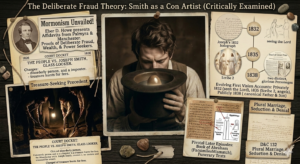
AI-generated image illustrates The Con Artist Framework: This collage presents a naturalistic critique of Joseph Smith, framing his religious movement not as a divine restoration, but as a sophisticated evolution of his early career as a frontier “scryer” and treasure hunter.
Deliberate Fraud Theory: Smith as a Con Artist
The starkest naturalistic view casts Joseph Smith as a calculating deceiver, fabricating revelations for power, wealth, and sex—from treasure scams to prophetic empire-building. Early critics embodied this: Eber D. Howe (Mormonism Unvailed, 1834) via affidavits painted Smith a liar; John C. Bennett, ex-Mayor/Church Assistant President (1841), defected in 1842, alleging “spiritual wifery” cons, seductions under “celestial marriage” guise (History of the Saints, 1842)—excommunicated for adultery/fraud. Polemicists like Alexander B. Norton (A Defence of the Faith, 1837) and 1870s Tanners labeled him a fraud; the persistence of this claim is maintained in modern critiques (e.g., CES Letter).
Treasure-Seeking Precedent
Strongest pillar: 1826 Bainbridge, NY, trial as “disorderly person” for glass-looking; Smith admitted using seer stone for Josiah Stowell’s treasure hunts, charging fees amid guardian spirit lore—convicted or discharged (records vary), pattern of unfulfilled claims. Affidavits (Palmyra 1833): Willard Chase called Smith “lazy,” family “cheaters”; evolved stone the same for “plates.”
Evolving First Vision Accounts
Private 1832 holograph (Joseph Smith Papers): sin-forgiveness crisis—“many sects,” “at 12 began to reflect,”“saw the Lord,” forgave sins—no Father, no creeds/church query (already deemed all wrong). 1835 (Scribe 2): two Personages, many angels; 1838 Pearl of Great Price (canonical): 14-year-old revival confusion—“which church?”—Godhead duo, all wrong. No public mention pre-1838 (despite 1820 claim); discrepancies (one/two beings, motive) suggest embellishment for authority amid apostasy narrative. Apologists cite complementary details (revival both), but evolution fuels fraud claims.
Pivotal Later Episodes Book of Abraham: 1835 Egyptian papyri “translated” as Abraham (facsimiles mismatch Egyptology); destroyed 1871, photos confirm funerary texts. D&C 132 plural marriage (1843): ~30–40 wives (teens/polyandry), denied publicly (1844)—D&C 132 retroactively justifies, post-Nauvoo Expositor destruction. Polygamy affidavits (1870s) vs. Emma’s denials highlight deception.
The Treasure Digging Pattern and the Gold Plates
Continuity with Treasure-Seeking Methods
Joseph Smith’s Book of Mormon translation seamlessly extended his folk magic practices: the same brown-white chocolate-colored seer stone, used for 1820s treasure hunts (e.g., 1825–1826 Stowell digs), went into a hat to exclude light, yielding English words via divine gift—mirroring scrying for guardian spirits/treasure guardians. Eyewitnesses (Emma, Harris, Whitmer, Knight): 20–60 words/phrase, rapid dictation sans notes; David Whitmer: “never saw the plates… nor the spectacles” during process. For ~150 years, official art/histories (e.g., 1842 Times and Seasons, Cowdery’s 1834 letters) emphasized Urim/Thummim “spectacles” (Nephite interpreters, briefly used); seer stone minimized as “hearsay” (e.g., McConkie 1958).
2013 Gospel Topics Essay Shift
The Church’s February 2013 “Book of Mormon Translation” essay (Gospel Topics, updated) explicitly affirmed: “Joseph… placed either the interpreters or the seer stone in a hat… and read aloud the English words”—citing Harris, Whitmer, etc.—sparking member shock (e.g., forums: “hiding it?”). Accompanied 2015 Ensign “Joseph the Seer” and manual updates; FAIR notes gradual disclosure, but critics hail it as “admission” of sanitized history.
Plates as Weighted Prop?
~11x8x6 inches (Pratt 1840s; Harris: 8x7x4–6), ~40–60 lbs (William Smith: “about sixty pounds”; Mary Musselman Whitmer hefted; Hyrum/McLellin felt weight)—feasible for tumbaga alloy (gold/copper/silver; ~53–58 lbs per Grover/Putnam) or tin plates (~37–51 lbs, Vogel replicas). Three Witnesses (June 1829): visionary (Harris: “by faith… angel showed”); Eight (late June): handled sealed stack, “hefted,” thumbed leaves/engravings—“like ancient arrowpoints” (Whitmer). Never fully unwrapped (linen; D&C 3); no non-family clear engravings view; returned to Moroni ~July 1829, unseen post. Fraud theorists posit tin/lead block (engravings filed superficially), weighted convincingly—familial trust (Hiram Page plates too) suffices; visionary element dodges scrutiny.
Revelation as Social Control
Self-Serving Revelations in Doctrine and Covenants Fraud theory peaks with Doctrine and Covenants (D&C) sections aligning suspiciously with Smith’s disputes, authority bids, and gains—personal crises yielding self-favoring “divine” mandates. Critics (Howe 1834, Bennett 1842, Tanners) cite a pattern: ~60% of 138 sections address immediate needs, theological retrofits.
D&C 132: Polygamy and Emma’s “Destruction”
Dictated July 12, 1843 (recorded post-July 22), amid Emma discovering Joseph’s letters to plural wives (e.g., Eliza R. Snow); Hyrum urged writing amid her “vexed” opposition. V51–56: Emma “receive… this law” (plurality), or “be destroyed“—property deeded away (v56: “give unto my servant Joseph”); v52: “first… receive this revelation… abide this commandment… or she shall be destroyed.” Post-revelation, Emma briefly “consented” (destroyed Parley Pratt MS); Joseph wed Eliza Partridge secretly in May 1843 despite refusal. Public denial (1844) vs. private ~30–40 wives (teens/polyandry) screams convenience.
Debt Forgiveness and Financial Mandates
D&C 64:27 (Sep 11, 1831): “I, the Lord, forgive the debtor”—context: Leman Copley reneged on Missouri lands (D&C 63:25 consecration); absolves Church debts amid economic woes. D&C 84:1–5 (Sep 1832): priesthood revelation post-Missouri Zion failure; indirectly mandates support (“care of the Church,” v72, 94–96 tithing precursors). D&C 82 (Apr 1832) forms the United Firm for properties.
Kirtland Safety Society Catastrophe
Jan 1837 “bank” (charter denied, “Anti-Banking Co.”); D&C 111 (Jul 1836, NY): “silver and gold… thrust upon you”; Warren Parrish revelation (1836) endorsed. Panic of 1837 collapsed it (notes worthless); investors (Rigdon, apostles) lost thousands—defections: Warren Parrish/John Boynton excommunicated, apostles fled Missouri amid suits (Joseph jailed). ~100 lawsuits targeted Smith as an endorser.
Erosion of Sincerity Boundary
Pattern—revelations resolve conflicts (D&C 3 rebukes Harris; 5 promises him witness), justify acts (D&C 27 wine; 28 Hiram Page seer stone)—hard to parse vision from opportunism. Fraud allows partial sincerity (pious elements), but consistent benefit (power, wives, funds) indicts construction.
The Book of Abraham: A Case Study in Fabrication Analysis
The Facsimiles and Their Claims
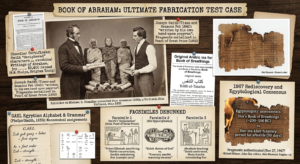
AI-generated image presents a visual case against the Book of Abraham’s origins, highlighting discrepancies between Joseph Smith’s explanations and Egyptological consensus. The composition points out specific examples where interpretations of figures and symbols differ from modern readings. It frames these differences as evidence of inconsistency, inviting viewers to question the reliability of the original explanations.
Book of Abraham: Ultimate Fabrication Test Case
The Book of Abraham stands as Mormonism’s starkest falsifiability lab: Smith’s 1835 “translation” of Egyptian papyri yields theology absent from the source—creation, premortal spirits, polytheism—disproven by rediscovered documents.
Chandler’s Mummies and 1835 Purchase
July 3, 1835: exhibitor Michael H. Chandler arrived in Kirtland, OH, with 4 mummies (Antonio Lebolo catacombs, 1831), 2+ papyrus rolls (one long Abraham scroll, Breathing Permit vignettes). Chandler’s July 6 certificate: Smith “deciphered” characters “much to… joy… writings of Abraham.” Church raised $2,400 (W.W. Phelps, Brigham Young); Smith: “roll contained writings of Abraham… writing of his own hand upon papyrus” (Times and Seasons Feb 1842). Fragments serialized 1842 Times and Seasons, Pearl of Great Price 1852.
1967 Rediscovery and Egyptological Consensus
Fire-damaged? No—surviving fragments (Met Museum, 1918 acquisition from Emma’s museum sales) returned to the LDS Church Nov 27, 1967 (Nibley authenticated). Egyptologists (unanimous, incl. LDS Robert Ritner, non-LDS John Gee critics): Hor’s Book of Breathings (Ptolemaic, ~200–100 BC), Hor-ma-kher funerary permit for afterlife (50 days post-death); vignettes standard Osiris resurrection. No Abraham/Jehovah; “Abraham” vignette = Hor’s resurrection by Anubis/Isis.
The Books of Breathing (Arabic: كتاب التنفس Kitāb al-Tanafus) are several ancient Egyptian funerary texts, intended to enable deceased people to continue existing in the afterlife. The earliest known copy dates to circa 350 BC.
Nonsensical Egyptian Alphabet & Grammar
1835 GAEL (Phelps/Smith): assigns paragraphs to characters (e.g., “Zub zub zuuz + Iohee = first degree Io = first order Zub = strength…”); hieroglyphs phonetic/ideographic, not rebus theology—pure invention, unrelated to Coptic/Egyptology (post-Champollion 1822).
Facsimiles Debunked
Fac 1 (lion couch): Smith—“priest Elkenah sacrificing Abraham on altar” (Fig 1 idolatrous god, 5 Abraham); Egypt—“Osiris resurrection, Anubis/Isis embalming Hor” (canopic jars). Fac 2 (hypocephalus): “Kolob throne of God”—funerary amulet warming mummy. Fac 3: “Pharaoh throne, Abraham teaching astronomy” (Fig 1 God, 2 King Pharaoh, 3 Abraham); Egypt—“Osiris enthroned, Maat/Anubis introducing Hor (Fig 5).” Consensus: misidentified vignettes; Smith’s “explanation” (1842) erroneous.
LDS Apologetic Responses to the Book of Abraham Challenge
LDS defenders proffer theories for the papyri-translation mismatch, gaining traction in committed circles (e.g., FAIR, Scripture Central) but scant non-LDS scholarly buy-in.
Missing Papyrus Theory
Prominent: Abraham text on lost fragments (surviving ~10–30% per Nibley/Gee; long roll estimates 20–40 ft, vignettes 5–10%). Kirtland Egyptian Papers (KEP) tied to Fac 1/ Breathing Permit, not Abraham—suggests “Abraham portion” separate/missing (Chicago fire?). Hurdles: Smith’s Times and Seasons (1842) links translation to vignettes; GAEL derives from extant chars; odds of precise “fit” sans source strain credulity.
Catalyst/Inspiration Theory
Church essay (2014): papyri “catalyst” for revelation, not literal text—like Book of Mormon plates. “Translation” broadly: pure revelation (Book of Moses); aligns D&C 76 “by… inspiration.” Critique: contradicts Smith’s claims—“translated… characters” (Chandler cert), “Abraham’s own hand” (History, 1835), KEP methodology; retrofits post-1967. Unfalsifiable, severs document-translation link.
Falsifiable Data Point
Non-LDS verdict: extant papyri (Hor’s Breathing Permit, vignettes) bear zero Abraham content—theological chasm, Egyptological slam-dunk (Ritner, Muhlestein debates notwithstanding). Unlike gold plates, Abraham supplies source + output: no match. Establishes Smith fabricated or “revealed” untethered from papyri—prophet or projector?
Literary and Structural Evidence
Hebraisms and Their Double Edge
Chiasmus Discovery and Its Limits John W. Welch’s 1967 mission epiphany (published BYU Studies 1969)—spotting chiasmus (AB…BA parallelism) in Mosiah 5:10–12 (“Mosiah, king Mosiah… Christ, Lord Christ”)—ignited LDS fervor as Hebraic fingerprint, proliferating 200+ studies (Chiasmus in Antiquity, 1981). Ancient staple (Isaiah 6, Leviticus), obscure in 1820s U.S. (post-Lowth 1753, pre-Welch revival)—argued improbable for Smith sans Hebrew.
Ubiquity Blunts Claim
Counter: chiasmus universal in extended prose—Jane Austen, Dickens, Uncle Tom’s Cabin abound (simple ABBA); Book of Mormon’s elaborate (Alma 36) cluster in KJV-Isaiah quotes/expansions (2 Nephi 9–10), doctrinal pivots. Welch concedes non-random stats, but 19th-century. prevalence (Thoreau, sermons) fits revivalist oral patterning, not uniquely Semitic.
KJV Artifacts Over Hebraisms
Linguist Edward H. Ashment (SUNSTONE 1980) flags KJV-isms: 1,405 “and it came to pass“ (27% verses; 1 Nephi 129x, Helaman 99x)—KJV 453x (OT), Hebrew wayehi convention, but density apes Bible mimicry (Twain: “pamphlet sans”). “If-we… that-we” pleonasms (Alma 34:32), Isaiah italics/errors (2 Nephi 12:9)—translationese from KJV immersion, not Hebrew underlayer. Debate rages: ancient residue or 19th-century. idiom?
The 1769 King James Edition Problem
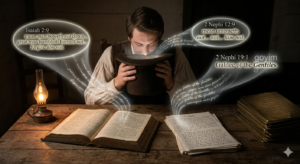
AI-generated image illustrates the Verbatim Errors (Isaiah 2:9): The magnified bubbles compare the KJV text of Isaiah 2:9 with 2 Nephi 12:9. It shows how the Book of Mormon replicates a known 1769 KJV printing error (“him not”) and specific italicized words, even though the original Hebrew and earlier English editions (1629) read correctly as “them not.”
KJV Errors Expose Book of Mormon Isaiah Dependence
Imagine translating ancient Hebrew plates from 600 BC—centuries before the Masoretic text—only to reproduce quirks from the 1769 King James Bible, including translator italics and printing errors. That’s precisely what the Book of Mormon’s 21 Isaiah chapters (2 Nephi 12–24, etc.) do, claiming origin on Laban’s brass plates (1 Nephi 5:13).
These passages don’t just echo the KJV; they replicate its idiosyncrasies verbatim. Consider 2 Nephi 12:9 (= Isaiah 2:9): “mean man boweth not down… great man humbleth himself not… forgive him not.” The 1769 KJV edition—Smith’s likely Bible—erroneously reads “not… not… him not,” while earlier Cambridge editions (1629/1638) correctly say “them not,” matching the Hebrew.
The pattern repeats: 2 Nephi 19:1 (= Isaiah 9:1) uses “Galilee of the Nations” (1769 “Gentiles” blunder; Hebrew goyim). 2 Nephi 12:16 (= Isaiah 2:16) has “ships of the sea shall toss” (1769 “be tossed”; Hebrew reflexive). Across ~433 verses, 46% match KJV word-for-word, retaining italics like 2 Nephi 14:5’s “be called holy” (absent Hebrew).
Ancient Source? Impossible.
A pre-exilic translation should align with Hebrew originals (Dead Sea Scrolls/Septuagint), not 17th-century English artifacts postdating 600 BC by 1,100+ years. Scholar David P. Wright notes the text responds to KJV phrasing, not Semitic undertext. Apologists invoke “loose translation” or divine KJV fidelity; critics see direct cribbing from Smith’s well-worn Bible, dictated mid-trance.
This isn’t interpretive wiggle room—it’s falsifiable: 1769 errors in “ancient” plates confirm modern origin. The parsimonious verdict? Smith channeled the King James idiom he knew intimately.
The Nineteenth-Century Theological Fingerprint
The Book of Mormon’s 19th-Century Theological Mirror
Picture an ancient record from 600 BC–421 AD, penned for future readers, suddenly surfacing in 1830, upstate New York. You’d expect timeless universals, not laser-focused takedowns of 1820s Protestant squabbles. Yet the Book of Mormon dives headlong into era-specific flashpoints: infant vs. believer’s baptism, grace-alone vs. works, creedal authority, church polity, New Testament gifts, and revelation’s cessation—settling them with 1820s polemical edge.
Burned-over district revivalism boiled with these: Presbyterians/Methodists defended infant sprinkling; Baptists/Campbellites demanded adult immersion (Alexander Campbell’s 1827 Christian Baptist: creeds “human inventions”). Book of Mormon counters: Moroni 8 “solemn mockery” (infants innocent); 2 Nephi 31 immersion “whole body… buried”; Alma 32 faith-works balance; 2 Nephi 29 mocks “Bible-only” cessationists.
Parallels from Pulpit and Press
The parallels cascade. Campbell’s restorationist push for prophets, apostles, and primitive church order mirrors 2 Nephi 3/27 and 3 Nephi 11. Charles Finney’s 1830s infant salvation debates find rebuttal in Alma 32 and Moroni 8. The anti-creedal fervor sweeping Palmyra manifests in 1 Nephi 13’s “great and abominable church” that “adds cunning” to scripture (post-1830 KJV tweak). Revival tongues and prophecy? Moroni 10.
No verbatim plagiarism—Smith’s voice rings distinct—but the thematic saturation screams immersion in his milieu: Presbyterian, Baptist, Methodist exposures amid frontier revivals. An ancient Nephite/Lamanite manual, oddly preaching 19th-century America? Critics see an unmistakable fingerprint of revivalist dictation; apologists claim prophetic prescience. The systematic attunement to the 1820s debates parsimoniously points modern.
The Pearl of Great Price: Moses and Smith’s History
The Book of Moses and Expanded Genesis
Book of Moses: 1830 Revelation or Retroactive Theology?
In June 1830, mere weeks after the Book of Mormon’s March publication, Joseph Smith received what became the Book of Moses—eight expanded Genesis chapters in the Pearl of Great Price (canonized 1880). No physical artifact like Abraham’s papyri, so empirical debunking yields to literary scrutiny: it fleshes out Moses’s visions, Satan’s fall, Enoch’s Zion utopia (Moses 7), plan of salvation—all KJV-infused, suspiciously attuned to nascent LDS doctrines.
1830 Doctrinal Syncs
Text codifies emerging revelations: Moses 6:62 “plan of salvation“ (faith/repent/baptize/Spirit)—echoes D&C 20 (Apr 1830); Enoch’s city “taken up” (Moses 7:21,69)—D&C 38:4 (Jan 1831) Zion bosom; Satan weeps (Moses 7:44)—prefigures war in heaven (D&C 29:36–38, Sep 1830); premortal council (Moses 4:1–4)—D&C 93:29 intelligences (1833). Genesis expansions (Adam baptism, priesthood) ground the JST Bible (1830–1831).
Campbell’s 1831 Prescience
Restorationist Alexander Campbell—baptized Sidney Rigdon/Parley Pratt (1830), whose flocks swelled Mormon ranks—dissected the Book of Mormon in Delusions (Millennial Harbinger, Feb 1831): “solution to every religious question agitating America… Smith’s positions.” Pre-LDS temple/polygamy, he nailed polemic (creeds, gifts, restoration)—“contemporary theological polemic masquerading ancient history.”Oliver Cowdery rebutted (PDF download, 1835), but Campbell’s early insight endures.
This 1830 imprint—KJV phrasing fused with doctrinal scaffolding for Smith’s unfolding revelations—poses a stark choice: ancient lost scripture, or modern blueprint? Critics vote decisively for the latter.
Joseph Smith’s History and Its Problems
Pearl of Great Price Histories: From Private Vision to Public Legend
Tucked into the Pearl of Great Price—canonized in 1880—the official Joseph Smith—History (1:1–26) delivers the polished origin story of Mormonism’s founding prophet: a teenage First Vision, angelic Moroni visits, and golden plates retrieved from a hill. Drawn from Smith’s 1838–1856 manuscript (serialized in the 1842 Times and Seasons), these vignettes feel foundational. Yet peel back the layers, and they reveal a narrative in constant evolution, each retelling more elaborate, more theologically charged, mirroring how religious movements shape memory to meet the moment.
A Vision That Grew in the Telling
Smith’s earliest account, scrawled in his own hand in 1832, paints an intimate crisis of conscience: at age 12, wrestling with sin amid warring sects, he sees “the Lord” alone—no Father—offering forgiveness and damning creeds as corrupt. Fast-forward to November 1835, recounting to stranger Robert Matthias: now two glorious Personages pierce a pillar of light, flanked by angels, an evil power first thwarting prayer. By 1838—the canonical Pearl of Great Price version, penned amid Kirtland’s banking collapse and swelling apostasy—a 14-year-old Smith seeks “which church shall I join?” Revival chaos sets the stage; Father and Son deliver the ecclesial verdict. No public whisper of this vision surfaces before 1838, despite its supposed 1820 earth-shaking import. With each iteration, details swell—angels, opposition, cosmic stakes—perfectly timed for institutional crisis.
Moroni’s Visits: Guardian Spirit to Divine Messenger
The plates saga follows suit. Joseph Smith—History 1:27–65 casts 1823 Moroni as a resplendent angel directing Hill Cumorah’s treasure; annual nighttime pilgrimages ensue (1823–1827). Yet Oliver Cowdery’s 1834–35 Messenger and Advocate letters blur the First Vision into a singular 1820 revival epiphany with Moroni; his 1829 claims add personal plates, witness. The pattern is unmistakable: Smith’s treasure-hunting guardian spirit, complete with annual hill rites, transmutes into a celestial envoy, aligning folk magic with prophetic calling.
The Psychology of Sacred Memory
Religious scholars like Bart Ehrman and Jan Shipps chart this trajectory across faiths: raw subjective experiences accrue cultural gloss and theological utility over time. Smith’s arc—from private absolution (1832) to public mandate (1838)—shadows his movement’s needs: D&C 20’s church blueprint (1830), 1837 Kirtland Safety Society fallout. An original spark may have ignited, but its retellings—ever more vivid, ever more essential—bear the fingerprints of retrospection and institution-building, turning personal epiphany into founding myth.
The Revelatory Process: How Translations Worked
The Hat and Stone: Mechanics of Dictation
Understanding the mechanics of Smith’s translation process is essential to evaluating origin theories. The most credible account, consistent across multiple sources including Emma Smith, Martin Harris, and Oliver Cowdery, describes Smith placing his seer stone in a hat, burying his face to exclude light, and dictating text that appeared as luminous letters or words in the stone. The plates themselves, according to most witness accounts, were not directly consulted during translation — sometimes they were in the room wrapped in cloth, sometimes not present at all. Witnesses noted that a word or phrase would remain visible in the stone until correctly transcribed.
This process is described by LDS theologians as miraculous and by critics as entirely consistent with Smith’s existing practice as a treasure seer — a man who had spent years staring into a stone looking for treasure and producing accounts of what he saw there. The transition from producing treasure visions to producing scriptural texts required no new mechanics, only a new social context and a new audience. What changed was not the method but the meaning assigned to it.
The dictation mechanics have implications for theories of production. If Smith were reading from a concealed manuscript, the hat-and-stone method would make that difficult but not impossible — he could, in principle, have memorized substantial passages or used the stone as a prop while dictating memorized text. If he were improvising, the process is consistent with an individual capable of sustained oral narrative performance in altered states. If the process involved unconscious confabulation, the mechanics would facilitate rather than hinder it. No theory of origin requires the mechanics to be other than what witnesses describe; different theories simply interpret those mechanics differently.
Speed, Consistency, and the Absence of Revision
Critics of naturalistic theories sometimes invoke the speed and consistency of the Book of Mormon’s production as evidence against simple fraud. Smith and his scribes produced roughly 8,000 words per transcription day over approximately 65 working days — a pace that seems to preclude careful composition. More striking, according to Emma Smith’s testimony, her husband never consulted previously dictated text, resuming after interruptions from exactly the point of departure without review. The Book of Mormon’s internal chronology, genealogies, and narrative consistency across the full 270,000 words would be remarkable if produced by conscious improvisation under these conditions.
The honest intellectual response to this argument is that it cuts both ways. It is evidence against simple, clumsy fraud. It is not evidence against the several more sophisticated possibilities: unconscious confabulation by a mind with unusual narrative capacity; prior composition and memorization; collaboration with someone who maintained the larger narrative architecture; or genuine revelation. The argument from speed is frequently invoked apologetically as though eliminating fraud eliminates all naturalistic explanations. It does not.
Modern Scholarship and Synthesis
The Post-DNA Problem
The environmental and literary theories received powerful new support from molecular anthropology. In 2002, geneticist Simon Southerton published Losing a Lost Tribe: Native Americans, DNA, and the Mormon Church, synthesizing the emerging consensus from mitochondrial DNA and Y-chromosome studies of Native American populations. The genetic evidence overwhelmingly supports an Asian origin for the ancestors of Native Americans, via the Bering Land Bridge, with no detectable Near Eastern genetic contribution at the time, scale, or location that Book of Mormon history would require. Southerton, himself a former LDS bishop, acknowledged the theological devastation of his findings.
LDS apologists have responded with the “limited geography theory” — confining the Book of Mormon narrative to a small region, perhaps Mesoamerica, where a small Israelite founding population could have been genetically absorbed into a much larger indigenous population, leaving no detectable signal. This response has attracted some scholarly attention but requires reading the text against its apparent intent: Nephites and Lamanites are described as the ancestors “of the American Indians” in multiple Church documents, including the title page and official 1981 introduction to the Book of Mormon. The Church quietly revised that introduction in 2006, removing the phrase “principal ancestors” in favor of “among the ancestors” — an editorial change that registered the genetic problem without acknowledging it.
The Gospel Topics Essays: Institutional Acknowledgment of Problems
Between 2013 and 2015, the LDS Church published a series of Gospel Topics Essays acknowledging historical and doctrinal difficulties that had long been suppressed or downplayed in the official curriculum. The essays acknowledged the seer stone translation method, the existence of multiple First Vision accounts, the practice of plural marriage with girls as young as fourteen, polyandrous sealings to women already married to living husbands, the Book of Abraham papyri problem, and DNA evidence challenges to Book of Mormon historicity. Published without authorial attribution and initially without any prominent linking from the Church’s main website, the essays represented a significant institutional acknowledgment that the received version of LDS history was incomplete at best.
For origin theory analysis, the essays are important because they demonstrate that the evidentiary problems identified by critics are not the product of anti-Mormon prejudice but are recognized by the institution itself as genuine historical difficulties requiring pastoral management. The essays do not abandon faith claims — they argue for continued belief while acknowledging the problems — but they implicitly validate the scholarly and critical work that uncovered those problems over more than a century.
The Myers and Hales Contribution: Pushing Back
Fair representation of the scholarly landscape requires acknowledging that not all serious researchers find naturalistic theories adequate. LDS historians Brian and Laura Hales have produced exhaustive documentation of plural marriage that, while not vindicating Smith on ethical grounds, complicates the simple fraud narrative by demonstrating that many of Smith’s plural marriages were not sexually motivated and that the practice was embedded in a genuine theological framework, however problematic from an orthodox Christian standpoint. John L. Sorenson’s Mormon Codex (2013) remains the most ambitious attempt to situate Book of Mormon geography in Mesoamerica and find plausible correspondences, though scholars outside the LDS community have generally found his methodology circular.
The fundamental epistemological problem with pro-LDS scholarship on origins is that it operates within a framework of committed belief — the conclusion is fixed, and the evidence is marshaled accordingly. This does not make such scholarship worthless; apologetics has always produced careful scholarship as a byproduct of its advocacy. But it does mean that the weight of the scholarly consensus, including the work of LDS historians operating under institutional pressure, has generally moved in the direction of greater skepticism about the traditional narrative rather than greater confidence.
An Appraisal: What the Evidence Supports
Convergence and Divergence Among the Theories
The various non-LDS theories surveyed here converge on several points while diverging on others. All serious theories agree that the Book of Mormon and associated texts are most plausibly understood as nineteenth-century productions rather than ancient records. All agree that the environmental matrix of upstate New York in the 1820s provided the raw material — theological, literary, and cultural — for the texts Smith produced. All agree that the Book of Abraham, in particular, cannot be defended as a genuine translation by any intellectually honest standard. The divergence is primarily over Smith’s psychology: was he a calculating fraud, a genuine visionary who believed his own revelations, a gifted confabulator, or some complex combination of all three?
The evidence most strongly supports the combination view. The treasure-seeking context and the mechanics of the seer stone establish that Smith had a genuine capacity for visionary experience — whether produced neurologically, psychologically, or supernaturally is a separate question — and had been practicing it for years before the Book of Mormon. The internal consistency of complex narrative threads across the Book of Mormon is more consistent with sustained creative vision, however produced, than with simple on-the-fly fabrication. The nineteenth-century theological fingerprint, the KJV Isaiah problem, and the Book of Abraham evidence together establish beyond reasonable scholarly doubt that Smith was not receiving material from ancient sources with no connection to his contemporary world.
The Fraud-Vision Spectrum
Joseph Smith: Creative Storyteller from Boyhood
Documentation exists, primarily from Lucy Mack Smith’s 1845 history (dictated 1844–45, published 1853), portraying young Joseph (~12–18) as a captivating narrator of ancient American tales—prefiguring Book of Mormon motifs. She recounts family evenings where “Joseph would occasionally give us some of the most amusing recitals that could be imagined. He would describe the ancient inhabitants of this continent, their dress, mode of traveling, and the animals upon which they rode; their cities, their buildings, with every particular; their mode of warfare; and also their religious worship. This he would do with as much ease, seemingly, as if he had spent his whole life among them.”
Neighbors’ 1833 Palmyra affidavits (Hurlbut) deride “lazy” Smiths, money-digging “necromancers,” but imply imaginative flair (no direct “storyteller”). William Smith (1875): truthful boy, family believed visions implicitly. Critics (Vogel) spin Lucy’s “amusing” as tall tales; apologists: prophetic previews.
Nuanced Spectrum: Beyond Fraud or Prophet
Scholars like Fawn Brodie, Dan Vogel, D. Michael Quinn, Robert Anderson, and Grant Palmer place Smith on a spectrum defying binaries. Picture a boy of prodigious creative/social genius, steeped in magic (seer stones, guardians) and visions, honing trance-narratives into a movement of mythic endurance. Family/friends saw storyteller first—did he blur subjective spark from public claim? Evidence whispers no—a prophet-pioneer navigating inspiration’s gray fog.
This is not a charitable reading in the sense of being flattering to Smith — it describes a man who misled his most intimate associates about matters of enormous consequence. But it is charitable in the sense of being historically serious, refusing the reductiveness of pure cynicism. The man who produced the Book of Mormon, whatever its origins, was not simply reading from a concealed manuscript in a hat. Something more psychologically complex and more humanly interesting was happening in that farmhouse in western New York, and the honest intellectual task is to describe it as accurately as the fragmentary evidence permits.
The Apologetic Implication for Christian Ministry
For Christians engaged in evangelism among LDS communities, the origin theories surveyed here carry specific pastoral implications. The theories are not primarily useful as rhetorical weapons — deployed clumsily, they generate defensiveness and close rather than open conversations. They are useful as frameworks for honest inquiry, particularly when LDS interlocutors are willing to follow evidence where it leads. The Book of Abraham is particularly valuable as a starting point precisely because it is the cleanest case, least susceptible to the charge of theologically motivated reasoning, and most likely to produce the cognitive dissonance necessary for genuine re-evaluation.
The honest apologist acknowledges what the theories can and cannot establish. They can establish, beyond a reasonable doubt, that the Book of Mormon and the Pearl of Great Price are not what they claim to be. They cannot establish the precise mechanism of their production, which may never be known with certainty. They can establish that Joseph Smith was not a reliable prophetic voice — his track record on prophecy, including multiple failed prophecies documented in primary sources, is unambiguous. They cannot establish that Smith was, therefore, the most contemptible fraud in American history — that designation fails to account for the genuine complexity of his psychology and the genuine power of the movement he created.
What the non-LDS scholarship consistently establishes is this: the Latter-day Saints’ confidence in the truthfulness of the Restoration narrative rests not on historical and archaeological evidence — that evidence uniformly undermines the narrative — but on a subjective spiritual testimony that is explicitly insulated from empirical challenge by the very epistemology the Church teaches. The “burning in the bosom” standard for truth, when examined critically, is a methodology that would validate virtually any religious claim. That is the conversation worth having, and the origin theories surveyed here provide the necessary background for having it honestly.
Conclusion: The Persistent Question
Joseph Smith produced a prodigious body of texts in a remarkably short time, texts that have sustained a major world religion for nearly two centuries. The question of how he did it remains open in its details while settled in its broad outlines. He did not translate golden plates from an Israelite civilization in ancient America. He did not translate Egyptian papyri from Abraham’s own hand. He did not receive the Book of Moses as a restoration of Genesis chapters suppressed for millennia. What he did — whether through visionary confabulation, deliberate fraud, collaborative composition, or some combination — was to produce texts that functioned as scripture for his followers, that encoded the theological disputes of his age in the idiom of ancient narrative, and that generated a movement sufficiently resilient to survive his violent death and expand across the world.
The non-LDS theories collectively demonstrate that the extraordinary explanation — divine revelation and miraculous translation — is not the best explanation. Occam’s razor, applied honestly to the evidence surveyed here, consistently points toward the ordinary: a brilliant and unusual man, working in a specific historical context, producing texts that reflect that context in the ways all human texts do. The extraordinary explanation requires the dismissal of DNA evidence, Egyptological consensus, multiple textual anachronisms, the progressive development of revelation narratives, and the pattern of revelations that tracked Smith’s personal interests with suspicious precision. The naturalistic explanations require only that Joseph Smith was a complex human being capable of producing extraordinary things by ordinary means, which is, in the end, a far more intellectually modest and historically defensible position.
For the Christian evangelist engaging with Latter-day Saints, this body of scholarship is not the destination. It is the clearing of the ground. The destination is the Christ of Scripture, whose sufficiency requires no Restoration because his atonement was not, as LDS theology insists, incomplete. But the ground must be cleared. Joseph Smith’s prophetic claims stand or fall on evidence, and the evidence surveyed here establishes what honest inquiry has always established: they fall.
Select Bibliography
• Anderson, Robert D. Inside the Mind of Joseph Smith: Psychobiography and the Book of Mormon. Signature Books, 1999.
• Brodie, Fawn M. No Man Knows My History: The Life of Joseph Smith. Knopf, 1945.
• Howe, Eber D. Mormonism Unvailed. Telegraph Press, 1834.
• Palmer, Grant H. An Insider’s View of Mormon Origins. Signature Books, 2002.
• Quinn, D. Michael. Early Mormonism and the Magic World View. Revised ed. Signature Books, 1998.
• Roberts, B.H. Studies of the Book of Mormon. University of Illinois Press, 1985.
• Smith, Ethan. View of the Hebrews. Smith & Shute, 1823.
• Southerton, Simon. Losing a Lost Tribe: Native Americans, DNA, and the Mormon Church. Signature Books, 2004.
• Vogel, Dan. Joseph Smith: The Making of a Prophet. Signature Books, 2004.
• Widmer, Kurt. Mormonism and the Nature of God: A Theological Evolution. McFarland, 2000.
A Note on Research Methods and Accuracy
This work represents a collaboration between the author’s own theological research, primary source documentation, and the emerging capabilities of artificial intelligence research tools. AI assistance was employed throughout the investigative process — not as a ghostwriter or a substitute for scholarship, but as a rigorous research partner: surfacing sources, cross-referencing claims, identifying scholarly consensus, and flagging potential errors before they could reach the page.
Every factual claim in this work has been subjected to active verification. Where AI-generated content was used as a starting point, it was tested against primary sources, peer-reviewed scholarship, official LDS documentation, and established historical records. Where discrepancies were found — and they were found — corrections were made. The author has made every reasonable effort to ensure that quotations are accurately attributed, historical details are precisely rendered, and theological claims fairly represent the positions they describe or critique.
That said, no work of this scope is immune to error, and the author has no interest in perpetuating inaccuracies in the service of an argument. If you are a reader — whether sympathetic, skeptical, or hostile to the conclusions drawn here — and you identify a factual error, a misattributed source, a misrepresented doctrine, or a claim that cannot be substantiated, you are warmly and genuinely invited to say so. Reach out. The goal of this work is not to win a debate but to get the history right. Corrections offered in good faith will be received in the same spirit, and verified corrections will be incorporated into future editions without hesitation.
Truth, after all, has nothing to fear from scrutiny — and neither does this work.