

Are we still waiting on this prophecy, or did Brigham Young miss it “by a mile?”
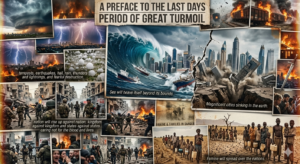
“The last days will be a period of great turmoil… All we have yet heard and we have experienced is scarcely a preface to the sermon that is going to be preached. When the testimony of the Elders ceases to be given, and the Lord says to them, “Come home; I will now preach my own sermons to the nations of the earth,” all you now know can scarcely be called a preface to the sermon that will be preached with fire and sword, tempests, earthquakes, hail, rain, thunders and lightnings, and fearful destruction. What matters the destruction of a few railway cars? You will hear of magnificent cities, now idolized by the people, sinking in the earth, entombing the inhabitants. The sea will heave itself beyond its bounds, engulfing mighty cities. Famine will spread over the nations and nation will rise up against nation, kingdom against kingdom and states against states, in our own country and in foreign lands; and they will destroy each other, caring not for the blood and lives of their neighbors, of their families, or for their own lives.”
(Discourses of Brigham Young, 111–12).
Ah, yes. The Great American Prophet. The man who looked at the dusty, wind-blasted salt flat he’d just parked his handcarts on and thought, “This is the place where I will become an infallible mouthpiece for God.”
Gather ’round, friends, because Brigham Young has an announcement. The Lord is done letting mere mortals do His talking. He’s going full pyrotechnics. Fire. Sword. Earthquakes. Hail. Cities swallowed whole. The sea eating coastlines like an all-you-can-drown buffet. This isn’t a sermon — this is a Michael Bay film with divine backing.
And the best part? What you’ve seen so far is barely a preface.
That was 1860-something. Let’s check the scorecard.
Magnificent cities sinking into the earth? Chicago is still there. New York is insufferably still there. Paris is annoyingly still there, hosting fashion weeks and film festivals with zero subterranean activity. Los Angeles — which frankly deserves it — remains stubbornly above sea level, producing Marvel sequels without interruption.
The sea heaving itself beyond its bounds? Oceans remain, as ever, professionally bound. They have not received Brigham’s memo.
The Lord preaching His own sermons with fire and sword? Crickets. The Elders are still out there knocking on doors, wearing their little name tags, apparently because God has not yet cleared His throat to open His cosmic keynote address.
Now, in fairness to Brother Brigham, he did hedge brilliantly. He didn’t give a date. He didn’t say which magnificent cities. He didn’t specify whose famine. This is prophecy written in permanent escape-hatch ink — vague enough to be unfalsifiable, dramatic enough to keep the Saints suitably terrified and sufficiently obedient.
It’s a masterclass in apocalyptic ambiguity: predict catastrophe on a long enough timeline and someone, somewhere, will point to something and say, “See? He called it.”
Meanwhile, we’re still waiting for God to swap the missionaries for meteors.
He missed it by a mile? Try by a geological epoch. The only “great turmoil” here is the mental gymnastics required to pretend this wasn’t just a narcissistic control freak trying to scare the polygamy royalties into handing over another tithing settlement.
Any. Day. Now.
Oh, wait … was Brigham Young channeling the Book of Revelation?
Absolutely — and that’s actually the more damning indictment.
Here’s why:
The sourcing problem cuts both ways. If Young was genuinely prophesying, the content should be original revelation — thus saith the Lord, fresh word, apostolic authority in action. That’s the whole LDS claim: a living prophet who receives current divine communication, not a seminary student recycling Patmos.
But the “prophecy” reads like a greatest-hits remix of Revelation 6–16: seals, bowls, wrath, cities falling, seas convulsing, nation against nation (which is actually Jesus in Matthew 24, also borrowed). Young essentially dressed John’s apocalypse in 19th-century frontier grammar and repackaged it as prophetic utterance.
The irony is exquisite. LDS theology insists the Bible is incomplete, corrupted, and insufficient — hence the need for a restored prophet. Yet when Brigham wants to sound prophetic, he plagiarizes the Bible he just discredited.
The theological trap: He’s caught in a vise. Either —
He received original revelation, in which case we’re 160 years into “any day now,” or
He was paraphrasing John, in which case he’s a prophet borrowing his prophecies from a source his own church considers unreliable
Neither exit is clean.
Bottom line: Brigham Young didn’t channel Revelation. He laundered it — ran John’s visions through the prophetic spin cycle and handed them back to the Saints as fresh goods.