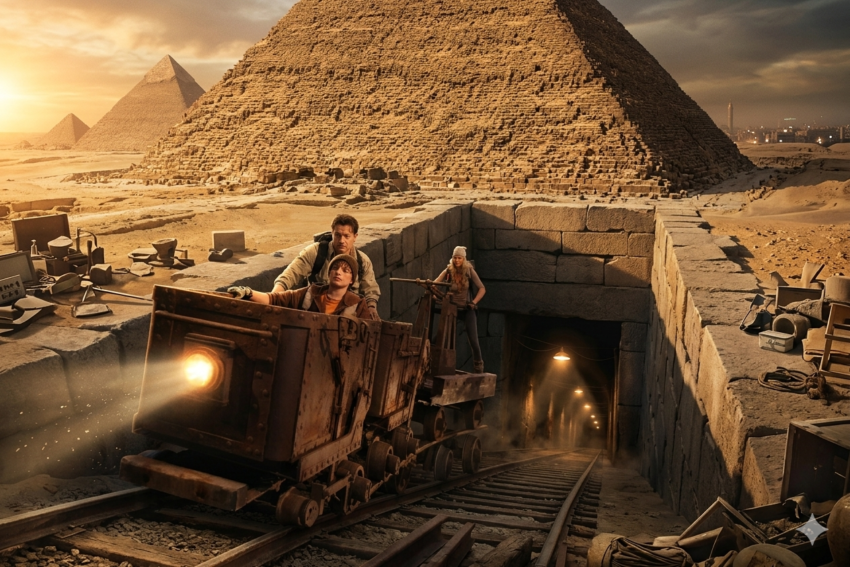
Image: This dramatic AI-generated image imagines Brendan Fraser’s epic return from a forgotten ancient city on his breathtaking journey to the Earth’s core, discovered through a shaft at the foot of the Khafre pyramid.
How a Fringe Physicist, a Conspiracy King, and the Internet Fabricated the Greatest Archaeological Fraud Since the Arizona Gazette’s Egyptian Cave
INTRODUCTION: The Viral Lie That Swallowed the Internet
On March 19, 2025, Alex Jones—the barrel-chested prophet of Infowars, professional vendor of dietary supplements and apocalyptic hysteria—stabbed his finger at his keyboard and unleashed what he called the greatest archaeological discovery in the history of human civilization. His post on X was breathless: “Using Powerful Ground-Penetrating Radar, Scientists Have Mapped a Structure More Than Twice the Height of the Tallest Building on Earth Under the Khafre Pyramid in the Giza Complex.”
Within hours, the claim was everywhere. It appeared on fringe news aggregators, migrated into mainstream tabloids, invaded Facebook feeds and YouTube comment sections, and eventually found its way into the amplifying megaphone of Joe Rogan’s enormous audience. Dozens of headlines blared variations of the same astonishing claim. Truth Mafia ran it. Deep Newz ran it. News 18 ran it. Each outlet added its own layer of melodramatic varnish, and by the time the story had completed one full revolution around the internet, hundreds of millions of people had been exposed to a claim that was—from first principle to final footnote—physically impossible.
This is not a story about archaeology. It is a story about how fake science moves through a credulous media ecosystem at the speed of light, how conspiracy entrepreneurs exploit public fascination with ancient mysteries, and how the same fundamental hoax—the hidden chamber, the buried city, the suppressed discovery—has been recycled by charlatans and yellow journalists for more than a century. It is also, as we shall see, a story with a very Arizona flavor. Because before there was a fake underground city beneath the Pyramids of Giza, there was a fake Egyptian cave in the Grand Canyon—and before the Grand Canyon story went viral on the internet, there was The Thing, a rusting corrugated-steel roadside attraction in Benson, Arizona, that has been charging five dollars to see an inexplicable mummified whatever-it-is since the 1950s.
The Giza underground city hoax follows a formula. Learn the formula, and you will never be fooled by it again.
SECTION 1: Alex Jones and the Claim That Launched a Thousand Shares

The Original Post and Its Anatomy
Alex Jones has built a media empire—Infowars, various supplement lines, a devoted audience—on a reliable editorial formula: take a germ of real-world research, strip it of every qualifying caveat, inflate the findings to apocalyptic proportions, attach it to a pre-existing narrative about hidden knowledge or government suppression, and publish before any responsible fact-checking can occur. The Khafre Pyramid post followed this formula with mechanical precision, and as you’ll notice, generated THIRTY-SIX THOUSAND likes!
The March 19, 2025, post referenced no paper, no journal, no institution, no scientist by name. It mentioned “scientists” in the vague plural—the rhetorical equivalent of saying “they say”—and attached a dramatic image that Jones later described as “an artist rendering of the radar scans recently made public.” In a follow-up post the next day, Jones doubled down with characteristic bravado, calling the illustrated image “to scale” and describing the alleged underground complex as “the largest artificially made structures on Earth.”
The Greatest Archeological Find in HISTORY was Just Discovered!
Using Powerful Ground-Penetrating Radar, Scientists Have Mapped a Structure More Than Twice the Height of the Tallest Building on Earth Under the Khafre Pyramid in the Giza Complex pic.twitter.com/QBxJFHZNto
— Alex Jones (@RealAlexJones) March 19, 2025
“The Greatest Archeological Find in HISTORY was Just Discovered! Using Powerful Ground-Penetrating Radar, Scientists Have Mapped a Structure More Than Twice the Height of the Tallest Building on Earth Under the Khafre Pyramid in the Giza Complex.”
— Alex Jones, @RealAlexJones, X (formerly Twitter), March 19, 2025
Two assertions deserve immediate scrutiny. First, the technology claim: ground-penetrating radar. Second, the scale claim: a structure more than twice the height of the Burj Khalifa—the world’s tallest building at 829.8 meters (2,722 feet)—meaning the alleged structure would exceed 1,659 meters, or roughly 5,444 feet, buried underground, or just over 1 mile. As we will demonstrate in the section on radar technology, both claims collapse the moment they are subjected to basic scientific analysis.
The Joe Rogan Factor

What begins as an Alex Jones post rarely stays in Alex Jones territory. In the amplification ecosystem of modern social media, claims migrate upward through the credibility chain—from fringe aggregators to tabloids to podcasters to mass audiences—gaining apparent legitimacy with each step, even when the underlying claim has not changed one syllable. In the case of the Khafre Pyramid story, that amplification chain ran directly through Joe Rogan.
Rogan’s podcast, The Joe Rogan Experience, regularly draws tens of millions of listeners and has an outsized influence on how information—particularly semi-scientific or fringe-adjacent information—reaches the public. Rogan has demonstrated consistent fascination with archaeological mysteries, ancient civilizations, and the possibility of suppressed historical knowledge. When the Khafre Pyramid story surfaced, it was precisely the kind of content his audience expects and rewards. The result was predictable: a story that had originated in the fever swamps of conspiracy media received validation from one of the most-listened-to voices in English-language podcasting, and millions of people encountered the claim not as the ravings of a supplement salesman but as a legitimate open question worth taking seriously.
This is not a trivial distinction. The difference between “Alex Jones said scientists found an underground city” and “Joe Rogan’s guest discussed the possibility of underground structures at Giza” is the difference between easy dismissal and genuine confusion. Rogan provides the normalization that conspiracy claims require to persist. He is, in the vocabulary of disinformation studies, a “credibility launderer”—not necessarily because he intends to mislead, but because the sheer size of his platform transforms fringe ideas into mainstream conversation topics.
SECTION 2: The Khafre SAR Project — Pioneers or “Pyramidiots”?
The Scientists Behind the Claim

It is important to establish that the Jones post did not spring from pure fiction. It latched onto a real event: a March 22, 2025, press conference in which a group of Italian and Scottish researchers presented what they called “The Khafre Research Project SAR Technology” to an audience of approximately 1,000 delegates, simultaneously live-streamed on YouTube. The team—Corrado Malanga of the University of Pisa, Filippo Biondi of the University of Strathclyde in Glasgow, explorer Armando Mei, and communications head Nicole Ciccolo—claimed to have visualized massive structures beneath the Giza Plateau using satellite-based Synthetic Aperture Radar (SAR) combined with artificial intelligence processing.
This was not the team’s first rodeo. In October 2022, Biondi and Malanga published a paper in the journal Remote Sensing claiming to have found internal structures inside the Great Pyramid of Khufu using similar methods. That paper produced modest academic engagement and virtually no public coverage—its findings were technical, limited, and did not claim anything resembling a subterranean civilization. The 2025 press conference was a different animal entirely.
Corrado Malanga: Chemist, UFOlogist, “Heretic Scientist”

Any serious investigation must begin with the principal investigator. Corrado Malanga holds a legitimate academic position at the University of Pisa, where he teaches chemistry. His scientific credentials within that field are not in dispute. What is in dispute is the body of work for which Malanga is primarily known outside the chemistry department: a decades-long research program into UFOs, alien abductions, and what he describes as the extraterrestrial manipulation of human consciousness.
Malanga has authored books and papers on alien abduction phenomenology that are explicitly outside the boundaries of peer-reviewed mainstream science. He has been described by his own admirers as a “heretic scientist,” a label that—like most self-applied heresies in pseudoscience—is intended to signal courageous truth-telling but actually signals departure from evidentiary standards. The Answers in Genesis review of the Khafre Project, authored by Gavin Cox—a researcher with both Egyptology credentials (M.A., 2015) and oil-industry seismic survey experience—notes that the Italian team’s bold 2025 claims were revealed via a YouTube press conference, not a published scientific study.
“Their bold 2025 claims were revealed via a YouTube press conference, not a published scientific study, raising concerns about transparency and peer scrutiny.”
— Gavin Cox, Answers in Genesis, “The Controversial Case of Giza’s ‘Underground City’,” July 23, 2025
This is not a minor procedural complaint. In legitimate science, the peer review process is the mechanism by which extraordinary claims are tested against methodological critique, statistical scrutiny, and replication by independent researchers. Announcing a world-historical discovery at a press conference, before publication in any peer-reviewed venue, is not science—it is theater.
Filippo Biondi: Legitimate Technologist, Questionable Partnership

Filippo Biondi presents a more complicated figure. He is a legitimate radar signal processing researcher at the University of Strathclyde, with published work in SAR imaging that falls squarely within mainstream science. He has patented signal processing techniques and works in a recognized field. The association between Biondi’s technical credibility and Malanga’s fringe reputation appears to have been project-specific, driven by Biondi’s technical capabilities and Malanga’s longstanding interest in ancient mysteries. The partnership is professionally dangerous for Biondi: his name now appears in every breathless news article about an underground alien city, directly adjacent to a UFO abduction researcher.
TRT World’s investigative coverage noted that experts dismissed the claims as “fake news.” The Egyptian Ministry of Tourism and Antiquities—the sovereign authority over all archaeological activity at Giza—issued no acknowledgment of the findings. The Giza Project at Harvard University issued no statement. The Supreme Council of Antiquities remained silent. In the world of Egyptian archaeology, official silence is not conspiracy—it is the sound of serious professionals declining to validate claims unworthy of a response.
“Experts dismiss it as fake news.”
— TRT World, “EXCLUSIVE: Is there a secret city under the Giza Pyramids? Unpacking the controversy,” April 17, 2025
SECTION 3: The Technology Gap — Why SAR Cannot See Two Kilometers Underground
What Synthetic Aperture Radar Actually Does
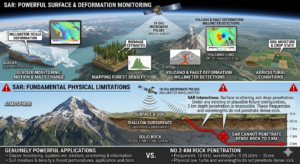
Synthetic Aperture Radar is a legitimate and well-established remote sensing technology. NASA’s Earth observation program uses it extensively. SAR works by emitting microwave pulses from a satellite or aircraft toward the Earth’s surface, then capturing the reflected signals. By comparing multiple passes over time, SAR can detect millimeter-scale ground deformation, monitor glaciers, map forest density, track agricultural conditions, and detect subtle shifts in tectonic plates. It is genuinely powerful technology, and its applications in geophysical monitoring are significant and expanding.
What SAR cannot do—under any existing or theoretically plausible future configuration—is penetrate solid rock to a depth of two kilometers. The radar waves used in SAR systems operate at frequencies around 10 GHz, producing wavelengths in the millimeter range. These wavelengths interact primarily with surfaces and the very shallowest subsurface layers; they do not penetrate dense rock at all. The Answers in Genesis technical analysis is precise on this point, noting that SAR radar waves “can’t penetrate deep into dense materials like rock (a significant reason why phone signals are lost underground).”
“SAR is therefore mostly useful for surface detection. The radar waves used (around 10 GHz) have millimeter wavelengths, so they can’t penetrate deep into dense materials like rock.”
— Gavin Cox, Answers in Genesis, “The Controversial Case of Giza’s ‘Underground City’,” July 23, 2025
The Khafre team attempted to address this limitation by describing their methodology as “Synthetic Aperture Radar Doppler Tomography”—a novel technique in which SAR data is processed to detect tiny surface vibrations (Doppler shifts) caused by seismic micro-movements, which are then interpreted as responses to subsurface features. This approach involves an extraordinary chain of inference: surface vibrations are observed, those vibrations are attributed to underground resonance, and then 3D structures are extrapolated from that resonance using AI image processing. At each step, the inferential leap grows wider and the empirical grounding thinner. By the final step—AI-generated 3D images of underground cubes and spiral shafts—the connection to actual observational data has become essentially unfalsifiable.
What Ground-Penetrating Radar Actually Does — And Its Hard Limits
Jones’ original post referenced “powerful ground-penetrating radar” rather than SAR tomography. This is worth addressing directly, because GPR is widely used in legitimate archaeological work—including at Giza—and its capabilities are well-documented by authoritative sources.
The U.S. Environmental Protection Agency describes GPR as an electromagnetic geophysical method that “transmits radio wave pulses at select center frequencies into the ground to study the subsurface.” The method works by detecting contrasts in dielectric permittivity between different subsurface materials. When a pulse encounters a material interface of sufficiently different electromagnetic properties, some energy is reflected to the receiver, creating a cross-sectional image of subsurface structures.
“GPR capitalizes on the effects that the electrical properties of matter have on electromagnetic energy propagation. If a wave pulse encounters a material interface of sufficiently different electromagnetic properties, some of the energy is reflected back while the remainder continues to propagate.”
— U.S. Environmental Protection Agency, “Ground Penetrating Radar (GPR)”
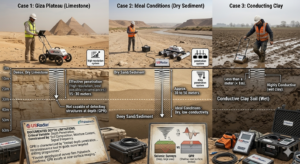
The critical variable is depth penetration. USRadar, a professional GPR systems manufacturer, documents the depth limitations clearly: effective penetration is constrained by soil composition, moisture content, and signal frequency. In typical field conditions, GPR penetrates from less than a meter in highly conductive clay soils to a maximum of approximately 30 to 50 meters in ideal conditions—dry, low-conductivity sediment or ice. In dense, dry limestone bedrock like that underlying the Giza Plateau, effective penetration for a high-resolution system runs in the range of a few meters to perhaps 15–30 meters under the best possible circumstances.
Finnish geophysical survey firm Palsatech confirms GPR’s limitation in comparative analysis: unlike seismic surveys, which offer deep penetration over large areas, GPR is characterized by “limited depth penetration, affected by soil conductivity.” The technology excels at near-surface imaging and is described as a “reconnaissance tool to guide more targeted drilling programmes”—not as a technology capable of detecting structures at depth.
“GPR provides higher resolution images of shallow subsurface features. The technology complements rather than replaces traditional methods, often serving as a reconnaissance tool to guide more targeted drilling programmes.”
— Palsatech, “What is ground penetrating radar in geological surveys?”
The arithmetic is devastating to the Jones claim. A structure “more than twice the height of the Burj Khalifa” would need to extend to a depth of at least 1,659 meters underground. GPR, operating at the Giza Plateau, might reliably resolve features at 10–20 meters depth. The gap between what the technology can do and what the claim requires is not a matter of degree; it is a matter of magnitude—the claim exceeds GPR’s actual capability by a factor of roughly 80 to 160 times.
The Geology of Giza: Why the Earth Itself Refutes the Claim
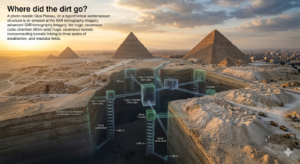
Even if we granted the technology every impossible advantage — assume, for the sake of argument, that some future version of SAR tomography could somehow image structures at 600 meters, let alone 2,000 meters — the geology of the Giza Plateau would still render the claim absurd. The earth itself is a witness, and it has not been silent.
The Giza Plateau sits atop a relatively flat formation of Eocene-era limestone. This formation — the Mokattam Formation — extends to considerable depth and is solid rock, not hollow. The plateau covers approximately 2.5 square kilometers. The idea that a structure exceeding 1,600 meters in vertical extent could exist beneath it — spanning a geological column equivalent to descending from the surface to nearly the depth of some of the world’s deepest mines — is not merely improbable. It is structurally incoherent.
But here is the argument that should have ended the conversation before it ever started, the one that requires no radar expertise or geological training to grasp: Where did the dirt go?
Constructing any large underground cavity requires the removal of material. You cannot hollow out a space without displacing what was there. A subterranean complex of the scale described by the Khafre Project team — eight spiral shafts descending 648 meters, two cubic chambers every 80 meters per side, interconnecting tunnels running beneath three pyramids across a two-kilometer span — would require the excavation of an almost incomprehensible volume of dense limestone. Conservative estimates for the two cubic chambers alone suggest a displaced volume approaching one million cubic meters of rock. Add the shafts, the passageways, and the connecting infrastructure, and you are looking at a debris field that would have covered the Giza Plateau like a small mountain range.
That rubble does not exist. It has never existed. No archaeologist, no satellite survey, no geological core sample, no aerial photograph, and no casual tourist with functioning eyesight has ever observed a deposit of excavated limestone on the Giza Plateau consistent with this scale of operation. The ancient Egyptians left abundant evidence of their actual quarrying activity at Giza — tool marks, waste chips, workers’ villages, and administrative records. The hypothetical builders of a two-kilometer underground city left nothing. Not a chip. Not a spoil heap. Not a ramp. Not a trace.
The silence of the geological record is not a gap waiting to be explained. It is the answer.
A subterranean void of such scale would compound the problem geophysically. The removal of that much limestone would generate seismic signatures detectable by global monitoring networks. The overlying rock column — bearing the weight of the pyramids themselves — would experience measurable subsidence. Satellite-based interferometric SAR, the legitimate application of the technology the Khafre team claims to be using, would detect surface deformation to millimeter precision. None of these effects has been observed because the cavity does not exist, the rubble was never dumped, and the earth has been quietly telling us so for the entire duration of this manufactured controversy.
The underground city of Giza was not suppressed by the Egyptian government, concealed by the Smithsonian, or missed by two centuries of professional archaeology. It was never there. The most powerful argument for that conclusion is not a radar specification or a geological stratigraphy chart. It is the simple, unanswerable question that every responsible journalist should have asked the moment the story hit their inbox:
If someone dug all that out — where exactly did they put it?
SECTION 4: Arizona’s Long Tradition of Glorious Archaeological Nonsense
The Grand Canyon Egyptian Cave: A Century-Old Ancestor of the Giza Hoax
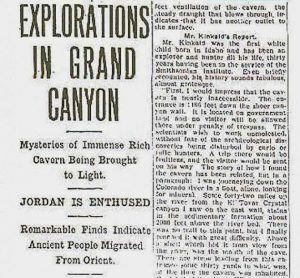
On April 5, 1909, the Arizona Gazette—a Phoenix newspaper of modest circulation and elastic relationship to factual reporting—ran a front-page story under the headline “Explorations in Grand Canyon.” The piece claimed that a lone river traveler named G. E. Kincaid had discovered a vast underground complex high in the canyon walls, subsequently joined by Professor S. A. Jordan for a Smithsonian-sponsored excavation. The reported contents of the cave were spectacular: extensive passageways, copper tools, ancient granaries, statues reminiscent of Buddhist imagery, rows of male mummies—and, most provocatively, artifacts suggesting ancient Egyptian or “Oriental” origin. The article triumphantly declared that “Egypt and the Nile, and Arizona and the Colorado will be linked.”
The Smithsonian Institution has no record of G. E. Kincaid. It has no record of Professor S. A. Jordan. It has no record of any Grand Canyon excavation matching the Gazette’s account. The institution’s Department of Anthropology has repeatedly stated, in responses compiled since the early 2000s, that the story is false. Period. As Wikipedia’s documentation of the episode confirms, “subsequent reviews by journalists, librarians, park staff and historians have found no evidence that the expedition occurred, that the named participants ever existed, or that any such cave was documented by authorities.”
“The Smithsonian Institution has repeatedly stated it has no records of the people or project described, and modern reporting characterizes the episode as a local hoax that later fed into Internet-era conspiracy theories about suppressed archaeology and alleged cover-ups.”
— Wikipedia, “Grand Canyon Egyptian cave.”
And yet the story is still circulating. It has appeared in books, cable television documentaries, podcasts, YouTube videos, and Facebook groups, each new iteration adding fresh urgency and fresh embellishment. The Discover Magazine analysis of the story’s trajectory traces how it re-entered popular culture through mid-twentieth-century sensationalist compilations and was turbocharged by the internet. Park archaeologists at the Grand Canyon report receiving recurring inquiries about the Kincaid cave; the story resurfaces, with remarkable regularity, whenever a new online video goes viral. As Wikipedia notes, the survival of the myth is sometimes linked to the presence of Egyptian-themed place names on official Grand Canyon maps—Isis Temple, Horus Temple—which lend an unearned credibility to the idea that some ancient Egyptian connection to the region has been “suppressed.” (These names were assigned by geologist Clarence Dutton in the late nineteenth century for purely aesthetic reasons, drawing from global mythologies when naming buttes and mesas.)
The structural DNA of the 1909 Arizona Gazette story and the 2025 Giza underground city claim is identical. A named but unverifiable discovery. A vague institutional association lending false credibility. A scale of revelation that defies all prior knowledge. A convenient suppression narrative explaining why nobody else has confirmed it. An audience primed by a pre-existing fascination with hidden ancient knowledge to receive the claim with enthusiasm rather than skepticism.

The Thing: When Mystery Becomes a Business Model
Full disclosure: this author has no standing to mock anyone for falling for it.
Following my college graduation in the summer of 1970, my buddy Gary and I loaded up his Triumph TR6 — a machine that was equal parts beautiful and genuinely thrilling to pilot across open desert highway — and pointed it west toward Los Angeles with the reckless confidence of two young men who believed the continent was roughly the size it appeared on a gas station road map. We were somewhere deep in the New Mexico desert — sunburned, saddle-sore, running on bad coffee and the pure oxidized optimism of youth — when the first billboard ambushed us out of the scrub brush. Yellow. Stark. Sun-bleached at the edges but utterly unambiguous in its demand on our attention. A single question, printed in bold black letters that brooked absolutely no argument:
THE THING? MYSTERY OF THE DESERT!

THE THING? MYSTERY OF THE DESERT!
Not one billboard willing to answer it.
Then another. Then another. Mile after mile, the billboards accumulated like a drumroll, each one identical, each one deepening the mystery without adding a single syllable of explanation. By the time Exit 322 appeared outside Benson, Arizona, we had been marinating in manufactured curiosity for the better part of two hours. We took the exit without a moment’s discussion.
We were, of course, completely taken in — and in excellent company.
Travelers on Interstate 10 between Tucson and El Paso have been conditioned since at least the 1950s to watch for those yellow billboards. The campaign starts in New Mexico, roughly 200 miles out, repeating with hypnotic insistence a question that is perfectly engineered to be unanswerable by any means short of stopping the car. By the time a sufficiently curious motorist pulls off at Benson, the mystery has had 200 miles to percolate into a genuine, almost physical need for resolution. What the billboard campaign understood — decades before behavioral economists gave it a name — is that an unanswered question is cognitively intolerable to most human beings. We will pay five dollars and drive two hours out of our way, simply to make it stop.
It is, without serious competition, one of the most effective pieces of teaser advertising in the history of American roadside commerce. And in 1970, it worked perfectly on two college kids from South Carolina who should have known better and didn’t, and who have never entirely regretted it.
“The Thing attracts roughly 250,000 visitors annually, generating millions in revenue not from the five-dollar admission, but from the attached travel center. People stop for the mystery and stay to buy gas, snacks, and souvenirs.”
— RoughMaps, “The Mystery Behind Arizona’s Most Popular Roadside Attraction”
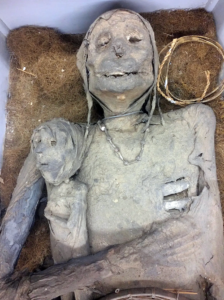
For a five-dollar admission fee, visitors are guided through three connected buildings filled with vintage automobiles, Old West memorabilia, antique curiosities, and what the attraction describes as “ancient torture devices.” The path winds deliberately, maximizing anticipation, until the visitor arrives at the main event: a mummified humanoid figure—possibly two figures, one adult and one child—displayed in a climate-controlled case. The plaques offer no concrete information about their origins. It might be an archaeological artifact. It might be a carnival fabrication. It might be a movie prop. The management, wisely, declines to specify, but don’t tell them we showed you the picture.
Islands.com describes The Thing as a destination that “serves up alien gift shop kitsch on a silver roadside platter,” noting that it is located in Benson, just outside Tucson, where it captures travelers “enticed by promises of oddities.” The attraction’s genius is precisely its refusal to resolve the mystery. In an era when every question has a Google answer, The Thing remains deliberately, aggressively unknowable. And that unknowability is commercially brilliant.
The parallel to the Giza underground city story is more than superficial. Both exploit the same psychological mechanism: the human appetite for mystery that exceeds explanation. The difference is this: The Thing is honest about being a mystery. It charges you fairly, gives you a weird experience, and lets you make your own assessment. The Khafre underground city story pretends to be science. It dresses its mystery in the vocabulary of peer-reviewed research—SAR tomography, Doppler shifts, phononic data—and deploys that vocabulary to fraudulently claim the authority of scientific discovery. The Thing is a carnival attraction. The Giza story is a carnival attraction wearing a lab coat.
SECTION 5: The Media Ecosystem That Made This Possible
How the Story Spread
The velocity with which the Khafre underground city story spread through the media ecosystem is itself a story worth telling. Within days of Jones’ March 19, 2025, post, the following headlines had appeared across the internet:
✔ Truth Mafia: “SAR Scan of Khafre Pyramid Shows Huge Underground Structures.”
✔ Trends Newsline: “The Greatest Archaeological Find: Massive Structure Under Giza!”
✔ Deep Newz: “Radar Scans Reveal 648-Meter-Deep Complex Beneath Khafre Pyramid.”
✔ News 18: “Pyramids Or Ancient Power Grids? Radar Scans Reveal Massive Underground Structures In Egypt’s Giza.”
✔ The Intel Drop: “HUGE Structures Discovered 2km BELOW Pyramid of Khafre?!”
✔ Express Tribune (Pakistan): “New discovery beneath Khafre Pyramid reignites theories that Egypt’s iconic monuments served as ancient energy hubs.”
The Express Tribune piece—which the original essay memorably described as “hogwash published”—is worth examining in detail as a case study in how genuine scientific language can be weaponized to dress up a nonstory. The Tribune’s account described Malanga and Biondi’s claimed findings with unqualified excitement, reporting eight vertical cylindrical wells descending 648 meters below the surface, spiral pathways, and two massive cube-shaped chambers each measuring 80 meters on each side, all forming an “underground system stretching two kilometers beneath all three major pyramids.” The piece noted that the findings “reignited theories” about the pyramids as “ancient energy hubs”—a framing device borrowed wholesale from the alternative archaeology community’s playbook, presenting pseudoscientific speculation as a natural and legitimate response to new evidence.
Why Fake Archaeology Stories Go Viral: The Psychology of Ancient Mystery
The persistence of this story—and its predecessors stretching back to the 1909 Arizona Gazette—is not accidental. It is the product of specific and well-documented psychological dynamics that make ancient mystery stories uniquely resistant to debunking.
The pyramids of Giza are among the most emotionally loaded objects in human civilization. They are genuinely mysterious—we do not have complete certainty about every aspect of their construction, and the scale of the achievement remains awe-inspiring even to professional archaeologists who have spent careers studying it. This genuine mystery creates what we might call the credibility gap: because something about the pyramids is not fully explained, audiences are primed to accept that something more might be hidden. The conspiracy template fills that gap with its own preferred contents: ancient aliens, lost civilizations, suppressed technology, government cover-ups.
TRT World’s investigative coverage captured this dynamic precisely, noting that the Khafre team “joins a growing faction of archaeology and history enthusiasts who challenge the official accounts and narratives of how and when the pyramids were constructed,” arguing that the pyramids could not have been built by the ancient Egyptians because they “did not possess the technology to accurately build three eight-sided pyramids, accurately aligning with true north.” (This claim is itself false; Fourth Dynasty Egypt demonstrably did possess the organizational, mathematical, and engineering capabilities required.) The alternative archaeology community has cultivated this narrative for decades, and any new “discovery” that can be attached to it receives an immediate built-in audience.
The fake news literature is clear on the mechanism. Wikipedia’s synthesis of hoax scholarship, drawing on Britannica and EBSCO research, identifies the key components of a successful hoax: a claim that activates strong prior beliefs, a narrative that flatters the audience’s self-image as independent thinkers challenging official narratives, a source just credible enough to create initial doubt, and a distribution channel capable of reaching large audiences before fact-checking can catch up. The Khafre story checked every box.
SECTION 6: A Thorough Debunking of the “Underground City”
The Eight Vertical Wells
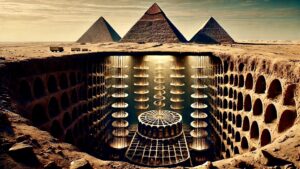
The claimed discovery of eight vertical cylindrical wells descending 648 meters below the surface, encircled by spiral pathways, collides immediately with geological reality. The Giza Plateau’s limestone bedrock, formed during the Eocene, is a sedimentary formation lacking the large natural voids or karst features that occasionally produce dramatic cave systems in other limestone regions. Egyptian limestone at Giza is relatively dense and homogeneous. The creation of eight cylindrical shafts descending 648 meters into this formation would represent an engineering project of a scale that dwarfs anything in the documented ancient world—and would have left evidence in the geological record, in the seismic record, and in the surface topography.
No such evidence exists. The shafts do not exist.
The Cube-Shaped Chambers
Two cube-shaped chambers, every 80 meters on a side, are said to connect the base of the spiral shafts. An 80-meter cube is roughly the volume of a 25-story building, the same as the Times Tower (New York City, USA), famously known for the New Year’s Eve ball drop in Times Square. Two of them would represent an underground void of approximately one million cubic meters. The excavation of such a space in solid limestone would produce a rubble volume that would need to go somewhere. It is not on the surface of the Giza Plateau. There is no deposit of excavated limestone consistent with this scale of operation anywhere in the archaeological record of the region. The chambers do not exist.
The 2-Kilometer Underground System: A Brief Lesson in Rock Pressure
The claim that an underground system extends two kilometers beneath all three major pyramids — Khufu, Khafre, and Menkaure — connecting them in some grand architectural unity beneath the surface — would require a horizontal tunnel network extending across an area larger than the Giza Plateau itself. This is worth pausing on. The claimed underground infrastructure is literally wider than the site it supposedly underlies. The builders, whoever they were — ancient Egyptians, lost civilization, extraterrestrials with an inexplicable fondness for cubic chambers — apparently tunneled past the edges of the plateau without anyone on the surface noticing the project underway beneath their feet.
But set the geometry aside for a moment and consider the physics.
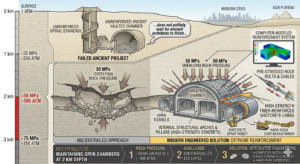
At two kilometers of depth, the overlying rock pressure bears down at approximately 50 megapascals — roughly 500 times atmospheric pressure. To put that in terms a non-geologist can feel in their bones: that is the kind of pressure that does not politely wait for ancient architects to finish their spiral staircase before collapsing the ceiling. Maintaining open tunnels and vaulted chambers at this depth in dense limestone is an engineering challenge that modern civilization, with computer-modeled reinforcement systems, high-strength concrete, and a century of hard-rock mining experience, approaches with extreme caution and considerable expense.
Just ask the Oak Island team what happens when you dig ambitious tunnels into unstable ground, and the earth decides it has heard enough of your plans. The so-called Money Pit has been collapsing, flooding, and defeating excavators equipped with twentieth-century machinery since 1795. And Oak Island’s legendary tunnel system — if it exists at all — operates at a depth measured in tens of meters, not thousands. The Oak Island crew at least has the dignity of working with a mystery that obeys the basic laws of structural engineering. The Khafre underground city, by contrast, would need to maintain cathedral-sized voids at a depth where the rock itself is under pressures that would crush a submarine.
Ancient civilizations did not solve this problem. Modern civilization has not solved this problem. The system does not exist, the tunnels were never bored, and the limestone at two kilometers depth is doing precisely what limestone at two kilometers depth has always done: sitting there, under crushing pressure, completely and utterly solid.
The Peer Review Absence
The most damning indictment of the Khafre SAR Project is the one that the media almost universally failed to report: as of the date of this writing, no peer-reviewed paper documenting the 2025 findings has been published. The extraordinary claims made at the March 2025 press conference—claims that, if true, would represent the most significant archaeological discovery in history—have not been submitted to independent scientific scrutiny. No Egyptologist has been given access to the raw data. No independent radar specialist has been invited to evaluate the methodology. The findings exist, in their entirety, as a YouTube press conference and a series of AI-generated 3D renderings.
Gavin Cox, whose Answers in Genesis analysis remains the most technically rigorous published response to the Khafre Project, puts the methodological problem precisely: in the team’s earlier 2022 paper, “the tomographic images don’t match known structures in the Great Pyramid. The researchers highlight arbitrary areas in their images,” raising the possibility that they have identified artifacts of their own image processing rather than genuine physical structures.
SECTION 7: What Archaeology Has Actually Found Beneath Giza
The Real Underground Infrastructure of the Giza Plateau
The irony of the Khafre underground city story is that the Giza Plateau does have genuine underground features—features discovered, documented, and published through legitimate archaeological work over the past two centuries. These real discoveries are, in their own way, remarkable. They simply fail the entertainment test, because they are the modest, hard-won findings of patient scholarship rather than the sensational revelations of an internet press conference.
The Campbell’s Tomb and the Giza Necropolis Shafts
The Giza Plateau contains numerous tomb shafts and burial chambers cut into its limestone bedrock, dating from the Old Kingdom through the Late Period. The area known as Campbell’s Tomb, excavated in the nineteenth century, descends approximately 30 meters into the bedrock and contains multiple chambers. The necropolis surrounding the Great Pyramid includes hundreds of mastaba tombs, many with subterranean components.
The Rediscovered Three Shafts
In October 2025, Ancient Origins reported the rediscovery of three precisely engineered shafts that had been identified decades ago but subsequently lost track of in the archaeological literature. Located in the triangle formed by the Great Sphinx, Khufu’s Pyramid, and Khafre’s Pyramid, these vertical passages descend more than 130 feet (approximately 40 meters) into the bedrock, with walls described as “so smooth and geometry so precise that they challenge conventional explanations about their origins.”
“Hidden beneath the sands of Egypt’s Giza Plateau, three precisely engineered shafts have been rediscovered that may unlock access to a vast underground network whispered about by ancient Greek historians.”
— Gary Manners, Ancient Origins, “Rediscovery of Three Shafts May Lead to Underworld Beneath Giza Pyramids,” October 14, 2025
These shafts are real. They are accessible, measurable, and documented. They descend to 40 meters, not 648 meters. They represent a genuine and ongoing archaeological mystery, consistent with the known patterns of Old Kingdom mortuary architecture. They are exactly what we would expect to find beneath one of the ancient world’s most important sacred landscapes: evidence of human labor and religious intention, scaled to human capability.
The ScanPyramids Project
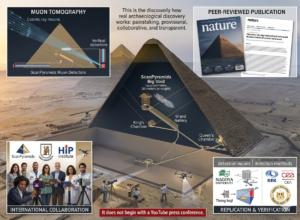
In 2017, the international ScanPyramids project—led by Cairo University and employing genuine muon tomography, thermography, and photogrammetry—announced the detection of a large void inside the Great Pyramid of Khufu. This void, subsequently termed the “ScanPyramids Big Void,” measures approximately 30 meters in length and sits above the Grand Gallery. Its function remains unknown. The discovery was published in the peer-reviewed journal Nature. It was subjected to independent scrutiny, replicated using different methodologies, and acknowledged by the Egyptian authorities. This is how real archaeological discovery works. It is painstaking, provisional, collaborative, and transparent. It does not begin with a YouTube press conference.
The 2024 Smithsonian Anomaly
A May 2024 Smithsonian Magazine report documented research by teams from Higashi Nippon International University, Tohoku University, and the National Research Institute of Astronomy and Geophysics in Egypt, who used GPR and electrical resistivity tomography to identify an underground anomaly near the royal graveyard adjacent to the Great Pyramid of Khufu. The anomaly is described as a possible chamber or tomb. No dimensions are claimed beyond what the technology can reliably resolve. The findings are characterized as preliminary and subject to further investigation. This, too, is how real archaeology works.
CONCLUSION: Why the Story Will Not Die
We return, in closing, to the formula. The Khafre underground city story is not a new story. It is the 1909 Arizona Gazette story. It is The Thing at Exit 322 on I-10, dressed in academic regalia. It is the eternal human story about hidden knowledge—about the possibility that beneath the surface of the knowable world lies something vast, something suppressed, something that would overturn everything we thought we understood.
That story is not going away. It will be told again when the next fringe researcher with a legitimate university affiliation decides to hold a press conference. It will be told again when the next Alex Jones finds the press conference useful. It will be told again when the next Joe Rogan mentions it to his 50 million listeners as an interesting thing he’s been hearing about. And it will be spread by 50 more outlets that did not fact-check the 1909 Arizona Gazette, did not fact-check the 2025 Khafre Project, and will not fact-check whatever comes next.
The counter-formula is simpler, though harder to apply in the heat of a viral moment. It requires two questions. First: what peer-reviewed evidence supports this claim? Second: What would the physical consequences be if this claim were true, and has anyone observed those consequences? Applied to the Khafre underground city story, both questions produce immediate, decisive answers. There is no peer-reviewed evidence. And the physical consequences—seismic anomalies, surface deformation, geological instability—have not been observed, because the structure does not exist.
We began this investigation with a photo caption. Do you remember it? The image at the top of this essay — that sweeping, dramatically lit, altogether magnificent piece of digital AI artwork — depicts Brendan Fraser making his triumphant return from a forgotten ancient city discovered through a shaft at the foot of the Khafre Pyramid, somewhere deep on his breathtaking journey to the Earth’s core. It is a genuinely stirring image. Brendan looks terrific. The lighting is extraordinary, which only AI image generators and overbudgeted Hollywood productions can produce.
It is also, of course, complete fiction — and that is precisely the point.
The Khafre underground city story is, at its beating heart, a movie. It has a cast: the rogue scientists challenging the establishment, the conspiracy broadcaster sounding the alarm, the credulous internet audience leaning forward in their seats. It has a set: the most visually iconic archaeological site on Earth. It has a poster: those AI-generated renderings of spiral shafts and cubic chambers that look extraordinary precisely because they were designed to look extraordinary, with no obligation whatsoever to correspond to anything that actually exists beneath the sand. The whole production is optimized for emotional impact, not empirical accuracy. Brendan Fraser would be right at home.
But here is what the movie cannot compete with: the actual pyramids.
The documented discoveries of genuine archaeologists — working in the unglamorous tradition of evidence-based scholarship, publishing in peer-reviewed journals, submitting their data to independent scrutiny — are remarkable on their own terms. Tomb shafts descending 40 meters into precisely cut limestone. A large void detected by muon tomography inside the Great Pyramid of Khufu, its function still unknown, its existence confirmed by multiple independent methodologies. Engineering precision at a scale that still generates legitimate scientific debate about construction techniques, four and a half millennia after the last stone was set. These are real. They are documented. They reward careful attention and serious thought in a way that no AI rendering ever can, precisely because they are true.
The pyramids of Giza do not need the supplement salesman from Infowars. They do not need the UFO-abduction researcher from Pisa. They do not need AI-generated cubes two kilometers underground, or spiral shafts, or Brendan Fraser emerging heroically from a shaft in the bedrock with his hair improbably perfect.
The real thing — the actual, documented, physically present thing — is already one of the most astonishing achievements in the history of human civilization. It has been standing in the Egyptian desert for 4,500 years, surviving intact through the rise and fall of every empire that has come and gone since it was built. It does not need a special effects budget.
And unlike the underground city, it actually exists.
The greatest archaeological fraud since the Arizona Gazette’s Egyptian cave has now run its course through the internet’s attention span. The debunking is on record. The verdict of serious science is clear. And the next time you see a billboard on the information highway promising something astonishing underground, you already know the question to ask:
What is The Thing? — and does it actually exist?
Primary Sources Consulted:
• EPA Ground-Penetrating Radar: https://www.epa.gov/environmental-geophysics/ground-penetrating-radar-gpr
• USRadar GPR Depth Analysis: https://usradar.com/blog/how-deep-does-gpr-go
• Palsatech GPR in Geological Surveys: https://palsatech.fi/what-is-ground-penetrating-radar-in-geological-surveys/
• Answers in Genesis – Giza Underground City: https://answersingenesis.org/archaeology/ancient-egypt/controversy-giza-underground-city/
• TRT World – Khafre SAR Controversy: https://www.trtworld.com/article/1bd4fb6965ee
• Ancient Origins – Giza Shaft Rediscovery: https://www.ancient-origins.net/news-history-archaeology/giza-underground-discovery-00102221
• Wikipedia – Grand Canyon Egyptian Cave: https://en.wikipedia.org/wiki/Grand_Canyon_Egyptian_cave
• RoughMaps – The Thing Arizona: https://www.roughmaps.com/travel/the-mystery-behind-arizonas-most-popular-roadside-attraction/2
• Islands.com – The Thing Mystery: https://www.islands.com/1934944/benson-arizona-thing-mystery-desert-kitschy-roadside-stop-huge-gift-shop-exhibits-aliens/
A Note on Research Methods and Accuracy
In recent years, some have voiced concern that artificial intelligence may distort facts or introduce inaccuracies into serious research. That criticism deserves acknowledgment. However, AI has now evolved into the most powerful research instrument available to any dedicated scholar—capable of analyzing vast datasets, cross‑referencing historical records, and surfacing overlooked connections across sources. This work represents a collaboration between the author’s investigative inquiry, verified primary documentation, and the advanced analytic capabilities of AI research tools. Here, AI was not used as a ghostwriter or a shortcut for scholarship, but as a disciplined research partner devoted to rigor, accuracy, and transparency.
Every factual claim in this work has been subjected to active verification. Where AI‑generated content was used as a starting point, it was tested against primary sources, peer‑reviewed scholarship, official institutional documentation, and established historical records. Where discrepancies were found—and they were found—corrections were made. The author has made every reasonable effort to ensure that quotations are accurately attributed, historical details are precisely rendered, and theological claims fairly represent the positions they describe or critique.
That said, no work of this scope is immune to error, and the author has no interest in perpetuating inaccuracies in the service of an argument. If you are a reader—whether sympathetic, skeptical, or hostile to the conclusions drawn here—and you identify a factual error, a misattributed source, a misrepresented teaching, or a claim that cannot be substantiated, you are warmly and genuinely invited to say so. Reach out. The goal of this work is not to win a debate but to get the history right. Corrections offered in good faith will be received in the same spirit, and verified corrections will be incorporated into future editions without hesitation.
Truth, after all, has nothing to fear from scrutiny—and neither does this work.