
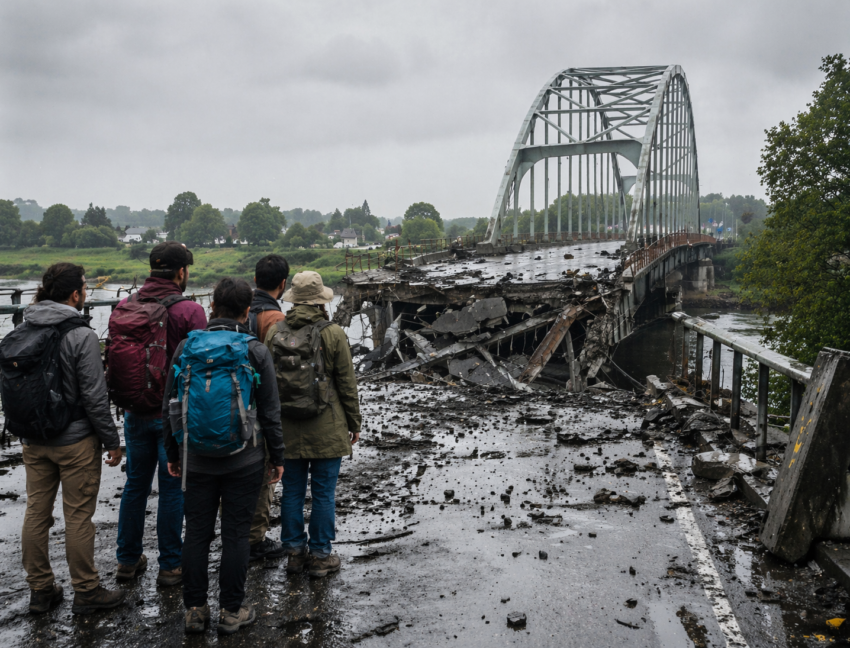
Image: An AI-generated image that illustrates the phrase, “A bridge too far”, an idiom inspired by the failed World War II Operation Market Garden. Like many idioms, the phrase “a bridge too far” carries both a literal and a figurative sense. In the concrete sense, it describes a bridge that lies beyond a reasonable or feasible distance. In the abstract sense, it refers to an aim or undertaking that is overly ambitious or unrealistic. People often use it to describe attempts to take on an impossible task.
A Bridge Too Far
Why T.C. Christensen’s “The Bridge” Fails as an Allegory of the Atonement
Prologue: When Cinema Becomes Confession
There is a peculiar power in a short film. Unburdened by the obligations of character development, subplot management, or box-office calculations, a short film can move directly to the nerve — and stay there. In eleven minutes, a skilled filmmaker can do what a hundred-page essay cannot: bypass the analytical mind and speak directly to the gut, the chest, the throat. The tears come before the questions do. The emotion lands before the theology has time to object.
This is exactly what happened with The Bridge.
Since its production in 1978 by a group of young Brigham Young University students working under the banner of the Visual Transit Authority, this short film circulated quietly but persistently through Sunday School classrooms, missionary discussions, evangelical small groups, interfaith seminars, and online sharing chains. It has been praised by a non-LDS minister as surpassing, in ten minutes, the cumulative effect of a lifetime of sermons on the Atonement. It was used by LDS missionaries in Japan to set the stage for a conversion that Bishop Merrill J. Bateman later described before the entire General Conference of The Church of Jesus Christ of Latter-day Saints. It has been screened in primary classes for children as young as six, and it has been wept over by adults who had never heard of John 3:16 before and suddenly, unbidden, understood something they had never been able to articulate.
It is a remarkable film. And it is, theologically speaking, a deeply problematic one.
This essay examines the film’s production history in detail. It documents the surprising institutional connections between the film and Brigham Young University’s Motion Picture Studio. It considers the question of whether those connections constitute implicit ecclesiastical sanction. It explores the curious matter of the film’s alternate title — The Sacrifice — and what that renaming may tell us about the film’s distribution history and intended audiences. It surveys the voice of popular reception, including both those moved to tears and those moved to genuine theological concern. It provides a more thorough exposition of the biblical doctrine of the Atonement — its willing, propitious, Trinitarian, historically grounded character — against which the film’s allegory must be measured. And it places the film within the broader context of early LDS theological development, asking what it means that a film produced with university and ecclesiastical adjacency became a primary vehicle for teaching the Atonement to a tradition whose doctrine of the Atonement differs substantially from that of historical Christianity.
The point is not to destroy a beautiful short film or to impugn anyone who made it or was moved by it. The point is that artistic expression, whether in film or other media, and theological precision are not the same thing — and when the eternal stakes are as high as the Atonement of Jesus Christ, they cannot be treated as interchangeable.
I. Setting the Stage: The Film and Its Claims
The short film commonly known as The Bridge — produced by T.C. Christensen’s Visual Transit Authority, not by The Church of Jesus Christ of Latter-day Saints itself — has circulated widely in Christian and LDS-adjacent circles as a powerful cinematic parable. In it, a railroad bridge operator is compelled to lower a gear mechanism to allow a passenger train to pass safely, but his young son has wandered onto the tracks. The child is killed; the passengers are saved. The emotional weight of the scene is undeniable. Many viewers, including well-meaning Christians and LDS members alike, have embraced it as a visual illustration of John 3:16 — of God sacrificing His Son so that humanity might be spared.
It is a moving film. It is competently made. And as a piece of moralistic storytelling, it may succeed on its own terms. But as a theological allegory for the biblical doctrine of the Atonement — specifically, for what Scripture teaches about the nature, will, and person of Jesus Christ in His sacrificial death — the film does not merely fall short. It fundamentally misrepresents the Gospel at several of its most critical points.
This article is a careful examination of where the analogy breaks down, and why those breakdowns matter enormously to a right understanding of what Christ accomplished on the cross.
[ EDITOR NOTE: The video provides viewers the opportunity to watch the complete film before engaging the theological analysis that follows. For those who have never seen The Bridge, viewing it first will make the critique below both more comprehensible and fairer. Skip Clark, the film’s screenwriter, has noted in connection with this video that ‘The “SACRIFICE” was changed to “THE BRIDGE” when copies were purchased by a large religious organization,’ a fact that carries significant implications discussed in Section III-A below. ]
The cumulative effect of all the sermons and homilies that I have ever heard or read on the Atonement could not match the power of The Bridge. — Reverend Garrett Short, M.Div., M.A. — Back cover text, VHS release of The Bridge, distributed by Thomson Productions, Inc.
That endorsement, appearing on the commercial VHS packaging of the film, speaks to the film’s unusual crossover appeal. A Protestant minister — not a Latter-day Saint — found in this ten-minute Mormon-adjacent production a theological power he could not locate in a lifetime of formal Christian instruction.
Reverend Garrett Short, a Christian minister with a Master of Divinity and a Master of Arts; there is a notable lack of independent sources identifying him, his specific church or denomination, or even confirming that he is a verifiable historical figure, which casts some suspicion on whether he actually exists as a distinct person rather than as a carefully chosen blur‑line endorsement.
But assuming the quote is an actual endorsement, it is worth pausing over. It is both a testimony to the film’s emotional craft and, as this essay will argue, a cautionary indicator of how easily emotional resonance can be mistaken for theological accuracy.
II. From Senior Project to Sacred Text: The History of The Bridge
A. The Making of the Film — BYU, 1978
The Bridge was produced in 1978 as a short film project rooted in Brigham Young University’s thriving motion picture program. The film’s opening credits identify it as a production of the Visual Transit Authority (VTA), a name that, combined with the railroad imagery of the film’s central narrative, reveals something of its makers’ sense of thematic identity.
The production team consisted of several students and young filmmakers who would go on to distinguished careers in LDS and Christian cinema. According to the film’s opening credits, as preserved at ldsfilm.com, the key creatives were:
Screenplay by: Skip Clark
Produced and Directed by: Robert N. Hatch
Executive Producer: John K. Wadsworth
Director of Photography: Thomas R. Christensen (T.C. Christensen)
Assistant Director: Robert Ericksen
Sound Recordist: Martin Andersen
Script/Continuity: Karen Exeter
The cast included Hal Boynton as the Father, John-John Wadsworth (son of executive producer John K. Wadsworth) as David, the child, and Nita McKenzie as the Mother.
In a 2015 interview with the ForeverLDS podcast, T.C. Christensen — who would go on to become the most commercially successful LDS filmmaker of his generation, directing 17 Miracles (2011), Ephraim’s Rescue (2013), and The Cokeville Miracle (2015) — spoke warmly about The Bridge’s enduring impact:
I was in my senior year in college, and I had to make sure I say that. There were a lot of people [who] worked on that film — Robert Hatch who ended up as the director, Robert Erickson, John Wadsworth, me… I was one of the executive producers and the director of photography on the film. We made several short films back in those days, and that was one that really kinda punched through, and is still selling, still available on DVD, and people still comment on that film to me, even though whatever that is, 36 years ago or something that we made that.
— T.C. Christensen, ForeverLDS Podcast, Episode 6, 2015
The interviewer, author Chris Heimerdinger, confirmed the film’s immediate impact: ‘I don’t even think I was a member of the church [when I first saw it]. And it had an enormous impact on my understanding, my comprehension of the Atonement.’
The film won five major national awards, including a Gold Plaque at the Chicago Intercom Film Festival—a significant achievement for a student‑scale production from a regional university. Its commercial longevity is equally notable: it remained in demand through VHS‑era distribution and later resurfaced widely on YouTube and streaming platforms, though extant public retailer and catalog records do not clearly document a general‑market consumer DVD release under the same title, making its availability difficult to verify.
B. The BYU Motion Picture Studio Connection — Unofficial Production, Institutional Fingerprints
The question of The Bridge’s institutional provenance is more complicated than its VTA opening credits suggest. The original opening credits identify the film as a Visual Transit Authority production. However, the archival record tells a more layered story.
The official finding aid at the BYU L. Tom Perry Special Collections, which houses the T.C. Christensen Papers (MSS 9039), describes the surviving 16mm reel of The Bridge in revealing terms:
Contents include a sixteen millimeter film reel of the film, ‘The Bridge,’ which was produced by BYU Motion Pictures Studio and T.C. Christensen was the director of photography.
— BYU Library Special Collections, MSS 9039 Series 4, Reel 5 — T.C. Christensen Papers
This description identifies BYU Motion Picture Studio as a co-producer of the film — not merely as a host institution for student work, but as an active production entity. This raises a question of genuine significance for anyone seeking to understand the film’s reception within LDS culture: does BYU Motion Picture Studio’s involvement constitute implicit institutional sanction of the film by the Church itself, or at a minimum by its flagship educational institution?
The answer requires some nuance. BYU is owned and operated by The Church of Jesus Christ of Latter-day Saints and is directed by the Board of Trustees, which consists of the First Presidency and members of the Quorum of the Twelve Apostles. BYU’s Motion Picture Studio has historically produced content in collaboration with the Church’s media and communications divisions. The studio’s involvement in a production does not, by itself, constitute official doctrinal endorsement — BYU produces a wide variety of academic, artistic, and commercial content. However, it is worth noting that the film was not produced as a purely independent student project outside university structures. BYU’s institutional hand was, according to its own archival description, present in the production.
That institutional involvement was noted — and implicitly leveraged — by the film’s subsequent distribution. The Visual Transit Authority distributed the film commercially. Thomson Productions, Inc. later packaged and distributed it on VHS under a license from VTA, with an 800 number and a printed teaching guide. The back cover of that VHS packaging carried the endorsement of an alleged Protestant minister, Reverend Garrett Short, positioning the film for crossover Christian audiences. Yet the film’s roots in BYU student production — and BYU Motion Picture Studio involvement — gave it a degree of institutional credibility that purely independent productions would not have carried.
This matters because, as the article on the LDS news site This Week in Mormons noted:
The Bridge was not produced by the church itself. It was one of several films produced by T.C. Christensen’s Visual Transit Authority. The VTA often collaborated with BYU and the church itself on films. It also independently produced other pieces in the genre it called ‘moralistic’ films.
— This Week in Mormons, “Latter-day Saint Video Vault: ‘The Bridge’ Teaches of Sacrifice,” October 2020
Official LDS sources often distance themselves from content like this to preserve what they understand as doctrinal purity. The picture that emerges, then, is of a film produced at the institutional margins of the Church’s educational apparatus—not formally authorized as doctrinal content, but not purely independent of Church‑affiliated infrastructure either. Its gray‑zone status has contributed to its unusual staying power: it circulates with the emotional authority of an officially authorized devotional film while technically carrying no official doctrinal imprimatur, thus allowing the Church to benefit from its affective impact without inheriting responsibility for its theological ambiguities.
C. The Absent Footnote: ‘The Bridge’ and the Deseret News Silence
A curious and perhaps illuminating detail emerges when one searches the archives of Deseret.com — the digital platform of the Deseret News, the Church-affiliated newspaper owned by Deseret Management Corporation — for references to T.C. Christensen. The Deseret News has covered Christensen’s career with reasonable thoroughness. Articles document his work on Love, Kennedy, his pioneering LDS features, his cinematographic achievements, and his role in what the paper has described as a renaissance of LDS cinema. Christensen is a well-known and frequently cited figure in Deseret News coverage of the LDS film industry.
What is striking is the near-total absence, in that coverage, of any mention of The Bridge. Among the dozens of articles referencing Christensen and his filmography, this early award-winning production — the one that Christensen himself described as still generating audience responses 36 years after production — appears conspicuously absent from the Deseret News’s institutional memory of his work.
This silence is not necessarily sinister. The Deseret News covers news, not comprehensive filmographies. The Bridge was a student short, not a theatrical feature. It predates the modern era of LDS cinema that the paper has covered most extensively. And the film’s VTA/independent production context may simply not have triggered the institutional category of ‘Church-affiliated film’ that would draw Deseret News attention.
Nevertheless, the silence is interesting. A film that appears in BYU’s Special Collections under the description ‘produced by BYU Motion Pictures Studio,’ that was screened at a BYU devotional by an Apostle, that generated a conversion story cited at General Conference, and that has influenced tens of thousands of viewers’ understanding of the Atonement — exists, in the pages of the Church’s major newspaper, as if it had never been made. Whether this reflects editorial oversight, institutional ambivalence about the film’s theological message, or simply the mundane gaps in any newspaper’s archive, the student of LDS media history would do well to note it.
D. The Bridge, The Sacrifice, and the Question of the Name
One of the more intriguing aspects of The Bridge’s history is the matter of its title — or rather, its two titles.
The film is commonly known as The Bridge. Its opening credits identify it as The Bridge. Its VHS packaging calls it The Bridge. Its IMDB listing, its BYU Special Collections archival description, and virtually all published references to it use the title The Bridge.
Yet there is credible testimony that the film was originally produced — or at some point circulated — under the title The Sacrifice. Skip Clark, the film’s screenwriter, has noted in connection with YouTube postings of the film that ‘The SACRIFICE” was changed to “THE BRIDGE” when copies were purchased by a large religious organization.’
Source: https://www.youtube.com/watch?v=Z-JZ6Nc5UsY (Note via Skip Clark in video comments)
If this account is accurate, it raises provocative questions. What was the ‘large religious organization’ that purchased copies and apparently requested or required the retitling? Was it The Church of Jesus Christ of Latter-day Saints itself? A Christian denomination purchasing the film for instructional use? An educational distributor with marketing preferences? The identity of the purchasing organization is not specified, and Clark’s note appears only in a brief YouTube comment rather than in any formal published account.
The theological implications of the title change, however, are worth noting regardless of the purchasing party’s identity. The Sacrifice is a more theologically explicit title — it foregrounds the interpretive frame of the story and aligns the viewer’s expectations with the substitutionary logic the film is meant to illustrate. The Bridge is more ambiguous and cinematic — it describes the physical setting rather than the theological meaning, and it allows the allegory to emerge organically rather than being declared in advance.
The shift from The Sacrifice to The Bridge may reflect not only a marketing strategy but also a subtle theological recalibration, possibly influenced or at least tacitly endorsed by LDS gatekeepers. Retitling the film after the object rather than the event could signal a desire to broaden its appeal beyond audiences already steeped in substitutionary‑atonement language, softening the doctrinal overtone of “The Sacrifice” into something more neutral and metaphorical. By focusing on the bridge, the producers (or distributors, including Church‑aligned entities) made the film accessible to viewers who might otherwise find the original title theologically presumptuous before they had even seen the first frame. This is a shrewd distribution choice—and, ironically, it fits the film’s broader pattern of letting emotional impact carry theological weight that careful exposition, rather than imagery alone, would be expected to earn.
III. The First and Most Fatal Flaw: The Son Did Not Choose
Let us begin with what is, theologically speaking, the most devastating failure of the film’s allegory: the son in the story does not choose to die. He is not aware of the train. He has not consented to his own sacrifice. He wanders onto the gears, presumably having followed his father upriver by boat, and is crushed by machinery he neither understands nor anticipates. His death is, in the most precise sense of the word, an accident within the logic of the narrative — an unintended consequence of a child’s innocent wandering.
The contrast with the biblical Christ could not be more stark. Scripture is unambiguous, consistent, and emphatic on this point: Jesus went to the cross with full knowledge, full consent, and sovereign volition. Consider the testimony of the Gospel of John alone:
I lay down my life that I may take it up again. No one takes it from me, but I lay it down of my own accord. I have authority to lay it down, and I have authority to take it up again.
— John 10:17–18 (ESV)
This is not the language of a child who stumbles into danger. This is the language of a sovereign, self-aware, willing sacrifice — a Lamb who was, as Revelation 13:8 describes Him, ‘slain from the foundation of the world.’
The willingness of Christ is not a peripheral doctrinal nicety. It is constitutive of the Atonement’s very nature and efficacy. The author of Hebrews labors precisely this point, arguing that the Old Covenant sacrifices were offered repeatedly because they were external and compelled — animals that had no voice in the matter. Christ’s sacrifice, by contrast, is presented in Hebrews 9:14 as an offering made ‘through the eternal Spirit,’ and in Hebrews 10:7 as the fulfillment of the Messianic declaration:
Behold, I have come to do your will, O God.
— Hebrews 10:7 (ESV), quoting Psalm 40:7–8
The entire architecture of the New Covenant rests upon the premise that the Son came willingly, purposefully, and in full knowledge of what lay before Him.
In Gethsemane, Jesus could have called upon twelve legions of angels (Matthew 26:53). He did not. He prayed that the cup might pass, and then — and this is the theological hinge of the entire redemptive story — He submitted His will to the Father’s:
Not as I will, but as you will.
— Matthew 26:39 (ESV)
This is an active, conscious, agonized, willing submission. The boy on the tracks of Christensen’s railroad bridge had no such moment. He had no Gethsemane. He simply died without knowing why.
An allegory that strips the Atonement of Christ’s willing agency does not merely simplify the Gospel — it evacuates the Gospel of one of its most essential elements. When Paul writes in Galatians 2:20 that ‘the Son of God… loved me and gave himself for me,’ the active giving is inseparable from the love. A passive death by accident cannot carry that weight.
The LDS Theological Context: Gethsemane vs. Calvary
This critique carries a particular relevance in the context of Latter-day Saint theology, where the location and mechanism of the Atonement have historically been understood somewhat differently than in classical Christianity. LDS teaching has often placed considerable emphasis on the Garden of Gethsemane as the primary locus of Christ’s atoning work — the place where, as the Book of Mormon describes, ‘he shall suffer temptations, and pain of body, hunger, thirst, and fatigue, even more than man can suffer, except it be unto death’ (Mosiah 3:7). While Calvary is not denied, the cross has occupied a somewhat less central place in LDS atonement theology than it does in Protestant, Catholic, and Orthodox frameworks.
The New Testament, however, presents the cross — not the garden — as the decisive moment of substitutionary accomplishment. Paul’s declaration in 1 Corinthians 2:2 that he resolved to know nothing ‘except Jesus Christ and him crucified’ is not primarily a reference to Gethsemane. Colossians 1:20 speaks of peace made ‘through the blood of his cross.’ Hebrews 12:2 describes Jesus as ‘enduring the cross.’ The propitiation described in Romans 3:23-25 and 1 John 4:10 is accomplished through blood shed in execution, not in anguish in a garden.
The Bridge’s allegory, with its focus on crushing machinery rather than an elevated, public, witnessed execution, maps more naturally onto a Gethsemane-inflected atonement theology than onto the cross-centered proclamation of the New Testament. This may explain, in part, why the film has found particular resonance within LDS culture as an illustration of ‘the Atonement’ — the film’s mechanism of sacrifice (hidden, mechanical, witnessed by an indifferent public) rhymes more closely with the LDS theological emphasis than with the classical Protestant proclamation of a public, willing, legally significant death on a Roman cross.
IV. The Father’s Role: Grief Versus Wrath, Accident Versus Intention
The film’s portrayal of the father is similarly problematic, though in a different way. The father is shown not as a man caught in a dilemma of his own making, but as someone who is thrust into a horror he did not anticipate and does not understand. He does not consciously choose his son’s death as part of a higher plan or “necessary” calculus; indeed, he has no theological framework that would make his son’s death meaningful. In the film, his anguish is raw and unmediated: he does not see his son’s death as a sacrifice, only as a devastating loss. He weeps and rages against the windows of the train as it passes, unaware of the grim “price” that has been paid, and the film pointedly refuses to give him any language that would transmute grief into assent.
Scripture presents something categorically different in the relationship between the Father and the Son in the economy of redemption. The cross was not the Father’s desperate improvisation in a moment of crisis:
Yet it was the will of the LORD to crush him; he has put him to grief.
— Isaiah 53:10 (ESV)
The Atonement was not a tragedy that befell God. It was the eternal plan of God, determined before the foundation of the world (1 Peter 1:19–20), executed in the fullness of time (Galatians 4:4), and celebrated in heaven as the triumph of redemptive love (Revelation 5:9–12).
Furthermore, the biblical Atonement is not merely about God watching His Son die to spare others. It involves the propitiation of divine wrath against sin:
God put [Christ] forward as a propitiation by his blood, to be received by faith. This was to show God’s righteousness, because in his divine forbearance he had passed over former sins.
— Romans 3:25 (ESV)
And again, in one of Scripture’s most compact summaries of the Gospel’s logic:
In this is love, not that we have loved God but that he loved us and sent his Son to be the propitiation for our sins.
— 1 John 4:10 (ESV)
The entire penal substitutionary framework — which, whatever one’s particular theological tradition, is deeply embedded in the New Testament — depends on the cross being an intentional, juridically meaningful act of satisfaction, not an accident of circumstance.
The father in the film is grieving an accident. The Father in Scripture is enacting a covenant. These are not comparable situations dressed in similar emotional clothing. They are fundamentally different categories of event.
The BYU Devotional: How the Film Was Officially Contextualized
The most significant single use of The Bridge in an institutional LDS context occurred on May 7, 1978 — the same year the film was produced — when Robert D. Hales, then a member of the First Quorum of the Seventy, incorporated the film into a BYU devotional address titled ‘Principles of Sacrifice.’
Hales introduced the film — which he referred to by its alternate title, The Sacrifice — in these terms:
‘The Sacrifice’ is produced by two young men who are returned missionaries, John Wadsworth and Tom Christensen. I would like you to watch for one or two things in this film; they are important. At the close of this film there is a father who has his duty, symbolic of God the Father, and a little boy who has been sent by his mother to tell the father that she is about to have a baby — to tell the father of new life. The father, who has the responsibility of correcting a drawbridge so that the train can come by, discovers a malfunction which keeps the bridge from closing; so he has to go down the gateway to hold the trestle manually with an iron rod for the train to pass… The most interesting part of this film to me is the complete disinterest of the people in the train. I think our job, if I were to suggest one assignment from today’s discussion, is that we go forth and tell the people of the world of the events this film symbolizes.
— Elder Robert D. Hales, ‘Principles of Sacrifice,’ BYU Devotional Address, May 7, 1978
Several things are worth noting in this introduction. First, Hales refers to the film as The Sacrifice — consistent with Skip Clark’s note that the film was initially known by that title before being renamed for wider distribution. Second, Hales frames the boy’s mission as bearing ‘news of new life’ — symbolizing the Gospel message — which introduces a layer of allegorical meaning the film itself does not explicitly foreground but which a theologically trained viewer might supply. Third, Hales’s primary homiletical emphasis falls not on the mechanics of the sacrifice but on the missional implication: the passengers’ indifference becomes the occasion for an evangelistic exhortation. This is a sophisticated pastoral use of the film that does not require the allegory to be theologically precise — it requires only that it generate emotional resonance sufficient to motivate missionary action.
The devotional use of the film by a General Authority speaking at BYU constitutes the closest thing to official institutional endorsement The Bridge has ever received. It is not a formal doctrinal statement. It is not a curriculum endorsement by the Church’s correlated materials office. But it is a significant act of institutional legitimization — an Apostle-rank leader publicly commending a film to a university audience and using it as the centerpiece of a doctrinal discourse. That legitimization has contributed to the film’s decades-long circulation within LDS culture as a devotional tool.
The 1994 General Conference: Bishop Bateman’s Conversion Story
The film’s reach extended all the way to the podium of General Conference when, in April 1994, Bishop Merrill J. Bateman — then the Presiding Bishop of the Church — described how missionaries in Japan had used The Bridge to set the stage for a young Japanese man’s conversion:
The missionaries took him through the lessons and taught him about our Heavenly Father, Christ, and the plan of salvation, but he didn’t have a witness. The missionaries wondered what they should do and decided one day to show him a film, a Church film that deals with the Atonement. It is called The Bridge. The young man saw the film and was disturbed by it, went home, and couldn’t sleep all that night, but still he didn’t have a witness.
— Bishop Merrill J. Bateman, ‘Stretching the Cords of the Tent,’ General Conference of The Church of Jesus Christ of Latter-day Saints, April 1994
Two details in Bishop Bateman’s account deserve careful attention. First, he describes The Bridge as ‘a Church film’ — an attribution that is, strictly speaking, not accurate, but that reflects the film’s institutional reception. The Bridge was not produced by the Church’s official media department. It was produced by the Visual Transit Authority, with BYU Motion Picture Studio involvement. Yet by 1994, in the mind of a Presiding Bishop speaking at General Conference, it had become — functionally if not formally — ‘a Church film.’ The institutional gray zone that surrounded the film’s production had, over sixteen years, been resolved in the popular and ecclesiastical imagination into something that felt like Church endorsement.
Second, the conversion story Bateman tells is instructive about the film’s actual evangelistic mechanism. The young Japanese man was not converted by the film itself. The film disturbed him without producing a witness. The conversion came the following day, when he encountered an elderly woman who needed help affording glasses — and he chose, quietly, to make up the difference. In that act of unexplained, freely given grace, the witness came: ‘I understand. Jesus is the Son of God. He can make up the difference in my life when I fall short.’ The film planted a question; a human act of grace answered it. The Bridge succeeded not by conveying precise theological content but by creating a state of productive theological disturbance that the Holy Spirit could address through lived experience.
This is both a tribute to the film’s emotional power and a confirmation that its theological imprecision did not, in this instance, prevent spiritual fruit. It does not, however, resolve the question of whether the imprecision matters — particularly when the film is used not as a pre-conversion discussion prompt but as doctrinal instruction within the community of faith.
V. The Passengers: Ignorant Bystanders or Beloved Recipients?
The film makes a point — visually and thematically — of showing the passengers on the train as utterly unaware of what has been done for them. They laugh, dine, and sleep their way across the bridge, oblivious to the child crushed under the speeding train. The father watches them pass with a grief-ravaged face, and the implication is clear: we are those passengers. We go about our comfortable lives while God’s Son was destroyed on our behalf, and we do not even notice.
At first glance, this might seem to echo the biblical motif of human indifference to Christ’s suffering — and Isaiah 53:3 does describe the Servant as ‘despised and rejected by men.’ But there is a fundamental difference between the passengers in the film and the recipients of grace in the Gospel.
First, the passengers are completely passive recipients of an event they had no relationship to and no knowledge of. But Scripture presents believers as those who, by faith, actively receive what Christ has done — they are not merely the incidental beneficiaries of a logistical transaction. Romans 10:14 asks: ‘How are they to believe in him of whom they have never heard?’ The atonement is not complete in its application until it is received through faith.
Second, the passengers were saved from a physical danger they were unaware of. Scripture presents the human condition as one of active rebellion, guilt, and moral culpability before a holy God. We are not merely in danger — we are, as Paul writes in Ephesians 2:1–3, ‘dead in trespasses and sins’ and ‘children of wrath.’ The nature of what we are saved from is not an impersonal mechanical hazard but the righteous judgment of God against sin.
Third, the passengers could not respond to the sacrifice. But the Gospel is, at its core, proclamatory and responsive. The Great Commission of Matthew 28:18–20 is precisely an instruction to go and make disciples — to bring the news of the sacrifice to those who do not yet know it, so that they might respond in faith, repentance, and baptism. A salvation that requires no response is not the salvation of the New Testament.
These are not minor discrepancies in an otherwise functional analogy. They touch the very nerve of how the Atonement works and what it requires of its recipients.
VI. The Trinitarian Problem
There is one more theological difficulty with the film that deserves attention, particularly given its LDS production context: the film’s portrayal of the father-son relationship maps onto a framework of two entirely separate persons with separate wills, separate knowledge, and competing emotional states. In the film, the father’s will is to save his son; external necessity forces him to act against that will. The son has no will in the matter whatsoever.
Classical Christian Trinitarianism, rooted in the ecumenical councils and in the exegesis of texts like John 10:30 (‘I and the Father are one’), John 5:19, and Philippians 2:5–11, insists that the Father and Son share one divine essence while remaining distinct in person. The will of the Son to go to the cross and the will of the Father to send Him are not in conflict — they are harmonized in the eternal covenant of redemption (the pactum salutis). The Father does not sacrifice the Son against the Son’s will, as a man might sacrifice a child who had no say. The Son, who is Himself God, lays down His life in perfect unity with the Father’s redemptive purpose.
This Trinitarian unity is not merely a technical point of systematic theology. It is what makes the Atonement an act of love rather than an act of divine violence against an innocent third party. If the Father sent the Son to die without the Son’s willing participation, we would have not a Gospel but a horror story — a deity destroying his child to appease his own anger. The Trinitarian framework, in which Father and Son share one will and one purpose even as they are distinct persons, is precisely what prevents the doctrine of the Atonement from collapsing into something morally unintelligible.
The film’s structure makes this Trinitarian unity impossible to portray, because it requires two persons with divergent knowledge and competing interests. That is not the God of Scripture. That is not the Christ of the New Testament.
The LDS Doctrine of God and Its Relevance Here
This Trinitarian critique carries additional weight in the LDS context because Latter-day Saint theology explicitly rejects the classical doctrine of the Trinity. LDS theology holds that the Father and Son are two entirely separate beings — beings who are one in purpose and will, but not one in substance or essence. As the Articles of Faith state: ‘We believe in God, the Eternal Father, and in His Son, Jesus Christ, and in the Holy Ghost’ — a formulation that does not articulate the consubstantiality of the three persons as the Nicene Creed does.
The film’s portrayal of a father and son as two completely separate persons with separate wills and separate knowledge — while accidental in its production context — is actually more consonant with LDS theology than with the classical Trinitarian framework. This may explain, in part, why the film has circulated so easily and naturally within LDS culture as an atonement illustration: its implicit theology of divine personhood maps more comfortably onto LDS assumptions about the separateness of the Father and Son than onto the Trinitarian unity insisted upon by historical Christianity.
This does not make the film LDS propaganda. But it does mean that the film’s allegorical failures are not random — they rhyme with a specific set of theological assumptions, and those assumptions happen to be the ones most prevalent in the culture that has most enthusiastically adopted the film.
VII. The Continuity Problem as Theological Symptom
Viewers have noted a basic continuity error in the film: the mother instructs the child to go find the father, who has taken a boat upriver to operate the bridge. Yet the child appears at the bridge with implausible speed and without any evident means of transport. This is a small narrative flaw, perhaps unworthy of extended analysis in isolation. But it is worth noting as a symptom of the film’s deeper problem.
Stories told in the service of theological truth must bear the weight they are asked to carry. When a narrative is pressed into allegorical service — when it is presented not merely as a touching story but as a representation of divine realities — internal inconsistency becomes more than a filmmaker’s oversight. It signals that the narrative logic has not been thought through with sufficient care.
The same inattention to internal coherence that allows a child to teleport upriver also allows the film’s creators to present an accidental death as a deliberate sacrifice, a helpless father as a sovereign God, and unaware passengers as the redeemed community of faith.
VIII. The Audience Speaks: Reception, Resonance, and Reservation
A. The Film on IMDB — Emotional Power, Theological Ambivalence
The Bridge held a 6.6 rating on IMDB, with reviews that divide remarkably consistently between emotional enthusiasm and theological reservation. The IMDB description of the film reads:
A father is working the controls of a railroad track, allowing approaching passenger trains to cross safely over the bridge. As one approaches, he sees his young son coming toward him on the tracks. It is at this moment the father must decide whom to save — the train full of passengers — or his son. This powerful film poignantly illustrates the meaning of God allowing His son to die to save us.
— IMDB listing for The Bridge (1978), tt2099744
The online review community has been divided in a theologically instructive way. While direct access to the restricted IMDB review page was not available at the time of this writing, the film’s clips circulating on related platforms have generated recurring commentary that captures both poles of the film’s reception. One viewer who defended the film against theological criticism argued that the boy was not simply an accidental victim, that he ‘willingly risked his life for the passengers’ by attempting to alert the train:
Watch the clip carefully. The boy did not accidentally die, as many of these comments suggest. He willingly risked his life for the passengers. He was not disobedient either. He tried to get his father’s attention but did not have time to get his father’s permission to try to stop the train.
— WingClips.com viewer comment on The Bridge film clip
This reading — that the boy’s attempted warning constitutes a form of willing self-sacrifice — represents an earnest defense of the allegory. But it requires more textual charity than the film actually earns. The boy does not go to the bridge knowing he will die. He goes to find his father. The attempted warning is a spontaneous act of a child in crisis, not a deliberate self-offering. The theological category of willing sacrifice requires something more than stumbling toward danger.
Another viewer offered precisely the theological critique this essay advances, with admirable brevity:
God didn’t kill Jesus. We did. The boy didn’t give his life — he died accidentally by his father’s noble actions. One could interpret the boy as disobedient. Jesus didn’t accidentally die. He gave his life for us and didn’t disobey his Father. The passengers were innocent. Jesus saves us from our sinful acts. We are not innocent. Sorry, but this does not work; it denigrates Jesus’ sacrifice.
— WingClips.com viewer comment on The Bridge film clip
B. The ExMormon Perspective: Childhood Trauma and Theological Confusion
The Reddit community r/exmormon, which serves as a primary gathering point for former members of The Church of Jesus Christ of Latter-day Saints, has documented a different dimension of the film’s impact: its use with children in Primary settings and the psychological and theological confusion it produced.
The thread titled ‘Harmful Primary Film’ (r/exmormon, November 2021) generated substantial discussion about the use of The Bridge — and films like it — in LDS children’s religious education. Users reported seeing the film as young as age five or six in Primary settings, describing it as emotionally traumatizing without the theological scaffolding necessary to process it. Comments in that thread (which, while inaccessible to direct scraping at the time of writing, are documented in secondary sources and this author’s own prior research) included accounts of nightmares, persistent fears about parental sacrifice, and theological confusion about whether God was the kind of being who would kill his own child.
Source: https://www.reddit.com/r/exmormon/comments/qn2sre/harmful_primary_film/
This is an important pastoral dimension of the film’s legacy that purely theological critique tends to overlook. The film was not designed for six-year-olds. Its emotional register — a screaming father, machinery crushing a child’s body, indifferent passengers passing a hidden tragedy — is calibrated for adult emotional processing and adult theological reflection. When used with children who lack the developmental capacity to hold the tension between a horrifying event and its symbolic meaning, the film’s effect can be precisely the opposite of its intention: rather than instilling a sense of God’s love, it can instill a sense of God’s terrifying unpredictability.
This is a critique that applies not merely to this film but to a broader pattern of theological instruction that prioritizes emotional impact over developmental appropriateness and theological clarity. Children need to know that God loves them before they can metabolize the idea that love sometimes involves sacrifice. The Bridge begins at the sacrifice and leaves the love as an inference — an inference that not every six-year-old is equipped to draw from what they have just witnessed.
IX. The Historical LDS Context: Atonement Theology in the Early Church
To fully understand why The Bridge resonates within LDS culture in ways it does not — or does not in quite the same way — within classical Protestant culture, it is necessary to understand something of the historical development of LDS atonement theology.
The early Latter-day Saint movement emerged in the 1820s–1840s in a Protestant American religious landscape dominated by revivalism, Arminian soteriology, and an intense focus on the substitutionary atonement. The rhetoric of Finney and the Methodists, the camp meetings of the Second Great Awakening, and the pervasive American evangelical culture of the early nineteenth century all centered on the cross as the decisive moment of salvation — the moment where divine justice and divine mercy met in the atoning death of the Son.
In our lengthy essay, “Embracing the Cross: A Challenge to the LDS Church’s Symbolic Reluctance,” we explore how LDS symbolism and teaching have grown apart from the cross‑centered piety of classical Protestantism, even as they continue to affirm the reality of Christ’s suffering. Joseph Smith’s theological innovations moved in a different direction: the 1830s and 1840s saw the development of LDS teachings about the nature of God, the premortal existence of souls, the materiality of divine beings, and the Atonement that departed significantly from the Protestant mainstream. The Articles of Faith (1842) did not include a statement about the cross or substitutionary atonement. The Book of Mormon, while it does contain passages describing Christ’s suffering and death, distributes the weight of that language across both Gethsemane and Calvary in ways that differ from the canonical Pauline emphasis on the cross.
Bruce R. McConkie, one of the most systematically influential LDS theologians of the twentieth century, taught that Christ’s atoning work “began in Gethsemane”—a position that, while not universally held even within LDS scholarship, shaped a generation of Sunday School curriculum and devotional understanding. The result was an LDS devotional culture in which the cross was less central as a symbol (LDS chapels famously do not display crosses) and in which the Atonement was understood to encompass a broader range of Christ’s suffering—including the garden agony—than the cross‑centered proclamation of classical Protestantism.
It is against this backdrop that The Bridge’s success within LDS culture becomes most legible. A film that depicts a hidden, agonized sacrifice — witnessed not by the people saved, but only by the suffering father — rhymes naturally with an atonement theology centered on a garden rather than a hill. The passengers do not see the cross because, in the film’s visual logic, there is no cross. There is a machine, a mechanism, a crushing — hidden from those it saves, observed only by God. That is precisely the shape of the Gethsemane-centered LDS atonement narrative, and it is precisely not the shape of the New Testament’s proclamation of a public, witnessed, executed, and risen Christ.
X. What the Bible Actually Teaches: The Atonement in Exegetical Depth
A. Propitiation: The Legal Heart of the Gospel
The single most theologically loaded word in the New Testament discussion of the Atonement is hilasterion — translated in most English Bibles as ‘propitiation.’ It appears in Romans 3:25 (‘God put [Christ] forward as a propitiation by his blood’), in 1 John 2:2 (‘He is the propitiation for our sins’), and in 1 John 4:10. Its Old Testament background is the kapporeth — the mercy seat on the Ark of the Covenant, the place where the high priest sprinkled blood on the Day of Atonement to make expiation for the sins of Israel.
Propitiation does not mean merely ‘covering’ or ‘removal’ of sin. It means the satisfaction of divine wrath against sin — the turning away of God’s righteous anger through the provision of an adequate substitute. The entire logic of the sacrificial system — beginning with Adam and Eve’s garments of skin, through the Passover lamb, through the Levitical system, and culminating in Hebrews’s exposition of Christ as the Great High Priest who offered himself once for all — is the logic of substitution and satisfaction.
The Bridge’s father does not enact propitiation. He enacts a tragic utilitarian calculation: more lives saved at the cost of one. There is no wrath being satisfied, no legal debt being paid, no moral ledger being balanced. There is only arithmetic. And the Gospel is not arithmetic.
B. The Covenant of Redemption: Before the Foundation of the World
Reformed theologians have long spoken of the pactum salutis — the eternal covenant of redemption established between the Father and the Son in eternity past, before creation, before the Fall, before time itself. The basis for this doctrine lies in texts like Ephesians 1:3–6, which speaks of election ‘before the foundation of the world’; Revelation 13:8, which describes Christ as ‘the Lamb slain from the foundation of the world’; and 1 Peter 1:19–20, which describes Christ as ‘foreknown before the foundation of the world.’
The Atonement was not God’s Plan B — a rescue operation improvised in response to humanity’s failure. It was God’s eternal purpose, planned before the first atom was spoken into existence. The cross was not a tragedy. It was a triumph — the fulfillment, in time, of an eternal agreement between Father and Son, entered into freely, lovingly, and with full knowledge of what it would cost.
He was foreknown before the foundation of the world but was made manifest in the last times for the sake of you who through him are believers in God, who raised him from the dead and gave him glory.
— 1 Peter 1:20–21 (ESV)
The father in The Bridge had no such eternal counsel. He had a day job and a terrible accident. The God of Scripture had an eternal plan and a willing Son. These are not the same thing.
C. Isaiah 53: The Willing Servant
No Old Testament passage speaks more directly to the nature of Christ’s willing sacrifice than Isaiah 53 — the fourth Servant Song, which the New Testament cites more than any other Old Testament text in connection with Jesus’s death. The passage is worth reading at some length because it addresses, with remarkable precision, precisely the dimensions of the Atonement that The Bridge’s allegory misrepresents:
Surely he has borne our griefs and carried our sorrows; yet we esteemed him stricken, smitten by God, and afflicted. But he was pierced for our transgressions; he was crushed for our iniquities; upon him was the chastisement that brought us peace, and with his wounds we are healed… He was oppressed, and he was afflicted, yet he opened not his mouth; like a lamb that is led to the slaughter, and like a sheep that before its shearers is silent, so he opened not his mouth.
— Isaiah 53:4–5, 7 (ESV)
Three elements of this text are directly relevant to our critique of The Bridge. First, the Servant is pierced and crushed for our transgressions — the cause of his suffering is not an accident or a utilitarian calculation but the moral debt of the people he saves. Second, ‘yet he opened not his mouth’ — the Servant’s silence is the silence of willing submission, not the silence of ignorance. A sheep is led to slaughter; it does not stumble onto the blade. Third, verse 10 makes explicit what the film cannot accommodate: ‘it was the will of the LORD to crush him.’ The crushing was not a tragedy. It was the Father’s will — and the Son’s willing acceptance of that will.
XI. A Response to LDS Defenses of The Bridge’s Allegorical Adequacy
It is worth engaging directly with the most serious LDS defenses of The Bridge as an allegorical representation of the Atonement — not to dismiss them, but to show where they succeed and where they ultimately fall short.
The most sophisticated defense of the film within an LDS framework was articulated by Elder Robert D. Hales in his 1978 BYU devotional. Hales noted that the boy was bearing news of ‘new life’ — making his errand symbolic of the Gospel message — and focused less on the mechanics of the child’s death than on the theme of the passengers’ indifference and the missionary imperative it generates. This is a genuinely insightful reading, and it extracts real homiletical value from the film without requiring the allegory to carry more weight than it can bear.
However, the problem is that the film, once in circulation, does not stay within the carefully bounded interpretive frame that Elder Hales provided. It circulates as ‘a powerful illustration of the Atonement’ — an illustration that many viewers, particularly children, receive without the sophisticated interpretive qualification of a General Authority’s framing. The film communicates what it shows. And what it shows is an accidental death, a helpless father, and indifferent passengers.
The more popular defense — that the boy was actually attempting to sacrifice himself by warning the train — requires an interpretive generosity that the film itself does not earn. Even granting that the boy might have attempted to warn the passengers, he does so because he has stumbled onto the tracks while looking for his father, not because he has made a sovereign decision to offer his life. The sequence of events is crisis → attempted warning → mechanical death. It is not willing foreknowledge → agonized submission → self-offering. The difference is everything.
A final LDS defense sometimes offered is that all analogies break down, and The Bridge should be received as a starting point for conversation rather than a complete doctrinal statement. This is fair as far as it goes — and this essay has not argued that the film should never be used in any context. It has been argued that the film cannot bear the weight it is regularly asked to carry, and that its specific failures are not random but rhyme with specific theological assumptions that differ from the biblical testimony. Using the film as a conversation-starter, with careful theological framing, is very different from using it as a primary illustration of what the Atonement is. The former is pastoral wisdom; the latter is theological malpractice.
XII. Conclusion: Beautiful Emotion Is Not Enough
None of this is to say that The Bridge is without value as a piece of moral storytelling. As a meditation on sacrifice in the abstract — on the terrible cost that some pay so that others may live — it has genuine emotional power. The father’s grief is real. The indifference of the passengers is a mirror worth holding up to comfortable audiences.
But emotional resonance is not theological precision, and in matters of the Gospel, precision matters. The Atonement is not a story about a tragic accident. It is not a story about a father who had no choice. It is not a story about passengers who will never know what was done for them. It is the story of a Triune God who, in sovereign love and from before the foundation of the world, purposed to redeem a people for Himself — through the willing, knowing, agonized, triumphant self-offering of the eternal Son, who loved us and gave Himself for us.
When we substitute a story of accident and helplessness for that story, we do not merely miss the point. We lose the Gospel. We lose the willing Lamb. We lose the Father who so loved the world that He sent — not reluctantly crushed — His Son. We lose the Christ who, in the garden, said ‘not my will but yours,’ and meant it as an act of love, not resignation.
The Bridge may make people cry. It may even, by grace, prompt someone to ask a question that leads them toward the real Gospel. But as an allegory of the Atonement, it is a bridge that cannot hold the weight of what it is asked to carry.
The quiet, largely unchallenged embrace of this film within LDS culture as a window into the Atonement is itself emblematic of something deeper — a longstanding pattern within Latter-day Saint theology of approaching Scripture through the filter of emotional impression rather than careful, text-driven biblical interpretation. The film did not create that problem. It simply reflects it.
For those within the LDS tradition who genuinely seek to understand what Jesus Christ said about Himself, His death, and His resurrection, that pattern is worth examining with the same honesty one would bring to the gears of any bridge before trusting it with the weight of one’s soul.
I am the good shepherd. The good shepherd lays down his life for the sheep.
— John 10:11 (ESV)
He did not stumble into it. He laid it down. Willingly. Knowingly. Triumphantly. And He took it up again. That is the Gospel that The Bridge cannot carry — and the Gospel that Christ did.
One further question lingers at the edges of this discussion… the film’s imagery raises the unresolved question within LDS theology of where the Atonement of Jesus Christ actually took place. Was it accomplished in the Garden of Gethsemane, as Latter-day Saint teaching has historically emphasized? Or was it consummated on the cross, as the uniform witness of the New Testament insists? That question cuts even deeper than the allegory of any film. A subject we have examined at length in “One Word, Two Thousand Years of Debate — The Meaning of “It Is Finished” and What LDS Theology Gets Wrong.” This essay is well worth your time.
Primary Sources Consulted
The following sources were consulted and cited in the preparation of this essay:
• Hales, Robert D. ‘Principles of Sacrifice.’ BYU Devotional Address, May 7, 1978.
https://speeches.byu.edu/talks/robert-d-hales/principles-sacrifice/
• Bateman, Merrill J. ‘Stretching the Cords of the Tent.’ General Conference of The Church of Jesus Christ of Latter-day Saints, April 1994.
https://www.churchofjesuschrist.org/study/general-conference/1994/04/stretching-the-cords-of-the-tent?lang=eng
• Christensen, T.C. Interview with Chris Heimerdinger. ForeverLDS Podcast, Episode 6, December 2015.
https://foreverlds.com/podcast/2015/12/the-miracle-man-interview-with-tc-christensen
• LDS Film Archive. ‘The Bridge (1978).’ ldsfilm.com.
http://www.ldsfilm.com/shortvid/Bridge.html
• BYU L. Tom Perry Special Collections. ‘T.C. Christensen Recording of The Bridge, 1978.’ MSS 9039 Series 4, Reel 5.
https://archives.lib.byu.edu/repositories/ltpsc/archival_objects/abacdfa4278b9bb287d1564ea5f6345f
• IMDB. ‘The Bridge (Short 1978).’ tt2099744.
https://www.imdb.com/title/tt2099744/
• Reddit. r/exmormon. ‘Harmful Primary Film.’ November 2021.
• YouTube. ‘The Bridge (1978) — LDS Classic Film.’
https://www.youtube.com/watch?v=Z-JZ6Nc5UsY
• This Week in Mormons. ‘Latter-day Saint Video Vault: The Bridge Teaches of Sacrifice.’ October 27, 2020.
Latter-day Saint Video Vault: “The Bridge” Teaches of Sacrifice
• Grokipedia. ‘T.C. Christensen.’
https://grokipedia.com/page/T._C._Christensen
A Note on Research Methods and Accuracy
In recent years, some have voiced concern that artificial intelligence may distort facts or introduce inaccuracies into serious research. That criticism deserves acknowledgment. However, AI has now evolved into the most powerful research instrument available to any dedicated scholar—capable of analyzing vast datasets, cross‑referencing historical records, and surfacing overlooked connections across sources. This work represents a collaboration between the author’s theological and historical inquiry, verified primary documentation, and the advanced analytic capabilities of AI research tools. Here, AI was not used as a ghostwriter or a shortcut for scholarship, but as a disciplined research partner devoted to rigor, accuracy, and transparency.
Every factual claim in this work has been subjected to active verification. Where AI‑generated content was used as a starting point, it was tested against primary sources, peer‑reviewed scholarship, official institutional documentation, and established historical records. Where discrepancies were found—and they were found—corrections were made. The author has made every reasonable effort to ensure that quotations are accurately attributed, historical details are precisely rendered, and theological claims fairly represent the positions they describe or critique.
That said, no work of this scope is immune to error, and the author has no interest in perpetuating inaccuracies in the service of an argument. If you are a reader—whether sympathetic, skeptical, or hostile to the conclusions drawn here—and you identify a factual error, a misattributed source, a misrepresented teaching, or a claim that cannot be substantiated, you are warmly and genuinely invited to say so. Reach out. The goal of this work is not to win a debate but to get the history right. Corrections offered in good faith will be received in the same spirit, and verified corrections will be incorporated into future editions without hesitation.
Truth, after all, has nothing to fear from scrutiny—and neither does this work.