
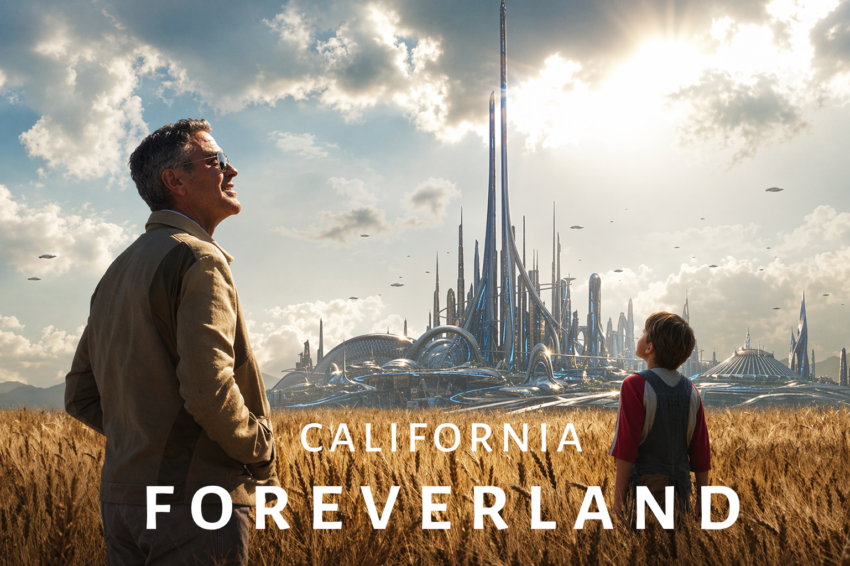
Image: An AI-generated image imagines California Foreverland. Rated PG for Pipe dreams and Grandiosity. Starring Jan Sramek as the visionary, 50,000 acres of farmland as the reluctant co-star, and Solano County residents as the audience that walked out.
CALIFORNIA FOREVER:
A Billionaire’s Blueprint on a Collision Course with Reality
A Critical Examination of the East Solano Plan and Its Unlikely Path to Realization
Introduction: Dreams, Dollars, and Dirt
In 2017, a young Goldman Sachs trader from the Czech Republic stood on the agricultural flatlands of Solano County, California — caught somewhere between San Francisco and Sacramento — and saw not fields of grain, but the skyline of the future. Jan Sramek, ambitious, idealistic, and flush with the conviction that California needed to be reborn, decided he would build a city from scratch. Not renovate a crumbling downtown. Not reform a suburb. Build. From. Scratch.
If that origin story sounds vaguely familiar, it should. In Disney’s 2015 film Tomorrowland, a brilliant, idealistic inventor — played by George Clooney with a jaw set somewhere between visionary and unhinged — discovers a hidden futuristic utopia existing in a secret parallel dimension, accessible only to the select few whose genius earns them a golden pin. The city gleams. Monorails zip. Jet packs work as advertised. The future has been pre-assembled by the smartest people in the room, and all that ordinary humanity needs to do is show up and be grateful.
Jan Sramek, one suspects, has seen the film. Possibly more than once.
The parallels are difficult to ignore — and, on reflection, difficult not to find instructive. Both stories begin with a visionary who sees limitless possibilities where others see only dirt. Both envision a city conjured from nothing, by brilliance and will, as the solution to everything wrong with the present world. Both feature a conspicuously small inner circle that knows about the plan long before the rest of us do. And both, critically, ask you to simply trust that the people holding the golden pin have thought the whole thing through.
The difference, of course, is that Tomorrowland is a work of fiction — and its sequel was never greenlit. California Forever is real, which means it must answer to the laws of physics, hydrology, environmental regulation, local government, and the stubborn opinions of Solano County farmers who did not ask to be extras in anyone else’s origin story.
What followed Sramek’s flatlands epiphany was one of the most audacious — and revealing — real estate ventures in American history. Over the next six years, Sramek and a shadowy subsidiary called Flannery Associates quietly spent over $900 million acquiring more than 50,000 acres of California farmland, assembling a land holding twice the size of San Francisco without a single neighbor knowing who was buying. The secrecy, the company would later explain, was necessary to prevent land speculation from inflating prices — a justification that might carry more weight if the project’s next move had not been to file a $510 million lawsuit against the very farmers who had declined to sell.
Then, in August 2023, the secret exploded into public view. The curtain lifted on “California Forever” — and the reaction ranged from breathless excitement to thunderous opposition. George Clooney, notably, was not available for comment.
The project promises a walkable, Mediterranean-styled city of up to 400,000 residents, a massive manufacturing hub, a functioning shipyard on the Sacramento River estuary, parks covering a third of the land area, and the cure for California’s legendary housing crisis. It is backed by the who’s who of Silicon Valley wealth: Marc Andreessen, Reid Hoffman, Laurene Powell Jobs, Michael Moritz, and the Collison brothers of Stripe. The investor list reads like a TED Talk fantasy.
And yet, from the moment California Forever stepped into the light, it has been met with a cascade of obstacles that no venture capital check can simply dissolve. Farmers felt ambushed. County officials bristled. Environmental advocates raised alarms. The Pentagon weighed in on proximity to Travis Air Force Base. Indigenous tribal leaders accused the developers of bulldozing sacred ground. A ballot initiative was launched — and then, in July 2024, quietly withdrawn.
Now, as of early 2026, the project has pivoted — pivoted again, actually — this time toward a shipyard, a manufacturing industrial park, and potential annexation deals with small cities like Suisun City and Rio Vista. The ambition remains stratospheric. The obstacles remain structural.
This essay undertakes a systematic critical examination of the California Forever project through the lens of urban and environmental planning. We will trace its origin, dissect the expertise — and the conspicuous gaps in expertise — of the individuals driving it, review the evolution of the plan and its community reception, analyze the stunning pivot toward shipbuilding and manufacturing, and place the entire venture against the backdrop of comparable city-building attempts and the lived experience of the Phoenix, Arizona metropolitan area. We will conclude with a frank assessment of the project’s prospects, which, under the weight of evidence, appear low.
“A city cannot be a work of art. To approach a city, or even a city neighborhood, as if it were a larger architectural problem, capable of being given order by converting it into a disciplined work of art, is to make the mistake of attempting to substitute art for life. The results of such profound confusion between art and life are neither art nor life. They are taxidermy.” — Jane Jacobs, The Life and Death of Great American Cities
California is considering building a brand new city an hour away from San Francisco that will be called ‘California Forever’
22,000 acres of farmland will be eliminated for this new “walkable city” that could house 400,000 people
The total amount of farmland could be as much as… pic.twitter.com/bkxQ0Ve5WT
— Wall Street Apes (@WallStreetApes) April 16, 2026
Transcript:
Here is the full transcript [Click HERE to close]
–
So how does California forever sound to you? There’s a new poll fueling a lot of buzz about a proposal to build a controversial new city in Solano County known as California forever. As NBCBayArea’s Jodi Hernandez tells us, she’s the first to get a look at the new data that suggests people may be warming to the idea of a city of the future. We call it the hidden gem of the bay. That’s how Suisun City Mayor Alma Hernandez describes her quaint Delta community. The waterfront city is full of small-town charm, but the mayor says it’s been financially struggling for years, and good-paying jobs are near non-existent here. The average person in Suisun City is commuting and their costs are increasing with the gas at the pump, with a toll that’s going to be about $11 by 2030.
That’s why Mayor Hernandez says California Forever’s proposal to build a new city in the region sounds attractive. Suisun City has agreed to explore annexing 22,000 acres of California Forever’s agricultural land. The group hopes to build a new city the size of Oakland, complete with thousands of affordable homes, the nation’s largest manufacturing park, and a shipyard. I looked at an opportunity for Suisun City, which is to explore expansion for the city, specifically because we need jobs in our community, we need revenues in our community, and we found ourselves in a financial challenging time. Tonight, a new poll commissioned by the California Forever group shows growing support of the project. Project organizers say it shows a majority of voters surveyed feel the county’s economy is struggling.
And when voters learned what the city would bring with it, 59% said they’re in favor of it. Everyone here knows someone who has lost a job or who’s losing a job. And I think we feel privileged to be in a position to hopefully do something about it. California Forever’s CEO says he’s encouraged by the new numbers and is determined to make his vision a reality. He hopes to break ground in 2028. We want to make sure that the moment that we get the permits, we can get going and we can break ground and we can put as many of those people back to work as we can and hopefully many, many, many more than that. I strongly ask them to put this on the ballot for November so Solano County can vote and then we’ll see how it comes out.
Fairfield’s mayor doesn’t believe the poll’s findings and says the group should let voters decide, noting the initial proposal set outside Fairfield was roundly shot down. Meanwhile, supporters like lifelong Suisun resident Ruth Forney say they hope Suisun City agrees to annexation. We need California forever in this county, in Solano County, in this city, and in the region. An environmental impact report should be complete by the end of the year. Mayor Hernandez says the city is carefully weighing the plan. In Suisun City, Jodi Hernandez, NBC Bay Area News.
SUMMARY:
The transcript focuses on growing interest in California Forever, a proposed new city in Solano County, California, as a fresh poll suggests public support may be strengthening. The piece contrasts the project’s promise of jobs and housing with ongoing skepticism from critics who want voters to decide the plan’s fate.
Main points:
Suisun City Mayor Alma Hernandez describes her community as a “hidden gem of the bay,” but also says it has struggled financially for years, with limited good-paying jobs and rising commuting costs. She argues that California Forever’s proposal is appealing because the city needs “jobs in our community” and “revenues in our community.”The project would involve annexing 22,000 acres of agricultural land and building a city comparable in size to Oakland, with thousands of affordable homes, a large manufacturing park, and a shipyard. Supporters say a new poll shows 59% of surveyed voters favor the project once they understand what it would include.
California Forever’s CEO says the poll gives him confidence and insists the goal is to move quickly once permits are approved, with hopes to break ground in 2028. He says, “the moment that we get the permits, we can get going,” and emphasizes the potential to “put as many of those people back to work as we can.”
Key quotes:
• “We call it the hidden gem of the bay.”
• “We need jobs in our community, we need revenues in our community.”
• “When voters learned what the city would bring with it, 59% said they’re in favor of it.”
• “We want to make sure that the moment that we get the permits, we can get going.”
• “I strongly ask them to put this on the ballot for November so Solano County can vote.”Not everyone is convinced:
The mayor doubts the poll and says the matter should go to voters, especially since an earlier proposal was rejected. Meanwhile, local supporters like Ruth Forney say the county needs California Forever, while an environmental impact report is expected by year’s end and Suisun City continues to weigh annexation. If a new city promises economic revival, who gets to decide whether that future is worth the tradeoffs?
Section I: The Origin of California Forever — Who, What, Why, When, and Where
The Man Behind the Plan
Jan Sramek is, by any measure, a compelling protagonist. Born in the post-Communist Czech Republic — a place where the promises of visionary ideology were still fresh wounds in the national memory — he arrived in California carrying what he describes as an almost religious reverence for the state as a place where transformation is possible. He was a Goldman Sachs trader in his mid-twenties when, on what was meant to be a fishing trip in Solano County in 2016, the idea seized him.
The Bay Area’s urban landscape disappointed him. Low-rise sprawl, endless surface parking, and glacial infrastructure progress. But the open expanse of eastern Solano County struck him differently. Within a year, he had left Goldman Sachs and raised $10 million in four months, pitching the idea of a new California frontier to some of the most powerful investors in the world.
“The vision from the beginning was that California needed a new place to build — a new frontier.” — Jan Sramek, California Forever CEO (City Journal, February 24, 2026
By 2017, Sramek had incorporated Flannery Associates — named, reportedly, for an obscure reason unrelated to the project’s identity. Over the next six years, this entity became the most aggressive, secretive land aggregation operation California had seen in modern memory. Operating through anonymous shell purchases and non-disclosure agreements, Flannery assembled what California Forever’s own website would later call a “mostly contiguous” tract of 50,000-plus acres, spending north of $900 million in the process.
“The development of the project was described as a five-year “stealth campaign.” The company purchased over 50,000 acres of land in Solano County for an estimated $900 million.” — Wikipedia, California Forever
The Backers: Silicon Valley’s Most Powerful Names
California Forever’s investor roster, revealed by The New York Times in August 2023, reads as a roll call of the Bay Area tech establishment: Marc Andreessen and Chris Dixon of Andreessen Horowitz; Reid Hoffman, co-founder of LinkedIn; Michael Moritz, former Sequoia Capital partner; Laurene Powell Jobs, founder of Emerson Collective and widow of Steve Jobs; Patrick and John Collison, founders of Stripe; Nat Friedman, former GitHub CEO; Daniel Gross of Y Combinator.
The company notes that 97% of its funding is from US investors, with the remaining 3% from British and Irish investors — an important point given that national security concerns about the project’s proximity to Travis Air Force Base raised early questions about foreign involvement.
The Where and Why: Solano County
The site chosen by Sramek sits approximately 60 miles northeast of San Francisco, just north of Highway 12 between Travis Air Force Base and the city of Rio Vista. Eastern Solano County is among the least urbanized portions of the Bay Area — flat, windswept agricultural land largely devoted to grain farming and cattle grazing, crossed by the Sacramento River and its estuary.
Sramek’s case for this specific location rests on a threefold argument: California’s housing shortage cannot be solved through infill development alone; existing city-edge expansion was too politically and financially constrained; and only a truly new city on open land could achieve the scale of transformation needed. He also points to the land’s proximity to both major Bay Area population centers and a dredged harbor along the Sacramento River estuary — which, he would later argue, made it “the best maritime plot on the Pacific Coast.”
As of 2023, however, that land was zoned entirely for agricultural use and protected by Solano County’s Orderly Growth Ordinance — a slow-growth law explicitly designed to keep farmland as farmland. The only legal path to urban development was a countywide ballot initiative.
Section II: Who Is Actually Building This City? A Closer Look at the Expertise
A Goldman Sachs Trader, Not an Urban Planner
The most striking feature of California Forever’s founding team is not what expertise is present but what is conspicuously absent. Jan Sramek is a trained financial trader. His Silicon Valley backers are venture capitalists, software entrepreneurs, and tech executives. None of them, individually or collectively, has built a city, designed urban infrastructure, managed municipal governance, or navigated the labyrinthine world of California environmental regulation — at least not until very recently.
California Forever has since assembled a more credentialed planning team. Leading the urban design division is Gabriel Metcalf, who has spent years at urbanist think tanks in the US and Australia. Heading the industrial development arm, “Solano Foundry,” is Andreas Lieber, a former Uber executive and COO of the logistics firm Shippo. The urban planning vision draws on classic New Urbanist principles — a Jeffersonian street grid, mixed-density housing, walkable neighborhoods, and transit orientation.
“The overall city design — this is more important than any other goal in the urban design — is to make it a place where people walk. The city plan we’re proposing is a classic American town plan. It’s got a street grid set on the Jeffersonian grid of county roads, just like Chicago.” — Gabriel Metcalf, California Forever Urban Planning Director (City Journal, February 24, 2026
The Missing Institutional Memory
What California Forever lacks, and what no amount of late-stage hiring can fully supply, is institutional memory — the hard-won, decade-by-decade knowledge of what actually drives city formation. The great planned communities of the American Southwest were not born in the minds of financiers looking for the next frontier. They emerged from a specific convergence of federal water policy, military investment, post-war migration patterns, cooperative state governance, and incremental private investment.
Consider the legacy of Del Webb Corporation, which transformed the Phoenix suburb of Sun City into the first large-scale American retirement community in 1960. Del Webb did not begin with a grand vision and a $1 billion land stake. He began with deep Arizona roots, careful market research, an understanding of post-war demographics, and — critically — a pre-existing water and transportation infrastructure backbone provided by the Salt River Project and the federal government’s wartime investment in the region.
Or consider Paolo Soleri’s Arcosanti, begun in 1970 on the Arizona high desert as a living experiment in “arcology” — architecture fused with ecology. Soleri was trained under Frank Lloyd Wright at Taliesin West, possessed genuine theoretical credentials, and still managed to produce, over five decades, a community of approximately 50-80 permanent residents on a project intended for 5,000. The lesson from Arcosanti is not that vision fails — it is that vision without a self-sustaining economic engine, adequate infrastructure, and organic community formation produces extraordinary architecture and essentially no city.
California Forever’s technology-sector investors appear to have absorbed the lessons of app-scale disruption — move fast, acquire market share, force adoption through superior product — and applied those lessons to a domain governed by entirely different physics. Urban development is not a software launch.
“The more precise and comprehensive your image of a city is, the less likely that the place you’re imagining really is a city… Scaling up narrows the range of the informal contacts that drive creativity and discovery.” — Sandy Ikeda, Market Urbanism
Section III: The Plan’s Evolution and the Community Firestorm
The Reveal: August 2023
When California Forever finally stepped out of the shadows in August 2023, announcing its East Solano Plan, the initial public response was genuinely mixed — not the outright triumph the company may have hoped for, nor the total rejection its critics might have predicted. The plan promised a city of up to 400,000 residents built on 17,500 of the company’s 50,000-plus acquired acres, leaving the remainder as a buffer. The development was to include walkable neighborhoods with Mediterranean architecture and streetcar infrastructure, a solar farm, public parks, mixed-density housing, and eventually a self-sustaining economic base.
California Forever issued a mail-in poll to gauge local support, claiming encouraging results. They held community meetings — contentious ones. And they filed their ballot initiative, promising that it would be submitted to county voters in November 2024.
The Lawsuit That Poisoned the Well
Before the ballot initiative could gain traction, the company committed a public relations catastrophe. In 2023, Flannery Associates filed a $510 million lawsuit against a group of local landowners, accusing them of conspiring to inflate real estate prices during the secret acquisition phase. The lawsuit named farmers and landowners who had declined to sell — and immediately shifted the narrative from visionary city-building to corporate intimidation.
“Some farmers who refused to sell their land described feeling “caught off guard” by the aggressive nature of the land purchases and were pressured by repeated offers. Several farmers had reached confidential settlements to avoid costly legal battles.” — Wikipedia, citing KQED reports
The lawsuit — which was eventually dropped — had already accomplished something irreversible: it confirmed, in the minds of many Solano County residents, that California Forever was not a community partner but a corporate juggernaut willing to use the courts as a weapon. Trust, once broken in a small agricultural community, does not easily repair.
Official Opposition
Elected officials moved swiftly to distance themselves or oppose the project outright. U.S. Representative John Garamendi, who represents the area, labeled the project a “nightmare” scenario for the region, citing environmental damage, the loss of irreplaceable farmland, the threat to the Sacramento-San Joaquin Delta, and proximity to Travis Air Force Base. Fairfield Mayor Catherine Moy was openly skeptical, calling on the company to put the plan on the ballot and face a direct public verdict.
The Ballot Initiative Withdrawal: July 2024
After months of contentious public meetings and escalating opposition, California Forever withdrew its ballot initiative in July 2024 — before it could be defeated. The company framed this as a strategic pivot: rather than force an unprepared electorate into a yes-or-no vote, they would commission a full Environmental Impact Report and work with county officials to develop a comprehensive development agreement. A new ballot initiative was targeted for 2026.
The withdrawal was widely interpreted as a defeat. Critics pointed to polling that showed deep division among Solano County residents, and to the legal and environmental challenges that had made the November 2024 timeline untenable. Whatever the internal rationale, the public withdrawal confirmed that California Forever had significantly misjudged the local political landscape.
“The secretive nature of the initial land acquisition by Flannery & Associates… created a lack of trust. Many critics and some local politicians view the project as “scrapped” or a product of “hubris.”” — California Forever, AI Overview Summary (project document)
“When voters learned what the new city would bring with it, 59% said they’re in favor of it.” — NBC Bay Area, April 14, 2026
The 59% figure, however, must be understood in context: it was drawn from a poll commissioned by California Forever itself, conducted after respondents were provided the company’s own description of the project’s benefits. Fairfield Mayor Moy dismissed the poll’s findings as unreliable, and publicly called for putting the question directly before county voters — knowing the outcome might be very different without the company’s framing.
Section IV: “What in the World?” — The Pivot to Shipyards and Manufacturing
A Solution in Search of a Problem
By 2025, California Forever had not merely pivoted — it had pivoted to something that seemed, on the surface, almost comically disconnected from its original premise of a walkable, Mediterranean-styled residential community. The new centerpiece of the project was Solano Foundry: a 2,100-acre advanced manufacturing industrial park. And anchoring the entire venture was a proposed shipbuilding facility on 1,400 acres near Collinsville, along the Sacramento River estuary.
“Nobody was talking about shipbuilding in 2016, but we happened to buy the best maritime plot on the Pacific Coast.” — Jan Sramek (City Journal, February 24, 2026
Sramek argues this is not a pivot but a natural evolution — that the site always had maritime potential, and that the national reindustrialization movement triggered by post-COVID supply chain crises and US-China competition has simply brought that potential to the fore. Andreas Lieber, heading Solano Foundry, envisions hosting “industries that are in the first inning, not the last one” — AI, robotics, drones, defense contractors, and energy technology.
“California Forever CEO Jan Sramek says manufacturing hub joins proposed new Solano County city.” — CBS News Sacramento
The Shipyard Problem
The shipyard proposal has attracted its own cloud of skepticism. The United States has not built a major new commercial shipyard in decades. The American shipbuilding industry, protected and subsidized through the Jones Act but chronically under-competitive globally, is not waiting for a Silicon Valley-funded industrial park in the Sacramento Delta to rescue it. Building a functional shipyard from a clean site requires not just land and investment but an entire regional ecosystem of specialized labor, materials supply chains, dry-dock infrastructure, navigational channel maintenance, and regulatory compliance with the Army Corps of Engineers.
Critics have also noted that the proposed location, while adjacent to the Sacramento River estuary, requires significant dredging and channel maintenance to support heavy maritime commerce — work that is federally regulated and environmentally contentious, particularly given the ecological sensitivity of the Sacramento-San Joaquin Delta. The Guardian reported in March 2025 that the shipyard plan had attracted some support from the Bay Area Council and local officials, but observers noted the gap between political enthusiasm and functional reality remained vast.
Manufacturing Without Workers
The manufacturing hub vision faces its own structural challenge: the workers. Advanced manufacturing in AI, robotics, and defense requires a skilled technical workforce. That workforce currently lives in San Jose, Oakland, Fremont, and the broader Bay Area — not in a city that does not yet exist. The theory of the case is that workers will move to the new city because it offers affordable housing unavailable in the existing Bay Area. But this assumes that the workers in question value affordable housing more than proximity to the established professional networks, universities, hospitals, entertainment venues, and family roots that exist in the Bay Area.
“Businesses will have no reason to relocate themselves 50 miles away from the already existing concentration of people and talent in San Francisco.” — Volts podcast, critiquing California Forever
Section V: The Sheer Complexity of Urban Development
Cities Are Not Products
The fundamental category error underlying California Forever is the application of product-launch logic to city-building. A tech product can be designed, built, tested, iterated, and deployed. A city cannot. Cities are complex adaptive systems — the term used by contemporary urban complexity theorists — in which social, economic, environmental, and technological interactions generate emergent behaviors that no planner, however well-capitalized, can fully anticipate or control.
“Urbanization is an accelerating global phenomenon driving cities to become increasingly complex as they expand in size and population… Complexity Theory establishes that urban systems function as complex adaptive systems, where numerous components interact in non-linear ways, leading to unpredictable emergent behaviors that cannot be deduced by analyzing individual parts in isolation.” — Abujder Ochoa et al., “The Theory of Complexity and Sustainable Urban Development: A Systematic Literature Review,” Sustainability 2025
This scholarly framework has immediate practical implications for California Forever. The plan envisions a specific type of city — walkable, dense, transit-served, mixed-income — and attempts to will that city into existence through top-down design and financial investment. But as complexity theory makes clear, the properties that make cities livable and economically vital — diverse uses, informal social networks, emergent commercial clusters, organic neighborhood identity — arise from the bottom up, from thousands of uncoordinated individual decisions made over decades.
The Infrastructure Cascade
Before a single residential unit can be occupied in a new city, an infrastructure cascade must be completed: water supply secured and distribution systems built; wastewater treatment plants designed and constructed; electrical transmission infrastructure extended or newly built; road networks developed and, in California, subjected to extensive environmental review; schools planned, funded, and staffed; emergency services organized; healthcare facilities attracted or constructed; and broadband telecommunications infrastructure deployed.
Each of these elements involves not just capital investment but regulatory approvals from multiple overlapping jurisdictions. In California specifically, this means compliance with CEQA (the California Environmental Quality Act) — one of the most rigorous and litigation-prone environmental review processes in the world. CEQA allows virtually any citizen or interest group to challenge a development on environmental grounds, and legal challenges under CEQA can delay or kill projects for years, regardless of their underlying merit.
California Forever’s promised Environmental Impact Report, expected to be completed by the end of 2026, represents only the beginning of this regulatory marathon, not its conclusion.
Water: The Desert in the Room
Water supply is the most fundamental constraint facing any major California development. The Sacramento-San Joaquin Delta, which borders the project site, is already the subject of epic political battles over water rights, environmental flows for endangered species, and the demands of California’s agricultural sector and Southern California’s urban users. Adding a city of 400,000 new water users to this equation — users who would require not just potable water but significant water for landscaping, industrial processes, and fire suppression — would require water rights and infrastructure investments that remain completely unspecified in California Forever’s public materials.
“Concerns exist regarding a reliable water supply and the capacity of local infrastructure to support such a large development.” — California Forever, AI Overview Summary (project document)
Travis Air Force Base: A National Security Complication
The project’s proximity to Travis Air Force Base — the largest air mobility hub on the US Pacific Coast — introduces a national security dimension that California Forever’s backers consistently underplay. Military installations maintain “clear zones” and Accident Potential Zones (APZs) around their flight paths that restrict surrounding land use. The Department of Defense and the Air Force have formal processes for reviewing proposed developments near military installations, and they have blocked or substantially modified development projects that would introduce large residential populations into flight corridors.
Building a city of 400,000 people within the existing operational envelope of Travis AFB would require DoD coordination, potentially Air Force approval, and possibly congressional action. None of this has been transparently addressed in California Forever’s public planning materials.
Section VI: Has Anyone Tried This Before? Comparable Developments
The Short List of New Cities
The history of intentionally planned new cities is both longer and more cautionary than California Forever’s backers appear to appreciate. The 20th century produced a handful of genuine new-city successes — Canberra, Brasília, Chandigarh, Irvine — and a much larger number of expensive failures and compromises. The successes share key features that California Forever conspicuously lacks: a governmental mandate (national capital relocation, colonial administration, or state university anchor), pre-existing infrastructure investment by public bodies, and a captive user base.
Brasília, perhaps the most celebrated planned new capital of the 20th century, was built through the combined force of the Brazilian federal government, which relocated an entire national capital. Irvine, California — often cited as the most successful planned community in the US — was developed by the Irvine Company over decades on land the company had owned since the 19th century, with the University of California, Irvine providing an institutional anchor, and with the extraordinary amenity infrastructure of Orange County already surrounding it.
The Woodlands, Texas: A More Honest Comparison
The Woodlands, Texas — developed north of Houston beginning in the early 1970s by the Mitchell Energy and Development Corporation — represents perhaps the most honest comparison to California Forever. George Mitchell invested hundreds of millions of dollars in a master-planned community that promised to be environmentally sensitive, economically diverse, and self-sustaining. The Woodlands succeeded, but only over a 30-to-40-year timeline, and only because of several California-Forever-absent conditions: proximity to a massive, pre-existing employment center (Houston’s energy and medical complex); Texas’s exceptionally developer-friendly regulatory environment; and the absence of anything resembling California’s CEQA process.
The Woodlands today is one of the most successful master-planned communities in America. It took four decades and a Fortune 500 corporation’s patient capital to get there.
Arcosanti, Arizona: The Dream That Never Scaled
No examination of ambitious new city proposals is complete without a visit to Arcosanti, the Arizona desert experiment conceived by architect and philosopher Paolo Soleri beginning in 1970. Trained under Frank Lloyd Wright at Taliesin West and a genuine theorist of urban ecology, Soleri designed Arcosanti as a demonstration of “arcology” — the integration of architecture and urban ecology in a compact, car-free settlement of 5,000 residents.
After more than 50 years of construction, Arcosanti houses approximately 50-80 permanent residents. The project is real, physically present, and intellectually fascinating. It is also the clearest possible demonstration that visionary design, architectural credibility, and genuine philosophical conviction cannot substitute for the economic gravity well that draws people to cities: jobs, markets, institutions, and the irreducible fact of other people having chosen to be there first.
The Failed “Startup City” Precedent
In more recent decades, the “startup city” or “charter city” movement — heavily influenced by economist Paul Romer’s concept of institutional reform through new urban environments — has produced a series of high-profile failures. Honduras’s experiment with charter cities (ZEDEs) ended in constitutional controversy and investor withdrawal. Various libertarian-themed new city proposals in Latin America, Africa, and the Pacific have similarly failed to progress beyond the planning stage, defeated by the same forces that now confront California Forever: regulatory complexity, community opposition, and the inability to bootstrap an economy and population simultaneously.
Section VII: The Phoenix Comparison — What Organic Metro Growth Actually Looks Like
Phoenix’s Organic, Decades-Long Formation
The Phoenix metropolitan area — today the fifth-largest metro in the United States with a population exceeding five million — is the most instructive real-world comparison available to California Forever’s planners, if they are willing to examine it honestly. Phoenix grew not from a single visionary investor’s plan but from an improbable convergence of federal infrastructure investment, post-war migration, aggressive municipal annexation, and decades of developer competition across an openly accessible land market.
“Phoenix is a relatively young city. By 1930, while Denver had a population of about 288,000, Phoenix had just over 48,000 residents… Arizona didn’t establish statehood until after the second industrial revolution, which was a critical time for urban development. Our massive amounts of land and burgeoning sprawl dispersed development, and density never became part of our building culture.” — Lynita Johnson, Local First Arizona
The conditions that made Phoenix possible — and that California Forever cannot replicate — include: the construction of the Roosevelt Dam and the Salt River Project irrigation system, providing reliable water to an otherwise uninhabitable desert; post-World War II military investment (Luke Air Force Base, Williams Air Force Base, Falcon Field) that seeded the region with trained workers and defense industry contracts; the development of evaporative cooling and later residential air conditioning by local entrepreneurs like Goettl and Servel; the construction of the Interstate Highway System through Phoenix in the 1950s and 1960s; and the aggressive, competition-driven development of master-planned communities by companies like Del Webb, DMB Associates, and Robson Communities across multiple jurisdictions simultaneously.
Del Webb, DMB, and the Master-Planned Community Model
Del Webb Corporation’s Sun City, which opened in January 1960, is often cited as proof that master-planned communities can work at scale. But Sun City’s success was built on conditions that California Forever cannot recreate: a massive, pre-existing retiree demographic newly mobile due to Social Security and pension income; federally subsidized highway access via I-17 and US-60; Phoenix’s already-established water infrastructure and utility networks; and the existence of multiple competing cities (Phoenix, Glendale, Peoria, Surprise) already providing commercial and civic services within driving distance.
DMB Associates, the developer behind landmark Arizona communities like Verrado and DC Ranch, similarly built on Phoenix’s pre-existing foundations — transportation networks, municipal services, regional employment centers — rather than attempting to create all of those elements simultaneously. Verrado, though a successful new-community development in Buckeye, took more than 15 years to reach meaningful population and still relies fundamentally on the Phoenix metro’s employment base for the majority of its residents’ livelihoods.
John F. Long: The Pioneer Who Played the Long Game
John F. Long is the true patron saint of Phoenix’s master-planned development tradition. Beginning in the 1950s, Long developed thousands of affordable homes in west Phoenix — Maryvale, specifically — using innovative pre-fabrication techniques and an encyclopedic understanding of working-class buyers’ needs and budgets. Long’s success was not built on venture capital or Silicon Valley ideology. It was built on intimate knowledge of the market, personal financial risk-taking at a human scale, and a community deeply woven into Phoenix’s existing urban fabric.
The lesson from Long, from Del Webb, from DMB Associates, is consistent: successful large-scale community development in the American West requires pre-existing infrastructure, an already-functioning regional economy, patient capital deployed across decades rather than years, and an organic community identity that cannot be manufactured.
The Water Reality That Phoenix Faced and Solved
Phoenix’s water story is instructive for another reason. The city’s transformation from a small agricultural town into a metropolis was made possible only by a century of federal water infrastructure investment — Hoover Dam, Glen Canyon Dam, the Central Arizona Project canal — representing tens of billions of dollars of public investment over generations. California Forever’s proposed water solution for its new city is, as of this writing, essentially a placeholder: the company acknowledges the challenge without presenting a credible, fully-costed solution.
Section VIII: The Unlikely Path to Success — A Comprehensive Assessment
The Regulatory Gauntlet
California’s regulatory environment is, without exaggeration, the most complex in the United States for large-scale development. CEQA alone has generated thousands of legal challenges, delayed projects by years, and added hundreds of millions of dollars to development costs for projects far simpler than a new city of 400,000. The CEQA review for a development of this scale — involving agricultural land conversion, potential wetland impacts, proximity to a military installation, effects on the Sacramento-San Joaquin Delta ecosystem, and traffic generation of potentially millions of daily trips — would take years and face legal challenges from environmental groups, farmland preservation advocates, tribal governments, and neighboring municipalities.
Beyond CEQA, California Forever must navigate: local zoning and general plan amendments requiring supermajority approval; annexation proceedings before the Solano County Local Agency Formation Commission (LAFCO); state Coastal Commission review (due to Sacramento River estuary proximity); Army Corps of Engineers permitting for any dredging or waterway modification; Federal Aviation Administration review due to Travis AFB proximity; potential National Environmental Policy Act review if any federal actions are triggered; and a web of state housing laws, building codes, and municipal service agreements.
The Building Code and Infrastructure Cost Reality
California’s building codes — Title 24, the California Building Standards Code — are among the strictest in the world, incorporating energy efficiency, seismic safety, accessibility, and environmental standards that add significantly to construction costs. A new city in Northern California, built to current California code, would face per-unit construction costs that are structurally incompatible with the “affordable” price points California Forever has promised. The company has pledged up to $400 million in down-payment assistance, but legal experts and elected officials have questioned whether these promises are legally enforceable.
“The Silicon Valley tech billionaires aim to put a nearly 100-page ballot initiative before county voters. But skeptical legal experts and local officials dispute the idea that the project’s developers will be obligated by law to deliver on the so-called guarantees.” — CalMatters, February 22, 2024
The Equity Problem
Among the most pointed critiques of California Forever is what it would actually cost to live there — and who would realistically be able to afford it. The company’s marketing language is saturated with words like “affordable” and “mixed-income.” But critics note that a brand-new development, built to California code, financed by venture capital seeking a return, and located in a region with extraordinary land values, cannot offer genuine affordability at scale without sustained public subsidy.
“The deeper you look at California Forever, the less it resembles a utopian city for the masses and the more it feels like something else entirely: a billionaire panic room with bike lanes.” — Stephen A. Crockett Jr., NewsOne
This is not merely rhetorical skepticism. The economics of new-city development are brutally clear: the first wave of residents in any new planned community pay premium prices for the privilege of being first, premium prices that reflect the absence of established amenities, services, and community density. Genuine affordability in master-planned communities historically arrives, if at all, in the second and third decades of development, when the infrastructure investment has been amortized and competition among developers has emerged.
Local Opposition: More Than NIMBYism
California Forever’s proponents have tended to characterize local opposition as reflexive NIMBYism — the predictable resistance of people who are comfortable and do not want change. This characterization is both uncharitable and analytically wrong. The opposition to California Forever in Solano County includes not just anti-development sentiment but substantive, legitimate concerns that have not been adequately addressed:
• The permanent conversion of prime agricultural land to urban uses, with no guarantee of reversibility.
• The threat to the Sacramento-San Joaquin Delta is already one of California’s most environmentally stressed ecosystems.
• The operational impact on Travis Air Force Base, a critical national security asset.
• The unproven and potentially unenforceable nature of the company’s financial “guarantees.”
• The displacement of generational farming families and rural communities with no equivalent replacement.
• The lack of a credible water supply plan for a city of 400,000 in a state already in a chronic water deficit.
• The conflict between the project’s scale and the county’s existing slow-growth ordinance.
Business Support: More Skepticism Than Enthusiasm
Beyond the Bay Area Council’s supportive statement about the shipyard — an endorsement that reflects Bay Area business community interests rather than Solano County stakeholders’ interests — California Forever has not demonstrated broad-based business community support from the region where the city would actually be built. Existing Solano County businesses face the prospect of a massive new competitor for labor, commercial space, and municipal attention, without any clear guarantee that they will benefit from the new city’s development.
The manufacturing hub model depends entirely on attracting businesses that do not yet exist — “industries in the first inning,” as Andreas Lieber put it. These industries may or may not materialize. They may choose to locate in more established industrial corridors. They may locate in other states with more favorable regulatory and tax environments. Building a city around hypothetical future economic activity is a bet of extraordinary risk.
The Indigenous Heritage Question
California Forever’s relationship with the region’s Indigenous communities — specifically the Patwin people, part of the Wintun linguistic family native to this region for at least 4,000 years — represents both a moral and legal vulnerability. Archaeological evidence has documented continuous Indigenous occupation of eastern Solano County back to at least 2000 BCE.
“Marge Grow-Eppard, a member of the Miwok tribe, accused the developers of disregarding the heritage of the Native Americans and warned that construction would cement over Native American burial grounds without consent.” — Wikipedia, citing public meeting records
Federal law — specifically the National Historic Preservation Act and the Native American Graves Protection and Repatriation Act — requires formal government-to-government consultation with federally recognized tribes before any ground disturbance that may affect cultural or burial sites. California’s AB 52 (2014) similarly requires lead agencies to consult with California Native American tribes during CEQA review. These requirements are not discretionary. They are not obstacles to be managed around. They are legal prerequisites that, if inadequately addressed, can and do invalidate environmental review processes and halt construction.
The 2026 Ballot and Beyond
California Forever’s current timeline targets a 2026 ballot measure, following completion of the Environmental Impact Report. Even optimistic projections from observers sympathetic to the project suggest that ground-breaking before 2028 is improbable, with meaningful residential occupancy unlikely before the mid-2030s at the earliest. A city of 400,000 — Sramek’s stated ultimate goal — would require 30 to 40 years of sustained development, a time horizon that exceeds the typical investment patience of even the most long-term-oriented venture capital.
During that 30-to-40-year window, the regulatory environment will change. Political leadership in Solano County will change. California’s water situation may worsen. Travis AFB’s mission may expand or contract. The tech industries underpinning the company’s investment thesis may shift geographically or structurally. Any one of these variables, in a project of this complexity, can be decisive.
Conclusion: The Dream That Cannot Build Itself
In the end, California Forever’s fundamental problem is not a lack of vision, capital, or intelligence. It is a profound misunderstanding of what cities are and how they form. A city is not a product. It cannot be designed, funded, and deployed like a software platform. It is, as Jane Jacobs understood with unmatched clarity 60 years ago, a living organism — a complex adaptive system whose most essential properties emerge not from the genius of planners but from the accumulated choices of thousands of ordinary people using local knowledge to solve problems only they can see.
California Forever’s backers are genuinely intelligent people with genuine resources and, in many cases, genuine concern for California’s future. The housing crisis is real. The need for more walkable, transit-served development is real. The desire for a place where the middle class can afford to live near major employment centers is real. These are problems worth solving.
But the evidence examined in this essay points consistently toward a low probability of success for the project as currently conceived. The regulatory gauntlet of CEQA and federal environmental law alone could consume a decade. The water question is unresolved and potentially unresolvable at the scale proposed. The proximity to Travis AFB introduces national security complications that have not been adequately addressed. The building code and cost structure of California make genuine affordability nearly incompatible with venture-capital returns. The Indigenous heritage obligations are legally non-negotiable and have been embarrassingly under-addressed. The track record of comparable new-city ventures globally is sobering. The local opposition is substantive, not merely sentimental. And the plan’s own economic foundation — a manufacturing hub and shipyard in industries that do not yet have confirmed tenants — is speculative in the extreme.
“It’s just political money, foreign money. They’re buying up land, they’re trying to sue farmers for their land, and we don’t need all that. This is a generational town. We don’t need another town.” — Nikki, Rio Vista resident (City Journal, February 24, 2026
The Phoenix metropolitan area — which took a century of federal water investment, a generation of military spending, and decades of competing developers to reach its current scale — offers the most honest mirror California Forever should hold up to itself. Phoenix did not become Phoenix because one visionary investor with $1 billion decided it should. It became Phoenix because of a confluence of public infrastructure investment, demographic movement, economic gravity, and time that no private company, however well-capitalized, can substitute for.
California Forever may build something. A manufacturing park, a partial residential development, a shipyard facility — any of these is possible within the company’s financial means and a favorable regulatory outcome. But a city of 400,000 residents, complete with schools, hospitals, transit systems, diverse commercial districts, cultural institutions, and the organic vitality of a genuine urban community? That is not a product that can be funded into existence. That is a city, and cities take centuries to become themselves.
Complexity theory, urban history, and the hard lessons of every comparable attempt in the modern era converge on the same conclusion: California Forever, as envisioned, has a low probability of success. Not because the dream is unworthy, but because the nature of cities is being asked to bend to the will of capital — and cities, in the long run, do not bend. They evolve.
“Urbanization is a rapidly accelerating global phenomenon that challenges sustainable development, requiring innovative frameworks for understanding and managing urban complexity. This study concludes that embracing Complexity Theory enables a holistic approach to urban sustainability, fostering adaptable, resilient systems that can better manage uncertainty.” — Abujder Ochoa et al., Sustainability 2025
Primary Resources:
• https://www.planning.org/planning/2016/jan/coolplaces.htm
• https://localfirstaz.com/news-blog/a-brief-history-of-development-in-phoenix-and-a-briefer-look-ahead
• https://www.sciencedirect.com/science/article/abs/pii/S0169204613001643
• https://novus2.com/righteouscause/wp-content/uploads/2026/04/sustainability-17-00003.pdf
• https://marketurbanism.com/2016/09/20/urban-design-and-social-complexity/
• https://www.linkedin.com/pulse/urban-complexity-harnessing-data-gis-decode-shape-future-ajith-vyas-cuqoc
• https://en.wikipedia.org/wiki/California_Forever
• https://californiaforever.com/
• https://www.city-journal.org/article/california-forever-project-jan-sramek
• https://mendovoice.com/2026/03/forever-or-never-california-forever-plan-for-new-city-of-400000-divides-solano-county/
• https://www.nbcbayarea.com/news/local/california-forever-poll-city-solano-county/4068963/
• https://www.theguardian.com/us-news/2025/mar/28/california-forever-tech-boats
• https://www.sfgate.com/local/article/california-forever-new-bay-area-city-factory-20788666.php
• https://www.cbsnews.com/sacramento/news/california-forever-ceo-manufacturing-hub-new-solano-county-city/
• https://calmatters.org/economy/2024/02/california-forever-promises/
• https://www.volts.wtf/p/is-the-brand-new-city-in-california
• https://newsone.com/6853233/will-you-afford-live-california-forever/
• https://www.facebook.com/groups/775318240797761/posts/1252714083058172/
A Note on Research Methods and Accuracy
In recent years, some have voiced concern that artificial intelligence may distort facts or introduce inaccuracies into serious research. That criticism deserves acknowledgment. However, AI has now evolved into the most powerful research instrument available to any dedicated scholar—capable of analyzing vast datasets, cross‑referencing historical records, and surfacing overlooked connections across sources. This work represents a collaboration between the author’s investigative inquiry, verified primary documentation, and the advanced analytic capabilities of AI research tools. Here, AI was not used as a ghostwriter or a shortcut for scholarship, but as a disciplined research partner devoted to rigor, accuracy, and transparency.
Every factual claim in this work has been subjected to active verification. Where AI‑generated content was used as a starting point, it was tested against primary sources, peer‑reviewed scholarship, official institutional documentation, and established historical records. Where discrepancies were found—and they were found—corrections were made. The author has made every reasonable effort to ensure that quotations are accurately attributed, historical details are precisely rendered, and theological claims fairly represent the positions they describe or critique.
That said, no work of this scope is immune to error, and the author has no interest in perpetuating inaccuracies in the service of an argument. If you are a reader—whether sympathetic, skeptical, or hostile to the conclusions drawn here—and you identify a factual error, a misattributed source, a misrepresented teaching, or a claim that cannot be substantiated, you are warmly and genuinely invited to say so. Reach out. The goal of this work is not to win a debate but to get the history right. Corrections offered in good faith will be received in the same spirit, and verified corrections will be incorporated into future editions without hesitation.
Truth, after all, has nothing to fear from scrutiny—and neither does this work.