
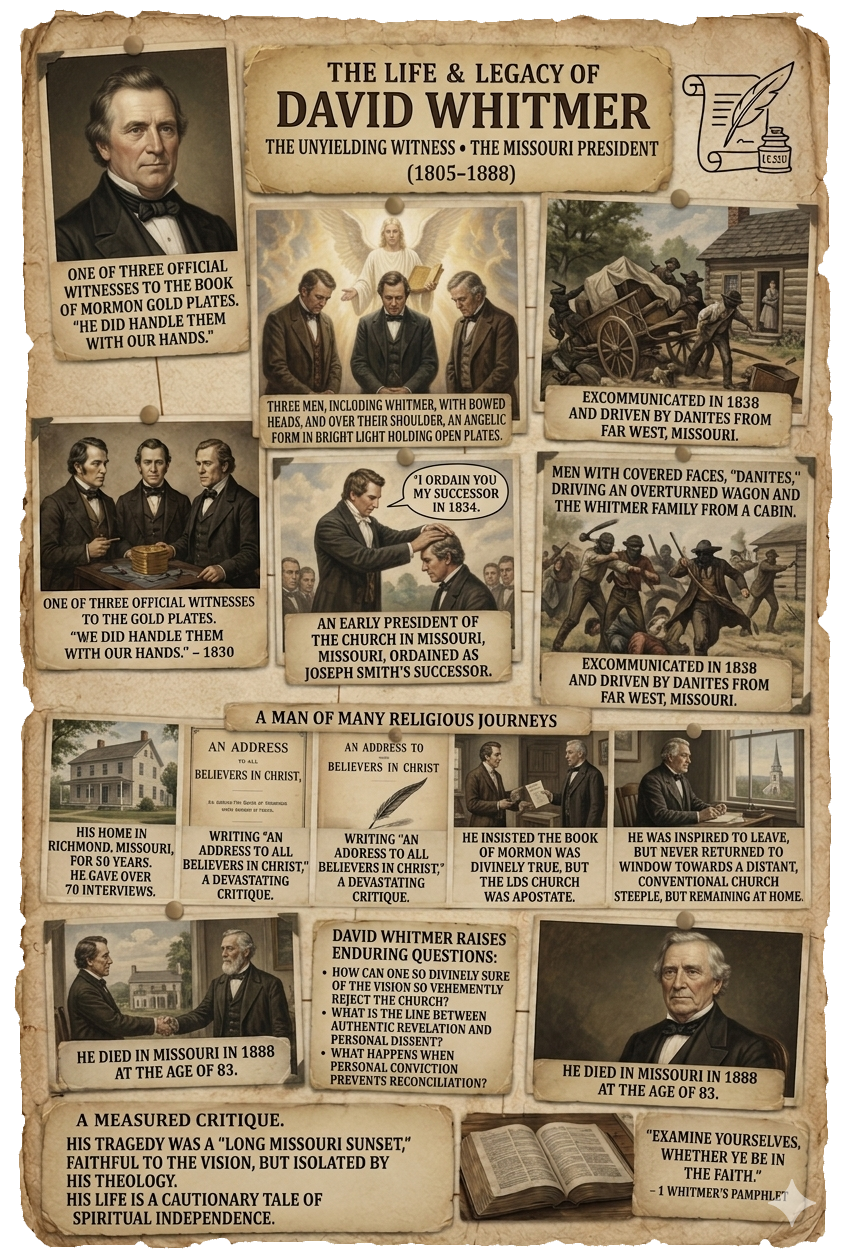
Sixth Post in the Early Mormon Personalities Series
Ink Beneath the Hand: The Strange Half-Faith of One of the Three Witnesses of the Book of Mormon
❦ ❦ ❦
Prologue: A Light in the Fayette Woods
Late June, 1829. The light slants through the maples on the Whitmer family farm in Fayette, New York, dappling the cleared ground where a young farmer of twenty-four kneels in prayer beside two other men. To his left is Oliver Cowdery, the schoolteacher whose letters from Palmyra have, for the better part of a year, set fire to the Whitmer hearth. To his right kneels Joseph Smith Jr., twenty-three years old, taller than David expected, eyes burning with the certainty of a man who believes he carries a continent’s worth of restored truth in a hidden cache of golden plates. They have walked together away from the house — past the corn rows, past the well, past the brothers and sisters and the worried mother — into a clearing where they hope no neighbor will see them. They are looking for a vision.
What David Whitmer would later say happened in that clearing — and what he said again, and again, in more than seventy recorded interviews across the next fifty-nine years of his long life — is that the heavens opened. A light “not like the light of the sun, nor like that of a fire, but more glorious and beautiful” enveloped them. An angel stood before them, holding a table on which lay golden plates, the brass plates of Laban, the sword of Laban, the directors that had guided Lehi through the wilderness, and the interpreters that Joseph had used to translate. A voice declared the records true. David Whitmer, fourth son of a German-immigrant Presbyterian, was forever altered.
And yet, less than a decade later — almost to the month — David Whitmer would walk out of the church that vision had founded, and he would not come back. Not when his brother-in-law Oliver Cowdery returned in 1848. Not when his fellow witness, Martin Harris, was rebaptized in Utah in 1870. Not when missionaries traveled hundreds of miles to plead with him. Not when his nephew attempted to organize a new offshoot in his name. Not on his deathbed, when even the loyal local newspaper editors of Richmond, Missouri, leaned in and listened for any sign that the old man might at last recant. He died in January 1888 carrying the same paradox he had borne for half a century: the Book of Mormon was, he insisted, the word of God; the Church it had founded was, he insisted with equal vigor, an apostate fraud.
This is the strange, sober, and theologically arresting story of the witness who walked away — and of the institution that, even now, two centuries on, must figure out how to print his name on the front of every Book of Mormon while quietly sweeping the rest of his testimony out of the foyer.
❦ ❦ ❦
I. Origins of a Pennsylvania Dutchman
David Whitmer was born on January 7, 1805, near Harrisburg, Pennsylvania, the fourth of nine children born to Peter Whitmer Sr. and Mary Musselman Whitmer. The Whitmer line was thoroughly Continental: his grandfather, George Witmer, had been born in Prussia; his great-grandfather had come from Switzerland. The household spoke German with a thick accent for much of David’s youth, and the family belonged to what historians sometimes call the “Pennsylvania Dutch“ stratum of pious, propertied, sober German Protestants who had populated the lower Susquehanna and Cumberland Valleys throughout the eighteenth century.
Religion in the Whitmer home was Reformed and Presbyterian in flavor — disciplined, scriptural, communal — though the family’s piety was practical rather than enthusiastic. They were not the people who tore their clothes in revival meetings; they were the people who came home from church and made supper. By the early 1820s, in search of better land, the Whitmers had relocated to Seneca County in the Finger Lakes region of upstate New York, settling on a farm in Fayette, only a few miles from Waterloo and within the wider orbit of what religious historians have come to call the “Burned-Over District“ — that strip of post-Revolutionary New York so repeatedly scorched by waves of revivalism that, by the time the Whitmers arrived, scarcely a clearing remained unsinged.
On March 12, 1825, when David was twenty, he was elected a sergeant in a newly organized local militia, the Seneca Grenadiers — a small detail, but a telling one. By the standards of the rural early republic, a Whitmer son with shoulders broad enough to drill volunteers was a Whitmer son who carried a measure of community trust. The family was respectable, propertied, churched, and connected. They were not seekers in the impoverished, anxious, last-resort sense of that word. When David Whitmer first heard of golden plates and angels in 1828, he was not a desperate man looking for any miracle that would have him. He was a young farmer with land, family, a militia commission, and a Bible he had been reading since boyhood.
That fact matters. It will return throughout this story. Whitmer’s later witness was not, by any honest reckoning, the witness of a man unmoored — and that is precisely what made him so useful to Joseph Smith, and so dangerous to the Church that bore Joseph Smith’s name.
A Family Saturated in Folk Religion
Yet alongside their Reformed Presbyterian sobriety, the Whitmers — like nearly every other family on the New York frontier in the 1820s — inhabited a religious imagination that modern Christians may find startling. The line between “religion” and “folk magic” in their world was porous, almost indistinguishable. Divining rods to find buried treasure, peep stones placed in hats to receive revelations, charms and astrological calculations, and Masonic-tinged ritual — all coexisted, often comfortably, with church attendance and family prayer.
David Whitmer himself owned at least two seer stones during his lifetime — flat, oval river stones with characteristic markings, identical in form and function to the stones used by Joseph Smith and others in their treasure-hunting circles. Hiram Page, who would later marry David’s sister Catherine and become one of the Eight Witnesses, possessed his own black seer stone through which he claimed to receive revelations — until Joseph Smith pronounced his stone a Satanic counterfeit and pressured him to surrender it.
To understand David Whitmer, one must first understand that he did not arrive in the company of Joseph Smith from a world of secular skepticism, asking whether visions were real. He arrived from a world saturated with seers and stones and signs, asking only whose vision was the right one. The Bible was already, for him, only one of several authoritative texts in a syncretic spiritual landscape. That landscape was the soil in which the Book of Mormon would, with breathtaking speed, take root.
❦ ❦ ❦
II. The Burned-Over District and the Cowdery Letters
The intellectual climate of western New York in the late 1820s defies modern reconstruction unless one keeps before one’s mind a single, almost incredible fact: virtually every adult in the region had been told, repeatedly and from multiple pulpits, that the entire historic Christian Church was apostate. Methodist circuit riders denounced the Calvinists; the Disciples of Christ denounced the Methodists; the Shakers denounced everyone; the Millerites announced that every existing denomination was about to be incinerated when the Lord returned in 1843. Restoration theology — the conviction that pure New Testament Christianity had been lost shortly after the apostolic age and must now be recovered, preferably by oneself — was not a fringe view. It was the air.
Into this air, in 1828, David Whitmer made what history records merely as “a business trip” to Palmyra, New York, sixty-odd miles up the road from his Fayette farm. There he met, or perhaps re-met, a young schoolteacher named Oliver Cowdery, a man cut from the same restless restoration cloth as Whitmer himself but with literary skill, social ambition, and (as would become important) a documented family history with rod-divining. Cowdery had been engaged to teach school in the very district where the Joseph Smith Sr. family lived; he had taken room and board with the Smiths; he had heard the family’s stories about young Joseph and the buried plates of an ancient American people; and his curiosity had calcified rapidly into conviction.
Whitmer himself recalled the impression Cowdery’s investigation made on him during their conversations on the matter. He told a Kansas City Journal reporter in 1881 that Cowdery had written him from Palmyra reporting that, after meeting the Smiths, he was “convinced that there must be some truth to the matter, and that he was going to investigate it.” Across the months that followed, Cowdery wrote, and Whitmer read; and Whitmer in turn read those letters aloud to his parents, his brothers, his sisters, his brother-in-law Hiram Page. The letters were not idle correspondence. They were proselytization in slow motion — a pious man on the Smiths’ hearth converting, by ink and post, an entire extended family forty miles away. By the spring of 1829, Cowdery had himself become Joseph Smith’s principal scribe in Harmony, Pennsylvania, and the translation of the gold plates was underway. By May, harassment from neighbors in Harmony — fueled by Joseph’s increasingly visible peculiarities and by his hostile father-in-law, Isaac Hale — had stalled progress. Cowdery wrote to Whitmer with an urgent practical request: would the Whitmer family take in the Smiths and provide room and board so the translation could be completed?
They would. They did. And in agreeing to it, the Whitmer family wrote themselves into the founding chapter of a new American religion.
The Miracles of the Wagon Trip
Before Joseph and Emma Smith could be moved from Harmony to Fayette, David Whitmer himself drove a wagon roughly one hundred thirty-five miles north to fetch them — a journey of several days each way over rough country roads. Around this trip, the Whitmer family generated a small body of tradition that would later embarrass both critics and apologists alike. According to David Whitmer’s own 1878 account, he arrived home to find between five and seven acres of his fields miraculously plowed overnight, the plow left standing in the furrow, the work completed by unseen hands. Lucy Mack Smith — Joseph’s mother and the principal hagiographer of the early movement — added further marvels in her own History: she recorded that two days’ labor had been compressed into a single afternoon, and that eleven acres of plaster had been spread on the family land by workers no one had hired. As David moved Joseph’s family north on the return journey, the travelers reported encountering an angelic figure on the road, a man with the plates of Mormon strapped to his back in a knapsack, walking toward Cumorah like a celestial laborer given a practical errand.
These details rarely appear in modern Latter-day Saint Sunday School curricula. They were, however, reported by David Whitmer himself well into his eighties, by his mother Mary Musselman Whitmer, and by Lucy Mack Smith. They form an essential part of the texture of early Mormon experience: a movement born not in cool deistic deliberation but in a cloud of folk-marvels, signs, and the breathless conviction that the supernatural order was operating freely in the New York countryside.
Critics have, naturally, been unkind. The 1884 evangelical debate between Clark Braden and E. L. Kelley produced sharp commentary on Whitmer’s credibility, with Braden arguing, in vinegar tones, that Whitmer was a witness whose miraculous tales undermined rather than supported his testimony. Apologists have generally chosen to forget the angels with the plows. From the Christian standpoint, however, the more interesting question is not whether these stories were literally true but what they reveal about the spiritual register in which David Whitmer was operating. He was a man for whom the boundary between earth and heaven had become not merely thin but practically permeable. Once he was prepared to believe that angels plowed his fields, he was prepared to believe almost anything else that a young man named Joseph could see in a hat.
That said, the credulity argument cuts in at least two directions. Whitmer’s willingness to accept the miraculous did not, in the end, make him a permanent institutional asset. The same capacity for supernatural conviction that drew him into the movement eventually turned against it: he came to believe, with equal certainty, that Joseph Smith had corrupted the Restoration he had been called to begin. Whatever we make of his openness to angels, it did not simply make him pliable. It made him, for better and worse, a man who trusted his own experience — and that experience, over fifty years of interviews and public testimony, pointed in two directions at once.
❦ ❦ ❦
III. The Whitmer Farm: Cradle of the Restoration
On June 1, 1829, Joseph Smith Jr., his pregnant wife Emma, and Oliver Cowdery arrived at the Whitmer farm in Fayette, New York. The household was, by frontier standards, large: Peter and Mary Whitmer Sr.; their grown sons Christian, Jacob, John, David, and Peter Jr.; their daughters Catherine (married to Hiram Page), Elizabeth Ann (soon to marry Oliver Cowdery), and the others. The arrival of a translator, a scribe, an expectant young woman, and a wagonload of mysterious objects did not so much expand the household as transform it: for the next month, the Whitmer farm became the operational center of one of the most consequential literary projects in American religious history.
The translation of the Book of Mormon was completed during this brief interval — by the Whitmer family’s own reckoning, in roughly thirty days. David himself frequently sat in the room while Joseph dictated to Oliver. He provided what was, by his own description, the closest sustained eyewitness perspective on the translation process anyone has ever offered. And it was here, almost six decades later, that he gave his most arresting account of the actual mechanics:
Joseph Smith would put the seer stone into a hat, and put his face in the hat, drawing it closely around his face to exclude the light; and in the darkness the spiritual light would shine. A piece of something resembling parchment would appear, and on that appeared the writing. One character at a time would appear, and under it was the interpretation in English. Brother Joseph would read off the English to Oliver Cowdery, who was his principal scribe, and when it was written down and repeated to Brother Joseph to see if it was correct, then it would disappear, and another character with the interpretation would appear. Thus the Book of Mormon was translated by the gift and power of God, and not by any power of man.
— David Whitmer, An Address to All Believers in Christ (Richmond, MO, 1887), p. 12
This account — Joseph’s face buried in a hat, peering at a luminous magic stone — was repeatedly given by David Whitmer in the late nineteenth century. It is, however, almost absent from official Latter-day Saint art and curriculum until the 2015 release of the Church’s Gospel Topics essay on Book of Mormon translation. For nearly two centuries, generations of Mormon children were instead shown paintings of Joseph reverently reading from the open plates with his finger tracing across the engravings. The seer stone in the hat — the actual mechanism Whitmer described — had been, until very recently, theologically unspeakable.
This is the first and not the last instance in which the testimony of the Church’s most reliable witness has had to be quietly edited to fit the institution’s preferred self-image.
Mary Whitmer Sees the Plates
During the Smiths’ stay at the Whitmer farm, the labor of feeding and housing two extra adults began to wear on the family’s matriarch. Mary Musselman Whitmer, well into middle age, was milking the cows late one evening, exhausted, when — according to her own family’s testimony, repeated by her grandson John C. Whitmer — she was met in the barnyard by a stranger carrying a knapsack. He showed her the gold plates, leaf by leaf, and told her to be patient and faithful. Mary went back into the house refreshed.
Mary Whitmer is sometimes counted as an informal twelfth witness to the Book of Mormon. Her experience was not included in the official statements printed at the front of the book. But she described it to her descendants for the rest of her life, and the story has become a small fixture in modern Latter-day Saint devotional literature. It is, again, a reminder of the textured supernatural atmosphere in which David Whitmer first met Joseph Smith. The angels were, the family believed, on every side.
❦ ❦ ❦
IV. The Vision of the Three Witnesses
By late June 1829, the Book of Mormon manuscript was substantially complete, and Joseph Smith faced a difficulty entirely of the text’s own making. Buried within the body of the work itself were promises — in 2 Nephi 27, in Ether 5 — that three witnesses would be permitted to see the plates and the marvelous things about them, and would bear testimony of them to all the world. Two of those witnesses were already determined: Oliver Cowdery, the scribe, and Martin Harris, the prosperous Palmyra farmer who had mortgaged his farm to finance the printing. The third spot was open. David Whitmer wanted it. So did Hiram Page, the Whitmer brother-in-law, and arguably others. According to David’s own account, he, Cowdery, and Harris together pressed Joseph to inquire of the Lord; and the answer was Section 17 of what would become the Doctrine and Covenants:
Behold, I say unto you, that you must rely upon my word, which if you do with full purpose of heart, you shall have a view of the plates, and also of the breastplate, the sword of Laban, the Urim and Thummim… And it is by your faith that you shall obtain a view of them…
— Doctrine and Covenants 17:1, 5
Sometime around June 28, 1829, the four men — Joseph, Oliver, David, and Martin — walked into the woods near the Whitmer farm to pray for the promised vision. By every account, the first attempts failed. Martin Harris, sensing he was the obstacle, voluntarily withdrew; Joseph, Oliver, and David continued to pray. Then, suddenly, the light. The angel. The plates and the brass plates and the directors and the sword and the interpreters. The voice declaring the records true. Joseph then went to find Harris, who was praying alone elsewhere in the woods, and a second vision was given to the two of them.
The signed statement of these three men was printed in the front of the first edition of the Book of Mormon in 1830 and has been printed in nearly every edition since.
Be it known unto all nations, kindreds, tongues, and people, unto whom this work shall come: That we, through the grace of God the Father, and our Lord Jesus Christ, have seen the plates which contain this record, which is a record of the people of Nephi, and also of the Lamanites… and we know that they have been translated by the gift and power of God, for his voice hath declared it unto us; wherefore we know of a surety that the work is true.
— The Testimony of Three Witnesses, Book of Mormon (1830), signed by Oliver Cowdery, David Whitmer, and Martin Harris
“In the Spirit” — But Also “In the Body”
The precise nature of what Whitmer saw has been the subject of nearly two centuries of theological wrangling, much of it driven by Whitmer’s own remarks in interviews half a century after the fact. To Anthony Metcalf in 1887, Whitmer wrote that the experience was both spiritual and bodily:
Of course we were in the spirit when we had the view, for no man can behold the face of an angel, except in a spiritual view, but we were in the body also, and everything was as natural to us, as it is at any time. Martin Harris, you say, called it ‘being in vision.’ We read in the Scriptures, Cornelius saw, in a vision, an angel of God. Daniel saw an angel in a vision, also in other places it states they saw an angel in the spirit. A bright light enveloped us where we were, that filled at noon day, and there in a vision, or in the spirit, we saw and heard just as it is stated in my testimony in the Book of Mormon.
— David Whitmer, letter to Anthony Metcalf, March 1887, in Ten Years Before the Mast (Malad, Idaho, 1888), p. 74
To the John Murphy interview in June 1880, however, Whitmer offered a strikingly different framing. When pressed about the appearance of the angel, he reportedly said it had “no appearance or shape,” and when asked how he could then have testified that he saw an angel, replied with the question, “Have you never had impressions?” Murphy left the interview persuaded that Whitmer’s experience was “a delusion or perhaps a cunning scheme,” and the printed account scandalized Latter-day Saints across the West. Whitmer responded with a published “Proclamation” the following year, insisting that he had never denied his testimony, and that whoever had read Murphy’s account should understand that “it was no delusion.”
To the Zenas Gurley interview in January 1885, Whitmer further clarified: when asked whether the table on which the plates appeared was literal wood, Whitmer said it had “the appearance of literal wood as shown in the vision, in the glory of God,” and acknowledged that he and his fellow witnesses “did not touch nor handle the plates.” Critics have seized on these admissions ever since: they did not touch; they saw “in vision”; the experience was, in the deepest sense, spiritual. Apologists insist on the natural reality. Whitmer himself, in his eighties, seems to have been groping for a category that English does not quite offer — something more than dream, less than handling. What is clear is this: he never wavered on the central claim that he had seen an angel and the plates, and he died affirming it.
❦ ❦ ❦
V. Apostle, High Priest, President of Zion
Within days of the vision in the woods, on or about June 1829, David Whitmer was baptized in Seneca Lake. When the new “Church of Christ” was formally organized at the Whitmer farm on April 6, 1830 — in response to a recorded revelation commanding formal organization, and in a form that satisfied New York’s statutory requirements for a recognized religious society — David Whitmer was one of the six founding members. By June 9, 1830, he had been ordained an elder. On October 5, 1831, Oliver Cowdery ordained him to the office of high priest. He participated in the earliest missionary journeys, accompanying Joseph Smith to baptize new converts. He was, in those first years, exactly the sort of solid, reliable, propertied citizen the fledgling movement most needed: educated enough to write, prosperous enough to host, principled enough to be believed.
Several early revelations were specifically directed to him: Doctrine and Covenants 14, 17, 18, and 30. The third of these — Doctrine and Covenants 18 — appointed both Whitmer and Cowdery to “search out” twelve men who were to become the new Quorum of the Twelve Apostles. Five years later, in February 1835, Whitmer, Cowdery, and Martin Harris carried out that commission, blessing and ordaining the first Twelve Apostles of the Latter Day Saint movement. It is a striking ecclesiastical fact, often passed over: the original Twelve Apostles of the Restoration were chosen and laid hands upon not by Joseph Smith, but by the Three Witnesses.
On July 7, 1834, Joseph Smith ordained David Whitmer as president of the Church in Missouri — and, in a startling move, also designated him as Joseph’s own successor:
[I] ordained David, to be a leader, or a prophet to this Church, which (ordination) was on conditions that he (J. Smith Jr.) did not live to God himself.
— Far West Record (Minute Book 2), 15 March 1838, p. 108
This is no small detail. From July 3, 1834, until December 5, 1834 — when Oliver Cowdery was appointed Associate President of the Church — David Whitmer stood, as one Latter-day Saint historian has put it, in “an administrative position next to the First Presidency” and was, ecclesiastically, the prophet’s appointed successor. He was, in 1834, the man designated by Joseph Smith himself to lead the Church if Joseph fell. Three years later, that designation would become the bitterest possible weapon against the Prophet who made it.
The Whitmer Family Web
To grasp David Whitmer’s centrality to the early movement, one must grasp the sheer demographic weight of the Whitmer clan within the original Restoration witness pool. Of the eleven witnesses to the Book of Mormon — three official, eight supplementary — seven were Whitmers by blood or marriage. The five Whitmer brothers (David, Christian, Jacob, John, and Peter Jr.) account for nearly half. David’s brother-in-law, Hiram Page, married to his sister Catherine, accounts for another. Oliver Cowdery, married to his sister Elizabeth Ann, accounts for one more. With the lone exception of Martin Harris, every original witness to the most important book in early Mormonism was a member of either the Joseph Smith Sr. household or the Peter Whitmer Sr. household. To say that the Book of Mormon’s witness foundation was a family business is not unkind; it is simply demographic. And when the Whitmers eventually broke with Joseph Smith en masse in 1838, the institutional cost was not merely personal. It was credibility. It was almost the entire witness base, walking out the door at once.
❦ ❦ ❦
VI. The Crack in the Foundation: Kirtland, 1837
The fissure between Joseph Smith and David Whitmer did not open suddenly. It widened over a period of perhaps four years, around a familiar trio of catalysts: doctrinal change, financial catastrophe, and personal pride. Throughout 1835 and 1836, even as the Kirtland Temple rose stone by stone in northeastern Ohio, Whitmer was already growing uneasy with the proliferation of new offices and new revelations. His later writings make it clear that he had been internally protesting since at least the introduction of the office of high priest in 1831 — an office he came to attribute to the influence of Sidney Rigdon, the eloquent Disciples-of-Christ minister whose conversion had brought hundreds of new members and a more presbyterial ecclesiology along with him. Whitmer never warmed to Rigdon. He came, eventually, to despise him.
The proximate cause of the rupture, however, was money. In 1836-1837, Joseph Smith and his counselors organized the Kirtland Safety Society — an unchartered “anti-banking” institution intended to issue currency and finance the Church’s expanding operations. It collapsed within months under a combination of poor capitalization, the panic of 1837, and what dissenters called outright fraud. Hundreds of Saints lost their savings. Joseph Smith himself was sued repeatedly. By the autumn of 1837, a substantial faction within the Church had concluded that the Prophet had erred grievously — that the Kirtland Safety Society debacle was evidence of a fallen prophet, no longer speaking with the authority of God.
Among the dissenters were figures of the highest stature: apostles Lyman Johnson, Luke Johnson, John F. Boynton, John Whitmer, William E. McLellin, and David Whitmer himself. According to Brigham Young’s later account, a meeting was held in the upper room of the Kirtland Temple in late 1837 with the explicit purpose of deposing Joseph Smith and installing David Whitmer as President of the Church, drawing on Joseph’s own 1834 ordination of Whitmer as his successor. Young recorded:
On a certain occasion several of the Twelve, the witnesses to the Book of Mormon, and others of the Authorities of the Church, held a council in the upper room of the Temple. The question before them was to ascertain how the Prophet Joseph could be deposed, and David Whitmer appointed President of the Church. I rose up, and in a plain and forcible manner told them that Joseph was a Prophet, and I knew it… they could only destroy their own authority, cut the thread that bound them to the Prophet and to God and sink themselves to hell.
— Manuscript History of Brigham Young, 1801–1844, pp. 15–17
Whether Whitmer himself convened that council, or simply attended it as the named successor, is unclear. What is clear is that by the end of 1837, Joseph Smith had concluded that David Whitmer — once his ordained successor — was now his most dangerous internal rival. On January 26, 1838, David Whitmer, John Whitmer, and W. W. Phelps were stripped of their leadership of the Church in Missouri. The path to formal excommunication was now short and predictable.
The Excommunication of April 13, 1838
By the spring of 1838, Joseph Smith and Sidney Rigdon, harried by creditors and threats, had themselves fled Kirtland for Far West, Missouri. There, they reasserted authority and began moving against the dissenters. On April 12, Oliver Cowdery — David’s brother-in-law, second only to Joseph in the founding hierarchy of the movement — was excommunicated. The very next day, April 13, charges were brought against David Whitmer in the Far West high council:
The charges, as recorded in the Far West Record, were six in number: “not observing the word of wisdom”; “unchristian-like conduct in neglecting to attend to meetings”; “uniting with, and possessing the same spirit with the Dissenters, in writing letters to the Dissenters in Kirtland unfavorable to the cause and to Br Joseph Smith jr.”; “neglecting the duties of his calling”; “separating himself from the cause and the Church”; and — perhaps most provocatively — “signing himself President of the Church of Christ in an insulting letter to the High Council.”
David Whitmer refused to appear before the council. Instead, he sent a letter that combined doctrinal protest with personal grievance:
To spare you any further trouble I hereby withdraw from your fellowship and communion — choosing to seek a place among the meek and humble, where the revelations of Heaven will be observed and the rights of men regarded.
— David Whitmer, Letter to Far West High Council, April 13, 1838 (Far West Record, p. 132–133)
The high council read the letter, declined to investigate further, and Thomas B. Marsh — then president of the Quorum of the Twelve — pronounced David Whitmer no longer a member. The simultaneous loss, within twenty-four hours, of two of the Three Witnesses to the Book of Mormon caused, in the words of one Latter-day Saint historian, “great sorrow throughout the Church.” It also planted a long-fuse explosive in the institutional memory of the movement: the very witnesses whose names would forever stand at the front of the Book of Mormon had now been adjudged unfit for fellowship by the very Church their testimony had founded.
❦ ❦ ❦
VII. The Danite Threat and Flight to Richmond
Excommunication did not end David Whitmer’s troubles in Missouri. It magnified them. In June 1838 — only weeks after Whitmer’s removal — Sidney Rigdon delivered the notorious “Salt Sermon“ at Far West, taking as his text Matthew 5:13: “if the salt have lost his savour, wherewith shall it be salted? It is thenceforth good for nothing, but to be cast out, and to be trodden under foot of men.” The application was unmistakable. The dissenters were the salt that had lost its savor; they must be cast out, and trodden under.
Rigdon’s sermon was followed almost immediately by the so-called “Danite Manifesto,” a circulated letter signed by approximately eighty prominent Mormons. Addressed personally to Oliver Cowdery, David Whitmer, John Whitmer, William W. Phelps, and Lyman E. Johnson, it left no ambiguity:
Out of the county you shall go, and no power shall save you. And you shall have three days after you receive this communication… for you to depart with your families peaceably… and unless you heed us… there shall be no escape; for there is but one decree for you, which is depart, depart, or a more fatal calamity shall befall you… we will put you from the county of Caldwell: so help us God.
— Danite Manifesto, June 1838, signed by approximately eighty prominent Mormons including Hyrum Smith, Lyman Wight, and Sidney Rigdon
The Danites — Latter-day Saint scholars now uniformly acknowledge — were not a renegade splinter group operating without sanction. They were formed and approved by Joseph Smith and Sidney Rigdon, with Sampson Avard as their immediate operational leader. They patrolled at night. They administered oaths binding members to support the Church leadership in “every thing they should teach.” They invaded the homes of dissenters and seized property. To call the Danite period an embarrassing chapter of early Mormonism is an understatement; it was, by any honest reading, organized violence in the name of God against fellow Saints who refused to surrender their lands and their consciences.
David Whitmer, for his part, recalled the matter with the dry precision of a man who had been there:
In the spring of 1838, the heads of the church and many of the members had gone deep into error and blindness. I had been striving with them for a long time to show them the errors into which they were drifting, and for my labors I received only persecutions. In June, 1838, a secret organization was formed, Doctor Avard being put in as the leader of the band; a certain oath was to be administered to all the brethren to bind them to support the heads of the church in every thing they should teach. All who refused to take this oath were considered dissenters from the church, and certain things were to be done concerning these dissenters, by Dr. Avard’s secret band.
— David Whitmer, An Address to All Believers in Christ (1887), p. 27
Whitmer and his family fled Far West for Richmond, Missouri — about thirty miles to the south, just outside Caldwell County — taking with them what they could carry. They lost lands, possessions, and the social standing they had built. In later writings, David would claim that during this very crisis, the voice of the Lord had spoken to him a second time:
If you believe my testimony to the Book of Mormon; if you believe that God spake to us three witnesses by his own voice, then I tell you that in June, 1838, God spake to me again by his own voice from the heavens, and told me to ‘separate myself from among the Latter Day Saints, for as they sought to do unto me, so should it be done unto them.’
— David Whitmer, An Address to All Believers in Christ (1887), p. 27
It is, of course, a remarkable claim. The same heavenly voice that had attested to the Book of Mormon now, by Whitmer’s account, attested to its rejection of Joseph Smith. Whether one credits the testimony or not, its rhetorical and theological function in Whitmer’s later life was unmistakable: it placed his exile from the LDS Church on precisely the same supernatural footing as the experience that founded his witness in the first place. The Latter-day Saint Church wishes to invoke the first revelation while disposing of the second. Whitmer himself thought them inseparable.
❦ ❦ ❦
VIII. Fifty Years in Richmond, Missouri
Of all the early figures of the Restoration, no one had a longer and more public second act than David Whitmer. Joseph Smith was murdered at age thirty-eight in 1844. Hyrum Smith was murdered the same day. Oliver Cowdery died of tuberculosis in 1850, at forty-three. Martin Harris died in Utah in 1875, at ninety-two, but his last fifty years had been largely lived in obscurity. David Whitmer, by contrast, lived in the same town, in plain view, for half a century, and answered every visitor’s question. He owned a livery stable in Richmond. He was elected to the city council. In 1867, following a vacancy in the mayor’s office, the city aldermen appointed Whitmer to fill out the unexpired mayoral term. The Three Witnesses’ last living member, having walked out on the Prophet of the Restoration, became, in his sixties, the mayor of a Missouri river town.
More importantly, Whitmer became, in the words of Latter-day Saint historian Richard Lloyd Anderson, “the most interviewed of the Book of Mormon witnesses.” The compiled record stands at over seventy interviews and statements between 1838 and 1888, with eighteen additional letters and newspaper appearances from Whitmer himself. He saw Mormon missionaries traveling east; he saw Reorganized LDS Church inquirers from Iowa and Illinois; he saw evangelical Christian polemicists; he saw skeptical journalists from Chicago and Kansas City; he saw Methodists and Disciples and Presbyterians and curious neighbors; he saw, by his own report, “thousands” of inquirers. To each, with rare exception, he gave the same core testimony: that the Book of Mormon was a divine record and that Joseph Smith had gone grievously wrong in the years after its translation.
What is striking — and what makes Whitmer historically unusual — is not merely the consistency of his witness but its durability under scrutiny. He never recanted. He never disavowed the plates. Yet careful readers of the interview record will notice that the precise character of what Whitmer claimed to have experienced was described with varying emphasis to different interviewers. To some, the encounter with the angel and the plates was rendered in strikingly physical, sensory terms; to others, the language shaded toward the visionary and spiritual. Whitmer himself seemed at times aware of this tension, and his 1887 pamphlet An Address to All Believers in Christ represents his most sustained attempt to settle the question on his own terms. Whether one reads that variation as the natural imprecision of memory across six decades, or as something more theologically significant, is a question the record leaves open — and one that Whitmer’s many interviewers never quite managed to close.
The Reputation
What is striking — and what makes Whitmer’s case so theologically important — is the consistency with which his neighbors, almost none of whom accepted his Book of Mormon testimony, nevertheless attested to his honesty. The Richmond Conservator and Richmond Democrat newspapers, both edited by non-Mormons, published consistent praise for his character across decades. After one anti-Mormon lecturer in town disparaged Whitmer as disreputable, the local paper responded with a front-page editorial defending “the forty six years of private citizenship on the part of David Whitmer, in Richmond, without stain or blemish.” When James Moyle, a young Latter-day Saint lawyer, traveled to interview Whitmer in 1885, he begged him: “I begged of him not to let me go through life believing in a vital falsehood.” Whitmer’s answer left Moyle persuaded that it was “impossible” for the old man to be insincere.
Perhaps the most famous moment came in July 1884, when Whitmer was challenged by Colonel Giles, a skeptical Missouri officer who suggested in his presence that perhaps Whitmer had been the victim of “some mental disturbance, or hallucination.” Joseph Smith III, who had traveled from the RLDS Church to interview Whitmer, recorded the response:
How well and distinctly I remember the manner in which Elder Whitmer arose and drew himself up to his full height — a little over six feet — and said, in solemn and impressive tones: “No, sir! I was not under any hallucination, nor was I deceived! I saw with these eyes and I heard with these ears! I know whereof I speak!”
— Joseph Smith III, interview with David Whitmer, Richmond, Missouri, July 1884; reprinted in Saints’ Herald, January 28, 1936
This was the central paradox of Whitmer’s last decades. Honest as the day is long, by his enemies’ own concession; insistent on his witness even when it would have been socially convenient to drop it; and yet equally insistent — in the same breath, in the same publications — that the Latter-day Saint Church was, beyond question, fallen and false.
The Murphy Affair and the 1881 Proclamation
In June 1880, an interviewer named John Murphy of Polo, Caldwell County, Missouri, came to call. Murphy left with a sour impression: he later printed an account suggesting that Whitmer’s experience was “a delusion or perhaps a cunning scheme” and that Whitmer ought to recant before he died. Whitmer, then seventy-six, was sufficiently incensed that the following March he published a one-page “Proclamation,” subsequently reprinted in newspapers from Hamilton, Missouri, to Salt Lake City:
It having been represented by one John Murphy, of Polo, Caldwell County, Mo., that I, in a conversation with him last summer, denied my testimony as one of the three witnesses to the BOOK OF MORMON. To the end, therefore, that he may understand me now, if he did not then; and that the world may know the truth, I wish now, standing as it were, in the very sunset of life, and in the fear of God, once for all to make this public statement: That I have never at any time denied that testimony or any part thereof, which has so long since been published with that Book, as one of the three witnesses… I do again affirm the truth of all of my statements, as then made and published. He that hath an ear to hear, let him hear; it was no delusion!
— David Whitmer, “A Proclamation,” Richmond Conservator, March 24, 1881
This is the document Latter-day Saint sources love to quote, and on its central point, Whitmer was unambiguous and consistent throughout his life. But “that testimony or any part thereof” referred to the testimony of the Three Witnesses about the Book of Mormon, not to any blanket endorsement of Joseph Smith’s later prophetic career or the Latter-day Saint Church’s later teachings. The 1881 Proclamation, often quoted in isolation, was issued by a man who had spent the previous forty-three years actively opposing the Church that revered him as a witness. The two facts are not in tension; they are the architecture of his life.
❦ ❦ ❦
IX. “An Address to All Believers in Christ” (1887)
In April 1887, less than a year before his death, the eighty-two-year-old David Whitmer published, at his own expense, a 75-page pamphlet that he titled An Address to All Believers in Christ: A Witness to the Divine Authenticity of the Book of Mormon. He could no longer hold a pen reliably and dictated the bulk of it to his brother-in-law, J. J. Snyder. He had it printed locally in Richmond and distributed it freely to anyone who would receive it. It is, without exaggeration, one of the most extraordinary primary documents in nineteenth-century American religious history. It was written by the man whose name appears at the front of every Book of Mormon, against the prophet who put it there, in defense of the book itself, and against the church that the prophet built around it.
Across its dozen chapters, Whitmer enumerated what later commentators have called “David Whitmer’s Twelve Points Against the LDS Church.” The full taxonomy is too detailed to reproduce here, but the structural complaints are these: Joseph Smith was, in Whitmer’s phrase, a fallen prophet who had “drifted into many errors”; the Doctrine and Covenants contained “false doctrines of importance”; the original Book of Commandments had been altered between 1833 and the 1835 reissue under the new title “Doctrine and Covenants”; the office of “Prophet, Seer, and Revelator” with its centralized authority had been a Satanic innovation; the office of high priest had been imported by Sidney Rigdon and was unbiblical; polygamy was “a great evil, shocking to the moral sense”; and the renaming of the original “Church of Christ” to “The Church of the Latter Day Saints” in 1834 had stripped the name of Christ from his own Church.
On Joseph Smith as a Fallen Prophet
Now, all honest men will understand, after they have read this pamphlet through, that I am doing God’s will in bringing the truth to light concerning the errors of Brother Joseph. They will see that it is necessary, as he is the man who introduced many doctrines of error into the Church of Christ; and his errors must be made manifest and the truth brought to light, in order that all Latter Day Saints shall cease to put their trust in this man, believing his doctrines as if they were from the mouth of God.
— David Whitmer, An Address to All Believers in Christ (1887), p. 39
Brother Joseph went into this error on April 6, 1830, and, after unwittingly breaking a command of God by taking upon himself such an office, in a few years those revelations were changed to admit this high office, which otherwise would have condemned it. They were changed to mean something entirely different from the way they were first given and printed in the Book of Commandments; as if God had not thought of this great and important office when he gave those revelations.
— David Whitmer, An Address to All Believers in Christ, pp. 33-34, 46
That last passage is, theologically and historically, devastating. It is one of the earliest and most authoritative testimonies to a fact that the LDS Church itself has been forced to acknowledge: the original revelations published in the 1833 Book of Commandments were materially altered when reissued as the 1835 Doctrine and Covenants. New language was inserted; texts were modified to reflect ecclesiastical structures that had not existed at the time of the original “revelation.” The man who knew this best, having watched it happen with his own eyes, was David Whitmer. And he never let his readers forget it.
On Polygamy
We denounce the doctrine of polygamy and spiritual wifeism. It is a great evil, shocking to the moral sense, and the more so because practiced in the name of Religion. It is of man and not of God, and is especially forbidden in the Book of Mormon… He gave the church a leader, but it proved their destruction and final landing of the majority of them in the Salt Lake valley in polygamy, believing that their leader had received a revelation from God to practice this abomination.
— David Whitmer, An Address to All Believers in Christ, pp. 3, 34, 44
Whitmer’s argument against polygamy carries a peculiar weight because it is internal: he points to the Book of Mormon itself — to Jacob 2, where Nephite men are denounced for taking multiple wives — as a divinely-given prohibition against the very practice the Utah church embraced. By Whitmer’s reckoning, the Latter-day Saints had abandoned not only biblical sexual ethics but the moral teaching of their own foundational scripture.
On Centralized Authority and the High Priesthood
There is nothing in the New Testament part of either the Bible or Book of Mormon concerning a one-man leader or head of the church… Whoever claims that such an office should be in the church today, goes beyond the teachings which Christ has given us… You have changed the revelations from the way they were first given and as they are today in the Book of Commandments, to support the error of Brother Joseph in taking upon himself the office of Seer to the church.
— David Whitmer, An Address to All Believers in Christ, pp. 33-34, 46
As to the High Priesthood, Jesus Christ himself is the last Great High Priest, this too after the order of Melchisedec, as I understand the Holy Scriptures… The next grievous error which crept into the church was in ordaining high priests in June, 1831. This error was introduced at the instigation of Sydney Rigdon. The office of high priests was never spoken of, and never thought of being established in the church until Rigdon came in.
— David Whitmer, An Address to All Believers in Christ, pp. 35, 46
Here, remarkably, the apostate Whitmer steps onto solidly biblical ground. The book of Hebrews — central to Pauline Christology — explicitly identifies Jesus Christ as the great High Priest “after the order of Melchizedek” whose priesthood is permanent and unrepeatable: “But this man, because he continueth ever, hath an unchangeable priesthood. Wherefore he is able also to save them to the uttermost that come unto God by him, seeing he ever liveth to make intercession for them” (Hebrews 7:24-25). Whitmer’s instinct is sound. The LDS doctrine of a continuing high priesthood, distributed to ordinary male members of the Church and identified with the order of Melchizedek, runs directly against the explicit argument of Hebrews 7-10. That a man who had spent fifty years outside historic Christianity could reach for this exact New Testament truth as a club against his former associates is one of the more arresting ironies of the entire affair.
On the Canadian Copyright Revelation
Among the most damaging anecdotes in the Address is Whitmer’s recollection — corroborated by Hiram Page, who actually went on the mission — of a revelation Joseph Smith pronounced through the seer stone in 1829, instructing certain brethren to travel to Toronto, Canada, to sell the copyright of the Book of Mormon for ready cash. Hiram Page and Oliver Cowdery made the trip. They came back empty-handed. The revelation had been false. Pressed for an explanation, Whitmer recalled, Joseph Smith inquired of the Lord again and received a fresh communication:
Joseph looked into the hat in which he placed the stone, and received a revelation that some of the brethren should go to Toronto, Canada, and that they would sell the copy-right of the Book of Mormon. Hiram Page and Oliver Cowdery went to Toronto on this mission, but they failed entirely to sell the copy-right, returning without any money… we asked Joseph how it was that he had received a revelation from the Lord for some brethren to go to Toronto and sell the copy-right, and the brethren had utterly failed in their undertaking. Joseph did not know how it was, so he enquired of the Lord about it, and behold the following revelation came through the stone: ‘Some revelations are of God: some revelations are of man: and some revelations are of the devil.’ So we see that the revelation to go to Toronto and sell the copy-right was not of God, but was of the devil or of the heart of man.
— David Whitmer, An Address to All Believers in Christ, p. 31
This is the same David Whitmer whose testimony of the Book of Mormon, the Latter-day Saints are urged to trust. By his own account, the same Joseph Smith, using the same seer stone, by the same method by which the Book of Mormon was translated, had also produced a demonstrably false revelation — a revelation Joseph himself eventually conceded had been “of man” or “of the devil.” If Whitmer is to be believed about the angel and the plates, he must also be believed about the Toronto revelation. And if he is to be believed about the Toronto revelation, the entire epistemological apparatus of “the gift and power of God” used to produce the Book of Mormon is fatally compromised.
It is a problem the Church has never resolved, because it cannot.
❦ ❦ ❦
X. Theological Departure from Biblical Christianity
Any Christian writer who undertakes to evaluate David Whitmer must do so on a knife’s edge, because his theological position by 1887 was, in a curious and instructive way, double-sided. Some of his protests against Latter-day Saint Mormonism are remarkably aligned with biblical Christianity. Others — particularly his foundational commitment to the Book of Mormon as additional scripture — are not. Whitmer is, in this sense, a tragic transitional figure: he saw enough of Mormonism’s errors to leave it, but not enough of historic Christianity to come home to it.
Where Whitmer Approached Biblical Truth
In four substantive areas, Whitmer’s protests landed on solidly biblical ground:
First, on the sole headship of Christ over the Church. The New Testament is unambiguous that Jesus Christ — and Christ alone — is the head of His Church (Ephesians 1:22-23, Colossians 1:18). No earthly office stands between the believer and the risen Lord. Whitmer’s denunciation of “a one-man leader to the church” — his insistence that there is “nothing in the New Testament part of either the Bible or Book of Mormon concerning a one-man leader or head of the church” — is precisely correct as it applies to the office of “Prophet, Seer, and Revelator” claimed by Joseph Smith and his successors. The pattern of New Testament leadership was a plurality of elders (Acts 14:23; Titus 1:5; 1 Peter 5:1-4) under the lordship of Christ, not a singular living oracle.
Second, on the finality of Christ’s high priesthood. Whitmer’s argument that “Jesus Christ himself is the last Great High Priest” is essentially the argument of Hebrews 7-10. Hebrews 7:23-24 explicitly contrasts the Aaronic high priests, who succeeded one another because death prevented permanence, with the Lord Jesus, who “because he continueth ever, hath an unchangeable priesthood.” Hebrews 10:12-14 declares that Christ, having offered “one sacrifice for sins for ever, sat down on the right hand of God; for by one offering he hath perfected for ever them that are sanctified.” The Latter-day Saint doctrine of a continuing Melchizedek Priesthood distributed to ordinary male members directly inverts the argument of Hebrews. Whitmer was right; his former Church was wrong.
Third, on the immutability and integrity of God’s revealed word. Whitmer’s outrage that the Book of Commandments revelations had been quietly altered to suit later ecclesiastical developments is rooted in a high view of revelation that biblical Christians share. Deuteronomy 4:2 forbids adding to or subtracting from the word of God. Revelation 22:18-19 issues a fearful warning to anyone who tampers with the words of the prophecy. Whitmer’s instinct that “the Lord had changed his mind a few years after he gave the revelations” was a heretical possibility was theologically sound. Texts that have to be retroactively edited to support later doctrine are not Scripture; they are propaganda.
Fourth, on polygamy. Whitmer’s denunciation of plural marriage as “a great evil, shocking to the moral sense” reaches back through the Book of Mormon’s own Jacob 2 to the foundational Genesis 2:24 — “Therefore shall a man leave his father and his mother, and shall cleave unto his wife, and they shall be one flesh” — quoted with marital exclusivity by the Lord Jesus Himself in Matthew 19:4-6. The biblical pattern, when it depicts polygamy at all (in Lamech, in Solomon, in Jacob), depicts it as a source of misery and theological compromise. Whitmer’s moral horror at the practice was the moral horror of historic Christianity.
Where Whitmer Remained Outside Biblical Christianity
And yet, for all this, David Whitmer was not a biblical Christian by the standards of historic orthodoxy, and he never claimed to be. His foundational commitment was not to the sufficiency of Scripture but to the divine authenticity of the Book of Mormon — a commitment he carried unbroken to the grave. This is not a small caveat. It is the architecture of his entire later theology.
The Book of Mormon, on its own terms, presents itself as an additional revelation supplementing the Bible — a record of ancient Israelites who migrated to the Americas, were visited by the resurrected Christ after His ascension, and produced a parallel body of scripture culminating in the engraved plates Joseph Smith claimed to translate. Whatever else may be said about the book, its core claim — that the historic biblical canon is incomplete and requires a supplementary revelation to be understood properly — runs against the explicit New Testament conviction that the faith was “once for all delivered unto the saints” (Jude 3) and that the apostolic writings represent the final unveiling of the mystery of Christ (Ephesians 3:3-5; Hebrews 1:1-2). The Bible’s own claim is not that more canonical revelation will arrive but that the canon is closed in the apostolic deposit.
Furthermore, the Book of Mormon presupposes the foundational restorationist assumption — that the entire historic Christian Church, from approximately the death of the apostles until 1820, was so thoroughly apostate that no portion of authentic Christianity survived in it. This assumption is theologically irreconcilable with Christ’s promise in Matthew 16:18: “upon this rock I will build my church; and the gates of hell shall not prevail against it.” If the Lord meant what He said, then no period of total ecclesiastical apostasy is possible. The very premise on which the Book of Mormon as “another testament” stands is, biblically, untenable.
Whitmer also continued, throughout his life, to operate within the framework of continuing prophetic revelation — he simply rejected the centralization of that office in Joseph Smith. He claimed, as we have seen, that God had spoken to him “by his own voice from the heavens” in 1838, commanding him to leave the Latter-day Saints. He believed his own writings carried prophetic weight. He never embraced the principle of sola scriptura — that Scripture alone is the final, sufficient, normative authority for the Church. He merely shifted the locus of post-biblical revelation from the LDS hierarchy to himself.
Finally — and this may be the most poignant detail — Whitmer to the very end believed that he himself was the rightful successor to Joseph Smith. In 1875, he established the Church of Christ (Whitmerite). He ordained his nephew, John C. Whitmer, to lead it. The body never grew beyond approximately 750 members and dissolved within a generation of his death. But its very existence reveals that David Whitmer, even in old age, could not fully escape the framework that had captured him in 1829. He merely claimed it for himself.
The Bereans’ Test
The Apostle Paul commended the Bereans because they “received the word with all readiness of mind, and searched the scriptures daily, whether those things were so” (Acts 17:11). The Berean test is the Christian’s test: every claimed revelation, every alleged apostle, every visionary teacher must be measured against the written Word of God. David Whitmer, near the end of his life, was applying that test — or something like it — to Joseph Smith’s revelations after 1829, and they were failing. Many of his complaints in An Address to All Believers in Christ are nothing more than a frontiersman applying the Bereans’ standard to the inflation of an evolving theological system.
But Whitmer never turned that test on the foundation. He never applied to the Book of Mormon what he applied with such rigor to the Doctrine and Covenants. Had he done so, he would have asked: Where in Scripture did God promise an additional book of canonical revelation through a New York seer? Where in Scripture is the historic Christian Church declared wholly apostate? Where in Scripture do we find divinely-sanctioned continuing prophetic offices identified with the Aaronic and Melchizedek priesthoods after the cross? On every one of those questions, the Book of Mormon fares no better than the Doctrine and Covenants. It simply got there first, with David Whitmer’s signature on the front.
This is the tragedy of his theological position. He was a man whose half-conversion away from Mormonism brought him much of the way home — to a sober rejection of polygamy, of one-man hierarchy, of altered revelations, of priesthood pretensions — but never the full distance. He stopped at the Book of Mormon. He died there.
❦ ❦ ❦
XI. Character Study and Moral Evaluation
To assess David Whitmer as a man — apart from the truth or falsity of his religious claims — is to encounter a person of unusual contradictions. He was honest in dealings, generous to inquirers, courageous under threat, and deeply principled. He was also, by his own family’s admission and by his enemies’ agreement, increasingly stubborn, intermittently bitter, and theologically convinced of his own correctness in ways that admitted little correction.
Strengths
First, his honesty. Whatever else may be said of him, fifty years of public life in Richmond, Missouri — among non-Mormon neighbors who had no theological reason to flatter him — produced not a single credible accusation of personal dishonesty. The Richmond Conservator’s editorial line on Whitmer, repeatedly defended across decades, was that he was a man “without stain or blemish” in his dealings. The non-Mormon doctor who attended his deathbed had no question of his sound mind. The Latter-day Saint historian Richard Lloyd Anderson, no friend to Whitmer’s later opinions, summarized: “Impeccable in reputation, consistent in scores of recorded interviews, obviously sincere, and personally capable of detecting delusion — no witness is more compelling than David Whitmer.”
Second, his consistency. Across more than seventy interviews stretching from 1838 to 1888, the central elements of Whitmer’s testimony of the Book of Mormon never substantively varied. The angel, the light; the plates and the brass plates and the directors and the sword; the voice declaring the records true. Details fluctuated; the substance did not. The same is true, somberly enough, of his testimony against the Latter-day Saint Church: across the same fifty years, in pamphlet and in interview, he repeated the same list of grievances against Joseph Smith and Brigham Young.
Third, his courage. In 1833, when David Whitmer was tarred and feathered alongside other Mormon leaders by a Jackson County mob and threatened with death unless he denied the Book of Mormon, he did not deny it. He raised his hand and bore witness — and, to the mob’s apparent surprise, walked away alive. In 1880, when John Murphy reported that he had recanted, the seventy-six-year-old Whitmer publicly issued a Proclamation correcting the record. Even from his deathbed in January 1888, with multiple witnesses in attendance, he repeated the testimony. Whatever else can be said of him, he was not a coward.
Fourth, his refusal of personal vendetta against Joseph Smith. Despite the ferocity of his theological critique, Whitmer repeatedly went out of his way in An Address to qualify his judgment of the man:
Now, I do not judge, nor say whether Saul, David, Solomon, or Joseph will be saved or lost. These are all in the hands of a just God. Perhaps the errors of David were more grievous than those of Joseph. Now I hope you understand me. I am not persecuting Brother Joseph and never did persecute him. Because he erred is no reason why I should not love him.
— David Whitmer, An Address to All Believers in Christ, p. 26
This is, in its way, an admirable theological humility — the recognition that the most fallen of God’s instruments still pass into His hands for judgment, and that one need not despise the man whose teachings one rejects.
Weaknesses and Blind Spots
And yet alongside these strengths runs a parallel set of weaknesses that grew more pronounced with age. The first was a stubborn pride that would not die. Even after his excommunication, Whitmer never entirely surrendered the conviction that he himself was Joseph Smith’s true ordained successor. When William E. McLellin came to him in 1847 with the proposal that the Whitmers should rebuild the Church of Christ with David at its head, Whitmer was more receptive than he might have been. When James Strang’s emissaries claimed his support, the Whitmers initially leaned in. Eventually, in 1875, Whitmer organized his own “Church of Christ” in Richmond. The pattern is consistent: he could not let go of the office that Joseph Smith had once promised him.
The second weakness was familial insularity. Trent Stephens has noted, in his 2025 essay on the Whitmer family’s history, that David’s situation differed crucially from those of Cowdery and Harris. Both of those men spent their disaffected years in relative isolation from other Book of Mormon believers; their bitterness softened over time and gave way to humility and reunion. David, by contrast, was surrounded for fifty years by the entire Whitmer clan, all of whom shared his disagreements with the Church. This was, on one hand, a blessing — they reinforced each other’s faith in the Book of Mormon. On the other hand, it became a kind of echo chamber:
Recognizing this social element can help us better understand why David Whitmer never returned… [the family] continued to reinforce their perceived grievances against Joseph Smith and other Church leaders, preventing them from ever reflecting on their actions with the humility needed to bring about repentance. Instead their resentment slowly took over until they lost nearly all faith in Joseph’s prophetic ability outside his divine translation of the Book of Mormon.
— Doctrine and Covenants Central, KnoWhy #609 (June 10, 2021)
Doctrine and Covenants Central wrote that with reference to LDS apologetics, but the principle, drawn from Russell M. Nelson’s counsel, has wider application: “Stop increasing your doubts by rehearsing them with other doubters.” Whether one accepts the LDS theological frame or not, the social observation holds. The Whitmer clan rehearsed their grievances among themselves for half a century. The grievances grew.
The third weakness was the theological inconsistency we have already noted at length: a willingness to apply rigorous testing to Joseph Smith’s later revelations while exempting the Book of Mormon and his own foundational visionary experience from the same scrutiny. The result was a hybrid faith — what one critic has called “a Book of Mormon-affirming, Joseph-Smith-rejecting movement” — that satisfied no one for long. The Whitmerite Church survived perhaps eighty-five years and dissolved by the 1960s. The related Hedrickite Church of Christ (Temple Lot), descended from the same general impulse, persists today with around five thousand members but is, in any meaningful theological sense, a curiosity rather than a movement.
Fourth, and finally, was a lifelong inability to grapple seriously with the folk-magic substrate of his founding experience. Whitmer never publicly addressed the embarrassment of the angels who had plowed his fields. He never reckoned honestly with Hiram Page’s seer stone, which had produced supposed revelations in 1830 that Joseph Smith pronounced Satanic — even though Whitmer’s own foundational revelation had come through a strikingly similar mechanism. He never grappled with the hat-and-stone translation method he himself described. He simply called all of it “the gift and power of God” and stopped there. A more rigorous mind, applying the Bereans’ test thoroughly, would have noted that the same mechanism cannot be both divine when it produced the Book of Mormon and demonic when it produced the Toronto revelation. Whitmer, to the end, declined to ask that question.
❦ ❦ ❦
XII. The LDS Church’s Whitmer Problem
How does The Church of Jesus Christ of Latter-day Saints handle David Whitmer today? The answer, observable in the official sources fetched for this essay, is delicate, selective, and at times astonishingly inconsistent. The official Doctrine and Covenants Historical Resources biography on the churchofjesuschrist.org website describes him as having been “appointed president of the Church in Missouri,” notes that he was “stripped of that title in February 1838,” and observes that he “was excommunicated the following April and then expelled from Far West, Missouri, in June.” It then mentions, with admirable restraint, that he “founded the Church of Christ (Whitmerite)” in 1875. What it does not mention is the title or contents of An Address to All Believers in Christ, the substance of his testimony against Joseph Smith, the Twelve Errors he documented, the altered revelations he exposed, or the half-century of his sustained public opposition to the LDS Church.
This pattern is not accidental. It is structural. The Church faces a problem with Whitmer that no honest biographer can avoid: it needs his testimony of the Book of Mormon as foundational evidence for the truth claims of the Restoration, while simultaneously needing his testimony against Joseph Smith to disappear into a discreet footnote. It cannot have both. So the official narrative simply emphasizes one and quietly buries the other. Sharon Lindbloom of Mormonism Research Ministry has documented the rhetorical sleight of hand in detail. When the LDS Church’s Liahona magazine in February 2021 ran a piece on Whitmer in the Come, Follow Me curriculum, it quoted his 1881 Proclamation affirming his Book of Mormon testimony — and said almost nothing else. As Lindbloom observed:
The LDS church asks people to trust and believe David Whitmer’s unverifiable testimony that an angel showed him the Book of Mormon gold plates, and that God’s voice told him the translation of the book was true. At the same time, the LDS church denies David Whitmer’s eyewitness, evidence-laden testimony regarding Joseph Smith and the false revelations, altered revelations, and pretended revelations that have led the Latter-day Saints “deep into error and blindness.”
— Sharon Lindbloom, “Consider David Whitmer’s Testimony,” Mormonism Research Ministry, February 8, 2021
The selectivity extends to the translation method. As we have seen, Whitmer’s vivid description of Joseph Smith’s face buried in a hat over a seer stone — a description he repeated for decades, in print, to every interviewer who would listen — was effectively suppressed in mainstream LDS art and curriculum until the 2015 Gospel Topics essay quietly admitted what Whitmer had been saying since at least the 1870s. Generations of Latter-day Saint children grew up with paintings of Joseph reverently reading the open plates with his finger tracing the engravings — a depiction Whitmer himself never gave.
The selectivity extends to his self-understanding. The 1834 ordination of Whitmer as Joseph Smith’s successor — a fact preserved in the Far West Record and acknowledged by Latter-day Saint scholars — is rarely mentioned in modern Church curriculum. Brigham Young’s account of the late-1837 conspiracy in the Kirtland Temple to depose Joseph and install Whitmer is similarly obscure. The implication is uncomfortable: that the man who was, in 1834, ecclesiastically the second-most-authoritative figure in the Church was, in 1838, a worthless apostate, was, in 1880, an indispensable witness, and is, in 2021, a tightly curated public-relations resource.
The Selective Citation Pattern
Modern LDS apologetic sources — FAIR Latter-day Saints, Scripture Central, Doctrine and Covenants Central, the official Church History website — handle Whitmer with three predictable moves. They quote his 1881 Proclamation. They cite his refusal to deny his Book of Mormon testimony. They affirm his honesty as attested by his Richmond neighbors. And they pivot quickly away from the rest of his testimony — into discussions of the Whitmers’ “social isolation,” their “reinforced grievances,” or their having “progressively come to reject nearly all the revelations given after the Book of Mormon was translated.”
The 2021 Doctrine and Covenants Central KnoWhy on “Why Did David Whitmer Never Return to the Church?” is a case study in institutional framing. It explains his non-return primarily in psychological terms: he had become attached to the idea of being Joseph’s successor; he was insulated by his family; he “continually rehearsed” his doubts until they became impenetrable. What it nowhere considers is that David Whitmer might have been substantively right about anything.
The possibility that the Book of Commandments revelations were in fact altered — a fact LDS scholars have themselves acknowledged in peer-reviewed academic settings, including the Dialogue: Journal of Mormon Thought, which documented substantive changes made to multiple revelations between their 1833 and 1835 publications — never enters the frame. The possibility that polygamy was in fact a serious moral wrong — a practice LDS leadership itself officially discontinued in 1890 under federal pressure, and one the Church’s own 2014 Gospel Topics Essays acknowledged caused significant suffering — is left unaddressed. The possibility that the office of “Prophet, Seer, and Revelator” might have biblical problems is unmentioned. Whitmer’s substantive arguments are converted, gently, into a story about his psychology.
This interpretive move has a name. Historians of religion call it pathologizing dissent — the rhetorical conversion of theological objection into personal dysfunction is a communicative strategy that reinterprets doubt, disagreement, or dissent regarding religious doctrines as evidence of an individual’s psychological instability, moral failing, or emotional brokenness. This mechanism functions as a form of rhetorical defense that invalidates critical theological inquiry by treating it as a symptom of a deeper personal, mental, or spiritual crisis, rather than engaging with the argument on its merits.
And while the label is analytical rather than empirical, the pattern it describes is well-documented and not seriously disputed even among sympathetic LDS scholars. Consider the evidence: when Oliver Cowdery raised governance objections in 1838 and was excommunicated, official and semi-official histories consistently frame his departure in terms of pride, ambition, and wounded ego — not as a potentially valid institutional critique. When Sidney Rigdon refused to accept Brigham Young’s succession claim and was expelled in 1844, the standard narrative centers his erratic behavior and grandiosity, not the genuine ecclesiastical ambiguity of the succession crisis itself. When William E. McLellin spent decades documenting his objections to Smith’s later teachings, institutional sources treated him as a bitter apostate, not as a witness whose proximity to the founding generation gave his criticisms evidentiary weight.
The pattern is consistent enough to constitute a methodology. Across these cases, the rhetorical structure is identical: the witness’s testimony is extracted, preserved, and celebrated precisely insofar as it confirms the institutional narrative. Where it contradicts that narrative — where the same witness who affirmed the plates also affirmed that Smith corrupted his own movement — the contradiction is resolved not by engagement but by diagnosis. The witness becomes unreliable not because his facts are wrong, but because his motives are impure, his family too close, his grievances too old.
What makes David Whitmer’s case particularly resistant to this treatment is the sheer volume and consistency of the record. Over seventy documented interviews across fifty years, conducted by interviewers with every conceivable motivation — LDS missionaries hoping to reclaim him, RLDS inquirers hoping to recruit him, evangelical polemicists hoping to weaponize him, skeptical journalists hoping to expose him — and the core testimony remained stable. He never recanted the plates. He never recanted his opposition to what the church had become. To reduce that sustained, public, cross-examined record to the psychological residue of a disappointed succession hope is not history. It is institutional self-protection dressed in the language of pastoral concern.
❦ ❦ ❦
XIII. Legacy: The Tombstone, the Whitmerite Church, and the Long Echo
David Whitmer died on January 25, 1888, at his home in Richmond, Missouri, eighteen days after his eighty-third birthday. He was attended by his physician, Dr. George W. Buchanan, who was not a Latter-day Saint and who attested in print to Whitmer’s complete soundness of mind in his last hours. The local Richmond newspapers — the Conservator, the Democrat — published immediate, sympathetic obituaries. Both reprinted his deathbed testimony of the Book of Mormon. The Conservator recorded:
On Sunday evening before his death he called the family and his attending physician, Dr. George W. Buchanan, to his bedside and said, “Doctor do you consider that I am in my right mind?” to which the Doctor replied, “Yes, you are in your right mind, I have just had a conversation with you.” He then addressed himself to all present and said: “I want to give my dying testimony. You must be faithful in Christ. I want to say to you all that the Bible and the record of the Nephites, (The Book of Mormon) are true, so you can say that you have heard me bear my testimony on my death bed.”
— Richmond Conservator, January 26, 1888
He was buried in Richmond Cemetery, in the same plot where Oliver Cowdery had been laid to rest thirty-eight years earlier. According to his own instructions, his testimony of the Book of Mormon was carved into his headstone. The inscription reads, simply: “The Record of the Jews and the Record of the Nephites are One. Truth is Eternal.”
The phrase is, on closer reading, theologically loaded. “The Record of the Jews” — the Bible. “The Record of the Nephites” — the Book of Mormon. “Are One.” This is the central, irreducible claim of David Whitmer’s life: that the Bible and the Book of Mormon are coequal in canonical authority and harmony. It is the claim that, from the standpoint of historic Christian theology, defines him as outside the orthodox tradition, no matter how much of his late-life critique of Mormonism otherwise approached biblical truth. The headstone is a paradox in stone: it represents a half-conversion frozen in granite.
The Whitmerite Church of Christ
In January 1876, two years before his death, David Whitmer formally resurrected the institutional vehicle for his ecclesiastical claim. He ordained his nephew, John C. Whitmer, as “First Elder” of a re-established Church of Christ (Whitmerite). The body operated primarily out of Richmond, drew its members chiefly from the extended Whitmer family and a few sympathetic outsiders, and at its peak boasted approximately seven hundred and fifty members. After Whitmer’s death, leadership passed to his nephew. The movement gradually contracted across the early twentieth century and ceased to function as an organized church by the 1960s.
It is sometimes confused with the related but distinct Church of Christ (Temple Lot), or “Hedrickites,” a similarly Restoration-tradition body led by former apostle John E. Page and Granville Hedrick. The Hedrickite church purchased the original Independence, Missouri “Temple Lot” — the parcel Joseph Smith and Sidney Rigdon had dedicated in 1831 as the future site of the New Jerusalem temple — and persists today with a worldwide membership in the low thousands. The Whitmerite and Hedrickite communions were never identical, but they shared a common conviction: the Book of Mormon is true; Joseph Smith fell; Brigham Young was an apostate; the original Church of Christ must be restored under leadership other than the Utah Mormons. Both movements survived, in attenuated form, into the late twentieth century, and the Hedrickite remnant remains.
It is a strange and somewhat melancholy theological inheritance. Whitmer’s offshoot Christianity was neither what historic Christians could call orthodox nor what mainstream Latter-day Saints could call legitimate. It died, like most third-way movements, of starvation between the two larger streams it tried to bridge.
The Long Echo in LDS Apologetics
Whitmer’s longer legacy, however, lives less in the Whitmerite remnant than in the perennial apologetic problem he creates for the LDS Church. He is the witness whose name is on the Book of Mormon and whose seventy-five-page indictment of the Church bearing that name is on the public record. So long as the Church appeals to the Three Witnesses as foundational evidence — and it does so in nearly every missionary discussion, in nearly every general conference address that touches on the topic, in the front matter of every printed Book of Mormon — David Whitmer’s full body of testimony remains theologically combustible. Every Latter-day Saint who reads An Address to All Believers in Christ encounters not a fading detractor but a primary, named, credentialed source declaring that Joseph Smith “drifted into many errors” and “introduced doctrines of error into the Church of Christ.”
Latter-day Saint scholarship has, to its credit, increasingly engaged with the difficulty in academic settings. The 2007 essay collection Scattering of the Saints: Schism Within Mormonism contains thoughtful treatments of the Whitmer movement. Richard Lloyd Anderson’s Investigating the Book of Mormon Witnesses, despite its apologetic framing, is a serious work of historical reconstruction. The Joseph Smith Papers Project has made primary sources widely available. But none of this serious scholarship penetrates the Liahona article or the Sunday School manual or the missionary’s flannel-board summary. At the level of mass devotional formation, David Whitmer remains exactly what he has been for a century: a name on the front of the Book of Mormon and an inconvenient ghost everywhere else.
❦ ❦ ❦
XIV. Theological Reflection: The Witness Christians Should Read
Why should a Christian — particularly an evangelical, biblically-grounded Christian engaging in respectful dialogue with Latter-day Saint friends and neighbors — care about David Whitmer? The answer is: because he illuminates several truths the Apostle Peter had in mind when he commanded believers to “sanctify the Lord God in your hearts: and be ready always to give an answer to every man that asketh you a reason of the hope that is in you with meekness and fear” (1 Peter 3:15).
First, sincerity is not the same as truth. David Whitmer was, almost beyond reasonable dispute, a sincere man. His non-Mormon neighbors testified to it. His enemies among Joseph Smith’s defenders never seriously contested his honesty as such; they merely doubted his judgment. He did not deny his testimony for personal gain; he had no obvious worldly incentive to maintain it; he died affirming it. And yet sincerity does not validate the content of an experience. The Apostle Paul was sincerely convinced he was serving God when he persecuted the Church (Acts 26:9). The Galatian Judaizers were sincerely persuaded their gospel was the true gospel. Sincerity is necessary but not sufficient. The witness must be tested against Scripture. “Beloved, believe not every spirit, but try the spirits whether they are of God: because many false prophets are gone out into the world” (1 John 4:1).
Second, visionary experiences require discernment. Paul’s solemn warning to the Galatians is decisive: “But though we, or an angel from heaven, preach any other gospel unto you than that which we have preached unto you, let him be accursed” (Galatians 1:8). The criterion for evaluating a heavenly visitation is not the vividness of the experience but the conformity of its message to the apostolic gospel already delivered. By that test, an angel showing additional canonical scriptures supplementing the Bible — scriptures that introduce a continuing prophetic office, a separate priesthood structure, eventual polygamy, and a doctrine of human deification — fails. The vivacity of David Whitmer’s testimony does not exempt the message from evaluation.
Third, the restorationist premise is biblically untenable. The whole architecture of the Latter-day Saint movement, from the Book of Mormon forward, presupposes the total apostasy of the historic Christian Church between approximately A.D. 100 and A.D. 1820. The Lord Jesus, however, declared the opposite: “upon this rock I will build my church; and the gates of hell shall not prevail against it” (Matthew 16:18). If our Lord meant what He said, then no period of total church apostasy is theologically possible. Whatever errors and corruptions any era of Christian history has known, the Lord’s true Church has continued through them — protected by His Spirit, sustained by His Word, witnessing to His gospel. The Restoration is, in this fundamental sense, a solution to a problem that does not exist.
Fourth, Scripture is sufficient. “All scripture is given by inspiration of God, and is profitable for doctrine, for reproof, for correction, for instruction in righteousness: That the man of God may be perfect, throughly furnished unto all good works” (2 Timothy 3:16-17). The Berean test that David Whitmer applied to Joseph Smith’s later revelations is the test the Christian must apply to all subsequent revelatory claims, including the Book of Mormon itself. It is the same test the Reformers applied to medieval Catholic accretions, the same test the apostles applied to the Judaizers, the same test John urged on his readers. If the test is good enough for Doctrine and Covenants Section 132, it is good enough for First Nephi 1.
Finally, David Whitmer’s tragic position should provoke a gentle warning. He saw enough of Mormonism’s errors to leave it. He did not see enough of historic Christianity to come home to it. He died affirming a book that itself failed the very test he applied so devastatingly to the rest of Joseph Smith’s prophetic output. There is a Whitmer-shaped tragedy that any modern critic of Mormonism may also fall into: rejecting the Latter-day Saint Church without ever submitting to the historic Christian gospel. The half-conversion is no conversion. To leave Mormonism without coming to Christ is to swap one error for another. To say, with Whitmer, that the Church of Latter-day Saints has “drifted into many errors” is true. To stop there — without affirming the sufficiency of Christ’s once-for-all sacrifice, the closed apostolic canon, the indefectibility of Christ’s true Church through the ages, and salvation by grace through faith alone in Christ alone — is to die in Richmond, with a curious epitaph carved on a granite stone, and not yet to have come home.
The Christian, watching Whitmer’s life unfold across these decades, must say with Paul: “My heart’s desire and prayer to God for Israel is, that they might be saved. For I bear them record that they have a zeal of God, but not according to knowledge” (Romans 10:1-2). David Whitmer had a zeal. He had honesty. He had courage. What he did not have, on the central question of the gospel, was knowledge according to the apostolic deposit. And so he died standing — manfully, courageously, but ultimately on the wrong side of the boundary.
❦ ❦ ❦
Epilogue: Sunset in Richmond
In one of his last interviews, in early January 1888, David Whitmer told a Richmond reporter that he had no regrets. The reporter, no friend to Mormonism in any of its forms, recorded the encounter for the Richmond Democrat:
Skeptics may laugh and scoff if they will, but no man can listen to Mr. Whitmer as he talks of his interview with the Angel of the Lord, without being most forcibly convinced that he has heard an honest man tell what he honestly believes to be true.
— Richmond Democrat, February 2, 1888 (originally Omaha Herald)
In a small cemetery in Richmond, Missouri, a granite stone has weathered more than a hundred and thirty-five winters with two words still legible across its face: Truth is Eternal. It marks the grave of David Whitmer, last surviving of the Three Witnesses to the Book of Mormon, dead in his eighty-third year, never having retracted what he claimed to have seen in a cleared field beneath the summer maples in June of 1829, and never having returned to the church his testimony had helped to found.
That single sentence on his stone is, perhaps, the truest epitaph anyone has yet composed for him. An honest man, telling what he honestly believed to be true. The Christian historian must hold both halves of that sentence with equal weight, and let neither cancel the other.
For honesty is not, by itself, salvation. Sincerity is not, by itself, truth. A long life of consistent witness to a vivid experience is not, by itself, evidence that the experience was what its witness believed it to be. The apostle who had walked with Jesus warned his churches plainly: “Beloved, believe not every spirit, but try the spirits whether they are of God: because many false prophets are gone out into the world” (1 John 4:1). The test is not the sincerity of the witness; the test is the source of the spirit. And Paul, addressing a Galatian church already drifting into another gospel, sharpened the point until it cut bone: “Though we, or an angel from heaven, preach any other gospel unto you than that which we have preached unto you, let him be accursed” (Galatians 1:8). Try the spirits. Always. Even — perhaps especially — when the spirits speak through honest men in summer fields.
And yet there is a lingering pathos in Whitmer’s case that no Christian historian should refuse to feel. He was not a charlatan. He was not a self-promoter. He profited nothing materially from his testimony; he died with little to leave his children but a name and a stone. He spent fifty years in Richmond saying the same things — refusing every easier path, declining to recant either toward the Latter-day Saints who pleaded with him to return or toward the skeptics who would have welcomed his repudiation. He paid for the printing of his 1887 Address to All Believers in Christ out of his own thinning resources, putting his own hand and his own name to a long, careful, devastating indictment of Joseph Smith — of altered revelations, of the unbiblical office of high priest, of polygamy, of the corruption of the very church the witness had helped to plant. He went to his grave a man divided against the institution his name still adorned, refusing both reconciliation and renunciation, leaving the riddle entirely intact for every future reader of the Book of Mormon to answer for himself.
It is a riddle Scripture has, in fact, already answered.
Truth is Eternal is not the sentiment of David Whitmer’s tombstone alone. It is the testimony of the prophets and apostles of the living God. “Thy word is true from the beginning: and every one of thy righteous judgments endureth for ever” (Psalm 119:160). “The grass withereth, the flower fadeth: but the word of our God shall stand for ever” (Isaiah 40:8). “Sanctify them through thy truth: thy word is truth” (John 17:17). The eternity of truth is the very ground on which the believer stands — the rock no flood can carry away, the foundation no scholar can dig beneath. And it is the eternity of that truth, the truth fixed forever in the canon closed by the apostles and sealed by the blood of the martyrs, that exposes the tragedy of the witness who walked away.
For David Whitmer saw enough, in his last fifty years, to know that Joseph Smith had become a fallen prophet. He did not see enough — or perhaps was never granted the grace to see further — to know that the church he should have walked toward had been waiting, all along, in the Scriptures he could have opened on any winter evening in Richmond. The faith once delivered to the saints (Jude 3) was lying open on the lectern of every Methodist and Baptist meeting house within a day’s wagon ride of his door. The eternal Word — living and powerful, sharper than any twoedged sword (Hebrews 4:12) — had been preserved without need of golden plates, without need of seer stones, without need of any new revelation conveyed through any nineteenth-century vessel. Christ Himself had said, “The scripture cannot be broken” (John 10:35), and the apostle Paul had testified that “all scripture is given by inspiration of God, and is profitable for doctrine, for reproof, for correction, for instruction in righteousness: that the man of God may be perfect, throughly furnished unto all good works” (2 Timothy 3:16–17). Sufficient. Complete. Eternal. There was no record left to find. There was only a record left to read.
The reader who approaches Whitmer’s story from outside the Latter-day Saint tradition may be tempted to laugh at him; the reader who approaches it from inside that tradition may be tempted to soften him into a faithful son of the restoration he never quite was. The Christian, holding the eternal Word in one hand and the granite epitaph in the other, can do neither. We owe the man too much honesty for the first response and too much truthfulness for the second. We owe him, instead, the only response Scripture authorizes for any human witness however sincere: we try the spirits. We measure every claim — including the claims of angels in cleared fields and translations from seer stones in upturned hats — against the canon already closed. “To the law and to the testimony: if they speak not according to this word, it is because there is no light in them” (Isaiah 8:20).
And then, having tried the spirits, we turn from the granite stone in Richmond to the empty tomb in Jerusalem. For there is another witness, older and surer than David Whitmer, whose testimony has been verified not by eleven men in a wooded clearing but by “above five hundred brethren at once” (1 Corinthians 15:6) — the witness of the apostles to the bodily resurrection of the Lord Jesus Christ. That testimony has not required defense by any later seer, supplementation by any later revelation, or correction by any later prophet. It has stood for two thousand years on its own evidence, in its own canon, before its own witnesses, and it stands still.
Truth is, indeed, eternal. David Whitmer knew that. He carved the words into stone with the conviction of a man who had stared into the supernatural and walked away unable to deny what he believed he had seen — and equally unable to remain in the church it had built. He was right about the eternity of truth. He was, however, profoundly mistaken about which record was the eternal one.
The eternal record was never the one bound in the front of the Book of Mormon beside his name. It was — and is — the one bound at the front of the Holy Scriptures beside the name of the Son of God. “Heaven and earth shall pass away, but my words shall not pass away” (Matthew 24:35). That is the record the witness should have walked toward. That is the record the reader, today, may still open. That is the eternal truth that needs no further witness than the One who is Himself the Truth — “I am the way, the truth, and the life: no man cometh unto the Father, but by me” (John 14:6) — and who calls every honest man, in every cleared field and every quiet country cemetery, to come to Him and live.
Sources Consulted
• https://www.churchofjesuschrist.org/study/history/doctrine-and-covenants-historical-resources-2025/people/bio-david-whitmer?lang=eng
• https://en.wikipedia.org/wiki/David_Whitmer
• https://en.wikipedia.org/wiki/Three_Witnesses
• https://www.mormonhandbook.com/home/david-whitmer.html
• https://www.analyzingmormonism.com/david-whitmer/
• https://mrm.org/consider-david-whitmers-testimony
• https://mrm.org/address-whitmer
• https://scripturecentral.org/knowhy/why-was-david-whitmer-excommunicated-from-the-church
• https://doctrineandcovenantscentral.org/knowhy/why-did-david-whitmer-never-return-to-the-church/
• https://doctrineandcovenantscentral.org/knowhy/why-is-david-whitmers-witness-of-the-book-of-mormon-so-compelling/
• https://www.trentdeestephens.com/post/what-happened-to-the-whitmers
• http://www.mormonthink.com/whitmerrandyj.htm
• https://www.fairlatterdaysaints.org/answers/Question:_Did_David_Whitmer_ever_deny_his_Book_of_Mormon_witness_because_he_thought_that_Joseph_Smith_was_a_fallen_prophet
• https://www.churchofjesuschrist.org/learn/history/sites/missouri/discover/the-whitmer-family-in-missouri?lang=eng
• Far West Record (Minute Book 2), 13 April 1838 — josephsmithpapers.org
• David Whitmer, An Address to All Believers in Christ (Richmond, Missouri, 1887)
• Lyndon W. Cook, ed., David Whitmer Interviews: A Restoration Witness (Grandin Books, 1991)
• Dan Vogel, ed., Early Mormon Documents, vol. 5 (Signature Books, 2003)
• Richard Lloyd Anderson, Investigating the Book of Mormon Witnesses (Deseret Book, 1981)
A Note on Research Methods and Accuracy
In recent years, some have voiced concern that artificial intelligence may distort facts or introduce inaccuracies into serious research. That criticism deserves acknowledgment. However, AI has now evolved into the most powerful research instrument available to any dedicated scholar—capable of analyzing vast datasets, cross‑referencing historical records, and surfacing overlooked connections across sources. This work represents a collaboration between the author’s investigative inquiry, verified primary documentation, and the advanced analytic capabilities of AI research tools. Here, AI was not used as a ghostwriter or a shortcut for scholarship, but as a disciplined research partner devoted to rigor, accuracy, and transparency.
Every factual claim in this work has been subjected to active verification. Where AI‑generated content was used as a starting point, it was tested against primary sources, peer‑reviewed scholarship, official institutional documentation, and established historical records. Where discrepancies were found—and they were found—corrections were made. The author has made every reasonable effort to ensure that quotations are accurately attributed, historical details are precisely rendered, and theological claims fairly represent the positions they describe or critique.
That said, no work of this scope is immune to error, and the author has no interest in perpetuating inaccuracies in the service of an argument. If you are a reader—whether sympathetic, skeptical, or hostile to the conclusions drawn here—and you identify a factual error, a misattributed source, a misrepresented teaching, or a claim that cannot be substantiated, you are warmly and genuinely invited to say so. Reach out. The goal of this work is not to win a debate but to get the history right. Corrections offered in good faith will be received in the same spirit, and verified corrections will be incorporated into future editions without hesitation.
Truth, after all, has nothing to fear from scrutiny—and neither does this work.
Exceptionally well-written and researched. A little repetitive, but just a small nit.
Thank you very much—I truly appreciate the generous feedback and your taking the time to read it so closely. You are probably right about some repetition. Whitmer’s unusual position—affirming his Book of Mormon witness while rejecting Joseph Smith’s later authority and the institutional church—was the thread I kept returning to because it is so central to the story. But a tighter treatment would likely make the piece stronger.
I am glad you found it well written and researched, and I appreciate the constructive nudge.